⚡ In short
A large whale carcass delivers 30–160 t of organic matter to the deep and sustains an ecosystem for decades. We explain bone-eating worms, research off Cape Noma in Japan, the fate of carbon and links to whaling.
In the darkness of the deep sea, a whale weighing tens of tons slowly sinks. Its carcass becomes an "oasis" that feeds deep-sea life for decades.
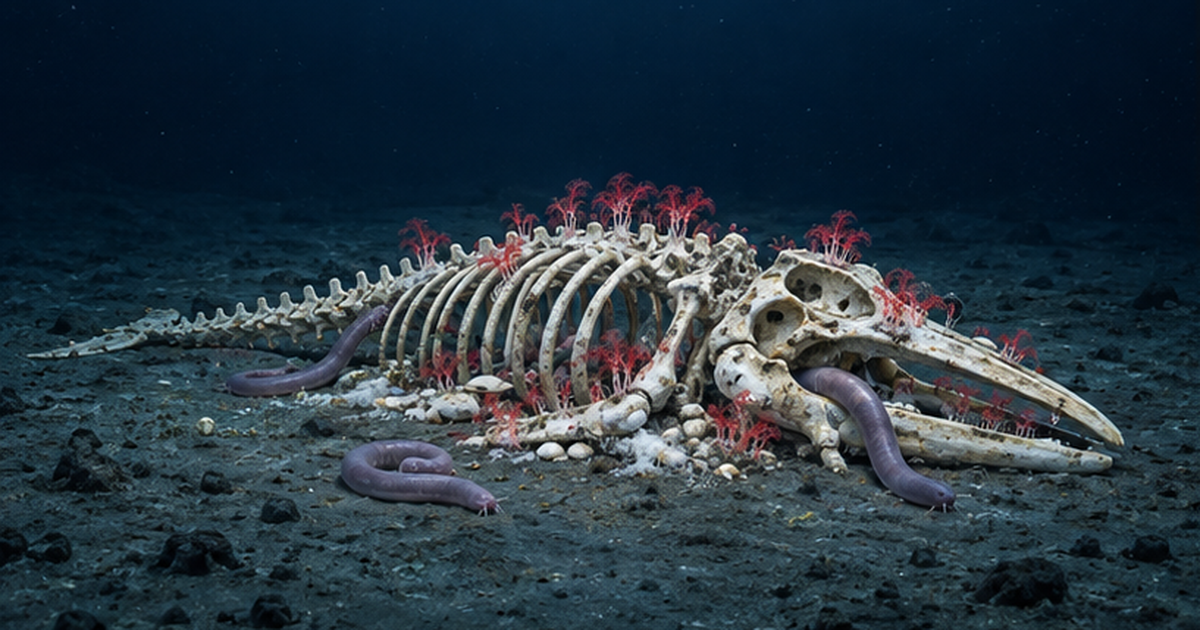
For the food-poor deep sea, the organic matter in a single whale equals many years of marine snow. Bone-eating worms and sulfur-powered bacteria gather, and a unique ecosystem grows.
This article reads whale-fall communities through three lenses: research in Japanese waters, the evolution of bone-eating worms, and the links among the carbon cycle and whaling.
What you will learn
- How whale-fall communities arise
- The ecology of Osedax and its history since the Cretaceous
- Research off Cape Noma, Japan
- How whales relate to the carbon cycle and whaling
- How to read estimated figures with care
What a whale's death delivers to the deep: tens of tons of organic "gift"
The deep sea is a place with little food
Sunlight does not reach below about 1,000 m. Organic matter made by phytoplankton through photosynthesis is eaten or decomposed as it sinks, and very little reaches the seafloor. These sinking particles are called "marine snow" and are the everyday food of deep-sea animals.
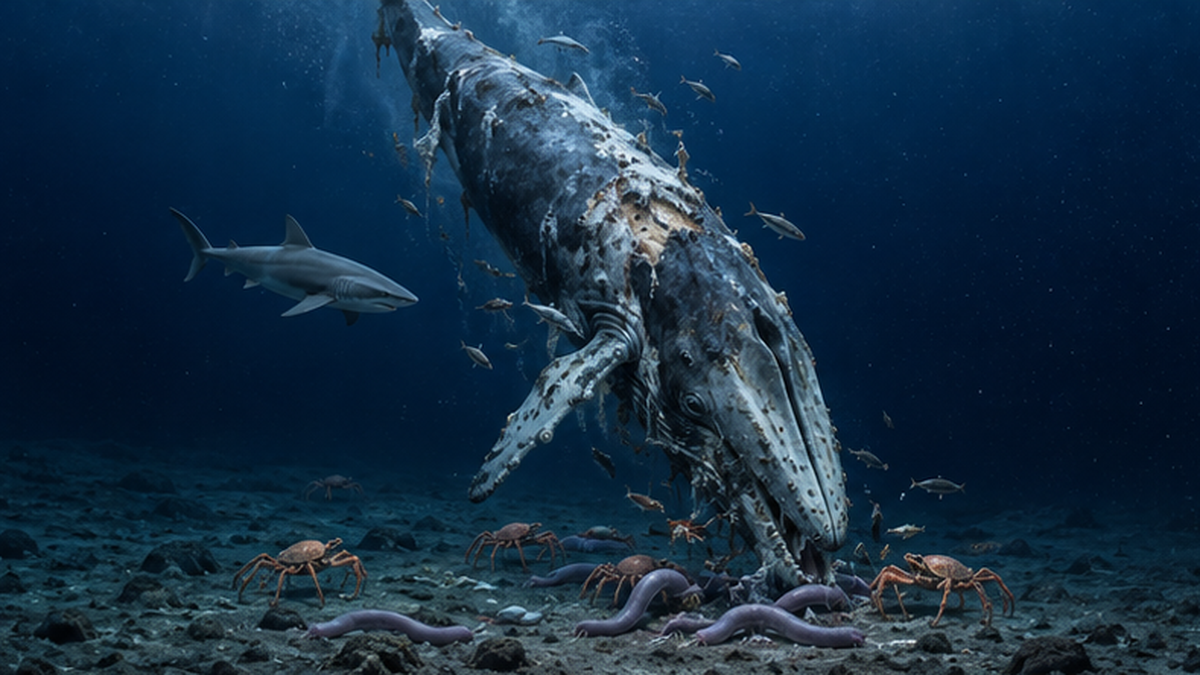
Into this quiet dining room, tens of tons of food can suddenly drop: the carcass of a large whale. Adult large whales are reported to weigh 30–160 t (Smith & Baco, 2003), most of it fat, muscle and bone. Where a whale sinks, an ecosystem unlike the surrounding seafloor arises.
The discovery of whale-fall communities
This ecosystem became a subject of science in the late 1980s. In the Santa Catalina Basin off California (about 1,240 m deep), the submersible Alvin found a baleen whale carcass and the animals swarming on it (according to Scientific American and other accounts). Surveys by submersibles and robots followed, and communities that depend on whale carcasses came to be called "whale-fall communities".
For the basic succession, see our article What is a whale-fall community?. Here we go a step further, from research in Japanese waters, the evolution of bone-eating worms, and the history of carbon and whaling.
Key points of this section
- A large whale carcass delivers 30–160 t of organic matter to the deep at once
- The first observation was reported in the Santa Catalina Basin in the late 1980s
- This article focuses on Japanese research, bone-eating worms and the fate of carbon
The three stages: a chain of life as the main players change
Whale-fall communities are generally said to pass through three stages. Their length varies greatly with carcass size, depth, water temperature and surroundings.
Main players and timescale of each stage
| Stage | Main animals | Approximate duration |
|---|---|---|
| ① Mobile scavenger stage | Large scavengers such as hagfish and sleeper sharks | Several months to about 1.5 years |
| ② Enrichment opportunist stage | Polychaetes and crustaceans in surrounding sediment, bone-eating worms | Several months to several years |
| ③ Sulfophilic stage | Bacteria that break down bone lipids, and the clams and worms that depend on them | Decades (some sources report nearly 100 years) |
In the first stage, hagfish and sharks strip soft tissue; consumption of 40–60 kg per day has been reported, and most soft tissue disappears within months to a little over a year. In the second stage, polychaetes and crustaceans gather in the organically enriched sediment. The next, third stage is the greatest feature of whale-fall communities.
Lipids inside the bone power the third stage
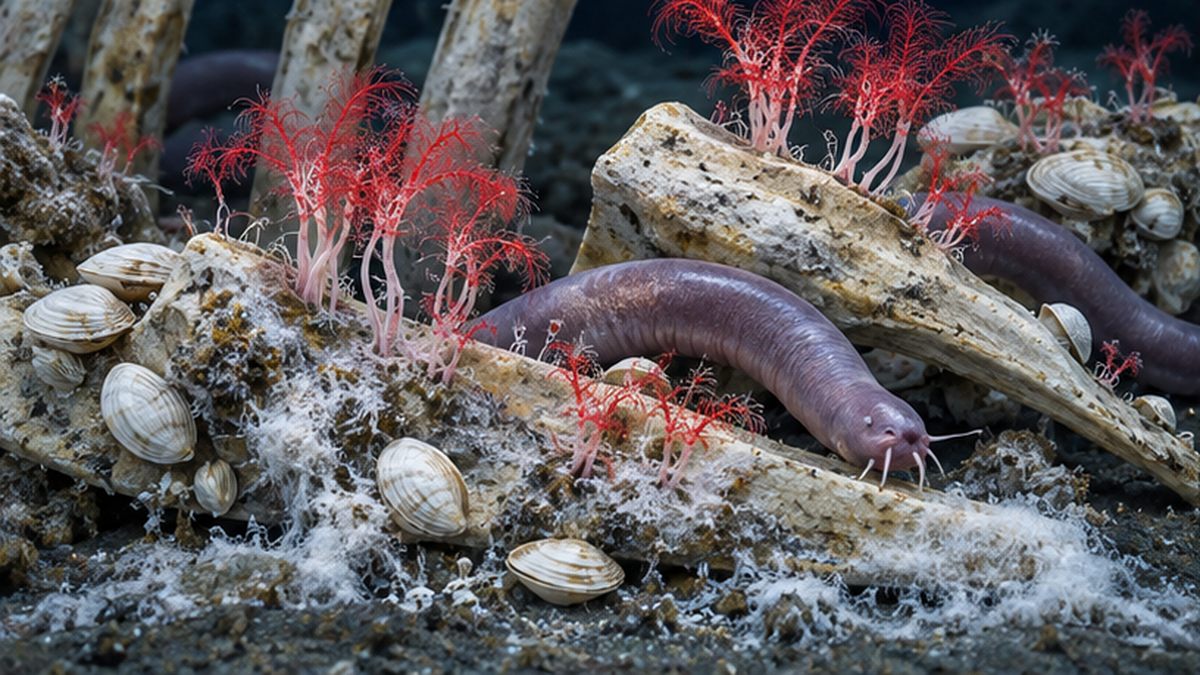
Whale bones contain large amounts of lipids. When bacteria break them down on the oxygen-poor seafloor, hydrogen sulfide is produced. It is poison to many animals, but a feast for chemosynthetic bacteria, which use it as an energy source to make organic matter. Clams and worms that host these bacteria gather, and a food web independent of sunlight lasts for decades.
Hydrothermal vents and cold seeps are likewise chemosynthesis-based. Researchers discuss whether whale falls act as "stepping stones" that share animals with such places.
Succession length is not fixed
- S
- m
- a
- l
- l
- e
- r
- w
- h
- a
- l
- e
- s
- o
- r
- c
- a
- r
- c
- a
- s
- s
- e
- s
- i
- n
- s
- h
- a
- l
- l
- o
- w
- e
- r
- w
- a
- t
- e
- r
- m
- a
- y
- h
- a
- v
- e
- s
- h
- o
- r
- t
- e
- r
- o
- r
- p
- a
- r
- t
- l
- y
- s
- k
- i
- p
- p
- e
- d
- s
- t
- a
- g
- e
- s
- .
- F
- i
- g
- u
- r
- e
- s
- s
- u
- c
- h
- a
- s
- "
- l
- a
- s
- t
- s
- N
- y
- e
- a
- r
- s
- "
- a
- r
- e
- g
- u
- i
- d
- e
- s
- f
- o
- r
- l
- a
- r
- g
- e
- c
- a
- r
- c
- a
- s
- s
- e
- s
- i
- n
- t
- h
- e
- d
- e
- e
- p
- s
- e
- a
- .
Bone-eating worms: the discovery and evolution of Osedax
An accidental discovery in Monterey Bay
In February 2002, researchers at the Monterey Bay Aquarium Research Institute (MBARI) used the ROV Tiburon to examine a gray whale carcass at about 2,893 m in Monterey Canyon. They found the bones covered with red, tuft-like worms. In 2004, Rouse, Goffredi, Vrijenhoek and colleagues reported them as the new genus Osedax in Science (vol. 305, pp. 668–671). The name means "bone-eater" in Latin.
No mouth, no gut: how do they eat bone?
Osedax are polychaete worms. According to JAMSTEC, they have no mouth, anus or gut, and take in nutrients by sending "roots" into whale bone. Symbiotic bacteria in the roots are thought to help break down lipids and collagen in the bone. The red tufts act as gills that take in oxygen from the water.
Tiny males and large females
- I
- n
- m
- o
- s
- t
- O
- s
- e
- d
- a
- x
- s
- p
- e
- c
- i
- e
- s
- ,
- f
- e
- m
- a
- l
- e
- s
- a
- r
- e
- l
- a
- r
- g
- e
- a
- n
- d
- m
- a
- l
- e
- s
- a
- r
- e
- e
- x
- t
- r
- e
- m
- e
- l
- y
- s
- m
- a
- l
- l
- a
- n
- d
- l
- i
- v
- e
- i
- n
- s
- i
- d
- e
- t
- h
- e
- f
- e
- m
- a
- l
- e
- '
- s
- t
- u
- b
- e
- .
- T
- h
- e
- 2
- 0
- 0
- 4
- p
- a
- p
- e
- r
- '
- s
- t
- i
- t
- l
- e
- i
- n
- c
- l
- u
- d
- e
- s
- "
- d
- w
- a
- r
- f
- m
- a
- l
- e
- s
- "
- .
- E
- x
- c
- e
- p
- t
- i
- o
- n
- s
- s
- u
- c
- h
- a
- s
- O
- .
- p
- r
- i
- a
- p
- u
- s
- ,
- w
- h
- o
- s
- e
- m
- a
- l
- e
- s
- a
- r
- e
- a
- b
- o
- u
- t
- a
- s
- l
- a
- r
- g
- e
- a
- s
- f
- e
- m
- a
- l
- e
- s
- ,
- w
- e
- r
- e
- r
- e
- p
- o
- r
- t
- e
- d
- l
- a
- t
- e
- r
- .
A bone-eating history reaching back to the Cretaceous
The team suggested that Osedax's bone-eating lifestyle began in the Cretaceous (about 145 to 66 million years ago), before marine mammals appeared. European researchers later reported traces thought to be made by Osedax in the bones of plesiosaurs and sea turtles, supporting the idea. Bone-eating worms may have lived on the remains of marine reptiles long before whales.
Relatives of Osedax have also been found in Japanese waters; a species named Osedax japonicus is known. In Japan too, whale carcasses quietly sustain life.
Whale-fall research in Japan: off Cape Noma and Sagami Bay
The sinking experiment off Cape Noma
Off Cape Noma on the Satsuma Peninsula in Kagoshima (about 200 m deep), an experiment was carried out in which the carcass of a stranded sperm whale was placed on the seafloor. According to JAMSTEC cruise reports, surveys were carried out every year for three years from 2003, tracking changes in the community around the bones.
The survey found new species such as bone-eating worms and a lancelet associated with whale bones. A community centered on two mussel-family species hosting chemosynthetic bacteria (Adipicola pacifica and a relative) was also confirmed. The 2005 report notes that the community was changing as the bones weathered, and the 2006 report suggests chemosynthetic communities persisted after soft tissue had almost disappeared.
Why has research advanced in Japan?
Japanese waters have relatively frequent whale strandings and topography that gives easy access to the deep. JAMSTEC's submersibles and robots allow regular surveys of seafloor at hundreds to thousands of meters. The 2008 cruise report set out a policy of continuing experimental surveys in different sea areas and depths to clarify the role of whale bones.
- Sinking experiments let us follow succession over time
- New species discoveries deepen understanding of biodiversity in Japanese waters
- Continued observation shows how communities change as carcasses shrink
Figures and years in cruise reports may be written differently from report to report. Please check the originals published by JAMSTEC/GODAC.
Carbon carried by whale bones: a deep-sea carbon store
Where does a sunken whale's carbon go?
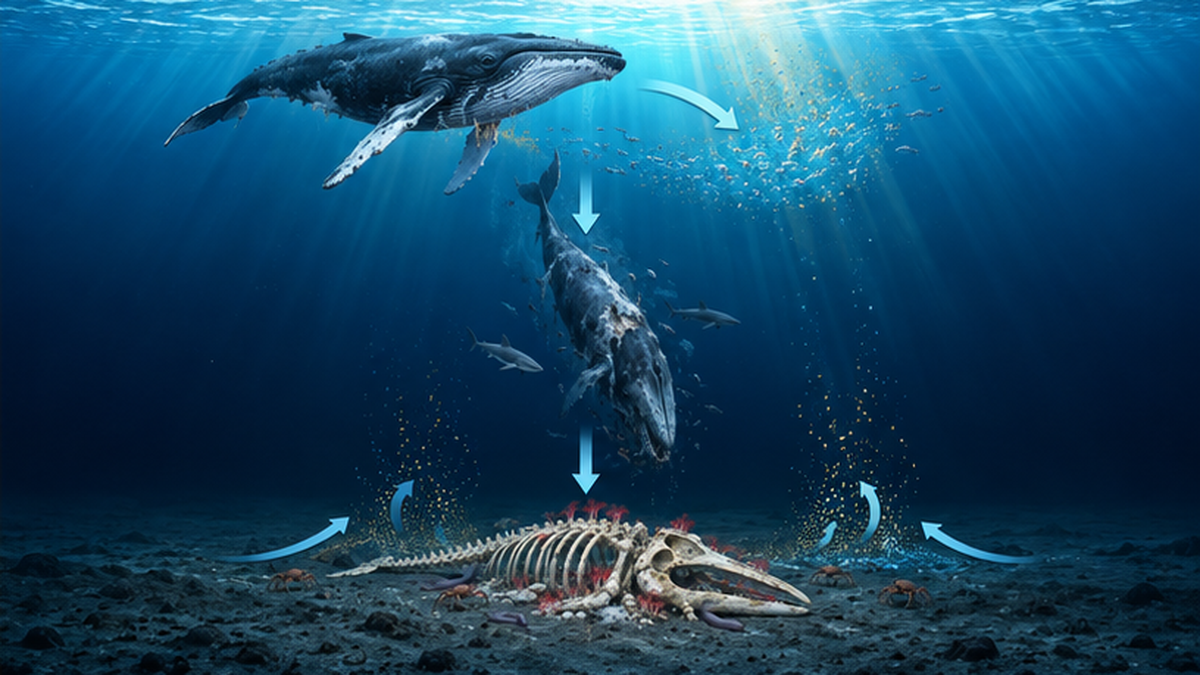
Nearly half of a whale's body weight is organic matter containing carbon. When the carcass sinks, this carbon is cut off from the surface and stays near the seafloor for a long time. Within the ocean's carbon uptake, whale falls are thought to be a small but distinct "carbon pathway".
A 2010 study by Pershing et al. (PLoS ONE) estimated that the decline of large baleen whales through whaling reduced carbon stored in the ocean by about 9.16×10⁶ tons. It also estimated that if whale populations recover, sinking carcasses could carry about 1.66×10⁵ tons of carbon per year to the deep sea. The estimate depends on assumptions such as the fraction of carcasses that actually sink; the study assumed about 50% of rorquals and gray whales and about 10% of right and bowhead whales sink to depth.
| Item | Estimate by Pershing et al. (2010) | Caveat |
|---|---|---|
| Stored carbon lost to whaling | About 9.16×10⁶ tons | Large baleen whales only |
| Annual carbon transport after recovery | About 1.66×10⁵ tons | Depends on the sinking fraction |
| Assumed sinking fraction | About 50% for rorquals and gray whales; about 10% for right whales etc. | Few measurements |
Do not over-sell it as a "climate silver bullet"
Carbon transport by whales is small relative to the whole ocean carbon cycle. Commentary on the research also stresses that it is comparable in size to other carbon-management schemes but highly uncertain. Protecting whales matters not only for climate but also for protecting whole ecosystems. When converting numbers into "tons of CO₂ per whale", check the assumptions.

The history of whaling and whale falls: how many "oases" were lost
What happens when carcasses become fewer?
Large whales were greatly reduced by past whaling. Fewer whales mean fewer carcasses reaching the deep sea. Animals that depend on whale falls survive when larvae swim from one carcass to the next oasis. Fewer carcasses widen the gaps and may lower the chance that larvae arrive.
How much whaling affected specialists such as Osedax is still not well understood. Still, large carcasses are clearly a valuable food source, and conservation discussions now pay attention to the roles whales play "after death" as well as alive.
Links between coast and open sea
While alive, whales bring surface nutrients to the sea through their waste, helping phytoplankton grow. After death, they deliver nutrients to the deep over a long time. Having these two faces, alive and dead, shows how heavily whales weigh in the ecosystem.
Common misunderstandings
- It is not true that all carbon is stored in the deep whenever a whale sinks (decomposition and reuse are faster in shallow water)
- Nor is the deep-sea ecosystem safe just because whale bones exist (the number and spacing of carcasses matter)
Why study whale falls: how do we protect the deep sea?
Relation to deep-sea development and fishing
Interest in deep-sea mineral development and deep-sea fishing has grown. Deep-sea biodiversity is still barely surveyed and slow to recover once damaged. Ecosystems that form over decades, like whale falls, call for particular care in impact assessments.
What citizens can do
- Report stranded whales to local aquariums or research institutions (do not touch or take anything away)
- Learn where to send information on whale strandings and drift ashore
- Join exhibitions and events about whale bones to broaden interest in the deep sea
The deep sea may feel far away, yet what happens there is tied to the health of our seas and the climate. Learning about the deep sea through something as familiar as a whale carcass is a first step to protecting the ocean.
What you can do today
- Tell a family member or friend one thing about whale-fall communities
- Look for whale-bone exhibits at an aquarium or museum
- Look at information from ocean conservation groups

Summary: even in death, whales support the ocean
A sunken large whale brings 30–160 t of organic matter to the deep and feeds many animals: hagfish, sharks, polychaetes, bone-eating Osedax and sulfur-powered bacteria. Chemosynthesis using hydrogen sulfide shares its form of sun-independent life with hydrothermal vents and cold seeps.
Off Cape Noma in Japan, sinking experiments with stranded whales produced new species and long-term observations of succession. Research is also advancing on how whaling-driven declines have affected ocean carbon storage and deep-sea ecosystems. Though the numbers are uncertain, understanding that whales contribute to the sea both alive and dead will be a foundation for future ocean conservation.
Summary of this article
- A large whale carcass creates an ecosystem lasting decades in the deep sea
- Osedax may have used bones since the Cretaceous
- Sinking experiments in Japanese waters have revealed new species and the reality of succession
- Estimates of whale carbon transport are uncertain but support ecosystem conservation
References and Sources
- Smith & Baco (2003) Ecology of whale falls at the deep-sea floor – Oceanography and Marine Biology: An Annual Review 41, 311-354
- Rouse, Goffredi & Vrijenhoek (2004) Osedax: Bone-eating marine worms with dwarf males – Science 305, 668-671 (MBARI commentary)
- Pershing et al. (2010) The impact of whaling on the ocean carbon cycle – PLoS ONE
- Life at the Bottom: The Prolific Afterlife of Whales – Scientific American
- One death, 200 years of life – UC San Diego Scripps Oceanography
- JAMSTEC Cruise Summary NT05-12 – Noma-misaki whale-fall survey (GODAC)
- JAMSTEC – Deep-sea research information
- Frontiers in Ecology and Evolution (2022) – Front. Ecol. Evol.
FAQ
What is a whale-fall community?
A group of animals that gathers around a whale carcass on the seafloor. Scavengers, bone-eating worms, and clams and worms relying on chemosynthetic bacteria succeed one another over decades.
How do Osedax worms eat bone?
They have no mouth or gut. They send roots into whale bone and are thought to take in lipids and other nutrients with the help of symbiotic bacteria in the roots.
How long does a whale fall support an ecosystem?
It depends on carcass size and depth, but decades for large carcasses, and some reports suggest nearly 100 years.
Are sunken whales a climate solution?
Sinking carcasses carry carbon to the deep, but the amount is small relative to the whole ocean carbon cycle and the estimates are uncertain. It is better seen from the viewpoint of ecosystem conservation.
Is whale-fall research done in Japan?
Yes. JAMSTEC has surveyed stranded whale carcasses off Cape Noma in Kagoshima and elsewhere, reporting new species and community changes.
Related Articles
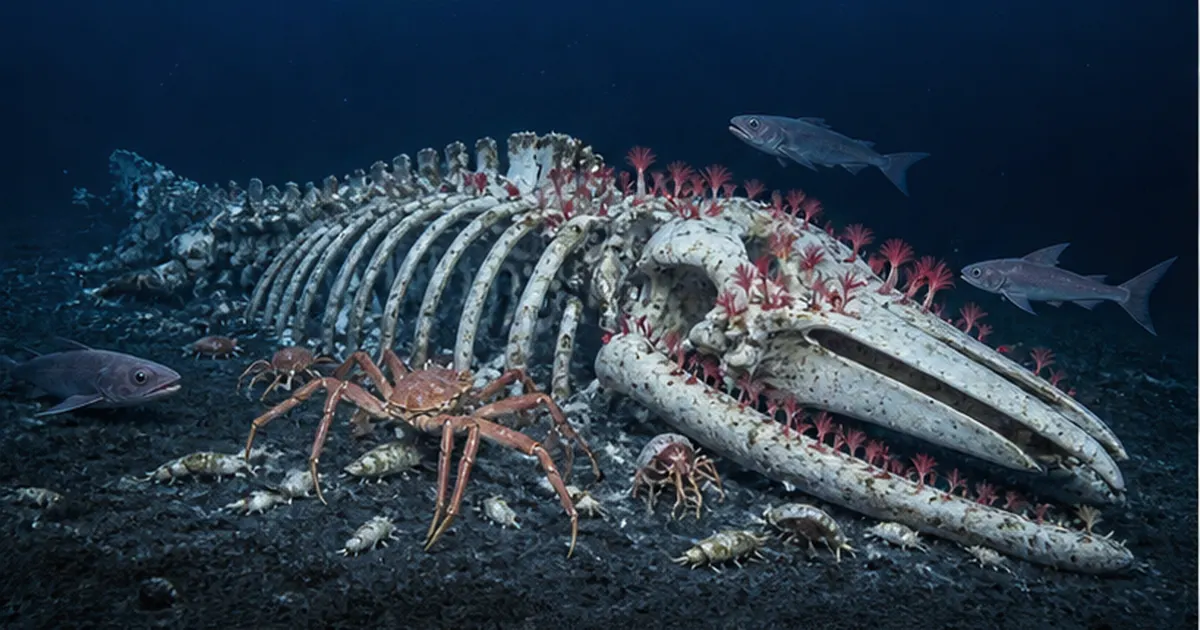
What Is a Whale Fall? How Sunken Whales Feed Deep-Sea Life
When a whale dies and sinks, it creates a whale fall community that feeds deep-sea life for decades. Learn about the three successional stages, bone-eating Osedax worms, and the chemosynthetic chain of life, with examples from Sagami Bay.
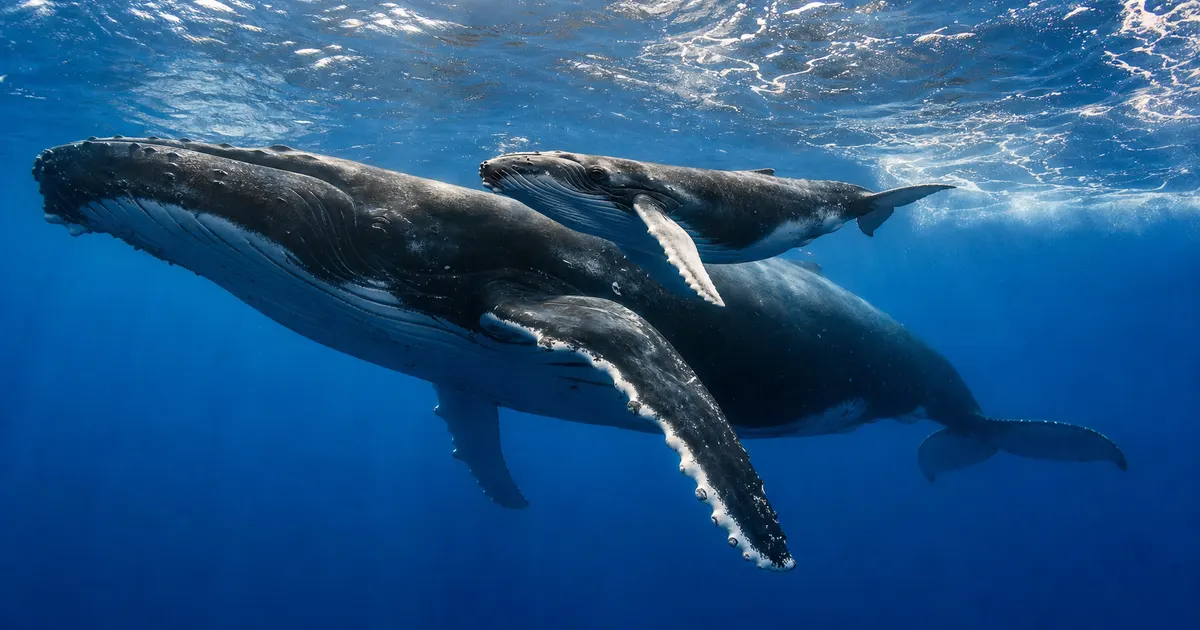
Why Do Whales Migrate Thousands of Kilometers? The Mystery Behind Feeding, Breeding, and the Ocean's Greatest Journey
Every year, humpback whales travel thousands of kilometers each way between food-rich cold seas and warm seas suited for raising young. Drawing on primary sources, this article explains why they make this journey of up to 11,300 km, how they find their way, their role in circulating the ocean's nutrients and carbon, and the risks climate change poses to their migration.
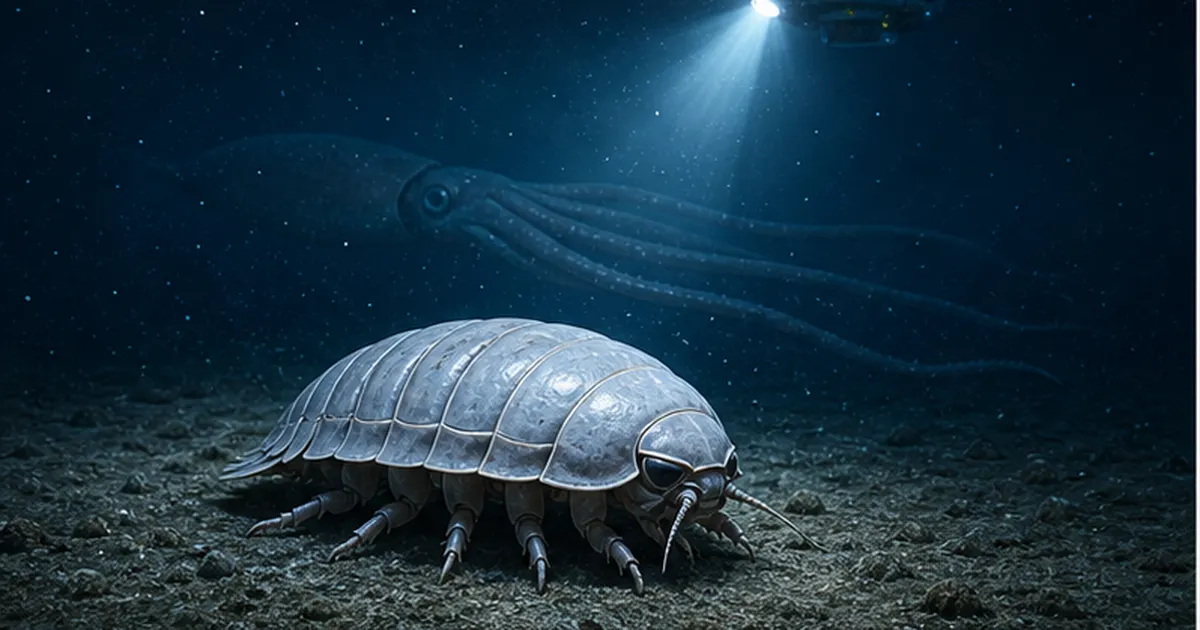
What Is Deep-Sea Gigantism? Four Hypotheses for Why Giant Isopods and Colossal Squid Grow So Large
A garden pill bug is 1.5 cm; a deep-sea giant isopod approaches 50 cm. Why do deep-sea animals grow so large? We walk through four hypotheses — cold, oxygen, food scarcity and predation pressure — alongside the latest research, from the first footage of a colossal squid to the Yokozuna slickhead of Suruga Bay, and confront the evidence that some deep-sea animals shrink instead.