⚡ In short
Eelgrass beds are seagrass meadows that store carbon in seabed mud. Japan's national estimate is about 350,000 t-CO2/yr for seagrass and seaweed beds; we review cases such as Yokohama's 12.3 t certification and Hakata Bay's 43.4 t.
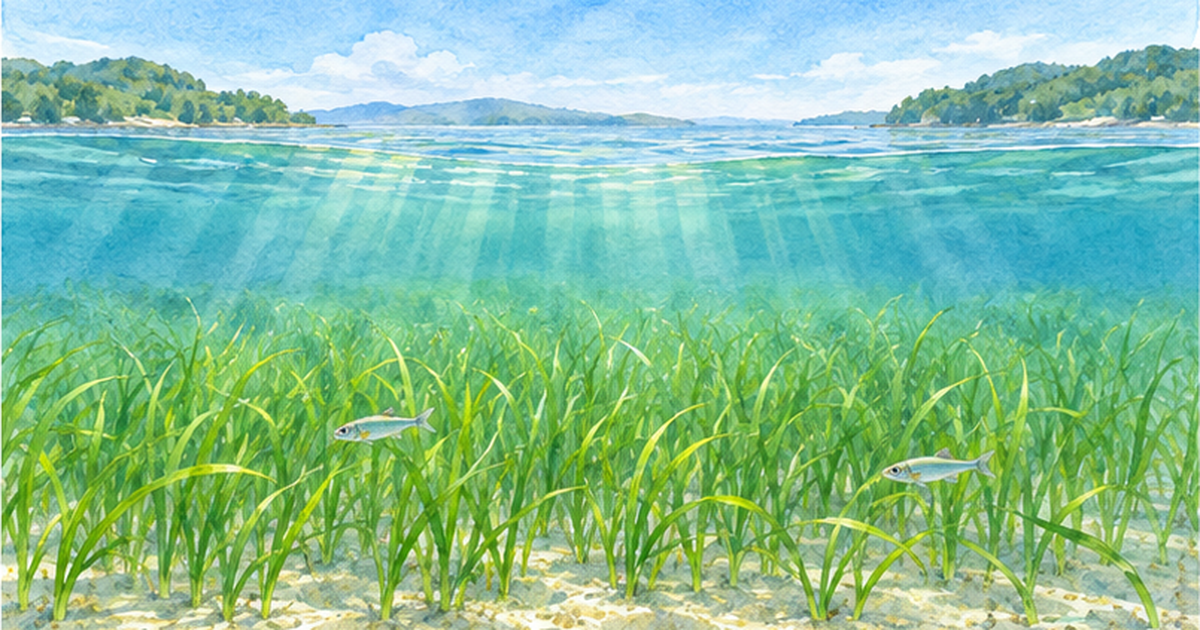
A green meadow spreading across shallow seas: eelgrass beds. Known as the "cradle of the sea" for juvenile fish, they now also draw attention as blue carbon sites that store carbon in the ocean.
In its FY2022 calculation, Japan put CO2 absorption by seagrass and seaweed beds at about 350,000 t-CO2 per year in total. In Yokohama and Hakata Bay, eelgrass beds have been certified and sold as credits.
This article organizes the mechanism, Japan's numbers, credit cases and challenges using public information. Figures that could not be confirmed are not asserted, and this is stated explicitly.
What you will learn
- Why eelgrass is a seagrass, not a seaweed
- How eelgrass beds store carbon
- How to read the national figure of 350,000 t
- Credit cases in Yokohama and Hakata Bay
- Restoration methods and challenges
- Cautions when reading the numbers
What are eelgrass beds? Meadows under the sea
Eelgrass is a "seagrass", not a "seaweed"
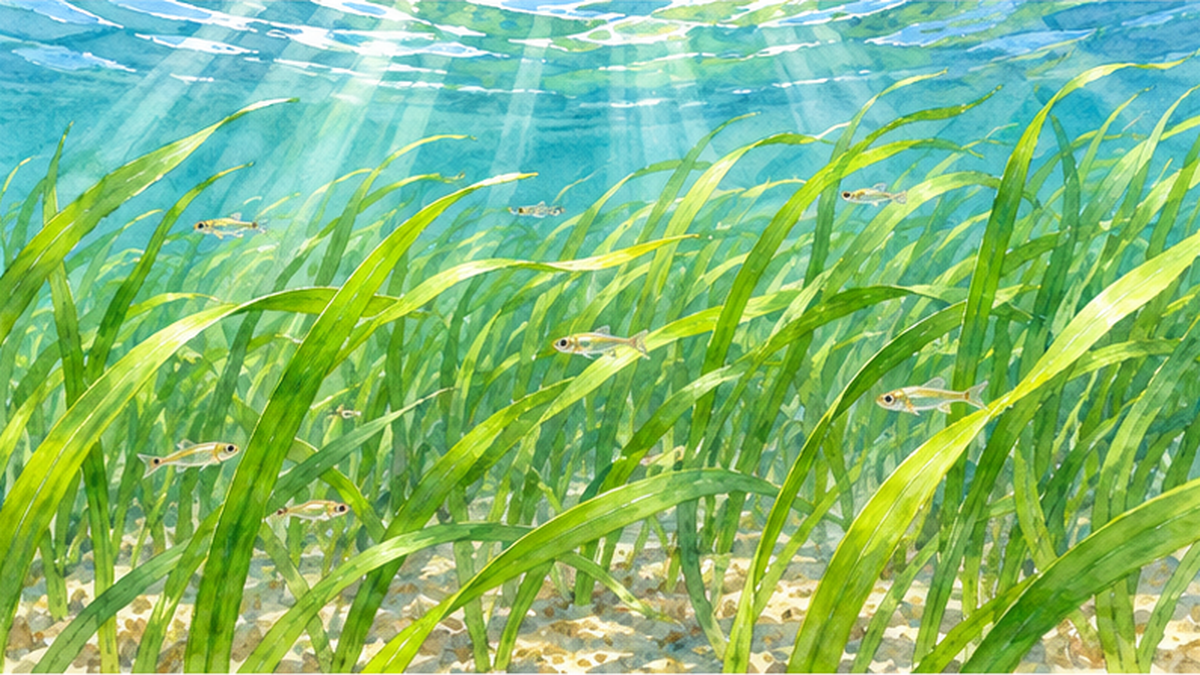
Eelgrass has roots, stems and leaves, flowers, and produces seeds. It is a seagrass. Seaweeds such as kelp and wakame are algae that spread by spores, so they belong to an entirely different group. Eelgrass roots in sandy or muddy seabed and forms belt-like meadows in shallow inner bays, down to roughly a few meters deep. These meadows are called eelgrass beds.
Seaweed beds attach to rocks, while seagrass beds root in sand and mud. This difference matters for where carbon ends up. Roots and rhizomes remain in the mud, and part of the organic matter from dead leaves settles on the seabed, so seagrass beds attract attention as blue carbon that stores carbon in seabed mud.
Where eelgrass beds are found
Eelgrass beds spread in calm, inner bays and offshore of tidal flats where light reaches the seabed. Typical places include Tokyo Bay, Mikawa Bay, the Seto Inland Sea, Hakata Bay and Omura Bay. These bays are also close to ports, factories and cities. They are easily affected by reclamation and water-quality decline, and bed areas have fallen in many places in the past.
- Classification: seagrass (seed plant). It flowers and spreads by seed
- Habitat: sandy or muddy bottoms of inner bays and tidal flats; shallow, sunlit water
- Main functions: shelter for juvenile fish, water purification, carbon storage, wave dampening
- Weaknesses: easily lost to turbid water, reclamation, grazing and high water temperature
Differences from other marine vegetation
| Type | Plant classification | Habitat | How carbon accumulates |
|---|---|---|---|
| Eelgrass beds (seagrass beds) | Seagrass (seed plant) | Sandy or muddy bottoms of inner bays | Accumulates on the seabed in roots, rhizomes and sediment |
| Seaweed beds (kelp, wakame, etc.) | Seaweed (algae) | Rocky reef areas | Dead fronds drift away and are carried offshore or to the deep sea |
| Mangrove forests | Trees | Tropical and subtropical estuaries and tidal flats | Stored for a long time in roots and mud |
Key points of this chapter
- Eelgrass is a flowering seagrass, not a seaweed
- Because it roots in sand and mud, carbon readily accumulates in seabed mud
- For an overview of marine vegetation, see also CO2 absorption by seaweed beds and J-Blue Credits .
How eelgrass beds work as blue carbon
Taking in CO2 through photosynthesis
Like land plants, eelgrass takes in CO2 by photosynthesis and builds organic matter. Carbon is stored in leaves, stems, roots and rhizomes. As CO2 in seawater decreases, gas exchange with the atmosphere proceeds, and as a result atmospheric CO2 moves into the sea. This is the basis of absorption by eelgrass beds.
Why can carbon be "stored"?
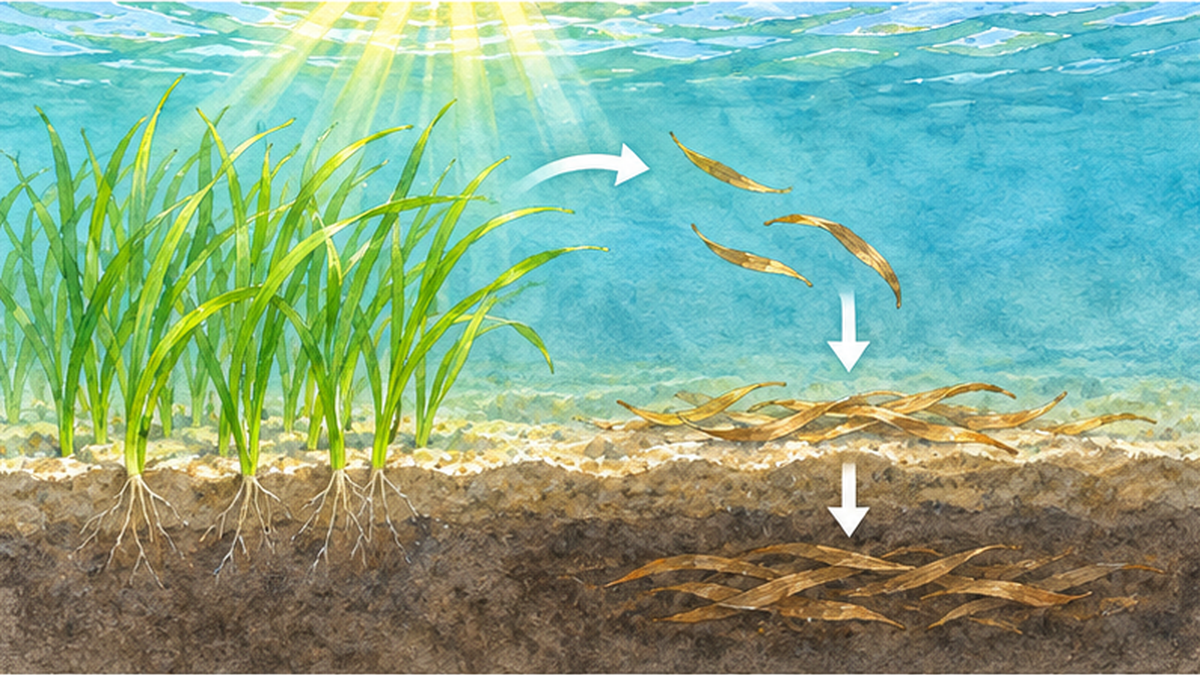
The key point of blue carbon is not only taking in carbon but storing it for a long time. In eelgrass beds, dead leaves that sink and particles trapped as the meadow slows water flow become buried in mud. Decomposition is slow in oxygen-poor mud, so carbon tends to stay for a long time. On the other hand, many leaves become drifting fragments and are carried elsewhere, so not everything accumulates on site.
- ① Photosynthesis: carbon is fixed in leaves, stems and roots
- ② Deposition: the meadow weakens currents, and organic matter and particles settle on the seabed
- ③ Burial: decomposition slows in oxygen-poor mud
- ④ Outflow: part becomes drifting fragments and is carried elsewhere
Absorption, fixation and storage: clarifying terms
Depending on the source, the words "absorption," "fixation" and "storage" are used. Strictly, taking in through photosynthesis is absorption or fixation, and staying on the seabed for a long time is storage. Credits and calculations often focus on the amount that finally accumulates on the seabed. When you see a number, check which stage it refers to.
Important
- Absorption is not simply "what eelgrass takes in"; the scope differs by calculation method
- Always check whether a number is annual or cumulative, per area or total
How much CO2 do Japan's eelgrass beds absorb?
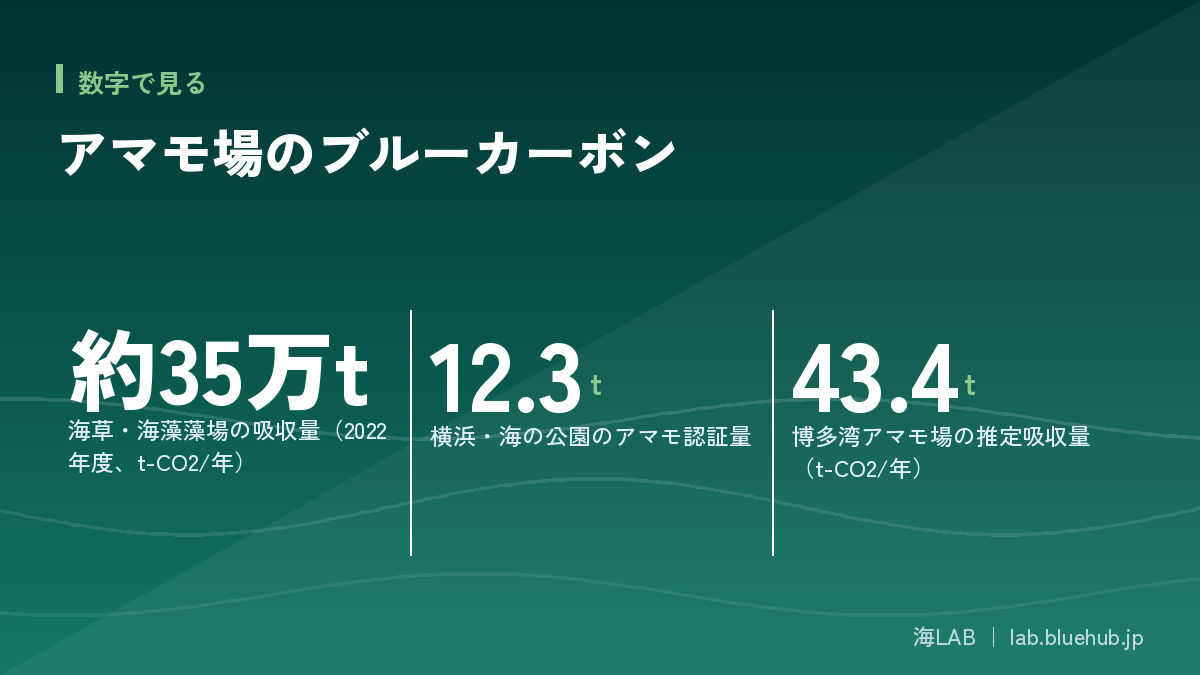
National calculation: about 350,000 t-CO2/yr for seagrass and seaweed beds
According to Ministry of Land, Infrastructure, Transport and Tourism materials, Japan's FY2022 greenhouse gas inventory calculated CO2 absorption by seagrass and seaweed beds at a total of about 350,000 t-CO2/yr. This was reported to the UNFCCC secretariat in April 2024. The Ministry of the Environment says it was the first in the world to report absorption by seagrass and seaweed beds together to the UN.
Note that this approx. 350,000 t is the sum of seagrass and seaweed, not a value for eelgrass beds alone. A national figure for eelgrass beds alone could not be found in the public materials I checked, so this article does not present one.
By location, the scale varies widely
Absorption by eelgrass beds varies greatly with area and environment. The table below shows examples from public materials. Credit amounts and municipal estimates rest on different assumptions, so they are not suited to side-by-side comparison.
| Place | Amount | Notes |
|---|---|---|
| Nationwide (seagrass + seaweed) | approx. 350,000 t-CO2/yr | FY2022 calculation. Not a value for eelgrass beds alone |
| Hakata Bay (Fukuoka City) | 43.4 t-CO2/yr | Estimate under Fukuoka City's offset system; sold as credits |
| Yokohama Port (eelgrass beds over about 10 ha) | 19.4t-CO2 | Credit amount for FY2021 (Ports and Harbours Bureau materials) |
| Tokuyama-Kudamatsu Port (artificial tidal flat of about 29 ha) | 44.3t-CO2 | Credit amount for FY2021 (Ports and Harbours Bureau materials) |
| Yokohama Sea Park | 12.3t-CO2 | Amount certified as a J-Blue Credit |
Some small sites show only a few kilograms
In a trial calculation at five sites in Omura Bay, Nagasaki Prefecture multiplied area, wet weight, water content and carbon content, then converted to carbon dioxide. Results ranged from at most 92 kg-CO2 per year to as little as 5.6 kg-CO2, varying greatly with site area. Small beds absorb little, but their value is not only CO2.
Cautions when reading numbers
- "About 350,000 t" is the sum of seagrass and seaweed, not eelgrass alone
- Credit amounts are certified amounts and not necessarily the full absorption of a bed
- Do not confuse annual amounts, cumulative amounts and per-area amounts
The J-Blue Credit system and eelgrass cases
What is the J-Blue Credit?
The J-Blue Credit is a system in which the Japan Blue Economy Association (JBE), an association authorized by the Ministry of Land, Infrastructure, Transport and Tourism, certifies CO2 absorption from seaweed-bed conservation and restoration so that it can be transferred to companies and others. Review is carried out by a third-party committee. The whole system is explained in What is the J-Blue Credit? .
Yokohama: one of the first certifications
In ministry materials, activities by Yokohama fisheries cooperatives and NPOs at Yokohama Port are cited as a case under the first certification in FY2020. The City of Yokohama announced that it had certified 12.3 t-CO2 of blue carbon from eelgrass in the managed area of Sea Park as credits. It was Yokohama's first blue carbon credit certification.
Hakata Bay: a municipal offset system
Fukuoka City estimates the amount fixed and absorbed each year by eelgrass beds in Hakata Bay at 43.4 t-CO2/yr and sells it as credits under its offset system. Ministry study-group materials also cite NPO conservation and restoration of eelgrass beds at Hakata Port as a reference case for later applications.
Growing trade
Ministry materials state that in the fourth call for purchase applicants in FY2023, the trading volume was 127.3 t-CO2 with 89 purchasing companies and organizations (counted with duplicates), as of May 17, 2024. The GX League's list of eligible projects also registered, in March 2026, an eelgrass restoration project in Uwajima, Ehime, certified as a J-Blue Credit. It shows eelgrass credits are gradually being used in corporate decarbonization efforts.
- Certifier: JBE (reviewed by a third-party committee)
- Activity groups: fisheries cooperatives, NPOs, citizen groups, municipalities, etc.
- Buyers: companies and organizations (used for carbon offsetting, etc.)
Expanding eelgrass beds: restoration methods
Restoration with seeds and shoots
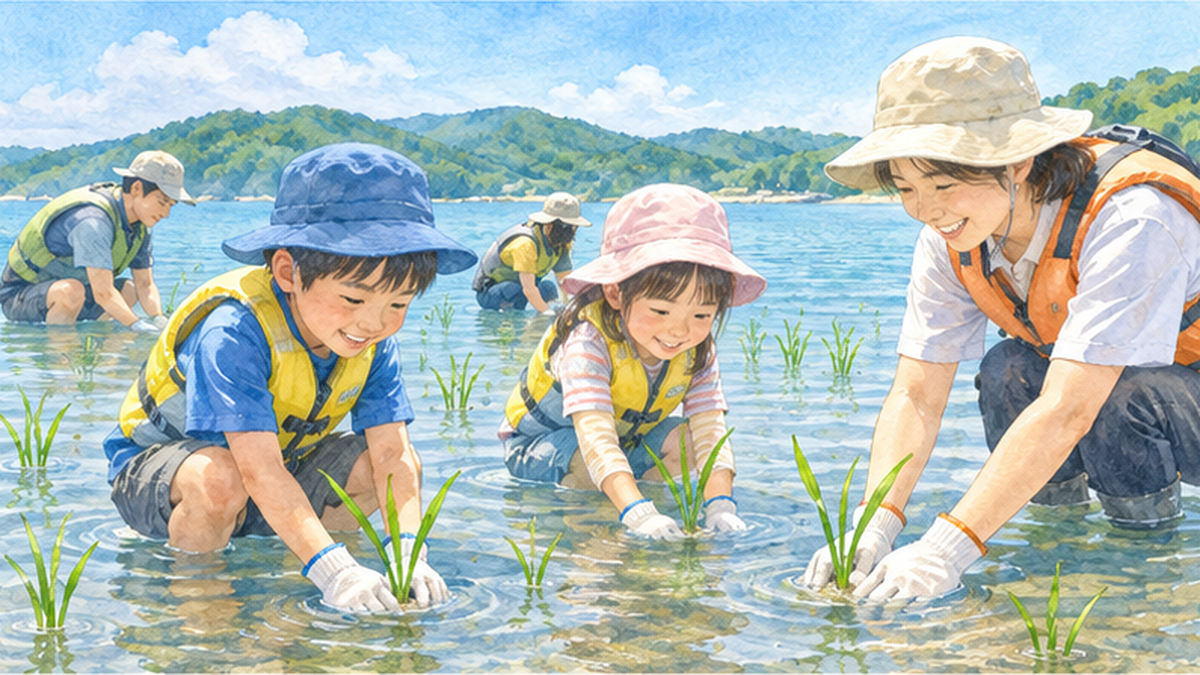
Restoration methods include collecting flowering shoots, extracting seeds and planting seedlings, and sowing seeds directly, practiced in many places. Fisheries cooperatives, NPOs, schools and companies often join together, and the activity also serves environmental education. Eelgrass will not grow in unsuitable places, so prior checks of light depth, sediment and wave strength are essential.
Technology for measuring bed area
To calculate absorption, the bed area must be known accurately. The Ports and Harbours Bureau of the ministry and the Port and Airport Research Institute are developing a data system (BDAS) to grasp, with high precision and efficiency, the CO2 absorption of seaweed beds and the bed area needed for the calculation. The better the measurement system, the higher the reliability of credits.
Cases that do not go well
Challenges include planted eelgrass failing to establish, grazing damage and decline from high water temperature. Restoration does not end with planting; long-term monitoring is needed. For the technical side, see also Restoring eelgrass beds .
Value beyond CO2
A "cradle of the sea" for juvenile fish
Eelgrass beds provide shelter and feeding grounds for juvenile fish and small creatures. For biodiversity, see Biodiversity of eelgrass beds . They are also a foundation for nurturing resources for fisheries.
Cleaner water and gentler waves
Meadows slow water flow and help suspended particles settle. They also soften wave energy and are expected to help protect coasts. Evaluating these "values beyond CO2" motivates people to protect the beds.
| Value | Description |
|---|---|
| Climate | Takes in CO2 and stores it on the seabed |
| Wildlife | Habitat for juvenile fish and small creatures |
| Water quality | Helps suspended particles settle |
| Disaster prevention | Softens wave energy |
| Education and community | A place for citizen-led restoration |
Challenges and outlook
Uncertainty in calculations
Carbon storage in seaweed beds varies greatly with place, season and sediment conditions, and calculations retain uncertainty. There are points still debated internationally, such as how to treat carbon carried elsewhere as drifting fragments. It is appropriate to treat the numbers as "current calculations."
Credits are not an "indulgence"
Credits are to be used together with emission-reduction efforts. Blue carbon alone cannot offset Japan's emissions. The national figure (about 350,000 t-CO2/yr) is small compared with Japan's total emissions. That is why the value of seaweed beds lies not only in CO2 but in protecting ecosystems and local seas.
What we can do
- Join local eelgrass restoration events
- Learn about corporate and group efforts such as credit purchases and donations
- Live in ways that reduce nutrients and litter flowing into the sea
Summary
- In the national calculation, seagrass and seaweed beds total about 350,000 t-CO2/yr
- Eelgrass beds have begun to be certified and traded as credits
- It matters to protect them with a view that includes values beyond CO2
References and sources
- MLIT Ports and Harbours Bureau: blue carbon materials (J-Blue Credit) – system overview and trading results
- MLIT Ports and Harbours Bureau: blue carbon study group materials – certification cases (Yokohama Port, Hakata Port)
- MLIT BLUE CARBON Guideline v6 – blue carbon guideline
- Ministry of the Environment: Blue carbon (Japan's efforts) – inventory reporting and initiatives
- Ministry of the Environment: Blue carbon initiatives – list of early initiatives
- Yokohama blue carbon credit certification (pps-net) – Sea Park eelgrass 12.3 t-CO2
- GX League: list of eligible projects and credits – registration of the Uwajima eelgrass restoration project
- Nagasaki Prefecture: trial calculation of CO2 absorption by eelgrass in Omura Bay – formula and site-by-site estimates
* Sources are arranged in order of reliability: government agencies > academic institutions > peer-reviewed papers > specialist organizations > reliable media