⚡ In short
Eelgrass meadows in shallow water cover just 0.1% of the ocean floor yet act as nurseries for 20% of the world's largest fisheries. Fish, squid and tiny crustaceans all gather in the green forest built by a flowering seed plant of the sea. This article explains the mechanics of that biodiversity, and the reality that Japan has lost about 70% of its meadows, using primary sources.
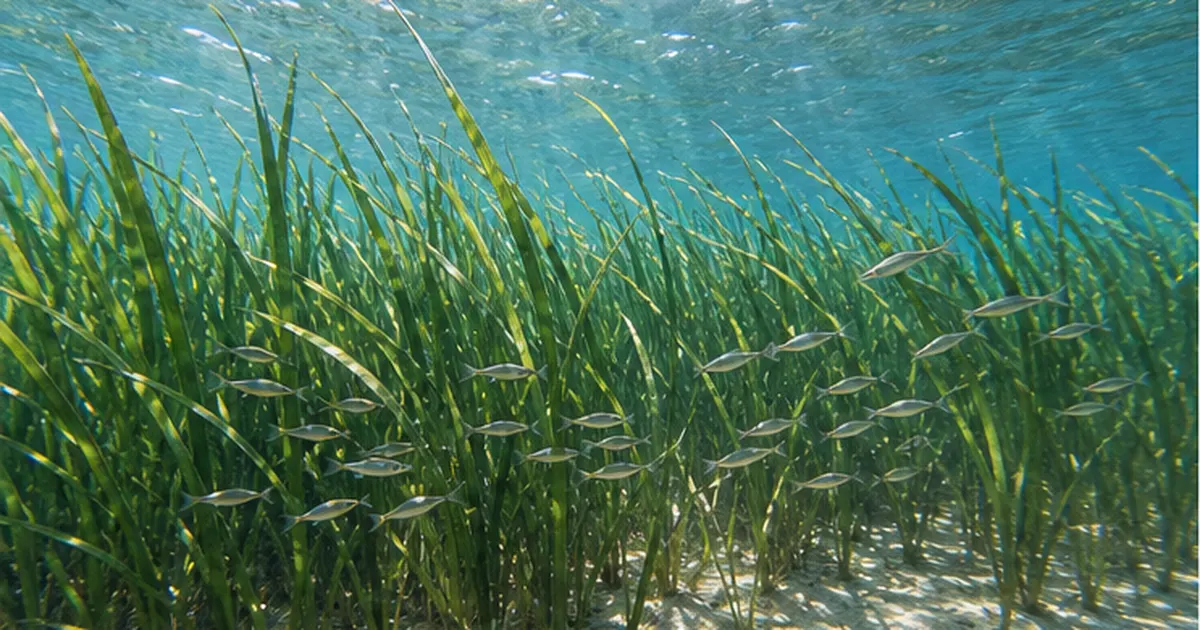
Look into a shallow bay in summer and you may find a whole field of slender green blades swaying underwater. That plant, which looks remarkably like a rice leaf, is eelgrass (amamo). It is not a seaweed but a genuine flowering, seed-bearing plant. The dense stands it forms — eelgrass meadows — have long been called the cradle of the sea by Japanese fishers.
That name is no poetic exaggeration. According to Out of the Blue, a 2020 report from the United Nations Environment Programme (UNEP) and partners, seagrass meadows cover only 0.1% of the ocean floor, yet they serve as nursery grounds for 20% of the world's largest fisheries. They are also the dining table of dugongs and green sea turtles, and a carbon vault responsible for more than a tenth of the carbon buried in ocean sediments each year.
In Japan, however, roughly 70% of eelgrass meadows disappeared between 1960 and around 1990 (Ministry of the Environment). This article unpacks the biology of why seagrass meadows can support so much life, then traces what has been lost and what is being brought back, drawing on primary sources from Japan's Ministry of the Environment, the Fisheries Agency, UNEP and others.
What you will learn
- That "seagrass" and "seaweed" are completely different kinds of organism
- The physical mechanisms that make eelgrass meadows work as nurseries and spawning grounds
- The cast of characters living in a meadow — fish, squid, and tiny epifauna on the blades
- How seagrass cleans the water, stabilizes the seabed, and stores carbon
- How seagrass meadows have been lost in Japan and worldwide, and what that means for biodiversity
- Monitoring programs and citizen efforts to watch over and restore the meadows
What is seagrass? A flowering plant that went back to the sea
Before we talk about eelgrass meadows, there is one confusion worth clearing up: "seagrass" and "seaweed" are completely different organisms. In Japanese the two words are both read kaisō, so seagrass is sometimes read umikusa — literally "sea plant" — to distinguish it.
Seaweed and seagrass are entirely different organisms
Wakame, kombu, hijiki, sargassum — the "seaweeds" that appear on the dinner table are algae. They have no clear distinction between root, stem and leaf; they absorb nutrients from the water across their whole body surface, and they cling to rock with a holdfast that only looks like a root. They never flower; they reproduce by spores.
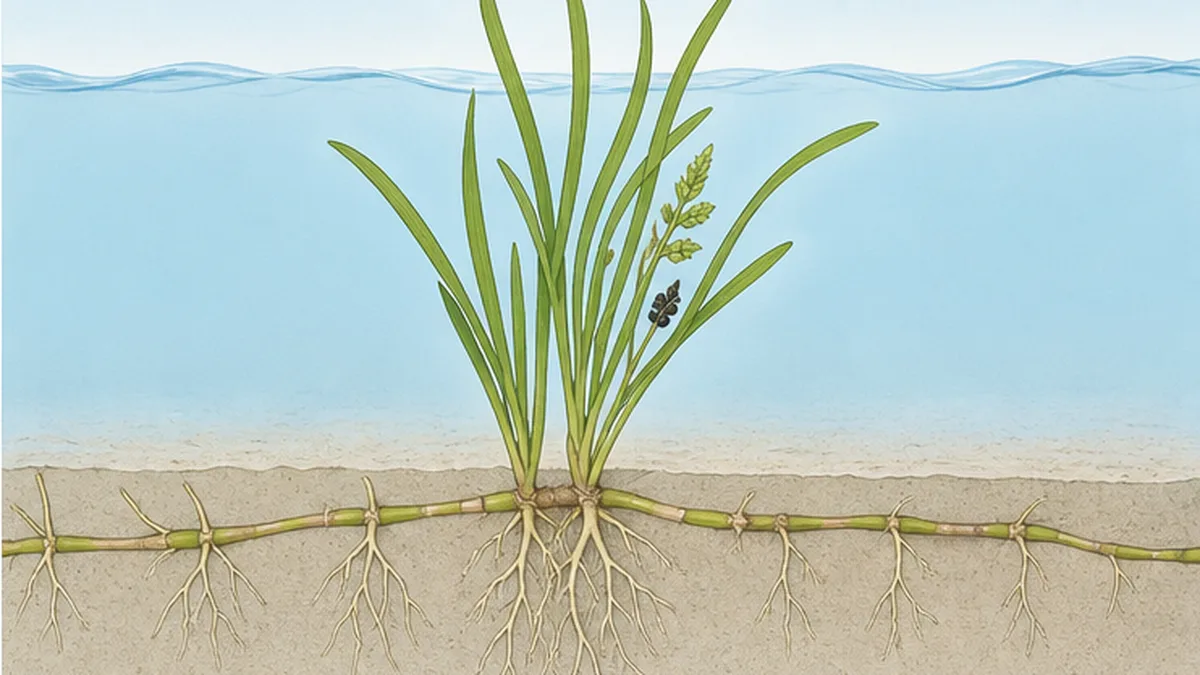
Eelgrass and its relatives, by contrast, are seagrasses: angiosperms, the same group as the flowering plants on land. Japan's Fisheries Agency defines seagrass as "marine seed plants that spend their entire lives underwater." They have a rhizome that runs through the sediment and true roots that absorb nutrients and water, and long, slender leaves that photosynthesize. Five to seven veins run in parallel along an eelgrass blade, giving it a form much like a grass of the rice family. Indeed, eelgrass is a monocot herb.
The distinction goes deeper than appearance. Trace the evolutionary history of plants and you find that life once left the sea for land, and there acquired roots, stems, leaves, flowers and seeds. Seagrasses are thought to be a group of those land plants that returned to the sea. Even after going back, they never gave up the traits they had gained ashore: they still flower, and they still make seeds.
| Item | Seagrass (eelgrass, etc.) | Seaweed (wakame, kombu, etc.) |
|---|---|---|
| Classification | Angiosperm (seed plant) | Algae |
| Body structure | Distinct roots, rhizome and leaves | No distinction; the whole body is a thallus |
| Reproduction | Flowers and seeds; also spreads by rhizome | Spores |
| Where it grows | Roots anchored in sandy-muddy bottoms | Attached to rock or stone by a holdfast |
| How it feeds | Uptake through roots plus photosynthesis in leaves | Uptake across the body surface plus photosynthesis |
| Typical meadow type | Eelgrass meadow | Sargassum, Eisenia/Ecklonia and kelp beds |
It blooms, and it spreads by seed
An eelgrass flower is anything but showy. Petals and sepals have been reduced away, leaving only pistils and stamens in tiny white flowers borne on a flowering shoot wrapped in a leaf sheath. Because pollination happens underwater, there is no need for color or scent to attract insects; instead, eelgrass evolved its own method — thread-like, elongated pollen carried on the current.
Once pollinated, it sets black seeds about the size of a grain of rice. These seeds have an intriguing property: it is known that they need a period of exposure to lowered salinity before they germinate. The fact that eelgrass belongs in inner bays fed by river freshwater is written into the biology of the seed itself.
Eelgrass does not rely on seeds alone. By extending and branching its rhizome sideways and sending up new shoots, a stand spreads steadily outward. Some populations are annual, dying back within a year; others are perennial, overwintering as rhizomes. Which strategy dominates depends on the site, and this two-track approach is how eelgrass survives on coasts exposed to waves and heat.
Japan's seagrasses, from eelgrass to Enhalus
About 70 seagrass species are known worldwide. Around 16 of them occur along Japan's coasts, divided among three families: Zosteraceae (eelgrass, dwarf eelgrass, Zostera caulescens, surfgrass and others), Cymodoceaceae (Cymodocea, Halodule and others), and Hydrocharitaceae (Enhalus, Halophila and others).
The cast changes dramatically by region. Eelgrass and dwarf eelgrass dominate the inner bays of Honshu, while along Hokkaido's coast surfgrass forms belts on wave-swept rocky shores. In the reef lagoons of the Nansei Islands, by contrast, tropical species such as Thalassia hemprichii and Enhalus acoroides spread like carpets — and those beds have long been dugong feeding grounds.
Key points
- Seagrass is not algae but an angiosperm that flowers and sets seed
- It is the product of an evolutionary return to the sea by plants that had colonized land
- Around 16 species occur along Japan's coasts, with the cast shifting from northern surfgrass to southern Enhalus
Why eelgrass meadows are called "the cradle of the sea"
Japan's Fisheries Agency defines an eelgrass meadow as a bed of "seagrass flourishing on sandy-muddy bottoms in calm inland and inner-bay waters," and describes its role as "providing spawning grounds and nursery habitat for larval and juvenile fish." But why should grass growing on a sandy bottom turn that place into a nursery of life? There are three main reasons.
A three-dimensional forest made of leaves
A bare sandy-muddy seabed is, from a creature's point of view, a flat desert. There is nowhere to hide, nowhere to attach eggs, and no substrate for the small organisms that would be food. But once eelgrass takes hold, a layer of leaves roughly one meter tall rises from the bottom toward the surface.
A plane becomes a volume — and that change is decisive. Every blade becomes a wall, a ceiling, a perch. Ecologists describe this as an increase in habitat complexity. The relationship between structural complexity and the number of species and individuals an environment can support holds in forests on land and in meadows underwater alike. On the same footprint, an apartment building houses more residents than a bungalow.
Value as a hiding place: refuge from predators
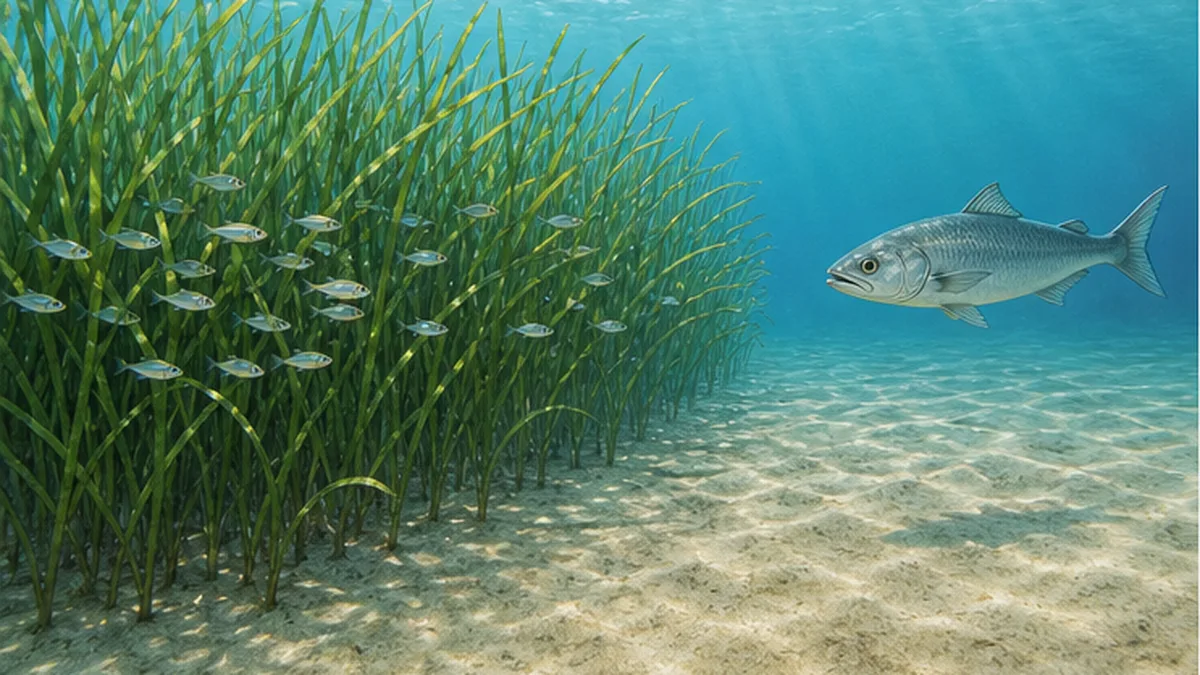
For a newly hatched fish, the greatest threat is predation. Drifting in open water while small and slow means being eaten almost immediately. Where eelgrass blades grow densely, large fish snag on the vegetation and cannot swim freely, and their line of sight is blocked. A space riddled with gaps only juveniles can slip through is an overwhelmingly favorable battlefield for the small.
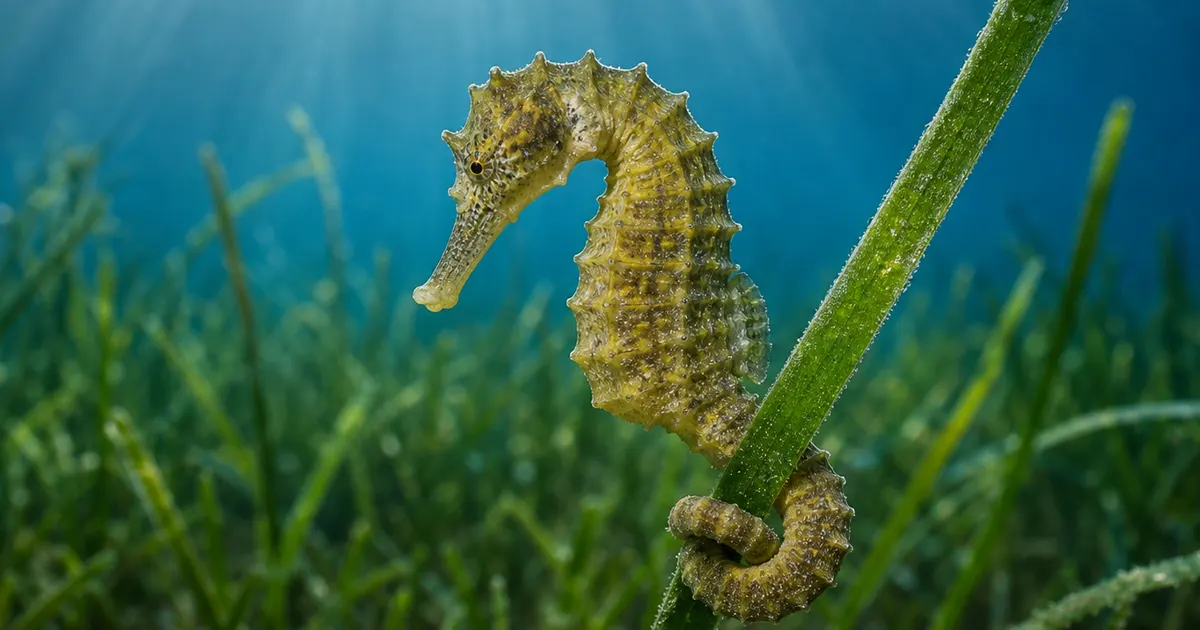
The color and pattern of the blades also aid camouflage. Pipefish and seahorses hovering with their slender bodies held vertically, parallel to the leaves, are the classic example. Body forms that mimic a blade of seagrass are themselves evidence of how the meadow environment has shaped its inhabitants over long spans of time.
Slowing the current, holding the young fish in place
The third reason is physical. An eelgrass stand absorbs the flow of water and sharply reduces current speed inside it. Ministry of the Environment materials likewise note that meadows "moderate water movement caused by waves and tidal currents." When the flow slackens, weak-swimming juveniles and drifting eggs and larvae are far more likely to stay put.
At the same time, slower flow lets fine particles — dead plankton, fragments of organic matter — settle out, so organic food accumulates inside the meadow. It is not only a hiding place but also a canteen where the food arrives on its own. Protected, and well fed: as reasons for juveniles to grow up here, it is hard to ask for more.
Three conditions that make a "cradle"
- Three-dimensional structure: flat sand becomes a forest of meter-tall blades, multiplying the living space
- Refuge function: large predators struggle to enter, and the gaps favor the small
- Reduced flow: eggs and larvae stay in place, and organic food settles and accumulates
The creatures that gather in an eelgrass meadow
So what would you actually meet if you looked into a meadow? Surveys across Japan point to a richness of dozens of fish species alone, and hundreds of species once invertebrates are included. And the ways they use the place differ completely from one species to the next.
The fish: rockfish, surfperch, pipefish
The regulars whose names come up most often are coastal fish such as Japanese black rockfish (mebaru), surfperch (umitanago), multicolorfin rainbowfish (kyūsen), black sea bream (kurodai), Japanese whiting (shirogisu) and yellowfin goby (mahaze). At the restored eelgrass site off Ninoshima in Hiroshima, rockfish, rainbowfish and surfperch were reported among the species that appeared.
There are three patterns of use. First, species that spend their whole lives in the meadow — pipefish, seahorses and filefish such as Rudarius ercodes — mimicking the blades and picking small animals off them. Second, species that spend only childhood there: rockfish and black sea bream juveniles grow up in the meadow and move out to reefs or offshore as they get larger. Third, species that visit to feed: adult black sea bream and flatfish come through hunting the small animals that gather in the meadow.
This layered structure — residents, nursery users and visitors — is a major reason the species count in a meadow runs so high. One place serves at once as housing, as a nursery school, and as a cafeteria.
A spawning ground for bigfin reef squid
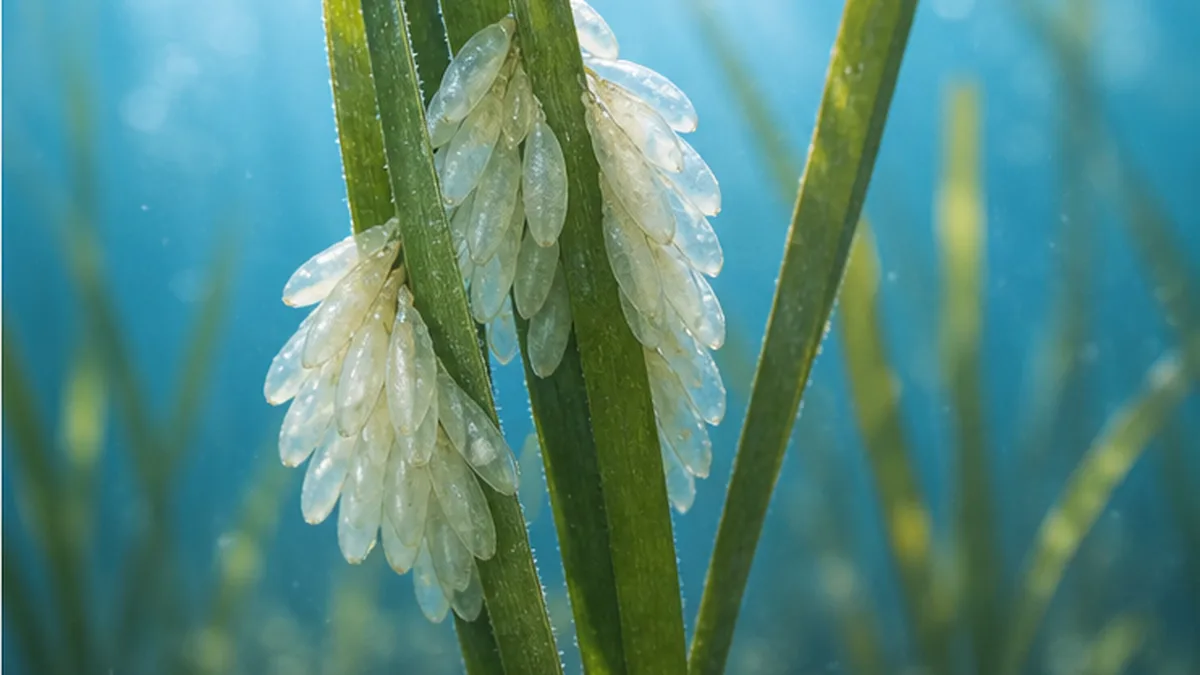
If we had to name one headline species, it would be the bigfin reef squid (aori-ika). To spawn, these squid move into shallow coastal water and attach white, finger-like egg capsules to the stems of eelgrass or sargassum. The spawning season is long, from April to September, peaking between May and July. According to research materials from Tokushima Prefecture, Japan's bigfin reef squid fall into at least three types; the so-called "shiro-ika" type that spawns in shallow coastal waters such as seagrass meadows carries about five eggs per capsule.
Seagrass stems are supple and resist breaking, and they sway at a consistent height. Egg capsules are not battered by the waves, yet fresh seawater constantly washes over them — as a place to keep eggs safe until hatching, nothing is better. In regions where meadows have declined, fishers have installed artificial spawning reefs made of bundled cut branches sunk to the seabed, known as ikashiba. It is nothing less than an attempt to replace by hand the foothold that was lost.
The small residents on the blades: epifauna
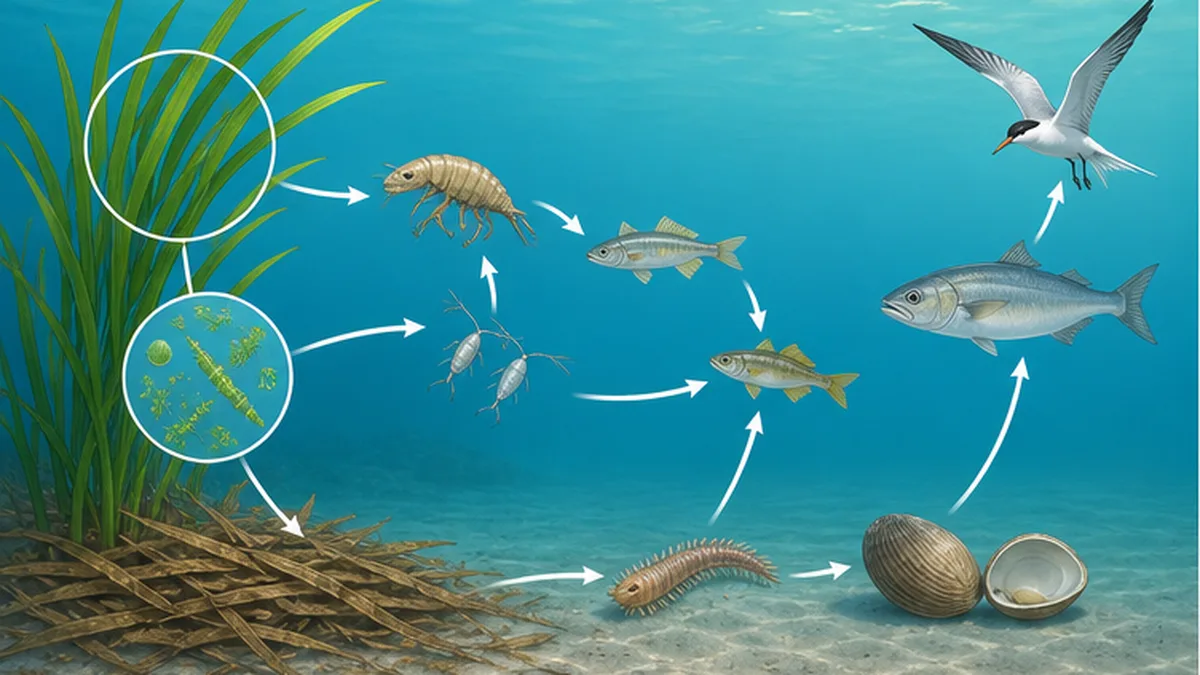
No account of meadow biodiversity is complete without the world of epifauna — the animals living on the blades, barely visible to the naked eye. A thin film of microalgae, mostly diatoms, forms on the leaf surface (epiphytes). Amphipods, skeleton shrimp, small snails and tiny shrimp cling to the blades to graze that film, and juvenile fish in turn pick them off. An entire food chain is completed on the surface of a single leaf.
These small residents play another crucial role. By grazing the epiphytes off the leaf surface, they keep the light reaching the eelgrass itself clean. If the epiphyte layer grows too thick, eelgrass cannot photosynthesize and weakens — so the epifauna act as the seagrass's cleaning crew, propping up the health of the whole meadow. Creatures are protected by the place, and in turn protect the place: this mutual dependence is the essence of a meadow ecosystem.
| Organism | How it uses the meadow | Type of use |
|---|---|---|
| Pipefish and seahorses | Resident, mimicking the blades and eating small crustaceans | Lifelong resident |
| Rockfish and black sea bream | Shelter and growing ground during the juvenile stage | Nursery user |
| Bigfin reef squid | Spawning ground; attaches egg capsules to stems | Spawner |
| Amphipods, skeleton shrimp, snails | Graze epiphytes and clean the blades | Epifauna |
| Flatfish and gobies | Forage for benthic prey on the meadow floor | Visitor / bottom dweller |
| Green turtles and dugongs (southern waters) | Eat the seagrass itself | Large grazer |
The meadow food web: a chain of life that starts with photosynthesis
Shelter is not the only reason meadows hold so much life. More fundamentally, it is because an enormous amount of food is produced there. Even among coastal habitats, eelgrass meadows are known as places of outstanding productivity.
High primary production, precisely because the water is shallow
Eelgrass generally grows in shallows around 1 to 5 meters deep. Light reaches the bottom in abundance and nutrients flow in from rivers — conditions could hardly be better for a plant. Seagrass can also draw nutrients from the sediment through its roots, so it can keep photosynthesizing even when the water column is nutrient-poor.
As a result, per unit area a meadow produces organic matter on a par with farmland or forest on land. And eelgrass itself is not the only producer. Epiphytes on the leaf surface, phytoplankton drifting inside the stand, benthic microalgae on the bottom — a meadow is a factory where several layers of primary producers work at once.
Fallen leaves (detritus) that sustain bottom-dwelling life
What is interesting is that in Japan's temperate waters, relatively few animals eat eelgrass blades directly. The leaves are fibrous and hard to digest. So where does the organic matter that eelgrass produces go? The answer is that it circulates as detritus — fragments of organic material.
Blades that wither or break off fall to the seabed and are gradually broken down and fragmented by microbes. In the process microbial biomass attaches to them and raises their nutritional value, making them high-quality food for benthic animals such as polychaete worms, bivalves, sea cucumbers, shrimp and crabs. As those animals multiply in the mud, flatfish and gobies gather to eat them, and higher predators follow — a food web that begins with fallen leaves spreads out beneath the meadow.
Bounty carried beyond the meadow
Organic matter produced by a meadow does not stay put. Torn-off blades ride the tide offshore or into deeper water and feed animals on seabeds far away. After a typhoon, the bands of eelgrass washed up on a beach feed sand hoppers, which shorebirds such as sandpipers and plovers then peck at — visible proof that the meadow's bounty reaches all the way to land.
Moreover, juveniles that grow up in a meadow and then move offshore are themselves an export of biomass from the meadow to the open sea. This spillover effect lies behind UNEP's assessment that seagrass meadows are nurseries for 20% of the world's largest fisheries. It is no exaggeration to say that a good share of the fish on our plates depended on an eelgrass meadow at some point in life.
Cleaning the water, protecting the seabed: the foundation beneath biodiversity
A meadow's work is not limited to raising animals directly. By improving the condition of the water and the seabed themselves, it indirectly supports the entire ecosystem. Japan's Ministry of the Environment explains that meadows decompose organic matter in the water, absorb nutrient salts and carbon dioxide, and supply oxygen, thereby "playing a major role in purifying seawater."
Drawing up nutrients and easing the trigger for red tides
Nitrogen and phosphorus flowing to the coast from cities and farmland can, in excess, cause phytoplankton blooms (red tides); when the dead cells decompose, oxygen is consumed and hypoxic water masses form. Eelgrass absorbs these nutrients through roots and leaves and locks them into its own tissue. Where broad meadows remain healthy, the pressure of eutrophication is correspondingly reduced.
A caveat is in order, though. In the Seto Inland Sea, advanced sewage treatment went so far that the opposite problem — nutrient depletion, or oligotrophication — emerged, causing discoloration of nori seaweed and poor sand lance catches. It is not as simple as "the cleaner the sea, the better." For more on the idea of designing that "just right" balance, see our article on the satoumi concept.
Stabilizing sediment and keeping the water clear
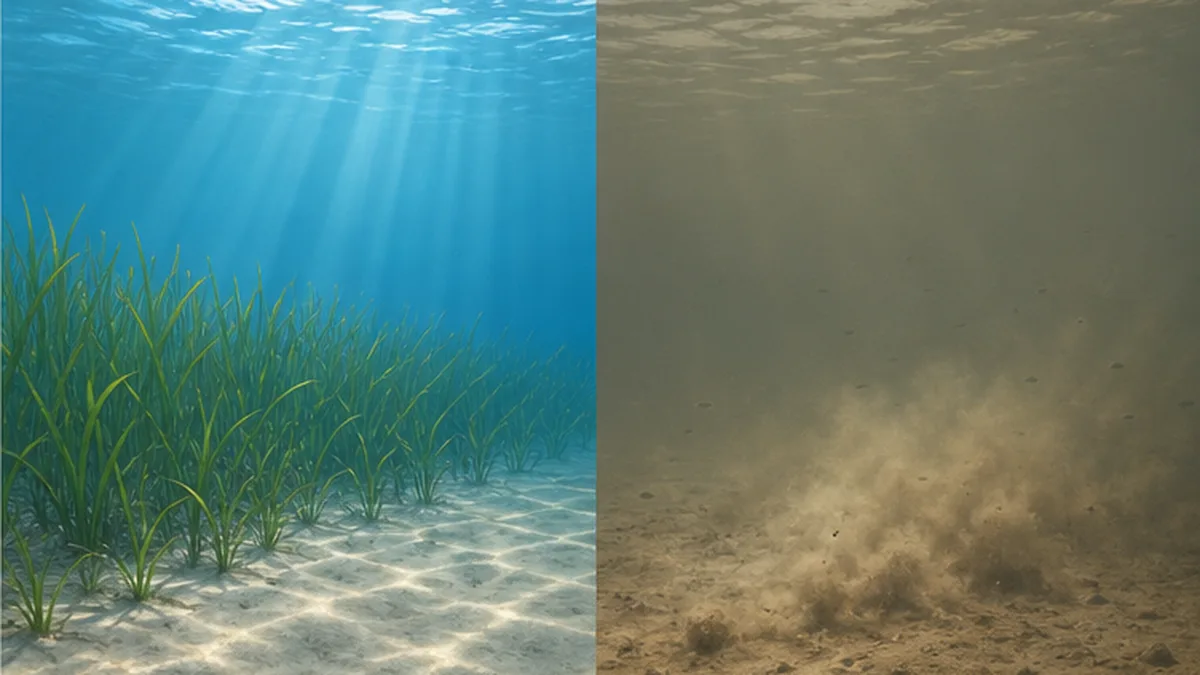
Eelgrass rhizomes and roots spread through the sand and mud like a net, gripping the seabed. Even when typhoons or high waves arrive, sand where roots are present is less likely to be stirred up. And because the blades slow the flow, fine particles in the water settle more readily. The result is that around a meadow turbidity falls and clarity rises.
This is a matter of life and death for the seagrass too. In turbid water, light does not reach the bottom and eelgrass cannot photosynthesize. In other words, a positive feedback is at work: eelgrass reduces turbidity, light gets through, eelgrass grows. The flip side is that once a meadow is lost and turbidity rises, light no longer reaches the bottom and recovery becomes difficult — the loop reverses into a vicious one. That structure is why the loss of a meadow tends to be so hard to undo.
Storing carbon: seagrass as blue carbon
Attracting particular attention in recent years is the way seagrass takes up atmospheric carbon dioxide and stores it for long periods in seabed mud as dead leaves and roots. This carbon storage, provided by mangrove forests, seagrass meadows and salt marshes, is known as blue carbon. UNEP estimates that although seagrass meadows occupy only 0.1% of the ocean floor, they account for more than 10% of the carbon buried in ocean sediments each year.
Seabed mud is oxygen-poor, so organic matter decomposes slowly. Carbon therefore is not returned to the air within decades as it is in a terrestrial forest, but stays locked away over long timescales. In Japan, a system for reporting seagrass and seaweed uptake to the United Nations has begun operating, as has a trading scheme called J Blue Credit. For details, see our article on how blue carbon works.
Four functions an eelgrass meadow performs
- Providing habitat: shelter for juveniles, spawning substrate, and a home for epifauna
- Underpinning the food web: high primary production and a supply of food via detritus
- Protecting water and sediment quality: nutrient uptake, reduced turbidity, sediment stabilization
- Storing carbon: locking carbon away over long timescales as blue carbon
Seagrass meadows worldwide and the large animals that depend on them
Widen the view to the whole planet and seagrass meadows occur on coasts almost everywhere except around Antarctica. Out of the Blue: The Value of Seagrasses to the Environment and to People, released by UNEP, GRID-Arendal and UNEP-WCMC on World Oceans Day in 2020, is the standard reference summarizing their value.
72 seagrass species supporting the world's coasts
According to that report, 72 species of seagrass are known worldwide. Their distribution is astonishingly broad, from the meadows spreading behind tropical coral reefs to cold, shallow inlets in northern Europe. Yet at the same time, at least 22 of those 72 species are in decline, and roughly 30% of the world's known seagrass area has been lost since records began in 1870.
Estimates of the rate of loss vary between studies, but several report annual figures in the range of 0.9% to 7%, and they agree that seagrass is among the coastal ecosystems disappearing fastest. Because it vanishes quietly, without drawing the public attention that coral reefs or tropical forests attract, seagrass is often called a "forgotten ecosystem."
Dugongs and green turtles: the large grazers of the sea
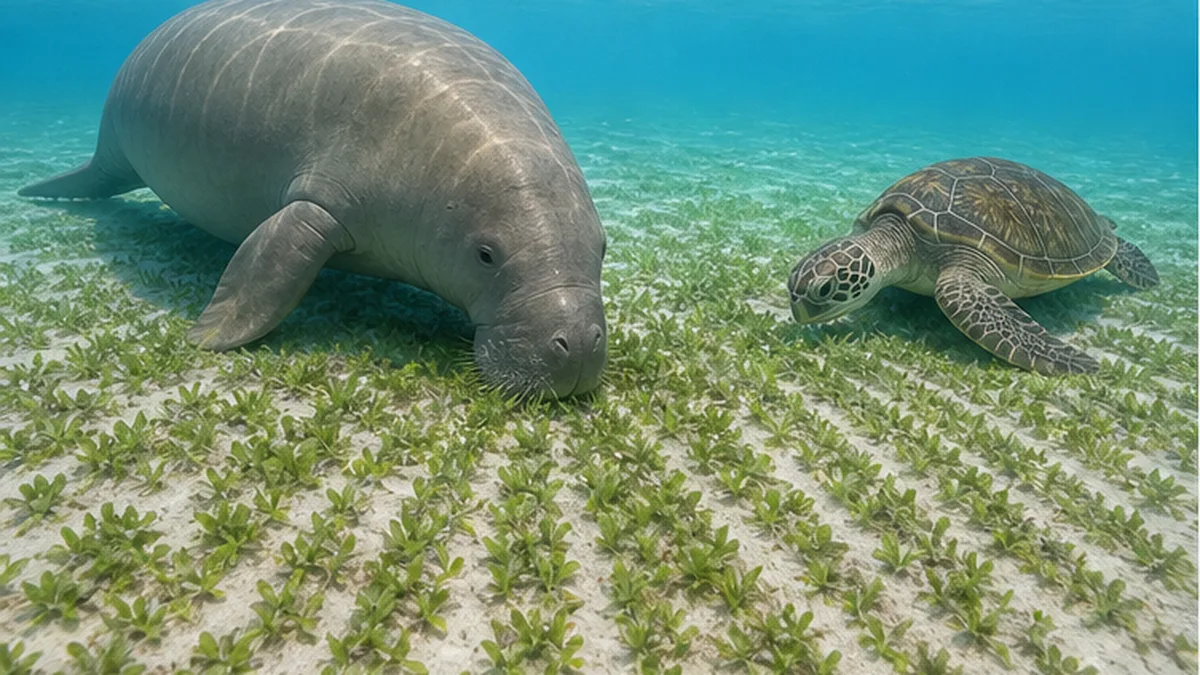
The best-known large animal that eats seagrass directly is the dugong. Dugongs are the world's only fully herbivorous marine mammal, with seagrass making up more than 90% of their diet. A 2025 study that measured the metabolism of wild individuals estimated that a dugong needs 25 to 65 kilograms of seagrass (fresh weight) per day simply to stay in energy balance; growth and reproduction require considerably more.
Few places can supply that much every single day. It is inevitable that dugong distribution overlaps with seagrass meadows, and if the meadows are lost the population is immediately imperiled. In Japan, Okinawa has been regarded as the northern limit of their range, but confirmed sightings are extremely rare and the situation remains critical.
The green sea turtle is likewise an herbivorous turtle that shifts to a diet of seagrass and seaweed as it matures. Grazing by dugongs and turtles also has an upside: cropping overgrown blades promotes new shoot growth and helps rejuvenate the stand. The same relationship by which grazing animals maintain grassland on land holds beneath the sea as well.
The invisible foundation of global fisheries
The other figure UNEP emphasizes is the one already noted at the outset: seagrass meadows serve as nurseries for 20% of the world's largest fisheries. Along the coasts of Southeast Asia and East Africa in particular, small-scale fishing in seagrass meadows directly supports local people's protein supply and cash income. The United Nations World Ocean Assessment likewise identifies seagrass meadows as important habitats warranting conservation.
Seagrass meadows are, in short, one of the few forms of natural capital that address several challenges at once: climate action (carbon storage), food security (fisheries), biodiversity conservation (habitat for endangered species) and disaster risk reduction (wave attenuation and sediment stabilization). Precisely because they do so much on so little area, losing them causes losses across a wide front.
Vanishing meadows and the impact on biodiversity
The richness described so far, however, is becoming past tense. The blow Japan's eelgrass meadows have taken has been even harsher than the global average.
What happened in Japan: the collapse that began in the 1960s
According to Ministry of the Environment materials, about 70% of Japan's eelgrass meadows were lost between 1960 and around 1990. Roughly half of the country's tidal flats disappeared over a comparable period. In the Seto Inland Sea alone, about 70% of eelgrass meadows vanished between fiscal 1960 and fiscal 1989–90.
Concrete numbers convey the severity. In Hinase, Bizen City, Okayama Prefecture, the eelgrass meadow that covered 590 hectares around 1950 had shrunk to just 12 hectares by 1980 — one fiftieth. In step with that, catches in the Seto Inland Sea have continued to fall from their peak around 1980.
What made the meadows disappear
There was no single cause. Land reclamation and shoreline armoring during Japan's high-growth era physically erased the gently sloping sandy-muddy bottoms where eelgrass grows. Eutrophication and red tides driven by household and industrial wastewater clouded the water, blocked light and generated hypoxic water masses. Marine sand mining and bottom trawling churned up the seabed.
In recent years climate change has been added to the list. Abnormally high summer water temperatures kill eelgrass and impair seed production. On top of that, grazing damage by herbivorous fish such as rabbitfish and parrotfish, and by sea urchins — all more active in warmer water — has stripped meadows bare, and the resulting "isoyake" barrens have grown severe across the country. The Fisheries Agency has revised its isoyake countermeasure guidelines, strengthening measures against herbivorous fish.
| Driver | Effect on meadows | Main period |
|---|---|---|
| Reclamation and shoreline armoring | The shallow sandy-muddy substrate itself is eliminated | High-growth era onward |
| Eutrophication and red tides | Turbidity blocks light; hypoxic water masses form | Chiefly the 1960s–80s |
| Sand mining and bottom trawling | Disturbance of the seabed, destruction of rhizomes and roots | Same period |
| Rising water temperature | Summer die-off and reduced seed production | Expanding in recent years |
| Grazing by herbivorous fish and urchins | Blades eaten away; isoyake barrens form and persist | Expanding in recent years |
| Chronic turbidity | Insufficient light for recovery, so regrowth stalls | Ongoing |
The effects on living things cascade
When a meadow disappears, what is lost is more than a green landscape. Without shelter for juveniles, recruitment — the number of individuals joining the fishery as the next generation — declines; without spawning substrate, squid wander in search of somewhere to lay eggs. If epifauna lose their home, the fish that fed on them decline too. If fallen leaves stop arriving, the benthic animals in the mud grow lean.
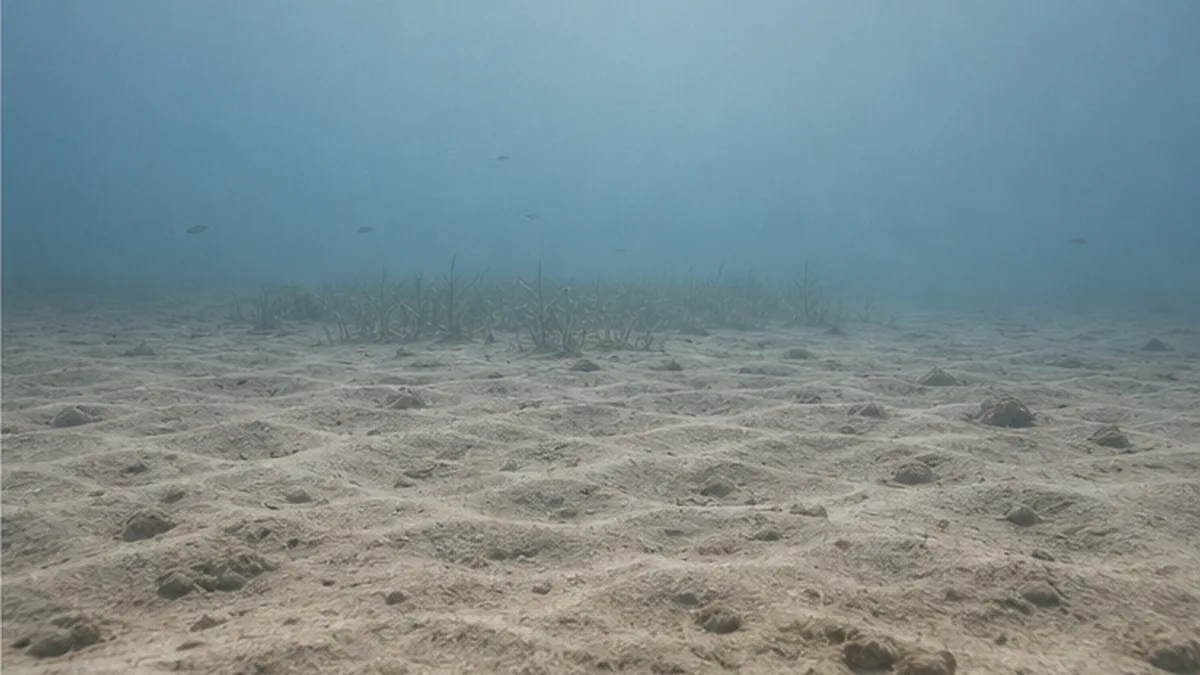
And, as noted above, the loss comes with a vicious loop: turbidity leads to insufficient light, which makes regrowth difficult. Where reclamation has removed the substrate altogether, there is no ground left to restore in the first place. The idea that "we can simply replant what we lose" does not easily apply — and that is what makes meadow conservation so hard.
Points to watch
- About 70% of Japan's eelgrass meadows were lost between 1960 and 1990 (Ministry of the Environment)
- Globally, about 30% has been lost since 1870, and at least 22 of 72 species are in decline (UNEP)
- Meadow loss carries a vicious loop of turbidity, light shortage and difficult regrowth, making it hard to reverse
Watching over and winning back: the future of meadows and biodiversity
The figures have been grim, but the situation is not hopeless. Japan has a track record of communities and fishers winning meadows back by hand.
Start by knowing: Monitoring Sites 1000
Conservation starts with measuring the present state, continuously. The Ministry of the Environment's Monitoring Sites 1000 program observes important ecosystems across Japan over the long term; in coastal waters it covers rocky shores, tidal flats, eelgrass meadows and other seaweed beds. Experts and local surveyors examine the same sites by the same methods over time, and the survey reports are published.
It looks like unglamorous work, but without it we would not even know whether meadows are increasing or decreasing. In recent years, broad-scale mapping combining satellite imagery, acoustic instruments and drones has advanced, gradually revealing distributions that had been hard to grasp.
Hinase's journey: from 12 hectares to 250
Hinase in Okayama Prefecture, introduced above as the place that shrank to one fiftieth, is better known for what happened next. In 1985, Okayama Prefecture's fisheries experiment station made eelgrass seed-collection techniques practical, and the local Hinase Fisheries Cooperative began sowing. Collect seeds from what little eelgrass remained, and scatter them in the sea — that patient repetition bore fruit, and the meadow recovered to 80 hectares in 2007, 200 hectares in 2011, and 250 hectares by 2015.
What matters is that this was not a government-led initiative but something fishers themselves started for their own sea. As the meadow returned, so did the fish and shellfish that depend on it, creating a cycle in which conservation pays back into livelihoods. The Seto Inland Sea is now called the birthplace of eelgrass restoration, and the practice has spread into national summits and citizen activities. For the techniques of meadow creation and countermeasures against isoyake, see our article on restoring seaweed and seagrass beds.
What we can do
Conserving meadows is not a job for coastal residents and fishers alone. Inland life is connected to the meadows, reliably, by way of rivers. Not letting excess detergent or fertilizer run off, being mindful of household wastewater, gardening in ways that let rainwater soak into the soil — such actions reduce the load of turbidity and nutrients arriving from the watershed.
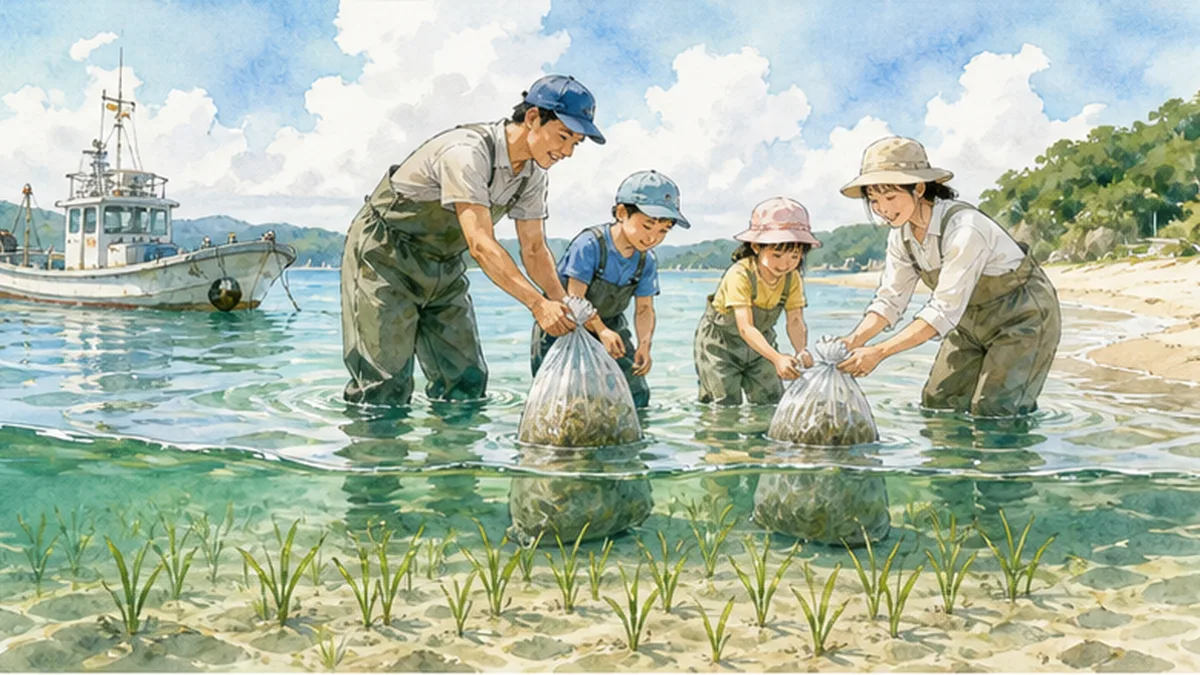
Eelgrass sowing and transplanting events and meadow observation sessions are also held around the country. Stand knee-deep in the shallows and peer between the blades, and you will be surprised by how many small lives are moving there. If "protecting marine life" sounds abstract, starting with the experience of looking is the surest entry point. For the wider richness of life along Japan's coasts, see also our article on Japan's marine biodiversity.
What you can do today
- Go easy on detergent and fertilizer to reduce the nutrient and turbidity load flowing from rivers to the sea
- Join a local eelgrass sowing event or meadow observation session (most common in spring and early summer)
- Buy seafood with awareness that meadows raised it — check where and how it was caught
- At the shore, avoid trampling shallow-water seagrass or dropping anchor into it
In closing: the richest sea lies in the shallows at our feet
An eelgrass meadow is not somewhere you must travel to reach, as with the open ocean or a coral reef. It spreads across the seabed of any calm inlet, at knee depth. That unspectacular green prairie, on just 0.1% of the ocean floor, raises 20% of the world's largest fisheries, accounts for more than a tenth of the carbon buried in the seabed, feeds dugongs and turtles, and cleans the water.
That seagrass is not algae but a plant that flowers and sets seed is more than a taxonomic footnote. It is evidence of a long story: life that once climbed onto land returned to the sea and there became the support of an entire coastal ecosystem. And it is we who are writing the latest chapter of that story. Japan lost 70% in about thirty years; Hinase brought its meadow back twentyfold in about thirty years. Both were the result of human hands.
The next time you stand at a shallow shore, look into the water at your feet. If slender blades are swaying there, that is a cradle for countless lives. And if it is bare sand — we hope you will spend a moment imagining what once grew there.

References and sources
- Fisheries Agency of Japan – Types of seaweed and seagrass beds (classification and roles of eelgrass, sargassum, Eisenia/Ecklonia and kelp beds)
- Fisheries Agency of Japan – Functions and current status of seaweed and seagrass beds
- Ministry of the Environment, Japan – Setouchi Net – Status of seaweed/seagrass beds and tidal flats (about 70% of eelgrass meadows lost between 1960 and 1990)
- Ministry of the Environment, Japan – Satoumi Net – Satoumi and ecosystems (roles and decline of meadows and tidal flats)
- Biodiversity Center of Japan, Ministry of the Environment – Monitoring Sites 1000 eelgrass meadow survey (long-term monitoring reports)
- UNEP – Out of the Blue: The Value of Seagrasses to the Environment and to People (2020; 72 seagrass species, 20% of the world's largest fisheries, 0.1% of the ocean floor)
- UNEP – Five ways often-unheralded seagrasses boost biodiversity
- Fisheries Agency of Japan – Conservation and creation of seaweed/seagrass beds and isoyake countermeasures (guidelines)
- Hinase Fisheries Cooperative – Eelgrass meadow restoration plan (about 590 ha around 1950 → 12 ha in 1980 → 250 ha in 2015)
- Marine Mammal Science (Lanyon et al., 2025) – Estimated daily seagrass requirement of dugongs based on metabolic measurements of wild animals
* Ordered by reliability: government and academic institutions > peer-reviewed papers > specialist organizations > trusted media