⚡ The answer in 30 seconds
- Katsuobushi is a uniquely Japanese dried and fermented food made by simmering and smoking skipjack and repeating mold-curing and sun-drying; honkarebushi takes about 4–6 months.
- Mold lowers water and fat and mellows the flavor, and the main umami component is inosinic acid.
- Domestic production is concentrated in Kagoshima and Shizuoka, and the 2022 and 2025 international assessments found skipjack not overfished.
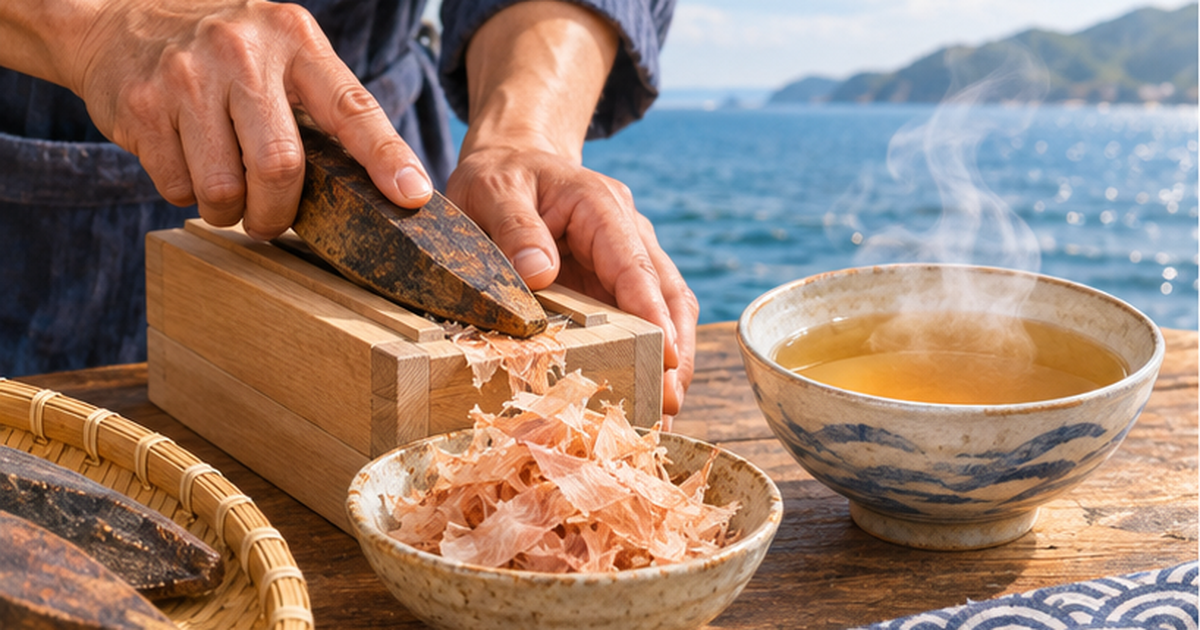
Katsuobushi is a rare dried fish finished with mold.It is simmered, smoked, inoculated with mold and dried again. After months of work, the rock-hard block yields a clear broth and deep aroma when shaved.
This article organizes the production process, the role of mold, domestic output and production areas, the status of the skipjack stock and the link to Japanese food culture, based on primary sources such as the Ministry of Agriculture, Forestry and Fisheries, the Fisheries Agency and WCPFC.
Let us trace the sea and the craftspeople behind the dashi.
What you will learn
- Differences between arabushi, karebushi and honkarebushi
- The production process from simmering to honkarebushi
- How mold-curing affects fat and umami
- Output and main production areas
- Skipjack stock status and international management (WCPFC)
- Dashi culture in washoku and future challenges
What is katsuobushi? A rare dried fish finished with mold
The basics: skipjack that is simmered, smoked and dried
Katsuobushi is a traditional Japanese preserved food made by simmering skipjack, smoke-drying it and then maturing it with mold. The Ministry of Agriculture, Forestry and Fisheries explains that repeating smoke-drying (baikan) and mold-curing reduces moisture to the extreme, leaving an environment where microorganisms cannot grow and improving shelf life. In other words, katsuobushi is both a dried food and a kind of fermented food that uses the action of mold.
An ordinary dried fish is just “dried to remove water,” but katsuobushi repeats smoking, mold-curing and drying many times. This accumulation creates a deep aroma and umami absent from fresh skipjack, and a material that gives a clear broth simply by being shaved into hot water.
Arabushi, karebushi and honkarebushi
Katsuobushi is named by how far it is finished. Product whose processing stops after smoke-drying is arabushi. Arabushi that has been mold-cured is karebushi, and one finished with repeated mold-curing is called honkarebushi. Sources differ on how many cycles qualify as honkarebushi (for example “three to four or more”), and the exact line varies by region and maker.
| Type | Stage reached | Characteristics |
|---|---|---|
| arabushi | Simmering and smoke-drying only (no mold) | Strong smoky aroma and robust flavor; used in many commercial shavings |
| karebushi | Arabushi that has been mold-cured | Less fat and a mellower aroma |
| honkarebushi | Repeated mold-curing and sun-drying | Long shelf life and a refined, clear dashi |
Key points of this article
- Katsuobushi is a dried and fermented food built by simmering, smoking, mold-curing and drying
- Domestic production is concentrated in Kagoshima and Shizuoka prefectures
- The raw-material skipjack is under international management, and the current assessment is “not overfished”
How katsuobushi is made: a process lasting months
From cutting to simmering: shaping the fillets into “bushi”
Production starts by removing the head and guts from landed skipjack (thawed or fresh) and filleting it into three pieces. The fillets are further divided into back and belly sides and shaped into “bushi.” The back piece is called obushi and the belly piece mebushi; one fish yields four pieces (a smaller form called kamebushi is sometimes made).
The shaped pieces are placed in baskets and simmered in hot water. Simmering firms the protein so the shape holds, removes excess fat and blood, and suppresses enzymes and microbes that cause spoilage. After simmering, the bones are removed and gaps in the flesh are filled with fish paste to restore the shape.
Smoke-drying (baikan): drying over wood smoke
Simmered pieces are exposed to wood smoke in a smoking room. Smoke-drying is repeated over many days, with fire applied several times a day and then rested, slowly drawing moisture from the surface to the inside. This removes water, adds aroma from the smoke and helps surface sterilization and keeping quality. A Consumer Affairs Agency document also treats product smoke-dried after simmering to 26% moisture or less as the benchmark for arabushi.
Repeated mold-curing and sun-drying
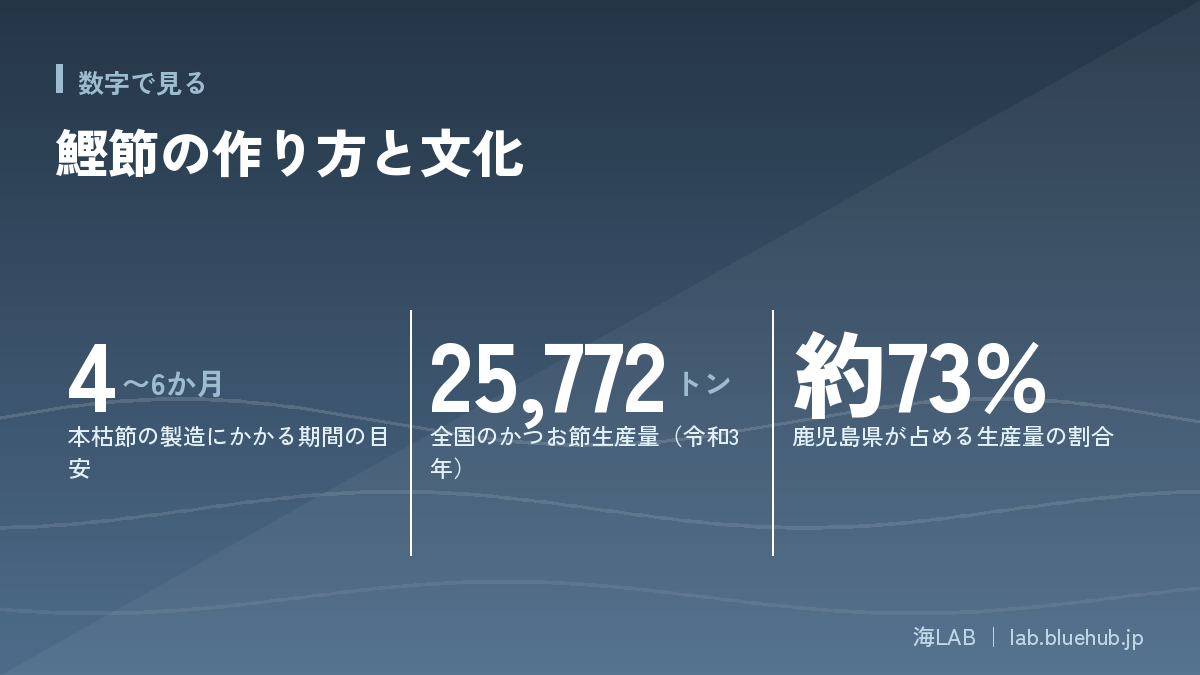
To finish arabushi as honkarebushi, the surface is shaved and the piece goes into a dedicated mold room for several days until mold covers it. After the mold grows, the piece is sun-dried and the mold brushed off, then mold-cured again. This is repeated many times. A Kyoto Prefecture document says honkarebushi takes roughly four to six months to make.
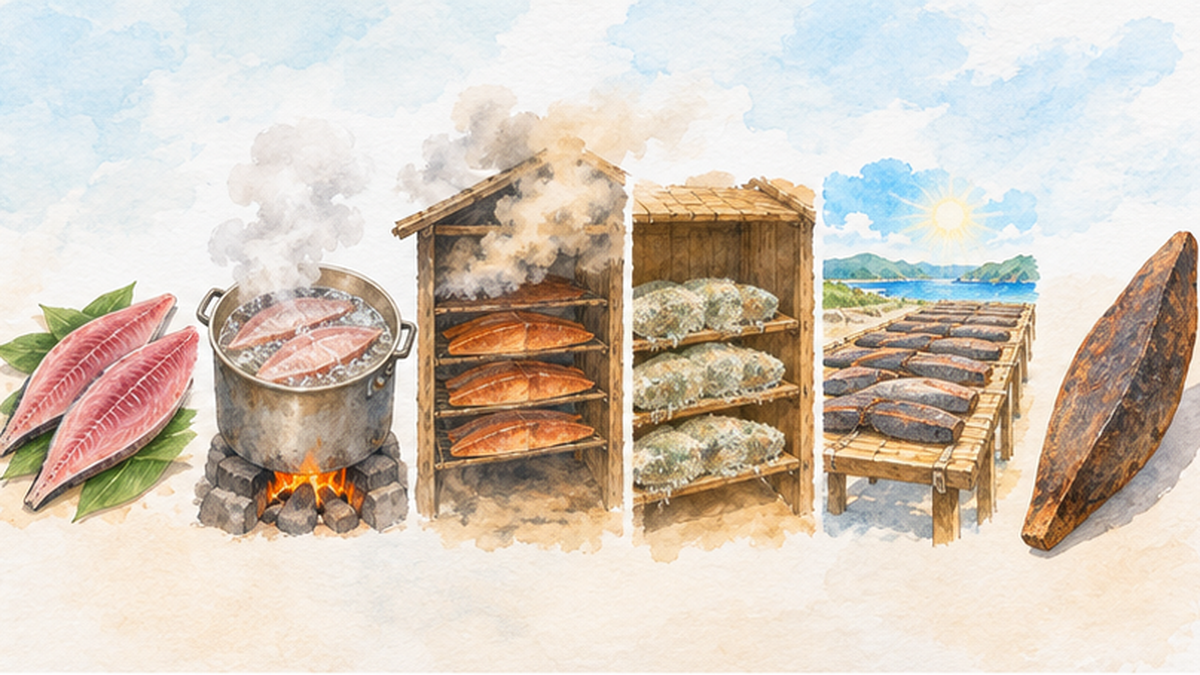
- Cutting: remove the head and guts, fillet into three and shape into bushi
- Simmering: cook in hot water to firm the protein
- Smoke-drying: smoke over wood to reduce moisture gradually (this stage yields arabushi)
- Mold-curing and sun-drying: repeat mold-curing and drying to reduce water and fat and mature the product (karebushi and honkarebushi)
The role of mold: why it does not spoil and gains umami
Three changes brought by mold-curing
The mold used on katsuobushi is a type used in food production (related to koji mold) and is distinct from harmful molds. It acts on the surface of the pieces as follows.
- Draws out moisture: as the mold grows, internal moisture moves to the surface and escapes in the sun; repeated cycles reduce water to the extreme
- Breaks down fat: a Kagoshima University paper reports that mold-curing lowers water and fat content, and that mold lipase (a fat-degrading enzyme) breaks down fat
- Mellows the flavor: with less fat and water, a clear dashi with little off-taste can be obtained
When mold-curing reduces fat, the broth is less likely to turn cloudy and harshness and fishiness are suppressed. This is one reason honkarebushi is treated as a premium dashi material. According to the Standard Tables of Food Composition in Japan (Eighth Revised, 2023 supplement), katsuobushi contains 2.9 g of fat per 100 g.
Inosinic acid, the star of umami
The main umami component of katsuobushi is inosinic acid, a kind of nucleotide. Combined with the glutamic acid in kombu, umami is known to intensify synergistically, and the basic washoku “awase dashi” uses this property.
Trivia
- The mold on katsuobushi is sometimes described as a relative of the koji mold used for miso, soy sauce and sake. All are fermentation workers supporting Japanese food culture.
Japan’s katsuobushi industry: output and production areas
How much is produced?
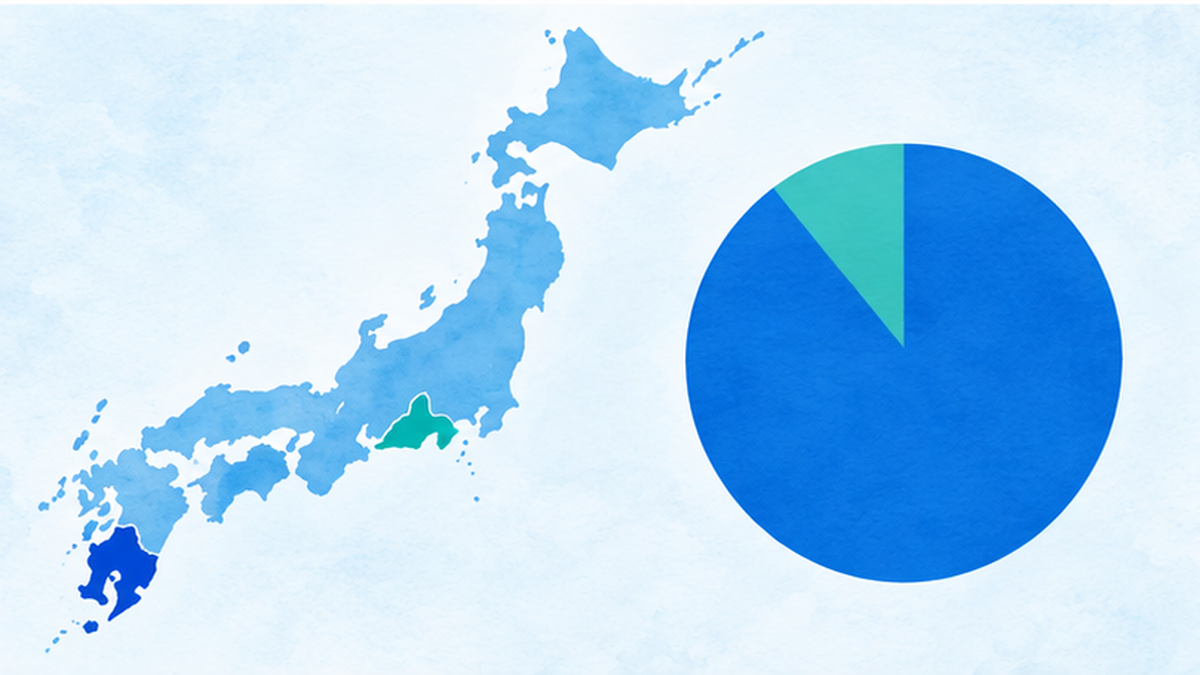
According to a Shizuoka Prefecture document based on MAFF’s fishery processing statistics, national katsuobushi output in FY2021 was 25,772 tonnes. Kagoshima produced 18,921 tonnes and Shizuoka 6,598 tonnes, so the two prefectures account for most of the total: about 73% and about 26% respectively.
| Prefecture | Output (FY2021) | Share (approx.) |
|---|---|---|
| Kagoshima | 18,921 t | About 73% |
| Shizuoka | 6,598 t | About 26% |
| National | 25,772 t | — |
In 2024, national output of “bushi products” was 68,638 tonnes, up 4% from the previous year. However, this figure includes bushi other than katsuobushi, such as mackerel and soda bonito bushi, and is not the katsuobushi figure alone. Because the survey has covered only major producing prefectures since 2020, take care with year-to-year comparisons.
Main areas: Makurazaki, Yamakawa and Yaizu
Well-known production areas are Makurazaki and Yamakawa (Ibusuki) in Kagoshima and Yaizu in Shizuoka. Kagoshima, with its warm climate and role as a base for distant-water and coastal skipjack fishing, makes both arabushi and honkarebushi. In Shizuoka, katsuobushi is made mainly in Yaizu, Omaezaki and Nishiizu.
The raw material: where skipjack is caught and is the stock healthy?
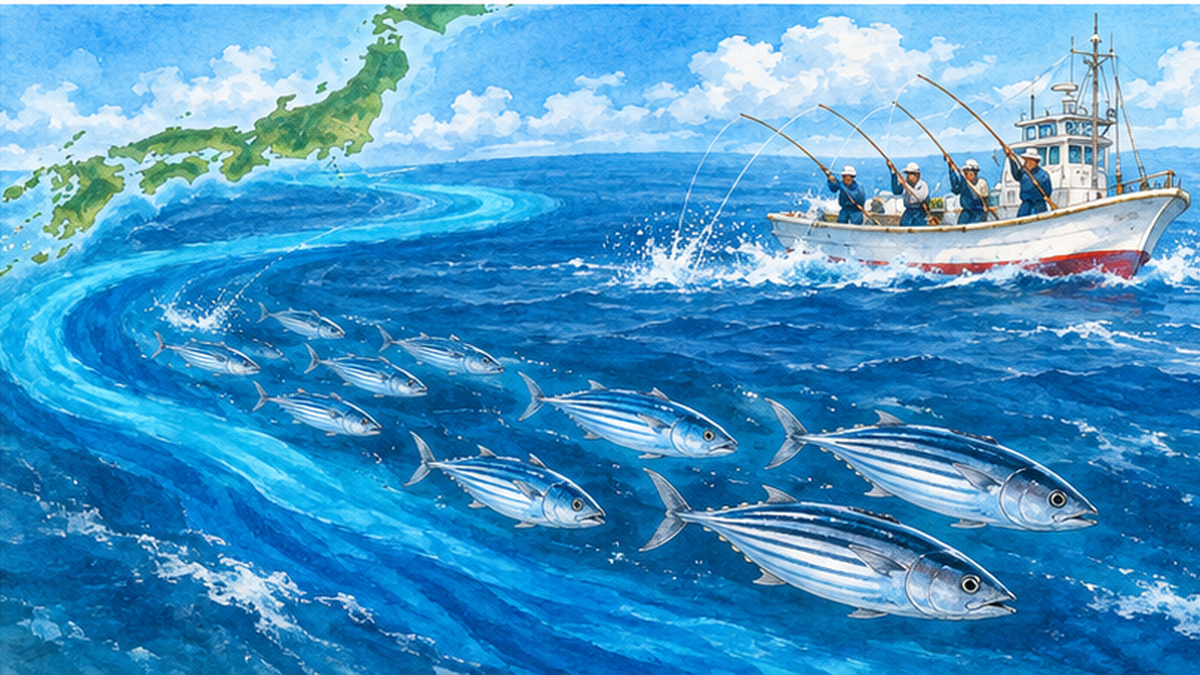
Skipjack migrate across the world’s oceans
Skipjack are widely distributed from tropical to temperate seas and migrate north to Japanese waters on the Kuroshio. Raw material comes from pole-and-line and purse-seine catches in coastal waters as well as distant-water Pacific catches. For domestic landings, an Ibaraki Prefecture document (2024 fishery and aquaculture statistics) ranks Shizuoka first, Miyagi second and Tokyo third.
International management: WCPFC assessments
Skipjack is managed internationally by the Western and Central Pacific Fisheries Commission (WCPFC). The 2022 stock assessment judged it “not overfished and not subject to overfishing” against WCPFC reference points. Scientific Committee documents report a median recent spawning-biomass depletion of about 0.51 (limit reference point 0.20) and a median F/FMSY of 0.32. Total skipjack catch in the western and central Pacific in 2021 was about 1.548 million tonnes, down about 10% from the previous year.
The 2025 assessment also found skipjack “not overfished and not subject to overfishing,” with the next assessment planned for 2028 (according to WCPFC documents). The stock is relatively healthy among tunas, but challenges remain such as distribution shifts from climate change and bycatch of other species.
A healthy stock is no reason for complacency
- The summary of the FY2024 White Paper on Fisheries reports that the average sea surface temperature around Japan in 2024 was the highest since records began. For a migratory fish like skipjack, fishing grounds and arrival timing may shift with water temperature, so domestic landings are not guaranteed to be stable even when the stock is healthy.
For related topics, see also the recovery of Pacific bluefin tuna and stock collapse from overfishing for a fuller picture of fishery resource management.
Washoku and katsuobushi: dashi as intangible heritage
Washoku’s registration and “umami”
On December 4, 2013, “Washoku, traditional dietary cultures of the Japanese” was inscribed on UNESCO’s Intangible Cultural Heritage list. MAFF lists its features as respect for the character of diverse, fresh ingredients, nutritional balance supporting healthy diets, expression of nature’s beauty and the seasons, and ties to annual events. It also explains that skillful use of dashi umami and fermented foods helps limit intake of animal fats.
How dashi is used
Katsuobushi is used from miso soup, clear soup and simmered dishes to noodle sauce and okonomiyaki toppings, at home and in restaurants. From authentic dashi made by shaving honkarebushi to bagged shavings, dashi packs and granulated dashi, it has taken many forms in daily life.
- Shavings: thinly shaved arabushi or karebushi, used for home dashi and toppings
- Dashi packs: shavings or powder in a bag for easy dashi
- Granulated dashi: powdered bonito extract and similar, widely used in processed foods
The katsuobushi industry faces changing fishery resources and a shrinking domestic market, and companies have worked on overseas markets and new uses since the washoku listing (a Seitoku University Junior College paper also discusses katsuobushi companies’ strategies).
The future of katsuobushi: sustainability and challenges
Workforce and fishery challenges
Katsuobushi depends on both the fishery that catches skipjack and the artisans who process it. Aging fishers and lack of successors are issues for the whole fishing industry and affect the raw-material supply. See also our article on declining fishers and the succession problem for details.
Choosing sustainably sourced products
When choosing katsuobushi or shavings, fishery eco-labels such as MSC are a clue to how the skipjack was caught. See our guide to seafood eco-labels for how they work. Better seafood traceability is also important as a way to verify origin and fishing method.
Adapting to climate change
Fish distributions changing with warmer seas is also known as the northward shift of fish species. Changes in skipjack arrival timing and fishing grounds can affect processing plants and raw-material supply, so both the industry and the resource continue to be monitored.
What we can do
- Make dashi with honkarebushi or shavings and notice the difference in taste
- Choose eco-labeled products or products with known origin
- Reduce leftovers and use dashi residue in cooking
Summary
- Katsuobushi is a uniquely Japanese dried and fermented food built by simmering, smoke-drying, mold-curing and sun-drying
- National katsuobushi production is concentrated in Kagoshima and Shizuoka (FY2021: 25,772 t nationwide)
- Skipjack is assessed by WCPFC as not overfished, but attention to environmental change such as warming seas continues
References and sources
- MAFF, materials on “Washoku, traditional dietary cultures of the Japanese” – Washoku’s UNESCO inscription (December 4, 2013) and features of dashi
- MAFF, Local dishes and traditional foods (fermented foods and bushi) – Improved shelf life through smoke-drying and mold-curing
- Shizuoka Prefecture, fisheries promotion materials (katsuobushi output) – Katsuobushi output by prefecture, FY2021
- Kyoto Prefecture, introduction of Fukushima Katsuo – Typical production time of honkarebushi
- WCPFC Scientific Committee, skipjack stock assessment materials – 2022 assessment (not overfished)
- Ibaraki Prefecture, skipjack stock and catch trends (FY2024) – Domestic landing ranking and WCPFC assessment
- Fisheries Agency, FY2024 White Paper on Fisheries – Sea surface temperature around Japan in 2024
- Kagoshima University, paper on mold-curing of katsuobushi – Changes in water and fat from mold-curing
- Consumer Affairs Agency, document on katsuobushi labeling – Moisture standard for arabushi (26% or less)
- Seitoku University Junior College, paper on katsuobushi industry strategy – The industry after the washoku listing
* Ordered by reliability: government and academic institutions > peer-reviewed papers > specialist organizations > reliable media