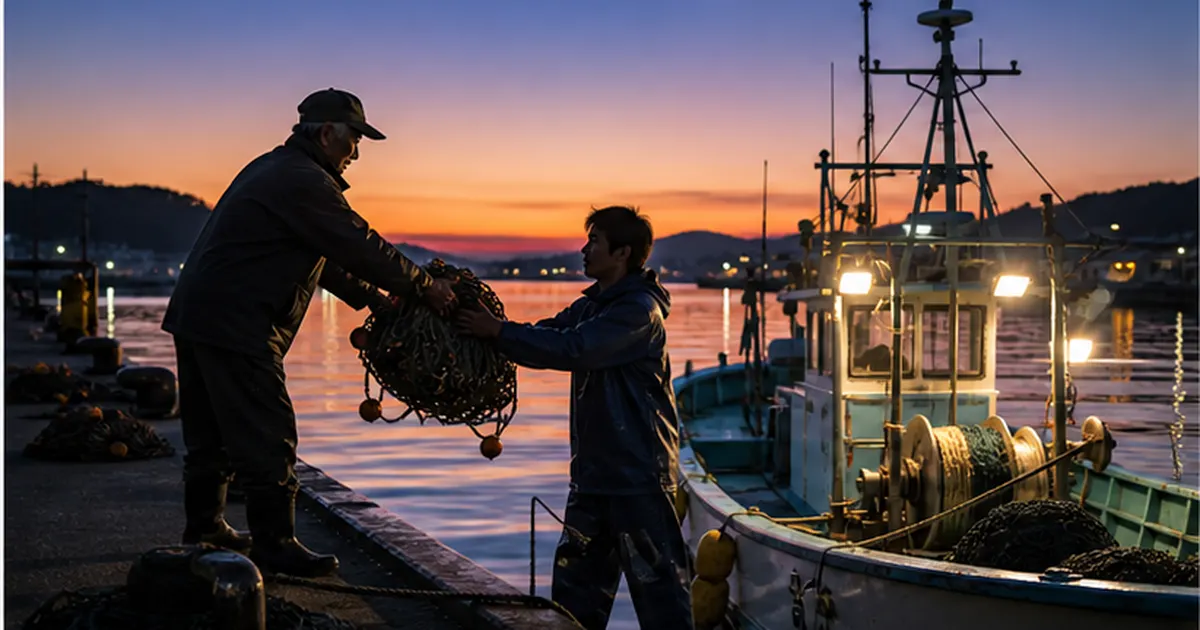
On the Nagara River in Gifu Prefecture, small boats lit with bonfires (kagaribi) still glide across the water every year from May to October, as usho (cormorant masters) guide their trained cormorants with hand-held cords to catch ayu (sweetfish) in a practice known as ukai (cormorant fishing). Said to have continued for over 1,300 years, this is far more than a tourist spectacle — it is a fishing method built around the wisdom of not exhausting a small fishing ground.
Across Japan, alongside ukai, traditional fishing methods that predate modern fishing technology by centuries still survive: yana, which dams a river to wait for fish, and ama divers, who free-dive without oxygen tanks to gather abalone and turban shells. What these methods share is that they limit season, gear, or catch volume by their very nature, so as never to strip the sea or river in front of them bare.
At the same time, the people who carry on these traditional fisheries are disappearing fast. The number of ama divers in Toba-Shima has fallen to one-eighth of what it was 50 years ago, and a shortage of successors is a shared problem in fishing villages nationwide. This article introduces ukai, yana, and ama fishing with concrete figures and sources, examines the resource-management wisdom built into each, why that wisdom is now at risk of being lost, and what efforts are underway in different regions to pass it on.
What you'll learn in this article
- The mechanisms and history behind three traditional fishing methods: ukai, yana, and ama diving
- Why these methods inherently avoid overharvesting
- Concrete resource-management measures in ama fishing: closed seasons, size limits, and seedling releases
- Why the number of people carrying on these traditions is falling so fast, and how regions are working to train successors
- How the Globally Important Agricultural Heritage Systems (GIAHS) program evaluates traditional fisheries
- How this traditional knowledge can inform modern ocean resource management
What Is Traditional Fishing? Built-In Mechanisms That Prevent Overharvesting
The term "traditional fishing" covers a wide range of practices that vary greatly by region and target species. Yet looking across Japan's surviving traditional fisheries, one common thread emerges: a natural limit is built into the gear, the season, or the catch volume itself.
How It Differs From Modern Fishing
Modern fishing methods such as trawl and purse-seine nets can efficiently harvest a wide area at once, but they carry the risk of catching indiscriminately in large volumes. Ukai, yana, and ama fishing, by contrast, all have a physical ceiling on how much can be caught at one time, and the periods and locations where they can be practiced are limited. There is a paradox here: inefficiency itself has become the mechanism that protects the resource.
For example, the cormorants used in ukai can only swallow so much ayu in one night. Yana can only be installed in part of a river, so fish outside the dammed section escape upstream or downstream. In ama fishing, the human lung capacity required for free-diving sets the ceiling on the catch. In every case, the constraint — "even if you wanted to catch more, the structure itself won't allow it" — exists before any rule is written down.
This article looks at these three methods through history, technique, and figures. We begin with ukai's 1,300-year history, move to yana, which dates back to the era of the Kojiki, and then turn to ama diving, whose practitioners are disappearing the fastest today. Finally, drawing on GIAHS recognition and similar cases overseas, we examine how these methods fit into modern ocean resource management.
The Three Methods Covered in This Article
- Ukai: cormorant fishing for ayu and other fish, passed down on rivers such as the Nagara
- Yana: damming a river and guiding fish into a bamboo or wood weir
- Ama: free-diving without oxygen tanks to gather abalone, turban shell, and more
Traditional Fishing and the SDGs
In recent years, these traditional fisheries have drawn renewed attention as early examples of "sustainable fisheries" under SDG 14, with the Fisheries Agency and local museums and research institutions reassessing their value. A structure that prioritizes the persistence of the resource over efficiency has, as a result, sustained these fishing grounds over the long term.
Innovations Born Not to "Protect" but to "Continue"
What matters is that most of these limits were not added later for the sake of environmental protection — they were innovations fishers themselves devised in order to keep fishing for the long haul. Cormorant masters did not tie a ring around a cormorant's throat as part of a conservation movement; they devised it as a way to bring the catch home. Ama divers did not set closed seasons because a law told them to, but as a form of self-preservation to keep making a living from the same fishing ground the following year and beyond. Resources were protected as a result. Understanding this order reveals that traditional fishing was never simply "the old way of doing things" — it was practical knowledge built on a long-term view.
Ukai (Cormorant Fishing): 1,300 Years of Cormorants and Masters
A 1,300-Year-Old Record in the Shosoin Documents
Ukai on the Nagara River in Gifu City is said to have a history spanning over 1,300 years, based on a household register from the Taiho era (early 8th century) preserved in the Shosoin, which is believed to describe a group in Mino Province who made their living from cormorant fishing. The method itself — a master guides a cormorant (umiu) with a hand cord, lets it dive to catch ayu, and pulls up the fish caught in the bird's throat — has barely changed since.
The Special Status of Imperial Household Agency Cormorant Masters
The Nagara River's cormorant masters number six today, and their official title is Imperial Household Agency Ceremonial Cormorant Master. In 1890, three sections of the Nagara River basin were designated imperial hunting grounds (now imperial fishing grounds) and closed to fishing year-round, giving the masters a stable position under the Imperial Household Ministry of the time. Nagara River ukai is the only cormorant fishing in Japan performed for the imperial household, and some of the ayu caught is still presented to the imperial family today. The full set of 122 tools used in ukai is designated a National Important Tangible Folk Cultural Property, and the technique of ukai fishing itself is a National Important Intangible Folk Cultural Property.

The Ring on the Cormorant's Throat: A Built-In Limit on Overharvesting
The most ingenious mechanism in ukai is a ring called the "kubi-yui," tied around the cormorant's neck. Adjusted to lightly constrict the bird's throat, it lets small fish pass through while larger ayu remain lodged in the cormorant's mouth. The master retrieves these, while letting the bird swallow smaller fish as food — naturally controlling how much each bird catches. Rather than a "catch as much as possible" method like nets or rods, the physiological limit of the cormorant itself becomes the ceiling on the catch, which is why ukai can be described as a resource-management system rather than a mere tourist show.
The Bond Between Master and Bird: Two to Three Years to Become Skilled
Ukai depends on far more than the night's fishing. Masters rise around six or seven each morning to check their cormorants' throats and feathers and manage their health, training young birds to become useful in the fishery. It typically takes about two to three years under a master before a young cormorant can work skillfully in an actual fishing run. Year-round care builds trust between master and bird, and that accumulated trust is what allows for coordinated teamwork during the night's fishing. It is this daily care, not just fishing technique, that gets passed down to the next generation.
"Sogarami": The Climactic Group Drive
In Nagara River ukai, a single master handles as many as 10 to 12 cormorants at once with hand cords. The first half of the fishing run is called "karikudari," in which the cormorant boats move downstream alongside the viewing boats, catching ayu along the way. The climax is "sogarami": six masters aboard six boats form a line spanning the width of the river and drive the ayu together toward the shallows all at once. Even this all-out drive, which sweeps the entire fishing ground in a single run, follows a fixed procedure and range each night — it is not a method that expands its reach indefinitely.
11 Sites Nationwide, Many Cormorants From the Same Coast
The Nagara River is not the only place ukai is practiced as a tourist attraction. Cormorant fishing can still be seen at some 11 sites nationwide, including the Kiso River in Inuyama, Aichi Prefecture, and the Uji River in Uji, Kyoto Prefecture. Many of the cormorants used are caught on Ishihama Beach in Hitachi, Ibaraki Prefecture, and then transported to fishing sites around the country — an interesting example of how the fishery's workforce is supported across regional lines.
| Location | River | Notes |
|---|---|---|
| Gifu City, Gifu Prefecture | Nagara River | Performed for the imperial household by Imperial Household Agency cormorant masters |
| Inuyama City, Aichi Prefecture | Kiso River | Held jointly with Kakamigahara City, Gifu Prefecture |
| Uji City, Kyoto Prefecture | Uji River | A long history dating back to Heian-era literature |
Why It Doesn't Overharvest
- A ring (kubi-yui) around the cormorant's throat is adjusted so only larger fish are held back from being swallowed
- There is a limit to how much ayu one cormorant can catch in a single night
- Closed zones and seasons have been historically maintained through the designation of imperial hunting grounds
Yana: Damming a River and Waiting for Fish to "Get Caught"
An Ancient Method Mentioned in the Kojiki and Nihon Shoki
Yana dams a river's flow with wood or stone and guides ayu and other fish drifting downstream into a woven bamboo or wood weir (su) to catch them. References to ayu-catching yana appear in Japan's oldest historical records, the Kojiki and Nihon Shoki, suggesting the method predates the Heian period. Unlike casting a net or a rod, yana has a passive structure — it waits for fish to arrive on the current rather than chasing them.
Gifu's Yana-Setting Technique Becomes a National Treasure
Gifu Prefecture, home to the Nagara, Kiso, and Ibi Rivers, has long been a center of yana fishing. The "yana-setting technique" of the Ibi River was designated a National Important Intangible Folk Cultural Property in 2016. Today, tourist yana sites are still set up on rivers around the country each summer, doubling as restaurants that serve freshly caught ayu drifting downstream. Similar tourist yana sites continue as a summer tradition elsewhere too, including the Yoshino River in Gojo City, Nara Prefecture, and the Mikuma River in Hita City, Oita Prefecture.
Targeting "Ochi-ayu": A Narrow Spawning-Season Window
Most yana fisheries target "ochi-ayu" — ayu heading downstream to spawn in autumn. The yana sites on the Mikuma River in Hita City, Oita Prefecture, carry on this same tradition of catching ochi-ayu, and the ayu of Hita, a town built around its waterways, have long been known nationwide for their abundant catch. The very idea of catching ayu — which die after spawning — specifically during their downstream migration rather than before spawning is itself a choice of timing that preserves the chance to reproduce while still allowing the fishery to operate.
Why Being a "Waiting Fishery" Protects Resources
Rather than chasing fish like a net or rod fishery does, yana waits for fish drifting naturally downstream. As a result, the fishing ground is limited to part of the river's width, and the season is set by region and river. Unlike a method that drives fish together and sweeps them all up at once, individuals upstream or those that avoid the yana are left uncaught, meaning part of the resource is naturally preserved.
In addition, the right to install a yana, and its location, are managed by local fisheries cooperatives — anyone cannot simply set one up freely. By limiting the period and location where yana can be installed, fishing pressure across the river as a whole is kept from concentrating too heavily on any one spot or season.
Key Points on Yana Fishing
- A method that artificially dams a river and guides drifting fish into a weir to catch them
- So old it is mentioned in the Kojiki and Nihon Shoki
- The Ibi River's "yana-setting technique" in Gifu is a National Important Intangible Folk Cultural Property
- Limited seasons and locations make it structurally difficult to overharvest
Ama Divers: The Skill of Women Who Live With the Sea
Why They Don't Use Oxygen Tanks
Ama are fishers who, without oxygen tanks or other diving equipment, hold their breath and dive to the seafloor to gather abalone, turban shell, sea cucumber, and more. The practice is passed down along coastlines across Japan, centered on Toba and Shima in Mie Prefecture but also found in Wakasa Bay (Fukui Prefecture) and Wajima (Ishikawa Prefecture). Ama divers themselves often explain that they avoid oxygen tanks not simply out of tradition, but because limiting how long and how often they can dive in one session naturally prevents overharvesting — testimony documented in surveys by Mie Prefecture and others.
Designated a National Important Intangible Folk Cultural Property
"The Ama Diving Techniques of Toba and Shima" was designated a National Important Intangible Folk Cultural Property on March 3, 2017 — the first time ama fishing had been designated as a cultural property in Japan, and efforts continue toward eventual UNESCO Intangible Cultural Heritage recognition. In Wajima, Ishikawa Prefecture, "The Ama Diving Techniques of Wajima" also holds this designation, and Wajima's roughly 200 practicing ama divers make it the second-largest such community in Japan after Toba-Shima.
Abalone and Turban Shell Are "Sedentary Resources" That Vanish If Overharvested
Abalone, turban shell, and sea cucumber are known as "sedentary resources" (netsuki shigen) with a very limited range of movement — overharvest one spot and the population there can disappear entirely. Unlike migratory fish, new individuals rarely flow in from other waters, so if local fishers don't protect the resource themselves, that fishing ground may never recover. This is why strict, community-wide resource management has long been practiced in Toba-Shima's ama fishery.
Ama Gear: From Cotton Diving Suits to Wetsuits
Ama once entered the water wearing a white cotton diving garment called an isogi. White is thought to appear visually larger, helping deter sharks, and this thin isogi remained in use in the Toba-Shima region until wetsuits were introduced in the 1960s. To pry abalone from the rocks, ama use a tool called an isonomi, and place their catch in a wooden tub about 60cm in diameter called an isooke (tarai) — a container that also doubles as a float to support the diver's body when she surfaces to rest. While the gear itself has changed over time, the most important rule — never using an oxygen tank, fishing only within the range of one's own lung capacity — has held even through this modernization of equipment.
A 50-Second Dive: How Physical Limits Set the Catch
A single ama dive lasts roughly 50 seconds to a minute and a half, with an average diving depth of around 10 meters and a limit of about 15 to 20 meters for the deepest divers. In that brief window, a diver must spot her target abalone or turban shell, gather it, and return to the surface. An oxygen tank could greatly extend dive time and increase the catch, but ama fishing deliberately does without one. The physiological limit of human lung capacity itself sets the ceiling on how much a single diver can gather in a day — an example, much like the ring on a cormorant's throat, of a bodily constraint rather than a piece of equipment doing the work of resource management.

Ama Resource Management: Closed Seasons, Size Limits, Seedling Releases
Mie Prefecture's Concrete Rules
Ama fishing in Mie Prefecture observes a closed season (roughly October through February) and limits on the hours diving is permitted. Abalone below a shell length of 10.5cm must be returned to the sea, a size-limit custom that local fisheries cooperatives enforce as a self-imposed rule. Deliberately leaving smaller abalone uncaught protects individuals that have not yet finished spawning, preserving the resource for the following year and beyond.
Annual Release of Juvenile Abalone
Resource management isn't only about restraint. Ama fisheries cooperatives in Mie Prefecture also release around 20,000 juvenile abalone each summer — an effort that runs alongside catch limits to actively grow the resource. Combining seedling releases with closed seasons and size limits reflects an approach that manages both the "inflow" and "outflow" of the resource.
Parallels With the Fisheries Agency's Modern Resource Management
Modern resource-management approaches promoted by the Fisheries Agency, such as the Total Allowable Catch (TAC) system, ultimately share the same underlying idea as ama fishing's long-standing community self-regulation: set rules to prevent overharvesting, and have everyone follow them. If there is a difference, it's that ama fishing's rules were not imposed from above by government, but built up over generations by the fishers who actually use the resource.
| Measure | Details |
|---|---|
| Closed season | No abalone fishing roughly from October to February |
| Catch size limit | Abalone under 10.5cm shell length are returned to the sea |
| Operating hour limits | Restrictions on diving hours and frequency per day |
| Seedling release | Around 20,000 juvenile abalone released each summer |
Why the Number of Traditional Fishers Is Falling Today
Ama Divers Down to One-Eighth in 50 Years
According to a survey by the Toba Sea-Folk Museum, which has tracked ama numbers in Toba and Shima since 1972, the count fell from 4,124 in 1972 to 514 in 2022 — roughly one-eighth in about 50 years — with a decline of 146 people (22%) in just the five years from 2017 to 2022 alone. Over an even longer span, one survey puts the number of ama in Toba and Shima at 6,109 as of 1949, meaning the decline since the postwar period is even steeper.
Aging Populations and Declining Catches
Beyond the aging of ama divers themselves, declining abalone and turban shell populations — driven by isoyake (a phenomenon in which seaweed disappears and rocky reefs deteriorate) and changing water temperatures — are cited as reasons fewer young people are becoming ama. The heavy physical toll of free-diving also makes it harder to secure successors.
Concrete Efforts to Increase Successors
Toba City runs a program that subsidizes the cost of equipment, such as wetsuits, for women newly taking up ama fishing. The Toba Tourism Association also runs an "Ama Support Plan" in partnership with a travel website, using the funds raised to support successor training. In one case, a woman who moved from Tokyo as a member of a local revitalization corps settled in Toba and became a trainee ama diver — an example of the growing trend of pairing migration and settlement policies with the transmission of traditional fisheries.
A Successor Shortage Shared With Ukai and Yana
Ukai's cormorant masters and yana's fishers face the same aging and successor shortage. Nagara River's masters are largely hereditary, but how to train the next generation is a challenge shared across traditional fisheries nationwide, and regions and municipalities are increasingly combining tourism promotion with support for training successors.
What these successor shortages have in common is a structure in which passing down skills takes a long time, while the outlook for income and livelihood remains uncertain. Becoming a cormorant master requires years of training, including the daily care of cormorants; becoming an ama diver requires physically learning risky free-diving skills. Jobs that take a long time before someone can earn a living from them are hard to fill with successors in an era when other career paths are available. Government support programs and tourism revenue are, in a sense, practical answers to the question of how to sustain someone's livelihood during that training period.

The Wisdom of Satoyama-Satoumi Seen in GIAHS
Traditional Resource Use as Valued by the FAO
The Globally Important Agricultural Heritage Systems (GIAHS) program, launched by the UN Food and Agriculture Organization (FAO) in 2002, evaluates traditional agriculture, forestry, and fisheries together with the landscapes, biodiversity, and culture rooted in them.
"Noto's Satoyama and Satoumi": Japan's First GIAHS Site
In June 2011, "Noto's Satoyama and Satoumi" in Ishikawa Prefecture became Japan's first GIAHS site, recognized alongside "Sado's Satoyama in Harmony with the Toki" in Niigata Prefecture. The designation covers agriculture, forestry, and fisheries — and the way of life built around them — across four cities and five towns in the Noto region (Nanao, Wajima, Suzu, Hakui, Shika, Nakanoto, Anamizu, Noto, and Hodatsushimizu). The area where Wajima's ama diving technique is practiced falls within this Noto Satoyama-Satoumi region.
"Ayu of the Nagara River System": A GIAHS Including Ukai and Yana
The Nagara River itself, where ukai and yana are practiced, was recognized as a GIAHS site on December 15, 2015, under the name "Ayu of the Nagara River System." The designation covers the entire "Nagara River system," in which a clear river is maintained from the upper to middle reaches — even as it flows through an urban area home to about 860,000 people — and ayu thrive in those clear waters. Ukai and yana are positioned within this system as concrete forms of fishing that have sustained the relationship between people, the river, and ayu for centuries.
Managing Land and Sea as One System
What GIAHS values is that satoyama (villages, farmland, secondary forests) and satokawa/satoumi (coastal or river fishing grounds) are not treated separately — that appropriate human intervention has sustained both biodiversity and productivity over a long period. Traditional fisheries like ukai, yana, and ama diving can be seen as an extension of this same idea: that resources are sustained precisely because people continue to engage with them.
GIAHS Recognition Spreading Across Japan
As of November 2023, GIAHS included 86 sites across 26 countries worldwide, 15 of them in Japan. These cover a wide range of agricultural, forestry, and fishery practices, including the Nishi-Awa region of Tokushima Prefecture, the Lake Biwa region of Shiga Prefecture, the Aso region of Kumamoto Prefecture, and the Kunisaki Peninsula-Usa region of Oita Prefecture. Noto's Satoyama-Satoumi and the Ayu of the Nagara River System stand out among them as representative examples that include coastal and river fisheries. The number of designated sites has continued to grow since, reflecting rising international interest in traditional approaches to resource use.

Similar Traditional Fisheries Found Overseas
Jeju's Haenyeo: Ama Culture Recognized by UNESCO First
Free-diving fisheries like Japan's ama are not unique to Japan. On South Korea's Jeju Island, divers called "haenyeo" use no mechanical equipment at all, holding their breath to dive more than 10 meters to gather abalone, turban shell, and seaweed. Jeju Island is home to nearly 4,000 practicing haenyeo, and "Jeju Haenyeo Culture" — encompassing their diving skills, deep knowledge of marine ecology, and safety rituals — was inscribed on the UNESCO Representative List of the Intangible Cultural Heritage of Humanity in 2016. Jeju's haenyeo fishery has also itself been recognized as a GIAHS site by the UN Food and Agriculture Organization. As Japan's ama culture seeks its own UNESCO recognition, Jeju represents a case that achieved this distinction first.
Cormorant Fishing on China's Li River: A Method That Survived as Tourism
In Guilin, in China's Guangxi Zhuang Autonomous Region, cormorant fishing known as "luci" has long been practiced on the Li River using trained cormorants. It, too, is said to have begun around 1,300 years ago — roughly the same length of history as Nagara River ukai. Its role as a practical fishery has largely disappeared, and today it continues mainly as a tourist experience — but the way it has preserved its technique as a tourist attraction and cultural asset even after it stopped functioning as a working fishery echoes how Japan's ukai sustains its skills through tourism revenue.
| Region | Method | Target | Recognition/Designation |
|---|---|---|---|
| Japan (Nagara River, etc.) | Ukai | Ayu | National Important Intangible Folk Cultural Property; GIAHS (Nagara River) |
| Japan (Toba-Shima, Wajima) | Ama | Abalone, turban shell | National Important Intangible Folk Cultural Property; pursuing UNESCO recognition |
| South Korea (Jeju Island) | Haenyeo (ama) | Abalone, turban shell, seaweed | UNESCO Intangible Cultural Heritage (2016); GIAHS |
| China (Guilin) | Luci (cormorant fishing) | River fish | Intangible cultural heritage; continues as a tourist experience |
What They Have in Common
Regardless of country or region, fisheries that use cormorants or that free-dive for sedentary resources share the same trait: there is a physiological ceiling on how much can be caught at once. These methods are recognized around the world as intangible cultural heritage or globally important agricultural heritage not simply because they are old, but because of their proven record of coexisting with the resource.
Traditional Wisdom at Work Today: Tourism, Education, and Local Efforts
Balancing Tourism and Fishing
Nagara River ukai today draws large numbers of viewing-boat visitors year-round as a tourism resource. Even though the actual catch remains limited, tourism revenue supports the masters' livelihoods and the transmission of their skills — a structure in which fishing and tourism complement each other. Demonstrations and experiences of ama diving at ama huts serve a similar role, sustaining both skill and income through tourism. There are also reports of growing interest among inbound visitors in the rarity of women free-diving as ama or fishing with birds as in ukai, raising hopes that this interest could help address the successor shortage.
The Idea of Community-Made Rules
The closed seasons and size limits in ama fishing were not imposed uniformly by law — they were set and upheld as self-made rules by local fisheries cooperatives. Rather than relying solely on government regulation, the idea that those who use a resource make the rules themselves and uphold them across generations remains an important perspective for modern ocean resource management.
A Place to Teach Children How Fishing Works
Ukai viewing boats, ama huts, and yana-site restaurants also give local children a chance to learn the history and mechanics of their region's fisheries. Why is there a closed season? Why are small abalone returned to the sea? Why is a ring tied around a cormorant's throat? Adults being able to explain each of these details is the first step toward passing the meaning of traditional fishing to the next generation. Passing on not just the technique but the reasoning behind why things have been done this way is a challenge that stands alongside training successors.
Related Articles
On the theme of managing fisheries resources, see also Why Do Fish Stocks Collapse From Overfishing?, which covers cases of resource collapse from overharvesting, and What Are Marine Protected Areas (MPAs)?, which introduces the concept of closed zones. The background behind the successor shortage shared by traditional fisheries is discussed in detail in Why Is Japan's Fishing Workforce Shortage So Serious?.

What We Can Do
- Experience traditional fishing firsthand, such as watching ukai or visiting an ama hut, when traveling
- Be mindful of the origin and fishing method when choosing sedentary-resource seafood like abalone and turban shell, which ama fishing has long protected
- Take an interest in why local resource-management rules were set the way they were
References and Sources
- Nagara River Ukai (Gifu City official site) – On its 1,300-plus-year history and the Imperial Household Agency cormorant masters
- Gifu Prefecture Tourism Official Site – On the history and cultural value of Nagara River ukai
- Nippon Tabi Magazine, "Ukai: A Complete Guide to 11 Sites Nationwide" – On ukai locations nationwide and the origin of the cormorants used
- Michi-no-eki Toju-no-Sato Adogawa – On the mechanism and history of the traditional yana fishing method
- Mie Prefecture Cultural Properties Division, "Ama Diving Techniques as a Cultural Property" – On the designation of Toba-Shima ama diving as a National Important Intangible Folk Cultural Property
- Nikkei, "Mie/Shima's 514 Ama Divers, One-Eighth of 50 Years Ago" – Data on the trend in ama diver numbers (1972–2022)
- Sasakawa Peace Foundation Ocean Policy Research Institute, "Toward UNESCO Recognition for Ama Culture" – On the push for UNESCO recognition of ama culture
- Mie University, "Environmental and SDGs Report 2022" – On ama fishing methods that coexist with the natural environment
- "Noto's Satoyama and Satoumi" GIAHS Information Portal – On the GIAHS program and the history of Noto Satoyama-Satoumi's recognition
- Gifu Prefecture, "Overview of the GIAHS Site 'Ayu of the Nagara River System'" – On the 2015 GIAHS recognition and the Nagara River system
- Japan Fisheries Agency, "Resource Management Room" – On the TAC system and other modern resource-management approaches
*Listed in order of reliability: government/academic institutions > peer-reviewed papers > specialized organizations > reputable media