⚡ The answer in 30 seconds
- Hokkaido's sea cucumber catch fell from the 2007 peak of 2,831 tonnes to 1,779 tonnes (¥8.7 billion) in 2023.
- Management rests on voluntary rules by cooperative committees: protected areas, seasons and weight limits.
- Seed release is expanding, but survival after release is still not well understood.
The Japanese sea cucumber caught in Hokkaido's waters is a high-value seafood exported dried to Chinese-speaking markets.
The catch has kept falling since its 2007 peak, raising the question of how to protect the stock.
Based on fisheries experiment stations and public sources, this article reviews the ecology, catch, exports, management and seed release of sea cucumbers.
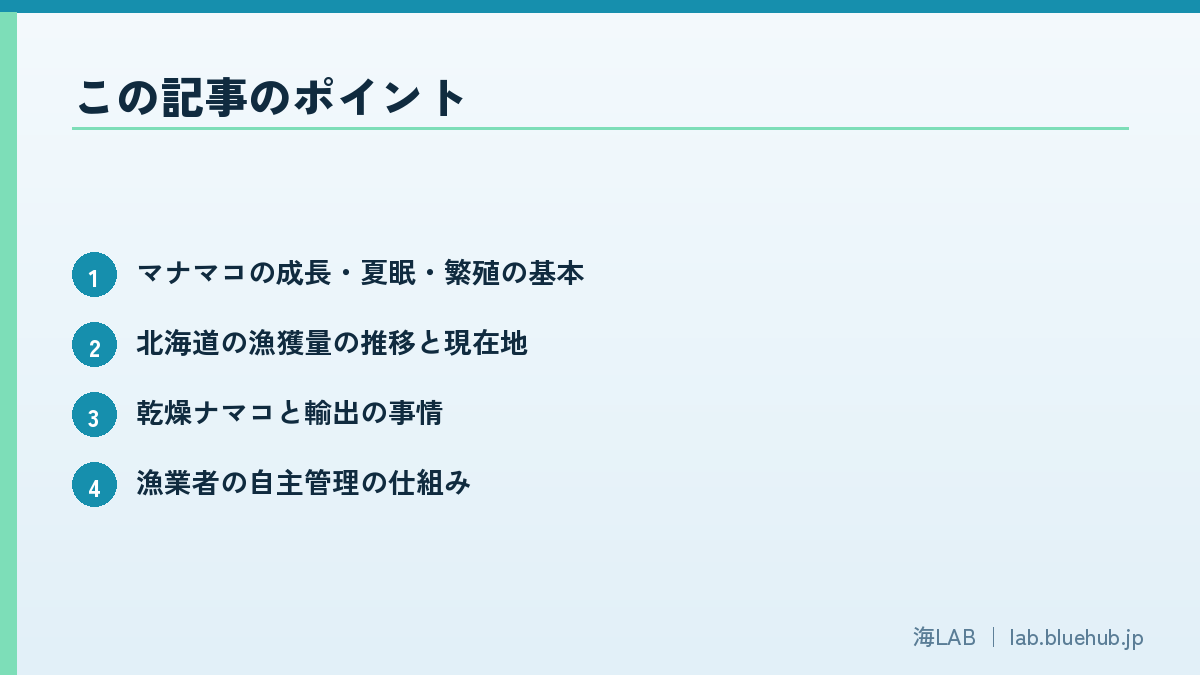
What you will learn
- Basics of growth, aestivation and reproduction
- Trends in Hokkaido's catch and where it stands today
- Dried sea cucumber and export conditions
- How voluntary management by fishers works
- Results and challenges of seed release
What Is a Sea Cucumber? The Seafloor Cleaner of Hokkaido
The basics of the Japanese sea cucumber
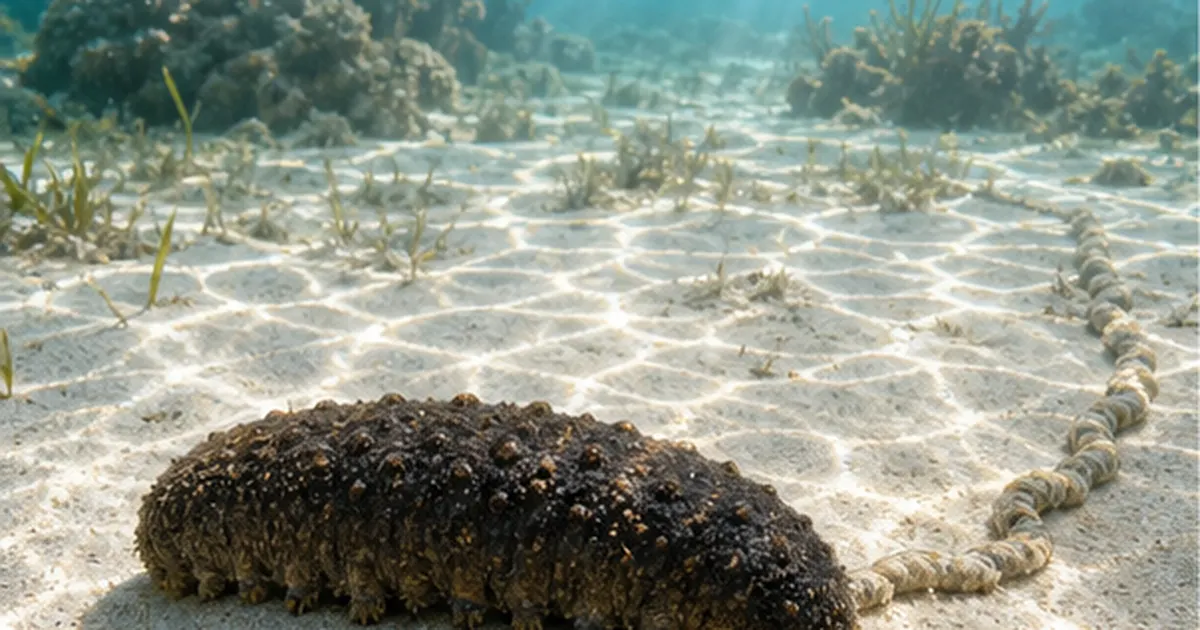
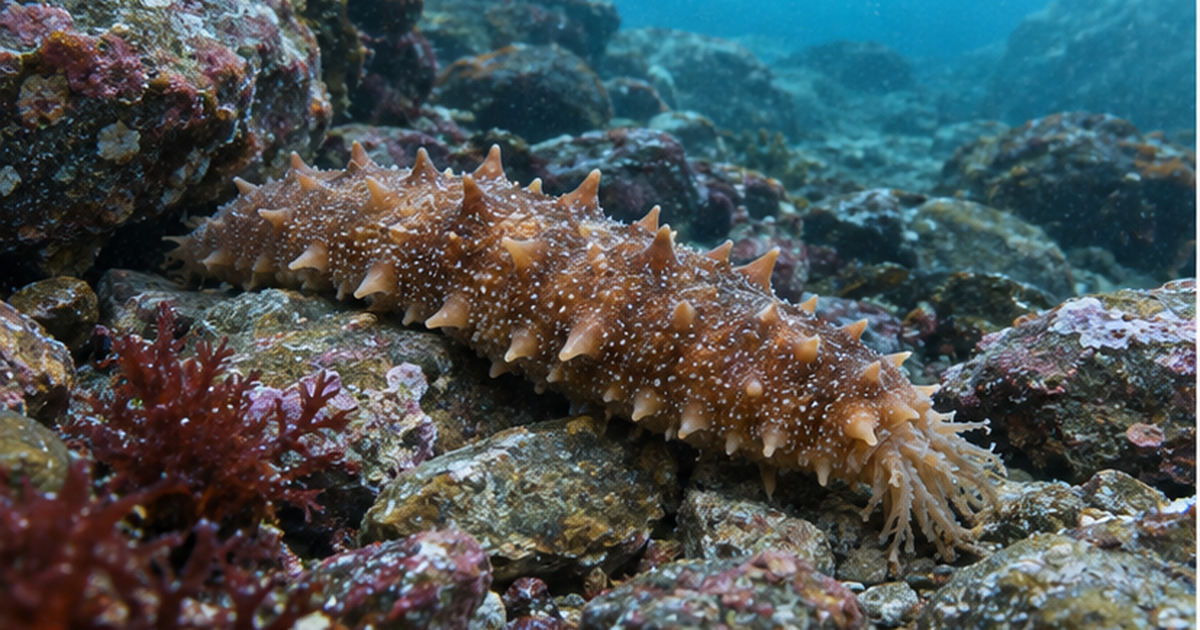
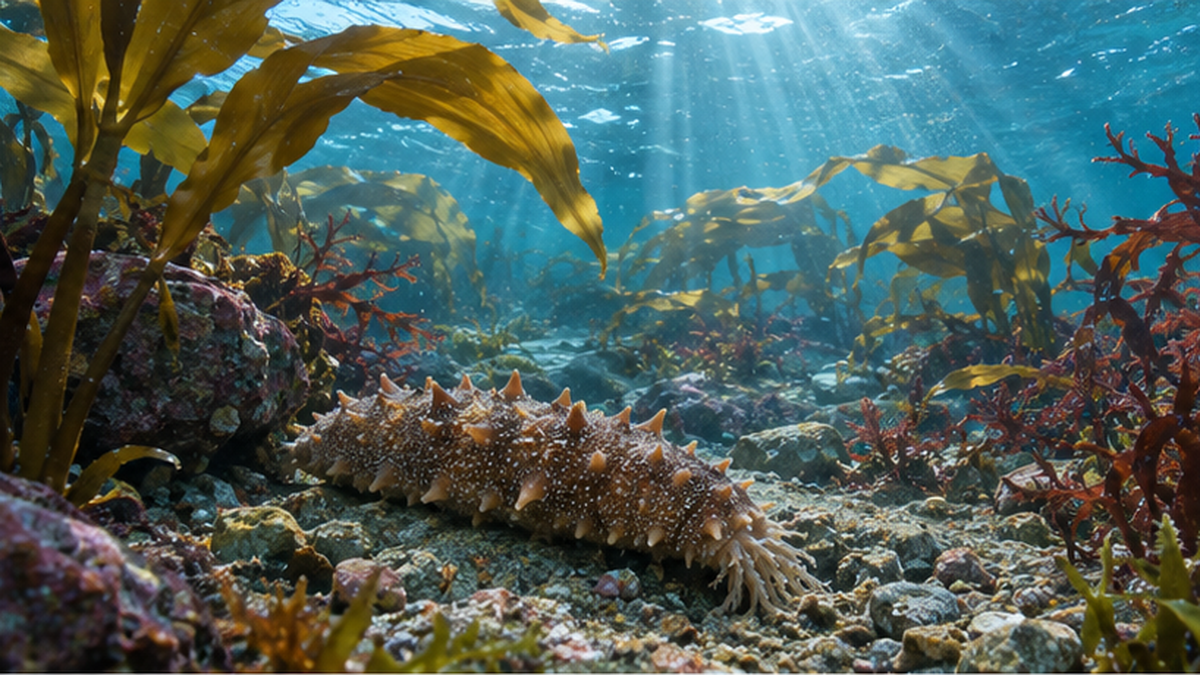
The main species fished and farmed in Japan is the Japanese sea cucumber (Apostichopus japonicus). An echinoderm related to sea urchins and starfish, it crawls slowly over rocky and gravelly seabeds and feeds on organic matter and fine algae in the sediment. It is divided by body color into "blue," "red," and "black" types.
In Japan it has long been eaten simmered, vinegared, or as konowata (salted intestines) and konoko (processed ovaries). In Chinese-speaking regions, dried and rehydrated sea cucumber (haishen) has long been prized as a luxury and tonic food. This demand has strongly shaped coastal fisheries in Hokkaido and Tohoku.
Growth, lifespan and reproduction
According to Aomori Prefecture, the Japanese sea cucumber lives about 7–8 years and matures at 130 g or more (females) and 87 g or more (males). Males begin to breed around age 2 and females around age 3. Spawning runs from April to July at about 13–16°C. In Mutsu Bay, individuals reach around 30 g at age 1, though variation is large. One source also notes growth of about 60 g per year from age 2.
In short, it takes several years to reach harvestable size, so this is a slow-growing resource that recovers slowly if overfished.
Aestivation: the summer sleep
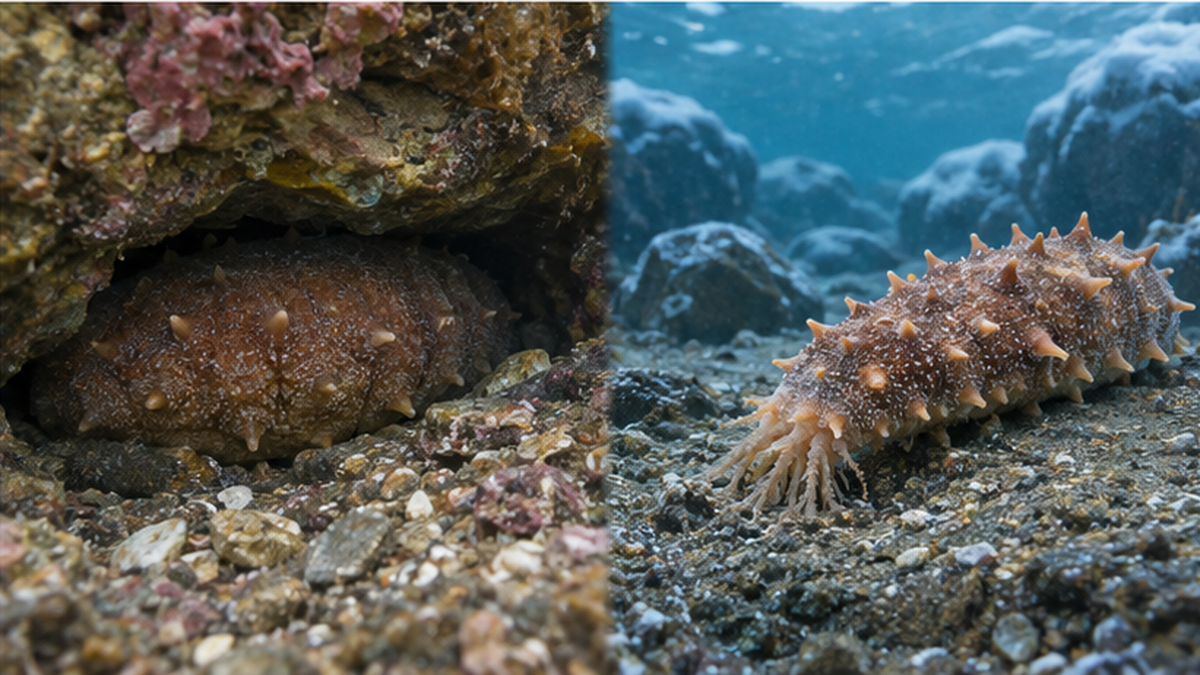
When the water temperature exceeds about 20°C, the animals hide in gaps between rocks and enter a dormant state called aestivation. They barely feed and lose weight. When the water cools in autumn they resume feeding and growing. Iwate Prefecture also explains that they do not feed in the high-temperature season after spawning.
Key points
- Sea cucumbers live on a seasonal cycle: they gain weight in winter and lose it in summer
- Because of aestivation, hot years can affect growth and survival
- With a lifespan of several years and slow growth, stock recovery takes years of management
Hokkaido's Sea Cucumber Fishery: Catch and Industry Today
1,779 tonnes and ¥8.7 billion in 2023
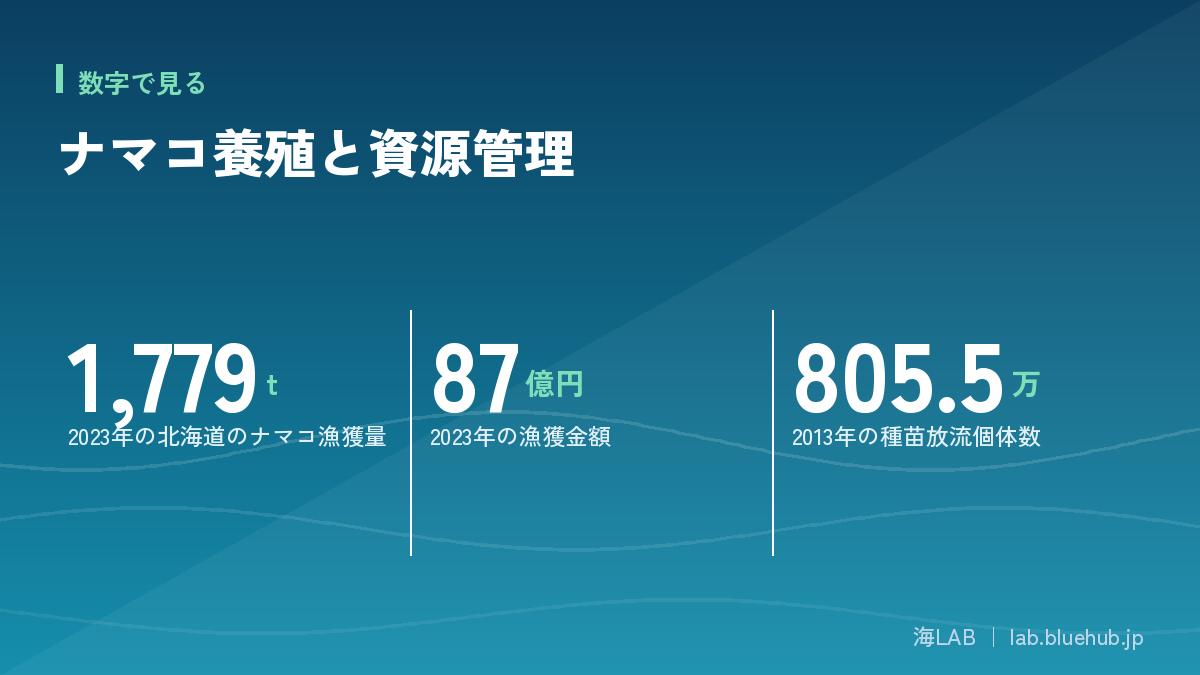
According to the Hokkaido Research Organization's fisheries experiment stations, Hokkaido's Japanese sea cucumber catch was 1,779 tonnes in 2023, worth ¥8.7 billion. That is roughly ¥4.9 million per tonne (about ¥4,900 per kg), showing how important this small animal is to coastal fishing income.
Decline from the peak
The catch peaked at 2,831 tonnes in 2007 and has trended downward since, raising concern about stock decline. The 2023 catch is about 37% below 2007 (calculated from 1,779 ÷ 2,831). High prices are thought to have increased fishing pressure.
| Year | Catch | Note |
|---|---|---|
| 2007 | 2,831 t | Peak |
| 2023 | 1,779 t | Catch value ¥8.7 billion |
Place within Japan
Hokkaido's fisheries stations describe Hokkaido's output as about one quarter of Japan's total and an important processed and export product. Note that this share comes mainly from descriptions dating to the late 2000s, so the latest figures should be checked in statistics.
Fishing methods
Methods vary by region and include dragging dredge nets across the seabed and hand-harvesting by diving. Methods are chosen to suit local stock and seabed conditions, and each fishery cooperative sets its own rules on gear and operating hours.
Dried Sea Cucumber and Exports: Why It Fetches High Prices
What is dried sea cucumber?
Dried sea cucumber is a shelf-stable food made by processing and drying the animal. In Chinese-speaking regions it is rehydrated and used in braised dishes. Drying makes a perishable product transportable over long distances. Hokkaido's fisheries stations also describe dried sea cucumber as an important processed and export product.
Scale of Japan's sea cucumber exports
According to JETRO, Japan's sea cucumber exports in 2023 fell 13.8% year on year to US$137.58 million, and by volume fell 22.9% to 400 tonnes. Most are exported dried or prepared, and Hong Kong is the top destination by value.
Impact of China's import suspension
China has suspended imports of Japanese seafood since August 24, 2023. Because sea cucumber depends heavily on Chinese-speaking markets, changes in the market environment affect producers' prices and shipping strategies. The latest status of any resumption should be checked in official announcements from the Fisheries Agency and the Ministry of Foreign Affairs.
How to read the numbers
- The export value and volume shown are for sea cucumbers overall, not only dried products
- The latest figures for dried sea cucumber alone can be found in Ministry of Finance trade statistics by item
- Exchange rates and Chinese market regulations make annual values swing widely
How Stocks Are Managed: Voluntary Management by Fishers
Input controls and output controls
Stock management of the Japanese sea cucumber in Hokkaido is based on voluntary management by fishers. Sea cucumber committees of each fishery cooperative or branch decide and enforce rules such as the following.
- Input controls: designating protected areas, limiting the fishing season, limiting operating hours
- Output controls: limiting the weight of harvested individuals, limiting the catch volume
Input controls restrict where, when and for how long fishing occurs; output controls restrict the size and quantity of what is caught. Combining both protects young animals before they take part in spawning.
The Hokkaido Sea Cucumber Management Guidelines
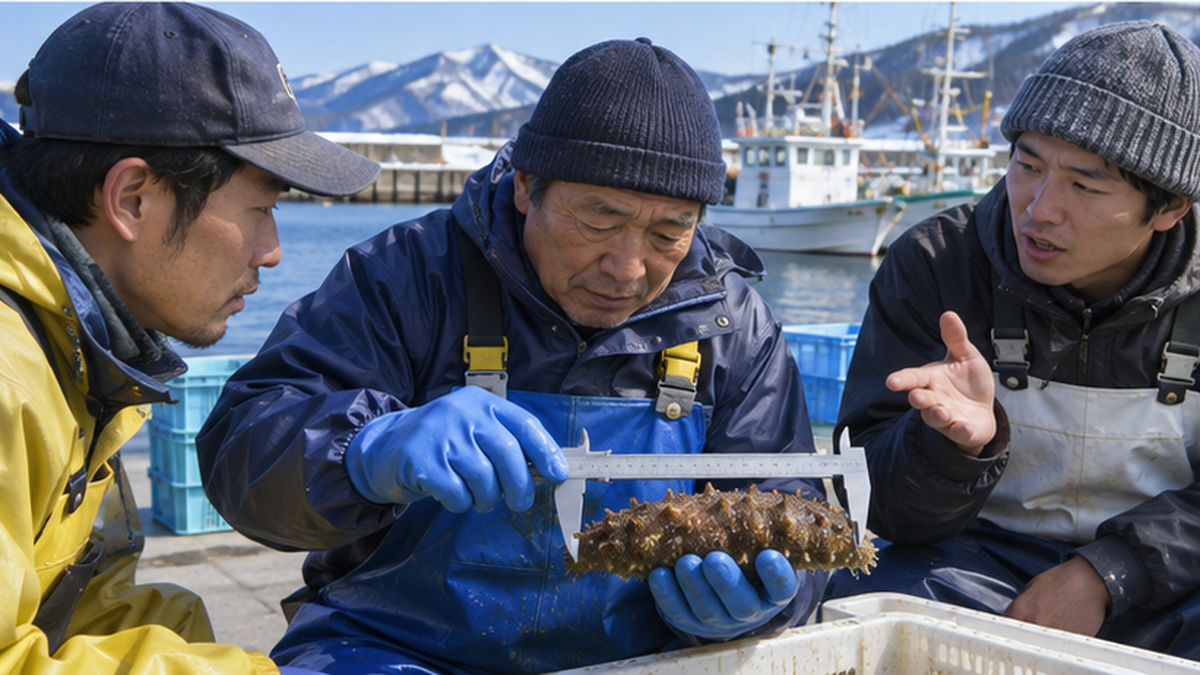
In 2014 the fisheries experiment stations published the "Hokkaido Sea Cucumber Stock Management Guidelines," a manual for advancing management based on objective stock assessment. To measure the effect of management, it is essential to grasp numbers and sizes through stock surveys, not just catch volume.
Strengths and challenges of voluntary management
- Strength: fishers who know local conditions can decide flexibly for each area
- Challenge: countering poaching and responding to climate-driven stock variation
- Challenge: securing staff and budget for the surveys that stock assessment needs
We could not confirm a uniform Hokkaido-wide size limit. Fisheries regulations and cooperative agreements in each area should be checked individually.
Seed Production and Release: Efforts to Increase Stocks
Expansion of releases
Driven by rising prices, seed production and release of sea cucumbers have become widespread. In 2013, 8.055 million juveniles were released by 35 organizations. Juveniles just after settlement can be mass-produced in a short time and small space, and are cheap.
Release size and retention
Seed is generally released at a size from just after settlement up to about 20 mm. However, it is known that rearing to about 30 mm raises the proportion that remains at the release site (retention rate), and technology to efficiently produce larger seed is being developed.
Remaining challenges
On the other hand, little is known about how many released juveniles survive. Identifying suitable release sites and follow-up surveys are challenges. Release is not a substitute for stock management; it is best seen as a supplementary measure combined with catch limits.
Do not expect too much from releases
- Because survival is not well understood, releases alone cannot be said to restore stocks
- They must go hand in hand with compliance with fishing rules
Toward Sustainable Fishing: Climate Change and Poaching
Effects of high water temperature
Because of aestivation, Japanese sea cucumbers are affected by how long the water stays above about 20°C. Prolonged summer heat may lengthen the non-feeding period and increase weight loss. For ocean warming and fish stocks, see also our article on ocean warming and fisheries.
Poaching and stock uncertainty
High prices also tend to invite illegal harvest (poaching). Illegal catches undermine the catch data on which management depends and reduce the accuracy of stock assessment. The global problem of illegal fishing is explained in our article on IUU fishing.
The science that supports management
- Regular stock surveys and accumulation of catch data
- Review of protected areas and seasons in each area
- Verification of the effects of seed release
- Understanding the relationship between water temperature and growth
Sea Cucumbers in the Ecosystem: Tilling the Seabed
Animals that eat sediment
Sea cucumbers take seafloor mud and sand into their mouths, use the organic matter in it as nutrition and excrete the rest. This behavior is thought to stir the sediment and help decompose organic matter. The roles of sea cucumbers are also covered in our article on their ecosystem role.
Effects of overfishing
If sea cucumbers decline, the cycling of organic matter on the seafloor may be affected. However, the size of the specific effect along Hokkaido's coast is not well understood. With stocks of concern, managing the catch appropriately protects both fisheries and the ecosystem.
Lessons from overfishing and stock collapse
Stock collapse from overfishing has occurred around the world. Mechanisms and cases are introduced in our article on overfishing and stock collapse. Slow-growing, high-priced resources like sea cucumbers need particular care.
What Consumers and Communities Can Do: Passing Sea Cucumbers On
Our choices as eaters
When eating sea cucumber, a first step is to take an interest in where it came from and how it was caught. Choosing products from areas where fishery cooperatives practice voluntary management supports the fishers who keep it going.
Supporting local efforts
- Buy at local markets or direct from producers, knowing the fishing season
- Read stock information published by cooperatives and fisheries experiment stations
- If you witness poaching, report it to the Japan Coast Guard or police
Challenges ahead
Many challenges remain: improving stock assessment, adapting to climate change, and responding to export market swings. The sustainable use of sea cucumbers is a fine subject for thinking about what it means to keep using the sea's bounty.
Summary
- Hokkaido's catch was 1,779 tonnes and ¥8.7 billion in 2023, down from the 2007 peak of 2,831 tonnes
- Management rests on voluntary rules by fishers (protected areas, seasons, weight limits)
- Seed release is expanding, but understanding survival remains a challenge
- Aestivation, high temperatures and poaching all drive stock variation
References and Sources
- Hokkaido Research Organization, Fisheries Experiment Stations (sea cucumber stock materials) – Catch and stock management
- Hokkaido Research Organization, Fisheries Experiment Stations (sea cucumber stock materials) – Catch and management
- Hokkaido Research Organization, Fisheries Experiment Stations (seed production materials) – Seed production
- Aomori Prefectural Industrial Technology Center (sea cucumber materials) – Ecology and growth
- Iwate Prefecture (sea cucumber seed release guide) – Aestivation and release
- JETRO (materials on sea cucumber exports) – Export trends
* Listed in order of reliability: government and academic institutions > peer-reviewed papers > specialist organizations > reliable media.