Pull out the single stone at the top of a stone arch bridge — the keystone — and the whole structure collapses. Ecosystems have something similar: a creature that accounts for only a tiny share of the total biomass, yet whose disappearance transforms the entire landscape. We call it a keystone species.
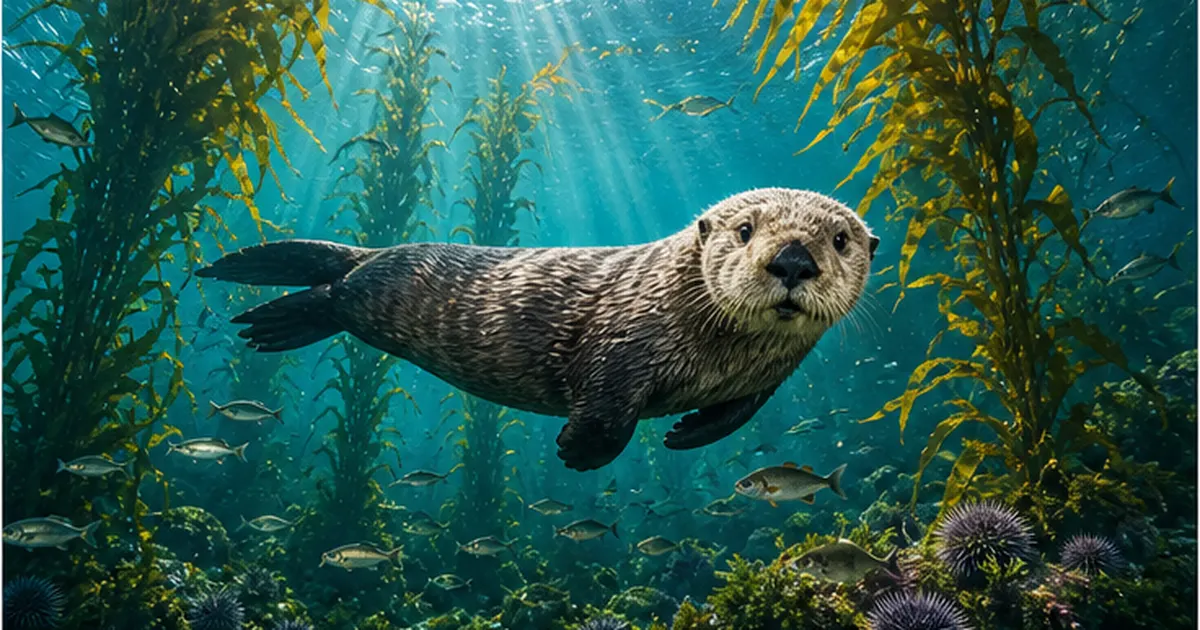
The most famous example is the sea otter. Where otters live, kelp (large brown seaweed) rises meters through the water in dense underwater forests teeming with fish and invertebrates. Where otters are gone, sea urchins multiply explosively, graze the kelp away, and leave behind a bare, desolate rock bottom. That stark contrast has appeared in ecology textbooks for half a century.
This article traces the scientific reasons the sea otter is called the keystone of the sea, from the classic 1974 study through findings published in 2025. Along the way we cover the fur trade that nearly erased otters from the North Pacific, their unexpected link to climate change, and the roughly 50 wild otters that have quietly returned to eastern Hokkaido — all drawn from public agencies and peer-reviewed research.
What you'll learn in this article
- How the term "keystone species" was born, and why the sea otter became its best-known example
- How the three-step trophic cascade of otter to urchin to kelp actually works
- What happened to seas where the fur trade removed otters, and how far protection has brought them back
- How otters connect to carbon storage and seagrass recovery through kelp forests
- The current status of Japan's wild sea otters in eastern Hokkaido, and the risks they face
- Why "bring back the keystone species and the ecosystem recovers" is not that simple (2025 research)
What Kind of Animal Is a Sea Otter? A Marine Mammal With No Blubber That Must Keep Eating
The sea otter (Enhydra lutris) is a marine mammal belonging to the family Mustelidae — the same family as river otters and weasels. It is among the largest mustelids, yet among the smallest of all marine mammals. Its range follows the North Pacific coastline from Hokkaido through the Kuril and Aleutian Islands, Alaska, British Columbia in Canada, and down to California.
An unusual evolutionary path: a weasel relative that went to sea
Whales and seals returned to the ocean tens of millions of years ago. The sea otter's ancestors, by contrast, adapted to marine life relatively recently. As a result, the sea otter lives in the sea while lacking some of the standard equipment of a marine mammal. Its greatest vulnerability is the absence of the thick layer of blubber that whales and seals rely on.
| Item | Details |
|---|---|
| Scientific name | Enhydra lutris (family Mustelidae, genus Enhydra) |
| Range | North Pacific coasts (eastern Hokkaido, Kurils, Aleutians, Alaska, California) |
| Size | Roughly 1-1.5 m long; males around 30 kg, females smaller |
| Main prey | Benthic invertebrates such as sea urchins, shellfish, crabs and octopus |
| Conservation status | IUCN Red List: Endangered (EN) / Japan Ministry of the Environment Red List: Critically Endangered (CR) |
| Key trait | No blubber; maintains body heat through extraordinarily dense fur and a high metabolic rate |
The densest fur in the animal kingdom
In place of blubber, the sea otter evolved fur of exceptional density, even among mammals. According to Toba Aquarium, that density reaches roughly 100,000 hairs per square centimeter — 800 million to 1 billion hairs across the whole body. Dozens of hairs growing from a single follicle make this density possible.
The fur's role is not simply to cover the body. It is to trap a layer of air between the hairs and insulate with that air. This is why sea otters spend so much time at the surface rubbing and grooming themselves: they are maintaining that air layer. Conversely, once the fur becomes fouled and can no longer hold air, an otter loses body heat almost immediately. Oil spills are so lethal to sea otters not primarily because of toxicity, but because the insulation itself is destroyed.
The same fur created both the vulnerability and the value
- Extremely dense, air-trapping fur is the sea otter's lifeline and its thermal regulation system
- That same beauty and warmth triggered a global fur trade in the 18th and 19th centuries
- Oil pollution destroys the fur's insulating function, making it an especially dangerous threat
Eating 20 to 30 percent of its body weight every day
Because fur alone is not enough insulation, sea otters survive cold water by continuously generating heat internally. Their metabolic rate is therefore very high, and they are said to need food equivalent to 20-30% of their body weight each day. For a 30 kg otter, that means working through 6-9 kg of shellfish and urchins daily.
This constraint — eat constantly or die — is precisely what makes the sea otter such a large presence in its ecosystem. Otters are not protecting the ocean on purpose. They eat enormous quantities of urchins in order to survive, and the seascape changes as a result. Boiled down, that single fact is the theme of this article.

What Is a Keystone Species? A 1969 Starfish Experiment Gave Us the Word
Before turning to otters, it is worth understanding where the term keystone species came from. The concept was born not from otters but from research on starfish.
A concept borrowed from the arch bridge
In the 1960s, zoologist Robert T. Paine, working in the rocky intertidal zone of Washington State, ran an experiment. He removed a single species of sea star, Pisaster ochraceus (the ochre sea star), from certain plots and compared them over time against untouched plots.
The results were dramatic. In the plots where the sea star had been removed, mussels overran the rock surface, crowding out and eliminating many of the species that had lived there. By preying on mussels, the sea star had prevented them from monopolizing space, and had thereby preserved room for a diverse community to coexist. In 1969, Paine named this role after the keystone at the top of a stone arch, and the term keystone species entered the language.
Three rough criteria for a keystone species
- It makes up only a small fraction of the ecosystem by biomass or abundance
- Yet its removal changes community structure dramatically, often irreversibly
- In most cases it affects many other species indirectly, through the prey it consumes
The 1974 study that made the otter the textbook case
The person who demonstrated this concept in a full-scale, open-coast marine ecosystem was James Estes, working with John Palmisano, in research published in Science in 1974. The two focused on the Aleutian Islands — a natural controlled experiment that no laboratory could ever construct.
In the Aleutians, islands where otters had survived the fur trade sat right beside islands where otters had been hunted out. Environmental conditions were nearly identical. The only difference was the presence or absence of otters. When the researchers dove and compared them, the underwater scenes could not have been more different.
| Observation | Islands with otters | Islands without otters |
|---|---|---|
| Urchin abundance | Few, and small in body size | Extremely abundant and large-bodied |
| Kelp (underwater forest) | Lush, forming a three-dimensional forest | Almost entirely absent |
| Appearance of the seafloor | Dense kelp forest with light filtering through | Bare rock, a barren |
| Fish and invertebrates | Diverse and abundant | Sparse |
The conclusion was simple. By eating urchins, sea otters keep urchins from grazing kelp to nothing. Otters were not protecting kelp directly; they were determining whether underwater forests existed at all through an indirect effect that skipped a level in the food chain.

Otter, Urchin, Kelp: How the Three-Step Trophic Cascade Works
When a top predator influences organisms further down the food chain by skipping levels, ecologists call it a trophic cascade. The otter-urchin-kelp relationship is the most famous textbook example there is.
Understanding it in three steps
- Otters eat urchins. Because they forage in large quantities every day, otters strongly suppress both urchin numbers and urchin body size. Urchins stay tucked into rock crevices and stop roaming actively.
- Urchins can no longer graze kelp. With urchin density and activity reduced, the grazing that severs kelp holdfasts drops sharply.
- Kelp forests establish themselves. Kelp is a fast-growing seaweed; once grazing pressure falls, it rapidly builds an underwater forest.
Remove the otters and the chain runs in reverse. Freed from their predator, urchins multiply, grow larger, and, no longer needing to hide, walk across the seafloor grazing kelp as they go. Because kelp washes away once its holdfast is cut, forests can vanish in a short time. What remains is the bare, urchin-covered seafloor known as an urchin barren.
What kelp forests support
The loss of a kelp forest matters far beyond the kelp itself. Like a forest on land, an underwater forest provides habitat for many species through its three-dimensional structure alone.
| Function of the kelp forest | What it means in practice |
|---|---|
| Habitat and shelter | Home to juvenile fish, shrimp, crabs, snails and more; structure to hide from predators |
| Spawning and nursery grounds | Spawning substrate for many fish species and a nursery for larvae and juveniles |
| Primary production | Photosynthesis generates large volumes of organic matter at the base of the marine food web |
| Wave attenuation | The underwater forest dampens wave energy and reduces coastal erosion |
| Carbon uptake | Absorbs large amounts of carbon dioxide as it grows; some of it is carried to the deep sea |

Urchin barrens are not someone else's problem for Japan
Along Japan's coasts, too, a serious problem known as isoyake (barren ground) has spread: beds of kelp, wakame, arame and kajime seaweed disappear and fail to recover, leaving persistently barren seafloor. The Fisheries Agency of Japan runs a national council and publishes guidelines under its program for conserving and creating seaweed beds and countering isoyake, and lists grazing by herbivores such as sea urchins among the causes. Barrens driven mainly by urchins are called urchin barrens.
Isoyake in Japan is a compound phenomenon involving rising sea temperatures, changing nutrient levels, grazing by herbivorous fish such as rabbitfish and parrotfish, and grazing by urchins; causes differ by region. The absence of otters is not the sole explanation. Still, the underlying structure is the same: when the force that suppresses herbivores weakens, seaweed beds collapse. For more on restoring seaweed beds, see Restoring eelgrass meadows, the ocean's nursery.
What happens when seaweed beds disappear
- Nursery grounds for juvenile fish are lost, affecting coastal catches
- Abalone, turban snails and other valuable grazing shellfish lose their food and lose condition
- The carbon dioxide uptake that seaweed provided is lost
- Once an urchin barren forms, it rarely recovers on its own if left alone
The Fur Trade That Broke the North Pacific: From Hundreds of Thousands to a Few Survivors
The reason the sea otter could be studied as a keystone species is, ironically, that humans had erased otters from much of the North Pacific. The coexistence of seas with otters and seas without them was not a natural arrangement.
In the 18th century, a single pelt set it all off
It began with the Bering expeditions of the 18th century. Sea otter pelts brought back by the naturalist Georg Wilhelm Steller and others commanded high prices in Europe and China for their fine, soft texture. From then on, the North Pacific coast filled with ships hunting otters. According to the U.S. Marine Mammal Commission, an estimated 150,000 to 300,000 sea otters historically occurred along North Pacific coastal waters.
Roughly two centuries of commercial hunting followed, and otters vanished from most of that range. By the early 20th century, all that remained were tiny scattered groups in places such as the Aleutians, the Kuril Islands, and the California coast. A continuous arc of range had been fragmented into isolated remnant populations.
The Kuril Islands, and Japan's own role
This hunting was not unrelated to Japan. From around 1872, hunting vessels from several nations began appearing throughout the Kuril Islands, and records show Japan joined the hunt from 1873 onward. Otter fur became fashionable domestically in the early Meiji era, accelerating the overexploitation. The seas around Japan at the time, from the Kurils to eastern Hokkaido, were an important part of the otter's range.

1911: one of the earliest wildlife protection treaties in the world
Once the depletion had become obvious to everyone, Japan, Russia, Britain (Canada) and the United States concluded the North Pacific Fur Seal Convention in 1911. By banning the taking of fur seals and sea otters at sea, it became known as one of the earliest multilateral treaties ever concluded for wildlife protection. Japan followed in 1912 with a domestic law banning the taking of sea otters and fur seals.
| Year | Event |
|---|---|
| Mid-18th century | The Bering expeditions introduce sea otter fur to Europe; the trade begins |
| Around 1872 | Hunting vessels from several nations converge on the Kuril Islands; overhunting intensifies |
| 1873 onward | Japan joins the hunt; otter fur becomes fashionable domestically |
| 1911 | Japan, Russia, Britain (Canada) and the United States conclude the North Pacific Fur Seal Convention |
| 1912 | Japan enacts a domestic law banning the taking of sea otters and fur seals |
| 1969 | Paine proposes the concept of the keystone species, from starfish research |
| 1974 | Estes and Palmisano demonstrate the otter's role in the Aleutian Islands |
| 1998 | Estes and colleagues report the renewed decline in western Alaska and the killer whale predation hypothesis |
| 2020 | IUCN reassesses the sea otter as Endangered (EN) |
| 2025 | Research showing the context dependence of the otter's keystone effect is published |
The treaty created an unintended natural experiment
Because protection left some waters with otters and others without them for decades, later ecologists inherited a decisive dataset. Arguably, the Estes research could never have happened without this unhappy history.
The Seas Where Otters Came Back, and the Seas Where They Declined Again
Protection and reintroduction turned otter populations around in the second half of the 20th century in Alaska, British Columbia and California. And in the waters where otters returned, kelp forests genuinely regrew. The trophic cascade also runs in the other direction.
Underwater forests returned alongside the otters
In Alaska, British Columbia, California and elsewhere, a community-level cascade was observed after otters recolonized or recovered: urchins declined and kelp came back. The pattern shown in 1974 was reproduced along a time axis as well. In ecology this counts as very strong evidence, because a spatial comparison (islands with and without otters) and a temporal change (before and after their return) pointed to the same conclusion.

The renewed decline in western Alaska in the 1990s
Then, in the 1990s, otters in western Alaska (around the Aleutians and the Alaska Peninsula) declined sharply after having recovered. Numbers fell at roughly 25% per year, and in some areas about 90% were lost in under a decade.
In 1998, Estes and colleagues published a hypothesis in Science attributing the decline primarily to predation by killer whales. One line of evidence was that otters remained stable in shallow inlets killer whales cannot reach, while declines were steepest in places open to the ocean. By their estimate, as few as a handful of killer whales feeding exclusively on otters could account for a decline of the observed magnitude. As otters declined, urchins increased again in these waters and kelp was lost.
The chain running in reverse across the Aleutians
- In the 1990s, western Alaska otters declined at roughly 25% per year (locally about 90%)
- Estes et al. (1998) proposed killer whale predation as the primary cause
- As otters declined, urchins increased and kelp forests contracted
- Grazing by urchins has also been reported to erode the calcified reef structure itself
California's population is stuck at about 3,000
Meanwhile, the southern sea otter population along the California coast has plateaued at around 3,000 animals for about a decade. According to the U.S. Marine Mammal Commission, the 2019 abundance estimate was 2,962. The U.S. recovery plan uses a three-year average exceeding 3,090 animals as the threshold for considering delisting, and the population has yet to reach it.
Several factors are cited for the stalled recovery: shark bites, pathogens such as Toxoplasma, harmful algal blooms, prey limitation, and habitat quality at the northern and southern edges of the range. This plateau shows that stopping the hunting does not automatically return things to how they were.
The IUCN Red List assesses the sea otter as Endangered (EN) in its 2020 assessment. In the western part of the range, declines exceeding 50% are reported over roughly the past 30 years.
Sea Otters and Climate Change: Carbon in Kelp, Recovery in Eelgrass
The otter's influence goes beyond the appearance of underwater forests. Because kelp is a fast-growing photosynthetic organism, the presence of otters may alter the flow of carbon in the ocean itself. The first study to examine this quantitatively was published in 2012 by Chris Wilmers, James Estes and colleagues.
Primary production differs by roughly an order of magnitude
The study, in Frontiers in Ecology and the Environment, analyzed some 5,400 km of the North Pacific otter range, combining 40 years of kelp abundance data, the chemical composition of kelp, net primary productivity, and the area of seafloor suitable for kelp forest development.
| Condition | Net primary productivity of kelp forest (as carbon) |
|---|---|
| Ecosystems with sea otters | 313-900 g C/m2/yr |
| Ecosystems without sea otters | 25-70 g C/m2/yr |
Applied across the entire North American range of the sea otter, the increase in carbon held in kelp due to the otter's indirect effect was estimated at 4.4 to 8.7 teragrams (1 teragram = 1 million tonnes). The striking implication is that a seemingly modest behavior, otters eating urchins, shows up in a continental-scale carbon ledger.
This is not otters as climate policy, however
This deserves careful reading. The estimate describes a difference in the amount of carbon taken up by kelp, and not all of it is sequestered from the atmosphere over the long term. Kelp does not root in sediment but attaches to rock, and dead fronds partly decompose back into carbon dioxide. How much is carried to the deep sea for long-term storage remains an active area of research.
The capacity of coastal ecosystems to store carbon is called blue carbon; in Japan, mangroves, salt marshes and seagrass meadows are the main targets. For details, see What is blue carbon? How mangroves and seagrass meadows lock carbon into the sea. The significance of the otter case lies in the perspective it introduced: the number of animals present can affect the amount of carbon stored.
How to read this research
- What was shown is a difference in carbon taken up by kelp, not the amount of long-term sequestration
- Even so, it is important for showing that the presence of a predator can matter to a continental carbon budget
- It is a leading example of why biodiversity conservation and climate action cannot be separated
Another cascade that rescued an eelgrass meadow
The otter's effects are not limited to kelp. At Elkhorn Slough in California, an estuarine system of mudflats and salt marsh, nutrient runoff drove eutrophication and eelgrass (Zostera marina) meadows declined. Then, from around 1984, sea otters returned, and the eelgrass began to recover.
Research by Brent Hughes and colleagues, published in PNAS in 2013, showed the recovery ran through a four-step cascade.
- Otters return and consume large numbers of crabs
- Sea hares, a type of sea slug previously eaten by those crabs, increase
- The sea hares graze the epiphytic algae coating the eelgrass blades, cleaning them
- With light restored, the eelgrass recovers
The result shows a top predator's recovery acting as a buffer against eutrophication, a problem arriving from land. The researchers noted that restoring valued coastal habitats may require restoring the entire food web, not just the habitat itself.

Japan's Sea Otters: About 50 Have Returned to Eastern Hokkaido
So far this article has focused on North America, but sea otters also live in the wild in Japan. Many people picture otters as aquarium favorites, yet wild otters genuinely live in the waters off eastern Hokkaido.
Animals that moved south from the Kurils
Sea otters in Japanese waters are thought to have moved south again as the Kuril Islands population recovered, after having almost entirely disappeared. Sightings in eastern Hokkaido increased from the 1980s, and in recent years breeding individuals have been confirmed in waters from Cape Kiritappu in Hamanaka Town to the area around Nemuro. With its rocky reefs and well-developed kelp beds, this coast suits otters well.
Even so, the total is said to be only about 50 animals. Compared with North American populations, that is two or three orders of magnitude smaller, an extremely small population.

Critically Endangered on Japan's Red List
Japan's Ministry of the Environment Red List classifies the sea otter as Critically Endangered (CR), meaning it faces an extremely high risk of extinction in the wild in the immediate future. This is the most severe category for threatened wildlife in Japan. Where the global IUCN assessment is Endangered (EN), Japan's domestic assessment is one step more serious still.
| Assessment | Category | Meaning |
|---|---|---|
| Japan Ministry of the Environment Red List | Critically Endangered (CR) | Facing an extremely high risk of extinction in the wild in the immediate future |
| IUCN Red List | Endangered (EN) | Facing a high risk of extinction in the wild (2020 assessment) |
| Estimated population in Japan | About 50 | Centered on eastern Hokkaido, from Cape Kiritappu to the Nemuro area |
A small population also means a single event can ripple through the entire group. In 2025, avian influenza virus was reported to have been detected in an animal that died near Cape Kiritappu, and a mother and pup were reported to have been attacked by killer whales. For a population of about 50, the loss of even a few animals is far from trivial.
Only two sea otters remain in Japanese aquariums
Captive otters are declining rapidly too. Sea otters were once on display at many aquariums across Japan, but international trade restrictions have made new imports difficult and domestic breeding did not continue successfully. When Lilo, a 17-year-old male kept at Marine World Umino-Nakamichi in Fukuoka Prefecture, died in January 2025, the only sea otters left in Japanese aquariums were two females at Toba Aquarium in Mie Prefecture.
Where Japan's sea otters stand today
- Wild: about 50 in eastern Hokkaido, Critically Endangered (CR) on Japan's Red List
- Captive: since January 2025, the only otters to see are two at Toba Aquarium
- The wild population is small enough to be vulnerable to disease, predation and accidents
- They also matter in the wider context of Japan's marine biodiversity (see Why Japan's seas hold some of the world's richest biodiversity)
A Keystone Species Is Not a Master Key: What 2025 Research Adds
The sea otter story is often told as a tidy lesson: restore the top predator and the ecosystem recovers. Recent research, however, has been adding careful qualifications to that understanding.
The same otter, very different effects
In March 2025, research by Ryan Langendorf, James Estes, Jane Watson and colleagues in PNAS compared long-term datasets tracking two regions across several decades.
| Study site | Period | What was observed |
|---|---|---|
| Western Vancouver Island, Canada | 1987-2017 | After otters arrived, urchins dropped rapidly and kelp rebounded fast. A textbook trophic cascade appeared clearly |
| San Nicolas Island, United States | 1980-2017 | Otters, urchins and kelp coexisted at intermediate densities for many years. No dramatic shift occurred |
The same otters, the same urchins, the same kelp, and yet completely different outcomes depending on location. The team found that at San Nicolas Island, chains of interaction including competition attenuated the otter's direct effect by 15-30%. Their conclusion: the keystone effect is dynamic and context-dependent, not a fixed property, but something that grows stronger or weaker depending on the makeup and history of the local community.
Add otters and isoyake will be cured? That does not hold
This finding matters for how Japan thinks about countering isoyake. Occasionally one hears the idea that increasing otters in Japanese waters could solve the barren-ground problem. It does not hold, for several reasons.
- Urchins are not the only cause of isoyake in Japan. High water temperatures, changing nutrients, and grazing by herbivorous fish such as rabbitfish and parrotfish are entangled differently in each region
- The otter's range is limited. Sea otters are adapted to rocky reefs in cold water, and in Japan their distribution centers on eastern Hokkaido. They are not suited to barren waters south of Honshu
- Effects depend on context. As the 2025 research shows, the same predator can act very differently from place to place
- Coordination with fisheries is essential. Otters also eat commercially valuable shellfish such as urchins and abalone, and friction with fisheries is a real issue in areas where they have recovered
That last point deserves emphasis. In North America, friction between recovering otters and urchin and shellfish fisheries has continued for years. Ecosystem recovery often collides with someone's livelihood. Conservation that ignores the reality that a good thing and a difficult thing can be two sides of the same event does not last.
Three perspectives that guard against oversimplifying
- The strength of a keystone effect varies with place, timing and the mix of other species present
- Restoring a top predator is not a universal prescription but a conditional source of resilience
- Ecosystem recovery must proceed together with coordination with local fisheries and livelihoods

What the Ocean's Keystone Can Teach Us
The sea otter story has been retold for half a century because it is not simply a plea to save a cute animal. What the otter teaches is a perspective: protecting living things means protecting the connections, the machinery, between them.
What counting alone cannot show
The health of an ecosystem is often measured in species counts and population numbers. What the otter case shows is that the scenery is determined not by sheer numbers but by the structure of relationships: who eats whom. An animal that represents only a sliver of total biomass held the fate of an enormous structure, the underwater forest. That asymmetry is the heart of the keystone concept.
This is why conservation practice asks not only whether an endangered species can be protected individually, but whether the role it plays can be restored along with it. That is exactly what the Elkhorn Slough researchers meant in saying that restoring a habitat requires restoring the food web.

What we can do
Things you can start today to protect the ocean's connections
- Learn the state of your local seaweed beds. Look into what is happening to the seaweed beds in your own coastal area and what local governments and fishery cooperatives are doing
- Learn about efforts to use culled urchins. In several regions, urchins removed from barren areas are fed and fattened for market, such as the cabbage urchin trademarked by the Kanagawa Prefectural Fisheries Technology Center, so that culling is not wasted
- Choose to reduce oil pollution. Oil spills destroy the insulation in an otter's fur and are lethal. Rethinking how we use energy is indirect conservation
- Learn at aquariums and observation facilities. With so few captive animals left, the chance to see a living otter is precious. Use the exhibit commentary to learn the background
- Do not approach wild animals too closely. When observing in eastern Hokkaido, keep enough distance that boats and people do not interfere with foraging or pup-rearing
Etiquette when observing
Wild sea otters spend most of the day foraging, grooming and raising young. A mother carries her pup on her belly and leaves it at the surface while she dives for food. If people approach and separate a mother from her pup, or disturb resting animals, the energy budget alone begins to fail. For an animal that cannot survive without sustaining a high metabolic rate, disturbed rest is a heavier burden than it looks.
In a population of about 50, the survival of each individual shapes the future of the whole. Use a telephoto lens or binoculars and watch quietly from a viewpoint on land. That is the surest consideration we can offer the otters that have returned to Japan's seas.
Summary of this article
- By eating urchins, sea otters indirectly protect kelp forests, the classic example of a keystone species
- The keystone concept began with 1969 starfish research and was applied to otters in the 1974 Aleutian study
- The fur trade cut a population of 150,000-300,000 to a fraction, and protection finally came with the 1911 fur seal convention
- Kelp primary production differs roughly tenfold with and without otters, estimated at a 4.4-8.7 teragram carbon difference across the North American range
- In Japan, about 50 animals live in eastern Hokkaido, listed as Critically Endangered (CR) on the national Red List
- But keystone effects are context-dependent. Restore the predator and recovery follows is not a reliable formula
References and sources
- Ministry of the Environment, Japan – Red List categories (definitions of Critically Endangered and others)
- Fisheries Agency of Japan – Conservation and creation of seaweed beds; countermeasures against isoyake
- Fisheries Agency of Japan – Guidelines for countering isoyake (PDF)
- U.S. Fish & Wildlife Service – What makes the sea otter a keystone species? (PDF)
- Marine Mammal Commission – Southern Sea Otter (population and recovery targets)
- IUCN Red List – Conservation assessment of Enhydra lutris (Sea Otter)
- Langendorf et al. (2025) PNAS – Dynamic and context-dependent keystone species effects in kelp forests
- Wilmers et al. (2012) Frontiers in Ecology and the Environment – How the otter and kelp trophic cascade affects the storage and flux of carbon
- Hughes et al. (2013) PNAS – Recovery of a top predator mediates negative eutrophic effects on seagrass (PDF)
- Toba Aquarium – Sea otter encyclopedia (fur density, feeding rate and other biology)
* Listed in order of reliability: government and academic institutions > peer-reviewed papers > specialist organizations > trusted media