⚡ The answer in 30 seconds
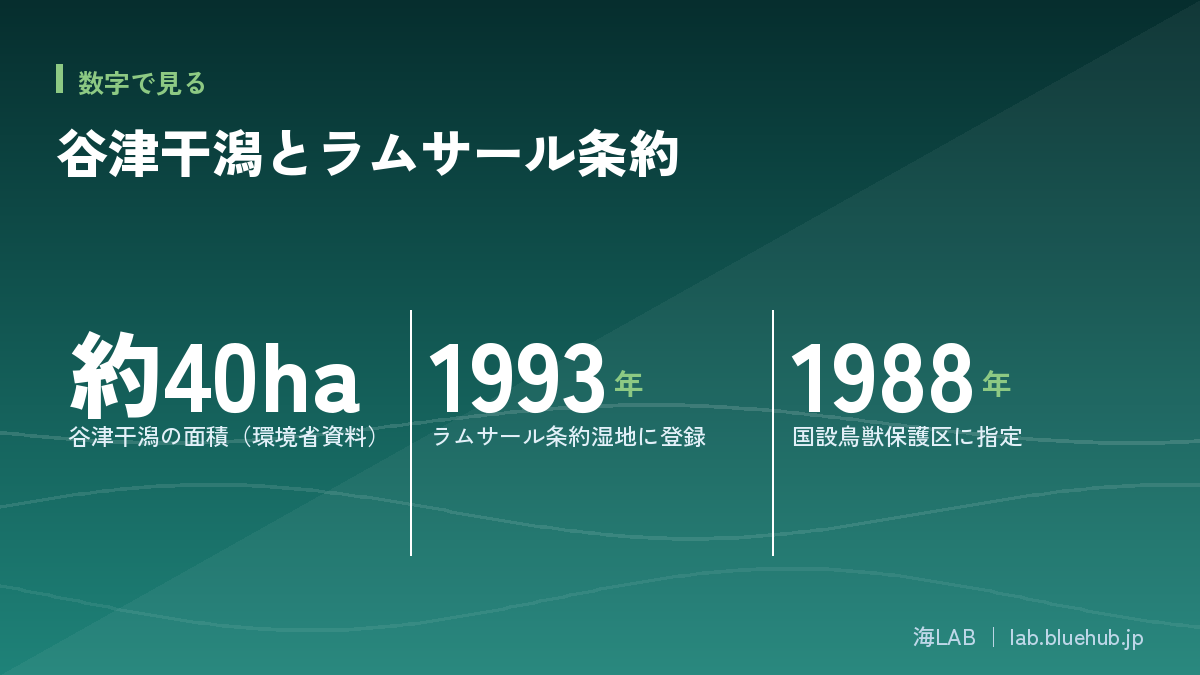
- Yatsu Tidal Flat is an urban tidal flat of about 40 ha in Narashino, Chiba, and in 1993 became the first Japanese tidal flat registered under the Ramsar Convention.
- It serves as a stopover on the East Asian–Australasian Flyway, used by shorebirds such as sandpipers and plovers.
- Sea lettuce overgrowth and declining benthic prey are challenges; the Ministry of the Environment ran a conservation project from FY2010 to FY2019.
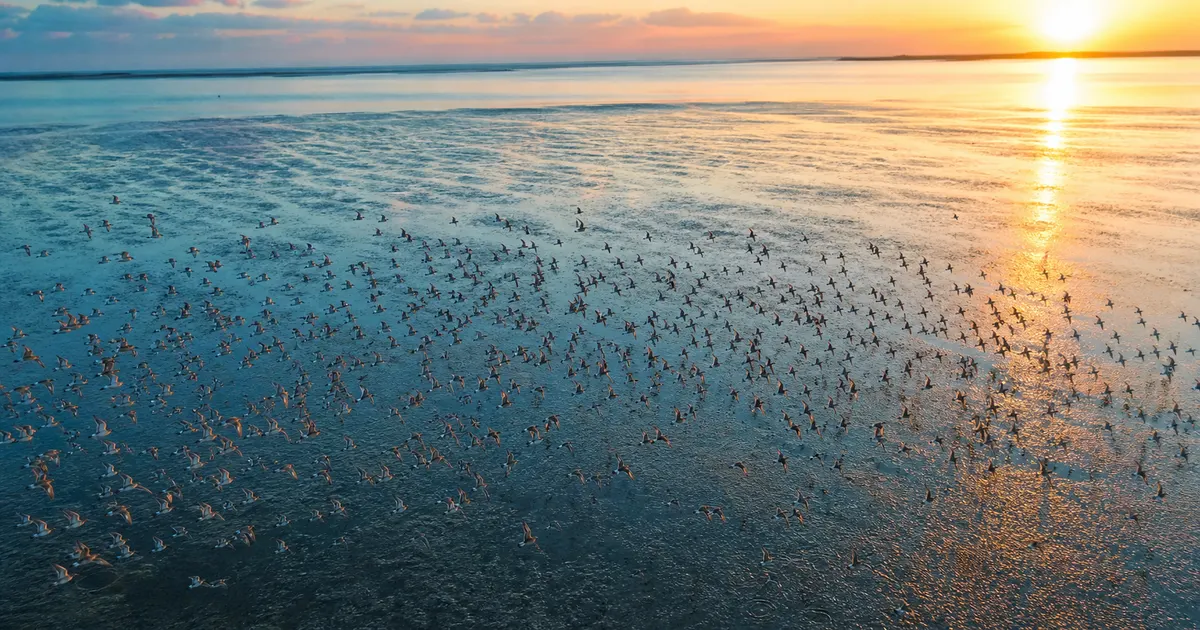
Surrounded by reclaimed land in inner Tokyo Bay, a tidal flat where migratory birds rest still remains: Yatsu Tidal Flat in Narashino, Chiba.
Registered in 1993 as the first Japanese tidal flat under the Ramsar Convention, it is an important place for thinking about coexistence between cities and nature.
This article summarizes its history, ecosystem, challenges and conservation efforts based on public materials such as those of the Ministry of the Environment.
What you will learn
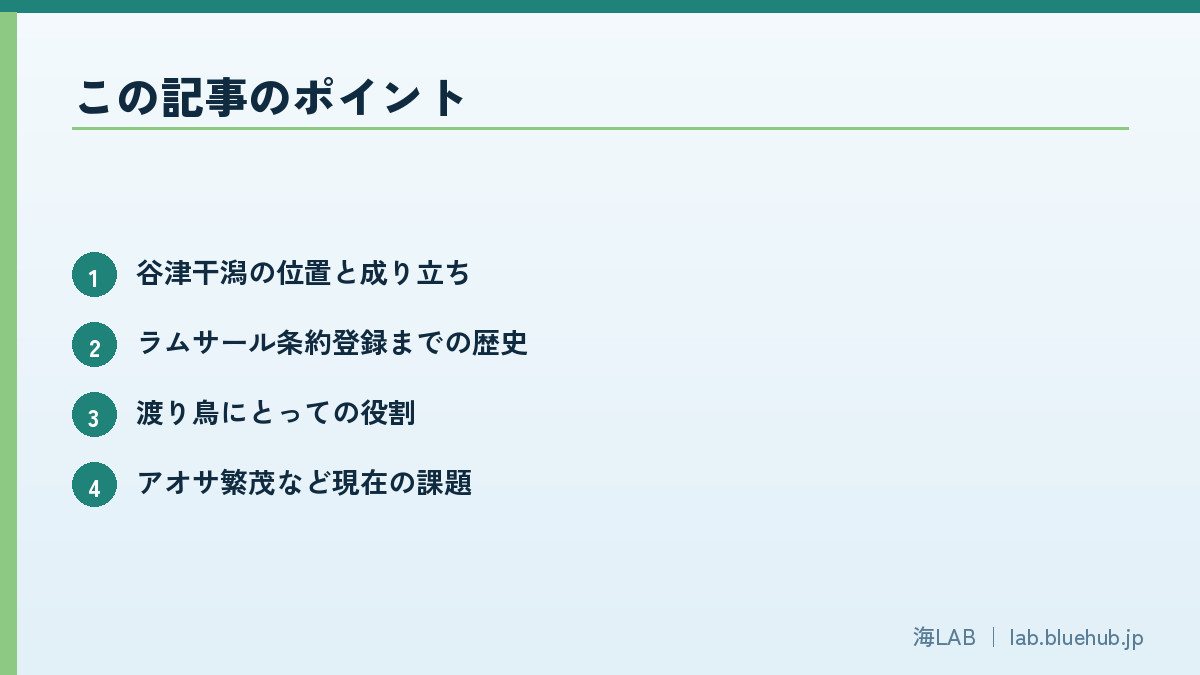
- Location and origins of Yatsu Tidal Flat
- History up to Ramsar registration
- Its role for migratory birds
- Current challenges such as sea lettuce overgrowth
- Conservation efforts and what we can do
What Is Yatsu Tidal Flat? A 40-Hectare Tidal Flat Left in Inner Tokyo Bay
A tidal flat in the middle of a city in Narashino, Chiba
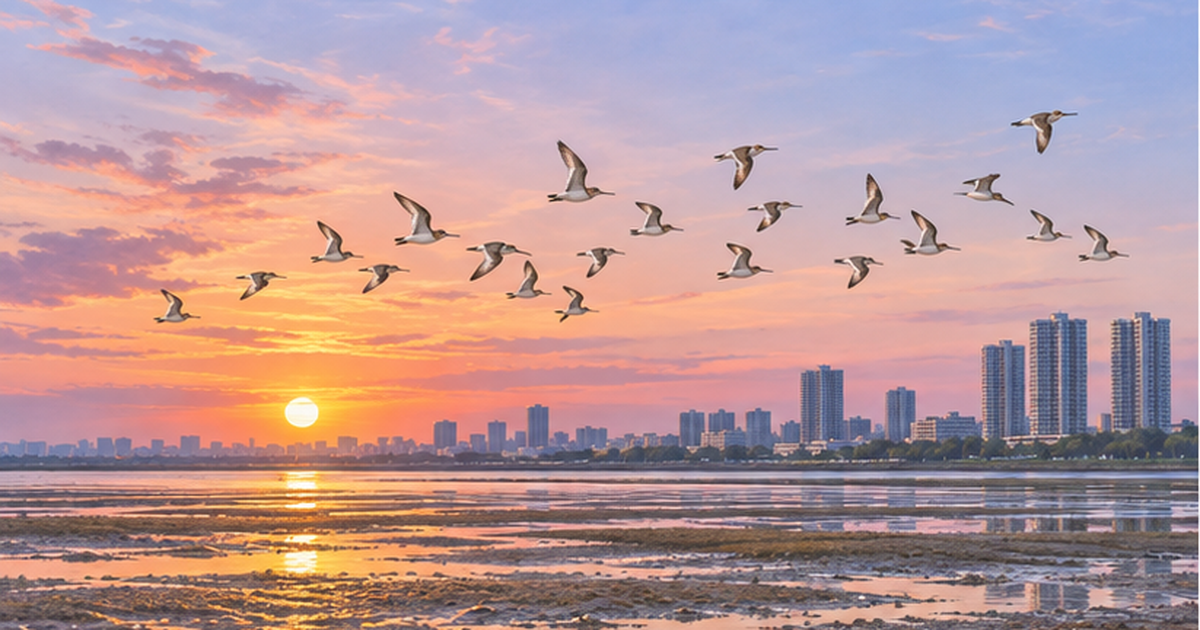
Yatsu Tidal Flat lies in inner Tokyo Bay in Narashino, Chiba, covering about 40 hectares. Surrounded by housing, roads and railways, with high-rise apartments in the background, it is known as a rare tidal flat in the middle of a city. Only about 30 minutes by train from Tokyo Station, it reveals a broad expanse of mud at low tide where shorebirds feed close to visitors.
Inner Tokyo Bay once had vast tidal flats and shallows from the Edo period into the Showa era. Postwar rapid economic growth brought reclamation that turned most of them into industrial and residential land. Yatsu Tidal Flat is a precious place left as water, surrounded by reclaimed land. Today it is connected to Tokyo Bay by channels and repeats exposure and submersion with the tides.
Basic data on Yatsu Tidal Flat
- Location: Narashino, Chiba (inner Tokyo Bay)
- Area: about 40 hectares (Ministry of the Environment; some private sources say 42 ha, so figures vary by source)
- Wetland type: tidal flat
- June 1993: registered as a Ramsar site (the first tidal flat in Japan)
- 1994: Yatsu Tidal Flat Nature Observation Center opened
Why is it called "Yatsu"?
"Yatsu" is an old Kanto term for a narrow, marshy valley cut into a plateau. Chiba has many valley rice paddies, and rivers carved valleys opening to the sea on the Narashino plateau. The name comes from this terrain linking upland and sea. Where fresh and salt water meet, brackish conditions arise and nutrient-rich mud supports diverse bottom-dwelling life, which becomes a rich table for migratory birds.
What this article covers
This article summarizes how Yatsu Tidal Flat became a Ramsar site, its role for migratory birds, how tidal flat ecosystems work, and today's challenges and conservation efforts, based on public materials such as the Ministry of the Environment's. For tidal flat conservation in general, see also our article on tidal flat conservation.
Why Did Tokyo Bay's Tidal Flats Decrease?
Tokyo Bay once was an inner bay with rich chains of tidal flats and shallows, including Sanbanze, Banzu, and the coasts of Yatsu, Funabashi and Narashino. In the Edo period, nori farming, shellfish gathering and fishing thrived, closely tied to people's lives. As population and industry concentrated, the coast was developed into ports, factories and housing, greatly changing the natural shoreline. As a result, the tidal flats left in Tokyo Bay are now only a small fraction of what they once were.
Losing tidal flats reduces water purification and also removes nursery grounds for fish and shellfish and feeding grounds for migratory birds. This is why remaining tidal flats like Yatsu have grown more valuable: even small, they serve as stepping stones among fragments of natural habitat in inner Tokyo Bay.
Features of an urban tidal flat
Yatsu Tidal Flat's great feature is its closeness to daily life. Birds can be seen from walking paths and schools can visit. This closeness also means exposure to domestic wastewater, litter, noise and light. Balancing nature protection and urban life requires careful adjustment based on observation data rather than prioritizing only one side.
A History of Escaping Reclamation: From Protected Area to Ramsar Registration
Postwar reclamation and a "water surface left behind"
From the 1950s to the 1970s, large-scale reclamation advanced along Tokyo Bay. Narashino's coast was no exception, and wide areas of tidal flat and shallows were turned into land for industrial parks and housing. The site of Yatsu Tidal Flat ended up enclosed by embankments and reclaimed land. It was once treated as part of planned reclamation, but its value as waterbird habitat gradually came to be recognized, and calls from citizens and researchers for protection grew.
Designation as a national wildlife protection area in 1988
According to materials from the Kanto Regional Environment Office of the Ministry of the Environment, Yatsu Tidal Flat is an important feeding ground and mass stopover site for shorebirds, and was designated a national Yatsu Wildlife Protection Area in 1988 (Showa 63). This not only banned hunting but created a framework for the national government to carry out conservation projects protecting wildlife habitat.
Ramsar registration in 1993
In June 1993, on the occasion of the 5th Conference of the Parties to the Ramsar Convention in Kushiro, Hokkaido, Yatsu Tidal Flat was registered as a Ramsar site together with Kushiro Marsh and others. Ministry of the Environment materials describe it as the first Ramsar-registered tidal flat in Japan (site number 615). The Ramsar Convention, concerning wetlands of international importance especially as waterfowl habitat, promotes the wise use of wetlands, aiming for both conservation and sustainable use.
| Year | Event |
|---|---|
| 1950s–70s | Large-scale reclamation advances in inner Tokyo Bay |
| 1988 | Designated the national Yatsu Wildlife Protection Area |
| 1993 | Registered as a Ramsar site (first tidal flat in Japan) |
| 1994 | Yatsu Tidal Flat Nature Observation Center opens |
| FY2010–2019 | Ministry of the Environment carries out the Yatsu Wildlife Protection Area conservation project |
What changes when a site becomes a Ramsar wetland?
Ramsar registration does not automatically create new legal restrictions. For Yatsu Tidal Flat, the domestic framework of a wildlife protection area already existed, and international recognition was added on top. The significance of registration lies in making its value widely known at home and abroad so that conservation efforts continue more easily, and in fostering local pride in protecting the tidal flat.
The idea of "wise use"
The central concept of the Ramsar Convention is "wise use": people continue to use the benefits of wetlands without damaging their ecosystems. At Yatsu Tidal Flat, areas protected by restricting entry and places for observation and learning are well balanced. The idea is that, rather than closing everything off, increasing the number of people who know its value strengthens long-term conservation.
International criteria for wetlands
Registration as a Ramsar site requires international criteria such as waterbird numbers and the presence of rare species. Yatsu Tidal Flat has been valued for its importance as a stopover for shorebirds. Registration is not a one-time event: contracting parties bear responsibility for continually checking the state of registered sites and responding to changes.
Yatsu Tidal Flat for Migratory Birds: A Flyway Stopover
East Asian–Australasian Flyway
Shorebirds make round trips twice a year between breeding grounds in Siberia and northern Alaska and wintering grounds in Southeast Asia and Australia. This route is called the East Asian–Australasian Flyway, and stopovers to rest and refuel are essential. Yatsu Tidal Flat is one important feeding site on this route, located in inner Tokyo Bay.
Passage migrants in spring and autumn
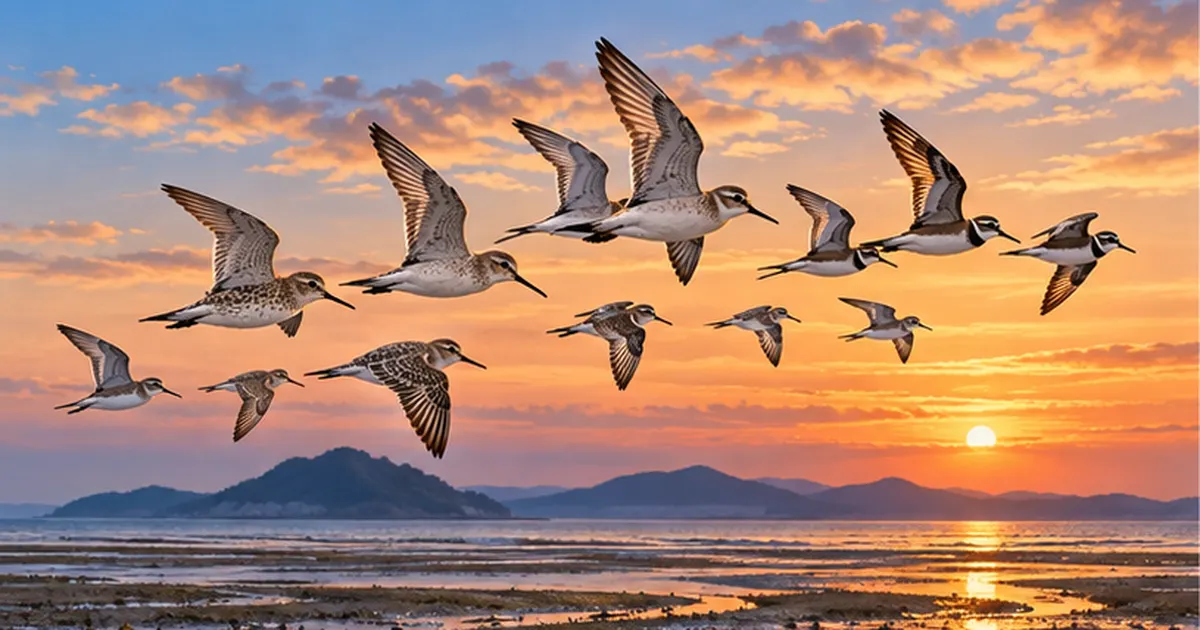
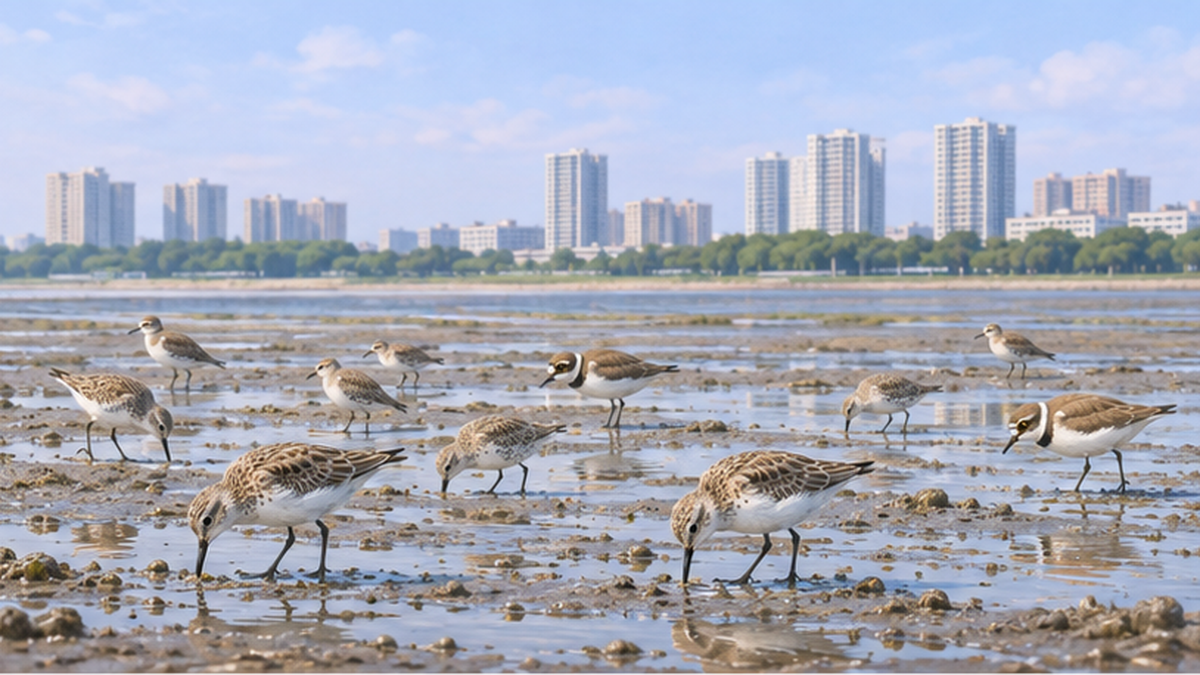
According to Ministry of the Environment materials, summer visitors, winter visitors and passage migrants visit Yatsu Tidal Flat throughout the year. During spring and autumn migration, shorebirds such as Grey Plovers, Dunlins and Kentish Plovers rest here, and in winter ducks such as Greater Scaup fill the water. For birds on long journeys, polychaete worms, shellfish and crustaceans in the mud are vital energy sources for recovery.
- Spring (around April–May): northbound passage migrants stop by
- Summer: summer visitors such as Little Terns that breed and raise young
- Autumn (around August–October): peak passage of southbound migrants
- Winter: ducks and wintering shorebirds stay
Birds and tidal flats: the rhythm of high and low tide
Tidal flat birds act according to the tide. When low tide exposes wide mud, birds go out to feed together. At high tide, when the flat is submerged, birds that lose their feeding ground float on the water or gather at surrounding resting places. Good observation times are said to be when the tide is rising and birds come close to shore. For similar relationships, see also our article on shorebird migration and tidal flats and our article on migratory bird flyways.
Observation tips
- Binoculars or a telescope help identify distant birds
- Check a tide table and visit around high tide
- Observe quietly from a distance so as not to startle birds
What a "stopover" means for birds
Migratory birds do not fly thousands of kilometers without rest. They stay several days to weeks at tidal flats and wetlands en route, build up fat, and take off again. If one tidal flat is lost, the whole route before and after can be affected. International conservation treats breeding, stopover and wintering sites as one chain, shared recognition being that migration cannot work if any link is missing.
Although Yatsu Tidal Flat is small, its location in inner Tokyo Bay means birds are also seen moving to and from other tidal flats such as Sanbanze. With several tidal flats complementing one another, birds can choose feeding sites according to tides, weather and human activity. Protecting the network of tidal flats is important.
Breeding birds and wintering birds
The mix of birds using the tidal flat changes with the season. In summer, birds that breed on the coast such as Little Terns appear; in winter many ducks come seeking shellfish. Observing throughout the year shows that the tidal flat plays a different role in each season.
Tidal Flat Ecosystems: Small Creatures in the Mud
The food chain supported by benthic life
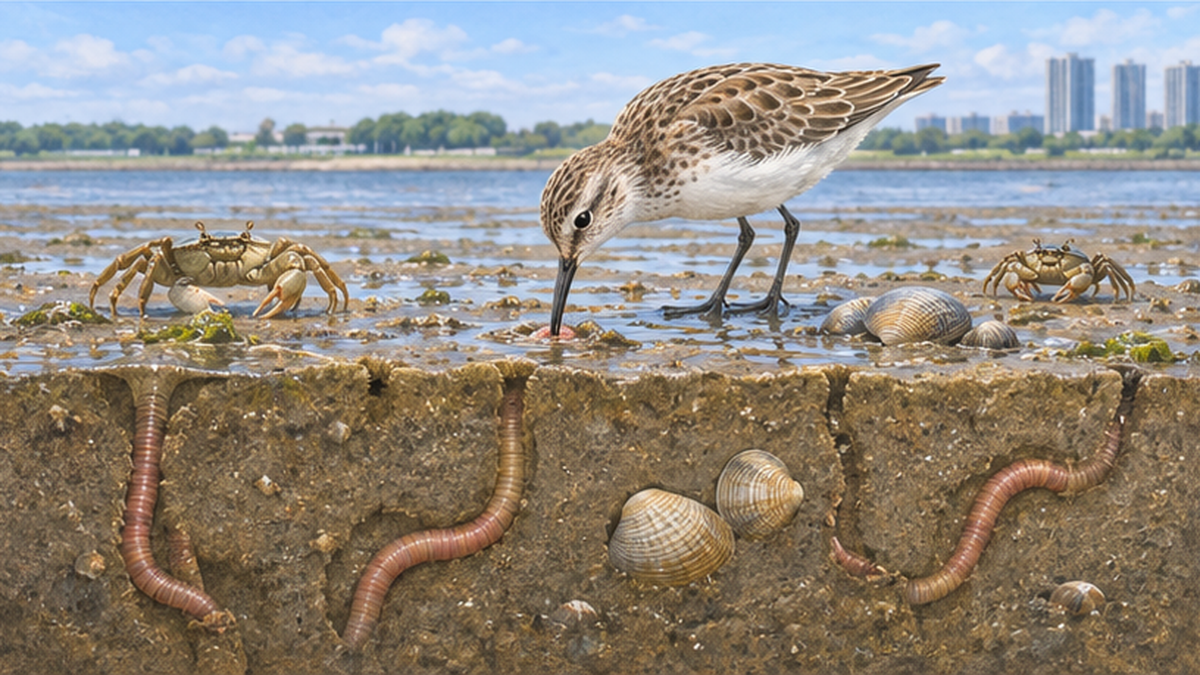
The mud of a tidal flat is home to many benthic organisms such as polychaetes, shellfish and crabs. They grow by eating phytoplankton and sedimented organic matter and are in turn eaten by shorebirds and fish, forming the base of the food chain. In Yatsu's conservation project, the amount of benthos, especially polychaetes, has been used as a key indicator of bird feeding conditions.
The water purification function of tidal flats
Tidal flats are known to clean water. Bivalves filter suspended matter from the water and microbes in the mud break down organic matter. Tidal flats thus act as natural purifiers processing nutrients flowing in from land. However, when nutrients are excessive, they cause other problems such as mass growth of seaweed (see below).
Links to blue carbon
Coastal ecosystems such as tidal flats and seaweed beds attract attention as "blue carbon" ecosystems that absorb and store carbon dioxide. Tidal flats tend to accumulate organic matter in mud, and evaluation of that role is advancing. See also our article on carbon storage in wetlands. Even a small tidal flat like Yatsu has considerable value as urban nature.
| Organism | Role in the tidal flat |
|---|---|
| Polychaetes | Turn over the mud and are a main food for birds and fish |
| Bivalves (e.g. clams) | Filter and purify water |
| Crabs | Send oxygen into the mud through burrows |
| Microbes | Decompose organic matter and cycle nutrients |
| Shorebirds | Eat benthic life and sit at the top of the tidal flat food chain |
Mud quality and the oxygen problem
Tidal flat mud has oxygen near the surface but becomes oxygen-poor and reduced a few centimeters down. Normally burrows of crabs and polychaetes carry oxygen deeper and keep the mud healthy. But when sea lettuce and similar algae pile up thickly and organic matter increases excessively, the whole mud becomes oxygen-starved and hydrogen sulfide is easily produced. In such conditions benthic life struggles, food decreases, and bird visits are affected.
Capturing tidal flat functions in numbers
Tidal flat functions are evaluated by bird counts, benthic weight and water quality values. The Ministry of the Environment's use of "wet weight of polychaetes" compared with a target value is one example of such quantitative evaluation. Following changes in numbers, not just impressions, lets us check objectively whether measures work.
Challenges Facing Yatsu Tidal Flat: Sea Lettuce Overgrowth and Environmental Change
Mass growth of sea lettuce and foul odor
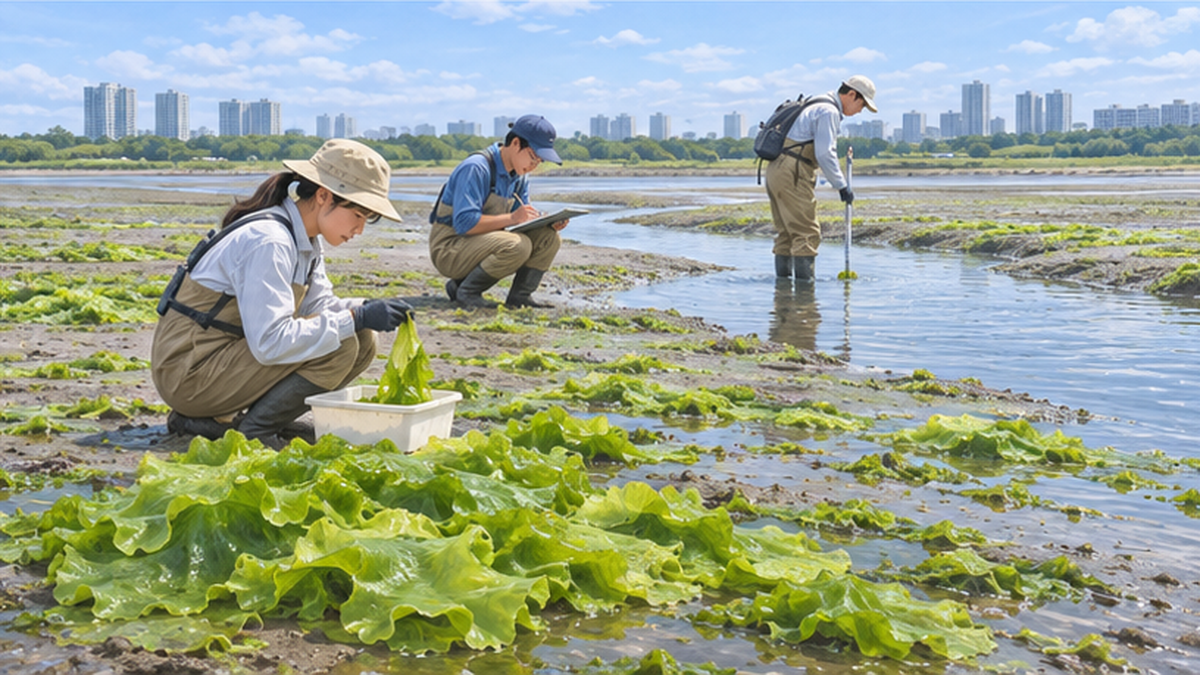
One long-standing challenge at Yatsu Tidal Flat is the overgrowth of sea lettuce (Ulva, a green alga). Materials from the Kanto Regional Environment Office note concern that conspicuous overgrowth would worsen bird habitat and residents' living environment. When piled-up sea lettuce decomposes, anaerobic bacteria produce a strong rotten odor and hydrogen sulfide.
Sea lettuce increases easily in waters rich in nutrients such as nitrogen and phosphorus, which is closely tied to the character of inner Tokyo Bay, affected by urban and domestic drainage. When it piles up, it covers the mud surface and hinders benthic life, raising fears of a vicious cycle in which bird food decreases.
Water flow and exposure time
Yatsu Tidal Flat is connected to Tokyo Bay by channels, but if water exchange is insufficient, water and sediment quality easily deteriorate. According to Ministry of the Environment materials, in FY2014 a small project removed sediment from the Takase River to improve water flow around the Triangle Flat. The aim was to increase the time and area the flat is exposed above water.
Decline in benthic prey
In national conservation projects, benthic monitoring has continued to protect bird feeding environments. A Kanto Regional Environment Office report records that in 2015 monitoring, the wet weight of polychaetes was only 1.9 g/m², far below the conservation target of about 12.7 g/m². With little food, migratory birds cannot build up enough nutrition. National materials also list declining numbers of visiting shorebirds as a conservation challenge.
Summary of challenges
- Foul odor and worse sediment from sea lettuce overgrowth and accumulation
- Poor water exchange and insufficient exposed area
- Decline of food such as polychaetes
- Fewer visiting migratory birds (especially shorebirds)
Urban nutrients and eutrophication of Tokyo Bay
Because many people live in its watershed, Tokyo Bay easily receives nitrogen and phosphorus from treated sewage and domestic wastewater. Moderate nutrients help life grow, but excess causes mass growth of phytoplankton and seaweed. Sea lettuce overgrowth is one symbol of such eutrophication. Meanwhile, in some sea areas nutrients have fallen so low that fisheries are affected, and the problem of a "too clean sea" is also debated. Finding the right nutrient balance is a future task.
Effects of climate change on tidal flats
Sea level rise and warming seawater can affect tidal flat area and the distribution of organisms. When the landward side is fixed by embankments, tidal flats cannot retreat inland as sea level rises, so area is easily lost, a "coastal squeeze". This is a special concern for flats surrounded by artificial structures like Yatsu. See also our article on sea level rise and Japan's coast.
Conservation Efforts: Ministry Projects and Community Activities
Yatsu Wildlife Protection Area conservation project
The Ministry of the Environment carried out the "Yatsu Wildlife Protection Area Conservation Project" from FY2010 to FY2019. It included benthic monitoring, surveys of sea lettuce distribution and decay, and hydrogen sulfide observation, and examined ways to improve bird feeding conditions. Rather than leaving nature alone, it adopts "adaptive management", in which people observe the environment and intervene as needed.
Role of the Nature Observation Center
The Yatsu Tidal Flat Nature Observation Center, established by Narashino City in 1994, stands on the south side of the flat and offers views of the whole flat from its observation corners. Through exhibits and observation events it conveys the flat's value to visitors and serves as a base for citizen surveys and environmental education. Please check the official website for admission fees and the latest information.
What citizens, schools and companies can do
- Join observation events and clean-up activities to get to know the tidal flat
- Be mindful of the water flowing into Tokyo Bay, for example through care with domestic wastewater
- Reduce marine plastic by not littering and by picking up trash
- Share the value of tidal flats through social media and school learning
Tidal flat conservation is tied not only to government but also to the daily actions of those of us who live in the area. As another example, our article on the Ariake Sea tidal flats shows common problems of Japan's tidal flats.
Why monitoring continues
The most important thing in conservation projects is not to "do it and forget it". After works or cleanups, we keep observing how benthos and bird numbers change, and review methods if effects are small. This repetition is adaptive management. Bird surveys and photo records by citizens are also valuable long-term data.
Local learning and passing it on
With a base like the Nature Observation Center, children can see, touch and think about the tidal flat firsthand. The feeling of "I want to protect this place" nurtured through experience grows future conservation leaders. Cooperation with schools and community groups is an important element in making conservation sustainable.
Visiting Yatsu Tidal Flat: Enjoyment and Manners
Access and observation tips
The Yatsu Tidal Flat Nature Observation Center is at 5-1-1 Akitsu, Narashino, Chiba, said to be within walking distance of stations on the JR Keiyo and Musashino lines. Paths around the flat are developed for walks and birdwatching. Opening days and fees may change, so check the official information before visiting.
Manners to keep
- Do not enter fenced or restricted areas
- Do not startle birds with loud voices or sudden movements
- Do not feed birds (it affects the ecosystem and water quality)
- Always take your trash home
- Follow the rules when walking dogs
Deepening your learning
After observing, looking up the names of birds you saw or comparing the tide table with bird behavior deepens understanding. An urban tidal flat close at hand is perhaps the best classroom for learning the connection between sea and people.
Enjoying each season
Spring and autumn are seasons when many passage migrants stop by, and you may meet birds not normally seen. In winter you can calmly watch ducks floating on the water. In summer, visiting in the cool early morning makes it easier to observe tidal flat creatures. Whenever you visit, just paying attention to tide and time changes what you see greatly.
Tips for photos and records
For records, note the date, tide level, and species and numbers of birds seen so you can compare later. When photographing, the first rule is not to get too close. Use a telephoto lens and keep a distance that does not disturb the birds' behavior.
Conclusion: What an Urban Tidal Flat Teaches Us
A tidal flat connects sea and land, nature and city, past and future. Yatsu Tidal Flat shows that Tokyo Bay's nature, lost to development, can be protected through people's efforts, while also teaching that continued observation and local understanding are essential to keep protecting it. First, visit a tidal flat and watch the tides and the lives of the birds. From there, the connection between Tokyo Bay and our lives should come into view.
Yatsu Tidal Flat is a roughly 40-hectare tidal flat left in inner Tokyo Bay where reclamation advanced. It became a national wildlife protection area in 1988 and in 1993 the first Japanese tidal flat registered as a Ramsar site. While an important stopover on the migratory flyway, it faces challenges such as sea lettuce overgrowth, decline of benthic life and fewer visiting birds.
Summary of this article
- A precious tidal flat remaining within a city
- Registered as a Ramsar site in 1993
- Challenges such as sea lettuce overgrowth, with monitoring and improvement projects by the Ministry of the Environment
- Our daily lives and Tokyo Bay's water environment are connected
References and Sources
- Ministry of the Environment: Ramsar Site Leaflet, Yatsu Tidal Flat – Overview of Yatsu Tidal Flat
- Ministry of the Environment: Ramsar Sites 2022, Yatsu Tidal Flat – Registered site information
- Ministry of the Environment: Ramsar Sites 2025 – 登録湿地一覧
- Kanto Regional Environment Office: Yatsu Wildlife Protection Area Conservation Project Plan – Conservation project plan
- Kanto Regional Environment Office: FY2015 Conservation Project Report Materials – Monitoring results
- Kanto Regional Environment Office: FY2014 First Conservation Project Report Materials – Water flow improvement works, etc.
* Arranged in order of reliability: government and academic institutions > peer-reviewed papers > specialist organizations > reliable media