⚡ In short
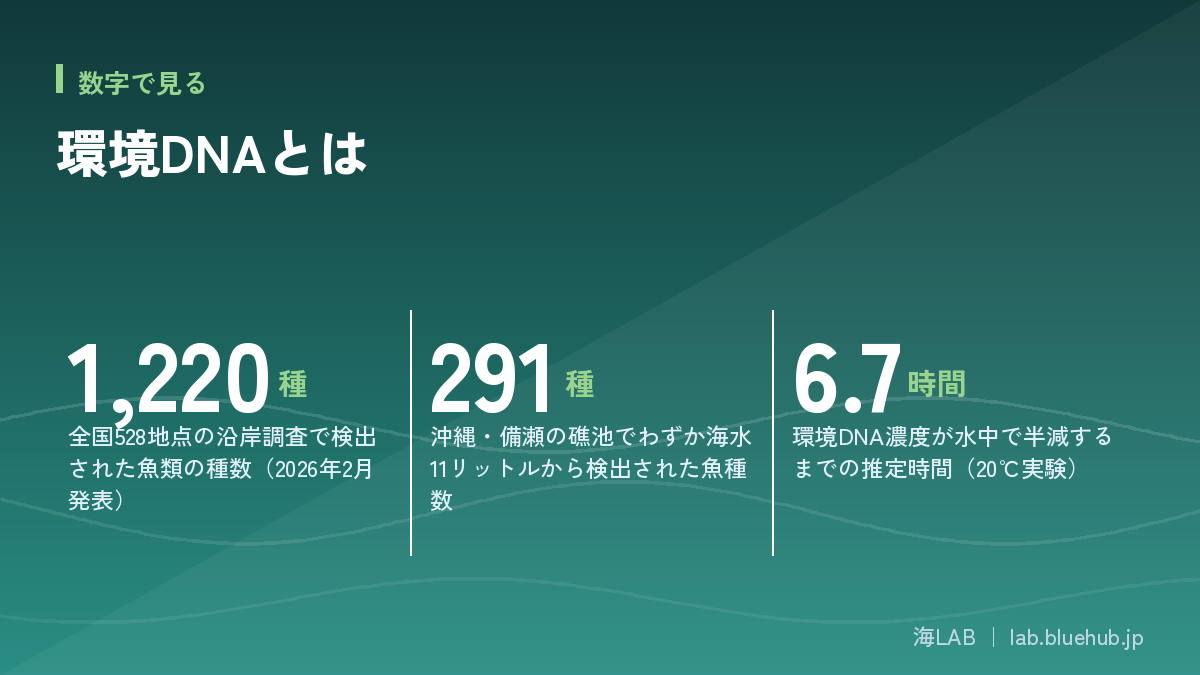
Just by testing a cup of water, scientists can now tell which fish species live there, and even detect rare or invasive species. "Environmental DNA" (eDNA) found 291 species in Okinawa's coral reefs and 1,220 species across 528 nationwide sites. Here's how the technology works and where its limits lie.
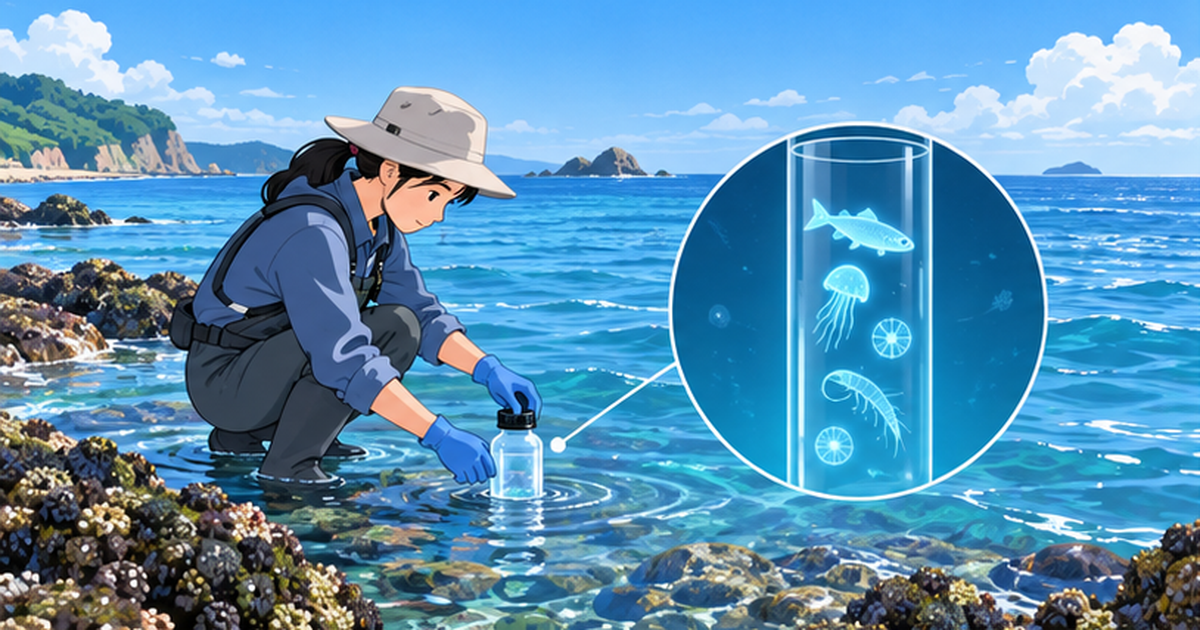
To find out "what lives there," you no longer need a net or a dive. Just scoop a cup of water and send it to a lab, and you can learn which fish species live in it—a technology that has rewritten the rules of marine biodiversity surveys over the past 15 years. Known as "environmental DNA" (eDNA), this method reads DNA fragments that organisms leave behind in water—mucus, feces, scales, eggs—to reveal what has "been there."
It began with a single paper published by a French research team in 2008. Their finding that bullfrog presence could be confirmed just by analyzing pond water eventually reached Japan. But when Kobe University's Toshifumi Minamoto presented the method at the Ecological Society of Japan in 2011, the room's reaction was cold. The scientific consensus at the time held that DNA released outside a cell degrades almost instantly.
Fifteen years later, the picture has completely changed. Japan's own MiFish primers became a global standard analysis method; in February 2026 a nationwide survey of 528 coastal sites recorded 1,220 fish species, and a small amount of seawater from Okinawa's coral reefs yielded 291 species. The technology is now being applied to dugongs, deep-sea fish, and other creatures that are notoriously hard to capture or observe. Let's look, in numbers, at how much a single cup of water can tell us—and where its limits lie.
What you'll learn in this article
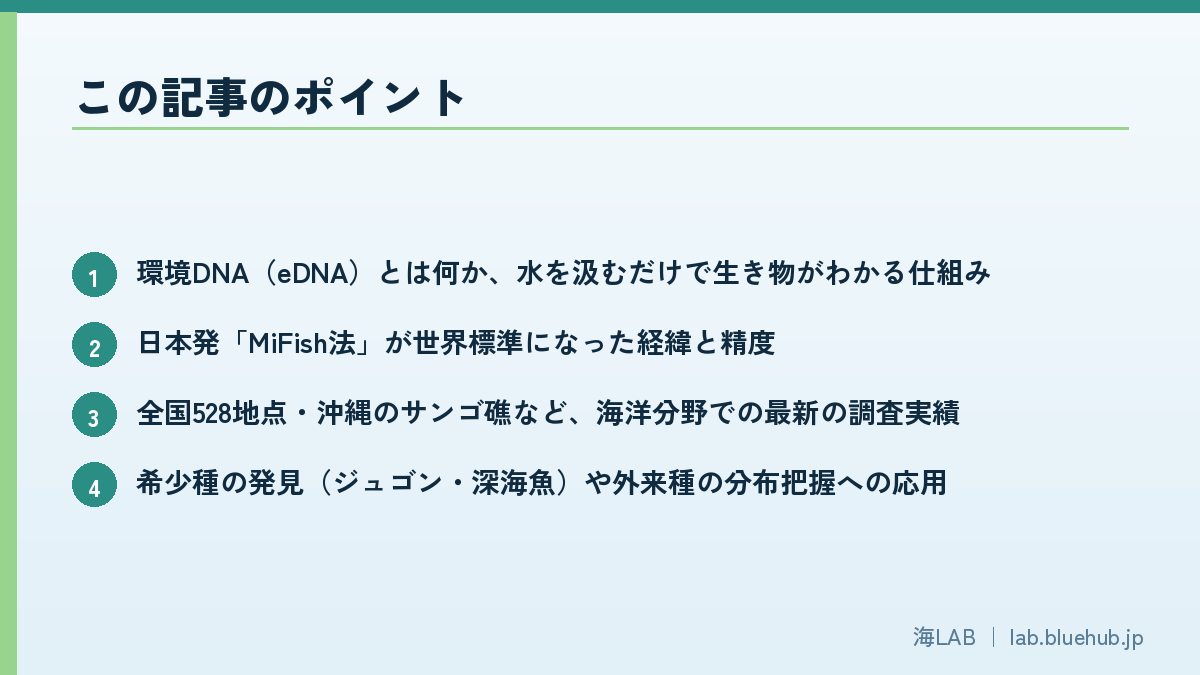
- What environmental DNA (eDNA) is, and how a water sample reveals living creatures
- How Japan's "MiFish method" became a global standard, and how accurate it is
- The latest marine survey results, from 528 nationwide sites to Okinawa's coral reefs
- How eDNA helps find rare species (dugongs, deep-sea fish) and track invasive species
- The strengths and limits of eDNA compared with diving and capture surveys
- How to get involved in eDNA monitoring as a citizen scientist
What Is Environmental DNA (eDNA)? The "Traces" Living Things Leave in Water
DNA fragments held in mucus, scales, and waste
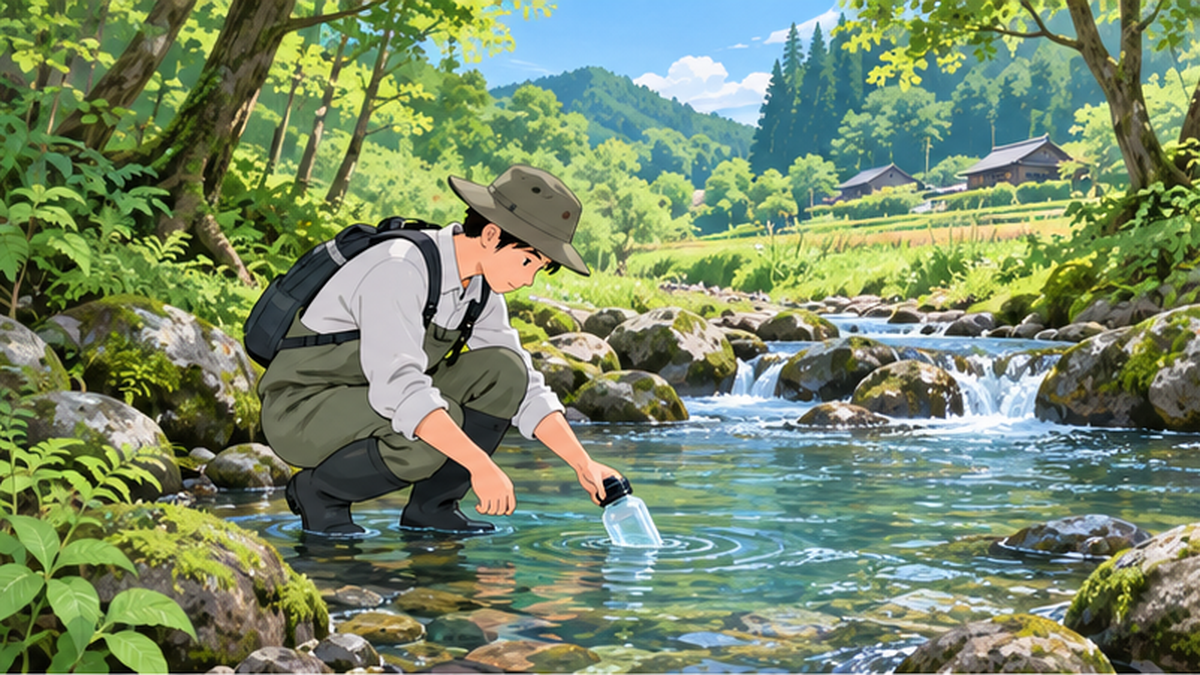
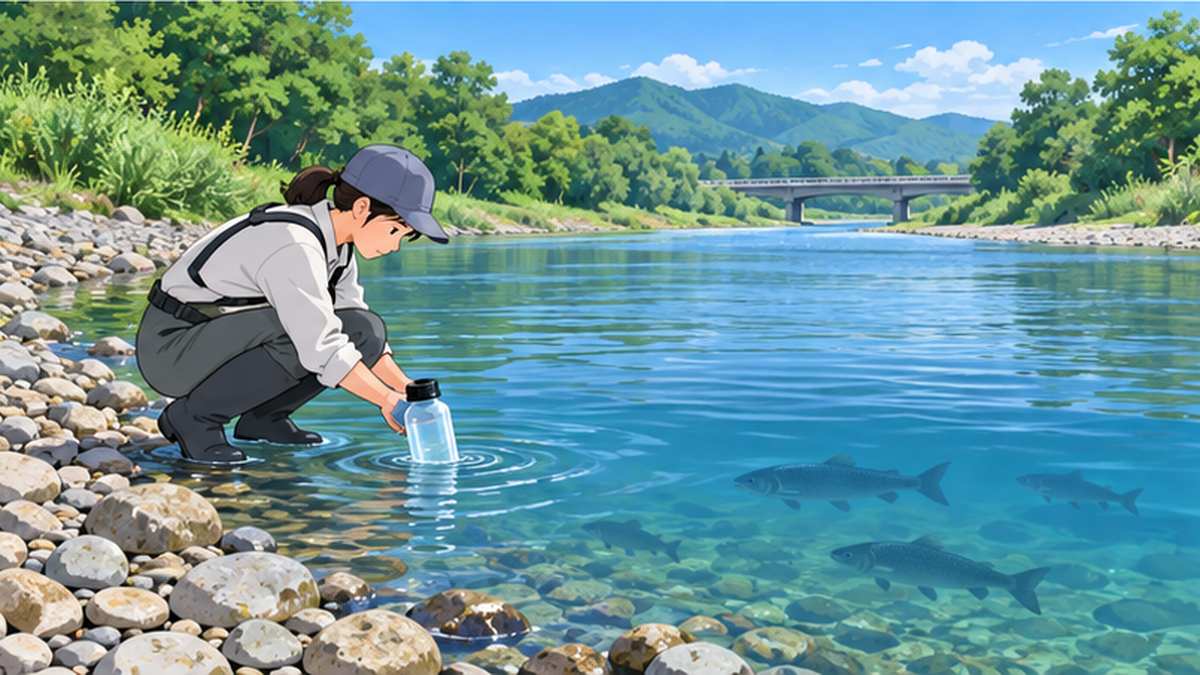
Living things are constantly releasing part of themselves into the water around them. The mucus, scales, feces, eggs, and even fragments of carcasses from fish all carry that individual's unique DNA. The sum of these minute DNA fragments drifting in the water is called "environmental DNA." By filtering several liters of water and amplifying and reading the DNA that remains on the filter, researchers can determine what has been present in that body of water—without ever seeing or capturing a single organism. The method works equally well in seawater and freshwater, allowing the same technique to be used from mountain streams to open coastal waters.
Why species can be identified without capturing them
There are broadly two types of analysis. "Species-specific detection" targets a single species, while "metabarcoding" (comprehensive analysis) reads the DNA of many species contained in the water all at once. The former uses real-time PCR to measure the DNA concentration of a targeted species, allowing highly sensitive judgments about the presence of rare or invasive species. The latter amplifies DNA fragments with a dedicated primer such as MiFish, reads them in bulk with a next-generation sequencer (NGS), and cross-references the results against a known fish DNA database to produce a full list of the fish community living in that body of water.
A method that causes no harm to living things
Capture surveys, gillnetting, and diving observation all place some degree of stress on an ecosystem—individuals caught in nets may die, and rare species may be accidentally injured. Because eDNA surveys are completed simply by collecting water, they never touch a living organism and never disturb its habitat. This non-invasive quality is a major strength, making the method safe to use even when studying endangered species or populations during spawning season.
Environmental DNA breaks down surprisingly fast
Environmental DNA does not, however, remain in the water indefinitely. A research team including Ryukoku University tested this in a rearing experiment using bluegill and estimated that, at 20°C, eDNA concentration halves in just 6.7 hours (Maruyama et al., 2014, PLOS ONE). In other words, detected DNA is fresh evidence that an organism was present at that spot very recently.
What this rapid decay means
- It tends to reflect organisms present "right now," not in the distant past
- Changing the timing of sampling can also track seasonal or time-of-day changes
- Conversely, species that were present only shortly before sampling can be missed
Fish are not the only target
The name "environmental DNA" suggests a fish-only technology, but the range of possible targets is much broader. Depending on how the primer is designed, it can target crustaceans, mollusks, amphibians, seaweed, plankton, and even marine mammals such as dugongs and finless porpoises. The salamander and dugong cases discussed in this article were only made possible because dedicated primers were developed for each.
The "Doubted Discovery" — The Dawn of eDNA Surveys
2008: a single paper from France
The turning point that spread the idea of environmental DNA around the world came in 2008, with a paper published by French researcher Gentile Francesco Ficetola and colleagues. They showed that simply analyzing pond water could determine whether the invasive American bullfrog was present. For a field that had relied entirely on capture and visual observation, this opened up an entirely new option. The idea of inferring the presence of a population from DNA had existed in some research since the 1980s, but this paper is considered the first to demonstrate it in such a practical form for wild aquatic organisms.
2011: a cold reception at the Ecological Society of Japan
The first in Japan to focus on this method was Kobe University's Toshifumi Minamoto. In March 2011, he presented on environmental DNA at the Ecological Society of Japan, but drew almost no interest. The prevailing wisdom in biology at the time was that DNA released outside a cell degrades almost immediately, and no one believed that a detectable amount of DNA could really be drifting in the water. Minamoto, together with Hiroki Yamanaka of Ryukoku University, Masaki Miya of the Chiba Prefectural Central Museum, Wataru Makino of Tohoku University, Hitoshi Araki of Hokkaido University, Teruhiko Takahara of Shimane University, and other Japanese researchers, went on to work together to establish and expand the method. Within just a few years, a technique once met with skepticism had become a core survey method adopted by national projects and routine municipal surveys alike.
It was PCR technology that made this possible
Underpinning eDNA detection is "PCR" (polymerase chain reaction), a technology that amplifies trace amounts of DNA millions of times over. Originally used in medicine for pathogen testing and paternity testing, PCR is an established technology—but it is precisely because it can amplify the vanishingly small amounts of an organism's DNA found in the environment up to a detectable level that eDNA surveys are possible at all. PCR, now widely known thanks to infectious disease testing, also plays a quiet but crucial supporting role in the completely different field of biodiversity surveys.
A rare salamander found in the hills of Kobe
Even so, Minamoto kept up his research, and eventually achieved a landmark result: discovering the habitat of the Seto Inland Sea salamander, a Red List species, in the Ogo district of Kobe's Kita ward—using environmental DNA analysis alone. As a concrete example showing that the presence of a hard-to-capture rare species could be confirmed just by collecting water, this discovery helped drive the subsequent spread of the research.
Japan's MiFish Method — The Key to Detecting an Entire Fish Community
Masaki Miya and the development of the "MiFish" primer
Detecting fish species all at once requires a "primer"—a short DNA fragment that targets the specific gene region to be amplified. A team led by Masaki Miya of the Chiba Prefectural Central Museum developed a dedicated primer that amplifies a highly variable region flanked by sequences conserved across all fish species, naming it "MiFish" after himself. Once the results were published in 2015, the method spread rapidly in research both in Japan and abroad, and has been shown to perform as well as—or better than—comparable primers developed by teams in Europe and the United States.
A proof-of-concept at Okinawa Churaumi Aquarium
To verify the accuracy of the MiFish method, the research team ran an experiment at Okinawa Churaumi Aquarium, where the fish species in four large tanks were already known, collecting and analyzing water from each tank. The results showed that the method could correctly detect over 93% of the fish species actually present using environmental DNA alone, demonstrating the method's reliability. This proof-of-concept later paved the way for the large-scale field survey on Okinawa's coral reefs described below.
A world first: 291 species detected on an Okinawa coral reef
Five years after the aquarium experiment, a research team from the Okinawa Churashima Foundation, the Chiba Prefectural Central Museum, and the University of Hyogo detected a total of 291 species of fish from just 11 liters of seawater collected at 11 points within the Bise reef flat in Motobu, Okinawa. This is considered the world's first application of metabarcoding in a coral reef environment—one of the most biodiverse environments on Earth. It demonstrated that the method can pick up small, nocturnal species hiding in crevices and sand that are easily missed by diving surveys alone.
From water sample to results: the process
Metabarcoding analysis using the MiFish method involves multiple steps after sample collection: filtration, DNA extraction, PCR amplification, next-generation sequencing, and database matching. Results typically take a few weeks to come back, but the time researchers need to spend in the field is far shorter than in traditional diving surveys, which require divers to stay on site for days at a time. This division of labor—"minutes in the field, weeks in the lab"—is what makes nationwide surveys possible.
528 Sites, 1,220 Species — What Ocean Currents Reveal About Japan's Fish
77 monitoring stations and citizen volunteers
"ANEMONE" (All Nippon eDNA Monitoring Network) is the eDNA observation network linking Japan's coasts, rivers, and lakes. Launched in 2017 under the leadership of Michio Kondoh of Tohoku University, it involves universities, research institutions, local governments, and companies conducting regular observations at 77 sites nationwide. In addition, around 200 citizen volunteers mobilized by the NPO Earthwatch Japan have taken part in surveys at 146 sites, achieving a geographic reach that experts alone could never cover. Since it began, ANEMONE has conducted 4,298 surveys and detected 885 fish species, and in June 2022 its observational data was released as "ANEMONE DB," the world's first freely available eDNA database of its kind. Participants span a wide range of sectors: shipping companies such as NYK Line and Kinkai Yusen collect monthly seawater samples along their regular routes, while local governments such as Minamisanriku in Miyagi Prefecture have joined to keep watch over changes in their local seas. This diverse mix of participants sustains a breadth and continuity of monitoring that research institutions alone could never maintain.
What the 528-site survey revealed about currents and fish distribution
An even larger effort was announced in February 2026: a collaborative study led by Tohoku University and the Japan Agency for Marine-Earth Science and Technology's WPI Advanced Institute for Marine Ecosystem Change (WPI-AIMEC), with participation from the Chiba Prefectural Central Museum, Hokkaido University, Kyoto University, Kobe University, Kyushu University, Shimane University, Ryukoku University, Kagoshima University, and the Kazusa DNA Research Institute, among others. Environmental DNA collected from 528 coastal sites across Japan revealed the distribution of 1,220 fish species in a short survey period—about 44% of Japan's known fish species. Some individual sites recorded as many as 118 species, and the variation between sites revealed how strongly ocean currents such as the Kuroshio and Tsushima Currents shape fish distribution.
Ongoing municipal monitoring: Kobe City's coastal fish survey
Environmental DNA is taking hold not just in national projects but at the municipal level too. As part of its effort to restore a "rich sea," Kobe City has conducted ongoing eDNA-based coastal fish surveys since fiscal year 2020, in order to confirm the effect that managed nutrient-release operations at sewage treatment plants have on marine biodiversity. In FY2020 the city surveyed 22 sites six times a year; since FY2022 it has surveyed 11–12 sites monthly. The number of species detected has been 167 in FY2020, 200 in FY2022, 183 in FY2023, 192 in FY2024, and 165 in FY2025. The ability to keep surveying the same sites with the same method year after year enables a kind of continuous monitoring that capture-based surveys struggle to match.
Finding Rare Species, Tracking Invasive Ones — How eDNA Is Changing Fieldwork
Confirming rare species just by proving they "exist"
Endangered species tend to have small populations, and capture surveys risk mistakenly concluding a species is "absent" simply because it was not found. With eDNA, detecting even a trace amount of DNA can indicate the possible presence of a species, making it well suited to confirming or rediscovering rare species.
Okinawa's ongoing effort to detect dugong eDNA
The dugong, an endangered species that survives in the waters off Okinawa, has such a small population that visual confirmation is extremely difficult. Researchers have developed a PCR primer set that specifically detects dugong DNA, and since 2020 have attempted to detect it directly from seawater around Okinawa Island. So far, however, direct detection from seawater has not succeeded, likely because the amount of dugong DNA present is extremely small and degrades quickly. On the other hand, in July 2022, DNA was successfully detected by analyzing dugong feces found along the coast of Kushi in Nago City—marking the first time Okinawa Prefecture's own survey confirmed traces of dugongs in the waters around Oura Bay. This illustrates that for large marine mammals with very small populations, "concentrated" samples such as feces or feeding trails can be more effective for detection than seawater itself.
Tracking black bass expansion across 31 prefectures
Largemouth bass (black bass) are carnivorous fish native to North America; designated an invasive alien species in Japan, they have long been recognized as a threat to native fish and crustaceans and to ecosystem balance. Accurately understanding how far their range has spread is essential for planning eradication and containment measures, but a nationwide capture survey would require enormous manpower and time. Here too, eDNA proves its worth. In May 2026, a joint research team from eight institutions—including Osaka Ohtani University, the National Institute for Environmental Studies, and the Fisheries Research and Education Agency—collected environmental DNA at 121 sites across 31 prefectures from the Tohoku region to the Chugoku and Shikoku regions, investigating the distribution of three species of black bass: largemouth bass, Florida bass, and smallmouth bass. DNA from at least one of these species was detected at 87 sites, and each species showed a distinct pattern of expansion.
| Species | Haplotypes identified | Expansion characteristics |
|---|---|---|
| Largemouth bass | 9 types | Genetic differentiation correlated with geographic distance, suggesting mainly short-distance stocking and natural dispersal |
| Florida bass | 9 types | Little geographic pattern, suggesting large-scale, repeated stocking into distant lakes |
| Smallmouth bass | 2 types | Rapid recent expansion, widely detected from Tohoku to the Kinki region |
How nationwide distribution data reshapes response priorities
This kind of distribution data directly informs policy decisions about where to direct limited budgets. Prioritizing surveillance and prevention in waters where invasion has not yet been confirmed, or is still in its early stages, is likely to stop the spread at a far lower cost than large-scale eradication after a species has become established. eDNA is valued in invasive-species management not only for showing "where a species is now" but also for confirming "where it still is not."
Confirming the "aftermath" of eradication efforts with water
In a joint study by the Shiga Prefecture Fisheries Experiment Station and Ryukoku University, environmental DNA analysis proved more sensitive than capture surveys at detecting population declines when verifying the effectiveness of efforts to eradicate invasive channel catfish near the mouth of the Seta River and the Araizeki weir. Being able to confirm, without ever casting a net, whether numbers had genuinely fallen after eradication work carries real significance for sites working within tight budgets. Dugong conservation is discussed in more depth in Why Did the Dugong Become an Endangered Species?.
Transforming Marine Biodiversity Surveys — eDNA vs. Diving and Trawling
Cutting labor and cost dramatically
Diving surveys and trawl or gillnet-based collection require skilled divers, boats, and crew, and are heavily affected by weather, depth, and water clarity. An eDNA survey, by contrast, is complete once water has been collected and passed through a filter, allowing a wide area to be surveyed quickly and without harming any organisms. This ease is exactly what made it possible to carry out the 528-site nationwide survey in such a short time. When commissioning a private analysis company to collect and analyze samples, a survey of around five sites typically costs roughly ¥150,000–200,000—a modest sum compared with the scheduling and weather risks involved in mobilizing professional divers for a full-scale biological survey.
| Survey method | Strengths | Weaknesses |
|---|---|---|
| eDNA survey | Simultaneous coverage of wide areas and many sites; detects rare or low-density species; non-invasive | Cannot estimate population size or body length; difficulty distinguishing closely related species |
| Diving observation survey | Direct observation of individual size, behavior, and habitat | Limited by visibility, depth, and weather; difficult over wide areas |
| Trawl / gillnet survey | Individuals can be directly collected and preserved as specimens | High stress on organisms; difficult to use on rocky reefs or coral reefs |
Finding unknown habitats in the deep sea
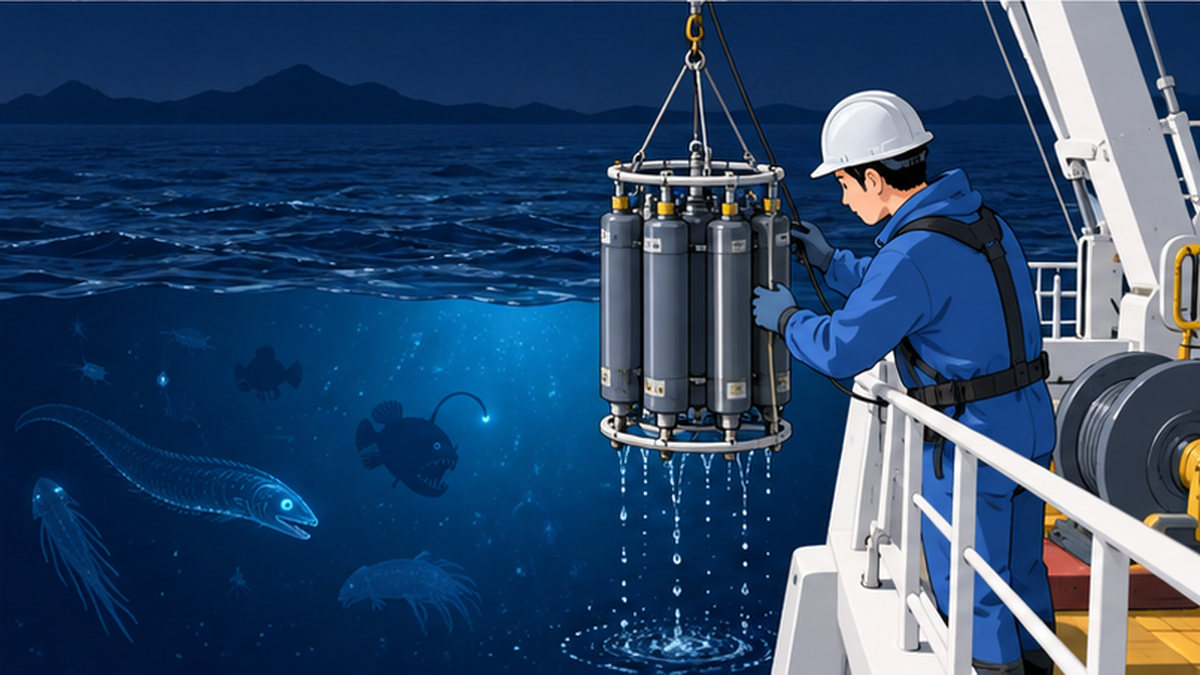
eDNA is useful not only for mapping the distribution of known species but also for discovering new habitats. At the Japan Agency for Marine-Earth Science and Technology (JAMSTEC), environmental DNA analysis in Suruga Bay pointed to the possible existence of an unknown habitat for the rare deep-sea fish "Yokozuna iwashi" (giant slickhead); researcher Akinori Yabuki and colleagues subsequently deployed a camera and successfully filmed it. Being able to narrow down "where to look" using eDNA before blindly deploying a submersible or remotely operated vehicle can make a major difference to the cost and time required for deep-sea research.
What eDNA can and cannot tell you
Still, eDNA is not a silver bullet. While it excels at determining presence or absence, it generally cannot tell you how many individuals are there, their age structure, or their body length. DNA concentration is also affected by water flow and dilution, so it does not necessarily reflect population density directly. When closely related species have similar DNA sequences, distinguishing between them can also be difficult. Researchers, including teams at Kobe University, are working on methods to estimate actual population size from eDNA data, but this remains a developing field.
The next frontier: environmental RNA
A group led by Hiroki Yamanaka of Ryukoku University is pursuing research into "environmental RNA," which breaks down even faster than environmental DNA. Because RNA is only produced by living cells, its shorter lifespan compared with DNA may make it an even more sensitive indicator of organisms that are "alive right now." Applications such as estimating physiological state are being explored as a next-generation extension of the technology.
Combining eDNA with traditional surveys is the realistic choice
Most researchers in the field treat eDNA not as a "replacement" for diving or trawl surveys but as a "complement" to them. A staged approach—first screening a wide area with eDNA, then focusing diving or capture surveys only on sites where rare or invasive species were detected—makes high-precision monitoring achievable even with limited budgets and staff. Both the 528-site nationwide survey and Kobe City's ongoing monitoring extend from this same idea of "using eDNA first to narrow down where to look."
eDNA Goes Global — Lessons from the Fight Against Carp in the Great Lakes
Asian carp threatening America's Great Lakes
eDNA's applications are not limited to Japan. In the United States, environmental DNA has played a central role in monitoring "Asian carp"—invasive fish such as bighead and silver carp that have moved north from the Mississippi River system and threatened to invade the Great Lakes. Great Lakes fisheries are estimated to generate roughly $7 billion a year in economic activity, and there are concerns that if Asian carp, with their voracious appetite and strong reproductive capacity, were to become established, they could sharply reduce native fish populations and commercial catches. Knowing exactly how far the invasion front has advanced is critical to the success of any response.
Large-scale sampling since 2009
Since 2009, the U.S. Army Corps of Engineers (USACE), the U.S. Fish and Wildlife Service (USFWS), and the U.S. Geological Survey (USGS) have collected 2,822 water samples, primarily in the Chicago Area Waterway System and the western basin of Lake Erie, to monitor the leading edge of the Asian carp invasion. A three-year calibration study (ECALS), aimed at improving accuracy and reducing costs, was completed in 2016, advancing the standardization of the method.
The chain reaction set off by a 2008 paper
This U.S. effort, too, traces back to that 2008 paper from France. As researchers shared the paper and applied it to the urgent challenge of monitoring an invasive fish threatening native species, environmental DNA rapidly gained recognition as a practical technology. Research that developed independently in Japan and the United States now increasingly draws on each other's methods. The academic journal "Environmental DNA" now regularly publishes research from Japan, the U.S., and Europe side by side—a virtuous cycle, built over 15 years, in which a single discovery in one country sparks the next application somewhere else.
Challenges Facing eDNA Surveys — and What Comes Next
The risk of contamination
Because eDNA work deals with trace amounts of DNA, contamination—from reused equipment or mixed-up samples—can skew results. To prevent contamination from reused equipment or airborne dust, field teams now rigorously use disposable equipment and standardized procedures.
Choosing between species-specific detection and metabarcoding
Which analysis method to choose depends on the goal: sensitively detecting a single targeted species, or comprehensively mapping the entire fish community of a body of water. Choosing the right method for the purpose, backed up by repeated sampling, is key to reducing both false detections and missed species.
The need for databases and standardization
Converting a detected DNA sequence into a species name requires a comprehensive reference database of known organisms' DNA sequences. A species not registered in the database will be "detected but unidentifiable," which is why expanding sequence registration both in Japan and internationally, and standardizing collection and analysis methods, are cited as ongoing challenges. Professional bodies such as the eDNA Society are working on this problem by developing and maintaining survey and experimental manuals.
Ensuring the reliability of citizen-collected data
In surveys like ANEMONE, where citizen volunteers handle water collection, procedural variation tends to be greater than in surveys run entirely by professional researchers. To address this, organizers standardize collection equipment, distribute photo-illustrated instructions, and have multiple people sample the same site to cross-check results—ongoing efforts to keep data quality at a consistent standard. Balancing the broad participation of citizen science with the scientific reliability of the resulting data remains an enduring challenge for this field.
eDNA is not a cure-all
- It generally cannot reveal population size or body length
- Water flow can cause the detection point and the actual habitat to differ
- Distinguishing closely related species depends on the quality of the reference database
The new international standard, ISO 17805:2026
Standardization efforts are not confined to Japan. In step with efforts to strengthen enforcement of the Water Framework Directive—which governs the ecological assessment of rivers and lakes—the European Union issued a new international standard in 2026, ISO 17805:2026 ("Water quality — Environmental DNA sampling methods"). The aim is to align procedures, from equipment handling to contamination control, that had previously varied between research institutions, so that data collected by different countries and institutions can be more easily compared. Knowledge built up by Japanese researchers is increasingly being incorporated into these international standardization discussions.
What We Can Do — eDNA as Citizen Science
Research institutions alone are not enough — we need more "eyes"
Japan's coastline stretches roughly 35,000 kilometers, making it practically impossible for researchers and research budgets alone to keep surveying the entire coast regularly. It is only when individual citizens collect water samples near their homes, again and again, that continuous, nationwide monitoring becomes possible. Much of why eDNA could become "a survey anyone can join" comes down to a characteristic unique to this technology: no specialized training in species identification is needed—just following the correct sampling procedure is enough to provide data of sufficient quality.
Anyone can take part in water surveys
As with ANEMONE, opportunities for non-experts to participate in surveys simply by collecting water are expanding. The NPO Earthwatch Japan set targets of 50 sites in FY2022 and 100 sites in FY2023 for citizen-participation surveys, among other efforts, and the base of citizen science keeps growing every year. Citizen-participation wildlife surveys spreading across Japan are covered in more depth in What Is Citizen Science? How Anyone Can Take Part in Wildlife Surveys, and How the Data Gets Used.
Reading a nearby river or coastline through "a bucket of water"
A single bucket of water scooped from a river or beach near your home might reveal the presence of fish, rare species, or invasive species living there. For a broader look at marine invasive species, see Where Do Marine Invasive Species Come From? The Threat of Ballast Water, Zebra Mussels, and Invasive Crabs.
Sampling kits and how analysis works
In citizen-participation surveys, sterilized sample bottles and filters are typically distributed in advance; participants collect water at a designated site, filter it, and send it—refrigerated or frozen—to the research institution. There is no need to handle specialized laboratory equipment yourself; as long as the correct sampling procedure is followed, anyone from elementary school students to adults can take part. Collected samples have their DNA extracted and analyzed in university or commercial laboratories, with results typically reflected in the database within a few weeks to a few months.
Article summary
- Environmental DNA is a technology that identifies species by reading DNA fragments organisms leave in water
- Japan's own MiFish method and the 528-site nationwide survey have transformed our understanding of marine biodiversity
- Applications are rapidly expanding, from finding rare species (dugongs, deep-sea fish) to tracking the spread of invasive species
- eDNA has real limits, such as estimating population size, so combining it with traditional survey methods remains essential
References and sources
- Biodiversity Center of Japan, Ministry of the Environment: "eDNA Surveys" – Explanation of eDNA analysis techniques and survey manuals
- ANEMONE (All Nippon eDNA Monitoring Network) – A nationwide network of 77 fixed eDNA monitoring sites
- Tohoku University press release (Feb. 17, 2026) – Nationwide 528-site survey reveals the distribution of 1,220 coastal fish species
- Okinawa Churashima Foundation research report – 291 species detected from 11 liters of seawater at the Bise reef flat
- JST joint announcement (July 22, 2015) – Development of the MiFish primer
- National Institute for Environmental Studies press release (May 14, 2026) – Estimating black bass distribution expansion via nationwide eDNA survey
- Kobe University news site – Interview with Professor Toshifumi Minamoto, "What a cup of water can tell you about species distribution"
- JAMSTEC BASE – How eDNA analysis led to the discovery of a new Yokozuna iwashi habitat
- The eDNA Society (Japan) – Publisher of eDNA survey and experimental manuals
- USGS, "Invasive Carp Risk Assessment" – eDNA monitoring of Asian carp in America's Great Lakes
※ Listed in order of reliability: government and academic institutions > peer-reviewed papers > specialist organizations > trusted media