⚡ In short
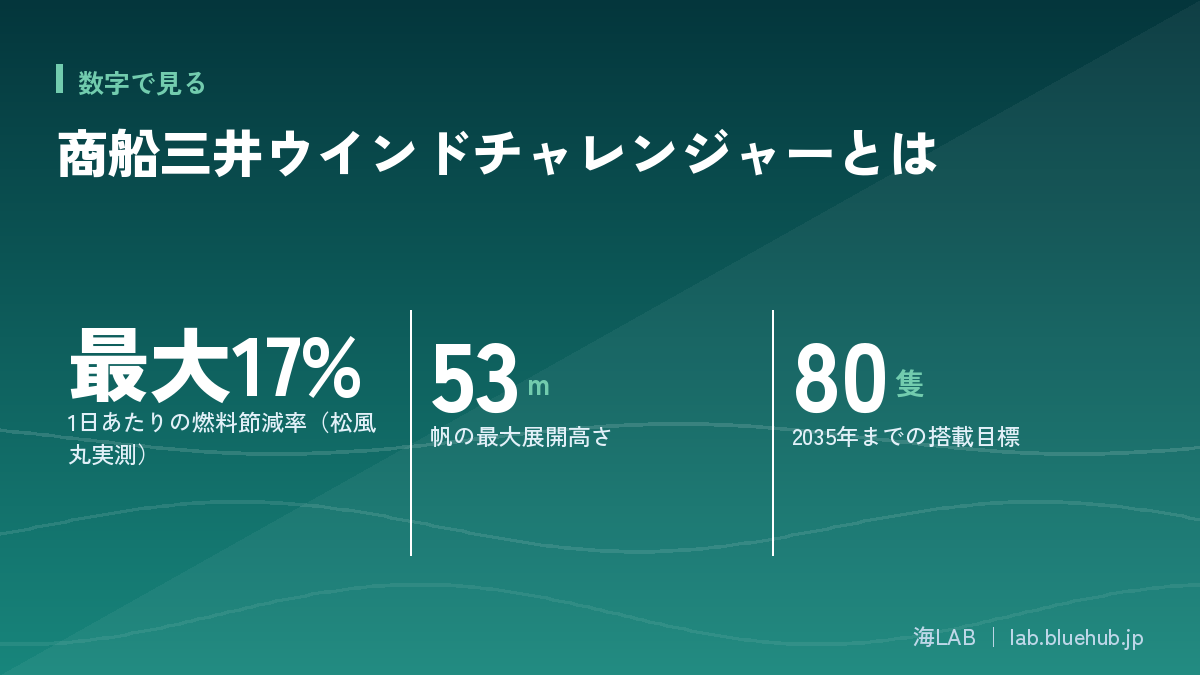
MOL (Mitsui O.S.K. Lines) developed the hard-sail wind propulsion system "Wind Challenger." The coal carrier Matsukaze exceeded expectations, cutting fuel use by up to 17% on its best days, and MOL plans to expand the fleet to 25 ships by 2030 and 80 by 2035. This article explains the technology, verified results, and industry impact.
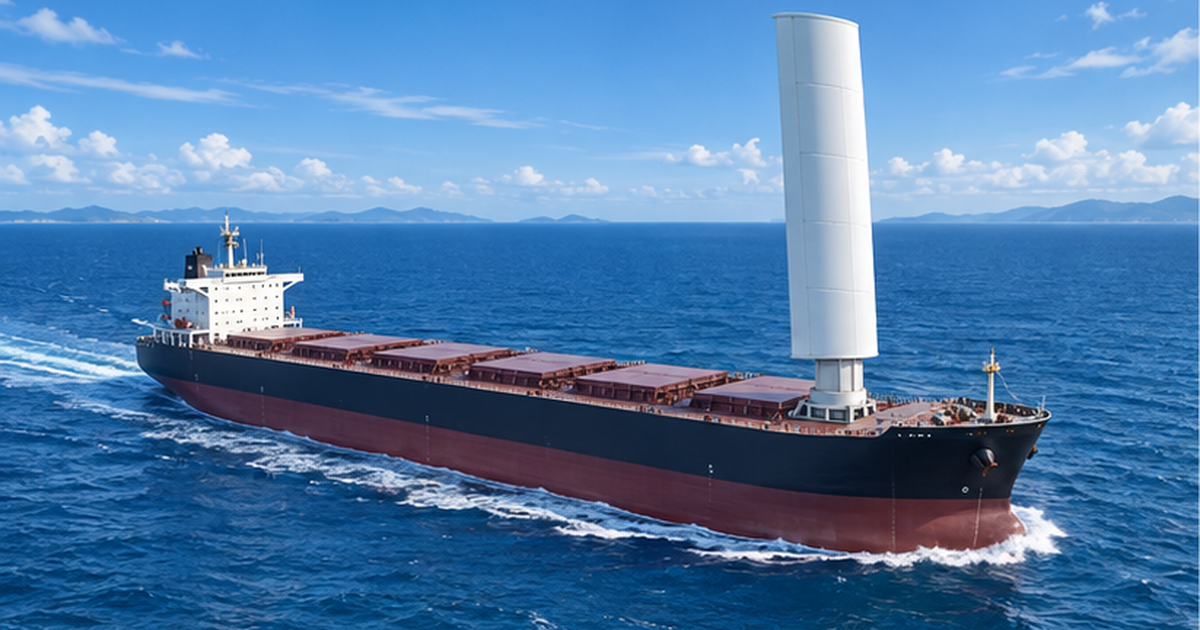
On the deck of a massive cargo ship, a wing-shaped white sail rises high into the sky. This is not a return to the age of sail — it is Wind Challenger, the cutting-edge wind propulsion technology commercialized by Mitsui O.S.K. Lines (MOL).
International shipping is estimated to account for about 3% of the world's CO2 emissions, and the International Maritime Organization (IMO) has been tightening regulations aimed at net-zero emissions around 2050. If ships that burn fuel to move can also harness the free, ever-blowing power of the wind, fuel consumption and emissions can be reduced directly.
Wind Challenger brings this idea to life through hard-sail engineering, and has accumulated real-world fuel-saving data on actual commercial routes. This article organizes its mechanism, verified results, and future deployment plans based on primary sources.
What you'll learn in this article
- How Wind Challenger's hard sail converts wind power into propulsion
- Real-world fuel savings data from the demonstration ship Matsukaze
- Deployment plans expanding beyond coal carriers to LNG and LCO2 carriers
- The link between international shipping's GHG regulations and wind propulsion
- The limits of decarbonization by sail, and how it combines with other technologies
What Is Wind Challenger?
"Wind Challenger" is a hard-sail wind propulsion system developed primarily by MOL (Mitsui O.S.K. Lines). Rather than a cloth sail, it uses a rigid structure shaped like an aircraft wing (a hard sail) erected on the ship's deck to catch the wind and generate propulsive force.
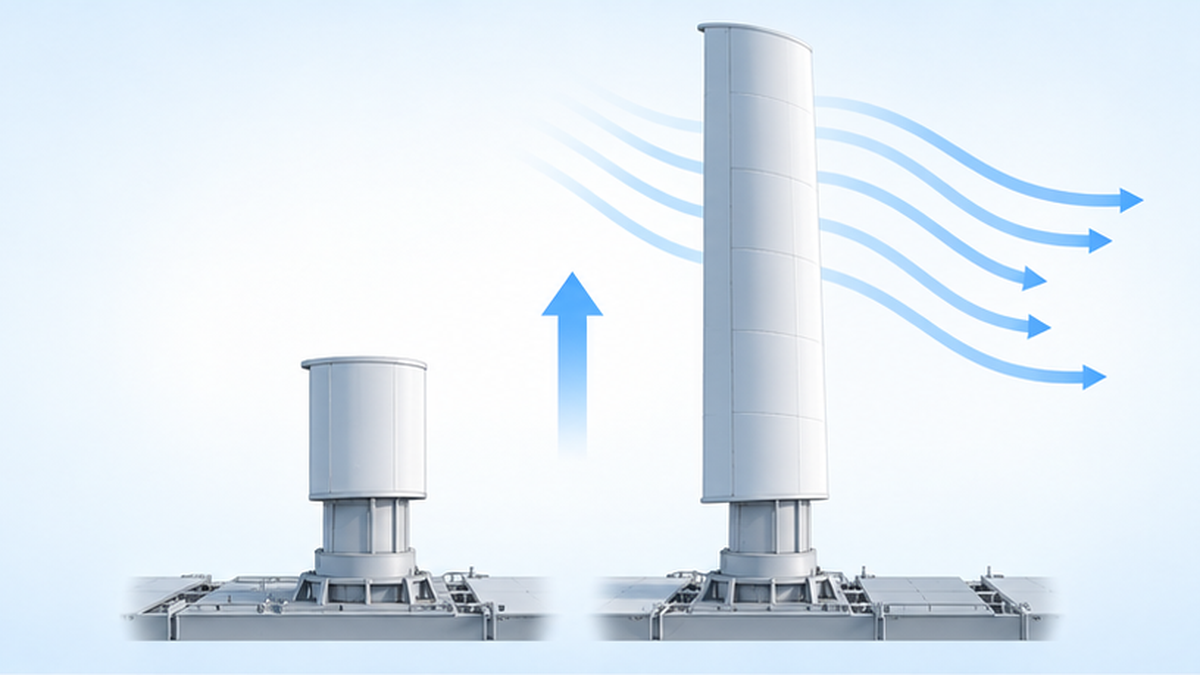
Its key feature is that the sail can extend and retract up to a maximum height of 53 meters. It is retracted during strong winds, cargo handling in port, or when passing under bridges, and extended during ocean cruising to make the most of the wind. Development has proceeded in cooperation with research institutions including the University of Tokyo, with basic research accumulating since around 2009.
Research began at the University of Tokyo in 2009
The research that became the prototype for Wind Challenger began in October 2009 as an industry-academia joint research project centered on the University of Tokyo's Graduate School of Engineering. In December of that year, Project Specially Appointed Professor Kazuyuki Ouchi (Department of Systems Innovation, Graduate School of Engineering, University of Tokyo) and others held a press conference to announce the "Wind Challenger Project." Together with Specially Appointed Associate Professor Kiyoshi Uzawa and Associate Professor Takuji Waseda (Graduate School of Frontier Sciences at the same university), they pursued research and development of a new "sail-powered, engine-assisted" wind propulsion ship type, aiming to cut fuel consumption to one-third or less compared with a conventional engine-powered ship of the same performance.
From 2013, the project was selected for subsidies under the Ministry of Land, Infrastructure, Transport and Tourism's "Next-Generation Ocean-Related Technology R&D Subsidy," accelerating practical research through industry-academia collaboration. From January 2018, MOL and Oshima Shipbuilding took over development, refining the university's basic research into an industrial product that could be installed on actual commercial ships. About a decade of accumulated research culminated in the first ship installation in 2022.
Building the first ship, Matsukaze
The coal carrier "Matsukaze" was the world's first ship to implement Wind Challenger. Built at Oshima Shipbuilding (Nagasaki Prefecture), it was completed in October 2022. Equipped with one hard sail, it operates as a dedicated coal-carrying vessel for Tohoku Electric Power, mainly on routes from Australia, Indonesia, and North America. Prior to completion, this installation plan was also certified under the Ministry of Land, Infrastructure, Transport and Tourism's "Introduction Plan for Ships with Superior Environmental Performance (Designated Ships)," suggesting the project also received policy support as part of national environmental policy.
The ship's name, "Matsukaze" (pine wind), embodies the expectation of a new generation of ships powered by wind. Coal carriers were chosen as the first demonstration target partly because resource carriers regularly repeat long-distance ocean voyages, making it easier to accumulate wind condition data and verify fuel efficiency improvements.
How the sail captures wind
Wind Challenger's hard sail is not simply a flat panel that catches wind — it has a cross-sectional shape that generates "lift" using the same principle as an aircraft wing. By automatically adjusting the sail's angle according to wind direction, it can convert not only tailwinds but also crosswinds and winds from oblique angles efficiently into propulsion. A bridge system automatically controls the sail's angle and height based on weather data and route information, meaning the crew does not need to operate it constantly — a key point for practical implementation.
Whereas a traditional yacht sail works more on the principle of "deflecting the wind to move forward," the hard sail's fixed airfoil-shaped cross-section makes it easier to generate stable lift and easier to control in strong winds. In dangerous weather conditions such as an approaching typhoon, the sail is designed to retract to its lowest position to minimize wind loads on the hull.
Installed without major changes to the hull
Another feature of Wind Challenger is that, as long as a base (mast section) to support the sail can be secured, no large-scale modification of the hull itself is required. It can be built into new ships from the design stage, and can also be retrofitted onto ships already in service through modification work that installs the base at an appropriate location on the deck. This high degree of versatility is the technical background that allowed it to be deployed across different ship types, from coal carriers to LNG carriers.
This "ease of retrofitting" carries significant weight for the shipping industry as a whole. Ships are often used for 20 to 30 years from construction to decommissioning, and replacing an entire fleet takes decades. If all emissions reductions relied solely on new ships, improving the performance of the entire fleet would take many decades. A technology that can be retrofitted onto existing ships can deliver emissions reductions to the currently operating fleet in a short period, accelerating the pace of emissions reduction alongside the introduction of new vessels.
The sail is made of lightweight, high-strength composite materials, which must withstand long-term exposure to the marine environment — salt damage, UV rays, and repeated wind loads. Maintainability is also factored into the moving parts, with regular inspection and maintenance cycles incorporated into existing shipboard equipment maintenance regimes. For equipment installed on a commercial ship that operates at sea for extended periods, durability and repairability are just as important as raw performance for practical use.
What the Demonstration Data Shows About Fuel Savings
After completion, Matsukaze made seven round-trip voyages to Japan over roughly 18 months (through April 2024), during which Wind Challenger's performance was verified through actual measurements.
| Metric | Measured Result |
|---|---|
| Maximum daily fuel savings | 17% |
| Average fuel savings per voyage | 5-8% (as expected prior to completion) |
| Verification period | About 18 months since completion, 7 round-trip voyages |
| Main routes | Australia, Indonesia, North America → Japan |
Savings vary depending on wind conditions, but reductions of about 5% on the Japan-Australia route and about 8% on the Japan-North America West Coast route are estimated. Under strong, stable wind conditions, a large one-day savings of 17% was confirmed, underscoring the technology's practical viability.
What matters is that these figures are not laboratory simulations but actual measured values from seven round-trip commercial voyages. In the shipping industry, a gap often emerges between "theoretical performance" and "real-world operating performance" for new technologies, but in Matsukaze's case, the pre-completion estimate (5-8%) was nearly reproduced in actual operation — a result that appears to have supported the subsequent decision to expand deployment.
Fuel savings are roughly proportional to CO2 emission reductions. Since marine fuel (heavy fuel oil) emits a fixed amount of CO2 when burned, cutting fuel consumption by 5-8% reduces CO2 emissions for that voyage by roughly the same proportion. The reduction per ship is far from negligible, and when scaled across dozens or hundreds of vessels, it becomes a level of impact that visibly affects a shipping company's overall CO2 emissions.
A 5-8% cut in GHG emissions from a single sail
According to MOL, installing a single Wind Challenger unit is expected to reduce greenhouse gas (GHG) emissions by an average of about 5-8% compared with a conventional ship of the same type. Designs with two sails, or combined with rotor sails, are also being considered to further increase the reduction rate.
The fact that fuel savings translate directly into fuel cost reductions is also a factor encouraging shipping companies to adopt the technology. Dedicated ships that repeatedly sail the same route (such as coal carriers for power companies) can benefit from fuel cost reductions over a long period, making it easier to plan a return on capital investment. This predictable payback likely factored into Matsukaze being chosen as the first demonstration target as a dedicated ship for a power utility.
What the Matsukaze demonstration revealed
- The pre-completion estimate (average 5-8%) was nearly reproduced in actual operation.
- On days with good wind conditions, a large one-day savings of 17% was also observed.
- This is based on long-term real-voyage data from about 18 months and 7 round trips.
Expansion Plans and Growing Applications
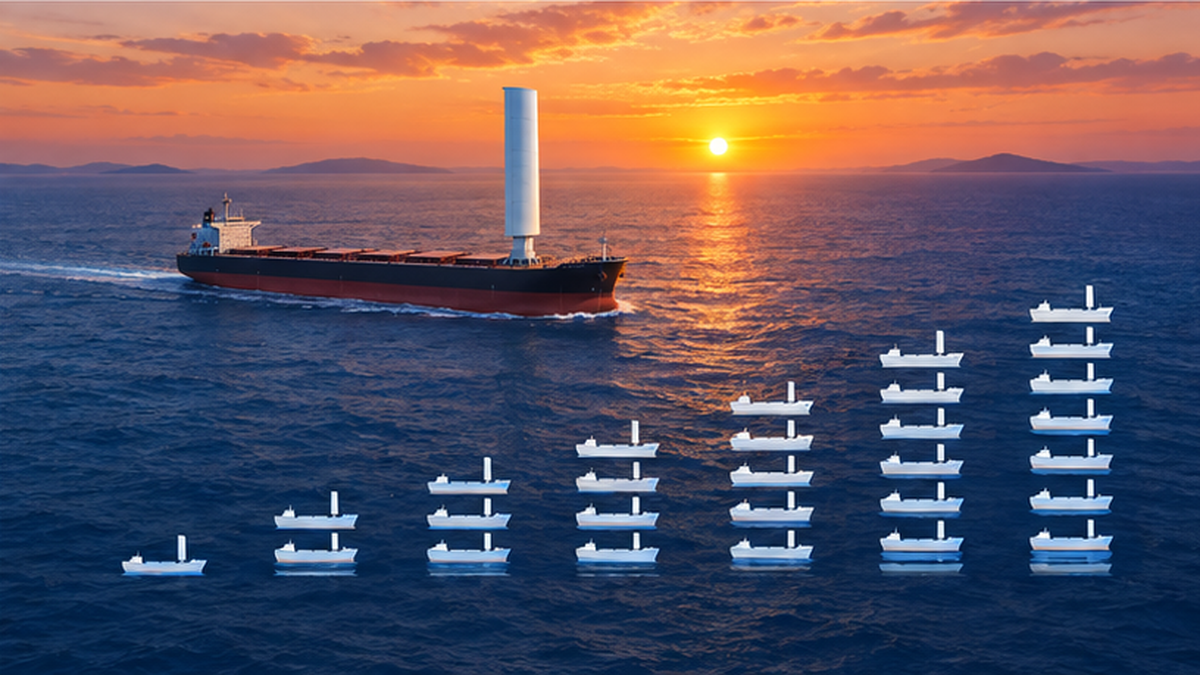
MOL has set achieving net-zero emissions by 2050 as a corporate goal, positioning "improving fuel efficiency" as one of its key measures. For Wind Challenger-equipped vessels, MOL plans to expand the fleet to 25 ships by 2030 and 80 ships by 2035.
- Coal carriers (both newbuilds and retrofitted existing ships)
- Dry bulk carriers (bulk cargo ships for grain, ore, etc.)
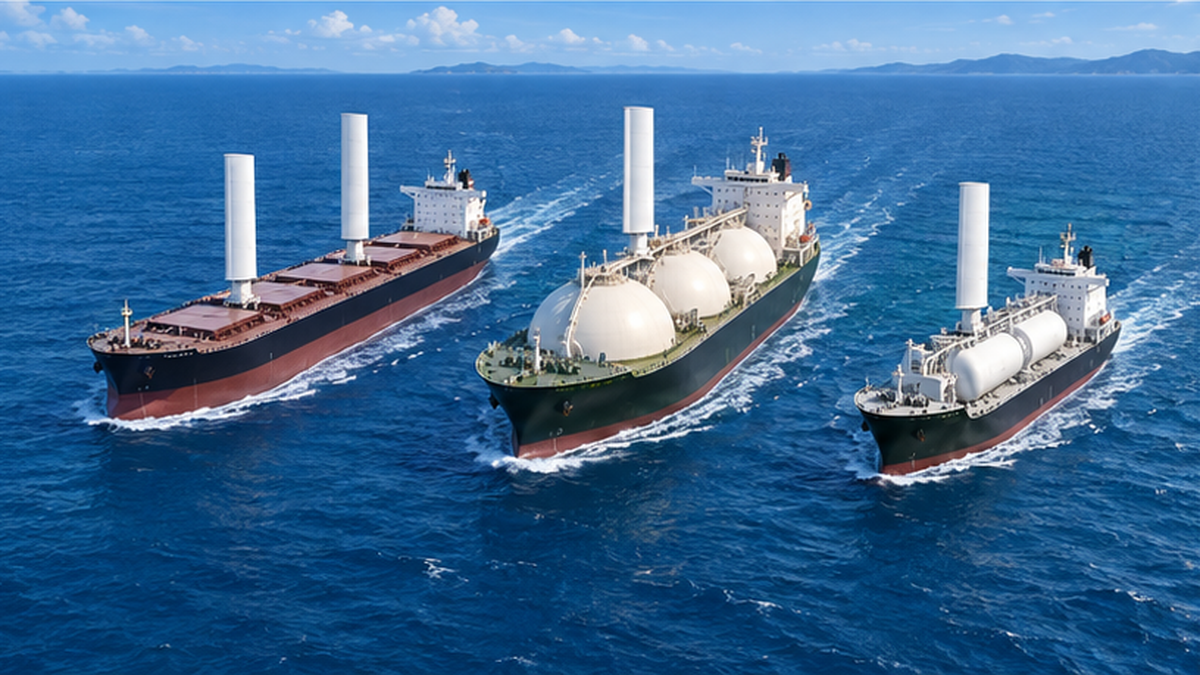
- LNG (liquefied natural gas) carriers
- Newly designed LCO2 (liquefied CO2) carriers
A world-first challenge: retrofitting an existing ship
On the coal carrier "Kurotakisan Maru III," operated for Electric Power Development Co., Ltd. (J-Power), modification work to retrofit Wind Challenger onto an already-in-service ship — rather than a newbuild — has been completed. This is considered a world first, and it is significant in that it demonstrated that wind propulsion technology can be deployed even to fleets already in operation. It opens a path to reducing emissions by making use of the existing ship fleet, rather than relying solely on new construction.
Expansion to LNG and LCO2 carriers
MOL is also pursuing the world's first case of installing two hard sails on an LNG carrier. Furthermore, in collaboration with South Korea's Samsung Heavy Industries, MOL developed a concept design for a 40,000-cubic-meter class LCO2 carrier equipped with three Wind Challenger units, and obtained Approval in Principle (AiP) from the classification society ClassNK. As CCS (Carbon Capture and Storage) projects that capture and store CO2 underground expand, demand for transporting CO2 itself by ship is expected to grow, and this is a move to build emissions reductions from wind propulsion into that transport stage as well.
The reason the concept of installing Wind Challenger on LCO2 carriers is attracting attention is that CCS projects themselves tend to face the contradiction of "emitting new CO2 in the process of transporting CO2 to reduce emissions." The process of compressing, liquefying, and transporting CO2 over long distances by ship consumes energy, so efforts are needed to minimize emissions from the transport stage itself. The design with three Wind Challenger units appears aimed at increasing the emissions-reduction effect across the entire CCS supply chain.
| Ship Type | Example Number of Sails | Notes |
|---|---|---|
| Coal carrier "Matsukaze" | 1 sail | World's first installation; obtained demonstration data |
| Coal carrier "Kurotakisan Maru III" | 1 sail | World's first retrofit onto an existing ship |
| LNG carrier | 2 sails | World's first two-sail installation |
| LCO2 carrier (concept design) | 3 sails | Jointly developed with Samsung Heavy Industries; obtained AiP |
Why Sails Are Being Reconsidered Now
International shipping is estimated to account for about 2-3% of the world's CO2 emissions, and in 2023 the International Maritime Organization (IMO) revised its greenhouse gas reduction strategy, unanimously agreeing on a policy to achieve net-zero emissions around 2050. Ahead of that, from January 2023, the "EEXI regulation," which evaluates the fuel efficiency of existing ships, and the "CII (Carbon Intensity Indicator) rating system," which rates actual fuel efficiency performance, began applying to large ocean-going ships worldwide. Shipping companies are continuously evaluated on whether their fleets comply with these regulations and ratings, and ships with low ratings may face disadvantages in future operations and trade.
There are broadly two approaches to reducing emissions from ships: converting the fuel itself to low-carbon fuels such as ammonia or methanol (see Decarbonizing International Shipping: A Complete Guide to IMO Regulations and the Shift to Ammonia and Methanol Fuel for details), and using renewable energy such as wind as an auxiliary power source to reduce the load on the engine itself. The IMO approved a net-zero framework including carbon pricing at its MEPC 83 meeting in April 2025, scheduled to take effect in 2027 and enter into force in 2028. Once emissions carry a price, technologies that save fuel will also gain greater economic value.
Wind Challenger is a leading example of the latter approach (renewable energy utilization), and its strength in practical terms is that it can be combined with existing diesel-engine ships regardless of fuel type. A full transition to new fuels requires the essential development of fuel supply infrastructure, whereas wind propulsion allows emissions reductions to proceed step by step while still using existing engines and fuel — positioning it as a kind of "bridge" technology as well.
Wind power is also expanding to smaller vessels
- Beyond large commercial ships, efforts to improve fuel efficiency by combining wind power and electrification are also progressing in the fishing vessel sector (related article: Decarbonizing Fishing Vessels: The Frontier of Fuel Efficiency and Electrification).
- Sail-assisted propulsion is attracting attention as a highly versatile technology applicable regardless of ship size or route.
The limits of wind propulsion technology
On the other hand, wind propulsion has its limits. In sea areas with little wind, or on routes with persistent headwinds, the savings effect becomes smaller. Installing a sail also requires design that avoids interference with deck space and cargo-handling equipment such as cranes, and retrofitting existing ships takes cost and construction time. It should be noted that Wind Challenger is merely an auxiliary device for the engine, not the primary means of propelling the ship on its own.
Some ship types also have difficulty securing space for sail installation. Container ships, which stack containers high on deck, face challenges in balancing the sail's range of motion with maintaining visibility, which is one reason practical adoption has moved ahead first on bulk carriers, tankers, and LNG carriers with relatively open decks.
It should also be noted that the emissions-reduction effect of wind propulsion varies significantly by route, so it cannot be simply stated that "installing this technology will achieve a uniform percentage reduction." Actual reduction rates fluctuate based on multiple factors, including seasonal prevailing winds, the latitude band the route passes through, and ship speed settings. The fact that MOL moved to expand deployment only after accumulating long-term real-voyage data likely reflects the need to thoroughly assess these variable factors.
Wind Challenger's Place in MOL's Decarbonization Strategy
Under its environmental strategy named "BLUE ACTION MOL," MOL is combining multiple technologies, including Wind Challenger, to aim for net-zero by 2050. Among these, wind propulsion is positioned as a technology that requires no additional fuel procurement cost and, once installed, continuously reduces fuel costs.
- Improving fuel efficiency through wind propulsion devices (Wind Challenger, etc.)
- Introducing alternative-fuel ships using ammonia, methanol, and others
- Thoroughly pursuing energy-saving operations (slow steaming, optimal route selection)
- Reducing emissions during port stays, such as through the use of shore power
Resource transport such as coal and LNG in particular involves many long-distance ocean routes, giving it characteristics that benefit readily from wind conditions. The background to MOL starting verification with coal carriers and then expanding to LNG and LCO2 carriers likely reflects a prioritization of practical implementation based on these route characteristics.
Wind propulsion is also advancing at other companies and abroad
MOL is not the only company working on energy-saving wind-assisted shipping technology. Overseas, Finland's Norsepower has developed "rotor sails" (Magnus-effect propulsion devices using rotating cylinders) and has accumulated installation track records on ferries and tankers. In Japan too, several shipping companies and shipyards are examining kite-type propulsion assist devices and hybrid configurations combining rotor sails with hard sails, and wind propulsion is expanding from being one company's proprietary technology to becoming a common option across the industry.
Multiple approaches to wind propulsion technology exist, including hard sails (the Wind Challenger type), rotor sails using rotating cylinders, and kite-type devices flown high above the ship. Each has different strengths depending on wind direction, ship type, and available installation space, and going forward, it is conceivable that the optimal method will be chosen according to ship type and route characteristics, or that multiple methods will be combined. Rather than a single "correct" technology dominating the industry, it is more likely that multiple technologies will coexist, together contributing to improved fuel efficiency across the shipping industry.
What This Means for Shipping Companies and Cargo Owners
The expansion of Wind Challenger deployment carries implications beyond MOL alone. For shipping companies transporting resources such as coal and LNG, fuel efficiency is increasingly becoming a public metric evaluated through the CII rating, and for cargo owners, the environmental performance of the shipping company they entrust with transport has become an element that cannot be ignored when managing emissions from the transport stage of their supply chain (Scope 3 emissions).
Linking to cargo owners' decarbonization goals
Many major cargo owners, such as power companies and resource trading firms, have set their own greenhouse gas emissions reduction targets, and achieving them requires reducing Scope 3 (entire supply chain) emissions. The fact that Matsukaze operates as a dedicated vessel for a specific power company shows that, for the cargo owner placing the transport order, there is also a benefit in being able to position the emissions reductions from fuel savings as part of their own environmental performance record. Here lies a structure in which a shipping company's technology investment helps advance a cargo owner's decarbonization goals.
This kind of structure is spreading across supply chains in heavy industries such as electric power, resources, and materials. Efforts to visualize and steadily reduce CO2 emissions at every stage, from raw material and fuel procurement through manufacturing, transport, and sales, are increasingly demanded of large cargo owners by shareholders and business partners who expect accountability. Entering long-term contracts with shipping companies that actively adopt technologies contributing to emissions reductions in the transport stage also serves cargo owners by improving the quality of their own emissions reporting.
Ripple effects across the shipping industry
In the process by which one company's technology development becomes an industry standard, the disclosure and sharing of demonstration data plays an important role. MOL's practice of publishing Matsukaze's fuel savings results with specific figures also serves as material for other shipping companies considering the introduction of wind propulsion technology at their own firms. Combined with Norsepower's overseas track record of practical rotor sail implementation, as confidence in wind propulsion technology as a whole grows, industry-wide adoption could accelerate further.
Shipping Decarbonization Enters an Era of Combined Technologies
What the Wind Challenger demonstration results show is not that "a single technology dramatically cuts emissions," but rather a realistic approach within the shipping industry of combining fuel conversion, energy-saving operations, and renewable energy use to steadily build up reductions.
A figure of 5-8% may seem small at first glance, but if it spreads across the world's shipping fleet, the cumulative contribution to reducing emissions from international shipping as a whole becomes far from negligible. The emergence of the world's first retrofit installation onto an existing ship also shows that this technology is moving from the experimental stage toward widespread practical adoption.
From the launch of basic research at the University of Tokyo in 2009, to the completion of the first ship in 2022, to the completion of the retrofit onto an existing ship in 2026, Wind Challenger has steadily built up its progress over roughly 15 years. This approach — prioritizing the accumulation of measured data over flashy announcements — may serve as one reference model for how technology should be introduced in an industry like shipping, where investments are long-term and large-scale.
Summary of this article
- Wind Challenger is MOL's technology that converts wind power into propulsion using a hard sail extending up to 53 meters.
- The demonstration ship Matsukaze confirmed fuel savings of up to 17% on its best day and an average of 5-8% per voyage through actual measurement.
- MOL plans to expand deployment to 25 ships by 2030 and 80 ships by 2035.
- In addition to coal carriers, applications are expanding to retrofitted existing ships, LNG carriers, and LCO2 carriers.
- Wind propulsion is positioned as part of a "combined technology" approach alongside fuel conversion and energy-saving operations.
Not a Return to the Age of Sail, but Cutting-Edge Engineering
Hearing that "sails move the ship" might bring to mind the sailing ships of the Age of Discovery. However, Wind Challenger is fundamentally different from sailing ships that operate cloth sails by hand. The hard sail is an industrial product made of composite materials and steel, automatically adjusted to the optimal angle and height through sensors and computer control. There is no need for crew members to raise or lower the sail, and the fact that the bridge system operates it autonomously based on weather data is itself a modern energy-saving technology.
A design philosophy of "sail-assisted," not "sail-powered"
At the basic research stage at the University of Tokyo, the goal was a "sail-powered, engine-assisted" ship type in which the engine played a supporting role and the sail served as the primary power source, with a research target of cutting fuel consumption to one-third or less of a conventional ship. The Wind Challenger that was actually commercialized is configured with the engine as the primary power source and the sail supplementing fuel reduction, suggesting that adjustments were made toward practical implementation between the ambitious research-stage goal and specifications that were realistic for actual commercial adoption. It is common across many environmental technologies that research targets are not implemented exactly as originally conceived, but are commercialized while balancing safety, operational efficiency, and cost.
A perspective on crew safety
Operating a large sail at sea requires ensuring safety during strong winds and rough weather. Wind Challenger is designed to retract the sail when danger is anticipated, such as an approaching typhoon, reducing wind loads on the hull. In addition, because automatic control eliminates the need for crew members to spend time operating the sail, there is no need to newly prepare the specialized sail-handling skills and staffing that traditional sailing ships required, which also lowers the barrier to adoption in commercial operations.
Modern commercial ships must complete long voyages with a small crew, and equipment that demands new specialized skills from the crew tends to face higher barriers to adoption. The fact that Wind Challenger is designed so that "operation is automatic, and the crew only monitors it" reflects practical consideration for raising environmental performance without increasing the crew's workload.
Weighing the Cost and Profitability of Adoption
An unavoidable factor in evaluating any new environmental technology is the outlook for installation cost and return on investment. A large hard-sail system like Wind Challenger requires a substantial initial investment, including the sail itself, its moving mechanism, and control systems. On the other hand, since fuel costs are a continuous expense throughout a ship's operating life, securing a fuel savings rate makes the investment easier to recoup the longer the ship operates.
Why it suits dedicated, long-term contract ships
Dedicated vessels like Matsukaze, which transports coal for a specific power utility, repeatedly sail the same route over long periods. This makes it easier to accumulate fuel savings and wind condition data over time, and easier to forecast the return on investment. In contrast, tramp ships, whose cargo owners and routes change frequently, face greater variation in wind conditions, making it harder to estimate the effect. MOL's approach of expanding deployment starting from dedicated, long-term contract ships like coal carriers is likely influenced by this predictability of profitability.
Fuel price volatility: another variable
The economic value of fuel savings is also affected by fluctuations in fuel prices themselves. When prices for heavy fuel oil or low-sulfur marine fuel rise, the monetary value of the same savings rate increases. In addition, if the IMO's carbon pricing (putting a price on emissions), mentioned earlier, is fully introduced in the latter half of the 2020s, a cost will be attached to the CO2 emitted from burning fuel, potentially further increasing the economic value of fuel savings achieved through wind power.
Points for investment decisions
- Whether the route has stable wind conditions (effects appear more readily on long-distance ocean routes)
- Whether long-term operation on the same route can be expected (dedicated and long-term contract ships recoup investment more easily)
- How to factor in the risk of future fuel price and carbon price increases
Government support also encourages adoption
As with Matsukaze's installation plan, which was certified under the Ministry of Land, Infrastructure, Transport and Tourism's "Introduction Plan for Ships with Superior Environmental Performance (Designated Ships)," tax incentives and subsidy programs are sometimes available for introducing ships with superior environmental performance. The mechanism of combining policy support from the government with private-sector investment, rather than leaving the initial investment in new technology to private companies alone, has helped lower the barrier to adoption — and is one reason Wind Challenger was able to reach practical implementation.
References and Sources
- MOL Press Release: "Completion of Wind Challenger Installation on Existing Coal Carrier for Electric Power Development" - World's first retrofit onto an existing ship
- MOL Press Release: "Wind Propulsion Assist Devices Installed on Seven MOL Dry Bulk Vessels" - Plan to reach 25 ships by 2030
- MOL Solutions: "WIND CHALLENGER Sea Trial" - Matsukaze's demonstration voyage data
- Mitsui O.S.K. Lines: "World's First Liquefied CO2 Carrier Equipped with Wind Challenger" - AiP obtained for the LCO2 carrier
- MOL Solutions: "WIND CHALLENGER Hard Sail Completed" - Construction case of the hard sail
- MOL Solutions: "World's first installation of the two Wind Challenger sails for LNG carrier" - Two-sail installation on an LNG carrier
- MOL: "BLUE ACTION MOL - WIND CHALLENGER" - Overview of Wind Challenger technology
- Ministry of Land, Infrastructure, Transport and Tourism: IMO Greenhouse Gas Reduction Strategy - International shipping's emissions reduction targets
- University of Tokyo: "Press Conference: Launch of the Wind Challenger Project" - Background on the project's launch in 2009
- MOL: "Wind Challenger Installation Plan Certified as a 'Designated Ship' Introduction Plan by MLIT" - Policy positioning of Matsukaze
*Listed in order of reliability: government and academic institutions > peer-reviewed papers > specialized organizations > reputable media