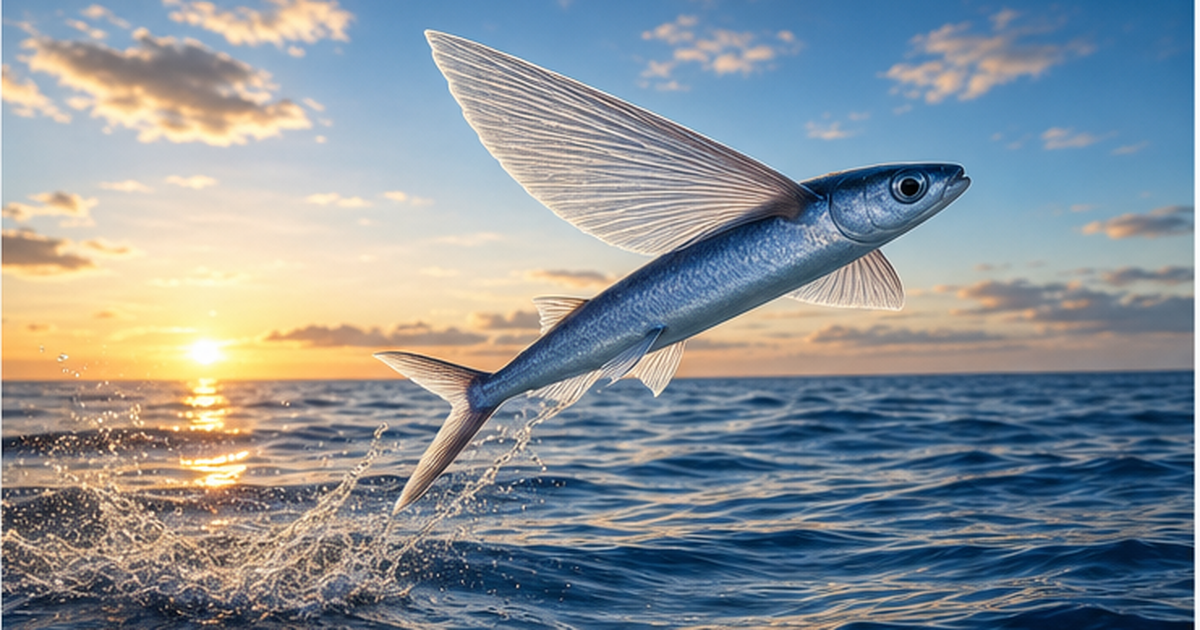
When you travel by boat across a summer sea, a silver fish startled by the bow wave bursts from the surface, spreads fins like wings, and slides away dozens of metres ahead. This is the flying fish. That a fish moves through air is strange enough, but learning its actual performance is even more surprising. The longest glide on record is about 400 metres, time aloft can exceed 40 seconds, and speed immediately after takeoff reaches nearly 70km/h.
This ability is not a matter of a fish simply happening to jump. Wind tunnel experiments conducted in 2010 by Hyungmin Park and Haecheon Choi of Seoul National University demonstrated through direct measurement that the ratio of lift to drag generated by a flying fish's pectoral fins rivals that of medium-sized birds such as vultures and petrels. Better than insects, on a par with birds — an extraordinary aerodynamic performance for a creature whose primary business is not flight.
Flying fish also choose to fly at an extremely low altitude, only tens of centimetres above the sea surface. This is not because they are afraid to climb higher; it is a rational flight strategy that exploits the physics of ground effect (surface effect), which reduces drag by up to 14%. This article traces the structure of the flying fish's body and the mechanics of its glide, the evolutionary context of why it came to fly, the ecology of the roughly 30 species living in Japanese waters, and the food culture in which it is known as "ago" and loved as a stock ingredient and fish paste product — all grounded in primary sources.
What you will learn in this article
- Why flying fish are said to "glide" rather than "fly," and the three-stage process leading to takeoff
- The fact that the lift-to-drag ratio measured in wind tunnel experiments equals that of medium-sized birds such as vultures and petrels
- The physics of "ground effect (surface effect)," which cuts drag by up to 14% when flying just above the sea surface
- The distinct roles that the pectoral fins, pelvic fins, and asymmetrical tail fin each play in gliding
- Gliding as a strategy for escaping predators, and the trade-off hidden within it
- Flying fish in Japanese food culture — ago stock, ago-noyaki, kusaya, and the fisheries of Kagoshima and Nagasaki
What exactly is a flying fish — the truth about the "flying" fish
Flying fish is the collective name for marine fishes classified in the family Exocoetidae of the order Beloniformes. They are widely distributed across the warm seas of the world, and roughly 7 genera and around 60 species have been described. The waters around Japan are among the richest in the world in terms of species count, with about 30 species recorded. In other words, roughly half of the world's flying fish species gather in Japanese seas.
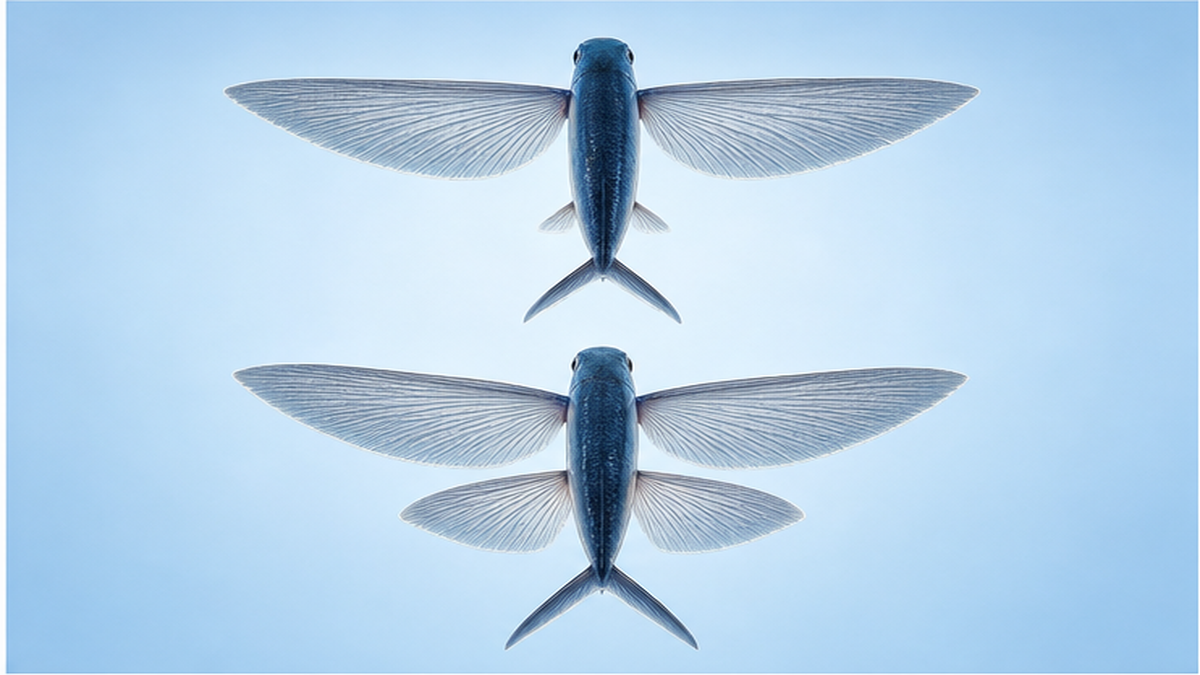
Their shared feature is the pectoral fins, developed to an extreme size relative to the body. In most fish the pectoral fins are small, used for turning and braking, but in flying fish they extend to nearly the length of the body and, when spread, form a plane like an aircraft's main wing. In addition, they have an asymmetrical tail fin in which the lower lobe is clearly longer than the upper lobe. These two features are the anatomical core of the "flying" fish.
Two-winged and four-winged forms
The family Exocoetidae divides broadly into two types according to how the fins are developed: the two-winged form, in which only the pectoral fins are greatly enlarged, and the four-winged form, in which the pelvic fins are enlarged as well. The representative of the former is the genus Exocoetus, distributed widely across the world's open oceans; the latter includes the genus Cheilopogon, which contains species such as the Japanese flying fish and the ocean flying fish, along with Hirundichthys and Cypselurus.
Because the four-winged form has two sets of lifting surfaces fore and aft, its configuration resembles a tandem-wing aircraft rather than a biplane. Adding the rear pelvic fins not only increases total lift but also shifts the relationship between the centre of gravity and the centre of lift toward stability, making the posture harder to upset. In general, species that glide over longer distances tend to be of the four-winged form.
| Type | Enlarged fins | Representative groups | Gliding characteristics |
|---|---|---|---|
| Two-winged form | Pectoral fins only | Genus Exocoetus | Common among smaller species; comparatively short glides |
| Four-winged form | Pectoral plus pelvic fins | Genus Cheilopogon and others | High stability from two sets of lifting surfaces; suited to long-distance gliding |
Four species familiar in Japan
The flying fish distributed as food in Japan are mainly four species: the ocean flying fish (hama-tobiuo), the Japanese flying fish (tsukushi-tobiuo), the slender flying fish (hoso-tobiuo), and the flying fish (tobiuo). The ocean flying fish in particular is a large species reaching 50cm in total length and 1kg in weight, and unusually among flying fish it spawns in winter. In the Izu Islands it is an important catch from winter through early spring, and the Tokyo Metropolitan Islands Area Research and Development Center of Agriculture, Forestry and Fisheries continues to survey its stock and fishing season.
The whole body is built to carry wings
The flying fish's adaptations are not limited to its pectoral fins. First, its body shape is a slender spindle with a somewhat angular cross-section. This shape reduces resistance underwater while, in air, the trunk itself is thought to act as a "lifting body" generating a small amount of lift. A design in which the fuselage as well as the wings carries part of the load is a concept also seen in high-performance aircraft.
The swim bladder is also distinctive, developing greatly along the dorsal side of the body cavity and contributing to a lighter body. Lightness is decisive for a flying animal, and the same logic by which birds hollow out their bones and shrink their gonads outside the breeding season operates in this fish as well. The characteristic mentioned later of being "low in fat" as a food ingredient is not unrelated to this weight reduction.
Furthermore, the eyes are large with a flattened cornea. Because the refraction of light differs completely between water and air, forming a clear image in both environments is inherently difficult. The shape of the flying fish's eye is often explained as a compromise that allows it to grasp waves and obstacles while moving at high speed above the water. Flying just above the sea at tens of kilometres per hour, it cannot afford to be unable to see.
What was changed in order to fly
- Pectoral fins: extended to nearly the length of the body, forming the wing surface
- Pelvic fins (four-winged form): add lift and stability as a rear lifting surface
- Tail fin: the lower lobe is longer than the upper, working as a propulsor even when half the body is in the air
- Body shape: a low-resistance spindle; in air the trunk itself generates a little lift
- Swim bladder and body fat: a large swim bladder and low fat create a light body suited to flight
Basic profile of the flying fish
- Classification: order Beloniformes, family Exocoetidae; about 7 genera and 60 species worldwide, about 30 species around Japan
- Distribution: surface layers of warm seas worldwide. In Japan they migrate along the Kuroshio and Tsushima warm currents
- Size: most are 20–35cm; the large ocean flying fish reaches 50cm and 1kg
- Diet: a surface-dwelling fish that feeds mainly on zooplankton
- Predators: large fish such as tuna, skipjack, mahi-mahi and billfish, as well as seabirds
It should be noted that although we say they "fly," flying fish do not obtain thrust by flapping their fins the way birds and bats do. They can appear to beat their fins vigorously up and down in the air, but this is not flapping; it is thought to be fine adjustment in response to airflow and posture. The flight of a flying fish is not powered flight but gliding, and all of its energy is obtained during the underwater run-up. This distinction is the key to understanding the takeoff process examined next.
The mechanics of gliding — the three stages of run-up, takeoff, and glide
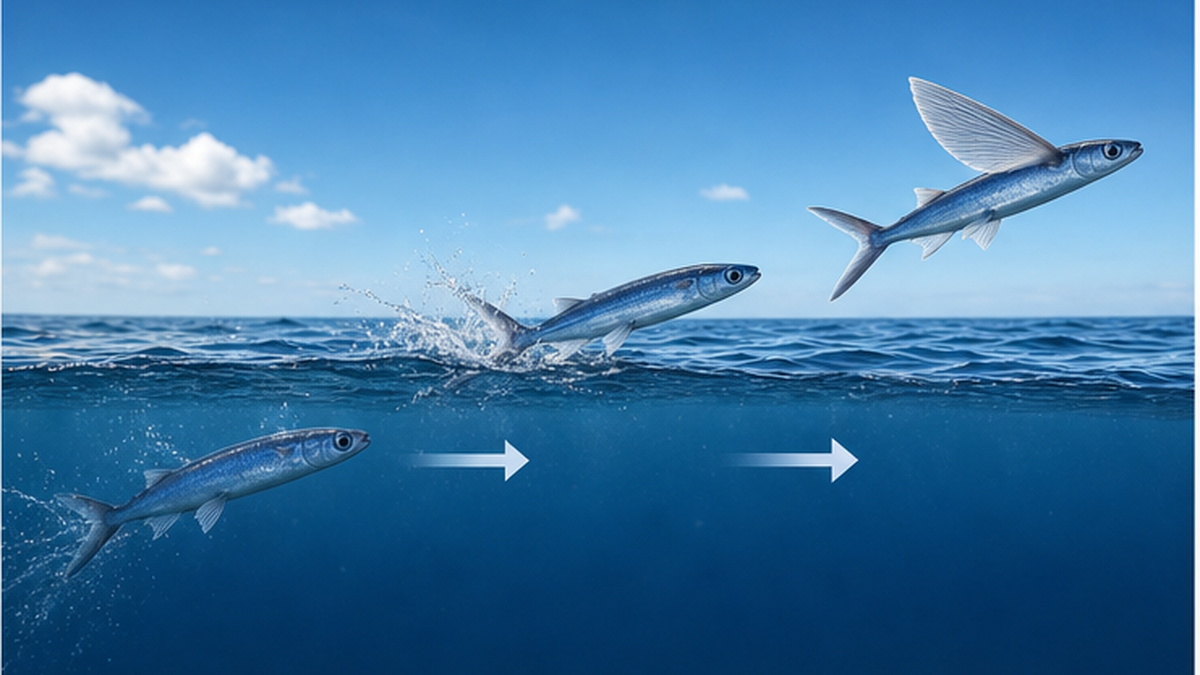
The flight of a flying fish divides broadly into three stages: the run-up, in which it accelerates underwater; the takeoff, in which it builds further speed by beating the sea surface with its tail fin; and the glide, in which it spreads its wings and slides. It closely resembles the way an engineless glider gains altitude and speed while towed by a tug aircraft: performance after leaving the water is almost entirely determined by how much speed was gained beforehand.
Stage 1: the underwater run-up
A flying fish that senses a predator first accelerates by whipping its body vigorously underwater. At this point the pectoral fins are still folded against the flanks, holding a spindle-shaped posture that minimises water resistance. Because water is roughly 800 times denser than air, reaching high speed underwater is not easy. Even so, rising obliquely toward the surface, it drives itself in one burst up to the speed required for takeoff.
Stage 2: takeoff powered by beating the sea surface
This stage is the most distinctive feature of a flying fish's takeoff. Even with the front half of its body already in the air, it keeps only the long lower lobe of the tail fin in the water and continues to sweep it side to side at a high frequency of dozens of beats per second. Because the part of the body in the air has drastically reduced drag, the thrust from the tail fin remaining in the water translates directly into acceleration. The seemingly unbalanced form of a longer lower lobe is an adaptation for working as a propulsor in exactly this "half in air, half in water" state.
The distance of this tail-driven surface run reaches anywhere from a few metres to over ten metres depending on species and individual. On a calm day, following a flying fish, you can sometimes see a thin, long wake like a scratch left on the water — that is the mark left by the beating tail fin.
Stage 3: spreading the wings and sliding
Once sufficient speed is reached, the flying fish lifts its tail fin clear of the surface and fully deploys its pectoral fins (and, in four-winged forms, the pelvic fins as well). From here it has no organ that generates thrust, so it can only slide while consuming the kinetic energy and altitude it already holds. Speed immediately after takeoff is said to reach 50–70km/h, and from there the fish gradually decelerates as it travels above the sea.
What is interesting is its behaviour once speed drops and it begins to lose altitude. Many flying fish do not land: instead they dip only the tail fin back into the water and beat it, recovering speed and entering another glide. By repeating this "touch and go," they can build a long continuous distance from a single takeoff. The record figures of roughly 400 metres of glide and over 40 seconds aloft are in most cases achieved through this kind of continuous gliding.
Why we write "glide" rather than "fly"
The flight of birds and bats is powered flight: they flap their wings to push air backward and generate thrust. Flying fish, by contrast, have no mechanism for producing thrust in the air. Theirs is a glide that simply converts the kinetic energy gained during the underwater run-up into lift at the wing surface and spends it. For that very reason, takeoff speed and the aerodynamic performance of the wings — the lift-to-drag ratio examined in the next chapter — determine the distance flown.
This sequence of movements is in fact not something they can perform right after hatching. As juveniles their pectoral fins are relatively small and their gliding ability is limited. As they grow, the pectoral fins extend to nearly the length of the body and their takeoff and gliding technique becomes refined. In order to survive in the surface layer of the open ocean, where predation pressure is high, flying fish invest a considerable portion of their growth in completing their "wings."
Flying together as a school
Flying fish sometimes fly alone, but when a boat approaches it is common to see dozens burst out at once. The surface splinters into silver as they scatter in a fan and glide away. For a predator, a large number of targets suddenly move in different directions at once, making it impossible to decide which to chase. The "confusion effect" of a fish school is thought to operate in the air as well.
This mass takeoff is also the most common opportunity for people aboard a boat to see flying fish. The waves and noise generated by a ferry or fishing vessel are, for a flying fish, a stimulus hard to distinguish from the approach of a large predator. They are fleeing rather than welcoming, but the sight of silver bands taking off one after another along an early-summer route is one of the most beautiful scenes the Japanese sea has to offer.
This takeoff also has an unintended side effect. At night it is not unusual for a flying fish drawn to a light to fly straight onto a ship's deck. In the islands of the Pacific, traditional fishing methods that take advantage of this — collecting flying fish on deck or from rocky shores — have been handed down. The ability to fly is effective against open-ocean predators, but it can backfire against artificial lights and structures.
Aerodynamic performance revealed by wind tunnel experiments — wings that match birds
The flight of flying fish has attracted the interest of naturalists for centuries, but for a long time it was difficult to say quantitatively "just how good it is." Wild individuals fly away in an instant, making it impossible to measure forces. What changed this situation was the wind tunnel experiment by Hyungmin Park and Haecheon Choi (Seoul National University), published in the Journal of Experimental Biology in 2010.
Measuring forces directly by placing specimens in a wind tunnel
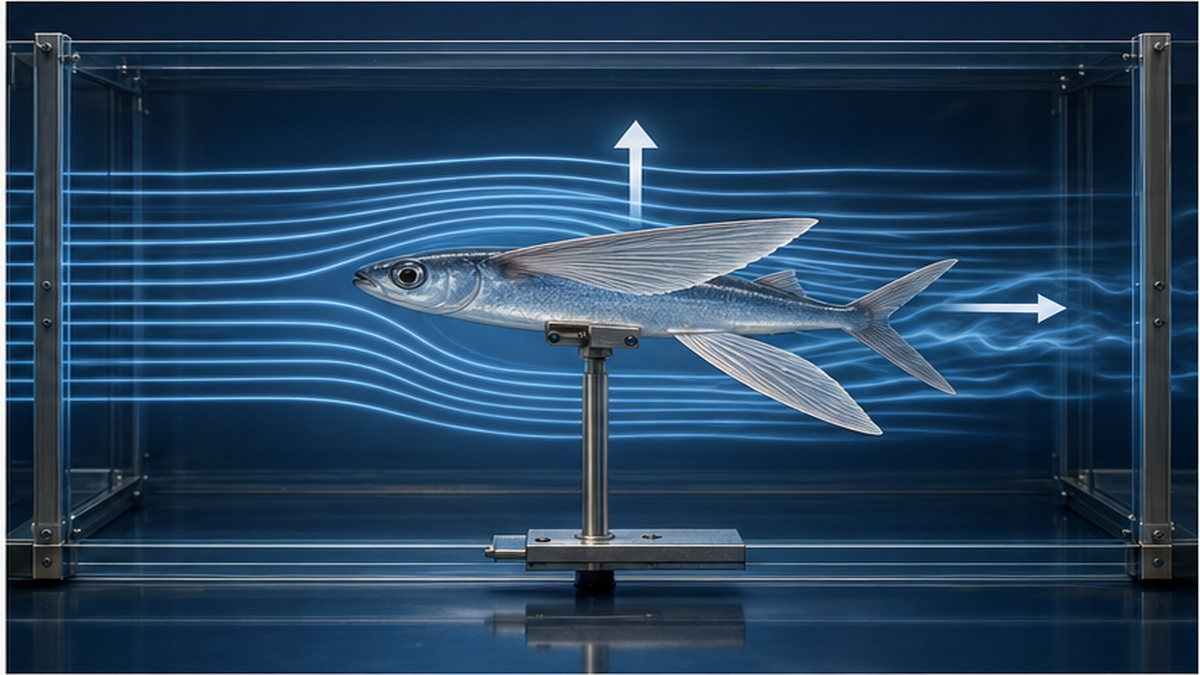
Using Cypselurus hiraii, a flying fish species distributed in the Sea of Japan, the research team prepared specimens with the fins spread in the gliding posture and one with the fins folded against the body. They fixed these in a wind tunnel and, while varying wind speed and angle of attack (the angle between the body axis and the airflow), directly measured lift, drag, and moment. This made possible the actual measurement of aerodynamic coefficients, which cannot be obtained from living individuals.
The results were clear. The lift-to-drag ratio was maximised at an angle of attack near 0 degrees, which matched the posture observed in the field — the fish holds its body almost parallel to the sea surface as it slides. Flying fish are not adopting that posture by chance; they fly in the attitude at which their performance as a wing is highest.
Surpassing insects, matching medium-sized birds
Even more striking was the level of that performance. The maximum lift coefficient and maximum lift-to-drag ratio measured by Park and Choi were comparable to those of medium-sized birds such as the vulture, the nighthawk, and the petrel. Compared with other gliding animals, flying fish clearly surpass the gliding performance of insects and sit alongside birds such as petrels and wood ducks. The standard is not "good for a fish" but "not inferior even to animals that specialise in flight."
| Comparison | Position in gliding performance |
|---|---|
| Insects (gliding species) | Lower than flying fish |
| Flying fish (Cypselurus hiraii) | Lift-to-drag ratio peaks near 0 degrees angle of attack |
| Petrels, nighthawks, vultures | Roughly equal maximum lift coefficient and lift-to-drag ratio |
| Birds specialised for long-distance gliding, such as albatrosses | Exceed flying fish |
Pectoral fins provide not only lift but stability
The experiments yielded one more important insight: the pectoral fins not only raise the lift-to-drag ratio but also improve longitudinal static stability. In aircraft design terms, the main wing not only generates lift but also serves to naturally damp pitching oscillations of the nose. In the four-winged form, with the pelvic fins added, this effect is strengthened further.
Incidentally, the significance of this research is not confined to biology. A shape that glides well and remains stable under the demanding condition of flying close to the water is an attractive model for the design of unmanned aerial vehicles and water-air hybrid vehicles. In recent years research has advanced on mechanically mimicking "gliding flight supported by tail beating," and the body of the flying fish is being measured anew from both biology and engineering.
Comparing with other creatures that "fly"
Animals that move through the air divide broadly into powered flight and gliding. Birds, bats, and insects belong to the powered-flight group that generates thrust by flapping, while flying squirrels, flying lizards, colugos, and flying fish belong to the gliding group. Every member of the gliding group adopts the same common solution of spreading some part of the body to create a wing surface, but the materials differ completely. The flying squirrel uses a membrane between fore and hind limbs, the flying lizard a membrane stretched over elongated ribs, and the flying fish its fins.
What sets flying fish apart is that they can use a different medium (water) for takeoff. A flying squirrel cannot begin a glide without climbing a tall tree, paying the cost of altitude to gravity. A flying fish accelerates under its own power in water, earning the equivalent of potential energy in the form of speed rather than height. Water is roughly 800 times denser than air, but that also makes it a medium one can push against hard. This combination of "run up in a heavy medium, slide in a light one" is a strategy unique among gliding animals.
| Animal | Origin of the wing surface | Method of takeoff |
|---|---|---|
| Flying fish | Pectoral fins (plus pelvic fins) | Accelerates underwater, beats the surface with the tail fin to leave the water |
| Flying squirrels | Membrane between fore and hind limbs | Climbs a tall tree and accelerates under gravity |
| Flying lizards | Membrane stretched over elongated ribs | Leaps from a tree |
| Flying squid (such as neon flying squid) | Fins and arm membranes | Bursts from the water using jet propulsion from the funnel |
| Birds and bats | Feathered wings, membranous wings | Powered flight by flapping (also uses gliding) |
In the same open waters around Japan, another fish achieves high-speed movement through an entirely different strategy: the migration of the Pacific bluefin tuna. Tuna built a body for high-speed cruising underwater; flying fish built a body for leaving the water and escaping into the air. It can also be seen as the result of predator and prey each optimising within domains governed by different physics.
Why they fly just above the waves — the physics of ground effect
Anyone who has seen a flying fish will have noticed how low it flies. In most cases it rises only tens of centimetres above the sea, at most one or two metres. It might seem that climbing higher would allow it to stay aloft longer, but in fact this low-altitude flight is precisely the rational choice for maximising distance.
What is ground effect (surface effect)?
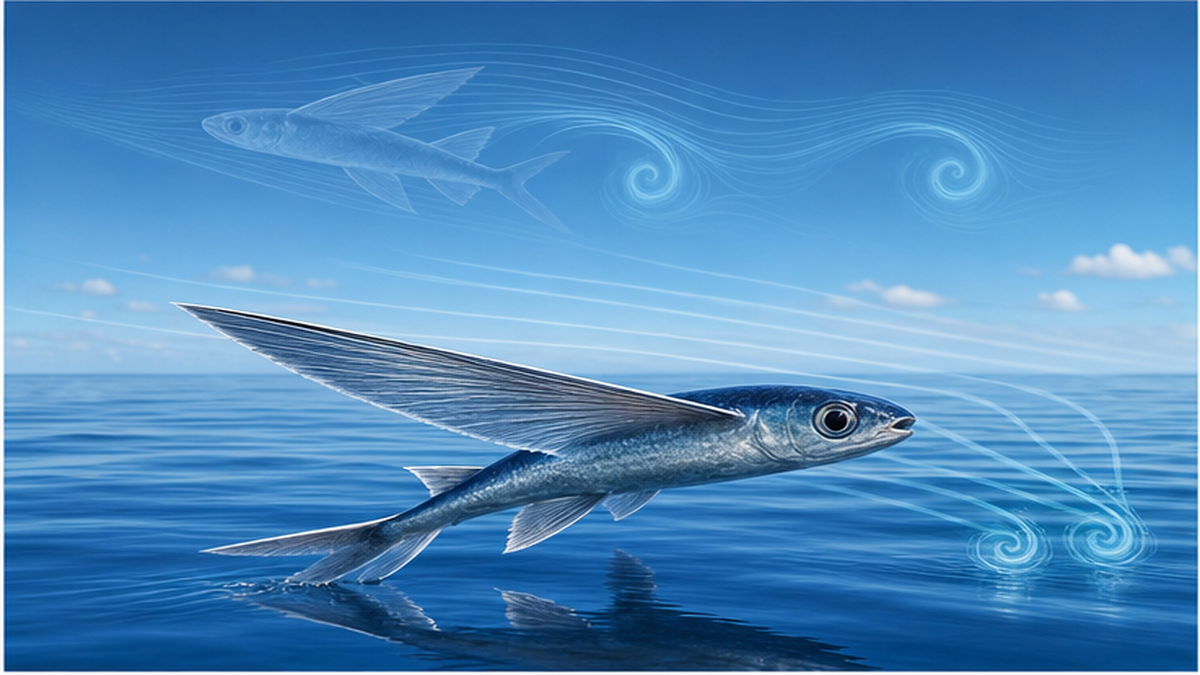
When a wing generates lift, high-pressure air from the lower surface curls around to the upper surface at the wingtip, creating a vortex (the wingtip vortex). This vortex produces a downward induced flow and effectively acts as a resistance dragging the wing backward — induced drag. However, when the wing is very close to the ground or the water surface, this curling around is physically obstructed and the wingtip vortex weakens. As a result induced drag falls, and lift is obtained more efficiently at the same speed. This is ground effect.
In the wind tunnel experiments of Park and Choi, this effect was reproduced by lowering the specimen toward a liquid surface. The result confirmed that flying close to the sea surface reduces drag by up to 14%. Less drag means travelling farther from the same initial speed. Flying fish stay near the surface because, as winged animals, they are choosing the most fuel-efficient altitude available.
"Vehicles" that use ground effect
- Flying fish: cut drag by up to 14% by gliding just above the sea
- Petrels and albatrosses: slide low along the slopes of waves, saving on flapping
- Ground-effect vehicles (WIG craft, ekranoplans): vehicles designed to fly close to the water, which have repeatedly been attempted in practice
- Aircraft on landing: the gentle floating sensation just before the runway is caused by this effect
Another advantage of flying low
Ground effect is a matter of fuel efficiency, but low-altitude flight has another meaning as well. Flying near the surface means that when speed drops, the fish can immediately dip its tail fin into the water and accelerate again. Had it climbed to ten metres, the glide would end as soon as speed fell and it would have no choice but to land. Staying tens of centimetres above the sea also means preserving "an altitude from which acceleration can be restarted." The continuous gliding described in the previous chapter is possible only because of this low altitude.
On the other hand, low flight carries risks. On days with high waves, glides are easily interrupted by collisions with the slopes of swells. Conversely, on windy days it is known that glides can be extended by using the updraft generated on the windward side of waves. The reason a flying fish's distance varies so widely — from tens of metres to several hundred — depending on individual and situation is this heavy dependence on the state of the sea surface.
Reading the wind and the waves
Glide distance is not determined by the body's performance alone, because the state of the sea surface is the flight environment itself. On days with large swells, air is pushed up along the windward slope of the waves, creating a weak updraft. It has long been noted that flying fish use this airflow to extend their glides — the same principle as the "slope soaring" by which albatrosses and petrels save on flapping by using wave slopes.
At the same time, waves are also obstacles. Flying at tens of centimetres above the sea, a glide ends the moment the fish strikes a wave crest. Some say a calm sea allows longer flights, others that moderate swells extend them; the optimum changes with conditions. The reason distance varies from tens of metres to several hundred even for the same individual is this strong environmental dependence.
What is intriguing is that flying fish appear to be choosing these conditions. Their takeoff angle is shallow, only about 10–20 degrees from horizontal, and they do not climb needlessly. During the glide they keep the body axis almost level. As seen in the previous chapter, an angle of attack near 0 degrees is exactly where the lift-to-drag ratio peaks. This fish holds the physical optimum through sense and experience.
In other words, the flight of a flying fish is not complete in the shape of its body alone. Only by using the sea surface as "a second wing surface" does that distance become possible. Considering how many times aircraft designers have attempted ground-effect vehicles, the fact that this fish has been mastering that physics for tens of millions of years is rather delightful.
Why they fly — escaping predators, and the price it carries
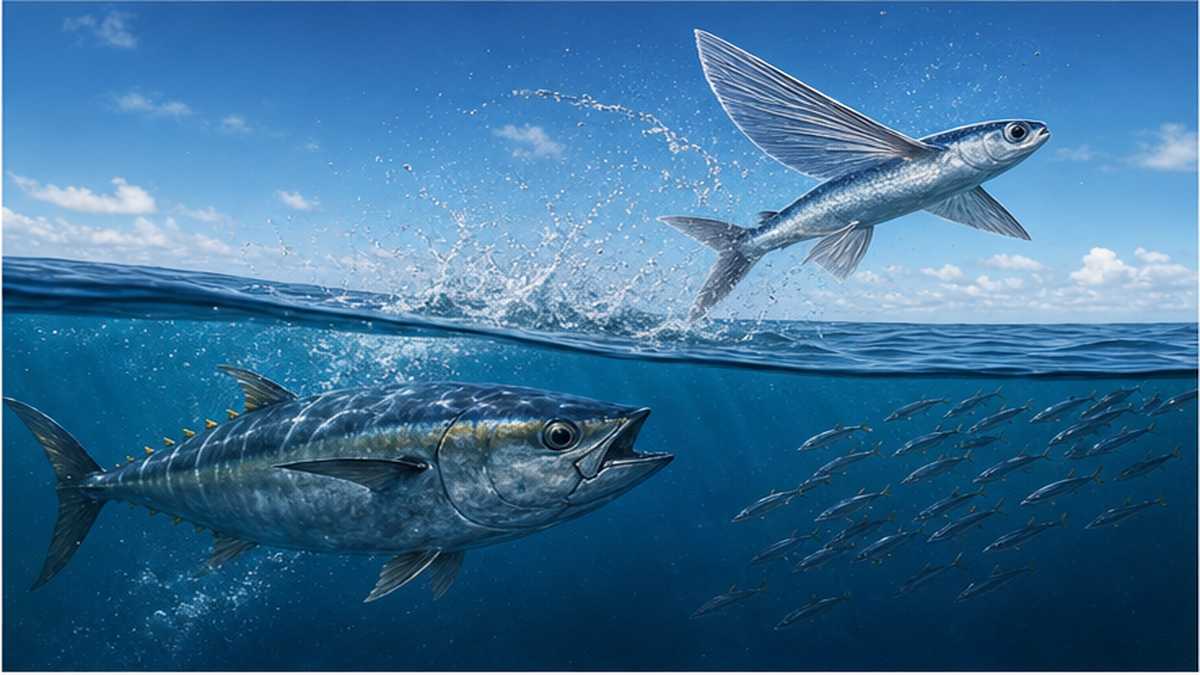
The most persuasive reason for the evolution of such an elaborate ability is escape from predators. Flying fish live in the surface layer of the open ocean, the pelagic surface zone. This environment offers no rocks or seaweed to hide behind and no depths in which to conceal oneself. Nevertheless, it teems with fast-swimming predators such as tuna, skipjack, mahi-mahi, and billfish. In a place with nowhere to flee, flying fish fundamentally changed how they flee.
From "two-dimensional escape" to "three-dimensional escape"
A fish pursued underwater has only a limited repertoire: swim fast, turn sharply, or confuse the predator with a school. But against tuna or mahi-mahi, a pure speed contest is unfavourable. What flying fish chose was the solution of moving into a medium the predator cannot enter. The instant they break through the surface, the pursuer loses sight of the prey. By the time they land several hundred metres away, the pursuer is no longer there.
This strategy is efficient. Gliding consumes less energy than swimming at full effort underwater and is thought to have a lower cost per distance of escape. From the predator's side, continuing to chase prey that has flown away from the surface does not pay. In fact, behaviour in which mahi-mahi and others predict the landing point and wait has been observed on the sea after a flying fish takes off, but capture is by no means certain.
There are enemies in the air too — the trade-off of gliding
Escaping underwater predators does not mean the air is safe. Seabirds such as frigatebirds and boobies catch flying fish in the air or immediately after they land. The altitude just above the sea is a "double danger zone" where the attack ranges of underwater predators and seabirds overlap. Gliding is not a universal solution but a choice that swaps one kind of risk for another.
Attraction to light, and the fisheries that use it
Another distinctive behaviour of flying fish is their attraction to light (phototaxis). Their habit of gathering around lit vessels at night has long been known, and in the islands of the Pacific, flying fish fisheries using ship lights and torches have been practised traditionally. This same trait, together with the behaviour of bursting out in alarm when a boat approaches, has a long history of being incorporated into fishing technology.
Japan's representative flying fish fishery, the flying fish rope-towing fishery of the Yakushima and Tanegashima area of Kagoshima Prefecture, turns this "startle and fly" trait to advantage. A rope is towed across the surface to startle the fish, and those that burst out are driven into nets. According to Yakushima Fisheries Cooperative statistics for 2006, the catch was 901 tonnes worth 207 million yen, accounting for 76% of the cooperative's total catch by volume and 43% by value — the core of the local fishery. That an ability evolved for escape becomes the very key to catching them is not without irony.
What it means to sit in the middle of the food chain
Flying fish feed mainly on zooplankton. Phytoplankton fix solar energy, zooplankton eat them, and flying fish eat the zooplankton. The flying fish in turn are eaten by tuna, skipjack, mahi-mahi, and seabirds. This fish stands in the surface layer of the open ocean, at the position linking the site of production with the domain of large predators.
Fish that serve as such a "middle link" are also delicate as a resource. If their numbers fall, the effect reaches higher predators; conversely, if top predators decline, their numbers may increase. The frequent overlap between skipjack and tuna fishing grounds and the distribution of flying fish is no coincidence, but the relationship between prey and predator appearing directly as an overlap of fishing grounds. Waters where flying fish gather can be good grounds for large fish as well.
The surface of the open ocean looks at first like nothing more than a vast expanse of blue water. In reality, however, structures exist — drifting seaweed, gradients in plankton density, boundaries in water temperature (tide rips) — and living things use them as cues. The places where schools of flying fish take off are also an indicator of the presence of such structures. When fishermen read tide rips from flocks of seabirds and the movements of flying fish, they are performing an interpretation of the ecosystem backed by experience.
The relationship with predators is not one-way. Flying fish are an important component of the surface ecosystem supporting marine biodiversity in Japanese waters, growing by eating zooplankton and themselves becoming food for large fish and seabirds. As a "middle link" passing surface energy up to higher predators, their abundance is directly tied to the productivity of the ecosystem as a whole.
Life history and distribution — eggs entrusted to drifting seaweed
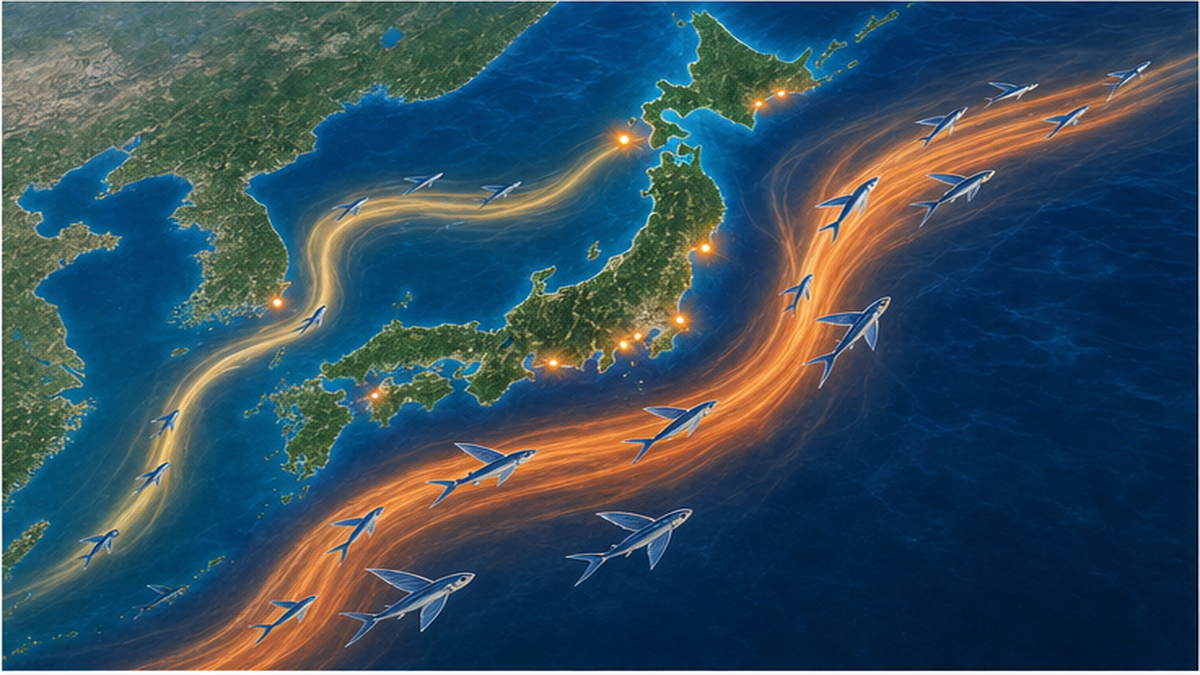
A flying fish's year is strongly tied to the movement of warm currents. Flying fish in Japanese waters ride the Kuroshio and the Tsushima warm current northward from spring into summer and spawn. The reason "the season when flying fish fly" is counted among the seasonal sights of early summer is that it coincides with the timing of this migration.
Eggs that tangle into seaweed with threads
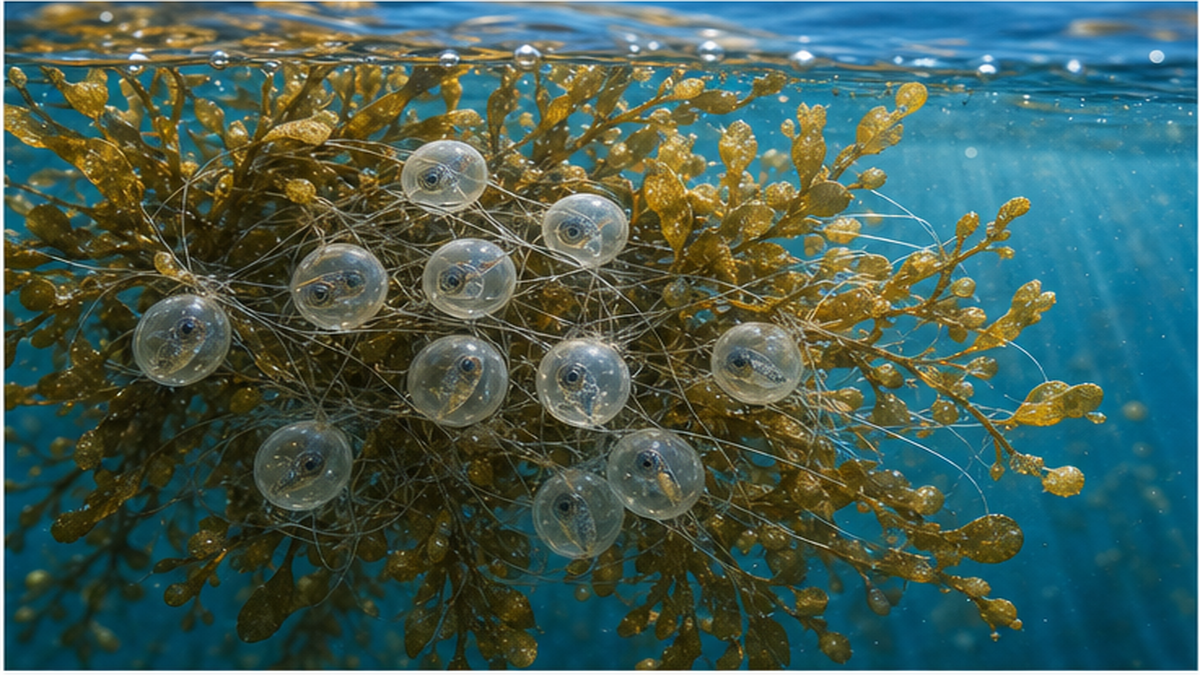
The eggs of flying fish are distinctive. Numerous long, thin thread-like projections grow from the surface of the egg membrane, and these tangle into drifting seaweed. In the ocean flying fish, for example, the egg is about 2mm in diameter and the threads growing from its surface number roughly 50 to 80. Because the surface layer of the open ocean has no seabed rocks or aquatic plants to serve as a spawning substrate, drifting seaweed — fragments of Sargassum and the like torn loose and adrift — becomes effectively the only "spawning bed."
This life history presupposes that the coastal seaweed beds supplying that drifting seaweed are healthy. Seaweed beds are produced along the coast, and torn fragments are supplied to the open ocean and drift there. In other words, the restoration of coastal seaweed beds concerns not only coastal fish and shellfish but also the next generation of flying fish swimming far offshore. It is a good example of how the connections among marine organisms extend beyond the range we can see.
| Item | Details |
|---|---|
| Spawning season | Spring to summer for most species. The ocean flying fish exceptionally spawns in winter |
| Egg diameter | About 2mm (ocean flying fish) |
| Egg characteristics | 50–80 attachment threads grow from the surface and tangle into drifting seaweed |
| Spawning site | Drifting seaweed in the open-ocean surface layer, originating from coastal seaweed beds |
| Juveniles | Pectoral fins are undeveloped and come to function as wings as the fish grows |
Eggs eaten as "tobiko"
These eggs are also a familiar ingredient in Japan. Tobiko, used in gunkan-maki sushi and dressed dishes, is processed flying fish roe. Its popping texture is not unrelated to the fact that the egg membrane is tough, structured to support the attachment threads. From gliding to the dinner table, this fish has consistently drawn human interest through its unusual construction.
Juveniles disguise themselves as drifting seaweed
Newly hatched juveniles also spend a period around drifting seaweed. The juveniles of many flying fish species have whisker-like projections and colour bands on the mouth area and body surface, giving them an appearance that blends into fragments of floating seaweed. This is thought to be camouflage for self-protection in the surface layer of the open ocean, an environment with no hiding places. During the period when they still cannot fly, they get by with a different strategy: blending in instead of flying.
As they grow and the pectoral fins extend and the body takes on its silver spindle shape, the main axis of defence shifts from camouflage to gliding. That the same species survives in completely different ways as a juvenile and as an adult is one of the interesting aspects of the flying fish life history. Drifting seaweed is both a spawning bed and a nursery supporting this transitional period.
For precisely this reason, the problem of marine plastic debris that tangles into drifting seaweed is not unrelated to flying fish reproduction. Creatures that gather at drifting seaweed also gather at artificial objects adrift in the same way. If the quality of drifting seaweed as a spawning substrate changes, so does the environment in which eggs and juveniles are placed. The fact that so many lives depend on the few structures adrift in the open ocean is an important perspective when considering the problem of offshore debris.
Warming and shifting distribution
Flying fish are surface fish that prefer warm seas and respond sensitively to changes in water temperature. In Japanese waters, the northward shift of fish species distribution accompanying rising sea temperatures has been widely observed, and warm-water flying fish are no exception. While they come to be caught in waters where they were not previously landed, traditional producing areas may see changes in the timing and volume of their arrival.
A northward shift in distribution can in itself mean the appearance of a new resource for a region. However, fishing gear, processing techniques, distribution, and food culture were each built up over long periods in particular places, and even when fish move, the systems do not move easily. The food culture of "ago" examined in the next chapter rests precisely on such locally rooted accumulation.
Flying fish in Japanese food culture — the stock and fish paste built on "ago"
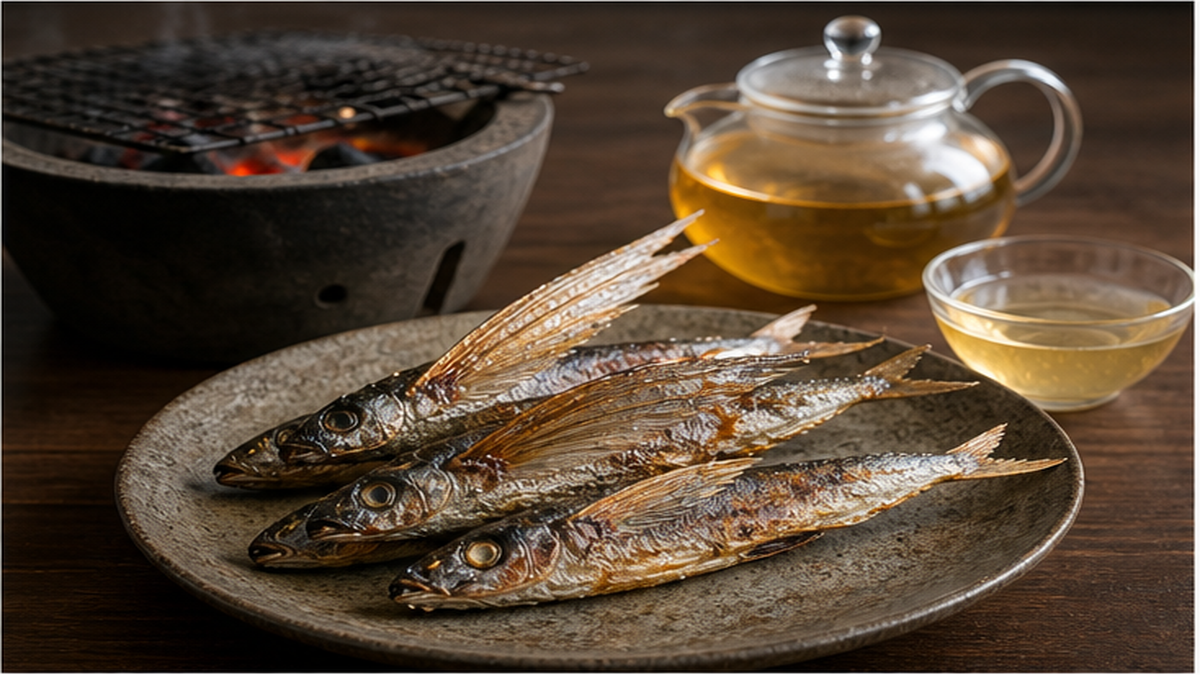
On the Japanese table, flying fish has a greater presence as a processed product than as sashimi or grilled fish. In western Japan flying fish is called "ago," and the stock taken from grilled and dried "yaki-ago" has long been used as the base for zoni soup, clear soups, and udon broth. There are various theories about the origin of the name, but the widely told one is that it comes from being "so delicious your jaw (ago) drops."
Yaki-ago — an elegant stock born from low fat content
The area best known as the main producer of yaki-ago is Hirado City, Nagasaki Prefecture. Flying fish caught from the Hirado Strait out to the waters off the Goto Islands are grilled slowly over charcoal and then dried over several days. Because flying fish are low in fat, they yield a clean yet fragrant stock with little off-flavour or fishiness when simmered. It is an ingredient occupying its own position, distinct from the powerful umami of dried bonito and the gentle umami of kelp.
This quality of being "low in fat" is surely not unrelated to a life spent moving at high speed across the open ocean and frequently bursting into the air. A heavy body cannot fly. Considering that the strategy of gliding is what ultimately made this fish an ingredient suited to stock, ecology and food culture come into view as a single connected line.
Ago-noyaki — the charcoal-grilled fish paste of San'in
Made from Shimane Prefecture through to the western part of Tottori Prefecture, ago-noyaki is a large fish paste product in which surimi of flying fish — caught abundantly in the Sea of Japan from May to September — is grilled over charcoal. It is a traditional food included in the Ministry of Agriculture, Forestry and Fisheries' "Illustrated Guide to Japan's Traditional Foods," and its distinctive method of rolling the paste into a thick bar before grilling produces a fragrant browned surface and a springy texture. Well established as a souvenir, it is one of the pillars of the region's seafood processing industry.
Learn more about this traditional foodAgo-noyaki | Illustrated Guide to Japan's Traditional FoodsA traditional food of Shimane Prefecture in which flying fish surimi is grilled over charcoal. Method and history explained by the Ministry of Agriculture, Forestry and Fisheries🔗 maff.go.jpKusaya, tobiko, and sashimi
Turning to the Izu Islands, flying fish has also been used as a raw material for kusaya. On Hachijojima and elsewhere, flying fish along with the brownstriped mackerel scad is a central species for kusaya processing; soaking in a fermentation brine (kusaya liquid) and drying produces its distinctive aroma and deep umami. It is a food culture that developed as a technique for preserving a precious source of protein in an age without refrigeration.
Learn more about kusayaAbout kusaya | Hachijojima Marine Products Processing CooperativeAn explanation of the traditional preserved food of the Izu Islands, made by soaking mackerel scad and flying fish in fermentation brine and drying them🔗 kusaya.tokyoEaten raw, a fresh flying fish is a fine white-fleshed fish. The Ministry of Agriculture, Forestry and Fisheries' "Local Cuisines of Our Home" includes flying fish sashimi as a local dish of Shimane Prefecture. In Kagoshima Prefecture, flying fish from Yakushima and Tanegashima are known affectionately as "toppy" and have been positioned as a regional brand fish. Kagoshima Prefecture is said to account for more than 70% of the national flying fish catch, showing how strongly this fish is tied to life in particular regions.
| Region | Name / processed product | Characteristics |
|---|---|---|
| Hirado City and the Goto Islands, Nagasaki Pref. | Yaki-ago (ago stock) | Grilled and dried, used as stock for zoni and clear soups |
| Shimane Pref. and western Tottori Pref. | Ago-noyaki | A large fish paste of charcoal-grilled surimi; included in the traditional foods guide |
| Izu Islands, Tokyo (Hachijojima and others) | Kusaya | A preserved food soaked in fermentation brine and dried; a main ingredient alongside mackerel scad |
| Kagoshima Pref. (Yakushima, Tanegashima) | Toppy | The largest producing area, accounting for over 70% of the national catch; rope-towing fishery |
| Nationwide | Tobiko | Processed roe used in gunkan-maki sushi and other dishes |
Making yaki-ago stock at home
Yaki-ago is an easy stock ingredient to handle at home. The basic method is cold brewing: add about 20–30g of yaki-ago to one litre of water and leave it in the refrigerator overnight (around 8 hours). If simmering, start from cold water, raise the temperature slowly over low heat, and reduce the heat just before boiling for a few minutes. Keeping it at a hard boil tends to bring out the harshness characteristic of fish, so gentle handling is the key. Removing the head and entrails before use yields a clearer flavour.
Yaki-ago stock is fragrant yet light on the finish. It suits dishes where you do not want to mask the ingredients — udon and soba broth, zoni, chawanmushi, simmered vegetables. Combined with kelp, the umami gains depth. Compared with dried bonito it is often described as "gentle at the outset with a long finish," a difference arising from the composition of its umami compounds and its low fat content.
Nutritionally, flying fish is a high-protein, low-fat white-fleshed fish with light, delicate flesh. As sashimi it has an elegant sweetness, and in Kyushu, San'in, and the Izu Islands fresh specimens are also eaten as "namero" and "tataki." That ways of eating it survive only where it is caught is the flip side of this being a fish whose freshness declines quickly.
What you can do as a consumer
- Check the origin label and choose consciously — Yakushima and Tanegashima (toppy), Hirado and Goto (yaki-ago)
- For yaki-ago stock, cold brewing overnight suppresses harshness and brings out aroma
- Try regional processed products such as ago-noyaki and kusaya while travelling or at regional product fairs
- Buy with the season in mind (early summer in most regions; winter to early spring for the ocean flying fish)
What flying fish teach us — engineering applications and the sea ahead
The body of the flying fish has been read not only as a subject of biology but also as an engineering blueprint. The requirement to slide stably and far just above the sea surface maps directly onto the design problems of unmanned aerial vehicles and water-air hybrid craft.
As a subject for biomimetics
The finding from Park and Choi's wind tunnel experiments that "the pectoral fins improve both the lift-to-drag ratio and longitudinal stability" offers direct implications for wing shape design. In recent years, research mechanically reproducing gliding flight supported by tail beating — that is, the movement used at takeoff — has been reported, and the feasibility of small craft that leave the water and slide at low altitude is being examined. It is a field where applications can be imagined, such as small drones for ocean observation that charge and stand by on the water and take off to move only when needed.
Read the original paperAerodynamic characteristics of flying fish in gliding flightPark & Choi (2010), Journal of Experimental Biology. The paper that directly measured the lift-to-drag ratio and ground effect of flying fish in wind tunnel experiments🔗 journals.biologists.com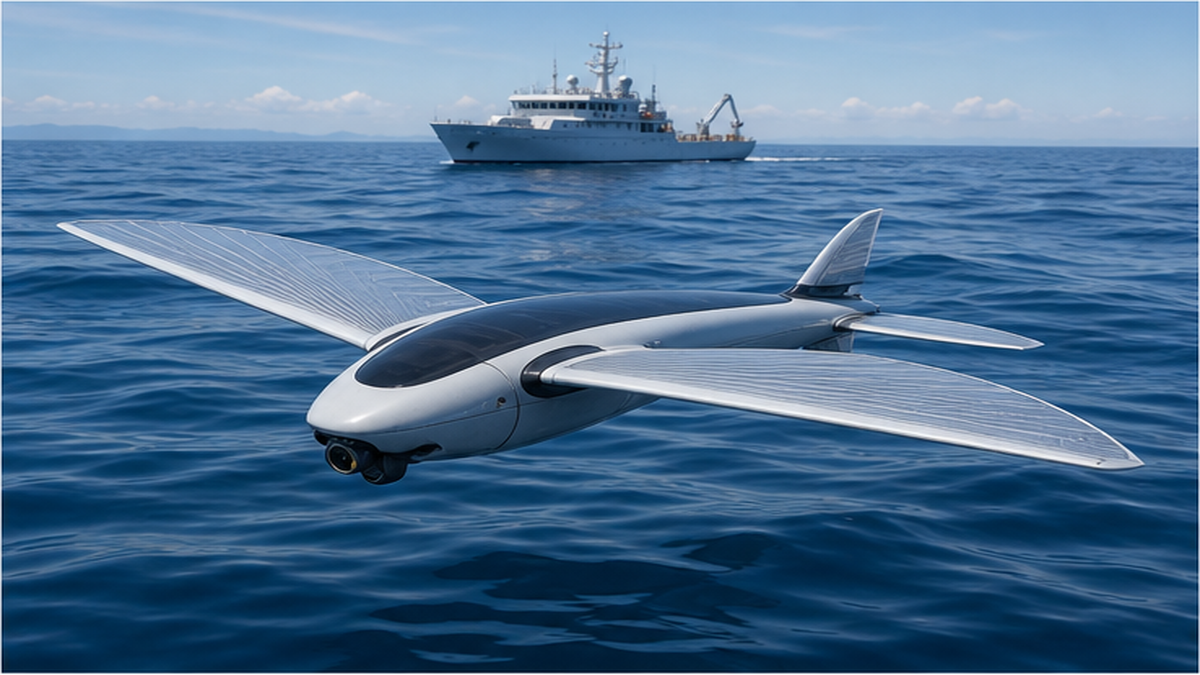
A view of the sea that is not only about crisis
Articles on the marine environment tend to become stories of crisis — pollution, warming. Those are certainly important, but there is a different value in knowing creatures like the flying fish. A fish that flies 400 metres just above the sea is flying off the coast of Japan at this very moment — that fact alone is reason enough to care about the ocean. The more concrete and appealing the thing to be protected, the easier it is to sustain action for the environment.
At the same time, this fish is a mirror reflecting environmental change. Spawning depends on drifting seaweed, and drifting seaweed is supplied from coastal seaweed beds. Distribution is governed by sea temperature, and the catch supports regional industry and food culture. Looking through the single lens of the flying fish connects elements of entirely different scales into one line: coastal seaweed beds, the open-ocean surface ecosystem, changes in sea temperature, regional fisheries, and traditional processing techniques.
Where and when you can see them
If you want to see flying fish for yourself, the best bet is aboard a boat crossing waters facing a warm current, from early summer through summer. Encounter rates are high on high-speed vessels and ferries in waters near warm currents — routes around the Izu Islands and Ogasawara, from Kyushu to the Nansei Islands, and off San'in on the Sea of Japan side. On a calm, sunny day, watching the water diagonally ahead of your direction of travel, you can catch the moment a silver fish bursts out of the boat's wave.
The trick to observation is to keep a broad watch on the nearby water some 10–30 metres from the boat, rather than the distance. Because flying fish take off startled by the boat, they burst out right alongside its path. A glide lasts from a few seconds to over ten, so once you spot one you can follow it until it lands. If you are holding a camera, raise the shutter speed and set it to burst mode.
There are cases of flying fish kept in aquariums, but as open-ocean surface fish that also leap out, they are not easy to keep. The best place to see a living flying fish glide is, after all, out at sea. The theme of marine conservation tends toward abstraction, but it is exactly these concrete encounters that keep an interest in the ocean alive over the long term.
Summary of this article
- There are about 60 flying fish species worldwide and about 30 around Japan, in a two-winged form using only the pectoral fins and a four-winged form that also uses the pelvic fins
- Their flight is gliding, not flapping, and consists of three stages: an underwater run-up, acceleration by beating the surface with the tail fin, and a glide with wings spread
- Wind tunnel experiments measured a lift-to-drag ratio equal to that of medium-sized birds such as vultures and petrels (peaking near 0 degrees angle of attack)
- They fly just above the sea because ground effect cuts drag by up to 14%. Continuous gliding reaches a maximum of 400m and over 40 seconds
- Gliding is a strategy for escaping predators, but it carries a trade-off against a different predation pressure: seabirds
- Eggs tangle into drifting seaweed with 50–80 attachment threads. The health of coastal seaweed beds supports reproduction in the open ocean
- In Japan, as "ago," the fish has built a diverse food culture including yaki-ago, ago-noyaki, kusaya, and tobiko
The next time you have a chance to board a boat, spend a moment looking at the water alongside. If something silver bursts out, it is not merely jumping. What is happening there is an extremely refined flight, using wings honed over tens of millions of years and exploiting the physics of the sea surface to the full.
References and sources
- Journal of Experimental Biology – Park H, Choi H (2010) "Aerodynamic characteristics of flying fish in gliding flight" 213: 3269-3279 (direct wind tunnel measurement of lift, drag, and ground effect in flying fish)
- PubMed (U.S. National Library of Medicine) – Bibliographic record and abstract of the above paper (PMID: 20833919)
- Ministry of Agriculture, Forestry and Fisheries, Illustrated Guide to Japan's Traditional Foods – Ago-noyaki (Shimane Prefecture): a traditional fish paste of charcoal-grilled flying fish surimi
- Ministry of Agriculture, Forestry and Fisheries, Local Cuisines of Our Home – Flying fish sashimi (Shimane Prefecture): the use of flying fish in local cuisine
- Tokyo Metropolitan Islands Area Research and Development Center of Agriculture, Forestry and Fisheries – Ocean flying fish: commentary on ecology and fisheries in the Izu Islands
- Kagoshima Prefecture Fisheries Technology Guidance Office (extension activity case study) – "Carrying on Japan's leading flying fish fishery (bringing Yakushima's toppy to the nation)," Yakushima Fisheries Cooperative Flying Fish Vessel Owners' Association: catch and value data for the rope-towing fishery
- Ministry of Agriculture, Forestry and Fisheries, Marine Fishery Production Statistics Survey – Catch statistics by species and prefecture, including flying fish (detailed data published on e-Stat)
- FAO (Food and Agriculture Organization of the United Nations) – EXOCOETIDAE Flyingfishes: species identification sheet for the family (taxonomy and morphology)
- WoRMS (World Register of Marine Species) – Exocoetidae Risso, 1827: taxonomic registration for the family
- JSME Robotics and Mechatronics Conference 2024 – "Elucidation of the gliding characteristics of flying fish near the water surface": domestic engineering research on gliding close to the sea surface
* Ordered by reliability: government and academic institutions > peer-reviewed papers > specialist organisations > trusted media