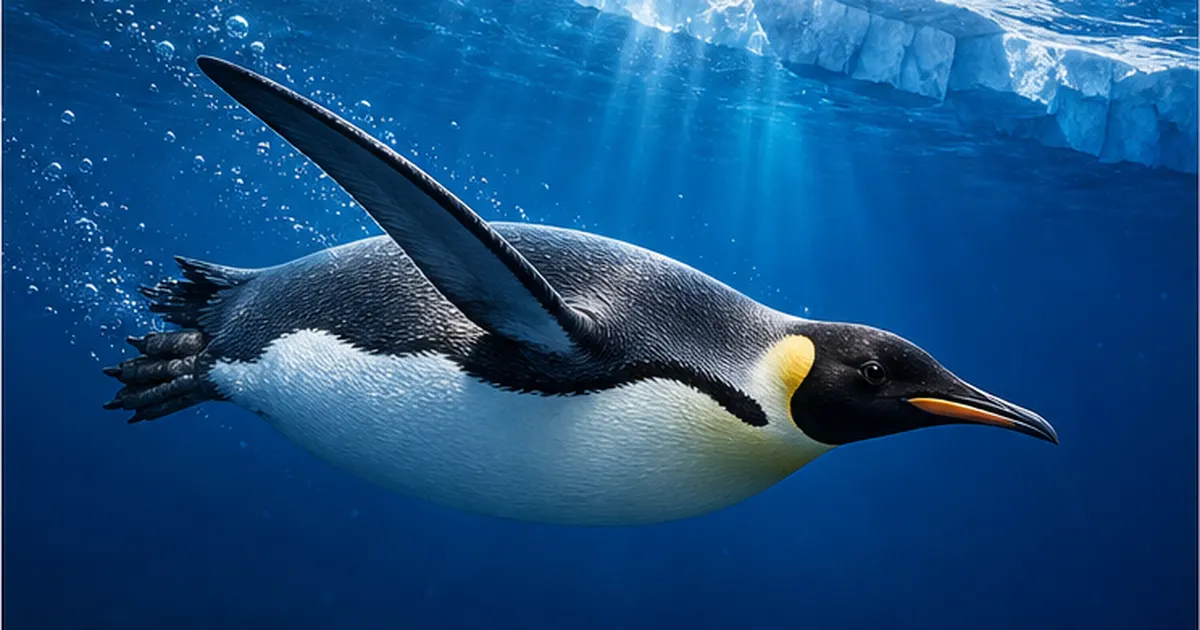
Stand in front of an aquarium tank and watch a penguin that was waddling awkwardly on land a moment ago. The instant it enters the water it becomes a different animal. It beats its wings up and down and moves through the water as though flying — that motion is the answer evolution arrived at over tens of millions of years.
The emperor penguin (Aptenodytes forsteri) is in a class of its own. Its deepest recorded dive is 564m and its longest is 32.2 minutes. On a single breath it descends through pressures many times greater than any free-diving human can reach, into total darkness, and returns. And it does this in Antarctic water that sits close to freezing.
This article works through five perspectives — wings, skeleton, blood, feathers and blood vessels — to explain how a penguin can do this. It closes with the change now sweeping Antarctica that even this remarkable body cannot resist: the background to the emperor penguin's uplisting to Endangered in April 2026.
What you will learn
- Why a penguin's wing became an oar for pushing water rather than a wing for flying, explained through bone and joint structure
- How emperor penguins store and spend oxygen to manage extreme dives of 564m and 32.2 minutes
- The layered feather structure that preserves body heat in near-freezing water, and the role of the counter-current heat exchanger at the base of the wing
- Lesser-known adaptations such as air lubrication with bubbles and the salt gland that lets penguins drink seawater
- What "bio-logging" — attaching small cameras and recorders to penguins in Antarctica — is revealing right now
- What sea-ice loss means for penguin breeding and moulting, and what we can do about it
Penguins Are Birds That Fly Underwater: How the Wing Became a Propeller
Penguins are birds. They have feathers, they lay eggs, and their skeletons are avian. Yet they cannot fly. The reason is simple: a wing for pushing air and a wing for pushing water need entirely different shapes. Faced with that choice, the ancestors of penguins chose water.
A Wing That Gave Up the Sky and Took Hold of Water
Air is light; water is roughly 800 times denser. A flying bird's wing is large and flexible so it can catch as much light air as possible over a wide area, and its feathers let air spill through the gaps. Underwater the opposite is true: a small, stiff wing that does not bend performs better. Dense water generates great thrust from a modest area, and a flexible wing simply lets that force escape.
The penguin flipper follows this requirement exactly. Both the humerus and the forearm bones are flattened into plates, the feathers are short, stiff and pressed flat against the surface, and the whole wing works as a single blade. The joints corresponding to our elbow and wrist barely bend, so movement is concentrated at the shoulder. The result is less a flapping wing than a single oar driven down from the shoulder.
Thrust on Both the Downstroke and the Upstroke
A flying bird generates lift mainly on the downstroke; the upstroke is essentially a recovery motion. Penguins are different. Underwater they can generate thrust in either direction by changing the angle of the flipper, so they move forward on both the downstroke and the upstroke. That is why a swimming penguin's path looks so smooth, with no stalling and no change of pace.
The body plan is equally uncompromising. The fusiform, torpedo-like line from head through trunk to tail suppresses flow separation, and the feet sit far back as rudders. That clumsy-looking waddle on land is the price of moving the feet aft, not a design flaw. It is what happens when underwater performance takes priority.

Diving Depth Varies by Species
There are around 18 penguin species, and their diving abilities differ greatly. Larger species can store more oxygen and tend to dive deeper and longer.
| Species | Approximate maximum dive depth | Main range |
|---|---|---|
| Emperor penguin | 564m (deepest of any bird) | Coastal Antarctica |
| King penguin | 343m | Sub-Antarctic islands |
| Gentoo penguin | About 200m | Antarctic Peninsula and sub-Antarctic |
| Adélie penguin | About 170m | Coastal Antarctica |
| Chinstrap penguin | About 121m | Around the Antarctic Peninsula |
Key points
- The penguin's wing bones are flattened and the elbow and wrist are essentially fixed, turning the wing into an oar
- Water is about 800 times denser than air, so a small, stiff wing propels more efficiently
- Generating thrust on both the downstroke and the upstroke is the major difference from avian flight
- Deeper-diving species are larger. The record belongs to the emperor penguin at 564m
564m and 32.2 Minutes: How Real Are the Emperor Penguin's Records?
The title of deepest-diving bird belongs to the emperor penguin. One point is often confused, so let us settle it first: the depth record and the duration record came from different individuals on different dives. No single bird went to 564m and stayed down for 32 minutes.
The Depth of 564m and the Duration of 32.2 Minutes
The 564m record comes from data recorders fitted to wild birds and was reported in Polar Biology in 2006. That study fitted depth recorders to 93 individuals and logged 137,364 dives over three seasons. Within the same dataset, the longest dive recorded was 21.8 minutes.
A dive of 32.2 minutes was later reported in Marine Ecology Progress Series in 2018, and that remains the longest known. A depth of 564m corresponds to about 57 atmospheres — a world in which a human's lungs would long since have collapsed and consciousness would be gone.
But Everyday Dives Are Shallower and Shorter
Records are extremes. According to the Australian Antarctic Program, most emperor penguin dives are 100–200m deep and last three to six minutes. That is the everyday foraging pattern. Extreme depths are reached only when prey distribution or ocean conditions are unusual.
Range also shifts sharply with season. In winter birds stay within 130km of the colony, but in summer they travel 180km to more than 550km west into deeper waters. One 76-day winter tracking record produced a cumulative travel distance of 2,600km.

How the Records Are Measured: The Bio-logging Method
All of these figures come from bio-logging. Small recording devices — depth loggers, GPS units, accelerometers, geomagnetic sensors and, more recently, miniature video cameras — are attached to an animal, which is then released and the devices recovered when it returns. In Japan, the National Institute of Polar Research has led this field for many years.
Observing from a ship or from the ice tells you nothing certain about what happens underwater. Bio-logging is a way of asking the animal itself to keep the record, and alongside deep-sea ecology it is one of the most rapidly advancing areas of research today. For more on how organisms adapt to extreme deep-sea environments, see Extraordinary Adaptation Strategies of Deep-Sea Creatures.
A Body Built to Hold Its Breath: Where the Oxygen Goes
Diving ability is determined less by wing shape than by how much oxygen the body can carry down and how long it can make that oxygen last. This is where the penguin's real capability lies.
Three Oxygen Stores
A diving emperor penguin holds oxygen in three places: the lungs (and air sacs), the blood, and the muscles.
- Lungs and air sacs: the avian air-sac system holds air efficiently in a limited space
- Blood: haemoglobin binds and carries oxygen, and blood volume relative to body mass is high
- Muscle myoglobin: a protein that holds oxygen within muscle. Concentrations are strikingly high in diving birds and marine mammals, and it becomes the main energy source in the later part of a dive
The distribution is what makes this interesting. In humans, most oxygen is in the lungs. In deep-diving animals, however, it makes more sense to carry oxygen in blood and muscle than in lungs that collapse under pressure. That is precisely why deep-diving animals have high blood volumes and high myoglobin concentrations.

The Aerobic Dive Limit Is 5.6 Minutes — Beyond That, It's Debt
Research by Paul Ponganis and colleagues at Scripps Institution of Oceanography puts the emperor penguin's aerobic dive limit (ADL) at about 5.6 minutes. It is defined as the dive duration at which lactate begins to accumulate above resting levels.
In other words, on dives longer than 5.6 minutes the body starts drawing on anaerobic metabolism, and the cost must be repaid after surfacing. Even so, emperor penguins routinely exceed their ADL. A 20- or 30-minute dive is a deliberate push past a known limit.
Six Beats a Minute During an 18-Minute Dive
What makes that push possible is extreme bradycardia. A 2008 study by Jessica Meir, Ponganis and colleagues, using electrocardiogram recorders, put numbers on just how extreme it is.
| State | Heart rate (beats/min) |
|---|---|
| At rest | 73 ± 2 |
| Average across all dives | 57 ± 2 |
| Dives within the ADL (5.6 min) | 85 ± 3 |
| Dives exceeding the ADL | 41 ± 1 |
| Last five minutes of an 18-minute dive | 6 |
| Maximum immediately after surfacing | 256 |
Late in an 18-minute dive, the heart is beating once every ten seconds. At the same time peripheral vessels constrict and blood flow concentrates in the brain and heart — the organs that cannot be allowed to stop. The muscles keep working on the oxygen bound to their own myoglobin.
The moment the bird surfaces, heart rate jumps to as much as 256 beats per minute. That is equivalent to the rate at maximum oxygen consumption, and it means the animal is repaying its oxygen debt within tens of seconds. Shut down while diving, spin up hard at the surface — that contrast is the emperor penguin's diving strategy.
What is the ADL?
ADL stands for aerobic dive limit: the maximum dive duration that can be covered by the body's oxygen stores alone. Beyond it, lactate accumulates and a long recovery is needed after surfacing. The emperor penguin's ADL is about 5.6 minutes, yet many of its actual dives exceed that — this is a body designed on the assumption that it will dive past its own limit.
Staying Warm in Freezing Water: Double Insulation from Feathers and Blood Vessels
Water temperature in the Southern Ocean varies with place and season, but in ice-covered waters it sits around −1.8°C — the temperature at which seawater freezes. A penguin's body temperature is about 38.5°C. That gap of nearly 40 degrees is defended by two systems: feathers and blood vessels.
About Nine Feathers per Square Centimetre — the "Dense Plumage" Story Was Half Myth
For a long time, accounts claimed that penguins carry as many as 100 feathers per square inch. A study published in Proceedings of the Royal Society B in 2015 measured the real figure and found about nine feathers per square centimetre — far fewer than earlier estimates of 11 to 46 per square centimetre.
Density varies by body region: roughly 5.8 per square centimetre on the back and 13.5 on the front. The front, which meets cold water over a larger area, is the denser side.
So why does such sparse plumage keep a penguin warm? The answer lies in the quality of the feathers and their layered structure. The same study showed that plumules and filoplumes — long treated as unimportant — are abundant within the body plumage, with downy plumules roughly four times denser than afterfeathers. The stiff, flat contour feathers on the surface shed water and wind while the layer of down beneath traps air; this layering is what does the insulating.

Preen Oil and the Essential Work of Grooming
You have probably seen penguins on land poking repeatedly at their own bodies. They are spreading oil from the uropygial gland at the base of the tail across the entire plumage with the bill. That oil keeps the feather surfaces hydrophobic and maintains the interlock between feathers.
When waterproofing fails, the insulating air layer is replaced by water. Air and water differ in thermal conductivity by more than a factor of 20, so this is lethal. Preening is not grooming for appearance; it is maintenance that determines survival.
The Heat Exchanger at the Base of the Wing
Some areas cannot be protected by feathers alone: the flippers and the legs. They carry blood, have large surface areas, and lose heat easily. Penguins meet this with a counter-current heat exchanger.
At the base of the wing, the brachial artery divides into three to five vessels running along the humerus, each bundled with two or more veins. This structure is called the humeral arterial plexus. Warm arterial blood leaving the body core warms the cold venous blood returning from the wingtip on the spot, drawing the heat back toward the core — that is the principle of counter-current exchange.
The effect is dramatic: temperature differences of up to 30°C have been measured between the shoulder and the wingtip. The tip of the wing stays cold while the trunk holds 38.5°C. By avoiding heat loss in the first place, the bird preserves energy it can spend on finding food.
The origin of this structure is intriguing. Analysis of the fossil record indicates the humeral arterial plexus was already established at least 49 million years ago, during a warm "Greenhouse Earth" interval. It did not arise in response to Antarctic cold; rather, an adaptation for underwater foraging in temperate seas is thought to have made the later move into polar regions possible.
The Body Surface Is Colder Than the Air
One striking observation shows just how thorough the insulation is. An infrared thermography study reported in Biology Letters in 2013 measured surface temperatures of emperor penguins at a breeding colony in Terre Adélie, Antarctica, and found that under clear skies most of the body surface was colder than the surrounding air.
The reason is radiative cooling. By radiating large amounts of heat to a clear sky, the feather surface drops below air temperature. Paradoxically, this is evidence that the insulation is so good that body heat barely reaches the feather surface. Only the area around the eye appears warm — because that is the one place without feathers.
Insulation in summary
- Feather density is about nine per square centimetre; the "air layer" trapped by down matters more than the count
- Preening spreads oil from the uropygial gland to maintain waterproofing; lose that and insulation goes with it
- The flippers and legs contain a counter-current heat exchanger (humeral arterial plexus) producing up to 30°C between shoulder and wingtip
- That exchanger dates to a warm period about 49 million years ago; it is not an adaptation to cooling
Accelerating Inside a Cloak of Bubbles: Air Lubrication and Drinking Seawater
Have you seen footage of a penguin launching out of the water onto an ice edge like a rocket? That leap posed a long-standing problem: the bird was simply moving too fast to explain.
Releasing Air from the Plumage to Cut Drag
A 2011 study by John Davenport and colleagues in Marine Ecology Progress Series proposed air lubrication as the answer.
Observations show that emperor penguins dive to 15–20m with air still held in the plumage and then, as they begin their ascent with the feathers held depressed, release that compressed air from across the whole body. Fine bubbles emerge continuously over the entire surface, forming a smooth layer around the body and leaving a bubbly wake behind.
The hypothesis holds that this bubble film reduces both frictional and form drag between the body and the water, enabling the observed pre-jump mean speed of 5.3 ± 1.01 m/s. The team also argued that buoyancy alone cannot account for that speed and that the bubbles are not produced by cavitation (bubble formation caused by a drop in pressure underwater).
The same principle is studied as a marine fuel-saving technology, and air-lubrication systems that blow air along a ship's hull to reduce friction are already in service on commercial vessels. Penguins arrived at the engineering solution first.

Why Seawater Is No Problem: The Salt Gland
Any animal that feeds at sea faces a salt problem. Penguins swallow large amounts of seawater along with their prey, and the kidneys alone cannot process that salt load.
The organ that handles it is the salt gland (nasal gland) above the eye, in the supraorbital region. It extracts excess sodium chloride from the blood at high concentration and expels it through the nostrils as brine. When a penguin shakes its head or lets a droplet fall from the tip of its bill, that is the gland at work.
Thanks to this organ, penguins can use seawater for hydration in an Antarctica that has almost no fresh water. The same adaptation is widespread among marine vertebrates including seabirds, sea turtles and marine iguanas.
Penguin adaptations that rarely get attention
- Air lubrication with a cloak of bubbles (mean pre-jump speed 5.3 m/s)
- A supraorbital salt gland that expels excess salt, allowing seawater to serve as hydration
- Feet act as rudders and the tail as a fine-trim control; propulsion comes almost entirely from the wings
- Vision is the primary underwater sense, and in the dark deep, prey bioluminescence is thought to serve as a cue
What They Eat and How: The Antarctic Table Revealed by Bio-logging
Diving ability is not an end in itself. It is a means of eating. And what penguins actually eat underwater long had to be inferred from stomach contents. Miniature cameras changed that completely.
Cameras Capture the Moment Pteropods Are Eaten
In March 2026 a Japan–France collaborative group led by project researcher Hinata Watanabe and Professor Akinori Takahashi of Japan's National Institute of Polar Research announced a surprising result. Near France's Dumont d'Urville Station in Antarctica, they fitted eight Adélie penguins with miniature video cameras, GPS units and accelerometers and recorded foraging behaviour underwater directly.
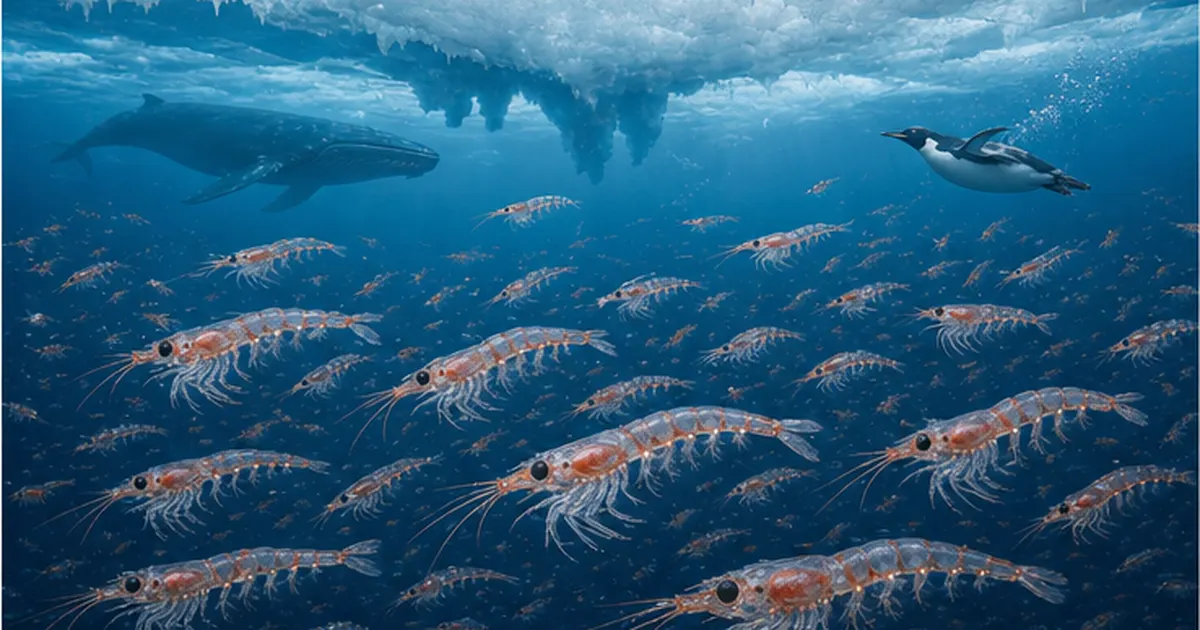
Analysis of 87 hours of footage showed, for the first time, that Adélie penguins frequently prey on the shelled pteropods Clio pyramidata and Limacina rangii (planktonic sea snails). There were 1,449 feeding events on record, including a case in which more than 80 individuals were eaten in just two minutes of a single dive.
This matters because pteropods are among the groups most sensitive to ocean acidification. With their thin calcium carbonate shells, pteropods are known to have shell formation impaired as seawater pH falls. That places the penguin's food supply directly in the path of acidification. The study was published in Marine Biology in March 2026.

Krill Flee, Creating a Ring Where Prey Is Hard to Catch
An even newer result was announced on 15 July 2026. A team including Watanabe, Takahashi and project assistant professor Junichi Takagi of Kyoto University tracked the relationship between Adélie penguins and Antarctic krill beneath the sea ice.
Recording swimming tracks and feeding behaviour with GPS, geomagnetic and acceleration sensors, they found that as penguins repeated their dives, feeding depths increased and the distance from cracks in the sea ice grew. Yet the density of the krill swarms themselves did not change. In other words, the krill were not being eaten out — they were fleeing deeper and further away.
The result is a band around the colony where krill are present but hard for penguins to catch — a state the team calls a functional prey depletion halo. It demonstrates a "non-consumptive effect" beneath the sea ice, in which a predator reshapes an ecosystem by changing prey behaviour rather than by consuming prey. The findings appear in Proceedings of the Royal Society B.
Unsuccessful Penguins Use Information from Their Colony Mates
A third study looked at social behaviour. In June 2026, associate professor Nobuhiko Kokubun and Professor Akinori Takahashi of the National Institute of Polar Research, together with Toshitaka Imaki of SOKENDAI, fitted GPS units to 116 of 270 breeding adults (about 43%) at a small colony near Syowa Station and analysed 653 foraging trips.
What emerged was a basic "win-stay, lose-shift" strategy — return to the same place after success, change location after failure — together with the behaviour that birds which had foraged unsuccessfully searched for new feeding grounds by following colony mates. Multiple birds frequently departed together, forming travelling groups. A penguin colony turns out to be not just a cluster of nests but a place where information circulates.
Incidentally, the Antarctic food web hubs on Antarctic krill, which in turn rests on a foundation of phytoplankton. For more on the base of ocean productivity, see Phytoplankton Produce Half the Oxygen on Earth.
Thirty-Four Days Without Feathers: The Vulnerability of the Catastrophic Moult
All the remarkable adaptations above come with one utterly defenceless period that arrives once a year: the moult.
Replacing Every Feather at Once
Most birds replace feathers gradually and get through the moult without losing the ability to fly. Penguins do not. They replace the entire plumage in one short burst — a pattern known as the catastrophic moult.
For emperor penguins the moult takes 30 to 40 days, with a fasting period of roughly 34 days. While feathers are missing, waterproofing is lost, so entering the water would instantly destroy the insulating air layer. The bird cannot go to sea, cannot feed, and must simply endure on land or ice. Mass loss over this period reaches up to 58% of pre-moult body mass in some species.
Moulting Is Only Possible on Stable Sea Ice
For emperor penguins, the places where those 34 days can be spent are limited: stable sea ice attached to the continent, known as fast ice. If it breaks up, the worst case follows — falling into the water mid-moult.
In 2022 and 2024 the Ice Broke Up Mid-Moult
A British Antarctic Survey (BAS) study published in Communications Earth & Environment in 2026 established a method for systematically identifying groups of moulting emperor penguins from satellite imagery for the first time. Using guano stains left on the ice as the clue, the team tracked moulting groups over seven years from 2019 to 2025 along about 200km of the Marie Byrd Land coast in West Antarctica.
What they saw was serious. In 2022 and 2024, the sea ice broke up before the moult was finished. Adults forced into the sea without waterproofing burn enormous amounts of energy maintaining body temperature and face hypothermia and increased predation risk.
As a result, the more than 100 moulting groups present before 2022 had fallen to 25 by 2025. It is a finding that shows adult survival itself — not just breeding success — is held hostage by sea ice.

What the moult means for risk
- Waterproofing is absent during the moult, forcing a fast of about 34 days out of the water
- Body mass loss reaches up to 58% of pre-moult mass (varies by species)
- Stable fast ice is essential; early break-up kills adults directly
- In West Antarctica, moulting groups fell from more than 100 (before 2022) to 25 (2025)
A Changing Antarctica and the Penguin's Future: Uplisted to Endangered
Diving physiology, insulation, social behaviour — all of it is highly refined adaptation, polished over tens of millions of years. And still it cannot keep pace with the speed of change now underway in Antarctica.
April 2026: the IUCN Lists the Emperor Penguin as Endangered
On 9 April 2026 the International Union for Conservation of Nature (IUCN) updated its Red List and uplisted the emperor penguin from Near Threatened to Endangered. The principal driver is human-induced climate change.
The assessment cited projections that the population will halve by the 2080s together with a decline of about 10% between 2009 and 2018 estimated from satellite imagery — equivalent to more than 20,000 adult birds. In the same update the Antarctic fur seal jumped from Least Concern straight to Endangered, having already declined by 50% since 2000 due to reduced food availability.
The United States acted earlier: on 26 October 2022 the U.S. Fish and Wildlife Service published its final rule listing the emperor penguin as threatened under the Endangered Species Act.
Observations Are Outpacing the Models
Harsher figures arrived in 2025. Analysing the latest satellite imagery, the British Antarctic Survey found that numbers fell by 22% over the 15 years from 2009 to 2024 across a sector taking in the Antarctic Peninsula, the Weddell Sea and the Bellingshausen Sea — a decline of roughly 1.6% per year.
That sector covers 2.8 million square kilometres (more than 11 times the size of the UK), contains 16 colonies and accounts for about 30% of the global emperor penguin population. The pace far exceeds the previous Antarctic-wide estimate of a 9.5% decline between 2009 and 2018. Researchers have noted that this decline may be worse even than the worst-case projections under high-emission scenarios.
| Period and region | Observed change | Source |
|---|---|---|
| Antarctica-wide (2009→2018) | About 9.5% decline | Satellite image analysis |
| Antarctic Peninsula–Weddell Sea (2009→2024) | 22% decline (1.6%/year) | British Antarctic Survey (2025) |
| West Antarctic moulting groups (pre-2022→2025) | More than 100 groups → 25 | Communications Earth & Environment (2026) |
| Antarctic fur seal (since 2000) | 50% decline | IUCN Red List (2026) |

2022: Colonies Where Breeding Failed Completely
Behind the statistics are specific events. A 2023 study in Communications Earth & Environment by Peter Fretwell and colleagues at BAS reported that in the spring of 2022, four of five colonies in the Bellingshausen Sea fledged not a single chick.
The cause is clear. Emperor penguins need stable fast ice from April through to January of the following year, but in November 2022 parts of this region lost 100% of their sea-ice concentration. Chicks have no waterproof plumage until they fledge, so when the ice breaks they fall into the sea and cannot survive. It was the first record clearly linking large-scale sea-ice contraction with total breeding failure.
The 2100 Fork in the Road Can Still Be Moved
Projections are also on the table. According to research by Stéphanie Jenouvrier and colleagues, under a high-emission scenario (RCP8.5) 98% of colonies would be effectively extinct by 2100 and the population would fall by 99% relative to historical levels.
The same work offers another figure. If the Paris Agreement targets are met, 61% of colonies would be at risk of extinction by 2100 — hardly grounds for optimism, but the gap between 98% and 61% is a gap our choices create. For more on how ocean warming reshapes ecosystems, see Ocean Current Changes Driven by Rising Sea Temperatures.
Where things stand
- On 9 April 2026 the IUCN uplisted the emperor penguin from Near Threatened to Endangered, driven mainly by climate change
- Numbers in the Antarctic Peninsula–Weddell Sea fell 22% between 2009 and 2024, faster than model projections
- In 2022, four of five colonies in the Bellingshausen Sea fledged no chicks at all
- Adults are also being lost through a route other than breeding: sea-ice collapse during the moult
- Under high emissions, 98% of colonies disappear by 2100; meeting the Paris Agreement holds that to 61%
Meeting Emperor Penguins in Japan: It Starts with Knowing Them
This may all sound like a distant Antarctic story. But there are places in Japan where you can meet emperor penguins in person — and the moment a species becomes an animal you know, news from Antarctica reads differently.
Only Two Facilities in Japan Keep Them
Emperor penguins are kept at just two facilities in Japan: Adventure World in Wakayama Prefecture and the Port of Nagoya Public Aquarium in Aichi Prefecture. Since 2009 the two have operated a breeding loan programme, lending individuals between them for breeding purposes.
At Adventure World, a chick hatched on 30 September 2025 — the first in four years and the sixteenth in total. Incubation lasted 66 days and the female chick weighed 295.9g at birth. The parents are a 27-year-old pair that arrived in 1997. According to the park, it is the only place in Japan where a successfully bred chick can be seen by visitors.

An Aquarium Observation Checklist
If you are going to visit, try confirming the structures described here for yourself. You do not need an emperor penguin; almost all of this can be observed in familiar species such as gentoo or Humboldt penguins.
- Wing motion: check that the elbow and wrist do not bend and the wing moves as a single oar driven from the shoulder
- Thrust on the upstroke: confirm that the body still moves forward as the wing rises
- Preening: the sequence of touching the bill repeatedly to the tail base and then spreading oil over the body
- Foot position: watch whether the feet trail behind while swimming, acting as rudders
- Droplets at the bill tip: these may be concentrated brine expelled by the salt gland
- Bubbles on ascent: you may catch the moment fine bubbles stream from the body surface
Our Choices Are Connected to Antarctica
There is almost no way to protect emperor penguins directly from our daily lives. It is not about anti-poaching or fencing habitat; it is almost entirely a matter of whether the sea ice survives. That is why this species' future hangs on greenhouse gas emissions, a route that looks indirect.
At the same time, Antarctic krill — the hub of the Antarctic food web — is also a fishery target. Sustainable krill management, marine protected areas (MPAs) in the Southern Ocean, and attention to certification labels when choosing seafood are all choices connected to the Antarctic ecosystem. For how migratory ocean animals are responding to environmental change, see also Why Whale Migrations Span Thousands of Kilometres.
What you can do today
- Go and actually observe how a penguin swims at an aquarium. Focusing on wing motion and preening changes what you see
- When you come across news about Antarctica, krill or sea ice, compare it against the figures in this article
- Check certification labels such as MSC when choosing seafood; Antarctic krill products carry certification too
- Cut greenhouse gases through choices about household energy, travel and food. It looks indirect, but it is the most effective lever
- Check the IUCN Red List and announcements from the National Institute of Polar Research a few times a year to follow the changes
A penguin's body is a collection of answers we have not yet managed to copy in engineering. Reduce drag with bubbles, recover heat with blood vessels, drop the heart to six beats a minute and descend into the deep. The gap between that degree of refinement and the speed at which it is now being lost is the heart of the problem. Start by knowing them — and then by going to see them.
References and sources
- National Institute of Polar Research – Penguin-mounted video reveals first record of penguins preying on pteropods (27 March 2026)
- National Institute of Polar Research – Fleeing krill, pursuing penguins: predation dynamics beneath Antarctic sea ice (15 July 2026)
- National Institute of Polar Research – Penguins that fail to forage use information held by colony mates to find feeding grounds (10 June 2026)
- IUCN – Emperor penguin and Antarctic fur seal now Endangered due to climate change – IUCN Red List (9 April 2026)
- British Antarctic Survey – Emperor penguin populations in Antarctica declining faster than thought (22% decline, 2009–2024)
- Communications Earth & Environment – Fretwell et al. (2023) Record low 2022 Antarctic sea ice led to catastrophic breeding failure of emperor penguins
- Communications Earth & Environment – Discovery of Antarctic moulting sites in satellite imagery reveals new threat to emperor penguins (2026)
- Journal of Experimental Biology – Meir et al. (2008) Heart rate regulation and extreme bradycardia in diving emperor penguins
- Proceedings of the Royal Society B – Williams et al. (2015) Hidden keys to survival: the type, density, pattern and functional role of emperor penguin body feathers
- Marine Ecology Progress Series – Davenport et al. (2011) Drag reduction by air release promotes fast ascent in jumping emperor penguins
- Biology Letters – McCafferty et al. (2013) Emperor penguin body surfaces cool below air temperature
- Australian Antarctic Program – Emperor penguins diving and travelling (baseline data on dive depth and range)
* Ordered by reliability: government and academic institutions > peer-reviewed papers > specialist organisations > trusted media