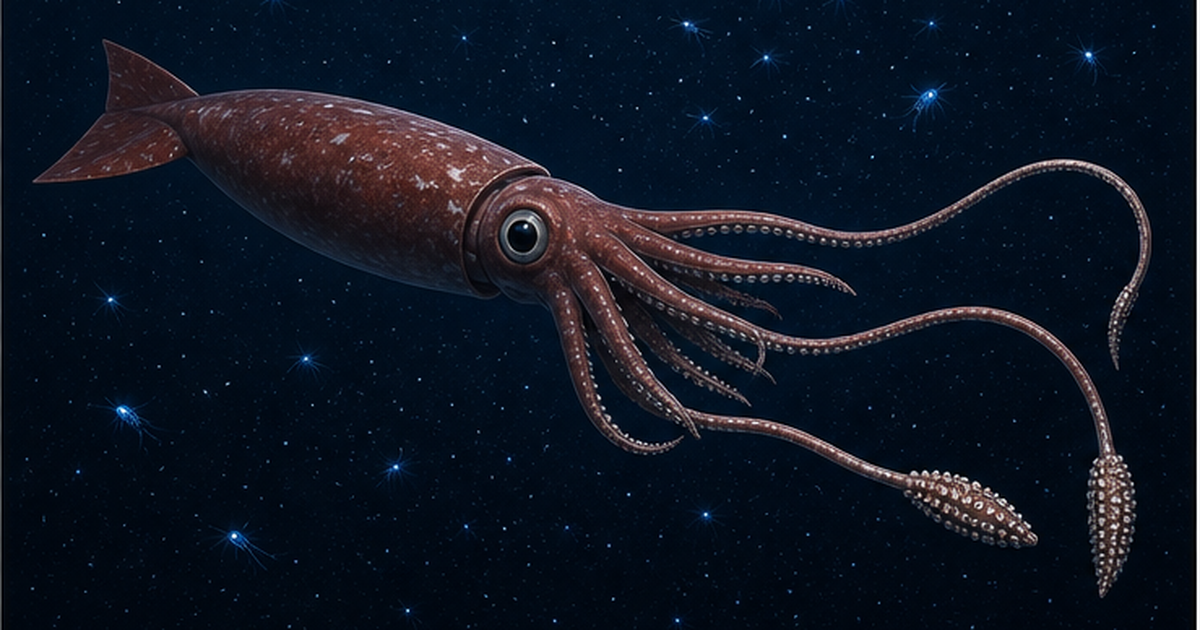
The kraken of sailors' tales, the giant sea monster said to drag ships under, was long dismissed as pure imagination. Yet the creature believed to lie behind the legend is entirely real. The giant squid (Architeuthis dux) reaches a total length of about 13 metres including its tentacles, and the largest eye ever measured on one was 27 centimetres across. It is among the largest invertebrates on Earth.
Strangely, for an animal of that size, humans first captured images of a living giant squid in the deep sea only in 2004. The team that managed it was Japanese. Dr Tsunemi Kubodera of the National Museum of Nature and Science and his colleagues lowered a camera to a depth of around 900 metres off Chichijima in the Ogasawara Islands and recorded a squid attacking the bait. That was 35 years after humans first walked on the Moon.
This article goes beyond the images of huge and frightening to look at the animal itself. Why does it have such an enormous eye? How does it stay suspended in the dark, and what does it eat? And how much do we actually know about its encounters with sperm whales? Drawing on peer-reviewed papers, museums and government agencies, let us work through the deep sea's greatest unsolved case.
What you will learn
- How big the giant squid really is, and where fact ends and legend begins
- Why an eye 27 cm across evolved, and what it is designed to see in the deep
- How the squid lives and what it eats at depths of 650-900 m
- The road to 2004, when Japanese researchers first photographed a living giant squid
- The two lines of evidence for predation by sperm whales: sucker scars and beaks
- What genome sequencing and environmental DNA have revealed, and what remains unknown
What exactly is the giant squid?
The giant squid is a huge squid belonging to the family Architeuthidae within the cephalopods, the group that includes squid and octopuses. Its scientific name is Architeuthis dux. It occurs in deep waters around the world, and in Japanese waters it has been recorded off the Ogasawara Islands and along the coasts facing the Sea of Japan. The name was familiar long before the biology was, and most of what the animal actually does remained a blank until the end of the twentieth century.
For a long time, nobody even knew how many species there were
The main reason the giant squid was so hard to study is that no one had ever seen a living one. Research material was limited to carcasses washed up on beaches, individuals caught by chance in deep-sea nets, and the indigestible beaks recovered from the stomachs of sperm whales. Because specimens from different regions looked slightly different, more than twenty species were recognised at one point.
Genetic analysis resolved the confusion. When mitochondrial DNA from specimens collected worldwide was compared, no differences large enough to separate species were found between regions. Today the giant squid is generally treated as a single, globally distributed species, Architeuthis dux. A giant squid in the Pacific and one in the Atlantic belong to the same species.
How large does it get? Separating records from exaggeration
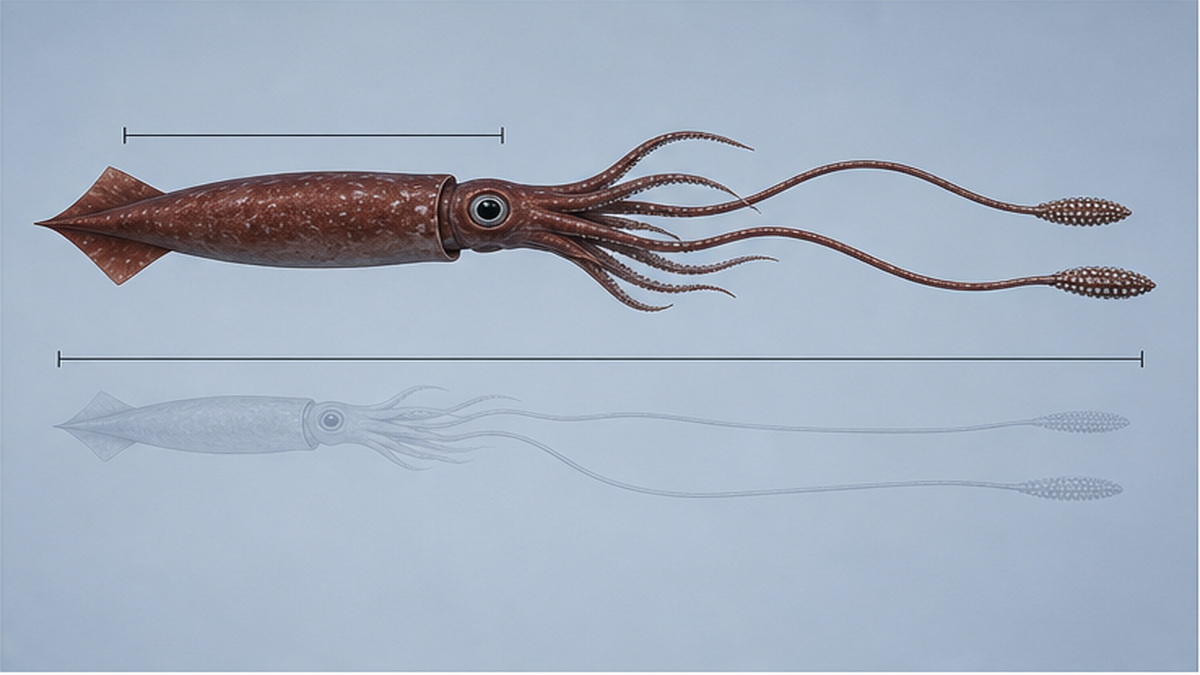
You may have heard that giant squid reach 20 metres. The figures researchers accept on the basis of actual measurements are far more modest. According to the Smithsonian Institution's ocean portal, the largest reliable record is a total length of about 13 metres including the tentacles, a mantle length of about 2.25 metres, and a weight of about 275 kilograms.
The confusion arises because most of the animal's length is in its two extensible tentacles. A squid has eight arms and two long tentacles, and the tentacles shoot out to seize prey. Pull on a carcass and the length keeps increasing, so researchers compare body size using mantle length, which does not stretch. Knowing this makes it much easier to read the total length figures that appear in the news.
| Measurement | Largest record | Why the value comes out that way |
|---|---|---|
| Mantle length | About 2.25 m | Does not stretch, so it serves as the standard for comparing body size |
| Body length to arm tips | Around 5 m | Includes the eight arms |
| Total length to tentacle tips | About 13 m | Includes the extensible tentacles, so it varies greatly with method |
| Weight | About 275 kg (female) | High water content, so it never approaches large land animals |
A heavier squid exists: the colossal squid
The title of largest squid in the world does not belong to the giant squid alone. The colossal squid (Mesonychoteuthis hamiltoni) of the Southern Ocean falls short in total length, but its mantle is far thicker and more robust, and it is thought to exceed the giant squid in weight. Its arms carry rotating hooks, and it is regarded as the more aggressive predator. Giant squid for length, colossal squid for weight is a useful way to remember the distinction.
Key points
- Genetic analysis indicates a single global species, Architeuthis dux
- The largest reliable records are about 13 m total length, 2.25 m mantle length and 275 kg
- Claims of 20 m are prone to measurement artefacts and exaggerated hearsay
- By weight, the largest squid is the colossal squid of the Southern Ocean
One of the largest eyes in the animal kingdom: what 27 centimetres is for
The feature that has astonished researchers most is the eye. The recorded eyeball diameter is 27 centimetres, with a pupil alone measuring 9 centimetres. That is roughly the size of a basketball, and there is one on each side of the head. It ranks among the largest eyes known in any animal. Even a sperm whale, approaching 20 metres in length, has nothing like it.
Bigger does not automatically mean better vision
Counter-intuitively, an eye does not keep gaining from being made larger. A bigger eyeball costs more tissue and blood supply to maintain, and the optic nerve has more information to process. In practice, the eyes of most animals level off at a few centimetres across. So why does the giant squid alone have such an extreme eye?
A giant eye evolved to spot a giant predator
The question was tackled directly by Dan-Eric Nilsson of Lund University in Sweden and colleagues, in a study published in Current Biology in 2012. Using the record of a specimen with a 27-centimetre eyeball, the team modelled the light environment of the deep sea and the optical performance of the eye, then calculated what could be detected, and at what range, as eye size was varied.
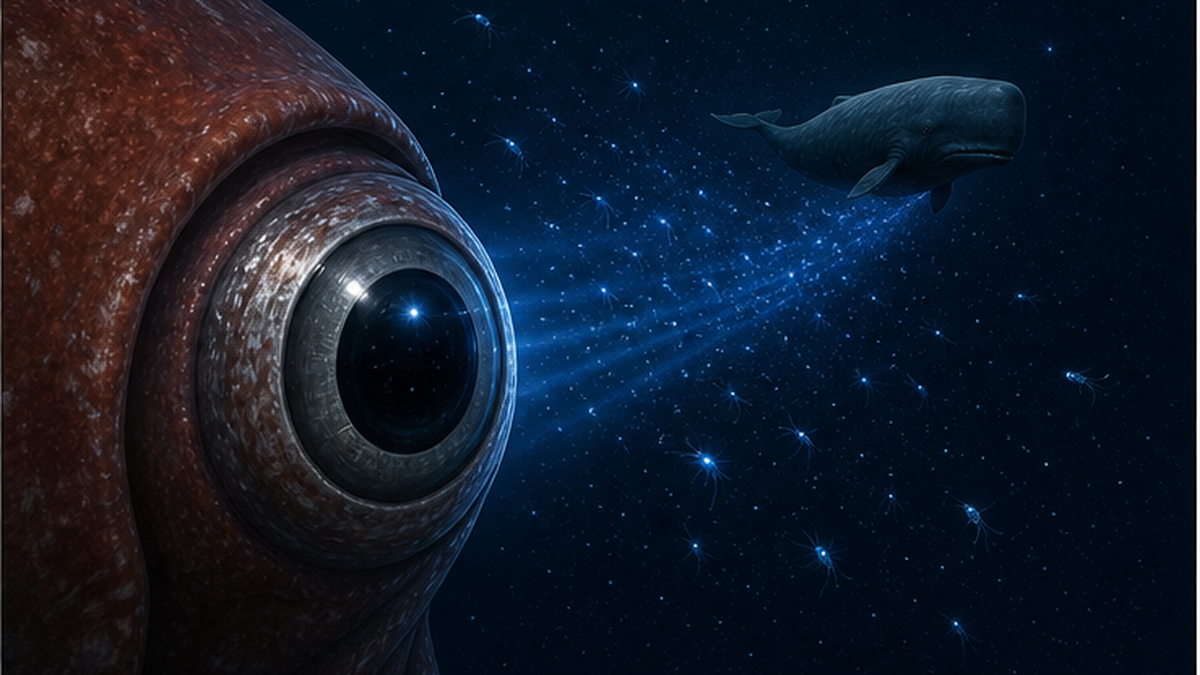
The conclusion was clear. For finding small prey, enlarging the eye brings almost no improvement. But for detecting the glow stirred up by a large moving object, a larger eye keeps paying off. In the deep sea, a large animal such as a sperm whale disturbs bioluminescent plankton as it swims, and they light up. The giant squid's enormous eye is well suited to picking out that halo of light around a moving animal.
According to the model, below about 600 metres the giant squid's eye could detect a sperm whale at a distance of more than 120 metres. In other words, that eye probably evolved not to find prey but to sense its greatest enemy early enough to flee.
A curious mismatch between eye and brain
Interestingly, later work has reported that while the eye is enormous, the optic lobe that processes visual information is not as large as the size of the eye would suggest. This hints that giant squid vision is specialised not for analysing fine images but for gathering faint changes in light across a wide field. Rather than an eye that resolves a landscape in detail like ours, think of an eye finely tuned to sense the movement of danger in total darkness.
The light environment of the deep sea
- Sunlight is essentially gone by 200 m, and 1000 m is complete darkness
- The main source of light in the deep sea is bioluminescence produced by organisms themselves
- The giant squid is thought to have no light organs of its own
- That is precisely why the ability to see other animals' light is a matter of survival
Our article on deep-sea bioluminescence looks at the relationship between light and life in the deep in more detail. Reading it alongside this one gives a fuller picture of the world in which the giant squid's eye evolved.
Life at 650-900 metres: buoyancy, swimming and food
The giant squid lives in the mid-water layer between the surface and the sea floor. According to survey records from the National Museum of Nature and Science, live individuals were confirmed in the mid-water zone at depths of about 650-900 metres during the day, at temperatures of roughly 5-11°C. It is a cold, still world where no sunlight reaches.
A body that does not sink: the ammonium chloride solution
Most fish adjust their buoyancy with gas in a swim bladder. Under the high pressures of the deep sea, however, using gas is a disadvantage. The giant squid took an entirely different route. By storing a solution of ammonium chloride, which is lighter than seawater, in its tissues and body fluids, it can remain suspended in mid-water with almost no swimming.
There is a cost. Flesh loaded with ammonium has a sharp smell and a bitter taste, and is not suited to human consumption. The answer to whether you can eat giant squid is that it will not harm you, but it is not good. Edible squid such as the Japanese common squid keep swimming with their muscles; the giant squid chose an energy-saving drifting strategy, and the character of its flesh changed as a result.
Far from passive: an active hunter
Drifting may suggest a passive animal, but the observations of 2004 and 2006 overturned that impression. According to the museum's records, when bait was lowered into the deep sea the squid spread its arms wide and attacked actively, wrapping its tentacles around the bait to seize it. This is not a creature that merely floats; it is a predator that goes after its prey.
As for diet, observations and stomach content analyses suggest that it favours squid smaller than itself. There are also records of deep-sea fish such as grenadiers being eaten. Cases of smaller individuals of its own species being consumed have been reported too, showing that it sits high in the deep-sea food web.
| Item | What is known | Basis |
|---|---|---|
| Depth range | Mainly the mid-water zone at 650-900 m | Photographic and capture records of live individuals |
| Water temperature | Roughly 5-11°C | Observations of the habitat |
| Buoyancy | Ammonium chloride solution stored in the body | Research on cephalopod buoyancy |
| Main prey | Smaller squid and deep-sea fish such as grenadiers | Observation and stomach content analysis |
| Predators | Sperm whales and other deep-diving toothed whales | Sucker scars and beaks in stomach contents |
A surprisingly short life
Squid and octopuses have a small organ called a statolith that governs their sense of balance. Growth increments are laid down in the statolith much like tree rings, and age can be estimated from them. Studies of giant squid statoliths suggest a lifespan of only a few years. For all its size, its life is remarkably short. That also means it grows extraordinarily fast, and how it manages that on the limited food supply of the deep sea remains one of the larger open questions.
How the living animal was finally filmed: 2004, 2006 and 2012
The history of giant squid research divides sharply into the era when only carcasses were available and the era in which the living animal could be seen. Japanese researchers drew that line.
2004: the world's first still images
Dr Tsunemi Kubodera and colleagues at the National Museum of Nature and Science noted that sperm whales gather off Chichijima in the Ogasawara Islands. If the whales were there, they reasoned, so was their prey. The team attached bait and a camera to a vertical line a thousand metres long and lowered it repeatedly, varying the depth between 400, 600 and 800 metres in a patient campaign of survey work.
On 30 September 2004, a camera at a depth of about 900 metres captured a giant squid spreading its arms wide and attacking the bait. Close to 500 images were recorded, and when the line was hauled up a tentacle was still entangled in it. The individual was estimated at about 1.7 metres mantle length, about 4.7 metres to the arm tips, and more than 8 metres in total length including the tentacles. The work was published in Proceedings of the Royal Society B in September 2005 and was chosen as the number one story in National Geographic News's top ten for 2005.
2006: video of an individual swimming at the surface
In December 2006, during another survey off the Ogasawara Islands, the team succeeded in hooking a live giant squid and filmed it swimming at the surface. This individual was a young one, about 1.4 metres in mantle length, about 3.5 metres from fin to arm tips, and around 50 kilograms. Brought up suddenly from the deep, it could not withstand the change in pressure and temperature and did not survive long, but as a record of the animal in motion it was a valuable step.
2012: at last, natural behaviour in the deep sea
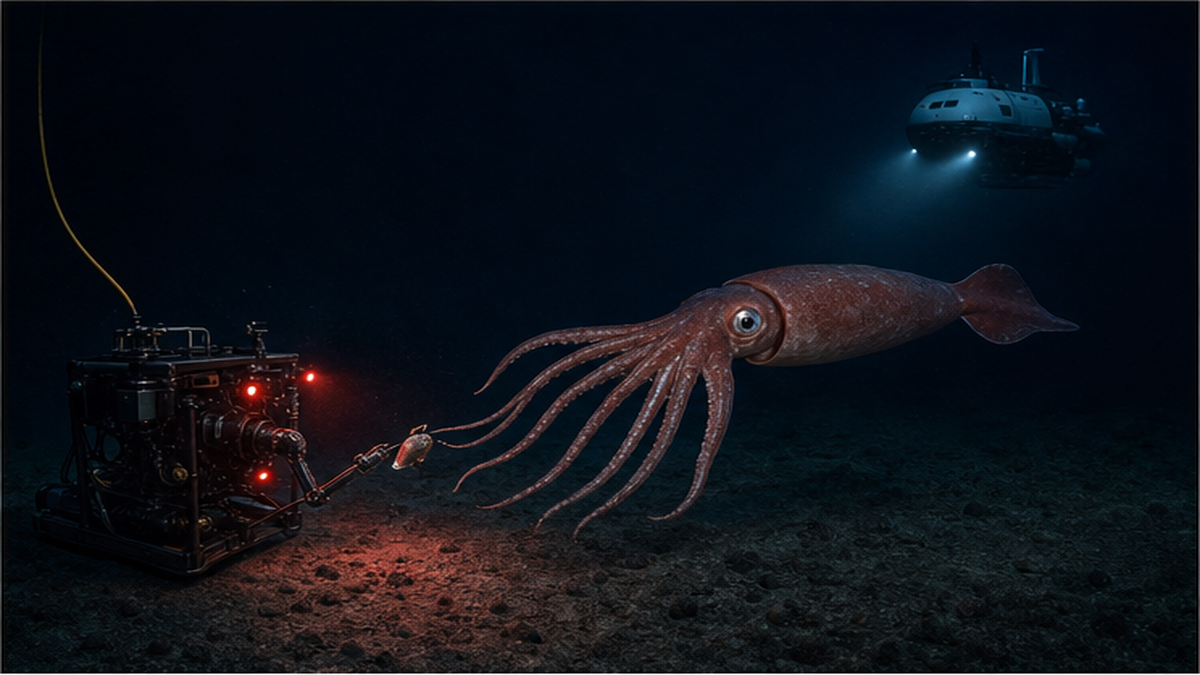
Then, from June to July 2012, an international team including Dr Kubodera, the American marine biologist Dr Edith Widder and the New Zealand researcher Dr Steve O'Shea mounted a large filming project off Chichijima. On 10 July, working from a crewed submersible, they tracked and filmed a giant squid for 23 minutes from about 630 metres down to about 900 metres. It was the first video anywhere of the animal behaving naturally in the deep sea. The results were announced in January 2013 and reported worldwide.
The key was light that does not frighten
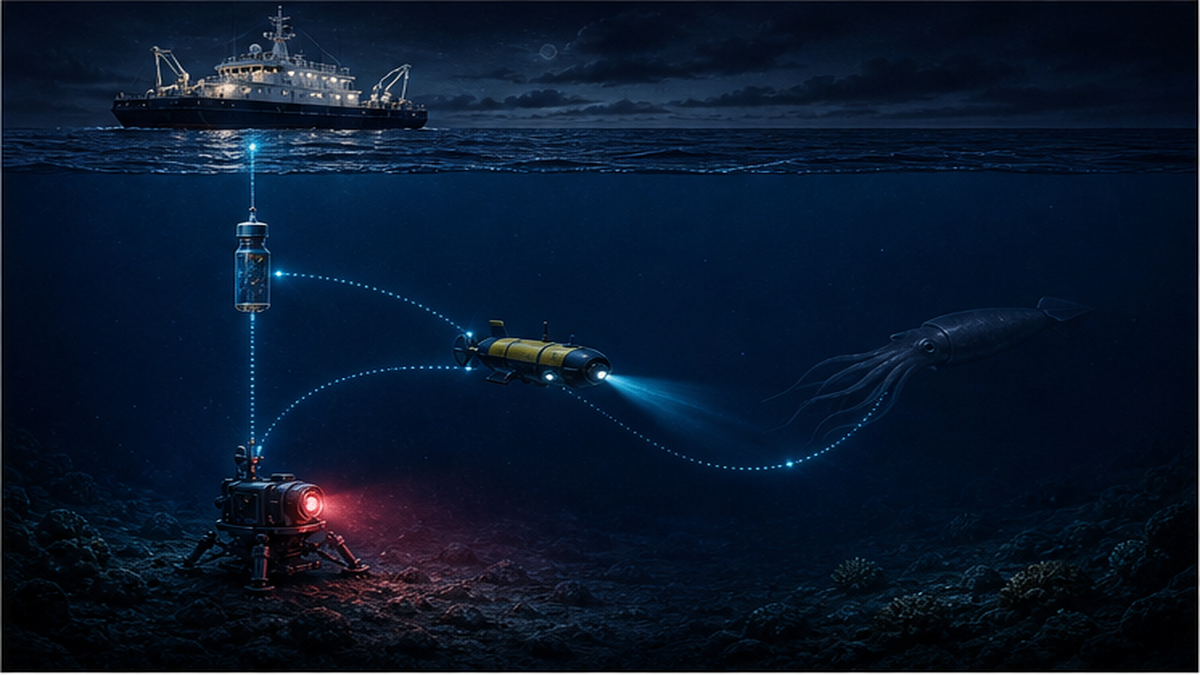
The breakthrough came from technical ingenuity. The deep-sea camera system Medusa, developed by Dr Widder, illuminates with dim red light that most deep-sea animals cannot see, and records with a highly sensitive camera. Strong white light drives deep-sea life away, so it was avoided. The team also fitted an electronic lure that mimics the flashing display a jellyfish produces when threatened, suggesting to large predators that prey might be nearby.
The method paid off again in the Gulf of Mexico in 2019. During the deep-sea expedition Journey into Midnight run by the US National Oceanic and Atmospheric Administration (NOAA), a Medusa deployed southeast of New Orleans recorded the first video of a giant squid in United States waters, a sequence of 28 seconds. The animal was estimated to be a young individual about 3 to 3.7 metres long.
Milestones in observing living giant squid
- 2004: first still images anywhere, at about 900 m off the Ogasawara Islands, by Dr Tsunemi Kubodera and colleagues
- 2005: results published in a journal of the Royal Society
- 2006: a live individual hooked off the Ogasawara Islands and filmed swimming at the surface
- 2012: 23 minutes of tracking from a crewed submersible at 630-900 m, the first video in the deep sea
- 2019: first video in US waters, in the Gulf of Mexico, by NOAA using the Medusa camera
Battles with sperm whales: what two lines of evidence tell us
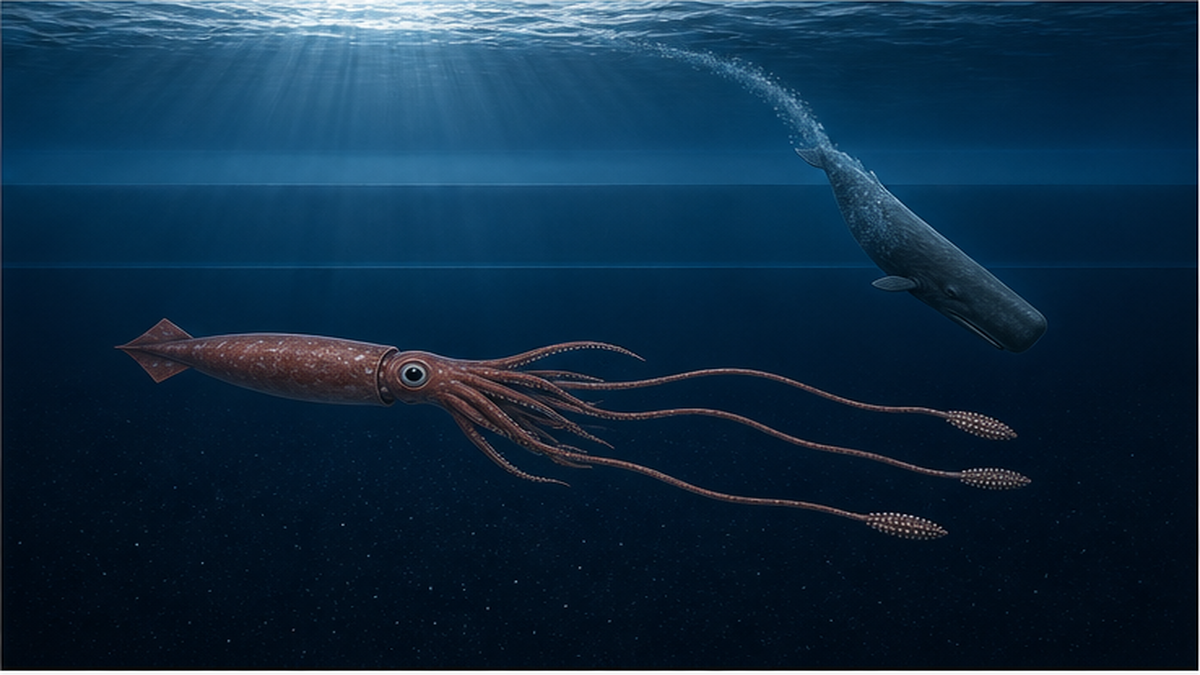
No account of the giant squid is complete without its struggles with sperm whales. No human has yet witnessed one of these encounters in the deep, but the evidence that the two stand in a predator-prey relationship has accumulated steadily from two directions.
Evidence 1: circular scars on whale skin
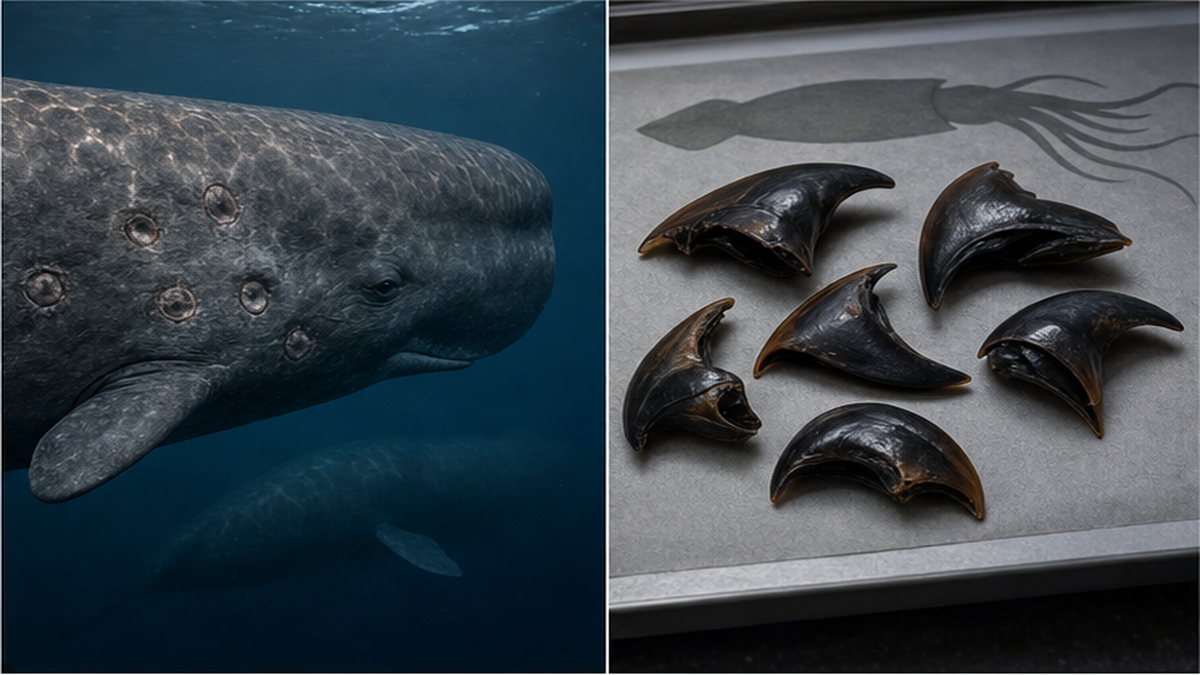
It has long been known that sperm whales that strand or are caught carry numerous circular scars, concentrated on the head. The size and shape of these marks match the hard rings that line the rims of large squid suckers. Older animals carry so many scars that they overlap, suggesting a lifetime of repeated grappling with large squid.
A caveat is needed, though. Not every such scar comes from a giant squid. Species with hooks, such as the colossal squid, leave differently shaped marks, and other large squid are possible sources. Scientifically the distinction matters: the scars are strong evidence of contact with large cephalopods, not proof that the animal involved was necessarily a giant squid.
Evidence 2: indigestible beaks in the stomach
The second and more definitive line of evidence is stomach contents. A squid's beak is made of chitin and is not digested, so it remains in the stomach. Examinations of sperm whale stomachs repeatedly find large numbers of squid beaks, including those of giant squid. Because a beak's shape and size allow the species and body size to be estimated, beaks make it possible to reconstruct what a whale had been eating and in what quantity.
In fact, much of the early knowledge of giant squid distribution came from this stomach content research. In an age when humans could not reach the deep sea, sperm whales effectively served as its sample collectors.
Not an evenly matched duel
Paintings and documentaries tend to show whale and squid locked in an even struggle. By weight, however, a mature male sperm whale runs to tens of tonnes, while a giant squid tops out just under 300 kilograms, two orders of magnitude apart. The real relationship is better understood as an overwhelming predator and a prey animal trying to detect it and get away.
That is exactly what gives the enormous eye of the previous section its meaning. Not to fight head-on, but to sense a presence 120 metres away and flee: that is the giant squid's survival strategy. For the whale's side of the story, see our article on whale migration.
Common misconceptions
- Giant squid sink ships: physically impossible at about 275 kg, and the kraken legend is an exaggeration
- All whale scars come from giant squid: other large squid species are possible sources
- Whale and squid fight as equals: the weight difference is enormous, and predation fits the evidence
- They attack people: living below 650 m, they have essentially no opportunity to meet us
What the genome revealed about becoming giant
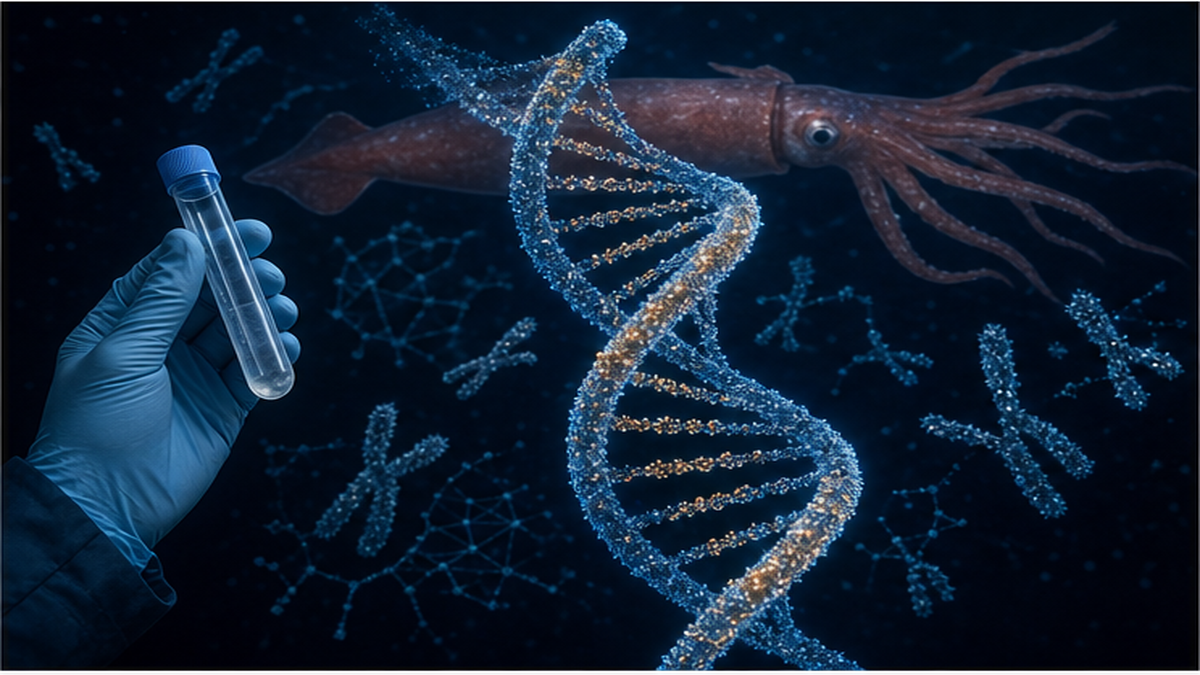
In January 2020 a new door opened. An international team published a draft genome of the giant squid, an outline of its complete genetic information, in the journal GigaScience. It was the first time the genetic information of an animal that can only be met in the deep sea had been read in such a comprehensive form.
A genome close in size to our own
The assembled genome came to about 2.7 billion base pairs (2.7 Gb), close to the roughly 3 billion base pairs of the human genome. A total of 33,406 protein-coding genes were annotated with supporting evidence, and genome completeness as measured by BUSCO reached 92 per cent. Achieving that quality from fragile deep-sea material was a considerable technical accomplishment.
| Item | Giant squid, 2020 draft | For comparison: human |
|---|---|---|
| Genome size | About 2.7 billion base pairs | About 3 billion base pairs |
| Annotated genes | 33,406 | About 20,000 |
| Genome completeness (BUSCO) | 92% | - |
| Significance | A foundation for studying gigantism and deep-sea adaptation | - |
Gigantism did not come from whole-genome duplication
In vertebrates, whole-genome duplication events during evolution are thought to be linked to increases in complexity and body size. Some researchers hoped the giant squid's size could be explained the same way. The analysis found otherwise: no trace of whole-genome duplication was found in the giant squid genome. Its gigantism must have arisen by some other mechanism.
What did draw attention was a large expansion, across cephalopods, of the protocadherin gene family involved in connecting nerve cells. Cephalopods have strikingly complex nervous systems for invertebrates, and the genomic basis of that is now coming into view. Our article on the intelligence of octopuses and squid covers this in detail.
What a genome makes possible
Publishing a genome sequence widens the field of research at a stroke. Surveys based on environmental DNA (eDNA), which detect fragments of DNA shed by organisms into seawater, depend on knowing the target species' sequences. With the giant squid genome available, it becomes possible to say that a water sample from a given area contained giant squid DNA, and so to infer distribution without ever seeing the animal. It opens a path to counting deep-sea life without diving into the deep sea.
Japan's seas and the giant squid: why they appear in winter
The giant squid is not a story about distant foreign waters. Japan is one of the countries with the most records anywhere in the world. In particular, strandings and entries into set nets cluster along the Sea of Japan coast from winter into spring.
Why they come close to shore in winter
The giant squid prefers a cold mid-water layer of roughly 5-11°C. When the surface of the Sea of Japan cools in winter, that temperature band extends into shallower water. Individuals that would normally stay deep can then rise to relatively shallow depths. There they exhaust themselves, or are pushed along by wind and waves, and end up cast ashore. The coasts of the San'in region and the Noto Peninsula, and the set nets of Toyama Bay, are among the places where such records are most common.
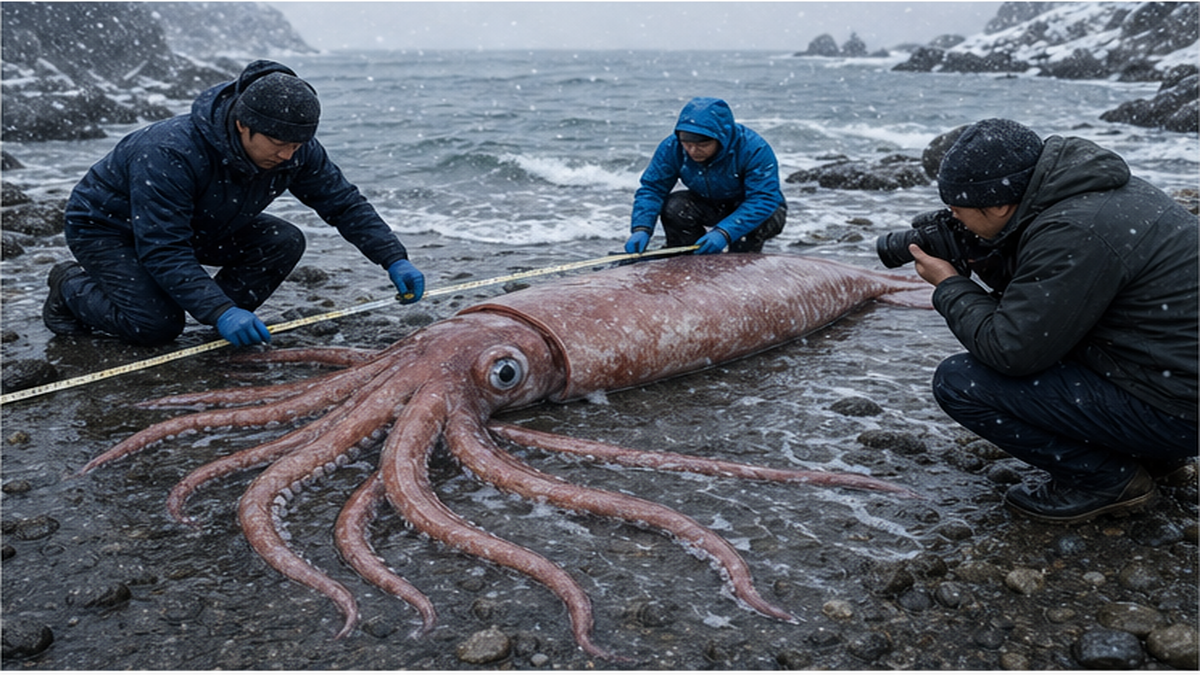
In other words, a news report of a stranded giant squid does not necessarily mean something is wrong in the deep sea. It is more natural to see it as a season in which the oceanography of the winter Sea of Japan happens to bring our world and the squid's into overlap. That said, collecting stranding records over the long term does provide clues about changing sea temperatures and the state of deep-sea ecosystems. There is real value in the careful record museums keep of each individual case.
Why you cannot see a living one in an aquarium
If live animals occasionally enter nets, why not keep one in an aquarium? Displays have in fact been attempted, at facilities such as the Uozu Aquarium in Toyama Prefecture. But an individual brought up abruptly from the deep suffers severe damage from the sudden change in pressure and temperature, and long-term husbandry is extremely difficult. The giant squid is also large and easily injured, and it is adapted to drifting through open mid-water, so even bumping into the wall of a tank can be fatal.
For that reason, almost every giant squid we see in Japanese museums and aquariums is a frozen or formalin specimen, or a carefully made replica. Specimens can be seen at the National Museum of Nature and Science and at facilities around the country. Standing in front of one and taking in its full length brings the scale of the deep sea abruptly close.
Interest in the deep sea leads to conservation
The giant squid is not currently listed as endangered. That is not because it has been confirmed safe, but because the data needed to estimate its numbers simply do not exist. Deep-sea bottom trawling, seabed resource development, and changes in deep-sea temperature and oxygen driven by warming could all affect it. Our article on adaptation in deep-sea life is a useful companion on how these animals live and what pressures they face.
What you can do
- When you meet a deep-sea animal in the news or at an aquarium, look up its depth range and diet
- If you find an unfamiliar large animal on a beach, do not touch it; contact your local authority or a museum
- Visit exhibitions and public lectures by museums and institutes working on deep-sea research
- Follow coverage of seabed resource development and deep-sea fishing with ecosystems in mind
The mysteries that remain, and the future of deep-sea research
Even now, with living animals filmed and the genome read, basic questions about the giant squid remain unanswered. If anything, the progress has sharpened the outline of what we still do not know.
A reproductive life nobody has seen
The largest blank is reproduction. Males are thought to implant spermatophores directly into the tissue of a female's arms, but neither mating nor spawning has ever been observed in the wild. Where the egg masses end up, and at what depth the hatchlings grow, can only be inferred from fragmentary collection records. If an animal reaches 10 metres in a few years, growth in the juvenile stage must be extraordinary, yet that whole process is essentially blank.
We do not even know how many there are
Population estimates do not exist either. There are arguments, working back from how much sperm whales eat, that the numbers must be considerable, but no direct stock assessment has been carried out. Given the size and depth of the ocean, this is perhaps not surprising. Humanity has detailed maps of the Moon and Mars, yet has still not fully charted the topography of its own planet's deep sea floor.
| Theme | What has been established | What remains unknown |
|---|---|---|
| Form and size | Up to about 13 m total length and 2.25 m mantle length | Where the true upper limit lies |
| Vision | A 27 cm eye is well suited to detecting large predators | How that is actually translated into behaviour |
| Behaviour | An active predator that attacks bait | Everyday swimming and movement patterns |
| Reproduction | Spermatophores are thought to be implanted in the arms | Mating, spawning and where juveniles grow |
| Population | - | Abundance and density are almost entirely unknown |
Technology is starting to open the case
There is reason for optimism. Observation technology for the deep sea has advanced greatly over the past two decades: red-light cameras that do not startle animals, long-duration unattended observation platforms, distribution estimates from environmental DNA, and submersibles that keep getting smaller and cheaper. Combine these and it becomes possible to approach the giant squid by means other than chance encounter. In the fifteen years from 2004 to 2019 alone, humans filmed giant squid in the deep sea several times. Before that it had never happened once, which shows how fast things are moving.
Not a monster, but a neighbour in the deep
From the legend of the kraken to an object of science: the path the giant squid has travelled is also a history of how people have viewed the sea. Once a figure of fear, then a specimen to be studied, it is now valued as a key to understanding deep-sea ecosystems.
And it is worth remembering that this animal lives in the same sea we look at every day, just a little deeper. Go a few dozen kilometres offshore from the Japanese coast and a few hundred metres down, and you are already in giant squid territory. Conversation about protecting the ocean tends to centre on visible places such as coral reefs and beaches, but the lightless deep sea holds a diverse world of animals, many of which do not yet even have names. The giant squid may be the guide that opens the door to it.
Summary
- The giant squid reaches about 13 m and 275 kg, is among the largest invertebrates, and is now treated as a single global species
- Its 27 cm eye is well suited to detecting large predators such as sperm whales from more than 120 m away
- It lives at 650-900 m, holds its position using ammonium chloride, and actively preys on smaller squid and deep-sea fish
- In 2004 Dr Tsunemi Kubodera and colleagues in Japan first photographed a living individual, and video in the deep sea followed in 2012
- The genome was sequenced in 2020, yet basic mysteries such as reproduction and population size remain
References and sources
- National Museum of Nature and Science, Japan – Giant squid, mystery of the deep sea (with Dr Tsunemi Kubodera, Department of Zoology)
- Proceedings of the Royal Society B – Kubodera & Mori (2005), first observations of a live giant squid in the wild
- Current Biology – Nilsson et al. (2012), A Unique Advantage for Giant Eyes in Giant Squid
- PubMed (US National Library of Medicine) – A unique advantage for giant eyes in giant squid (abstract)
- GigaScience (Oxford Academic) – da Fonseca et al. (2020), a draft genome sequence of the giant squid
- Smithsonian Ocean – How Big is the Giant Squid? on the size records
- Smithsonian Ocean – Giant Squid Sucker Marks, on the scars left on sperm whales
- NOAA Ocean Exploration – Record of the 2019 giant squid encounter in the Gulf of Mexico
- Guinness World Records – Largest cephalopods
- Encyclopaedia Britannica – Giant squid: Description, Size, & Facts
* Ordered by reliability: government and academic institutions > peer-reviewed papers > specialist organisations > trusted media