⚡ In short
Snow that falls in winter melts in spring and flows to the paddies, the rivers and the sea — a natural dam. This article explains how meltwater underpins Japan's 53.3 billion m³ of agricultural water, what JMA observations reveal about declining snow depth, and how warm winters and low snowfall are changing farming, groundwater and the coast.
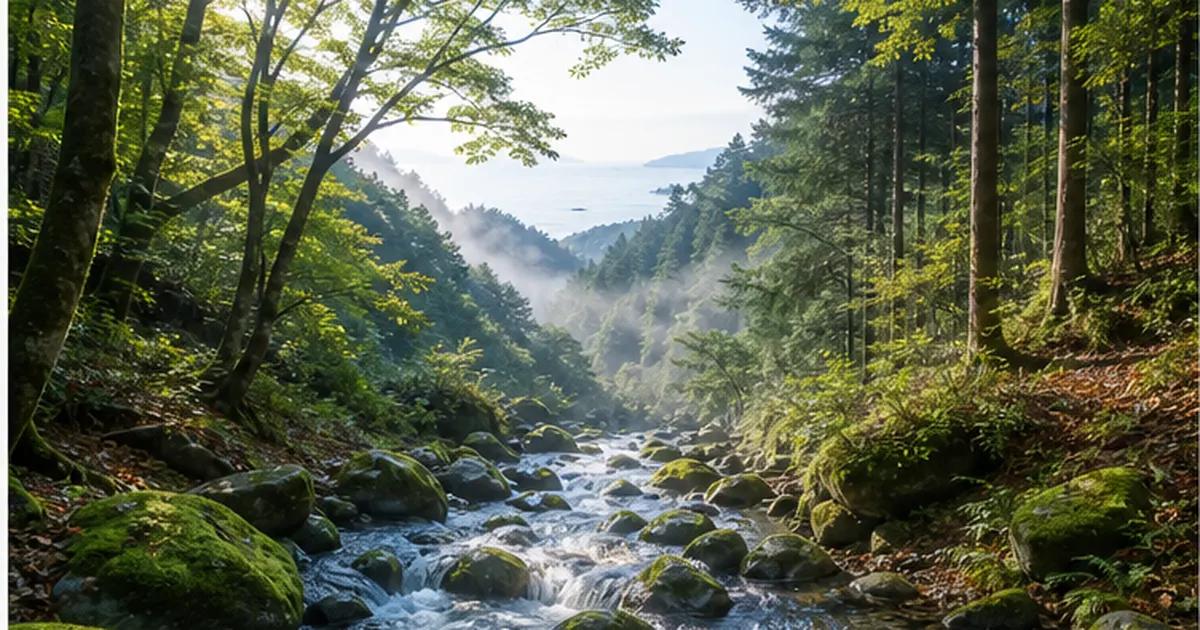
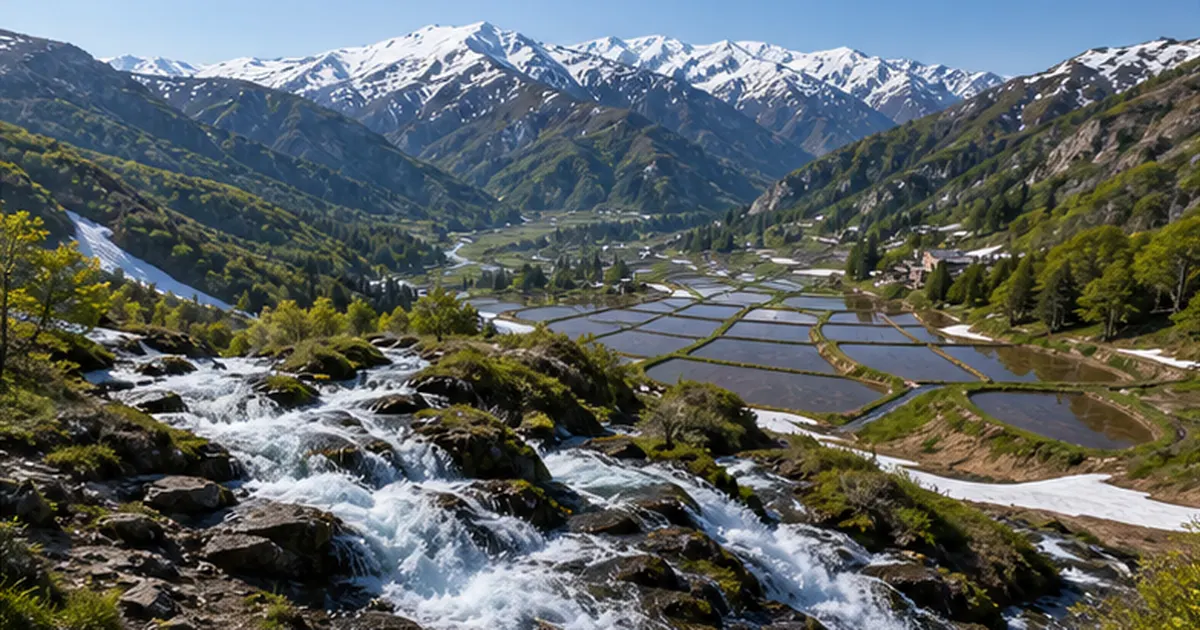
Snow that piles up on the mountains in winter is not simply sleeping there in white silence. A snowpack is a natural dam that stores several months' worth of water. Then in spring, as temperatures rise, it melts little by little, runs down the ravines, becomes a river, enters a reservoir, and travels through irrigation canals to the rice paddies. Japanese rice farming can begin in spring precisely because this meltwater emerges "at the right time, in the right amount".
Yet that natural dam is quietly shrinking. According to Japan Meteorological Agency observations, the annual maximum snow depth on the Sea of Japan side shows a long-term declining trend. In the winter of 2020, Japan's winter mean temperature anomaly reached +1.66°C, the highest since records began in 1898, and snowfall on the Sea of Japan side of eastern Japan was just 7% of normal — a record low. Snow is a nuisance and, at the same time, a resource you miss when it disappears. Climate change is forcing snow country to confront that duality again.
This article traces how meltwater becomes a water resource, how it supports agriculture, daily life and the sea, and what happens as warm winters and low snowfall advance — all based on primary sources from government agencies and peer-reviewed research. Snow is not only a concern for snowy regions. A single snowflake on a mountain waters the paddies, flows down the river, and finally creates spring in the sea. Let us follow that single line.
What you will learn
- How a snowpack works as a "natural dam", and how snow is measured as Snow Water Equivalent (SWE)
- The route meltwater takes from the mountains through rivers, dams and canals to the rice paddies
- Why paddy irrigation — about 94% of Japan's 53.3 billion m³ of agricultural water — depends on the timing of snowmelt
- What JMA observations show about declining annual maximum snow depth, and what happened in the record-low winter of 2020
- How low snowfall affects spring water shortages, groundwater, snowmelt floods and the coastal sea
- From fighting snow to using it: snow storage rooms, snow cooling and water-saving snow-melting pipes
What is meltwater? The snowpack as a natural dam
Meltwater is the water produced when snow that accumulated on the ground during winter melts as spring temperatures rise, then flows over the surface or soaks into the ground. Put that way it sounds obvious, but the value of snow as a water resource lies not in quantity but in its ability to shift timing. Miss that point and it becomes impossible to see why low snowfall matters.
Snow does not add water. It delays it
Consider the same amount of precipitation falling as rain or as snow. As rain, it runs down the river and out to sea within days. As snow, that water is held on the mountainside as a solid and does not move until temperatures rise in spring. Water that fell in December first appears in the river in April or May. That gap of several months is the true nature of snow as natural infrastructure.
What humans try to achieve with concrete dams — storing water when it is abundant and releasing it when it is needed — the mountain snowpack does without energy or construction cost. Moreover, the snowpack is spread thinly across the whole catchment, so it does not concentrate water in one place but supplies it slowly from countless ravines. It is areal storage, not point storage. That dispersion also keeps stream temperatures low, stabilises spring water and sets the rhythm of ecosystems.
Three reasons a snowpack is called a natural dam
- Storage across seasons: it holds winter precipitation for months and releases it in spring, when demand rises
- Areal, distributed supply: because it accumulates thinly across the whole catchment, water emerges gradually, ravine by ravine
- Low temperature: the water it releases is cold, keeping streams and springs cool for the organisms that depend on them
Snow Water Equivalent (SWE): measuring snow as a depth of water
The familiar figure in weather forecasts is snow depth. For water resources, however, depth alone is not enough: one metre of fluffy new snow and one metre of dense spring snow contain very different amounts of water. Hence Snow Water Equivalent (SWE), which expresses how many millimetres of water the snow would produce if it all melted.
If new snow with a density of 100 kg/m³ lies one metre deep, the SWE is 100 mm; if spring snow has compacted to 400 kg/m³, the same metre gives an SWE of 400 mm. Through the winter, snow is compressed by its own weight and by cycles of melting and refreezing, so its density rises. In other words, "snow depth is decreasing" and "the snow water resource is decreasing" are not necessarily the same statement. Only by looking at both can you tell how much water is actually stocked on the mountain.
| Indicator | What it measures | Characteristics and uses |
|---|---|---|
| Snow depth | Height of snow above the ground (cm) | Easy to observe and timely. Used for snow clearance, transport and daily life |
| Snow Water Equivalent (SWE) | Amount of water if melted (mm) | Essential for water resources and river flow forecasting; captures changes in density |
| Snowfall | Total new snow over a period (cm) | The total "supply" for that winter; does not account for what has already melted |
| Annual maximum snow depth | Deepest snow depth of that winter (cm) | Used to monitor long-term change; JMA publishes station-by-station statistics |
Where meltwater matters within Japan's water use
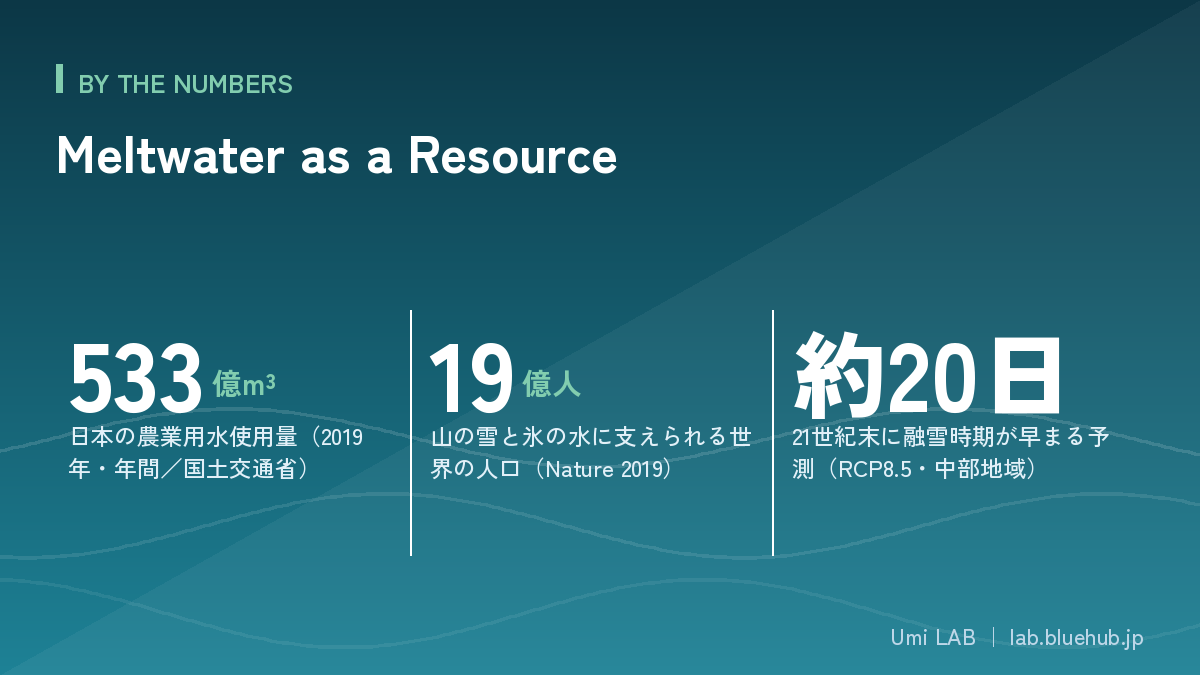
According to the Ministry of Land, Infrastructure, Transport and Tourism's annual report on Japan's water resources, national water use in 2019 was about 53.3 billion m³/year for agriculture and about 25.2 billion m³/year for urban use (domestic plus industrial), for a total of roughly 78.5 billion m³/year. Agriculture dominates, at about 70% of the total. And agricultural water is not used evenly through the year: demand surges from spring into early summer and is almost nil in winter — an extremely seasonal pattern.
In snow country, this "demand concentrated in spring" has meshed beautifully with the "storage released in spring" provided by the snowpack. That is no coincidence: the shape of paddy agriculture was chosen to fit the terrain and climate. Behind the scenes, meltwater has quietly aligned supply with demand.
| Category | Use (2019) | Share of total | Seasonality |
|---|---|---|---|
| Agricultural water | approx. 53.3 billion m³/year | approx. 68% | Concentrated in spring to early summer; almost unused in winter |
| Urban water (domestic + industrial) | approx. 25.2 billion m³/year | approx. 32% | Relatively stable year-round, rising somewhat in summer |
| Total | approx. 78.5 billion m³/year | 100% | — |
From mountain to paddy: the route meltwater travels
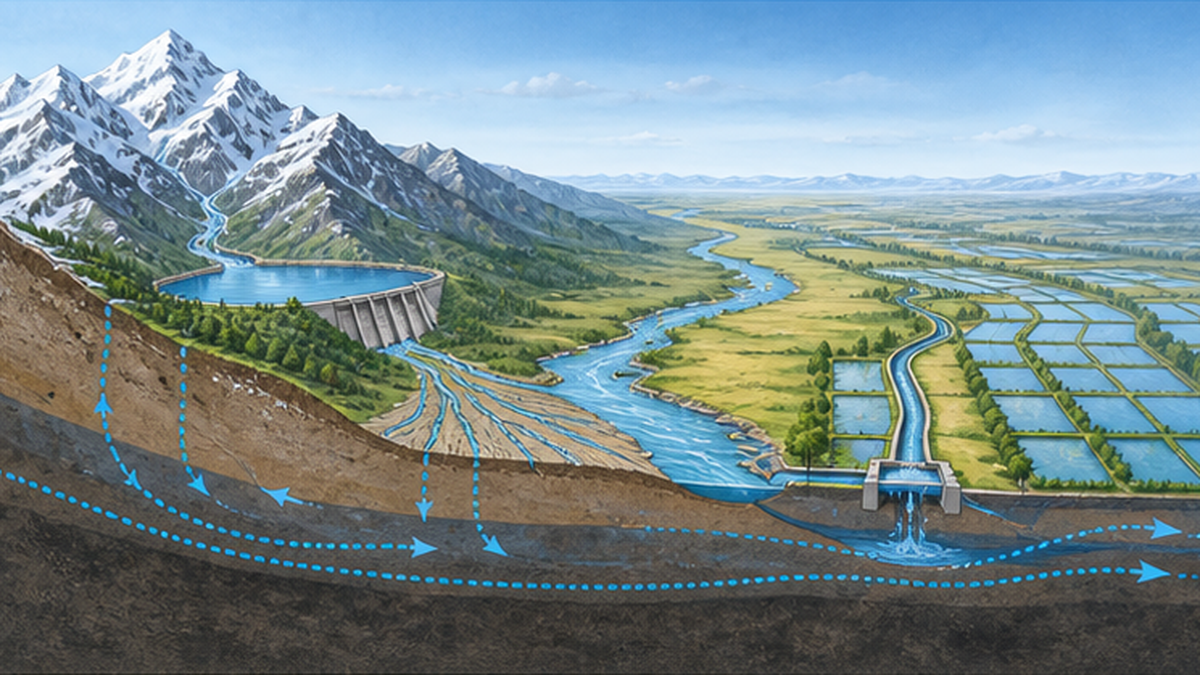
Knowing how snow on the mountains reaches the paddies on the plain makes it clear where the bottlenecks appear in a low-snow year. The journey of meltwater falls into four stages: melting, collection, regulation and distribution.
Stage 1: Melting on the mountain — the start of the snowmelt runoff season
In spring, as solar radiation strengthens and temperatures rise, melting begins at the surface of the snowpack. The meltwater does not run off immediately, however. It is first absorbed into the pore spaces inside the snow, refreezes at night, melts again by day, and repeats that cycle. Only when the whole pack is saturated and can hold no more does water begin to escape from its base and flow down the slope. This transition marks the arrival of the snowmelt runoff season, and rivers in snow country often reach their annual peak flow at this time.
Temperature is not the only control on melt rate. Solar radiation, wind, humidity and above all rain matter greatly. When warm rain falls on lying snow, the water of the rain is compounded by the heat it carries, melting the snow rapidly and generating a large volume of water in a short time. That is the classic trigger for a snowmelt flood, and the reason the Ministry of Agriculture, Forestry and Fisheries issues preventive disaster-reduction information for the snowmelt runoff season every year.
Stage 2: Gathering in the ravines — the value of emerging slowly
Water leaving the slope gathers into countless ravines to form streams. Here the distribution of snow across the whole catchment matters. If snow were concentrated at a single point, it would all run out at once and nothing would remain. In reality, melt timing varies by elevation, slope aspect and forest cover, so across the catchment water keeps emerging for weeks or months. Snow lingering on north-facing slopes and valley floors into May and June is the last water source that carries the region through early-summer dry spells.
Forests also change how melt unfolds. Canopy shade means snow inside a stand melts later than in the open, while deciduous broadleaf forests admit sunlight in late winter and early spring and follow a different schedule again. This site-by-site diversity smooths out flow. Combined with the way forest soils retain water and delay runoff, snow and forest together decide how water leaves a catchment.
Stage 3: Regulation by dams — natural and artificial storage
Once in the river, water in many catchments enters a dam. Dams in snow country store the inflow of the melt season to prepare for summer drought, so the baton passes from a first dam of mountain snow to a second dam of concrete. Dam operators decide whether to lower the water level in preparation for floods or raise it in preparation for drought, based on forecasts of snowmelt runoff — and the premise of that judgement is that year's snow water equivalent.
Here lies the first blow of low snowfall. If there is little snow on the mountain, less water flows into the dam at all, and the reservoir enters summer without filling. A dam is a device that stores and distributes water, not one that creates it, so if there is no snow upstream there is nothing to be done. Dams also trap sediment, which affects the supply of sand to the coast — a subject covered in the relationship between dams and coastal erosion.
Stage 4: Becoming groundwater — the invisible reservoir of alluvial fans
Not all meltwater flows in rivers. Where mountains meet the plain, alluvial fans absorb large volumes of water through the riverbed, which becomes subsurface flow and groundwater. This water migrates slowly over months or years and re-emerges as springs across the plain. It is no accident that famous spring-water districts, wasabi fields and sake breweries in snow country cluster on the spring lines of alluvial fans in Toyama, Niigata, Yamagata and Nagano.
A study of central Japan published on the National Institute for Environmental Studies' climate adaptation platform (conducted by the Japan Weather Association, covering the Kurobe and Jinzu river basins) indicated that the seasonal distribution of groundwater recharge could shift under future climate scenarios: recharge from November to April would increase relative to today, while May and June would decrease. More winter precipitation falling as rain infiltrates early, while supply thins in early summer when it is most needed — showing that for groundwater too, the issue is timing rather than volume.
The four stages, and where low snowfall bites
- Melting: snow begins to melt as temperatures rise, accelerating sharply when rain falls → in low-snow years it starts earlier and ends earlier
- Collection: water gathers in countless ravines, with elevation staggering the timing and smoothing flow → less high-elevation snow means thinner early-summer flow
- Regulation: dams store melt inflow against summer drought → without inflow, reservoir levels never rise
- Distribution and infiltration: canals carry water to paddies, alluvial fans to groundwater → if timing misses peak demand, drought follows
Japanese rice farming rests on snow
The link between Japanese paddy agriculture and meltwater goes deeper than the mere presence of water: it is a matter of seasonal timing. Let us look at the specifics.
Paddy irrigation is about 94% of agricultural water
According to Ministry of Agriculture, Forestry and Fisheries materials, about 94% of Japan's agricultural water is paddy irrigation water. There is also water for upland irrigation and livestock, but by far the largest share is the water held in rice paddies. And paddy water demand has a distinct peak: the period of puddling — levelling the soil before transplanting so it holds water — and the establishment period just after transplanting. During those weeks, paddies need enormous volumes of water.
The timing of puddling and transplanting varies with region and variety, but in snow country it broadly falls in spring to early summer — exactly when snowmelt runoff peaks. Meltwater is a precondition written on the first page of Japan's rice calendar. Conversely, if melt comes early and the water has already drained away, that precondition collapses.
The value of cold water as a matter of quality
Meltwater supports more than volume. Water temperature is a quality that matters too. Meltwater is cold, low in turbidity and rich in dissolved oxygen. Wasabi cultivation requires cold spring water with a stable temperature year-round, and the concentration of sake-rice regions and breweries in snow country is inseparable from high-quality brewing water. Cold-water stream fish such as yamame and iwana, and the young salmon and trout that grow in these rivers, also depend on the low temperatures meltwater sustains.
Water that is too cold, however, can hinder rice growth (cold-water damage). Canals in snow country therefore have long incorporated devices to raise temperature — routing water on detours or passing it through warming ponds. Living with meltwater has always meant not just diverting it, but managing its temperature.
What snow raises: rice, sake, wild vegetables and snow-room foods
Snow-country food culture rests on both meltwater and snow itself. The reputation of rice from heavy-snow districts reflects several factors: abundant meltwater, the way the weight of snow suppresses pests and weeds, and large day-night temperature ranges. Spring mountain vegetables sprout all at once on slopes just bared of snow, and their flavour is shaped by the time they spent waiting beneath it.
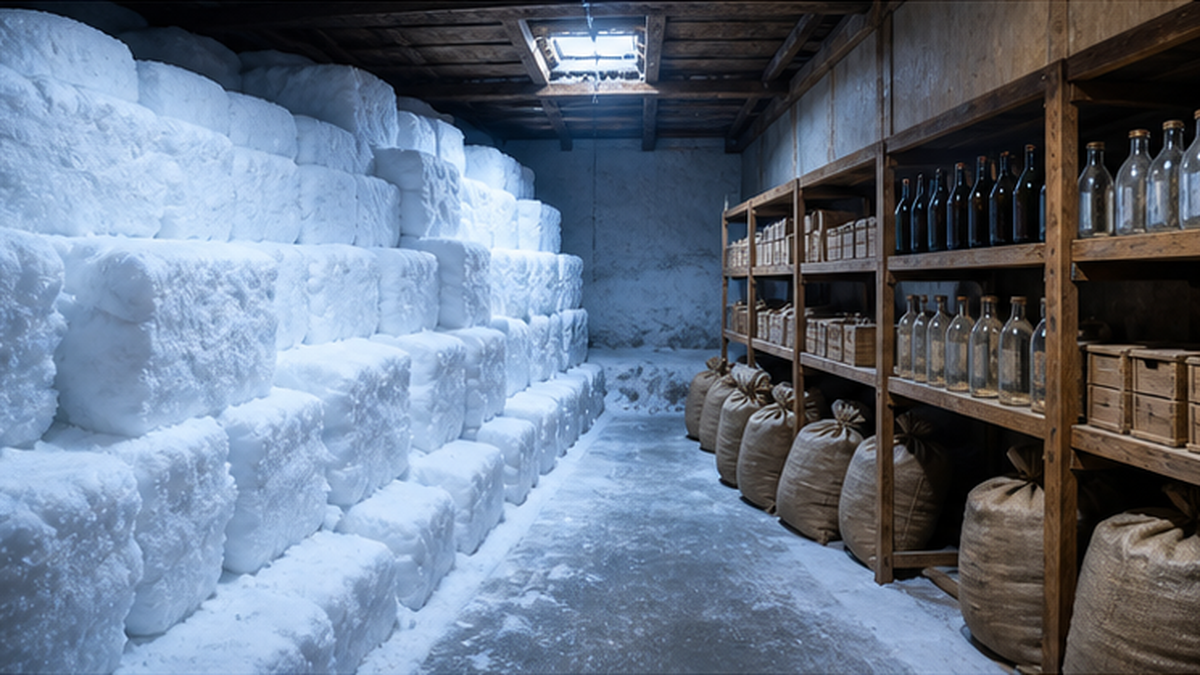
There is also yukimuro, a technique that uses the snow itself for storage. Winter snow is packed into a storehouse and its chill keeps rice, sake, vegetables and meat at low temperature and high humidity. According to a 2021 report by the Development Bank of Japan's Niigata branch, Niigata Prefecture has around 40 facilities using snow and ice, and the city of Minamiuonuma alone operates 12 snow rooms. Foods aged in a snow room are said to mellow, and are marketed as high-value products.
Industries and culture supported by meltwater and snow
- Rice farming: irrigation water for puddling and transplanting, and water quality suited to growth
- Sake brewing: spring water from alluvial fans as brewing water — directly tied to where breweries stand
- Wasabi and cold-water vegetables: spring water with a stable temperature year-round is essential
- Inland fisheries: habitat for cold-water stream fish and young salmon and trout
- Snow rooms and snow cooling: snow itself used as a source of cold for storage and air conditioning
- Hydropower: abundant flow in the melt season creates the annual peak in generation
The world's water towers: mountain snow and ice for 1.9 billion people
Mountain snow sustaining the lowlands is not a uniquely Japanese arrangement. In the world's arid and semi-arid regions the dependence is far greater than in Japan, and civilisations themselves rest on mountain snow and ice.
The study that ranked 78 mountain water systems
In 2019 an international team led by W. W. Immerzeel of Utrecht University published a paper in Nature titled "Importance and vulnerability of the world's water towers". It was the first systematic ranking of 78 mountain water systems that store and supply water through glaciers, snowpack, lakes and rivers, assessed both for their importance to downstream regions and for their vulnerability to climatic and socio-economic change.
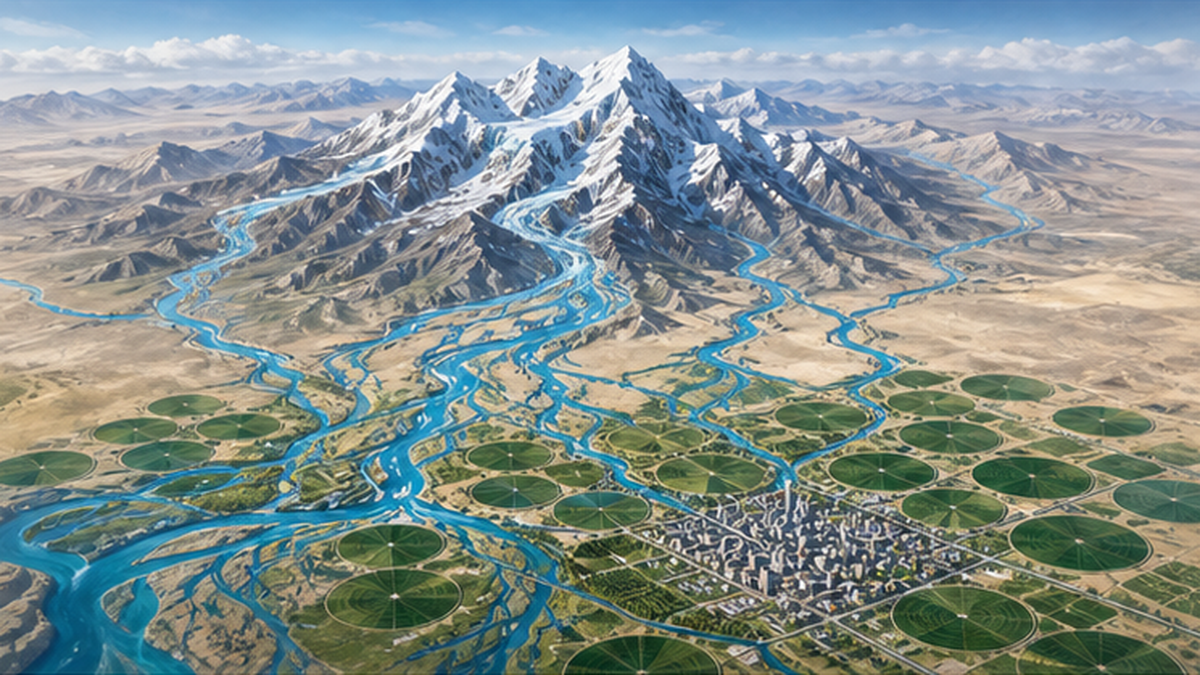
According to the study, these mountain systems supply water to 1.9 billion people — roughly a quarter of the world's population. Of these, about 0.3 billion live in the mountain areas themselves and about 1.6 billion downstream. The team reached a troubling conclusion: the most important water towers are also among the most vulnerable. The Indus basin in Asia ranked high on both counts.
The western United States: over two-thirds of reservoir inflow comes from snow
Research is most advanced in the western United States, where the majority of surface water originates as mountain snowfall and more than two-thirds of reservoir inflow is snow-derived. Some 40 million people, and some of the most agriculturally productive land in the country, depend at least partly on snowmelt-derived streamflow. California's Central Valley and the irrigated agriculture of the Colorado basin alike trace back to snow in the Sierra Nevada and the Rockies.
In that region the mountain snowpack is likened to a natural drip-irrigation system: water is stored high up and released a little at a time as summer demand builds. The structure is the same as in snow-country Japan, but because the climate is arid there is no alternative source. That is why declining snow translates directly into the severe allocation disputes known as water wars.
A new problem: melting in mid-winter
A 2021 paper in Nature Climate Change by K. N. Musselman of the University of Colorado Boulder and colleagues identified a change that had been overlooked. Analysing observation stations across western North America, the team found increasing winter snowmelt trends at 34% of stations — about three times the share (11%) showing declines in snow water equivalent itself.
In other words, even where total snow has not fallen much, water is already leaking away on mild days in midwinter. Water that melts in winter is not there when spring demand arrives. Watch only the macro indicator of total volume and this change goes unnoticed. In snowy Japan too, people sometimes remark in warm winters that "snow fell well enough, yet less spring water came than expected" — quite possibly the same mechanism.
The most important water towers are also among the most vulnerable, and climatic and socio-economic changes will affect them profoundly.
― Immerzeel, W.W. et al. (2019) Importance and vulnerability of the world's water towers, Nature (summarised from the abstract)
What observations show: how Japan's snow is declining
Now let us look at the changes actually observed in Japan, centred on Japan Meteorological Agency data. What can be said statistically, rather than impressionistically?
The long-term decline in annual maximum snow depth
The JMA monitors long-term changes in annual maximum snow depth — the deepest snow of each winter — at multiple stations on the Sea of Japan side. Analysis of data since records began in 1962 shows that annual maximum snow depth on the Sea of Japan side has a declining trend. Material compiled by the Tokyo District Meteorological Observatory for the Hokuriku region states explicitly that the annual maximum snow depth at seven stations on the Sea of Japan side of eastern Japan "shows a declining trend (statistically significant at a confidence level of 95% or above)".
Even more striking is that the frequency of heavy snowfall is falling too. The same material reports that the annual number of days with daily snowfall of 20 cm or more at those seven stations is declining (significant at a confidence level of 99% or above). For Hokkaido, material from the Sapporo District Meteorological Observatory shows annual maximum snow depth on the Sea of Japan side falling at about 3.9% per decade. The lived sense in snow country that "it does not snow like it used to" is borne out by the statistics.
| Observation | Region | Trend | Source |
|---|---|---|---|
| Annual maximum snow depth | Sea of Japan side, eastern Japan (7 stations) | Declining trend (significant at ≥95% confidence) | JMA, Tokyo District Meteorological Observatory |
| Annual days with snowfall ≥20 cm | Sea of Japan side, eastern Japan (7 stations) | Declining (significant at ≥99% confidence) | JMA, Tokyo District Meteorological Observatory |
| Annual maximum snow depth | Sea of Japan side, Hokkaido | Declining at about 3.9% per decade | JMA, Sapporo District Meteorological Observatory |
| Winter mean temperature | Japan, nationwide | Continuing long-term rising trend | JMA, Climate Change Monitoring Report |
The winter of 2020, when records were rewritten
The winter of December 2019 to February 2020 was symbolic of that change. According to the analysis by the JMA's Advisory Panel on Extreme Climate Events, published on 14 April 2020, Japan's winter mean temperature anomaly was +1.66°C, the highest since records began in 1898.
Snowfall was even more startling. It was 44% of normal on the Sea of Japan side of northern Japan and just 7% of normal on the Sea of Japan side of eastern Japan — both record lows since statistics began in 1962. Less than a tenth of normal is beyond what the word "low snowfall" conveys. At Iida in Nagano Prefecture, snowfall fell below 1 cm for the first time since records began in the winter of 1960/61.
The JMA attributed the record warm winter to the persistent northward meandering of the upper-level westerlies near Japan and to a dominant positive Arctic Oscillation from January onward, which weakened the inflow of cold air. It also noted, as background, the continuing global rise in temperature associated with climate change. Any individual winter is shaped by the lottery of atmospheric circulation, but the base on which that lottery is drawn has been pushed upward.
"It snowed heavily this year, so warming is a hoax" does not hold
- Snow amounts vary enormously from year to year; a single year's value cannot determine a long-term trend
- Warmer air holds more water vapour, so when cold air does arrive, short-duration heavy snow can actually occur
- In fact, the season after the record-low winter of 2019/20 brought heavy snow across Japan in 2020/21, damaging agriculture, forestry and fisheries
- What matters as a long-term trend is both that the average is declining and that the amplitude of variation is widening
Projections: why "20 days earlier" matters more than volume
What of the future? A regional study of central Japan under the Regional Adaptation Consortium programme, published on the National Institute for Environmental Studies' climate adaptation platform (conducted by the Japan Weather Association from FY2017 to FY2019, covering the Kurobe and Jinzu river basins, with Associate Professor Taichi Tebakari of Toyama Prefectural University as adviser), projected the future using multiple climate models (MIROC5, MRI-CGCM3) and emissions scenarios (RCP2.6, RCP8.5).
The results indicated that under the high-emissions RCP8.5 scenario, snow water equivalent could decline by the end of the twenty-first century and, in addition, the timing of snowmelt could advance by roughly 20 days. Twenty days is decisive on an agricultural calendar. If the mountain water drains away before preparations for puddling are complete, then even with unchanged annual precipitation the water is simply not there when it is needed.
Read the studyStudy on how changes in snowfall and snowmelt timing affect water resource management and groundwater useA report from the Regional Adaptation Consortium programme (central Japan), projecting future snow water equivalent and melt timing in the Kurobe and Jinzu basins.🔗 adaptation-platform.nies.go.jpThe effects of low snowfall: agriculture, groundwater, floods and communities
Declining snowpack and earlier melt cannot be summed up as simply "less water". The effects branch along several pathways, and some run counter to intuition. Let us take them in turn.
1. Spring water shortages and summer drought risk
This is the most direct effect. If melt ends early, less water is flowing in rivers during puddling and transplanting. Reservoirs also enter summer without filling, so in years with weak rainy-season precipitation the risk of summer drought rises sharply. When intake restrictions are imposed, water must be rotated among paddies through the arrangement known as bansui.
Farming is not the only sector affected. Where tap water comes from reservoirs or rivers, supply restrictions on domestic water become possible. Hydropower output also depends heavily on melt-season flow. A winter event — little snow on the mountain — reaches all the way into summer life, and that time-lagged chain is the defining feature of meltwater as a resource.
2. Pressure on groundwater: snow-melting pipes as a double-edged sword
On roads in snow country, snow-melting pipes are widely used: groundwater pumped from wells is sprayed onto the road surface through buried pipes to melt the snow. Groundwater stays around 13°C even in winter, so snow can be cleared without burning fuel. The system was realised in 1961 in Nagaoka, Niigata Prefecture, by Yosaburo Imai, founder of the confectionery maker Naniwaya Seika and a member of the Nagaoka city assembly. When Nagaoka recorded its deepest-ever snow of 3.18 m on 30 January 1963, only the 3.7 km stretch fitted with snow-melting pipes still showed bare asphalt, and its effectiveness became widely known.
Widespread adoption brought a problem, however: land subsidence from excessive groundwater pumping. As groundwater levels fall, clay layers compact and the surface sinks. According to Niigata Prefecture, the Nagaoka area was where snow-melting pipes were first installed anywhere in Japan and still uses a great deal of groundwater for snow melting, so the city has enacted a groundwater conservation ordinance to promote appropriate use. In the Joetsu area too, winter groundwater use for snow melting is regarded as the main cause of subsidence.
How low snowfall fits in is not straightforward. In low-snow years the pipes run less, so pressure on groundwater eases. But if heavy snow suddenly follows a run of low-snow years, everything switches on at once before groundwater levels have recovered, raising the risk of wells running dry. It is the widening amplitude itself — lower on average, occasionally extreme — that makes groundwater management difficult.
3. Risks in the opposite direction: snowmelt floods and avalanches
Less snow does not mean fewer disasters. Risks specific to the melt season may in fact become harder to manage as temperatures rise. The prime example is the snowmelt flood. When heavy warm rain falls on lying snow, the rainwater itself plus the heat it carries melt the snow rapidly, producing a large volume of runoff in a short time. On large rivers in snow country such as the Shinano, managing melt-season flows has long been central to flood control.
Rising temperatures also mean repeated melting and refreezing through the winter, which tends to create weak layers within the snowpack and changes the risk of full-depth avalanches. The Ministry of Agriculture, Forestry and Fisheries issues preventive disaster-reduction information for the snowmelt runoff season each year because damage concentrates in this period: slope failures on farmland, damage to irrigation ponds and canals, and landslides. A trend toward less snow and an increase in disaster risk are entirely compatible.
See the guidancePreventive disaster-reduction information for the snowmelt runoff season (MAFF)Official guidance on preparing for farmland slope failures, damage to ponds and canals, and landslides that concentrate in the melt season.🔗 maff.go.jp4. Ripple effects on local economies and daily life
Low snowfall hits the number of days ski resorts can operate and affects winter tourism such as snow festivals. Snow-clearing costs fall, but for economies built around snow the net effect is painful. Wider swings in snowfall also make it harder to maintain snow-clearing capacity: if low-snow years persist, fewer contractors keep machines and operators on hand, so when heavy snow does come the response falls short.
Water shows the same pattern. Canal networks and water-rights customs designed around abundant meltwater raise the question of who accepts how much reduction when supply thins. Water allocation rests on layers of law and local agreement, and changing it takes time. Can the institutions of water keep pace with the speed of climate change? That is becoming the central question of water management in snow country.
Summary of the effects of low snowfall
- Spring water shortage: insufficient water at puddling and transplanting, requiring rotation arrangements
- Summer drought: reservoirs fail to fill, raising the possibility of restrictions on domestic and industrial water
- Unstable groundwater: wider swings between low and heavy snow make snow-melting groundwater harder to manage
- Melt-season disasters: sudden runoff from rain on snow, avalanches and landslides do not diminish
- Local economies: lost winter tourism revenue combined with difficulty maintaining snow-clearing capacity
- Institutional lag: water rights and allocation systems struggle to keep up with the pace of change
Meltwater and the sea: how water flowing downriver creates a coastal spring
So far we have stayed on land, but the journey of meltwater ends in the sea — and for the sea, the melt season is special. Changes in snow reach coastal ecosystems too, quietly.
The "spring bulk delivery" that reaches the sea
River flow peaks for the year during the melt season, and rivers carry more than water. Nutrients such as nitrogen and phosphorus that had accumulated in mountain soils, dissolved organic matter from decomposed leaf litter, and trace elements such as iron are all pushed out to the coast together, including the stock built up over winter. For living things it is like a bulk delivery arriving in early spring.
Around river mouths, fresh water spreads as a thin layer over seawater, forming a low-salinity surface layer. Being less dense, it stays stably at the surface and gives phytoplankton abundant sunlight. When nutrients, light and a stable water column coincide, phytoplankton multiply explosively in what is called the spring bloom. Research on the Sea of Japan side of Hokkaido reports diatoms tolerant of salinity fluctuation dominating and taking up nutrients in the low-salinity conditions of the melt season.
Too much or too little: the balance of nutrients
More nutrients is not simply better. Excessive loading from a catchment causes eutrophication, driving red tides and hypoxic water masses. Conversely, in recent years the opposite problem of "oligotrophication" has been debated in places such as the Seto Inland Sea, where falling nutrient levels are linked to discoloured nori and declining catches. Marine productivity depends on the right amount of nutrients arriving in the right season in the right form. How nutrients travel from catchments is covered in where nitrogen and phosphorus in the sea come from.
Earlier snowmelt means that "right season" shifts. If the timing of plankton growth diverges from that of the zooplankton that graze on them, and in turn from the spawning and larval periods of the fish that eat those — the gears of the food web can slip (the idea known as match–mismatch). Rising sea temperatures are already moving the fish themselves (the northward shift of fish distribution), and combined with changes in the rhythm of water from the land, what happens along the coast is not simply predictable.
Connecting forest, river and sea in a single line
As the Japanese saying "the forest is the sweetheart of the sea" suggests, the idea of treating a catchment as a single system has long been rooted in Japan. Meltwater embodies that unity more clearly than anything else. Snow falling on a mountain passes through forest soil, runs down the river, waters the paddies, becomes groundwater and finally enters the sea to raise fish. Break that line anywhere, and effects appear downstream.
It may seem a detour for a media outlet covering the ocean to talk about snow. But the richness of the sea begins with a single snowflake on a mountain. Treat declining snow as "a problem for snow country" and that line disappears from view. Earth's water is a single system circulating through atmosphere, land and ocean, and within it snow plays the irreplaceable role of storing time.
What meltwater delivers to the sea
- Fresh water: forms a low-salinity surface layer near river mouths, favouring phytoplankton growth
- Nutrients: supplies nitrogen, phosphorus and other nutrients stored in soils over winter, all at once
- Dissolved organic matter and iron: carried with forest humus, becoming trace elements that underpin marine primary production
- Sediment: a season of high transport capacity, also relevant to the supply of sand to the coast
- Seasonal cues: changes in temperature and salinity act as switches for migratory fish and coastal organisms
From fighting snow to using it: today's technologies
The history of snow country was long a history of kokusetsu — overcoming snow: clearance, melting systems, snow-resistant housing. In recent years, however, the ideas of risetsu (using snow as a resource) and shinsetsu (living companionably with snow) have spread. Precisely because snow is diminishing, that shift matters.
Snow-derived cold energy: snow rooms and snow cooling
Facilities using snow and ice for cold fall broadly into two types: snow refrigeration (yukimuro), which chills things, and snow cooling, which chills air. The principle is simple: pack large volumes of snow into an insulated store in winter, keep it until summer, and use the chill of the snow and its meltwater. Because they use almost no electricity, they cut the energy needed for cooling and refrigeration dramatically.
According to the 2021 report by the Development Bank of Japan's Niigata branch, Niigata has the second-largest number of snow-and-ice facilities in Japan after Hokkaido, with about 40 in the prefecture. Minamiuonuma operates 12 snow rooms, storing sake, rice, vegetables and meat. Ageing in a snow room is said to mellow flavours, and this is used to add value: the "Echigo Yukimuroya" brand had 20 member companies as of 1 October 2022. Hokkaido has also installed multiple snow-and-ice facilities since 1987, including heat-pipe systems, ice shelters and low-temperature seedling stores.
The appeal of snow-derived cold lies in the reversal: a nuisance turns directly into commercial value. Snow that would have been dumped is stored and used, so a disposal cost becomes a benefit. The weakness is that in low-snow years there may not be enough snow to store, which is why multi-year storage and combinations with other renewable energy sources are being explored.
Water-saving snow melting and protecting groundwater
Both technology and policy are addressing the groundwater problem posed by snow-melting pipes. Technically, water-saving snow-melting pipes now incorporate recirculation of sprayed water and controls that limit spraying to the places and times required. Non-spray systems using other heat sources — river water, treated wastewater, ground heat or industrial waste heat — are another option.
Institutionally, frameworks such as Nagaoka's groundwater conservation ordinance let municipalities track extraction volumes and promote appropriate use. Joetsu likewise continues monitoring and public education as subsidence countermeasures. Because groundwater is invisible, making visible who uses how much is the first step in managing it.
Advances in measuring snow
Managing snow as a water resource requires knowing precisely how much water is stocked on the mountain. Point observation once dominated; now satellite mapping of snow-covered area, laser surveying by aircraft and drones, automatic observation devices in mountainous terrain, and areal estimation of snow water equivalent combined with weather models are all advancing.
Such information feeds directly into dam operating plans and water allocation decisions. Accurate forecasts of the volume and timing of snowmelt runoff allow smarter handling of the trade-off between lowering levels in advance for flood safety and storing water against drought. The less reliable past experience becomes as the climate shifts, the more valuable data-driven water management grows.
| Approach | Examples | Aim |
|---|---|---|
| Overcoming snow | Mechanical clearance, snow-melting pipes, melting roofs, snow-resistant structures | Keep daily life and transport running |
| Reducing the load | Water-saving and recirculating melting systems, ground heat or river water, groundwater ordinances | Limit pressure on resources such as groundwater |
| Using snow | Snow rooms, snow cooling, snow-chilled warehouses, stored snow for summer air conditioning | Use it as cold energy and create added value |
| Measuring snow | Satellite and drone observation, areal estimation of snow water equivalent, melt runoff forecasting | Improve the accuracy of dam operation and allocation decisions |
| Enjoying snow | Snow festivals, skiing and snow play, transmitting snow-country culture | Pass the value of life with snow to the next generation |
Designing water for the future, and what we can do
Changes around meltwater will not bring sudden catastrophe. What they will bring, steadily, is the erosion of a natural service that has always been supplied free of charge. Finally, let us set out what to think about and what can be done.
Counting mountain snow as water infrastructure
Discussions of water resource planning tend to centre on built facilities: reservoir capacity, intake volumes. In reality, the mountain snowpack does an enormous amount of work upstream of all that, for free. If the capacity of that infrastructure is shrinking, it means exactly what a shrinking reservoir capacity would mean. Counting it honestly as a depreciating asset is the starting point.
From there come the options: increase artificial storage (raising existing dams, tackling sedimentation, artificial groundwater recharge), reduce demand (fixing canal leakage, water-saving irrigation, revising varieties and cropping calendars), or widen sharing (inter-basin transfers, agreeing allocation rules for droughts in advance). Each has drawbacks in cost and in the difficulty of building consensus. But redesigning on the premise that snow will decline cannot be avoided.
Thinking at catchment scale: reconnecting upstream and downstream
Water is also a question of relationships — upstream and downstream, mountain and sea, countryside and city. It is people in mountain villages who tend the headwater forests, yet city residents downstream who enjoy the benefit. It is farmers who maintain the canals, yet that network also mitigates floods and provides habitat, making it an asset for the whole region.
Mechanisms to bridge that asymmetry are emerging: corporate participation in headwater forest conservation, grants to source regions, catchment-scale councils, and support through hometown tax donations. No perfect system exists yet, but sharing the recognition that water arrives thanks to someone's labour upstream is the premise for any institutional design.
Five concrete things an individual can do
What one person can do looks small, but the greatest obstacle in water issues is that they are simply not known — so knowing has value in itself. Here are concrete steps that can begin today.
Where to start today
- Find out your own water source: check on your municipality's website which river, reservoir and mountain your tap water comes from
- Choose snow-country products: pick up rice, sake and vegetables stored in snow rooms and other snow-based products
- Support the catchment: join headwater forest conservation activities, donate to source regions, choose companies engaged in forest stewardship
- Save water in low-snow years: watch winter snowfall reports and review your water use with summer drought in mind
- Enjoy the snow: go skiing, play in the snow, visit snow festivals, and know the value of life with snow through experience
One last thing. Snow tends to be discussed only as a crisis, but that conveys just half of it. The stillness of fresh snow at dawn, the sound of the thaw, mountain vegetables emerging from beneath the snow, the mellow taste of sake aged in a snow room — these are unmistakably gifts the Earth has prepared. First, come to love what you want to protect. Without that feeling, neither tedious institutional design nor long consensus-building can be sustained.
Summary of this article
- Snow does not add water; it works as a natural dam that delays winter precipitation until spring
- Japan uses about 78.5 billion m³ of water a year, of which about 53.3 billion m³ is agricultural. Paddy irrigation, some 94% of that, peaks exactly when snowmelt arrives
- Worldwide, 78 mountain water systems (water towers) support 1.9 billion people, and the most important are also the most vulnerable (Nature, 2019)
- JMA observations show a significant declining trend in annual maximum snow depth on the Sea of Japan side. In winter 2020 the temperature anomaly hit +1.66°C and snowfall on the Sea of Japan side of eastern Japan was 7% of normal — a record
- A study of central Japan projects that under RCP8.5 snowmelt could arrive about 20 days earlier by the end of the century. The mismatch in timing, not the volume, is what strikes agriculture
- Effects extend to spring water shortages, summer drought, unstable groundwater, melt-season disasters and local economies: less snow and greater disaster risk are compatible
- Meltwater carries nutrients and fresh water to the coast and triggers the spring bloom, so changes in snow reach the rhythm of marine production
- From fighting snow to using it: snow rooms, snow cooling, water-saving melting systems and better snow observation are widening the options
References and sources
- Japan Meteorological Agency, Climate Change Monitoring Report – Observed climate change in Japan and worldwide, including long-term trends in annual maximum snow depth and snowfall
- Japan Meteorological Agency press release (14 April 2020) – Characteristics and causes of the record warm winter of 2019/20 (Advisory Panel on Extreme Climate Events)
- MLIT, Water Resources in Japan (FY2025 edition) – Core statistics on water availability and on agricultural and urban water use
- MAFF, Agricultural water use in Japan – How agricultural water, centred on paddy irrigation, is used and how it has changed
- MAFF, Preventive disaster-reduction information for the snowmelt runoff season – Guidance on preparing for damage to farmland and agricultural facilities during the melt season
- Climate Change Adaptation Information Platform (NIES) – Regional Adaptation Consortium, central Japan 3-2: study on how changes in snowfall and melt timing affect water resource and groundwater management
- Immerzeel, W.W. et al. (2019) Nature – Importance and vulnerability of the world's water towers
- Musselman, K.N. et al. (2021) Nature Climate Change – Winter melt trends portend widespread declines in snow water resources
- JMA Tokyo District Meteorological Observatory, Climate change in the Hokuriku region – Long-term trends in annual maximum snow depth and heavy-snow days on the Sea of Japan side of eastern Japan
- Niigata Prefecture, Land subsidence in the Nagaoka area – Groundwater use for snow melting, land subsidence, and conservation measures
* Listed in order of reliability: government and academic institutions > peer-reviewed papers > specialist bodies > trusted media