⚡ In short
The Japanese macaque is the world's northernmost non-human primate. This article explores the origin of the "snow monkeys" at Jigokudani, their matrilineal societies with strict dominance hierarchies, and the roughly 800 million yen a year in crop damage they cause, drawing on primary data from Japan's Ministry of the Environment and Ministry of Agriculture.
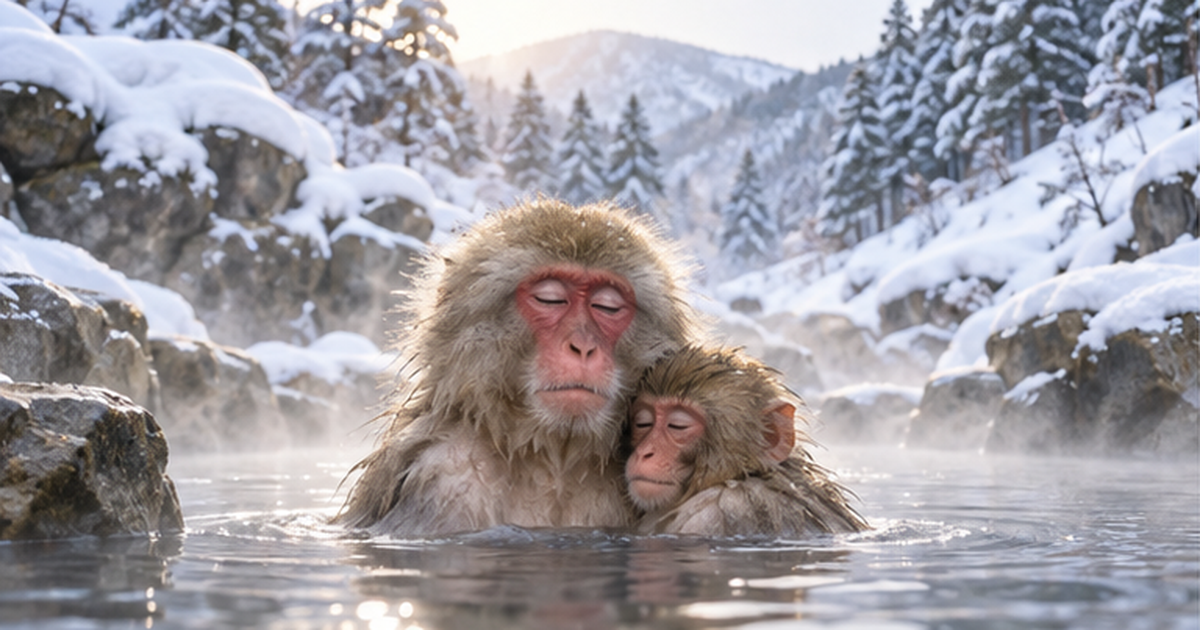
In the snow-covered valley of Jigokudani hot spring in Nagano Prefecture, monkeys sit shoulder-deep in an open-air bath, eyes closed in apparent contentment. Known worldwide as "snow monkeys," these animals belong to Japan's only native primate and the world's northernmost-living non-human primate: the Japanese macaque (Macaca fuscata).
Living everywhere from sea-level coastal forests to alpine zones above 3,000 meters across Honshu, Shikoku, and Kyushu, Japanese macaques have built complex troop societies based on matrilineal descent and strict dominance hierarchies, and have evolved unique adaptations that let them survive in snow country well below freezing. At the same time, "problem troops" that raid villages and farmland have become an issue nationwide in recent years, with crop damage running at roughly JPY 800 million a year.
This article draws on primary sources — government agencies and research institutions — to cover everything from the ecological backstory of the Jigokudani hot-spring monkeys and the workings of their matrilineal society, to what the Ministry of the Environment's population surveys reveal, and the background and on-the-ground countermeasures behind the worsening crop damage.
What you'll learn in this article
- Why the Japanese macaque is the world's northernmost-living wild primate, found on the Shimokita Peninsula
- How troops are held together by matrilineal society and a strict dominance hierarchy
- The historical origin of the hot-spring bathing behavior at Jigokudani, and how it spread as a "culture"
- What the Ministry of the Environment's population surveys reveal about nationwide numbers
- Why crop damage is worsening, and how "problem troop" countermeasures work on the ground
What Is a Japanese Macaque? The World's Northernmost Primate
The Japanese macaque (Macaca fuscata) is a species native to Japan, a medium-sized Old World monkey found widely across Honshu, Shikoku, and Kyushu. Body length runs 50–60 cm, with males averaging around 11 kg and females around 9 kg. Its reddish face and rump are distinctive, and its coat thickens considerably in winter. Though often simply called "monkeys," they belong to a taxonomically distinct group from the great apes, such as chimpanzees and gorillas, seen at zoos.
A range from sea level to 3,000 meters
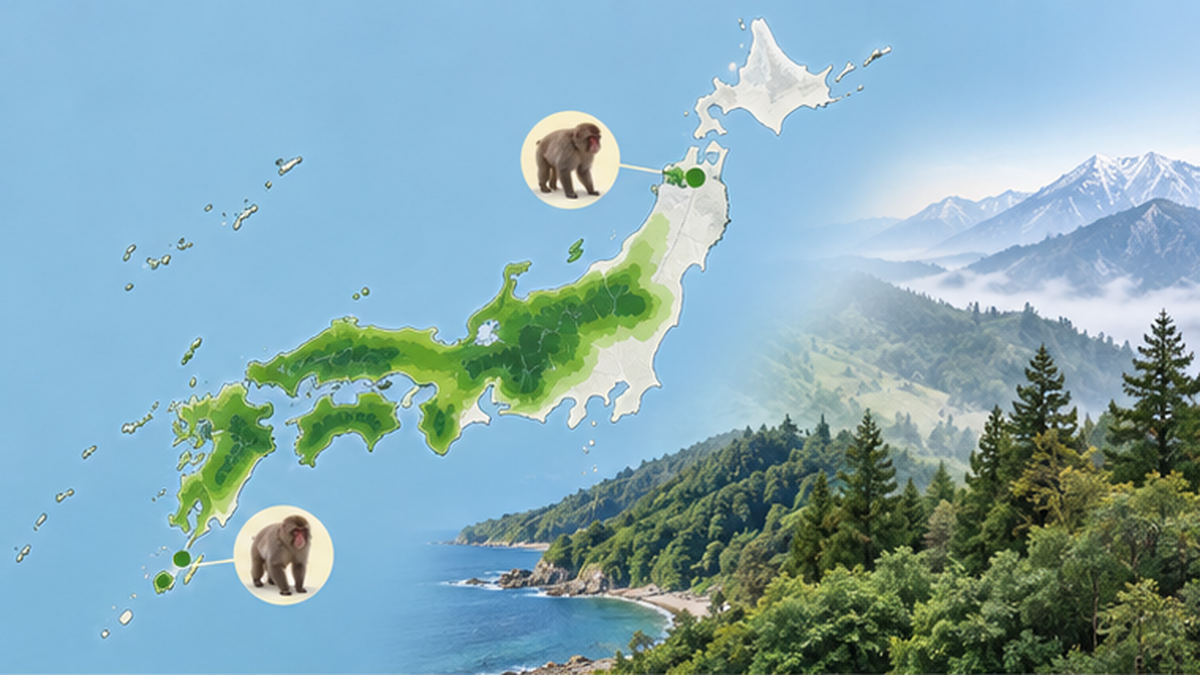
The species' range extends from the Shimokita Peninsula in Aomori Prefecture (around 41°N) in the north to Yakushima Island in Kagoshima Prefecture in the south, adapting to everything from coastal forest to subalpine conifer forest in between. The Shimokita population in particular is known as the world's northernmost wild population of any non-human primate, overwintering in conditions of over a meter of snow and temperatures approaching minus 20°C. Yakushima Island is home to the Yakushima macaque subspecies, which characterizes the island's ecosystem known for its rich vertical distribution of vegetation. In terms of elevation, the species is reported to use everything from coastal evergreen broadleaf forest to alpine zones above 3,000 meters in the central mountains, giving it an exceptionally broad environmental range even among primates as a whole.
Diet and daily life
Japanese macaques are omnivorous, said to use over 100 kinds of food including leaves, fruit, seeds, bark, and insects, and occasionally small animals. Because available food changes greatly with the season, in winter they must rely on low-nutrient items such as bark and buds, with some individuals living off stored body fat to get through. They are diurnal, active during the day and resting at night in trees or on rocky cliffs, with troops typically heading out to forage around sunrise and returning to their sleeping sites before dark in a fairly regular daily rhythm.
Why the red face and rump?
The Japanese macaque's reddish face and rump are one of its most memorable features, believed to result from blood vessels running close to the skin's surface, letting the blood's color show through. In some individuals, this redness intensifies in females during the breeding season, suggesting it may also serve as a visual signal of physical condition to other troop members. It has also been suggested that individuals living in colder regions tend to show more pronounced facial redness, alongside their habit of huddling together in winter.
A deep-rooted place in Japanese culture
Having long lived close to human settlements, the Japanese macaque is deeply woven into Japanese folk culture. A well-known example is the carving of the "three wise monkeys" — see no evil, speak no evil, hear no evil — at Nikko Toshogu Shrine, an image that spread nationwide in connection with Koshin folk belief. The monkey is also familiar as one of the twelve zodiac animals, and its presence is etched into folktales and place names across the country. This closeness to human life has long generated friction as well, a relationship that connects directly to today's crop-damage problems.
Japanese macaque at a glance
- Classification: Family Cercopithecidae, genus Macaca (Macaca fuscata)
- Range: Honshu, Shikoku, Kyushu (northern limit: Shimokita Peninsula; southern limit: Yakushima Island)
- Weight: males ~11 kg on average / females ~9 kg on average
- IUCN Red List: Least Concern (though the regional Yakushima macaque population is a domestic conservation focus)
Matrilineal Society and Strict Rank: How a Troop Works
Japanese macaques form highly social troops ranging from a few dozen to several hundred individuals. Troops are "multi-male, multi-female" groups made up of several males and females, and their operation is underpinned by what is known as matrilineal society.
Females stay for life; males move from troop to troop
Females spend their entire lives in the troop where they were born, inheriting rank based on kinship passed from mother to daughter. Males, on the other hand, leave their natal troop around age four or five, when they reach reproductive maturity, and transfer to another troop. This sex-biased dispersal pattern — females stay, males leave — is thought to play an important role in avoiding inbreeding. Males who transfer repeatedly may move through several troops over their lives, also helping maintain genetic connections between troops.
The social function of grooming
Grooming, frequently observed within troops, is not simply about keeping the body clean. It carries meaning as a form of communication — expressing affection, reconciling after conflict, easing tension, and confirming rank relationships. Higher-ranking individuals tend to receive grooming from more partners, and the troop's power dynamics show through in the details of this behavior.
Communicating through calls and expressions
Japanese macaques are also known for using a range of distinct vocalizations to communicate with troop members — calls to gather companions, alarm calls warning of danger, and calls infants use to search for their mothers, among others, used differently depending on the situation. Facial expressions such as the "grimace" (baring teeth with a distorted mouth, signaling submission or fear) are thought to function as signals that help avoid unnecessary conflict within a society where power relations are clearly defined.
Raising young is a troop-wide affair
A mother monkey stays in constant contact with her newborn for a time after birth, but as the infant grows, other females in the troop — often kin such as older sisters or aunts — are frequently observed carrying and grooming the infant in a behavior known as "allomothering." This kin-centered mutual support is thought to both ease the mother's burden and strengthen bonds within the troop.
When rank can be a matter of life and death
Higher-ranking females can secure priority access to foraging sites even when food is scarce, and are known to tend toward better nutritional condition and higher reproductive success as a result. Lower-ranking females and their offspring, by contrast, are more likely to be at a disadvantage in competition over food. For males as well, rank within a troop directly affects access to food and mating opportunities, so the struggle for rank after transferring to a new troop is closely tied to reproductive strategy itself.
When a troop grows too large, it splits
When a troop grows too large, competition over food and resting sites intensifies, and the troop as a whole may divide into two in a process known as "fission." Takasakiyama Natural Zoological Garden in Oita Prefecture is a well-known example. When the park opened in 1953, there was only Troop A; around 1959, Troop B split off from Troop A, and Troop C later emerged as well. Troop A was last seen in 2002, while Troops B and C have continued to survive, with roughly 1,000 individuals combined living on the slopes of Takasakiyama as of 2022. More than half a century of accumulated observation has produced valuable records for tracking the long-term dynamics of troop fission, disappearance, and survival.
| Sex | Relationship to troop | How rank is determined |
|---|---|---|
| Female | Stays in natal troop for life | Inherits a rank close to the mother's |
| Male | Leaves the troop and transfers at age 4–5 | A new rank is established in the troop transferred to |
What is the "alpha male"?
The highest-ranking male in a troop is called the "top-ranking male" or "alpha male," and is said to hold priority access to food and mating opportunities. Rank is not fixed, however, and can change through power struggles and age differences among males who have transferred in from other troops.
Jigokudani Hot Spring and the "Snow Monkeys": An Accidental Start That Captivated the World
Jigokudani Snow Monkey Park, located deep in the Yokoyu River valley fed by the Shiga Kogen highlands in Nagano Prefecture, opened in 1964. The "monkeys bathing in hot springs" seen here have become one of the iconic images of wildlife in Japan.
It started with a single young monkey
The story goes that it began when one curious young monkey, seeking to escape the cold, entered the outdoor bath of a nearby inn. Other troop members gradually followed suit, and once the monkeys' apparently contented expressions were reported in a newspaper, they drew nationwide attention. Since monkeys bathing in a bath meant for humans raised hygiene concerns, a dedicated outdoor bath for the monkeys was built within the park, and the bathing behavior has been passed down across generations ever since.
A LIFE magazine cover built worldwide fame
In 1970, the Jigokudani monkeys appeared on the cover of the American photo magazine LIFE as "Snow Monkeys," and gained worldwide fame as a result. The site remains a destination for overseas visitors to the snowy valley to this day.
The monkeys bathe in the hot spring as a way of coping with the harsh cold of Jigokudani in winter, when temperatures can drop below minus 10 degrees Celsius.
— Jigokudani Snow Monkey Park, official website
Koshima Island's "potato washing": the first documented animal "culture"
The spread of behavior across generations and troops is not unique to the hot-spring bathing at Jigokudani. On the uninhabited island of Koshima in Kushima City, Miyazaki Prefecture, a research team from Kyoto University led by Kinji Imanishi and Junichiro Itani had been observing wild macaques since 1948. In 1953, Satsue Mito, who was assisting with the research, discovered and reported that a one-year-old female had begun washing the dirt off sweet potatoes given to her in water. This "potato-washing" behavior gradually spread through the troop via kinship and companionship, and some individuals were said to have come to prefer dipping the potatoes in seawater for the added salty taste. This pioneering discovery — that "culture" spread through learning can exist in animals other than humans — holds a landmark place in the history of primatology worldwide.
What Jigokudani and Koshima teach us
- Wild animal behavior can spread from one individual's chance discovery to an entire troop, and even across generations (cultural transmission)
- Populations exposed to change — a harsh environment, or an encounter with a new food — tend to be more flexible about adopting new behaviors
- At Jigokudani, providing a dedicated bath for the monkeys balanced hygiene with tourism value
How Do the Northernmost Monkeys Survive Snow Country? Life on the Shimokita Peninsula
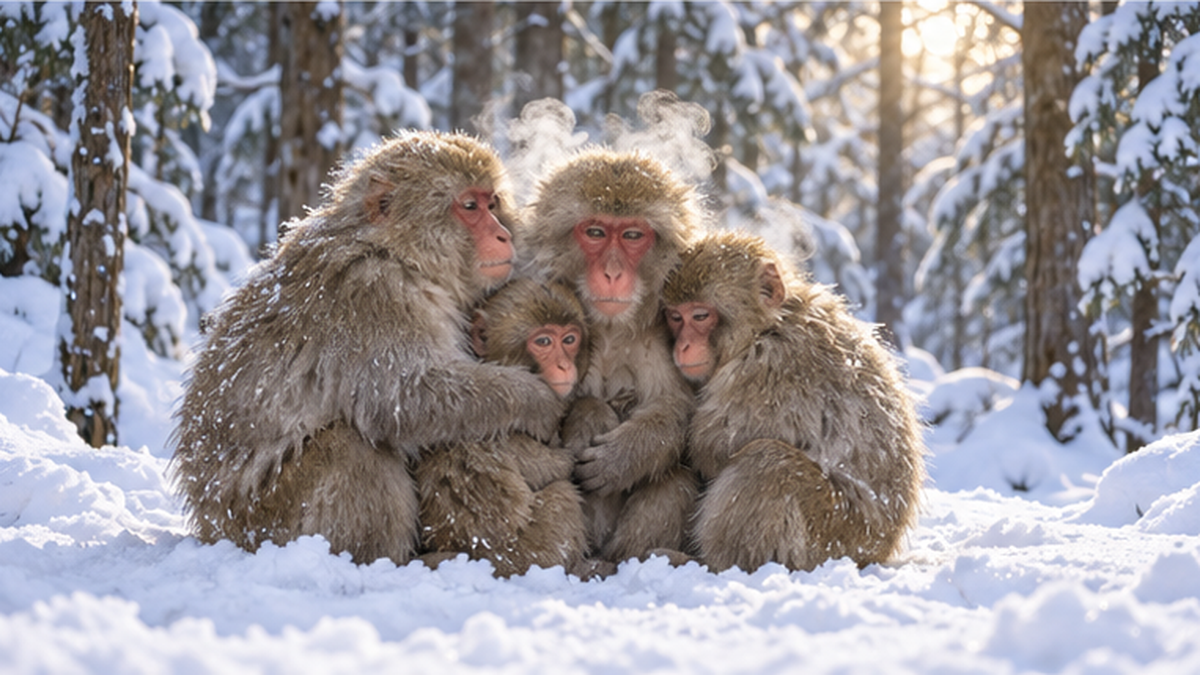
The Japanese macaques living on the Shimokita Peninsula in Aomori Prefecture are the world's northernmost-living wild population of any non-human primate. Located around 41°N, the region is blanketed in over a meter of snow in winter, with temperatures sometimes dropping to nearly minus 20°C. Given that most primates live in tropical or subtropical regions, this adaptation to a cold climate is highly exceptional.
Thick fur and behavioral thermoregulation
Winter fur is far denser than summer fur, providing greater insulation. Behavioral adaptations are also part of coping with the cold — huddling together with troop members, choosing sunny rock outcrops or south-facing slopes as resting spots, and reducing activity to cut energy expenditure. When food is scarce in winter, the monkeys also rely on hard-to-digest, low-quality items such as bark and buds, deliberately drawing down the body fat stored from summer and autumn to get through.
Foraging unique to the snowy season
Some populations of Japanese macaques in the central mountain ranges have been reported to flexibly shift their diet with the seasons, including eating aquatic organisms from mountain streams. How each population gets through the snow-bound season varies by region, reflecting adaptations tailored to local conditions. In years of especially deep snow, some populations have been observed sharply shrinking their home range and staying put through the cold within a limited area — interpreted as an energy-conserving strategy to avoid wasting resources.
Seasonal weight change and breeding timing
Japanese macaques build up body fat through autumn when food is abundant, get through the harsh winter, and reach a birth peak from spring through summer. This seasonality is thought to be an adaptation that times births to coincide with periods when food needed for raising young is abundant, and this seasonal pattern is said to be especially pronounced in the cold-climate population on the Shimokita Peninsula.
- Insulation from thick, dense winter fur
- Warmth retention through huddling as a troop
- Selective use of sunny slopes and rock outcrops
- Reliance on low-quality food such as buds and bark, paired with deliberate use of stored body fat
- Reduced home range in the snowy season to conserve energy
How Many Are There? What the Ministry of the Environment's Population Survey Shows
Japanese macaque numbers fell sharply during and after World War II due to food shortages and overhunting, with records showing some regional populations pushed to the brink of local extinction. Numbers later recovered as hunting regulations and management improved, and in recent years a gradual nationwide increase and range expansion has been noted. So how many actually live in Japan today?
A median estimate of about 155,000 individuals
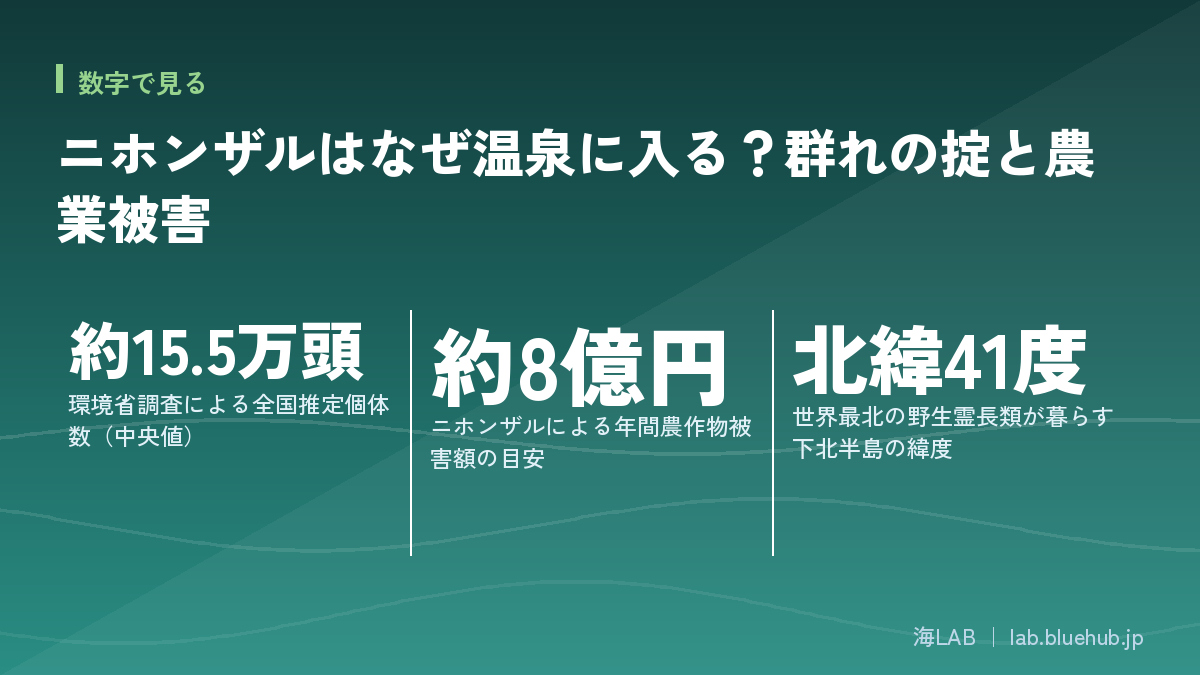
According to a nationwide population estimation survey conducted by the Ministry of the Environment alongside brown bears, Asian black bears, sika deer, and wild boar, the estimated number of Japanese macaque troops is 3,025–3,149 (median 3,069), and the estimated population is 145,973–165,062 (median 154,805). With an average troop size of several dozen individuals, this works out to roughly 3,000 troops dispersed across the country.
Land-use change behind the expanding range
Alongside the population recovery, the macaques' range itself is said to have expanded. One contributing factor cited is that satoyama landscapes once managed by people have grown overgrown as depopulation and abandoned farmland increase in mountainous and hilly regions, turning them into environments more usable by monkeys. As a result, troops have spread into areas where they previously were not established, contributing to the expansion of areas affected by damage.
Regional management under Specified Wildlife Protection and Management Plans
The Japanese macaque is one of the species covered under Specified Wildlife Protection and Management Plans, based on Japan's Act on Protection and Control of Wild Birds and Mammals and Hunting Management. As of the 2020s, 29 prefectures had formulated their own individual plans. While some regions have seen damage reduced through countermeasures, in others the population and range continue to expand, and damage persists.
A note on reading population survey figures
Wildlife population figures are statistical estimates combining sensor cameras, sighting reports, and genetic analysis, not a literal head count. Published figures are therefore typically given as a range, and the "roughly 155,000" cited in this article should also be understood as a median estimate.
How is the population actually estimated?
Because Japanese macaques live in troops, national and regional population figures are estimated by combining surveys of troop distribution (tallying sightings and habitat information by grid cell) with estimates of the average troop size. Capture records, automatic camera data, and direct observation by researchers are also used as supplementary information, with multiple methods integrated to produce a more reliable range of estimates.
Worsening Crop Damage: Why Do Monkeys Come Down to Villages?
According to Japan's Ministry of Agriculture, Forestry and Fisheries, crop damage from wildlife nationwide totaled JPY 16.4 billion in fiscal 2023. Sika deer (about JPY 7.0 billion) and wild boar (about JPY 3.6 billion) account for the largest shares, but Japanese macaques are also among the leading culprits, causing an estimated JPY 800 million a year in ongoing damage, mainly to fruit orchards, vegetables, and rice.
Why do "problem troops" emerge?
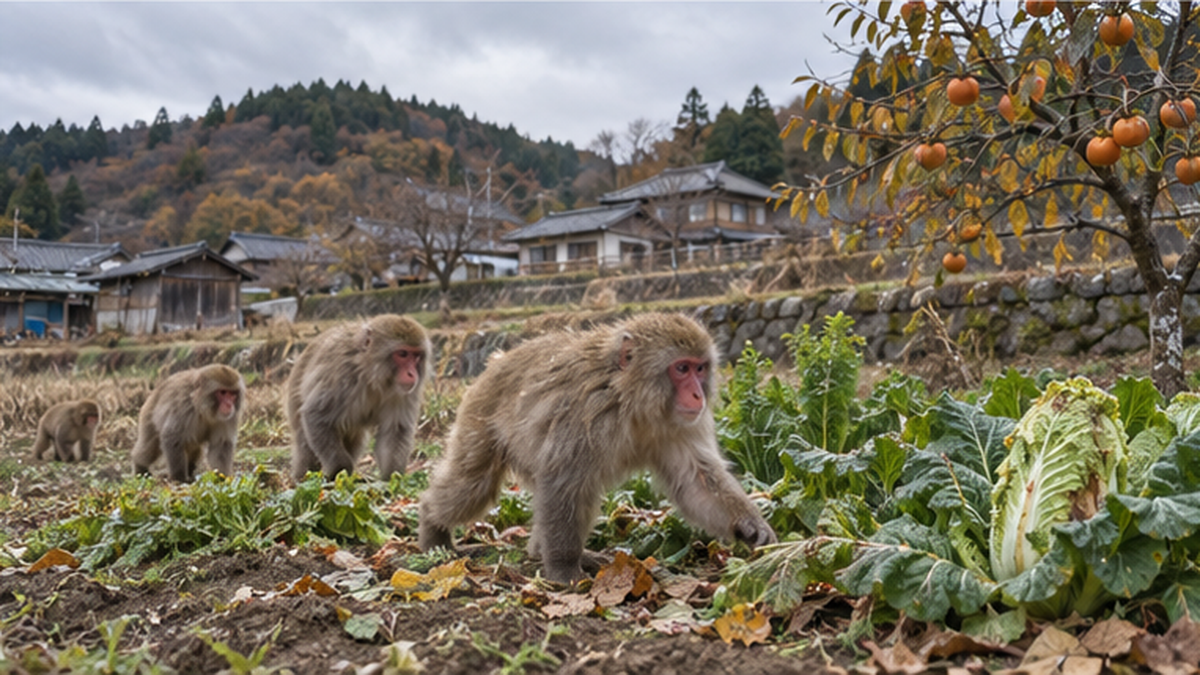
The main cause of damage is a subset of "problem troops" that have learned the taste of crops near human settlements and repeatedly return. A cited background factor is the increase in abandoned farmland due to depopulation and aging populations in mountainous and hilly regions. Untended farmland grows overgrown, becoming a corridor that lets monkeys move around while staying hidden. In addition, a decline and aging of the hunter population is said to be weakening the very "pressure" that once kept monkeys away from settlements. Once a troop has learned how abundant and easy to obtain food is near human settlements, it can gain calories more efficiently there than from forest food, so without countermeasures such troops tend to keep returning.
Crops most vulnerable to damage
The crops affected vary by region but range widely, from orchard fruit such as apples, persimmons, mandarins, and grapes, to vegetables such as cabbage and root vegetables, to rice and soybeans nearing harvest. Fruit just before harvest, in particular, has high sugar content and offers an efficient source of energy for monkeys, making it a frequent target.
- Orchard fruit (apples, persimmons, mandarins, grapes, etc.)
- Vegetables (cabbage, root vegetables, etc.)
- Grains such as rice and soybeans
- Home gardens and crops near houses
When damage tends to concentrate
Damage can occur throughout the year but tends to concentrate especially from summer to autumn, the harvest season for fruit and vegetables. This period also overlaps with when wild food in the mountains is beginning to ripen, making farmland — where troops can obtain energy more efficiently — especially attractive at this time. Timing countermeasures by overlaying the local farming calendar with troop appearance patterns is considered an important practical point for reducing damage.
Damage can't be measured in money alone
Crop damage isn't limited to losses that can be converted into monetary terms. The psychological burden of having crops ruined right before harvest, the resulting decline in motivation to farm, and the further expansion of farmland abandonment this can trigger form a vicious cycle repeatedly flagged as an issue in agricultural and forestry communities. In affected areas, community-wide monitoring and coordinated countermeasures can also take on significance beyond simple wildlife management, as a way of sustaining the local community itself.
| Species | Fiscal 2023 damage (nationwide) |
|---|---|
| Sika deer | ~JPY 7.0 billion |
| Wild boar | ~JPY 3.6 billion |
| Bears | ~JPY 0.7 billion |
| Japanese macaque | ~JPY 800 million per year (recent-year trend) |
Countermeasures and the Path to Coexistence: Management Plans in Practice
The basic approach to managing Japanese macaques is to treat the "problem troop" causing damage as the unit for culling or hazing efforts. Rather than indiscriminately reducing individuals, the priority for countermeasures is judged troop by troop.
Three pillars: electric fences, buffer zones, and hazing
Measures used in the field can be broadly grouped into three: installing electric fences to physically protect farmland; clearing buffer zones with good visibility along the boundary between settlements and forest to remove hiding places; and hazing, using fireworks or dogs to drive monkeys away from fields. Electric fences designed for monkeys need to account not just for monkeys walking in along the ground but also their tendency to climb, so design touches such as wiring upper "negative lines" differ from fences aimed at deer or boar. Combining these measures to keep troops on the forest side is considered key to reducing damage.
Tracking troop movement with GPS collars
In recent years, fitting some individuals in problem troops with GPS-transmitter collars to track troop location in real time has also been adopted in various regions. Combined with systems that automatically notify residents when a troop approaches a settlement, this supports building a response system that allows for hazing and vigilance before damage actually occurs. The shift from relying on sightings and tracking of signs to more accurate, faster tracking of troop ranges through communication technology represents a significant improvement for local governments working with limited budgets and staff.
Not relying on culling alone
Countermeasures tend to bring to mind reducing populations through culling, but Japanese macaque management places greater emphasis on the idea of "keeping problem troops on the forest side." Needlessly provoking a troop or drastically disrupting its composition can instead destabilize its behavior and worsen damage. For this reason, the basic policy is a measured, troop-by-troop response: maintaining a clear boundary with settlements through buffer zones and hazing, while carrying out planned culling limited to the troops causing the most serious damage.
A ten-year goal to halve problem troops
The Ministry of the Environment's guidelines set a goal of halving the number of problem troops within ten years, centered on effective culling measures. Rather than sharply reducing the overall population, the aim is positioned as reducing troops dependent on human settlements while maintaining distance from troops living on forest resources as they naturally would — a way to balance damage reduction with the survival of the population.
Main countermeasures combined in the field
- Physical intrusion prevention such as electric fences (designed to account for climbing)
- Maintaining buffer zones around settlements (clearing brush, etc.)
- Hazing with fireworks, dogs, etc.
- Planned culling targeted at problem troops
- Tracking troop movement and proximity alerts via GPS collars
What We Can Do: Tourism, Research, and Community Toward Coexistence
The Japanese macaque is also one of the world's most thoroughly studied wild primates, with research institutions in Japan and abroad, led by researchers at Kyoto University, conducting individual identification surveys for over half a century. Much of what we know about "cultural spread" — the potato-washing behavior at Koshima and the bathing behavior at Jigokudani among them — has come to light through this patient observational research. Japan's pioneering wild macaque research is internationally recognized as a forerunner of the method of identifying and tracking individuals over the long term.
Long-term observation underpins conservation policy
Long-term observation that follows specific troops for decades, as at Koshima and Takasakiyama, carries meaning that goes well beyond uncovering interesting anecdotes. The accumulation of long-term data — on troop fission and disappearance, the inheritance of rank, and changes in reproductive success — also forms the foundation for actual conservation policy, including population estimation and the revision of Specified Wildlife Protection and Management Plans. Sustained understanding of and support for long-running basic research ultimately strengthens the ability to adjust the relationship between monkeys and people on a scientific basis.
Viewing etiquette helps protect populations
Facilities like Jigokudani Snow Monkey Park, and Takasakiyama Natural Zoological Garden in Oita Prefecture, known as a viewing site for Japanese macaques since it opened in 1953, offer settings where macaques can be observed in a defined space under set rules — places to learn the appropriate distance to keep from wildlife. Basic etiquette such as not feeding the monkeys unless you are facility staff, not shouting, and not maintaining close eye contact at close range is considered important both for preserving the monkeys' natural behavior and for avoiding encouraging dependence on human settlements. Drawing monkeys to these managed observation sites is also thought to have a buffering effect that indirectly reduces their appearance in surrounding farmland.
Community-wide efforts reduce damage
Cases from around the country show that installing electric fences and maintaining buffer zones is more effective when tackled community-wide rather than by individual farmers alone. Everyday practices — not leaving food waste or harvest residue in fields, reducing attractants during community inspections — also form the foundation for preventing problem troops from forming. Apps that let residents share sighting information and systems for reporting sightings to local governments are also spreading in various areas, building a response framework where government and residents work from the same information.
The challenge posed by Japanese macaques differs from protecting rare species at risk of extinction — it is instead the distinct challenge of managing a situation where numbers and proximity have both grown too great, requiring an adjustment of the distance between people and wildlife. For other examples of wildlife living alongside human settlements in Japan, see how Sado Island has pursued a path of coexistence with The Crested Ibis and Sado: From Extinction to 500 Wild Birds, a Recovery Supported by Rice Paddies, and, from the perspective of managing a rare species' population, Why Is the Amami Rabbit a "Living Fossil"? An Eightfold Population Recovery After Eradicating the Mongoose — both offer a sense of the many different ways Japan is working out its distance from wildlife.
References and sources
- Ministry of the Environment, Japan – Revised guidelines for Specified Wildlife Protection and Management Plans (Japanese macaque)
- Ministry of the Environment, Japan – Recent trends in Japanese macaque protection and management
- Biodiversity Center of Japan, Ministry of the Environment – National Survey on the Natural Environment: Specified Mammal Habitat Survey
- Ministry of Agriculture, Forestry and Fisheries, Japan – Nationwide status of crop damage caused by wildlife (fiscal 2023)
- Jigokudani Snow Monkey Park – Official site, about the park
- Jigokudani Snow Monkey Park – Japanese macaque society
- Wildlife Research Center, Kyoto University – Satsue Mito and the Koshima monkeys archive
- Takasakiyama Natural Zoological Garden – History of the park and its troops (Troops A, B, and C)
- New England Primate Conservancy – Japanese macaque, Macaca fuscata (ecology overview)
*Listed in order of reliability: government and academic institutions > peer-reviewed papers > specialist organizations > reputable media