⚡ In short
Shirakami-Sanchi, a Natural World Heritage Site of about 17,000 ha across Aomori and Akita. Learn how its primeval beech forest stores water, which wildlife lives there, how it was listed and what threatens it, based on Ministry of the Environment and Forestry Agency materials.
Shirakami-Sanchiis a mountain range spanning Aomori and Akita prefectures, known as one of the largest primeval beech forests remaining in Japan. In December 1993, about 17,000 hectares of its core area were inscribed, together with Yakushima, as Japan's first Natural World Heritage Site.
Forestry Agency materials state that Shirakami-Sanchi is home to birds such as the black woodpecker and large mammals including the Japanese serow and Asian black bear. Ministry of the Environment data list birds numbering in the 80s of species, showing that many birds use the forest.
This article organizes the origins of Shirakami-Sanchi, beech traits, water storage, wildlife, the path to listing and future challenges, based on information from public bodies such as the Ministry of the Environment and the Forestry Agency.
What you will learn
- Location, area and the path to World Heritage listing
- Beech traits and the multi-year mast cycle
- How beech forests store rain and snowmelt as a "green dam"
- Birds and animals living in the forest, such as black woodpeckers and Asian black bears
- The history from opposition to the road to registration
- Challenges to conservation: warming, deer and tourism
What is Shirakami-Sanchi? Japan's largest primeval beech forest, chosen as World Heritage
A mountain range of 130,000 hectares across Aomori and Akita
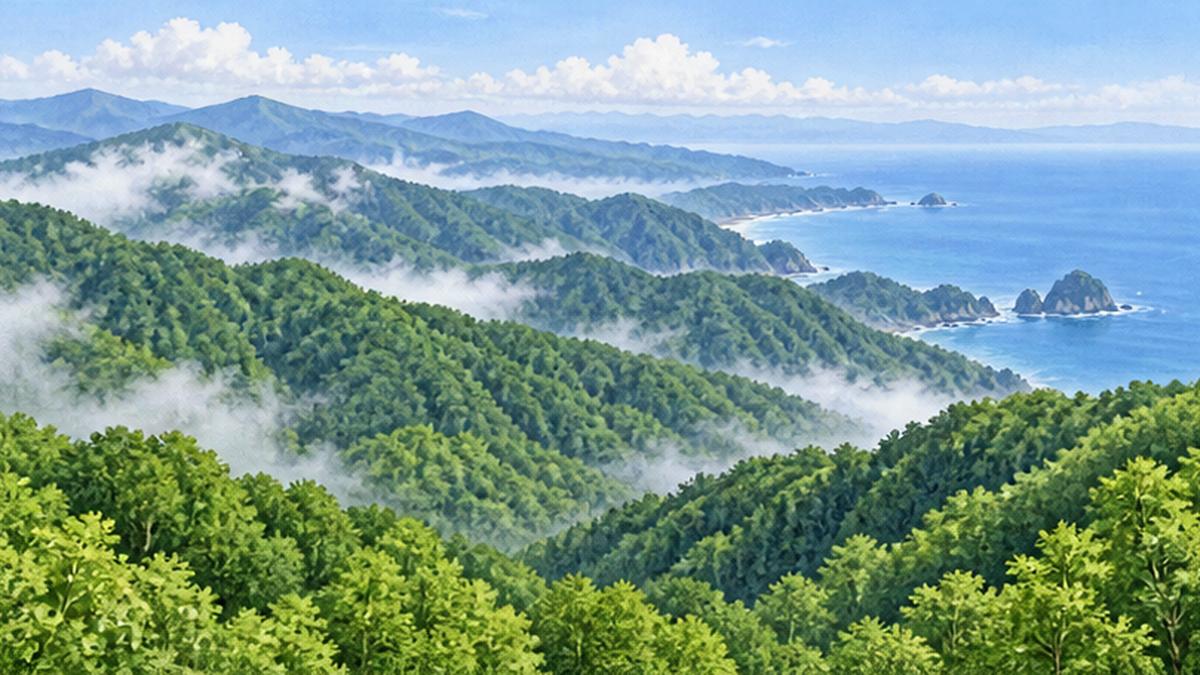
Shirakami-Sanchi is the general name for a mountain area of about 130,000 hectares stretching from southwestern Aomori to northwestern Akita. Though near the Sea of Japan, peaks of around 1,000 meters rise, and moist air blowing from the sea hits the mountains and brings much rain and snow. This climate has nurtured the cool-temperate deciduous forest led by beech.
In December 1993, about 17,000 hectares of the core of Shirakami-Sanchi (12,627 ha in Aomori, 4,334 ha in Akita, 16,971 ha in total) were inscribed, with Yakushima, as Japan's first UNESCO Natural World Heritage Sites. The criterion is "(ix)", which covers outstanding examples of ongoing ecological and biological processes. A large beech forest with almost no human intervention remaining as one continuous block was recognized as having international value.
A double structure: core and buffer zones
The World Heritage area is divided into a "core zone" and a "buffer zone" according to the degree of protection. The core zone is kept as untouched nature, and entry is strictly restricted. In the outer buffer zone, trail maintenance and guided use are allowed, making it a place to learn while enjoying nature.
| Zone | Role | How it is used |
|---|---|---|
| Core zone | Central area where the primeval beech forest is strictly preserved | Entry is restricted (notification or approval required); kept natural in principle |
| Buffer zone | The surrounding area that shields the core zone from outside influence | Learning and recreation through hiking trails and paths are possible |
| Surrounding mountain area | The wider Shirakami-Sanchi outside the heritage area | Coordination of forest management, local life and tourism |
Why it is called the last primeval beech forest
Beech once grew widely across the mountains of northern Japan. After the war, however, many beech forests were cut and replaced with plantations of cedar and other trees. Even so, a large primeval beech forest remained in one block in Shirakami-Sanchi. The Forestry Agency and the Ministry of the Environment explain that beech forests have covered northern Japan's mountains for about 12,000 to 8,000 years, and Shirakami-Sanchi is a precious place that conveys that scene to this day.
The difference from cedar plantations is also described in the article on Cedar plantations and thinning is also covered in detail. Single-species stands planted by people and primeval forests with mixed ages and species differ greatly in the light reaching the forest floor and the living things found there.
Beech: why the tree written "橅" is the star of the forest
Cool-temperate deciduous broadleaf trees
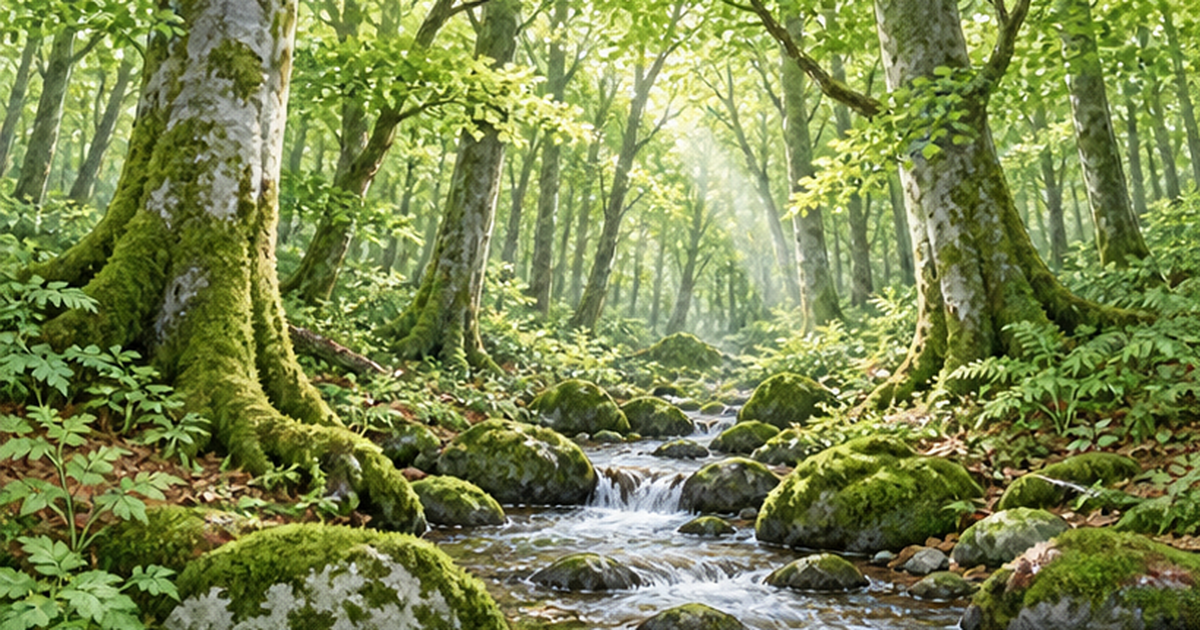
Beech is a deciduous broadleaf tree typical of the cool-temperate climate, distributed in Japan from southern Hokkaido to Kyushu. The snowy Sea of Japan side of Tohoku especially suits it. The trunk is smooth and grey-white and can grow over 30 meters tall. Its lifespan is about 200-300 years, and it sustains the forest through repeated generations.
The character for beech is sometimes written "橅", with the tree radical and "無" (nothing). One theory is that the wood splits and warps easily and was once considered useless as building material. Yet thanks to that "unusability", intact beech forests such as Shirakami-Sanchi may have escaped logging.
A bumper crop every few years: beech nuts connect the forest
Beech does not bear the same amount of nuts every year. It alternates between mast years, when it bears huge numbers at once every few years, and lean years with almost none. This rhythm is thought to be linked to the populations of small mammals such as mice, to the animals that eat them, and even to bears coming into villages in search of nuts.
Around the beech nut, eating and being eaten are intricately entangled in the forest. The fruiting cycle of a single tree can sway the numbers of living things across the whole forest.
How to recognize a beech forest
- Trunks are smooth and grey-white, often covered with moss and lichens
- Leaves are oval with wavy edges and turn yellow to brown in autumn
- A triangular husk holds the nuts, produced in large numbers every few years

Green dam: how beech forests store rain and snowmelt
The forest stores water and releases it slowly
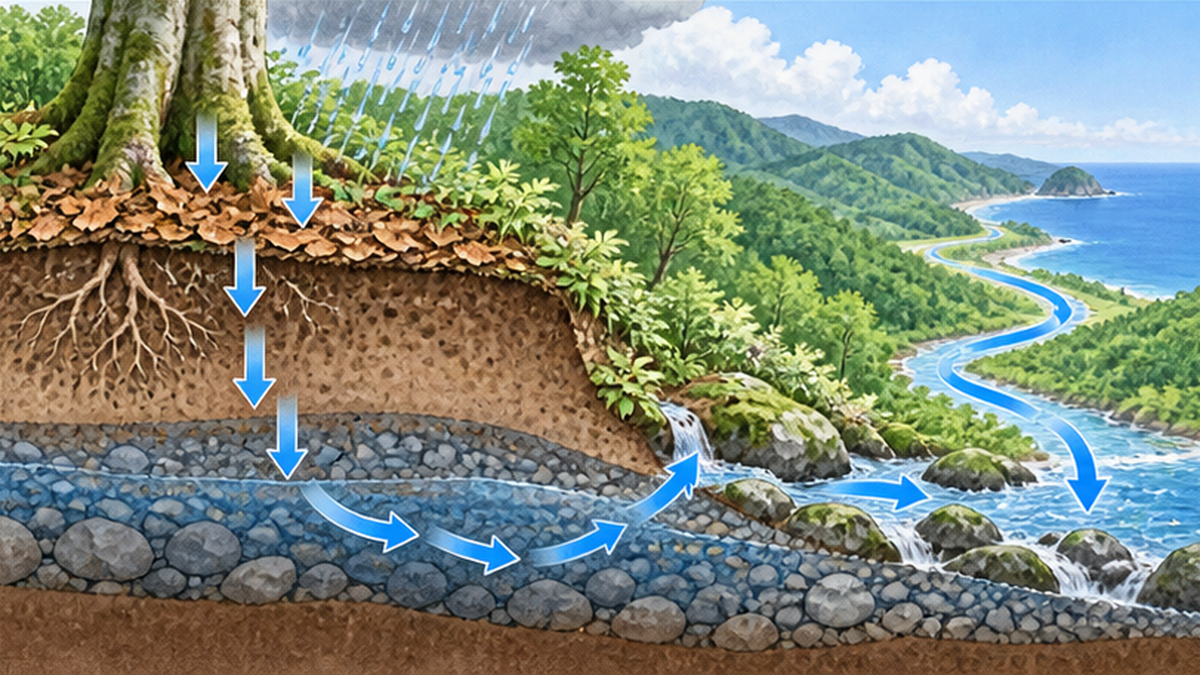
Beech forests are often likened to a "green dam". The forest floor, covered with leaf litter and humus, is soft like a sponge and temporarily stores rain and snowmelt before sending it slowly to rivers. This function is called water source conservation: it softens floods in heavy rain and sustains river flow in droughts.
Strictly speaking, forests cannot prevent every flood, as research points out limits set by soil depth and rainfall intensity. Forests are not all-powerful, but they remain an important foundation for nurturing water. This issue is organized in the article on role of headwater conservation forests.
Heavy snow feeds spring rivers
The Tohoku Sea of Japan side, including Shirakami-Sanchi, is a heavy-snow region. The accumulated snow melts slowly in spring, soaks into the beech forest soil and flows into streams and rivers. This snowmelt becomes a water source for downstream paddies and settlements, and carries nutrients through estuaries to the coastal sea.
The cycle in which forest nutrients are carried by rivers to the sea to nurture marine life is explained in Forest, river and sea connections. The beech forest of Shirakami-Sanchi is also an unseen headwater for the fishing grounds of the Sea of Japan.
| Forest condition | How water flows | Expected function |
|---|---|---|
| Primitive beech forest | Thick layer of leaf litter and humus; slow infiltration | Eases floods and droughts and purifies water |
| Under-managed plantation | In a dark understory with little undergrowth, soil is easily washed away | Risk of soil runoff increases |
| Bare ground / just after logging | Rain runs straight over the surface | Water tends to run off into rivers quickly |
Life in the beech forest: from black woodpeckers to Asian black bears
Birds and mammals that need the forest
FMAFF materials state that Shirakami-Sanchi is home to birds such as the black woodpecker and large mammals including the Japanese serow and Asian black bear. Ministry of the Environment data list birds numbering in the 80s of species, showing that many birds use the forest.
The black woodpecker is one of Japan's largest woodpeckers, nearly all black with a red crown. It nests in cavities in large trees, so old-growth forest with thick, old trees is essential. A forest like Shirakami-Sanchi where old trees remain in stands is a precious refuge for species such as this.
Unseen protagonists: fungi, insects and soil animals
Fungi, soil animals and insects decompose the leaf litter and pollinate flowers; a fallen tree becomes a home for insects and returns to the soil. This cycle is also covered in stag beetles and rotting woodand Life in the soil also cover this cycle.
In Shirakami-Sanchi, the forest regenerates by its own power without thinning or care as in plantations. When light enters a gap created by a fallen tree, young beech saplings grow together and the forest renews itself. Being able to observe this natural regeneration cycle is part of the value of a primeval forest.
The idea of relict species
Ministry of the Environment materials explain that Shirakami-Sanchi also hosts plants regarded as remnants of the cold glacial-age climate, such as Silene aomorensis and Hylotelephium tsugaruense. The origin of plants surviving at high elevations is also explained in Why are alpine plants glacial-age survivors? also explains this.
The road to World Heritage: the logging road plan and protection efforts by residents and researchers
The plan for the logging road and opposition to it
That Shirakami-Sanchi still keeps its primeval character is no accident. In the 1980s, a plan to build a forest road (the Seishu Forest Road) linking Aomori and Akita raised fears that the heart of the beech forest would be cut open. Conservation groups, researchers and local people campaigned against it.
The opposition spread nationwide and helped make the value of Shirakami's beech forest widely known. The road plan was then reconsidered and the forest turned toward conservation, leading to World Heritage listing in 1993. Conservation advanced thanks not only to government but to the voices of local people.
Matagi hunters and life in the mountains
Around Shirakami-Sanchi live people long known as matagi, traditional hunters. Their culture preserves the wisdom of taking only what is needed from the mountain and reverence for it. The history of using wild vegetables, mushrooms and stream fish sustainably offers important clues for balancing conservation and use.
Key points on the road to World Heritage
- 1980s: a road plan arises and forest conservation becomes a social issue
- Early 1990s: the road plan is reconsidered and protection begins
- December 1993: inscribed with Yakushima as Japan's first Natural World Heritage Site
Protecting Shirakami-Sanchi: facing warming, deer and tourism
How climate change affects beech forests
Because beech prefers cool, moist environments, rising temperatures and changes in snowfall may affect its distribution and growth. As an ecosystem vulnerable to climate change, Shirakami-Sanchi is under long-term monitoring. However, predictions of how much beech forest will shrink vary among studies and cannot be stated definitively.
Expansion of sika deer and grazing on undergrowth
Recent reports say the range of sika deer is expanding northward in the Tohoku region. As deer increase, undergrowth and saplings are eaten and forest regeneration may be hindered. Damage in Japan's alpine zones is described in Alpine plants article, and Shirakami-Sanchi also needs monitoring.
Balancing tourism: conservation without overcrowding
As attention to World Heritage grows, visitors increase and burdens such as trampling and introduced species appear. Entry is therefore restricted in the core zone and use under rules is requested in the buffer zone. More visitors broaden understanding but also increase the load on nature. Balancing the two is the hardest part of World Heritage management.
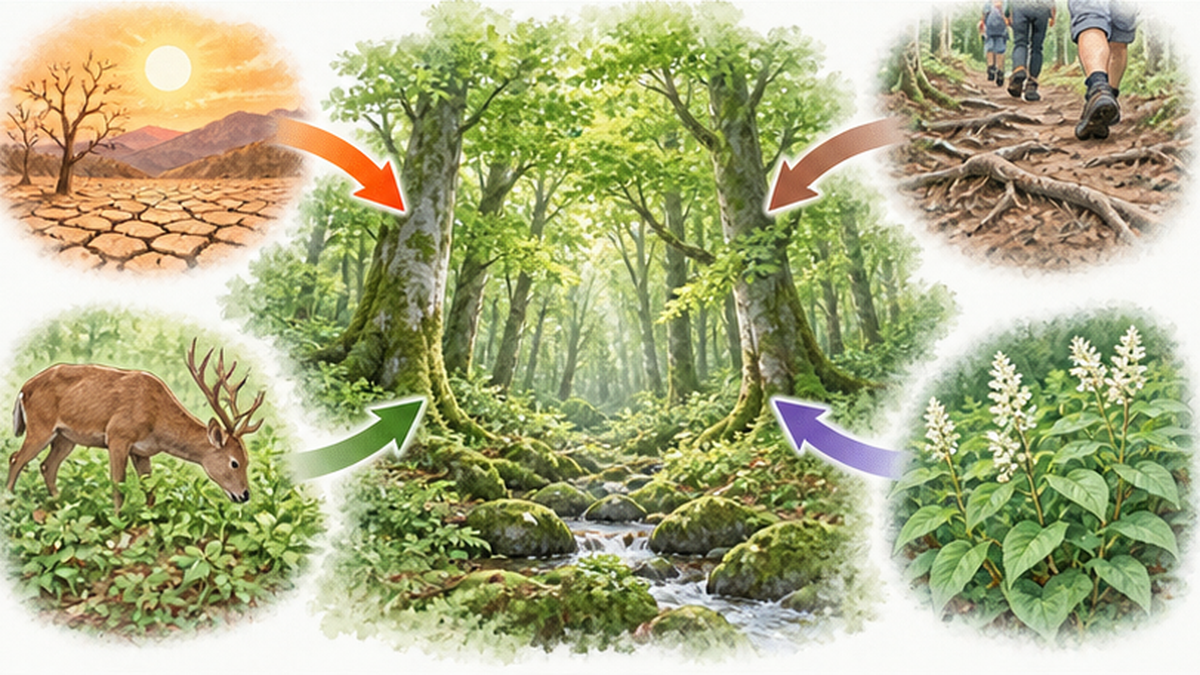
- Climate change: long-term effects of temperature and snowfall changes on beech forests
- Sika deer expansion: browsing on undergrowth and saplings hinders regeneration
- Concentrated use: trampling, introduced species and litter
What we can do: learning the forest-sea link from Shirakami-Sanchi
Learn, visit, support
There are several things we can do to protect Shirakami-Sanchi. First, know that this forest supports water and the sea downstream. Next, keep to the designated routes and rules when visiting. Then take part by choosing local products or supporting conservation activities.
For the health effects of forest bathing, see Why is forest bathing good for the body?. As a World Heritage site, also read Cedar ecosystems of Yakushima for how Japan's two primeval forests differ.
Linking to ocean learning
The water stored by the beech forest flows to the Sea of Japan as rivers, nurturing coastal ecosystems and fisheries. Protecting forests also protects the sea. As an entry point to ocean learning, we hope you will think about the sea from the mountain forest.
Three actions you can take today
- When visiting Shirakami-Sanchi, keep to designated routes and do not take plants or animals
- Choose domestic timber and local mountain products to support the forest cycle
- Trace a nearby river to its source and explore the link between forest and sea
References and Sources
- Ministry of the Environment: Shirakami-Sanchi data – Area, year of registration, criterion
- MAFF Tohoku Forest Management Office: Overview of the Shirakami-Sanchi World Heritage area – Origins and protection of the beech forest
- MAFF: World Heritage Shirakami-Sanchi – Introduction to the forest ecosystem
- Tohoku Forest Management Office: Beech guide – Guide to beech trees
- Aomori Prefecture Environmental White Paper (Shirakami-Sanchi) – Registered area and prefectural breakdown
- Ministry of the Environment: Shirakami-Sanchi overview – Biota and relict species
* Listed in order of reliability: government and academic bodies > peer-reviewed papers > specialist organizations > reliable media