On March 11, 2011, the oyster rafts lined up neatly across the sea of Sanriku vanished overnight, swept away by the tsunami. Boats, processing plants, and facilities for raising seed oysters were all washed out to sea. In Miyagi Prefecture, one of Japan's leading oyster-producing regions, damage to aquaculture facilities and farmed stock alone reached approximately 133.5 billion yen. Many fishery workers looked up at the sky, thinking they might never be able to return to the sea.
Yet in the process of rebuilding from that devastation, Sanriku's oyster farmers made a decision to let go of one piece of conventional wisdom. They abandoned the "overcrowded farming" that had been the norm before the earthquake — packing rafts in tightly — and dared to cut the number of rafts to a third. Most people assumed that farming less would mean landing less. The producers chose the opposite.
The result was dramatic. In a sea where nutrients and oxygen could once again reach every oyster, the time to shipment — which had taken two to three years — shrank to just one year, and the meat content and flavor improved dramatically. In time, this same sea would give rise to Japan's first international certification of its kind. This article traces Sanriku's more than ten years — from the despair of losing every raft, through a revival of the sea and a revolution in quality, to a fishery that workers are once again choosing to join — with concrete figures and on-the-ground examples.
What you'll learn in this article
- The scale of damage the Great East Japan Earthquake inflicted on Sanriku's oyster farming, and the reality of losing entire facilities
- Why the "overcrowded farming" that had become the norm in pre-earthquake Sanriku was degrading quality
- The reverse-course recovery strategy Togura, Minamisanriku, chose: cutting the number of rafts to a third
- How rethinking overcrowding simultaneously improved the farming period, quality, unit price, and working hours
- What Japan's first ASC certification reveals about the international standard for environmentally and socially responsible aquaculture
- Efforts to restore the connection between forest, village, and sea, and the path toward a sea that workers return to
The day the farming rafts vanished from Sanriku's sea
The Sanriku coast, stretching from Miyagi Prefecture into Iwate Prefecture, is a world-class fishing ground for oyster farming, where the intricate ria coastline calms the waves and rich nutrients flow down from the mountains via rivers. In 2010, the year before the earthquake, Miyagi Prefecture produced about 36,000 tonnes of oysters on a shell-on basis, making it Japan's second-largest producing region after Hiroshima Prefecture. As a major source of raw Pacific oysters for direct consumption, its shucked meat was delivered to dining tables across the country.
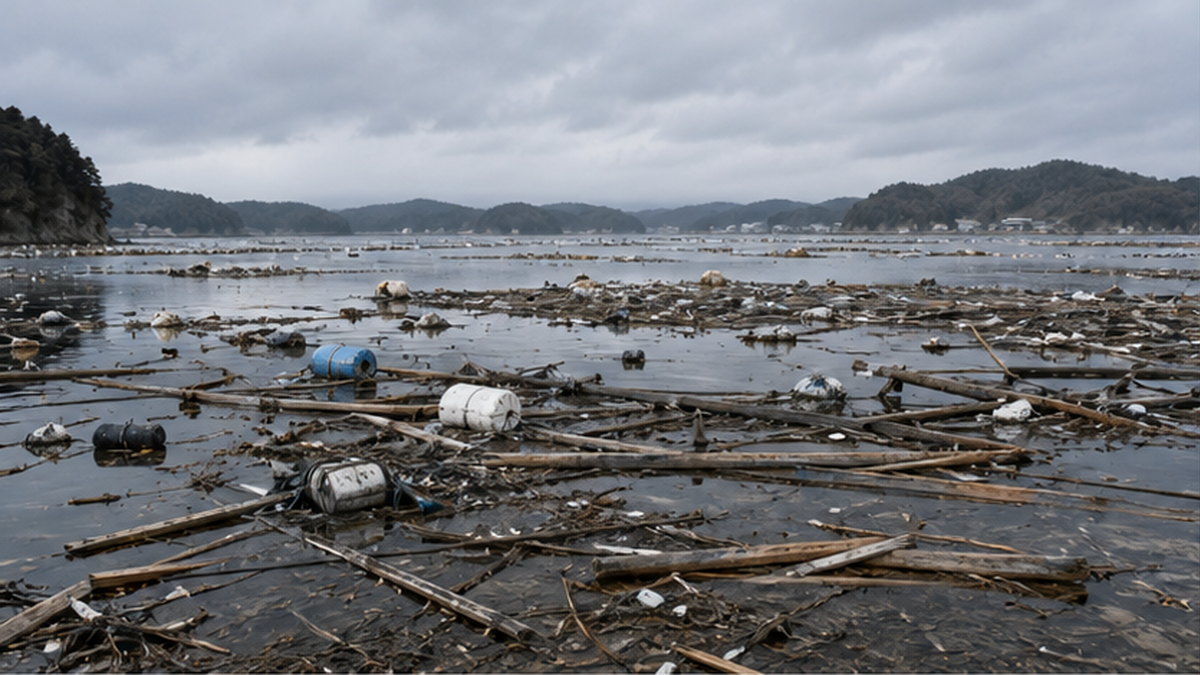
On March 11, 2011, the massive tsunami of the Great East Japan Earthquake tore that maritime way of life up by the roots. The farming rafts that had lined the sea surface neatly were swept away; the seed-collection facilities for raising seed oysters, the processing plants where harvested oysters were shucked, the fishing boats, and even the harbors themselves were devastated. Sanriku's oyster farming was forced to start over almost from zero.
The scale of the damage, in numbers
According to figures compiled by the Fisheries Agency of Japan, total damage to the fisheries sector from the Great East Japan Earthquake reached approximately 1.2637 trillion yen. Breaking this down, fishing port facilities accounted for about 823 billion yen, or 65.1% of the total; fishing boats came next at about 182.2 billion yen (14.4%); and aquaculture facilities and farmed stock came to about 133.5 billion yen (10.6%). Even limited to the aquaculture industry that includes oysters, this amount of assets was lost in an instant.
| Category of damage | Damage amount (estimate) | Share of total |
|---|---|---|
| Fishing port facilities | About ¥823.0 billion | 65.1% |
| Fishing boats | About ¥182.2 billion | 14.4% |
| Aquaculture facilities and farmed stock | About ¥133.5 billion | 10.6% |
| Total, fisheries sector | About ¥1.2637 trillion | 100% |
About 29,000 fishing boats were damaged. Aquaculture facilities — from materials like rafts, ropes, and floats, all the way to the oysters themselves that were still growing in the sea — were swept away together. Because oysters in particular are farmed over the course of years from seeding to shipment, "that year's income falling to zero" and "losing the assets that had been raised" happened at the same time.
The basics of oyster farming
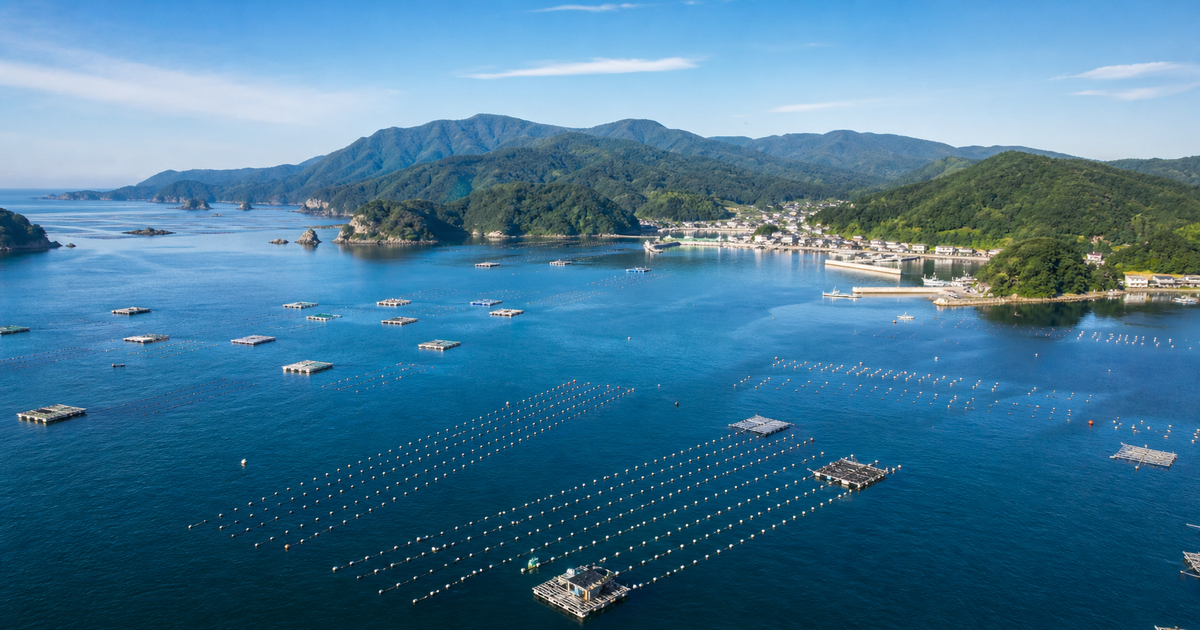
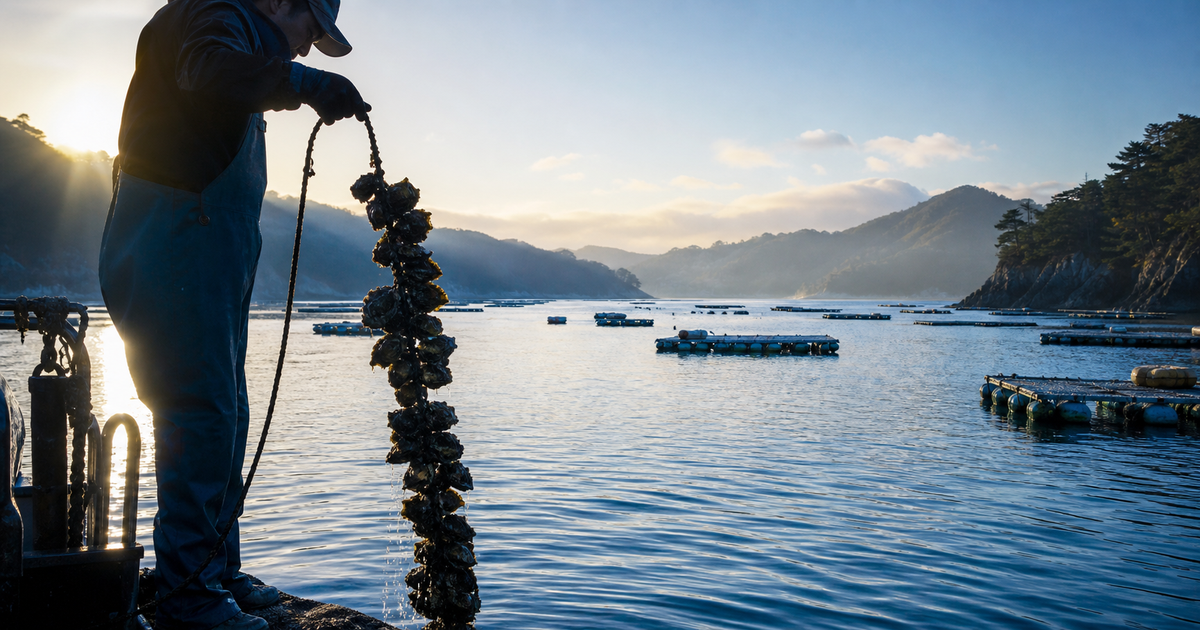
Pacific oysters are mainly farmed using a "hanging cultivation" method, in which larvae (seed oysters) are attached to scallop shells and other materials, strung onto ropes, and lowered into the sea, where they feed on phytoplankton and grow. The floating structure that holds these ropes is the "raft," and how densely rafts are arranged determines how fiercely the sea's nutrients get fought over.
The recovery dilemma — restore, or change?
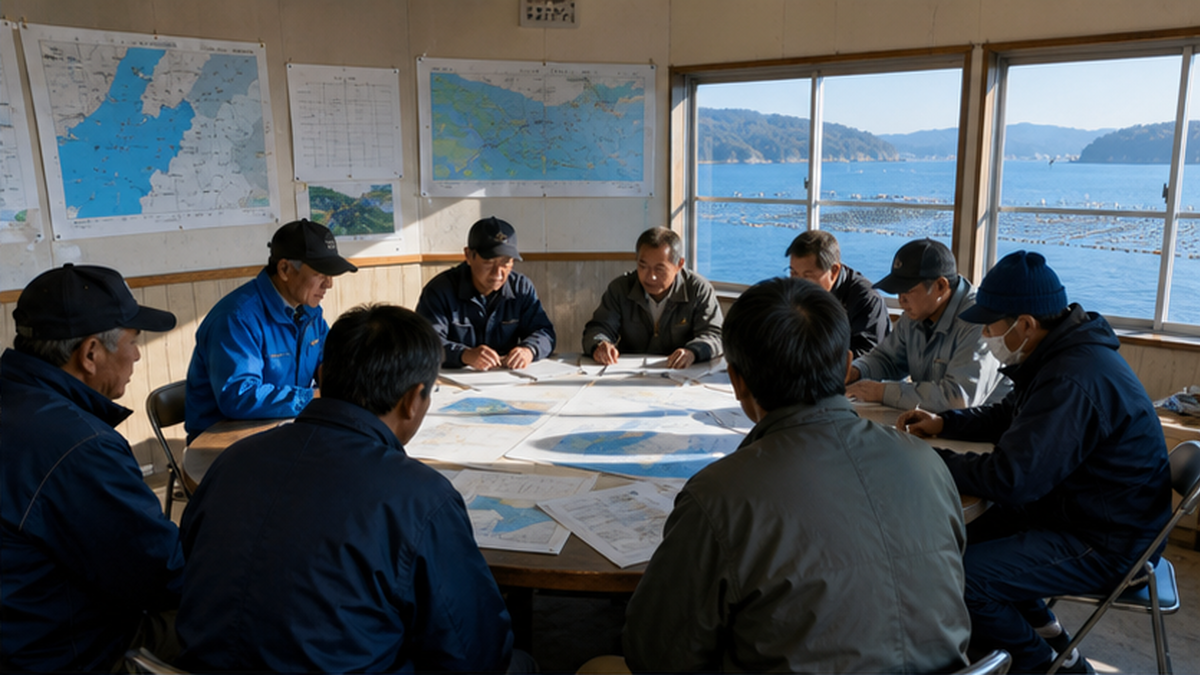
Facing a devastated aquaculture industry, producers confronted a major question: should they restore what they had lost to "exactly how it was before the earthquake," or should they use this opportunity to rethink the farming method itself? National reconstruction support rushed to help rebuild livelihoods, but a question was rising up from the field: was simply restoring things as they were really the right approach?
The anxiety buried inside "restoring things as they were"
Pre-earthquake oyster farming in Sanriku looked prosperous from the outside, but it carried serious problems underneath. Years of steadily adding more rafts had made farming density excessive in many bays, and oyster growth had been slowing year by year. Oysters that could once be shipped in about a year now took two to three years to grow to a sufficient size before the earthquake. Restoring things as they were would have meant returning once again to this "gradually worsening sea."
Eutrophication of the sea and lack of oxygen are challenges not limited to oyster farming but shared across coastal fisheries as a whole. The structure by which excessive load damages marine ecosystems is connected to issues like the mechanisms of red tide and eutrophication and ocean deoxygenation and dead zones. The earthquake could also serve as an opportunity to reset that very structure.
A support scheme that backed joint management
In the early stage of reconstruction, schemes to financially support the resumption of aquaculture were put in place, such as the Fisheries Agency's "Aquaculture Reconstruction Support Project (Ganbaru Yoshoku)." Under this project, public funds covered aquaculture costs until income stabilized, and a framework was adopted in which producers managed operations jointly. Rather than each fishing household bearing all the risk alone, a framework for rebuilding collectively as a region was created, making it easier to also make the bold choice to "change how things are done."
Key terms in this article
- Overcrowded farming = a state in which too many rafts are packed in, resulting in a shortage of nutrients and oxygen
- Turnover rate = the efficiency measured by how many times a year oysters can be shipped from a single raft
- ASC certification = an international label recognizing aquaculture that is environmentally and socially responsible
"Overcrowded farming," a long-standing problem
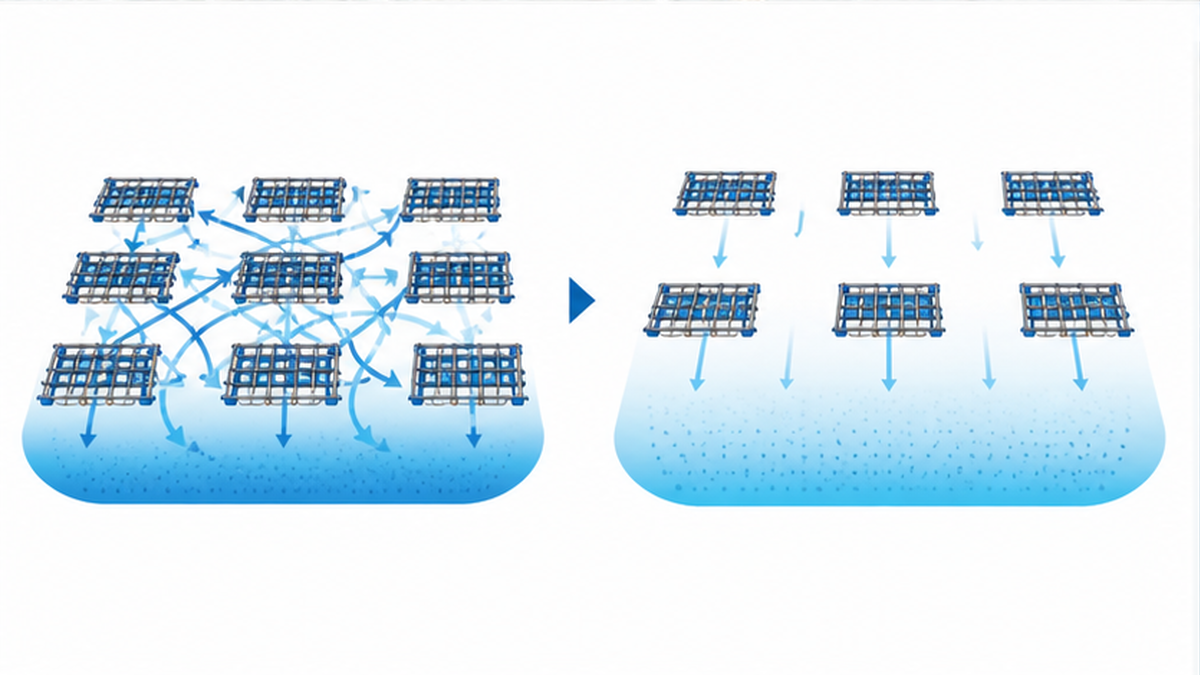
The biggest weakness carried by Sanriku's oyster farming was "overcrowded farming." This term refers to a state in which too many rafts are packed into a limited stretch of sea, making the amount farmed per unit area excessive. Because oysters grow by filtering phytoplankton out of seawater to eat, when rafts are packed tightly together, neighboring oysters end up competing with each other for the plankton that serves as food and the oxygen dissolved in the water.
More than 1,000 rafts spaced 5 to 10 meters apart
In Shizugawa Bay, Minamisanriku Town, before the earthquake, oyster farming had reached a state of "severe overcrowding," with more than 1,000 rafts lined up at narrow intervals of just 5 to 10 meters. The accumulation of individual decisions — wanting to squeeze in even one more raft to secure a bit more short-term harvest — had saturated the entire bay. If more oysters are hung than the sea can support, the nutrients reaching each individual oyster are naturally diluted.
| Item | Before the earthquake (overcrowded) | After rethinking |
|---|---|---|
| Raft spacing | 5–10 meters | About 40 meters |
| Time until shipment | 2–3 years | About 1 year |
| Nutrients per oyster | Tended to fall short | Reaches every oyster sufficiently |
| Meat content and flavor | Highly variable | Stable and good |
The paradox of growing thinner the more you hang
What was so wrong with overcrowded farming? It might seem that increasing the number of oysters would increase total harvest, but in reality each individual oyster grew thinner and took longer to develop. The slower they grow, the longer they need to stay hanging in the sea, which extends the period they are exposed to risks such as typhoons, disease, and mass die-off. All that extra effort didn't raise the unit price either. The producing region had long been stuck in the paradox that "the more you hang, the more quality and efficiency decline."
What's more, under densely packed rafts, oyster waste and uneaten food sink to the seabed and tend to accumulate. As the seabed environment deteriorates, it affects the creatures living there too. Overcrowded farming had been quietly placing a burden not just on quality, but on the bay's ecosystem itself. This perspective of protecting the connection between the sea and the coast has something in common with efforts such as tidal flat conservation.
The vicious cycle caused by overcrowded farming
- Growth slows because oxygen and food (plankton) are fought over
- Shipment takes 2 to 3 years, extending the period exposed to risk
- Poor meat content makes it hard to raise the unit price
- Organic matter accumulates under the rafts, degrading the seabed environment
Togura's decision — cutting rafts to a third
It was the oyster producers of the Togura district in Minamisanriku Town who broke this chain of overcrowded farming. Having lost all their facilities in the earthquake, they laid out a bold policy for rebuilding: cutting the number of aquaculture rafts to a third of the pre-earthquake level — a decision that defied conventional wisdom, made with full awareness of the risk that harvest volume might fall.
A change of course just months after the disaster
What's striking is how quickly this decision was made. Within just a few months of the disaster, Togura's producers began working to eliminate overcrowding. Precisely because they had lost everything, they could redesign the optimal layout from a blank slate. They widened raft spacing to about 40 meters — several times the pre-earthquake distance — redesigning an environment in the whole bay where oysters could grow with room to spare.
The number of producers changed dramatically too
The number of fishing households engaged in oyster farming in the Togura district fell from 78 before the earthquake to 38 as of October 2011. The following year, 2012, 34 households resumed oyster farming under joint management, and since then the number has held at around 35. To maintain the producing region even as the number of workers fell, there was no choice but to shift to a form of farming with high efficiency and quality that could be run even by a smaller number of people. Rethinking overcrowded farming was both a philosophy and a realistic choice for survival.
- Before the earthquake: 78 fishing households engaged in oyster farming
- October 2011: Fell to 38 households
- 2012: 34 households resumed farming under joint management
- Present day: Holding at around 35 households, with rafts at a third of the pre-earthquake number
The framework of joint management also supported this transition. Rather than each individual fighting over rafts, managing the fishing grounds as a whole community made it easier to align the total volume with "exactly what the bay can sustain." The crisis of the earthquake also became an opportunity to bring the producing region together. A similar story of revival unfolding elsewhere in Sanriku is also covered in the article on the revival of Sanriku's seafood.
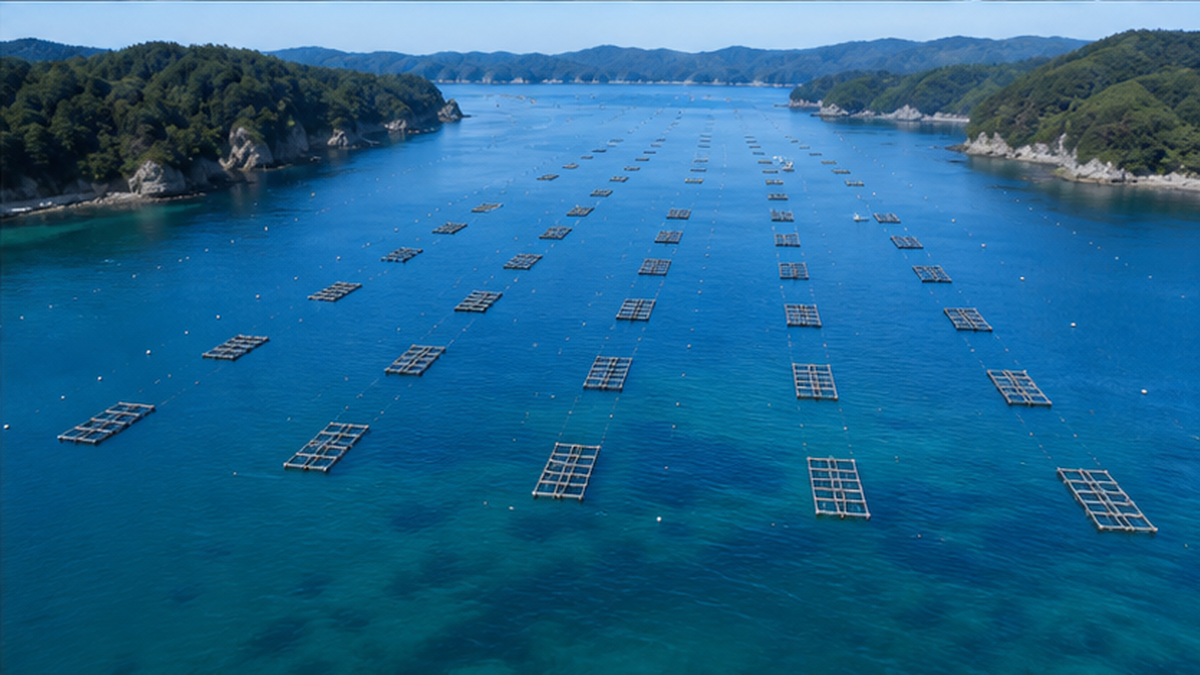
Everyone thought that cutting the number of rafts would mean cutting the catch. But by creating room in the sea, the oysters grew almost unrecognizably better, and as a result, the producing region grew stronger.
— From various records documenting the recovery of Togura, Minamisanriku
The sea responded — dramatic change in quality and turnover
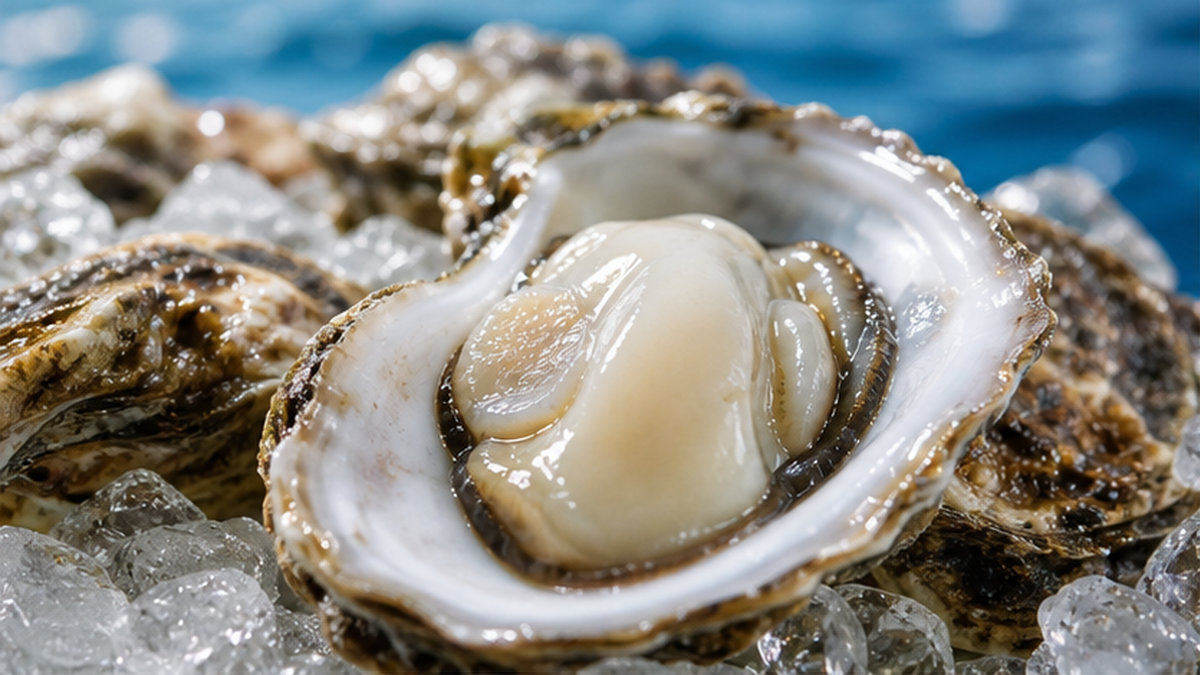
The sea, once relieved of some of its rafts, responded immediately. Oysters that could now get enough food and oxygen began to grow astonishingly fast, and plump. The time until shipment, which had taken two to three years during the era of overcrowding, shrank to about one year. It was the moment Sanriku's oysters, once shippable within a year, regained their original speed.
"Turnover rate" transforms the business
The significance of the farming period shrinking to a third is huge. If oysters can be shipped from a single raft every year, then even with fewer rafts, the "turnover rate" rises, and annual landing volume can be maintained without falling. In fact, in Togura, even though catch volume itself decreased from before as a result of cutting rafts to a third, quality improvements raised the unit price, and sales revenue is reported to have actually increased. According to a case study by the Reconstruction Agency, landing revenue recovered to pre-earthquake (fiscal 2010) levels in fiscal 2016, and surpassed them in fiscal 2017. If you can earn as much or more with fewer facilities, material costs and labor also become lighter.
Unit prices rose, and working hours fell
Improved quality also showed up in price. Oysters with good meat content and consistent size were valued highly in the market, raising the unit price. According to a Reconstruction Agency case study, working hours that before the earthquake had been over 12 hours a day with almost no days off have now dropped to about 7 hours a day, to the point where Sundays can be taken off from fishing. Even so, sales revenue increased thanks to the rise in unit price. "Fewer working hours, more income" — letting go of overcrowded farming even raised the quality of daily life.
| Indicator | Direction of change | Details |
|---|---|---|
| Time until shipment | Shortened | 2–3 years → about 1 year |
| Number of rafts | Reduced | A third of the pre-earthquake number |
| Landing revenue | Increased | Recovered and exceeded pre-earthquake levels through higher unit prices |
| Fishery workers' working hours | Decreased | Over 12 hours a day → about 7 hours |
| Income | Increased | Sales revenue rose thanks to higher unit prices |
This shift — earning through quality and efficiency rather than chasing volume — also offers a suggestive lesson for fisheries in an era when climate change is destabilizing fishing grounds. The impact of rising sea temperatures on fisheries is covered in more detail in ocean warming and fisheries. Togura's decision is packed with hints for building a producing region resilient to environmental change.
Key points here
- Even with fewer rafts, sales can be maintained or improved if quality and unit price rise
- Growing fast means a shorter period exposed to risk, which stabilizes the business
- Improved quality was reflected in the unit price, so income rose even as working hours fell
Proof in the form of Japan's first ASC certification
Rethinking overcrowded farming eventually led to an international "seal of approval." On March 30, 2016, oyster farming operated by the Togura branch office of the Shizugawa branch of the Miyagi Prefecture Federation of Fisheries Cooperative Associations became the first in Japan to obtain ASC (Aquaculture Stewardship Council) certification. ASC is an international label recognizing responsible aquaculture that limits environmental impact and gives due consideration to the local community.
What is ASC certification?
ASC (Aquaculture Stewardship Council) certification is sometimes called an eco-label for aquaculture. It can only be obtained by farms that meet a wide range of standards, covering impact on water quality and seabed environments, consideration for surrounding biodiversity, working conditions, and relationships with the local community. Togura's farming, having eliminated overcrowding and reduced the burden on the seabed and ecosystem, met these strict standards.
- Impact on water quality and seabed environment is managed
- Consideration for surrounding biodiversity, including endangered species
- Social responsibility such as workers' rights and safety
- Good relations with the local community
From Togura to Ishinomaki, and then the whole prefecture
The path Togura opened up spread across all of Sanriku. In April 2018, three branch offices of the Miyagi Prefecture Federation of Fisheries Cooperative Associations — the Ishinomaki district branch, Ishinomaki East branch, and Ishinomaki Bay branch — obtained ASC certification. The oysters produced here, combined with those from Togura, which had already been certified, account for about 60% of Miyagi Prefecture's oyster production. Ishinomaki's certification process included a preliminary review to assess the current situation and an environmental survey, scientifically verifying the impact of farming on the seabed environment and ecosystem.
Minamisanriku Town is also the first municipality in the world to obtain both FSC, the international certification for forest management, and ASC for aquaculture. Managing an entire watershed sustainably, from the mountain forests to the sea's farming grounds — that symbolic model was born from a disaster-stricken area. This way of thinking also resonates with ideas like blue carbon ecosystems, which protect and make use of the sea's environmental value.
The value certification has spread
ASC certification serves as a marker that lets consumers choose "oysters raised with environmental consideration." Beyond simple safety, it lets people support aquaculture that protects the sea and the local community. The on-the-ground effort of rethinking overcrowded farming was made visible in the form of an international standard, boosting the producing region's brand power.
Restoring the connection between forest, village, and sea
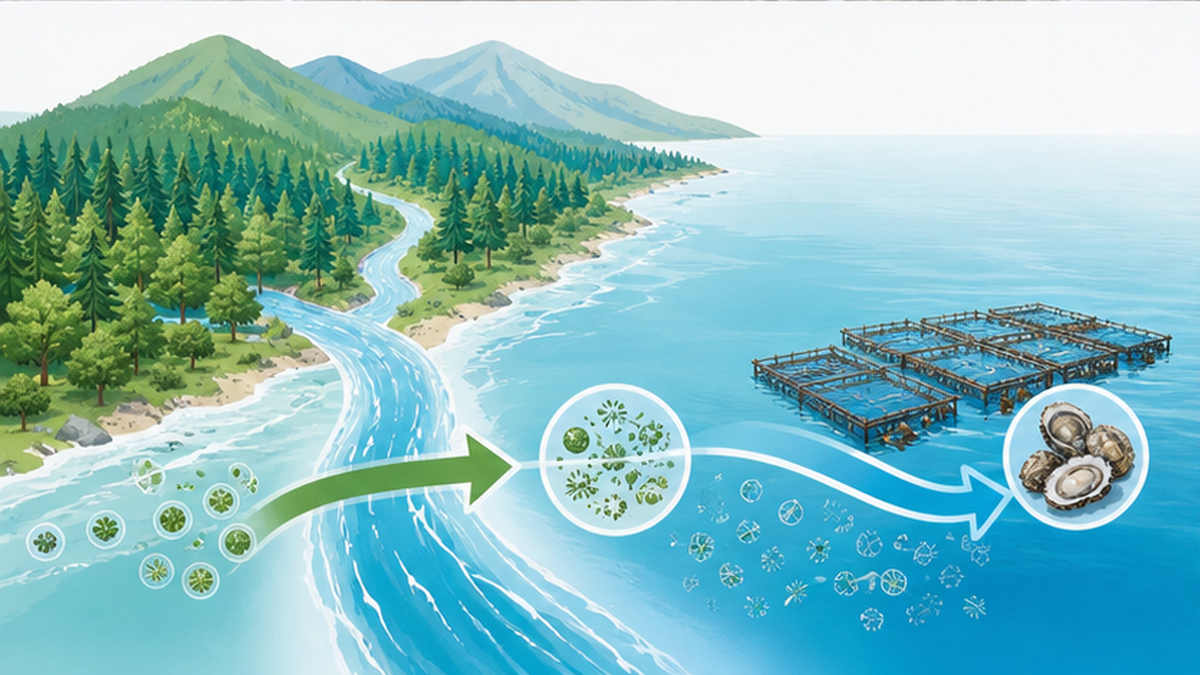
When telling the story of Sanriku's oyster farming revival, one perspective must not be forgotten: don't look at the sea alone. The phytoplankton that feed oysters grow on nutrients carried down from mountain forests via rivers. The richness of the sea is, in fact, connected to the forests on land. Sanriku's fishery workers had long known this obvious fact in their bones.
The "Forests are Longing for the Sea" movement
Shigeatsu Hatakeyama, who runs an oyster farm in Maune Bay in Karakuwa, Kesennuma City, has continued a movement since 1989 under the slogan "Forests are Longing for the Sea," planting trees in the mountains in order to nurture the sea. Having watched the sea of Kesennuma become polluted by household wastewater and develop red tides, he realized that reviving the sea would require protecting the environment of the entire watershed. This movement of tree-planting and public education had been known nationwide even before the earthquake.
What the earthquake revealed about the sea's resilience
In the Great East Japan Earthquake, the people carrying out this movement also lost every one of their farming rafts. But because nutrients continued to flow from the upstream forests into the devastated sea, plankton grew, and abundance began returning at an astonishing speed. In Maune Bay, the land subsided due to the tsunami, and new wetlands and tidal flats formed at the boundary between river and sea. A choice was made not to intervene too much, but to watch over that natural recovery, and the area has become a symbolic site of environmental conservation born from the earthquake.
Coastal wetlands and tidal flats purify water, nurture diverse organisms, and support a rich sea. The significance of protecting them is also covered in more detail in tidal flat conservation. The recovery of oyster farming was not just a story about rafts on the water's surface, but also a story of revival across the entire watershed, connecting forest to tidal flat.
Forests are longing for the sea. If you want to protect the sea, first plant trees in the mountains.
— From the philosophy of the "Forests are Longing for the Sea" movement
Toward a sea that workers return to — ways of working, and successors
The biggest outcome of rethinking overcrowded farming may, in fact, have been about "people." As the farming period shortened, working hours decreased, and income increased, oyster farming transformed from "grueling work that doesn't pay" into "work that pays well through efficiency and quality." This change has begun to gradually shift a flow of workers that had been thinning due to the earthquake and an aging population.
Rethinking overcrowding as a work-style reform
In a world of fishing where long working hours had been the norm, Togura's achievement of "raising income while cutting working hours" drew attention as a model for work-style reform in the fisheries industry. When there is room to breathe, time with family and the energy for new challenges can also be secured. To make young people think "I could take this over," the work itself must first be attractive.
Successors and new entrants
In a producing region where quality and efficiency go hand in hand and brand value has risen, successors find it easier to return. In fact, rethinking overcrowded farming is reported to have also helped secure successors. Rebuilding from zero was a continuous struggle, but the process revealed a form of fishery that is "sustainable, profitable, and allows room to breathe" — and that has become a solid baton passed on to the next generation.
- Shortening the farming period and reducing risk stabilized the business
- Reduced working hours created room to breathe in daily life
- Improved quality and branding raised the unit price, increasing income
- The industry became able to attract successors and new entrants as "attractive work"
Of course, challenges remain. Looking at Miyagi Prefecture as a whole, oyster production has still not reached its pre-earthquake peak. The producing region faces many difficult issues, including the aging of workers, changes to the farming environment from rising sea temperatures, and soaring material costs. Even so, Sanriku's experience of shifting its center of gravity from an era of "packing in volume" to one of "being chosen for quality and sustainability" serves as a valuable compass for Japan's fisheries going forward. Efforts such as recycling oyster shells as a resource are also an extension of this same direction.
What we can do
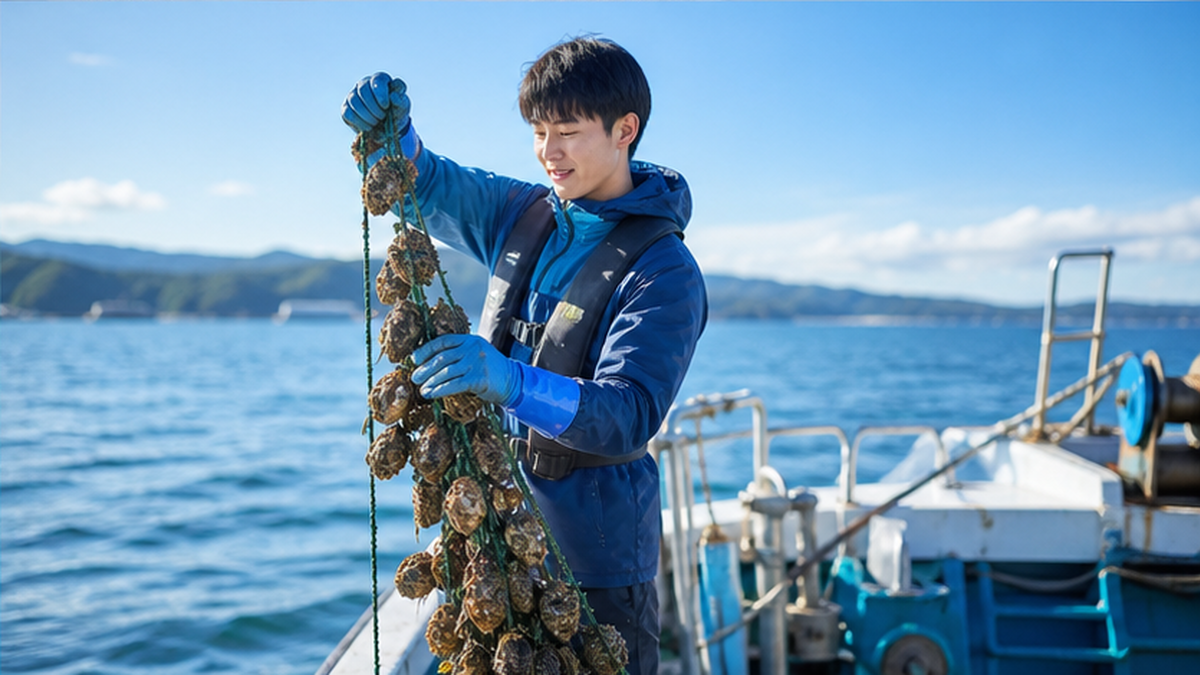
- Choose to buy oysters raised with environmental care, such as those with ASC certification
- Learn about the story of the producing region and its producers, and eat in support of them
- Taste Sanriku oysters, and support recovery and the sea's revival deliciously
- Take an interest in the connection between sea and forest, and be mindful of protecting the whole watershed
Summary — the shape of recovery that "growing less to grow better" revealed
The Great East Japan Earthquake took away both the facilities and the assets of the sea from Sanriku's oyster farming. But instead of simply trying to restore what they had lost, the producers chose to let go of the weakness of "overcrowded farming" that had existed even before the earthquake. The paradoxical decision to cut the number of rafts to a third created room in the sea, awakened the oysters' true potential, and raised the level of quality, efficiency, daily life, and the workforce, all at once.
It was a shift from a fishery aimed at "catching as much as possible" to one that "raises exactly what the sea can support, at high quality, sustainably." Japan's first ASC certification, a watershed-wide perspective connecting forest, village, and sea, and a workplace to which workers have begun to return — what Sanriku demonstrated is a hopeful example proving that environmental restoration and viable business are not in conflict, but can, in fact, go hand in hand. Recovery is not just about restoring things as they were; it is also about choosing a better future.
Summary of this article
- Damage to aquaculture facilities and farmed stock from the earthquake totaled about 133.5 billion yen. Sanriku's oyster farming was forced to rebuild from almost zero
- Before the earthquake, Sanriku suffered from "overcrowded farming," where nutrients and oxygen ran short, and shipment took 2 to 3 years
- Togura, Minamisanriku, cut its rafts to a third of the pre-earthquake number and widened spacing to about 40 meters
- The farming period shortened to about one year. Sales revenue rose thanks to higher unit prices, while working hours fell from over 12 hours a day to about 7
- In 2016, Togura obtained Japan's first ASC certification. In 2018, three Ishinomaki branches also obtained it, extending coverage to about 60% of Miyagi Prefecture's oyster production
- The perspective of forest, village, and sea, symbolized by the "Forests are Longing for the Sea" movement, supported the sea's revival across the whole watershed
- Rethinking overcrowded farming also led to work-style reform and securing successors, becoming a compass for sustainable fisheries
Today, Sanriku's oysters still grow slowly but powerfully in a sea with wider spacing. Each one carries the story of people who rose from despair, questioned convention, and chose anew a way of living together with the sea. The next time you eat an oyster, take a moment to remember the sea's revival and the challenge taken on by its producers behind it.
References and sources
- Fisheries Agency of Japan – Current status and challenges toward the recovery of the fisheries industry from the Great East Japan Earthquake
- Fisheries Agency of Japan – Fisheries White Paper: Status of restoration and recovery in the fisheries industry
- Ministry of Agriculture, Forestry and Fisheries, Japan – Oyster producing regions and production volume
- Miyagi Prefecture – Miyagi's oyster production
- Reconstruction Agency – Japan's first ASC certification obtained in the wake of the Great East Japan Earthquake (case study)
- WWF Japan – Japan's first "ASC-certified" fishery born from the sea of a disaster-stricken area
- WWF Japan – ASC certification spreads: 60% of Miyagi Prefecture's oysters now certified
- Minamisanriku Town – Minamisanriku's oysters obtain Japan's first ASC certification
- Seikatsu Club Consumers' Co-operative Union – Oyster farming that continues into the future (the case of Togura)
- Mori wa Umi no Koibito (Forests are Longing for the Sea), NPO – The "Forests are Longing for the Sea" movement
※ Listed in order of reliability: government/academic institutions > peer-reviewed papers > specialized organizations > reputable media