⚡ In short
Every night, from hundreds of metres down to the surface: the diel vertical migration of zooplankton and mesopelagic fishes is, by biomass, the largest animal migration on Earth. From the "false bottom" that sonar found in 1942 to how animals follow the light, the firefly squid of Toyama Bay, and a 14% boost to carbon export from the sunlit ocean - explained from primary sources.
As the sun goes down, the biggest commute on Earth begins. Zooplankton, small shrimps, squids and fishes rise together from the darkness hundreds of metres down toward the sea surface. As dawn approaches they retrace the same path back into the deep. This is diel vertical migration (DVM). Wildebeest crossings and stork migrations involve tens of thousands to a few million individuals; diel vertical migration happens every single day across every ocean, moving an almost unimaginable amount of living matter at once. The US National Oceanic and Atmospheric Administration (NOAA) describes it as the largest organised mass movement of animals on the planet, whether measured by biomass, by number of individuals, or by the number of species moving together.
This is not a remote deep-sea curiosity, either. Animals that feed on phytoplankton at the surface take carbon into their bodies at night, carry it down to the deep by day, and leave it there as faeces and respired carbon dioxide. In other words they work as couriers for the "biological pump" that locks atmospheric carbon dioxide away in the deep ocean. The story of phytoplankton producing roughly half the planet's oxygen and the story of this daily rise and fall are really one continuous story.
This article starts with the riddle of the "false bottom" that military sonar found in 1942, then looks at what cues the animals follow, why the effort is worth it, how the phenomenon appears in Japanese waters (firefly squid in Toyama Bay, sakura shrimp in Suruga Bay), and why it matters for climate and for fisheries - all based on primary sources such as government agencies and peer-reviewed papers. Read it as if you were leaning over the rail of a boat, looking down into the night sea.
What you'll learn in this article
- What diel vertical migration (DVM) is, and why it is called Earth's largest animal migration
- How wartime sonar discovered the "false bottom" that turned out to be the deep scattering layer
- Why the trigger is the rate of change in light, while the ultimate reason is escaping visual predators
- Patterns that break the textbook rule: reverse migration, midnight sinking and moonlit migration in the polar night
- Vertical migration in Japanese waters - firefly squid in Toyama Bay, sakura shrimp in Suruga Bay and lanternfish
- How the migration shapes the ocean carbon cycle and oxygen, and how human activity disturbs it
What diel vertical migration is - Earth's largest migration, repeated every night
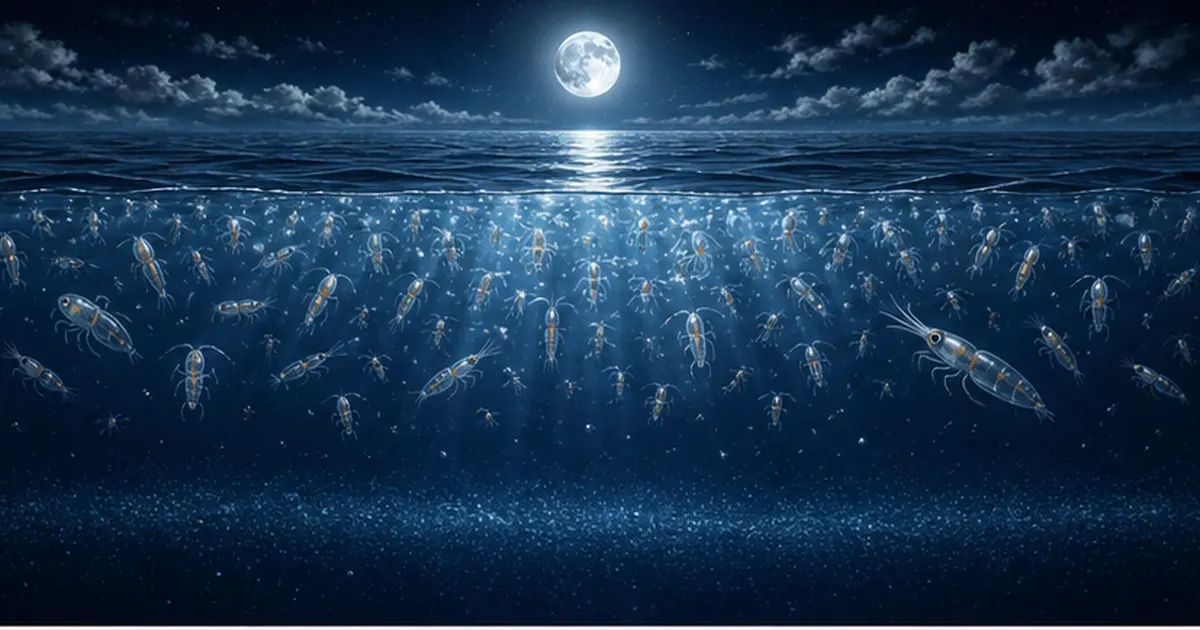
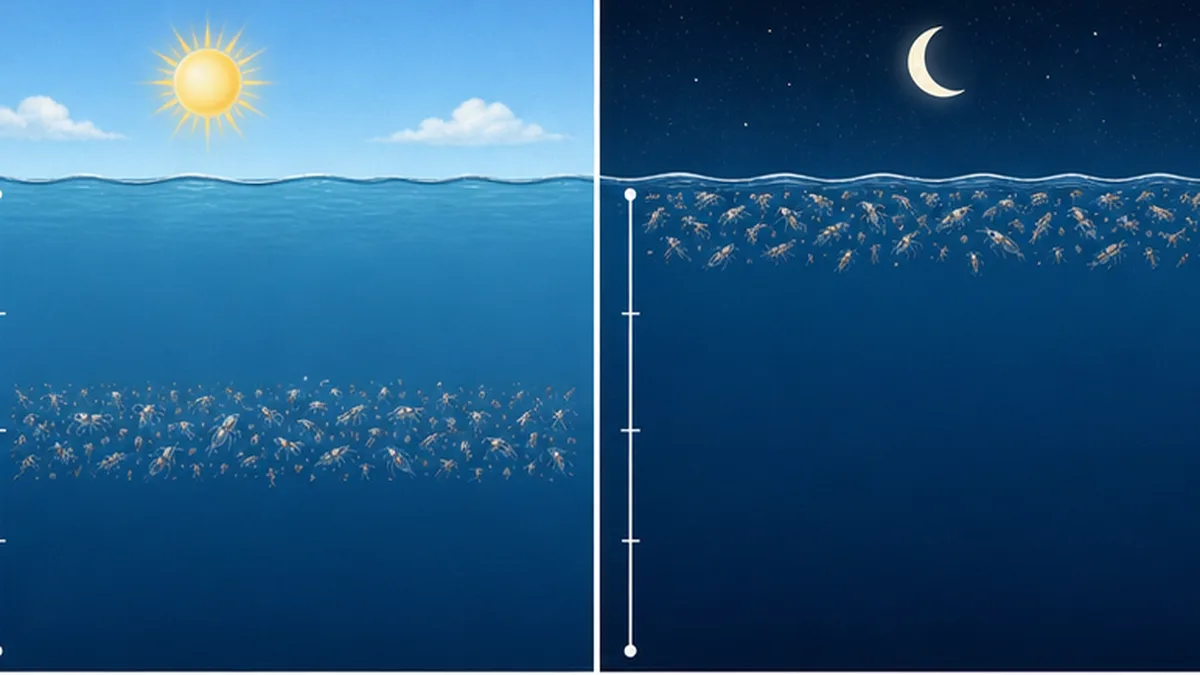
Diel vertical migration is the behaviour in which marine animals change their depth in step with the daily rhythm of light and dark. The commonest pattern is shallow at night, deep by day: they rise from depth at sunset, feed near the surface, and go back down before sunrise. The distance covered ranges from a few tens of metres to nearly a thousand, depending on species and region. For an animal one or two centimetres long, a round trip of several hundred metres is a journey of tens of thousands of body lengths.
The stars of the show are small and numerous
The migrants are copepods and krill and other zooplankton, arrow worms and jellyfish, and the small swimming animals known as micronekton - lanternfishes and other mesopelagic fishes, small squids and shrimps. Individually they are only millimetres to centimetres long. But because they are spread through every ocean in staggering numbers, their combined biomass on the move exceeds that of any other animal migration. NOAA describes it as the largest organised animal movement on the planet in terms of biomass, individual numbers and the number of species moving at the same time.
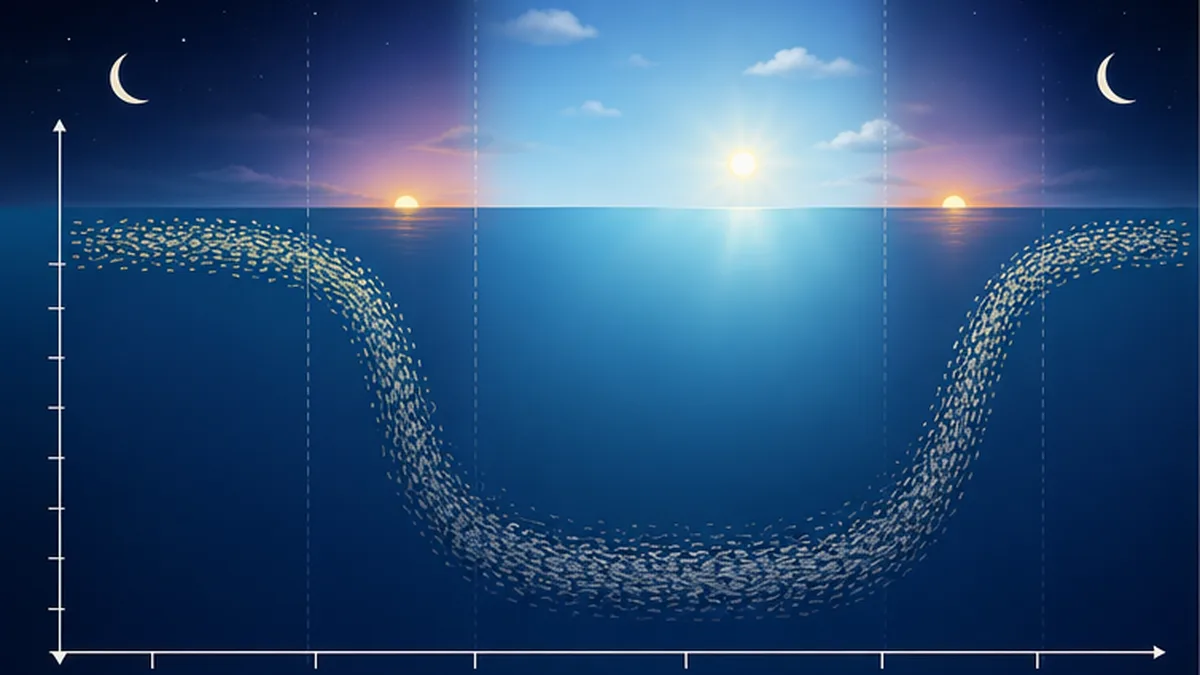
The migration itself takes anywhere from tens of minutes to a few hours, depending on the species and the distance. They begin rising in the late afternoon, reach the surface some time after sunset, feed through the night, and start down before dawn. This cycle runs every day, across every ocean, keyed to almost the same cue. And the participants are not coordinating with each other: each individual is simply responding to changing light, yet the result looks as though the whole ocean were breathing in time. That spontaneous synchrony is the most beautiful property of diel vertical migration.
One way to grasp the scale is the amount of fish living in the mesopelagic zone (200-1,000 m, also called the twilight zone). Analysing acoustic data from the 2010 round-the-world Malaspina expedition, Irigoien and colleagues (2014, Nature Communications) estimated the fish biomass of this layer at about 10 billion tonnes - roughly ten times the earlier net-based estimate of around 1 billion tonnes. Net surveys had badly underestimated them because these agile fishes sense a trawl and swim away.
Who migrates, and how far
| Group | Examples | Approximate daytime depth | Notes |
|---|---|---|---|
| Copepods (zooplankton) | Calanus, Neocalanus | Tens to hundreds of metres | The foundation of the marine food web; migration range varies widely by species and region |
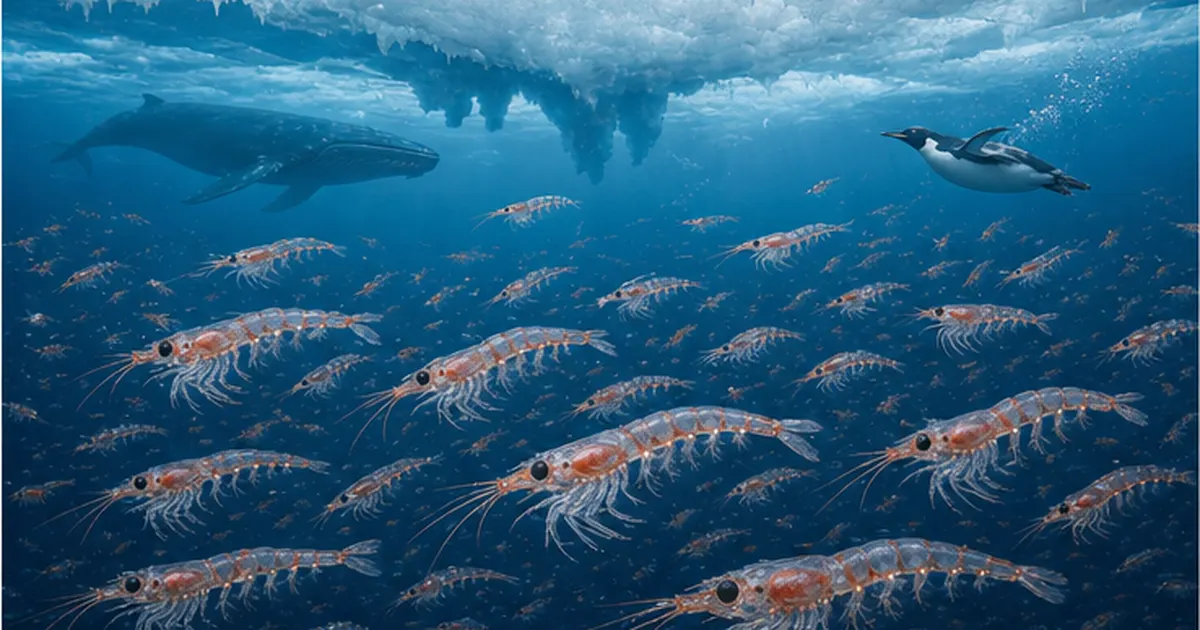
| Krill (euphausiids) | Antarctic krill, Pacific krill | Around 100-500 m | Migrate in swarms and are a staple food for whales and fishes |
| Mesopelagic fishes | Lanternfishes, bristlemouths | 200-1,000 m | Strong sound reflectors and the main constituents of the deep scattering layer |
| Small squids and shrimps | Firefly squid, sakura shrimp | About 200-600 m / 200-300 m | Fishery targets in Japanese waters; they rise into shallow layers at night |
The essentials
- Diel vertical migration is a daily change of depth keyed to the rhythm of light and dark
- The basic pattern is shallow at night, deep by day, covering tens of metres to nearly a kilometre
- By biomass, individual numbers and species involved it is Earth's largest organised animal movement (NOAA)
- Mesopelagic fishes alone may total about 10 billion tonnes - far more than once assumed
The story of the discovery - the "false bottom" that sonar found
It seems strange that a phenomenon this vast went unnoticed until the middle of the twentieth century. But you cannot see into the sea. What finally revealed the migration was not biology but acoustic technology built for war.
1942: a strange echo aboard USS Jasper
In the summer of 1942, off San Diego, California, researchers from the University of California Division of War Research were testing long-range active sonar designed to detect submarines. Their vessel was USS Jasper. When they sent sound into the depths, a strong seafloor-like echo came back from about 300 yards (roughly 270 m) down. According to the charts there was no seafloor there. And the depth of the echo moved up and down with the time of day.
The mysterious layer was named the "ECR layer" after the initials of the three technicians who worked on it - C. F. Eyring, R. J. Christensen and R. W. Raitt - and later became known as the deep scattering layer (DSL). Among sonar operators of the time it was simply the "false bottom" whose depth kept changing.
1945: nets reveal the answer
The answer came about three years later. In 1945 the oceanographer Martin Johnson lowered nets in the Pacific and established that the layer was a vast swarm of small marine animals, most of them no longer than a human finger. What had been bouncing the sound back was not rock or sand but fish swim bladders and crustacean bodies - travelling every day from the deep sea to the surface and back. It was the moment when the mesopelagic zone, long assumed to be nearly empty, turned out to be packed with life beyond anyone's expectation.

Listening for life: the modern toolkit
Seeing animals with sound is now the mainstay of observation. Quantitative echosounders on research vessels and moorings (which measure reflection strength at several frequencies) and the backscatter data produced as a by-product by acoustic Doppler current profilers (ADCPs) have accumulated records of vertical migration all over the world. More recently, autonomous platforms, biogeochemical floats and underwater imaging that analyses particles and organisms have made it possible to follow movement species by species and size class by size class.
- Quantitative echosounders: infer what a swarm is made of - fish, crustaceans - from reflection strength at multiple frequencies
- ADCP backscatter: a by-product recorded for decades by research vessels, and the basis of global analyses of migration patterns
- Moored sensors: record continuously in one place for a year or more, capturing seasonal change and behaviour during the polar night
- Underwater imaging: observes soft jellyfish and other gelatinous animals intact, which nets destroy
What nets alone could not show
Nets - plankton nets and trawls - are still basic tools, but fast fishes dodge them and soft jellyfish are torn apart inside them. Combining acoustics with imaging revealed that mesopelagic biomass may be an order of magnitude larger than earlier estimates. When the method of observation changes, so does the apparent size of the world.
Why go up and down - caught between wanting to eat and not wanting to be eaten
Swimming hundreds of metres every night is an enormous energy expense for a small animal. Evolution nevertheless favoured it, because the payoff is larger still. Researchers separate the reasons into ultimate causes (why it pays off) and proximate causes (what cue triggers the movement). Let us start with the ultimate causes.
The main reason is escaping predators that hunt by sight
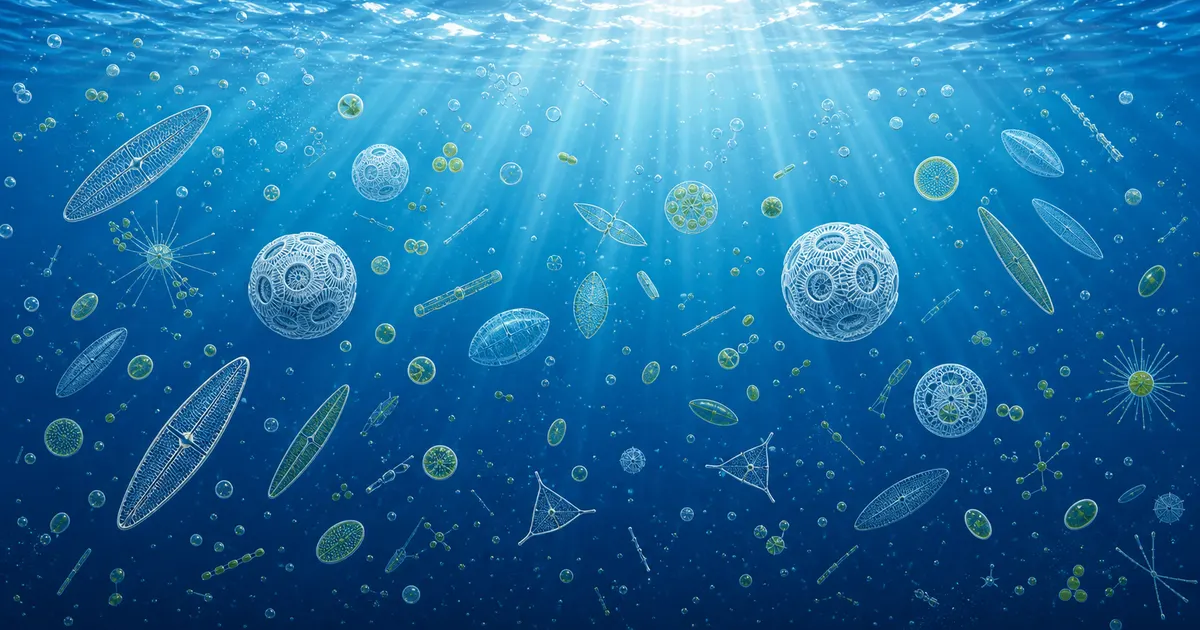
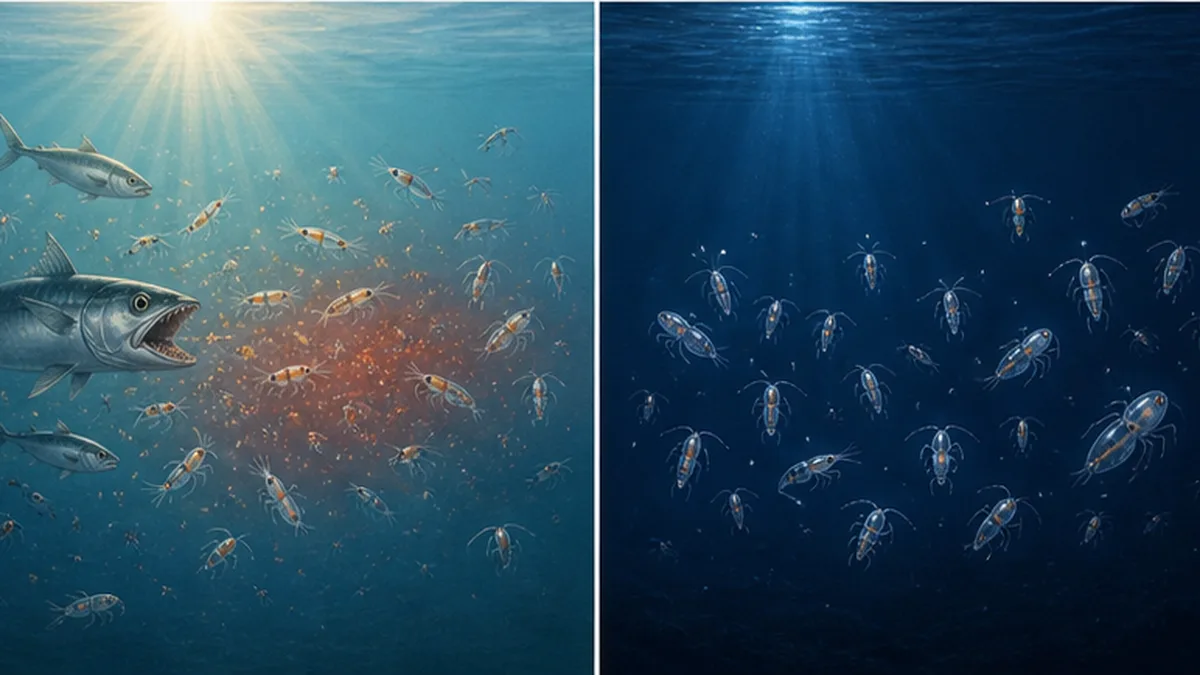
The phytoplankton that zooplankton eat are abundant only in the sunlit surface layer where photosynthesis is possible. In other words, the canteen is only in the bright place. But the bright surface is also the hunting ground of fishes and seabirds that find prey by sight. Even a transparent body casts a shadow and shows its eyes in lit water. So it pays to separate the two in time: eat at the surface while it is dark, and hide in the deep, beyond a predator's sight, while it is light.
Plenty of evidence supports this. In freshwater Daphnia, experiments show that vertical migration intensifies when the animals detect chemicals released from fish skin (kairomones). In the sea, migration tends to be deeper and larger where and when predators are abundant. Where predators are scarce, migration becomes shallower or nearly disappears. In short, vertical migration is not a fixed instinct but a flexible strategy tuned to the level of danger.
The important point is that this is a calculation of costs and benefits. Migration costs energy to swim, and it confines feeding to the hours of darkness. Animals still choose to hide deep because the chance of being eaten outweighs the modest cost of staying a little thinner. When food is plentiful they take some risk and linger shallower; when predators increase they sink deeper. The observed shifts in migration are that balance tipping one way or the other.
Shielding from ultraviolet light - an ultraviolet sensor in the brain
A second suggested reason is avoiding strong ultraviolet radiation. Small transparent bodies are easily damaged by ultraviolet light, which makes the daytime surface a dangerous place. In 2017 a joint group from Japan's Institute for Molecular Science and National Institute for Physiological Sciences reported an ultraviolet-sensing photoreceptor protein (an opsin) in the brain of the larva of the marine annelid Platynereis dumerilii, which drifts as plankton; the protein responds most efficiently to ultraviolet light at 383 nm (published in the Journal of Biological Chemistry). It suggests that tiny animals may be choosing their depth by distinguishing the colour of light itself.
Saving fuel in the cold deep
The third advantage is metabolic. Deep water is colder than the surface, so the longer an animal spends there the lower its metabolic rate and the less energy it burns. Feed heavily in the warm surface at night, then sit quietly in the cold deep by day, digesting while spending little - this can pay off in growth efficiency. How life copes with the cold, high pressure and darkness of the deep is covered in more detail in our article on the adaptations of deep-sea creatures.
Three reasons to migrate (ultimate causes)
- Predator avoidance: hide from visual hunters during daylight - the leading explanation
- Ultraviolet avoidance: small transparent bodies are vulnerable, making the daytime surface risky
- Metabolic saving: spend less in the cold deep and grow more efficiently
How do they know the time? Reading how the light changes
So how does a small animal with no clock and no calendar know that it is time to rise? The key is light - but the trigger is thought to be not the absolute brightness but the way brightness changes.
The trigger is the relative rate of change in light
As sunset approaches, underwater light fades quickly. Many zooplankton begin to rise once this rate of decrease in brightness per unit time passes a threshold, and begin to descend when the rate of increase passes a threshold at dawn. Because the cue is the rate of change rather than absolute brightness, the same moments - sunset and sunrise - can be detected reliably on cloudy days, in turbid water, and whether or not the moon is up. It is an elegant piece of engineering.
Following the isolume
The idea that explains where the migration settles is isolume tracking. If an animal chooses depth so as to stay at the brightness it considers safe, it will follow that layer of light all day as the sun's elevation changes. Analyses of global acoustic data show that the monthly mean migration depth can be expressed as the depth of the 10⁻³ W/m² isolume. In other words, migration depth is largely set by the clarity of that stretch of ocean - turbidity and plankton load - together with the height of the sun.
This neatly explains regional differences. In plankton-rich, turbid coastal and upwelling waters, light fades fast, so the same brightness sits shallower and the migration range is smaller. In the nutrient-poor, crystal-clear subtropical open ocean, light reaches far down, so animals must dive deeper and the range grows. The same behaviour - seeking the same safe dimness - produces different depth patterns in different seas, filtered through the lens of water clarity.
Starting down 21 minutes before sunrise - what global data show
Bianchi and Mislan's analysis of global acoustic (ADCP backscatter) data (2016, Limnology and Oceanography) put numbers on this synchrony. Acoustic scattering layers leave the surface on average 21 minutes (±20) before sunrise and return to it on average 17 minutes (±23) after sunset. Mean speeds were 7.6 cm/s (±3.6) downward and 6.5 cm/s (±3.5) upward, meaning descent is significantly faster than ascent. Seven and a half centimetres a second is about 270 m per hour - a remarkable pace for a body a few millimetres long.
| Measure | Global mean (acoustic data) | Interpretation |
|---|---|---|
| Time of leaving the surface | About 21 minutes before sunrise (±20) | They retreat to a safe depth before it gets light |
| Time of returning to the surface | About 17 minutes after sunset (±23) | They wait for darkness before rising to feed |
| Descent speed | 7.6 cm/s on average (about 270 m/hour) | They hurry more on the descent that takes them away from danger |
| Ascent speed | 6.5 cm/s on average (about 234 m/hour) | The ascent is comparatively leisurely |
Why is the descent faster?
Dawn is the hour when danger arrives. Heading for the deep only once it is already light could be too late - and indeed scattering layers start leaving the surface before sunrise. The evening ascent, by contrast, can wait until darkness is complete, so there is less need to hurry. The observed asymmetry in speed fits this survival strategy.
Not by the textbook - reverse migration, midnight sinking and moonlit journeys
"Shallow at night, deep by day" is only the basic pattern. In the real ocean, the variety is remarkable - differing by species, by life stage and by season. That variety is what tells us vertical migration is a strategy chosen to fit the situation, not a simple reflex.
Reverse migration - shallow by day, deep at night
Some small zooplankton deliberately do the opposite: shallow by day and deep at night, known as reverse diel vertical migration. The reason is that the predators hunting them are themselves rising to the surface at night. Carnivorous plankton such as arrow worms and jellyfish, which catch prey by touch rather than sight, become active in the surface layer after dark. If everyone else comes up at night, it is safer to avoid that time. The layered structure of eating and being eaten decides even the direction of the migration.
Midnight sinking
Instead of staying at the surface all night, animals are also observed to sink once around midnight and then rise again toward morning - a two-peaked pattern. Suggested explanations include full individuals sinking to digest, and bright moonlight making the surface dangerous. Because it appears differently from night to night in the same waters, it is probably a fine adjustment weighing food against risk.
Winters without sunrise - a 24.8-hour rhythm set by the moon
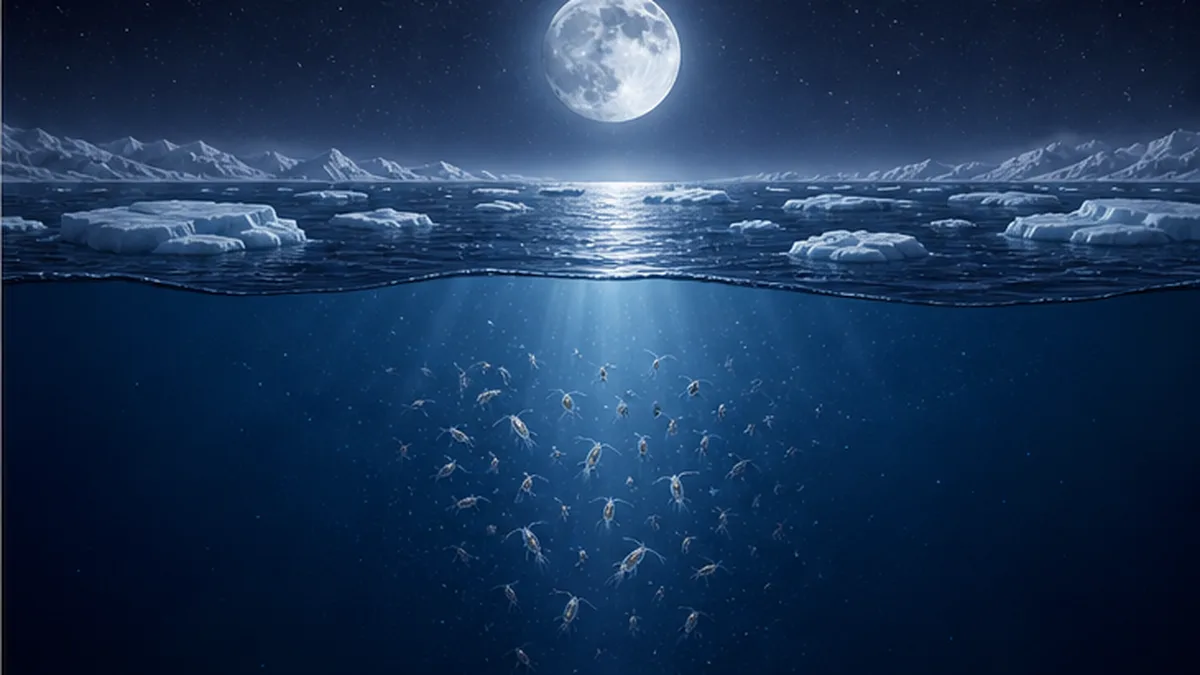
The most dramatic case is the Arctic polar night. When the sun never rises above the horizon in winter, does the daily migration simply stop? Last and colleagues (2016, Current Biology) showed, using observations from Arctic fjords, shelves, slopes and open sea, that when the moon rises above the horizon in winter the rhythm of zooplankton migration switches from the 24-hour solar day to the 24.8-hour lunar day. Moreover, in step with the full moon, mass sinking to about 50 m occurred every 29.5 days. In a world with almost no light, the animals were choosing their depth by moonlight.
Seasonal migration that comes with growing up
Separate from the daily journey, there is also ontogenetic (seasonal) vertical migration, in which animals change depth over a season or a lifetime. Large copepods such as Neocalanus in the North Pacific and Calanus in the North Atlantic feed on phytoplankton at the surface in spring, build up lipid reserves, then descend to the deep to spend months in dormancy (diapause) before returning to the surface the following season. If daily migration is the commute, this is the seasonal move. Both create flows of material connecting the surface with the deep.
The variety of migration patterns
- Normal: shallow at night, deep by day (the commonest)
- Reverse migration: shallow by day, deep at night, avoiding predators that rise after dark
- Midnight sinking: a two-peaked pattern with a dip during the night and a rise toward dawn
- Moonlit migration: in the polar night the rhythm switches to a 24.8-hour lunar day
- Seasonal migration: large copepods overwinter in dormancy in the deep
Vertical migration in Japanese waters - firefly squid, sakura shrimp and lanternfish
Diel vertical migration is not only a distant open-ocean affair. Several seafoods on the Japanese table are caught precisely because of this daily rise and fall. Japan is fortunate in that deep trenches and steep submarine canyons come close to shore in places, so deep-layer animals can be observed near the coast. Toyama Bay has submarine canyons deeper than 1,000 m - the steep depressions known as aigame - reaching almost to the shoreline, and Suruga Bay, the deepest bay in Japan, holds water 2,500 m deep inside the bay itself. Mesopelagic animals you would otherwise have to sail far offshore to meet become fishery targets inside a Japanese bay.
Firefly squid in Toyama Bay - a ribbon of light rising from the deep
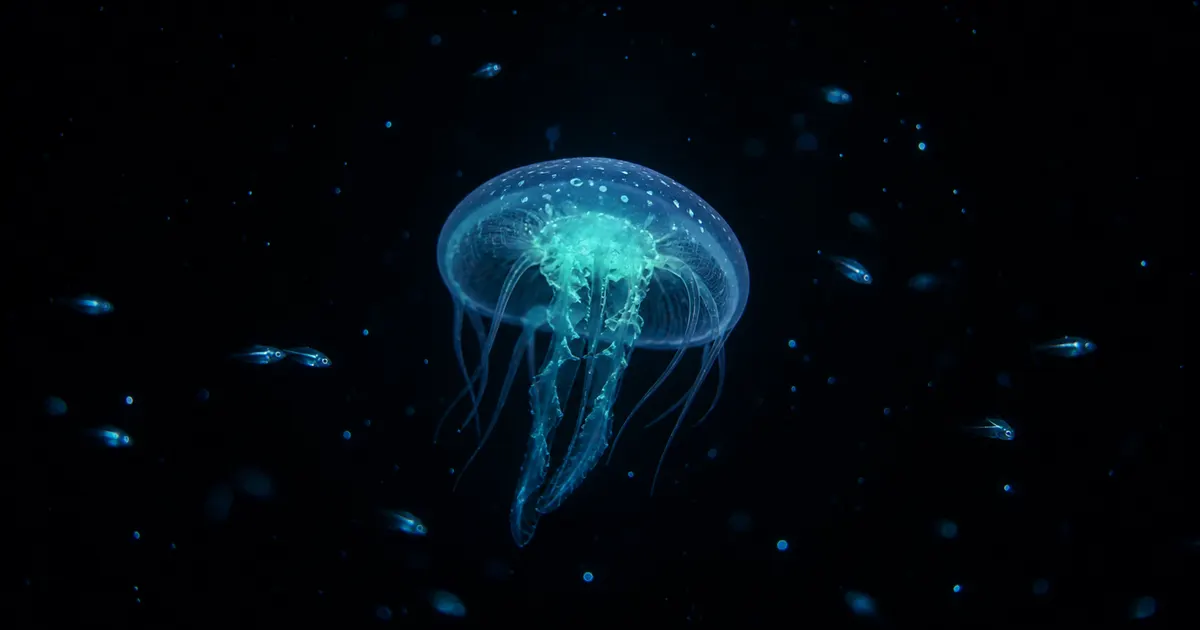
The firefly squid (Watasenia scintillans) is a migratory, annual squid living at depths of 200-600 m. It stays around 200 m during the day and rises at night. In the spawning season from March to May it arrives in Toyama Bay in shoals, comes up from the submarine canyons into shallow coastal water during the night, and returns offshore before daybreak. Females are about 5-7 cm long, males 4-5 cm. Their bodies carry roughly 1,000 tiny photophores that glow blue-white. That light is thought to startle enemies, erase the animal's own silhouette against predators looking up from below, and help individuals recognise one another. For how bioluminescence works, see also our article on light-producing life in the deep sea.
The stretch of water where firefly squid swarm in Toyama Bay is designated a Special Natural Monument of Japan. Sightseeing boats run on spring nights to see the squid glowing blue-white in set nets, so the scenery created by diel vertical migration and spawning migration has become part of the region's culture and tourism.
Sakura shrimp in Suruga Bay - night fishing because they rise at night
Sakura shrimp also migrate strongly. They spend the day in deep layers at 200-300 m and rise to around 20-50 m at night, which is why the fishery works after dark. Waiting at the depth where the shrimp arrive, at the hour they arrive - the fishing method itself rests on knowledge of the animals' ecology. In Suruga Bay the stock has been depressed since around 2018, and fishers have introduced voluntary closures and changes to mesh size, while Shizuoka University and others pursue research aimed at restoring the resource.
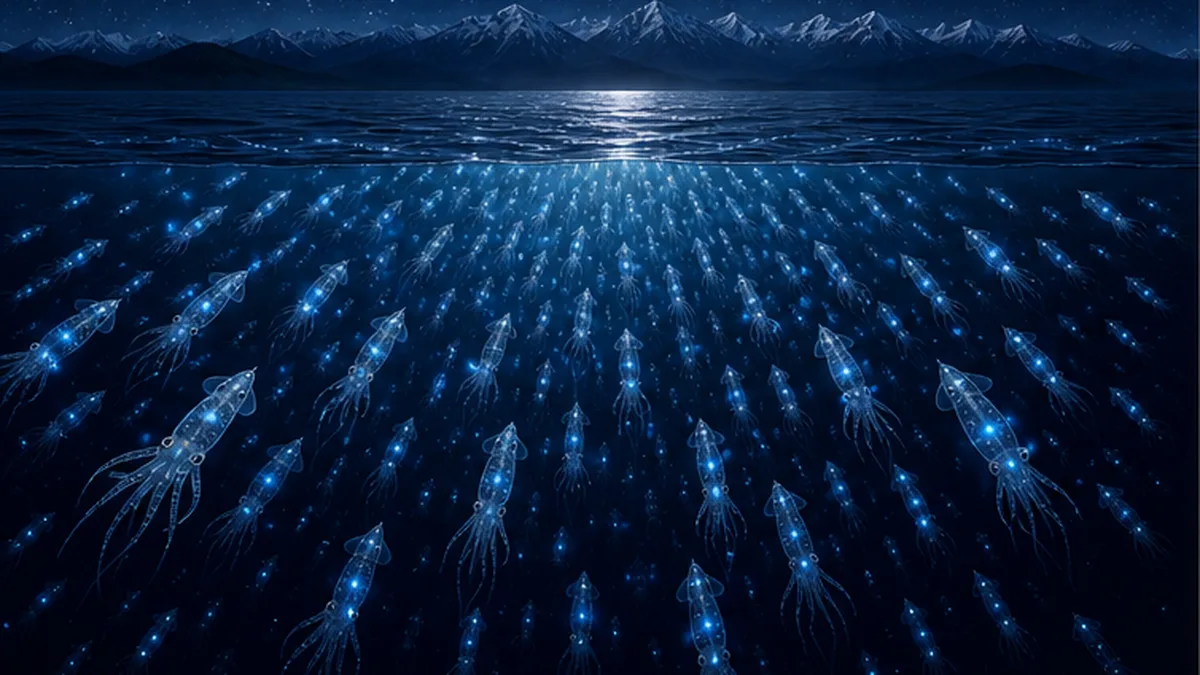
Lanternfish - the unnamed stars of the deep scattering layer
Lanternfishes are small mesopelagic fishes with rows of photophores along their sides and bellies; about 250 species are known worldwide and more than 80 around Japan. They are regarded as the most dominant group in the mesopelagic zone everywhere except the Arctic, and they are the main constituents of the deep scattering layer. Many species perform diel vertical migration, staying in the mesopelagic by day and rising near the surface at night to eat crustacean zooplankton. The photophores on the belly are thought to match the dim background when seen from below, erasing the silhouette - counter-illumination.
Their biomass is immense, yet there is almost no commercial fishery for lanternfishes anywhere in the world: they are small, watery and spoil quickly. But they are an important food for tuna and skipjack, whales and squids, and at the same time they are couriers carrying carbon into the deep. As discussed below, how to treat this apparently "untouched giant resource" has become an international question.
| Species | Waters | Daytime depth | Night-time depth | Relation to fisheries |
|---|---|---|---|---|
| Firefly squid | Toyama Bay and other Sea of Japan waters | Around 200 m (habitat 200-600 m) | Rises into shallow coastal water | Spring set-net fishery; the swarming area is a Special Natural Monument |
| Sakura shrimp | Suruga Bay | 200-300 m | 20-50 m | Night-time boat seine fishery; stock management is now a challenge |
| Lanternfishes | Around Japan and the world's open oceans | 200-1,000 m | Near the surface | Almost no commercial fishery; important prey for tuna and others |
A migration that moves the climate - "swimming carbon transport" and the biological pump
Now to what diel vertical migration means on a planetary scale. The ocean has absorbed a considerable share of the carbon dioxide humanity has emitted, and one of the mechanisms behind that is the biological pump - the flow that carries surface carbon into the deep through the work of living things. Vertically migrating animals are an important part of that pump.
Carbon that sinks, and carbon that is carried by swimmers
The biological pump has several pathways. The longest known is gravitational settling, in which dead plankton and faecal particles sink slowly. But it became clear that more carbon reaches the deep than that pathway alone can explain. Attention therefore turned to active transport - the pathway in which animals carry the carbon down themselves by swimming.
The mechanism is simple. Zooplankton and mesopelagic fishes eat phytoplankton and smaller animals at the surface during the night. Before dawn they move to depth, where they defecate, respire carbon dioxide, and are sometimes eaten so that their bodies remain there. Carbon taken up at the surface is thus shortcut hundreds of metres downward within hours, without waiting for particles to sink. Carbon released at depth can take decades to centuries to return to the surface, and for that time it is isolated from the atmosphere.
Raising carbon export from the sunlit layer by about 14%
How big is this active transport? Archibald and colleagues' modelling study (2019, Global Biogeochemical Cycles) built zooplankton diel vertical migration into a global export model and estimated that carbon export out of the sunlit layer increases by about 14% compared with considering sinking particles alone. Across the world ocean, that is large enough to matter for the atmospheric carbon budget. In terms of ocean carbon sequestration, the role of the open-ocean mesopelagic deserves attention alongside the blue carbon held by coastal seagrass meadows and tidal flats.
What determines the efficiency of this pathway is the depth at which the carbon is released. Carbon released near the surface returns to the atmosphere quickly through upwelling and winter mixing. Carbon released below the thermocline and below the base of the mixed layer, by contrast, stays away from the surface for a long time. So the deeper an animal migrates, the greater its per-individual contribution to climate. That depth effect is why the fishes and shrimps that descend into the lower mesopelagic (500-1,000 m) have drawn particular attention in recent years.
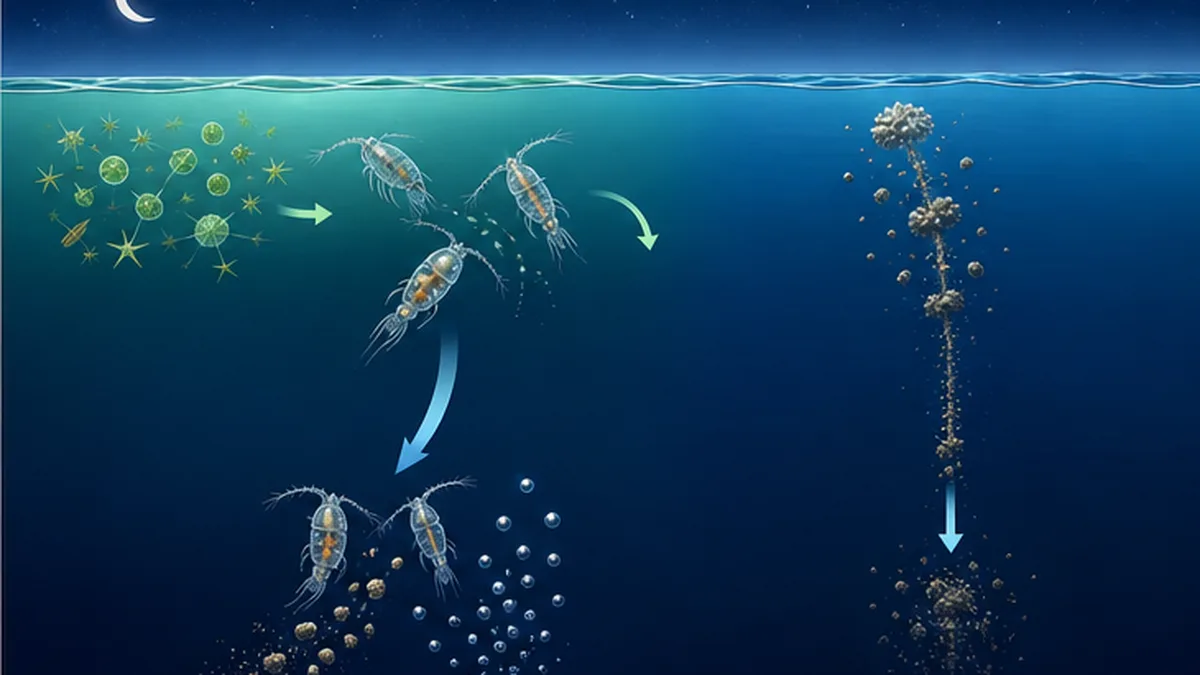
Changing where oxygen is consumed
Carbon is not the only thing transported. Migrating animals respire at depth during the day, which means they shift the place where oxygen is consumed from the surface into mid-water. In 2013 Bianchi and colleagues published work in Nature Geoscience showing that vertically migrating animals intensify oxygen depletion in the open ocean, pointing to a role for migration in mid-water deoxygenation. Conversely, where oxygen minimum zones reach shallow depths, animals cannot dive as deep and their migration range is observed to be compressed. Migration and the oxygen environment influence each other.
A flux that has been calculated and modelled, but not measured
One caveat must be stated honestly. The magnitude of active transport has almost never been measured directly. A review in the Annual Review of Marine Science says so in its very title: calculated and modelled, but never measured. Animal numbers, body sizes, digestion timing, respiration at each depth, losses to predation - each carries large uncertainty, and chasing them from a ship to measure them is extremely difficult. So the figure of 14% is the best available estimate, not a settled value. Observing vertical migration remains a frontier for reducing uncertainty in climate models.
The role of vertical migration in the biological pump
- A shortcut pathway that carries surface carbon hundreds of metres down within hours
- Estimated to increase carbon export from the sunlit layer by about 14% (Archibald et al. 2019)
- Also shifts oxygen consumption from the surface into mid-water, possibly contributing to deoxygenation
- But direct measurement is extremely hard, so the magnitude carries large uncertainty
Nights that humans have changed - light pollution, warming and mesopelagic fishing
Diel vertical migration depends entirely on light as a natural cue. That is exactly why human alteration of the ocean's light, temperature and biomass disturbs this vast migration directly. Here are three disturbances now under discussion.
A ship's working lights change behaviour 200 metres down
The most direct is artificial light at night (ALAN). Ludvigsen and colleagues (2020, Communications Biology) showed that in the Arctic polar night the ordinary working lights of a research vessel disturbed the behaviour of fish and zooplankton down to at least 200 m and over an area larger than 0.125 km² around the ship. When the lights came on, animals changed position and swimming behaviour within seconds. Ironically, this also means the natural state you want to measure is destroyed by the approach of the research vessel itself. The more coastal streetlights, aquaculture facilities and ship lights increase, the more the darkness of the night sea - itself a resource - is eroded.
Warming and changing clarity change the depth
Migration depth is strongly governed by the depth of the isolume, which depends on water clarity and the height of the sun. That means if warming heats the surface water, strengthens stratification and changes the distribution and abundance of phytoplankton, the way light penetrates changes too - and so do the depth of the migration and the timing of arrival. If the water at the destination warms, the benefit of "saving metabolism in the cold deep" also fades. If the times and depths at which predator and prey meet shift apart, the connections of the food web themselves can change. Just as fish distributions shift northward, warming is rewriting the coordinates of where animals live in the vertical direction too.
The change also appears as a mismatch in time. Relationships between organisms require not only being in the same place but being there at the same hour. If the time when prey plankton rise and the time when juvenile fish are at the surface drift apart, food can be present and still go uneaten. What terrestrial ecology calls phenological mismatch can occur in the sea as a shift of hours within a single day.
Should we touch this "untapped giant resource"?
Now that the mesopelagic zone has been estimated to hold about 10 billion tonnes of fish, proposals to harvest this layer for fishmeal, fish oil and aquaculture feed are being examined around the world. The concerns are serious, and at least the following have been raised. First, mesopelagic fishes are a staple food for top predators including tuna, skipjack, whales and seabirds, so large catches would ripple through the entire open-ocean food web. Second, they are the couriers that carry carbon into the deep, so depleting them could mean cutting into the climate-regulating service itself. Third, knowledge of their stock dynamics, lifespan and growth is still too thin to design credible management.
Main concerns about mesopelagic fishing
- It could take food directly from top predators such as tuna, whales and seabirds
- It risks damaging the work of carrying carbon into the deep - a climate-regulating service
- Scientific knowledge of stock size, growth and lifespan is scarce, making catch limits hard to design
- Profitability is unproven, with no established use that justifies the fuel and effort
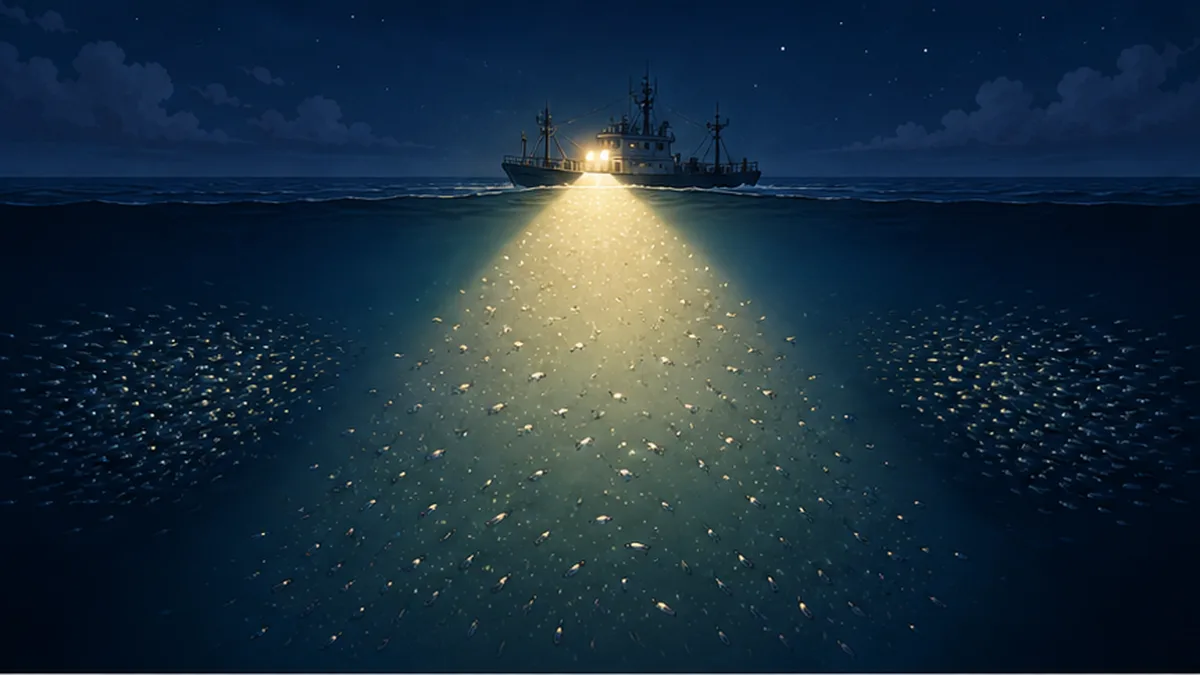
Enjoying the night sea - tips for watching, and what we can do
Finally, a way of seeing this phenomenon not only as something to protect but as something to enjoy. Diel vertical migration is one of the few great natural spectacles you can glimpse a piece of at an ordinary harbour, with no telescope and no specialised vessel, if conditions are right.
To Toyama Bay in spring - or to the harbour down the road
The clearest experience is the firefly squid of Toyama Bay. On spring nights in the spawning season, sightseeing boats run to see the squid glowing blue-white in set nets. You do not have to travel far, though: look down at the water from a harbour or pier at night and you may see plankton and small fish gathering to the light. Scoop seawater into a clear cup and hold it up to a lamp, and you can sometimes make out zooplankton as small moving specks. It is enough to feel that the sea has a different face at night.
Manners for watching
Here it is worth remembering the previous chapter on artificial light. Shine a strong light on the water for a long time and the animals abandon their natural behaviour. Watch with as dim a light as possible, for as short a time as possible. Red light is thought to affect many organisms comparatively little. And because the shore at night brings risks of falling in and of high waves, do not neglect safety: a light for your feet, a life jacket, and company.
The idea of protecting darkness
"Do not produce litter" and "choose sustainable seafood" are well known as things we can do for the ocean. Try adding one more: reduce light you do not need. Do not aim coastal lighting toward the sea, avoid pointing floodlights upward, and switch off lighting that serves no purpose at night. This saves energy too, and it helps migratory birds and the nesting and hatching of sea turtles. For marine life, the darkness of night is an environmental condition as important as temperature or oxygen.
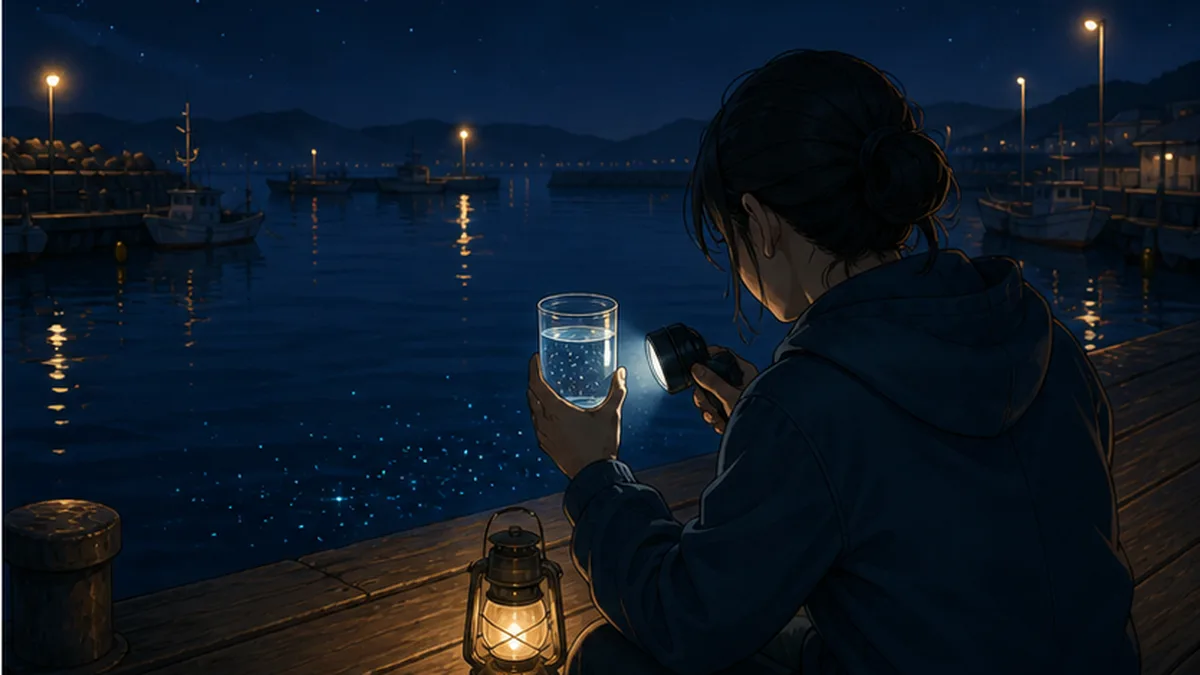
What you can do today
- On a spring night, look for firefly squid in Toyama Bay - or just look down at the water at your local harbour
- Watch with a dim light for a short time; never keep a strong beam on the water (red light is comparatively gentle)
- Do not aim outdoor lighting toward the sea or upward, and switch off unnecessary night-time lights
- Follow the news on mesopelagic resource use - "untapped" does not mean "free to take"
- Tell family and friends about the nightly migration as a story about ocean carbon and food webs
Animals shorter than your finger travel hundreds of metres up and down the dark ocean every night - a movement greater in total than any other animal migration on Earth, and one that reaches as far as the fate of atmospheric carbon. The richness of the sea is not sustained by conspicuous large animals alone. The daily lives of small, unnamed, uncountably numerous creatures are quietly tuning the breath of the planet. Change the way you look at the night sea, and this planet may look a little different too.
References and sources
- NOAA Ocean Exploration – What is the deep scattering layer? (explains the layer and why DVM is the largest organised animal movement)
- Nature Communications – Irigoien et al. (2014) Large mesopelagic fishes biomass and trophic efficiency in the open ocean (mesopelagic fish biomass estimated at about 10 billion tonnes)
- Limnology and Oceanography – Bianchi & Mislan (2016) Global patterns of diel vertical migration times and velocities from acoustic data
- Global Biogeochemical Cycles – Archibald, Siegel & Doney (2019) Modeling the Impact of Zooplankton Diel Vertical Migration on the Carbon Export Flux of the Biological Pump (about a 14% increase)
- Current Biology – Last et al. (2016) Moonlight Drives Ocean-Scale Mass Vertical Migration of Zooplankton during the Arctic Winter
- Communications Biology – Ludvigsen et al. (2020) Artificial light during the polar night disrupts Arctic fish and zooplankton behaviour down to 200 m depth
- National Institute for Physiological Sciences / Institute for Molecular Science (Japan) – An ultraviolet-sensor protein working in the brain of a planktonic larva (June 2017, published in the Journal of Biological Chemistry)
- Annual Review of Marine Science – Active Carbon Transport by Diel Vertical Migrating Zooplankton: Calculated and Modeled, but Never Measured (a review of how hard the flux is to measure)
- Toyama Firefly Squid Association – The mystery of Toyama Bay: firefly squid (habitat depth, spawning-season ascent, photophores)
- Shizuoka University – Suruga Bay Sakura Shrimp Stock Restoration Research Project
* Listed in order of reliability: government/academic institutions > peer-reviewed papers > specialized organizations > reliable media