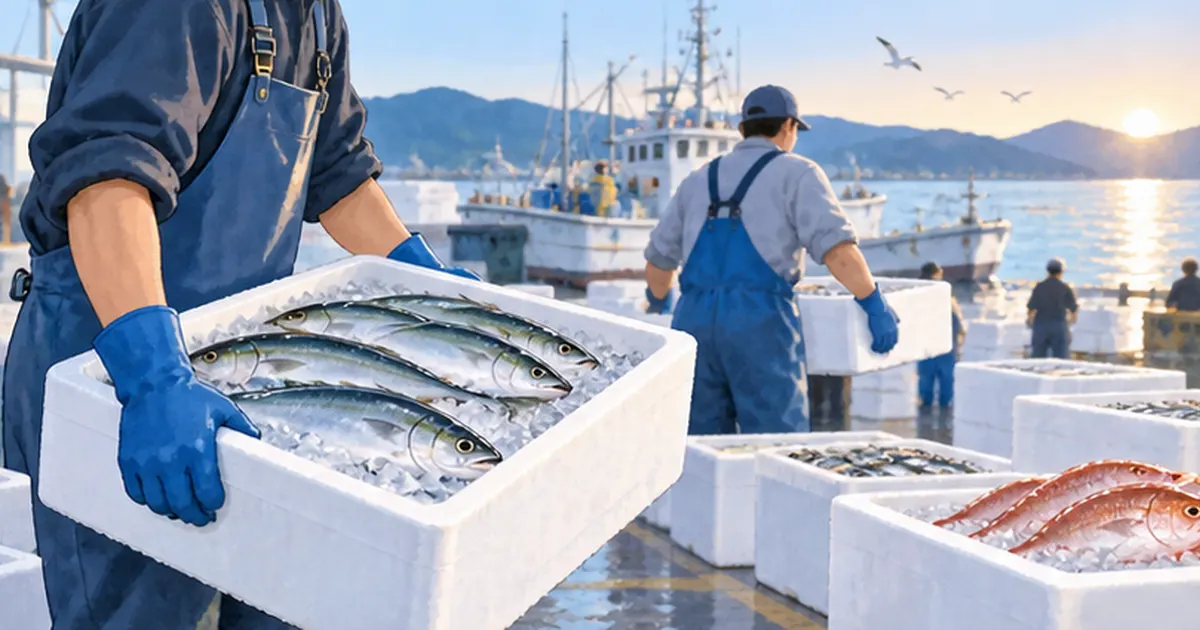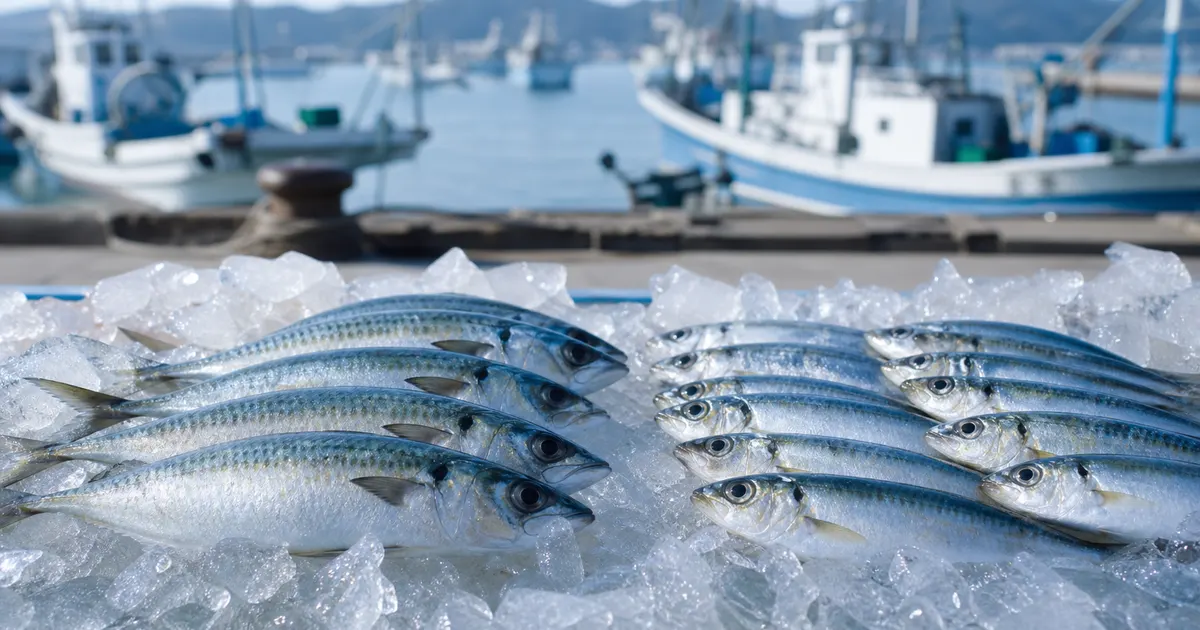
⚡ The answer in 30 seconds
- The main sources of loss in conveyor-belt sushi are unsold pre-made plates, processing residues and leftovers.
- National estimates put FY2023 food loss at 4.64 million tonnes, with food service up to about 0.66 million tonnes.
- Shifting to made-to-order and demand forecasting can cut disposal from pre-made items.
- Using up whole catches of low-utilized fish eases demand concentration and lightens pressure on fishery resources.
Behind every plate on a conveyor-belt sushi lane, food loss arises at each stage: sourcing, processing, preparation and service. Food loss is the issue at stake.
Japan's food loss is trending downward, but the food service sector has gone up. Using conveyor-belt sushi as an example, this article sorts out the causes and the countermeasures.
From ordering-system tweaks to using up whole catches, we explain how this connects to the fishing industry, with figures and tables.
What you will learn
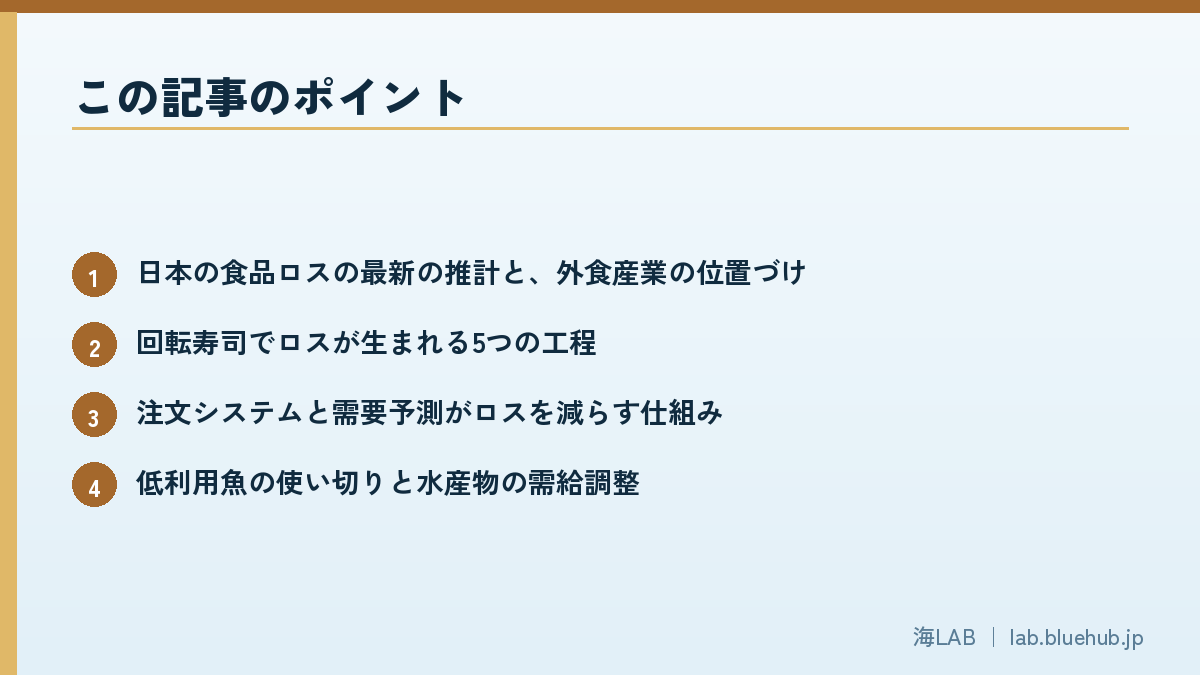
- The latest national food loss estimates and where food service stands
- The five stages at which conveyor-belt sushi generates loss
- How ordering systems and demand forecasting reduce loss
- Using up low-utilized fish and balancing seafood supply and demand
- Concrete actions for restaurants and households
Why food loss matters in conveyor-belt sushi
Conveyor-belt sushi is appealing because you can simply pick the plates you like as they pass by. The flip side is that making sushi in advance and sending it round on the expectation that someone might order it makes unsold items likely. Sushi uses fresh seafood, so quality drops over time and, for safety reasons, it cannot be served indefinitely. Conveyor-belt sushi is therefore a business where the balance between freshness and waste is always at stake.
The big picture of food loss in Japan
According to estimates by the Ministry of Agriculture, Forestry and Fisheries, the Ministry of the Environment and the Consumer Affairs Agency, Japan's food loss in FY2023 was 4.64 million tonnes, down 80,000 tonnes from the previous year. Of this, business-sector food loss from food-related businesses was 2.31 million tonnes, about 58% lower than the FY2000 level. The national goal of halving business-sector food loss from the FY2000 level by FY2030 has thus already been met.
The picture differs, however, for the food service sector alone. Its food loss rose to about 660,000 tonnes in FY2023 from about 600,000 tonnes the year before, an increase of 60,000 tonnes. The Ministry of Agriculture, Forestry and Fisheries explains that this reflects the return of dining out after the pandemic and a rise in foreign visitors.
| Category | FY2022 | FY2023 |
|---|---|---|
| Total food loss | 4.72 million t | 4.64 million tonnes |
| Business-sector food loss | 2.36 million t | 2.31 million t |
| Food service | about 0.60 million t | about 0.66 million t |
| Food manufacturing | about 1.17 million t | about 1.08 million t |
| Food retail | about 0.49 million t | about 0.48 million t |
Breakdown of food service loss
Most food loss in food service comes from diners' leftovers and from pre-service disposal caused by over-preparation or unsold items. Banquets at izakaya and hotels mostly produce leftovers, but in formats like conveyor-belt sushi, where food is prepared in advance and sent around the lane, unsold items weigh more heavily.
- Leftovers: portions ordered but not finished
- Over-preparation: ingredients left over after misjudging customer numbers
- Trimmings: edible parts of fish such as scraps, skin and bones that go unused
- Expired items: plates that stay on the lane past the time limit
Purpose of this article
- Using conveyor-belt sushi as an entry point, we organize the relationship between food loss countermeasures and fishery resources. We look beyond ordering-system ideas to “using everything” at the sourcing stage.
How conveyor-belt sushi works and where loss arises
The shortcut to reducing food loss is to break the process into stages and ask where waste occurs. Conveyor-belt sushi can be divided into five stages: sourcing, processing, preparation, service and eating.
Sourcing and processing
Fish catches depend on weather and sea conditions, so it is hard to secure the same volume of the same species every day. When a chain tries to offer the same menu at stores nationwide, it ends up choosing only fish of a certain size and fat content, and off-spec fish tend to lose their place. The head, bones, skin and other processing residuesproduced when cutting fillets are also discarded if they have no use.
Preparation and service
Sushi is best eaten right after it is made, but with a lane system, plates are made and sent round while waiting for orders. Because the toppings dry out or warm up on the way, many restaurants set a time during which quality is maintained and remove plates past it. Plates removed this way generally cannot be served again and are discarded.
- If demand forecasts miss, either overproduction (waste) or underproduction (lost sales) occurs
- The gap between peak and quiet periods is large, so the right quantity changes by time of day
- The larger the menu, the more slow-moving items there are
Eating
Leftovers also occur when diners take too many plates, leave wasabi they dislike, or leave only the rice. This is especially common with children, who may take plates out of curiosity and be unable to finish them.
| Stage | Main cause of loss | Direction of countermeasures |
|---|---|---|
| Sourcing | Off-spec or unused fish are not used | Buy whole catches; review specifications |
| Processing | Scraps, skin and bones discarded | Convert to processed products, feed or fertilizer |
| Preparation | Unsold pre-made items | Cook to order |
| Service | Expiry on the lane | Manage the quantity and time on the lane |
| Eating | Leftovers | Portion choice and finish-your-food awareness |
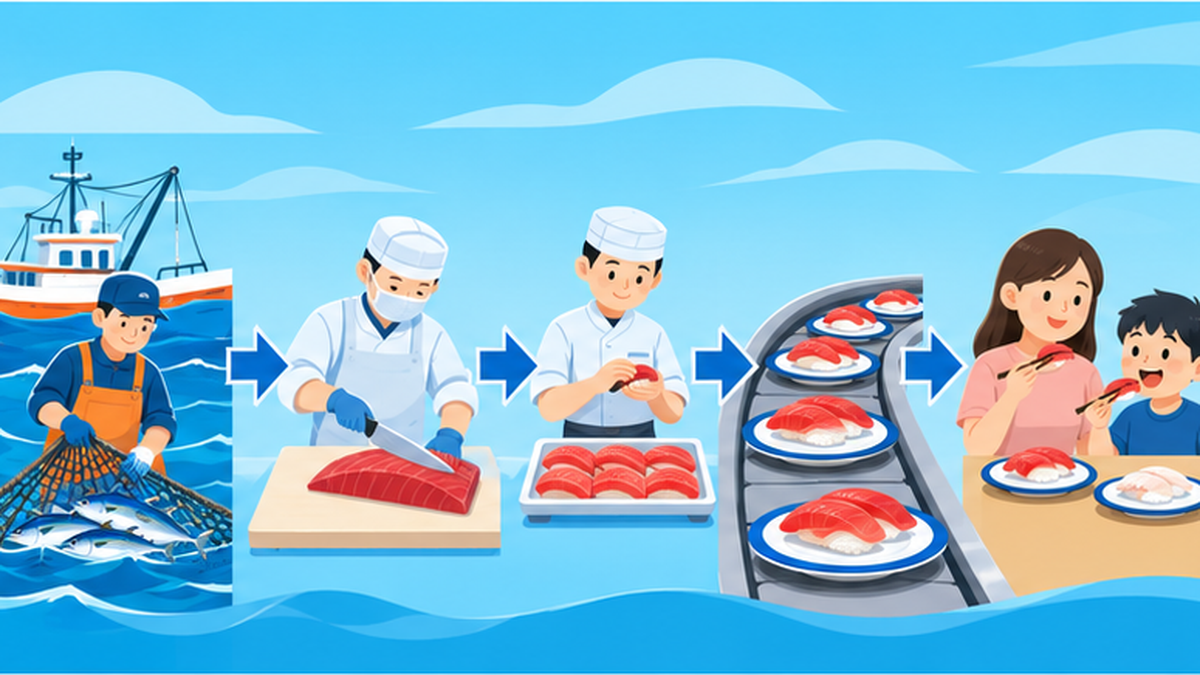
Evolution of ordering systems and how they cut loss
In recent years, many conveyor-belt sushi chains have introduced ordering via touch panels or dedicated apps. This change in ordering has greatly altered how food loss arises.
From made-to-forecast to made-to-order
Previously, staff judged by experience how much sushi to send round the lane, but with order information they can make what is actually wanted. When ordered items are delivered on a dedicated lane, there is less worry about spoilage while in transit, and the time food sits pre-made is shorter. However, making every plate order-only would reduce the casual appeal unique to conveyor-belt sushi, so each company balances “lane plates” and “ordered items”.
Demand forecasting with data
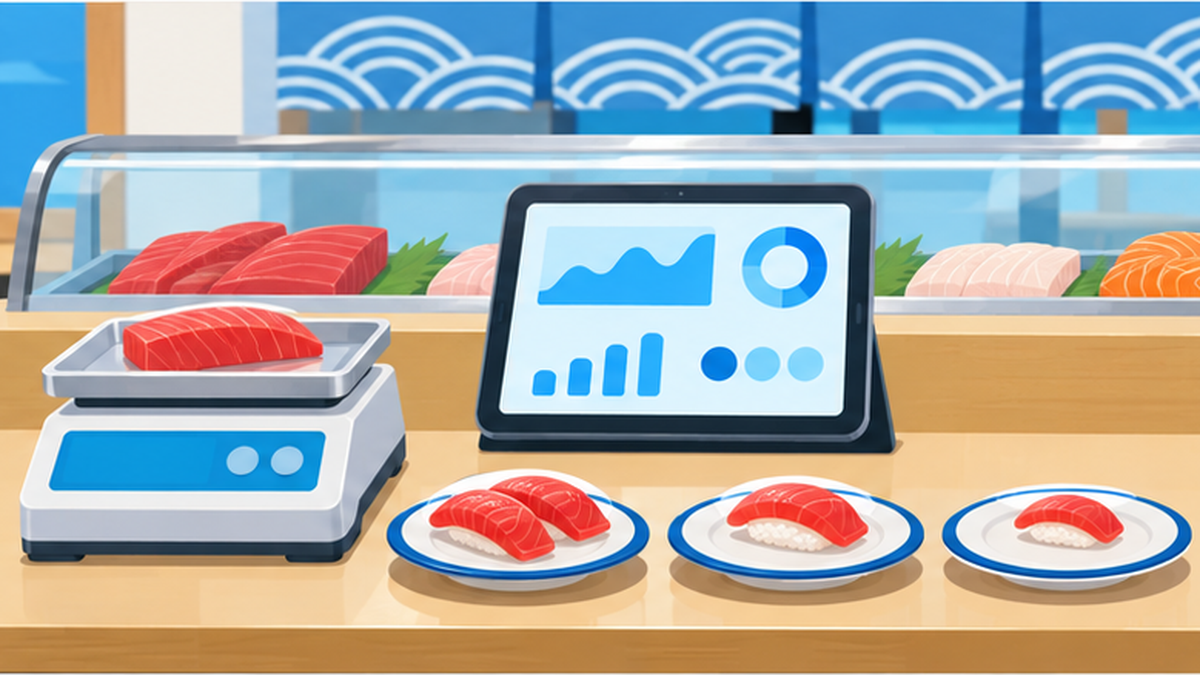
When data such as order history, visitor numbers, weather and day of the week are available, it becomes easier to predict which items will sell in what quantities by time of day. The better the forecast, the less over-preparation occurs. Many food service chains take this approach, and it is an area where cutting food loss and cutting costs go hand in hand.
Point
- The effect of ordering systems is not only less loss. Because “what I want reliably arrives”, diners can also be expected to take fewer extra plates.
Systems that let diners choose portions
Services that let diners choose the amount of rice or the number of pieces per plate are effective in the sense of matching what can be finished. In the “finish your meal” initiatives promoted by the Ministry of Agriculture, Forestry and Fisheries, small portions and portion choice are introduced as typical measures.
- Offer small portions so diners can pick what they can finish
- Provide a portion-selection screen when ordering
- Use prompts and signs to prevent taking too much
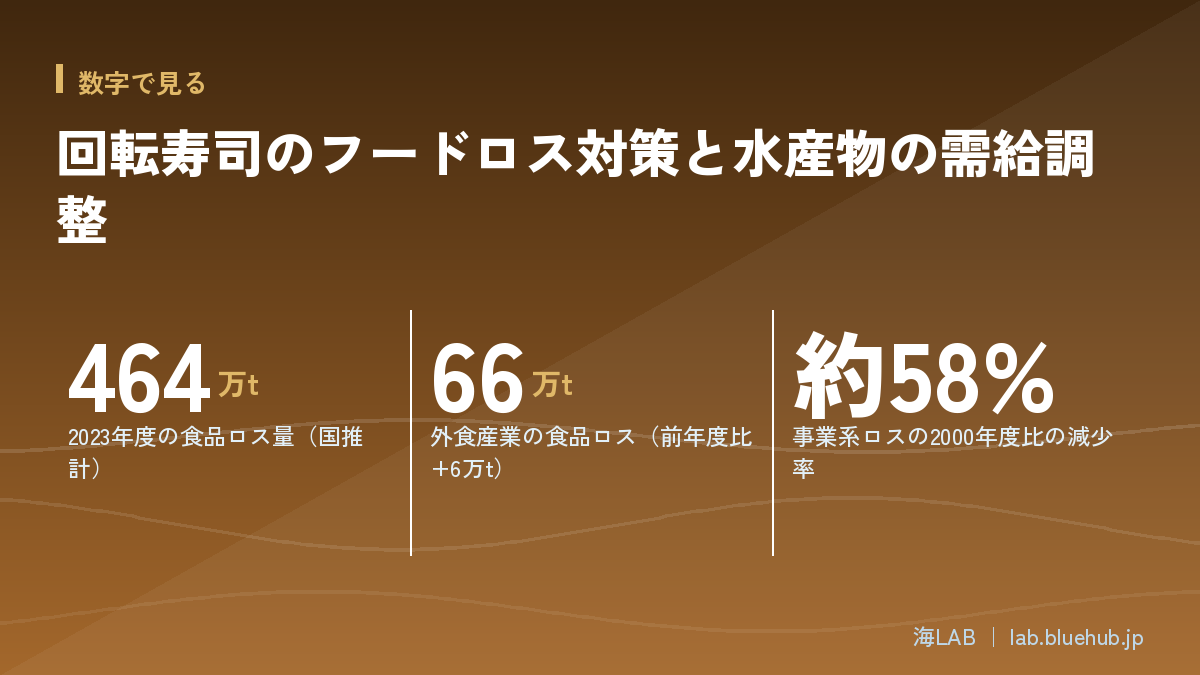
Using up the catch: low-utilized fish and “100% fish”
Food loss measures are not complete with diners' efforts to reduce leftovers alone. “Reducing unusable fish” at the point of sourcing is also important for fishery resources.
What are low-utilized fish?
Low-utilized (unused) fish are fish that, even when caught, fetch low prices and are hard to distribute because of size, appearance, low recognition or difficulty of handling. Even when they are caught in the net, they have been returned to the sea as bycatch or sent to cheap feed. Even when taste is no issue, chains find them hard to handle because a fixed quantity cannot be secured reliably.
Case study: Kura Sushi
The company operating Kura Sushi has described buying catches mixed with low-utilized fish whole from fishers and processing them at its own processing center for sale as products. Municipal materials cite the “100% Fish Project” to use up whole catches, and a case of selling nizadai (a surgeonfish), regarded as one cause of isoyake (seaweed bed loss), after feeding it cabbage to reduce its odor.
How to read this case
- This is an introduction based on companies' published materials. For effect figures, please check announcements by the companies and municipalities. It is presented here as an example of the idea of “using everything at the sourcing stage.”
Why unused fish are increasing
- Warming seas and other changes mean species not previously caught now enter the nets
- Demand concentrates on popular species while others are left over
- Small and off-spec fish fetch low prices relative to the processing effort
What is seafood supply–demand adjustment?
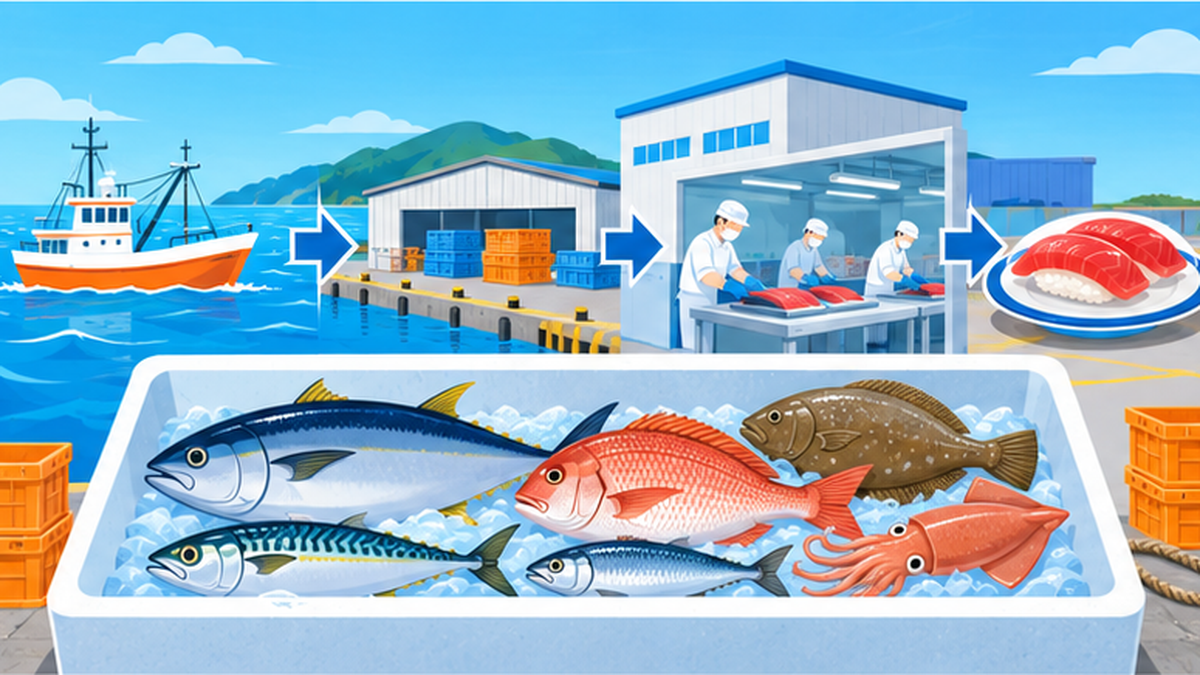
What links conveyor-belt sushi food loss to the fishing industry is the idea of supply–demand adjustment. It means narrowing the gap between how much can be caught (supply) and how much people want to eat (demand).
Catches do not follow a plan
Unlike farm products, fish cannot be scheduled in advance for when and how much will be caught. Prices fall on big-catch days and rise on poor-catch days. Because schools of fish are affected by water temperature and currents, the species and timing of catches have been changing in some sea areas in recent years.
How chain menus can distort supply and demand
The more demand gathers on popular toppings, the more fishing pressure concentrates on particular species. Conversely, fish with no demand go unused and are sometimes disposed of at the port. Rotating the menu flexibly to make use of what is caught, instead of fixing it, is one way of adjusting supply and demand from the demand side.
| Approach | Content | Example in conveyor-belt sushi |
|---|---|---|
| Spreading demand | Choose varied fish rather than favoring popular species | Add low-utilized and local fish to the menu |
| Smoothing supply | Preserve by freezing or processing during big catches | Use processed and frozen toppings |
| Relaxing specifications | Do not insist on shape or size | Buy off-spec fish |
| Sharing information | Know catch information in advance | Cooperation with production areas |
Point
- Food loss countermeasures are not separate from resource management. Not wasting the fish that are caught can also be an indirect way to prevent overfishing.
Concrete loss-reduction measures for restaurants
Here we sort out measures that restaurants, not only conveyor-belt sushi, can adopt easily.
Before service
- Record orders by day and time of day and review preparation quantities
- Reduce the number of plates sent round and raise the share of ordered items
- Divert scraps and skin from processing to staff meals and processed products
- Make stock visible and use first-in items first
During and after service
- Manage time on the lane thoroughly and record the volume of plates removed
- Prepare small and half-size menu items
- Offer take-home (with hygiene cautions)
- Measure discarded volume and set reduction targets
Encouraging diners to finish their food
The Ministry of the Environment and the Ministry of Agriculture, Forestry and Fisheries urge diners to finish their food when eating out. Small actions add up: thinking about the amount before ordering, and saying early if you cannot finish.
Checklist for restaurants
- Do you record discarded volume daily?
- Do you record the basis of demand forecasts?
- Do you have a use for scraps and skin?
- Do you show diners portion options?
What households and consumers can do
Food loss changes greatly through the behavior of users as well as stores.
When eating out
- Do not take too much at once; add a little at a time
- Ask for disliked ingredients to be left out when ordering
- Order with the number of people and amounts you can finish in mind
- Check whether take-home is possible if you cannot finish
What to look for when choosing fish
Trying seasonal fish, locally caught fish and species you do not normally choose is a step toward avoiding demand concentrating on specific species. Certification labels such as MSC and ASC also serve as a guide for choosing.
Bringing it into learning
Learning programs also exist, such as Kura Sushi's visiting class “Learning SDGs through Sushi”, in which children use an actual lane to experience how sushi left untaken becomes food loss. Some have been run as part of local government and Nippon Foundation “Sea and Japan Project” initiatives. At home, simply talking about “how much can we eat?” before going out to a conveyor-belt sushi restaurant creates a learning opportunity.
Summary
- Choosing an amount you can finish reduces waste at the restaurant and lightens the load on fishery resources.
Challenges and outlook
Although food loss is trending downward, it has turned upward in the food service sector. As demand returns, efforts not to increase waste become all the more important in food service, including conveyor-belt sushi.
Challenges
- Improving forecast accuracy requires accumulating data and operational effort
- Securing stable volumes and prices of low-utilized fish is a challenge
- Changing diners' behavior requires clear information
Outlook
If AI demand forecasting, sharing of catch information and processing technology for low-utilized fish advance, waste could be cut continuously from sourcing to the table. Enjoying the ocean's bounty without waste also helps sustain food culture while protecting resources.
Related topics: see also Food loss at Toyosu Market、Upcycling seafood by-products、Seafood traceability.
Also read Food loss at convenience stores.
References and sources
- MAFF: Food loss in FY2023 (press release) – Estimates including 4.64 million tonnes of food loss and 2.31 million tonnes of business-sector loss
- MAFF: Food loss in FY2022 (press release) – FY2022 estimate and announcement that the target was met
- Ministry of the Environment: Press release on food loss and food recycling – Release of food loss estimates
- Consumer Affairs Agency: Food loss reduction – Information on food loss reduction initiatives
- Shiga Prefecture: Case materials on food loss reduction – Cases including Kura Sushi's initiatives
- nippon.com: Food loss in FY2023 was 4.64 million tonnes – Commentary on the estimates
- Fisheries Agency – Information on fishery resources and policy
* Listed in order of reliability: government and academic institutions > peer-reviewed papers > specialist organizations > reliable media