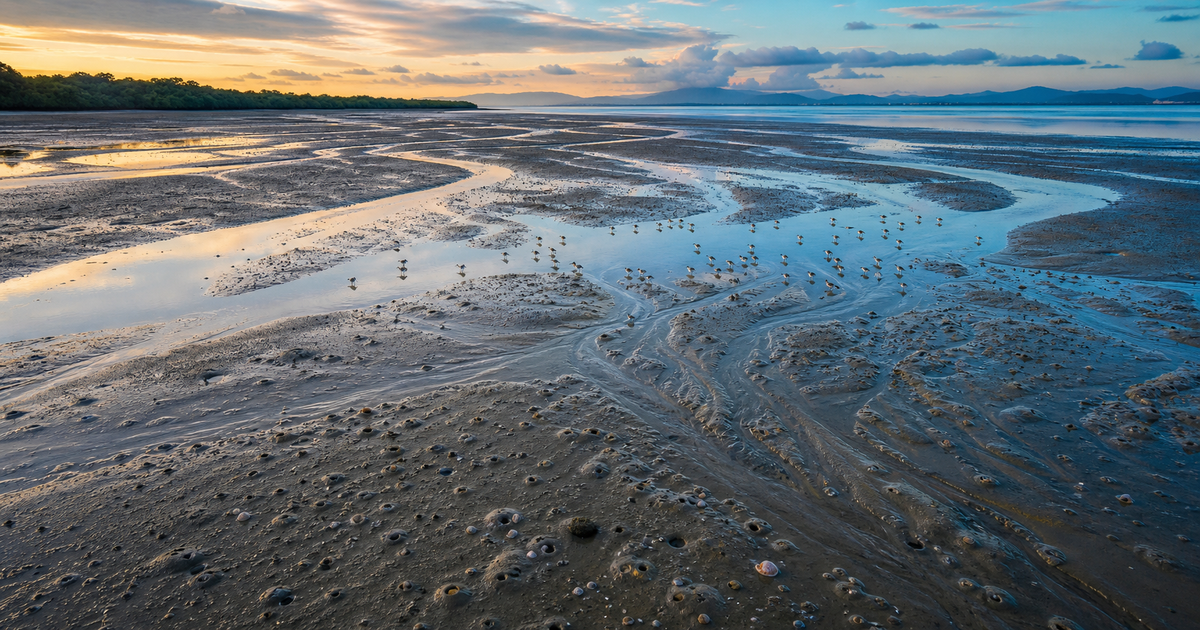
At low tide, a plain of mud and sand stretches out endlessly along the shore. At first glance, this "sea of mud" looks like it holds nothing at all — but a tidal flat is actually one of the most productive ecosystems on Earth. Countless creatures grow up there, migratory birds cross entire continents to rest their wings, and turbid seawater is slowly clarified. A tidal flat is both a "cradle of the sea" and a "natural water treatment plant."
In Japan, however, land reclamation since the era of rapid economic growth has already erased about 40% of the country's tidal flats. Looking worldwide, 16% of tidal flats were lost in just the 33 years from 1984 to 2016. At the same time, there are places like Fujimae Tidal Flat in Nagoya, where citizens' efforts halted a reclamation plan, and restoration projects now under way in the Ariake Sea and Tokyo Bay.
Drawing on primary sources such as surveys by the Ministry of the Environment and the Fisheries Agency, and peer-reviewed research, this article carefully unpacks the roles tidal flats play, the history of their loss, and the conservation and restoration efforts under way around the country. By the time you finish reading, that "sea of mud" should look completely different to you.
What you'll learn in this article
- How tidal flats form, and how they divide into three types — open-coast, estuarine, and lagoon
- The mechanism behind the "natural purification system" by which clams and bacteria clean seawater
- Why tidal flats are a life-or-death stopover for migratory shorebirds
- How much tidal flat area has been lost in Japan and around the world, and why
- The environmental changes the Isahaya Bay reclamation brought to the Ariake Sea, and the lessons learned
- The front lines of conservation and restoration under way at Fujimae Tidal Flat, Sanbanze, and the Ariake Sea
What is a tidal flat? — a special place shaped by the ebb and flow of the tide
A tidal flat is a flat expanse of mud or sand that, day after day, sinks beneath the sea at high tide and emerges into the open air at low tide. At high tide it becomes the seafloor; at low tide it reveals a vast plain broad enough to walk across. It is precisely this dramatic environmental shift — becoming sea and then land, twice a day — that makes a tidal flat unlike any other place.
Several conditions must come together for a tidal flat to develop. First, a large difference between high and low tide. Second, a calm, enclosed bay where fine sediment carried by rivers can settle quietly. And third, a gently sloping, shallow seafloor. In Japan, enclosed inner bays fed by major rivers — such as the Ariake Sea, Tokyo Bay, and the Seto Inland Sea — meet all these conditions, nurturing rich tidal flats.
The ebb and flow of the tide is generated by the gravitational pull of the moon and sun. The sea bulges on the side facing the moon and on the opposite side, and as the Earth rotates, most sea areas experience roughly two high tides and two low tides a day. The difference in water level between high and low tide is called the "tidal range," and the larger this range, the wider the tidal flat that emerges when the tide goes out. The Ariake Sea is known as having the largest tidal range in Japan, reaching around six meters at spring tide. That is precisely why the Ariake Sea has developed tidal flats so vast they stretch as far as the eye can see.
The mud and sand of a tidal flat are never uniform. Fine mud accumulates in areas close to rivers, sandier ground appears closer to the open sea, and channels where the tide flows like a waterway — called "mio-suji" — cut through. Even subtle differences in terrain and grain size change which creatures make their home there. This fine, mosaic-like diversity of environments is a hidden reason behind the high biodiversity of tidal flats.
Tidal flats fall into three types
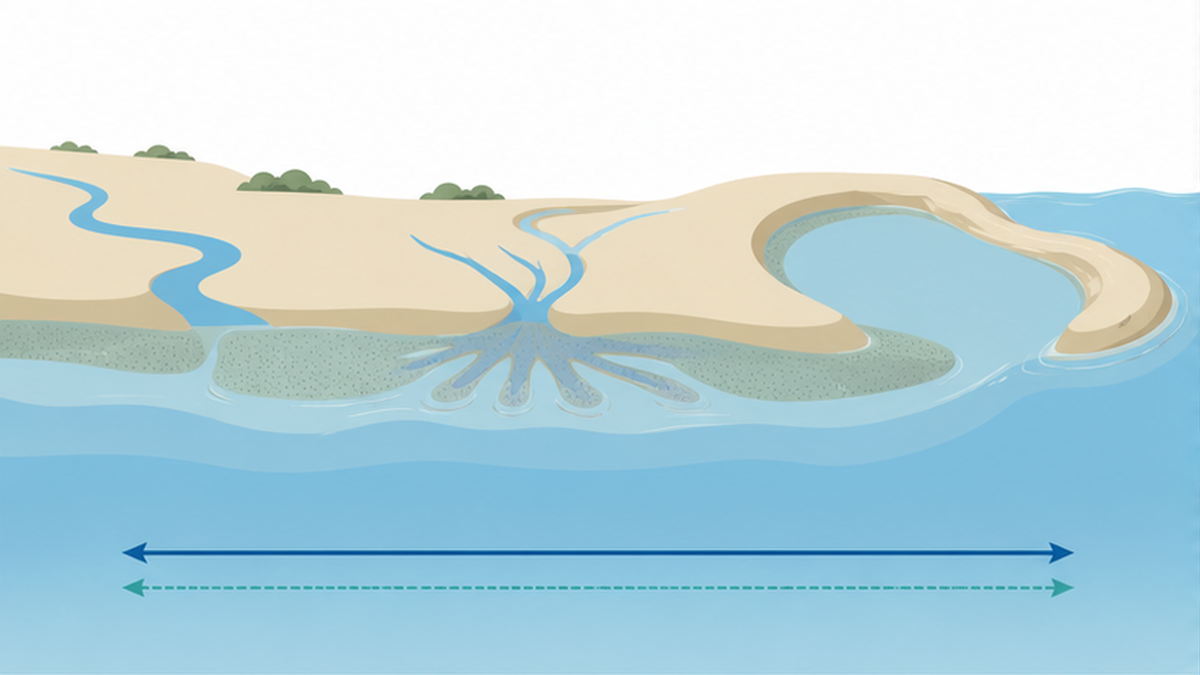
In the Ministry of the Environment's Basic Survey on Natural Environment Conservation, tidal flats are broadly classified into three types according to how they form. Most of the tidal flats we see along the shore are "open-coast tidal flats" facing the open sea.
- Open-coast tidal flats: the most common type, developing along the shoreline of the open sea or an inner bay. They make up the majority of Japan's total tidal flat area.
- Estuarine tidal flats: tidal flats that form where a river meets the sea. Fresh water and seawater mix, making them nutrient-rich and highly biodiverse.
- Lagoon tidal flats: extremely calm tidal flats that form inside an inlet (lagoon) separated from the open sea by a sandbar or similar feature.
| Tidal flat type | Nationwide area (1994 survey) | Characteristics |
|---|---|---|
| Open-coast tidal flats | ~33,048 ha | The largest type, following the shoreline |
| Estuarine tidal flats | ~15,777 ha | A nutrient-rich zone where river meets sea |
| Lagoon tidal flats | ~2,853 ha | A calm environment inside a lagoon |
| Artificial tidal flats, etc. | ~271 ha | Constructed tidal flats |
The surface of every single grain of mud and sand on a tidal flat is densely coated with invisible microalgae (such as diatoms) and countless bacteria. When the tide goes out and sunlight reaches the surface, these microalgae begin photosynthesizing all at once, and the entire tidal flat springs to life as a giant "food production factory." This quiet, steady primary production is the foundation for all the abundance of a tidal flat.
The richness born at the boundary between land and sea
A tidal flat, neither fully land nor fully sea but somewhere in between, is called an "ecotone" (a transition zone). It is known that where two worlds meet, elements of both mix together and unexpectedly rich life gathers at the boundary. A tidal flat, where seawater meets fresh water, water meets air, and light meets mud, is a place that truly embodies this liveliness of boundaries. Only creatures able to endure the "fluctuations" of being submerged and exposed twice a day, and seasonal shifts in temperature and salinity, survive there — and that very hardship shapes a unique ecosystem.
Three conditions that give rise to a tidal flat
- A large difference between high and low tide
- A calm inner bay where rivers can carry and quietly deposit fine sediment
- A gently sloping, shallow seafloor
The life a tidal flat nurtures — from bottom-dwelling creatures to migratory birds
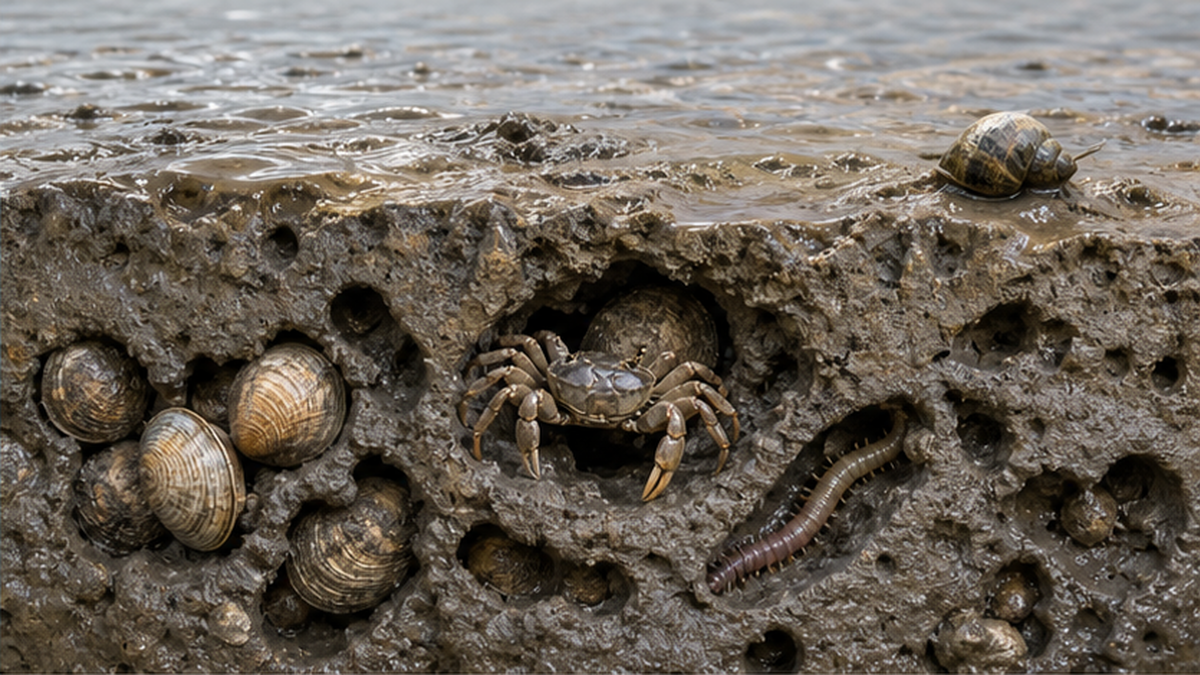
An astonishing number of creatures live in and on the mud of a tidal flat. The main players are small invertebrates known as "benthos" — bottom-dwelling organisms that burrow into or crawl across the mud. Polychaete worms (a type of segmented worm), bivalve mollusks such as clams and hard clams, and crustaceans such as crabs and shrimp form the core cast, and it is not unusual for hundreds or even thousands of individuals to be packed into a single square meter of mud.
A food chain woven through the mud
The food chain of a tidal flat begins with microalgae and detritus (fragments of organic matter such as dead organisms and waste). Polychaetes, crabs, and shellfish feed on this, and in turn fish, crabs, and birds come looking for these bottom-dwelling creatures. Some fish, such as the mudskipper of the Ariake Sea, lick the mud surface to eat microalgae directly, forming a food web unique to tidal flats. The connections among marine creatures here are entirely different from those of a deep-sea ecosystem — a world unique to the light-filled shallows.
Organic matter flowing in from land, and the remains of plankton born in the sea, would rot and pollute the water if left alone. On a tidal flat, however, they become a perfect "feast" for bottom-dwelling creatures. In other words, a tidal flat is also a "conversion device," transforming organic matter gathered from land and sea into visible forms of life — shellfish and birds. This efficient cycling of matter is precisely why tidal flats are called the "cradle of the sea." Many species of fish and shellfish spend their youth in the safety of a tidal flat's shallows before growing and heading out to open water.
Tidal flats are also home to many creatures unique to a particular place. The mudskipper, the eel goby, and the fiddler crab (a crab with one oversized claw) of the Ariake Sea can be found only there, or are especially abundant there. This high degree of uniqueness is the product of evolution shaped over a long span of time on the tidal flat, and once lost, it cannot easily be recovered.
- Polychaetes (segmented worms): feed on organic matter in the mud and serve as an important food source for birds and fish
- Bivalves (clams, hard clams, etc.): the main agents of water purification, filtering seawater
- Crustaceans (crabs, shrimp, fiddler crabs): dig burrows that carry oxygen down into the mud
- Gobies (mudskippers, etc.): fish unique to tidal flats that feed on microalgae on the mud surface
- Shorebirds (sandpipers, plovers): migratory birds that rely on bottom-dwelling creatures as food to sustain their long-distance journeys
A lifeline "gas station" for migratory birds
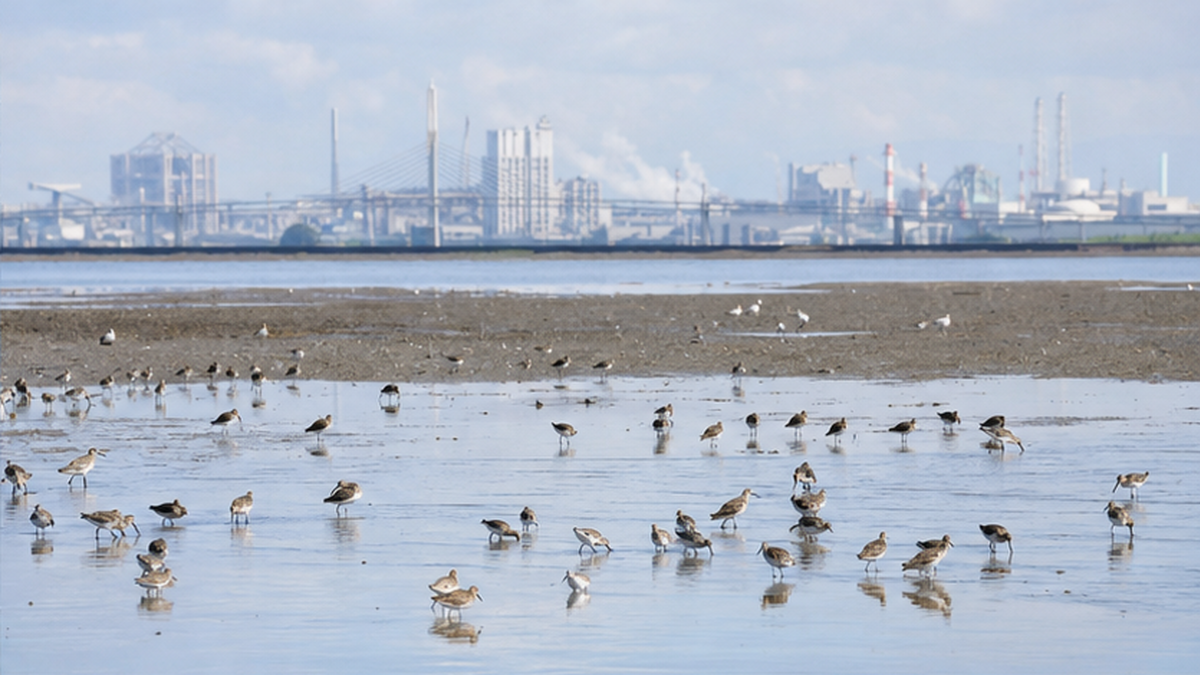
Another leading player on a tidal flat is the migratory shorebird — sandpipers and plovers. They breed in Siberia and Alaska in early summer and spend the winter in Australia and New Zealand, making a long-distance migration each year that spans the length of the globe. The longest such journeys cover roughly 12,000 kilometers one way. Along the way, Japan's tidal flats serve as an irreplaceable "gas station" (stopover site), where the birds rest their wings and refuel on energy by eating worms and shellfish buried in the mud.
This migratory route is known as the "East Asian–Australasian Flyway," spanning 22 countries and territories including Japan, Russia, China, South Korea, and Australia. The loss of even a single tidal flat stopover along this route can leave birds unable to reach the next refueling point, and they perish. Tidal flat conservation is thus directly tied to the fate of migratory birds across international borders. As creatures making an epic long-distance journey, they share something of the same grandeur as the migration of whales across the ocean.
The current state of the East Asian–Australasian Flyway
- About 38% of the 63 shorebird populations tracked are in decline
- 20 migratory shorebird populations are listed on the IUCN Red List
- Port development and coastal reclamation are accelerating the loss of stopover sites
This is also why Japan's tidal flats matter internationally. Yatsu Tidal Flat in Tokyo Bay, for example, attracts around 110 species of wild birds annually, and is said to host roughly 10% of all the shorebirds that migrate to Japan. A small tidal flat is sustaining a global cycle of life.
Yet globally, the situation surrounding migratory birds is growing more severe. Among the shorebirds using the East Asian–Australasian Flyway, about 38% of 63 populations are in decline, and 20 populations are listed on the Red List of the International Union for Conservation of Nature (IUCN). The single biggest cause of decline is the loss of stopover tidal flats to reclamation. Especially around the Yellow Sea in Asia, large-scale reclamation is rapidly shrinking this haven for migratory birds, making the value of Japan's tidal flats all the greater.
Migratory birds also serve, in a sense, as an "indicator" of a tidal flat's health. Where bottom-dwelling creatures are abundant as food and there is a quiet place to rest, birds naturally gather. Conversely, a tidal flat where bird numbers are declining is a sign that the ecosystem beneath is weakening. Birdwatching, then, is more than a hobby — it functions as valuable citizen monitoring of a tidal flat's condition.
A natural purification system — how tidal flats clean the water
A tidal flat is not only the "cradle of the sea" — it is also an excellent "natural water treatment plant." Nitrogen, phosphorus, and other nutrients, along with organic matter, flow into the sea from cities and farmland via rivers. In excess, these cause red and blue tides, but tidal flats efficiently remove them, clarifying seawater. This purification mechanism is supported by three main agents.
What happens when seawater becomes turbid or over-nutrient? Excess nutrients cause plankton to multiply abnormally, producing a "red tide" that stains the sea red. When this surplus plankton dies and decomposes, it consumes vast amounts of dissolved oxygen, creating a mass of oxygen-poor water (a hypoxic water mass). When this rises to the surface, it appears pale blue due to sulfur compounds — a "blue tide" — and can cause mass die-offs of fish and shellfish. A tidal flat acts as a natural breakwater against this vicious cycle, preventing the "over-absorption of nutrients" that is its starting point. The mechanism behind red tides is explored further in our article on red tides.
1. Bivalves such as clams filter the water
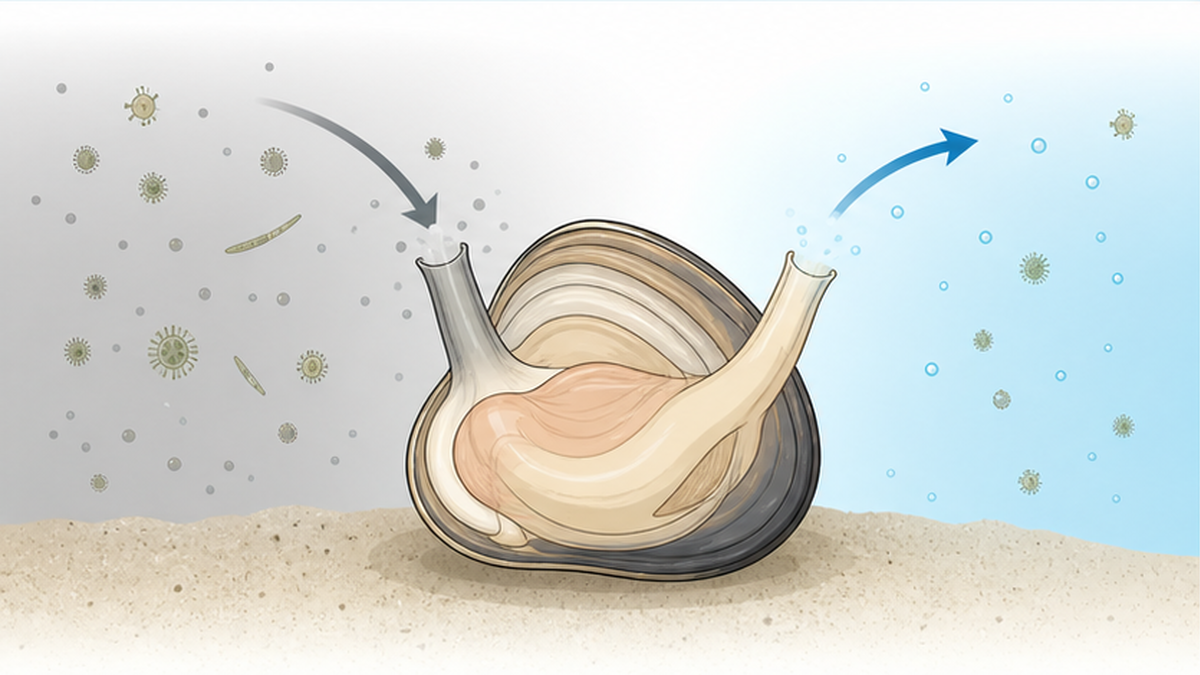
Bivalves such as clams and hard clams are "filter feeders" that strain seawater through their gills to eat plankton. Their capacity is astonishingly high: a single grown clam is said to filter roughly one liter of seawater per hour. A survey of the tidal flat at Matsukawaura in Fukushima Prefecture reported that in summer, the amount of nitrogen absorbed in a single day by clams and oysters was comparable to the total amount of nitrogen present in that body of water. The bivalves packed densely across a tidal flat are, quite literally, living water filters.
2. Microalgae absorb excess nutrients
The microalgae covering the surface of a tidal flat photosynthesize while taking up nitrogen and phosphorus from seawater as nutrients. This is precisely the mechanism that reduces the excess nutrients responsible for red tides. In addition, these algae produce oxygen through photosynthesis, supplying it to the tidal flat's creatures and the water itself. In terms of the nutrient cycle, the bottom-dwelling algae of a tidal flat play a role comparable to that of phytoplankton supporting the open ocean.
3. Bacteria release nitrogen into the atmosphere
And, though invisible, the countless bacteria (microorganisms) living in the mud are decisively important. The mud of a tidal flat is a special environment where an oxygen-rich surface layer meets an oxygen-poor deeper layer, and here a chemical reaction called "denitrification" takes place. Denitrification converts nitrogen dissolved in seawater into nitrogen gas, releasing it into the atmosphere — and through this process, nitrogen itself is removed from the sea. Whereas filtration and absorption simply "move nutrients around," denitrification is the trump card of a tidal flat's purifying power, in that it "expels them from the system entirely."
What's fascinating is that the countless burrows dug into the mud by bottom-dwelling creatures such as crabs and polychaetes help drive this purification process. Through these burrows, oxygen-rich seawater reaches deep into the mud, creating an environment where bacteria can thrive. As living creatures till the mud, decomposition and denitrification by microorganisms advance further still. On a tidal flat, shellfish, crabs, and microorganisms each play their part, together running one giant purification system. If even one is missing, this delicate balance collapses.
The three purification mechanisms of a tidal flat
- Filtration by bivalves: straining out plankton and organic matter through the gills
- Absorption by microalgae: taking up nitrogen and phosphorus through photosynthesis while releasing oxygen
- Denitrification by bacteria: converting dissolved nitrogen into nitrogen gas and releasing it into the atmosphere
Combined, these three functions are said to give a tidal flat purification capacity comparable to that of a sewage treatment plant. And a tidal flat does all this without electricity or chemicals, using only sunlight and the activity of living creatures, purifying water around the clock, 365 days a year, without ever resting. It requires no maintenance costs and emits no carbon dioxide. It is hard to build such an ideal water-purification infrastructure artificially. Losing a tidal flat to reclamation is equivalent to demolishing, with our own hands, a vast water treatment facility that works for free.
There have also been attempts to convert a tidal flat's purifying power into economic value. The functions a tidal flat performs — water purification, the supply of fishery resources, disaster mitigation, and recreation — are called "ecosystem services," and estimates suggest their value, if converted into monetary terms, would be enormous. Perhaps the biggest reason tidal flats have been undervalued is that we have treated these invisible services as "free" and lost them without a second thought.
Tidal flats we've lost — the history of land reclamation, in data
Tidal flats this valuable have nonetheless disappeared rapidly from Japan. According to a Ministry of the Environment survey, the nationwide tidal flat area was about 82,621 hectares in 1945, but had fallen to about 53,856 hectares by 1978 and about 49,380 hectares by 1996. That works out to a loss of roughly 40% of Japan's tidal flats over about 50 postwar years.
The shoreline that rapid economic growth took away
Tidal flats declined especially sharply during the period of rapid economic growth from the late 1960s onward. Shallow, easily reclaimed tidal flats were converted one after another into port facilities, industrial land, residential areas, and commercial districts. A treasure trove of living creatures and water purification was regarded merely as "unused land" for the sake of economic growth. At the time, the value of a tidal flat's purification function and biodiversity was not yet well understood, and "turning an empty-looking shallow into usable land" was even considered a symbol of progress and prosperity.
| Year | Nationwide tidal flat area | Notes |
|---|---|---|
| 1945 | ~82,621 ha | Shortly after the war |
| 1978 | ~53,856 ha | Sharply reduced after the era of rapid growth |
| 1996 | ~49,380 ha | Down roughly 40% from the postwar level |
Tokyo Bay: down to about one-thirteenth
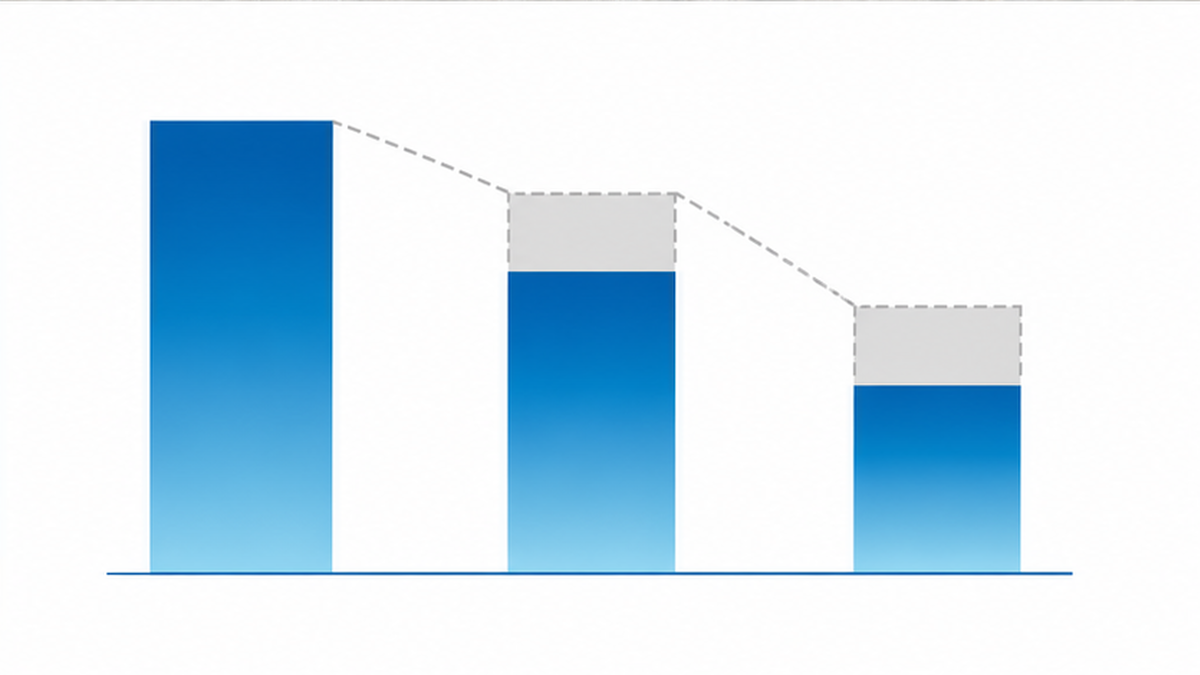
Reclamation was especially intense in Tokyo Bay. Tidal flats that covered about 136 square kilometers in the late Meiji era had shrunk to just about 10 square kilometers by 1983. As the city expanded, Tokyo Bay's natural shoreline all but disappeared. Today, tidal flats remain in only a handful of spots in Tokyo Bay, such as Sanbanze, Yatsu Tidal Flat, and the mouth of the Obitsu River. The fact that natural shoreline has almost entirely vanished from Tokyo Bay — once the "Edo-mae" sea that supported rich fisheries — quietly tells the story of what we gave up in the name of economic growth.
Tidal flat loss is a global phenomenon
Japan is not alone in losing its tidal flats. A 2019 study published in the journal Nature analyzed more than 700,000 satellite images and estimated that about 16% of the world's tidal flats were lost over the 33 years from 1984 to 2016. In Asia especially, port development and reclamation tied to economic growth have been concentrated, wiping out one flyway stopover after another. Alongside the problem of plastic waste flowing into the sea, the loss of tidal flats is a coastal environmental challenge the whole world must confront.
Tidal flat loss is not only "visible destruction" like reclamation — it also progresses gradually and quietly. When dams and shoreline protection reduce the sediment rivers carry to the sea, tidal flats stop receiving fresh sand and mud and slowly waste away. There is also concern about "coastal squeeze," in which rising sea levels push tidal flats to retreat landward, only to find their path blocked by seawalls and buildings, leaving them nowhere to go. Simply stopping reclamation is not enough to protect tidal flats.
What happens when a tidal flat is lost
- Water purification capacity is lost, making red and blue tides more likely
- Migratory bird stopovers disappear, reducing international bird populations
- Fishery resources such as clams and seaweed decline, weakening coastal fisheries
- The buffer zone that softens storm surges and tsunamis is lost
The lesson of Isahaya Bay — what land reclamation brought
No discussion of Japan's tidal flat problems can avoid the reclamation project at Isahaya Bay (Nagasaki Prefecture), located at the innermost part of the Ariake Sea. The Ariake Sea is an enclosed bay with Japan's largest tidal flats, home to numerous unique tidal-flat creatures including the mudskipper, and long known as one of Japan's largest stopover sites for shorebirds. It is, in many ways, a symbol of tidal-flat abundance itself.
Sealed off by a tide-control dike
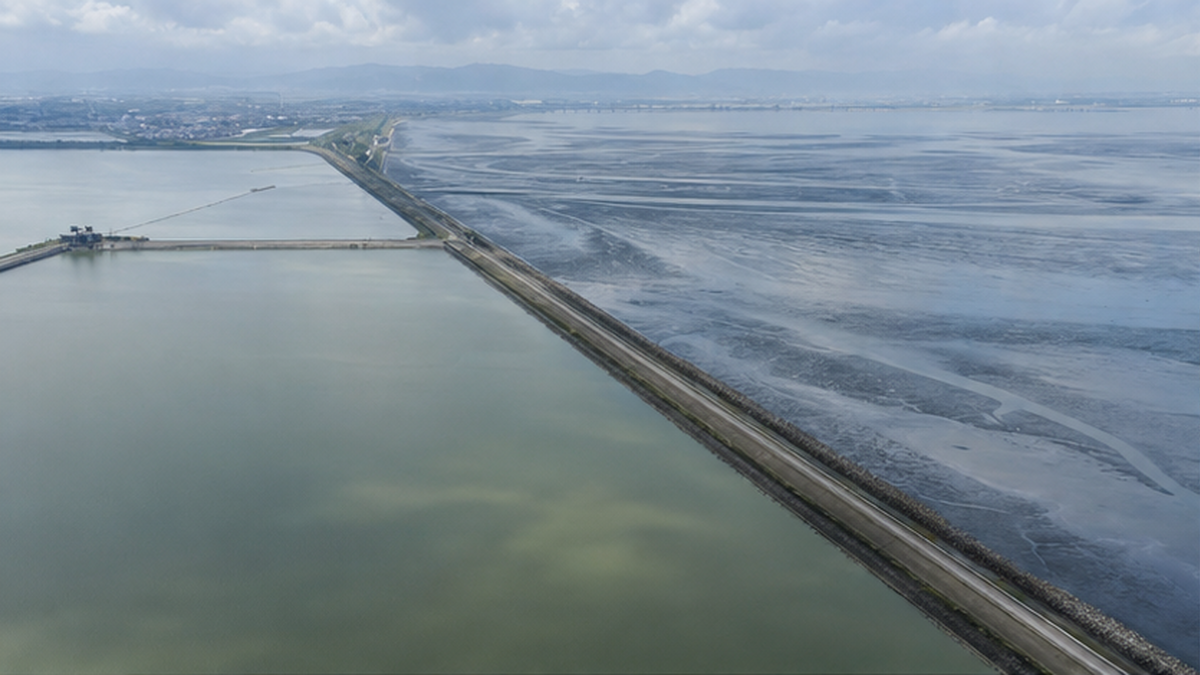
The Isahaya Bay land reclamation project began in 1986, and on April 14, 1997, a tide-control dike roughly seven kilometers long was closed, cutting off about 3,550 hectares of shallow sea from the ocean. The sight of 293 steel plates being dropped one after another into the water came to be nicknamed "the guillotine," and much of the Isahaya Tidal Flat — once one of Japan's largest — along with the bottom-dwelling creatures and migratory birds that lived there, vanished.
Effects that spread across the whole Ariake Sea
The effects were not confined to the sealed-off bay. Experts point out that the loss of the tidal flat and the tide-control dike weakened tidal currents and the tidal range across the Ariake Sea as a whole. As the movement of seawater slowed, oxygen had a harder time reaching the seafloor, making red tides and oxygen-poor "hypoxic water masses" more likely to form. These effects are deeply tied to the loss of the purification function the tidal flat once provided.
As a result, the Ariake Sea — once called a "treasure sea" — suffered serious blows to its fisheries, including discoloration of its famous nori seaweed and a sharp decline in Pinna pectinata (a large bivalve). The way a collapse in nutrient and oxygen cycling can tip an entire ecosystem into a chain reaction has something in common with the problem of ocean acidification and coral unfolding in the open ocean. Isahaya Bay has become a cautionary lesson in how greatly losing a single tidal flat can destabilize the balance of an entire sea.
It has also been suggested that the loss of the tidal flat may have weakened the Ariake Sea's own inherent self-purifying capacity. Once the water purification function that the vast tidal flat once provided disappears, the sea's ability to absorb nutrients and organic matter flowing in from rivers declines, making red tides and hypoxia even more likely. The loss of the tidal flat, the deterioration of water quality, and the slump in fisheries are not separate problems — they are linked together like a single chain. That is precisely why restoration requires more than fixing the dike or the fishing grounds; it demands a perspective centered on restoring the tidal flat itself.
Opening the sluice gates of the tide-control dike and reintroducing seawater from the Ariake Sea is needed to restore the ebb and flow of the tide and the tidal currents.
— Wild Bird Society of Japan (Toward the Restoration of the Isahaya Tidal Flat)
At Isahaya Bay, opinion remains divided even now over opening the sluice gates, and court rulings have swung back and forth. The livelihoods of people farming the reclaimed land and the wishes of those hoping to restore the Ariake Sea's fisheries and environment clash head-on, and the dispute has dragged on for years. How to handle nature once it has been significantly altered becomes a question with no easy answer the more people are involved. This case drives home to us just how much weight lies in "protecting before losing."
The lesson of Isahaya Bay also lies in how far one can foresee the "irreversibility" of altering nature. When the project was planned, it was not fully anticipated that the loss of the tidal flat would affect the Ariake Sea so broadly as a whole. An ecosystem is a complex web of interwoven elements, and tampering with one part can ripple out to unexpected places. That is precisely why, before any major development, careful "environmental impact assessment" of ecological effects plays such an important role.
A tidal flat that was saved — Fujimae and the power of citizens
The history of tidal flats is not only a story of loss. There is a symbolic success story in which citizens' efforts halted a reclamation project and saved a tidal flat: Fujimae Tidal Flat, in the port of Nagoya. Located at the innermost part of Ise Bay, Fujimae is an important stopover for migratory birds, yet it was slated to be reclaimed as a landfill site for the city of Nagoya's waste.
A reversal from a landfill plan
Citizens' groups and conservation organizations mounted a tenacious campaign against this plan. Voices advocating for the tidal flat's ecological value converged with the government's final decision, and in January 1999, the reclamation plan was finally called off. Then, on November 18, 2002, Fujimae Tidal Flat was registered as a Ramsar Convention wetland and designated a special protection zone within a national wildlife protection area, being reborn as a "protected tidal flat" where reclamation and land conversion are restricted.
This outcome was by no means a given at the time. Since the era of rapid economic growth, tidal flat reclamation had proceeded one project after another in the name of "progress," and was rarely halted. The decision to cancel the Fujimae reclamation is remembered as one of the major turning points in Japanese society's shift in values — from an era of "destroying nature to make land" to an era of "recognizing nature's value and preserving it." It should not be overlooked that the tidal flat's international importance as a stopover for migratory birds helped push the government's decision.
How a tidal flat changed a city's attitude toward trash
What makes the story of Fujimae Tidal Flat especially fascinating is that saving it changed the city itself. Having lost its landfill plan, the city of Nagoya declared a "garbage emergency" the following February, in 1999. Through thorough waste sorting and recycling, the city succeeded in cutting its garbage volume by about 23% year-over-year by 2000. The choice to protect a tidal flat became the catalyst for rethinking the very way a city lives.
What Fujimae Tidal Flat showed us
- When citizen action and government decisions align, reclamation can be stopped
- Tidal flat conservation can even change a city's waste-reduction and recycling awareness
- Ramsar Convention registration is an effective institutional tool for protecting tidal flats
Several tidal flats in Japan today — including Yatsu Tidal Flat (Chiba Prefecture), Fujimae Tidal Flat (Aichi Prefecture), and Higashiyoka Tidal Flat (Saga Prefecture) — are internationally protected as Ramsar Convention wetlands. Higashiyoka Tidal Flat, in particular, is one of Japan's largest stopover sites for shorebirds, symbolizing the precious tidal flats that remain in the Ariake Sea. The Ramsar Convention is an international treaty for protecting waterbirds that migrate across borders and the wetlands they depend on; once registered, development is restricted, and conservation together with "wise use" is required.
What Fujimae Tidal Flat teaches us is that the power to protect a tidal flat lies not only in the hands of experts and politicians, but in the hands of ordinary citizens too. It was because people spoke up, communicated its value, and took action that this tidal flat still stands. And that choice not only saved the tidal flat — it pushed the way of life in a major city like Nagoya toward greater sustainability. Protecting a single tidal flat can go on to protect the future of an entire region.
The front lines of restoration in the Ariake Sea and Tokyo Bay
Beyond protecting the tidal flats that remain, efforts are under way across the country to actively "restore" tidal flats that have been damaged. Here we look at restoration activities now under way, focusing on the Ariake Sea and Tokyo Bay. Conservation is also expanding beyond Japan's borders, to overseas tidal flats connected to Japan as migratory bird stopovers. The 2019 inscription of China's Yellow Sea coastal tidal flats as a UNESCO World Natural Heritage site symbolizes the growing momentum to protect East Asia's tidal flats across national boundaries.
Yatsu Tidal Flat's "elevation" restoration
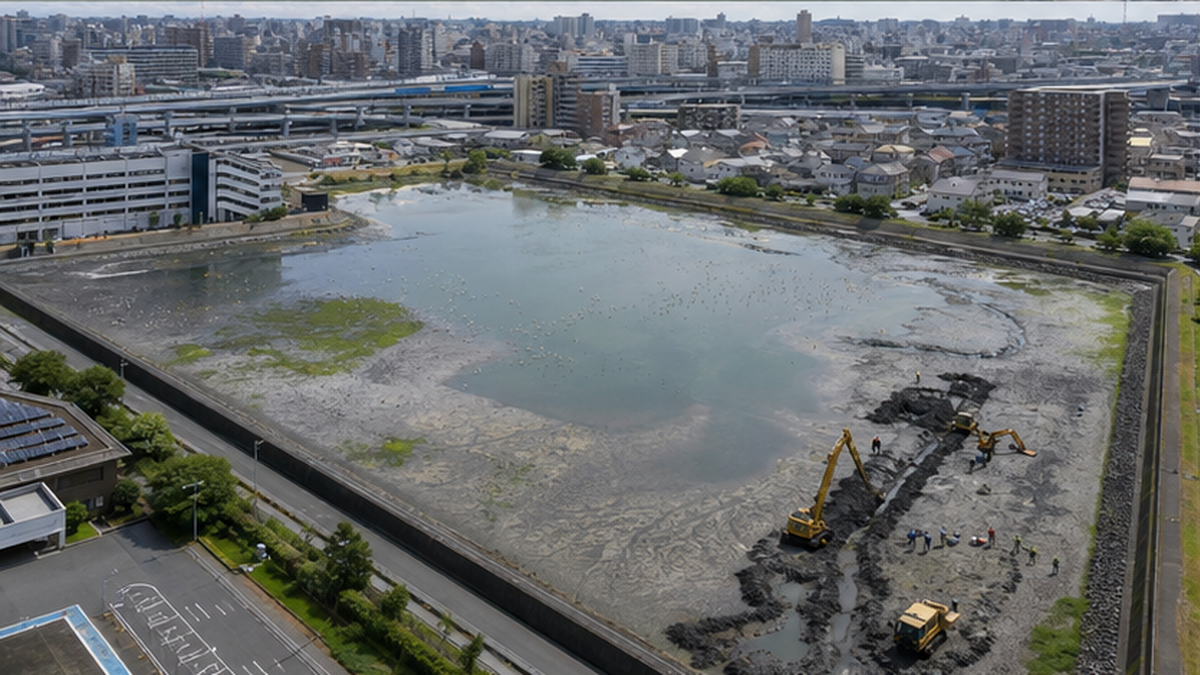
The roughly 40-hectare Yatsu Tidal Flat, remaining at the innermost part of Tokyo Bay, was registered on June 10, 1993, as the first tidal flat in Japan to be listed under the Ramsar Convention — a landmark achievement. However, surrounded by urban development like an "island on land," it has faced challenges such as mass outbreaks of sea lettuce (a green alga) and the accumulation of sludge. In response, the Ministry of the Environment's Kanto Regional Environment Office has, since fiscal year 2010, carried out conservation projects such as "sand replenishment" (raising the mud level) and removing sea lettuce, continuing to restore an environment friendly to birds and monitor its progress.
The search for restoration at Sanbanze and in the Ariake Sea
Sanbanze, another part of Tokyo Bay off the coasts of Funabashi, Narashino, Ichikawa, and Urayasu in Chiba Prefecture, is a tidal-flat and shallow-sea area that was once slated for reclamation, but the plan was reconsidered after discussion among citizens and experts, and restoration efforts are now under way. In the Ariake Sea too, efforts to restore fishing grounds and tidal-flat environments are being explored, through campaigns calling for the Isahaya Bay sluice gates to be opened, and through "sand capping" (a technique that spreads sand over the seafloor to improve sediment quality). The path to recovering a sea once lost is by no means an easy one.
What is often said on the ground during restoration efforts is the difficult truth that "an artificial tidal flat can never fully substitute for a natural one." Even adding sand to a constructed tidal flat cannot faithfully recreate the complex ecosystem and web of diverse life a natural tidal flat has nurtured over long years. That is precisely why protecting the natural tidal flats still remaining, so that no more are lost, must take priority above all else. There is a growing view that restoration should be a last resort, and that no restoration surpasses conservation.
A new value as blue carbon
In recent years, tidal flats have also come into a new spotlight as "blue carbon." Blue carbon refers to the carbon absorbed through photosynthesis by marine ecosystems and stored on the seafloor and elsewhere. Alongside seaweed beds, mangroves, and salt marshes, tidal flats are considered an important carbon sink of this kind. The Ministry of the Environment has positioned the conservation and creation of blue carbon ecosystems as a CO2-absorption measure, and the restoration of tidal flats is beginning to connect with climate change countermeasures as well. Reading our article on blue carbon alongside this one, on the sea's capacity to store carbon, will give you a fuller, more three-dimensional picture of a tidal flat's value.
This perspective gives new momentum to tidal flat conservation. Until now, a tidal flat's value has centered on things hard to quantify, such as "migratory birds come here" or "the water becomes cleaner." But if the amount of carbon absorbed can be evaluated as blue carbon, it opens a path for companies and local governments to invest in tidal flat conservation as part of their decarbonization efforts. Protecting living creatures and preventing climate change become linked in a single place — a tidal flat. That is, in itself, one more reason to protect tidal flats.
Main approaches to tidal flat restoration
- Elevation / sand replenishment: raising mud to a height friendly to birds and other creatures
- Sand capping: spreading sand over the sediment to improve hypoxia and sludge buildup
- Removing sea lettuce and sediment: taking out excess organic matter to improve the environment
- Conservation as blue carbon: protecting and expanding tidal flats and seaweed beds as CO2 sinks
What we can do — carrying tidal flats into the future
Tidal flat conservation might seem like a job left only to government and researchers. But a tidal flat is also the "entrance to the sea" that is closest to our everyday lives. Each small action we take will genuinely shape the future of tidal flats.
First, "learn about" and "visit" tidal flats
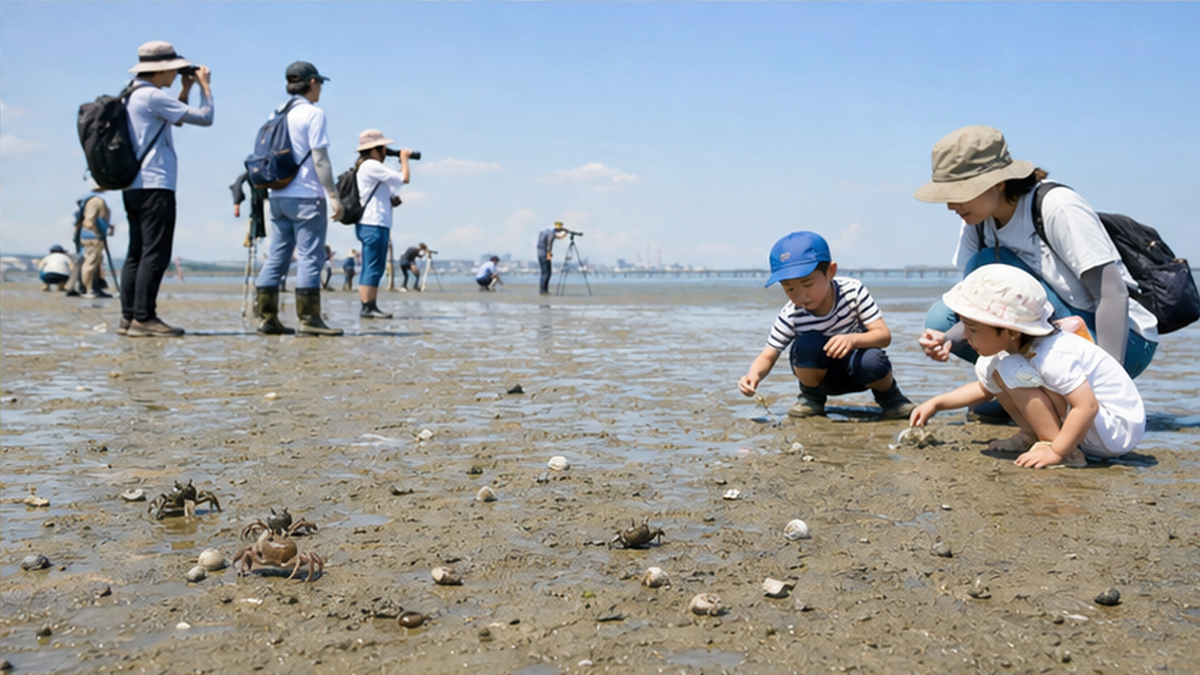
The first step in conservation is learning about a tidal flat's value. Facilities such as the Yatsu Tidal Flat Nature Observation Center and Fujimae Tidal Flat's activity base offer places around the country where you can learn while enjoying yourself. Through clam digging or birdwatching, coming face-to-face with the creatures in the mud and migratory birds should make it clear that a tidal flat is anything but "just a sea of mud." The simple fact that more people take an interest is itself a powerful force protecting tidal flats. Letting children experience tidal-flat creatures at a young age, in particular, is an investment in raising the sea's future protectors.
Reduce the burden we place on the sea in daily life
One of a tidal flat's enemies is the influx of excess nutrients and pollution. Everyday habits — not pouring cooking oil down the drain, not overusing detergent — ultimately protect the quality of water flowing into the sea. Learning about the problem of gear-derived marine debris (ghost gear) is also useful in reducing the trash that ends up in the ocean. As the story of Fujimae Tidal Flat shows, a lifestyle that reduces waste is directly connected to a lifestyle that protects tidal flats.
For those who live near tidal flats, one accessible action is simply savoring the seasonal bounty a tidal flat provides — clams, nori, and hard clams. Choosing to eat seafood raised on a healthy tidal flat supports fishing practices that use the tidal flat while protecting it. When you go clam digging, leaving small clams uncollected and following designated areas and rules helps protect the resource for years to come. "Supporting through eating" is also a legitimate form of conservation.
Support conservation efforts
Across the country, citizen-participation activities are under way — tidal flat cleanups, monitoring surveys, and the restoration of eelgrass and clam beds. Volunteering for these activities, or supporting organizations that protect tidal flats through donations, is also a meaningful way to help. Efforts to protect marine life range widely, from institutional approaches such as marine protected areas to hands-on work like tending to a tidal flat.
Tidal flat conservation actions you can take starting today
- Visit a nearby tidal flat or observation center to watch the creatures and migratory birds
- Reduce the burden on the sea — don't pour oil down the drain, don't overuse detergent
- Sort and recycle your waste thoroughly, cutting off sources of marine debris
- Participate in or donate to citizen activities such as tidal flat cleanups and creature surveys
- Share the value of tidal flats with people around you, through social media or conversation
Conclusion — the sea of mud is a treasure that protects life and water
At first glance, a tidal flat is a plain of mud and sand that appears to hold nothing. But in reality, it is one of the richest, hardest-working ecosystems on Earth — home to countless bottom-dwelling creatures, a resting place for migratory birds mid-way through a journey spanning the globe, and a place where murky seawater is clarified. Its three purification mechanisms — filtration by clams, absorption by microalgae, and denitrification by bacteria — rival the capability of a sewage treatment plant.
What we've lost, and what we're trying to reclaim
Japan has lost 40% of this treasure over roughly 50 postwar years, and the world has lost 16% of it in just 33 years. The Isahaya Bay reclamation taught us that losing a single tidal flat can shake an entire sea. On the other hand, Fujimae Tidal Flat stands as a success story — protected through the power of citizens, and even changing a city's attitude toward waste. In the Ariake Sea and Tokyo Bay, restoration efforts continue, from elevation and sand capping to conservation as blue carbon.
What has become clear through this article is that a tidal flat's value is layered across multiple dimensions: living creatures, water purification, migratory birds, carbon absorption, and disaster mitigation. Even a single one of these reasons would justify protecting a tidal flat, yet a tidal flat carries all of them at once. Few forms of nature are this multifunctional, and fewer still keep working for free.
And we must not forget, as Isahaya Bay showed us, that once a tidal flat has been significantly destroyed, restoring it to its former state is an extraordinarily difficult task. Even bringing in sand artificially cannot faithfully recreate the complex ecosystem a natural tidal flat nurtured over a long span of time. That is precisely why not losing any more of the tidal flats we still have — conservation itself — is the greatest and best form of restoration.

The choice is ours, each and every one
Whether a tidal flat is protected or lost depends not on someone far away, but on the accumulated choices of each of us who uses the water that flows into the sea. The next time you stand on a shore at low tide, remember how much life, and how much clean water, that "sea of mud" beneath your feet is supporting. The more people who carry that perspective with them, the surest first step it becomes toward never losing another tidal flat.
For you, having just read this article, starting today
- Look up the location of a nearby tidal flat or nature observation center
- Start one habit that reduces your burden on the sea, such as not pouring oil down the drain
- Share the value of tidal flats with family or friends, even in just a single sentence
Summary of this article
- Tidal flats fall into three types — open-coast, estuarine, and lagoon — and are a treasure trove of life and water purification
- Clam filtration, microalgae absorption, and bacterial denitrification powerfully purify seawater
- Tidal flats are stopover sites where migratory shorebirds sustain the long-distance journeys of their lives
- Japan lost about 40% of its tidal flats over roughly 50 postwar years; the world lost 16% in 33 years
- Isahaya Bay showed the lesson that losing a tidal flat can harm an entire sea; Fujimae Tidal Flat showed the hope that citizens' power can protect one
- With restoration under way in the Ariake Sea and Tokyo Bay, the choices we make in daily life will shape the future of tidal flats
References and sources
- Ministry of the Environment, Biodiversity Center of Japan – Basic Survey on Natural Environment Conservation (tidal flats, seaweed beds, coral reef survey)
- Ministry of the Environment – Decline of Tidal Flats, Seaweed Beds, and Coral: Trends in Tidal Flat Area (PDF)
- Fisheries Agency – Conservation of Seaweed Beds, Tidal Flats, and Coral Reefs / The Function and Current State of Tidal Flats
- National Institute for Environmental Studies – Water Purification by Organisms in Shallow Seas: Findings from a Survey of the Tidal Flat at Matsukawaura, Fukushima Prefecture
- Ministry of the Environment – Setouchi Net: What Is a Tidal Flat? (Explanation of Purification and Ecosystems)
- Wild Bird Society of Japan – Toward the Restoration of the Isahaya Tidal Flat / Tidal Flats Remaining in Tokyo Bay
- Council of Municipalities with Ramsar Convention Registered Wetlands – About Yatsu Tidal Flat
- City of Nagoya – Conservation and Use of Fujimae Tidal Flat
- Ministry of the Environment – What Is Blue Carbon? / Collection of Blue Carbon Initiative Case Studies
- Nature (Murray et al. 2019) – The global distribution and trajectory of tidal flats
* Listed in order of reliability: government and academic institutions > peer-reviewed papers > specialist organizations > reputable media