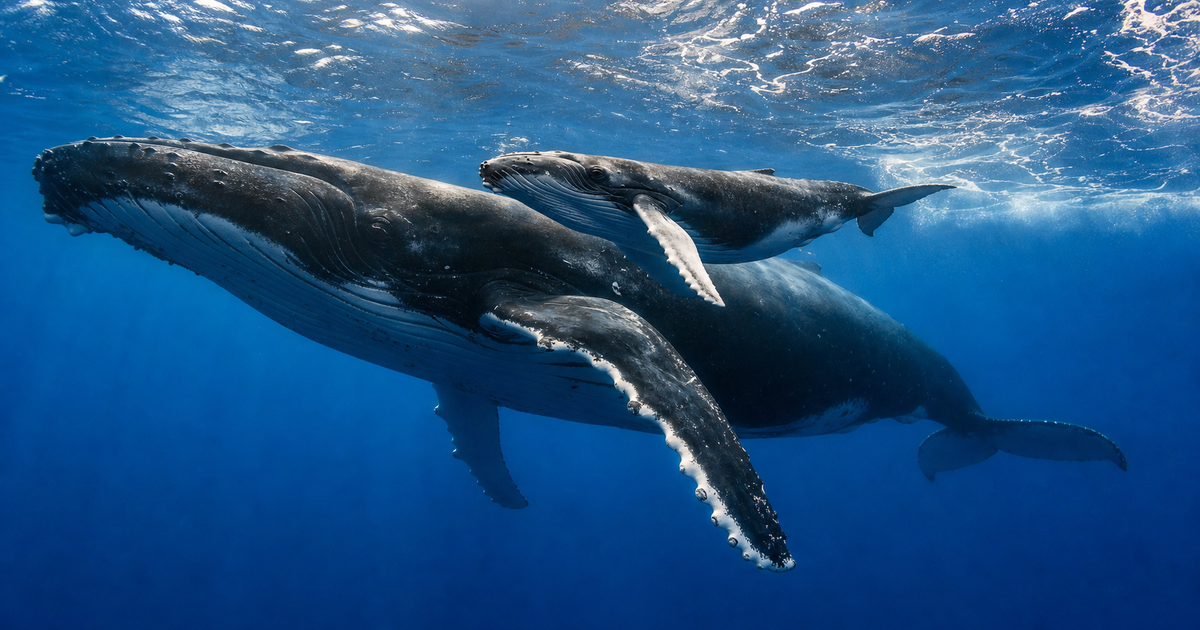
Every winter, enormous shadows return to the waters off Okinawa and the Ogasawara Islands: humpback whales, up to 15 meters long and 30 tonnes in weight. Just weeks earlier, these same whales were gorging themselves in the cold waters far to the north, off Russia or Alaska. From there, they swim thousands of kilometers, eating almost nothing along the way, to reach Japan's warm seas to give birth and raise their young.
Why do whales make this exhausting round trip, so faithfully, every single year? There are no signposts anywhere across the vast ocean. And yet they travel precisely between the sea where they were born and the feeding grounds far away. This behavior — "migration" — is one of the most spectacular journeys made by any living creature on Earth, and it remains wrapped in many mysteries even today.
This article draws on primary sources from Japan's Ministry of the Environment, JAMSTEC (Japan Agency for Marine-Earth Science and Technology), the Fisheries Agency, the IWC (International Whaling Commission), NOAA (the U.S. National Oceanic and Atmospheric Administration), and others to unpack the mechanics of whale migration and how it supports the entire marine ecosystem. Migration is not simply movement — it is also a "planetary-scale circulation system" that carries nutrients and carbon across the ocean.
What you'll learn in this article
- Why whales travel thousands of kilometers (switching between food-rich cold seas and warm seas suited to raising young)
- Humpback whales' specific migration routes, and the movement records that have astonished the world
- How whales find their way across the vast ocean without getting lost (the mystery of navigation)
- The "whale pump" — a massive system that circulates nutrients and carbon through the ocean
- The "whale fall" ecosystem — a separate world created in the deep sea by a dead whale
- How climate change is throwing off migration timing and threatening the future of whales
What is whale migration? One of Earth's grandest "seasonal journeys"
"Migration" refers to animals moving regularly along a set route in step with the seasons. Salmon swimming upriver to spawn is migration too, but a whale's migration is on a completely different scale. Baleen whales in particular are known as the mammals that travel the longest distances on Earth.
In the case of humpback whales, they spend the summer in cold, high-latitude waters and move to warm, low-latitude waters come winter. This round trip is roughly 5,000 kilometers each way on average, and can be even farther for some groups. It's a journey on a scale incomparable to any distance a human might travel by bullet train — and whales accomplish it with nothing but their own bodies and swimming.
Shuttling between a summer "dining hall" and a winter "nursery"
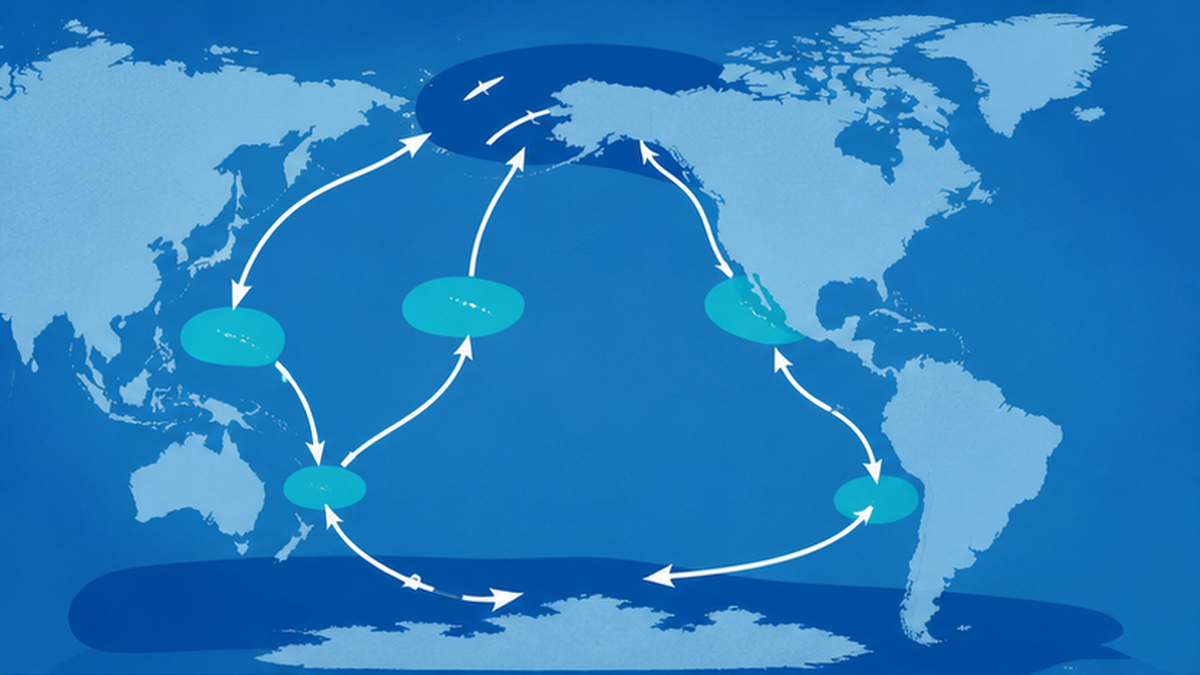
The key to understanding whale migration lies in how they use two different seas for two different purposes: a feeding ground where they eat, and a breeding ground where they mate and raise young. For North Pacific humpback whales, summer means eating without pause in high-latitude feeding grounds off Russia and Alaska, while winter means giving birth in warm seas such as Okinawa, Amami, Ogasawara, Hawaii, and Mexico.
In other words, whales spend the "eating season" and the "birthing and raising season" of the year in entirely different seas. This two-location lifestyle is the fundamental reason behind their journeys of thousands of kilometers. To put it in human terms, it's as if you ate an entire year's worth of food in one summer, storing it in your body, then moved to a distant land for the winter to give birth and raise a child on nothing but those reserves — with your own swimming as the only means of transport. It gives a sense of just how demanding this way of life is.
A humpback whale is roughly 11.5 to 15 meters long and weighs 25 to 30 tonnes, with females generally growing slightly larger than males. Maintaining a body this size while swimming thousands of kilometers with almost no food, and then giving birth and nursing on top of that, means that how much a whale can store up over the summer directly determines whether it lives or dies that year. For them, migration is a life-or-death undertaking that repeats every single year.
Baleen whales and toothed whales journey for different reasons
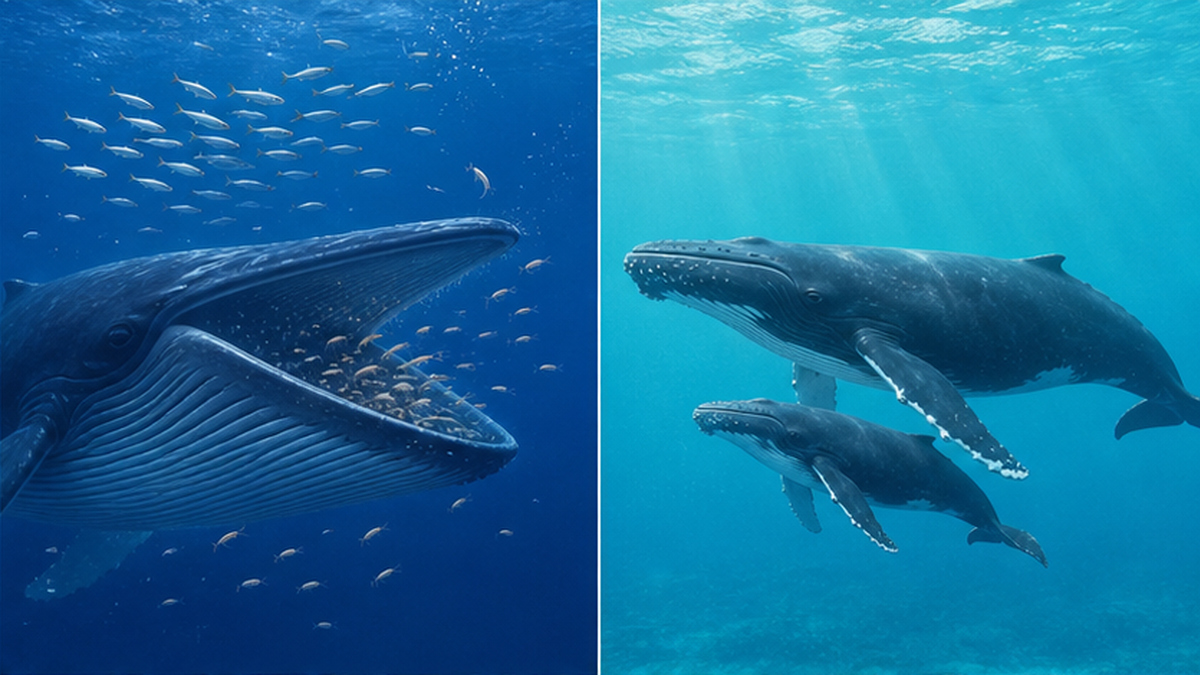
Whales are broadly divided into baleen whales (humpback whales, blue whales, fin whales, and others), which filter krill and small fish through their baleen plates, and toothed whales (sperm whales, orcas, dolphins, and others), which have teeth and hunt squid and fish. Long-distance seasonal migration is most clearly seen in baleen whales.
Krill, herring, and other small fish that baleen whales feed on multiply explosively in cold, nutrient-rich, high-latitude waters. But those same cold seas are too harsh for newborn calves. This mismatch between "where the food is" and "where it's safe to raise young" is exactly what drives baleen whales into their massive annual journeys.
By contrast, toothed whales like sperm whales dive deep to hunt squid and deep-sea fish. Because their food isn't concentrated in a particular season or particular high-latitude waters, they don't show the same tightly scheduled north-south seasonal migration seen in baleen whales. Even among "whales," the shape of the journey differs entirely depending on what they eat and where. This article mainly deals with the long-distance-migrating baleen whales we encounter in Japan's winter seas — humpback whales, in particular.
The essentials, first
- Whale migration = using different seas to match the season
- Summer means "eating" in cold seas, winter means "giving birth" in warm seas
- Humpback whales travel thousands of kilometers each way, every year
- Long-distance migration is most prominent among baleen whales
Whales aren't the only marine creatures that change how they live in step with the season and environment. In the deep sea, for example, creatures have evolved their own unique strategies to cope with an extreme environment with little light or food. Take a look at our article on the remarkable adaptations of deep-sea creatures as well, for a fuller picture of the diverse survival strategies marine life has evolved.
Why travel thousands of kilometers? Two seas, two reasons — food and raising young
The biggest mystery of migration is still "why go to such lengths?" Traveling thousands of kilometers consumes an enormous amount of energy. And because whales eat almost nothing in their breeding grounds, the journey means living off stored fat reserves. Even so, there are clear reasons why they make this round trip every year.
Cold seas offer food, warm seas offer safety
Cold, high-latitude seas are rich in nutrients, allowing phytoplankton to thrive. That, in turn, supports huge blooms of krill and small fish, making these waters a dream feeding ground for whales. Humpback whales concentrate their eating into these few summer months, storing nutrients in their bodies as blubber. Research suggests baleen whales' actual food intake is roughly three times earlier estimates, with large individuals reported to eat several tonnes of food in a single day.
Newborn calves, on the other hand, have thin blubber and cannot maintain body temperature in cold water. In warm, low-latitude seas (surface temperatures of roughly 21-28 degrees Celsius), even a fragile newborn can maintain its body temperature more easily, easing the burden on the mother as well. Calm waters surrounded by islands make an ideal "cradle" for young calves still learning to swim. Even a newborn humpback calf is already about 4-5 meters long, but that's still a fragile size compared with a 15-meter mother. In rough, cold seas, being tossed about by waves alone could be life-threatening.
This raises a question: "Wouldn't it be easier to just give birth in the food-rich cold seas, rather than making the trip all the way to warm seas with no food?" The answer is that whales cannot satisfy two needs at once in a single sea — eating enough, and safely raising their young. Choosing one means sacrificing the other. That is exactly why, it's thought, whales arrived at the solution of "migration," linking both seas across the seasons. Traveling thousands of kilometers is the compromise that evolution produced to reconcile two conflicting needs.
The theory of protecting young from predators
Beyond food and water temperature, another possible reason whales choose warm seas is thought to be avoiding predators. Orcas (killer whales) are a leading predator that attacks whale calves. Because orcas also gather in large numbers in the food-rich high-latitude seas, one prominent hypothesis holds that giving birth in low-latitude seas with fewer predators improves calf survival rates.
That said, these reasons aren't mutually exclusive. It's natural to think that multiple factors — food, water temperature, and safety — overlap to drive whales into long-distance migration. Migration isn't the product of a single simple purpose, but a comprehensive strategy to maximize both survival and reproduction.
Traveling without eating — fat as "portable food"
While in the breeding grounds, humpback whales eat almost nothing. Mother whales draw down their own fat reserves as they nurse their calves on rich, fat-heavy milk. Calves drink hundreds of liters of milk a day, growing rapidly before your eyes. In other words, the fat stored up over the summer serves both as fuel for the journey and as "portable food" for raising the newborn. Mother whales lose a great deal of weight over the winter, growing gaunt, before heading back to the northern feeding grounds once again.
This "traveling without eating" strategy amounts to a massive advance loan of energy. In years when summer feeding doesn't go well and mothers can't store enough fat, they may give up on breeding, or their calves may fail to grow sufficiently. That is exactly why the decline in food supply and timing mismatches caused by climate change, discussed later, become serious problems that directly affect whale reproductive success. Migration and reproduction rest on a precisely balanced system, as delicate as a tightrope walk, sustained meal by meal through the summer.
| Item | Feeding ground (summer, high latitude) | Breeding ground (winter, low latitude) |
|---|---|---|
| Water temperature | Cold (nutrient-rich) | Warm (roughly 21-28°C) |
| Main activity | Eating large amounts of food | Giving birth, raising young, courtship |
| Food | Large quantities of krill and small fish | Almost no eating |
| Representative waters | Alaska, Russia, Antarctica | Okinawa, Ogasawara, Hawaii, Tonga |
| Energy | Storing fat | Drawing down fat |
Fun fact: whale "song" also echoes in the breeding grounds
Male humpback whales sing long, complex "songs" in the breeding grounds, thought to be a form of courtship aimed at females. Males within the same group tend to sing similar songs, and the melody changes gradually year by year. Warm seas are not just a nursery — they're also a stage for whale courtship.
Tracing humpback whale migration routes — world records and the waters around Japan
Advances in satellite tagging and photo identification (the pattern on a whale's tail fluke is as distinctive as a fingerprint) have gradually revealed the actual routes whales take. What they've shown is a journey far more spectacular than we ever imagined.
The longest migration record ever to astonish the world
Humpback whale migration records have been repeatedly broken. Known cases include a female that traveled more than 9,800 km from a breeding ground off Brazil to waters off Madagascar in the Indian Ocean (an unusual east-west movement spanning about 90 degrees of longitude). More recently, an individual was confirmed to have traveled about 11,300 km from Saipan Island in the Mariana Islands to Sayulita, Mexico — one of the longest humpback whale migrations ever recorded.
Cases have also been reported of whales switching dramatically between breeding grounds. Discoveries such as an individual that moved from the Pacific all the way to a breeding ground in the distant Indian Ocean are turning up one after another, overturning the conventional wisdom that whales simply travel back and forth along a fixed route — whale behavior still has depths we haven't fully sounded.
Japan, one of the world's foremost "whale nurseries"
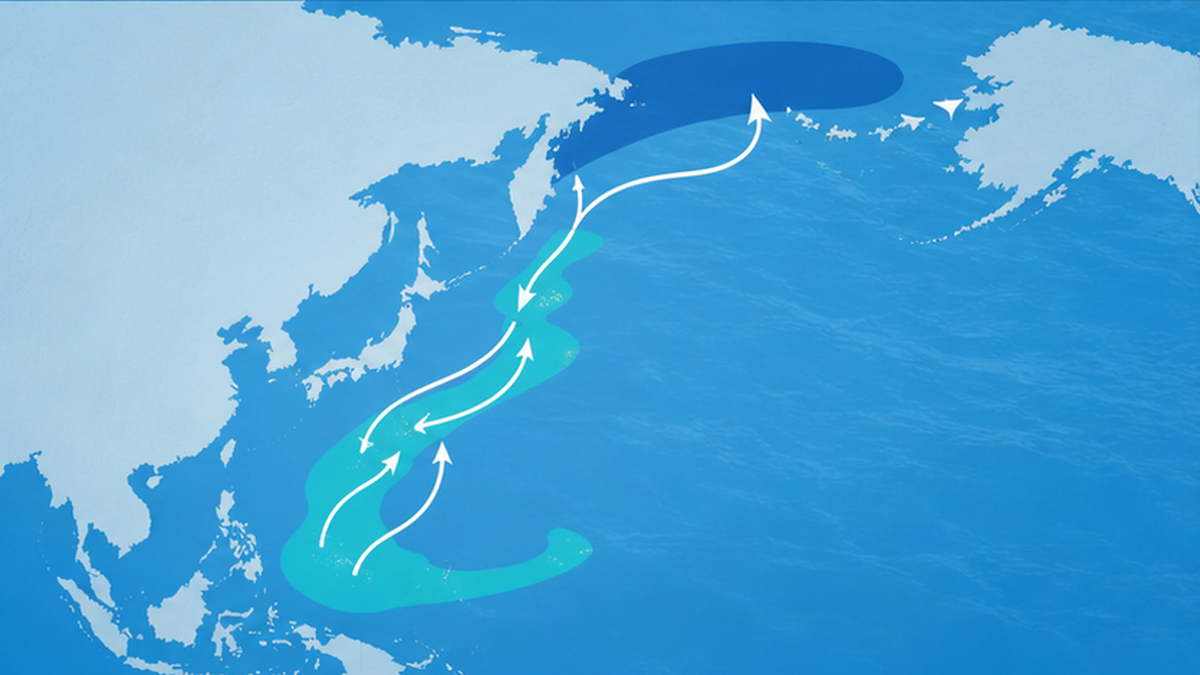
Japan's seas are, in fact, an important breeding ground for humpback whales. For the western North Pacific population, waters around Russia serve as the feeding ground, Okinawa, Amami, Ogasawara, and the Philippines/Mariana Islands area as the breeding ground, and Hokkaido and other areas as a corridor along the migration route. Every winter, several hundred humpback whales arrive from far northern seas to Japan's southern waters.
The Ogasawara Islands see nearly 400 humpback whales visit every winter to give birth and raise their young. Okinawa's Zamami waters likewise become lively with mother-calf pairs and courting groups from late December through early April. Japan's coastal waters have become one of the "cradles" that raise the world's humpback whales. North Pacific humpback whales, once decimated by whaling, have been on a recovery trend thanks to protection efforts, and more individuals have been returning to Japan's waters. The fact that Japan's winter seas are now so bustling with whales is itself a result of long years of conservation effort.
Different groups head to different "destinations"
In recent years, methods such as photo identification and genetic analysis have gradually revealed the group structure of humpback whales visiting Japan. A research team from Osaka University's Cybermedia Center and others automatically matched 3,532 tail fluke photographs taken between 1989 and 2020 in the waters off Okinawa, Amami, Ogasawara, and Hokkaido, showing that these four domestic sea areas are essentially used by a single, shared population, while also suggesting the possible existence of smaller subgroups within it — a Pacific-side group (Ogasawara-Mariana) and an East China Sea-side group (Amami/Okinawa) — that interact with different frequencies. Pinning down which feeding ground the individuals visiting breeding grounds such as Okinawa and Ogasawara come from is essential basic information for protecting whales.
Why does group structure matter so much? If a particular group depends heavily on a particular feeding ground, and that feeding ground alone deteriorates due to warming or overfishing, that group alone would take a concentrated hit. Conversely, knowing which breeding ground connects to which feeding ground makes it possible to prioritize which waters most need protection. By combining three methods — photo identification, genetic analysis, and satellite tracking — researchers are gradually piecing together the full picture of whales' otherwise invisible journeys.
| Role | Main waters | Season |
|---|---|---|
| Feeding ground | Russia, the Aleutian Islands, Alaska | Summer (roughly June-September) |
| Migration corridor | Off Hokkaido and Honshu | Spring, fall |
| Breeding ground | Okinawa, Amami, Ogasawara, Mariana Islands | Winter (roughly December-April) |
A tail fluke is as unique as a "fingerprint"
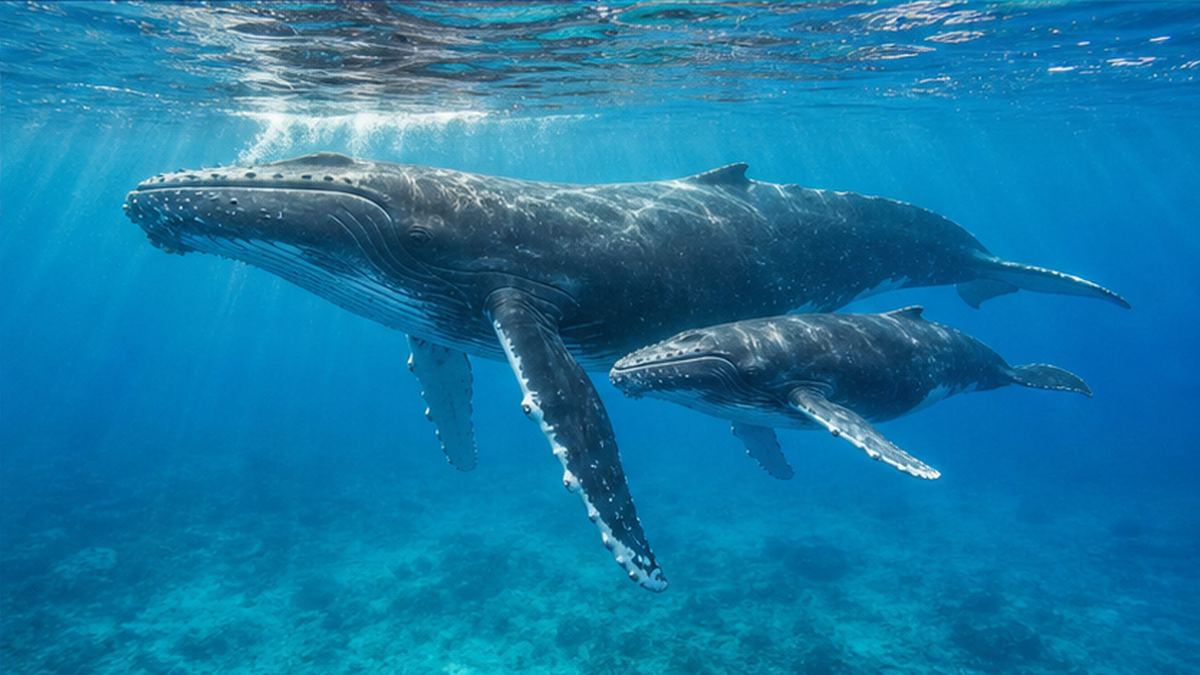
A humpback whale's tail fluke (the black-and-white pattern on the underside) is as distinctive to each individual as a human fingerprint. Researchers photograph and match this pattern to track where the same individual has traveled from and to. Cataloguing photos from around the world into a shared database has led to one astonishing long-distance discovery after another.
How do whales find their way? The mystery of navigation
There are no roads or signposts across the vast ocean. With no GPS and no map, how do whales precisely navigate between feeding grounds and nurseries thousands of kilometers apart? This remains one of the biggest mysteries in whale research, and a few clues are gradually coming into focus.
"Sensing" the Earth's magnetic field to navigate
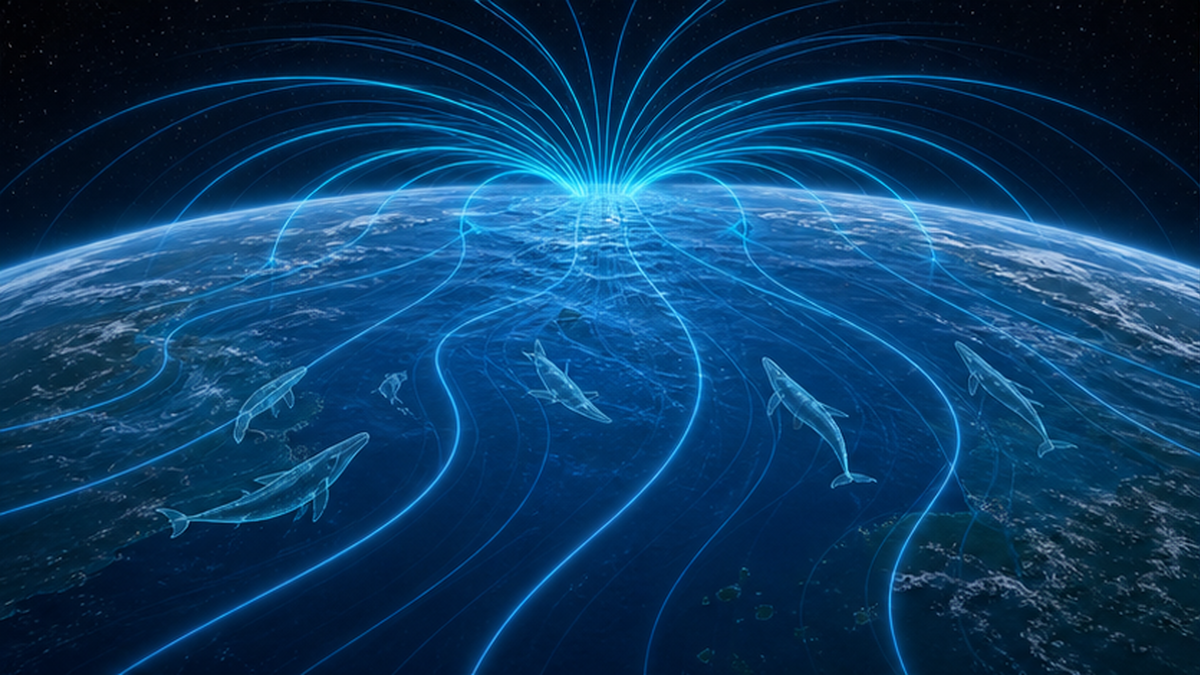
One leading theory is navigation using geomagnetism (Earth's magnetic field). Earth is a giant magnet, with field strength and inclination varying by location. Research has shown that fin whale migration is related to changes in the geomagnetic field, and that whale migration routes tend to follow contours of the magnetic field (a kind of magnetic terrain) rather than the shortest possible distance. Tissue containing magnetite — a mineral that can sense magnetism — has been found in whale bodies, suggesting it may function as a biological compass.
The sun, moon, and ocean currents as clues too
The magnetic field isn't the only factor. Recent research suggests that blue whale migration routes, for example, may also be related to the position of the sun and moon, and the direction and changes of ocean currents. In other words, whales may combine multiple sources of information — geomagnetism, celestial bodies, and ocean currents — to build a rough "mental map" of the sea. In addition, the memory of experienced, older whales, and route information passed down from mother to calf, are also thought to matter. It's likely that a calf that experiences its first migration alongside its mother learns the route and follows the same path in subsequent years — a learning aspect that shouldn't be overlooked.
When we humans travel long distances, we too unconsciously combine multiple cues — not just a compass, but landmarks like mountains or stars, and past experience. Whales are likely doing something similar: rather than relying on a single perfect sensor, they layer multiple imperfect clues together to achieve a robust navigation system that keeps them from getting lost even in a vast ocean. That's exactly why it's difficult to declare any single theory "the correct answer."
Do solar storms scramble a "whale's GPS"?
There's an intriguing phenomenon that lends support to the magnetic navigation theory. When a large eruption occurs on the sun's surface (a solar flare), it disturbs Earth's magnetic field. Research has reported a correlation between such geomagnetic disturbances and whale strandings. If whales navigate relying on the magnetic field, it would make sense that they lose their sense of direction when the field is disturbed, wandering into shallow waters as a result. This is not yet confirmed, but it's an important clue toward solving the mystery of whale navigation.
Many hypotheses remain unconfirmed
The navigation mechanisms introduced here are all still under active research and have not been fully proven. How whales find their way remains a major unsolved question that scientists around the world continue to tackle. The fact that "so much remains unknown" is itself part of what makes whale research so fascinating.
- The geomagnetic compass theory — magnetite has been found inside their bodies
- The celestial navigation theory — using the position of the sun and moon as cues
- The theory of using the direction and changes of ocean currents
- Memory carried by older individuals, and route information passed from mother to calf
Whales that sustain the marine ecosystem — the whale pump and carbon
Whale migration isn't just a behavior for their own survival. Their entire cycle of activity — traveling thousands of kilometers, eating enormous amounts, excreting, and eventually dying and sinking — functions as a massive ecosystem engine that circulates nutrients and carbon throughout the ocean. In recent years, the scale of this role has become clearer and clearer.
The "whale pump" — carrying deep-sea nutrients to the surface
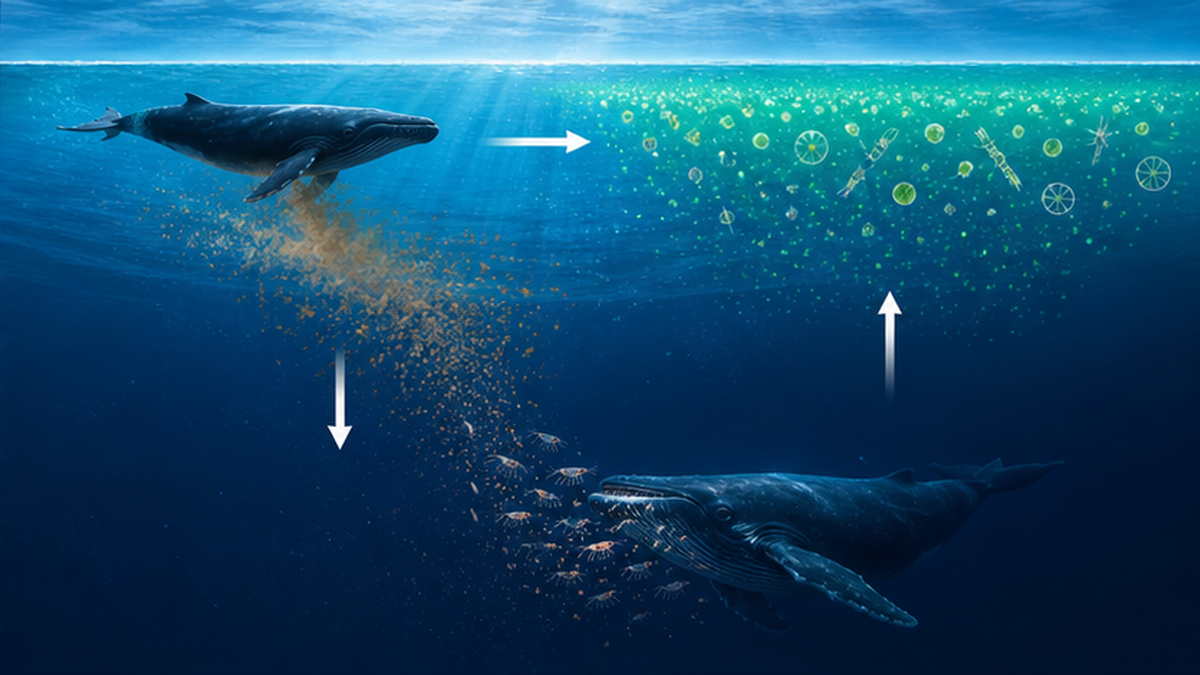
Whales are animals that often feed at depth and defecate near the surface. This behavior pumps nutrients, which otherwise tend to accumulate in the deep sea, back up to the surface layer. This is called the whale pump. Whale feces are rich in iron — a nutrient often scarce at the ocean surface — along with nitrogen and other nutrients.
Iron is an essential nutrient for phytoplankton growth. As whales spread iron-rich feces at the surface, phytoplankton increases, which in turn increases the krill and small fish that feed on it, which eventually increases the whales' own food supply as well. In other words, whales fertilize their own dinner table. This is the mechanism behind the famous "krill paradox" (the more whales eat, the more krill there is). The paradoxical phenomenon in which krill populations also declined after whaling decimated whale numbers is thought to be a result of this nutrient cycle breaking down.
Research suggests that baleen whales' actual food intake is roughly three times earlier estimates. Eating and excreting that much also means circulating that much more nutrients. The whales that once filled the ocean in far greater numbers than today were, in effect, "giant farmers," tilling and fertilizing the sea on a scale far beyond what we ever imagined. A decline in whale numbers isn't simply the story of one species disappearing — it means a decline in the ocean's productive capacity itself.
Whales as "carbon carriers" too
The phytoplankton that increases through the whale pump absorbs atmospheric carbon dioxide (CO2) as it photosynthesizes. Phytoplankton is, in a sense, a vast forest floating in the ocean. By supplying nutrients, whales strengthen this "ocean forest's" ability to absorb CO2. According to an International Monetary Fund (IMF) estimate, a single large whale locks away an average of 33 tonnes of CO2-equivalent carbon over its lifetime — comparable, by one assessment, to thousands of trees.
The IMF has gone further, publishing an economic estimate of the ecosystem services provided by a single whale, valuing it at more than 2 million dollars (roughly 200 million yen) per large whale. The view that recovering whale populations, decimated by whaling, could substantially boost the ocean's capacity to absorb CO2 is drawing attention in the context of climate action as well.
In protecting the planet, a single whale is worth thousands of trees.
— International Monetary Fund (IMF), Finance & Development magazine (2019)
Migration itself transports nutrients
Interestingly, the act of migration itself also transports nutrients. Whales eat in the nutrient-rich high latitudes, then give birth, excrete, and molt in the nutrient-poor low latitudes. In other words, they physically carry the nutrients gained in their feeding grounds to distant breeding grounds. This long-distance nutrient transport is sometimes called the "great whale conveyor belt," and it works to even out the ocean's nutrient balance on a planetary scale.
Three gifts whales give the ocean
- Pumping deep-sea nutrients (especially iron) up to the surface (the whale pump)
- Boosting phytoplankton and strengthening the ocean's capacity to absorb CO2
- Carrying nutrients from feeding grounds to distant seas through migration (long-distance nutrient transport)
This kind of ocean carbon cycle is also strongly affected by rising sea temperatures and shifting currents. How ocean warming affects plankton and marine life is covered in detail in our article on rising sea temperatures and shifting currents.
The world born when a whale dies — whale-fall communities
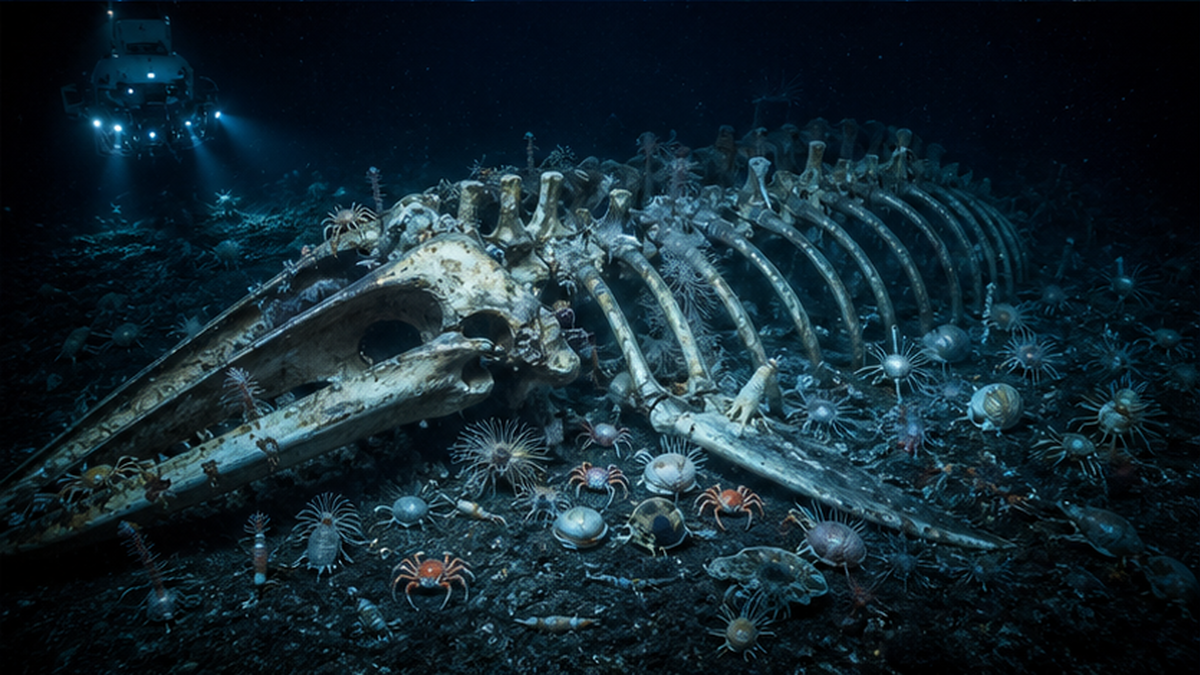
A whale's contribution to the ocean doesn't end when its life does. When the enormous body of a whale that has reached the end of its life sinks to the deep sea, it gives rise to a distinctive ecosystem that continues for decades. This is called a whale-fall community. Into a pitch-dark, food-scarce deep sea, a massive feast suddenly arrives — and an astonishing variety of creatures gather around it.
A "feast" falling into the deep sea
The deep sea is a world with no sunlight and extremely little food. The sinking of a whale carcass weighing tens of tonnes is like an oasis suddenly appearing in the desert. A single whale's body becomes a source of nutrition for deep-sea creatures for decades to come. JAMSTEC (the Japan Agency for Marine-Earth Science and Technology) has studied these whale-fall ecosystems for many years, and during a round-the-world research voyage in 2013, discovered one of the deepest whale-fall communities ever found, at a depth of 4,204 meters off the coast of Brazil.
Ordinarily, the only nutrients reaching the deep seafloor from the surface far above arrive slowly, as tiny particles of organic matter called "marine snow." The amount is minuscule. Into that world, suddenly falls a still-fresh mass of nutrients weighing tens of tonnes — an unparalleled feast for deep-sea creatures. It's said that the amount of life a single whale carcass can support is comparable to the organic matter the same area of seafloor would normally receive over hundreds of years. Even in death, whales bring extraordinary bounty to the deep sea.
An ecosystem that shifts through four stages
A whale-fall community shifts its leading players over time, in a process known as ecological succession. Roughly, the following stages are recognized. First, when the carcass sinks, scavengers such as sharks, hagfish, and deep-sea crabs gather and strip away the soft tissue. Next comes a stage of small creatures swarming over the remaining bones and surrounding sediment.
- Scavenger stage — sharks and hagfish eat the soft tissue
- Opportunist (bone-dissolving) stage — bone-eating worms and others break down the bones, attracting many small animals
- Chemosynthetic stage — hydrogen sulfide seeps from the bones, and creatures that live symbiotically with bacteria using it thrive
- Suspension-feeder stage — once the bones are stripped of nutrients, creatures that feed on organic matter in the water settle in
A "chemosynthesis" world that doesn't rely on sunlight
The third stage in particular deserves attention. Whale bones contain large amounts of fat, and as bacteria break it down, they produce a substance called hydrogen sulfide. Just as at deep-sea hydrothermal vents, bacteria that use hydrogen sulfide as an energy source (chemosynthetic bacteria) appear, and clams, tube worms, and other creatures that live in symbiosis with them thrive. In other words, a whale-fall community is an ecosystem that relies entirely on chemical energy, with no dependence on sunlight whatsoever.
Researchers suspect that this world of chemosynthesis may serve as "stepping stones" connecting creatures at distant hydrothermal vents and seep sites. The idea that whale bones, scattered across the deep sea floor, might help disperse chemosynthetic ecosystem organisms is a truly grand hypothesis. The mechanisms of creatures living in the extreme environment of the deep sea are also covered in detail in our article on the remarkable adaptations of deep-sea creatures.
Whale-fall communities have yielded discoveries of many previously unknown species. A single whale's death boosts deep-sea biodiversity all at once. Migrating whales, then, circulate nutrients and carbon through the ocean's surface while alive, and give rise to a new chain of life in the deep sea when they die — truly a presence that sustains the ocean from beginning to end. Protecting whales, then, is also connected to protecting the future of deep-sea creatures we haven't even discovered yet.
The "bone-eating worm" — an odd star of the show
A representative resident of whale-fall communities is a tube worm known as the bone-eating worm (genus Osedax). With no mouth or stomach, it survives by absorbing nutrients from whale bones through bacteria it houses symbiotically inside its body. It's a strange creature, almost like a "flower that eats bones," and it plays a role in recycling nutrients in the deep sea.
Climate change is throwing migration off course — the crisis of mistimed arrivals
The whale migration that has repeated for thousands of years is now quietly starting to waver. The cause is climate change. Rising sea temperatures and shifting currents are affecting where and how much food whales find, as well as the timing of migration itself, posing a major risk to their future.
Krill, their food, is declining and shifting
Krill, the staple food of baleen whales, is strongly affected by water temperature and by the abundance of the phytoplankton it feeds on. Antarctic krill in particular is sensitive to rising sea temperatures and shrinking sea ice. Research has pointed to the risk that, as warming progresses, the waters suited to krill growth shrink and shift, reducing their population. If food declines, the entire Antarctic ecosystem — including whales that depend on it, along with penguins, seals, and more — suffers.
The pitfall of "timing mismatch"
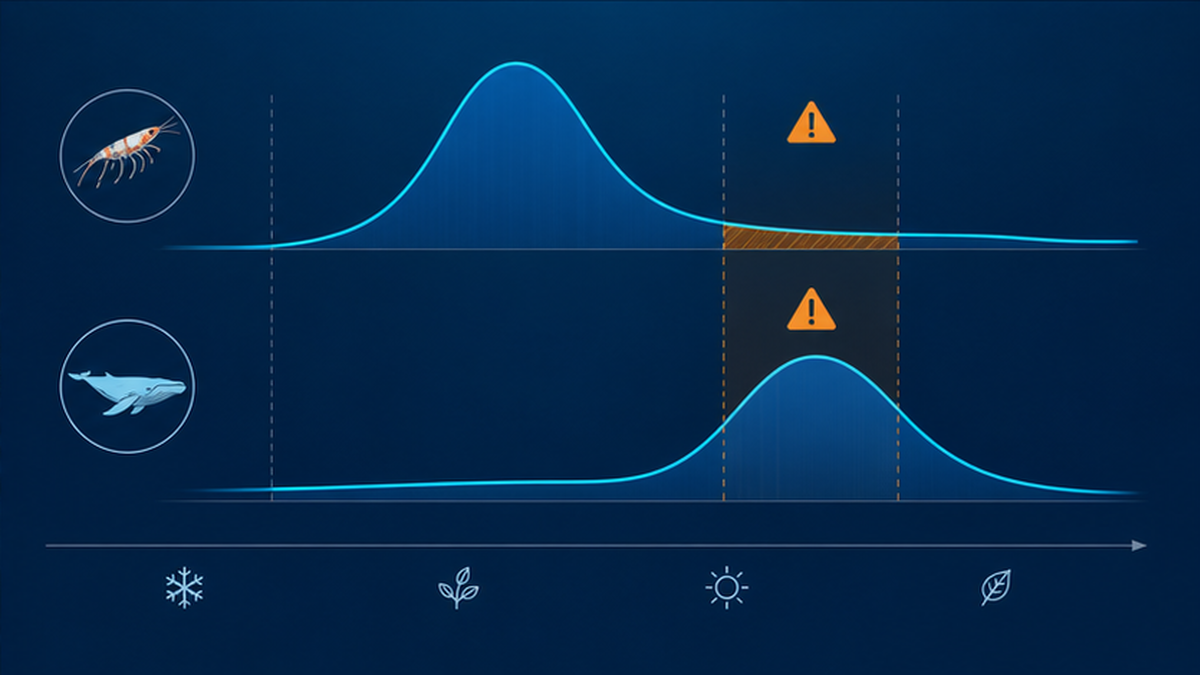
More serious still is timing mismatch (phenological mismatch). Whales schedule their migration to arrive at feeding grounds when food is at its most abundant. But if warming causes the peak in krill abundance to shift earlier, a whale arriving on its usual schedule may end up reaching a feeding ground where the peak has already passed. If they can't get enough food, they can't store enough fat, which threatens the following year's reproduction and their long journey.
Indeed, there are observations that the timing of blue whale migration is already shifting. One study reported that blue whale arrivals shifted roughly 42 days earlier over a decade (about 4.2 days per year). Whales are trying desperately to adapt to environmental change, but it remains uncertain whether they can keep pace with how fast that change is happening. The tricky part is that the trigger for whale migration (such as day length) and the trigger for food abundance (such as water temperature) are governed by separate factors. There's no guarantee that both will shift earlier at the same rate, and the gap between them could keep widening year after year.
Migration routes are changing, and accidents are increasing
Climate change is also altering the distribution of whales themselves. As sea temperatures rise, it's been suggested that whale habitats may be shifting northward. There have also been reports of Arctic whales no longer moving south even in winter, seen as another sign of shifting migration patterns. As distribution shifts, whales may pass outside of existing protected areas or overlap with shipping lanes, raising the risk of increased ship strikes.
| Effect of climate change | Risk to whales |
|---|---|
| Rising sea temperatures, shrinking sea ice | Krill populations decline and shift in distribution |
| Earlier peak in food abundance | Timing mismatch leads to insufficient food |
| Northward shift in habitat | Changes to traditional routes, movement into new waters |
| Route and distribution changes | Increased ship strike incidents |
Ocean warming affects every corner of the marine ecosystem, not just whales. Coral bleaching, and the difficulty corals and shellfish face growing in an increasingly acidic ocean, are also serious problems. See also our article on ocean acidification and coral reefs.
Migration is not a "fixed, unchangeable schedule"
Whale migration is a precise schedule, honed over a long evolutionary history to match the environment. But climate change is rapidly rewriting the very premise that schedule relies on — when and where food becomes abundant. If the pace of change is too fast, whales' ability to adapt may not keep up, potentially leading to food shortages and reproductive failure.
Encountering whales in Japan's seas — whale watching and conservation
Having read this far, do you have a sense of just how remarkable whale migration truly is? Happily, a scene from that grand journey can be witnessed up close in Japan's own waters. Japan's coastal seas in winter are one of the world's premier spots for observing humpback whales.
Winter in Okinawa and Ogasawara is bustling with whales
In Okinawa's Zamami waters, the best whale-watching season runs every year from late December through early April. Sightings are especially frequent during the peak from late January through early March, when the encounter rate with humpback whales has historically averaged 98%. The Ogasawara Islands also see nearly 400 whales visit every winter, reaching their peak around February-March. Visitors sometimes get to see mothers and calves swimming close together, or males performing dramatic breaches on the surface.
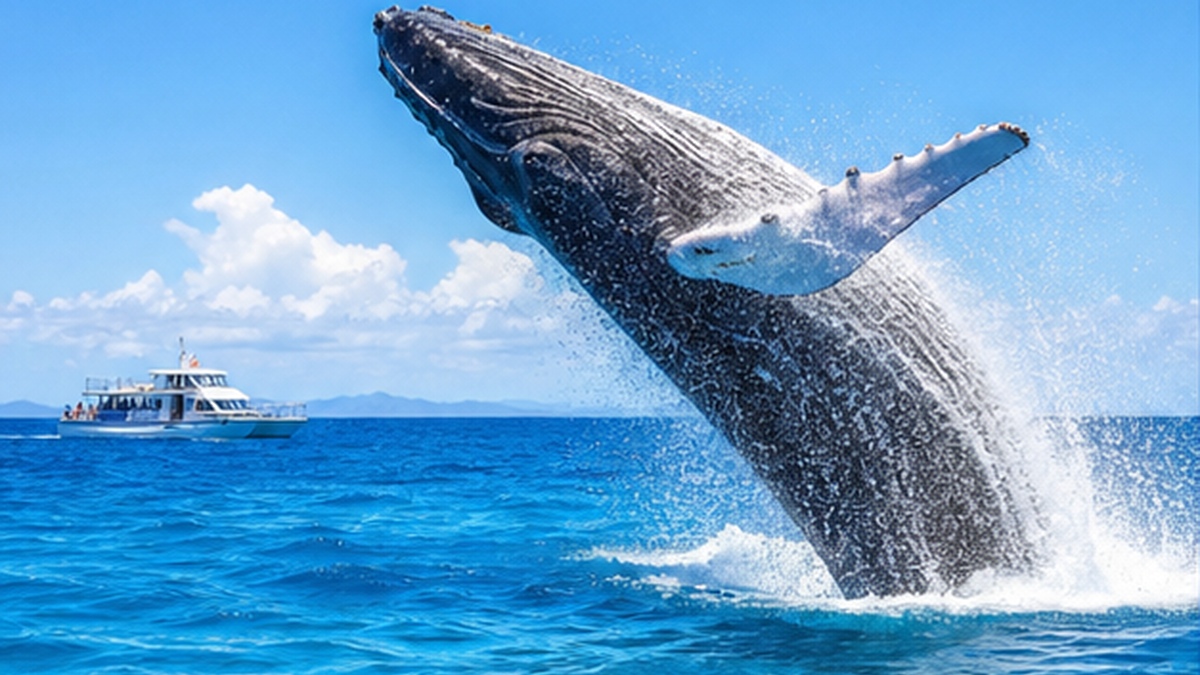
Rules for living alongside whales
When going to see whales, it's important to follow etiquette that doesn't burden them. Operators such as the Zamami Village Whale Watching Association, and similar groups elsewhere, run their tours under self-imposed rules on how closely boats may approach whales, boat speed, and observation time. Mothers and calves in the middle of raising young are especially sensitive, and boats getting too close or following for too long can interfere with nursing and rest. Encountering whales with restraint helps protect a sea where they can raise their young in peace. Choosing a tour that follows the rules is, in itself, a meaningful step toward whale conservation.
How to protect migrating whales
Migrating whales cannot be protected by any single country's waters alone. On their journey of thousands of kilometers from Russia's feeding grounds to Japan's nurseries, they pass through the seas of various countries and international waters. That's exactly why international frameworks such as the IWC (International Whaling Commission), along with scientific monitoring through satellite tracking and genetic analysis, are indispensable. The problem of ocean plastic waste and microplastics also affects all marine life, migrating whales included. See also our related article on the breakdown of ocean plastic.
What we can do
- When whale watching, follow the operator's self-imposed rules and be considerate toward whales
- Reduce plastic waste, and avoid adding to the litter that flows into the sea
- Choose actions that reduce emissions of the greenhouse gases behind rising sea temperatures
- Take an interest in whale and marine ecosystem research and conservation efforts, and share what you learn
Whale migration might seem like something happening in a distant Antarctic or northern sea, but it is, in fact, genuinely connected to our own daily lives. Every individual action that protects the ocean helps support the journey of the whales that will return to Japan's seas again next year.
Conclusion — a whale's journey is itself the cycle that connects the ocean and the planet
Whale migration is not simply a long-distance movement. Eating in food-rich cold seas, giving birth in warm seas suited for raising young, carrying nutrients and carbon through the ocean along the way, and nurturing life in the deep sea even after death — migration is, in itself, the grand cycle that connects the ocean to the planet.
That precise travel schedule is now being shaken by climate change. Protecting whales is connected to protecting the entire marine ecosystem they sustain — and the planet's climate itself. The next time you spot a whale in Japan's waters, remember that its journey of thousands of kilometers, and the future of the ocean itself, are riding on its back.
Summary of this article
- Whales make an annual round trip between food-rich cold seas (feeding grounds) and warm seas suited to raising young (breeding grounds)
- Humpback whale migrations run thousands of kilometers each way, with the longest recorded at about 11,300 km
- Japan's Okinawa, Amami, and Ogasawara are among the world's foremost humpback whale breeding grounds (nurseries)
- Whales are thought to navigate using geomagnetism, celestial bodies, and ocean currents as clues, though much remains unresolved
- The whale pump circulates nutrients and carbon, playing an important role in boosting the ocean's capacity to absorb CO2
- A dead whale creates a whale-fall community in the deep sea — a separate world that doesn't rely on light
- Declining food supply and timing mismatches caused by climate change are threatening the future of migration
References and sources
- Ministry of the Environment / Fisheries Agency, Japan Fisheries Research and Education Agency - Status of International Fisheries Resources: Blue Whale and Large Cetacean Stock Assessment
- JAMSTEC (Japan Agency for Marine-Earth Science and Technology) - What is a whale-fall ecosystem? (Research on the evolution of chemosynthetic ecosystems)
- NOAA Fisheries - Humpback Whale: ecology, migration, conservation
- IWC (International Whaling Commission) - Whale Watching Handbook: Humpback Whale
- International Monetary Fund (IMF) - Nature's Solution to Climate Change (estimate of whales' carbon contribution)
- Global Change Biology (peer-reviewed) - Decadal-scale phenology and climate drivers of migratory baleen whales
- Scientific Reports (peer-reviewed) - Timing is everything: interannual variability in blue whale migration
- Osaka University ResOU - Unraveling the group structure of humpback whales visiting four domestic sea areas
- Zamami Village Whale Watching Association - Humpback whale ecology and observation rules
- National Geographic Japan - Numerous long-distance movements overturning conventional wisdom about humpback whales revealed, updating the longest migration record
* Listed in order of reliability: government/academic institutions > peer-reviewed papers > specialized organizations > reliable media