⚡ The answer in 30 seconds
- When Arctic permafrost thaws, long-frozen carbon escapes as CO2 and methane and drives further warming, a vicious cycle known as positive feedback.
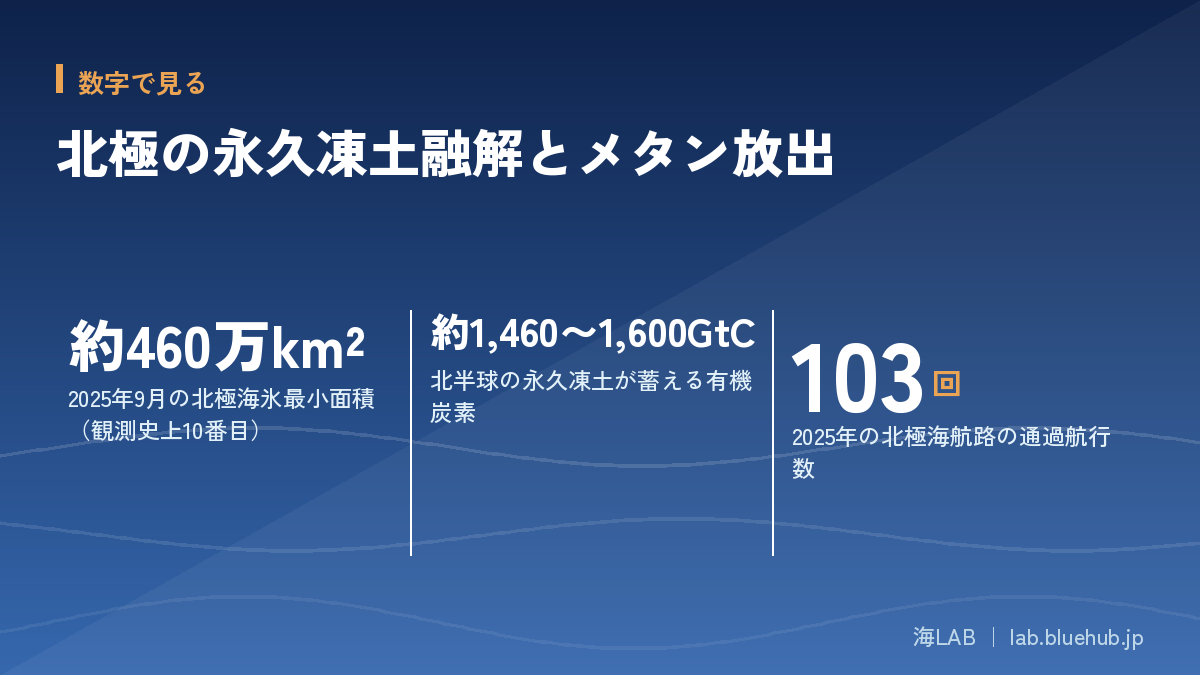
- Northern Hemisphere permafrost holds about 1,460–1,600 GtC of organic carbon, nearly twice the carbon in the atmosphere.
- Sea ice in 2025 was again the 10th smallest on record, and thick old ice has fallen by more than 95% since the 1980s.
- The Northern Sea Route is convenient but carries oil-spill and noise risks; cutting emissions is the root solution.
Ice and land in the Arctic are quietly changing.Shrinking sea ice and thawing permafrost are critical themes that shape Earth's climate.
Permafrost holds vast amounts of carbon; when it thaws, CO2 and methane can be released and accelerate warming.
Based on the latest observations and expert estimates, this article explains how Arctic change connects to our daily lives.
What you will learn in this article
- How Arctic amplification and sea ice loss work
- How much carbon is stored in permafrost
- How methane release drives a positive feedback
- Estimates and uncertainty for subsea permafrost
- The current state and risks of the Northern Sea Route
- Why cutting emissions is the most important response
What Is Happening in the Arctic: Warming Far Above the Global Average
The Phenomenon of Arctic Amplification
The Arctic is warming faster than the global average. This is called "Arctic amplification," and recent studies report that Arctic temperatures have risen about four times faster than the global average over roughly 40 years since 1979. As sea ice shrinks, the white surface that reflected sunlight is replaced by dark open water, which absorbs more heat. This "ice-albedo feedback" is one of the main drivers of amplification.
Changes in the Arctic are not distant events. Sea ice loss, permafrost thaw and the opening of Arctic shipping routes are linked, and their effects reach Japan's weather, fisheries and shipping. This article focuses in particular on methane released from permafrost and its positive feedback on warming, organizing the latest observations and estimates.
Sea Ice Today: Observations from 2025
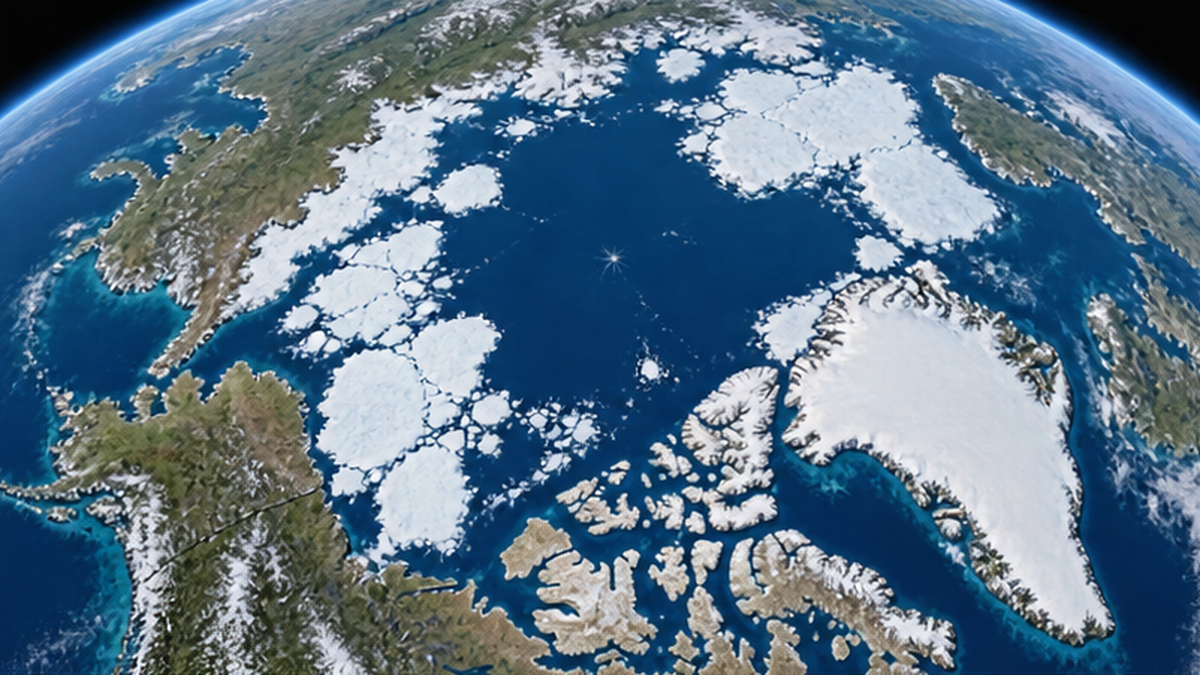
According to the U.S. National Snow and Ice Data Center (NSIDC), Arctic sea ice reached its annual minimum of about 4.6 million square kilometers around September 10, 2025, the 10th lowest in the nearly 47-year satellite record. The winter maximum in March 2025 was the lowest in the satellite record. The 19 lowest September minimums have all occurred in the last 19 years.
NSIDC also notes that there has been no statistically significant trend in September minimums over the past two decades. This does not mean sea ice loss has stopped; it shows that year-to-year natural variability is large. Over the long term, thick old ice (4+ years) has declined by more than 95% since the 1980s, leaving the ice thinner and more fragile.
| Indicator | Value / Status | Source |
|---|---|---|
| Minimum sea ice extent, September 2025 | About 4.6 million km² (10th lowest on record) | NSIDC |
| Winter maximum, March 2025 | Lowest in the satellite record | NOAA Arctic Report Card 2025 |
| Old ice (4+ years) | Down more than 95% from the 1980s | NOAA Arctic Report Card 2025 |
| Lowest 19 September minimums | All within the last 19 years | NOAA Arctic Report Card 2025 |
Key points of this section
- The Arctic is warming faster than the global average (Arctic amplification)
- Sea ice varies year to year but is getting thinner and younger over the long term
- Sea ice change cascades to permafrost and shipping routes
What Is Permafrost? Vast Carbon Sleeping in Frozen Ground
Definition and Distribution of Permafrost
Permafrost is soil or rock that stays at or below 0°C for two or more consecutive years. It covers about a quarter of Northern Hemisphere land, spreading across Siberia, Alaska, northern Canada and the Tibetan Plateau. The surface "active layer" thaws in summer and refreezes in winter, with frozen ground beneath.
A Huge Carbon Reservoir
Permafrost holds dead plants and animal remains that froze before they could decompose. The IPCC Special Report on the Ocean and Cryosphere in a Changing Climate (SROCC, 2019) assessed that Northern Hemisphere permafrost stores about 1,460–1,600 gigatons of organic carbon (GtC). This is nearly twice the carbon currently in the atmosphere (about 870 GtC).
When permafrost thaws, microbes begin decomposing the organic matter. Carbon dioxide (CO2) is mainly produced where oxygen is present, and methane (CH4) where waterlogged ground lacks oxygen. Thawing is thus a gateway for carbon to return to the atmosphere.
| Item | Details |
|---|---|
| Distribution | About a quarter of Northern Hemisphere land |
| Organic carbon | About 1,460–1,600 GtC (IPCC SROCC) |
| Gases released by thaw | CO2 (with oxygen), CH4 (without oxygen) |
| Caveat | Estimates are highly uncertain, and future releases span a wide range |
How Strong Is Methane?
- Methane lasts only about 10 years in the atmosphere, but its warming effect over 100 years is about 27–30 times that of CO2. In the short term it has a large impact on warming.
How Methane Is Released and the "Positive Feedback"
Warming → Thaw → Release → More Warming
Permafrost thaw is a problem because it is both a result and a cause of warming. Warming thaws permafrost → greenhouse gases are released → warming advances → more permafrost thaws. A cycle in which the result strengthens the cause is called a "positive feedback."
- Gradual thaw: the active layer deepens and organic matter decomposes bit by bit
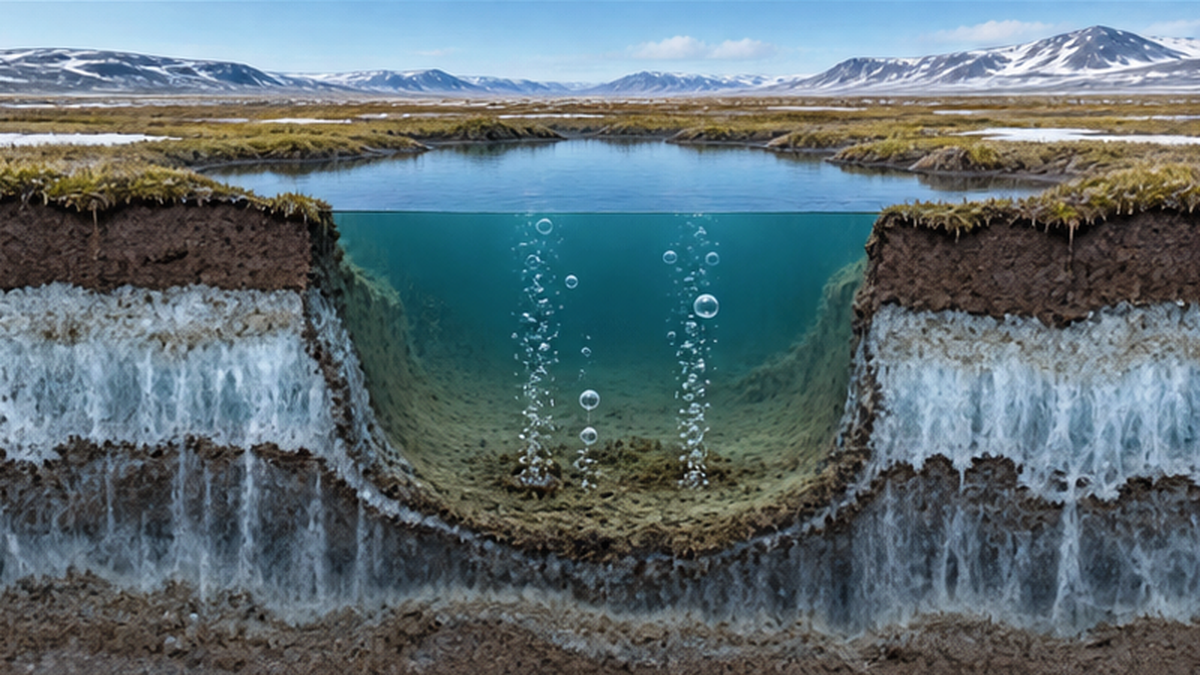
- Abrupt thaw (thermokarst): ground collapses, lakes and wetlands form suddenly, and oxygen-poor conditions spread
- Arctic fires: peat and organic soils burn, releasing stored carbon all at once
Why Abrupt Thaw Matters
Conventional climate models assumed permafrost thaws slowly from the surface. Recent studies, however, point out that "abrupt thaw," in which ground collapses and lakes form, may increase carbon release more than expected. In this process, methane is readily produced in the oxygen-poor environment of lake bottoms.
Changes Shown by the NOAA Arctic Report Card
NOAA's Arctic Report Card marked its 20th anniversary in 2025. According to news coverage, recent reports point out that Arctic tundra is shifting from a carbon "absorber" to a carbon "emitter." Warming and wildfire are the main causes, and the carbon stored in permafrost was described as about 1.5 trillion tons. However, carbon balance differs greatly by region and year, and uncertainty remains in the assessment.
Frozen Ground Under the Sea: Subsea Permafrost and Methane
What Is Subsea Permafrost?
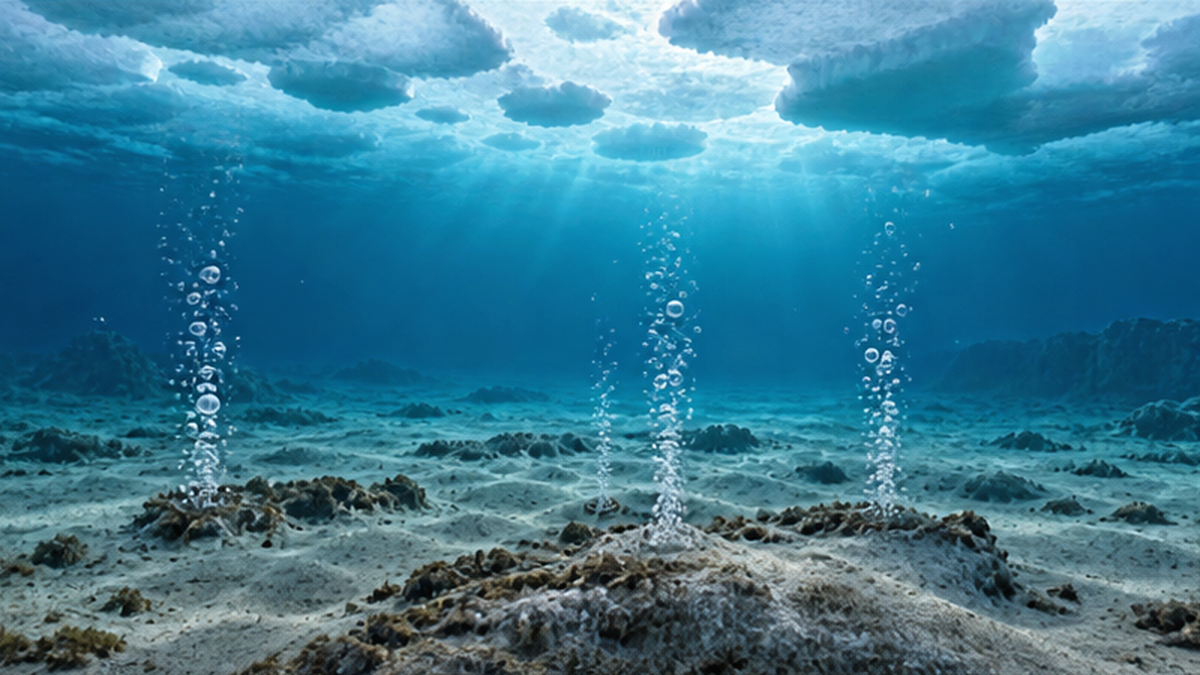
Permafrost exists not only on land but also under the seabed of the shallow Arctic continental shelf. It is land that froze when sea level was low during the ice age and was later submerged as seas rose. The East Siberian Arctic Shelf (ESAS) is a leading example and is known as one of the world's largest shallow shelves.
Estimates from Expert Assessment
A 2020 assessment by 25 experts estimated that the subsea permafrost domain holds about 560 GtC of organic carbon (90% confidence interval 170–740) and about 45 GtC as methane (10–110). Current annual methane release from the seabed is put at about 18 million tons of carbon (2–34 million tons).
For the future, under the highest-warming scenario (RCP8.5), about 43 billion tons of CO2 equivalent (14–110 billion) could be released by 2100 and about 190 billion tons by 2300. Under the low-emission scenario (RCP2.6), release is expected to be about 30% lower.
| Item | Estimate | Notes |
|---|---|---|
| Organic carbon in subsea permafrost domain | About 560 GtC | 90% range 170–740 |
| Methane in the same domain | About 45 GtC | 90% range 10–110 |
| Current annual methane release | About 18 Mt C/yr | 90% range 2–34 |
| Release by 2100 (RCP8.5) | About 43 Gt CO2e | 90% range 14–110 |
A Common Misunderstanding
- The idea that methane will burst explosively from the seabed is widely reported, but current scientific assessments see release as a gradual process unfolding over hundreds to thousands of years. High uncertainty is not the same as sudden occurrence.
Sea Ice Loss and Its Effects on the Arctic Ocean Ecosystem
Life That Depends on Ice
Algae called "ice algae" grow on the underside of sea ice and form the base of the Arctic food web. Zooplankton, Arctic cod, seals and polar bears rely on it in turn. As ice thins and melts earlier, the timing of this production may shift.
- Polar bears and seals: fewer platforms for hunting, giving birth and raising pups
- Walruses: with less resting ice, large groups have been reported crowding onto land
- Phytoplankton: more open water lets in light, changing spring and autumn blooms
Newcomers from the South
As waters warm, fish and plankton from farther south are expanding into the Arctic Ocean, a shift called "borealization." It creates competition with native species but also draws attention as a possible new fishery resource. To avoid overfishing before management frameworks exist, commercial fishing in the central Arctic Ocean is banned for now under an international agreement.
Changes in the Arctic are not unrelated to Japan's coastal waters. For links to marine heatwaves and shifting fish distributions, see also our article on marine heatwaves.
The Northern Sea Route: Opportunities and Risks of an Open Passage
Current Use
As sea ice shrinks, the Northern Sea Route (NSR) between Europe and Asia becomes realistic. Under good conditions it is said to cut sailing distance greatly compared with the Suez Canal route. According to the Centre for High North Logistics (CHNL), there were 103 transit voyages (88 vessels) in 2025, up from 97 the previous year, carrying about 3.2 million tons of cargo. However, ice formed early in the east, and the navigation window was about three weeks shorter than the year before.
Ships are increasing across the whole Arctic. According to the Arctic Council's PAME, 1,812 vessels operated in the Polar Code area in 2025, with activity concentrated in August–October when sea ice is at its minimum.
Risks and Challenges
- Oil spills: hard to recover in cold conditions, and ecosystems recover slowly
- Ship noise and collisions: concern for whales and seals
- Heavy fuel oil and black carbon: deposits on snow and ice reduce reflectivity and speed melting
- Limited rescue capacity: rescue bases are far away in an accident
The International Maritime Organization (IMO) brought the Polar Code for ships operating in polar waters into force in 2017, setting safety and environmental standards. Japan is also engaged in observation and international cooperation, including building an Arctic research vessel.
Think About It
- Shorter routes may cut fuel use and emissions. But how should we view the contradiction that the route exists because of warming itself?
The Arctic and Japan: Effects on Weather, Fisheries and Shipping
Effects on Weather
Researchers are studying whether Arctic warming is linked to jet stream meandering and cold waves. Causality is still debated among scientists, however, and no firm conclusion has been reached. For the mechanism, see our article on the jet stream.
Relationship with Sea Level Rise
Sea ice already floats on the ocean, so its melting barely raises sea level. What contributes to sea level rise is melting of the Greenland ice sheet and land glaciers, plus thermal expansion of seawater. The IPCC special report assesses the combined impacts. For the big picture, see our article on the IPCC Special Report on the Ocean and Cryosphere.
Japan's Research and International Cooperation
Japan has advanced Arctic observation centered on the National Institute of Polar Research (NIPR) and JAMSTEC. It also takes part in the Arctic Council as an observer state, contributing to scientific data sharing and international rule-making.
What We Can Do: Cutting Emissions Is the Key Response
Not Strengthening the Feedback
Humans cannot directly stop methane from permafrost. But as the expert assessment above shows, scenarios with strong emission cuts see future release about 30% lower. So reducing CO2 and methane emissions is the most reliable way to weaken the permafrost feedback.
- Save energy and use renewables to cut CO2
- Reduce food loss to curb methane from waste
- Learn the science accurately and share it with others
- Take interest in efforts that support ocean and polar research and observation
The role of ocean carbon uptake is explained in our article on the ocean's carbon uptake.
Summary
- The Arctic is warming faster than the global average
- Permafrost holds nearly twice the carbon in the atmosphere; thaw releases CO2 and methane
- Subsea permafrost methane is highly uncertain but assessed as a gradual process
- The Northern Sea Route is convenient but carries environmental risks
- Emission cuts are the most reliable way to weaken the feedback
References and Sources
- NOAA Arctic Report Card 2025 – Annual assessment of Arctic sea ice, permafrost and carbon balance
- WMO: Arctic Report Card Marks 20 Years Amid Record Warming in 2025 – Record Arctic warming in 2025
- NSIDC Arctic sea ice news – Analysis of the 2025 sea ice minimum
- NASA SVS: Arctic Sea Ice Minimum 2025 – Visualization of the 2025 sea ice minimum
- IPCC SROCC Special Report on the Ocean and Cryosphere – Assessment of permafrost carbon and more
- Subsea permafrost carbon stocks and climate change sensitivity estimated by expert assessment – Expert assessment of subsea permafrost (2020)
- The East Siberian Arctic Shelf: permafrost-related methane fluxes – Methane release on the East Siberian Arctic Shelf
- gCaptain: Arctic ship traffic record 2025 (PAME) – Arctic vessel activity in 2025
* Arranged by reliability: government and academic institutions > peer-reviewed papers > specialist organizations > reliable media