Flounder, shrimp, and snow crab lined up at the supermarket seafood counter — much of it was landed using bottom trawling (also known as demersal trawling, or simply trawl fishing), a method that drags a bag-shaped net along the seafloor. While this technique can efficiently haul in large volumes of fish, it also has a darker side: it scrapes the seabed like a giant bulldozer, tearing apart the world of living things that spreads across it.
Recent research has shown that the problems caused by bottom trawling are not confined to "under the sea." When a net churns up seafloor mud, carbon that has been locked away for hundreds or thousands of years can be stirred loose and released as carbon dioxide into the ocean — and potentially the atmosphere. In other words, destroying the seafloor may also be fueling climate change.
This article walks through, step by step in plain language, how bottom trawling damages the seafloor environment, corals, and marine life; the relationship between resuspended sediment and carbon release; and the shift toward sustainable fishing — including bycatch-reducing gear and marine protected areas — drawing on reliable sources such as Japan's Ministry of the Environment, the Fisheries Agency of Japan, the FAO, and peer-reviewed papers.
What you'll learn in this article
- What bottom trawling is as a fishing method, and how it is used in Japan
- What happens to the seafloor environment, corals, and benthic life when a net is dragged across the bottom
- Why resuspending sediment leads to carbon release linked to climate change
- The scale of the bycatch and discard problem — lives that were never the target
- Regulations, marine protected areas, and gear improvements underway around the world and in Japan
- The path toward sustainable fishing, through selective gear, MSC certification, and consumer choice
What is bottom trawling?
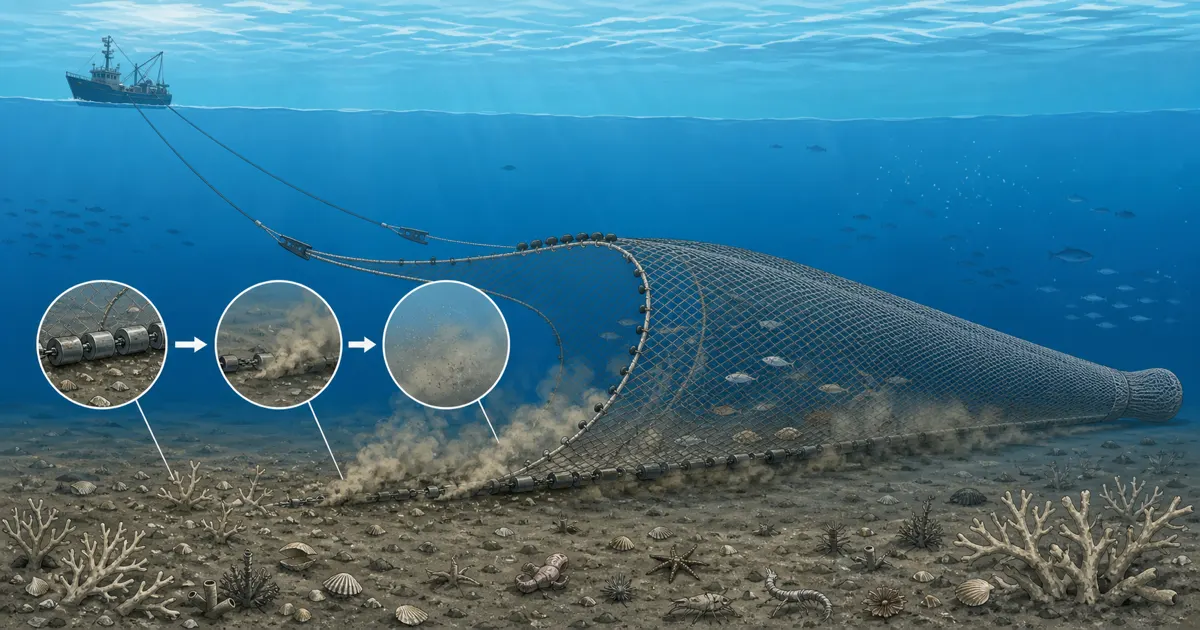
Bottom trawling is a fishing method in which a large, bag-shaped net is towed behind a boat to sweep up fish, shrimp, crab, and other creatures living on or near the seafloor. In English it's also called trawling (from "trawl"), and it's used all over the world. Because the net is dragged along the seabed with its mouth held wide open, it can catch nearly everything in its path — and it's precisely this efficiency that has made it so widespread.
According to the Food and Agriculture Organization of the United Nations (FAO) and various estimates, more than a quarter of the world's marine catch comes from bottom trawling and other bottom-contact fishing methods. Much of the whitefish, shrimp, and shellfish we eat every day is connected to this method. Its efficiency is exactly what makes it such a productive pillar of the fishing industry — and that's why it has spread across the globe over such a long history.
Bottom trawling arose from a very natural desire: to harvest efficiently from a wide area of ocean with limited manpower. Rather than targeting schools of fish swimming in mid-water, it scoops up everything at once — fish resting near the seafloor, shellfish and crustaceans buried in sand and mud — giving access to resources that other fishing methods struggle to reach. This "catch-anything" quality is the very essence of the method, combining convenience with environmental cost in equal measure.
How the net's "mouth" opens
If you simply towed a bag-shaped net, its mouth would close. So various devices are used to keep it open: "otter boards" (panels that spread the net's mouth sideways) attached on either side use water resistance to hold the opening wide, or two boats tow the two ends of the net apart. Along the bottom edge of the net runs a weighted line (a ground rope or chain) that traces the seafloor, and this is the part that scrapes directly against the bottom. It is this contact section that ends up acting as the "blade" that gouges the seafloor.
The wider the net's mouth and the heavier the ground gear, the larger the area swept in a single tow — and the bigger the catch. But that also means a larger area of seafloor gets scraped away each time. The trend toward bigger, more capable gear has raised fishing efficiency even as it has deepened the damage to the seafloor — an unavoidable dilemma built into the method.
- Otter trawl: a single boat tows the net, with otter boards on either side spreading its mouth open.
- Danish seine ("kakemawashi"): a long towing rope is laid out on the seafloor in a diamond shape and then hauled in, drawing the net together.
- Pair trawl ("nisōbiki"): two boats sail side by side, each towing one end of a single net to hold its mouth wide open.

Seen this way, bottom trawling differs fundamentally from most other fishing methods in one key respect: it sweeps the seafloor as a surface. Where angling or longlining picks out fish "point by point," bottom trawling drags the entire seafloor along its path into the net. This difference is the root reason why, in exchange for fishing efficiency, the method places such a heavy burden on the seafloor environment. Keep this image of "sweeping a surface" in mind — it's the starting point for everything that follows in this article.
How is "bottom trawling" different from "purse seining"?
Purse seining is a method that encircles schooling fish in mid-water with a net, and it generally never touches the seafloor. Bottom trawling, by contrast, drags along the seafloor itself, so its impact on the seafloor environment is fundamentally different. Even among methods that use "nets," the environmental burden varies enormously depending on how they're fished.
Bottom trawling in Japan today
Bottom trawling is one of the major fishing methods in Japan as well. Broadly speaking, it falls into small-scale coastal bottom trawling, operated by small boats close to shore, and offshore bottom trawling, which operates in deeper waters further out, along with distant-water trawling that ventures even further afield. The main catch consists of seafloor-dwelling species such as flatfish, flounder, walleye pollock, Atka mackerel, snow crab, and shrimp.
Offshore bottom trawling in Japan uses three main methods — single-boat Danish seining ("kakemawashi"), single-boat otter trawling, and pair trawling — operating from just tens of meters deep in shallow areas to depths of 600 to 1,500 meters in deeper waters. Because organisms grow more slowly the deeper you go, and take longer to recover once damaged, operations in deep water raise particular concern about environmental impact.
"Kakemawashi," for example, involves laying out a long towing rope from the boat in a diamond shape on the seafloor, then hauling it in to draw the net along — a method widely used in bottom trawl fisheries on Japan's Sea of Japan coast. "Pair trawling," on the other hand, uses two boats working together to tow a large net, giving it greater catching power — and, correspondingly, a heavier toll on the seafloor. Even within "bottom trawling," the area and intensity of seafloor contact vary by method.
A fishing method that has sustained local food culture
Bottom trawling is also a method deeply rooted in local economies and food culture, bringing snow crab — beloved as a winter delicacy (known regionally as matsuba-gani or Echizen-gani) — and whitefish from all over Japan to the dinner table. That's precisely why this isn't simply a matter of "it's a bad method, so stop it" — what's needed is a way of thinking about how to continue the practice while reducing its environmental burden. This article, too, is written not to condemn fishing but to consider more sustainable ways forward.
The people who work in fishing know better than anyone that if the resource dwindles, their own livelihoods become unsustainable. Protecting the seafloor environment isn't some distant ideal — it's a practical challenge tied directly to whether fishing can continue tomorrow. Environmental conservation and the survival of the fishing industry aren't opposing forces; fundamentally, they point in the same direction. With that in mind, this article now turns to the challenges bottom trawling faces, and the path toward change that lies beyond them.


This article's stance
- Bottom trawling is an important fishing method that supports local food culture.
- At the same time, it carries real costs for the seafloor environment and the climate.
- The goal isn't "ban it or keep it as is" — it's a shift that reduces its burden.
What happens on the seafloor — the mechanics of physical destruction
The biggest problem with bottom trawling is that the heavy net and ground gear drag directly across the surface of the seafloor. Picture it this way: rather than walking through a forest to find animals, you bulldoze the entire forest flat first, then pick through the fallen trees for your quarry. Deep grooves and scraped tracks are left behind on the seafloor wherever the net has passed.
Countless benthic organisms — clams, polychaete worms, starfish, crabs, sponges, and corals among them — live on the seafloor's surface. They churn the sand and mud to cycle nutrients, and provide shelter and feeding grounds for fish; together, they form the foundation that supports the seafloor ecosystem. Bottom trawling scrapes away this entire foundation.
The surface layer of seafloor mud and sand is a thin, delicate "membrane of life," where everything from invisible microbes to benthic invertebrates lives layered together. This layer breaks down nutrients, maintains water quality, and nurtures the small organisms that fish feed on. When a net passes through, this membrane is physically stripped away, churned up, and buried. It's not just the surface that gets disturbed — resuspended sediment also settles over the surrounding area, sometimes suffocating organisms in places the net never even touched.
"Frequency" determines recovery
After a single tow, life can sometimes return to a sandy or muddy seafloor over time. The problem is that the best fishing grounds tend to be trawled again and again. If the net comes through again before the ecosystem has recovered — and this cycle repeats — the seafloor gradually simplifies, until only a few tough, fast-growing organisms remain. Whether recovery outpaces the frequency of trawling determines the seafloor's fate.
The term "seafloor desertification"
When the same area is trawled repeatedly, a seafloor that once had a complex, three-dimensional structure gradually flattens into a featureless plain. Researchers sometimes describe this as the "desertification" of the seafloor. Hiding places and spawning grounds are lost, biodiversity declines, and the very fish stocks that depended on that habitat begin to shrink. The destruction doesn't end with a single event — it feeds back into the fishing industry itself, as reduced reproductive capacity of the stock.
- The seafloor's three-dimensional structure (coral, sponges, shells, and the like) is lost and flattened.
- Fish spawning grounds and juvenile nursery habitats are destroyed.
- Benthic biodiversity declines, and the ecosystem's balance is disrupted.
- The more an area is trawled repeatedly, the less room there is for recovery.

Once a deep-sea ecosystem is lost, recovery takes an extraordinarily long time. In places with long-lived organisms, the scars persist across generations.
— paraphrased from deep-sea ecosystem researchers
To put it in terrestrial terms: imagine clearing old-growth forest for farmland, then tilling it over and over at every harvest. However many times you till such land, deep forest never returns. The seafloor works the same way — once its rich, three-dimensional structure is lost, the fish that depended on it, and the fishery that depended on those fish, both slowly wither. Destroying the seafloor is, in the end, an act that erodes the fishing industry's own future.
What are "benthic organisms"?
This is the general term for creatures that live on the seafloor — clams and polychaete worms burrowing in sand and mud, sponges and corals attached to rocks, and crabs and starfish that crawl about. They may not stand out, but they cycle nutrients, feed fish, and quietly support the seafloor ecosystem from the ground up — the unsung heroes of the sea floor.
The toll on corals and benthic life
The impact of seafloor destruction is especially severe for organisms that grow extremely slowly. The prime example is cold-water coral (deep-sea coral), which forms colonies in the cold, dark depths. Unlike shallow tropical coral reefs, it grows painstakingly slowly, over hundreds or even thousands of years, in a world where light never reaches.
Research from the University of the Ryukyus and others has found a coral colony more than 7,000 years old on a Pacific seamount at a depth of 525 meters, with reports of individuals estimated to exceed 8,000 years. Life that has persisted longer than the history of human civilization can be shattered by a single pass of a trawl net — and there is no hope of it recovering within our lifetimes. You can learn more about cold-water coral ecology in our article on cold-water coral (deep-sea coral).
Coral as the "forest of the sea"
The three-dimensional colonies formed by corals and sponges serve as shelter and spawning grounds for many fish and invertebrates — in effect, a forest of the sea. Deep-sea bottom trawling has been likened to clear-cutting this entire forest in one pass. Reports from outlets such as National Geographic have repeatedly pointed out that deep-sea trawling can devastate the seafloor. For the challenges facing shallow-water coral, see our article on the mechanism behind coral bleaching.
In the food-scarce environment of the deep sea, cold-water coral colonies act as something like an oasis for living things. Shrimp, crabs, and juvenile fish shelter in the gaps of their intricately branched skeletons, drawing in the fish that prey on them — an entire small ecosystem built around them. When a single pass of a net shatters this structure, the countless creatures that lived there all lose their home at once. What's destroyed isn't just one species of coral — it's the entire ecosystem built around it.
The deep sea isn't just "dark and barren"
At first glance, the lightless deep sea might seem like a world with little life. In reality, though, it holds pockets of unique richness — cold-water coral and sponge colonies, ecosystems sustained by chemosynthesis, and more. See our article on the remarkable adaptations of deep-sea creatures for more on how these organisms survive. Because such places grow slowly and recover slowly from damage, they are precisely the "seas that most need protecting" — and the ones most vulnerable to bottom trawling.
| Organism | Characteristics | Recovery time if destroyed |
|---|---|---|
| Cold-water coral (deep-sea coral) | Grows over hundreds to thousands of years in the lightless deep sea | Hundreds to thousands of years — effectively irreversible |
| Sponge colonies | Form three-dimensional structures that serve as fish habitat and spawning grounds | Often decades or more |
| Bivalves, polychaete worms, and other benthic life | Churn sand and mud to cycle nutrients | A few years to over a decade, depending on conditions |
| Seaweed and seagrass beds | A "nursery of the sea" that raises many marine species | A few years — regeneration possible with protection |

The asymmetry of "destroyed in an instant, never restored"
A cold-water coral colony built over thousands of years can be destroyed in the seconds or minutes it takes a trawl net to pass over it. Destruction takes an instant; restoration takes millennia — it's this extreme asymmetry that makes deep-sea bottom trawling especially concerning.
Resuspended sediment and carbon release
In recent years, carbon release has emerged as a new concern surrounding bottom trawling. Seafloor mud (sediment) accumulates over long periods from the remains of plankton and other organic matter, locking away vast amounts of carbon. The seafloor also functions as a giant "carbon piggy bank," absorbing atmospheric carbon dioxide and storing it away for the long term. This carbon-storing function of the ocean is explained in detail in our article on blue carbon ecosystems.
But when bottom trawling churns up the seafloor, this dormant carbon is stirred loose and reacts with oxygen in the seawater, accelerating decomposition. As a result, carbon that had been locked away in this piggy bank is released as carbon dioxide into the seawater — and, in part, into the atmosphere. In other words, destroying the seafloor may, in turn, be adding fuel to climate change.
Inside seafloor mud is a low-oxygen environment where organic matter decomposes extremely slowly — a kind of "storage vault." That's precisely why carbon has been stably accumulated there over hundreds or thousands of years. But once a net churns it up, the mud is exposed to oxygen-rich seawater, and the organic matter that had lain dormant suddenly switches into rapid decomposition mode. What took a long time to store away gets released again in a short span of time.
It's not just mud — minerals react too
A 2025 study by Germany's GEOMAR ocean research institute and others revealed an even deeper mechanism. Low-oxygen mud contains an iron-bearing mineral called pyrite lying dormant. When bottom trawling stirs it up and exposes it to oxygen, an acid-producing chemical reaction occurs, converting bicarbonate ions in seawater — a climate-neutral form of carbon — into carbon dioxide. In other words, it's not just organic decomposition — mineral reactions may also be adding to the CO2 released.
How much carbon are we talking about?
A study published in the journal Nature in 2021 estimated that bottom trawling-induced disturbance of the seafloor worldwide could release roughly 0.58 to 1.47 gigatons of carbon dioxide (in the water) annually — a figure that sparked considerable debate. That estimate has drawn criticism as an overestimate, and subsequent research has offered more conservative figures, suggesting that the CO2 actually reaching the atmosphere may amount to at most around 340 to 370 million tons (0.34 to 0.37 gigatons) per year. The range is wide, and scientific discussion is still very much ongoing — but many studies agree on one point: a non-negligible amount of carbon can be released.
At a regional scale, in the North Sea — one of the world's premier fishing grounds — bottom-contact fishing gear is estimated to release about 1 million tons of CO2 annually. GEOMAR's research team has even pointed out that this kind of sediment resuspension could temporarily flip the seafloor from a "carbon sink" that absorbs CO2 into a "carbon source" that emits it. Bottom trawling may be weakening the ocean's own capacity to absorb carbon.
What matters here is neither to be needlessly alarmed by bottom trawling's carbon emissions nor to dismiss them lightly. The fact that the seafloor is a massive carbon reservoir, and that disturbing it may carry a climate cost — this perspective adds a new dimension to a debate that had previously focused only on "how much fish can be caught." Protecting the ocean also means protecting the climate. The problem of bottom trawling teaches us just how closely the two are connected.
| Scope / study | Estimated CO2 release (per year) | Context |
|---|---|---|
| Global — 2021 study | Roughly 0.58 to 1.47 gigatons of CO2 in the water | An early, large estimate; criticized as possibly overstated |
| Global — later studies | Up to roughly 0.34 to 0.37 gigatons reaching the atmosphere (340–370 million tons) | A more conservative estimate |
| North Sea (a leading fishing ground) | About 1 million tons per year from bottom-contact gear | Regional estimate based on measured data |

Why is the range of figures so wide?
How much of the disturbed carbon ultimately reaches the atmosphere, and exactly where and how intensively different sea areas are trawled — these are difficult things to measure precisely, and researchers work from different assumptions. That's why the estimates vary so widely. What matters isn't taking any single number at face value, but grasping the overall direction: that a substantial amount of carbon can be released.
Bycatch and discards — the problem of unintended lives lost
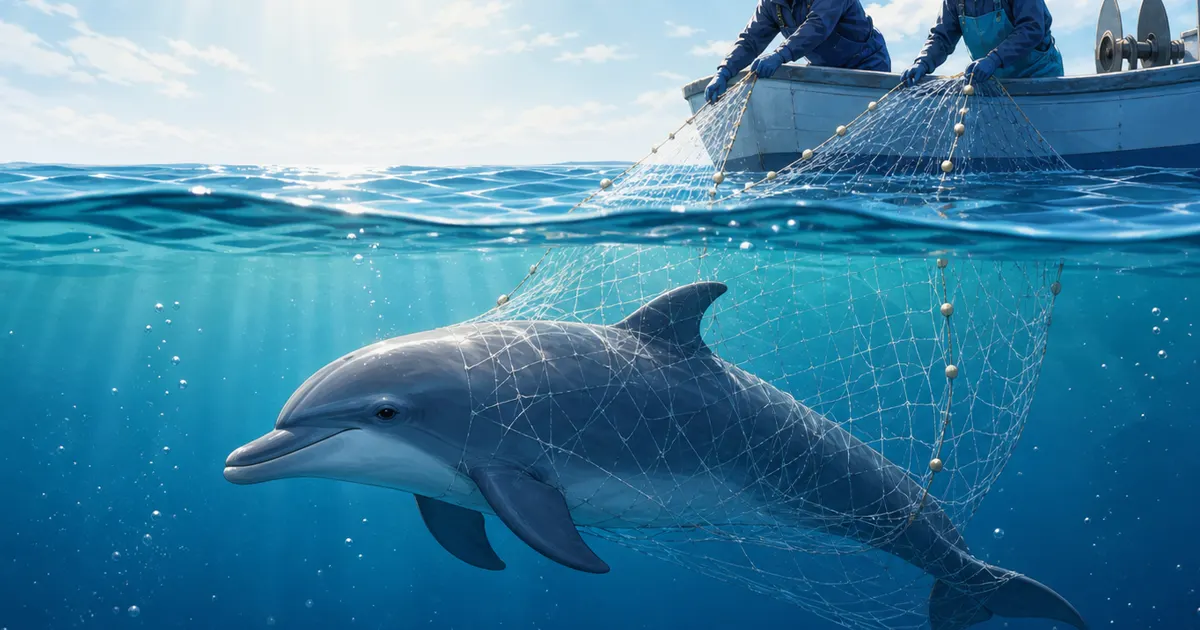
Because bottom trawling indiscriminately gathers up anything too large to pass through the net's mesh, bycatch is also a serious concern. Bycatch refers to the capture of creatures other than the intended target species — sea turtles, sharks and rays, seabirds, marine mammals such as dolphins, and even small or juvenile fish with no commercial value all get swept up together.
According to assessments by the FAO (Food and Agriculture Organization of the United Nations), roughly 60% of the fish discarded across the world's fisheries comes from trawl fisheries, with bottom trawling alone accounting for about 46% of total discards (roughly 4.2 million tons a year). Bottom trawling's average discard rate is about 22% — meaning roughly one-fifth of what's caught is thrown back into the sea, dead or injured. In some fisheries, 30 to 50% or more of the catch consists of non-target species.
Discarding happens for various reasons: the species has no market value, it's below the legal minimum size for landing, or the boat wants to save its limited hold space for higher-value fish. For these reasons, creatures that could otherwise have lived are thrown back into the sea. Worse, fish once caught in a bottom trawl net are usually already weakened by pressure changes and crushing, so most don't survive even when returned to the water. Despite the gentle sound of the word "returned," the reality is a mountain of lost lives.
Catching juvenile fish too
When the net's mesh is fine, even small juvenile fish that haven't yet spawned get caught along with everything else. This amounts to consuming future fish stocks before they can reproduce, and it's one factor accelerating stock collapse from overfishing. The relationship between overfishing and resource depletion is explored in detail in our article on overfishing and stock collapse.
- Sea turtles: can drown when caught in a net and unable to surface for air.
- Sharks and rays: grow slowly and are especially vulnerable to the effects of bycatch.
- Marine mammals and seabirds: can be unintentionally caught and lose their lives.
- Juvenile and small fish: future fish stocks are lost before they have a chance to grow.

In recent years, efforts have also spread to make use of bycatch and discarded fish as food rather than wasting them. If you're interested, see our articles on using bycatch fish as food and, on marine mammal bycatch specifically, marine mammal bycatch.
"Discarded catch" — a hidden waste
Most creatures caught as bycatch are thrown back into the sea without ever being landed. The vast majority are already dead, or don't survive being returned. This "invisible catch" — lost before it ever reaches a dinner table — represents a major loss, both for the ecosystem and as a food resource.
Regulation and protection efforts around the world and in Japan
As awareness of bottom trawling's impact has grown, regulatory and protective measures have spread around the world. The Pacific island nation of Palau has banned bottom trawling entirely within its own waters, and the United States has also restricted deep-sea bottom trawling across large areas off its Pacific coast. The EU, too, has moved to restrict bottom trawling in certain deep-sea areas. At the United Nations, resolutions have been adopted to limit bottom trawling operations in order to protect vulnerable marine ecosystems (VMEs) on the deep seafloor of the high seas.
Behind these regulations lies a growing scientific consensus: once a deep-sea ecosystem is destroyed, there's no getting it back. Many sea areas remain poorly surveyed, and the risk of trawling through them without knowing what precious ecosystems might be there is increasingly recognized internationally. When in doubt, protect first — this precautionary approach underlies much of the debate over deep-sea bottom trawling.
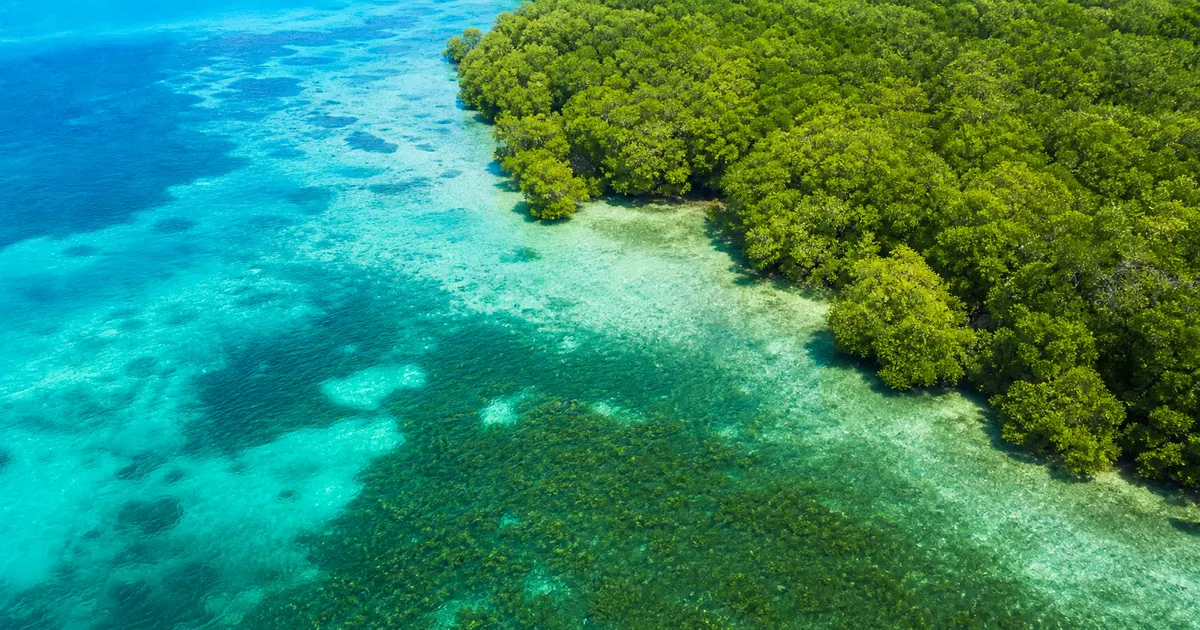
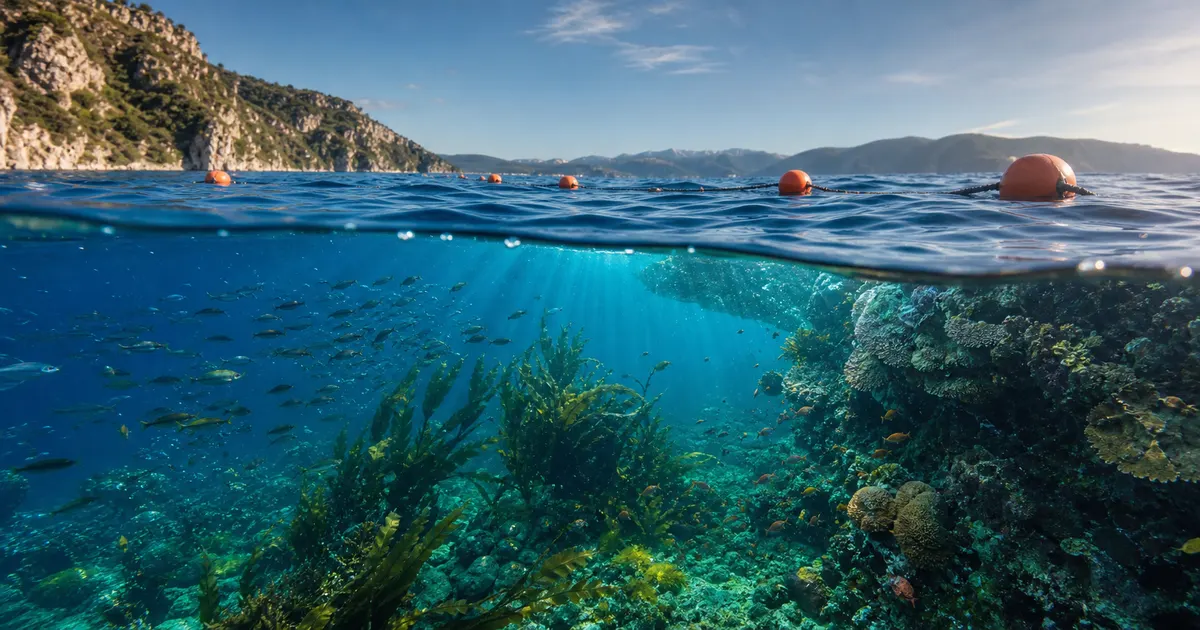
One pillar of protection is the marine protected area (MPA). The idea is to designate particularly rich ecosystems, or fragile deep-sea coral colonies, as protected areas and restrict destructive fishing methods such as bottom trawling there — protecting both the seafloor and the carbon locked within it. The role of marine protected areas is explained in detail in our article on marine protected areas.
Efforts in Japan
In Japan too, the Fisheries Agency is leading efforts to balance resource management with the conservation of the marine environment. Regulating mesh size to let small juvenile fish escape, setting the areas and seasons in which fishing is allowed, and managing catches according to stock levels — these steady, incremental rules form the foundation for continuing bottom trawling while reducing its burden. Research institutions, too, have continued developing gear and techniques to mitigate the impact of bottom trawling on marine ecosystems.
In recent years, mechanisms have also begun to take shape that assign economic value to the ocean's carbon-storing function (blue carbon) and support its conservation. Efforts to trade the carbon absorbed by seaweed beds and tidal flats as credits are introduced in our article on the J-Blue Credit market — and the idea of protecting carbon locked in seafloor sediment sits on the same conceptual ground. We may be entering an era where not destroying the seafloor carries value as climate action in its own right.
Protecting the ocean and continuing to catch fish are not opposites — they can coexist. Deciding what to protect, and refining how we fish, is the first step.
— paraphrased from international discussions on sustainable fisheries
| Type of measure | Examples | Aim |
|---|---|---|
| Area and seasonal management | Designating no-take zones and closed seasons | Protect spawning periods and important habitats |
| Gear rules | Regulating mesh size | Let juvenile fish escape and protect stocks |
| Marine protected areas (MPAs) | Designating areas that restrict destructive fishing methods | Protect seafloor ecosystems and carbon |
| International bans and restrictions | Palau's full ban; U.S. deep-sea restrictions | Protect especially vulnerable areas |

The shift toward sustainable fishing
Alongside these challenges, efforts are also underway to make the fishing method itself more environmentally friendly. The focus falls on two things: reducing contact with the seafloor and selectively catching only the target species (raising selectivity).
Gear innovations that reduce bycatch
Bycatch reduction devices (turtle excluder devices, or TEDs), which use a metal grid inside the net to let large sea turtles and sharks escape, and selective nets, designed with mesh or exit panels that let fish smaller than the target species slip out, have already been put into practical use. In Australia's shrimp fisheries, introducing excluder devices has reportedly reduced sea turtle bycatch to nearly zero. In Japan too, research and development continues on excluder devices and other bycatch-reducing gear.
Gear improvements like these also benefit fishers directly. With fewer non-target creatures caught, there's less sorting work, and the target catch stays fresher and higher quality. The assumption that "eco-friendly gear means lower yields" doesn't necessarily hold. A well-designed excluder device is built to cut only unwanted bycatch while preserving the intended catch. Gear improvement is a prime example of environmental and economic interests pointing in the same direction.
Efforts to reduce contact with the seafloor itself are also progressing. Lightening the ground gear, or designing rigs that tow slightly above the seafloor, can reduce the area and depth scraped. Going a step further, some fisheries are exploring a shift to more selective methods that don't drag along the seafloor at all — such as longlines, pots, and hook-and-line fishing. Maintaining catch levels while changing how the catch is taken — that's the heart of this transition.
- Turtle excluder devices (TEDs): an internal grid lets larger animals escape the net.
- Selective mesh and separator panels: let small juveniles and non-target fish slip out.
- Modifications to reduce seafloor contact: lighter ground gear and contact points reduce the area scraped.
- Switching to lower-impact fishing methods: adopting more selective methods such as longlines, pots, and hook-and-line fishing.

Certification and consumer choice
One thing we as consumers can do is choose seafood caught through sustainable fishing. The mark to look for is the MSC "Blue Fish" ecolabel. MSC certification is an international standard awarded to fisheries that avoid overfishing, limit their impact on ecosystems, and are properly managed; as of 2024, about 572 fisheries across roughly 60 countries hold the certification, accounting for about 16.5% of the world's wild seafood catch (several fisheries in Japan are certified as well).
Japanese seafood companies, too, are increasingly shifting toward resource-conscious sourcing (sustainable seafood). Major producer Nissui (Nippon Suisan Kaisha), for instance, has been revising its sourcing policy — a move covered in our article on Nissui's sustainable sourcing. AEON's private-label push to expand MSC- and ASC-certified products is also covered in detail in our article on AEON TOPVALU's MSC and ASC certification. The more people choose these certified labels and products, the stronger the push toward sustainable fishing becomes.
To be clear, some bottom trawl fisheries have themselves earned MSC certification. Certification isn't based solely on "which method is used" — it evaluates, holistically, whether a fishery properly manages its resources and works to limit its impact on ecosystems. In other words, this isn't a blanket condemnation of bottom trawling itself, but a system that recognizes and encourages fisheries that keep improving toward less damaging practices. When we as consumers choose that kind of seafood, it becomes a vote of support for fishers working to improve.
Change that starts with knowing
The shift toward sustainable fishing isn't a challenge for fishers and companies alone. The more people who know what method caught a given fish, and what impact it has on the seafloor, the more momentum builds behind choosing certified products — and the more it encourages fisheries working to improve. Conversely, if no one cares, only the cheapest, highest-volume methods will survive. What shapes the ocean's future is, in the end, the choices each of us makes at the dinner table.
A "vote for the ocean" you can cast while shopping
- Try choosing seafood carrying the MSC "Blue Fish" ecolabel.
- Look for seasonal, locally caught fish — choices less likely to encourage overfishing of juveniles.
- Try products that make use of bycatch or underutilized fish.
- Pay a little attention to what method was used to catch your fish.
Conclusion — using the seafloor while protecting it
Bottom trawling is an efficient fishing method that has long supported our dinner tables — but it's also a method with serious costs: it scrapes away seafloor environments, corals, and benthic life, and can stir up and release carbon that had lain dormant for ages. In particular, the asymmetry of cold-water coral — which takes thousands of years to grow yet can be destroyed in an instant — along with the non-negligible scale of bycatch and carbon release, compel us to rethink how we fish.
But the answer isn't a binary choice between "ban it" or "keep it as is." Gear that reduces seafloor contact, devices that let bycatch escape, marine protected areas, and consumers who choose sustainable seafood — by stacking these changes one on top of another, a real path opens up toward using the seafloor while protecting it. The next time you pick up a piece of fish at the store, take a moment to think about which sea it came from.
The ocean's challenges don't end with bottom trawling. The problem of lost fishing gear (ghost gear) that continues to drift and harm marine life is covered in our article on ghost gear, and the concept of protected areas that safeguard marine life is covered in our article on marine protected areas. Starting from bottom trawling, we hope to keep reexamining, little by little, how we relate to the sea.

Article summary
- Bottom trawling drags a net along the seafloor and accounts for more than a quarter of the world's marine catch.
- The net and ground gear scrape the seafloor, flattening (or "desertifying") the habitats of corals and benthic life.
- Cold-water coral takes hundreds to thousands of years to grow and, once destroyed, effectively never recovers.
- Carbon locked in seafloor mud can be stirred loose, potentially releasing up to about 370 million tons of CO2 a year (estimates vary widely).
- Bottom trawling's average discard rate is about 22%, making bycatch and discards a major problem as well.
- Bycatch reduction devices, marine protected areas, MSC certification, and consumer choice all support the shift toward sustainable fishing.
References and sources
- Fisheries Agency of Japan (Ministry of Agriculture, Forestry and Fisheries) – Fisheries White Paper, "Conservation of the Marine Environment and Fisheries," and other resource management and bottom trawling materials
- Ministry of the Environment, Japan – MSC "Blue Fish" ecolabel database, coral reef ecosystem conservation action plan
- FAO (Food and Agriculture Organization of the United Nations) – Technical report on discards and bycatch in global fisheries ("A third assessment of global marine fisheries discards")
- Nature – "Quantifying the carbon benefits of ending bottom trawling" (research on bottom trawling and carbon release, 2023)
- Nature Geoscience – "Long-term carbon storage in shelf sea sediments reduced by intensive bottom trawling" (2024)
- GEOMAR Helmholtz Centre for Ocean Research – "Trawling-induced sediment resuspension reduces CO2 uptake" (pyrite oxidation and carbon release, 2025)
- Marine Stewardship Council (MSC) – Explanation of bottom trawling, overview of MSC certification, and certification status worldwide and in Japan
- University of the Ryukyus – Discovery of a coral colony over 7,000 years old on a Pacific seamount at a depth of 525m
- WWF Japan – "Bycatch — an environmental challenge fisheries must solve"
- National Geographic Japan – "Deep-sea bottom trawling may be devastating the seafloor"
※ Listed in order of reliability: government and academic institutions > peer-reviewed papers > specialized organizations > reputable media