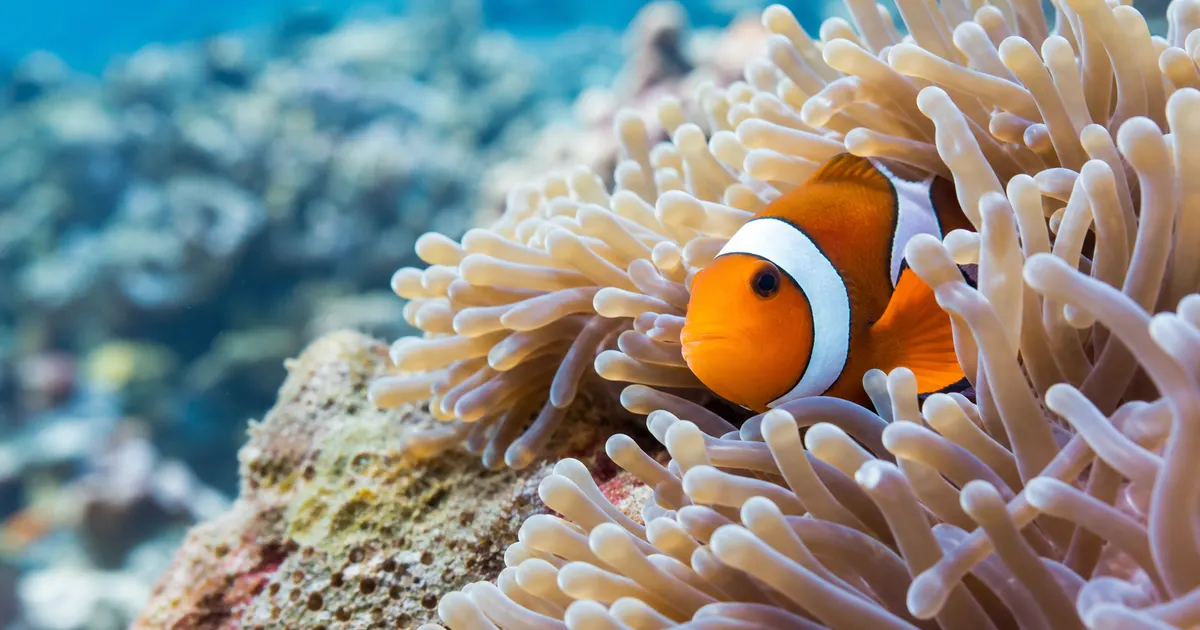
A sea anemone bristles with venomous stinging cells packed into every tentacle — a danger zone where other fish are paralyzed and eaten the moment they touch it. And yet the orange-and-white striped clownfish swims freely among those very tentacles as if they were its own living room, sleeping there at night and even laying its eggs nearby. Why is the clownfish alone unaffected? This question puzzled researchers for more than 100 years.
At the heart of the answer was the "mucus" that covers the clownfish's body. In 2025, an international team led by the Okinawa Institute of Science and Technology Graduate University (OIST) determined that the deciding factor was the amount of a sugar molecule called "sialic acid" contained in the mucus, finally providing a clear resolution to a long-standing mystery. The fish had been diluting its own chemical "scent" so it would not register on the anemone's sensors.
This article walks step by step through how the sea anemone's stinging cells work, the chemical trick that keeps the clownfish from being stung, the benefits both partners gain from supporting each other, and the ecology and realities of keeping and conserving these fish — made famous by the movie Finding Nemo. Let's take a look at this quiet, remarkable story of symbiosis unfolding beneath the waves.
What you'll learn in this article
- What kind of venomous device the "nematocysts" on a sea anemone's tentacles really are
- "Sialic acid," the key to why clownfish aren't stung, and the OIST research that uncovered it
- How the "chemical camouflage" of body mucus works, and the process of adjustment behind it
- The concrete benefits that both the clownfish and the sea anemone each gain
- The surprising society of clownfish, where every individual starts out male and later some change into females
- The ecology that became famous through film, and the realistic considerations of keeping and conserving them
Clownfish and Sea Anemones Have a "Give and Take" Relationship
The clownfish (Amphiprion ocellaris) is a small saltwater fish, roughly 6 to 11 centimeters long. It lives in warm coral reefs of the Pacific and Indian Oceans, and can also be found in Japan's southern seas, including Okinawa and Amami. What defines this fish more than anything else is its lifelong home in a large sea anemone.
When living things depend closely on one another, this is called symbiosis. There are several types of symbiosis — some relationships benefit only one party, and some, like parasitism, harm one side. The relationship between the clownfish and the sea anemone is thought to be one of mutualism, in which both sides benefit — truly a "give and take" partnership. The ocean is full of such mutually supportive relationships; living creatures do not survive alone, but within networks that sustain one another.
What makes the symbiosis between clownfish and sea anemones especially striking is the seemingly impossible pairing: a venomous creature and a fish that is entirely unaffected by that venom. A place that would be fatal for any other fish to approach is, for the clownfish, its own confidently claimed territory. It is precisely this unnatural-seeming pairing that has captured people's curiosity and drawn researchers in for over a century.
Sea Anemones Are, in Fact, Animals
Because of their flower-like appearance, sea anemones are often mistaken for plants, but they are genuine animals. They belong to the same group as jellyfish and coral — the cnidarians — with a mouth at the center of the body surrounded by countless tentacles. Those tentacles are equipped with stinging cells used to capture prey, allowing the anemone to catch and eat small fish and plankton. To learn more about coral, another cnidarian, see our article on the symbiosis between coral and zooxanthellae, and the mechanism of bleaching.
In other words, the clownfish deliberately makes its home in the embrace of a creature that could otherwise eat it. This seemingly reckless choice turns out to be a remarkably clever survival strategy. On a coral reef teeming with predators, survival is not easy for a fish only a few centimeters long. That is precisely why the clownfish secures its safety with a reversal of logic — choosing as its home the one "fortress of venom" that no other fish would dare approach.
This relationship is also a fine example of "coevolution," in which living things shape each other's evolution over long stretches of time through mutual influence. The clownfish adapted to the sea anemone, and the anemone in turn changed in ways that accommodated the clownfish as a housemate — the accumulation of these changes has produced the delicate balance we see today.

A Pairing Commonly Seen in Nature
About 30 species of clownfish (also called anemonefish) are known worldwide, along with about 10 species of large sea anemones that serve as their hosts. Not every species pairs freely with every other; there is compatibility between specific species. In Japan's waters, for example, the species simply called "clownfish" (kuma-nomi) often pairs with the Sebae anemone, and the tomato clownfish tends to prefer similar hosts. Japan is a valuable region where several species of clownfish can be observed, and diving in the coral reefs of its southern islands reveals clownfish that differ slightly in color and pattern from species to species.
Incidentally, while their names sound similar, the "clownfish" (kuma-nomi) and the "false clownfish" or "ocellaris clownfish" (kakure-kuma-nomi) are different species. The one made famous by the movie, with three white bands on an orange body, is the ocellaris clownfish — the one we picture when we think of "Nemo." All species share the habit of living with sea anemones, though they differ in body pattern and in which anemone species they prefer. This article focuses mainly on the ocellaris clownfish, while discussing the mechanisms of symbiosis that are common to clownfish as a whole.
- About 30 species of clownfish exist worldwide, with about 6 species found in waters near Japan
- Only about 10 species of large sea anemones serve as hosts
- Species compatibility matters; in nature, certain pairings are more common than others
- A single sea anemone is often home to just one family group that claims it as territory
Where This Article Begins
- Clownfish and sea anemones share a "mutualistic" relationship in which both sides benefit
- The sea anemone is a venomous animal that would normally be dangerous to fish
- The clownfish's strategy turns this danger zone into a safe home
Just How Precise a Weapon Is the Sea Anemone's "Nematocyst"?
To understand why the clownfish isn't stung, we first need to understand the mechanism of the anemone's weapon: the nematocyst, or stinging cell. Nematocysts are tiny, capsule-like cellular devices, invisible to the naked eye, packed densely across the surface of each tentacle. A single tentacle is said to contain tens of thousands of them — and this structure is the very origin of the name "cnidarian" (from the Greek for "stinging nettle").
A Stinger Fired in Under a Tenth of a Second
Inside each nematocyst, a thread-like venomous barb is coiled up under high pressure. When prey touches the tentacle and triggers a stimulus, the capsule's lid springs open in an instant, and the barb shoots out forcefully to pierce the target. This firing action is extremely fast, considered one of the quickest movements in the animal kingdom. The venom injected from the tip of the barb paralyzes small fish and plankton, which are then drawn in by the tentacle and carried to the mouth.
Once fired, a nematocyst is used up and cannot fire again. To compensate, the sea anemone continuously produces new nematocysts to restock its arsenal. The enormous number of nematocysts packed onto a single tentacle exists partly to make up for this single-use design. What looks to us like a tentacle gently swaying in the current is, in fact, a precision hunting device loaded with countless venomous barbs.
What matters here is that nematocysts fire not only in response to physical contact but also to chemical cues. When the sensors (chemoreceptors) on the tentacle detect a specific substance on the surface of prey, they judge, "this is something edible," and fire the barb. In other words, the firing of a nematocyst is not a simple reflex — it is a response based on reading the target's chemical "scent." This chemical trigger is exactly what lies at the heart of the mystery solved later in this article.
If nematocysts fired reflexively at anything that touched them, precious barbs would be wasted every time a grain of sand or a scrap of seaweed brushed against them. For this reason, sea anemones are thought to have finely tuned their firing mechanism to respond strongly only when both physical stimulation and chemical signals are present together. It is precisely this "double confirmation" that allows the clownfish's strategy — simply diluting its chemical marker — to succeed in avoiding being stung.

The Mystery of Why It Doesn't Sting Itself
Interestingly, a sea anemone's own tentacles do not sting each other even when they touch. Research has also revealed that the anemone itself simply does not carry, on its own surface, the substance that triggers firing. In other words, nematocysts are tuned to chemically distinguish "something that is not itself" or "something edible" before firing. It is precisely this precision of discrimination that the clownfish's way of life turns to its own advantage.
| Function of the nematocyst | Details |
|---|---|
| Role | Capturing prey and defending against enemies |
| Firing speed | Among the fastest in the animal kingdom (fires in an extremely short time) |
| Trigger | Both physical contact and chemical cues |
| Discrimination | Chemically distinguishes self, edible targets, and threats |
Nematocysts Are Shared by Coral and Jellyfish Too
The nematocyst is not unique to sea anemones — it is a mechanism common to all cnidarians, including coral and jellyfish. Getting stung by a jellyfish while swimming happens because these same nematocysts react to skin contact and fire their venomous barbs.
The Discovery of "Sialic Acid" That Solved a 100-Year Mystery
Why doesn't the clownfish get stung? This question has drawn researchers in since the early 20th century. For a long time, it was understood that the secret likely lay in the mucus covering the clownfish's body, but exactly "what" in that mucus was responsible remained unidentified. A clear answer to this puzzle was finally presented in research published in 2025, led primarily by OIST.
Research by an International Team from OIST and France
A joint research team from OIST's Marine Eco-Evo-Devo Unit and France's National Centre for Scientific Research (CNRS) closely compared the body-surface mucus of clownfish species with that of damselfish species that do not live in symbiosis with sea anemones. The result was a decisive difference found in a sugar molecule called sialic acid. The findings were published in the German scientific journal BMC Biology in February 2025.
Sialic acid is, in fact, one of the chemical triggers that causes nematocysts to fire. When the sensors on an anemone's tentacles detect sialic acid, they judge, "here comes something edible," and fire their venomous barbs. But when researchers examined the mucus of clownfish species, they found that the amount of this sialic acid was far lower than in damselfish species that do not live in symbiosis. The clownfish had, in effect, pre-emptively diluted the "scent" that would register on the anemone's sensors.
Sialic acid is a type of sugar molecule that coats the surface of living cells and is widely present across many animals. It often functions as a "marker" that cells use to recognize one another — a kind of name tag attached to the surface of the body. In ordinary fish, this marker is also present in the mucus on the body surface, and it is precisely this marker that the anemone's nematocysts use as a cue to judge "is this prey or not." By deliberately removing that name tag, the clownfish had effectively vanished from the nematocyst's sensors.
The research further confirmed that the sea anemone itself carries almost no sialic acid on its own body surface. The reason its own tentacles don't sting each other, even when they touch, is that the anemone simply does not carry the marker that triggers firing in the first place. In this sense, the clownfish had come to resemble, chemically, the very body state of its anemone host. Two parties that are never attacked were, it turns out, sharing the same "markerless" condition.


A Chemical Strategy That Makes the Anemone Think "Not a Target"
In short, the clownfish reduces the marker that the anemone's sensors are searching for, creating the illusion that "this is not something to eat." The core of this discovery is that the clownfish is not specially resistant to the venom — it is preventing the venomous barb from being fired in the first place. Rather than enduring an attack, it avoids being attacked at all — a remarkably clever survival trick.
Researchers began seriously tackling this mystery in the early 20th century, and over the years various hypotheses were proposed — that the mucus formed a thick protective layer, or that the clownfish had a special resistance to the venom. But no theory proved decisive, and why the clownfish went unstung remained a mystery for a long time. This research is significant precisely because it broke the mucus down to the molecular level and finally arrived at a concrete answer: "sialic acid is reduced." A mechanism that could never be understood just by watching came into view only through the lens of chemistry.
The clownfish is not resistant to venom — it prevents itself from being stung in the first place, by making the anemone's sensors perceive it as "not food."
— Key finding of the OIST-led research (published in BMC Biology)
Key Points of the Discovery
- One trigger for nematocyst firing is a sugar molecule called "sialic acid"
- Clownfish mucus contains far less sialic acid than fish without this symbiosis
- Rather than tolerating venom, the fish creates a condition where it is never fired at all
The "Chemical Camouflage" of Mucus and the Process of Adjustment
Central to the clownfish's defense is the role played by the mucus covering its body. A fish's skin is naturally protected by mucus, but in the clownfish's case, this mucus is thought to function as chemical camouflage (disguise) against the sea anemone. By wearing a chemical composition that does not trip the anemone's sensors, the clownfish can safely swim among its dangerous tentacles.
Newborns Do Get Stung — Mucus Changes as They Grow
What should not be overlooked is that this defense is not complete from birth. According to the OIST-led research, newly hatched clownfish juveniles have mucus rich in sialic acid, just like other fish. But by the time they grow and develop their orange-and-white striped pattern, sialic acid levels are confirmed to decrease. In other words, an unstingable body is something that is built through the process of growing up.
The "Settling-In Period" Before Symbiosis Stabilizes
Direct observation also confirms that symbiosis between clownfish and sea anemone does not form instantly. In the first moments after meeting, a clownfish may get lightly stung by the tentacles. Repeatedly rubbing its body gently against the tentacles, the clownfish gradually adjusts its body-surface condition and is slowly accepted by its host. The time needed for this adjustment varies by species and circumstances — it may take only minutes to hours, but in aquariums it has been reported to take anywhere from several days to several weeks.
This adjustment has been observed as a gradual process: it begins with the clownfish gently touching just part of its body — a pectoral or tail fin — to the tentacles, and it slowly progresses until the fish can entrust its entire body to them. The clownfish watches the anemone's reaction and carefully closes the distance, until eventually it can nestle completely among the tentacles without concern. It is a careful move-in process, much like slowly settling into a new home.
Research is also beginning to show that during this process of adjustment, changes occur not only in the clownfish's own body surface but also in the microorganisms (microbiome) living on its body. Some reports suggest that the microbial communities living on the surfaces of the clownfish and the sea anemone come to resemble each other through the process of symbiosis. The mechanism behind avoiding stings likely cannot be explained by the single molecule sialic acid alone — it is probably the product of multiple factors working together, including the chemical composition of the mucus and the activity of microorganisms. Research is still ongoing, and the full picture is gradually coming into focus.
- At the juvenile stage, mucus contains as much sialic acid as in other fish
- As they grow, sialic acid decreases and the body becomes harder to sting
- Stinging can still occur right after first contact; the process is not instantly complete
- Repeated body-rubbing behavior stabilizes the symbiosis over the course of weeks

This "settling-in period" is also something that keepers of these fish witness firsthand. Even when a clownfish and a sea anemone are newly placed together in an aquarium, symbiosis does not necessarily begin right away. A careful process is needed, over time, for the two to reach a chemical understanding with each other. This delicate exchange mediated by mucus can be seen as one example of the refined communication that marine life has honed through evolution.
The fact that this adjustment is acquired rather than innate shows that this symbiosis is not a fixed, hardwired instinct, but a flexible relationship adjusted to fit whichever partner is at hand. The way a clownfish adjusts can even differ depending on the particular species or individual anemone involved. Once symbiosis is successfully established, the pairing tends to remain stable for a long time, and it is not unusual for a clownfish to use the same sea anemone as its home for years. The trust carefully built between them is something they continue to protect, patiently, for a long time.
Mucus Is a Multi-Purpose Suit of Armor for Living Things
Fish mucus does more than act as a barrier against pathogens — it also reduces drag in the water and protects the body surface, among other roles. In clownfish, an additional function has been added to this list: a "disguise" that prevents nematocysts from firing.
What Both Partners Gain — An Exchange of Protection, Nutrients, and Oxygen
This symbiosis is called "give and take" because both the clownfish and the sea anemone receive a clear payoff. It is not a relationship in which one side is simply protected — it is a two-way exchange that supports both of their lives. Let's look at each in turn.
When we hear the word "symbiosis," we tend to picture one side being unilaterally protected by the other, but many long-lasting relationships in nature are in fact sustained by exactly this kind of two-way exchange. If only one side benefited, the side that lost out would have no reason to keep accepting the other. The reason the symbiosis between clownfish and sea anemones has remained stable for millions of years is precisely because both sides gain something solid from it. Let's look at exactly what each partner obtains.
What the Clownfish Gains — A Safe Home
The greatest benefit for the clownfish is protection from predators. Because most predatory fish avoid the venomous tentacles of a sea anemone, the space inside them becomes a safe refuge for the clownfish. When danger approaches, it can dart deep into the tentacles, and at night it can sleep securely among them. What's more, by laying its eggs near the anemone, the eggs too are protected from predators. It is, in every sense, the ultimate "home of one's own" for a small fish trying to survive a rough ocean.
It's also worth noting that the clownfish is not a particularly fast or skilled swimmer. Its fins move with a fluttering motion, ill-suited to swimming quickly across open water. And yet it manages to escape predators, because a safe home it can dash into is always close at hand. Having gained the sea anemone as a refuge, the clownfish no longer needs to swim fast out of necessity, and can live a relatively relaxed life within its small territory. The existence of a home, it seems, shapes not just where a creature lives, but its very body and behavior.
What the Sea Anemone Gains — A Cleaner and a Fertilizer Supply
The sea anemone, meanwhile, receives a variety of benefits from the clownfish. By swimming frequently among the tentacles, the clownfish stirs the surrounding water, delivering oxygen and fresh water. It also acts as a "cleaner," removing debris, leftover food, and parasites that collect on the tentacles. Furthermore, research has shown that the clownfish's waste is rich in nitrogen compounds such as ammonia, which nourish the symbiotic algae (zooxanthellae) living inside the anemone's tissue, helping the anemone grow.
In fact, some reports show that sea anemones hosting clownfish have significantly more symbiotic algae inside them, delivering more energy to the host. Clownfish have also been observed physically charging at butterflyfish and other species that come to nibble on the anemone's tentacles, driving them away. In short, the clownfish is a welcome housemate that doubles as a "bodyguard," a "cleaner," and a "fertilizer supplier" all at once. This mechanism involving symbiotic algae has parallels with the relationship between coral and zooxanthellae.
The symbiotic algae living inside the sea anemone use sunlight to produce nutrients and share a portion of them with their host — exactly the same mechanism by which coral lives alongside zooxanthellae. The nitrogen contained in the clownfish's waste becomes an essential fertilizer for these symbiotic algae. In other words, the clownfish is not only directly nourishing the sea anemone — it is delivering nutrients all the way down to the tiny algae inside it, indirectly boosting the health of the entire anemone. Even at night, as the clownfish rests among the tentacles, substances seeping from its body continue to nourish its host.
It is easy to overlook, but the water-stirring created by the clownfish's fin movements matters especially at night, when oxygen tends to run low for the anemone. Around a motionless sea anemone, water tends to stagnate and oxygen can grow scarce. By swimming about frequently and bringing in fresh water, the clownfish makes it easier for its host to breathe. The casual movements of a small fish are, in effect, tuning the environment of the entire household.
| Beneficiary | Benefit received |
|---|---|
| Clownfish | Protection from predators / a safe home / a spawning site |
| Sea anemone | A supply of water flow and oxygen / a cleaned body surface |
| Sea anemone | Nutrients from waste (nitrogen), promoting growth |
| Sea anemone | Defense against fish that eat its tentacles |

The Substance of Mutualism
- The clownfish's benefit is "a safe home" and "a spawning site"
- The sea anemone gains "cleaning," "oxygen supply," "nutrients," and "defense"
- This is a two-way relationship, not one where only one side benefits
Every Individual Starts Out Male — The Surprising Society of Clownfish
Alongside its mechanism of symbiosis, the clownfish has another astonishing trait: sex change. Every clownfish is born male, and as circumstances require, certain individuals change sex to become female. Technically, this trait is called protandrous sex change (male-first sequential hermaphroditism).
A Hierarchy Determined by Body Size
A single sea anemone is typically home to one family group. Within it, the single largest individual is the sole female and stands at the top of the group. The second largest is the breeding male, and this pair produces offspring together. The remaining individuals live as smaller, immature males, waiting their turn in line. A strict hierarchy based on body size underpins this society.
This hierarchy is not simply about power — it serves to maintain reproductive order. Only the top female and the breeding male produce offspring, while lower-ranked individuals remain suppressed in their maturation as they wait their turn. Rather than fighting each other into mutual ruin, the group avoids needless conflict within its limited home by deciding roles using an easy-to-read yardstick: body size. And because lower-ranked individuals retain the possibility of eventually moving up and breeding themselves, there is still a reason for them to remain in the group.
What Happens When the Female Disappears
The most dramatic event in this society occurs when the top female dies. The second-ranked individual — the breeding male — then undergoes sex change to become the new female at the top, and the individual that had been third in line is promoted to breeding male. It is a mechanism for quickly filling a vacancy from within the group by changing sex. For a clownfish that finds it difficult to travel far from its limited anemone "home," this is thought to be a rational reproductive strategy. This is why it has been pointed out that Marlin, the father in Finding Nemo who lost his mate, could biologically have undergone a sex change to become female after her death.
Sex change in clownfish is thought to be a one-way process: once an individual becomes female, it does not revert back to male. When switching from male to female, gene activity related to sex is dramatically rearranged inside the body, remodeling it into a body capable of producing eggs. The visible hierarchy based on body size and the internal biological mechanism of sex are linked, both shifting together according to an individual's position within the society. Even the seemingly simple family life of clownfish hides an intricate biological program.
This kind of sex change is, in fact, not unique to clownfish at all. Many ocean fish change sex depending on their environment or their position within a social group — wrasses and groupers, for instance, are known to change from female to male. Flexibly changing sex itself, in order to reliably pass on offspring in places where movement is difficult, is one of the ways marine life carries life forward using strategies quite different from what we might expect.
- All clownfish are born male
- Only the single largest individual in a group becomes female and rises to the top
- The second-largest individual becomes the breeding male and forms a pair
- If the female dies, the breeding male changes sex to become female, and the rest move up in rank

A Strategy Born of Being Unable to Move
Because clownfish are so strongly tied to a particular sea anemone, it is not easy for them to travel far in search of a new partner. Changing sex within the group to fill a needed role is thought to be a way of reliably passing on offspring within a limited space.
The Ecology Made Famous by Film, and the Realities of Keeping and Conserving Them
What turned the ocellaris clownfish into a global star was the animated film Finding Nemo, released in 2003. Its endearing image of making a home in a sea anemone captured the hearts of many, and clownfish became one of the ocean's most iconic creatures. But this popularity also cast an unexpected shadow.
"Nemo" Fame and Concerns Over Overharvesting
After the film's success, demand to keep clownfish as pets rose worldwide. Because most ornamental fish are collected from the wild, there were concerns that this surge in popularity might lead to overharvesting of wild individuals and the sea anemones that serve as their homes. Some collectors reportedly even took whole anemones along with their fish, sparking debate over the impact on coral reef ecosystems. Ironically, it was pointed out that "the story that saved Nemo" could end up endangering the real Nemo.
That said, there is also a more cautious view on whether the film itself was the direct cause of overharvesting. Some subsequent academic studies found no clear, sustained increase in sales attributable to the film's release, so it would be an oversimplification to conclude flatly that "the movie caused a sharp decline." Still, the underlying issue — that collecting ornamental fish can place a burden on coral reef creatures — remains an important challenge today. This is a topic worth considering alongside our article on how marine protected areas work.
Interestingly, when the sequel Finding Dory was released in 2016, concerns about overharvesting of its protagonist — a different fish, the blue tang — were raised even before the film hit theaters. Drawing on the lessons of the first film, environmental groups and researchers issued early warnings urging people "not to casually buy these fish as pets." While a story's power to spark interest in living creatures is wonderful, society has also learned to make sure that interest doesn't end up reducing wild populations.
The Reality of Keeping Them — Sea Anemones Are Difficult
Clownfish themselves are considered relatively easy saltwater fish to keep, and in recent years, captive-bred individuals have become widely available. Choosing a captive-bred fish is also meaningful in reducing pressure on wild populations. On the other hand, keeping the clownfish's anemone partner is far more difficult in practice. Sea anemones require strong lighting and clean water quality, and keeping the symbiotic algae inside them healthy demands careful management. If conditions aren't right, they weaken quickly, making them a challenging creature for beginners.
Also, in an aquarium, it isn't always the case — as in the film — that "the clownfish will always move into the sea anemone." Symbiosis requires the adjustment period described earlier, and species compatibility also plays a role. It's worth knowing that clownfish can be kept even without a sea anemone, and that symbiosis is not necessarily an absolute condition for their survival. If you do choose to keep them, it's important to understand the true nature of these creatures correctly, choose captive-bred individuals, and prepare to maintain water quality and lighting over the long term.
In an aquarium, a clownfish may, in place of a sea anemone, nestle up against a similarly shaped coral, or even the outlet of a water pump. This behavior reflects the clownfish's instinct to seek out a protective "place to belong." While such sights can be endearing, they are also, in a sense, a reflection of the absence of a true symbiotic partner. Keeping a living creature also means imagining the environment it naturally lives in, and trying to provide conditions as close to that as possible. Understanding the relationship between clownfish and sea anemones can itself offer a hint toward better ways of keeping them.
| Item | The reality |
|---|---|
| Keeping clownfish | Relatively easy. Captive-bred individuals are widely available |
| Keeping sea anemones | Difficult. Strong lighting and good water quality are essential |
| Symbiosis in an aquarium | Requires an adjustment period and compatibility. Not guaranteed to happen |
| Conservation perspective | Choosing captive-bred individuals reduces pressure on wild populations |

Global Warming: A New Threat
In recent years, rising sea temperatures caused by global warming have begun to threaten the clownfish's way of life. When sea temperatures rise, sea anemones can also lose their symbiotic algae and bleach, weakening in the process. If they lose their home, clownfish cannot survive either. Research published in 2025 observed something remarkable off the coast of Papua New Guinea: when clownfish were exposed to intense heatwaves, they attempted to survive by temporarily shrinking their own bodies. The research team measured 134 wild clownfish every month and found that, during a heatwave that ran 4 degrees above the seasonal average, individuals that shrank were more likely to survive. Individuals that successfully shrank were reported to have up to nearly 80% higher odds of surviving the heatwave. The effects of rising sea temperatures on marine life are also covered in our article on global warming and fisheries.
This body-shrinking response is thought to be a way of lowering the cost of maintaining the body in harsh conditions — when food becomes scarce or rising water temperatures accelerate energy consumption — in order to endure. The discovery that a fish shrinks rather than grows demonstrates the flexibility of living bodies, while also illustrating just how deeply global warming affects marine ecosystems. Even the endearing life of the clownfish cannot remain untouched by changes on a planetary scale.

During the heatwave, clownfish that shrank their bodies improved their odds of survival. The health of the sea anemone that serves as their home is directly tied to the clownfish's future.
— Research on clownfish shrinkage (Science Advances, 2025)
To Protect This Symbiosis
- Choose captive-bred ornamental fish, and avoid overharvesting wild individuals and sea anemones
- Keeping sea anemones is highly challenging; avoid taking it on casually
- Bleaching caused by global warming is a threat that robs clownfish of their very home
- Protecting coral reefs is directly connected to protecting the future of clownfish
Conclusion — A Delicate Story of Symbiosis Nurtured by the Sea
The life of the clownfish — turning a sea anemone bristling with venomous barbs into a safe home — is not simply a curiosity. It is supported by an elaborate mechanism refined all the way down to the chemical level. Diluting the marker that the host's sensors search for, adjusting patiently over time, and giving mutual benefit to each other — all of this condenses a delicate relationship that marine life has built up over a long span of evolution.
The discovery of sialic acid, which finally solved a century-old mystery, reminds us that even familiar creatures still hold many unsolved stories. At the same time, there is also the reality that human activities — global warming and overharvesting — are threatening this quiet symbiosis. If we truly want to cherish the story of Nemo, we cannot do without protecting the coral reef sea that serves as its stage.
The next time you see a clownfish playing among a sea anemone's tentacles at an aquarium, try to remember that, on the surface of its body right now, an invisible chemical exchange is quietly continuing. Diluting its own name tag to blend in with its host, repaying the favor through cleaning and nutrients, and supporting each other's lives — this relationship woven between a small fish and a moving flower gently teaches us just how delicate the bonds are on which the world of the ocean is built.
Summary of This Article
- The key to why clownfish aren't stung is that their mucus contains far less sialic acid than other fish
- The essence of it is not venom resistance, but a chemical camouflage that keeps the nematocyst from firing at all
- This defense is not innate from birth — it is built through growth and a patient process of adjustment
- In this mutualism, the clownfish gains protection and a spawning site, while the sea anemone gains cleaning, oxygen, nutrients, and defense
- All clownfish begin life as males, with some changing to female as needed
- While popularized by film, overharvesting and bleaching from global warming now threaten this symbiosis
References and Sources
- Science Portal (Japan Science and Technology Agency, JST) – Clownfish avoid being stung by anemones by reducing sugar on their skin, OIST discovers
- OIST, Okinawa Institute of Science and Technology Graduate University – Research announcement on the symbiotic mechanism between clownfish and sea anemones
- BMC Biology (published by Springer Nature; the main paper behind this article) – Anemonefish use sialic acid metabolism as Trojan horse to avoid giant sea anemone stinging (February 15, 2025)
- Scientific Reports (related paper published in Nature) – N-acetylated sugars in clownfish and damselfish skin mucus as messengers involved in chemical recognition by anemone host
- Science Advances (American Association for the Advancement of Science, AAAS) – Individual clown anemonefish shrink to survive heat stress and social conflict
- PMC (U.S. National Library of Medicine, NCBI) – Individual clown anemonefish shrink to survive heat stress and social conflict (full text)
- WWF Japan – The symbiosis between clownfish and sea anemones (staff blog explainer)
- Ioworld Kagoshima City Aquarium – An explainer on the symbiosis between clownfish and sea anemones
- Nazology – A 100-year mystery solved: why clownfish aren't stung by their host anemone
* Listed in order of reliability: government/academic institutions > peer-reviewed papers > specialist organizations > trusted media