⚡ In short
Coca-Cola (Japan) has adopted 100% recycled PET bottles for Coca-Cola and I LOHAS Natural Water under its "2030 Vision for Containers." This article explains how bottle-to-bottle recycling works, its CO2 reduction effect, and its link to ocean plastic pollution.
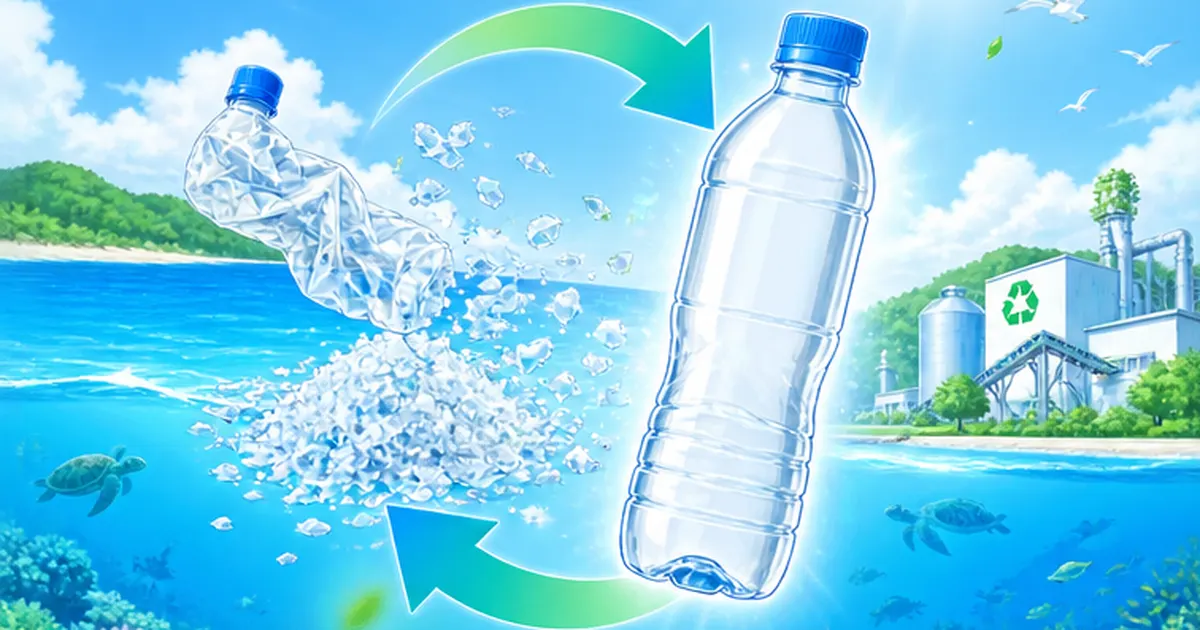
The "Coca-Cola" and "I LOHAS Natural Water" PET bottles you pick up at a convenience store or supermarket. Did you know that many of them are made using "bottle to bottle" recycling technology, which turns used PET bottles back into new PET bottles?
In 2018, Coca-Cola (Japan) Company and Coca-Cola Bottlers Japan announced the "2030 Vision for Containers," setting a goal to switch all PET bottles to 100% sustainable materials (recycled PET plus plant-based materials) by 2030. Flagship products such as "Coca-Cola," "Coca-Cola Zero," and "Georgia" have already adopted 100% recycled PET bottles.
This article explains, based on official announcements and industry statistics, how bottle-to-bottle recycling works technically, the concrete numbers behind its CO2 reduction effect, and how PET bottles used on land relate to the problem of ocean plastic pollution.
What you'll learn in this article
- The goals Coca-Cola has set under the "2030 Vision for Containers" and where things stand today
- How bottle-to-bottle recycling works (mechanical recycling and chemical recycling)
- The track record and history of adoption at I LOHAS Natural Water and Coca-Cola
- The CO2 and new-plastic reduction effects of switching to 100% recycled PET
- The reality behind Japan's world-leading 91.9% collection rate and 85.1% recycling rate for PET bottles
- How to sort PET bottles correctly at home to help prevent ocean plastic pollution
Coca-Cola's "2030 Vision for Containers"
In January 2018, Coca-Cola (Japan) announced its "2030 Vision for Containers," aiming for a zero-waste society. It rests on two main pillars: switching all PET bottles to 100% sustainable materials (recycled PET or plant-based materials) by 2030, and collecting and recycling an amount of containers equal to what is sold.
Why beverage makers are rethinking container design from the ground up
This goal is not something Coca-Cola (Japan) alone is pursuing. It is positioned as a goal for the entire "Coca-Cola system" in Japan — bottlers such as Coca-Cola Bottlers Japan, which manufactures and sells Coca-Cola products domestically, along with raw-material suppliers and recycling businesses, all working together. Because it requires rethinking the entire supply chain, from raw-material sourcing to container design, collection, and recycling, it was announced not as a single-year measure but as a long-term roadmap running from 2018 to 2030.
The Coca-Cola system is one of the world's largest beverage makers, and the volume of PET bottles it uses scales with its sales volume. Reducing dependence on newly produced petroleum-based plastic at the raw-material sourcing stage has a large impact on both CO2 reduction and resource circulation. In Japan, a roadmap has been laid out to introduce sustainable materials across all PET bottle products by 2025 and reach 100% by 2030.
Key milestones of the 2030 Vision for Containers
- January 2018: Vision announced
- March 2020: 100% recycled PET bottles for "I LOHAS Natural Water" launched nationwide
- May 2021: 100% recycled PET adopted for flagship brands including Coca-Cola and Georgia
- May 2025: 100% recycled PET adopted for 500ml label-less bottles as well
- 2030: All PET bottles to be 100% sustainable materials (target)
The other pillar: "recycling as much as is collected"
The 2030 Vision for Containers includes not just switching materials but also a goal to "collect and recycle an amount of containers equal to what is sold." This aims to close the loop of circulation completely — not just using environmentally conscious materials, but ultimately ensuring that plastic put into the market is collected back by society as a whole. The materials-side goal tends to get more attention, but if this collection-side goal is not achieved, the structural problem of new plastic waste piling up will not change no matter how high the ratio of recycled PET goes. The essence of this vision lies in advancing both wheels together.
How 100% recycled PET bottles work: what is bottle-to-bottle recycling
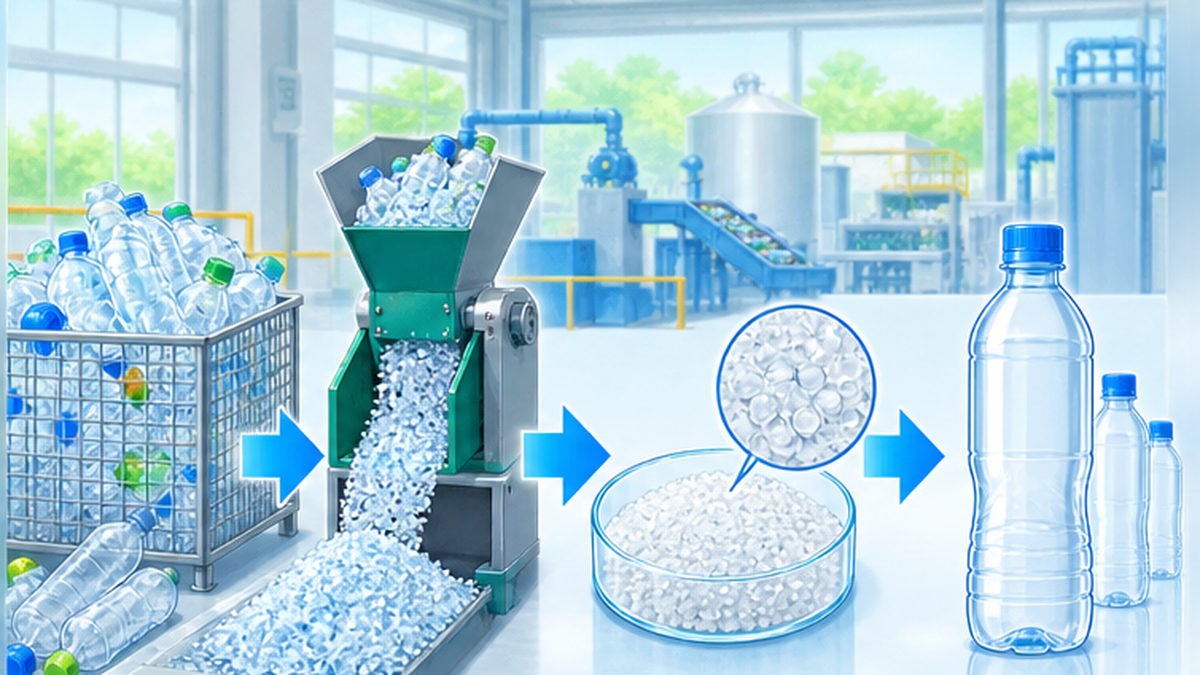
"Bottle-to-bottle" recycling refers to a horizontal recycling process in which used PET bottles are collected, washed, and crushed into "recycled flakes," which are then molded again into PET bottle resin. Unlike "downcycling," in which PET bottles become a different product such as clothing or trays, its distinguishing feature is that it can be recycled repeatedly for the same use.
The difference between mechanical and chemical recycling
There are broadly two methods of bottle-to-bottle recycling. According to the Council for PET Bottle Recycling, mechanical recycling (physical regeneration) processes the resin under high temperature and reduced pressure and removes contaminants through melt filtration; it requires relatively little capital investment and has a low environmental burden. Chemical recycling (chemical regeneration), on the other hand, breaks down used PET to the molecular level and rebuilds it into raw material, achieving high purity and little risk of contamination, but it requires large-scale equipment and is costly.
| Method | How it works | Advantages | Challenges |
|---|---|---|---|
| Mechanical recycling | Processed under high temperature and reduced pressure, with contaminants removed by melt filtration | Relatively low equipment cost, low environmental burden | Vulnerable to contamination from dirt and foreign matter |
| Chemical recycling | Broken down to the molecular level and regenerated into resin raw material | High purity, stable enough for food-contact use | Requires large-scale equipment, high cost |
Coca-Cola Bottlers Japan has partnered with Taiwan's Far Eastern New Century to run a joint project commercializing PET bottles made with chemically recycled PET raw material, pursuing a strategy of combining both mechanical and chemical technologies to increase the volume of recycled PET it can procure. The concept of horizontal recycling itself is spreading across the industry as a whole — for example, similar technology has also been adopted for Suntory's bottle-to-bottle recycling for its natural mineral water.
Why returning to the "same use" matters
Plastic recycling also includes "downcycling," in which PET bottles are remade into a different product such as textile fiber or trays. Downcycling is a valid form of resource use, but in most cases the loop stops there, and the resulting product cannot be turned back into a PET bottle. Bottle-to-bottle recycling, by contrast, is a horizontal recycling process that can return to the same use — a PET bottle — repeatedly, meaning the same resource could in theory keep circulating almost indefinitely. From the standpoint of plastic resource circulation, this question of "whether it can keep circulating without dropping down to a lower-value use" is an important evaluation criterion.
In practice, however, the resin degrades somewhat each time it is recycled (changes in color, reduced strength), so it cannot keep circulating at the same quality forever. To maintain quality, degraded recycled resin is blended with a certain proportion of fresh virgin resin or high-purity resin from chemical recycling — so even "100% recycled" involves meticulous quality control behind the scenes.
The globally spreading idea of "extended producer responsibility"
Behind the push for horizontal recycling like bottle-to-bottle in many countries lies the spreading concept of "Extended Producer Responsibility (EPR)." This is the principle that companies that manufacture and sell products should bear a certain degree of responsibility through the disposal and recycling stage as well; the European Union has already been phasing in mandatory recycled-plastic content requirements for PET bottles. Japan has no legal mandate like the EU's at this point, but many companies including Coca-Cola are moving in the same direction as voluntary industry targets — which also amounts to an early investment made with an eye on the global trend toward stricter regulation.
Seen against this international backdrop, companies switching to recycled materials is not merely an environmental branding strategy, but also part of managing business risk — preparing for future regulation and securing stable raw-material supply.
Why PET bottles on land are connected to ocean plastic pollution
PET bottles are not containers used at sea, but if they are not properly collected and recycled, they can become part of the plastic waste that flows from rivers into the ocean through littering or improper disposal. Ministry of the Environment surveys, as well as surveys on plastic waste flowing from rivers into the ocean, repeatedly find PET bottles and caps among the top items recovered, so strengthening resource circulation on land ultimately serves as a preventive measure against ocean plastic pollution.
"Recycled PET" does not mean "ocean plastic collection"
This is an easy point to misunderstand: Coca-Cola's "bottle-to-bottle" recycling is not made by collecting plastic waste that has already flowed into the ocean. Its raw material is used PET bottles sorted and collected on land, and it is a separate project from initiatives that reuse ocean plastic (ocean plastic reuse is progressing separately, in areas such as recycling abandoned fishing nets). Conflating the two leads to over- or under-crediting what a company's efforts actually achieve.
Even so, reducing the production of new petroleum-based plastic and establishing a system in society that keeps existing PET bottles circulating at high quality lays the groundwork for curbing the total generation of plastic waste over the long term and lowering the risk of it flowing into the ocean.
The route from land to sea
Most ocean plastic waste is thought to originate not at sea but on land, entering the ocean via rivers and drainage channels. Littered PET bottles, waste left out past collection days, and illegally dumped trash are carried into waterways by rain and wind and eventually reach the ocean. In other words, raising the PET bottle recycling rate and reducing the sheer volume of waste left in towns and along riverbanks directly narrows the "entry point" for ocean plastic pollution measures.
A perspective worth remembering
- Much of the ocean plastic waste originates from activity on land
- Properly sorting and collecting PET bottles serves as a "preventive measure" against flow-out into the ocean
- Corporate recycling initiatives, government collection infrastructure, and individual sorting behavior each function as separate gears
Solving the ocean plastic problem is said to require a three-stage approach: source reduction (cutting waste and thorough sorting on land), preventing outflow (collection at rivers and drainage channels), and recovering waste that has already flowed into the ocean (beach cleanups, surveys of drifted debris). Coca-Cola's bottle-to-bottle recycling is a source-reduction initiative, and its role differs from direct ocean-debris recovery such as beach cleanup activities. Only when both are combined does it become a comprehensive response to the ocean plastic problem.
Track record of switching across the product lineup
In March 2020, Coca-Cola (Japan) first launched 100% recycled PET bottles nationwide for "I LOHAS Natural Water." Rolled out as a "next-generation PET bottle" combining lightweighting with recycled-PET use, this initiative became the starting point for the subsequent rollout across flagship brands.
Rollout timeline for flagship brands
- March 2020: 100% recycled PET bottles for "I LOHAS Natural Water" launched nationwide
- May 2021: 100% recycled PET adopted for flagship products including "Coca-Cola" and "Georgia Japan Craftsman"
- April 2022: Label-less bottles using 100% recycled PET for "Coca-Cola" and "Coca-Cola Zero Sugar" launched online-only
- September 2023: New packaging design explicitly labeled "100% recycled PET bottle" launched nationwide
- May 2025: 100% recycled PET adopted for 500ml label-less bottles as well, expanding the range of covered products
Clearly labeling packaging with "100% recycled PET bottle" is intended to let consumers recognize the use of recycled material at the point of purchase, and it also serves as a clear, easy-to-understand environmental message from the company.
"By 2030, all PET bottles will be made from 100% sustainable materials"
— Coca-Cola (Japan) sustainability strategy announcement
Why "I LOHAS" was the first to adopt it
Among the flagship brands, "I LOHAS Natural Water" was the first to adopt 100% recycled PET bottles, and one reason is that the brand had already built its environmental positioning around a lightweighting concept — the "squeezable bottle." It appears the company judged that combining lightweighting technology with recycled-PET technology could strengthen both brand image and actual environmental-impact reduction at the same time. As a natural mineral water brand with a natural affinity for "water," including watershed conservation, it likely provided fertile ground for advancing the switch to environmentally conscious materials.
Combined with "label-less bottles"
Label-less bottles, which have expanded since 2022, are an initiative that reduces the burden of sorting — and cuts plastic use itself — by eliminating the label, a separate-material component. Combining 100% recycled PET with going label-less means the company is simultaneously pursuing "regenerating materials" and "reducing the materials used in the first place," which is a defining feature of its recent packaging strategy. The fact that it began as an online-only offering and has gradually expanded in terms of covered products and container sizes suggests the company is rolling it out cautiously while watching demand and production capacity.
Rolled out simultaneously for the canned-coffee brand "Georgia"
"Georgia," which offers coffee beverages in PET bottles, also adopted 100% recycled PET bottles at the time of the simultaneous rollout for flagship brands in May 2021. Although the brand is strongly associated with canned coffee, its PET-bottled products also account for a certain sales volume, so aligning the switch across different categories — carbonated drinks, water, and coffee — shows that the Coca-Cola system manages its container strategy in a unified way across brands.
The numbers behind CO2 reduction and new-plastic reduction
Switching to 100% recycled PET bottles has shown clear environmental benefits in numerical terms as well. According to Coca-Cola (Japan), 100% recycled PET reduces CO2 emissions by approximately 49% compared with 100% petroleum-based PET bottles. Furthermore, switching flagship products from conventional PET bottles to 100% recycled PET is expected to reduce CO2 emissions by roughly 60% per bottle, and by about 35,000 tons per year across the Coca-Cola system as a whole.
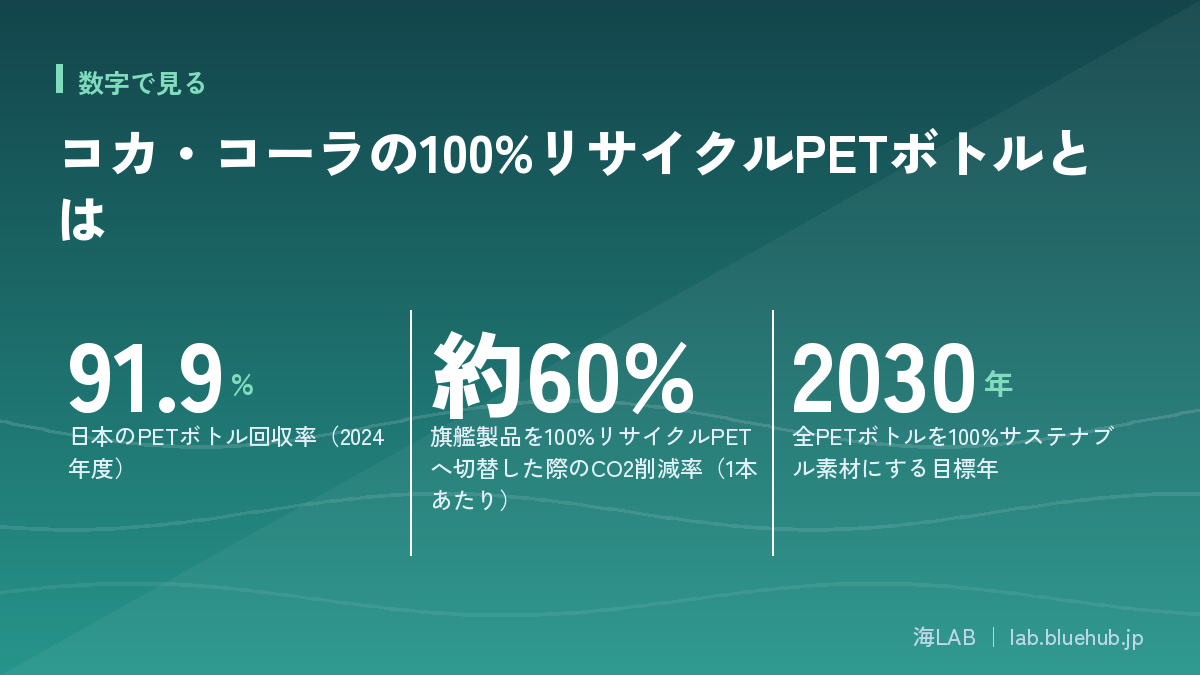
It is also expected to reduce the volume of newly manufactured petroleum-based plastic by roughly 30,000 tons per year. This is an initiative that reduces reliance on fossil resources starting at the raw-material sourcing stage — more important than being just a "recycling number," it also curbs plastic production volume itself.
Points to note when reading these reduction figures
The two figures — "49% reduction" and "60% reduction" — are presented side by side because they compare different things. The former refers to a comparison between 100% recycled PET in general and 100% petroleum-based PET, while the latter refers to the per-bottle effect from an actual switch of flagship products. When looking at a CO2 reduction figure a company announces, checking exactly what is being compared with what is the key to avoiding misreading it.
Why recycled PET emits less CO2
Manufacturing virgin PET resin from petroleum requires a multi-stage chemical process — from crude oil extraction and refining, through naphtha cracking, to polymerization — with energy consumed and CO2 emitted at every step. Recycled PET, by contrast, starts from used PET bottles, a resource that has "already been turned into resin," which allows much of the energy consumption at the raw-material sourcing stage to be skipped. This is the main reason recycled PET emits less CO2 than petroleum-based PET. Chemical recycling requires additional energy to break the material down to the molecular level, but it is still said to be more energy-efficient than manufacturing consistently from new crude oil.
The roughly 35,000 tons of annual CO2 reduction and roughly 30,000 tons of new petroleum-based plastic reduction expected across the Coca-Cola system as a whole show how much of an effect a single beverage company's switch in container materials can have on resources and emissions at this scale, illustrating the significance of material transitions across the beverage industry.
CO2 emission differences by container material (rough guide)
| Container material | Characteristics | CO2 emission tendency |
|---|---|---|
| Petroleum-based virgin PET | Manufactured consistently from crude oil | Large emissions at the raw-material sourcing stage |
| 100% recycled PET (mechanical) | Used PET physically regenerated | Lower emissions compared with virgin PET |
| 100% recycled PET (chemical) | Broken down to the molecular level and regenerated | Complex process but high purity, with reduction effect versus virgin material |
| Aluminum cans | Smelted from bauxite; recycling is also active | High emissions for initial production, low energy for recycling |
| Glass bottles | Manufactured from sand, soda ash, and similar materials | Heavy, so transport-stage emissions are relatively large |
This comparison shows that the environmental impact of a container material depends not just on "what it is made of" but also on "how it is made and transported." PET bottles are lightweight and transport-efficient, but their petroleum origin is a drawback, and switching to recycled material is one effective way to offset that weakness.
Japan's PET bottle recycling rate is world-class
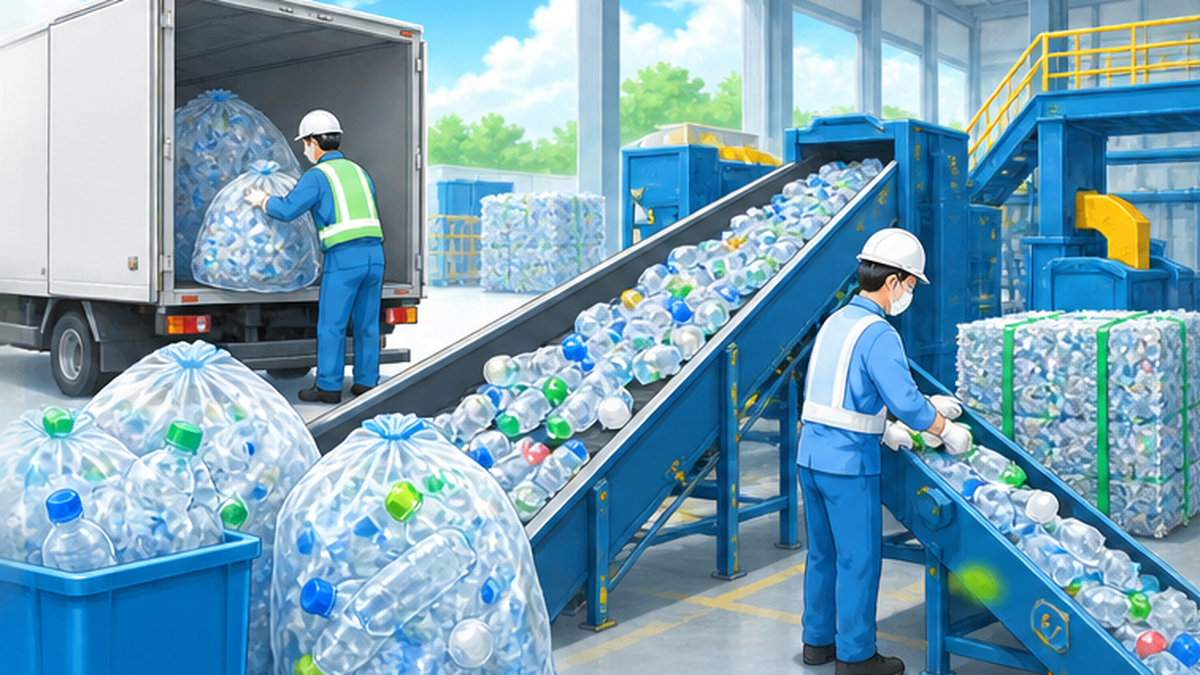
Beyond what Coca-Cola alone is doing, it's worth understanding the foundation of PET bottle recycling across Japan as a whole. According to the Council for PET Bottle Recycling's 2024 annual report, Japan's PET bottle collection rate for FY2024 was 91.9% and the recycling rate was 85.1%, both maintaining the 85%-or-higher target for another year running. The effective utilization rate, including thermal recovery, is estimated at 98.6%, a high level even compared with Europe and the United States.
Lightweighting (reduce) is also progressing
The PET bottle lightweighting rate (reduce rate) for FY2023 was 28.4%, meeting its target. Making the bottles themselves lighter also curbs CO2 emissions at the manufacturing and transport stages. Advancing recycling (Recycle) and lightweighting (Reduce) at the same time is a defining feature of Japan's PET bottle industry. Some of the recycled PET collected this way, while serving a different use than recycled products made from ocean plastic, can still be seen as part of the same broader direction toward resource circulation.
Where Japan stands globally
Since tallying methods for PET bottle recycling rates differ by country, simple comparisons are difficult, but Japan's figure of roughly 85% is generally considered high even compared with major European countries and the United States. This is underpinned by three combined factors: thorough sorted collection by local governments, a system of cooperation among beverage makers, retailers, local governments, and recycling businesses, and consumer cooperation with sorting. In particular, the fact that recycling is built into everyday life — through collection boxes next to vending machines and in-store collection at supermarkets and convenience stores — is a foundation supporting Japan's high PET bottle collection rate.
The difference between "designated PET bottles" and other PET products
The term "designated PET bottles" used in the Council for PET Bottle Recycling's statistics refers to PET bottles used mainly for food purposes, such as soy sauce, beverages, and alcoholic drinks. PET products for other uses, such as food trays or stationery, are covered by different tallies, so checking exactly what scope a "PET bottle recycling rate" figure refers to in a given news report is also helpful for reading the numbers correctly.
The legal framework: the Containers and Packaging Recycling Act
Japan's high PET bottle collection rate rests on the sorted-collection and re-commercialization system established under the Containers and Packaging Recycling Act, enacted in 1995. The law defines a division of roles in which municipalities collect sorted PET bottles from households and businesses bear the cost of re-commercialization (recycling) — a clear allocation of responsibility among government, businesses, and consumers that is a defining feature of Japan's recycling system. Voluntary targets set by beverage makers like Coca-Cola are built on top of this legal framework, going a step further.
Correct sorting: what consumers can do
What determines the quality of bottle-to-bottle recycling is not just corporate technology, but also how carefully households sort their waste. If foreign matter or dirt gets mixed in, the quality of the recycled PET drops, and it may no longer be usable for food-contact purposes.
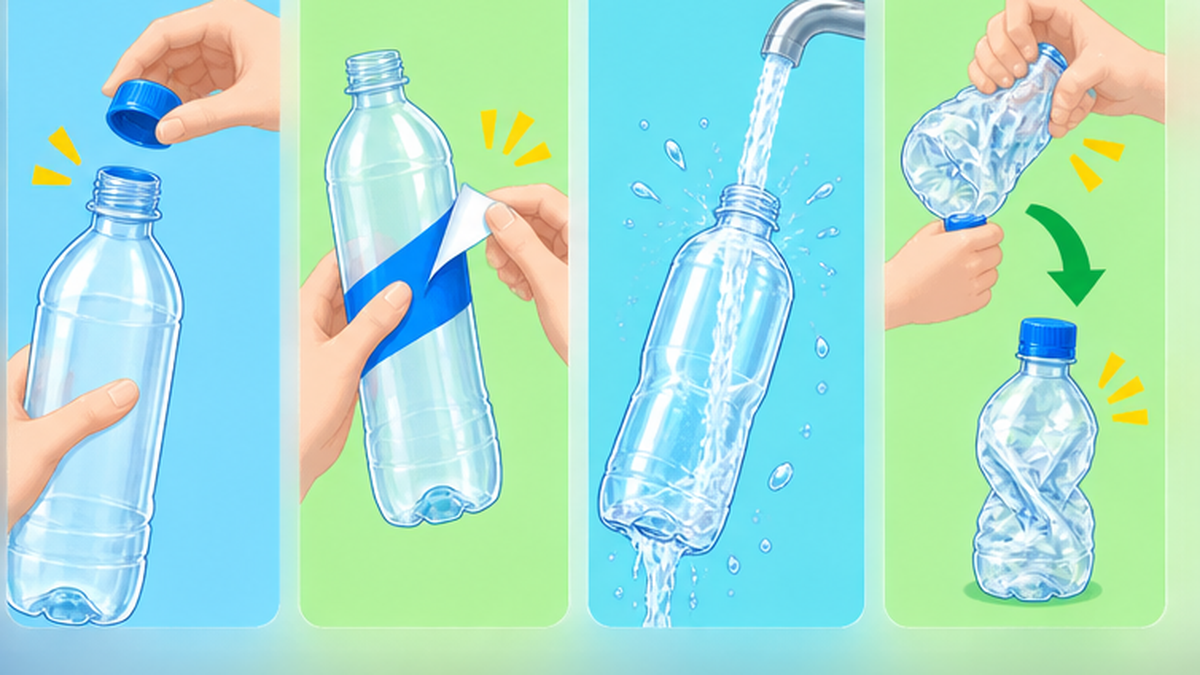
Four sorting steps you can do at home
- Remove the cap (caps are a different material, so sort them as plastic separately)
- Peel off the label (the label is also a different material; check your municipality's rules if it's hard to remove)
- Give it a quick rinse to remove dirt and liquid (no need to scrub it with detergent)
- Crush it lightly and put it out as a recyclable resource with the opening facing up
This small extra effort determines whether recycled PET can circulate as a "high-quality resource usable even for food-contact purposes." Japan's 91.9% collection rate figure is also built on the accumulation of this kind of household-level sorting.
Rules vary by municipality
The basic sorting steps are common everywhere, but detailed rules can differ by municipality — for example, some don't require peeling off the label, while others allow you to put the cap out together with the bottle. When in doubt, checking your municipality's official website or a waste-sorting app is the most reliable approach. Washing "too thoroughly out of good intentions" can actually mean using excessive water, so a light rinse to remove dirt is considered sufficient.
Common misconceptions about sorting
- "It can't be recycled unless it's completely clean" → A quick rinse is enough
- "You never need to peel off the label anywhere" → Rules differ by municipality, so check
- "It'll still be collected even if you don't crush it" → Crushing it improves transport efficiency and also helps reduce CO2
Companies are also designing for easier sorting
The recent adoption of label-less bottles and labels with perforations is also part of "design for recycling" — designing products so consumers don't have to struggle when sorting them. By keeping easy-to-peel labels, easy-to-remove caps, and single-material construction in mind from the container-design stage, companies lower the barrier to sorting at home, which in turn raises the quality of the recycled PET. Consumer effort and corporate design effort are mutually complementary — neither works on its own.
Remaining challenges and the roadmap toward 2030
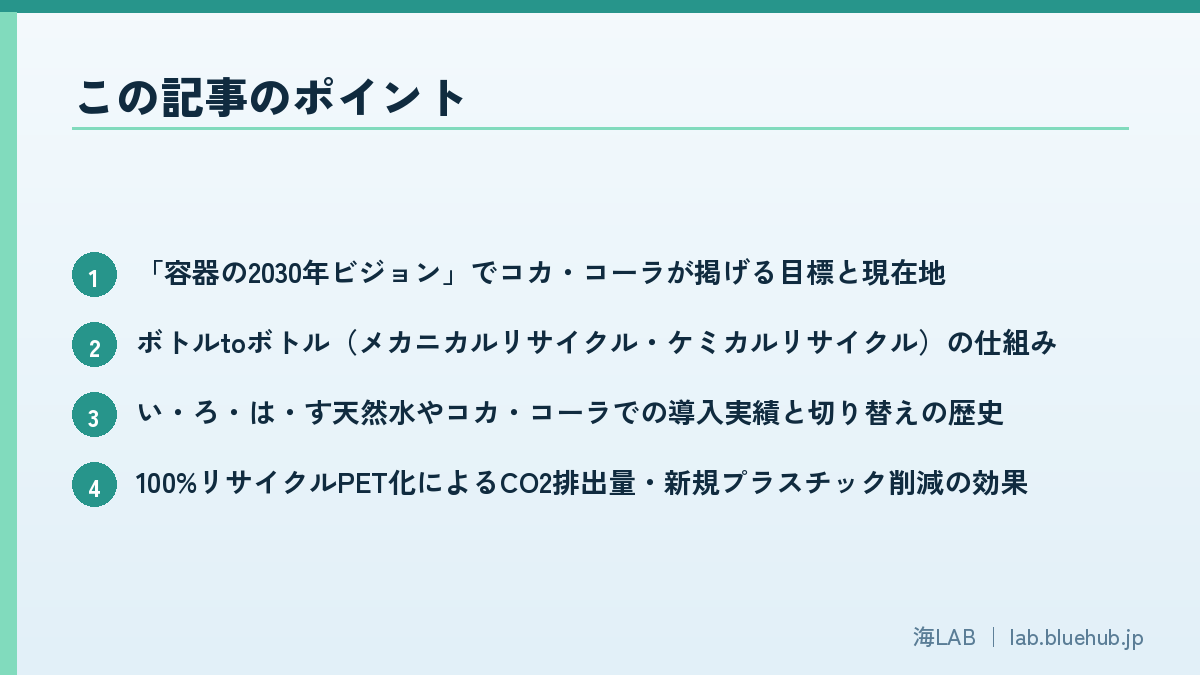
Toward the goal of making all PET bottles 100% sustainable materials by 2030, three challenges currently stand out: (1) securing a stable supply of recycled PET feedstock, (2) expanding chemical recycling facilities and lowering their cost, and (3) maintaining and increasing consumer cooperation with sorting. In particular, global demand for recycled PET feedstock is rising, and competition to secure good-quality used PET bottles is expected to intensify further.
There's also a target for the horizontal recycling rate of self-collected empty containers
Coca-Cola Bottlers Japan has set a target for the "horizontal recycling rate" — the share of used PET bottles and cans it collects itself, for example through recycling boxes attached to vending machines, that are turned back into raw material and reused in new containers — of 50% by 2030 and 100% by 2035. This is a more ambitious target that applies specifically to the channel the company collects directly, separate from the market-wide collection rate of 91.9%.
The industry-wide challenge of competing for recycled PET feedstock
Coca-Cola is not the only company setting a goal of switching to 100% recycled PET — other beverage makers and household-goods manufacturers have set similar targets. As a result, competition to secure good-quality used PET bottles (recycled feedstock) is intensifying across the industry, raising raw-material prices and the importance of long-term contracts with recycling businesses. Beyond individual corporate effort, strengthening collection infrastructure with the involvement of industry associations and government will be a key factor determining whether these 2030 targets are achieved.
Against this backdrop, Coca-Cola Bottlers Japan is diversifying its raw-material sourcing routes — investing in the chemical recycling technology mentioned above and partnering with overseas recycled-PET feedstock manufacturers. Building a system that does not depend on a single technology or a single supply source is positioned as an initiative that raises the likelihood of achieving the 2030 goal.
How this relates to moves by competitors and other industries
Suntory Beverage & Food is also building its own bottle-to-bottle system for brands such as "Tennensui" natural mineral water, and competition and cooperation to raise the recycled-PET ratio are proceeding simultaneously across the beverage industry as a whole. Even competing companies need to build cooperative relationships around the "social infrastructure" of collecting and recycling used PET bottles, and discussions on information sharing and technology standardization through industry associations are also becoming more active. From a consumer's perspective, the fact that recycled PET is becoming the norm no matter which brand you choose points to an improvement in society's overall capacity for resource circulation that goes beyond any single company's efforts.
Going forward, it will likely become important not only to increase the "volume" of recycled PET, but also to demonstrate as much transparency as possible in traceability — showing which collection point a batch of PET came from and what process it went through to become a product — in order to earn consumer trust.
Conclusion: corporate efforts and household sorting together protect the ocean
Key points from this article
- Coca-Cola has set a goal under its "2030 Vision for Containers" to make all PET bottles 100% sustainable materials by 2030
- Bottle-to-bottle recycling is a mechanism that regenerates used PET into new PET bottles via two methods: mechanical and chemical recycling
- Switching to 100% recycled PET is expected to reduce CO2 emissions by roughly 60% per bottle
- Japan's PET bottle collection rate of 91.9% and recycling rate of 85.1% are world-class
- Recycled PET is a separate effort from ocean plastic collection, but it lays a foundation for lowering the risk of plastic flowing into the ocean by curbing new plastic production
- Correct sorting at home — removing the cap and label, rinsing, and crushing — supports high-quality recycled PET
PET bottle recycling only works when three gears — corporate technology, government collection infrastructure, and household sorting — mesh together. The next time you pick up a PET-bottled beverage, remember that the small extra step of removing the cap and label and giving it a quick rinse is part of the ocean's resource circulation.
References and sources
- Coca-Cola (Japan) Company, "Toward Sustainable Containers" – Overview of the 2030 Vision for Containers and related initiatives
- Coca-Cola (Japan), "Aiming for a Zero-Waste Society: Coca-Cola (Japan) Announces the '2030 Vision for Containers'" – Press release announcing the vision in January 2018
- Coca-Cola Bottlers Japan, "What Is Bottle-to-Bottle Recycling?" – Explanation of mechanical and chemical recycling
- Coca-Cola Bottlers Japan, "Design | Sustainability" – Figures on expected CO2 reduction and new-plastic reduction
- Council for PET Bottle Recycling, "PET Bottle Recycling Annual Report 2024" – FY2024 statistics: 91.9% collection rate, 85.1% recycling rate
- Council for PET Bottle Recycling, "Section 6: Bottle-to-Bottle" – Definition and mechanism of bottle-to-bottle recycling (Q&A)
- Coca-Cola (Japan), "Launch of '100% Recycled PET Bottle' for I LOHAS Natural Water" – Press release on the March 2020 nationwide launch
- Coca-Cola (Japan), "New Label-Less Bottles Using 100% Recycled PET" – Press release on the April 2022 online-only launch
- Coca-Cola (Japan), "New 'Coca-Cola' Package Design" – Press release on the September 2023 nationwide launch and the background of the on-pack labeling
- Sustainable Brands Japan, "Coca-Cola (Japan) Adopts 100% Recycled PET Bottles for Flagship Products" – Reporting on the 49% CO2 reduction rate and the effects of the switch
- Sustainable Brands Japan, "Coca-Cola Aims for 100% Container Collection and Recycling by 2030" – Target of 50% by 2030 and 100% by 2035 for the horizontal recycling rate of self-collected empty containers
※ Listed in order of reliability: government and academic institutions > peer-reviewed papers > specialized organizations > trusted media