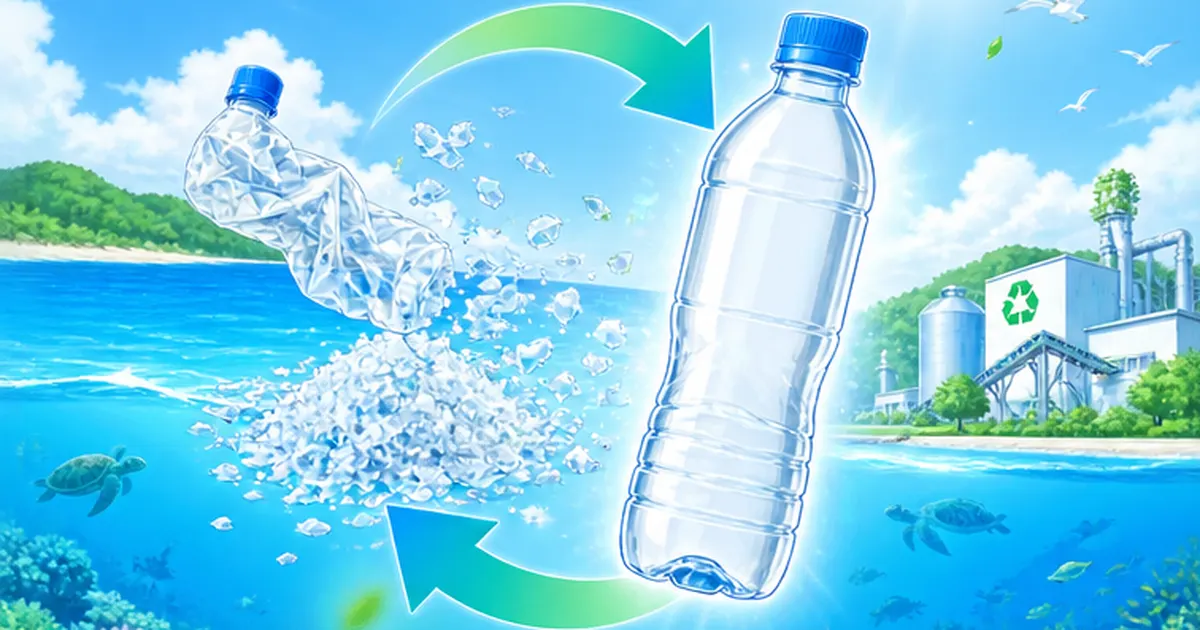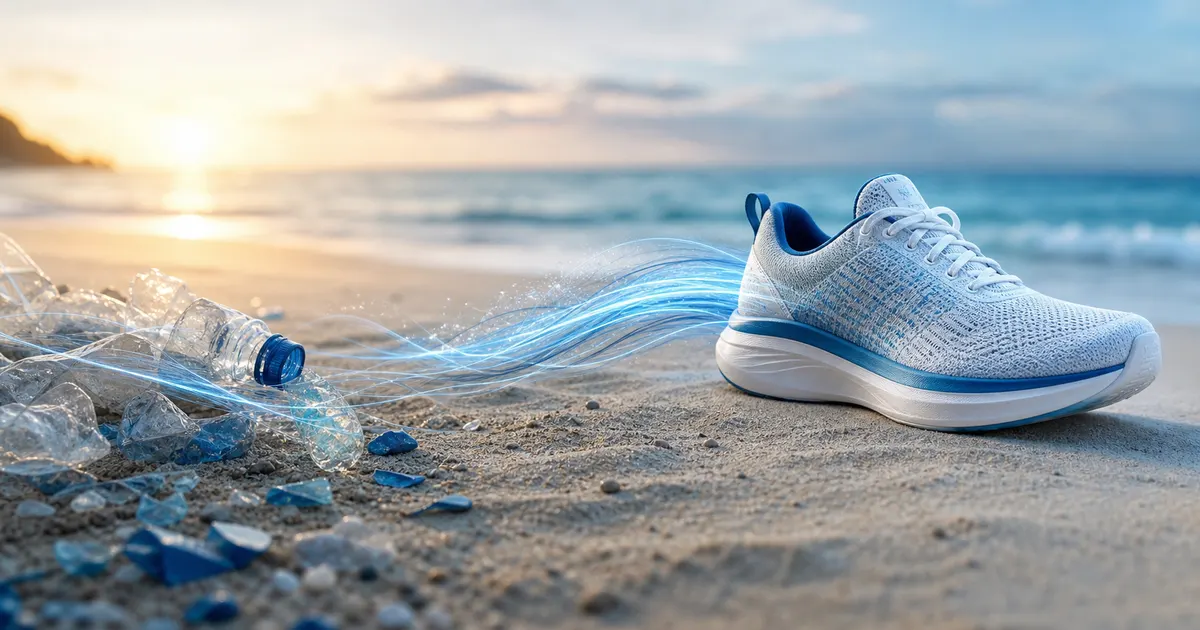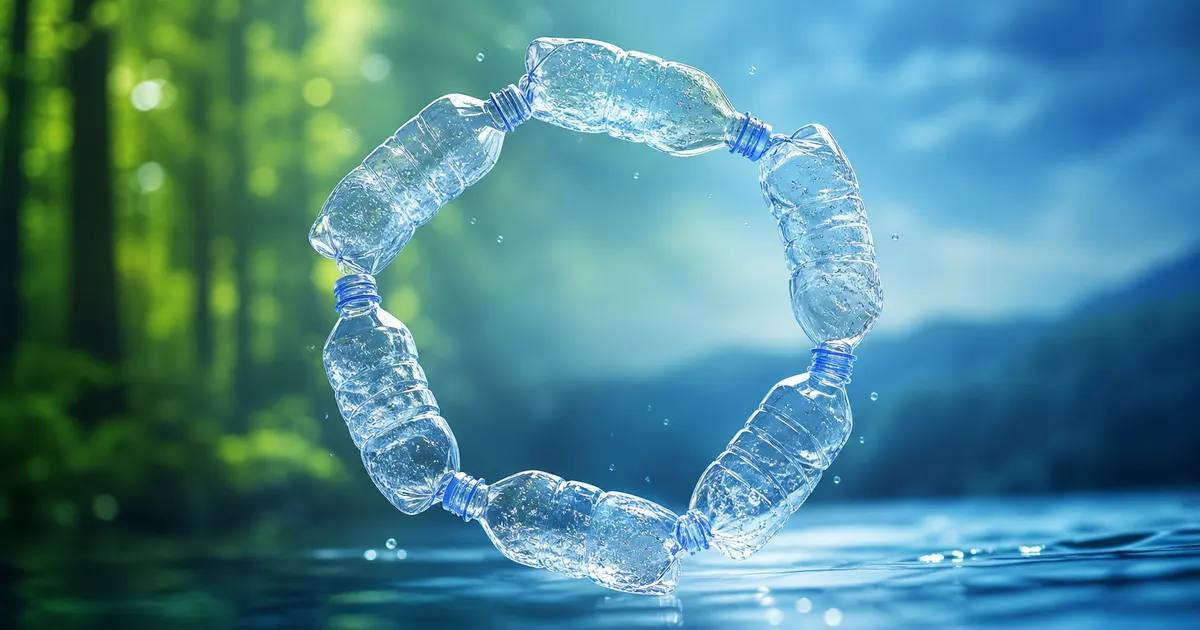
After finishing a bottle of "Suntory Tennensui" bought at a convenience store, have you ever wondered where the empty bottle goes? For most people, a PET bottle becomes "trash" the moment it's emptied. But today, a system is taking shape that treats that single bottle not as trash but as a "resource" to be circulated again and again. Instead of turning used PET bottles into fiber or trays, this approach brings them back to life as brand-new PET bottles once more — this is the horizontal recycling method known as "Bottle to Bottle."
Suntory, working with Kyoei Industry Co., Ltd., established this technology — mechanical recycling that turns used PET bottles into new PET bottles — as the first in Japan's domestic beverage industry in 2011, and put it into practical use the following year, in 2012. This was at a time when the term "horizontal recycling" was not even in common use. The technology has enabled Suntory to cut CO2 emissions by approximately 60% compared with manufacturing new bottles from fossil-derived raw materials, all while delivering 100% recycled-material PET bottles to the market. Cumulative sales of these bottles surpassed 15 billion as of the end of May 2024. Beyond circulating the bottles themselves, Suntory has also worked to protect the very water that fills them, nurturing water sources across more than 12,000 hectares of "Natural Water Sanctuaries" nationwide.
This article traces the mechanism and results of Bottle-to-Bottle horizontal recycling, as well as the water source conservation efforts of the Natural Water Sanctuaries, drawing on primary data from official sources such as Japan's Ministry of the Environment, Suntory, and the Council for PET Bottle Recycling. Why does the circulation of a single PET bottle connect to protecting the distant sea? In the spirit of Umi Lab, an ocean-focused media outlet, let's look closely at the numbers and facts behind the circulation of water.
What you'll learn in this article
- How "Bottle to Bottle (horizontal recycling)" — turning used PET bottles back into PET bottles — works, and how it differs from conventional recycling into fiber or trays
- How Suntory established this technology as the first in Japan's domestic beverage industry in 2011, cutting CO2 emissions by about 60% while keeping the material in circulation
- The three-tiered recycling technologies — mechanical, FtoP direct, and chemical — and the substance of the 2030 goal of making "100% of PET bottles sustainable"
- The water-source conservation activities of the "Natural Water Sanctuaries," spanning 12,000 hectares, that nurture as much water in the forest as is drawn from the ground, along with the regeneration of biodiversity
- How the circulation of PET bottles and the conservation of water sources connect to the problem of ocean plastic and the future of a rich sea
Why "Horizontal Recycling" of PET Bottles Protects the Ocean
Key Points of This Article
- Roughly 8 million tons of plastic waste flow into the ocean every year, and about 80% of it comes from land
- "Bottle to Bottle" is horizontal recycling that turns used PET back into PET bottles
- Suntory established this technology as the first in Japan's domestic beverage industry in 2011, cutting CO2 emissions by about 60%
- Cumulative sales of 100% recycled PET bottles surpassed 15 billion (as of end of May 2024)
- The "Natural Water Sanctuaries," which nurture as much water as is drawn, now cover more than 12,000 hectares
Our lives are surrounded by so much plastic that they would hardly function without PET bottles. Light, sturdy, and able to carry drinks hygienically, the PET bottle is undeniably a convenient invention. But behind that convenience, plastic that is not properly collected and processed continues to pollute oceans around the world. According to estimates by the United Nations Environment Programme and others, roughly 8 million tons of plastic waste flows into the ocean every year. And about 80% of it comes not from ships or fisheries, but from the land where we live. Containers littered in cities are carried by rain and wind into storm drains, flow down rivers, and eventually reach the sea.
Plastic that reaches the ocean does not simply disappear. Even as ultraviolet light and wave action break it into smaller pieces, the material itself remains in the natural environment for hundreds of years. This process is explained in detail in our article on how ocean plastic waste breaks down, but the key point is simple: plastic does not "disappear" — it only "becomes invisible," turning into microplastics under 5mm that work their way into marine life and, eventually, into our own bodies. One report submitted to the World Economic Forum went so far as to warn that, at this rate, by 2050 the weight of plastic in the ocean could exceed the weight of fish.

The Best Shortcut to "Not Throwing Away" Is "Circulating"
So what is needed to prevent plastic from flowing into the ocean? Broadly, there are two answers. One is to "reduce the amount used in the first place." The other is to "reliably collect what has been used and circulate it as a resource, again and again." The former is making progress through the spread of reusable bottles and the like, but it remains difficult to deliver beverages themselves without any container at all. That is precisely why the latter — a system that keeps used PET bottles circulating as resources rather than turning them into trash — becomes decisively important. Bottles that are collected and put back into circulation never end up flowing into the sea.
The key here is the protagonist of this article: "Bottle to Bottle" horizontal recycling. It returns a used PET bottle to being a brand-new PET bottle once again. When this cycle turns reliably, a single PET bottle can be reborn again and again, reducing the amount of new oil that needs to be drilled, the CO2 released through incineration, and the risk of ending up in the ocean. The circulation of PET bottles and the conservation of the sea may seem like distant topics, but in fact they are connected by the very same thread.
"Container Circulation" and "Water Source Conservation" — A Water Company's Two Responsibilities
There is one more responsibility that beverage makers bear: responsibility for the water itself. This is especially true for a company that pumps groundwater and sells it as "natural water" — if the forest that nurtures that water falls into disrepair, the very source of the product will run dry. Only when forests are rich does rain soak into the soil, filter slowly over a long period of time, and become high-quality groundwater. In other words, a water company carries two responsibilities toward two cycles: "the responsibility to keep used containers circulating" and "the responsibility to protect the water source that is the origin of the product." In the latter half of this article, we will look at how Suntory has approached both of these responsibilities.
Quick Glossary: Horizontal Recycling and Cascade Recycling
Recycling that turns a product back into the same product, again and again, is called "horizontal recycling" (bottle to bottle). By contrast, the flow in which a PET bottle becomes a different — and often lower-quality — product such as fiber or a tray, after which further recycling becomes difficult, is called "cascade recycling" (as in flowing down a waterfall). Horizontal recycling comes closer to the ideal of a circular society, since it keeps resources circulating on the same level.
What Is "Bottle to Bottle"? — The Mechanism of Horizontal Recycling
The term "Bottle to Bottle" has become common in recent years, but few people could accurately explain what it actually involves. Let's trace, step by step, the process by which a used PET bottle becomes a new bottle once again.
From Collection to Preform — Six Steps of Regeneration
Put simply, horizontal recycling of PET bottles follows the flow of "collect," "clean," "turn back into material," and "reshape." Breaking it down further: (1) used bottles are collected separately from households, offices, and stores; (2) labels and caps are removed and the bottles are sorted; (3) the bottles are crushed into small "flakes"; (4) these are thoroughly washed and decontaminated; (5) they are regenerated into PET resin of a quality suitable for beverage containers; and (6) this resin is melted at high temperature to create a "preform" — the original bottle shape that looks like a test tube. From there, the preform is inflated with air inside a mold to complete the familiar PET bottle.
- Used PET bottles are collected separately at homes, stores, and through municipal collection
- Labels and caps are removed, and bottles are sorted by color and for foreign matter
- The bottles are crushed into small "flakes"
- The flakes are washed and decontaminated to thoroughly remove dirt and foreign matter
- The material is regenerated into high-purity PET resin suitable for use in beverage containers once again
- The resin is melted to form a "preform," which is then inflated into a new bottle
What matters here is that, since the material will be used as a container to hold beverages, the regenerated resin must meet extremely high standards of food safety and purity. That is exactly why the "washing and decontamination" step is the crux of the process. If dirt or the smell of the previous contents remains, the material cannot be used for a beverage container. This difficulty is precisely why horizontal recycling of PET bottles has long been "easier said than done," and whether a company can establish the technology to overcome it has been the dividing line between companies.

"Mechanical" and "Chemical" — Two Recycling Methods
There are broadly two families of technology for achieving Bottle to Bottle recycling. One is mechanical recycling, a method that physically crushes, washes, and melts used bottles to regenerate them. Because it involves no chemical decomposition, it offers the advantage of high energy efficiency and lower CO2 emissions. The other is chemical recycling, in which PET is first chemically broken down to the raw-material level (molecules), returned to the same state as brand-new petroleum-derived material, and then remade from scratch. This method is highly resistant to dirt and foreign matter and loses little quality even after repeated recycling, but its processes are more complex and tend to require more cost and energy.
| Item | Mechanical Recycling | Chemical Recycling |
|---|---|---|
| Approach to regeneration | Physically crushed, washed, and melted for regeneration | Chemically broken down to the molecular level and resynthesized |
| Advantages | High energy efficiency, easier to keep CO2 low | Quality holds up well; resistant to dirt |
| Disadvantages | Difficult to handle heavily soiled raw material | Complex processes with high cost and energy demands |
| Suntory's positioning | Main method in practical use since 2012 (about 60% CO2 reduction) | Aiming for practical use by 2027 through R Plus Japan |
Neither method is unconditionally superior to the other. The ideal division of labor is to efficiently recycle cleanly collected, high-quality used bottles through mechanical recycling, while returning heavily soiled or contaminated material — which mechanical recycling struggles to handle — to raw material through chemical recycling. This same idea applies not only to PET bottles but also to the recycling of other ocean-related plastics such as fishing nets. Efforts to turn used fishing nets back into recycled nylon are covered in our article on recycling used fishing nets, and a wide range of cases turning ocean plastic into products is covered in our article on recycled products made from ocean plastic.
The Value of Being "Horizontal"
PET bottles were originally often recycled into other products such as fiber or trays. That, too, is a legitimate form of reuse, but further recycling from that point becomes difficult, and the material tends to head toward incineration or disposal eventually. With bottle-to-bottle horizontal recycling, the material can in theory keep circulating on the same level indefinitely. That is exactly why being "horizontal" holds such great value.
Suntory's Technological Evolution — A Three-Tiered Approach of Mechanical, FtoP, and Chemical Recycling
Now that we understand how Bottle to Bottle works, let's look at how Suntory has nurtured this technology. What stands out is that the company has never settled for a single technology, instead evolving step by step toward more efficient methods. Suntory's efforts are built on three technologies layered on top of one another.
Stage One: Establishing Japan's First "Horizontal Recycling" in the Beverage Industry (2011–2012)
Working together with Kyoei Industry Co., Ltd., a company engaged in PET bottle recycling, Suntory established, as the first company in Japan's domestic beverage industry, in 2011, a "Bottle to Bottle" horizontal recycling technology using mechanical recycling to make new PET bottles from used ones, and put it into practical use the following year, in 2012. This was at a time when the term "horizontal recycling" was not even in common use yet. This technology made it possible to cut CO2 emissions by approximately 60% compared with manufacturing new PET bottles from fossil-derived raw materials.
This figure of "approximately 60% reduction" is far from negligible. Since PET, the raw material of PET bottles, is made from petroleum, manufacturing a brand-new bottle consumes large amounts of energy — and emits CO2 — through the processes of drilling, refining, and polymerizing oil. Regenerating and reusing used bottles allows much of this upstream process to be skipped. In other words, horizontal recycling is not simply about "reducing waste" — it is also a significant effort as a countermeasure against climate change. Reading our article on blue carbon ecosystems alongside this one, which covers the effects of ocean warming, helps bring the significance of reducing CO2 into sharper relief.

Stage Two: The World's First "FtoP Direct Recycling Technology" (From 2018)
Suntory did not stop there. In 2018, together with Kyoei Industry, Italy's SIPA, and Austria's EREMA, the company announced that it had developed the world's first "FtoP (Flake to Preform) Direct Recycling Technology." In conventional mechanical recycling, crushed and washed flakes were first melted and hardened into "pellets," which were then melted again to form preforms — requiring two rounds of melting. FtoP processes the flakes under high temperature and vacuum to remove impurities, forming the preform directly without going through the pellet stage. Its greatest feature is reducing the number of melting steps from two to one.
Fewer melting steps mean less energy and less transportation. The FtoP direct recycling technology has made it possible to further cut CO2 emissions from transport and manufacturing by approximately 25%. This technology received an Encouragement Award and a Collaboration Award at the "Reiwa Year 1 Resource Circulation Technology and System Awards" sponsored by the Ministry of Economy, Trade and Industry, and in 2019 an expansion of the manufacturing line using this technology was also decided. Built on the foundation of the first-stage mechanical recycling, FtoP can be described as raising that efficiency by yet another level.
| Technology | Established/Announced | Key Features | CO2 Reduction Effect |
|---|---|---|---|
| Bottle to Bottle (Mechanical) | Established 2011 / Put into practical use 2012 | First in Japan's domestic beverage industry. Physical regeneration | Approx. 60% reduction vs. fossil-derived raw materials |
| FtoP Direct Recycling | Developed 2018 (world's first) | Forms preform directly from flakes. Melting reduced from twice to once | Further approx. 25% reduction vs. conventional method |
| Chemical Recycling | Targeting practical use by 2027 | Broken down to molecular level and resynthesized. Resistant to dirt | Brings hard-to-collect resources into circulation |
Stage Three: The Challenge of Chemical Recycling — "R Plus Japan" (From 2020)
The third stage is the challenge of chemical recycling. In June 2020, Suntory Holdings, together with companies that crossed traditional industry boundaries, established a new company, "R Plus Japan Co., Ltd.," to work on turning used plastic back into resources. At the time of its founding, it was jointly funded by 12 companies, but participation has since expanded across industries to more than 40 companies. What began as one beverage maker's effort has grown into a "movement that crosses industries," drawing in many companies spanning materials, containers, and retail.
R Plus Japan is pursuing chemical recycling that uses technology from the U.S. biochemical venture Anellotech to break down used plastic and return it to basic chemical products (such as benzene and toluene) that serve as the raw materials for plastic. This is expected to require fewer steps to turn plastic back into raw material than conventional chemical recycling, and the company is aiming for practical use by 2027. If heavily soiled plastic that has been difficult for mechanical recycling to handle can also be brought into the cycle, the loop of Bottle to Bottle will become larger and more solid still.
Since establishing the first Bottle to Bottle horizontal recycling technology in Japan's domestic beverage industry in 2011, we have advanced our technology step by step in order to keep the cycle turning with fewer resources and less energy.
— Suntory (summarized from materials on its Bottle to Bottle initiatives)
What Three Technologies Reveal: "A Cycle That Never Gives Up"
- First, physical regeneration (mechanical) efficiently cuts CO2 by about 60%
- Next, shortening the process (FtoP) cuts a further approximately 25% of CO2
- Then, chemical regeneration (chemical) brings even hard-to-collect resources into circulation
- Never settling for a single technology, the scope of what can be circulated keeps expanding
Results in Numbers — 15 Billion Bottles and the 2030 "100% Sustainable" Goal
With the technical story covered, let's now confirm the results in "numbers." No matter how admirable a philosophy or technology may be, it means nothing unless it is matched by how many bottles are actually being circulated. Suntory's efforts have steadily grown in scale.
100% Recycled PET Bottles: 15 Billion Cumulative Sales
Cumulative sales of Suntory's 100% recycled PET bottle products surpassed 15 billion as of the end of May 2024. A figure of 15 billion is so large that it's hard to grasp intuitively, but it means that PET bottles that would once have been used and discarded have instead been reborn as new bottles and put on store shelves — 15 billion times over. It could also be described as avoiding that much new oil drilling and CO2 emissions. Many of the beverages we reach for every day, starting with "Suntory Tennensui," are already part of this cycle.

Sustainable Material Usage Rate Expands to 58%
In 2019, the Suntory Group formulated its "Basic Policy on Plastics" and has since pushed forward the shift to recycled and plant-derived materials. As a result, the share of sustainable materials (recycled or plant-derived materials, etc.) used in PET bottles for its domestic soft drink business reached 58% in 2024. In other words, more than half of the Suntory PET bottle beverages sold in Japan are already made with materials that are no longer brand-new petroleum-derived material. What would have been difficult just a little more than a decade ago is now approaching the status of "the norm."
| Indicator | Figure | Timing/Source |
|---|---|---|
| Cumulative sales of 100% recycled PET bottles | Surpassed 15 billion | End of May 2024 (Suntory) |
| Sustainable material usage rate in domestic soft drink business | 58% | 2024 (Suntory) |
| CO2 reduction rate from horizontal recycling | Approx. 60% | Vs. fossil-derived raw materials (Suntory) |
| Area of "Natural Water Sanctuaries" | Over 12,000 ha | 27 sites in 16 prefectures (as of 2026) |
By 2030, All PET Bottles 100% Sustainable
Suntory's stated goal is clear. By 2030, all PET bottles used globally will be switched to 100% recycled or plant-derived materials, etc., bringing new use of fossil-derived raw materials to zero. This is a commitment made across the entire group, on a global scale. It amounts to nothing less than a declaration to stop drilling new petroleum to make PET bottles. It is this goal that gives the three-tiered technology development of mechanical, FtoP, and chemical recycling its consistent direction.
Goals like this also help raise the bar for society as a whole. Looking at PET bottles across Japan as a whole, the Council for PET Bottle Recycling reports that the recycling rate for fiscal 2023 stood at a high 85.0%, of which the "bottle-to-bottle rate" — the share returned from bottle to bottle — reached 33.7%, steadily up from 29.0% the previous fiscal year. As the companies leading the way create both demand and technology, the quality of circulation across society as a whole keeps rising.
Results at a Glance
- Cumulative sales of 100% recycled PET bottles surpassed 15 billion (end of May 2024)
- Sustainable material ratio in domestic soft drinks reached 58% (2024)
- Horizontal recycling cuts CO2 by about 60% compared with fossil-derived raw materials
- By 2030, all PET bottles to be 100% sustainable, with zero new fossil-derived raw materials
- Japan's overall bottle-to-bottle rate also rose to 33.7% (fiscal 2023)
Another Story of Water — The "Natural Water Sanctuaries" and Water Source Conservation
Up to this point, we have looked at the circulation of the "container" — the PET bottle. But a water company's responsibility does not end there. It also bears responsibility for protecting and nurturing, into the future, the "water" itself that fills the bottle. That is Suntory's "Natural Water Sanctuaries." Only when the effort to circulate containers and the effort to protect water sources exist together does the phrase "Living with Water" become real.
The Idea of Nurturing "More Than Twice" the Water Drawn, in the Forest
Suntory aims to nurture, in the forests of the areas that serve as water sources for its domestic plants, an amount of water more than twice the volume of groundwater it draws at those plants. This is a remarkable idea. Ordinarily, when a company draws groundwater, that act is nothing more than one-sided "use." But Suntory is instead working to enrich the region's water cycle by creating conditions in which the forest can store more water than is being used. Not "use it and leave it," but "nurture more than you take" — this way of thinking is the very root of the Natural Water Sanctuaries.
The key concept here is "kan'yo" (涵養), or water recharge. Recharge refers to the process by which rainwater falling on the surface slowly soaks into the soil and, over time, accumulates underground as groundwater in an aquifer. The soil of a rich forest absorbs rainwater like a sponge, letting it pass gradually into the ground. Conversely, when a forest falls into disrepair and the soil is left bare, rain rushes over the surface all at once, groundwater fails to build up, and the result can be landslides or turbid runoff. High-quality groundwater is born only where there is a healthy forest.

2003: Forest Conservation Begins in Aso
The "Natural Water Sanctuaries" initiative began in 2003, in Aso, Kumamoto Prefecture. That same year, Suntory established its Institute for Water Science, launching hydrological surveys with researchers to scientifically determine which forests serve as the water source for which plants. Rather than relying on the vague spirit of "forests are probably important somehow," the company investigates the geology and flow of groundwater, scientifically identifies the causal relationship of "this plant's water is nurtured by this forest," and only then moves to protect that specific forest. This thoroughly scientific approach is one of the defining features of the Natural Water Sanctuaries.
Building a forest, however, is not as simple as just planting trees. If a planted forest is left unattended and becomes overcrowded, light fails to reach the ground, undergrowth cannot grow, and the soil actually becomes poorer at retaining water. In the Natural Water Sanctuaries, ongoing, painstaking work continues over the long term in cooperation with local forest owners, government, and experts: thinning trees to let in light, creating conditions where diverse trees and undergrowth can grow, protecting young trees from deer damage, and repairing eroded slopes. This is work on a timescale of decades, not something that produces results overnight.

Expanding to 27 Sites in 16 Prefectures, Over 12,000 Hectares
The forest conservation effort that began in Aso has now spread nationwide. "Suntory Natural Water Sanctuaries" have expanded to 27 sites across 16 prefectures, covering more than 12,000 hectares combined (as of 2026). 12,000 hectares is roughly equivalent to about 20% of the area of Tokyo's 23 special wards. Continuing to devote effort not merely to "owning" this much forest, but to actively "nurturing" it, is a scale of corporate environmental activity that stands out from the rest.
And this activity is not limited to nurturing water alone. In forests where diverse trees and undergrowth flourish and healthy soil has been restored, insects, birds, and animals return. The Natural Water Sanctuaries serve simultaneously as sites for water source recharge and for the regeneration of biodiversity. The water nurtured by the forest eventually becomes a river, flows down to villages, irrigates fields, and finally pours into the sea. A rich forest is also the starting point of a rich sea. This idea — that nature becomes richer through human intervention — resonates deeply with the philosophy of satoumi (the concept of human-managed coastal ecosystems).
Four Water Sources of Natural Water, and the Flow of Water Connecting Forest to Sea
Though we speak of "Suntory Tennensui" as a single product, did you know it is actually drawn from four different water sources across Japan? Each one has its own forest that nurtures it, and its own water source to protect. Here, let's look at the diversity of these water sources and the flow of water that connects forest to sea.
Minami Alps, Aso, Okudaisen, Kita Alps — Four Water Sources
The water sources for "Suntory Tennensui," in order of when shipping began, are: the Minami Alps (Southern Japan Alps) in Hakushu, Hokuto City, Yamanashi Prefecture (from 1991); Aso, in Kashima Town, Kamimashiki District, Kumamoto Prefecture (from 2003); Okudaisen, in Kofu Town, Hino District, Tottori Prefecture (from 2008); and the Kita Alps (Northern Japan Alps), in Omachi City, Nagano Prefecture (from 2021). These sources have been added over time to keep pace with rising demand, and the geology and environment of each location give the water its own character in hardness and taste. Even under the single label of "Tennensui," eastern Japan is supplied mainly from the Minami Alps, western Japan mainly from Okudaisen, and Kyushu mainly from Aso — each region receiving water from its nearest source.
| Water Source | Location | Shipping Began | Main Sales Area |
|---|---|---|---|
| Minami Alps | Hakushu, Hokuto City, Yamanashi Prefecture | 1991 | Mainly eastern Japan |
| Aso | Kashima Town, Kamimashiki District, Kumamoto Prefecture | 2003 | Kyushu |
| Okudaisen | Kofu Town, Hino District, Tottori Prefecture | 2008 | Mainly western Japan |
| Kita Alps | Omachi City, Nagano Prefecture | 2021 | Mainly Nagano, Niigata, Tokai, and Hokuriku |

The Meaning of Having Multiple Water Sources
Having multiple water sources means more than simply meeting demand. Relying entirely on a single water source would leave a company fully exposed to environmental change or disaster in that one location. With water sources spread across several regions, the company becomes more resilient to risk while protecting the forests of each area. And above all, continuing forest conservation work in each of these locations helps enrich the water cycle and ecosystem of that region itself. The fact that the Natural Water Sanctuaries now span 27 sites across 16 prefectures is, in part, the result of protecting these multiple water sources one by one.
Protecting the Forest Means Protecting the Sea
"Water from the forest" and "the sea" may seem far apart, but they are in fact connected as one. Groundwater and springs recharged in the forest eventually become rivers, flowing down while irrigating fields and sustaining daily life along the way, and finally pouring into the sea. Water flowing from a healthy forest carries a moderate amount of nutrients (minerals) that nurture life at river mouths and along the coast. Conversely, when a forest falls into disrepair and soil washes away, or when household wastewater brings excess nutrients, the environment of coastal tidal flats can be disrupted, making problems such as red tide more likely. Forest, river, and sea are connected through water into a single, large cycle.
As the saying goes, "the forest is the lover of the sea" — a rich sea begins with a rich forest. The movement, seen in various regions, of fishermen planting trees in the mountains to protect oyster farming exists precisely because those in the fishing industry know this connection between forest, river, and sea in their bones. Suntory protecting the forests that are its water sources also means protecting the environment of the sea that the water ultimately reaches. Why Japan's seas are so rich is covered in our article on the biodiversity of Japan's seas, but without question, one source of that richness lies in the mountains and forests.
Forest, River, and Sea Are One Cycle
Water recharged in the forest flows as groundwater or rivers, carrying nutrients as it pours into the sea. When a forest falls into disrepair, sediment and turbidity increase, affecting coastal ecosystems as well. Protecting a forest that serves as a water source ultimately means protecting the richness of the sea. The story of circulating PET bottle containers and the story of protecting forest water sources both rest on the same philosophy: "keep water clean, and keep it circulating."
Challenges of Horizontal Recycling, and What We Can Do
We have covered a lot of positive ground so far, but Bottle to Bottle is no all-powerful magic. It would be premature to look only at the good side and conclude "this means we're fine." Let's calmly confirm the challenges that remain, and then consider what each of us, individually, can do.
Challenge 1: Without Proper Sorting, the Cycle Cannot Turn
The basic premise of horizontal recycling is that "high-quality used bottles are collected cleanly." If a PET bottle is discarded with its label and cap still attached, with contents still inside, or mixed with foreign matter such as cigarette butts, it places a greater burden on sorting and washing, and lowers the quality of the recycling. Because regenerating material for beverage containers requires such high purity, the quality of sorting at the entry point directly determines the quality of the entire cycle. In other words, the success or failure of this system, in the end, actually rests in the hands of us, the consumers.
Challenge 2: Energy, Cost, and What Never Gets Collected
Recycling naturally requires energy and cost as well. Chemical recycling in particular involves complex processes, and time is needed before it can be put into practical use and its costs brought down. And no matter how advanced the technology becomes, bottles that never enter the collection route in the first place — because they are littered or leak into the natural environment — cannot join the cycle. Japan's PET bottle recycling rate, at 85.0%, is high by global standards, but the flip side is that the remainder is not collected. To bring plastic flowing into the ocean truly close to zero, both the collection system and each individual's behavior are essential, alongside recycling technology itself.

Challenge 3: Recycling Must Go Hand in Hand with "Reducing and Using Fully"
And one thing we must not forget: recycling is, after all, only one part of the "3Rs." In order of priority, it goes first Reduce, then Reuse, and finally Recycle. Using a reusable bottle to reduce the container itself in the first place is a measure that comes even further upstream than recycling. Bottle to Bottle is a wonderful system, but that is no reason to grow complacent and increase single-use consumption. Only through both wheels turning together — "reduce what can be reduced, and cleanly circulate what has been used" — can the flow of plastic into the ocean truly be reduced. The perspective of using marine resources fully, without waste, also connects with our article on seafood food loss.
Five Simple Actions We Can All Take
- Remove the cap and label from a PET bottle, rinse it out lightly, and put it out for separate collection
- Carry a reusable bottle when out and about, to reduce single-use consumption in the first place
- When shopping, look for and choose products labeled as using "recycled material"
- Don't litter — and pick up litter when you see it. About 80% of plastic flowing into the ocean comes from land
- Talk with family and friends about the fact that forests and the sea are connected
No matter how impressive a company's technology or goals may be, in the end it is each of us who picks up a PET bottle, finishes it, and throws it away. That small extra step of sorting is the foundation supporting a cycle of 15 billion bottles. Conversely, skip that small step, and even the most advanced technology cannot come to life. The big story of protecting the ocean actually begins in the most familiar place of all — right at the kitchen counter, in front of the trash can. Efforts by various companies to turn ocean plastic into products are also introduced in our articles on Adidas × Parley and Patagonia's NetPlus — worth reading alongside this one.
Don't Stop at "It's Fine Because It Can Be Recycled"
Horizontal recycling is a powerful system, but if it is used as an excuse to increase single-use consumption, the whole point is defeated. Plastic that leaks into the natural environment without being collected never enters the cycle, and continues to pollute the ocean. Reduce first, then cleanly sort and circulate what has been used. Only when technology and behavior turn together as two wheels does the cycle truly function.
Conclusion — The Circulation of Water and the Sea Begins with a Single PET Bottle

A single finished PET bottle is reborn once again as a new PET bottle. Suntory established this "Bottle to Bottle" horizontal recycling as the first in Japan's domestic beverage industry in 2011, and has delivered a cumulative 15 billion 100% recycled PET bottles while cutting CO2 emissions by about 60%. Evolving its technology from mechanical to FtoP and now to chemical recycling, the company has set the goal of making all PET bottles 100% sustainable by 2030 and bringing new use of fossil-derived raw materials to zero. The challenge of transforming containers from "trash" into "circulating resources" is steadily moving forward.
At the same time, to protect the very water that fills those bottles, Suntory continues to nurture more than twice the water it draws, and to regenerate biodiversity, across the "Natural Water Sanctuaries" spanning 27 sites in 16 prefectures and more than 12,000 hectares. Water recharged in the forest becomes a river, irrigates villages, and eventually pours into the sea. Both the circulation of containers and the conservation of water sources rest at their root on the same philosophy: "keep water clean, and keep it circulating." The circulation of PET bottles and the future of the sea may seem like distant matters, but they are truly connected by a single thread.
And it is the small, individual actions of each of us that ultimately complete that cycle. Removing the cap and label to sort properly. Reducing single-use consumption with a reusable bottle. Not littering. Every one of these actions supports the cycle of 15 billion bottles and becomes a real step toward preventing plastic from flowing into the ocean. The next time you finish a bottle of "Suntory Tennensui," how you let go of that empty bottle is a choice connected to the future of the forest and the sea.
Summary of This Article
- About 80% of ocean plastic comes from land. Reliably "circulating" used bottles is what prevents this leakage
- "Bottle to Bottle" is horizontal recycling that returns used PET to being a bottle again. Unlike conventional recycling into fiber or trays, it can circulate again and again
- Suntory established this technology as the first in Japan's domestic beverage industry in 2011, cutting CO2 by about 60% compared with fossil-derived raw materials
- Evolving from mechanical to FtoP (world's first) to chemical (targeting practical use by 2027), the company aims to make all PET bottles 100% sustainable by 2030
- Cumulative sales of 100% recycled PET have surpassed 15 billion, and the domestic sustainable material ratio has reached 58%
- The "Natural Water Sanctuaries" span more than 12,000 ha. Nurturing more than twice the water it draws, the company is recharging water sources and regenerating biodiversity
- Both container circulation and water source conservation share the same philosophy of "keep water clean, keep it circulating." That final small step rests on our own habit of sorting
References and Sources
- Suntory Group – Recycle: Promoting "Bottle to Bottle" Horizontal Recycling (Sustainability / Resource Circulation)
- Suntory News Release – Development of "FtoP Direct Recycling Technology" for Manufacturing Beverage PET Preforms (2018)
- Suntory Holdings – Establishment of New Company "R Plus Japan Co., Ltd." for Recycling Used Plastic (2020)
- Suntory Beverage & Food – Cumulative Sales of 100% Recycled PET Bottles Surpass 15 Billion (News Release)
- Suntory Group – "Suntory Natural Water Sanctuaries" (Water Source Recharge / Biodiversity Regeneration)
- Suntory Tennensui – About Suntory Tennensui (Introduction of Its Four Water Sources)
- Council for PET Bottle Recycling – PET Bottle Recycling Annual Report 2024 (Fiscal 2023 recycling rate 85.0%, bottle-to-bottle rate 33.7%)
- Ministry of the Environment, Japan – Annual Report on the Environment, the Sound Material-Cycle Society, and Biodiversity in Japan, Reiwa Year 1 Edition (Domestic and International Situation Surrounding Plastic / Approx. 8 Million Tons of Ocean Plastic per Year)
- Kyoei Industry Co., Ltd. – Explanation of FtoP Direct Recycling Technology
* Listed in order of reliability: government/academic institutions > peer-reviewed papers > specialist organizations > reliable media