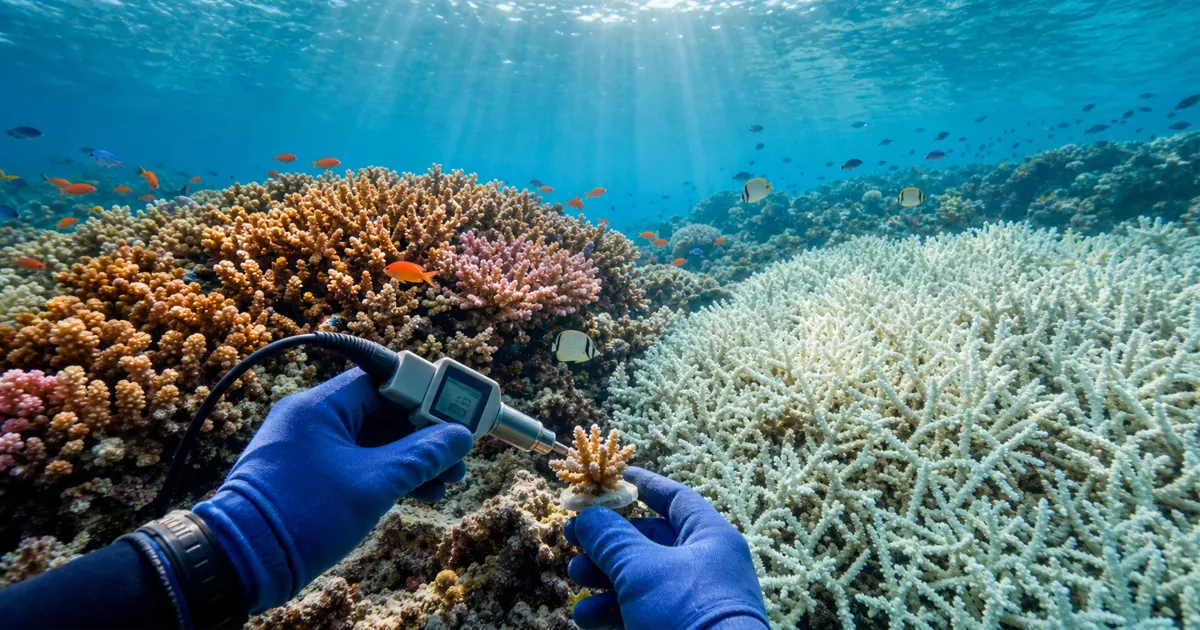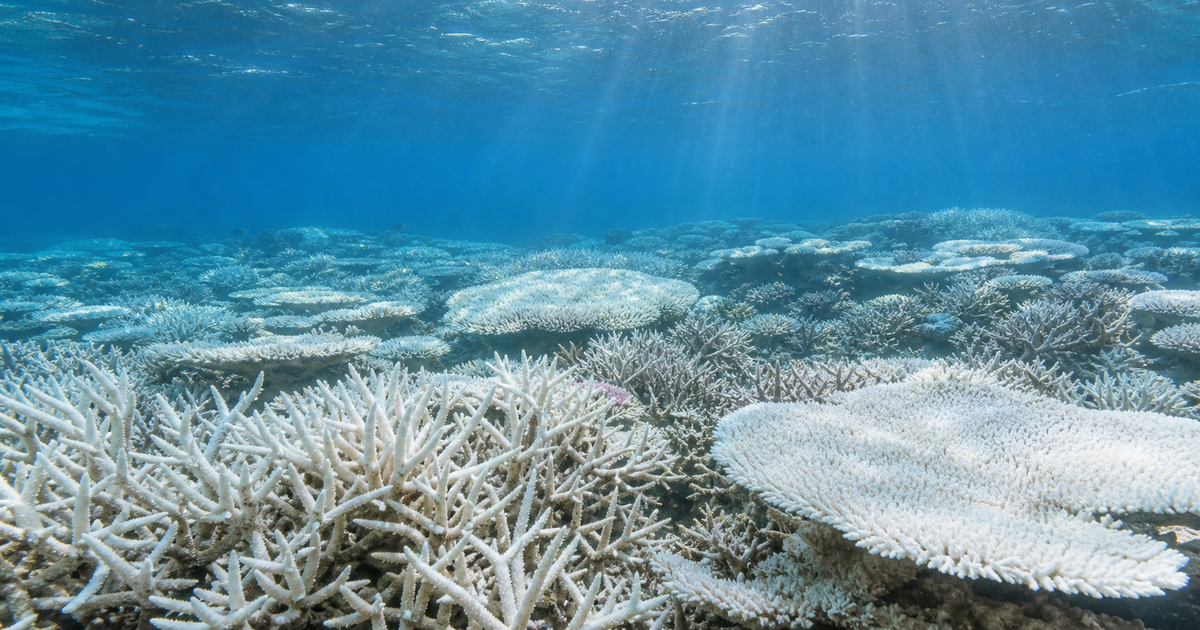
In seas where summer water temperatures stay high, once-colorful corals can turn stark white almost overnight. That sight is often taken to mean "the coral has died," but corals that have just bleached are still alive. Bleaching means a coral has lost the tiny algae living inside its tissue — zooxanthellae — and been cut off from most of its food supply. It is a state of starvation. What happens next determines whether the coral survives or dies.
Corals are animals, yet they rely on the photosynthesis of algae living inside them for most of their energy — a rare way of life even among living things. That is exactly why a rise of just 1-2°C in water temperature can shatter this delicate symbiosis. This article explains, using primary sources from Japan's Ministry of the Environment, NOAA (the U.S. National Oceanic and Atmospheric Administration), and the IPCC (Intergovernmental Panel on Climate Change), what molecular trigger sets off bleaching, how much heat corals can actually withstand, and where the line lies between recovery and death.
Bleaching is no longer a once-in-a-few-years anomaly — it is fast becoming a recurring, global-scale event. Between 2023 and 2025, 84% of the world's coral reefs were exposed to heat stress severe enough to cause bleaching. Why has this accelerated so much? Let's work through the background, and what is actually happening on Japan's own coral reefs.
What you'll learn in this article
- Bleaching is not "death" — it is a state of starvation caused by the loss of the coral's internal algae and its food supply
- The molecular mechanism by which high water temperature breaks down algal photosynthesis, and how reactive oxygen species (ROS) destroy the symbiosis
- DHW (Degree Heating Weeks), the index that measures how much heat a coral can withstand, and the threshold that separates bleaching from death
- The conditions that let bleached coral regain its color and recover, versus the conditions that lead straight to death
- Actual data showing how bleaching became a worldwide, recurring event between 1998 and 2024
- What Okinawa's Sekisei Lagoon monitoring has recorded about the reality facing Japan's own coral reefs
Coral and Zooxanthellae — the Strange Symbiosis of an Animal That Lives on Light
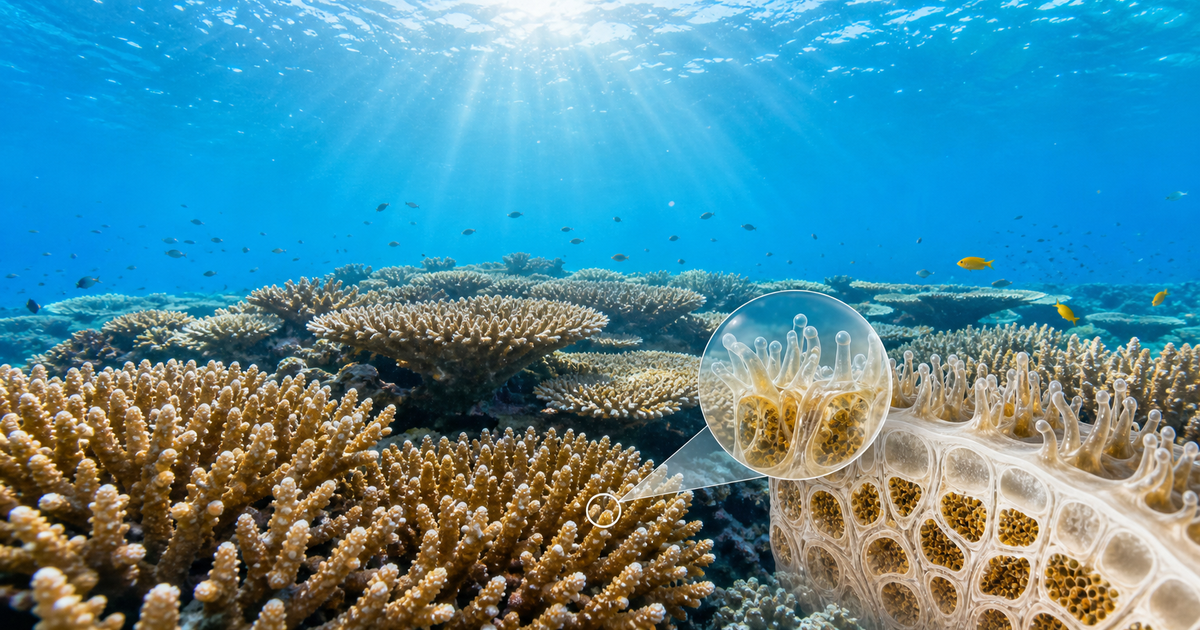
To understand the mechanism of bleaching, we first need to establish what coral actually is. Coral is a cnidarian, related to sea anemones and jellyfish, made up of countless tiny individuals called polyps, each just a few millimeters across, that form a single colony. Polyps secrete a calcium carbonate skeleton, and the slow, steady accumulation of that skeleton over long stretches of time is what builds the massive landforms we know as coral reefs.
The living part of the coral is a thin, transparent layer of tissue covering the surface of the skeleton. The vivid colors we associate with coral are not the coral's own color at all — they come from the pigments of the zooxanthellae (scientifically, dinoflagellates of the family Symbiodiniaceae) living inside that tissue. In other words, when a healthy coral looks brown, green, or yellow, that is direct evidence that it is densely packed with zooxanthellae.
Photosynthesis as a "food allowance" from within
Zooxanthellae receive a safe home inside the coral's tissue, along with the carbon dioxide, nitrogen, and other materials they need for photosynthesis. In return, they use sunlight to photosynthesize sugars and other organic compounds, and pass most of that production on to the coral. The coral relies on this "allowance" as its primary source of nutrition, and the share can be as high as roughly 90%. Direct predation — catching plankton with its tentacles — is little more than a supplementary source of food.
Key points of the symbiosis
- The coral animal itself is a cnidarian; its vivid color comes from pigments in the zooxanthellae it hosts
- Zooxanthellae pass most of the nutrients they produce through photosynthesis (such as sugars) to the coral
- Coral depends on this photosynthetic output for as much as roughly 90% of its energy
- That is why coral reefs can thrive even in clear, nutrient-poor tropical seas
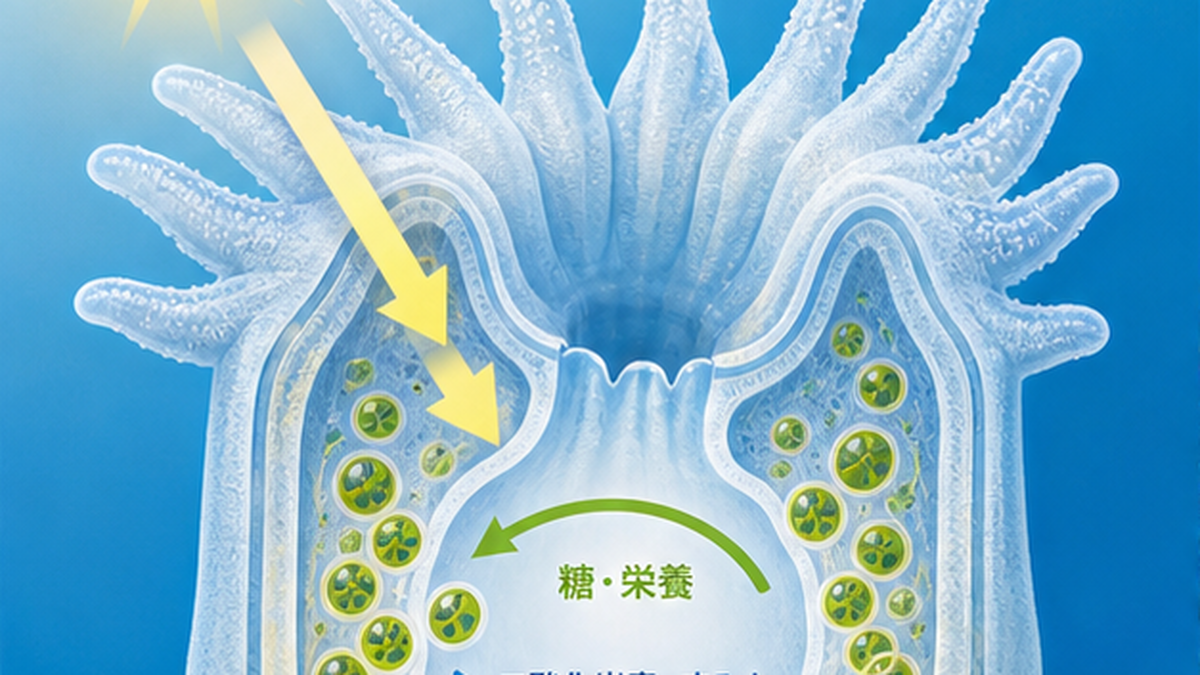
A "rich oasis" floating in a nutrient-poor sea
The clear waters of tropical and subtropical seas are, in fact, a "marine desert" poor in the plankton nutrients that other ecosystems rely on. And yet coral reefs teem with an extraordinary abundance of life, precisely because of this self-sufficient photosynthetic system. Although coral reefs cover less than 1% of the seafloor, they are estimated to provide habitat or spawning grounds for roughly 25% of all marine species. For fish, shellfish, and crustaceans, coral reefs truly are a cradle of life.
This richness is directly tied to human livelihoods as well. Estimates from bodies such as the United Nations Environment Programme (UNEP) put the value of the goods and services coral reefs provide — tourism, fisheries, coastal protection, pharmaceutical raw materials — at several hundred billion dollars a year, with some estimates reaching roughly $2.7 trillion annually. The health of coral reefs is tied not only to ecosystems but to coastal economies and food security. For more on how rising sea temperatures affect fisheries, see our article on how warming affects fisheries.
Coral reefs take tens of thousands of years to build
The large coral reef landforms we see today were not built overnight. Reef-building corals secrete a calcium carbonate skeleton, generation after generation, with each new generation growing on top of the skeletons left by the last — a process that has continued for thousands, in some places tens of thousands, of years to produce the reefs that exist today. Even fast-growing branching corals may add only a few centimeters a year, while massive (boulder-shaped) corals can grow less than a centimeter annually. In other words, once a coral reef is lost, recovering it takes an almost unimaginable amount of time. That is precisely why mass mortality from bleaching is described as an "irreversible loss" — because of this vast timescale.
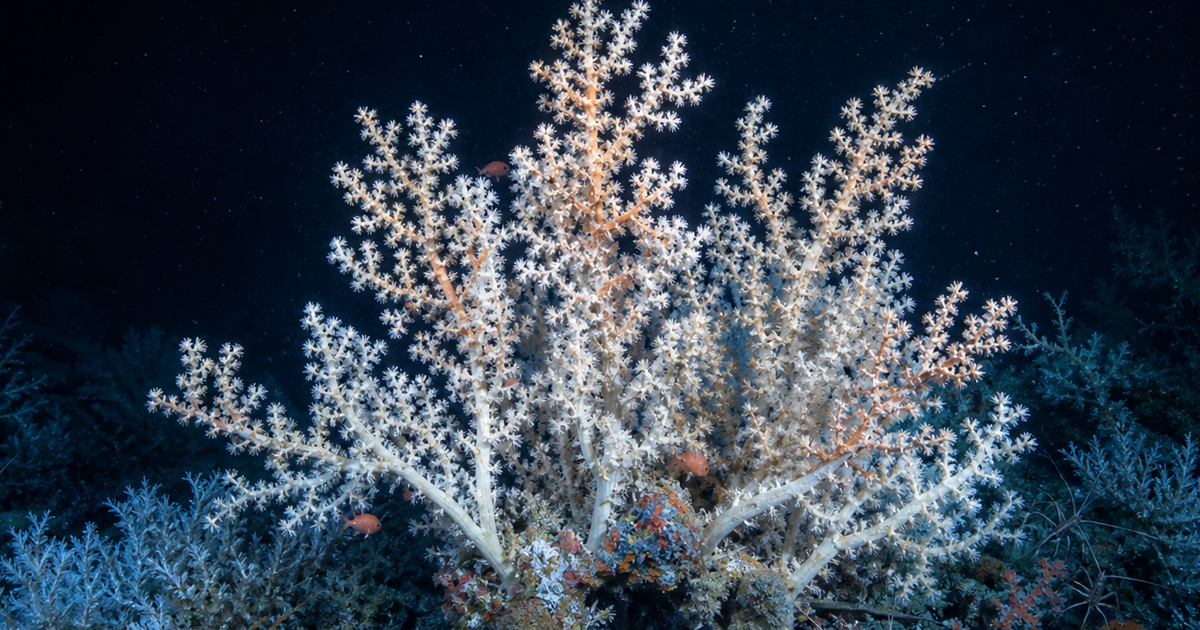
It is also worth noting that not all corals host zooxanthellae. "Non-reef-building corals" that lack zooxanthellae do not depend on photosynthesis and can survive even in places without light, such as the deep sea. Bleaching is a problem specifically for reef-building corals, which construct reefs through symbiosis with zooxanthellae. Precisely because they built vast ecosystems in shallow, warm seas by relying on light, they carry the fate of being vulnerable to the very heat that comes with that light.
Yet this elaborate symbiosis has a weakness. The photosynthesis of zooxanthellae is highly sensitive to temperature, and the comfortable range is remarkably narrow. For most reef-building corals, the optimal water temperature is roughly 25-29°C. Even a sustained high temperature only slightly above that upper limit is enough to throw off the gears of the symbiosis that has been sustaining the coral's nutrition. In the next section, we look at what "losing color" — bleaching — actually means inside the coral's body.
What Bleaching Actually Is — Losing Color Is the Start of Starvation, Not Death
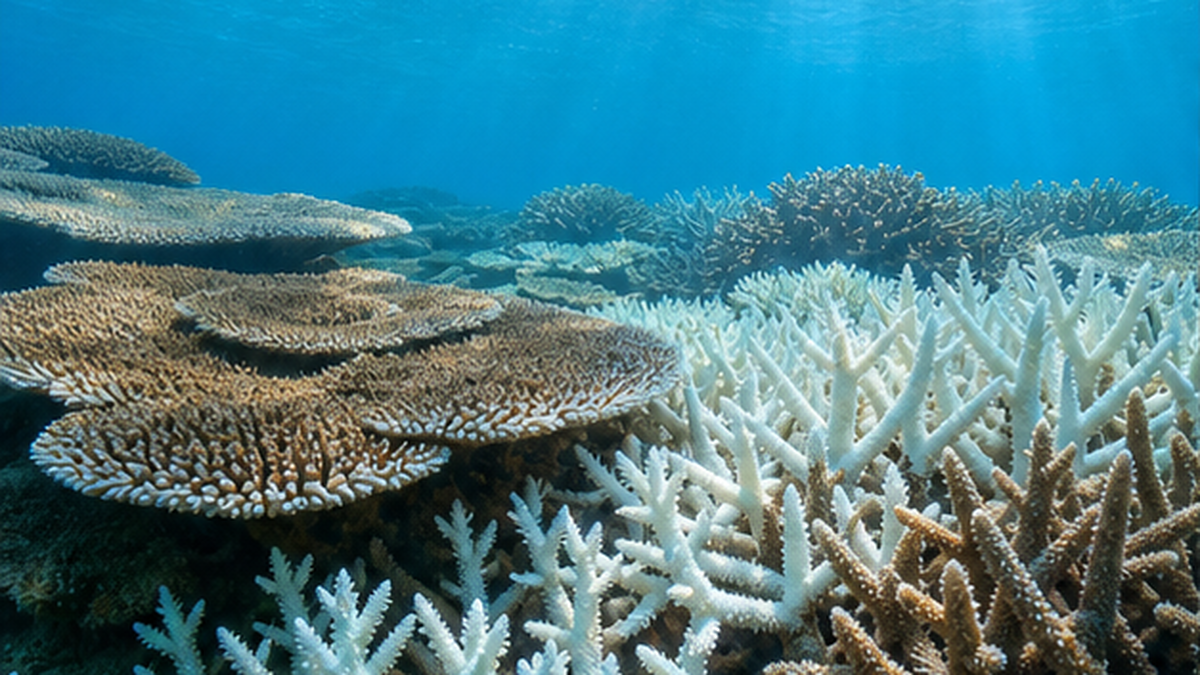
Bleaching is the phenomenon in which a stressed coral loses its zooxanthellae, or the pigments those algae carry fade, causing the white calcium carbonate skeleton beneath the transparent tissue to show through. The coral has not been "painted white" — it's easier to understand as the coral's naturally white skeleton simply becoming visible once the zooxanthellae that carried its color are gone.
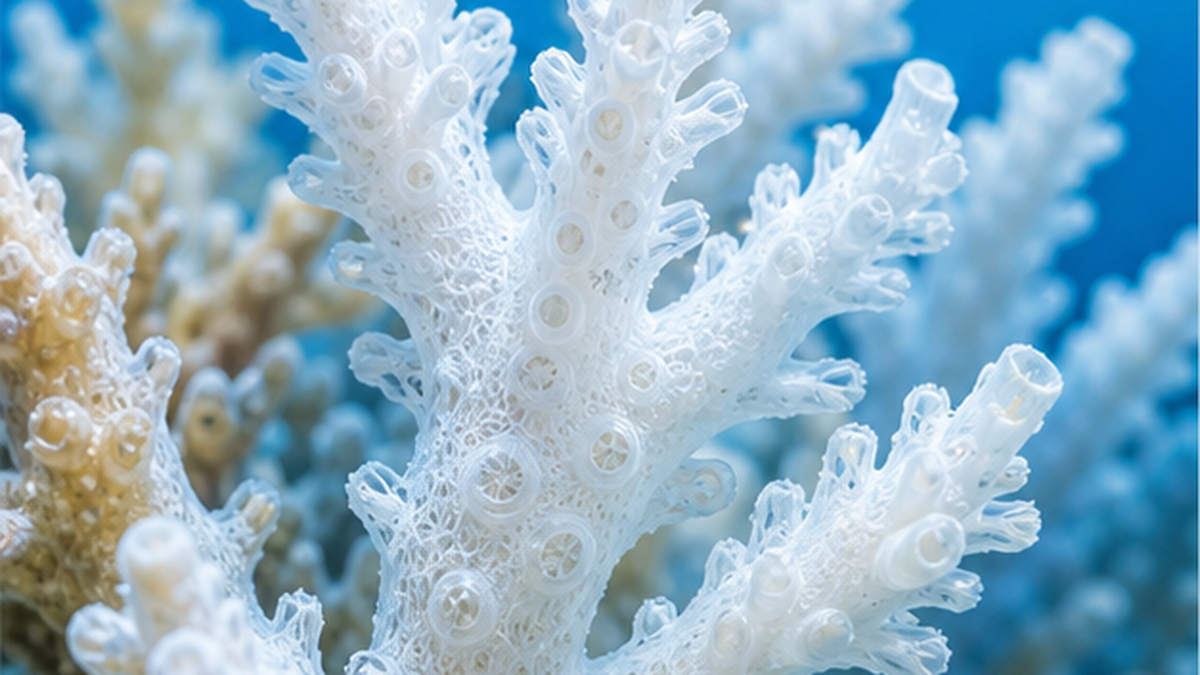
A coral that has just bleached is still alive
This is the point most often misunderstood. When we see coral that has turned completely white, it's natural to assume it has died. But a coral that has just bleached is, in most cases, still alive. What it has lost is its color, and the nutrient factory — the zooxanthellae — that produced that color. In other words, bleaching itself is not "death" — it is the start of a state of starvation after the coral's primary energy supply has been cut off.
A coral that has lost its zooxanthellae can no longer receive the nutrient allowance from photosynthesis. Even so, the coral can hold on for a while by catching plankton with its tentacles or drawing down stored lipids in its tissue. According to explanations from Japan's Ministry of the Environment, a coral can generally survive for roughly two to three weeks in a bleached state, provided the zooxanthellae return during that window. Put another way, if water temperature does not drop within that grace period, starvation progresses and the coral truly dies.
Bleaching does not equal death
Bleaching is a "state of starvation after losing color" — it does not mean the coral is dead at that moment. If water temperature drops within a few weeks and zooxanthellae return, the coral can recover; but if high temperatures persist, it will run out of nutrients and die. Bleaching is, in effect, a warning signal the coral sends out that it is nearing its limit.
What does a dead coral actually look like?
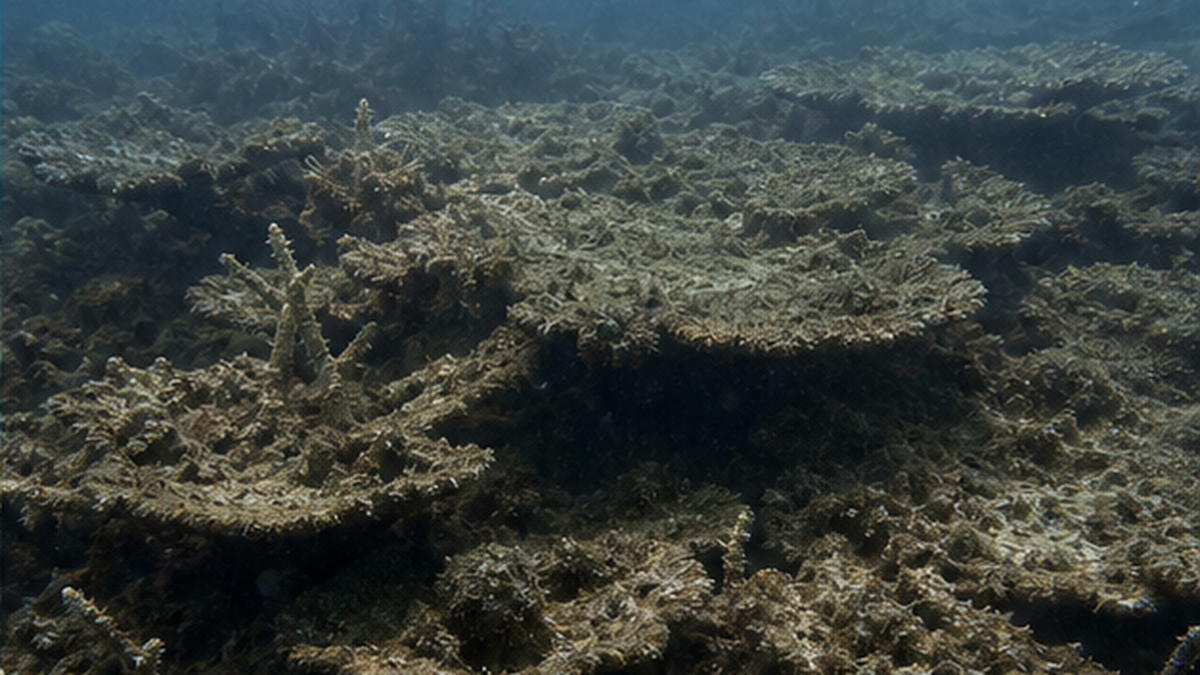
With a bit of practice, you can tell the difference between a coral that has just bleached and one that died some time ago. A freshly bleached coral has a bright, clean white skeleton, with the polyp structure still clearly visible. A coral that has died and lost its tissue, on the other hand, becomes overgrown with turf algae, dulling its surface to brown or green, and gradually becomes covered in a slimy film. This "browned coral" is precisely the appearance of death after the chance to recover has been missed.
- Healthy coral: brown, green, yellow, and so on. Rich in internal zooxanthellae
- Bleached coral: clean white. In a state of starvation after losing its zooxanthellae, but still alive
- Pale coral: zooxanthellae have declined and color has faded, a stage that precedes full bleaching
- Dead coral: overgrown with turf algae, dulled to brown or green. Tissue has been lost
Healthy coral hosts an enormous number of zooxanthellae
A single square centimeter of healthy coral tissue is said to host roughly several million zooxanthellae. The higher this density, the more deeply colored the coral appears, and the more abundant the nutrients it gains from photosynthesis. Bleaching is a state in which this density has dropped dramatically. Research suggests that a coral only appears "bleached" once the number of zooxanthellae has fallen to less than a tenth of the original level — meaning that by the time a coral looks visibly white, most of its nutrient factory has already been lost. Conversely, at the earlier "pale" stage, when color has only started to fade, the damage is shallower and there is greater room for recovery.
Bleaching does not necessarily occur uniformly across an entire colony. Even within the same reef, the degree of bleaching varies by species, sun exposure, and depth. In general, fast-growing branching and table corals tend to be more vulnerable to high temperatures and bleach first, while massive (boulder-shaped) corals tend to be relatively more resistant. This difference in resilience between species is a crucial factor that shapes both recovery from bleaching and the fate of an entire reef, and we will return to it in more detail later. So why does high water temperature break down the symbiosis in the first place? The next section examines that trigger.
Why High Water Temperature Breaks the Symbiosis — the Reactive-Oxygen Trigger
The single biggest direct trigger for bleaching is a rise in sea water temperature. But this isn't simply a matter of "melting from the heat." The key lies in a molecular-level phenomenon in which the photosynthesis carried out by zooxanthellae itself runs out of control under high temperature. Understanding this mechanism also explains why intense sunlight makes bleaching worse, and why the arrival of a typhoon can sometimes ease bleaching.
Stage one: photoinhibition of photosynthesis
Like plants, zooxanthellae absorb light energy to build sugars from carbon dioxide. But when water temperature rises above the optimal range, the apparatus that performs photosynthesis (the photosynthetic system) stops working properly, and it can no longer channel all the absorbed light energy into making sugar. This condition is called photoinhibition. Under intense sunlight in particular, the excess light energy that has nowhere to go begins to accumulate inside the cell.
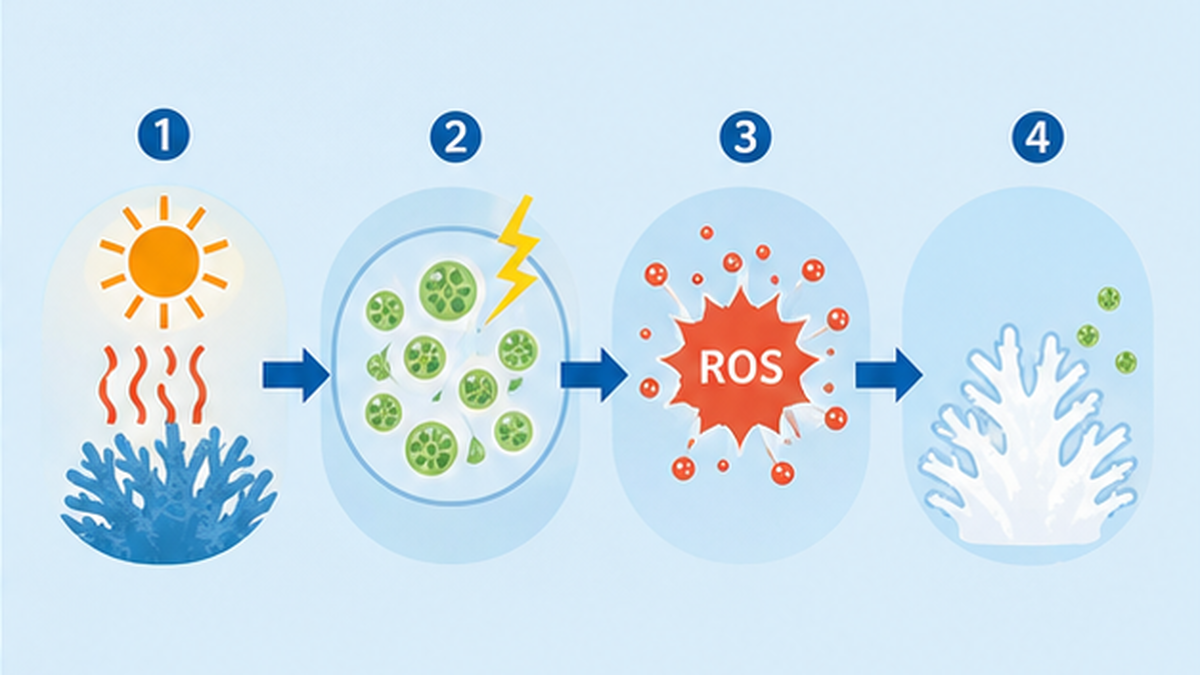
Stage two: reactive oxygen species (ROS) run wild
Light energy that can no longer be processed generates large quantities of reactive oxygen species (ROS — highly reactive oxygen compounds). ROS are cellular poisons that damage DNA, proteins, and cell membranes. As water temperature rises, the amount of ROS generated grows steadily relative to the nutrients produced by photosynthesis, and beyond a certain temperature, ROS is produced in quantities the coral's defenses can no longer neutralize. Research from institutions such as the University of Tokyo and Kobe University positions this excess generation of reactive oxygen species as the central trigger for the collapse of the symbiosis.
Why does high temperature break down the photosynthetic apparatus in the first place? The key is that "repair can no longer keep pace." The photosynthetic apparatus is constantly being damaged, bit by bit, whenever it is exposed to light, and the cell normally keeps functioning by continuously repairing that damage. But at high water temperature, this repair process is impaired, even as the damage keeps accumulating. The result is that damaged apparatus piles up and photosynthesis can no longer run normally — this is the true nature of photoinhibition. Because strong sunlight accelerates this damage, bleaching progresses rapidly when high water temperature and intense light occur together.
Stage three: expulsion of the zooxanthellae — bleaching
The coral attempts to expel the zooxanthellae that have become a source of poisonous reactive oxygen species. Research from Hiroshima University has revealed the mechanism by which coral, under high-temperature stress, actively digests and expels damaged zooxanthellae. To prevent damage from spreading by holding onto compromised zooxanthellae, the coral deliberately gives up its nutrient source. The result of the zooxanthellae leaving the tissue in this way is what we see as bleaching. Ironically, bleaching also carries an element of a defensive response by which the coral is trying to survive.
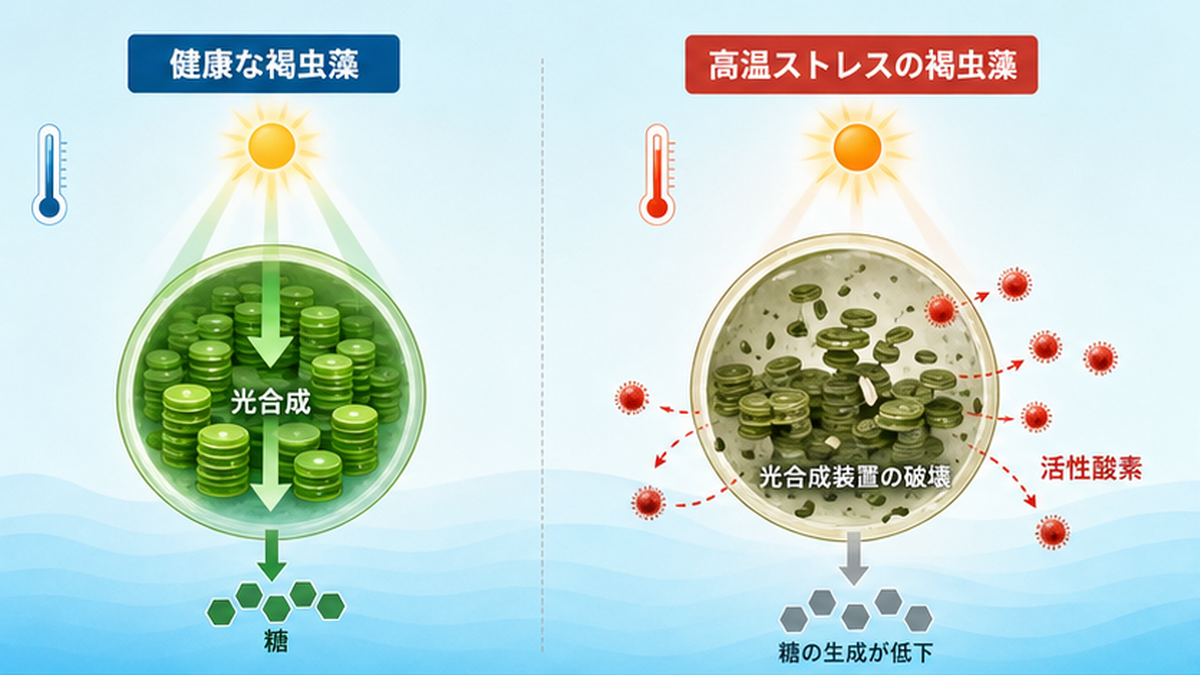
Where does the water-temperature "threshold" lie?
Most reef-building corals live comfortably at water temperatures of roughly 25-29°C. Bleaching risk rises sharply once temperatures stay "roughly 1°C" above the region's average summertime maximum (the maximum monthly mean temperature). On Japan's coral reefs, a useful rule of thumb is that sustained water temperatures above roughly 30°C put coral into the danger zone. That said, exceeding 30°C does not guarantee death — species, depth, sunlight, and water flow are all factors that come into play.
Light, currents, turbidity — factors beyond water temperature
High water temperature is the primary cause of bleaching, but the factors that intensify or ease it also matter. Strong ultraviolet light and sunlight promote the generation of reactive oxygen species and worsen bleaching. Conversely, the wave action and mixing of seawater brought on by a typhoon can lower water temperature and reduce sunlight exposure, sometimes slowing the progress of bleaching. The Nature Conservation Society of Japan has pointed out that bleaching tends to become more severe in summers when no typhoons arrive. Turbidity from red-soil runoff and pollution from domestic wastewater also weaken coral and make it more prone to bleaching. For more on the mechanisms of sea water temperature variation and ocean currents themselves, see our article on the relationship between sea temperature and ocean currents.
High water temperature is not the only cause of bleaching, either. Low water temperature, excessively strong light, extreme low salinity (from heavy rainfall), and even, according to recent research from Kobe University, "hunger" (nutrient deficiency) can also trigger bleaching. That said, the overwhelming driver behind the large-scale bleaching now occurring simultaneously around the world is the rise in sea water temperature caused by global warming. So how much heat can coral actually withstand? Next, we look at the index that measures this objectively.
How Much Heat Can Coral Take? — Measuring the "Heat Tally" with DHW, and the Line Toward Death
Coral bleaching is not determined by "that day's water temperature" alone. What matters is the cumulative tally — how many degrees of heat, sustained for how long. Just as humans lose stamina as summer heat wears on, even a modest amount of heat can become serious damage if it persists long enough. The index that quantifies this "accumulation of heat" is DHW (Degree Heating Weeks), provided by NOAA's (the U.S. National Oceanic and Atmospheric Administration's) Coral Reef Watch program.
What DHW actually measures
DHW sums up the heat stress from days on which water temperature exceeded the region's average summertime maximum (the maximum monthly mean, or MMM) by "1°C or more," over a rolling 12-week window. Its unit is "°C-weeks." As a rough guide, a week of temperatures 1°C above the MMM adds 1 to DHW, a week 2°C above adds 2, and so on, accumulating over time. In other words, the higher the DHW value, the more the coral has been exposed to either "intense heat," "prolonged heat," or both.
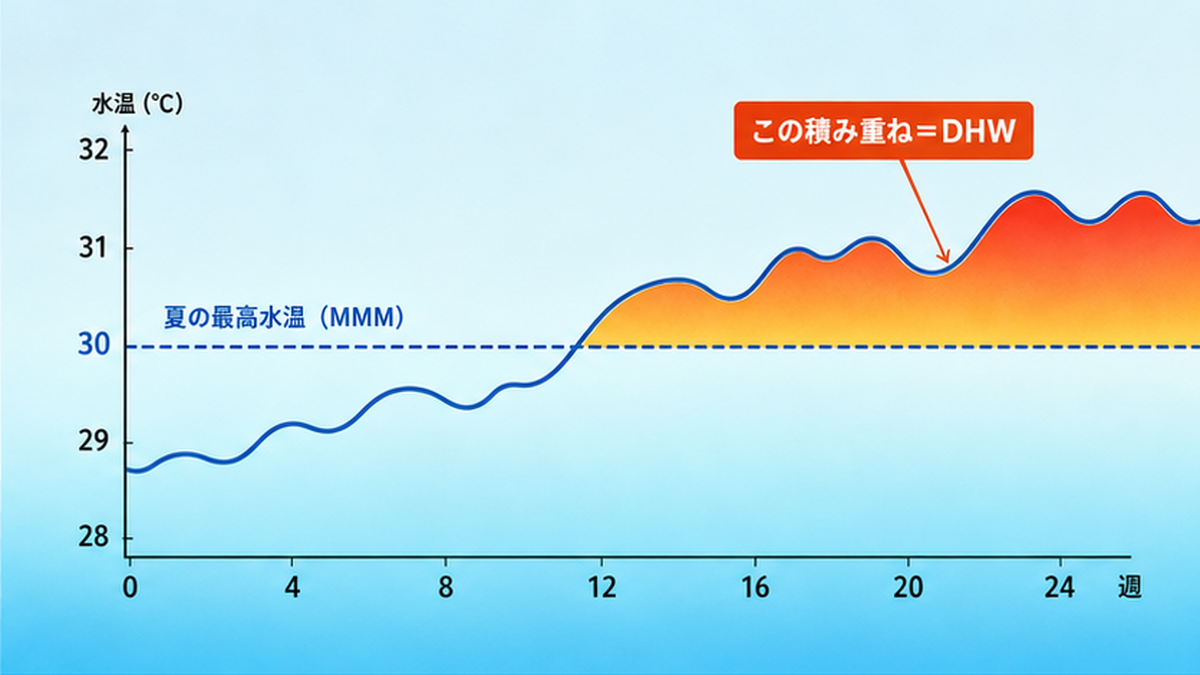
The DHW thresholds that separate bleaching from death
NOAA sets out the expected level of damage corresponding to different DHW values. As the number rises, the outcome progresses from bleaching to eventual, irreversible mass mortality. The following is, in effect, a "thermometer" showing how much heat coral can withstand.
| DHW (°C-weeks) | Expected impact | Coral condition |
|---|---|---|
| 4 or above | Significant bleaching begins | Bleaching centered on the most sensitive species |
| 8 or above | Reef-wide bleaching plus some mortality | Heat-sensitive species begin to die |
| 12 or above | Mortality across multiple species becomes likely | Reef-wide damage intensifies |
| 16 or above | Severe multi-species mortality (over 50%) | More than half the coral has died |
| 20 or above | Near-total mortality (over 80%) | The reef is nearly wiped out |
The line falls between "4" and "8"
Once DHW reaches 4, bleaching begins, but at this stage most coral is still alive. The real turning point is around 8. If heat stress continues past that point, the outcome shifts from bleaching to actual mortality. In other words, whether coral survives largely depends on whether water temperature drops before DHW reaches 8.
What makes this index so valuable is that it can be calculated automatically every day from satellite sea-surface temperature data, mapping the risk level of coral reefs worldwide in near real time. NOAA issues alert levels based on DHW — "Bleaching Watch," "Bleaching Warning Level 1 and 2" — which conservation staff around the world use to decide on emergency responses. Rather than the numbers standing alone, combining them with on-the-ground visual surveys gives a fuller picture of what is happening with bleaching.
Real-world examples make the weight of this threshold tangible. On Australia's Great Barrier Reef, DHW reached extremely high values in the northern section in 2016, and much of the coral there bleached and then died. In the southern section, where DHW was comparatively lower, the damage was much lighter. Even within a single, enormous reef system, the difference in accumulated heat stress (DHW) sharply divided survival from death. DHW has become an indispensable tool in modern ocean conservation for identifying "where is at risk" in advance and deciding where to direct limited resources.
It's important to note that these DHW thresholds assume a coral of "average sensitivity." In reality, even at the same DHW value, some species survive while others die. Coral on reefs that have previously experienced high temperatures may show greater resilience, while a reef already weakened once can suffer severe damage even at a lower DHW. In the next section, we dig deeper into the specific conditions that separate "recovering coral" from "dying coral."
DHW is also, by design, a measure of "how hot it got" rather than "when it got hot." In recent years, unusually high water temperatures have increasingly arrived in early summer, before the peak of the season, causing DHW to build up earlier than before. If bleaching thresholds are already exceeded before the height of summer even arrives, coral has little remaining capacity to withstand the hot weeks still to come. Only by considering "when and for how long" heat stress persists can we get a full picture of how severe bleaching will be in any given year.
Conditions for Recovery from Bleaching, and Conditions That Lead to Death
Bleaching is not an endpoint — it's a fork in the road. Two corals that turn equally white can end up in very different places months later: one may regain its color and grow healthy again, while another simply crumbles into brown and dies. What separates these two fates? This is the single most important question for thinking about the future of coral.
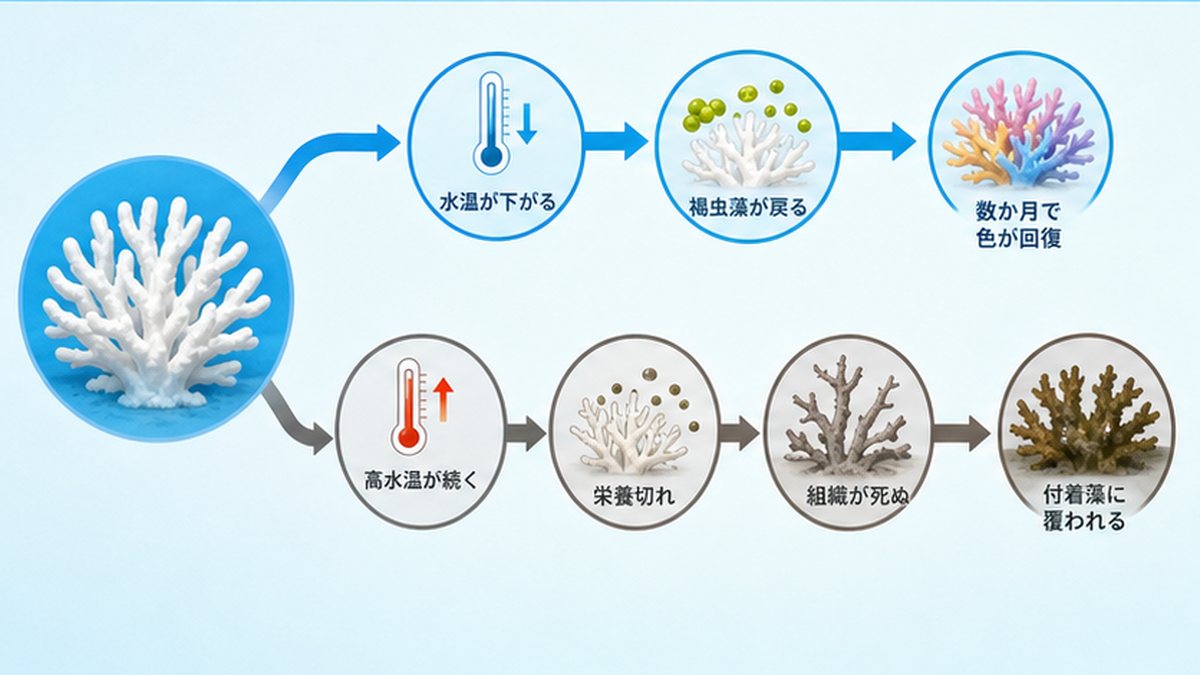
The absolute condition for recovery: heat stress must stop
The single biggest condition for recovery is simply that heat stress ends quickly. Once water temperature drops back into the optimal range, whatever zooxanthellae survived can begin to multiply again, or the coral can take in new zooxanthellae from the surrounding seawater, restoring its internal algal population. According to NOAA, coral can regain its color within a few months if conditions improve. As noted earlier, roughly two to three weeks is one rough limit for how long coral can endure a bleached state — whether water temperature drops within that window determines whether it lives or dies.
Conditions that support recovery
- High water temperature ends quickly and returns to the optimal range (25-29°C)
- Heat stress is mild (subsides before DHW reaches 8)
- Few additional stressors, such as red-soil runoff or wastewater pollution, pile on
- The coral is a resilient, fast-growing species, such as branching or table coral
- Enough time passes between bleaching events for the reef to recover
Conditions leading to death — "long, intense, repeated"
Conversely, if high water temperature persists at length and with intensity, and DHW climbs to 8, then 12, and beyond, coral tissue itself dies of starvation before the zooxanthellae can return. Once tissue has died, turf algae take hold and there is no going back. What makes matters worse is repetition. In recent years, the interval between bleaching events has shortened, so the next high-temperature episode arrives before the reef has fully recovered from the last one, robbing it of the time it needs to bounce back. Slow-growing massive corals can take decades to regenerate once they die, making them essentially irreplaceable under the current pace of recurring bleaching.
Differences in resilience between species, and the possibility of adaptation
Some coral species are more heat-tolerant than others, and some types of zooxanthellae are better able to withstand high temperatures. Research is also exploring the possibility of "adaptation," in which coral that survives a high-temperature event pairs up with more heat-resistant zooxanthellae, becoming somewhat more resilient to the next round of heat. But there are limits to how fast this kind of adaptation can occur, and it is far from certain whether it can keep pace with the current speed of sea water warming. For efforts to rebuild damaged reefs by human hands, see our detailed article on coral reef restoration technology.
What's interesting is that bleaching can sometimes function as a "partial escape strategy." Within the same colony, polyps in shaded areas or at cooler depths may survive, gradually regenerating tissue from those surviving pockets. It is also known that even after losing every last zooxanthella, a colony can rebuild itself by taking in new zooxanthellae drifting in the surrounding seawater or seafloor sediment. Coral is not simply a passive victim — it is fighting for survival by every means available. That is exactly why any reduction we can make in the sources of heat stress helps support that fight for survival.
Even surviving bleaching doesn't leave coral unscathed. Coral that recovers can still be left with lasting after-effects (sub-lethal impacts), such as slower growth or reduced egg production during spawning. In other words, a reef that bleaches repeatedly weakens little by little over time — even without dying outright — losing some of its capacity to sustain future generations. This slow, creeping decline is thinning out coral reefs worldwide over the long term. In the next section, we look at actual data to confirm why bleaching has become so "recurrent" in recent years.
Why Has Bleaching Become "Recurrent"? — the Acceleration from 1998 to 2024
Large-scale bleaching used to be an anomaly that occurred once every few decades. Now, it is becoming an "ordinary disaster" that strikes every few years — and simultaneously, on a global scale. This acceleration is perhaps the clearest evidence that sea water warming driven by climate change has started to routinely push coral past its limits.
Four global-scale bleaching events have occurred
When sea surface temperature rises broadly and coral reefs around the world bleach at the same time, it is called a "Global Coral Bleaching Event." Four such events have been confirmed to date, and the extent of the damage — the share of the world's reefs hit by bleaching-level heat stress — has expanded with each successive event. These events tend to occur in years when El Niño conditions push up sea temperatures, but the underlying force lifting the baseline is long-term global warming.
| Global bleaching event | Period | Share of the world's reefs affected |
|---|---|---|
| 1st | 1998 | Roughly 21% |
| 2nd | 2010 | Roughly 37% |
| 3rd | 2014-2017 | Roughly 68% |
| 4th | 2023-2025 | Roughly 84% (the largest on record) |
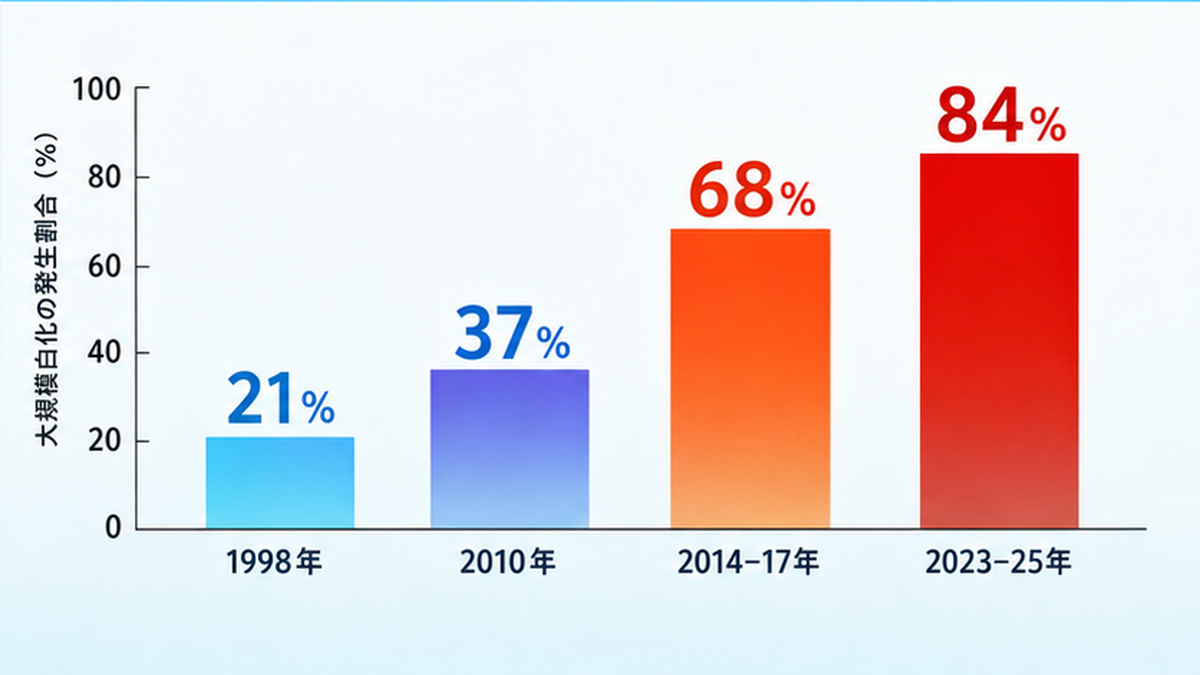
The largest ever — the fourth event (2023-2025)
The fourth event, confirmed by NOAA and ICRI (the International Coral Reef Initiative) in 2024, was the most severe on record. Between January 2023 and March 2025, 84% of the world's coral reefs were exposed to heat stress severe enough to cause bleaching, affecting 82 countries and territories. That figure far exceeds the previous, third event (roughly 68%), and can no longer be called an "exceptional year." At this point, finding a reef that has not bleached has become harder than finding one that has.
Accumulating losses — 14% of the world's coral gone in a decade
Recurring bleaching is steadily thinning out the world's coral reefs. According to the Global Coral Reef Monitoring Network's (GCRMN) report, "Status of Coral Reefs of the World: 2020," roughly 14% of the world's coral was lost over the roughly ten years from 2009 to 2018. That amounts to about 11,700 square kilometers — more than the entirety of living coral currently found in Australia. Its single biggest cause was repeated large-scale bleaching.
The "time to recover" is being stolen away
After the large-scale bleaching of 1998, the world's coral reefs took about ten years to recover to something close to their earlier level. But over the following decade, the intervals between bleaching events became too short, and the next high-temperature episode began arriving before reefs had a chance to fully recover. It is not bleaching alone but the loss of recovery time that is the fundamental problem now driving coral toward the brink.
At the root of this acceleration lies ocean warming itself. The ocean has absorbed more than 90% of the excess heat produced by humanity, and sea surface temperatures keep climbing year after year. Rising sea water temperature overlaps not only with bleaching but with ocean acidification and its impact on coral, which occurs as carbon dioxide dissolves into the sea — compounding the pressure on coral from two directions at once. Acidification weakens a coral's ability to build its skeleton, delivering a further blow to coral already weakened by bleaching. So how is this global-scale crisis showing up in the waters right at our own doorstep?
A particularly pressing issue in recent years is the "marine heatwave." This refers to a phenomenon in which water temperature in a given sea region stays abnormally high for anywhere from several days to several months — essentially a marine version of a heatwave on land. Global warming has increased the frequency, intensity, and duration of marine heatwaves alike, and they are a direct trigger for coral bleaching. Extreme high water temperatures that used to occur once every few decades now strike every few years — and this shift is the true source of bleaching's growing frequency. In terms of DHW, the heat stress that exceeds the bleaching line has been building higher, and for longer, than it used to.
What Is Happening on Japan's Coral Reefs — the Record from Sekisei Lagoon
Bleaching is not a story confined to some distant tropical island. Japan is home to some of the world's most significant coral reefs, and large-scale bleaching and mortality have already become a reality there too. The front line of this is Sekisei Lagoon, Japan's largest coral reef, located in the Yaeyama Islands of Okinawa Prefecture. Spread across the waters between Ishigaki Island and Iriomote Island, this reef has been monitored continuously by Japan's Ministry of the Environment since 2005, making it something of a mirror reflecting the health of Japan's coral reefs.
2016 — 97% bleached, 70% dead
Sekisei Lagoon suffered a decisive blow from the large-scale bleaching event of 2016. That year, record-breaking high water temperatures caused roughly 97% of the surveyed coral to bleach, and roughly 70% of it subsequently died. One of Japan's most iconic coral reefs sustained this level of damage in the course of a single summer. On a global scale, this was part of the third global bleaching event (2014-2017). This figure makes clear that Japan's own waters lie squarely within the reach of global-scale bleaching.
2022 — average bleaching rate of 92.8%
The damage was not a one-time event. In a survey conducted by the Ministry of the Environment in late September 2022, the average bleaching rate across all survey sites reached 92.8%. High water temperature struck the reef again before the wounds of 2016 had fully healed. The Ministry's comparison notes that in 2022, the shares of "healthy" and "pale" coral were somewhat higher than in 2016, suggesting the damage was somewhat contained — but this may simply reflect that the relatively hardier coral that survived the 2016 bleaching remained. It cannot simply be described as "recovered."
What the Sekisei Lagoon record makes clear is the harsh reality now facing coral reefs: bleaching that recurs every few years. Large-scale bleaching struck in both 2016 and 2022, with smaller bleaching events observed repeatedly in between. Because the next summer arrives before the reef has fully recovered from the last blow, its overall coverage — the share of the seafloor occupied by living coral — has been gradually declining. In areas once carpeted with vividly colored coral, dead skeletons and rubble are now an increasingly common sight. This pattern is closely tied to the broader shift seen in the northward spread of coral distribution across Japan, and the appearance of coral in some waters off Honshu — clear signs that the surrounding sea is steadily warming as a whole.
What Sekisei Lagoon's monitoring shows
- 2016: roughly 97% bleached, roughly 70% died (record-breaking high water temperature)
- September 2022: average bleaching rate of 92.8% across all sites
- The Ministry of the Environment has conducted continuous surveys since 2005, with visual surveys strengthened since 2016
- Bleaching recurring every few years is robbing the reef of the time it needs to recover
What monitoring, as a form of watching over, actually means
The reason the Ministry of the Environment continues its survey nearly every year is to record the true state of bleaching accurately, and to track the effects of countermeasures and how the reef is changing over the long term. Because the severity of bleaching varies considerably from year to year, a single year's data alone cannot reveal the full picture. Only through decades of continuous observation does the underlying truth — that coral reefs are gradually weakening — come into view. This steady, patient watching also underpins conservation efforts such as measures against red-soil runoff and coral transplantation and restoration.
What we can each do is, perhaps surprisingly, more connected to this than it seems. Reducing greenhouse gas emissions to curb the rise in sea water temperature itself is the most fundamental countermeasure, but reducing coastal pollution from red soil and domestic wastewater, and expanding marine protected areas that safeguard coral reefs, also raises the odds that coral right in front of us survives. Small actions — not touching coral while traveling, choosing reef-friendly sunscreen — also reduce the additional burden placed on already-weakened coral. The record from Sekisei Lagoon quietly reminds us that bleaching is a problem of the here and now.
Conclusion — Bleaching Is a "Warning Sign of a Limit," and the Line Is in Our Hands
Coral bleaching is not simply a change in color. It is a "warning sign of a limit" — the moment when coral, an animal that chose the unusual path of relying on photosynthesis, loses its lifeline, the zooxanthellae, and stands on the edge of starvation. And the line between recovering from that and dying from it depends on how quickly the high water temperature subsides — in other words, on how much we ourselves can curb the warming of the ocean.
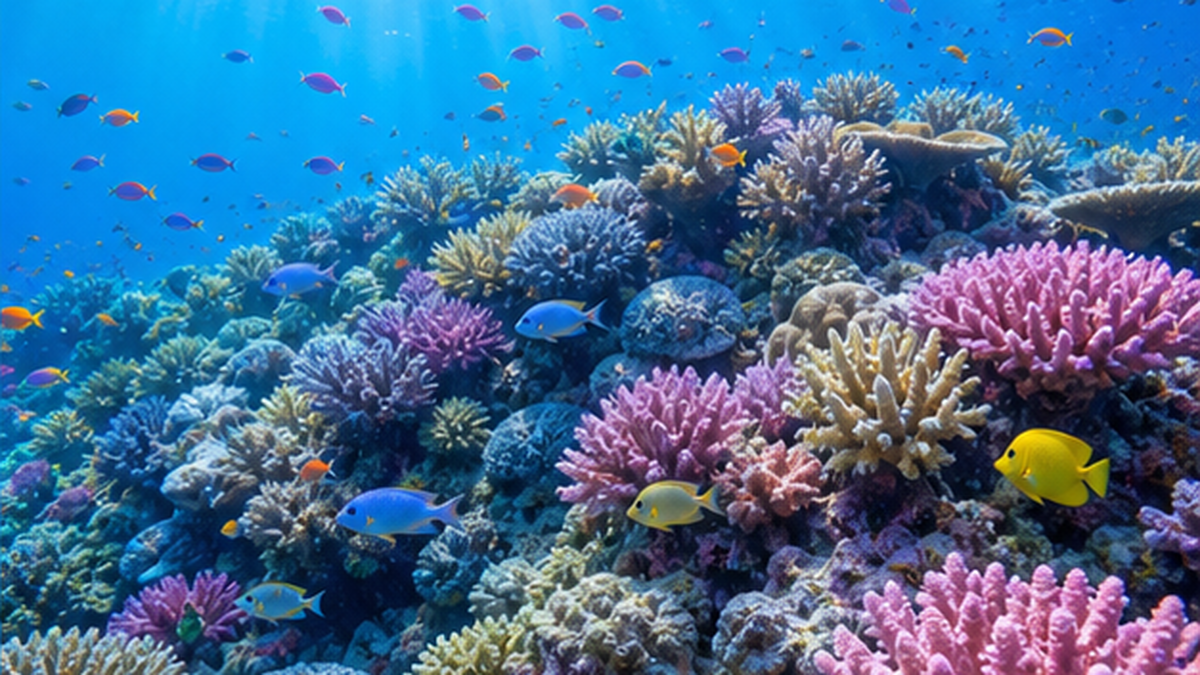
The IPCC's (Intergovernmental Panel on Climate Change) special report also points to a harsh future. Even if the rise in global average temperature is held to 1.5°C above pre-industrial levels, coral reefs are projected to decline by a further 70-90%, and at 2°C, more than 99% would be lost. That gap of just 0.5°C, between 1.5°C and 2°C, is what separates coral reefs "barely surviving" from "essentially disappearing." That is exactly why every single step we take now to reduce emissions matters.
The bleaching mechanism covered in this article is not, in the end, purely difficult science. If you grasp just these three points — "coral lives together with photosynthetic algae," "if the heat continues, that relationship breaks down and the coral loses its color," and "but if it cools down again within a few weeks, the coral can recover" — you can clearly understand both what news reports of bleaching actually mean, and why fighting climate change is directly connected to protecting coral. Bleaching is not a tragedy unfolding in some distant sea — it is a phenomenon directly connected to the greenhouse gases produced by our own daily lives.
Article summary
- Coral depends on the photosynthesis of its internal zooxanthellae for as much as roughly 90% of its nutrition, and its color comes from those same algae
- Bleaching = a state of starvation after losing zooxanthellae to high water temperature. Not death, but a fork toward life or death (a grace period of roughly two to three weeks)
- Mechanism: high water temperature plus strong light inhibit photosynthesis, generating excess reactive oxygen species → the coral expels its zooxanthellae
- The limit of endurance can be measured with DHW. Bleaching begins at 4, mortality starts around 8, near-total mortality occurs around 20
- The key to recovery is heat stress ending quickly. If it is long, intense, and repeated, the outcome shifts toward death
- Bleaching has become more frequent. The world's affected area expanded from 21% in 1998 to 84% in 2023-25. 14% of the world's coral was lost in a decade
- In Japan too, Sekisei Lagoon saw 97% bleaching and 70% mortality in 2016, and a 92.8% bleaching rate in 2022
- At 1.5°C, coral reefs decline by 70-90%; at 2°C, more than 99% is lost. Where that line falls depends on climate action
Coral reefs occupy less than 1% of the ocean's surface area, yet support a quarter of all marine life — a true "cradle of the sea." Protecting that is the same as protecting the food and livelihoods of fish, shellfish, and the people who depend on them. Understanding the mechanism of bleaching correctly is not meant to be a cause for despair, but a way to see clearly what we need to do to stay on the right side of that line. Umi Lab will continue to bring you the latest science and conservation efforts around coral, backed by reliable data.
References and sources
- Ministry of the Environment, Okinawa Regional Environment Office – Iriomote-Ishigaki National Park, Sekisei Lagoon coral bleaching survey results (monitoring)
- Ministry of the Environment, press release – On the survey results of coral bleaching at Sekisei Lagoon
- NOAA Coral Reef Watch – Degree Heating Weeks (DHW) 5km product methodology and bleaching thresholds
- ICRI (International Coral Reef Initiative) – 84% of the world's coral reefs impacted in the Fourth Global Coral Bleaching Event
- IPCC – Special Report on Global Warming of 1.5°C (SR15), Summary for Policymakers
- GCRMN / UNEP – Status of Coral Reefs of the World: 2020 (14% loss of the world's coral reefs)
- Hiroshima University – Elucidating the mechanism of symbiont expulsion that leads to coral bleaching
- Nature Conservation Society of Japan (NACS-J) – The mechanism of coral "bleaching" and its relationship with typhoons
- Fisheries Agency of Japan – The functions and current state of coral reefs
* Listed in order of reliability: government and academic institutions > peer-reviewed papers > specialized organizations > reputable media