⚡ The answer in 30 seconds
- Non-standard vegetables and unused fish are excluded from distribution not because of taste or safety, but because of size, appearance and market grading rules
- Japan's food loss totaled an estimated 4.64 million tons in fiscal 2023, split almost evenly between households and businesses
- Direct-to-consumer platforms and subscriptions such as Tabechoku, Poke-m, Kuradashi and Fishlle! are opening new routes to market for these foods
- Using unused fish supports both fishers' incomes and the efficient use of limited marine resources
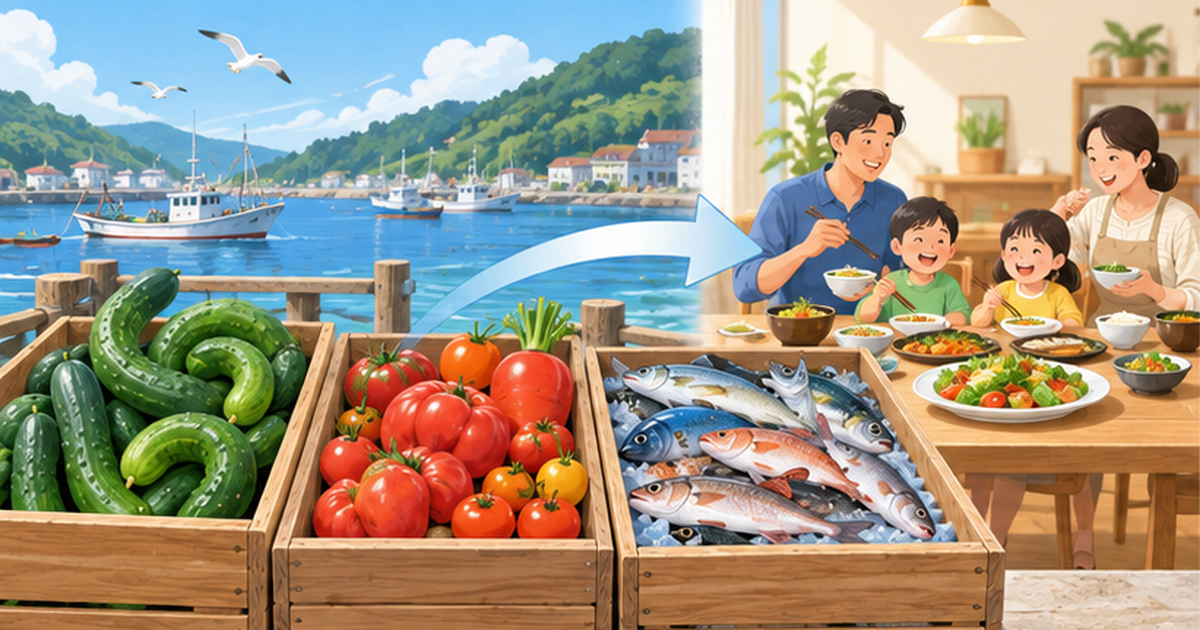
The vegetables and fish on a supermarket shelf are only a small fraction of what was actually grown in the field or landed at the port. Curved cucumbers, undersized potatoes, blemished tomatoes, and fish with no household name — even when there's nothing wrong with their taste or freshness, a great deal of produce and seafood disappears before it ever reaches the table, simply because it doesn't match the size, appearance, or grading standards set by the market.
According to estimates from Japan's Ministry of Agriculture, Forestry and Fisheries (MAFF) and the Ministry of the Environment, Japan's food loss in fiscal 2023 totaled roughly 4.64 million tons, split almost evenly between households and the production, distribution, and food-service sectors. A certain share of that is believed to be "non-standard vegetables" and "unused fish" that never even got the chance to appear on a shelf.
This article works through why non-standard vegetables and unused fish arise in the first place, how real services — Tabechoku, Poke-m, Kuradashi, and the unused-fish subscription Fishlle! — are closing the gaps in distribution, what this means for producers and fishers, and how it connects to protecting marine resources, all grounded in public data and primary sources.
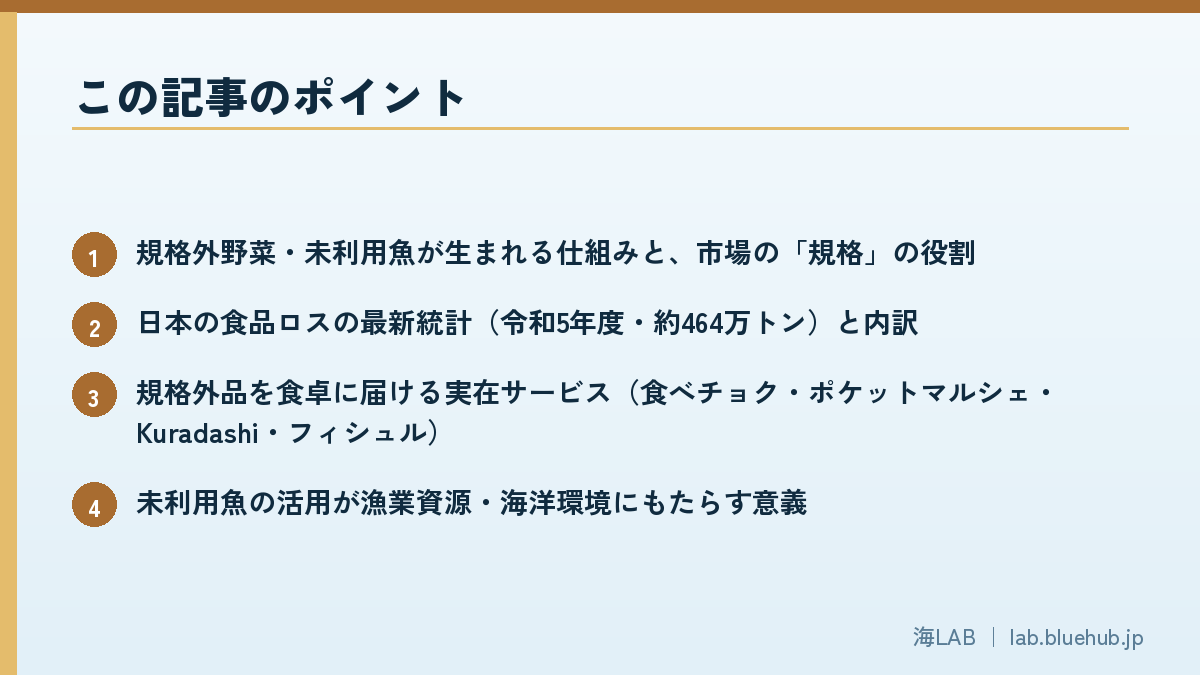
What you'll learn in this article
- Why non-standard vegetables and unused fish arise, and the role of market "grading standards"
- The latest statistics on Japan's food loss (FY2023: ~4.64 million tons) and its breakdown
- Real services that bring non-standard food to the table (Tabechoku, Poke-m, Kuradashi, Fishlle!)
- What using unused fish means for fishery resources and the marine environment
- The business benefits producers and fishers gain from selling non-standard food
- What to keep in mind when choosing non-standard produce at home
What Are Non-Standard Vegetables and Unused Fish?
The terms "non-standard vegetables" and "unused fish" don't refer to food of inferior quality. Both are umbrella terms for produce and seafood that are perfectly fine to eat and safe, yet rarely make it to market. Let's start by clarifying exactly what these two terms cover.
Defining non-standard vegetables
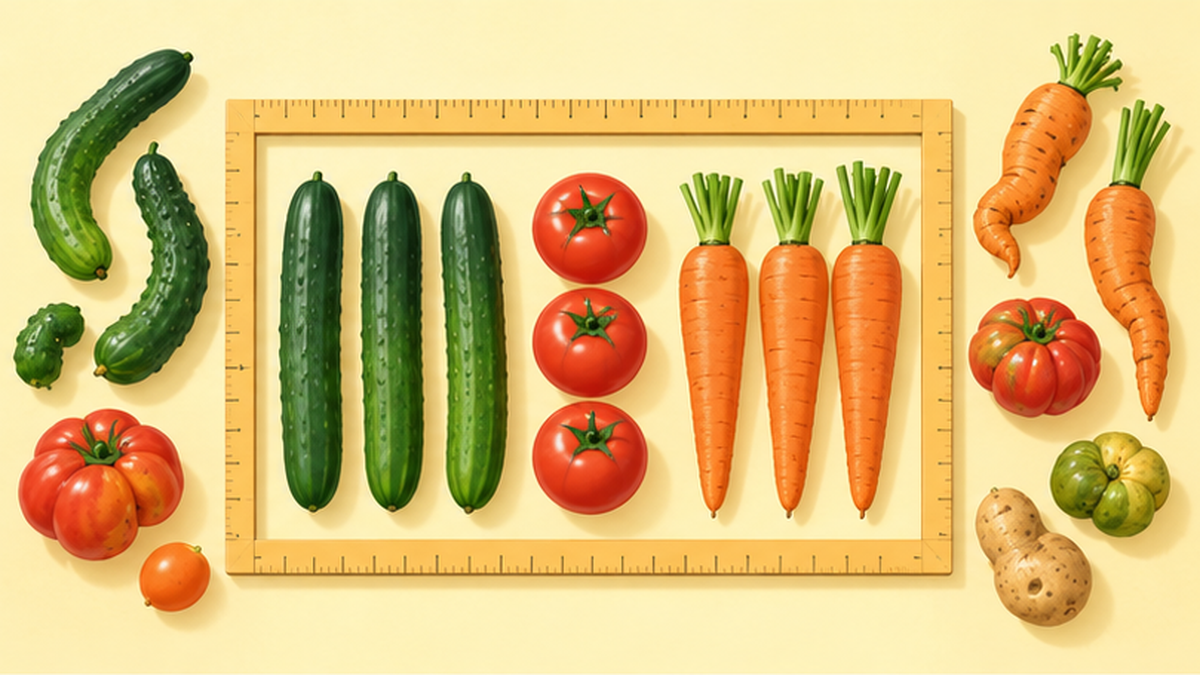
At the shipping stage, vegetables are sorted according to "grading standards" that align their size, weight, shape and color. These standards were built up over many years by agricultural cooperatives and wholesale markets to make boxing, transport, and store display more efficient. Vegetables that fall outside the standard are called "non-standard" or "imperfect," and end up discarded, or redirected to processing, home consumption, or farm-stand sales.
The reasons for non-standard grading vary widely — from simple curvature, to surface blemishes from bad weather, to surplus from an especially good harvest that exceeds the demand for standard-grade produce, to a size just slightly above or below the cutoff at harvest time. In most cases, none of this affects the actual taste or nutritional value.
Defining unused fish
According to the Fish Education and Promotion Center of the Japan Fisheries Association, unused fish is a general term for fish that are "not unused in the sense of never being used at all, but rather fish that taste good and are edible, yet rarely reach the market or are not fully utilized." This includes not just species with low public recognition, such as pufferfish relatives or unfamiliar deep-sea fish, but also ordinary fish that simply fall outside size standards.
It's worth noting that "unused fish" isn't a fixed label for particular species. A fish treated as unused at one fishing port may be a staple of local cuisine in another region. In other words, whether a fish counts as "unused" depends not just on the fish itself, but on local food culture and whether a distribution network for it exists.
Where non-standard food actually ends up
Non-standard vegetables and unused fish don't all follow the same path afterward. Some become raw material for cut vegetables, frozen food, or fish paste products; some are sold as-is at farm stands or roadside stations; some are recycled as feed or compost; and some end up with nowhere to go at all and are discarded. This article focuses mainly on the routes that bring these foods to the table for human consumption — through processing, direct sales, and e-commerce.
Even for the same batch of non-standard vegetables or unused fish, the value ultimately captured depends heavily on which route it takes. Sold fresh to the table, it can retain roughly the same value as standard produce; diverted to feed or compost, its value drops; and if discarded, it becomes zero. That's exactly why finding ways to route as much as possible toward human consumption directly benefits both producers' income and food-loss reduction.
"Non-standard" is not the same as "spoiled"
- Non-standard vegetables and unused fish are, in principle, still perfectly edible
- They're excluded not because of taste, but because of "size, appearance, or a mismatch with market rules"
- This should be kept distinct from the disposal of food that has actually spoiled or decayed
Why They Get Left Out of the Market
Vegetables: grading standards were built for efficiency
In distribution through wholesale markets, boxing vegetables of the same size and shape improves transport efficiency, ease of display, and pricing. This system itself has long been rational for delivering vegetables reliably across the country and preventing wild price swings. But as a result, vegetables that are merely misshapen, or that are surplus to standard-grade demand in a bumper year, become more likely to be excluded from shipment.
This is especially true for leafy vegetables and fruiting vegetables that are sensitive to weather — typhoons, prolonged rain, or extreme heat. The amount of non-standard produce generated in a given year swings widely with weather conditions, and there's an ironic structure at play: in a bumper-harvest year, demand can already be met by standard-grade produce alone, so the share that ends up non-standard tends to rise.
Fish: weight standards and the reality of "no buyer"
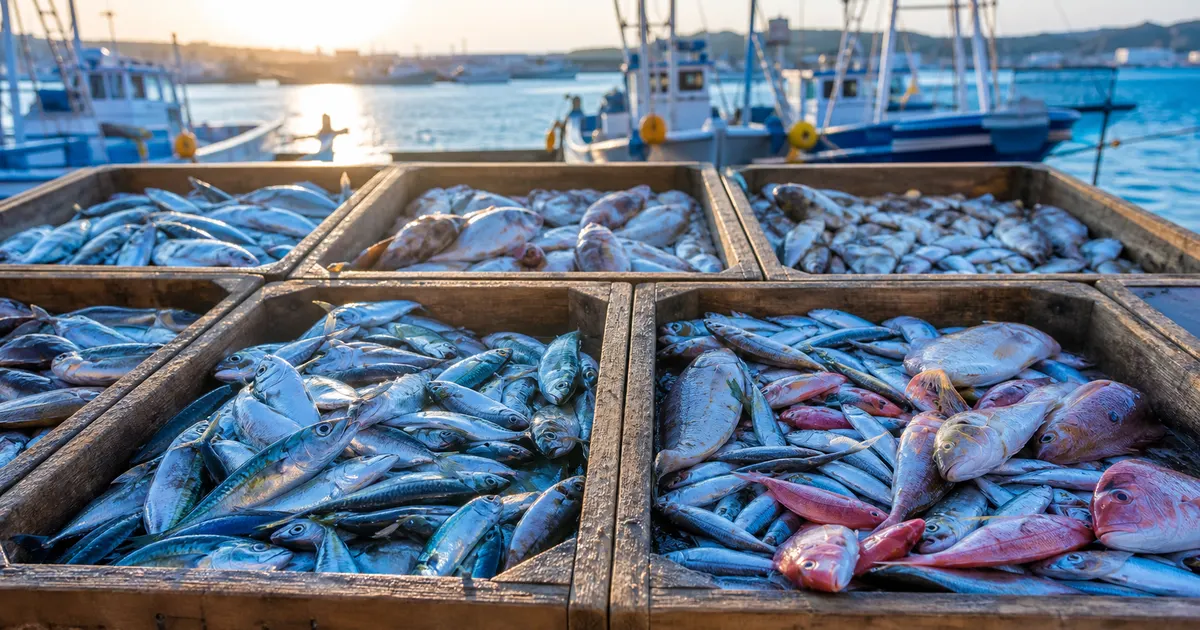
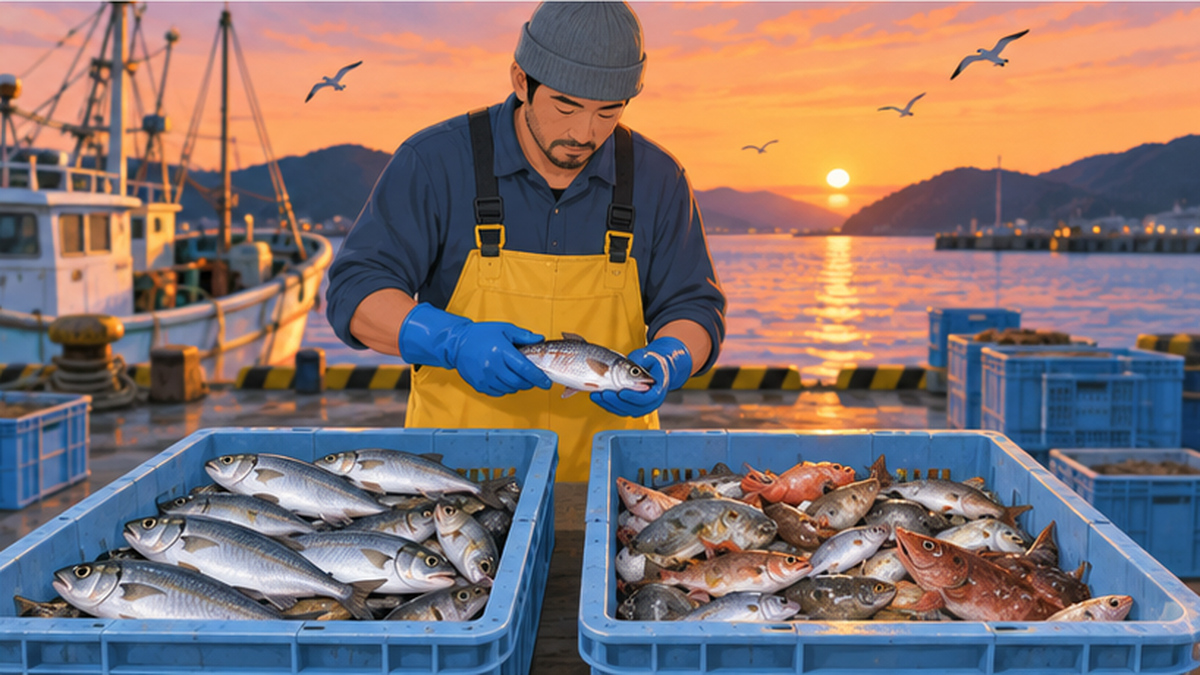
Fish markets at production areas also set size standards — mainly by weight — for efficient trading. Fish that don't meet this bar may not even be put up for auction or bidding. Unattractive-looking fish, or species with low name recognition, also struggle to find buyers; and if no price is offered, the economic incentive for a fisher to land that fish weakens considerably.
Another major factor behind unused fish is "bycatch" — species other than the target catch that get swept up in the net. A single fishing trip can land a wide variety of species, but not all of them have stable demand or a sales channel. The more demand skews toward particular species, the more likely the rest are to be treated as unused fish even after being landed.
A shortage of hands on board
Another reason unused fish arises is the limited processing capacity on board a fishing vessel. With a limited crew and limited time, priority naturally goes to sorting and icing the highest-value catch, and lower-grade or small-quantity species often can't be processed in time — ending up thrown back into the sea or discarded. This tendency is stronger in regions where the fishing workforce is aging and shrinking.
Loss accumulates at every stage of distribution
Non-standard and unused food isn't a problem that begins and ends at the point of production or landing. Even after passing selection at the production site, it's screened again at each subsequent stage — auctions at the wholesale market, re-sorting by intermediate wholesalers, and display standards at retail stores. There are multiple "grading checkpoints" a single vegetable or fish must pass before reaching the table, and being rejected at any one of them removes it from every route beyond that point. Understanding this multi-stage structure makes clear that making the most of non-standard food requires rethinking distribution as a whole, not just the production stage.
Regional and crop-by-crop differences are large
The rate at which non-standard or unused food arises is far from uniform nationwide — it varies significantly by local climate, the crop being grown, and the characteristics of the fishing ground. Areas that lie in the frequent path of typhoons, for example, tend to see more weather-damage-related non-standard vegetables. Among fisheries, coastal fishing grounds where many species mix together tend to generate more unused fish, while offshore fisheries targeting a single species tend to generate relatively less. Precisely because of these regional differences, what's needed isn't a one-size-fits-all national policy, but sales-channel development tailored to the realities of each production area.
| Factor | Vegetables | Fish (seafood) |
|---|---|---|
| Grading criteria | Size, shape, color | Weight, size |
| Main point of occurrence | Production area / sorting facility | Production-area market after landing / on board |
| Common causes | Weather-driven bumper harvest, irregular shape | Bycatch, low name recognition, labor shortage |
| Typical destination when non-standard | Processing, home use, farm stand, disposal | Home use, feed, disposal |
What they share: sitting outside "economic rationality"
- When something doesn't meet grading standards, the transaction costs of the market (sorting, pricing, transport) stop paying off
- As a result, producers and fishers themselves often forgo shipping or landing it
- The shared structure: it's edible, but there's no sales channel
Japan's Food Loss in Numbers
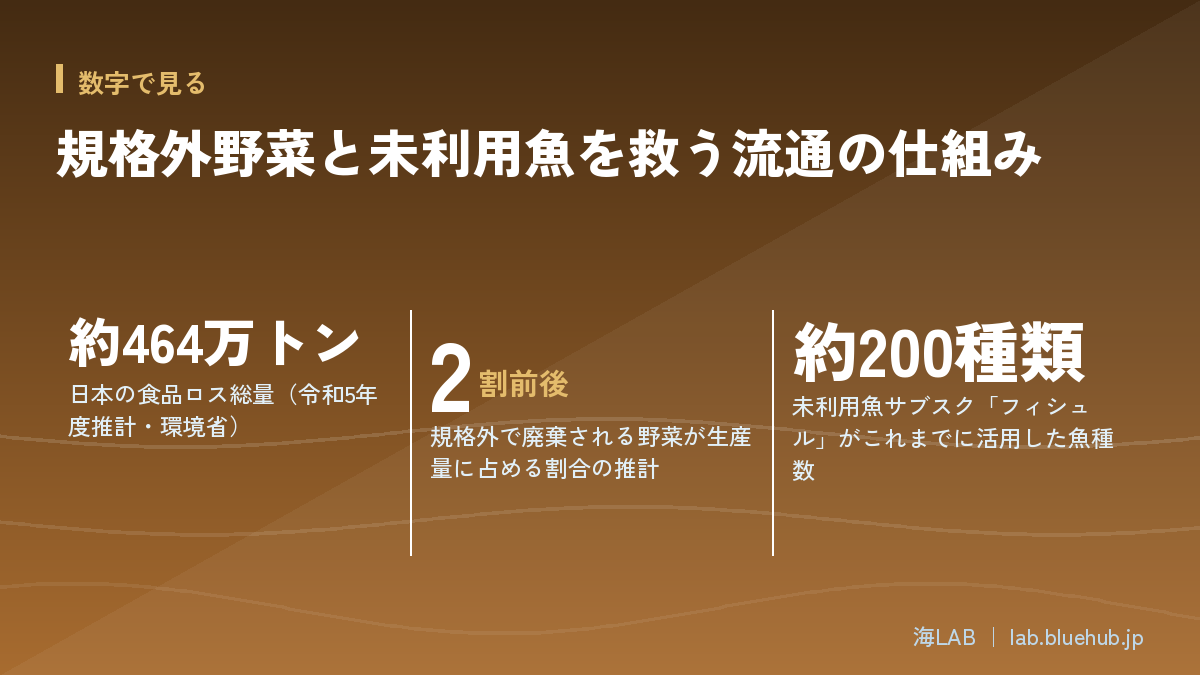
According to the Ministry of the Environment, Japan's food loss in fiscal 2023 is estimated at roughly 4.64 million tons. Of that, "household-sector" loss from homes accounts for about 2.33 million tons, and "business-sector" loss from food-related businesses for about 2.31 million tons — almost an even split. Compared with the previous year, fiscal 2022 (about 4.72 million tons), the total has edged down slightly, and reduction efforts are starting to show up in the numbers.
Business-sector food loss hit its target eight years early
According to MAFF, business-sector food loss had already, as of the fiscal 2022 estimate, achieved the national target of halving it from fiscal 2000 levels by fiscal 2030 — eight years ahead of schedule. This is attributed to improvements made across food manufacturing, wholesale, retail, and food service — better demand forecasting, revised best-before labeling, and so on — with the spread of non-standard-vegetable and unused-fish utilization considered one contributing factor.
Estimating the scale of non-standard vegetables
Estimates based on MAFF data suggest the non-standard-vegetable occurrence rate runs at roughly 20% of production. Not all of it is discarded — much goes to processing, home consumption, or farm-stand sales — but even so, a substantial volume effectively loses its outlet at the shipping stage. The rate varies by crop, region, and that year's weather, so it shouldn't be treated as a single uniform figure.
Consumer attitudes are shifting
In a MAFF survey conducted at supermarkets in Tokyo and Chiba Prefecture, 79% of respondents said they had purchased non-standard vegetables, and that figure rose to 93% when including those who hadn't but said they'd like to in the future. It appears that consumers who value substance over appearance already make up the majority.
This shift in attitude has been reinforced by the Act on Promotion of Food Loss and Waste Reduction, which took effect in October 2019. With a legal framework in place for the national government, local governments, businesses, and consumers to work together on reducing food loss, using non-standard food is no longer just a choice for a niche of environmentally conscious consumers — it has become a challenge positioned for society as a whole.
Disposal carries hidden costs, too
Discarding non-standard vegetables or unused fish is itself not free — it involves disposal fees and the labor of transport and storage. For producers and fishers, that means bearing disposal costs without earning any income in return, so a functioning market for non-standard food benefits them not just in revenue, but on the cost side as well.
Section summary
- Japan's food loss runs to roughly 4.64 million tons a year, split almost evenly between households and businesses
- Business-sector food loss hit its 2030 target eight years ahead of schedule
- An estimated 20% of vegetable production is non-standard, and consumer acceptance is rising
How Non-Standard Vegetables Reach the Table
Tabechoku's dedicated non-standard-produce site
Tabechoku, a direct-to-consumer e-commerce platform that ships seasonal ingredients straight from farmers and fishers nationwide, runs a dedicated site for non-standard produce called "Deliciousness that doesn't care about shape." Because the system delivers directly from producer to consumer without going through a market, items can be shipped quickly after harvest regardless of appearance. Since producers can set their own prices and quantities without being bound by market grading, being non-standard doesn't have to mean zero income.
Visit TabechokuTabechoku's dedicated non-standard-produce site “Deliciousness that doesn't care about shape.”A direct-to-consumer e-commerce site delivering non-standard vegetables, fruit, and seafood from farmers and fishers nationwide🔗 tabechoku.comPoke-m: a direct-sale platform run by farmers and fishers themselves
Poke-m is an online marketplace where only farmers and fishers themselves — not processors or intermediaries — can list products. It carries a large amount of non-standard produce, and because producers set their own prices and quantities, they don't lose out on income simply because something doesn't meet grading standards. Producers writing their own product descriptions and taking their own photos also lets them communicate the story behind non-standard food — such as "the taste doesn't change even in a bad year" — directly to consumers.
Kuradashi: combining discount goods with social contribution
Kuradashi is an e-commerce site that sells discounted food, including non-standard items, at up to 97% off, while also donating a portion of sales to social-contribution organizations — a distinguishing feature of its model. It has spread as a way to achieve food-loss reduction, economic benefit, and social contribution all at once, and its range of products spans well beyond vegetables and fruit to include processed foods.
Visit KuradashiKuradashiAn e-commerce site selling discounted and non-standard food at up to 97% off, donating a share of sales to social-contribution organizations🔗 kuradashi.jpMatchmaking support from local governments
Beyond direct-to-consumer platforms and e-commerce sites, local governments are also stepping up support for utilizing non-standard food. Against the backdrop of the food-loss reduction law, some local governments now run free matchmaking services connecting producers and businesses holding non-standard vegetables with processors and groups who want to use them, helping close supply-demand mismatches at the regional level.
| Service | Food handled | What makes it distinctive |
|---|---|---|
| Tabechoku | Non-standard vegetables, fruit, seafood | A direct-to-consumer e-commerce site's dedicated non-standard-produce page; producers list directly |
| Poke-m | Non-standard vegetables, unused fish, etc. | An online marketplace where only farmers and fishers themselves can list products |
| Kuradashi | Non-standard and discounted food in general | Up to 97% off, with a share of sales donated to social-contribution organizations |
| Fishlle! | Unused fish (~200 species) | A subscription delivering pre-processed, pre-seasoned unused fish |
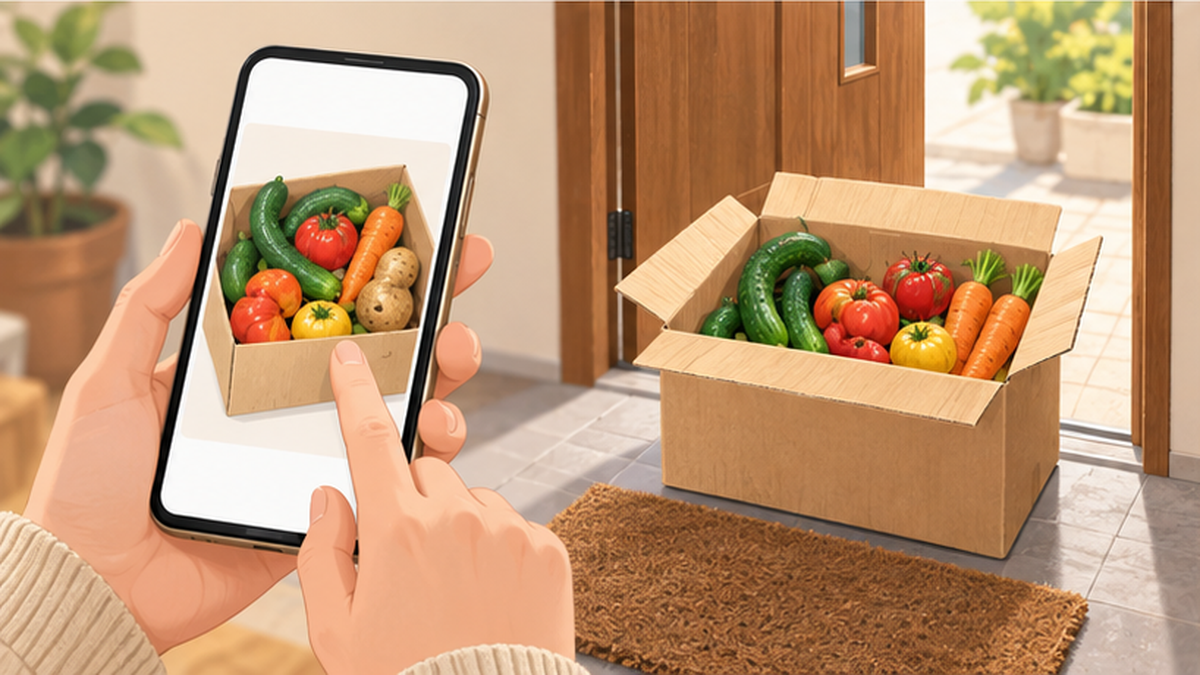
Connecting food that's discarded despite tasting fine with the consumers who want it is the first step toward reducing food loss.
― A view expressed across various food-loss-focused media
The art of pricing
Most services handling non-standard food set prices that are lower than standard-grade goods, while still trying to avoid cutting producers' share to an extreme degree. Rather than simple discounting, they aim for a price both producers and consumers can accept, factoring in the labor of sorting and packing — and that balance is part of why these services have been able to grow.
How Unused Fish Reaches the Table
The unused-fish subscription "Fishlle!"
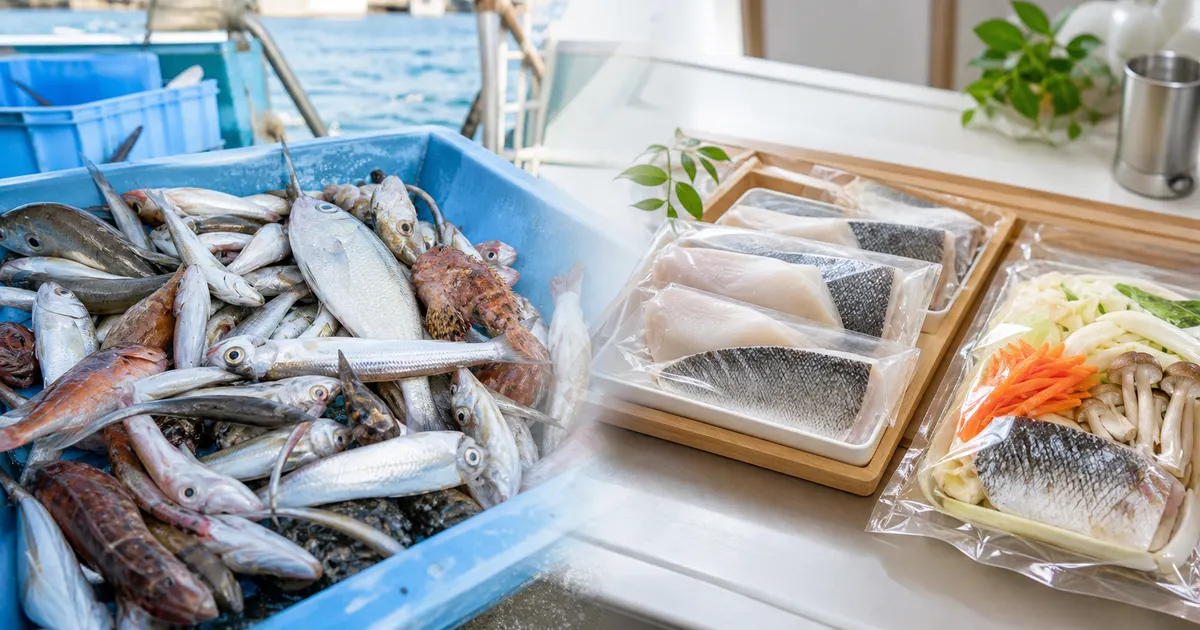
Fishlle!, run by Benners Inc., based in Fukuoka City, is a subscription service that processes fish discarded before distribution — due to inconsistent size or minor damage — into meal kits and processed products. It has used roughly 200 species to date, and by processing fish into a pre-seasoned, pre-prepared form that only needs thawing, it makes them approachable even for households that find filleting fish a barrier.
The strength of a service like Fishlle! lies in absorbing the inherent uncertainty of unused fish — the fact that the species on offer changes every time — through the processing and seasoning step. Consumers often can't choose in advance which fish will arrive, but receiving it with the cooking method already handled lowers the psychological barrier of "I don't know how to cook a fish I've never heard of." Fishlle!'s subscriber base passed 10,000 as of 2023, and the recurring nature of a subscription generates a level of steady demand for the production and processing side that's hard to achieve through one-off discount-goods purchases alone.
Visit Fishlle!Fishlle!A subscription service delivering pre-processed, pre-seasoned unused-fish meal kits (operated by Benners Inc.)🔗 fishlle.comThe advantage of a subscription model
Because the species and volume of unused fish change with every catch, it's difficult to sell them the way ordinary retail does — stocking and selling the "same product" continuously. A subscription model, where consumers agree upfront to accept variation in content, fits well with this uncertainty. For producers and processors, being able to count on a certain level of demand based on subscriber numbers also makes it easier to plan how much unused fish to procure.
The role of regional direct-sale platforms
Tabechoku and Poke-m, introduced earlier, also carry non-standard seafood and unused fish listed directly by fishers themselves, not just vegetables. When fishers close to the production area can secure their own sales channel, fish that never made it to auction get a chance to earn a price. Fish that once could only be sold through a fishing cooperative or middleman intermediary can now be delivered directly to consumers nationwide with just a smartphone — a genuine shift in the structure of distribution itself.
Efforts from the restaurant industry
Kura Sushi, the conveyor-belt sushi chain, runs a scheme called "whole-boat buying," in which it purchases an entire boat's catch directly from the fishing vessel, bypassing the market, and turns it into products including unused fish (see the related article for details). By buying up a whole catch, fishers can earn income for the full volume they land, while the restaurant chain secures stable supply while limiting exposure to market price swings — a setup that benefits both sides.
Expansion into school lunches and processed foods
Uses for unused fish extend beyond home-delivery e-commerce. Some local governments have started incorporating unused fish into school lunch ingredients, and using it as a raw material for processed products like fish paste or fish cutlets turns it into a product where the original shape of the fish is no longer recognizable — opening a path to consumption without any resistance to how it looks.
What This Means for Producers and Fishers
Diversifying income
Getting non-standard vegetables and unused fish onto a sales channel means more to producers and fishers than simply "reducing waste." Creating a new income source from food that previously had no buyer, or that could only be consumed at home or discarded, helps stabilize farming and fishing businesses that are inherently vulnerable to weather and fishing conditions. For small-scale family farms and fishing operations in particular, income from non-standard or unused product can act as a buffer that supports the business in years when standard-grade sales alone aren't enough.
Direct sales through e-commerce and subscriptions have a different fee structure than going through the wholesale market, and depending on conditions, producers sometimes end up keeping a larger share. That said, since producers must handle packing and shipping themselves, many weigh the added labor against their scale and resources before deciding whether to adopt this approach.
Fishing that wastes nothing from the catch
Fishery resources are finite, and making the fullest possible use of what's caught matters from a resource-management standpoint as well. Efforts to utilize unused fish can be one way to maximize the economic value drawn from a limited catch. Even with the same catch volume, being able to sell unused fish too means more income per trip for a fisher.
Given that fuel and labor costs are incurred every time a boat goes out, raising the share of the catch that translates into income — even slightly — matters for the sustainability of the fishing business itself. Beyond its environmental dimension, using unused fish is increasingly seen as a response to the tough conditions facing fishing operators, including rising fuel costs.
Combining processing with direct sales (sixth-sector industrialization)
Efforts to process and sell non-standard vegetables and unused fish directly — known as "sixth-sector industrialization" — are also spreading in various regions. Turning them into jam, pickles, dried goods, or fish paste extends shelf life beyond selling the raw product, and creates goods less constrained by grading or appearance. Processing requires equipment investment and know-how, but pairing it with direct-to-consumer e-commerce makes it easier to secure a sales channel.
- Having a sales channel for non-standard or unused product reduces producers' hesitation to ship or land it in the first place
- Direct-to-consumer e-commerce and subscriptions can sometimes yield higher take-home revenue than the market
- It also helps cut disposal costs (fees and labor for disposal)
- Communicating the production story directly to consumers can build loyalty and repeat purchases
Points worth keeping in mind
- Even as sales of non-standard food expand, the same quality-control and labeling rules that apply to ordinary food still need to be followed
- Direct sales through e-commerce create new sorting, packing, and shipping work for the producer
- The key to sustaining this isn't "it's cheap," but spreading the understanding that "this food has legitimate value"
The Connection to Marine Resources and the Environment
Bycatch and unused fish
In fishing, "bycatch" — creatures other than the targeted species getting caught in the net — happens often. Some of that bycatch has low market value and gets thrown back into the sea or discarded. Utilizing unused fish overlaps with an effort to turn this kind of bycatch from something "thrown away" into something "put to use."
A perspective of making full use of fishery resources
Sustaining the use of finite fishery resources over the long term requires not wasting what's caught. A system that delivers resources — including unused fish — to the table without waste is a way to draw out food value without increasing the catch volume itself. This is an idea tied to balancing resource management with securing food supply: preventing overfishing while still ensuring a reliable supply of seafood.
A shared structure between farmland and fishing grounds
Non-standard vegetables and unused fish arise in different places — farmland versus the sea — but they share a common structure: value goes unrecognized purely because something doesn't meet market rules. In both cases, this is a food-loss issue and a resource-and-environment issue at once, in the sense that it wastes labor and resources — soil, water, fuel, fishery resources — already invested at the production or catch stage.
The soil, water, and fertilizer used to grow a vegetable, and the fuel and gear used to catch a fish, are invested in equal amounts whether or not the result meets grading standards. Discarding it as non-standard or unused also wastes those invested resources themselves — a perspective that has drawn growing attention in recent years from an environmental-impact standpoint.
Resource management and reducing food loss are not in conflict
The idea of "not overfishing" in resource management and the idea of "not wasting what's caught" behind using unused fish might look like separate issues at first glance, but they're actually compatible goals. In fact, having a system that properly turns what's caught into food makes it easier for a fishing business to remain viable without needing to increase catch volume — which in turn helps ease pressure on the resource.
Re-evaluating food as a regional brand
In various regions, there's also a movement to deliberately brand unused fish or non-standard produce as food unique to that place. Fish that never reached the market simply due to low name recognition are now sometimes introduced through direct-to-consumer e-commerce or as a hometown-tax-donation gift, reaching consumers who value story and rarity over price. It can be seen as an attempt to turn the "negative attribute" of being non-standard or unused into the "positive story" of regional character.
The backdrop of climate change and shifting resources
In recent years, changes in the marine environment, including rising sea temperatures, have started to shift which species and how much of them get caught in some regions. When fish that used to be unfamiliar start getting landed, they easily become a new category of "unused fish." Having a system in place to utilize unused fish ahead of time is becoming more important precisely because it makes it easier to adapt to these shifts in resource composition.
The connection to the SDGs
Target 12.3 of the Sustainable Development Goals (SDGs) calls for halving per-capita food waste at the retail and consumer level by 2030, and reducing food losses along production and supply chains. Utilizing non-standard vegetables and unused fish is a direct contribution to exactly this — "reducing food loss at the production and supply-chain stage" — and it overlaps with Goal 14 (Life Below Water), which is about protecting marine resources.
The Umi LAB perspective
- Utilizing unused fish isn't just a money-saving trick — it connects directly to the marine-environment challenge of sustainably using fishery resources
- Land-based food-loss measures and marine resource management are worth thinking about together, not separately
Choices You Can Make at Home
Try a direct-to-consumer platform or subscription
E-commerce sites handling non-standard food, like Tabechoku, Poke-m, and Kuradashi, and unused-fish subscriptions like Fishlle!, are easy to start using without any special knowledge. They offer both the enjoyment of receiving seasonal ingredients and a way to contribute to reducing food loss at the same time.
Farm stands and roadside stations are another option
Local farm stands, roadside stations, and fishing-cooperative direct-sale counters often carry non-standard vegetables and unused fish at local prices. Using these regional sales channels, not just online options, also helps support an outlet for non-standard food. Even just stopping by during a trip or a visit home can be an opportunity to encounter vegetables and fish you don't normally see. A growing number of local supermarkets are also setting up "discounted" or "non-standard" corners, widening the options that fit naturally into everyday shopping.
Shifting how you think about appearance
Both curved cucumbers and unfamiliar fish can often be just as delicious as everyday ingredients, once you know the right preparation and cooking method. Looking up a simple recipe before buying makes it easier to work them in without hassle. Unused fish in particular can feel intimidating to prepare, so trying a service that delivers it already prepped is one good way to start.
Turn it into a chance to teach kids about food
Non-standard vegetables and unused fish also make good teaching material for learning, alongside children, that a food's appearance and its taste don't always match. The experience of handling an oddly shaped vegetable or an unfamiliar fish, cooking it, and eating it can be a natural way to start a family conversation about food loss and marine resources.
- Start small — try non-standard food through a direct-to-consumer platform or a farm stand
- Check the service's recipes or social media for how to cook what arrives
- If you use it regularly, consider a subscription to help support a stable sales channel for producers
Challenges and the Road Ahead
Legal frameworks are lending support
The Act on Promotion of Food Loss and Waste Reduction, which took effect in October 2019, sets a framework for the national government, local governments, businesses, and consumers to work together on reducing food loss, including the effective use of non-standard agricultural products. Against this legal backdrop, local governments have also expanded matchmaking support for non-standard food. The law designates October every year as "Food Loss Reduction Month," a period when awareness events and promotional sales involving non-standard food take place nationwide.
Rethinking the grading standards themselves
Beyond just "selling non-standard food through a separate channel," there's also a movement to relax grading standards themselves, or to establish multiple standards for different uses, such as processing. Combining diverse sales channels and standards is part of an effort to explore a model of production and distribution that doesn't assume waste as a given.
Room for consumer understanding to grow further
Consumer surveys already show over 90% either have purchased or are willing to purchase non-standard vegetables, but hurdles remain around actual purchase frequency, and around unfamiliarity with species in the case of unused fish. Lowering the psychological barrier to choosing non-standard food or unused fish, through information sharing and recipe suggestions, will be key to further adoption going forward.
The spread of social media and review features on direct-to-consumer e-commerce sites, where consumers share how they actually cooked what they bought, is also helping lower this barrier. As information on "how I cooked a fish I'd never heard of" becomes visible, it creates a virtuous cycle that makes the next consumer who encounters the same fish more likely to consider buying it.
New forms of distribution like direct-to-consumer e-commerce and subscriptions still represent only a small slice of the overall market. Even so, the gradual spread of systems that turn non-standard vegetables and unused fish from "something wasted" into "something chosen" marks a steady step forward for reducing food loss in Japan.
Producers and fishers, distribution businesses, and consumers each making the small, repeated choice not to let go of food simply because it doesn't meet a standard — that is what will steadily drive down the 4.64-million-ton food-loss figure in the years ahead.
Summary
- Non-standard vegetables and unused fish arise not from poor quality, but from failing to meet market grading standards
- Japan's food loss runs to roughly 4.64 million tons a year, with non-standard vegetables alone estimated at around 20% of production
- Services bypassing the market — Tabechoku, Poke-m, Kuradashi, Fishlle! — are expanding the routes to deliver this food
- Utilizing unused fish supports both fishers' income and the efficient use of fishery resources
References and Sources
- Ministry of the Environment, "Announcement of the Estimated Food Loss and Waste for FY2023" – Total food loss and the household/business breakdown
- MAFF, "What Is Food Loss?" – Definition and basic data on food loss
- MAFF, "FY2022 Business-Sector Food Loss Reduction Target Achieved" – Business-sector food loss reaching its 2030 target eight years early
- MAFF, Reference Material 3, "Possibilities for Addressing Diverse Needs in Fresh and Processed/Commercial Use of Agricultural Products (Draft)" – Consumer awareness survey on non-standard vegetables
- Fish Education and Promotion Center, Japan Fisheries Association, "What Is Unused/Underused Fish?" – Definition and causes of unused fish
- Consumer Affairs Agency, "Reference Materials on Food Loss Reduction (June 27, 2026 edition)" – Statistics and policy overview on food loss reduction
- Tabechoku's non-standard-produce site, "Deliciousness that doesn't care about shape." – Dedicated non-standard-produce page on a direct-to-consumer e-commerce site
- Poke-m – A direct-sale marketplace run by farmers and fishers
- Kuradashi – E-commerce for discounted and non-standard food, combined with social contribution
- Fishlle! – A subscription service for unused fish (operated by Benners Inc.)
※ Listed in order of reliability: government/academic institutions > peer-reviewed papers > specialist organizations > trusted media