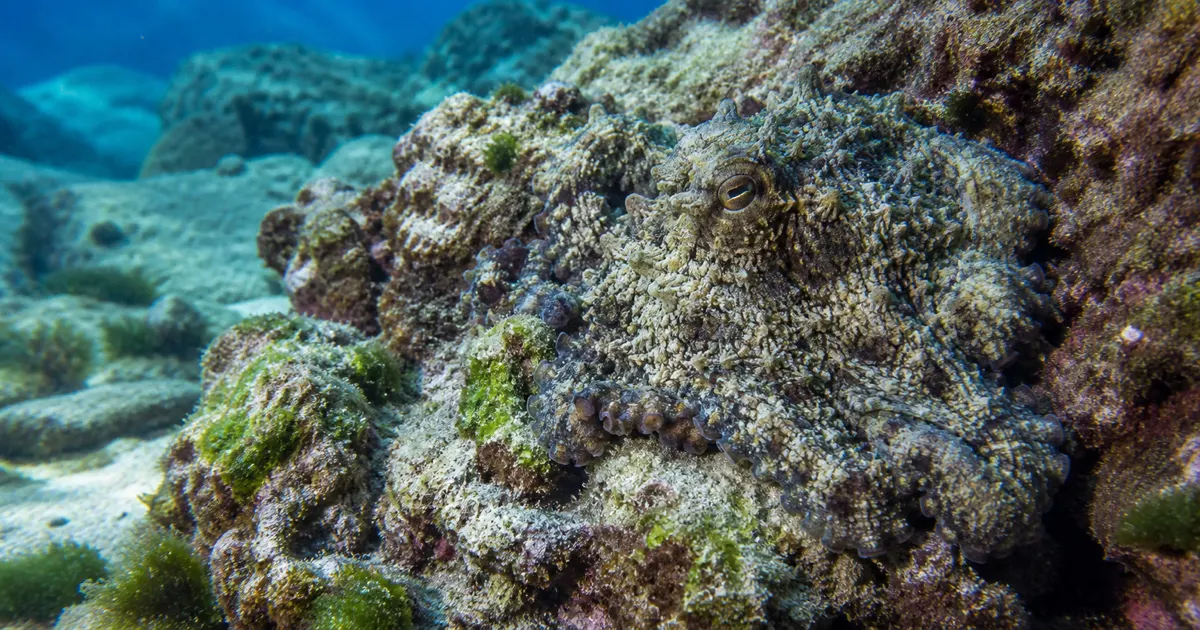
You approach a rock on the seafloor, and in the next instant, the octopus that was supposedly right there has vanished. It hasn't actually fled — it has transformed its color, pattern, and even texture to match the rock or seaweed so perfectly that it has "disappeared" right before your eyes. Octopus camouflage is, among known animals, exceptionally fast, exquisitely precise, and still wrapped in many mysteries. It is not unusual for even divers and underwater photographers to overlook an octopus sitting right next to them — that is how perfected the art of vanishing has become for these animals.
The star of this show is a type of cell packed densely into the skin called a "chromatophore." In shallow-water octopuses, as many as roughly 230 chromatophores are crammed into just one square millimeter of skin, each one opening and closing independently like a pixel on a computer screen. Recent research is also revealing that octopuses may sense light through their skin itself, and uncovering the mysterious mechanism by which they blend into surrounding colors despite lacking color vision.
Drawing on primary sources such as government ministries, universities, and peer-reviewed papers, this article carefully traces the little-known world of octopuses — the mechanics of chromatophores, the "seeing skin" that senses light, the mimic octopus that impersonates over 13 species, its escape-artist reputation from aquariums, and the distributed intelligence held in roughly 500 million neurons. If you're interested in the intelligence of marine creatures, also see our article on cephalopod intelligence.
What you'll learn in this article
- How the three-layer structure of chromatophores, iridophores, and leucophores produces color changes faster than the blink of an eye
- Why octopuses, despite lacking color vision, are thought to still be able to blend into background colors
- The discovery of "seeing skin" — opsins in the skin that sense light and trigger chromatophores without going through the brain
- The mimic octopus that impersonates over 13 species, and the high intelligence octopuses display through escapes and tool use
- How much energy color change actually costs, and the movement to protect octopuses as sentient beings
Instant Color Change: Chromatophores as "Living Pixels"
Cephalopods such as octopuses, squid, and cuttlefish can change the color and pattern of their skin faster than the blink of an eye. This speed of change is considered among the fastest of any known animal, allowing them to shift their appearance dramatically whether sneaking up on prey or hiding from predators. Let's start by looking at the mechanics of the cell at the heart of it all: the chromatophore.
Chromatophores Are "Color Sacs Opened by Muscle"
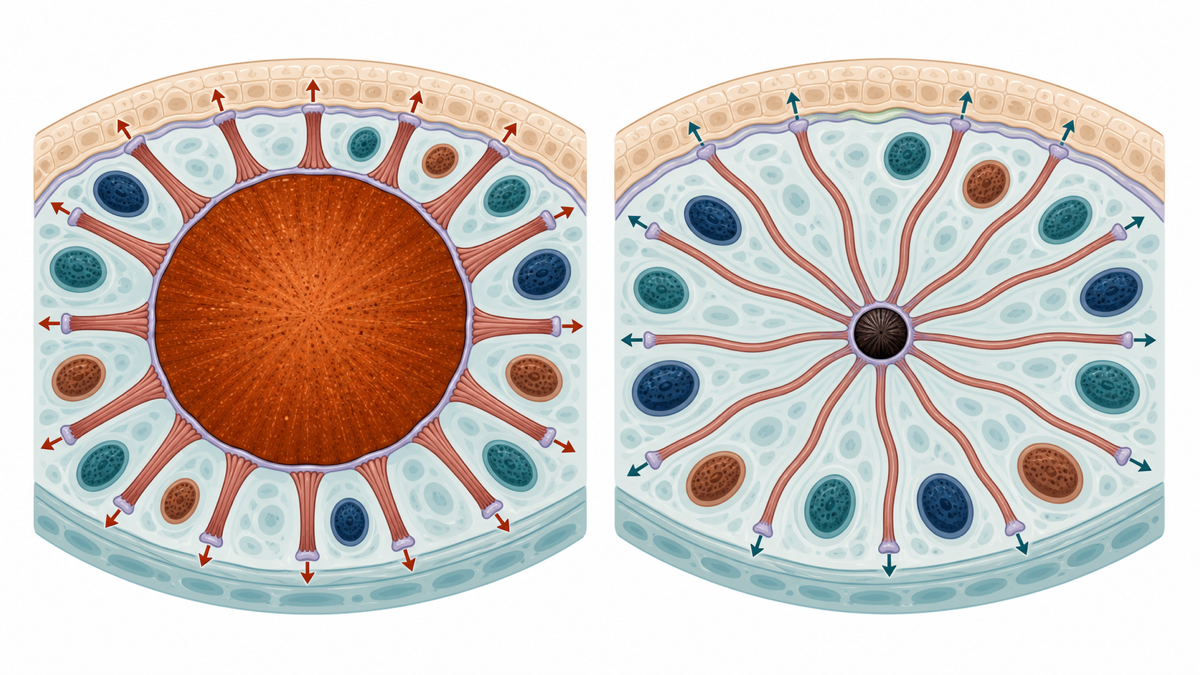
A chromatophore is a small sac-like cell densely packed with pigment granules. Around this sac, fine muscle fibers are arranged in a radial pattern. When the muscles contract, they pull the sac open, stretching it flat and wide so the color becomes "visible." When the muscles relax, the sac shrinks back into a tiny dot and the color seems to "disappear." Because countless chromatophores control this opening and closing simultaneously, complex patterns emerge.
What matters here is that this movement is not chemically recreating color — it is physically expanding or shrinking the area of color already present. That's exactly why the change can happen at a scale of milliseconds — a speed in an entirely different league. In contrast to the slow color change of a chameleon, an octopus's transformation is instantaneous. This is because the mechanisms are entirely different: a chameleon changes color by rearranging pigment particles within its cells, which takes time, while an octopus simply opens and closes muscular sacs. It's this speed that lets an octopus slip past a predator's gaze and keep matching its background even while on the move.
Skin as a Three-Layer Screen
An octopus's skin is not made of chromatophores alone. Research shows that at least three types of cells work together in layers. Because each layer has its own role, the octopus can achieve a richer range of expression than mere color change — including sheen and whiteness.
- Chromatophores: The topmost layer, containing yellow, red, brown, and black pigments that are opened and closed by muscles to create color and pattern.
- Iridophores: Reflective cells that bounce light to produce blue, green, and metallic sheens, mirroring the ambient light of the environment.
- Leucophores: An underlying layer that reflects light of all wavelengths, producing white and mirroring background colors.
In other words, an octopus's skin is a "living display" where a color-producing layer and a light-reflecting layer overlap. With chromatophores packed at a density of about 230 per square millimeter, the octopus can render fine patterns much like the pixels of a high-resolution screen. Just as a computer or smartphone screen renders a photo using tiny dots of red, green, and blue, the octopus achieves the same feat with living cells — and by its own will.
Changing More Than Color — Texture Too
The remarkable thing about octopus camouflage isn't limited to color and pattern. The surface of its skin has small muscular bumps called papillae, which it can raise or flatten in an instant. Raising the papillae makes the skin bumpy like rock or coral; flattening them makes it smooth like sand. Smooth on flat sandy ground, spiky on complex rocky terrain — by matching color, pattern, and texture all at once, the octopus can blend seamlessly even into a three-dimensional background. It's a feat no flat display could ever imitate.
What's more, the signals commanding these changes travel through the nervous system and reach the whole body instantly. At the tense moment of approaching prey, the instant a predator's shadow is sensed, or while communicating with a fellow octopus — the animal's patterns shift as if its emotions were being projected directly onto its skin. Some researchers have described the octopus's skin as "a screen where its mood bleeds through."
| Layer (cell type) | Main role | Effect produced |
|---|---|---|
| Chromatophores | Open and close pigment sacs using muscle | Yellow, red, brown, and black colors and patterns |
| Iridophores | Reflect and interfere with light | Blue, green, and metallic sheen |
| Leucophores | Reflect all wavelengths of light | White color and mirrored background hues |
Key points
- Chromatophores don't "create" color — they physically expand or shrink the visible area of color
- That's why patterns can change at a speed measured in milliseconds — an entirely different league
- Chromatophores, iridophores, and leucophores overlap in three layers to produce rich expression
The shape-shifting abilities of cephalopods are also covered in our article on cephalopod intelligence. Squid and cuttlefish share the same chromatophore mechanism, though it's interesting that different species favor different patterns and uses.
Matching Colors It Can't See? The Mystery of the Color-Blind Octopus
Here a major mystery arises. Despite blending so beautifully into its surroundings' colors, the octopus is thought not to have color vision like humans do. So how does it match colors it cannot even see?
Only One Type of Photoreceptor
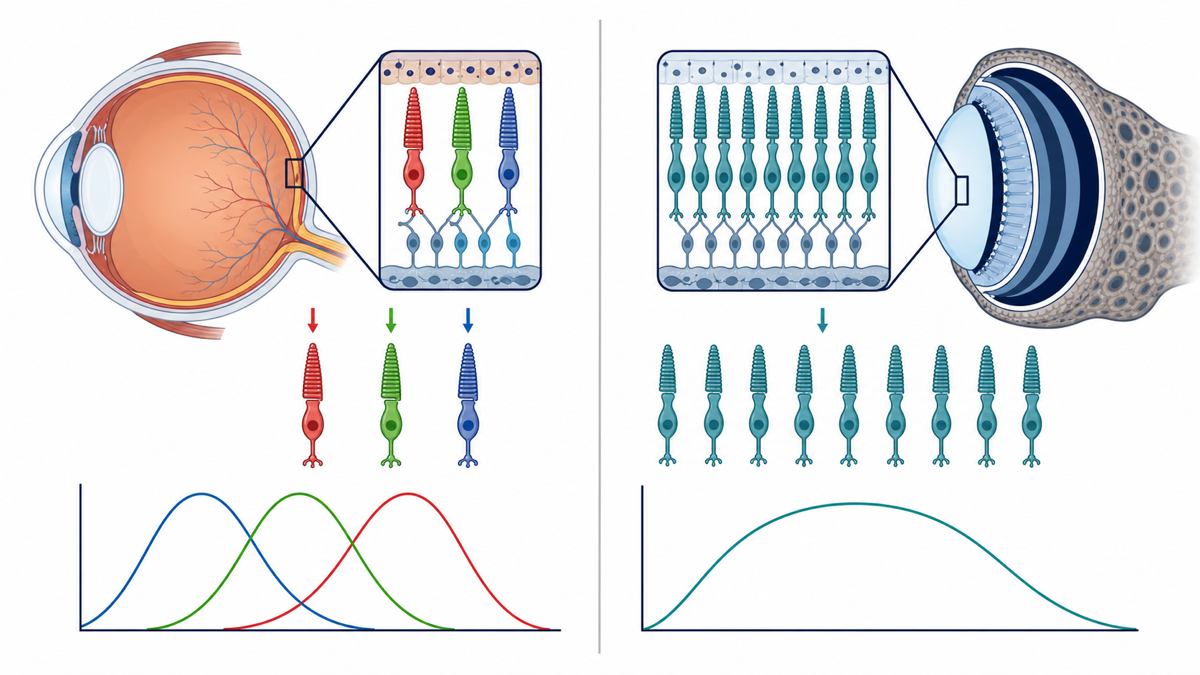
Human eyes contain three types of photoreceptors (cone cells) that respond to red, green, and blue, and we judge color from the differences in their responses. But the eyes of octopuses and many other cephalopods essentially have only a single type of photoreceptor. They cannot distinguish color by comparing multiple receptor types the way we do. In this sense, octopuses have long been considered "color-blind."
A Hypothesis: Odd-Shaped Pupils "Blurring" Color Into Focus
So how does it manage to match colors? A study published in 2016 in the Proceedings of the National Academy of Sciences (PNAS) offered a unique hypothesis. It suggested that by combining the oddly shaped pupils of octopuses and squid — horizontal, U-shaped, and so on — with "chromatic aberration" in the lens, a phenomenon where the focal distance shifts depending on wavelength, it may be possible to extract color information from differences in how sharply things come into focus, even with only one type of receptor. It's essentially a workaround: reading the degree of blur for each color while shifting focus.
This hypothesis is still being tested, but it is drawing attention as a compelling explanation for the long-standing contradiction of "an octopus that shouldn't have color vision, yet reacts to color." Human eyes dislike chromatic aberration as "blur" and try to cancel it out with lenses, but octopuses may actively use this very blur as information — which is the fascinating part. The same physical phenomenon can be either a flaw or a weapon, depending on the creature.
Reflective Skin That "Mirrors" the Background
Another key lies in the iridophores and leucophores introduced in the previous chapter. These reflective cells reflect and cause interference with the ambient light itself to produce color. If the background is a blue-green sea, they reflect blue-green; if it's a reddish rocky area, they reflect a reddish tint — the octopus's skin naturally mirrors the background based on the surrounding light it receives. In other words, the octopus doesn't need to "calculate" its own color — its skin, in a sense, acts like a mirror that naturally picks up the background's hue.
In deep water, red light doesn't reach at all, leaving only blue light. So for octopuses, matching brightness (contrast) precisely is often considered more effective for hiding than matching vivid colors. In fact, some suggest that what really determines the skill of camouflage isn't vivid color but how precisely the octopus can reproduce the brightness and texture of its background. While we humans tend to fixate on color, the octopus may be playing an entirely different game — one of light and shadow.
The mystery of color vision and camouflage
The paradox of "matching colors it cannot distinguish" is being explained by two complementary mechanisms: (1) a special way of seeing that uses odd pupil shapes and chromatic aberration, and (2) skin that reflects the surrounding light. Neither is fully settled — both remain active frontiers of research.
If you're curious about how corals get their color, our article on coral and zooxanthellae symbiosis offers an interesting complement, showing a fuller picture of how marine creatures deal with "color."
Sensing Light Through Skin: The Eyeless "Seeing Skin"
Among the discoveries surrounding octopus camouflage, one that has been received with particular astonishment is the research showing that "the skin itself senses light." Not just the eyes — the skin itself appears to function as a light sensor.
A Cut Piece of Skin Reacted to Light
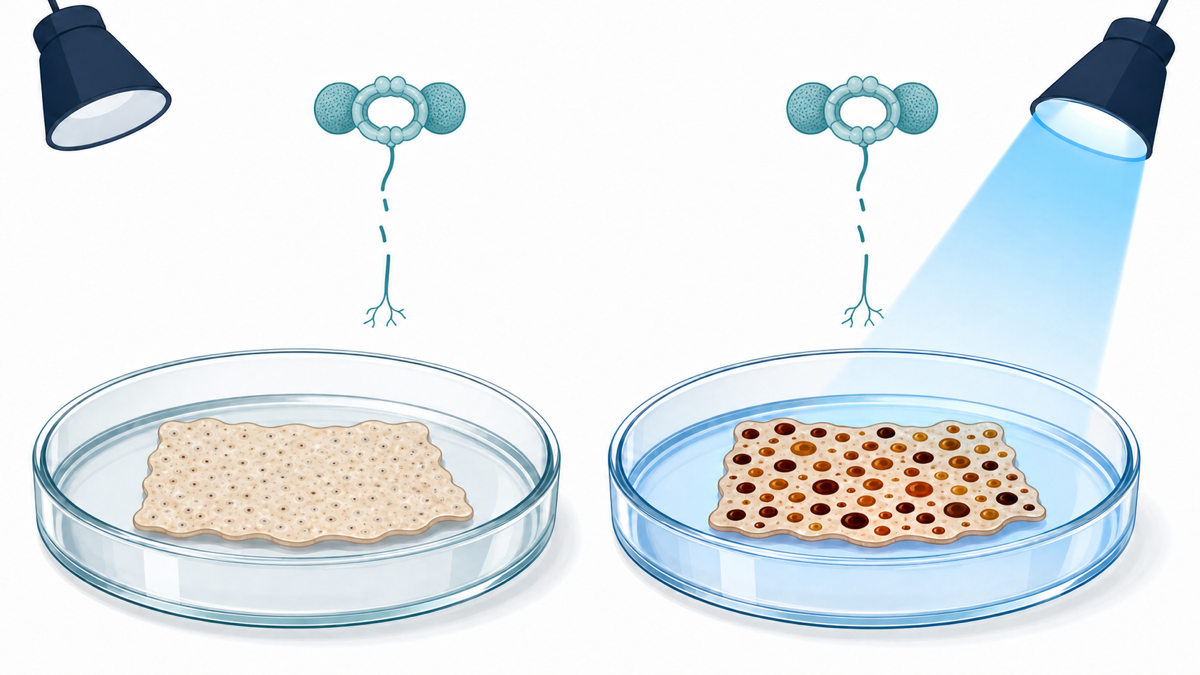
In 2015, a research team at the University of California, Santa Barbara (UCSB) published the results of an experiment using the California two-spot octopus (Octopus bimaculoides) in the Journal of Experimental Biology. When a piece of skin cut from the octopus's body was exposed to light, its chromatophores expanded on their own — even though the skin was no longer connected to the brain or nervous system. This phenomenon was named "Light-Activated Chromatophore Expansion," or LACE.
The Skin Had "Eye Parts" Too
The key player behind this reaction is a protein called opsin. Opsin normally works inside the eye as a "light-sensor component" that converts light into electrical signals. But the research team showed that the very same opsin exists and is actually functioning in the octopus's skin as well. The skin was capturing light using the same molecular mechanism as the eye. The reaction was strongest under blue light, matching the wavelength opsin responds to best.
That said, the skin's "vision" isn't as precise as that of the eyes. What the skin can sense is thought to be mainly changes in brightness — it likely cannot discern outlines, contrast, or fine shapes. Still, if it can capture the intensity and changes in light to help drive the chromatophore response, then the whole body may function as a "distributed sensor" that faintly senses light everywhere.
The octopus's skin senses light using the same molecular mechanism as the eye — a discovery that forces us to reconsider what it means for a living thing to "see."
— Summarized from a 2015 research report by the UCSB Marine Science Institute
This property of "skin that senses only brightness" carries significant meaning for understanding camouflage. As we saw in the previous chapter, matching brightness rather than color is often thought to be more effective for octopuses trying to hide. If the skin can sense changes in brightness across the entire body, that is exactly the kind of sense best suited for camouflage. By combining what the eyes see with the brightness the skin feels, the octopus may be blending its own form into the background.
A Mechanism Shared by Squid and Cuttlefish
Subsequent research has also found opsin and related molecules in the skin of cuttlefish, bigfin reef squid relatives, and Japanese flying squid. It is becoming clear that the ability to sense light through skin may not be unique to octopuses, but rather a trait broadly shared across cephalopods. Creatures that sense light with their entire body — that may be exactly what cephalopods are.
This "seeing skin" also makes good sense as a way to improve the precision of camouflage. If all control of chromatophores depended solely on the brain and eyes, information about the background would need to be captured by the eyes, processed by the brain, and then relayed back out to the entire body as a command. But if the skin itself can sense light and react, each part of the body can adjust autonomously to the brightness in its immediate vicinity. The same idea seen in the nervous system distributed across the eight arms can also be found in the skin's light sensors. Not central control but a "boots on the ground" approach — this seems to be the recurring theme running through the octopus's entire body plan.
Key points about "seeing skin"
- Even a cut-off piece of skin will have its chromatophores expand when exposed to light (the LACE phenomenon)
- The skin contains opsin, the same light-sensor molecule found in the eye, and responds especially well to blue light
- The skin is thought to sense mainly brightness, not fine outlines or detailed color
- A similar mechanism has also been confirmed in the skin of squid and cuttlefish
Three Types of Camouflage: The "Grammar" of Disguise
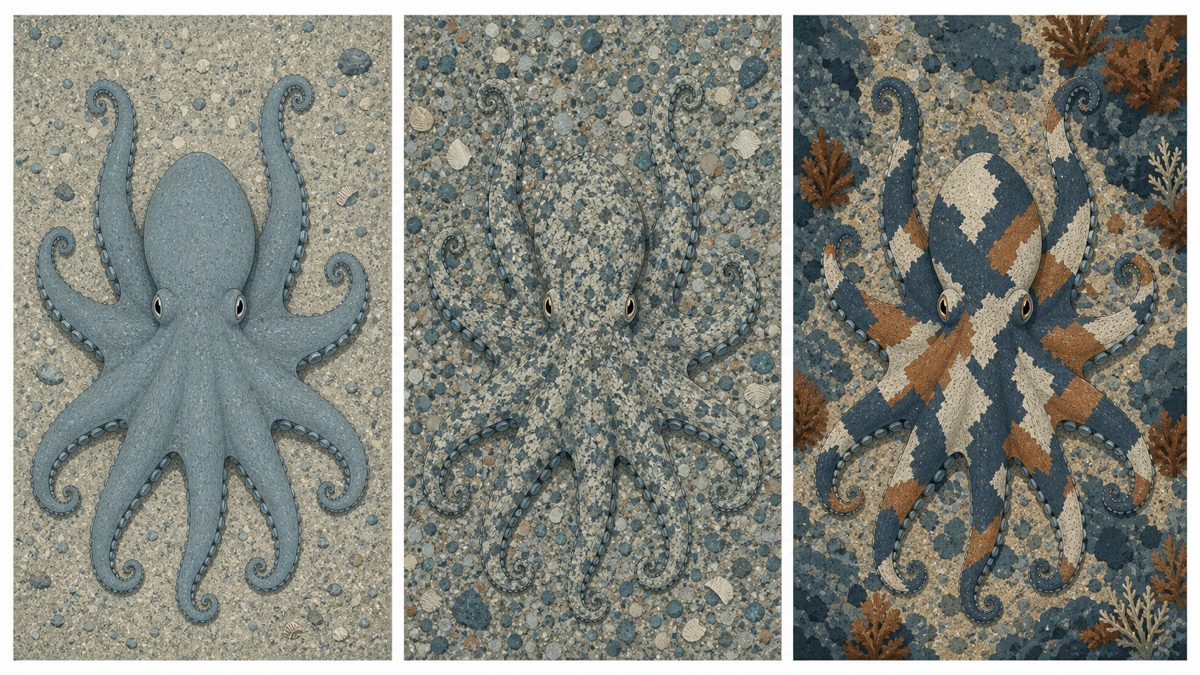
The patterns produced by octopuses and cuttlefish may seem infinite, but marine biologist Roger Hanlon, who has studied camouflage for decades, showed that they can largely be organized into three basic patterns. In a sense, camouflage has its own "grammar."
1. Uniform Pattern
This is a low-contrast pattern where the whole body takes on a roughly uniform color. It suits blending in unnoticed against sandy stretches or plain, single-colored backgrounds. It's the simplest form of "matching the background" camouflage.
2. Mottle Pattern
This pattern consists of small light and dark spots scattered evenly across the body's surface. Each spot corresponds to elements in the background such as gravel, small stones, or bits of seaweed, letting the octopus blend into a rough, natural-looking background as a whole. This is the most common camouflage pattern that many octopuses wear day to day.
3. Disruptive Pattern
This pattern places large, high-contrast blotches on the body to break up the outline of the body itself. Rather than "blending in" with the background, this is a strategy of "no longer looking like an octopus" by disrupting the shape of the body. Even if a predator notices the pattern, if it fails to recognize it as the shape of prey (an octopus), the hunt cannot proceed. This is the same idea behind the disruptive camouflage paint used on warships and military equipment.
| Pattern | Characteristics | Best suited for |
|---|---|---|
| Uniform | Low contrast, evenly toned | Sandy backgrounds and other single-colored settings |
| Mottle | Small light and dark spots scattered around | Complex backgrounds mixed with small stones and seaweed |
| Disruptive | Strong blotches that break up the outline | When trying to hide its shape, or while moving |
Octopuses "look at" the background and instantly select the pattern best suited to the situation. This speed and precision of judgment hints at intelligence that goes beyond mere reflex. Interestingly, even against the same background, the pattern selected changes depending on the size of the animal's body relative to the size of objects in the background. For example, experiments have confirmed a regularity in which a disruptive pattern tends to be chosen against a background where pebbles look large relative to the body, while a mottle pattern tends to be chosen against a background of fine sand grains. The octopus doesn't simply copy the background — it appears to calculate exactly what will make its shape disappear.
This use of different patterns has been studied especially closely using cuttlefish. When cuttlefish are placed over various black-and-white patterned backgrounds, they smoothly switch between the three pattern types depending on how the background appears to them. Researchers have used this response to work backward and figure out what visual cues the animal is using, gaining insight into the very mechanics of vision itself. The camouflage of octopuses and cuttlefish is, in a sense, a living experimental apparatus for understanding how creatures perceive the world. In the next chapter, we'll introduce a "star actor" that has taken camouflage to its ultimate extreme.
Camouflage isn't just about blending in
We tend to think of camouflage as "becoming the same color as the background," but disrupting the outline to obscure the shape, as in the disruptive pattern, is just as legitimate a strategy. Octopuses switch between these depending on the situation.
The Mimic Octopus: The Ocean's Star Actor Playing 13 Roles
At the pinnacle of camouflage stands the mimic octopus (Thaumoctopus mimicus). This relatively newly described species was discovered in 1998 in the murky river-mouth sand and mud flats off the coast of Sulawesi, Indonesia, and lives up to its name as a master of "mimicry."
Changing Not Just Color, But Shape and Movement
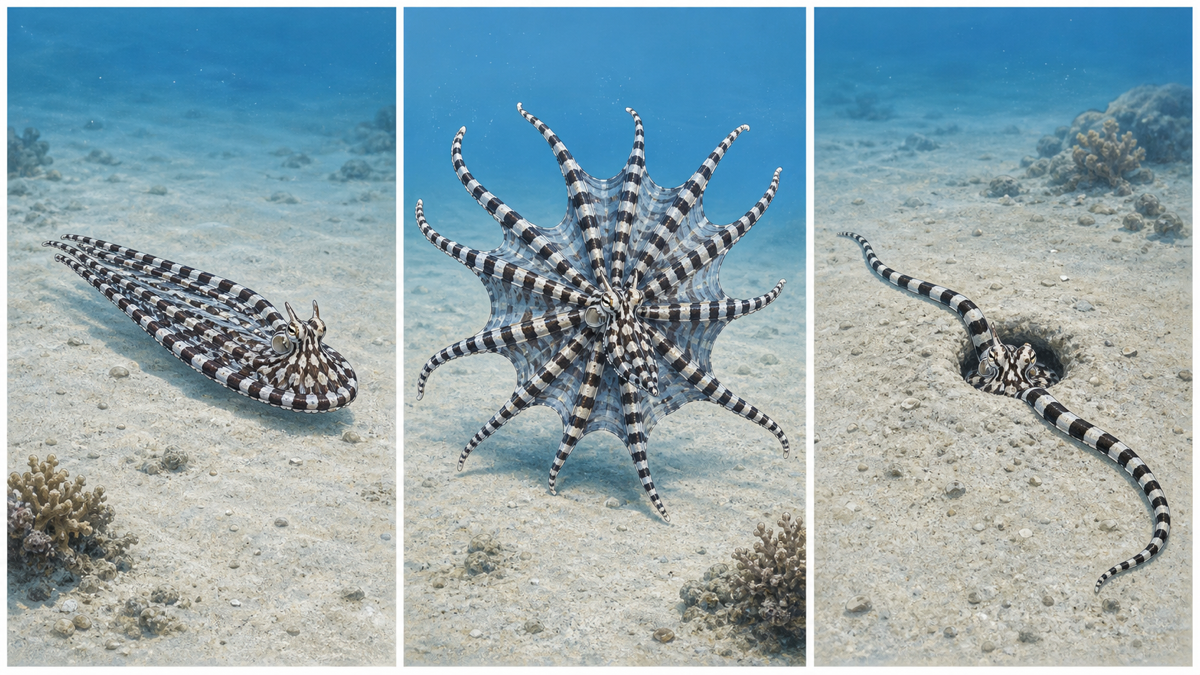
What makes the mimic octopus so remarkable is that it doesn't stop at changing color and pattern. It reshapes its body and even changes how it swims and moves to impersonate other creatures. And the creature it mimics is not chosen at random — it's believed to select "whichever disguise seems most effective" based on whatever predator happens to be nearby. Researchers have reported confirming impersonations of at least 13 or so different creatures.
A Signature Repertoire of Impersonations
- Flatfish (sole): Flattens itself with its arms held close to its body and glides along the seafloor, deterring predators by posing as a venomous flatfish.
- Lionfish: Spreads its arms out radially, making itself look like a dangerous fish bristling with venomous fins.
- Sea snake: Hides most of its body in a burrow, leaving out only two banded arms that it moves slowly, posing as a highly venomous sea snake.
What all of these have in common is that the octopus is choosing a creature that is more dangerous than itself and that predators tend to avoid. It carries out the logic of "if I pretend to be that venomous animal, I'm less likely to be attacked" through a combined performance of color, shape, and movement. This is a sophisticated form of camouflage involving situational judgment that goes well beyond simple protective coloration. What's more, the mimic octopus lives on open, muddy river-mouth flats, with few rocks or seaweed to hide among. It's thought that, precisely because there is no background to blend into, this species evolved the more advanced strategy of "impersonating a dangerous creature" instead. In other words, a harsh environment may have given rise to a remarkable ability.
The mimic octopus combines color, pattern, shape, and movement, and often disguises itself as another creature more dangerous than itself.
— Summarized from BBC Wildlife magazine and other reports
Interestingly, the mimic octopus often takes on bold stripes and blotches in bright brown and white. While many octopuses choose camouflage that helps them "blend in unnoticed," the mimic octopus also uses the exact opposite strategy: wearing conspicuous warning colors to broadcast "I'm dangerous." Hiding through camouflage, and disguising itself as something dangerous — the fact that this species can switch between two opposite approaches depending on the situation shows just how flexible and clever it is.
That said, exactly how deliberately the mimic octopus "chooses" its target is still not fully understood. While some researchers have observed it switching disguises depending on the type of predator nearby, others caution that more rigorous verification is needed. Because this is a topic prone to sensational anecdotes taking on a life of their own, care is taken to draw a clear line between solid observation and exaggeration. Even so, the fact that this animal combines color, shape, and movement to impersonate other creatures remains nothing short of remarkable.
Behind this kind of "deceiving" behavior lies the sophisticated information-processing ability unique to cephalopods. If you're interested in the intelligence of marine creatures, be sure to check out our article summarizing cephalopod intelligence as well.
Master Escape Artists: A Soft Body and Curiosity Behind the Feats
Alongside its camouflage, another thing that has made the octopus famous is its reputation as an "escape artist." Aquariums around the world regularly report octopuses slipping out of their tanks. Among these, one story that has become legendary is that of "Inky" in New Zealand.
"Inky," the Octopus That Slipped Out of an Aquarium
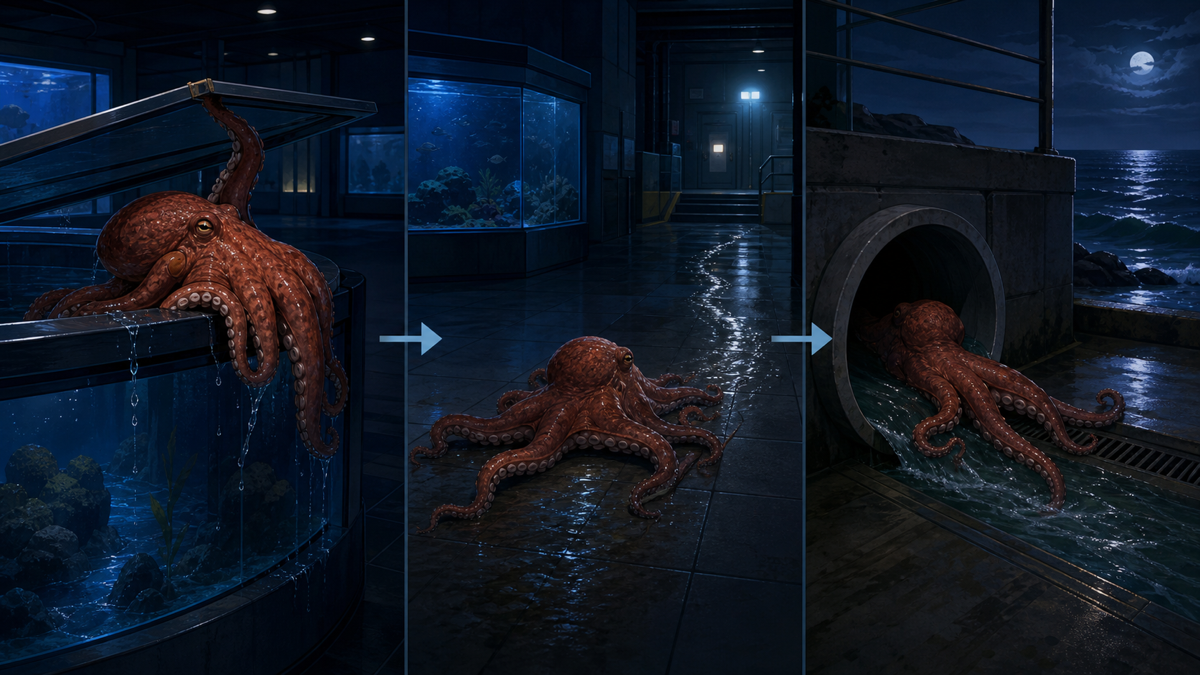
Inky was a common octopus living at the National Aquarium of New Zealand in Napier. In 2016, without the keepers noticing, he climbed out of his tank, crawled across the floor, slid into a drainpipe, and escaped through the pipe leading out to the sea. This escape, after which he was never found again, was reported around the world and has become a symbol of the octopus's intelligence and physical ability.
No Bones, So It Can Fit Through a Gap the Size of Its Own Eye
The reason an octopus can slip through remarkably narrow gaps is that it has not a single bone in its body. Because it has no rigid skeleton and instead supports its body using muscle and water pressure — a system called a "hydrostatic skeleton" — it can deform its body freely, sometimes even squeezing through a hole no bigger than its own eyeball. The only hard part is its beak, so as long as that can pass through, the rest of the body can follow.
Intelligence Behind the Escapes
A soft body alone isn't enough to pull off an escape, though. Inky's getaway required a whole chain of judgment: finding a gap in the lid, understanding that a path to the outside existed, and acting on it. In captivity, octopuses are often seen opening tank lids or unscrewing the lids of jars containing food. This overflowing curiosity and problem-solving ability is the true identity of the escape artist.
Aquarium keepers know from experience that octopuses are more prone to escaping and mischief when they are "bored." That's why they devise intellectual stimulation (environmental enrichment), such as puzzle toys with hidden food or jars whose lids need to be opened. An octopus given a mentally engaging task tends to be satisfied, and its attempts to escape are said to decrease. In other words, the very curiosity that hates boredom and cannot help but explore its surroundings is itself proof of the octopus's intelligence. The difficulty of keeping them in captivity is, in a sense, the flip side of their intelligence.
Incidentally, the octopus's preference for squeezing into tight spaces also serves a protective purpose similar to camouflage. As mentioned in the previous chapter, changing body color is a costly undertaking in terms of energy. So if the octopus can simply hide in a crack in a rock or inside a shell where it won't be found in the first place, it can avoid relying on costly camouflage altogether. A soft body is both an escape tool and, at the same time, the most reliable "hiding cloak" of all.
The trick behind the escape artist
- With no bones in its body, it can slip through gaps no bigger than its own eye
- The only hard part is the beak — as long as that fits through, the rest of the body follows
- What makes an escape possible isn't just narrowness, but the intelligence to understand that a way "out" exists
Distributed Intelligence: About 500 Million Neurons and Thinking Arms
Both camouflage and escape are rooted in the octopus's high intelligence. And an octopus's "smarts" are built on a design philosophy that is completely different from that of us vertebrates.
Two-Thirds of Its Neurons Are in Its "Arms"
An octopus is said to have about 500 million neurons (nerve cells) throughout its body — a number close to that of a dog, and tens of times more than a typical fish. What's surprising is how they're distributed: roughly two-thirds of all its neurons are scattered not in the brain but across its eight arms. Each arm functions almost like a small brain of its own, able to judge the texture and taste of whatever it touches and move semi-independently.
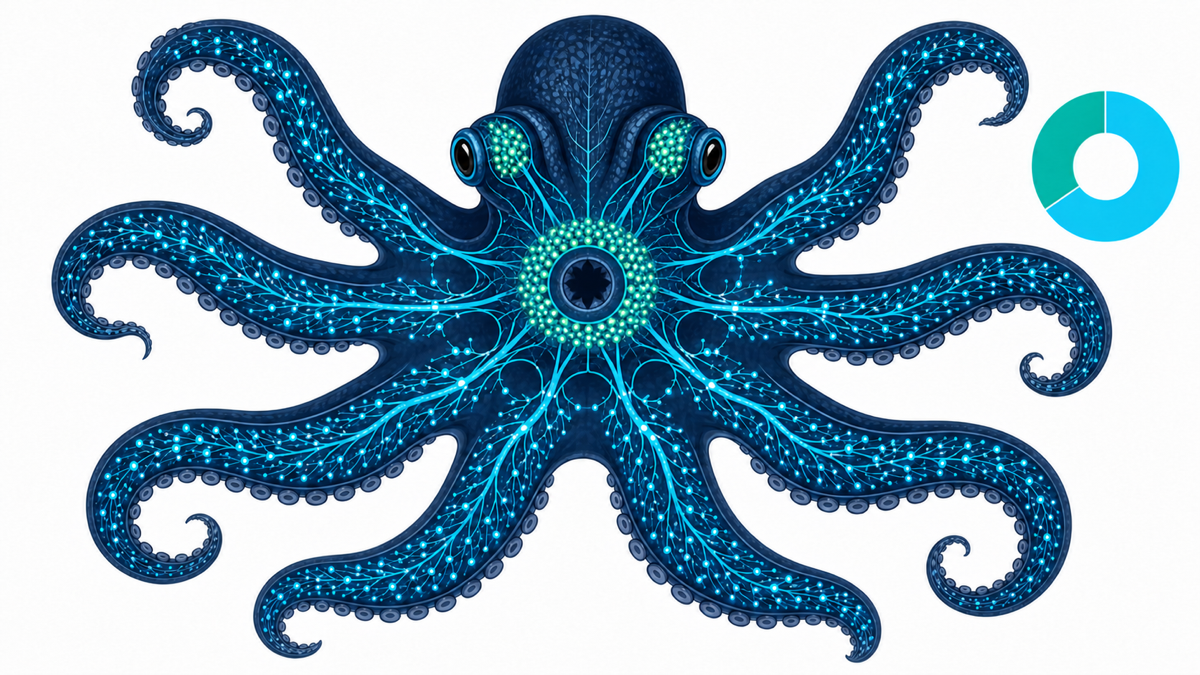
Thanks to this "distributed intelligence," an octopus can effortlessly manage parallel tasks — prying open a clam with one arm while another arm probes for the next prey. Rather than a central brain issuing every command, it's the "field" — the arms — that autonomously processes information, which is exactly why robotics and AI researchers are looking to the octopus's body for inspiration. In the field of soft robotics, researchers are studying mechanisms that, like an octopus's arm, can grasp objects by deforming flexibly without relying on countless rigid joints. The octopus is serving as a model for next-generation robots and control systems.
Using Tools, Learning, and Playing
An octopus's intelligence is also clearly reflected in its behavior. Research and observation have reported the following sophisticated behaviors:
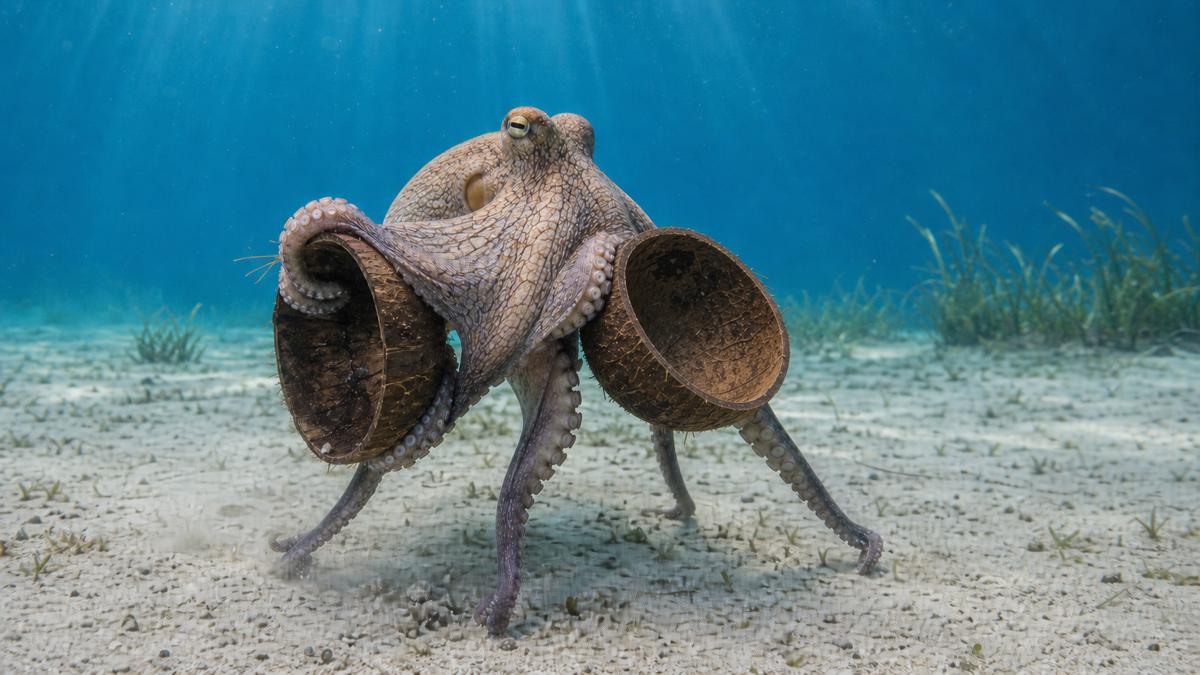
- Tool use: Carrying around broken coconut shells or seashells and assembling them into a shelter for hiding.
- Problem-solving: Solving mazes and unscrewing jar lids to overcome challenges through trial and error.
- Observational learning and memory: Using both short-term and long-term memory, drawing on past experience to guide future behavior.
- Playfulness and personality: Behavior such as repeatedly pushing seemingly meaningless objects around, apparently just for play, along with observed differences in personality between individuals.
The Genetic Secret Behind Its Intelligence
Behind this intelligence lie genetic characteristics as well. Genomic analyses of cephalopods have revealed an abundance of genes related to the nervous system, along with active use of "RNA editing," which rewrites RNA information depending on the situation. Having followed a completely different evolutionary path from vertebrates, the octopus has acquired a highly advanced nervous system and intelligence of its own — which is why it is sometimes called "the most alien intelligence on Earth."
The octopus as "another kind of intelligence"
The common ancestor shared by us vertebrates and the octopus dates back more than 500 million years. In other words, octopus intelligence evolved independently of ours, following an entirely different design — "another kind of intelligence." It's drawing attention as a clue for thinking about what alien intelligence might look like.
The Cost of Camouflage and the Octopus as a "Sentient Being"
All that remarkable camouflage and intelligence doesn't come free. Recent research has revealed that changing body color carries a surprisingly high "cost" for the octopus. And precisely because of its intelligence, ethical questions are also emerging about how we should treat it.
Changing Color Costs About as Much as a 23-Minute Jog
A study published in 2024 in the Proceedings of the National Academy of Sciences (PNAS) measured the oxygen consumption of 17 ruby octopuses (Octopus rubescens) before and after changing body color. The results showed that when changing its color across the whole body, an octopus consumes roughly 219 micromoles of oxygen per hour — an amount roughly equal to the energy used to maintain all of the body's functions at rest. The research team likened this burden, in human terms, to roughly 23 minutes of jogging.
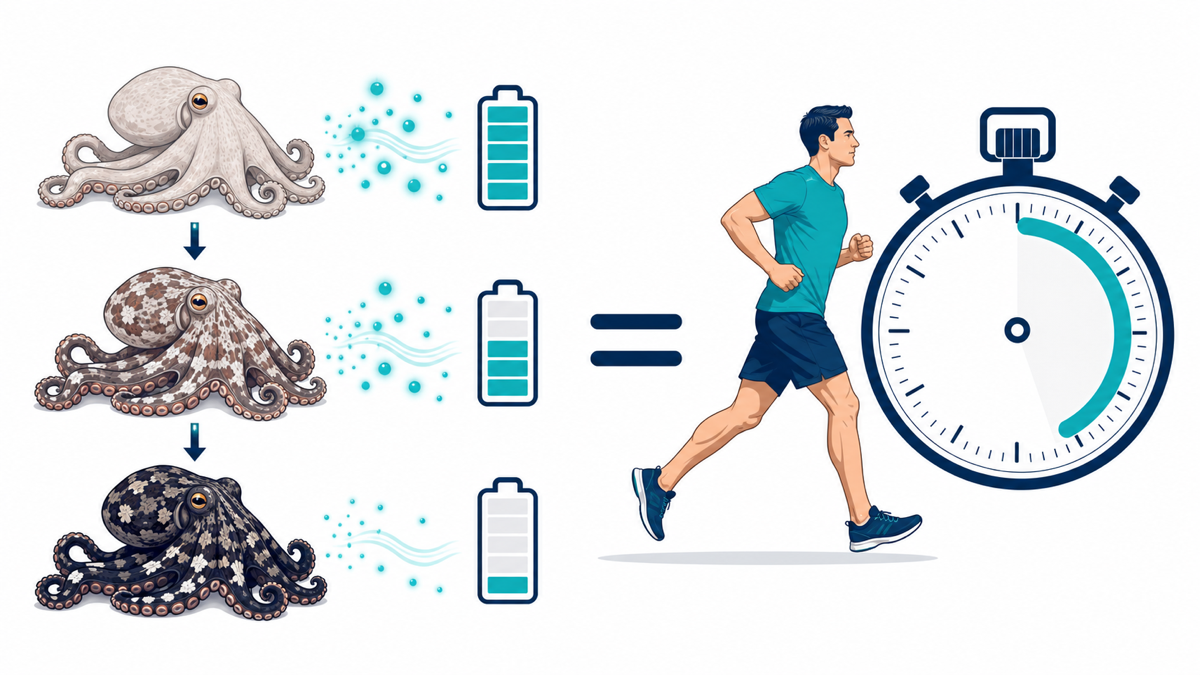
This finding also helps explain why octopuses spend so much of their time hiding in burrows. Because constantly changing color is costly, it's thought that octopuses normally hide in their den waiting for passing prey, reserving camouflage for the moments that truly matter. Behind this flashy shape-shifting ability lies a solid strategy of conserving energy wisely. The more spectacular the ability, the more it seems to be paired with the discipline of knowing exactly when to use it — a reminder of just how deep the design of living things can go.
The fact that color change costs this much energy also matters when considering how environmental changes, such as rising sea temperatures, might affect octopuses. As water temperature rises, metabolism rises too, requiring extra energy just to maintain the body. Add high-cost camouflage on top of that, and it could affect an octopus's stamina and choice of habitat. The workings of tiny cells are connected to the larger issue of a changing ocean environment.
Octopuses "Feel Pain" — And the Law Has Responded
The octopus's high intelligence and sensitivity have also influenced social institutions. In 2021, a research team at the London School of Economics (LSE) reviewed more than 300 scientific studies and concluded that cephalopods including octopuses, as well as decapod crustaceans such as crabs and shrimp, should be regarded as "sentient" beings capable of feeling pain and similar experiences. In response to this report, the United Kingdom added these animals to the protections of the Animal Welfare (Sentience) Act, which took effect in 2022.
Efforts to protect marine creatures depend not only on abilities like camouflage that help animals hide, but also on our own behavior as humans. On the problem of discarded fishing gear that harms octopuses and other creatures, also see our article on ghost fishing gear.
In recent years, plans to farm octopuses for food on a large scale at land-based facilities have also sparked global debate. Is it ethical to keep a highly intelligent, sensitive animal in a confined environment on a mass scale? For us, the octopus is both a familiar seafood staple on our dinner tables and, at the same time, the bearer of one of the most alien and sophisticated intelligences on Earth. How to reconcile these two faces is becoming an unavoidable question when thinking about our relationship with the sea.
A perspective we shouldn't overlook
- Camouflage isn't free — changing body color costs a great deal of energy
- That's precisely why octopuses hide in their dens, reserving camouflage for when it's truly needed
- Cephalopods have been recognized as "sentient beings," and are now legally protected in the UK
Conclusion: What the Ocean's Ninja Can Teach Us
Octopus camouflage turned out to be a remarkably deep phenomenon that the phrase "protective coloration" alone cannot capture. Countless chromatophores lined up in the skin, light-reflecting cells, and even opsins that let the skin itself sense light — together, they produce transformations faster than the blink of an eye. The mystery of how an octopus blends into colors it cannot even see continues to fascinate researchers to this day.
The mimic octopus that plays over 13 roles, Inky who escaped from an aquarium, and the problem-solving ability to use tools and solve mazes — behind all of it lies "another kind of intelligence," entirely different from ours, with roughly 500 million neurons distributed between the brain and eight arms. And behind that camouflage lies a solid strategy of using energy wisely, along with reasons why octopuses should be treated with care as beings capable of feeling pain.
An octopus quietly vanishing into the sea teaches us just how diverse the acts of "seeing," "thinking," and "transforming" can be across life on Earth. The next time you encounter an octopus at an aquarium or by the shore, try imagining what each and every one of its arms might be feeling and thinking in that moment.
Summary of this article
- Octopuses use three layers — chromatophores, iridophores, and leucophores — to change color and pattern faster than the blink of an eye
- Despite lacking color vision, they are thought to blend into background colors through unusual pupils and light-reflecting skin
- Opsin in the skin senses light and triggers chromatophores without going through the brain, in what has been called "seeing skin"
- The mimic octopus is a master of disguise, changing color, shape, and movement to impersonate over 13 species
- Two-thirds of its roughly 500 million neurons are in its arms, giving rise to high intelligence shown through tool use, escapes, and learning
- Changing body color costs a great deal of energy, and cephalopods are increasingly being protected as "sentient beings"
References and sources
- Proceedings of the National Academy of Sciences (PNAS) – Sonner & Onthank (2024) High energetic cost of color change in octopuses
- Journal of Experimental Biology – Ramirez & Oakley (2015) Eye-independent, light-activated chromatophore expansion (LACE) in Octopus bimaculoides
- Proceedings of the National Academy of Sciences (PNAS) – Stubbs & Stubbs (2016) hypothesis on color discrimination in "color-blind" animals via chromatic aberration and pupil shape
- UC Santa Barbara Marine Science Institute (UCSB MSI) – Seeing Without Eyes — commentary on octopus skin's light-sensing ability
- London School of Economics (LSE) – Birch et al. (2021) review of evidence on sentience in cephalopods and decapod crustaceans
- UK Government (GOV.UK) – Lobsters, octopus and crabs recognised as sentient beings (recognition under the Animal Welfare (Sentience) Act)
- National Geographic Japan – The astonishing reason octopuses and squid can change shape and color in an instant
- Nature Digest (Nature Portfolio) – What octopus genomes reveal about the secret of high intelligence
- Forbes JAPAN – Octopus "color change" energy cost equivalent to a "23-minute run"
* Sources are listed in order of reliability: government/academic institutions > peer-reviewed papers > specialized organizations > reputable media