⚡ The answer in 30 seconds
- About 95% of a scallop shell is calcium carbonate, close to limestone, so it can be used as a resource.
- Hokkaido discharges about 200,000 tonnes a year; soil conditioners and drainage material are the main uses, and much remains unused.
- Higher-value products such as chalk and chlorine-free anti-freezing agents are also being made.
- Construction materials are mostly at the research and study stage, with strength and particle-size control as challenges.
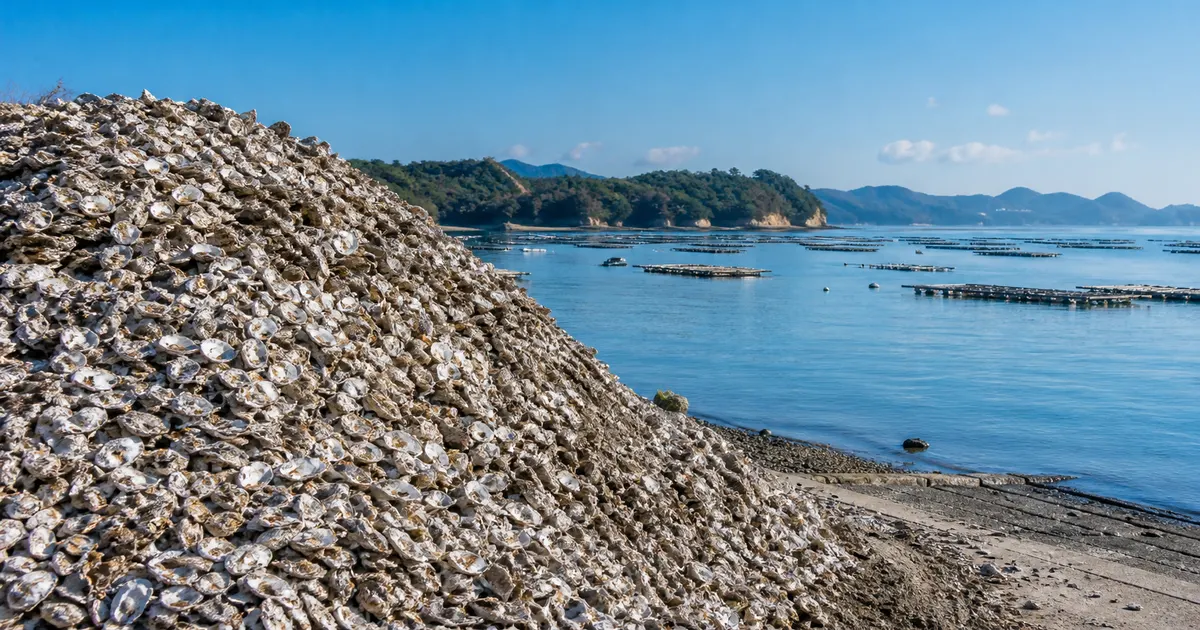
The shells left after eating scallop adductor muscle pile up in huge amounts every year in producing areas. In Hokkaido alone they are said to total about 200,000 tonnes a year, and they were long a troublesome by-product.
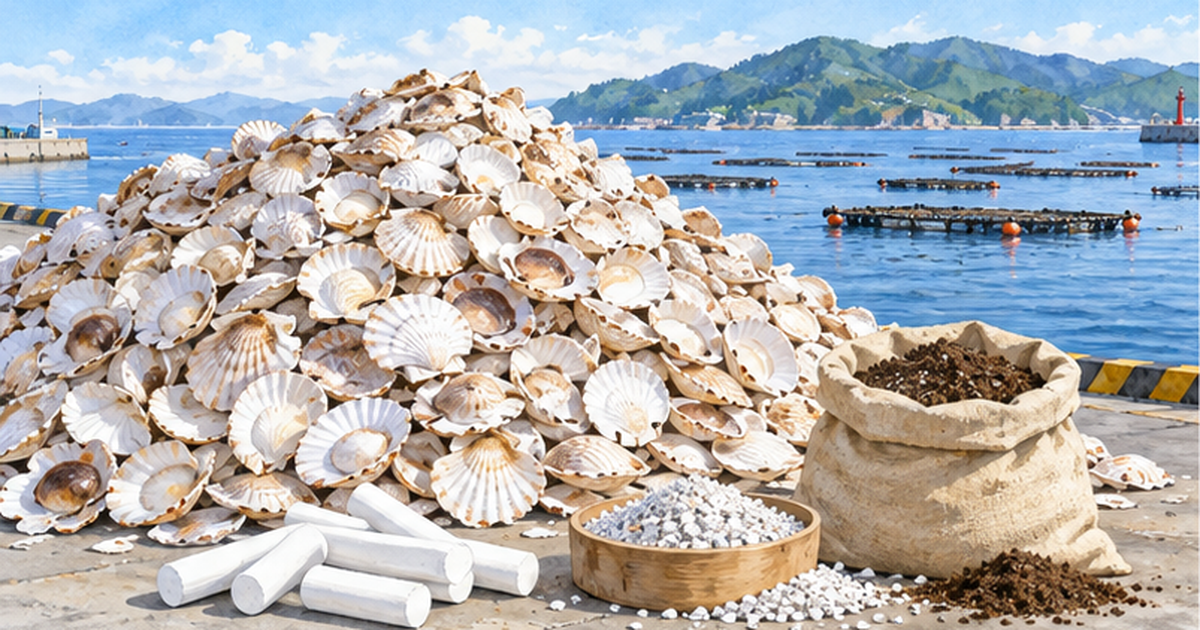
Today these shells are being turned into soil conditioners for farmland, school chalk, anti-freezing agents for winter roads, and a subject of research for construction materials.
This article organizes how each use works, real examples, and the practical limits that keep shells from being a cure-all, based on primary sources.
What you will learn in this article
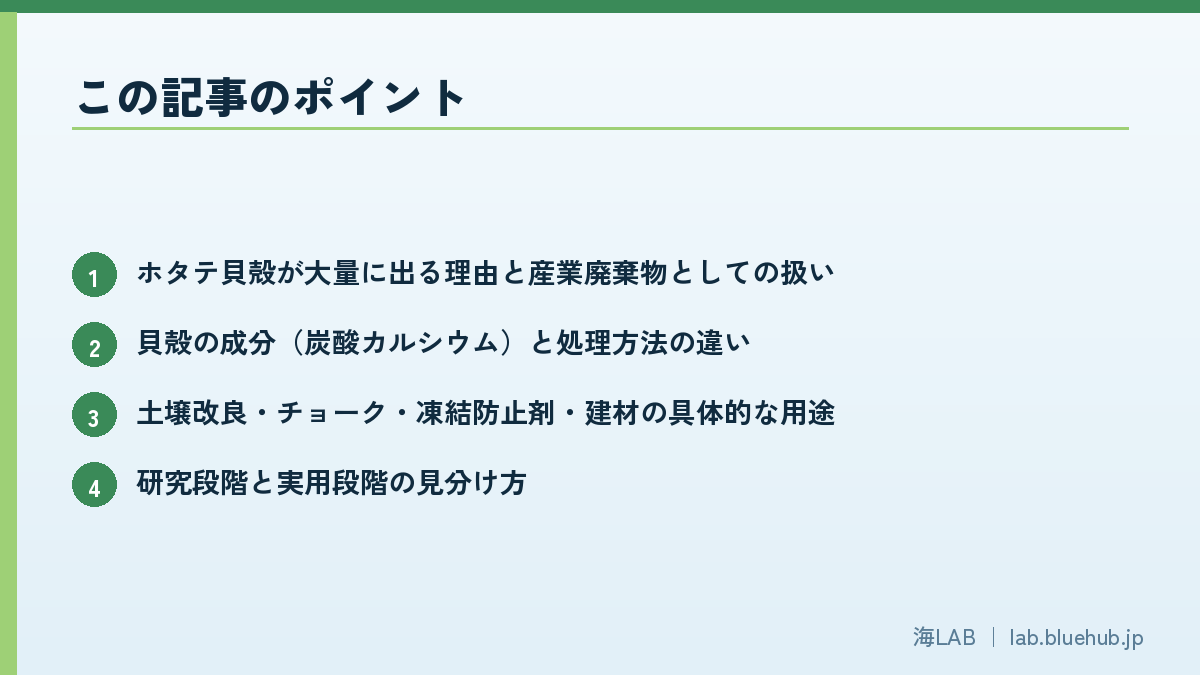
- Why so many scallop shells are produced and how they are treated as industrial waste
- The composition of the shells (calcium carbonate) and how processing methods differ
- Concrete uses: soil improvement, chalk, anti-freezing agents and building materials
- How to tell research-stage uses from practical ones
- How aquaculture troubles relate to shell recycling
Why do scallop shells become "industrial waste"?
A by-product of Japan's top scallop-producing region
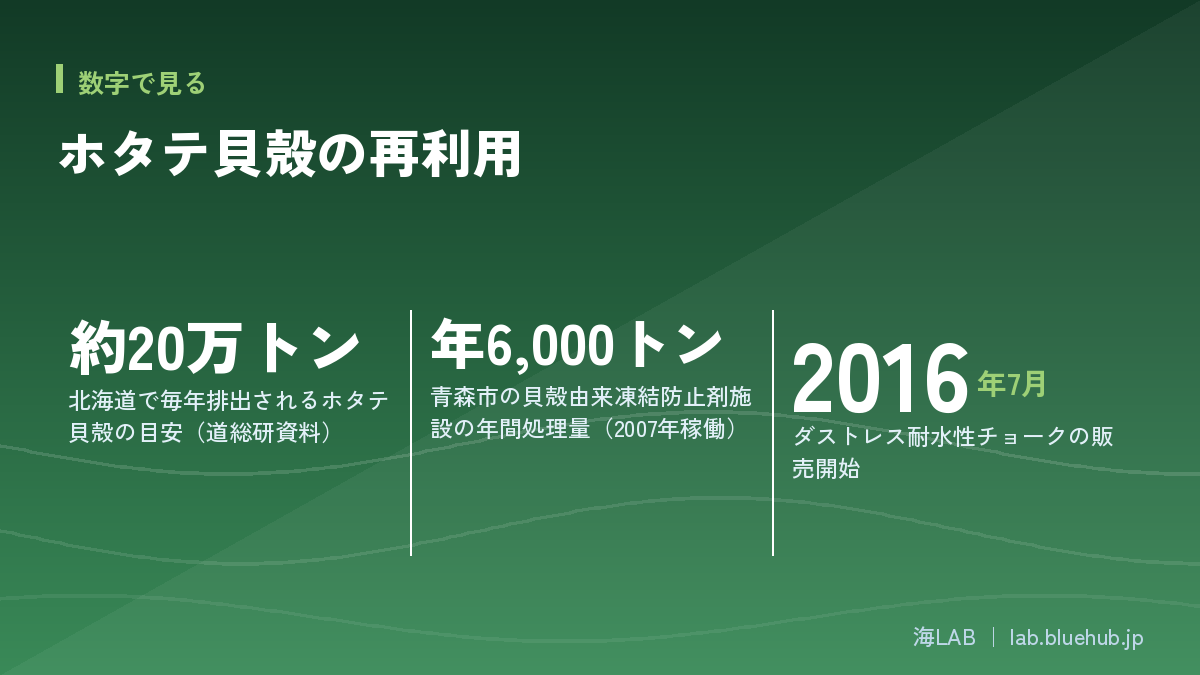
Scallops are landed in large quantities, mainly in Hokkaido and Aomori Prefecture, through aquaculture and seabed release. According to the Ministry of Agriculture, Forestry and Fisheries' 2022 fishery and aquaculture production statistics, scallop production in 2022 was about 510,000 tonnes. This weight includes the shells; the edible meat (adductor muscle and mantle) is only a portion of it.
Shucking is done at processing plants in producing areas, so shells are concentrated in particular port towns. A Hokkaido Research Organization document states that about 200,000 tonnes of scallop shells are discharged in Hokkaido every year. However, the publication year is not stated and landings vary by year, so it is best treated as a rough guide.
Looking by locality shows the concentration clearly. In Sarufutsu Village, Hokkaido, about 40,000 tonnes of shells a year have reportedly been a headache to dispose of. The amount is very large relative to the village's population, and just securing storage space burdens the municipality and fishery cooperative.
Legally treated as "industrial waste"
Shells are generally classed as industrial waste under the Waste Management Act, as animal and plant residue from seafood processing. Processors must therefore pay to have them treated or store them on their own land. In the past, "open piling" on beaches and vacant lots was common, and concerns were raised about scenery, odor and leaching by rainwater.
Why shells are troublesome
- Heavy: shells are hard to lighten, so transport costs add up
- Bulky: with many gaps, piling them up does not reduce volume
- Hard to decompose: the main component, calcium carbonate, does not break down naturally
- Concentrated in time: huge amounts come out in the landing peak
From waste to resource
On the other hand, around 95% of a shell is calcium carbonate, close to limestone. Limestone is one of the few mineral resources Japan can supply itself, and shells can be seen as a "renewable source of calcium carbonate" with similar properties. This view led to varied uses such as fertilizer, chalk, building materials and snow-melting agents.
This article starts from the composition and properties of shells and looks in turn at soil improvement, chalk, anti-freezing and snow melting, construction materials and functional materials made by firing. It then organizes the practical challenges that keep any of them from being a cure-all, and the links to the sea and fisheries.
What matters in understanding the shell problem is that it is both a "waste problem" and a question of "the sustainability of regional industry." The better the scallop catch, the heavier the burden of processing shells. In other words, the more successful the fishery, the larger the by-product problem: the two are two sides of the same coin.
The scallop adductor muscle you see on the dining table is, in the producing area, back to back with a mountain of shells. Knowing this is the first step toward seeing seafood as a "whole."
Composition and properties: a lump of calcium carbonate
Almost the same composition as limestone
Most of a scallop shell is calcium carbonate (CaCO3). The shell has a structure mainly of calcite-type crystals with a small amount of protein (organic matrix). The organic fraction is small, but it can cause a characteristic odor during crushing and firing.
Limestone is also mainly calcium carbonate, so there are many situations in which shells can substitute for it. However, shells contain traces of salt, organic matter and attached barnacles, so pretreatment such as washing, drying and crushing is needed.
Three directions of processing
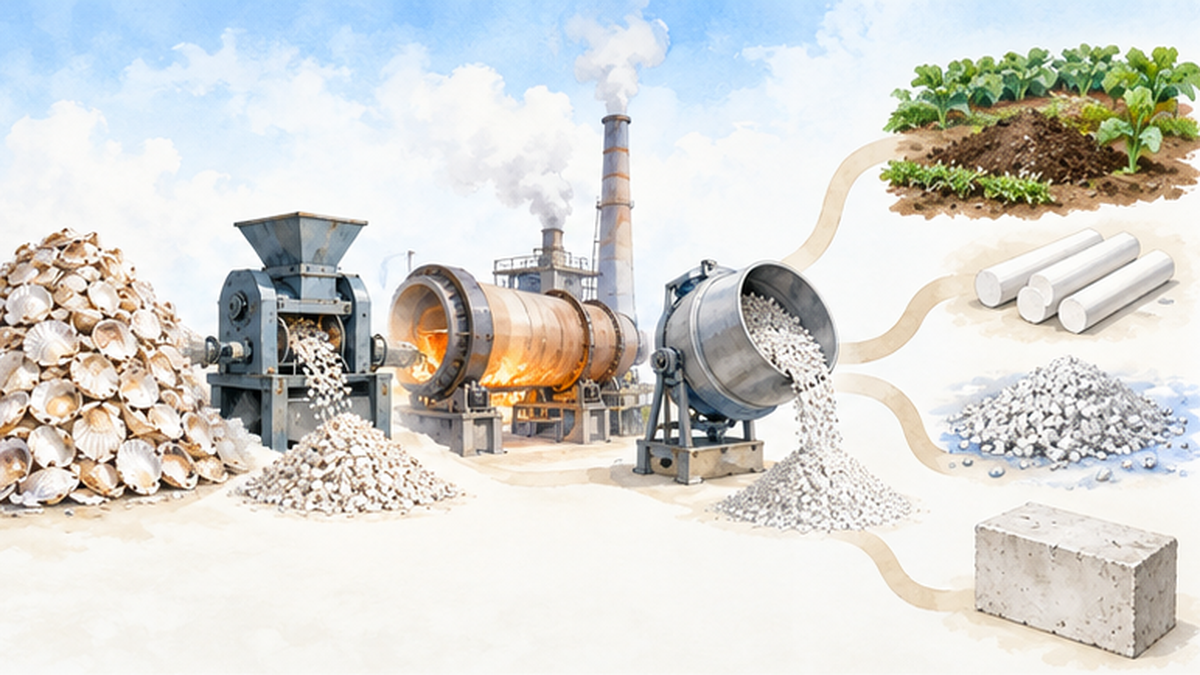
Shell processing falls roughly into three types. One is crushing and using them as they are. The second is grinding finely into powder as a raw material for mixtures. The third is firing at high temperature to change their chemical properties.
| Processing | Description | Examples of main uses |
|---|---|---|
| Crushing (coarse) | Wash and crush, aligning particle size | Drainage material for subsurface drains, candidate paving aggregate, soil improvement |
| Fine grinding | Make into powder as raw material | Chalk, fertilizer raw material, resin filler |
| Firing | Fire at high temperature to convert to calcium oxide, etc. | Antibacterial and deodorizing materials, raw material for snow-melting agents, water purification research |
Firing changes the properties
When shells are fired at high temperature, calcium carbonate releases carbon dioxide and becomes calcium oxide, which reacts with water to form calcium hydroxide. Calcium hydroxide is strongly alkaline and known to have antibacterial action. A report from the Nagasaki Ceramic Industry Technology Center studies the virus-inactivating performance of calcium hydroxide derived from fired shells.
However, firing requires fuel and also emits CO2. The carbon in shells was originally taken from carbonate in seawater, so it is not appropriate to simply say emissions increase. Even so, the energy cost of firing is an important factor when choosing a use.
Agricultural use: soil conditioner and fertilizer
Neutralizing acidic fields and grassland
Japanese soils tend to become acidic because of heavy rain, and farmers have adjusted acidity with lime materials (such as agricultural lime and magnesian lime). Scallop shells are rich in calcium and can serve in place of these lime materials.
A Hokkaido Research Organization report states that compost made by mixing scallop shells with cattle manure has a high calcium content and can be used to correct soil acidity in grassland as a substitute for agricultural lime. Hokkaido has a thriving dairy industry that produces large amounts of manure, so it can combine two regional resources: shells and cattle manure.
Case study in Hakodate: Hokkaido Scallop
Hokkaido Scallop in Hakodate is a company that was established in 2006 and began recycling scallop shells. It removes impurities, crushes the shells, mixes in additives and sells the product as a soil conditioner to farms in Hokkaido and elsewhere, and is reported to have greatly reduced the amount of shells discarded.
Points users should check
- Labeling or registration as a soil conditioner may be required under the Fertilizer Control Act
- Particle size changes how the material acts in soil (fast- or slow-acting)
- Materials with residual salt may affect crops if the recommended amount is not followed
As drainage material for subsurface drains
In subsurface drains (underground drainage facilities) that improve field drainage, shells have been packed in place of gravel or crushed stone as drainage material. Water passes through the gaps between shells, securing drainage. In Hokkaido, use as soil conditioner and drainage material is central and appears to be one of the largest uses by volume.
However, the source also points out that "many shells remain unused and new uses are needed," and in reality agriculture alone cannot absorb all the shells. The next sections look at uses with higher added value.
The idea of returning shells to the soil can also be seen as a cycle that gives back to the land, via the sea, the calcium taken from it. Carrying components of shellfish grown in the sea to farmland is part of the material cycle linking sea and land. However, not every shell can be put into soil unconditionally; management suited to salt content, organic matter and soil properties is a prerequisite.
For farmers, the criteria are the price of the material, ease of spreading and how well it works. For shell-derived materials to be accepted by local farmers, results from actual field trials and information from extension officers and agricultural cooperatives are essential.
Scallop shells turned into chalk: the case of Nihon Rikagaku Industry
Calcium carbonate behind school blackboards
Chalk is made either from gypsum (calcium sulfate) or from calcium carbonate. Hokkaido has an initiative that uses scallop shells as a raw material for the calcium carbonate type. The Bibai factory of Nihon Rikagaku Industry in Bibai, Hokkaido, is reported to have commercialized chalk made from scallop-derived calcium carbonate, used widely including in schools nationwide and sold overseas.
The company is also known for employing people with disabilities, and on the materials side the product is supported by an accumulation of unglamorous steps such as "grinding shells into powder and solidifying it." By balancing particle size and additives, it achieves both ease of writing and resistance to breaking.
Dustless water-resistant chalk
With support from the Hokkaido Industrial Research Institute, "dustless water-resistant chalk" with improved water resistance has been sold since July 2016. In addition to being dustless, it can write on wet blackboards and outdoors. It is useful not only in classrooms but also in places where ordinary chalk is hard to use, such as construction sites, cold storage and outdoor work areas.
What chalk use means
Chalk is a familiar product, but each stick uses little shell, so the total amount of shell it can absorb is not large. Even so, having a "tangible product" made from shells is valuable as an entry point to environmental education for children. If you can explain in front of a blackboard that "this chalk is made from sea shells," students can learn about the cycle of seafood by-products close at hand.
The chalk case also shows that shell recycling rests not on "mass consumption" but on "trust in quality." Shell-based products continue to be chosen by meeting the fine demands of schools, such as particle fineness, whiteness and resistance to breaking.
Protecting winter roads: snow-melting and anti-freezing agents
From chloride-based to chlorine-free
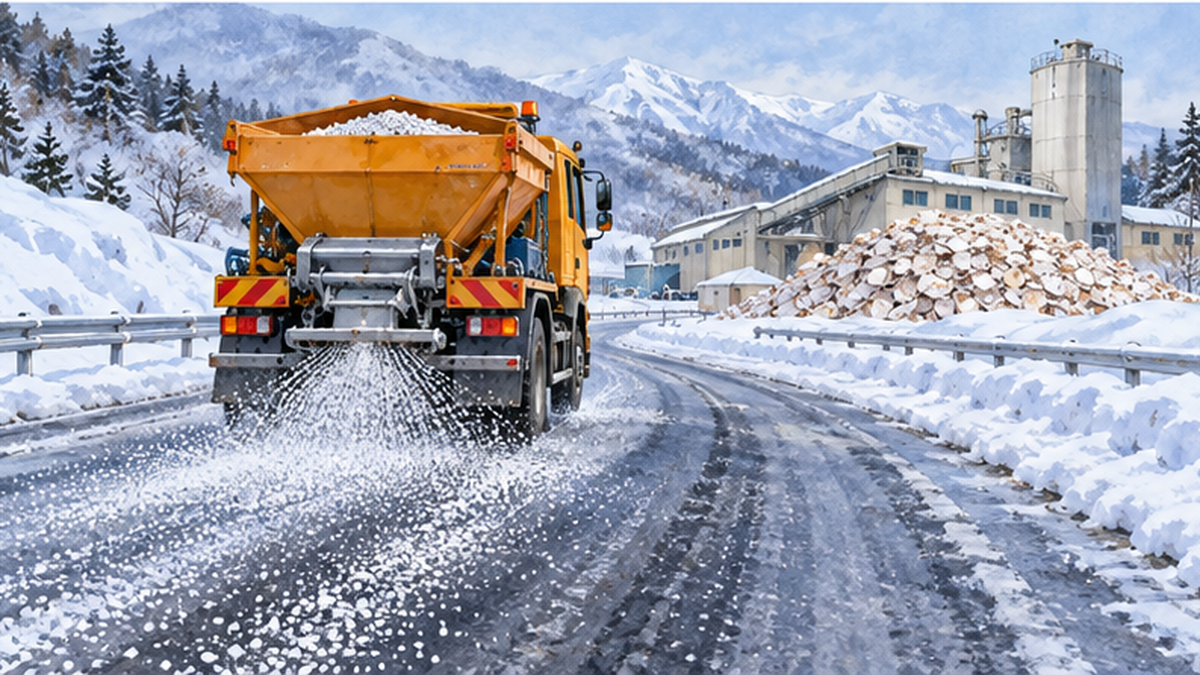
Sodium chloride and calcium chloride have long been used to prevent road freezing. But chlorides cause problems such as corrosion of vehicles and bridge rebar, salt damage to roadside trees and surrounding soil, and runoff into rivers. Hence the demand for anti-freezing agents that contain no chlorine.
In Aomori City, a plant producing chlorine-free anti-freezing agents (granular and liquid) from scallop shells began operating in 2007, with an annual processing capacity listed as 6,000 tonnes. Aomori Prefecture has thriving scallop aquaculture in Mutsu Bay, and a feature is that local shells can be turned into resources on the spot.
How does it work?
Calcium oxide obtained by firing shells gives off heat when it reacts with water. Reacting it with organic acids such as acetic acid to form calcium acetate is also expected to lower the freezing temperature. Using this mechanism, materials that melt road ice and snow have been developed.
Points to watch
They are said to be less corrosive than chloride types, but prices tend to be higher, and spreading amounts and durability of effect need to be evaluated. Firing also uses energy, so road administrators must compare cost, performance and environmental load as a whole. It is important not to dismiss them as simply "eco-friendly" but to verify them under each condition of use.
In cold regions, demand for freeze prevention arises almost every year. This stable demand is a tailwind for shell-derived materials. On the other hand, use falls in low-snow years, so as a business it is exposed to the weather.
Possibilities and limits as construction material
Can it replace aggregate?
Concrete is made from cement, water, and gravel and sand (aggregate). Sand and gravel are taken from rivers and the sea, but obtaining them is getting harder every year for reasons of environmental protection and resource depletion. Shells are mainly calcium carbonate and have properties similar to limestone aggregate, so they have been studied as a substitute.
A Penta-Ocean Construction document points out that the main component of shells is very similar to limestone aggregate. On the other hand, concrete with shells mixed in as they are tends to have low strength and is considered unsuitable for civil engineering structures; crushing them for use as fine aggregate is assessed as technically more reasonable.
Directions shown by research
Research at Hokkaido University of Science discusses uses of fired, powdered scallop shells such as chalk, sand substitute, and aggregate for concrete and mortar. In other words, the key is not to "mix them in as they are" but to "shape them and adjust their properties before use."
| Method | Expected benefit | Challenge |
|---|---|---|
| Mixing coarse shells in as they are | Direct use of waste | Lower strength; unsuitable for civil structures |
| Crushed for fine aggregate | Sand substitute; strength adjustable | Cost of particle-size control and washing |
| Permeable pavement and roadbed material | Structure that lets water pass suits shells | Load-bearing performance must be verified |
Returning to the sea: wave-dissipating blocks and more
In Sarufutsu Village, upcycling such as wave-dissipating blocks made from shells has been introduced. Use in the form of coastal structures that return to the sea is attractive because the shells' origin stays within the region. However, the attachment of organisms, strength and the effect on the installation site's environment must be assessed individually.
Distinguish "commercialized" from "research stage"
Many uses as construction material are at the research or demonstration stage, and we could not confirm that they are widely distributed as commercial building materials. Even when an article or advertisement says "put to practical use," it is important to check the scale and conditions.
The economics of shell recycling: why "usable" does not mean "used"
A material whose price rises as you transport it
Shells are heavy and bulky, so costs grow with transport distance. When carried to a demand area far from the producing area, freight can exceed the value of the shells themselves. For this reason, destinations tend to be limited to near the producing area, and "local production for local consumption" of shells is the basis.
Even among calcium carbonate raw materials, limestone mined from quarries is supplied in large volumes at low cost. To compete with limestone, shells need added value that exceeds the effort of washing, drying and crushing. The attention given to chalk, anti-freezing agents and functional powders reflects this effort to create value.
Who bears the processing cost?
Shell processing costs are often borne by processors, fishery cooperatives and municipalities, and success depends on whether recycling eases that burden. Finding a reuse destination lowers processing costs and keeps product sales in the region. Conversely, in areas with few destinations, piled-up shells must keep being stored.
| Perspective | Challenge | Direction of ingenuity |
|---|---|---|
| Transport | Heavy; high freight | Plants near producing areas; consumption within the region |
| Pretreatment | Washing, drying and crushing cost money | Shared processing facilities; automation |
| Demand | Cheap competitors such as limestone | Developing high-value uses |
| Supply | Fluctuating landings | Designs that combine multiple raw materials |
Building circulation within the region
In many successful cases, municipalities, fishery cooperatives, processors, research institutes and companies work together. For example, a prefectural test station gives technical support, a local company makes the product, and municipalities and schools buy it. Rather than one company trying to solve it alone, sharing roles across the region is especially important in shell recycling.
For businesses handling shells, stable quality leads to trust. Steady management such as removing attached matter, controlling salt and making particle size uniform supports buyers' confidence. Raising quality in current uses before seeking new ones is also a condition for a lasting cycle.
Cautions when reading statistics and figures
The amount of shells generated and the utilization rate differ by source in year, coverage (Hokkaido only, one locality only, etc.), and whether they are wet or dry weight. The figures introduced in this article are also guides based on Hokkaido Research Organization documents and press reports, not national official statistics. When comparing articles and documents, it is important to check what range a number refers to.
Challenges in producing areas: aquaculture troubles and the fate of shells
Rising water temperature shakes aquaculture
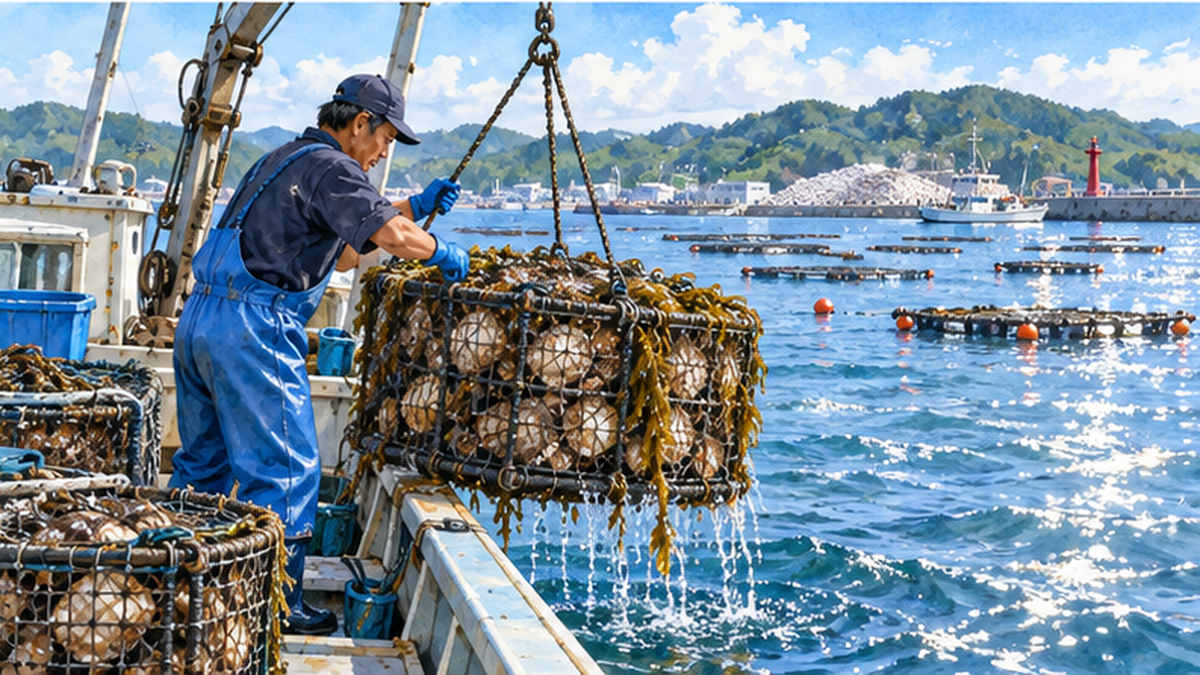
The supply of shells depends on scallop landings. In recent years, however, mass die-offs of scallops due to high water temperatures have occurred repeatedly in Mutsu Bay, Aomori Prefecture. A Kyodo News report from August 2026 says production that once exceeded 100,000 tonnes in good years is expected to fall to about 10,000 tonnes this year.
This affects not only the livelihoods of producing areas but also the resource cycle of shells. If shells decrease, securing raw material for recycling facilities becomes difficult. On the other hand, the disposal burden also eases, so the situation is complex and cannot simply be called good or bad. This is the author's organization of press reports, and we could not confirm any document that quantifies the effect on the amount of shells generated.
Can shells be returned to the sea?
The possibility that shells serve as habitat for organisms and take part in adjusting the carbonate system of seawater is being studied. In cases using oyster shells, a different shellfish, efforts such as collectors for aquaculture, fishing ground creation and water purification have been carried out. Similar attempts to use scallop shells as base material for seaweed beds and fishing grounds are being considered.
However, putting them into the sea requires attention to fishing rights, laws on preventing marine pollution and assessment of the effect on fishing grounds. For oyster shell cases, our site's Complete Guide to Oyster Shell Recycling is also helpful.
Comparison with other areas such as Sanriku
Regions with thriving seafood aquaculture, such as scallops, oysters and wakame seaweed, each have their own by-products. The path of reconstruction and the resumption of aquaculture in Sanriku is explained in The Path of Sanriku's Fisheries Recovery. Using by-products is tied to the sustainability of the region's fishery as a whole.
What we can do: choosing to support the shell cycle
Participating by choosing products
What ultimately supports turning shells into resources is demand from consumers, municipalities and companies that choose products. Everyday choices add up: choosing chalk for schools, using soil conditioners in gardening, supporting municipalities that adopt snow-melting agents.
Three things you can do from today
- Look for shell-derived chalk and similar items among school or office supplies
- When eating scallops, find out where the shells go (some municipalities and producing areas publish this)
- Learn about efforts by companies and municipalities that handle seafood by-products and share them with others
A viewpoint for judging "eco-friendly"
Reusing by-products is important, but considering transport distance, processing energy and comparison with other materials, it is not always optimal. It helps to look at three points: cycles that close within the region, the balance of price and performance, and durability.
For seafood processing residues in general, see also Turning Seafood Processing Residues into Resources for details. Even when the types of by-products differ, such as fish bones, skin and shells, the challenges and ingenuity have much in common.
Summary
Scallop shells are a large by-product, said to total about 200,000 tonnes a year in Hokkaido, and varied uses are being tried, including soil improvement, chalk, freeze prevention and construction materials. Each has strengths and limits, and there is no all-purpose answer. That is why it matters to combine uses and build the optimal cycle for each region.
Summary of this article
- Around 95% of a shell is calcium carbonate and can be used as a resource
- Uses are varied: soil improvement, chalk, anti-freezing agents and aggregate
- Many construction material uses are at the research or demonstration stage; conditions must be checked
- Aquaculture troubles may also affect the supply of shells
References and sources
- Hokkaido Research Organization: document on scallop shell compost – Compost of shells and cattle manure; use for correcting grassland acidity
- Hokkaido Research Organization: dustless water-resistant chalk – Development of chalk derived from scallop shells
- MAFF: Fishery and Aquaculture Production Statistics – Scallop production statistics
- Forbes JAPAN: shell upcycling in Sarufutsu Village – About 40,000 tonnes of shells a year and their use
- MONOist: Furukawa Electric "Furusato Trough" – Example of scallop shell use
- Nagasaki Ceramic Industry Technology Center research report – Performance of calcium hydroxide from fired shells
- MLIT Tohoku Regional Development Bureau document – Study of shell use in roads and construction
* Ordered by reliability: government agencies and academic institutions > peer-reviewed papers > specialist organizations > reliable media