
⚡ In short
Why does the sound of waves or birdsong feel so calming? This article explores what soundscape research reveals about the effect of natural sound on the autonomic nervous system, and the latest findings on how the "sound" of a healthy coral reef helps the ocean recover.
The sound of waves, birdsong, the rustle of trees — why do these natural sounds feel so pleasant to us, sometimes calming us to the point of tears? In recent years, soundscape research has been rapidly advancing, treating this sensation not as a mere matter of mood but as a measurable physiological response.
This research isn't limited to sounds on land. It has become clear that a healthy coral reef has its own lively "soundscape" made up of the sounds fish and shrimp produce, and that this sound serves as a cue larvae use to choose where to settle. Conversely, a degraded coral reef falls silent, trapping it in a vicious cycle in which marine life becomes less likely to return.
This article presents the scientific evidence for how natural sound affects the human autonomic nervous system, along with the latest research findings on how sound in the ocean shapes ecosystem recovery — all drawn from primary sources.
What you'll learn from this article
- What soundscape research is
- How the sound of waves and birdsong affects stress and the autonomic nervous system
- Why healthy coral reefs have their own distinctive "sound"
- The latest techniques for restoring degraded coral reefs with underwater speakers
- How human-made underwater noise affects marine life
- Practical tips for bringing natural sound into daily life
What Is Soundscape Research?
The word "soundscape," coined by analogy with "landscape," refers to the total sound that fills a given place. Canadian composer R. Murray Schafer proposed the concept in the 1970s, popularizing the view that environmental sound should be treated not as "noise" to be eliminated, but as a source of information for understanding an environment. Until then, sound had often been lumped together as "noise that should be quieted," but Schafer believed that sound, like landscape, has a rich structure that reflects a place's character and health.
This idea isn't simply about collecting "pleasant sounds." It's used as a way of documenting environmental change itself — comparing what sounds a forest once had, or how quiet a coastline has become. In other words, a soundscape is another way of recording an environment, much like a photograph or a map.
Three Layers: Biophony, Geophony, and Anthrophony
Researchers broadly divide sound sources into three categories: "biophony," sound produced by living things (birdsong, insect sounds, the sounds of fish and shrimp, and so on); "geophony," sound from wind, waves, thunder, and other physical sources; and "anthrophony," sound made by humans (traffic noise, ship engines, and the like). These three layers overlap to create something like a sonic fingerprint unique to a given place.
Bioacoustician Bernie Krause has pointed out that in healthy ecosystems, diverse species skillfully divide up frequency bands and times of day so that their sounds don't overlap — a kind of "acoustic partitioning." This idea is known as the "acoustic niche hypothesis," which holds that even when birds, insects, and frogs are all calling at once, each uses a different frequency band to avoid colliding with one another's signals. Conversely, when human-made noise disrupts this delicate partitioning, it may interfere with communication between species.
Terms to know
- Biophony: sound produced by living organisms
- Geophony: sound from physical sources such as wind, waves, and thunder
- Anthrophony: human-made sound from traffic, construction, ships, and the like
- Acoustic niche hypothesis: the idea that species coexist by dividing up frequency bands
Sound as an Indicator of Environmental Health
In recent years, researchers have also been developing an "acoustic diversity index" that quantifies the diversity of sound at a given location to assess ecosystem health. Ecosystems that are rich in species and structurally complex tend to have a greater variety of calls, sounds, and frequency bands, while this diversity is reported to be poorer in places where environmental degradation has progressed. One advantage of sound is that it can continuously record the activity of nocturnal animals that cameras miss, as well as the presence of organisms hidden underground or underwater.
These acoustic indicators are also beginning to be used as a way to monitor, over the long term and at fixed points, how ecosystems change due to deforestation and climate change. By comparing recordings from the same location every few years, it has become possible to capture environmental degradation or recovery that is hard to see — as data you can hear.
How Waves and Birdsong Affect the Autonomic Nervous System
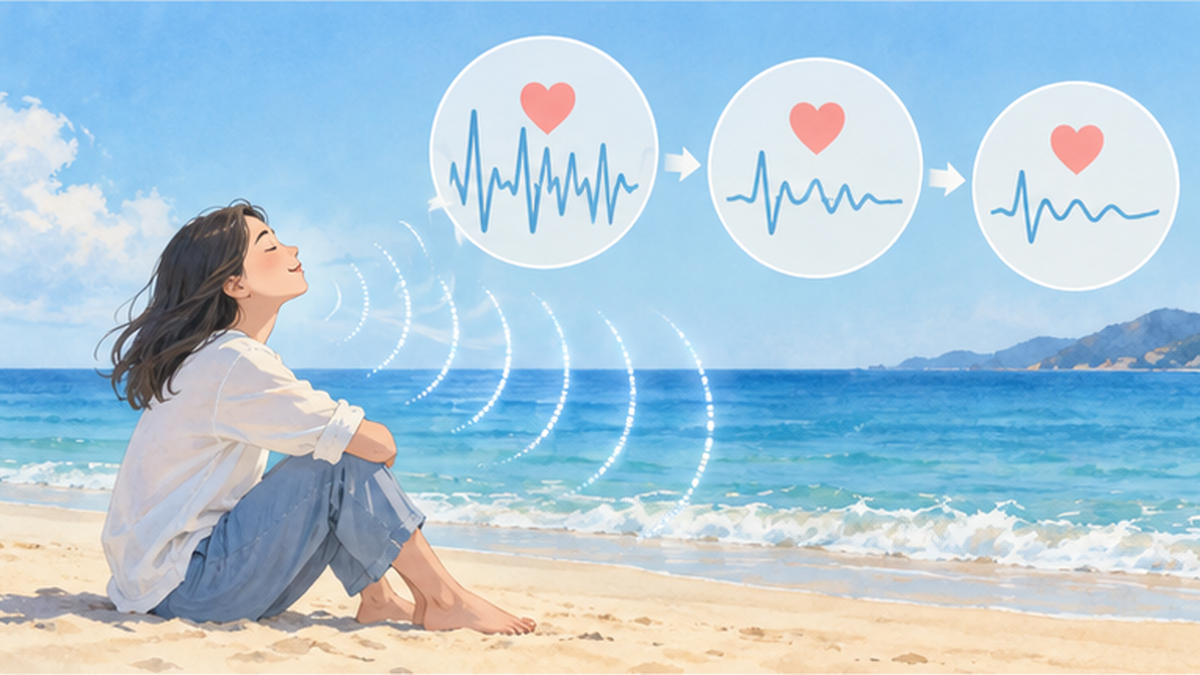
The stress-reducing effect of natural sound has been backed up by multiple experiments. A systematic review and meta-analysis published in 2024 confirmed that listening to natural sounds lowers heart rate, blood pressure, and respiration rate more effectively than simply resting in silence. Because this type of review integrates and analyzes the results of multiple existing studies, its conclusions are considered more reliable than those of any single experiment.
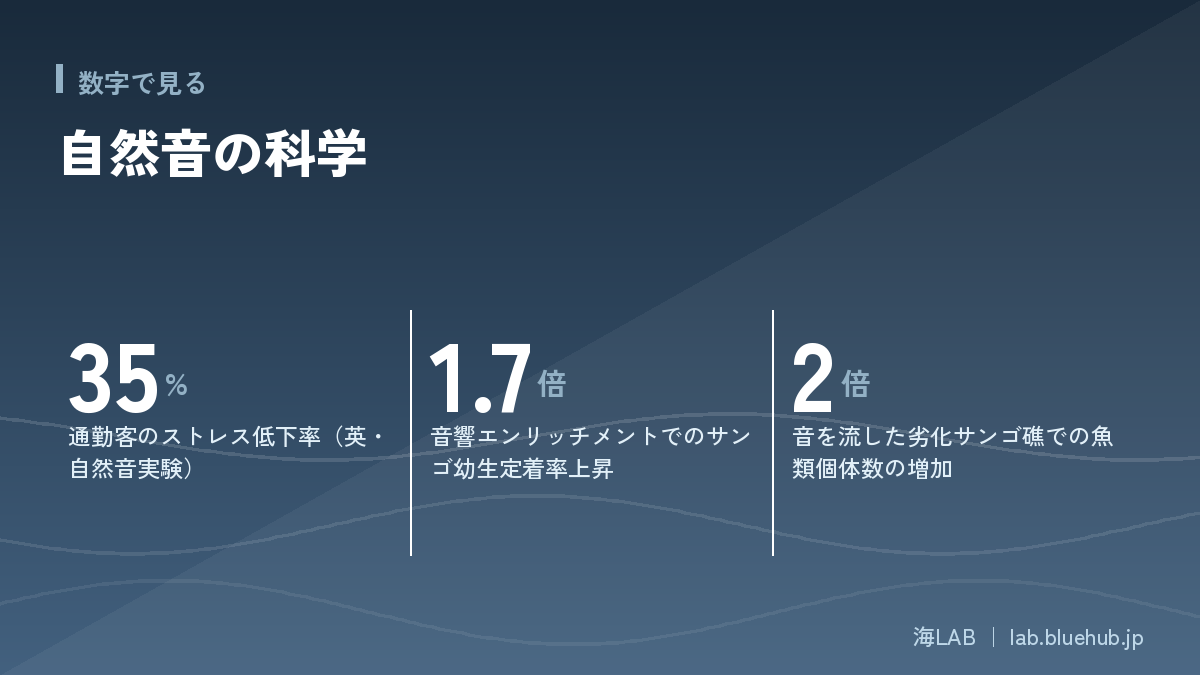
In an experiment conducted in 2024 by the UK rail operator South Western Railway, natural sounds — birdsong, a babbling stream, and rain — were played inside commuter trains, and commuters' stress levels reportedly dropped by 35%. It's notable that even in an environment full of stressors like crowded trains and delays, simply changing the soundscape produced a measurable shift in psychological state.
Different Sounds, Different Effects
Not all natural sounds work the same way. Research shows that the sound of water (waves, a babbling stream) has a strong effect on boosting "calm and serenity," while birdsong is especially effective at "reducing stress and irritability." One experiment found that listening to birdsong for just six minutes reduced anxiety and irritability.
On the other hand, some research shows that birdsong doesn't have a uniform effect. One study conducted in an urban park found no clear stress-recovery effect from playing birdsong, suggesting that the outcome may depend not just on the type of sound but on the context of where it's heard and how it combines with existing ambient sound. Rather than concluding that "playing natural sound always works," it's worth keeping in mind that the size of the effect varies with the conditions.
What fMRI Reveals About the Brain
Studies using functional MRI (fMRI) have shown that listening to the sound of waves increases activity in the parasympathetic nervous system (which governs rest and digestion) as well as in the brain's "default mode network." The default mode network is a set of brain circuits that becomes active during rest, when not focused on any particular task, and is thought to be involved in introspection and memory consolidation. This is said to stand in contrast to artificial sound stimuli, which activate the neural systems involved in the fight-or-flight response.
In other words, natural sound can be interpreted not as forcing the brain into tension, but as encouraging a switch into the "rest" mode the brain already has built in. Deliberately setting aside time to listen to natural sound amid a busy daily routine may function not merely as a mood booster, but as a switch that shifts the state of the brain itself.
Use in Medical Settings
The calming effect of natural sound is also being explored for use in medicine. There are reports that playing natural sound during procedures and examinations eases patients' pain and anxiety, drawing attention as a drug-free, supplementary way to relieve stress. It has been suggested that directing a patient's attention toward sound, especially during the wait before or during a painful procedure, may reduce how much subjective distress they experience.
A practical advantage is that in places like hospitals and care facilities, which aren't necessarily blessed with a natural environment, playing recorded natural sound can reproduce a certain degree of the effect. Even without actually being out in nature, the brain and autonomic nervous system appear to respond to some extent to sound information alone.
What Japanese Research Shows About Natural Sound
Research verifying the physiological effects of natural sound is also being conducted in Japan. A study examining autonomic nervous system function during exposure to natural sound reported that listening to natural sound changes the balance of the autonomic nervous system in a way that appears to enhance the body's own capacity for recovery. The experiment evaluated multiple physiological measures together — including heart rate variability, skin temperature, and physical flexibility — a notable feature being its attempt to capture the effects of natural sound from multiple angles rather than relying on a single indicator.
The Relaxing Effect of Insect Sounds
A survey conducted by a research group at Chiba Institute of Technology found that the sounds of chirping insects produce a relaxing, reassuring psychological recovery effect. Japan has long had a culture of appreciating insect sounds as "voices," and it has been suggested that this cultural background may overlap with the physiological effect. Some reports note that in certain language communities overseas, insect sounds are processed simply as noise — a reminder that cultural learning also plays a role in how sound is perceived.
The chirping of insects, which changes with the seasons — cicadas in summer, bell crickets and crickets in autumn — has long served the Japanese as an important source for sensing the changing seasons. It's thought that this accumulated, largely unconscious habit of receiving such sounds as a "seasonal message" may also function, even in today's stressful society, as a cue that helps calm the mind.
Effects on Sleep and Concentration
The effects of natural sound go beyond relaxation. Sounds with a steady rhythm, such as waves or a babbling stream, are widely used as ambient sound to promote falling asleep, and are also popular as background music for study or work. Some researchers point out that natural sound, which has a rhythm but isn't perfectly regular — a quality often described as "fluctuation" — carries just the right amount of information: not so monotonous nor so stimulating that it disrupts concentration.
Key points to remember
- The sound of water is strongly linked to "calm," while birdsong is strongly linked to "reducing stress and irritability"
- Even brief exposure to natural sound, around six minutes, has shown measurable effects
- In Japan, the relaxing effect of insect sounds has also been studied
- The size of the effect varies depending on the type of sound and the listening situation
The Connection Between Forest Bathing and Sound
"Forest bathing," which originated in Japan, is also an essential part of any discussion of the effects of natural sound. Much of the research verifying the effects of forest bathing has focused on scent compounds (phytoncides) and the visual effect of greenery, but in recent years it has also been suggested that auditory elements — the rustling of trees, birdsong — may contribute to reducing cortisol, a stress hormone. It's thought that the combined action of sight, smell, and hearing produces a greater relaxing effect than any single sensory stimulus alone.
These findings are also part of an effort to scientifically verify, sense by sense, the effect of simply "being out in nature." By isolating and testing sound alone, researchers are beginning to reveal whether the benefits of a natural environment can still be obtained even without visual information — for example, with eyes closed, or at night.
The Ocean Has Its Own "Soundscape" Too
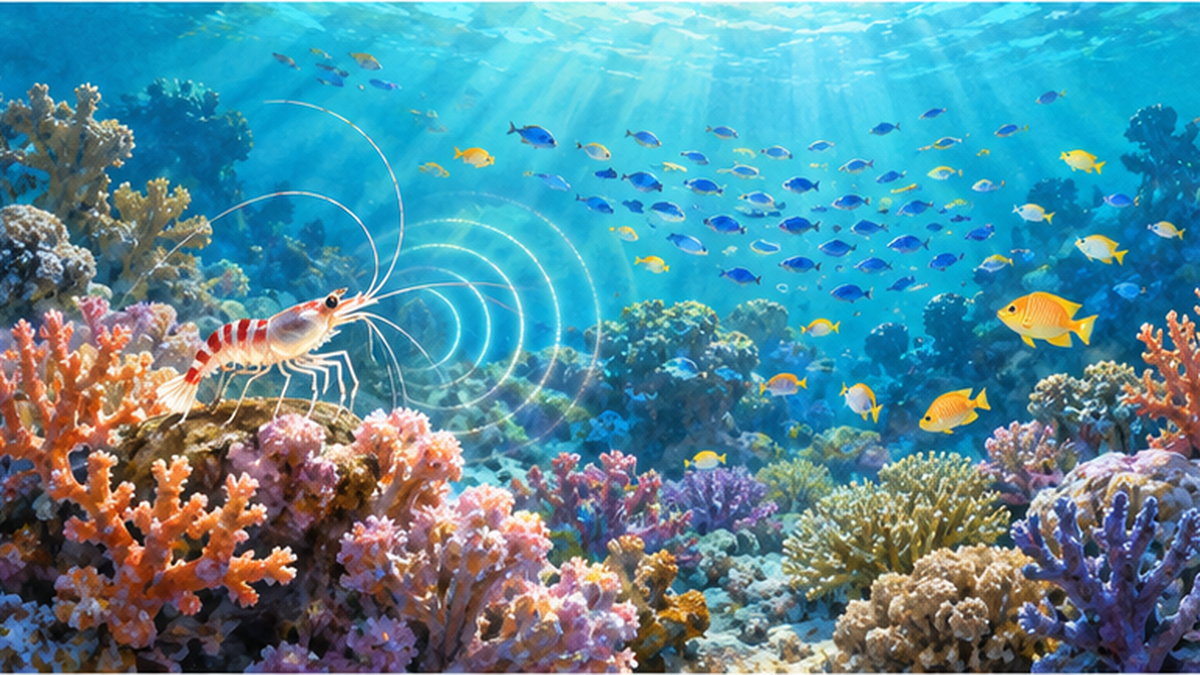
The effect of sound isn't limited to life on land. The ocean isn't silent either: a healthy coral reef forms its own lively soundscape made up of the sounds produced by fish and shrimp — including pistol shrimp. Pistol shrimp produce a distinctive crackling noise from the cavitation bubbles created when they snap their claws shut, and this is known to account for a large part of a coral reef's background sound.
Groups including the Japan Agency for Marine-Earth Science and Technology (JAMSTEC) have reported findings that drifting plankton larvae use this kind of soundscape as a cue to decide where to settle. Many marine organisms, immediately after hatching, spend anywhere from several weeks to several months drifting on ocean currents before searching for and settling in a suitable location. Recent findings suggest that alongside vision and chemical cues, sound is also used as one important cue in that process.
Degraded Reefs Fall "Silent"
A coral reef degraded by bleaching or overfishing loses the sounds of its inhabitants and falls silent. Fish and coral larvae then stop choosing it as a place to settle, further delaying the ecosystem's recovery — a vicious cycle. Researchers call this "soundscape degradation." Even if the reef's physical shape visually remains, without the sound that signals the presence of life, it ends up being passed over by larvae as "not worth living in."
Observing Deep-Sea Soundscapes
JAMSTEC has conducted baseline soundscape observations on the deep seafloor around Japan, including at Suiyo Seamount and off Minami-Torishima, revealing differences such as hydrothermal vent fields being rich with natural background sound while the deep-sea plains remain quiet. In hydrothermal vent fields, the sound of the venting itself overlaps with the activity sounds of the organisms gathered there, forming a distinctive acoustic environment.
Meanwhile, human-made noise from activities such as seabed resource development is estimated to sometimes exceed the natural background sound of hydrothermal vent fields by around 100 dB in sound pressure level, raising concern that it may become harder for plankton larvae to detect natural sound. A difference of 100 dB corresponds to roughly a tenthousand-fold difference in sound intensity, suggesting that natural signals could be drowned out by human-made noise.
Reef Sound Changes With the Season and Time of Day
A coral reef's soundscape isn't constant — it has been observed to change with the time of day and the season. Many fish and shrimp become more active at dawn and dusk, and on some reefs volume increases during these hours in a "chorus"-like pattern. It's also known that during spawning season, certain fish species produce courtship sounds different from their usual calls; by continuously recording sound, researchers may be able to detect breeding rhythms and activity patterns in marine life that are difficult to capture through visual observation alone.
"Acoustic Enrichment": Restoring Coral Reefs With Sound
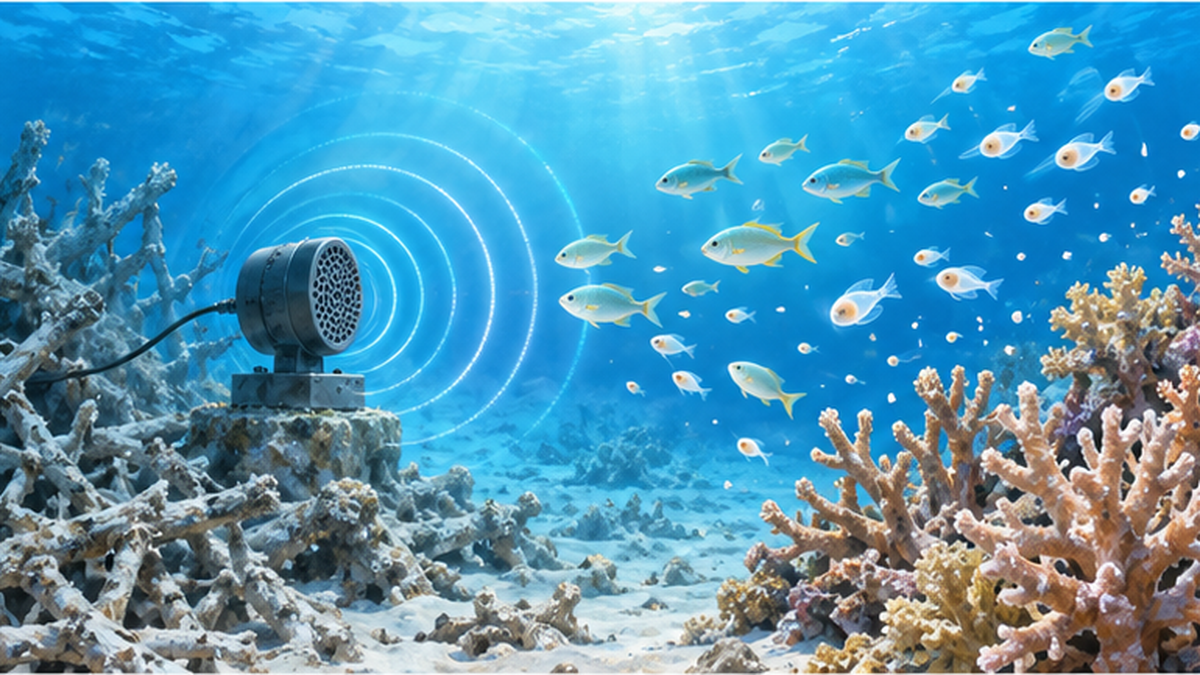
Research is advancing on a technique called "acoustic enrichment," which turns this property — that sound calls life back — to advantage, by installing underwater speakers on a degraded coral reef to play recordings of a healthy reef and support ecosystem recovery. Traditional coral reef restoration has centered on the physical work of transplanting coral fragments, but acoustic enrichment is drawing attention as an approach that complements existing methods by actively drawing in fish and coral larvae.
In a field experiment published in the journal Nature Communications in 2019, researchers installed underwater speakers on part of a degraded coral reef and played recordings from a healthy reef for six weeks. As a result, fish community development was accelerated on the plots where sound was played, with population numbers increasing across every major trophic level, including herbivorous, carnivorous, and planktivorous fish.
What's interesting is that it wasn't just the number of fish that increased. The research team confirmed that species richness also rose on the plots that received acoustic enrichment, showing that rather than attracting only certain species, a more complex and stable ecosystem foundation was being built as diverse species settled in. An increase in algae-eating fish could also help curb excessive algae growth, contributing to an environment where coral can grow back more easily.
| Subject studied | Result | Source |
|---|---|---|
| Fish community on degraded reefs | Overall population roughly doubled, species count rose about 1.5x | Nature Communications (2019) |
| Larvae of the reef-building coral Porites astreoides | Settlement rate averaged 1.7x higher (up to 7x) on acoustically enriched plots | Royal Society Open Science (2024) |
| Larvae of an endangered coral species | Settlement rate remained higher than the control even 30m or more from the speaker | Paper on PMC (reported 2025) |
Helping Coral Itself Settle
A 2024 study showed that sound affects not only fish but the larvae of coral itself. In an experiment involving Porites astreoides, a species of reef-building coral, larval settlement rates on acoustically enriched plots averaged 1.7 times higher than the control, and up to 7 times higher at peak. A higher coral settlement rate could have knock-on benefits for the reef's subsequent skeletal growth and the recovery of biodiversity.
Range and Limits of the Effect
The effect of acoustic enrichment has also been confirmed to weaken with distance from the speaker. Settlement rates decline with distance from the speaker, but according to some reports, settlement rates remained higher than in the untreated control even 30 meters or more away. This suggests that, if speakers are positioned with their effective range in mind, a relatively large area could be covered.
At the same time, the technique has its limits. Installing and maintaining underwater speakers requires a power source and ongoing equipment maintenance, and covering an entire, vast coral reef would take considerable cost and effort. Nor can sound alone fully restore an ecosystem — unless underlying stressors such as rising water temperatures and ocean acidification are addressed, the larvae drawn in may not survive over the long term. Researchers position acoustic enrichment not as a cure-all, but as a supplementary tool to be combined with other restoration methods.
How acoustic enrichment works
- Underwater speakers are installed on the seafloor of a degraded coral reef
- Recordings of fish and shrimp sounds from a healthy reef are played back
- Larvae and juvenile fish searching for a place to settle are drawn in by the sound
- The resulting increase in fish population also helps coral growth and curbs algae overgrowth
- The effect persists to some degree even 30 meters or more from the speaker
What It Takes to Protect the Sound of the Ocean
While acoustic enrichment holds promise, the fundamental challenge is that human-made noise in the ocean keeps increasing. The sound of ship traffic and seabed resource development may interfere with the ability of marine life to communicate through sound or to search for a place to settle. Rising global shipping volumes and activities such as sonar and seismic surveys have been quietly but steadily pushing up the ocean's background noise level.
For marine mammals such as whales and dolphins, which communicate using sound, human-made noise is also studied as a serious problem. In noisy waters, these animals have been observed changing the timing and volume of their calls in response, suggesting that changes in the acoustic environment affect their behavior directly.
Sound is also an important source of information for fish. Many fish use their inner ear and lateral line to sense surrounding sound and water movement, using this information to track the position of other fish, detect predators, and search for mates. Research suggests that in waters with heavy ship noise, this sound-based communication can be disrupted, potentially harming breeding and feeding behavior. For marine ecosystems, "quiet" isn't simply a matter of comfort — it's a resource directly tied to survival.
The Role of Passive Acoustic Monitoring (PAM)
"Passive acoustic monitoring" (PAM) — installing underwater microphones (hydrophones) to continuously record and analyze sound — is drawing attention as a non-invasive way to assess ecosystem health. Simply listening can reveal what organisms are present and whether the environment is deteriorating. Visual surveys by divers require considerable labor and cost and are affected by weather and visibility, whereas PAM has the advantage of being able to gather data continuously, over long periods and wide areas.
Efforts are also underway to automatically classify recorded sound data using machine learning, with technology advancing to efficiently extract the calls of specific species and human-made noise events from vast amounts of recorded data. This is greatly reducing the burden on researchers who would otherwise have to listen through and analyze every recording by hand.
Efforts to Protect a Quiet Ocean
In some waters, efforts are underway to reduce noise by slowing ship traffic speeds, and to shift the timing of construction or survey activities to avoid breeding and spawning seasons. In discussions of marine protected areas, researchers are increasingly arguing that evaluation criteria should include not just the density and rarity of species present, but the quietness of the acoustic environment itself.
The soundscape perspective extends ocean conservation beyond what's visible to what's audible. Even in murky waters or the deep sea, where visual surveys are difficult, sound may make it possible to continuously track the state of an ecosystem — and it's expected to become an important data source for ocean conservation policy going forward.
Bringing Natural Sound Into Daily Life
What soundscape research shows is that listening to natural sound isn't simply a mood booster — it's a "recovery process" accompanied by measurable physiological effects. Listening closely to birdsong in a park, the sound of waves at the beach, or playing a recording of natural sound before bed — these small habits can help regulate the autonomic nervous system amid a stressful daily routine.
Even for those living in a city who can't get out into nature often, some benefit may still be gained through small habits — opening a window and listening to the sounds outside, or listening to a recording of natural sound through earphones during the commute. Researchers point out that what matters is not letting natural sound simply play in the background, but deliberately setting aside even a few minutes to listen closely.
Things you can try today
- Spend one or two minutes each morning listening closely to birdsong or the wind outside your window
- Try playing a recording of waves or a babbling stream as background music while you work or study
- Play a recording of natural sound for a few minutes before bed instead of using your phone
- When traveling, pay attention not just to what you photograph but to the sounds of the place
Travel to Experience the Sound of the Ocean
Actually visiting the coast and taking in the sound of waves and the roar of the surf can also be an opportunity to learn about coral reef ecosystems while restoring your own body and mind. How to enjoy Okinawa tourism while protecting its coral reefs introduces the etiquette for engaging with coral reefs on-site. For anyone who wants to make the most of the sound experience while traveling, putting your face in the water while snorkeling and listening for the crackling of pistol shrimp is well worth trying.
Also worth exploring is the diel vertical migration of zooplankton, another example of a creature that navigates the ocean using sound as a cue. It explains how these organisms make their great daily migration through the ocean guided by light and gravity as well as sound.
For those interested in experiencing the sound of the ocean while traveling, What Is Sustainable Ocean Tourism? A Journey to Protect Coral is also a useful reference. Understanding both the benefits natural sound brings to body and mind, and the fact that ocean ecosystems depend on that same sound, can turn a fleeting moment of quiet on your travels into a far more meaningful experience.
References and sources
- Full article: The effect of exposure to natural sounds on stress reduction: a systematic review and meta-analysis – A systematic review and meta-analysis on natural sound and stress reduction (2024)
- Natural soundscapes enhance mood recovery amid anthropogenic noise pollution – A paper on natural soundscapes and mood recovery (PMC)
- Acoustic enrichment can enhance fish community development on degraded coral reef habitat – Fish community recovery on degraded coral reefs via acoustic enrichment (Nature Communications, 2019)
- Soundscape enrichment increases larval settlement rates for the brooding coral Porites astreoides – Improved coral larvae settlement rates via acoustic enrichment (Royal Society Open Science)
- JAMSTEC calls for the introduction of "sound" as an evaluation metric for deep-sea ecosystem monitoring – A report on deep-sea soundscapes and the impact of human-made noise
- Baseline observation of deep-sea soundscapes in waters around Japan – An article from the Sasakawa Peace Foundation introducing JAMSTEC research
- A study on the effect of listening to natural sound on autonomic nervous system function – A research bulletin from Tsukuba University of Technology (PDF)
- What are the effects of natural and environmental sound? How insect sounds influence relaxation and a sense of security [Chiba Institute of Technology, Professor Seki] – An introduction to research on the relaxing effect of insect sounds (Wellulu)
※ Listed in order of reliability: government and academic institutions > peer-reviewed papers > specialist organizations > trusted media