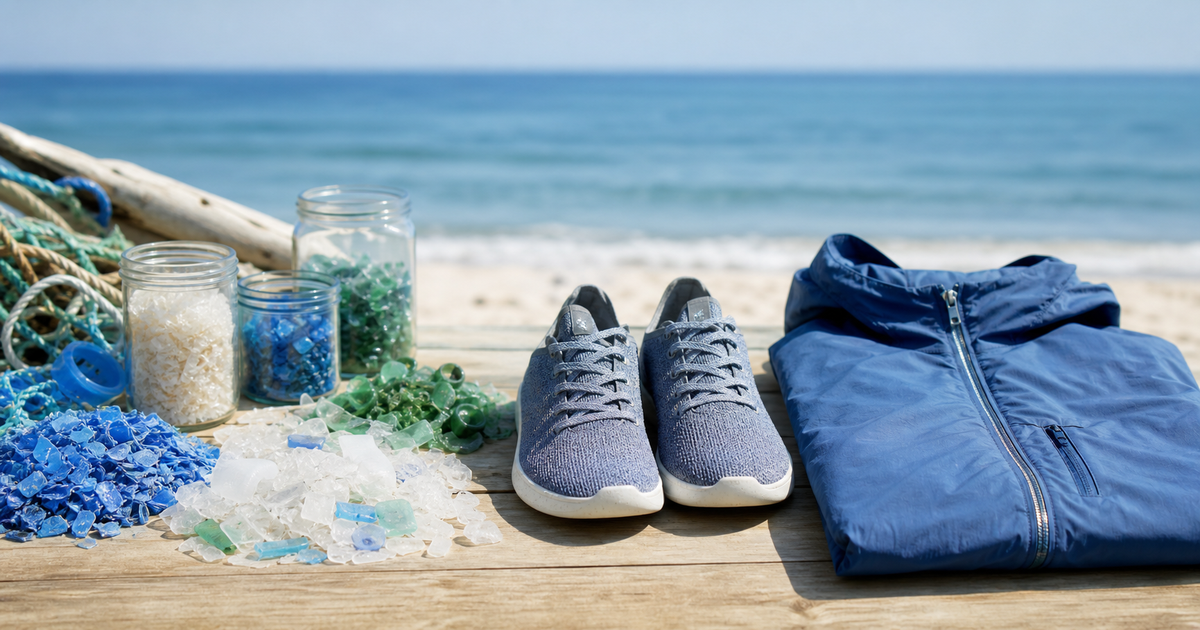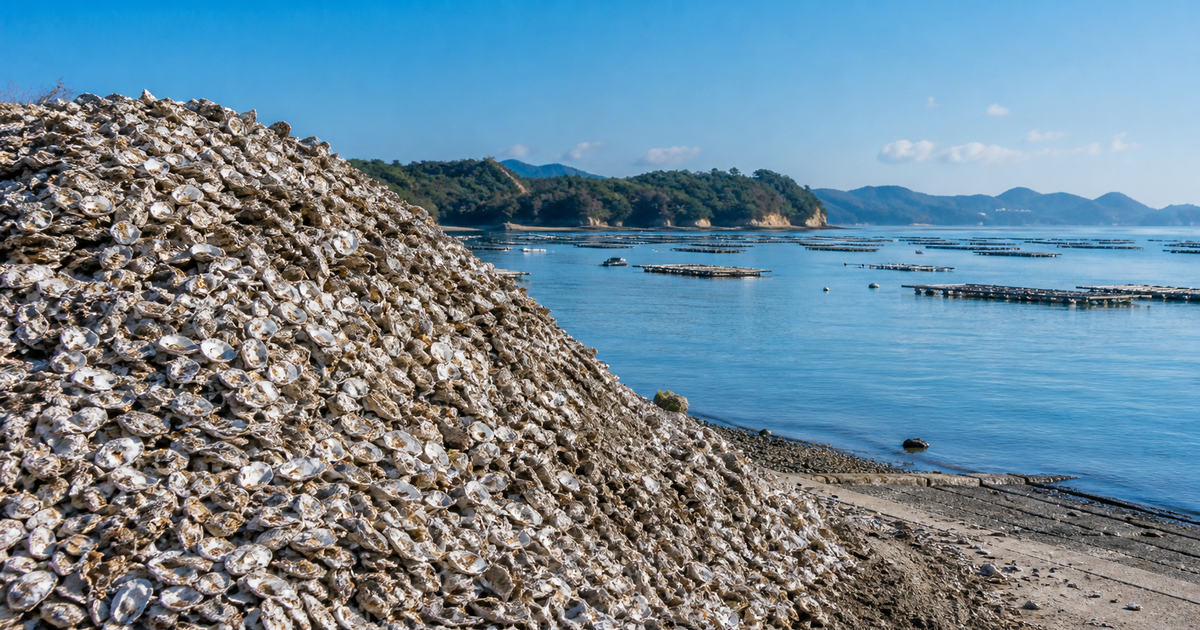
PET bottles washed up on the shore, fishing nets, fragments of polystyrene foam. Plastic, which has long supported our daily lives, has now become a massive form of "waste" troubling both the ocean and the planet. Global plastic production reached about 460 million tonnes in 2019, and the Organisation for Economic Co-operation and Development (OECD) projects it will exceed 700 million tonnes by 2040. A portion of that continues to flow into the ocean every year, on the scale of several million tonnes.
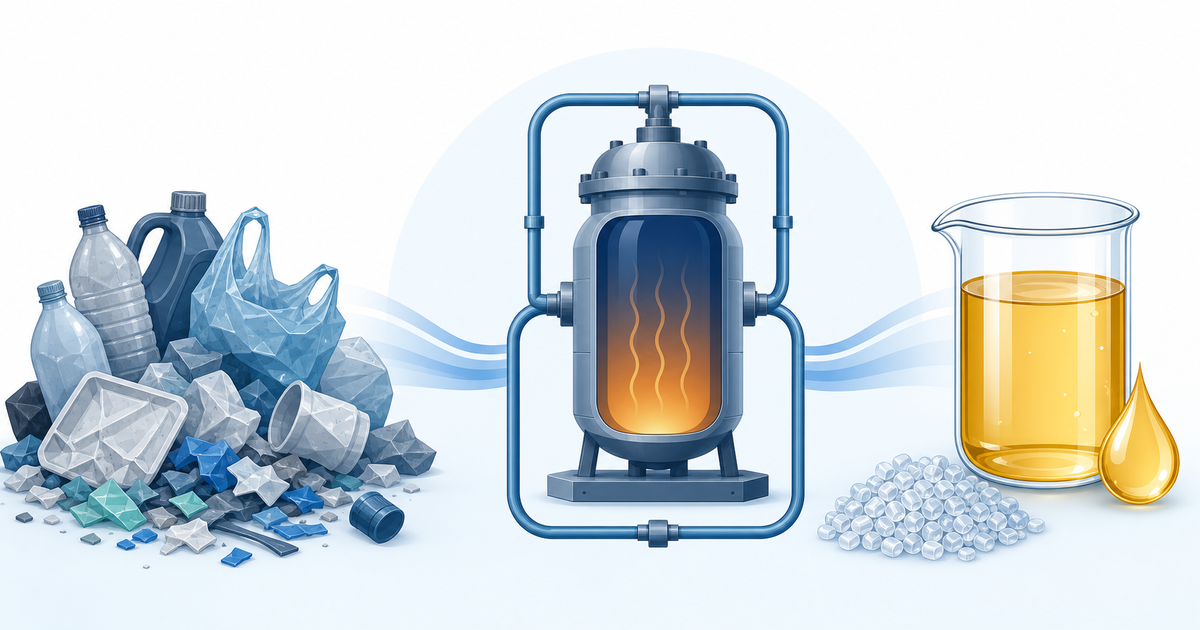
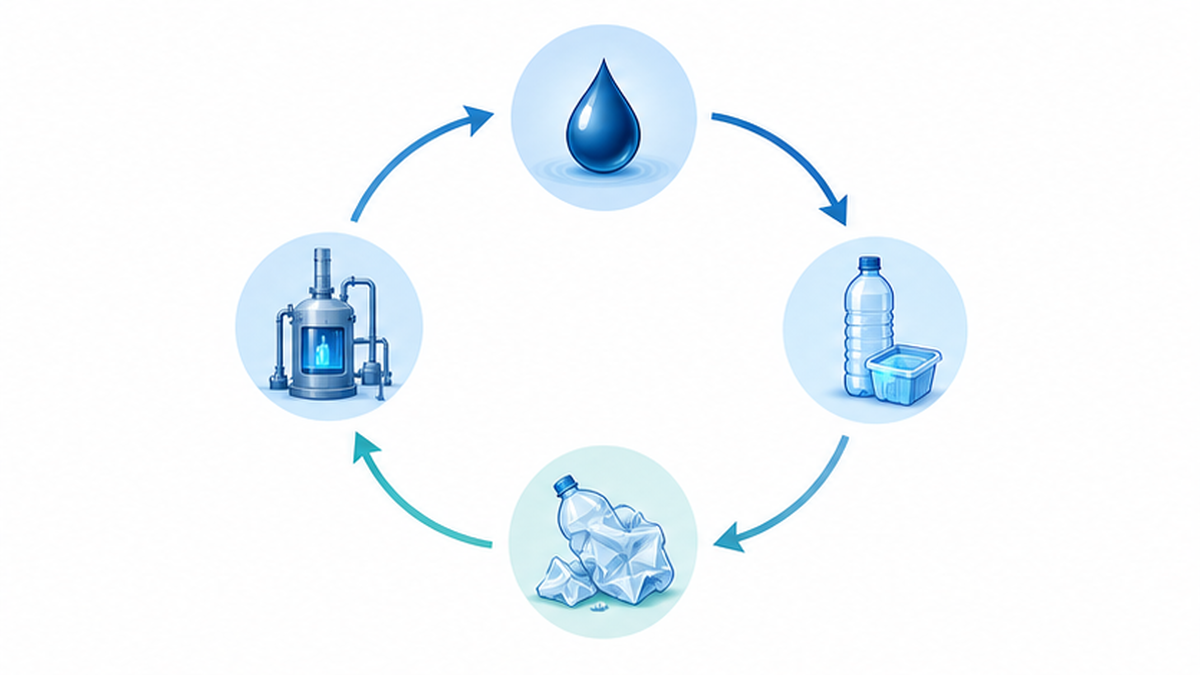
A technology that tackles this difficult problem head-on with the power of chemistry is now attracting attention. That technology is chemical recycling (plastic-to-oil conversion), which breaks down used plastic at high temperature and turns it back into an oil resembling petroleum. Plastic is, after all, a material originally born from petroleum. If we can unravel its molecular chains once more, turn it back into oil, and then make new plastic from that oil, resources can keep circulating in a loop — this is why the technology is seen as a trump card for the circular economy.
This article unpacks everything from the chemistry of "pyrolysis," the reaction that underpins plastic-to-oil conversion, to the demonstration and commercial plants now operating in Japan at a scale of 20,000 tonnes a year, to the toughest application of all — marine waste — and the challenges of turning it into a business, based on public data from the Ministry of the Environment and the Plastic Waste Management Institute, in a way that anyone from middle schoolers to adults can follow.
What you'll learn in this article
- What "plastic-to-oil conversion" means as a form of chemical recycling that turns waste plastic back into oil at the molecular level
- How "pyrolysis" — heating plastic to 400–800°C with the oxygen cut off — turns it back into oil and gas
- How this differs from material recycling, which melts plastic down and re-molds it, and what each is good and bad at
- Where the demonstration and commercial plants launched in Japan by Mitsubishi Chemical, ENEOS, Mitsui Chemicals, Idemitsu, and others currently stand
- The technical and cost barriers that stand in the way when trying to convert marine waste — laden with salt, dirt, and mixed materials — into oil
- The institutional support, such as the mass balance approach and the Green Innovation Fund, needed to make this viable as a business
What is "plastic-to-oil conversion" of waste plastic?
As the name suggests, plastic-to-oil conversion is a technology that uses a chemical reaction to turn used plastic back into oil. Technically, it is classified as a form of "chemical recycling." The raw material for plastic, if you trace it back, is naphtha (crude gasoline) obtained from crude oil. In other words, plastic is a polymer made of petroleum-derived hydrocarbons linked together in long chains. Plastic-to-oil conversion is, at its core, the idea of chemically cutting that long chain back into short molecules and extracting them as a liquid "oil" at room temperature.
The extracted oil is sent to an oil refinery or a naphtha cracker (the decomposition furnace at the heart of the petrochemical industry), where it is reborn once again into ethylene, propylene, and other basic raw materials for plastic. Being able to remake raw material from waste at hand, without newly drilling for oil, is where the great significance of plastic-to-oil conversion lies.
Why is plastic-to-oil conversion attracting attention now?
Behind this is the reality that the volume of plastic waste keeps swelling worldwide. Plastic that has flowed into the ocean is broken into fine pieces by ultraviolet light and waves, eventually becoming microplastics of 5mm or smaller that we now know work their way from the deep sea into our own bodies. Changing our one-way "make and throw away" habits into a "circular" model where resources keep going around has become a shared challenge for the whole world.
Plastic-to-oil conversion is especially hoped for because of its potential to handle dirty materials or plastics made of mixed resins. Unlike conventional recycling, which cannot be used unless the material is washed and sorted cleanly, plastic-to-oil conversion breaks materials all the way down to the molecular level, leaving room to accept some dirt or mixed material. This may open a path back to being a resource even for plastic that, like the miscellaneous waste washed up on shores, previously had no choice but to be incinerated.
Another reason is that it can circulate material without degrading its "quality." With material recycling, every time plastic is melted down and re-molded, its molecular chains are damaged little by little, and its color and strength decline. That is why a PET bottle does not repeatedly become the same PET bottle again — in reality, much of it is "downcycled" into fiber or other products. Because plastic-to-oil conversion returns plastic all the way to raw material, it can, in principle, remake resin of a quality close to virgin material over and over. This is called "horizontal recycling" or "bottle-to-bottle" recycling, and it is close to what a circular economy is truly meant to achieve.
That said, plastic-to-oil conversion is not a cure-all. Cutting molecules requires a great deal of energy, and the equipment involved is large-scale. That is exactly why an approach that combines multiple methods in the right place is essential: first reduce (reduce), then reuse repeatedly (reuse), then melt down and regenerate good-quality material (material recycling), and finally let plastic-to-oil conversion or gasification take on the dirty or mixed plastic that remains. Once you position plastic-to-oil conversion as the "last piece" that closes the loop of circulation, its role becomes much clearer.
Key terms in this article
- Chemical recycling = a method that regenerates plastic by breaking it down to the molecular level through a chemical reaction (plastic-to-oil conversion is the leading example)
- Pyrolysis = a reaction that cuts molecular chains by heating material to a high temperature with the oxygen cut off
- Pyrolysis oil = the oil obtained through plastic-to-oil conversion, similar in composition to naphtha
- Naphtha cracker = the core petrochemical facility that produces plastic raw material from oil
How pyrolysis works — the chemistry that turns plastic back into oil
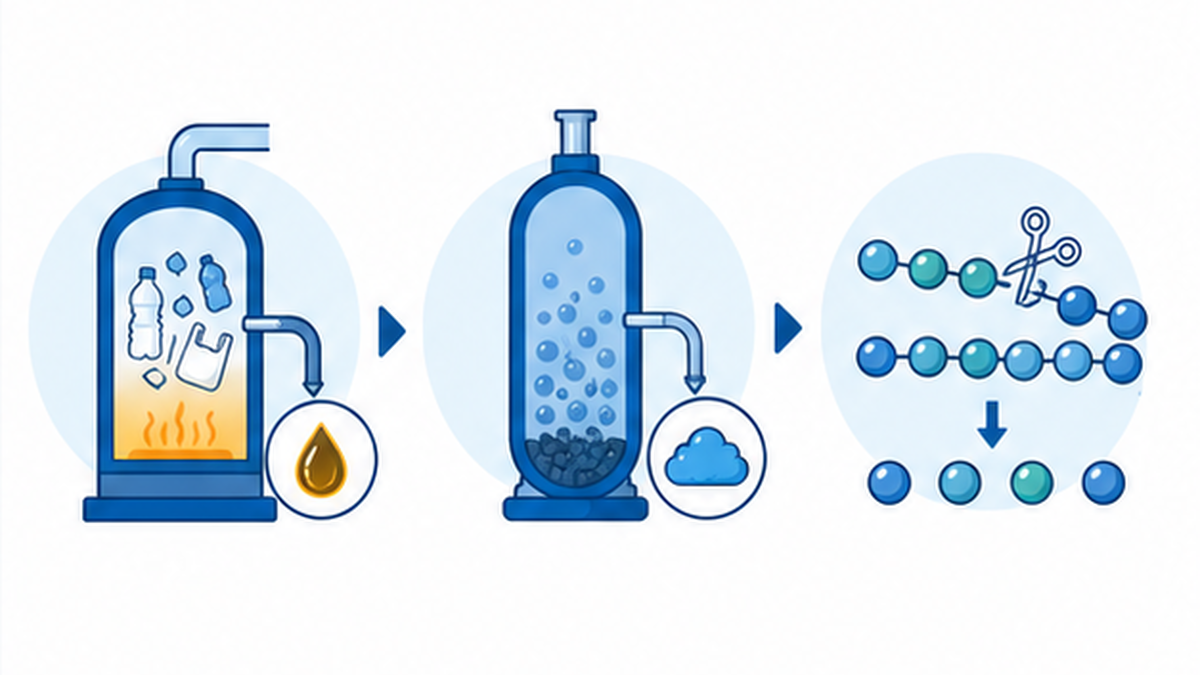
At the heart of plastic-to-oil conversion is a chemical reaction called pyrolysis. The key point is heating the material with almost no oxygen present. Normally, when plastic is burned in air, it combines with oxygen to become carbon dioxide and water, and simply disappears as heat. But when heated to a high temperature with oxygen cut off, instead of burning, the molecules are severed from within by thermal energy and transform into smaller molecules. This difference is the decisive line that separates plastic-to-oil conversion from simple incineration.
Cutting molecular chains at 400–800°C
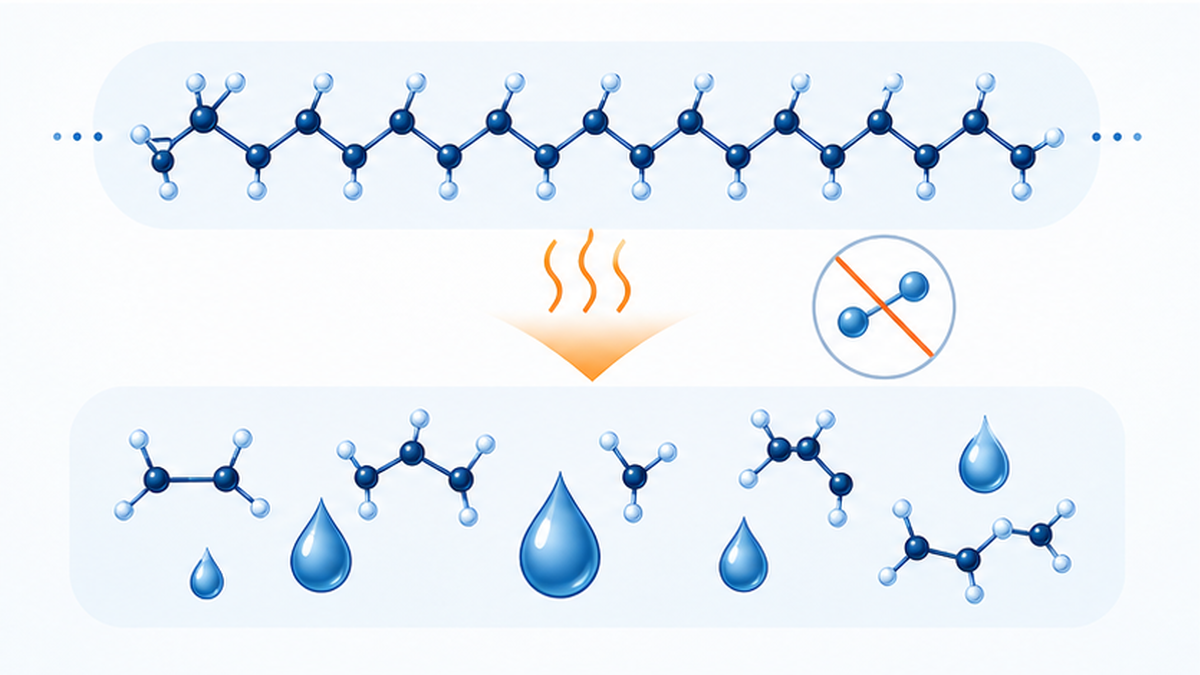
In pyrolysis, plastic is heated to roughly 400–800°C. Polyolefin-type plastics such as polyethylene (PE) and polypropylene (PP), which are made of simple chains of carbon and hydrogen linked together, have their chains cut in various places at this temperature range, turning into a mixture of short hydrocarbons. When cooled, much of this can be recovered as a liquid oil at room temperature — namely pyrolysis oil. The resulting oil contains a variety of hydrocarbons such as alkanes, alkenes (olefins), and aromatics, and its composition is similar to naphtha.
The recovered pyrolysis oil is further decomposed (steam cracking) together with high-temperature steam at a naphtha cracker, converting it into monomers such as ethylene and propylene that become the "building blocks" of plastic. Once this stage is reached, the quality becomes nearly indistinguishable from virgin raw material, opening up the possibility of use even in applications with strict hygiene standards, such as food containers. This is a strength of plastic-to-oil conversion that material recycling, discussed in the next section, does not have.
To break the reaction down a little further: polyethylene is a giant molecule made of tens of thousands of small "ethylene" units linked together in a chain. When heat is applied, bonds break at various points along this chain, and short molecules fly off one after another from the broken ends. This is called a "radical reaction," and much like beads scattering when the string of a necklace breaks, the long polymer unravels into many small, separate molecules. Depending on where the chain breaks, the products separate into gas, liquid (oil), and solid (wax- or char-like residue), and by adjusting temperature and time, the ratio can be brought closer to the desired mix.
| Method | Approximate heating temperature | What it produces | Characteristics |
|---|---|---|---|
| Pyrolysis (no catalyst) | 500–800°C | Pyrolysis oil, gas, residue | Relatively simple equipment. Requires high temperature and consumes a lot of energy |
| Catalytic cracking (with catalyst) | 400–550°C | Light oil, olefins | Lowers the reaction temperature with a catalyst and can increase targeted components |
| Supercritical water pyrolysis | About 400°C, high pressure | Decomposed oil | Uses high-temperature, high-pressure water; more tolerant of dirty feedstock |
Catalysts make the reaction gentler
Pyrolysis has the weakness of consuming a large amount of energy because it requires high temperatures. This is where catalysts come into play. Adding an acidic catalyst such as zeolite or silica-alumina makes it possible to cut molecular chains at a lower temperature, and also makes it easier to selectively increase the desired components (light oil or olefins). Research is also underway into reusing spent FCC catalyst (fluid catalytic cracking catalyst) from petroleum refining, which is a key to making plastic-to-oil conversion viable in terms of both cost and energy.
"Supercritical water," a new leading player
One method drawing attention in recent plastic-to-oil conversion is the use of supercritical water. When water reaches a special state of high temperature and high pressure (roughly 374°C and 22 MPa or above), it turns into a "supercritical" state that combines the properties of a liquid and a gas. This supercritical water dissolves oil-like substances well and becomes a strange solvent that helps chemical reactions along. When plastic is decomposed in this water, feedstock containing dirt or moisture is said to be relatively manageable, and the reaction is said to proceed evenly. The technology adopted by Mitsubishi Chemical and ENEOS in Ibaraki, licensed from the UK's Mura Technology, is also based on this supercritical water pyrolysis. By putting water in the leading role, new possibilities are opening up for plastic-to-oil conversion, which has long been troubled by dirty feedstock.
Not all plastic can be turned into oil
Plastic-to-oil conversion is especially well suited to polyolefin-type plastics made only of carbon and hydrogen, such as PE and PP. PET (which contains oxygen), used in PET bottles, on the other hand, is better suited to a different form of chemical recycling — depolymerization, which cuts molecular bonds and returns the material to raw monomers — rather than plastic-to-oil conversion. PVC (vinyl chloride), which contains chlorine, releases toxic hydrogen chloride gas when pyrolyzed, and if mixed into the feedstock, it damages equipment. The fact that "not everything can be turned back into oil" is directly connected to the challenges discussed later.
The difference from material recycling — sorting out the three types of recycling
Plastic recycling can broadly be divided into three types. Understanding this difference makes it much clearer where plastic-to-oil conversion fits as a technology.
The differences between the three types of recycling
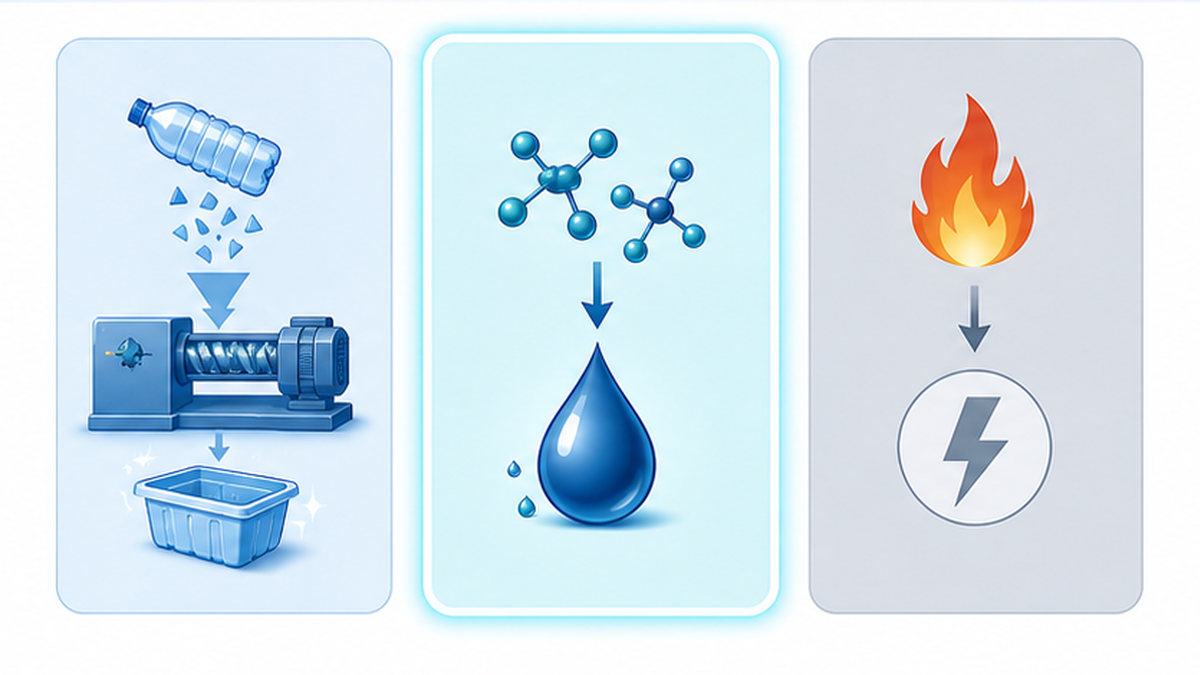
- Material recycling: A method that crushes and melts used plastic and re-molds it into plastic products again. It consumes little energy and is efficient, but it is weak against dirt and mixed materials, and quality declines each time it is melted down.
- Chemical recycling (plastic-to-oil conversion, gasification, depolymerization): A method that breaks material down to the molecular level through a chemical reaction and turns it back into oil, gas, or monomers. It can more easily handle dirty materials and can approach virgin quality, but it requires high temperature and high energy, leading to large equipment costs.
- Thermal recycling (heat recovery): A method that burns plastic and uses the heat for power generation or heating. Strictly speaking this is not "recycling," and the material is lost as a resource. In Japan, this share is disproportionately high.
Let's look at Japan's current situation in numbers. According to the Plastic Waste Management Institute, total waste plastic emissions in 2023 were 7.69 million tonnes, with an effective utilization rate of 89%. However, looking at the breakdown, material recycling accounts for 22%, chemical recycling for only 3%, and the remaining 64% is thermal recycling, which extracts heat by burning. In other words, most of that "89% effective utilization" figure is, in reality, simply incineration. Expanding chemical recycling, including plastic-to-oil conversion, is expected to be the key to changing this structure.
| Recycling method | Share in 2023 | Does it return as a resource? | Tolerance for dirt/mixed materials |
|---|---|---|---|
| Material recycling | About 22% | Yes (quality gradually declines) | Weak |
| Chemical recycling (plastic-to-oil, etc.) | About 3% | Yes (quality more easily maintained) | Relatively strong |
| Thermal recycling (heat recovery) | About 64% | No (consumed as heat) | Strong |
Plastic-to-oil conversion has the potential to take on the "dirty or mixed plastic" that material recycling is not good at, and to pull part of that 64% — which previously had no choice but to be burned — back into being a resource. Combined with efforts to turn recovered plastic into new products or the recycling of fishing nets, it could add more depth to resource circulation for the ocean.
Chemical recycling itself comes in several forms
Even under the single umbrella term "chemical recycling," there are actually several distinct methods. Plastic-to-oil conversion (pyrolysis) is the leading example, but there is also gasification, which converts plastic into a gas of carbon monoxide and hydrogen to use as a raw material for chemical products, and depolymerization (chemical depolymerization), which cuts molecular bonds in a targeted way — as with PET in PET bottles — to cleanly return the material to its original monomers. Plastic-to-oil conversion suits PE and PP, made only of carbon and hydrogen, while depolymerization suits PET and nylon — each method has resins it is and isn't suited to. That's why "plastic-to-oil conversion solves everything" isn't the case; only by combining these methods can a wide range of plastics be brought into the circular loop.
Japan also has methods that convert plastic into chemical raw material and a reducing agent in a coke oven, and methods that use it as a reducing agent when making iron in a blast furnace, and these too are counted as forms of chemical recycling. Because the definition of "what counts as recycling" differs from country to country, it is important to check the details carefully when comparing figures.
The pitfall of the term "thermal recycling"
Japan's "89% effective utilization rate" looks like a high standard by global comparison, but much of it consists of heat recovery through incineration. In Europe, it is common not to count energy recovery as "recycling" at all, so caution is needed when making international comparisons. Burning releases carbon dioxide and the resource is lost. This is exactly why the role of plastic-to-oil conversion — turning material into a resource before burning it — is being called into question.
Japan's demonstration plants and the front line of commercialization
For a long time, plastic-to-oil conversion has been said to be "technically possible, but not worth it as a business." However, as major Japanese chemical and energy companies have launched large-scale facilities one after another in the 2020s, the technology is finally entering the stage of practical implementation. Let's look at some representative projects here.
Mitsubishi Chemical × ENEOS — a domestic-largest-class plant in Ibaraki
The project attracting the most attention is the plastic-to-oil facility built by Mitsubishi Chemical and ENEOS at Mitsubishi Chemical's Ibaraki plant in Kamisu City, Ibaraki Prefecture. A completion ceremony was held in July 2025, and the facility boasts domestic-largest-class capacity, able to process 20,000 tonnes a year of used plastic. It adopts pyrolysis technology using "supercritical water" (HydroPRS) from the UK's Mura Technology, which decomposes plastic using high-temperature, high-pressure water. The resulting decomposed oil is used as feedstock at the adjacent oil refinery and naphtha cracker, with commercial operation targeted to begin within fiscal 2025.
Mitsui Chemicals — starting product manufacturing with the mass balance approach
In March 2024, Mitsui Chemicals began feeding pyrolysis oil derived from waste plastic into the naphtha cracker at its Osaka plant, starting the manufacture and sale of chemically recycled products using the mass balance approach. This is said to be the realization of Japan's first "bio and circular cracker." The mass balance approach will be covered in more detail in a later section, but it is a practical mechanism for incorporating a small amount of recycled feedstock into existing, massive facilities.
Idemitsu Kosan × Kankyo Energy — heading toward commercialization in Ichihara, Chiba
Chemical Recycle Japan, a joint venture between Idemitsu Kosan and Kankyo Energy, has built a plastic-to-oil plant with a capacity of about 20,000 tonnes a year, the Ichihara Plant, in Ichihara City, Chiba Prefecture, which was completed in January 2026. Commercial operation is scheduled to begin from April of the same year, and preparations are proceeding accordingly. By placing the plastic-to-oil facility right next to an oil refinery, a hub of petroleum refining, the plan takes advantage of being able to use the resulting oil directly as feedstock.
What these projects have in common is that they are all built at a scale of "roughly 20,000 tonnes a year" — a scale that goes beyond demonstration and looks toward commercial operation. In the past, plastic-to-oil conversion was carried out in small, modest facilities, and one project after another withdrew because the numbers didn't add up. Now, in the 2020s, chemical manufacturers and energy companies have joined forces and linked the technology with existing massive infrastructure, finally reaching a scale where it "might actually work as a business." This marks a major turning point for plastic-to-oil conversion in Japan.
On the other hand, considering that Japan's total waste plastic emissions are 7.69 million tonnes a year, a scale of 20,000 tonnes a year still falls short of even 0.3% of the whole. Whether demonstration plants can prove out the technology and profitability, and whether the knowledge gained there can be extended to the next large-scale plant and beyond, nationwide — whether plastic-to-oil conversion can go from being a "special experiment" to becoming "a normal option" depends on the next few years.
| Operator | Location | Processing capacity | Technology/features | Timeline |
|---|---|---|---|---|
| Mitsubishi Chemical × ENEOS | Kamisu City, Ibaraki Prefecture | 20,000 t/year | Supercritical water pyrolysis (Mura Technology) | Completed 2025; commercial operation planned same fiscal year |
| Mitsui Chemicals | Osaka Plant | Feeding in pyrolysis oil | Product manufacturing via mass balance approach | Started March 2024 |
| Idemitsu Kosan × Kankyo Energy | Ichihara City, Chiba Prefecture | 20,000 t/year | Feedstock production adjacent to an oil refinery | Completed January 2026; commercial operation planned to begin April same year |
Why build "next door" to an oil refinery?
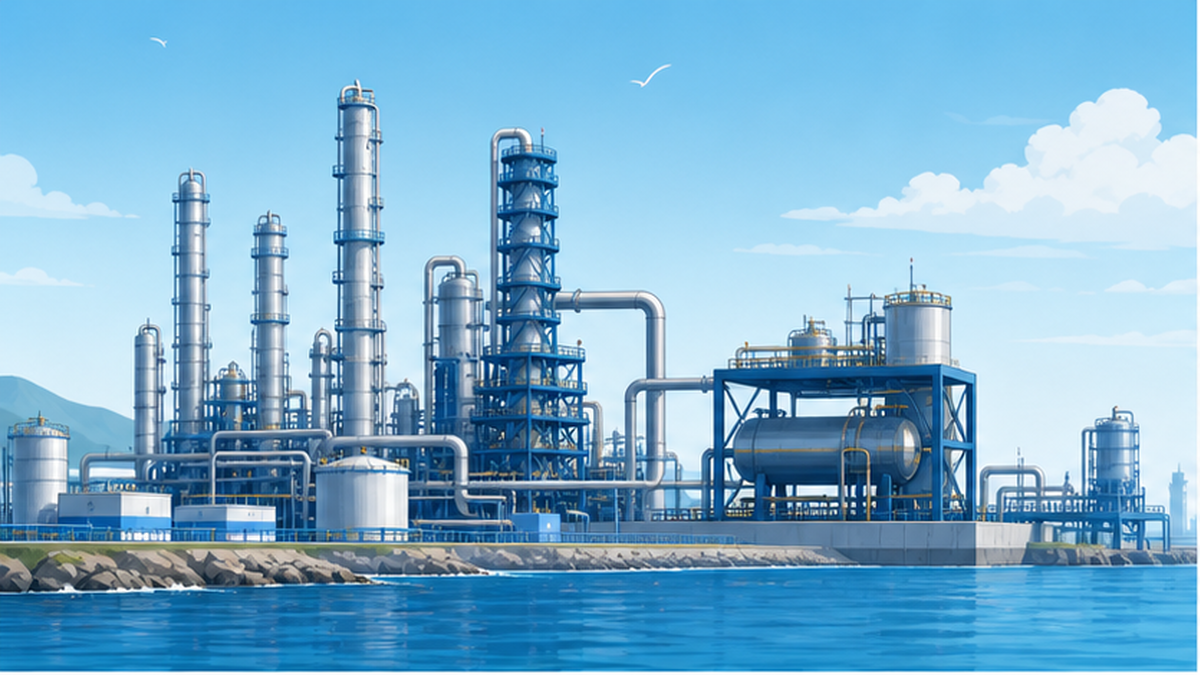
Pyrolysis oil obtained through plastic-to-oil conversion cannot be used as-is; it needs a further step of refining or cracking. Placing plastic-to-oil equipment near an existing refinery or cracker allows the oil to be piped over and efficiently converted into raw material. This "co-location" strategy, which keeps capital investment down compared to building from scratch, has become a common practical solution among Japanese companies.
Application to marine waste — expectations, and a very high wall
The plastic-to-oil conversion discussed so far mainly targets "relatively clean" waste plastic that comes from factories or households. So can it be applied to marine waste, the starting point of this article? In short, it is possible, but in reality the wall to overcome is much higher than for waste collected on land.
Why marine waste has been said to have "no choice but to be incinerated"
Plastic that has drifted at sea is exposed to seawater, sand, and marine life for long periods of time. As a result, it is recovered laden with salt (chlorine), sand, moisture, and organisms attached to its surface. Chlorine generates hydrogen chloride gas during pyrolysis, which corrodes equipment and, if burned, can be a source of toxic substances such as dioxins. Sand and dirt lower reaction efficiency and clog equipment. For these reasons, much of the plastic collected on beaches has been incinerated rather than recycled.
What's more, marine waste is made of wildly varied materials. Fishing nets, ropes, polystyrene foam, PET bottles, lighters, and shoe soles all get mixed together, and no small amount of it has become fused with metal or fabric. Waste in which multiple materials are tangled together, like fishing gear lost at sea (ghost gear), is difficult to sort, making it hard to send as-is either to plastic-to-oil conversion or to material recycling.
Why hopes are still pinned on plastic-to-oil conversion
Even so, plastic-to-oil conversion is seen as a source of hope for marine waste because it has the property of being "somewhat tolerant of dirt and mixed materials." Because plastic-to-oil conversion breaks material all the way down to the molecular level, it may be possible to reduce the labor of washing and fine sorting. In particular, methods using supercritical water are said to be relatively well suited to dirty feedstock, since the water itself doubles as both reaction medium and cleaning agent. If a pretreatment step to wash away salt and remove PVC is combined in, it may become possible to turn some of the marine waste that previously had no choice but to be incinerated back into a resource.
Ocean plastic pollution comes back to affect us in the form of plastic that has sunk into the deep sea and its impact on ecosystems. Preparing an exit that lets recovered waste circulate as a resource, rather than simply "burning it and being done," also has an important meaning for making efforts to protect the ocean sustainable.
As a realistic scenario, rather than dedicating oil conversion exclusively to marine waste, a workable approach would be to process pretreated marine waste by mixing it in small amounts with good-quality waste plastic from land. Marine waste alone is unstable in both quantity and quality, but if it is accepted as "part of" an existing large-scale plant, it can be added to the loop of resource recovery without strain. Efforts such as prioritizing the return of relatively clean PET bottles and polystyrene foam collected during beach cleanups also help widen this pathway.
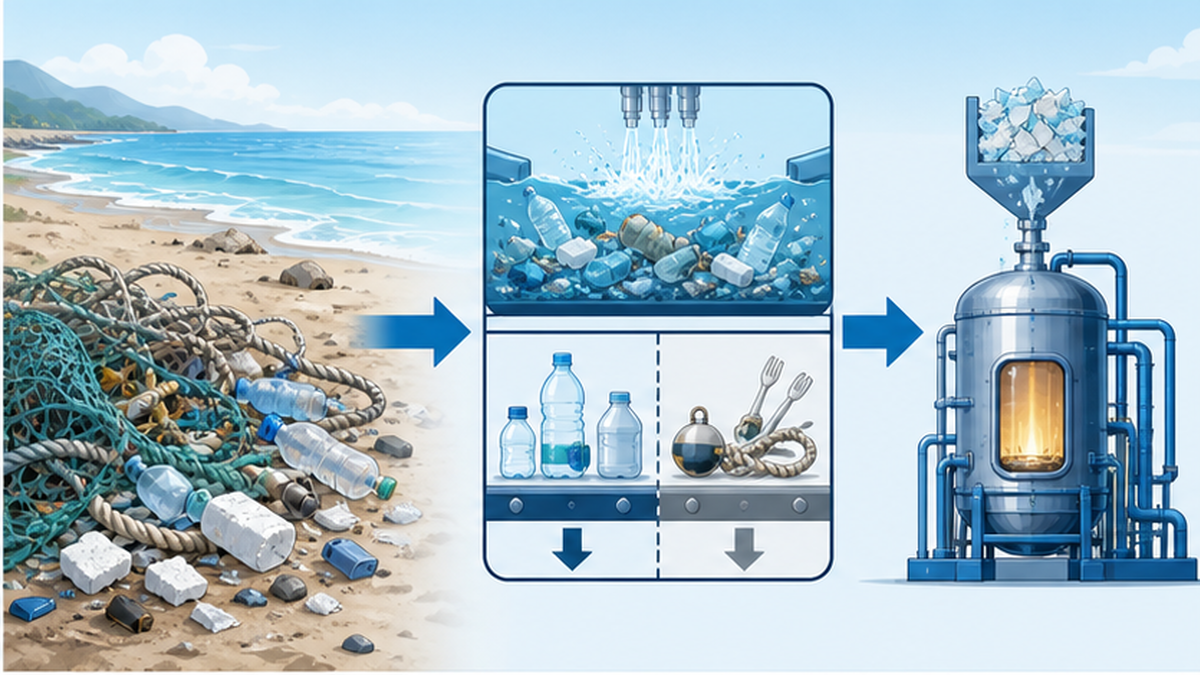
Three walls facing plastic-to-oil conversion of marine waste
- Salt/chlorine: causes equipment corrosion and toxic gas, making removal during pretreatment essential
- Dirt, sand, moisture: lowers reaction efficiency and causes equipment trouble
- Mixed materials: fishing nets, metal, and fabric get tangled in, driving up sorting costs
Challenges blocking commercialization — cost, energy, and quality
As a technology, plastic-to-oil conversion is moving past the demonstration stage. But the question of whether it can stand on its own as a business still has many challenges remaining. Let's look mainly at three walls here.
① The cost wall
The biggest challenge is cost. Raw material produced through plastic-to-oil conversion tends to be more expensive than ordinary virgin material made from crude oil. This is because of the equipment needed to maintain high temperatures, the labor of pretreatment, and the cost of catalysts. When oil prices are low, there is less economic reason to bother using pricier recycled feedstock. The government has also set a goal of reducing the manufacturing cost of chemical recycling, including plastic-to-oil conversion, by 20% versus current levels by 2030 and to parity with existing products by 2050, and is backing technology development toward that end.
② The energy and CO2 wall
Pyrolysis requires maintaining a temperature of several hundred degrees continuously, consuming a large amount of energy. If that energy is supplied by fossil fuels, carbon dioxide is released, undermining the very premise of "recycling for the sake of the environment." Whether the CO2 reduced through plastic-to-oil conversion truly outweighs the CO2 from the energy used to run the process — in other words, a full life-cycle assessment — is essential. Using renewable energy or waste heat is key to clearing this wall.
③ The raw material and quality wall
To run plastic-to-oil conversion stably, it is necessary to steadily gather waste plastic of consistent quality, cheaply and in large volumes. But in reality, waste varies widely in resin type and level of dirtiness. Even a small amount of mixed-in PVC causes chlorine to do damage, and mixed-in PET lowers the quality of the oil. The unglamorous processes of "collecting, sorting, and cleaning" are, in fact, what determine whether plastic-to-oil conversion succeeds or fails. Building the collection infrastructure is also a social challenge that cannot be solved by technology alone.
These three walls are not independent of one another; they are intertwined. Forcing through the processing of dirty feedstock drives up cost and energy use for cleaning and equipment repair, and lowers quality as well. Conversely, selecting only clean feedstock reduces the volume that can be collected, losing the benefits of scale. Wherever you push one issue down, another rises — finding the point of best balance within this trade-off is the essential difficulty in commercializing plastic-to-oil conversion. That is exactly why not just corporate effort, but society-wide mechanisms such as collection infrastructure and carbon pricing, are also called into question.
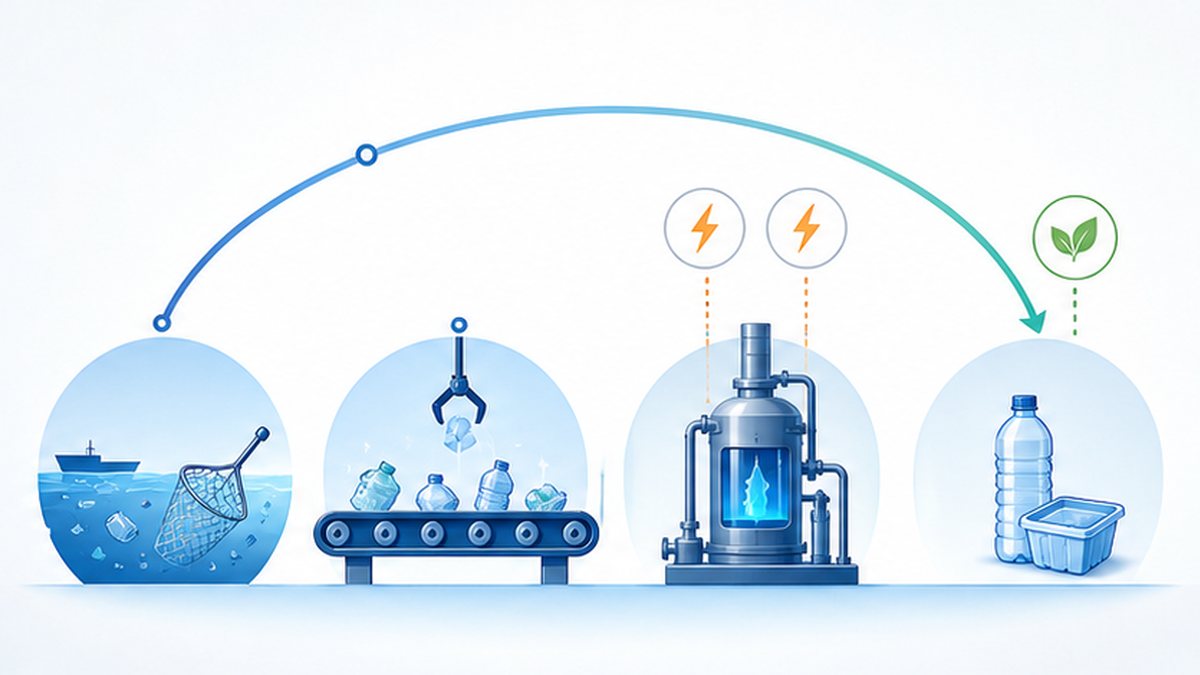
| Challenge | Content | Direction to overcome it |
|---|---|---|
| Cost | Tends to be pricier than virgin material | Mass production, government support, reflecting carbon pricing |
| Energy/CO2 | Consumes large amounts of energy to maintain high temperature | Renewable energy and waste heat use, life-cycle assessment |
| Feedstock quality and quantity | Dirt, mixing, and chlorine affect quality | Collection/sorting infrastructure, pretreatment technology |
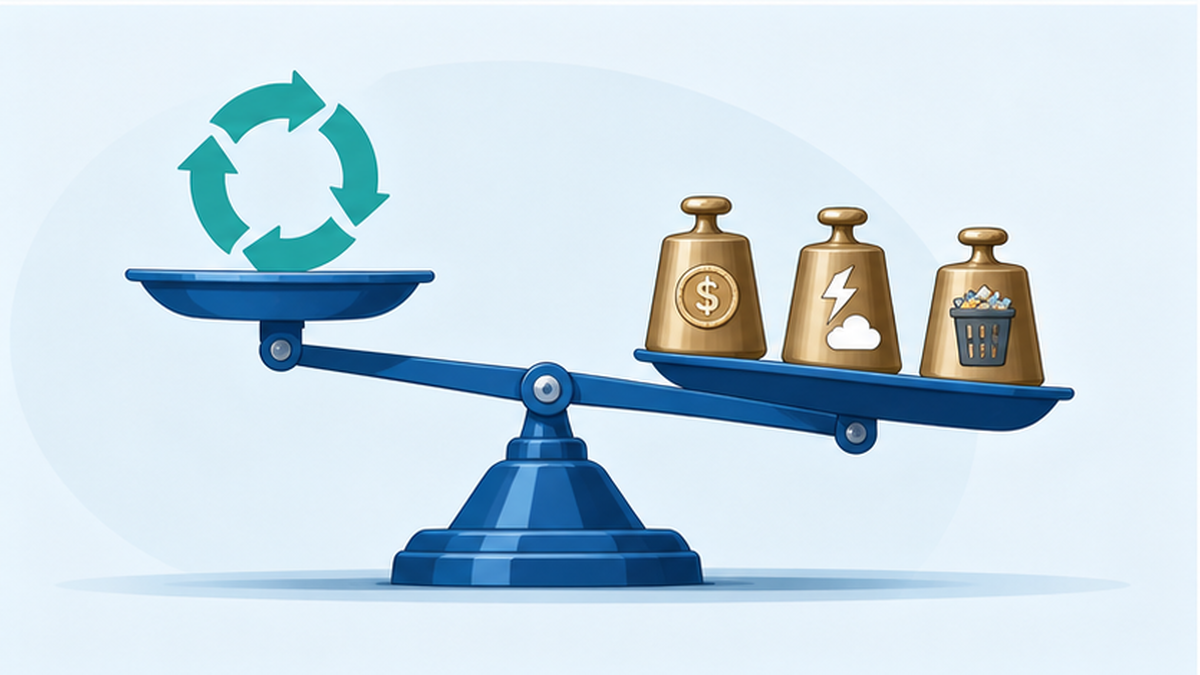
Plastic-to-oil conversion has moved past the question of "whether it can be done" and into the question of "whether it's worth doing." Scale-up and institutional design will decide the answer.
— From common points raised across each company's demonstration projects
Global and institutional trends — mass balance and the Green Innovation Fund
Spreading plastic-to-oil conversion through society requires not just technology but also the backing of supportive "institutions." In Japan and around the world, mechanisms to support plastic-to-oil conversion are steadily being put in place.
The mass balance approach as a practical solution
How do you incorporate a small amount of recycled feedstock into a huge naphtha cracker? This is where the mass balance approach comes in. This is the idea that when recycled feedstock is mixed with virgin feedstock during manufacturing, the value of being "recycled origin" is allocated to the finished product in proportion to the amount of recycled feedstock that was actually put in. Because it is difficult to physically keep everything separate during manufacturing, the volume is managed like an accounting ledger and value is allocated accordingly. Companies such as Mitsui Chemicals have obtained the international certification "ISCC PLUS" to guarantee the credibility of products made using this method.
National support through the Green Innovation Fund
The Japanese government is advancing a project called "Development of Technologies for Manufacturing Plastic Raw Materials Using CO2 and Other Sources" through NEDO's (New Energy and Industrial Technology Development Organization) Green Innovation Fund (GI Fund). This effort sets cost targets for chemical recycling and aims to secure an advantage for Japan through the international standardization of the mass balance approach. By supporting everything from research and development to social implementation as a single package, the aim is to bring plastic-to-oil conversion, which tends to be pricier, into the market.
Looking globally, negotiations continue over an international treaty giving legal force to plastic pollution rules, and rule-making that looks across the whole lifecycle from production to disposal is progressing. Only when "protective" efforts such as marine protected areas and "circulating" efforts such as plastic-to-oil conversion work together as two wheels of the same cart can progress truly be made on the problem of ocean plastic.
- Mass balance approach: An accounting-style mechanism that allocates the value of a small amount of recycled feedstock to products by managing volume
- ISCC PLUS: An international certification in which a third party guarantees that this allocation is done correctly
- GI Fund: A system in which the government supports everything from research and development to implementation, lowering the barriers of cost and standardization
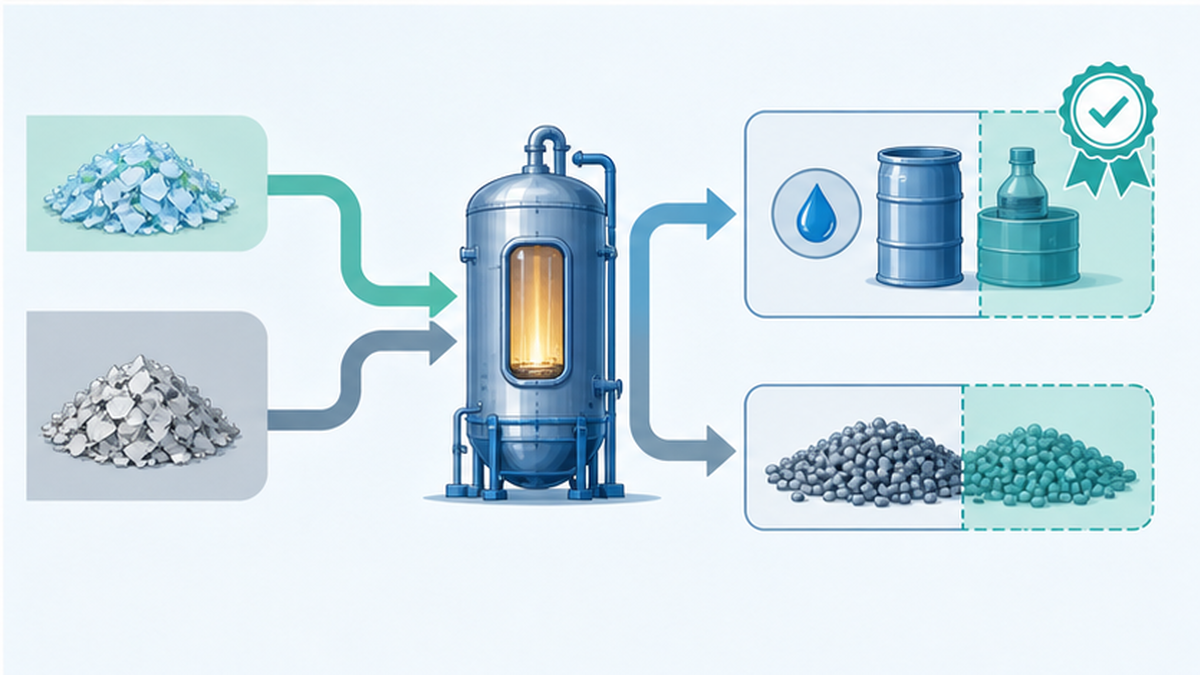
The question "Is this really recycled material?"
Products made using the mass balance approach are not necessarily made entirely of recycled-origin material. This has drawn some criticism of being "greenwashing." That is exactly why it is important to secure transparency in the allocation through third-party certification such as ISCC PLUS. Understanding the mechanism correctly is the first step toward being a smart consumer.
What we can do — thinking about the entrance from the exit
Plastic-to-oil conversion may look like a story about massive plants run by large corporations, but its entrance is connected to how we throw away our trash every day. Whether plastic-to-oil conversion works well depends on how much "consistent, low-dirt plastic" can be collected.
Small steps we can take in daily life
- Rinse containers and packaging lightly before sorting them for disposal (less dirt makes recycling easier)
- Check your local government's sorting rules for plastic resources and sort correctly
- Take part in beach cleanups to collect waste before it reaches the ocean (plastic collected before drifting is easier to turn into a resource)
- Choose products labeled as recycled-origin or mass balance certified, to support demand for circulation
- Above all, prioritize reducing single-use plastic in the first place (reduce)
What matters especially is collecting waste before it reaches the ocean. Once plastic has drifted at sea, salt and dirt make it hard to turn into a resource, but if it can be collected in towns and rivers, the range of recycling options — including plastic-to-oil conversion — widens considerably. Activities that protect tidal flats and coastlines, and local cleanups, ultimately serve as an entrance that supports resource circulation.
And we should not forget that recycling is a "last resort." Following the order of the three Rs — reduce, reuse, recycle — we should first reduce, then reuse repeatedly, and only recycle what still remains after that. Plastic-to-oil conversion is a reliable receiving basin at the very end of that chain, but its value only comes alive when there is effort at the entrance to reduce in the first place.
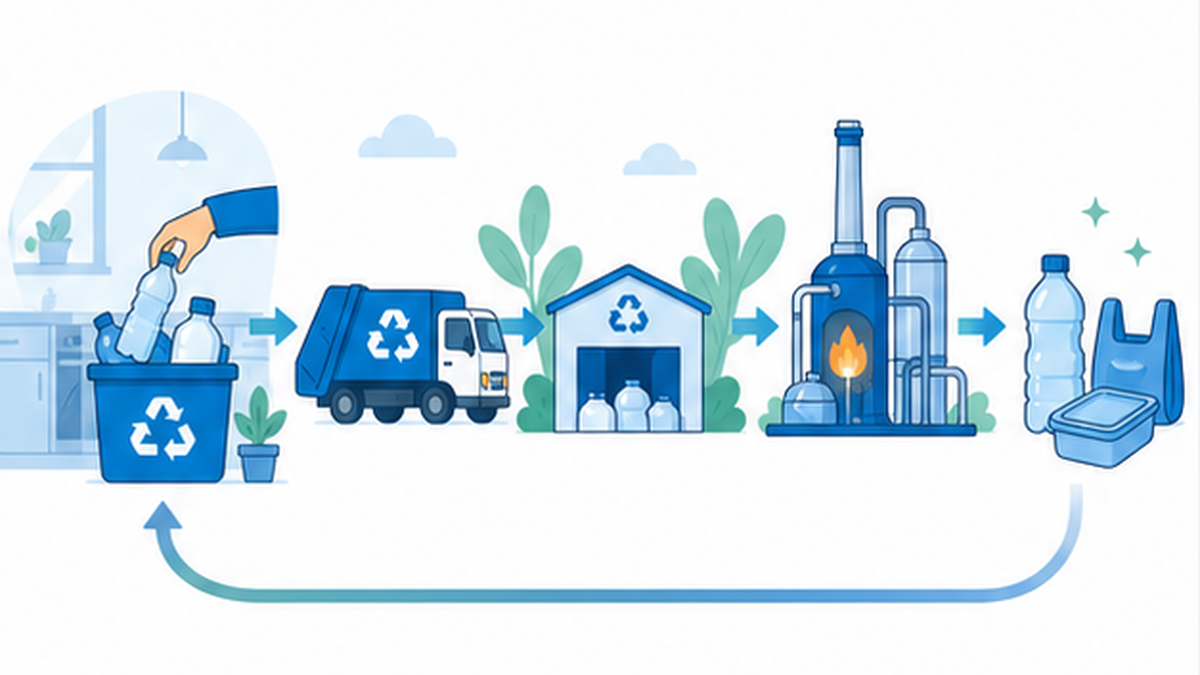
Actions you can take starting today
- Rinse plastic waste lightly and let it dry before sorting
- Try joining a local beach or river cleanup event once
- Check for "recycled-origin" labels when shopping
- Use a reusable bottle and bag to reduce plastic use in the first place
Summary — turning waste into a resource before it's burned
Plastic-to-oil conversion, which turns waste plastic back into oil, is a trump card for the circular economy, letting waste that previously "had no choice but to be incinerated" circulate as a resource. Through pyrolysis — cutting molecular chains at high temperature with oxygen cut off — plastic is turned back into an oil similar to naphtha, and new plastic is born from it. In Japan, too, companies such as Mitsubishi Chemical, ENEOS, Mitsui Chemicals, and Idemitsu have launched plants at a scale of 20,000 tonnes a year, entering the stage of practical implementation.
At the same time, applying this to marine waste faces a high wall of salt, dirt, and mixed materials, and challenges of cost, energy, and feedstock quality still remain for commercialization. Mechanisms such as the mass balance approach and the Green Innovation Fund are working to gradually lower those walls. And above all, whether plastic-to-oil conversion is put to good use or wasted depends on the entrance — how we, as individuals, dispose of our trash, and our mindset of reducing first.
Summary of this article
- Plastic-to-oil conversion = chemical recycling that breaks waste plastic down to the molecular level through pyrolysis and turns it back into oil
- Japan's waste plastic totaled 7.69 million tonnes in 2023. Chemical recycling remains at only about 3%, while 64% is incinerated
- Large-scale plants such as Mitsubishi Chemical × ENEOS (Ibaraki, 20,000 t/year) have begun moving toward commercialization
- Salt, dirt, and mixed materials are the wall for marine waste. Pretreatment and sorting are key to turning it into a resource
- Cost, energy, and feedstock quality are the three big challenges for commercialization. The mass balance approach and the Green Innovation Fund are providing support
- Only with sorting at the entrance and the "reduce first" principle of the three Rs does the exit of plastic-to-oil conversion truly come alive
References and sources
- Ministry of the Environment, Japan – White Paper on the Environment, the Sound Material-Cycle Society, and Biodiversity (the state of plastics in Japan and abroad, marine plastic waste)
- Ministry of Economy, Trade and Industry, Japan – Research, development, and social implementation plan for the GI Fund project "Development of Technologies for Manufacturing Plastic Raw Materials Using CO2 and Other Sources"
- NEDO Green Innovation Fund – Project for the Development of Technologies for Manufacturing Plastic Raw Materials Using CO2 and Other Sources
- Plastic Waste Management Institute – Total waste plastic emissions in 2023 were 7.69 million tonnes, with an effective utilization rate of 89% (material flow diagram)
- Mitsubishi Chemical Engineering – On the completion of the chemical recycling facility toward starting plastic-to-oil conversion with ENEOS and Mitsubishi Chemical
- Mitsui Chemicals – Start of manufacturing chemically recycled products using pyrolysis oil from waste plastic, realizing Japan's first bio and circular cracker
- Mitsubishi Chemical – Plastic-to-oil conversion and chemical recycling business for used plastic
- WWF Japan – About the ocean plastic problem (production volume and volume flowing into the ocean)
※ Listed in order of reliability: government/academic institutions > peer-reviewed papers > specialized organizations > reputable media