⚡ In short
The "30by30" goal aims to protect 30% of the ocean by 2030. Japan's marine protected areas currently cover only 13.3%, but a new framework called "OECM" and "Nature Symbiosis Sites" — which recognize marine areas outside national parks — could break the deadlock. This article explains the mechanism and real-world examples from Japan's coasts.
"Protecting 30% of the ocean" may sound like a distant, foreign issue. But in fact, the very activities of Japanese fishers who transplant coral and manage seaweed beds along the coast every day are key to achieving this international goal.
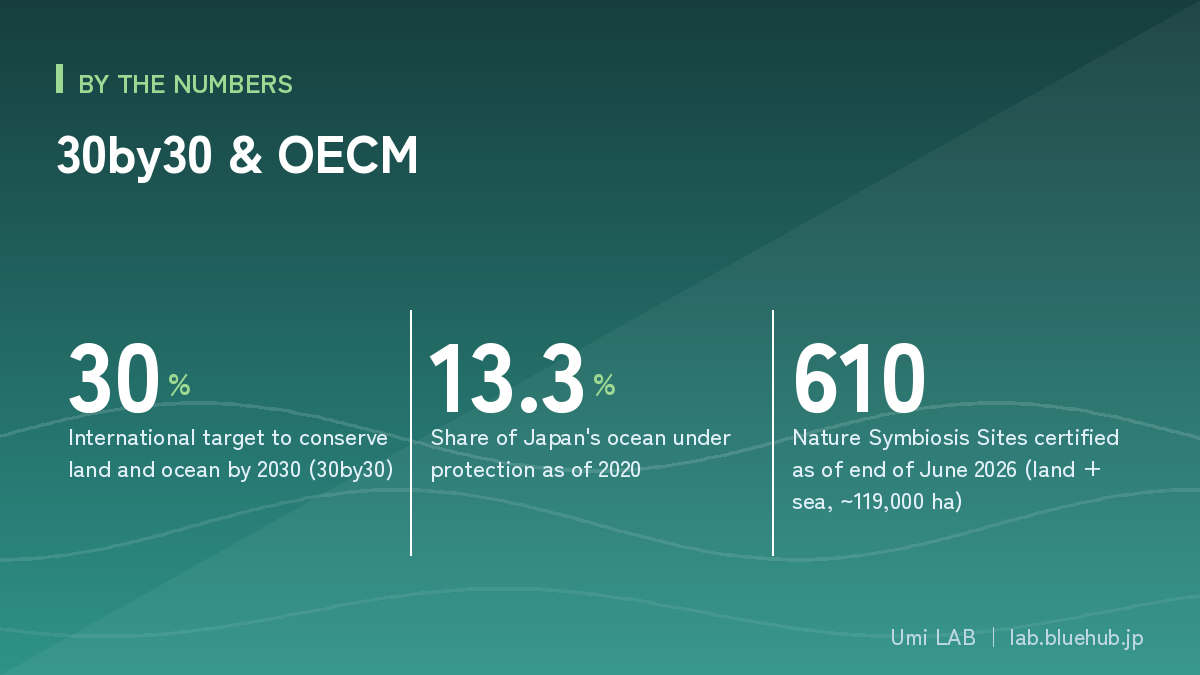
The 30by30 goal, set out in the "Kunming-Montreal Global Biodiversity Framework" adopted in 2022, calls on the world to conserve at least 30% of both land and ocean as healthy ecosystems by 2030. Japan's marine protected areas stood at just 13.3% as of 2020 — less than half the target.
To close this gap, Japan's Ministry of the Environment introduced the concept of OECM, which allows areas outside "protected areas" such as national parks to count toward the goal. This article explains the background of 30by30, how OECM and Nature Symbiosis Sites work, and real certification cases now emerging in the ocean.
What you'll learn in this article
- Why the 30by30 goal was created and its international background
- How OECM (Other Effective area-based Conservation Measures) works
- The Nature Symbiosis Site certification system and marine certification cases
- Why seaweed-bed and coral-reef conservation by fishers is directly linked to 30by30
- Why 30by30 is about "quality," not just "area"
What is the 30by30 goal?
30by30 is one of the core targets of the "Kunming-Montreal Global Biodiversity Framework," adopted at the 15th Conference of the Parties (COP15) to the Convention on Biological Diversity, held in Montreal, Canada in 2022. It calls on all countries to effectively conserve at least 30% of both land and ocean as healthy ecosystems by 2030. Formally positioned as "Target 3" of the framework, it is not just a slogan but an internationally agreed numerical target that each country must translate into domestic plans.
The background lies in growing recognition that biodiversity loss is a global crisis on par with climate change. Related reports from the UN Environment Programme and others point out that development, overexploitation, and pollution are rapidly degrading ecosystems on both land and sea, making it necessary to expand conservation areas both in quantity and quality. The ocean in particular has historically received less international attention than terrestrial conservation, so 30by30 is considered groundbreaking for elevating "ocean conservation" to a priority on par with land.
Under the Convention on Biological Diversity, to which 196 countries and regions including Japan are parties, each country establishes "national targets" toward 2030 and reports progress every five years. Because 30by30 is one of the more measurable quantitative targets, it has become a symbolic indicator for comparing countries' commitments internationally.
In Japan, the "National Biodiversity Strategy" — the domestic implementation plan for the Convention on Biological Diversity — was revised in 2023 to explicitly include 30by30 as a key numerical target. This revision established a cross-ministerial structure involving not only the Ministry of the Environment but also the Fisheries Agency and the Ministry of Land, Infrastructure, Transport and Tourism, with particular emphasis on coordination between fisheries and environmental administration for marine conservation.
The National Biodiversity Strategy also includes multiple other pillars beyond 30by30, such as measures against invasive species, reducing pollutants, and promoting biodiversity consideration in corporate activities. Among these, 30by30 stands out because progress can be tracked with a concrete numerical indicator — area — making it a frequent topic in parliamentary and media discussions and giving it outsized influence on policy priorities.
Japan's response: the 30by30 Alliance
In Japan, the Ministry of the Environment serves as the secretariat and launched the "30by30 Alliance" in April 2022. It brings together local governments, companies, and NPOs to expand statutory protected areas such as national parks while also building a system to count privately managed land and sea areas as conservation areas. As of 2026, the Alliance has more than 1,000 member organizations and is increasingly functioning as a platform for corporate CSR activities and local government environmental policy.
Why "ocean," not just "land"?
The ocean covers 70% of the Earth's surface, serving both as a sink for atmospheric carbon dioxide and as a source of food and livelihoods for a large share of the world's population. Discussions under the Convention on Biological Diversity have repeatedly noted that the degradation of marine ecosystems directly leads to declining fisheries resources and accelerating climate change. The fact that 30by30 sets land and ocean as equal targets reflects this importance of the ocean.
Japan is an island nation surrounded by the sea on all sides, and its fisheries industry is closely tied to regional economies and food culture. For Japan, 30by30 is thus seen not merely as fulfilling an international pledge but as an issue directly connected to the sustainability of coastal life and fisheries. Whether Japan can find a path that reconciles ocean conservation with the continuation of fisheries, rather than pitting the two against each other, may well determine the success of its 30by30 efforts.
The two pillars of the 30by30 goal
- ① Expanding statutory "protected areas" such as national and quasi-national parks
- ② Adding "OECMs" — areas that are not statutory protected areas but contribute to biodiversity conservation
Relationship to the higher goal of Nature Positive
30by30 is not a standalone goal; it is positioned as one of the concrete measures for achieving the overarching goal of the Kunming-Montreal Global Biodiversity Framework: to "halt and reverse nature loss by 2030" (Nature Positive). Beyond area-based conservation, the framework sets 23 individual targets covering invasive species control, pollution reduction, and sustainable resource use. Among these, 30by30 draws the most attention internationally because its progress can be tracked numerically.
Japan's ocean is still only 13.3% protected
According to the Ministry of the Environment's 30by30 roadmap, as of 2020 Japan's protected area coverage stood at 20.5% on land and 13.3% at sea. Japan's marine protected areas mainly consist of marine park zones within national parks and nature conservation areas, but this falls far short of covering Japan's vast Exclusive Economic Zone (EEZ). Japan's EEZ is the sixth largest in the world, roughly 12 times the size of its land territory. Expanding protection across such a vast marine area through conventional national park designation alone has clear limits, as recognized within the government.

Why expanding marine areas is harder than land
Designating new statutory marine protected areas such as national parks requires coordination with existing sea users, including fishing rights and shipping routes, which takes longer to reach consensus than expanding protected areas on land. For fishers, the designation of a protected area could mean restrictions on where they can operate, a matter that directly affects their livelihoods. As a result, it is widely recognized within government that simply expanding existing frameworks cannot realistically close the remaining gap of nearly 17 percentage points.
Comparison with marine protected areas worldwide
Internationally, the state of marine protected areas varies greatly by country. Some island nations with vast EEZs have achieved high coverage ratios by designating large offshore areas with little economic activity as protected zones, while countries like Japan, where coastal use is dense and fisheries are active, find it difficult to rapidly expand area-based protection. This difference is one reason Japan is pursuing both "expansion of protected areas" and "use of OECM" in tandem.
International discussion is also advancing on the "quality" of marine protected areas. Research increasingly suggests that areas under "adaptive management" — where recovery of ecosystems is continuously monitored and management methods adjusted as needed — deliver greater biodiversity conservation benefits than areas that simply restrict access or fishing. Some of Japan's marine protected areas are gradually adopting this adaptive management approach.
| Category | Share as of 2020 | Notes |
|---|---|---|
| Protected areas on land | 20.5% | National parks, quasi-national parks, etc. |
| Protected areas at sea | 13.3% | Marine park zones, marine protected areas, etc. |
| 30by30 target | 30% or more | Applies to both land and sea |
Area expansion alone has its limits
- Coordination with existing users such as fishing rights and shipping routes takes time
- New national park designations often require years of resident consensus-building
- What matters is not just area but how healthy each area's ecosystem actually is
The option of expanding offshore protected areas
To address these challenges, the Ministry of the Environment is also considering designating new marine protected areas not only along the coast but in offshore areas rich in ecosystems. Candidates under discussion include spawning grounds and migration routes for fisheries resources, as well as areas with unique ecosystems such as coral reefs and hydrothermal vent fields. However, since fishing and shipping activities also occur offshore, careful coordination with stakeholders remains a prerequisite for any designation.
OECM: a new way of thinking
The key to overcoming this barrier is the internationally defined category of OECM (Other Effective area-based Conservation Measures). It is a framework that recognizes areas which, while not legally designated for the purpose of "nature conservation" like national parks, nonetheless contribute to biodiversity conservation as a result. This concept was internationally defined at meetings of the Parties to the Convention on Biological Diversity, with each country asked to institutionalize it according to its own circumstances.
Examples of places that could qualify as OECM
- Water-source forests and biotopes managed by companies
- Secondary natural environments such as satoyama that local residents have long maintained
- Natural areas owned and managed by private organizations such as national trusts
- Seaweed beds and coral reefs managed by fishers, and calm bays used for aquaculture
- Sacred forests of shrines and temples and communally shared woodlands that have been protected for generations
Areas certified as OECM by the Japanese government are also registered in the "World Database on Protected Areas and OECMs," operated by the International Union for Conservation of Nature (IUCN), and are formally counted internationally as "areas with effective conservation outcomes." This means that domestic certification work in Japan directly feeds into the global progress of 30by30.
The key difference between protected areas and OECM
A protected area is "a place legally designated with nature conservation as its primary purpose," whereas OECM is fundamentally different in that it applies to "a place that, even if its primary purpose is something else, results in effective biodiversity conservation." For example, if a fisher manages a seaweed bed with the primary aim of sustainable catch, and as a result diverse habitats for fish and shellfish are maintained, that place fits the OECM concept. The defining feature of OECM is that it evaluates places based on "whether they are actually effective," not on stated purpose.
Examples of OECM use overseas
The OECM concept is not unique to Japan; international standards have been developed under the leadership of the IUCN. Overseas, examples include coastal waters traditionally managed by Indigenous peoples, and sea areas where fishing has been restricted around offshore infrastructure, resulting in ecosystems being incidentally preserved and later registered as OECMs. The fact that diverse forms of OECM are recognized according to each country's circumstances also illustrates the flexibility of this framework.
Reflecting this international trend, Japan's Nature Symbiosis Site system, which initially focused on land, has been expanding its scope to marine areas as well. A challenge unique to the ocean is that ecosystem conditions change significantly with the seasons and tides, requiring survey and evaluation methods different from those used for forests and grasslands on land. The Ministry of the Environment is working with the Fisheries Agency and research institutions to gradually refine review criteria tailored to marine areas.
How the "Nature Symbiosis Site" certification works
In Japan, the domestic OECM system known as "Nature Symbiosis Sites" began certification in fiscal year 2023. It was initially positioned as a certification granted by the Minister of the Environment, but it gained a legal basis with the enforcement of the "Regional Biodiversity Promotion Act" in April 2025. This legal grounding has enabled gradual development of support measures and tax treatment for certified areas.
The certification process
- The manager of the land or sea area (a company, local government, fishing cooperative, NPO, etc.) submits an application and biodiversity information
- A review committee of experts confirms the state of the local ecosystem and the management structure
- The Minister of the Environment grants certification and registers the site in the national database (the Nature Symbiosis Site information disclosure system)
- Areas that do not overlap with existing protected areas are also registered internationally as OECMs
According to the Ministry of the Environment, as of the end of June 2026, a cumulative total of 610 Nature Symbiosis Sites covering approximately 119,000 hectares had been certified. In fiscal year 2025 alone, 201 sites were certified in the first round and 58 in the second, showing rapid growth in numbers since the system began. Certification is conducted several times a year, and while applications for land areas — such as corporate idle land, company-owned forests, and municipal green spaces — are increasing steadily, marine certifications still remain a small fraction of the total.
Even as certification numbers accumulate, the total area of about 119,000 hectares remains a small fraction compared with Japan's total land area (about 37.8 million hectares) and the size of its marine territory. Ministry of the Environment officials acknowledge that achieving the 30by30 target will require further accelerating the pace of certification, particularly by increasing applications in marine and coastal areas where larger areas can be secured.
A widening range of applicants
In the early days of the system, certifications were dominated by relatively large landholdings such as corporate forests owned by major companies, but in recent years, applications have grown from smaller and more diverse entities, including small and mid-sized businesses, fishing cooperatives, and local NPOs. In marine areas too, cases are emerging where multiple fishing cooperatives and tourism operators jointly apply, rather than a single cooperative acting alone, suggesting that the system's base of participants is gradually broadening.
Key points of Nature Symbiosis Sites
- Areas that do not overlap with existing protected areas such as national parks are eligible
- Diverse entities such as companies, local governments, and fishing cooperatives can apply
- Once certified, sites are also registered internationally as OECMs and count toward the 30by30 achievement
What the review focuses on
The review examines the biodiversity present in the target area — what flora and fauna live or grow there — as well as whether a management structure capable of sustaining that state is functioning continuously. A distinguishing feature is that the process asks not just whether nature is rich, but "who" and "how" it will continue to be protected, focusing on the practical effectiveness of the management plan. For marine areas, surveys must also account for ecosystem changes driven by tides and seasons, often requiring more specialized expertise than surveys on land.
The expert committee conducting the review includes specialists in ecology and fisheries science, and decisions are made not only based on application documents but, when necessary, on-site surveys. Certified sites are also required to report on their status every few years, meaning certification is not permanently maintained once granted — another distinctive feature of this system.
While the application itself is free of charge, ecosystem surveys and the preparation of management plans require specialized knowledge and time. For this reason, the Ministry of the Environment has set up briefing sessions and online consultation desks for organizations considering an application, so that first-time applicants can more easily take part.
Marine Nature Symbiosis Site certification cases
Marine certifications remain few in number, but concrete cases are beginning to appear. Ago Bay in Hyogo Prefecture, a calm bay with a ria coastline facing the Seto Inland Sea, is home to thriving oyster aquaculture. This bay was certified as a Nature Symbiosis Site in the second round of fiscal year 2023 applications, formally recognizing a coastal environment integrated with aquaculture as a site of biodiversity conservation. Ago Bay's ria coastline, with mountains reaching close to the shore, creates calm waters well suited to oyster farming while also serving as habitat for a diverse range of organisms.

Coral reef and seaweed-bed conservation by fishers
According to the Fisheries Agency, about 25 fishing cooperatives nationwide are engaged in coral reef conservation activities, including coral transplantation. Many of these efforts are carried out not by fishing cooperatives alone but in cooperation with local businesses, resort hotels, and recreational divers. Transplantation typically involves collecting healthy fragments from coral colonies damaged by bleaching or typhoons and fixing them to dedicated frames returned to the sea.
The multiple roles seaweed beds play
Seaweed beds, often called "forests of the sea," purify water and sediment and serve as spawning and nursery grounds for many fish and shellfish species. As discussed in [Why Eelgrass Beds Are Called the "Nursery of the Sea"](/en/eelgrass-nursery-juvenile-fish/), the seaweed-bed conservation activities long carried out by fishing communities are being re-evaluated not only for sustaining catches but also from a biodiversity conservation standpoint. In addition, seaweed beds are a major contributor to "blue carbon" — the absorption and storage of carbon dioxide — drawing attention in the context of climate action as well.
At the same time, a phenomenon called "isoyake" (barren coastal rocks), in which seaweed beds rapidly disappear due to rising water temperatures and an increase in grazing organisms, is becoming a serious problem along coastlines across Japan. Seaweed-bed conservation by fishers also serves as a countermeasure to isoyake, making it not merely an environmental protection activity but one tied to the very survival of local fisheries.
To address the excessive proliferation of grazers such as sea urchins — a major cause of isoyake — thinning and culling are being carried out alongside seaweed transplantation efforts across the country. As a result of these steady on-the-ground efforts, some areas where seaweed beds have shown widespread recovery may increasingly consider applying for Nature Symbiosis Site certification in the future.
Challenges on the ground for fishing communities
That said, challenges remain for marine Nature Symbiosis Site certification. For fishers, preparing application documents and conducting ecosystem monitoring add to their already demanding workload, making ongoing support from government and NPOs essential. Moreover, certification does not automatically come with direct subsidies, leaving open the question of how the system's benefits can be translated into support for fishing communities on the ground.
To ease this burden, some local governments and regional fisheries research institutes have begun offering application support. By having researchers with specialized knowledge conduct field surveys on behalf of applicants or provide templates for application documents, certification is becoming a more realistic option even for fishing cooperatives that would otherwise struggle to apply alone. How much this kind of intermediary support grows in the future will likely shape the pace at which marine Nature Symbiosis Sites expand.
The significance of counting fisheries activities as "conservation"
- Fisheries have often been discussed as an environmental burden, but well-managed seaweed beds and coral reefs are increasingly formally recognized as agents of biodiversity conservation
- For fishing cooperatives and aquaculture operators, certification may lead to greater social recognition of their activities and potential support measures
Balancing aquaculture and biodiversity in bays
In bays like Ago Bay where aquaculture is practiced, feeding and waste from farmed organisms have generally been pointed to as potential influences on surrounding water quality. On the other hand, oyster farming conducted under appropriate density management can also contribute to water purification, as oysters feed on organic matter in the water — meaning aquaculture and ecosystem conservation are not necessarily in conflict. Ago Bay's certification is positioned as a case in which this "coexistence of livelihood and nature conservation" was formally recognized by the system.
The "quality" of conservation that 30by30 aims for
30by30 is not a goal that simply chases numbers in terms of area. International discussions emphasize "quality" — whether the ecosystems within designated areas are actually functioning in a healthy way — rather than merely increasing the area demarcated. Research teams, including one at the University of the Ryukyus, are working to scientifically evaluate the effectiveness of 30by30, pointing out that achieving the area target does not necessarily align with substantive improvements in biodiversity.
The "paper park" problem
Internationally, the existence of "paper parks" — areas registered as protected areas or Nature Symbiosis Sites but not actually managed adequately — has been raised as an issue. Japan's Nature Symbiosis Site system is designed to require periodic monitoring and reporting even after certification, incorporating mechanisms to prevent such formalities from becoming hollow. Still, as the number of certifications rapidly grows, how to maintain the review and follow-up system remains a challenge going forward.
Researchers have also proposed that, alongside the "quantity" indicator of certification numbers, evaluation criteria measuring "quality" — such as whether endangered species populations have actually recovered within certified areas, or how indicators of ecosystem health have changed — should be developed in parallel. As the Nature Symbiosis Site system matures, building such qualitative evaluation mechanisms is expected to become an important point of discussion.
Looking to the deep sea and open ocean
Beyond coastal areas, discussions on conserving the open ocean and deep-sea ecosystems — as introduced in [The Full Picture of Deep-Sea Biodiversity](/en/deep-sea-biodiversity/) — are also advancing, spurred by the entry into force of a new agreement on biodiversity in areas beyond national jurisdiction (BBNJ). 30by30 is a goal that looks not only at coastal satoumi (community-managed seas) but also at the distant deep sea. Waters near Japan also border the high seas, meaning there is potential for future connection with discussions on new marine protected areas under the BBNJ agreement.
| Aspect | Conventional protected areas | OECM / Nature Symbiosis Sites |
|---|---|---|
| Purpose of designation | Statutory nature conservation category | Contributes to biodiversity conservation as a secondary outcome |
| Managing entity | Primarily national or local government | Diverse entities including companies, fishing cooperatives, NPOs |
| Marine areas likely to be covered | Marine park zones within national parks | Seaweed beds, coral reefs, and bays managed by fishers |

What Nature Symbiosis Sites mean for businesses
Nature Symbiosis Site certification is not only a matter for government and fishers. Businesses are increasingly using part of their own facilities or company-owned land as sites for biodiversity conservation. In particular, fisheries-related companies and businesses with coastal operations are beginning to connect their environmental conservation activities in bays and tidal flats they use to certification applications.
Connection to Nature Positive management
In recent years, the concept of "Nature Positive" — evaluating the impact of corporate activities on the natural environment and reversing losses toward recovery — has been spreading internationally. Nature Symbiosis Site certification is one of the few ways companies can "visualize" their environmental activities through an objective national system, and it is beginning to be used as supporting material for investors and business partners.
Internationally, the framework of the Taskforce on Nature-related Financial Disclosures (TNFD), under which companies disclose nature-related risks and opportunities alongside financial information, is spreading, with a growing number of supporting companies in Japan as well. Owning or managing an area certified as a Nature Symbiosis Site can serve as concrete evidence of a company's engagement with natural capital within such disclosures.
Benefits for companies pursuing marine certification
- Formal recognition of the company's environmental conservation activities through a national system
- Support for disclosures related to Nature Positive commitments
- An opportunity to strengthen collaborative relationships with local fishers and governments
Indirect involvement through supply chains
Even companies without their own coastal operations can indirectly engage with Nature Symbiosis Site initiatives by supporting the environmental conservation activities of the fishers and aquaculture operators that supply their raw materials. Incorporating sustainability standards into seafood procurement policies is a growing trend among food-related companies in Japan and abroad, and such policy shifts are also expected to provide financial support for on-the-ground seaweed-bed and coral-reef conservation.
The costs of application and ecosystem monitoring are by no means small for small fishing cooperatives and individual operators. How far support measures from government, as well as financial and technical cooperation from companies, expand in the future will be an important factor determining how widely Nature Symbiosis Sites take root in marine areas.
What we can do
30by30 and OECM are not issues limited to national and local governments or companies. Consumers and travelers connected to the ocean also have a role to play. For example, as introduced in [Manners for Enjoying Okinawa Tourism While Protecting Coral Reefs](/en/coral-reef-restoration-okinawa/), choosing tours that are mindful of coral reefs can indirectly support the certification of coral reefs as Nature Symbiosis Sites.
Examples of actions you can take
- Support seaweed-bed and coral-reef conservation activities run by local fishing cooperatives and conservation groups through donations or volunteering
- Choose certified seafood and tours that are mindful of coral reefs and seaweed beds
- Learn about and support local governments or companies working toward Nature Symbiosis Site certification
- Participate in local ocean conservation events to help address the shortage of hands-on volunteers
As noted in [An Introduction to SDG 14, "Life Below Water"](/en/sdgs-14-life-below-water/), ocean conservation is not an issue for specialists alone — the accumulation of everyday choices shapes whether the goal is achieved. Behind the international 30by30 goal lies exactly this kind of individual action, alongside the fishers who continue to protect seaweed beds and coral reefs on the ground.
The time remaining until 2030
With only a few years left until 2030, how far Japan can raise its marine coverage from 13.3% depends not only on the pace of expanding statutory protected areas but also on how widely marine certification through Nature Symbiosis Sites can spread. Precisely because the number of certifications remains limited at this stage, accumulating what each of us — fishers, businesses, local governments, and consumers — can do from our respective positions is the realistic path toward achieving the goal.
References
- Ministry of the Environment: 30by30 – Overview of the 30by30 Alliance and its activities
- Ministry of the Environment: List of certified Nature Symbiosis Sites – Certification system and registry of Nature Symbiosis Sites
- Ministry of the Environment press release (FY2025 second-round Nature Symbiosis Site certification) – Announcement of FY2025 certification numbers
- Fisheries Agency: Fishers' activities to protect coral reefs – Introduction to coral reef conservation activities by fishing cooperatives nationwide
- Fisheries Agency: Conservation of seaweed beds, tidal flats, and coral reefs – Explanation of the roles of seaweed beds and conservation policy
- City of Aioi: 30by30 and Nature Symbiosis Sites – On the certification of Ago Bay as a Nature Symbiosis Site
- J-STAGE: "Protected Areas, the 30by30 Target, and OECM" – Academic explanation of Japan's protected area status and the 30by30 goal
- University of the Ryukyus: Scientifically evaluating the effectiveness of 30by30 – Research findings on evaluating the effectiveness of the 30by30 goal
* Listed in order of reliability: government and academic institutions > peer-reviewed papers > specialized organizations > reputable media