On August 24, 2023, the release into the ocean of "ALPS treated water," which had been accumulating on the grounds of the Fukushima Daiichi Nuclear Power Station, began. Television and newspapers were filled with words like "tritium," "reputational damage," and "import ban," with voices insisting it was safe mixed together with voices raising concerns—leaving many people unsure what to believe.
This article is not written to support either side. Based on data published by the government and international bodies, it carefully lays out, step by step, what tritium actually is, under what standards it is released, how the ocean and fish are monitored, and what real impact the fishing industry has experienced.
Scientific facts and the "perceptions" felt by consumers and fishermen do not necessarily move in lockstep. Seeing the two separately is the first step toward a calm judgment. Let's start with what ALPS treated water actually is.
What you'll learn from this article
- The difference between ALPS treated water and "contaminated water," and what kind of substance the remaining tritium is
- The meaning and basis of the release standards—under 1,500 becquerels per liter and 22 trillion becquerels per year
- Why tritium does not undergo biomagnification, and how it scientifically differs from cesium
- The details of the triple monitoring system run by the Ministry of the Environment, TEPCO, and the IAEA
- The impact China's import ban had on the fishing industry, and recovery measures such as export diversification and boosting domestic consumption
- What consumer awareness surveys reveal about the reality of "reputational damage" and how it has eased, in numbers
What is ALPS treated water?—Understanding it through its difference from "contaminated water"
At Fukushima Daiichi, water used to cool the melted nuclear fuel (fuel debris) from the accident, along with groundwater and rainwater that flows into the reactor buildings, comes into contact with radioactive substances and becomes contaminated water. This contaminated water cannot be released into the ocean as it is. That is where the Advanced Liquid Processing System, known by its English acronym ALPS, comes in—a purification system.
ALPS removes more than 60 kinds of radioactive substances contained in the contaminated water, including cesium and strontium, down to below safety standards. Water that has gone through this treatment is called "ALPS treated water." In other words, the untreated "contaminated water" and the purified "treated water" are handled as distinct—both in name and in substance. This distinction is not a euphemism meant to improve appearances; it reflects a genuinely different amount of radioactive material contained in each.
In news reports and everyday conversation, the two are often conflated, and expressions like "releasing contaminated water into the ocean" are sometimes used. Strictly speaking, what is being released is "treated water" that has undergone processing and dilution, not untreated contaminated water flowing out as is. That said, using the term "treated water" does not by itself resolve all concerns. It is important to first pin down the definitions precisely, and then move on to the next question: does the content actually meet the standards?
Why does only tritium remain?
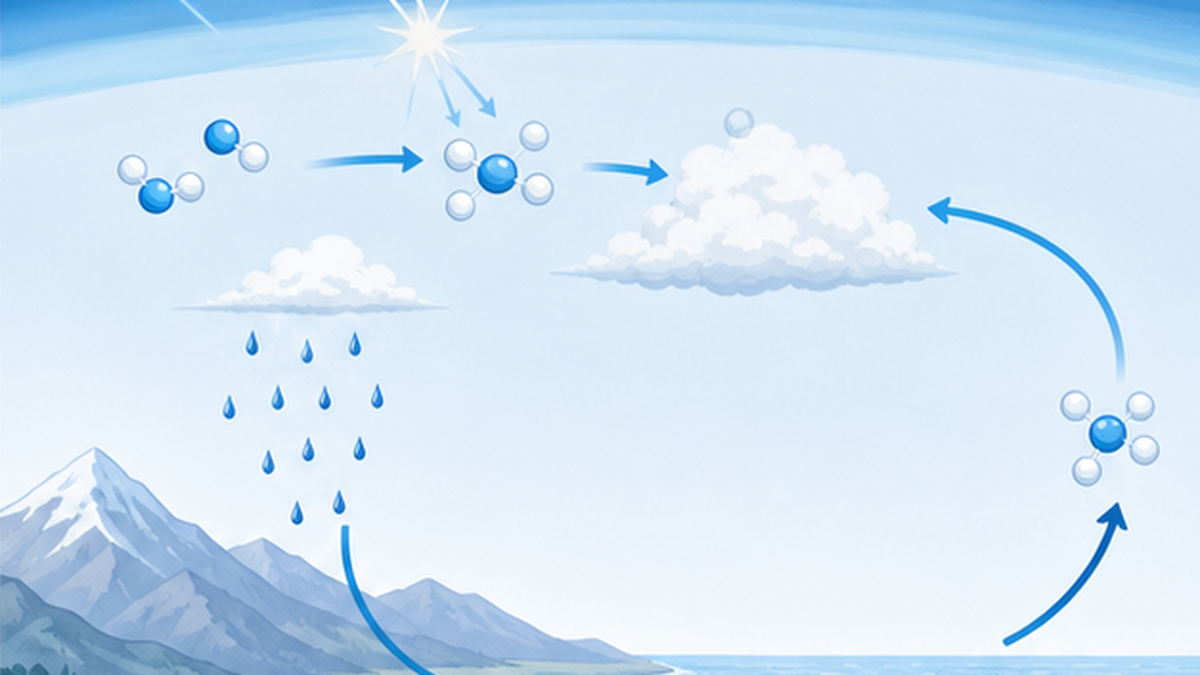
While ALPS can remove most radioactive substances, tritium is a substance that is technically very difficult to remove. Tritium is a form of hydrogen, and because it is integrated into the water itself as part of the water molecule (H₂O), ordinary filters cannot separate it from the water. Cesium and strontium exist as "separate substances" dissolved in water, so they can be captured with filters or adsorbents, but tritium has effectively become the water itself, making it fundamentally difficult to extract only the tritium without discarding the water. This is why nuclear facilities around the world currently dilute and release only tritium into the ocean or atmosphere.
What's worth noting here is that the decision to "release the treated water" and the ideal of "reducing tritium to zero" are two different things. Technologies to completely remove tritium are being researched, but no method has yet been established that can process the enormous volume of 1.34 million tons at a practical cost and within a practical timeframe. That is precisely why the practical approach chosen was not removal but diluting it and managing the total volume, and how to guarantee its safety has become the focus of debate.
One point to be careful about, however, is that even after ALPS treatment, a considerable amount of water in the tanks still contains radioactive substances other than tritium above the standard levels. The government and TEPCO explain that such water is processed through ALPS once again before release, bringing radioactive substances other than tritium down below the safety standard before diluting it with seawater. "Only water that meets the standard is released" is the basic premise of the release.
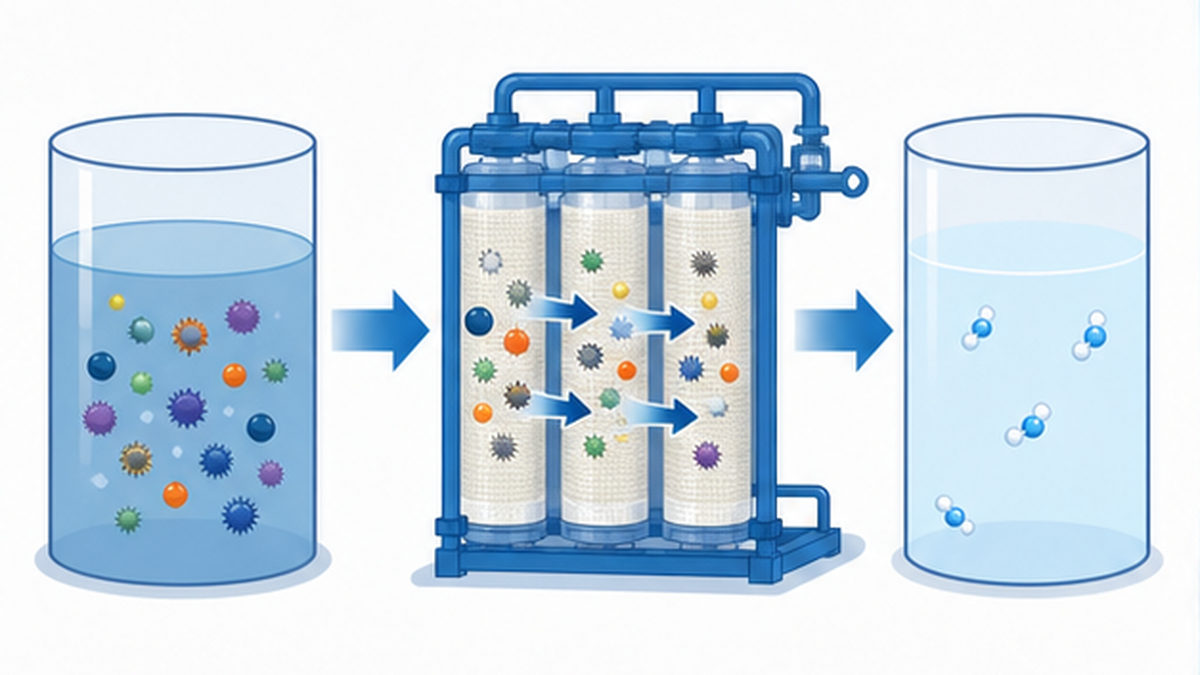
The roughly 1.34 million tons of water accumulated in tanks
The treated water was initially stored in around 1,000 tanks lined up across the site. The volume reached roughly 1.34 million tons, and the tanks came to occupy most of the site. Decommissioning work requires space for tasks such as removing the fuel debris, and continuing to add more tanks became difficult—this is cited as one reason the government chose ocean release.
The release is not something that finishes in one go; it is planned to be carried out gradually over roughly 30 years. By releasing it slowly, diluted, over a long period, the design aims to keep the burden on the environment low. Decommissioning itself is a long-term project spanning decades, and the release of treated water is only a small part of it. Put another way, we will continue to face this topic for decades to come. That is precisely why a stance of judging based on continuously updated data, rather than on emotions of the moment, is required.
It should also be noted that before arriving at the choice of ocean release, several methods were compared and examined, including injection into geological strata and vaporizing the water for release into the atmosphere. Ocean release was adopted as the practical option because there are precedents both in Japan and abroad, and because conditions after release are relatively easy to monitor. It is not that there were no other options—each had its own advantages and disadvantages, and it is worth viewing that fairly as well.
Sorting out the terminology
- Contaminated water: water containing radioactive substances, before purification
- ALPS treated water: water purified by ALPS, with everything except tritium brought below the standard
- Tritium: a radioactive isotope of hydrogen, integrated with water and difficult to separate
The topic of ocean recovery and the fishing industry is not limited to treated water. The fishing industry's path to recovery since the disaster is also covered in our article on the recovery of the Sanriku fishing industry. First, let's take a scientific look, in the next chapter, at what kind of substance the remaining tritium actually is.
The science of tritium—half-life, the natural world, and behavior in the body
Tritium tends to be seen as a special substance produced by nuclear power plants, but in fact it is a radioactive substance that has existed in our surroundings since long ago. Cosmic rays falling from space collide with atoms in the atmosphere, continuously generating tritium naturally on Earth. Its quantity is estimated at roughly 70 quadrillion becquerels a year (7×10¹⁶), and it is present in trace amounts in rain, rivers, seawater, and even our own bodies.
Half-life and beta rays
Tritium has a half-life of about 12.3 years, gradually turning into helium-3 over time. In doing so, it emits only beta rays, and moreover, their energy is so weak that they are stopped by a single sheet of paper or the surface of the skin. When we hear "radiation," we tend to imagine something highly penetrating like an X-ray, but the beta rays from tritium are of an entirely different nature. Exposure from tritium outside the body is rarely an issue at all. What is central to the debate is the effect of tritium taken into the body through food and drink.
The figure "half-life of 12.3 years" also needs to be read correctly. This is the period over which the physical quantity of tritium is halved, and is a separate matter from how long it remains in the body. As described later, tritium that enters the body is promptly excreted as water, so its actual residence time in the body is far shorter. Confusing the physical half-life with how readily it is excreted from the body (the biological half-life) leads to overestimating the risk.
In the body, it behaves just like water
When tritium enters the body of a person or a fish, most of it behaves just like water. Water circulates through the body and is eventually excreted as urine or sweat. Tritium behaves similarly, leaving the body relatively promptly rather than lingering. Part of the tritium water taken in (roughly 5–6%) converts into organically bound tritium (OBT), combined with proteins and the like, but its biological half-life is also short—about 40 days for the short-lived component and about a year even for the long-lived component.
This "ease of leaving the body" is precisely what matters most in thinking about tritium's risk. The health effects of a radioactive substance depend not only on how strong the radiation it emits is, but greatly on where in the body the substance stays, and for how long. A substance that lingers for a long time in a specific organ, continuing to emit radiation at close range, has a greater effect, but tritium, which flows out together with water, simply does not stay in the body for long in the first place. Emitting only weak beta rays, and not staying in the body—these two factors combine to make tritium's health effect assessed as small.
Why "no biomagnification" matters
An essential concept when discussing radioactive substances is biomagnification (bioaccumulation). This is the phenomenon by which organisms higher up the food chain tend to accumulate more of a certain substance in their bodies, with organic mercury—the cause of Minamata disease—being a typical example. Cesium-137, which became an issue after the Fukushima accident, is also known to become concentrated 5 to 100 times in fish.
Tritium, by contrast, moves in and out just like water, so it does not accumulate in the body. In fish, shellfish, and seaweed alike, the concentration factor is understood to be roughly 1—meaning it accumulates only up to the same concentration as the surrounding seawater, no more. The intuition that "the higher up the food chain, the more dangerous" applies to cesium and mercury, but not to tritium. Furthermore, the health impact per becquerel of tritium (the effective dose coefficient) is said to be roughly one 700th that of cesium-137. Even for the same "1 becquerel," the meaning differs enormously depending on the substance.
This point—that "a becquerel represents quantity, but the degree of danger differs by substance"—is very important for reading the news correctly. A becquerel is merely a unit of radioactivity representing how many times per second radiation is emitted; the health effect (expressed in sieverts) varies entirely depending on what kind of radiation it is and where in the body, and for how long, it stays. Rather than being alarmed by a headline saying simply "X becquerels detected," developing the habit of also checking which substance's becquerels are being discussed leads to a calmer understanding.
| Item | Tritium | Cesium-137 |
|---|---|---|
| Biomagnification (in fish) | Roughly 1x (no concentration) | 5–100x |
| Behavior in the body | Excreted promptly, just like water | Readily taken up into muscle and other tissue |
| Radiation emitted | Weak beta rays only | Beta rays and gamma rays |
| Approximate effective dose coefficient | Small (baseline) | About 700 times that of tritium |
Key points
- Tritium is always present in nature, with a half-life of about 12.3 years
- It emits only weak beta rays, and its effect from outside the body is very small
- Because it behaves like water, it does not accumulate in the body and does not undergo biomagnification
- Even for the same 1 becquerel, the health impact differs by orders of magnitude from cesium-137
Now that we understand the properties of the substance itself, let's next look at the release mechanism—at what concentration, and how, it is actually released.
The mechanism and standards of release—1,500 becquerels and 22 trillion becquerels a year
In the ocean release, two figures form the pillars of safety management. One is the concentration per liter of water released, and the other is the total volume of tritium released in a year. By setting upper limits on both fronts, the design suppresses effects both instantaneously and cumulatively.
Diluted more than 100-fold, to under 1,500 becquerels
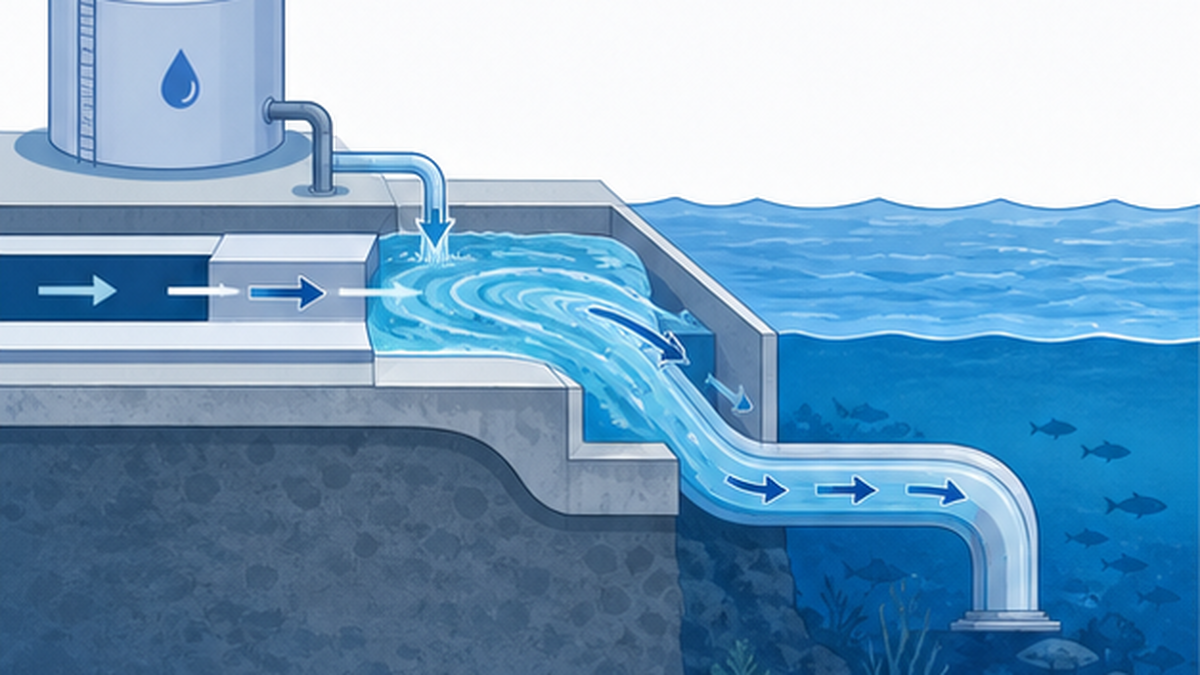
The treated water in the tanks can have a tritium concentration reaching several hundred thousand becquerels per liter before release. It is therefore mixed with a large volume of seawater and diluted more than 100-fold before release. The concentration after dilution is managed to stay below 1,500 becquerels per liter. This figure of 1,500 is about one-seventh of the WHO (World Health Organization) drinking water standard (10,000 becquerels per liter). In other words, it is designed so that even if that seawater were drunk as is, it would fall well below international drinking water standards.
There is also criticism that "diluting doesn't change anything, since the total amount stays the same." It is true that dilution alone does not reduce the total volume of tritium released. That is precisely why it is managed together with the annual total volume cap described below. The concentration cap is a safeguard to prevent locally high concentrations of seawater near the outlet, while the total volume cap is a safeguard to suppress long-term, cumulative effects. The two play different roles, and the design philosophy is that neither one alone is sufficient.
The annual total of 22 trillion becquerels, below the "pre-accident operational limit"
Beyond concentration, an upper limit is also set on the total volume of tritium released in a year. That figure is 22 trillion becquerels annually. This is the release management value that was used as an operational benchmark even before the Fukushima Daiichi accident occurred, and the release is carried out so as to stay below this level. Rather than setting a new, large figure, the approach is to keep releases within the bounds of a standard that had already been in use before the accident.
The release process and the mechanism for stopping it
The release proceeds through the following stages. Rather than suddenly releasing a large volume of water at once, it is characterized by proceeding little by little, interspersed with measurement and confirmation. Checking standards are met at each step, and reverting to the previous stage if they are not—this "measure, then release" sequence is the core of the safety management.
- Move the treated water in the tanks to measurement facilities and analyze whether radioactive substances other than tritium are below the standard
- If the standard is not met, purify it again through ALPS
- Dilute water that meets the standard with a large volume of seawater, more than 100-fold
- Measure the concentration after dilution and confirm it is below 1,500 becquerels per liter
- Release it into the ocean from an outlet about 1 km offshore
- Automatically stop the release if any abnormality is detected
Managed by a dual upper limit
- Concentration limit: below 1,500 becquerels/L after dilution (about 1/7 of the WHO drinking water standard)
- Total volume limit: 22 trillion becquerels a year (below the pre-accident operational value)
- A mechanism to automatically stop the release in the event of an abnormality
Even so, being told that "the standard is met" is not enough to feel reassured without confirming what is actually happening in the ocean. That is where the monitoring system, examined next, becomes important.
Monitoring—a triple check by the ocean, fish, and international bodies
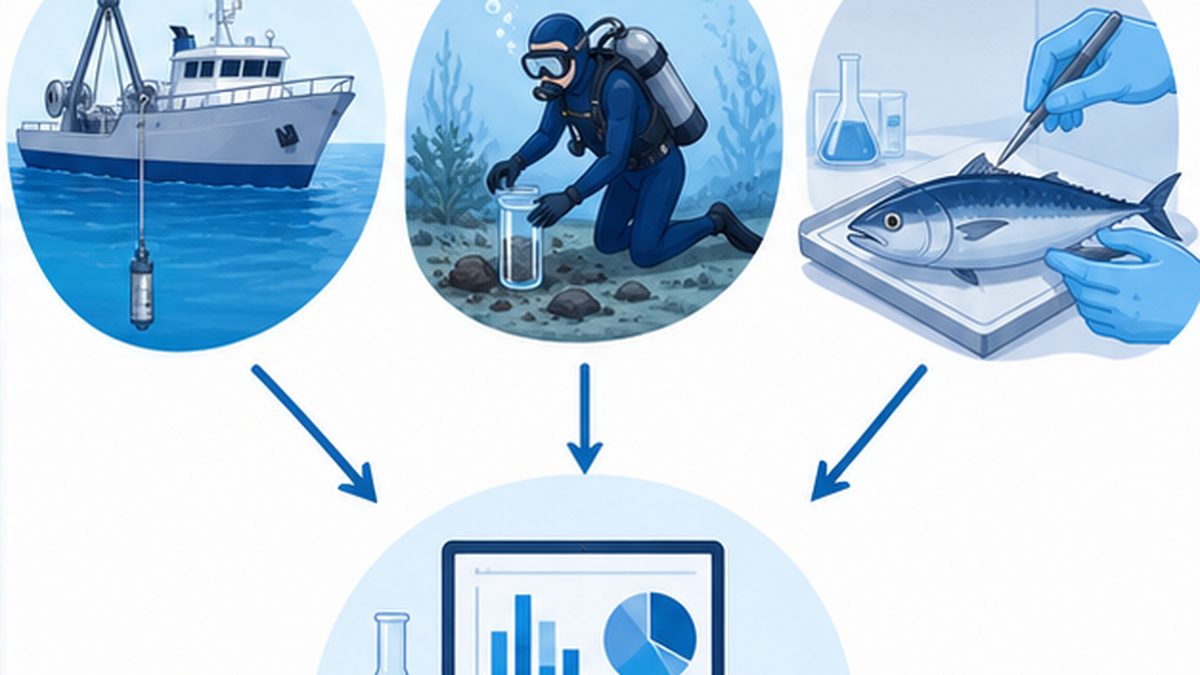
To confirm that the release is being carried out according to standard and that no actual impact is occurring on the ocean or living creatures, monitoring of seawater, seabed sediment, and marine products continues before and after the release. The parties involved extend beyond TEPCO alone to include the Ministry of the Environment, related agencies, and even the International Atomic Energy Agency (IAEA), forming a system checked by multiple sets of eyes.
Domestic monitoring—the Ministry of the Environment, TEPCO, and local governments
The Ministry of the Environment collects seawater across a wide area including the vicinity of the outlet, measures tritium and other nuclides, and publishes the results. TEPCO also frequently measures seawater both inside and outside the harbor, monitoring for any sharp rise in concentration during release. Fukushima Prefecture also conducts its own measurements, and having multiple entities measure independently increases the reliability of the data. The measurement results are published on websites as they become available, and it's also notable that anyone can access the raw data. It would be closer to the truth to say the reality is not that data is "being hidden," but that it is "published, yet not seen by many people."
Monitoring is not limited to seawater. Sediment accumulating on the seabed is also regularly sampled and analyzed. Some radioactive substances tend to accumulate in seabed sediment more than in seawater, so by looking at both the water and the seabed, efforts are made to catch early signs of long-term accumulation. This kind of multilayered measurement also plays a role in preventing people from judging reassurance or concern based on just a single indicator.
Tritium in fish continues to stay "below the detection limit"
What concerns consumers most is likely, after all, whether radioactive substances are accumulating in fish. Surveys continue in which fish caught off the coast of Fukushima are sampled to measure tritium concentration, and in many samples, results are reported as below the detection limit—that is, below the level detectable by measuring instruments. At some points in the seawater very close to the outlet, a slight rise has been observed during release, but even that has stayed within a range far below the standard. Reading our article on marine biodiversity in Japan alongside this one will deepen your understanding of the marine ecosystem itself.
International review by the IAEA
Domestic measurements alone leave open the question of "isn't this just an internal assessment?" That is why Japan has, since 2021, requested an independent safety review from the International Atomic Energy Agency (IAEA). The IAEA published a comprehensive report in July 2023, concluding that the release plan is consistent with international safety standards, and the radiological impact on people and the environment is negligible.
Since then, the IAEA has continued its reviews following the start of the release, confirming through independent analysis that tritium concentrations remain far below the regulatory and operational values. A report from the fifth safety review mission since the release began was published in 2026, stating that no non-conformance with international safety standards was found. Furthermore, additional monitoring—in which analytical institutions from third countries, including China, also participate—has been conducted under the IAEA framework, including cross-checks in which multiple countries split and measure the same seawater samples. This method, in which research institutions from countries with differing positions measure the same samples and compare results, can be considered one of the most direct answers to the suspicion that "Japan's data cannot be trusted."
Of course, the IAEA stating that the release "is consistent with safety standards" does not mean "the risk is absolutely zero." It is impossible, in principle, for science to prove "zero risk"; what it can show is only an assessment that "the impact is negligible when measured against the standard." Understanding this distinction keeps you from being swept up in an either/or debate over whether "the IAEA said it's safe" or "did not say it's safe." Data should be read not as black and white, but as a matter of degree.
A triple-check system
- Domestic: the Ministry of the Environment, TEPCO, Fukushima Prefecture, and others measure and publish data on seawater and marine products
- Marine products: tritium in fish off the coast of Fukushima is mostly below the detection limit
- International: the IAEA continues independent reviews, with additional monitoring joined by third countries
Even with this much scientific data accumulated, a different dynamic plays out in the world of consumption and trade. From here on, this is a story of reputational damage, in which "perception," rather than numbers, takes center stage.
Getting a sense of scale by comparing with nuclear plants and reprocessing facilities worldwide
Even when told "22 trillion becquerels," it is hard to grasp intuitively whether that is large or small. To understand what the number means, the quickest path is to line it up against how much tritium is released from other locations. The release of tritium itself is not something unique to Fukushima.
Nuclear plants worldwide routinely release tritium
Nuclear power plants around the world release tritium into the ocean, rivers, and atmosphere as part of normal operation, and the combined total is estimated at roughly 20 quadrillion becquerels a year (2×10¹⁶). Releases from reprocessing plants that handle spent nuclear fuel are even larger—France's La Hague reprocessing plant is reported to have released about 10.5 quadrillion becquerels in liquid discharge alone in 2022. Fukushima's annual cap of 22 trillion becquerels can be seen to be a considerably smaller figure compared to these. Considering that emissions from nuclear plants across Japan before the accident totaled about 380 trillion becquerels a year, it becomes clear that the 22-trillion-becquerel cap is not an exceptionally large figure.
To avoid any misunderstanding, it's worth emphasizing that this is not the defiant logic of "others are releasing it too, so it's fine." What matters is that having a sense of scale for the quantities helps avoid feeling, based only on news headlines or fragmentary information on social media, that "an outrageous amount is being released." Both underestimating and overestimating move us away from an accurate judgment. Being conscious of orders of magnitude when looking at numbers is a clue that helps prevent both.
Vast quantities already exist in nature
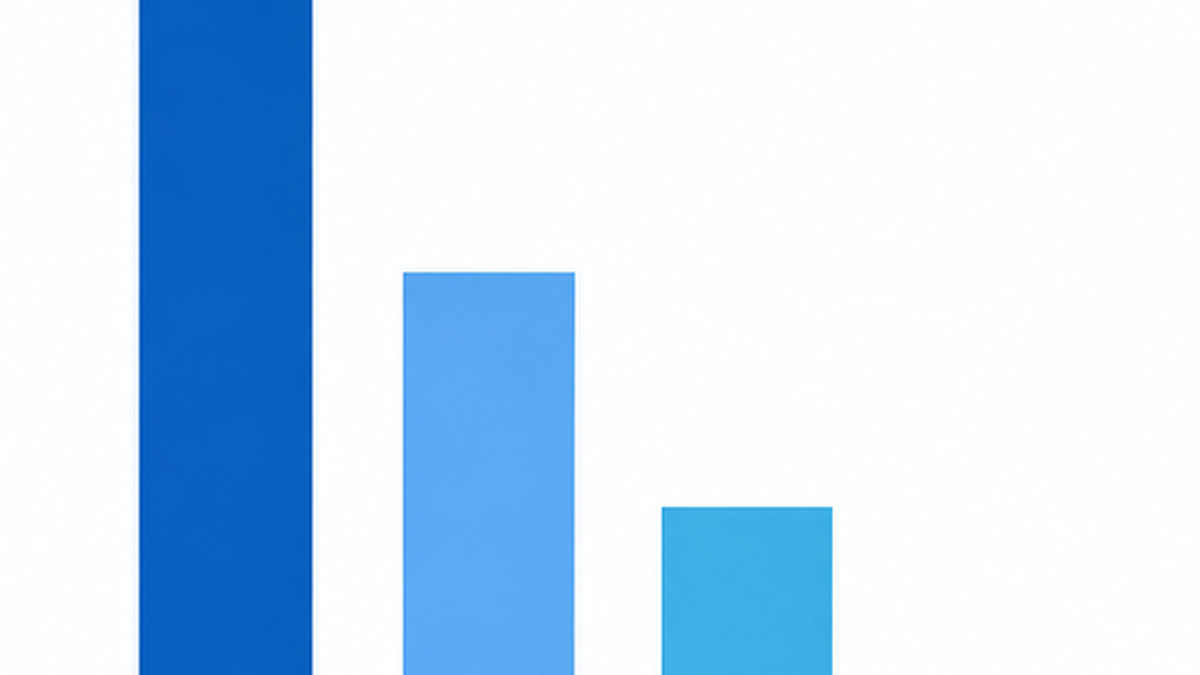
As touched on in the previous chapter, cosmic rays naturally generate roughly 70 quadrillion becquerels a year of tritium on Earth. The amount of tritium already present in seawater is vastly larger by orders of magnitude, and the released amount is only a tiny fraction relative to the total quantity present in the ocean as a whole. Of course, one cannot simply say "it's natural, so it's safe," but having a sense of orders of magnitude helps in avoiding both overestimation and underestimation.
| Source | Approximate annual tritium quantity |
|---|---|
| Natural generation by cosmic rays | About 70 quadrillion (7×10¹⁶) becquerels |
| Total release from nuclear plants worldwide | About 20 quadrillion (2×10¹⁶) becquerels |
| France's La Hague reprocessing plant (2022, liquid) | About 10.5 quadrillion becquerels |
| Fukushima Daiichi, annual release cap | Under 22 trillion becquerels |
Notes on reading the numbers
- A "quadrillion" is ten thousand times a "trillion." A difference of one order of magnitude changes the quantity greatly
- Even in the same becquerels, concentration (per liter) and total volume (per year) are different metrics
- The comparison is meant to give a sense of scale, not to show that the impact is zero
This is as far as the science and numbers go. From here, we turn to what actually happened to people's lives and livelihoods—the reality of reputational damage.
Reputational damage and the impact on the fishing industry—China's import ban and scallops
No matter how thoroughly scientific safety is explained, if a movement spreads of "not buying, or being unable to buy, simply out of vague unease," producing regions and fishermen take a hit. This is reputational damage. What had the greatest impact from this release was, more than consumers' own reluctance to buy, tighter regulation by export destination countries.
China imposes a blanket import ban
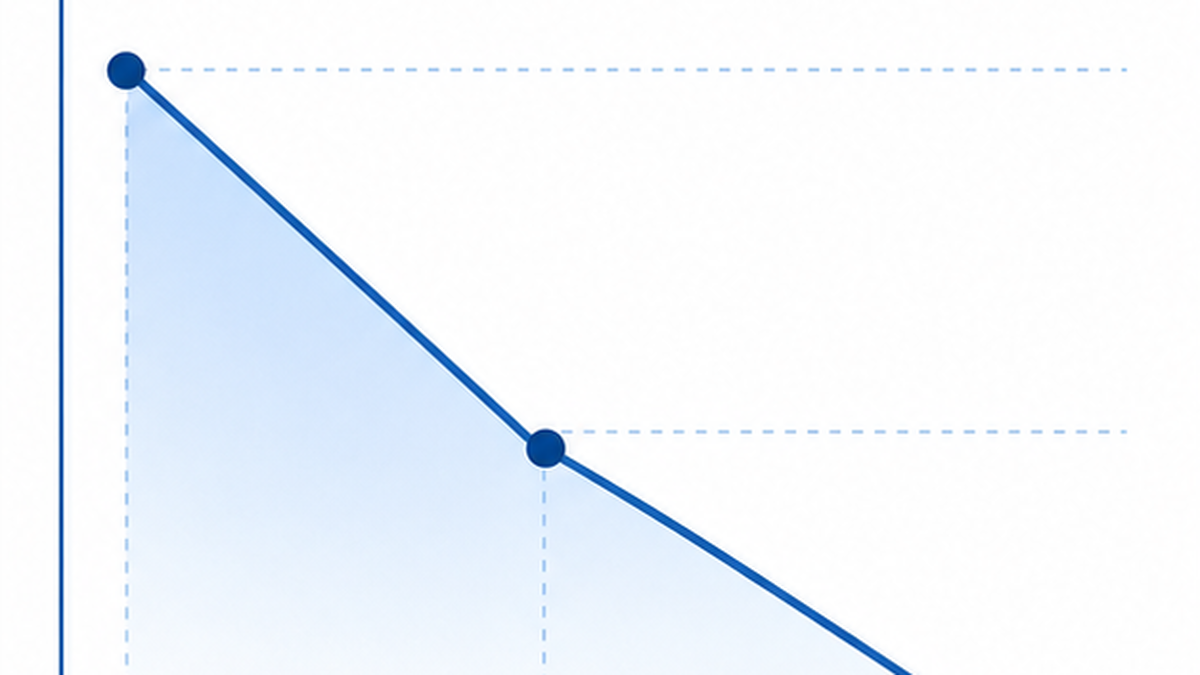
In August 2023, when the release began, China moved to a blanket ban on imports of Japanese seafood. Hong Kong and other regions also restricted imports from some areas. As a result, seafood export value to China fell sharply, down about 30% in 2023 and about 93% in 2024 compared with 2022. China had originally been one of the largest export destinations for Japanese seafood, and the impact of that market essentially disappearing altogether was enormous. This was a move driven more by political and diplomatic considerations than by scientific grounds.
What's worth distinguishing here is that "reputational damage," as a single term, actually contains two different things. One is consumer-level reluctance to buy, in which consumers both in Japan and abroad avoid Japanese fish out of vague unease. The other is regulatory-level measures, in which a country halts imports as a matter of institutional policy. This time, it was the latter that caused the greater loss in monetary terms. The former—reluctance to buy—settled down relatively quickly within Japan, as described later. Without separating these two, discussions of countermeasures also fail to align.
Scallops take a direct hit
Particularly severe was the impact on scallops. Japanese scallops relied heavily on exports to China, and moreover, a route had been established in which "shells were shucked through processing in China, then re-exported further to the United States and elsewhere." China served as a kind of processing waypoint, handling the labor-intensive shucking process with inexpensive labor. With China halting imports, this processing-and-export flow was cut off, and producing regions such as Hokkaido faced a situation of oversupplied inventory and falling prices. This was not a loss caused by any decline in quality due to safety issues, but a loss from having lost a buyer.
This episode reflected a structural weakness in Japan's export industries, not limited to fisheries. When production, processing, and sales are consolidated in a specific country for the sake of efficiency, costs fall and it is advantageous in normal times, but once relations with that country sour, an alternative outlet cannot be found immediately, and producing regions all get stuck at once. The treated water issue can also be seen as an event that exposed that fragility from the outside.
This fragility in export structure highlighted the risk of relying too heavily on a specific trading partner country. The fishing industry already faces many challenges of its own, such as changes in catch volumes due to climate change. Related to this, our article on ocean warming and fisheries is also worth referencing.
Domestic consumption actually rose in some respects
On the other hand, within Japan, a movement that could be called "consumption to show support" emerged. A momentum spread to actively eat the affected marine products, and household spending on scallops within Japan is reported to have increased by roughly 1.4 times year-on-year over the year from September 2023. Domestic consumers' reception showed a movement that was, in some respects, the opposite of the regulatory tightening at export destinations.
The essence of reputational damage
- The primary cause of the damage was tighter regulation by an export destination country, more than consumers' reluctance to buy
- Scallops suffered a large impact because they depended on the processing-and-re-export route through China
- This was an economic loss from "losing a buyer," not a safety problem
- There was also an opposite movement within Japan, with scallop consumption rising through support-buying
So what measures have been taken in response to this blow? Let's look at the efforts made toward recovery and rebuilding trust.
Efforts toward recovery and rebuilding trust—support, diversification, and the resumption of imports
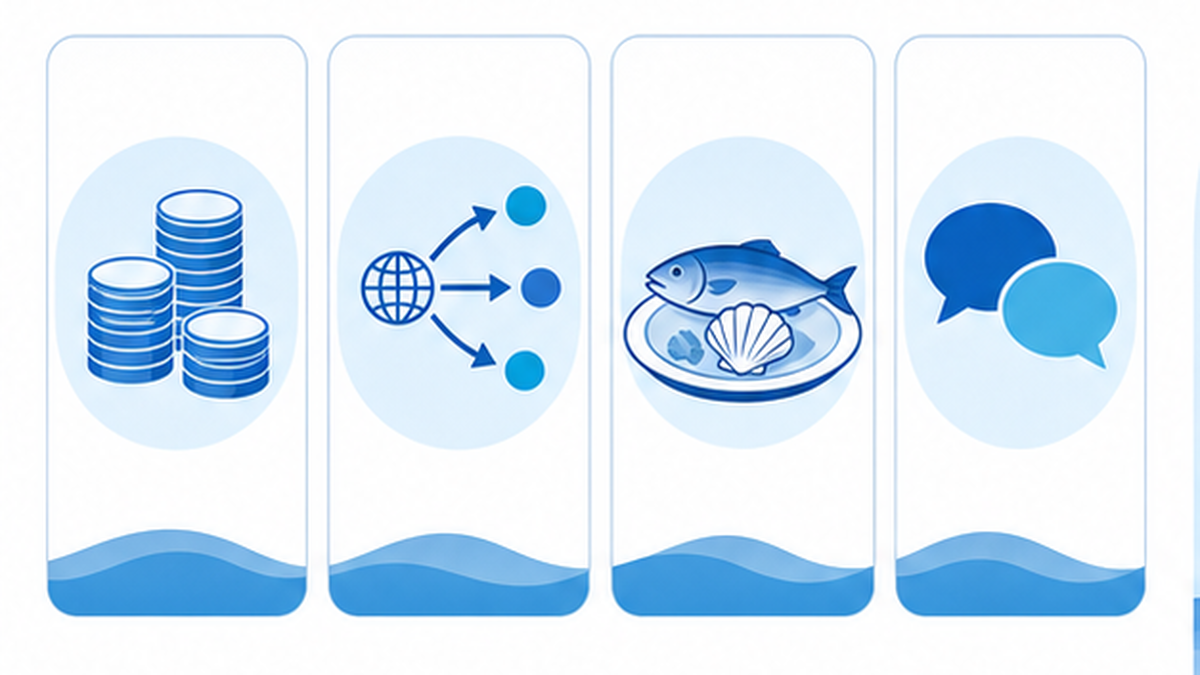
In response to the sharp drop in exports and falling prices, the government, local governments, and fishing industry stakeholders have pursued various countermeasures. Broadly, these fall into four directions: financial support, diversifying sales channels, expanding domestic consumption, and dialogue with the destination country.
A support package worth around 100 billion yen
The government first set up an 80-billion-yen fund in preparation for reputational impact, in addition to compensation from TEPCO, and then, in response to the tightened import regulations, launched a "Protecting the Fishing Industry" policy package totaling about 100.7 billion yen. This includes support for purchasing and cold-storing marine products, developing new fishing grounds and fish species, and strengthening processing systems. The aim is to reduce dependence on any single country and shore up the finances of producing regions.
Diversifying export destinations and a new route for scallops
To change the structure that had relied so heavily on China, diversification of export destinations has progressed. For scallops, efforts have moved forward to shift the shell-shucking processing previously done in China to countries such as Vietnam, Thailand, and Indonesia, and to build new routes exporting from there to the United States and elsewhere. In 2024, exports of frozen scallops to these countries increased, and processing there has also been expanding. On the broader issue of ocean environment challenges such as plastic waste, our article on fishing net recycling is also relevant.
Consumer awareness falls to "the lowest level on record"
The Consumer Affairs Agency has regularly surveyed consumer awareness of food from the disaster-affected areas since the year of the earthquake. In the March 2024 survey (the 17th), the proportion of people who cited "wanting to buy food that does not contain radioactive substances" as a reason for caring about the place of origin when shopping was 9.3%, down from 10.5% the previous year and the lowest level since the survey began. The share of people citing Fukushima Prefecture or the Tohoku region as places whose products they hesitate to buy because of radioactive substances has also continued to decline. In numerical terms, domestic reluctance to buy can be said to have steadily eased.
On the other hand, the same survey also shows that in recent years, around 60% of respondents say they are unaware that food is tested for radioactive substances. In other words, the decline in anxiety may reflect not so much trust built in the testing, but rather a fading of interest with the passage of time. Recovery of trust and mere indifference can look similar and are hard to distinguish, and this is a point that should not be overlooked in discussing recovery. Whether people feel reassured as a result of accurate information reaching them, or are simply forgetting, needs to be considered separately.
| Recovery and trust-rebuilding effort | Main content |
|---|---|
| Financial support | 80-billion-yen fund plus a policy package totaling 100.7 billion yen, and compensation from TEPCO |
| Diversifying sales channels | Shifting scallop processing to Vietnam, Thailand, and elsewhere, exporting to the US and other markets |
| Expanding domestic consumption | Calls for support-buying, offering products in company cafeterias and elsewhere |
| Dialogue with the destination country | Additional monitoring under the IAEA framework, Japan–China technical consultations |
China partially resumes imports
There has also been movement on the dialogue front. In September 2024, Japan and China announced "shared views," and additional monitoring, in which China also participates, was carried out under the IAEA framework. Then, in June 2025, China announced it would conditionally resume imports of Japanese seafood, excluding ten prefectures including Fukushima. This is premised on there being no abnormalities found through international monitoring and China's own inspections. Full normalization has not been reached, but the fact that a once-closed market has started moving again can be seen as a milestone toward recovery.
That said, this resumption remains partial, still excluding ten prefectures including Fukushima from its scope, and the situation remains difficult for producing regions in those areas. Also, sales channels and trading relationships once lost do not necessarily return immediately just because regulations have been lifted. Rebuilding trust and trade flows takes time. The experience gained from pursuing export diversification should also serve as preparation for the long-term challenge of "breaking away from dependence on a specific country." In that sense, the treated water issue also became an opportunity that forced structural transformation on Japan's fishing industry.
What consumers can do
- Develop the habit of checking public agencies' monitoring results as primary sources
- Keep in mind a perspective of judging by "inspection data" rather than "place of origin"
- Actually eating seafood from a producing region you're concerned about, as a form of support, is also one option
- Prioritize published materials from the Ministry of the Environment, the Fisheries Agency, and the IAEA over fragmentary information on social media
Finally, let's briefly recap what we've covered here.
Conclusion—separating the science from the perceptions
The ocean release of ALPS treated water is an issue discussed along two different axes: scientific data and how people perceive it. Confusing the two causes the discussion to talk past itself. The facts shown by the numbers, and the anxieties held by society or judgments made in trade, need to be treated carefully as separate matters.
Tritium is a substance that also exists in nature, behaves just like water, does not accumulate in the body, and does not undergo biomagnification. The release is managed under a dual cap on concentration and total volume, and layered monitoring by the Ministry of the Environment, TEPCO, and the IAEA continues. Meanwhile, the reputational damage epitomized by China's import ban has genuinely made things difficult for the fishing industry, and steady efforts—support, diversification, and dialogue—have been piled up toward its recovery.
What matters is not being swayed by fragmentary information, but consulting primary sources such as the Ministry of the Environment, the Fisheries Agency, and the IAEA, and understanding that "safety" and "peace of mind" are not the same thing. As a step toward thinking about the ocean's future, please also read our articles on the recovery of the Sanriku fishing industry and marine biodiversity.

Summary of this article
- ALPS treated water is water from which most radioactive substances have been removed, with the hard-to-separate tritium diluted before release
- Tritium also exists in nature, does not undergo biomagnification, and its health impact differs by orders of magnitude from cesium-137
- The release is managed under a dual cap: below 1,500 becquerels/L after dilution, and under 22 trillion becquerels a year
- Under layered monitoring by seawater, fish, and international bodies, tritium in fish is mostly below the detection limit
- The primary cause of reputational damage was China's import ban, which hit export-dependent items such as scallops
- Recovery is also progressing, through support measures, export diversification, rising domestic consumption, and China's partial resumption of imports
- It is important to separate scientific facts from social perceptions and to judge based on primary sources
References and sources
- Agency for Natural Resources and Energy, Ministry of Economy, Trade and Industry – One year since the ocean release of ALPS treated water began. What is the status of safety confirmation and monitoring?
- Ministry of Economy, Trade and Industry – What is ALPS treated water? Is it really safe? (ALPS Treated Water Portal)
- Ministry of the Environment – Sea area monitoring information related to ALPS treated water
- International Atomic Energy Agency (IAEA) – Japan's ALPS Treated Water Release Continues to Meet International Safety Standards
- Fisheries Agency of Japan – FY2024 Fisheries White Paper, developments surrounding the ocean release of ALPS treated water
- Ministry of Agriculture, Forestry and Fisheries – Information on countries and regions that have tightened regulations following the ocean release of ALPS treated water
- Consumer Affairs Agency – Survey on the actual state of consumer awareness regarding reputational damage (17th survey)
- Ministry of Economy, Trade and Industry – "Protecting the Fishing Industry" policy package (total of 100.7 billion yen)
- Japan External Trade Organization (JETRO) – China partially resumes imports of Japanese seafood (June 2025)
- Tokyo Electric Power Company Holdings (TEPCO) – On the ocean release of ALPS treated water / results of sea area monitoring
※ Listed in order of reliability: government and academic institutions > peer-reviewed papers > specialized institutions > reliable media