⚡ In short
The blue economy is an approach to sustainably harness ocean resources while pursuing economic growth. The OECD projects the value added by ocean-related industries will reach $3 trillion by 2030. This article explains Japan's efforts in offshore wind, aquaculture, and blue carbon.
Can "protecting the ocean" and "earning money from the ocean" go hand in hand? The concept trying to answer this question is the blue economy.
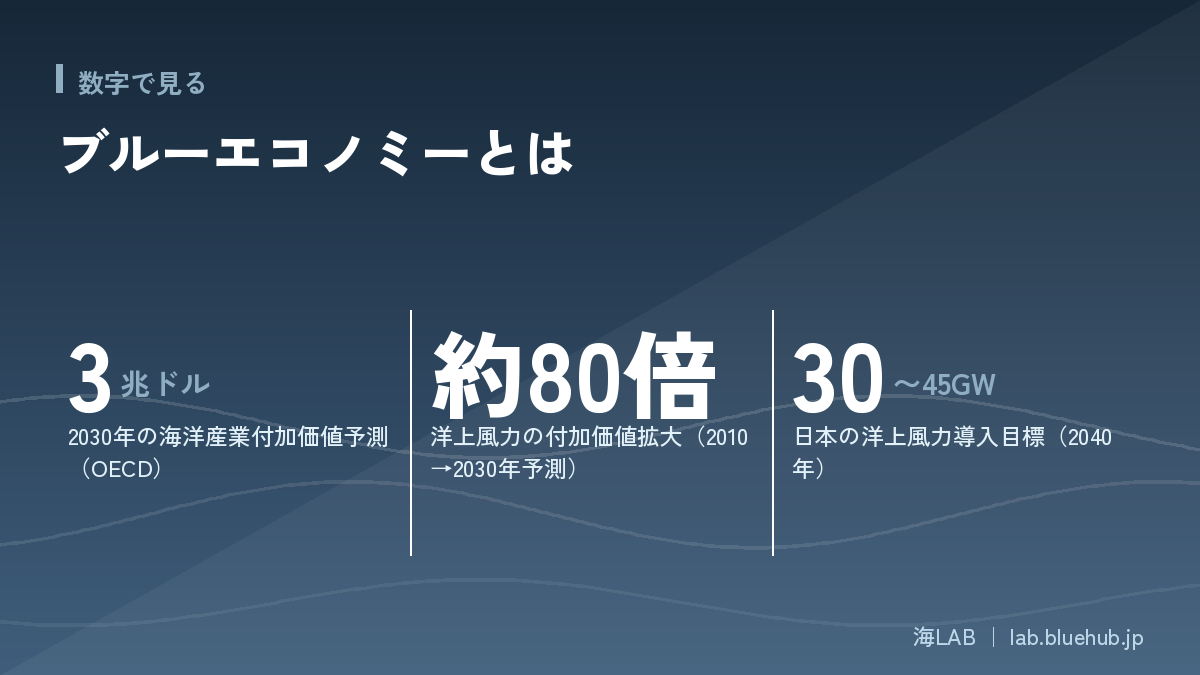
The OECD (Organisation for Economic Co-operation and Development) defines the "ocean economy" as the combination of economic activity from ocean-related industries—shipping, fisheries, tourism, ocean energy, and more—together with the value provided by marine ecosystems, and estimates that its total value added will reach $3 trillion by 2030. That is roughly double the scale seen in 2010.
In Japan, too, under the Fourth Basic Plan on Ocean Policy adopted by the Cabinet in 2023, concrete efforts are underway to advance both ocean conservation and economic growth simultaneously—expanding offshore wind power, making the fisheries industry smarter, and using blue carbon credits generated by seaweed-bed restoration. This article organizes the definition of the blue economy, policy trends in Japan and around the world, and real corporate examples.
What you'll learn in this article
- The definition of the blue economy and the OECD's market-size projections
- Japan's Fourth Basic Plan on Ocean Policy and the direction of OX (Ocean Transformation)
- Offshore wind power deployment targets and the current volume of projects in development
- How mechanisms such as J Blue Credit monetize blue carbon
- How the growth of the fisheries industry and decarbonization of shipping affect the economy
What Is the Blue Economy?
The blue economy is the concept of using ocean resources and marine ecosystems in a sustainable way to simultaneously achieve economic growth, job creation, and environmental conservation. The World Bank describes it as "the sustainable use of ocean resources for economic growth, improved livelihoods, and jobs while preserving the health of ocean ecosystems."
The OECD's Definition of the "Ocean Economy"
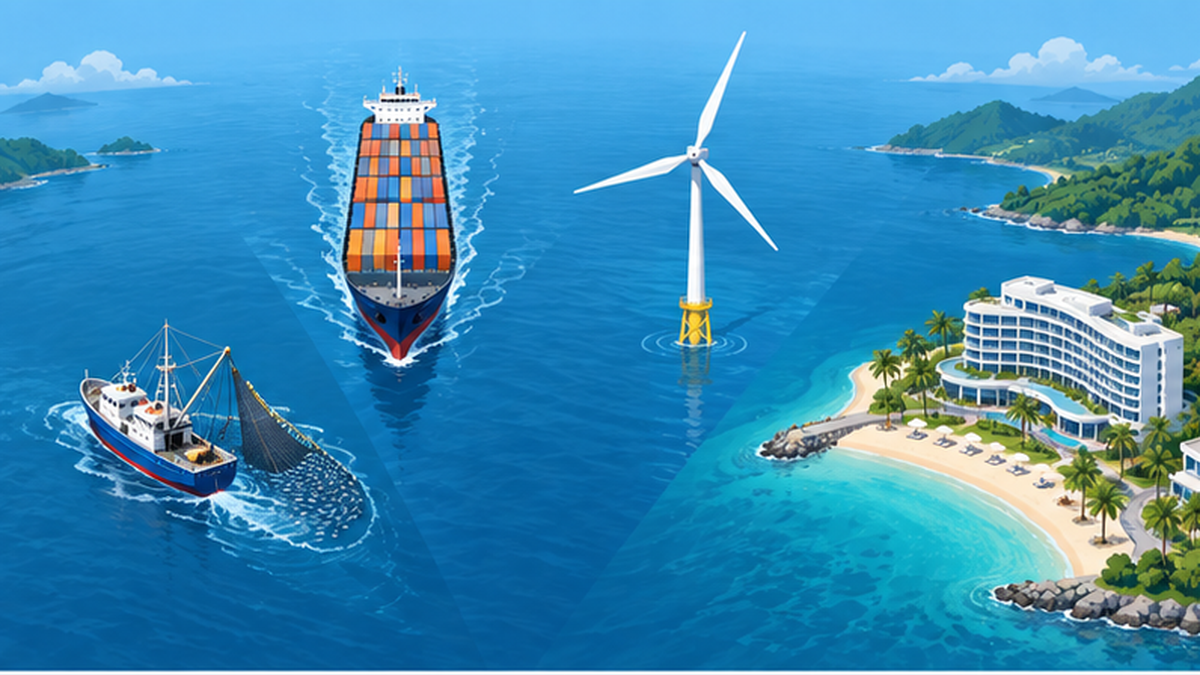
In 2016, the OECD (Organisation for Economic Co-operation and Development) defined the "ocean economy" as the combination of economic activity generated by ocean-related industries and the assets, products, and services provided by marine ecosystems. This includes industrial activities such as fisheries and aquaculture, shipping, offshore oil and gas, ocean tourism, and offshore wind power, as well as non-market values such as the climate-regulating functions and biodiversity that the ocean provides.
The Difference Between the Blue Economy and the Green Economy
- The green economy is a broad concept covering decarbonization and resource circulation across the entire economy, including land
- The blue economy is a concept focused on oceans and coastal areas, covering fisheries, shipping, ocean energy, and similar sectors
- The two overlap considerably; initiatives such as blue carbon, which harness the ocean's carbon absorption, relate to both
Its Relationship to the UN Sustainable Development Goals
The blue economy concept is closely tied to Goal 14 of the UN Sustainable Development Goals (SDGs), "Life Below Water." SDG 14 calls for preventing marine pollution, conserving ocean and coastal ecosystems, and ending illegal, unreported, and unregulated (IUU) fishing, and the blue economy is positioned as a framework that turns these goals into concrete economic activity. A key difference from conventional ocean development is that "sustainability"—using resources within the range they can regenerate—is a precondition, rather than simply pursuing catch volumes or export value.
Common Ground with the World Bank and UNEP Definitions
In a 2017 report, the World Bank defined the blue economy as "the sustainable use of ocean resources for economic growth, improved livelihoods, and jobs while preserving the health of ocean ecosystems." The UN Environment Programme (UNEP) similarly emphasizes the importance of economic activity that does not impair ocean and coastal ecosystem services. Both definitions share three common pillars: (1) creating economic value, (2) improving employment and living standards, and (3) maintaining the health of ecosystems—and if even one of these is missing, the result cannot truly be called a blue economy.
The Difficulty Created by Its Difference from the Land-Based Economy
The ocean is a body of water that flows across national borders, and its ecosystem connections extend over even wider areas than those on land. Development activity that one country undertakes along its coast can affect fishery resources and ecosystems in distant sea areas. For this reason, advancing the blue economy requires international cooperation that cannot be completed through the policy of a single country alone, and frameworks based on regional fisheries management organizations (RFMOs) and the UN Convention on the Law of the Sea play a role in complementing each country's efforts.
The Perspective of "Ocean GDP"
A perspective often used when discussing the blue economy is that of "ocean GDP." This is the idea of reassessing not just the production value of conventional ocean industries such as fisheries and shipping, but also the disaster-prevention functions the ocean provides to coastal areas, its value as a tourism resource, and even its climate-regulating functions, as economic benefits. How to incorporate ecosystem services that are difficult to quantify into such assessments remains a subject of academic debate, but the spread of this perspective itself is helping to build momentum for treating the ocean not merely as a resource to be extracted, but as a long-term asset.
The Expanding Scale of the Global Ocean Economy
According to OECD estimates, the total value added of ocean-related industries will reach $3 trillion by 2030, roughly double the scale seen in 2010. Broken down by sector, the highest growth rate is expected in offshore wind power, whose total value added is projected to expand roughly 80-fold between 2010 and 2030.
Growth Sectors: Aquaculture and Seafood Processing
Aquaculture, which uses AI, big data, and other cutting-edge technologies to make efficient and sustainable use of ocean resources, and seafood processing are each expected to see their total value added roughly triple. Against the backdrop of rising global demand for protein driven by population growth, the role of aquaculture—which does not rely solely on wild catch—is expanding.
| Sector | Change in value added, 2010→2030 (OECD estimate) |
|---|---|
| Offshore wind power | ~80x |
| Aquaculture | ~3x |
| Seafood processing | ~3x |
| Ocean industry overall | ~2x (to a $3 trillion scale) |
Differences in Approach Across Countries and Regions
How heavily countries and regions invest in the blue economy varies. The European Union (EU) has pursued a "Blue Growth Strategy," prioritizing investment in offshore wind, marine biotechnology, and the blue bioeconomy. In Pacific island nations, where exclusive economic zones (EEZs) make up the majority of their territory, managing fishing rights and ocean tourism form the core of blue economy policy. China, under its "maritime power" strategy, is expanding investment in aquaculture and port infrastructure—illustrating how differences in geography and industrial structure directly shape each country's or region's policy priorities.
Why Investment Money Is Flowing into the Ocean Sector
In recent years, institutional investors have increasingly issued so-called "blue bonds" for ocean conservation and sustainable fisheries. The World Bank and island nations such as Seychelles have issued blue bonds, using the proceeds to expand marine protected areas and upgrade fisheries management. Just as the "green bond" market has grown as a tool for climate action, the development of financing instruments specifically for the ocean sector is also acting as a tailwind for the growth of the ocean economy.
The Place of Ocean Tourism
Under the OECD's classification, ocean tourism—including cruise ships and coastal resorts—is also part of the ocean economy. Global cruise demand is on a recovery track after the slump caused by the COVID-19 pandemic, and tourism revenue remains a vital source of foreign currency for island nations and coastal municipalities. At the same time, concerns have been raised about the burden placed on coastal ecosystems by tourist concentration on coral reefs and the development of mooring facilities, making the balance between tourism and environmental conservation a key challenge.
High Fisheries Dependence in Emerging Economies
In coastal countries in Southeast Asia and West Africa, fisheries account for a larger share of GDP than in developed countries, and small-scale fishing serves as a vital source of protein and cash income for local residents. For these countries, the blue economy is not merely an industrial promotion policy but a policy issue directly tied to poverty reduction and food security. International cooperation agencies such as JICA are supporting the foundation for sustainable fisheries and the blue economy by helping developing countries build capacity in fishery resource management.
Japan's Ocean Policy and OX (Ocean Transformation)
The basic direction of Japan's ocean policy is set out in the "Fourth Basic Plan on Ocean Policy," adopted by the Cabinet in April 2023. A defining feature of this plan is that it puts forward OX (Ocean Transformation)—meaning industrial transformation driven by the ocean—and links it to GX (Green Transformation), the country's decarbonization strategy.
Coordination with the Basic Plan for Fisheries
The Basic Plan for Fisheries formulated by the Fisheries Agency positions resource management that accounts for changes in the ocean environment, the spread of smart fisheries, and export expansion as pillars, alongside making the fisheries industry sustainably competitive and revitalizing fishing communities. The Fisheries Agency has also set a goal of achieving zero net CO2 emissions in agriculture, forestry, and fisheries by 2050, and has laid out a policy of promoting CO2 fixation by seaweed (blue carbon).
Main Pillars of OX
- Expanding offshore wind power and other marine renewable energy
- Resource management and productivity gains through smart fisheries
- Utilizing blue carbon through the conservation of seagrass beds and tidal flats
- Achieving carbon neutrality in ports and shipping
Linkage with Port Policy
The Ports and Harbours Bureau of the Ministry of Land, Infrastructure, Transport and Tourism is advancing the development of base ports for offshore wind power and turning ports into receiving hubs for next-generation fuels such as hydrogen and ammonia. Ports were traditionally centered on the logistics function of loading and unloading cargo, but they are increasingly taking on roles as assembly and shipping hubs for offshore wind equipment and as supply hubs for fuel derived from renewable energy—repositioning ports themselves as key infrastructure for the blue economy.
Ripple Effects on Local Governments and Regional Economies
In local governments that are candidate sites for offshore wind power construction, efforts are underway to boost the ripple effects on regional economies, such as developing local companies to handle parts manufacturing and maintenance, and building mechanisms for cooperation payments to fishers. In regions such as Akita and Nagasaki prefectures, where offshore wind projects are already operating, examples of job creation in related industries and regional revitalization through port development are accumulating and being referenced by other coastal municipalities in their policymaking.
Building Ocean Data Infrastructure and Digitalization
Advancing OX also places emphasis on building infrastructure to collect and share ocean-related data in a unified way. If the ocean observation data held separately by the Japan Coast Guard, the Japan Meteorological Agency, and research institutions can be integrated into a system that businesses and researchers can use across organizations, it is expected to improve site selection for offshore wind and the precision of fishery resource management.
The Role of the Headquarters for Ocean Policy
The Headquarters for Ocean Policy, established within the Cabinet, is responsible for coordinating ocean-related measures across ministries and agencies under the Minister in charge of Ocean Policy. With multiple ministries and agencies—including the Ministry of Economy, Trade and Industry, the Ministry of Land, Infrastructure, Transport and Tourism, the Fisheries Agency, and the Ministry of the Environment—each advancing ocean policy within their own jurisdiction, a command-tower function is needed to prevent duplication and gaps in measures and to drive OX forward as a unified effort.
Offshore Wind Power: The Biggest Growth Engine
The Offshore Wind Industry Vision compiled by the Ministry of Economy, Trade and Industry and the Agency for Natural Resources and Energy sets a government target of forming 10GW of projects (on a project-formation basis) by 2030 and 30–45GW by 2040. As of 2025, more than 5GW of projects are being formed under the Marine Renewable Energy Sea Area Utilization Act and related frameworks.
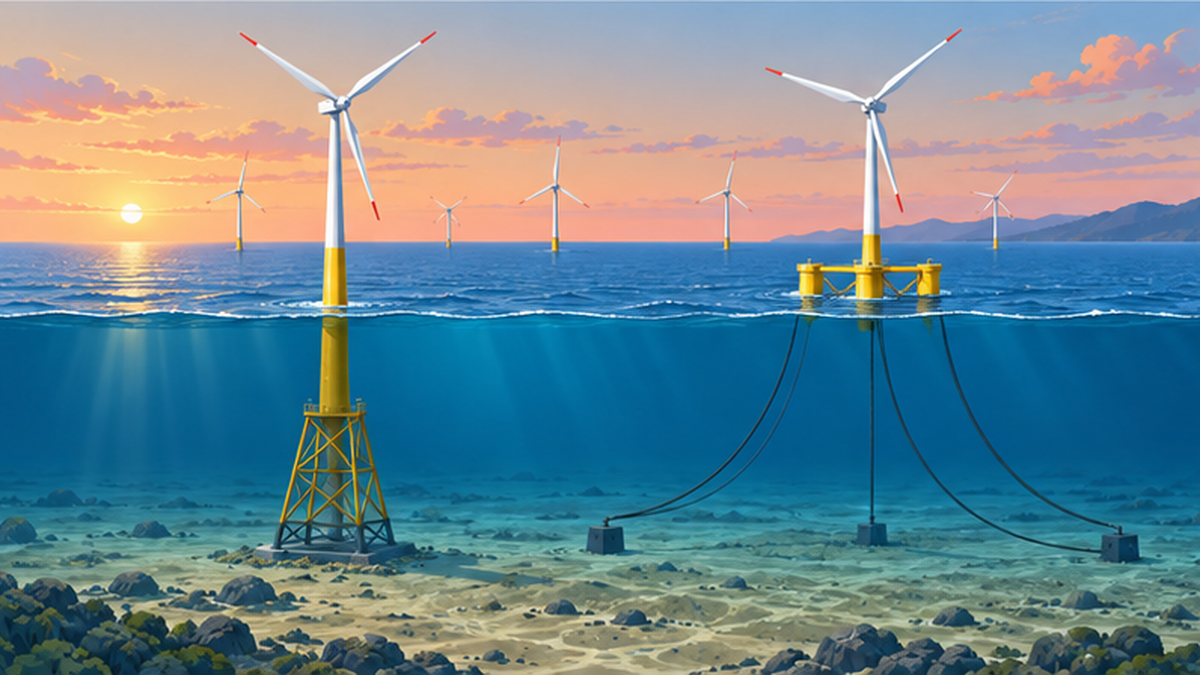
Fixed-Bottom and Floating Turbines
In Japan, where there is little shallow water close to shore, commercializing floating offshore wind turbines—which can be installed even in deep waters—is an important challenge. Fixed-bottom turbines have taken the lead in port areas and shallow coastal waters, while floating turbine projects are being developed in deeper waters such as those on the Sea of Japan side.
Want to learn more?
- For a detailed look at the differences between fixed-bottom and floating turbines and the history of their deployment, see Offshore Wind Power Expanding in Japan: An Easy Guide to Fixed-Bottom vs. Floating Turbines and the 2040 Target.
The Marine Renewable Energy Sea Area Utilization Act and the "Central" Method
Supporting the formation of offshore wind projects at the institutional level is the "Act on Promoting the Utilization of Sea Areas for the Development of Marine Renewable Energy Power Generation Facilities" (the Sea Area Utilization Act), which took effect in 2019. Under this law, a system was established in which the government designates promising sea areas and selects operators through open bidding. In recent years, a "central" method has also been introduced, in which the government conducts preliminary surveys (such as wind conditions and geology) before presenting sea areas to operators—aiming to reduce the duplicate initial survey costs each operator previously incurred and to speed up project formation.
The Challenge of Building a Supply Chain
Offshore wind turbines and their foundation structures are large and highly specialized, so building a domestic parts procurement and manufacturing system (supply chain) is key to expanding deployment. At present, much of the turbine equipment itself relies on overseas manufacturers, and the government has set targets for the domestic procurement ratio to encourage parts makers to enter the market. Developing turbine assembly yards at ports and securing dedicated construction vessels (SEP vessels) are also seen as factors that will determine the speed of project formation.
Demonstration Projects Toward Commercializing Floating Turbines
In Japan, where much of the surrounding sea is deep, commercializing floating offshore wind—in which floating structures are moored rather than fixed to the seabed—in addition to fixed-bottom turbines, is considered key to long-term deployment. In sea areas such as those off Goto City in Nagasaki Prefecture, demonstration and commercialization projects for floating turbines are underway, with cost reduction and establishing mass-production systems as the focus going forward.
J Blue Credit: Monetizing Blue Carbon
The ability of ocean and coastal ecosystems—seagrass beds, mangroves, tidal flats, and the like—to absorb and store CO2 is called "blue carbon." In Japan, the J Blue Credit scheme, operated by the Japan Blue Economy Association (JBE), quantifies and certifies the CO2 absorption achieved through the conservation and creation of seagrass beds and tidal flats, establishing a mechanism through which companies can purchase the results as credits.
A New Source of Income for Fishery Cooperatives and NPOs
Unlike the government-led J-Credit scheme, J Blue Credit is a privately led voluntary credit system, and in many cases the credit issuers are fishery cooperatives or local NPOs that manage seagrass beds. By combining conservation activity with an economic incentive, the scheme helps sustain ongoing activity in coastal areas that struggle with a shortage of people to carry out the work.
Want to learn more?
- For a detailed explanation of how J Blue Credit works and trends in its trading price, see What Is J Blue Credit? The Ocean Decarbonization Market That Turns Seagrass and Tidal Flat CO2 into Money.
A Structure Where Demand Pushes Up Prices
While the volume of J Blue Credit issued is limited, rising corporate demand for carbon offsets has, in some cases, caused purchase requests to exceed the volume issued, pushing prices up. On the corporate side, credits are used both to offset a company's own CO2 emissions and, in some cases, as part of CSR and branding efforts to support local ocean conservation activities. Revenue from credit sales is returned as ongoing funding for conservation activities, such as monitoring surveys of seagrass beds and efforts to control grazing species (such as sea urchins) that damage them.
Coexisting with Countermeasures Against Barren Seafloors (Isoyake)
Along Japan's coasts, "isoyake"—a phenomenon in which seaweed fails to grow due to rising water temperatures and the increase of grazing species such as sea urchins and rabbitfish—has become a serious problem in many areas. Conserving and creating seagrass beds not only enables CO2 absorption through blue carbon but also helps restore the function of seagrass beds as a "nursery for fish," a function lost to isoyake. The J Blue Credit scheme also plays a role in sustaining these activities by giving fishers and local organizations—who serve as the primary actors in isoyake countermeasures—an economic incentive to continue.
Its Relationship to International Blue Carbon Systems
Internationally, there is a growing trend toward including some blue carbon ecosystems, such as mangroves, in the greenhouse gas emissions and absorption reports that countries submit under the UN Framework Convention on Climate Change (UNFCCC). Japan's J Blue Credit is a separate, privately led scheme distinct from official international emissions reporting systems, but discussions continue about the possibility of linking it in the future with the country's official inventory (the official tally of greenhouse gas absorption).
Decarbonizing Shipping and Fisheries, and the Blue Economy
International shipping handles more than 80% of global trade volume by weight, but it also produces substantial CO2 emissions, and the IMO (International Maritime Organization) has set decarbonization targets that include a shift to alternative fuels such as ammonia and methanol. Decarbonizing shipping is directly linked to fuel costs and route planning, making it a key part of the blue economy.
DX Through Smart Fisheries
The spread of smart fisheries—including fishing ground prediction using IoT sensors and AI, and resource surveys using drones—is also positioned as a factor supporting the growth of the fisheries industry. At fishing sites where the workforce is shrinking due to the declining birthrate and aging population, technology investment that achieves both labor savings and more precise resource management is advancing.
Want to learn more?
- For details on decarbonizing international shipping, see What Is Decarbonizing International Shipping? A Thorough Explanation of IMO Regulations and the Shift to Ammonia and Methanol Fuel.
Electrification of Domestic and Remote-Island Shipping Routes
Beyond international routes, decarbonization is also progressing in domestic coastal shipping, ferries, and remote-island routes. Demonstration operations of electric-propulsion ferries and hydrogen fuel-cell vessels have begun in various regions, drawing attention as efforts that reduce CO2 emissions while maintaining the lifeline routes that island residents depend on. Domestic coastal shipping is a vital piece of infrastructure that handles a significant share of domestic freight transport, and its decarbonization is directly linked to reducing greenhouse gas emissions across the logistics sector as a whole.
Energy Savings in the Seafood Cold Chain
In the seafood cold chain—the low-temperature logistics network that carries fish from the point of landing to the consumer—efforts are also underway to switch from fluorocarbon refrigerants to natural refrigerants and to improve the energy efficiency of freezing and refrigeration equipment. The cooling processes essential to preserving freshness consume large amounts of electricity, and from a blue economy perspective, decarbonizing the "downstream" distribution and processing stages of the fisheries industry is an element that cannot be ignored.
Energy Savings and Electrification of Fishing Vessels
For the small fishing boats used in coastal fisheries as well, efforts are underway to upgrade to more fuel-efficient engines and to trial the introduction of electric propulsion systems. Fuel costs make up a large share of fishing operators' expenses, so improving energy efficiency delivers the practical benefit of easing the financial burden on fishing businesses alongside decarbonization—making it a policy that is readily accepted even at fishing sites struggling with a shortage of workers.
The Carbon-Neutral Port Concept
The Ministry of Land, Infrastructure, Transport and Tourism is advancing the formation of "carbon-neutral ports" that achieve both upgraded port functions and reduced greenhouse gas emissions. By coordinating with power plants and factories located at ports and developing hubs to receive and supply next-generation energy such as hydrogen and ammonia, the concept aims to decarbonize entire regions centered on ports, and it is closely related to the development of base ports for offshore wind power as well.
Challenges Facing the Blue Economy
The expansion of the ocean economy also carries the risk of environmental harm, such as overfishing and ecosystem destruction. The World Economic Forum and others have pointed out that maintaining the resilience of marine ecosystems—not just pursuing economic growth—is a precondition for the blue economy.
The Challenge of Coordinating Sea Area Use
Sites suitable for offshore wind power often overlap with sea areas where fishing rights have been established, and building consensus with fishing stakeholders determines the speed of deployment. Under the Sea Area Utilization Act, councils that include local fishers are established to carry out coordination before projects are formed.
- Assessing the impact that building and operating offshore wind facilities has on fishing grounds and shipping routes
- Securing sustainable funding and personnel to sustain seagrass bed conservation activities
- Absorbing the cost increases associated with the shift to alternative marine fuels
- The lag in unifying ocean data and sharing information across industry, academia, and government
Guarding Against "Bluewashing"
Just as "greenwashing" describes overstating environmental consideration beyond reality, concerns have also been raised in the ocean sector about "bluewashing"—claiming to be "ocean-friendly" without a substantive conservation effect behind it. For blue carbon credits as well, ensuring transparency in how absorption volumes are calculated and in third-party verification is essential to maintaining the credibility of the system as a whole.
Shortages of Funding and Talent
Introducing seagrass bed conservation and smart fisheries requires upfront investment, but in many fishing communities facing an aging workforce, there is little capacity to take on new equipment investment or acquire new technical skills. How to combine external funding sources—government and municipal subsidy programs, credit revenue, and the like—to address the structural challenge of a shrinking workforce will determine how effective blue economy policy proves to be.
The Lengthening Process of Building Consensus over Sea Area Use
Not just offshore wind, but new uses of sea areas—such as expanding aquaculture rafts or laying submarine cables—often require coordination with existing fishing rights and shipping route use. Building consensus can easily take several years, which makes it difficult for operators to forecast when their investment will pay off. Making the coordination process by national and local governments more transparent and faster has become an important issue that determines the speed of project formation.
The Risk Climate Change Poses to the Ocean Economy
Rising sea temperatures and ocean acidification are already affecting the distribution and catch volumes of fishery resources such as Pacific saury and Japanese flying squid, and aquaculture operations are also reporting an increased risk of mass die-offs due to high water temperatures. The growth scenario for the blue economy cannot be separated from efforts to mitigate climate change itself. Decarbonization initiatives such as offshore wind and blue carbon also serve as climate action that underpins the sustainability of the ocean economy.
Examples of Companies Entering the Blue Economy
As the blue economy expands, companies across a wide range of industries—energy, shipping, trading companies, and more—are advancing into the ocean sector. Here are some representative examples of the directions these efforts are taking.
Trading Companies and Energy Firms Entering Offshore Wind
Offshore wind projects off Akita Prefecture and off Choshi in Chiba Prefecture, among others, count power companies, general trading companies, and dedicated renewable energy operators among their project sponsors and investors. Within Japan, training the personnel needed to handle the operation and maintenance (O&M) of power generation facilities is also a challenge, and moves are emerging to establish joint-venture companies specializing in O&M based at local ports.
Shipping Companies Demonstrating Ammonia- and Methanol-Fueled Vessels
Japan's major shipping companies are moving one after another to build and conduct demonstration operations of vessels fueled by ammonia and methanol. With an eye on the tightening greenhouse gas emissions regulations set by the International Maritime Organization (IMO), the aim is to secure future international competitiveness by establishing next-generation fuel vessel technology ahead of competitors.
Trading Companies Investing in Blue Carbon Projects
Some general trading companies are investing in and participating in seagrass bed restoration projects and in intermediary businesses that trade J Blue Credit, supporting the expansion of the credit market. Beyond offsetting CO2 emissions across their own supply chains, some are also exploring these ventures as a new source of revenue in the environmental business.
The Growing Presence of Startups in Ocean Tech
It is not only large corporations—startups working on ocean observation drones and aquaculture management systems are also gaining a growing presence. Technology that combines satellite data and underwater sensors to grasp fishing ground conditions in real time enables efficient operations with reduced fuel consumption and also contributes to labor savings at fishing sites struggling with a shortage of workers. Venture capital investment in the ocean tech sector is also helping broaden the base of the blue economy market.
Conclusion: Growing the Economy While Protecting the Ocean
The blue economy is not merely a growth strategy for ocean industries—it is an economic model premised on the health of marine ecosystems. In Japan, concrete policies are now moving forward in offshore wind, fisheries, and blue carbon, and the focus going forward will be on how far fishers, companies, local governments, and research institutions can work together to coordinate sea area use and build consensus based on data.
Realizing the blue economy cannot be achieved through government policy alone. Companies are being asked to make visible the impact their business activities have on the ocean environment and, where appropriate, to purchase blue carbon credits or work together with fishers. For consumers, too, choosing seafood certified by bodies such as the MSC and ASC, and cooperating in efforts to reduce marine litter, are accessible steps that help sustain the blue economy.
Key Points of This Article
- The blue economy is the idea of balancing ocean economic activity with ecosystem conservation
- The OECD projects that the value added of the ocean industry will reach $3 trillion by 2030
- Japan has set out OX under its Fourth Basic Plan on Ocean Policy, promoting offshore wind, blue carbon, and DX in fisheries
- J Blue Credit is a mechanism that turns seagrass bed conservation into an economic incentive
References and Sources
- Agency for Natural Resources and Energy, "Trends in Offshore Wind Power in Japan and Abroad" – Offshore wind deployment targets and the status of project formation
- Fisheries Agency, "Basic Plan for Fisheries" – The basic direction of Japan's fisheries policy
- Japan Blue Economy Association (JBE), "J Blue Credit" – The certification system for blue carbon credits
- Ministry of Agriculture, Forestry and Fisheries, "Overview of the J Blue Credit Scheme" – An overview of Japan's domestic blue carbon credit system
- Cabinet Office Secretariat for the Headquarters for Ocean Policy, "Ocean Working Group Materials: The Blue Economy and Economic Growth Driven by Innovation" – Ocean policy materials from the Sasakawa Peace Foundation
- Ocean Policy Research Institute, Sasakawa Peace Foundation, "Toward Sustainable Development of the Environment, Economy, and Society Through the Blue Economy" – An explanation of the blue economy concept
- World Economic Forum, "Taking On Sustainability Through the Blue Economy" – Global trends in the blue economy
- JICA, "Promoting the Fisheries Blue Economy" – Fisheries blue economy projects as support for developing countries
* Listed in order of reliability: government and academic institutions > peer-reviewed papers > specialized organizations > reputable media