⚡ The answer in 30 seconds
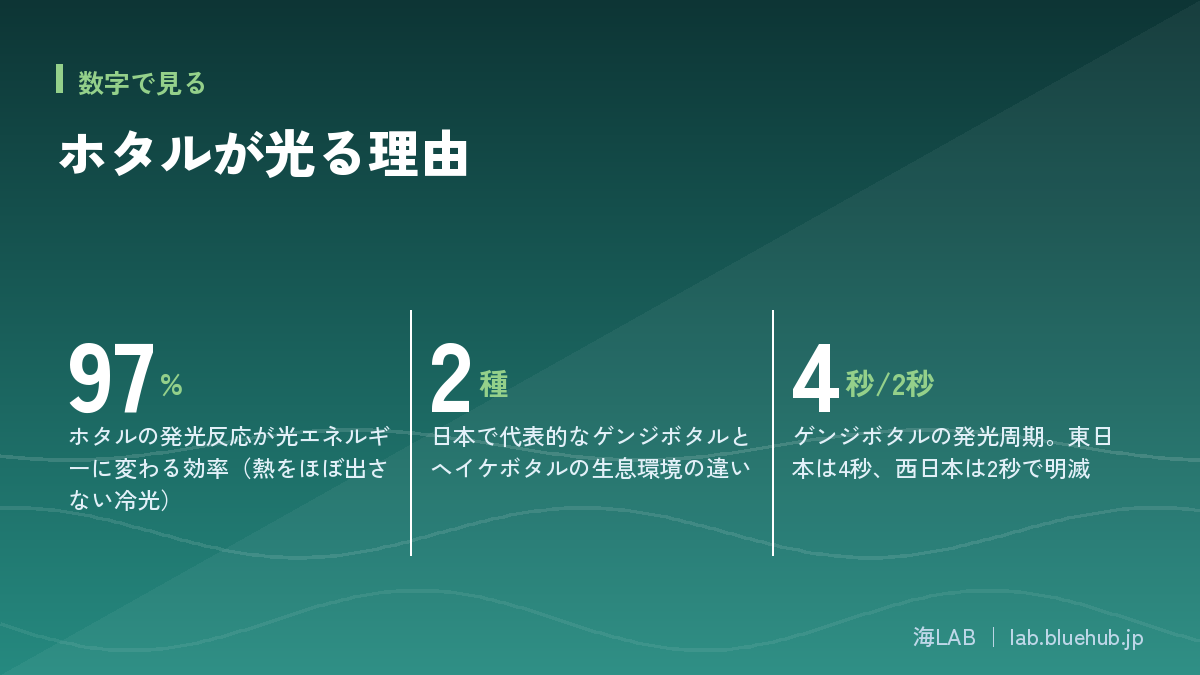
- Fireflies produce nearly heatless "cold light" through a reaction between luciferin and luciferase in the light organ at the tip of their abdomen
- Genji fireflies prefer flowing rivers, while Heike fireflies prefer still waters such as rice paddies and ponds; their flashing rhythms also differ
- The kawanina river snail, the larvae's food, is an indicator species for water clarity, so the presence of fireflies directly reflects the health of the water environment
- Pesticides, the drying of paddy fields, the concrete lining of waterway banks, and artificial light at night are factors contributing to the decline of fireflies
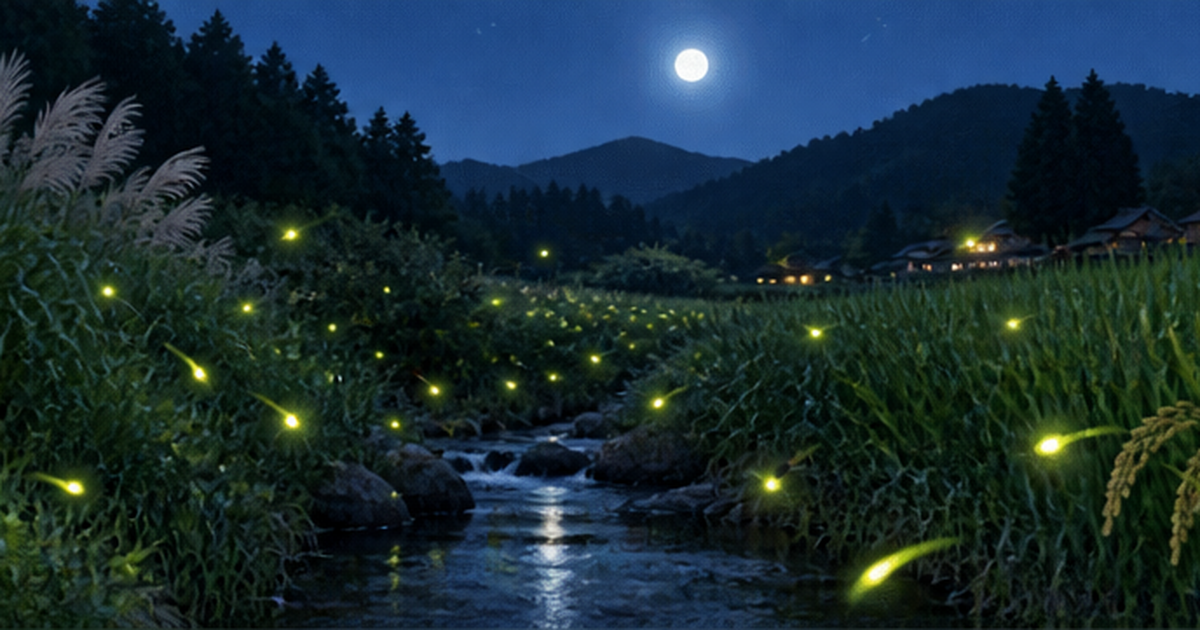
On a summer night, soft points of light drift above the water's edge. That glow is a courtship signal — and, at the same time, a health checkup for the water itself. The Genji firefly and Heike firefly are Japan's two most iconic glowing insects of the satoyama countryside, yet they flash differently and live in different places.
A firefly's light comes from a chemical reaction: a substance called luciferin reacts with oxygen through the enzyme luciferase, releasing most of the energy as light and almost none as heat. This highly efficient "cold light" has even been studied as a reference point for energy-saving lighting research.
Meanwhile, kawanina river snails and pond snails, the food of firefly larvae, are themselves indicator species for water clarity. Whether fireflies fly in a given spot is, in a sense, a mirror reflecting how healthy that waterside is. This article draws on primary sources to lay out how fireflies glow, how the two species differ, and what lies behind their decline.
What you'll learn in this article
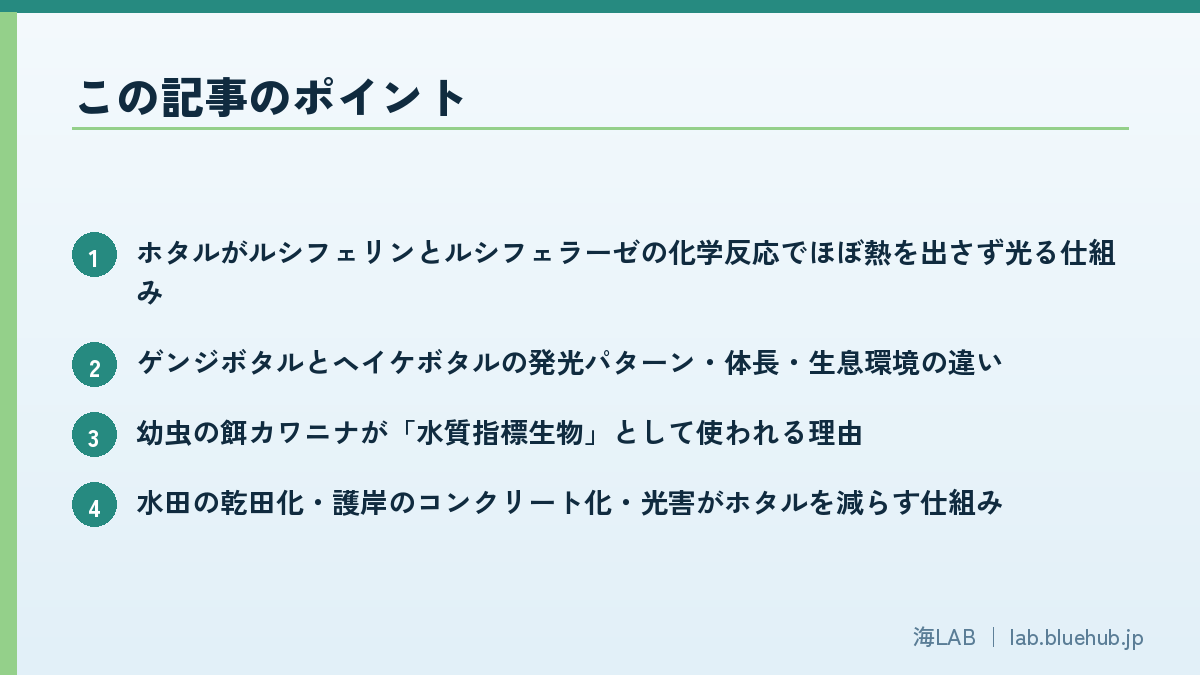
- How fireflies glow almost without heat, through a chemical reaction between luciferin and luciferase
- The differences in flash pattern, body size, and habitat between Genji and Heike fireflies
- Why the kawanina snail, the larvae's food, is used as a "water-quality indicator species"
- How the drying of paddy fields, concrete-lined banks, and light pollution reduce firefly numbers
- The framework of environmental surveys, such as Monitoring Sites 1000, that use fireflies as an indicator
Why Do Fireflies Glow? The Chemistry of Luciferin and Luciferase
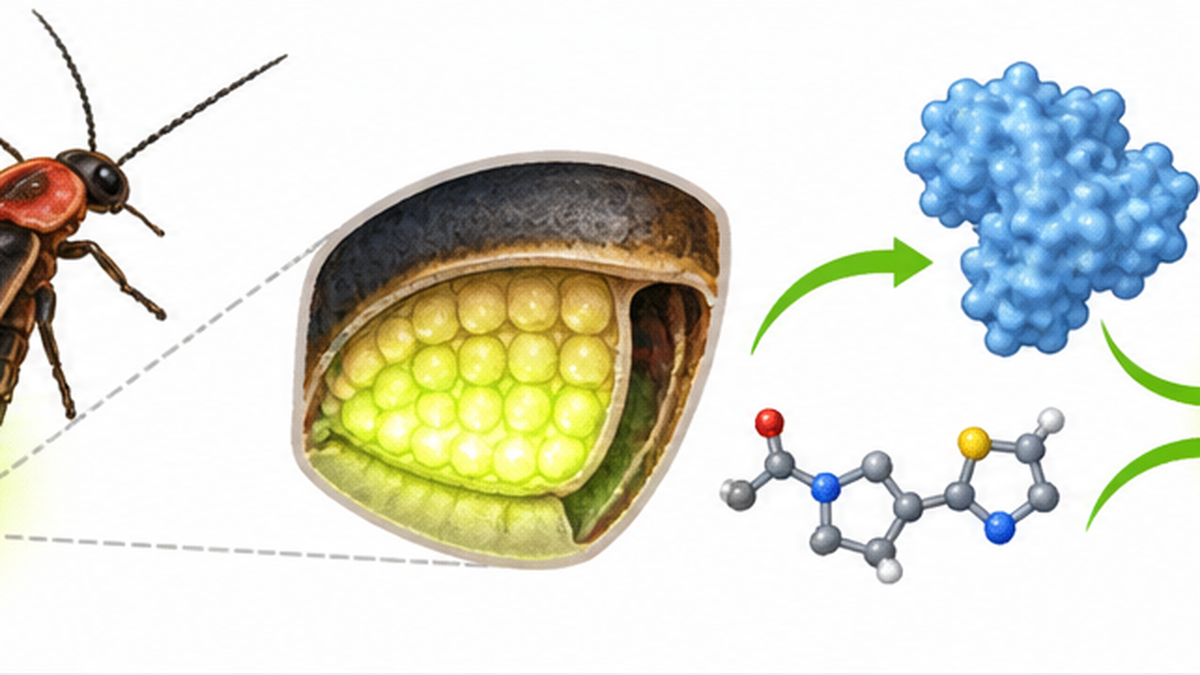
A firefly's glow comes from a chemical reaction in the light organ at the tip of its abdomen. The light-emitting substance luciferin is oxidized with the help of the enzyme luciferase, ATP (adenosine triphosphate), and oxygen; as the resulting excited oxyluciferin returns to its ground state, it releases a yellow-green glow.
This reaction proceeds in two steps. First, the carboxyl group of luciferin binds with ATP, briefly forming an intermediate called luciferyl-AMP inside the cells of the light organ. This intermediate then reacts with oxygen to produce excited-state oxyluciferin. The instant this high-energy, unstable state settles into a more stable ground state, the energy difference is released as a photon — the yellow-green light we see.
"Cold Light" That Produces Almost No Heat
While an incandescent bulb loses most of its energy as heat, a firefly's glow converts most of the reaction energy into light and generates almost no heat. Estimates of the exact energy-conversion efficiency vary between studies, but it is considered one of the most efficient forms of bioluminescence, and this mechanism has even been studied as a reference for energy-saving lighting design. The reason you feel no warmth when a firefly rests on your palm is that this reaction produces almost nothing but light.
If ordinary lighting can be described as "tolerating heat in order to produce light," a firefly's glow does the opposite: it produces light while generating almost no heat. Understanding this difference helps explain why researchers have studied firefly bioluminescence for so long. A mechanism that wastes almost no energy offers important clues for next-generation lighting and light-based applications in medicine.
In fact, firefly luciferase has been widely used as a tool in basic research. By inserting the luciferase gene as a marker into cells, scientists can make cells glow only when a specific gene is active — a technique widely used in life-science experiments. The small light a firefly shows off at a nighttime waterside has also become a powerful tool in the lab for visualizing what happens inside a cell. It is striking that the firefly, a beloved symbol of the satoyama countryside, and cutting-edge life-science technology derived from fireflies are connected by the very same light-emitting mechanism.
The Structure of the Light Organ and How It Gets Oxygen
A firefly's light organ is a tightly packed structure of light-emitting cells and a network of tracheae that deliver oxygen. Turning the light on and off is thought to occur as the nervous system regulates the oxygen supply to the light-emitting cells, meaning the firefly controls its own glowing and dimming at will. It is this precise oxygen-delivery mechanism that produces the regular, rhythmic flashing pattern.
Key points
- The glow is a chemical reaction itself — a "cold light," not electricity or friction
- The reaction involves four components: luciferin, luciferase, ATP, and oxygen
- Regulating oxygen supply to the light-emitting cells produces the on/off flashing
Genji vs. Heike Fireflies: Body Size and Flash Patterns
Japan's two best-known species, the Genji firefly and the Heike firefly, differ clearly in both size and flash pattern. The Genji firefly is somewhat larger at about 6–9 mm in body length and flashes strongly like a camera flash, while the Heike firefly, at around 7–10 mm depending on the population, flashes with a gentler, wavering light at roughly one-second intervals.
| Item | Genji Firefly | Heike Firefly |
|---|---|---|
| Approximate body length | About 6–9 mm | About 7–10 mm |
| Flash style | Strong, clear flashing (flash-like) | Weak, wavering flashing |
| Approximate flash cycle | About 4 seconds in eastern Japan, about 2 seconds in western Japan | About every 1 second |
| Main habitat | Clean flowing streams | Still water such as rice paddies and ponds |
| Larval food | Kawanina river snails | Kawanina snails, pond snails, and others (varies by species) |
The Light-Based Exchange of Courtship
A firefly's glow also serves as a courtship signal. The male flashes while flying to attract a female, and the female responds from a leaf with a flash of her own. Heike fireflies are known for particularly complex flash exchanges between males and females, with the interval and intensity of the light thought to play a role in species recognition and mating behavior.
This exchange of light is, in a sense, a "conversation of flashes." The male flashes on a fixed rhythm, and the female responds after a set interval. If the flash cycle or interval is off, the female will not respond. This mechanism is thought to prevent mistaken mating with closely related species. The flash pattern effectively serves as an invisible boundary separating species that look nearly identical.
It is also interesting that the Genji firefly's flash cycle differs between eastern and western Japan. Populations in eastern Japan flash roughly every 4 seconds, while those in western Japan flash roughly every 2 seconds — a difference thought to reflect distinct genetic lineages. Even within what looks like a single species, this regional difference in flashing rhythm, almost like a difference in "dialect," reveals the depth of firefly light communication.
Why the Two Species Flash So Differently
The difference between the Genji firefly's strong flash and the Heike firefly's weaker, wavering glow is thought to be related to their respective habitats. Riverbanks with flowing water tend to be open spaces, where a strong flash is needed to catch the attention of a distant female. In the enclosed spaces of rice paddies or ponds, on the other hand, even a weak light can reach a potential mate. It is possible that each species' flashing style has been optimized for the environment it lives in.
Differences worth remembering
- Genji firefly = strong, clear flashing; prefers flowing water
- Heike firefly = weak, wavering flashing; prefers still water such as paddies and ponds
- Mismatched flash patterns also serve as a mechanism to prevent mating between different species
The Waters Fireflies Prefer: Flowing Streams vs. Still Water
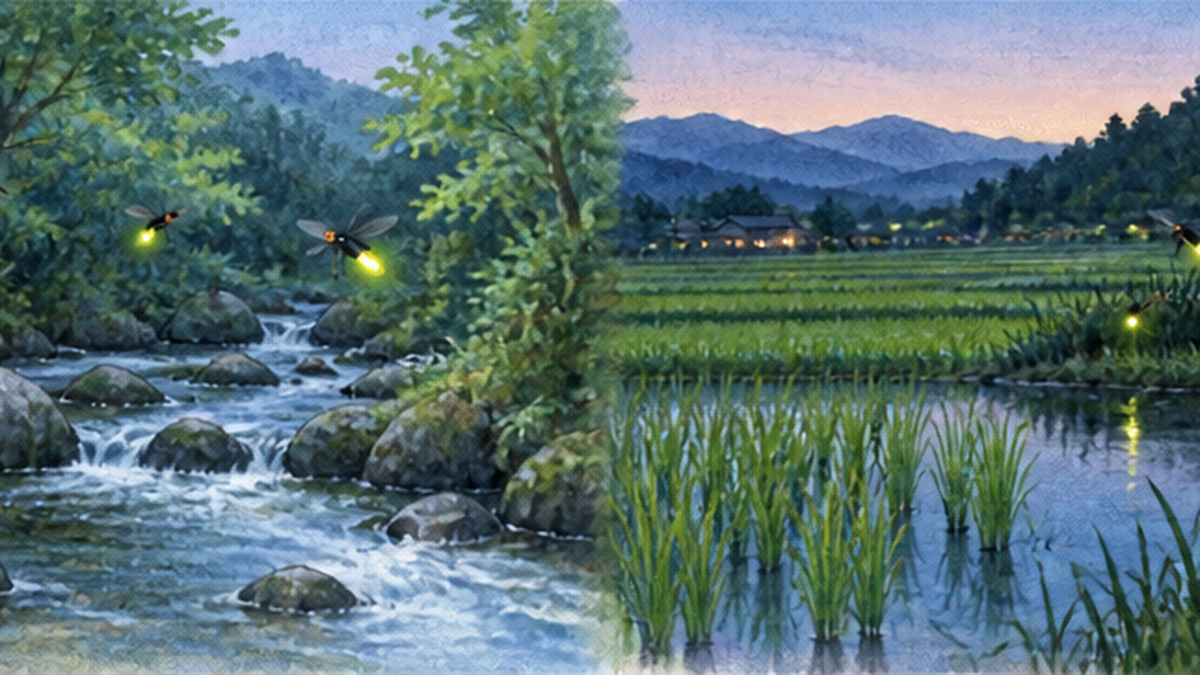
Genji firefly larvae spend their larval stage in clean, flowing water, feeding on kawanina snails. They favor places with some current, such as small rivers and irrigation channels. Heike fireflies, in contrast, are more common in still waters such as rice paddies, marshes, and ponds, where their larvae feed on kawanina and pond snails.
Compatibility with Fully Drained Paddy Fields
When rice paddies have no standing water, Heike firefly larvae burrow into the moist soil to wait it out. This means they struggle to survive in paddies that are completely dried out year-round, so how the surrounding water is managed determines whether they can live there at all.
The River Conditions Genji Firefly Larvae Need to Grow
Genji firefly larvae grow in the water by feeding on kawanina snails, then come ashore the following spring or early summer to pupate in the soil (a process of emerging and pupating). This requires soft banks that resist collapsing even when the water rises, along with gently sloped banks the larvae can climb. On a vertical concrete embankment, they cannot come ashore at all — even if the larval stage goes smoothly, they never make it to adulthood.
In other words, a Genji firefly habitat needs more than clean water; it also needs the right shape at the "boundary between land and water" along the bank. The condition of the riverbed, the volume of water, the water temperature, and the slope of the bank all have to align for a generation to successfully continue.
Stable water temperature is another condition that shouldn't be overlooked. Genji firefly larvae are vulnerable to both extreme heat and extreme cold, and tend to favor river stretches where inflowing spring water and adequate shade keep the temperature from swinging widely. Rising summer water temperatures or reduced flow from drought have been noted to affect larval growth rates and survival. Being a "clean stream" is not just about water clarity — stable water volume and temperature throughout the year are hidden conditions the larvae need in order to grow to maturity.
Satoyama Water Cycles and Fireflies
In Japan's satoyama countryside, spring water flowing down from the mountains nourishes rice paddies before eventually joining small streams that flow into rivers. Heike fireflies tend to occupy the paddy side of this cycle, while Genji fireflies occupy the river side — the two species often dividing up different watershed niches within the same satoyama landscape. In this sense, a place where both Genji and Heike fireflies can be found together is a sign that the entire water cycle, from paddies to rivers, is functioning in a healthy way.
A Firefly's Life: One Year from Egg to Adult
A Genji firefly takes roughly a year to develop from egg to adult. The period it spends as a glowing adult flying through the night sky is extremely brief; it spends most of its life in the water or in the soil.
| Stage | Approximate duration | How it's spent |
|---|---|---|
| Egg | About 1 month | The female lays roughly 500–1,000 eggs on moss and similar spots near the water |
| Larva | About 10 months (nearly a year) | Grows in the water feeding on kawanina snails, overwintering underwater |
| Pupa | About 1–2 months in total | Comes ashore and pupates in the soil (emergence and pupation) |
| Adult | About 1–2 weeks | Engages in glowing reproductive behavior before its short life ends |
The Egg and Larval Stages
The female lays several hundred eggs on moss or grass near the water's edge. About a month later, the hatched larvae move straight into the water and spend roughly the next 10 months growing there. During this time, the larvae dissolve and consume kawanina snails with digestive fluid, growing larger through repeated molts. Even through the winter, the larvae remain active underwater, growing slowly in the cold.
The Big Task of Coming Ashore to Pupate
The following spring, fully grown larvae leave the river, come ashore, and burrow into the soil to pupate. This emergence often happens all at once, on nights when rain has raised the water level. After the pupal stage, adults emerge from the ground and begin flying while glowing just days after eclosion.
Reproductive Behavior Packed into a Short Adult Life
As adults, fireflies have degenerated mouthparts and eat almost nothing. Using only the nutrients stored in their bodies, they pack courtship by glowing, mating, and egg-laying into a short adult life of about 1–2 weeks. Spending nearly all of the year underwater or underground, then dancing through the sky aglow for only its final few days — this allocation of a lifetime is precisely what makes a firefly's light so striking.
Key points
- The period a firefly spends glowing as an adult is only about 1–2 weeks of its entire life
- The larval stage lasts about 10 months, spent entirely underwater
- Emergence and pupation also depend on conditions on land, such as the state of the riverbank
Kawanina Snails as a Water-Quality Indicator: Fireflies as a Health Checkup for Water
Kawanina snails, the food of Genji firefly larvae, are also treated as one of the indicator species used to assess water quality. In methods that estimate water-quality grades from a river's biological community (such as the BMI method), kawanina snails are often classified near the boundary between "clean" and "relatively clean" water.
The Ministry of the Environment's Monitoring Project
Japan's Ministry of the Environment includes fireflies as one of the satoyama survey items in its Monitoring Sites 1000 project, a program for monitoring important ecosystems, and records of firefly occurrence are kept continuously as part of tracking familiar waterside life. Changes in where, when, and how many fireflies appear are used as an indicator of shifts in water environments and surrounding land use.
| Aspect | What it indicates about fireflies |
|---|---|
| Presence of larval food (kawanina snails, etc.) | A gauge of water clarity |
| Stable water volume and channel shape | The physical health of rivers and paddies |
| Darkness at night | Low light pollution and its impact on the ecosystem |
What Is Monitoring Sites 1000?
A Ministry of the Environment project that records long-term ecosystem changes across forests, grasslands, satoyama countryside, wetlands, tidal flats, coral reefs, and more nationwide. Fireflies are included as one of the survey targets in satoyama landscapes.
The Concept of an "Indicator Species"
Judging water quality through chemical analysis alone requires specialized equipment and effort. That's why people have long used the concept of "indicator species" — estimating how clean water is from the types of organisms living in it. Kawanina snails, freshwater crabs, and dobsonfly larvae are known to favor clean water, while other organisms can survive even in polluted water. Simply surveying which creatures live in a given waterside can yield information close to that of a specialized water-quality test — the strength of this approach.
Fireflies stand out even among indicator species. Because they announce their own presence by glowing, even people without specialized knowledge can readily notice changes such as "there's less light this year" or "we don't see them in this river anymore." This ease of observation is a major reason fireflies are frequently used in citizen-participation environmental monitoring.
Reflecting "Land Use," Not Just Water Quality
Firefly occurrence reflects not only water quality itself but also changes in surrounding land use. If rice paddies are converted to housing and waterways are blocked, or if logging reduces the flow of spring water, fireflies can disappear even without a major change in water quality. In other words, continuous firefly observation captures multiple factors at once — water quality, water volume, and land use — functioning as a barometer of a region's overall environment.
The Spread of Citizen-Participation Monitoring
In recent years, efforts to record firefly occurrence have spread widely, involving not just specialists but local residents and children. Steady, ongoing surveys — walking a fixed route each night to count flashes, or recording sighting locations and times in a notebook or on a map — accumulate into valuable data that can track how a region's waterside environment has changed over the long term. Compared with specialized water testing, this approach costs little and anyone can take part, which is another major advantage of using fireflies as an indicator.
Why Fireflies Are Declining: Pesticides, Drained Paddies, and Light Pollution
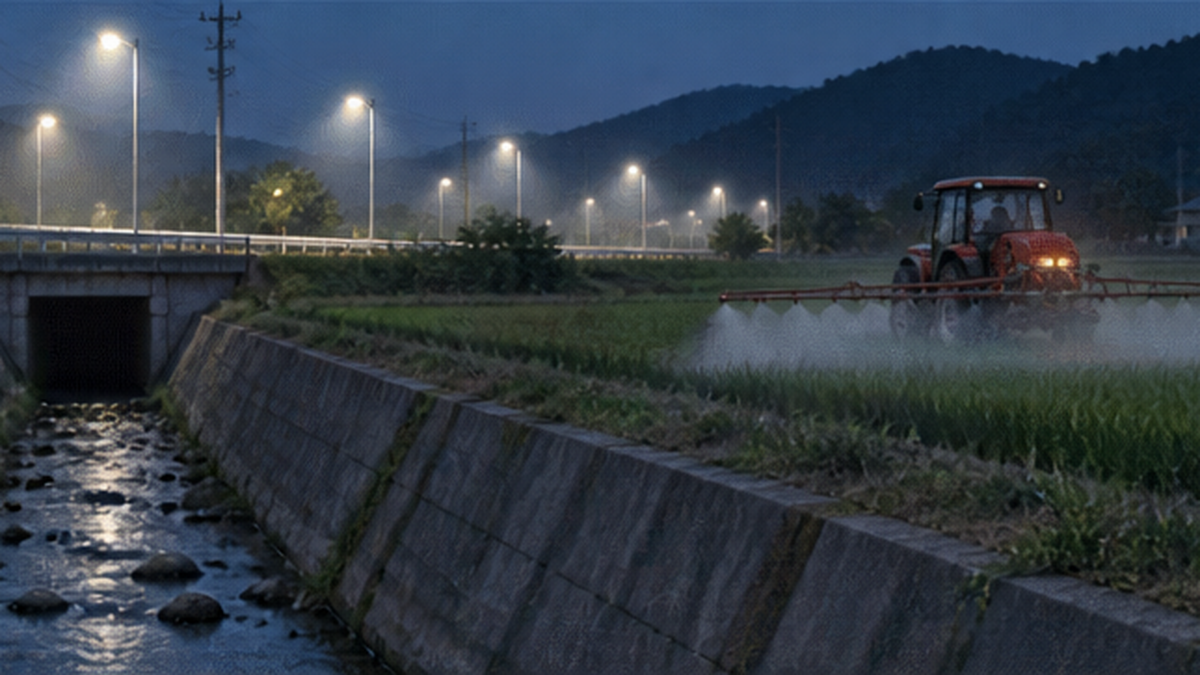
Fireflies that were once a familiar sight have declined in number across many regions. Factors cited include the decline of food sources such as kawanina and pond snails due to pesticides, the concrete lining of waterway banks, the drying out of paddy fields through farmland consolidation, habitat loss from development such as housing construction, and disrupted behavior caused by artificial light at night (light pollution).
How Artificial Light Affects Fireflies
In environments exposed to strong light throughout the night, reports indicate that larvae's emergence onto land can be disrupted and adult activity can slow down. Because fireflies depend on light-based communication in darkness, changes in the surrounding lighting environment can directly affect their reproductive success.
Their Status on Red Lists
The Heike firefly is not designated as an endangered species nationwide, but it is listed as Near Threatened or similar in the Red Data Books of several prefectures, suggesting large regional differences in population status. Protecting its habitat is closely tied to local-level management of paddies and waterways.
Farmland Consolidation as a Structural Factor
Postwar farmland consolidation projects — reorganizing paddy plots and improving irrigation and drainage channels — greatly contributed to more efficient farming and stable yields, but they often replaced winding earthen channels with straight concrete waterways, becoming one factor in reducing habitat for kawanina snails and places for larvae to come ashore. Balancing efficiency with habitat for living creatures has long been a shared challenge for both agriculture and nature conservation.
In recent years, construction methods that balance farming efficiency with pathways for wildlife have been spreading — for example, concreting only the channel bed while leaving soil or stone on the sides (avoiding fully "three-sided" concrete lining), or building gently sloped sections at intervals that let creatures climb out (fish and wildlife passages). Firefly conservation does not necessarily mean rejecting concrete construction outright; much of it comes down to design choices about how much and where to preserve a natural water's edge.
The Connection to Climate Change
Changing rainfall patterns and rising temperatures have also been cited as possible influences on when fireflies appear and how many there are. The emergence and pupation of Genji firefly larvae are sensitive to timing of temperature and rainfall, and years with record-low rainfall or extreme, concentrated downpours can shift the peak of emergence or cause large swings in population. Long-term climate change is one factor that can indirectly affect a firefly's life cycle through its effects on water volume and temperature.
How Multiple Factors Compound
Firefly decline is rarely explained by a single factor; pesticides, bank reconstruction, drained paddies, light pollution, and climate change often compound within the same region. In one year, water volume may be adequate but increased nearby lighting disrupts mating behavior; in another, water volume itself falls short and larvae fail to grow. Because the causes shift from year to year, measures to protect fireflies also need to address multiple aspects at once — water quality, water volume, bank shape, and nighttime lighting.
Famous Firefly Sites in Japan: Habitats Preserved Over Generations
Japan also has places, often called "famous sites," where communities have worked together to protect firefly habitats for generations. The most representative is Matsuoge in Tatsuno Town, Nagano Prefecture — a major Genji firefly breeding ground known since the Meiji era. A 2008 survey ranked it as the largest in the country, and in peak years as many as 10,000 fireflies dance there at once.
Tatsuno Town's Long-Term Conservation Stance
In Tatsuno, the "Tatsuno Firefly Festival" was revived in 1948, and in 1985 the Genji firefly was designated the town's symbol — administration and residents have jointly sustained conservation efforts for decades. During the peak viewing season of early to mid-June, the festival is timed to match the peak emergence, drawing many visitors. This kind of sustained effort is not a one-off event but the result of incorporating waterway management and the protection of breeding sites into the community's everyday life.
What a Famous Site Tells Us
What places that have long remained famous firefly sites share in common is that good water quality, an appropriate water volume, banks that larvae can climb, and care in limiting nighttime lighting have all been sustained continuously by the community. Conversely, if even one of these conditions breaks down, fireflies can disappear in a short time. The very existence of a famous site is evidence that the local waterside environment has remained healthy over the long term.
How Japan's Fireflies Differ from Fireflies Worldwide: Some Species Flash in Sync
About 2,000 species of fireflies are known worldwide, distributed mainly across the tropical and temperate regions of Asia and the Americas, since they favor humid climates. While many species, like Japan's Genji and Heike fireflies, flash individually and out of sync with each other, some species overseas — known as "synchronous fireflies" — flash all together in unison.
Tourists Flocking to U.S. National Parks
At Congaree National Park in South Carolina, and at Great Smoky Mountains National Park spanning Tennessee and North Carolina, a specific species of firefly synchronizes its flashing across the entire population in late spring, creating waves of light that appear to spread through the forest. Many tourists visit to witness the phenomenon during this season, and entry to viewing areas is sometimes managed by lottery to ease crowding.
North America is home to roughly 125 species of fireflies, but only a small number are known to flash in complete synchrony. The phenomenon of a single species flashing in unison amid a forest full of scattered lights captured researchers' interest from the moment it was discovered, and why only that species synchronizes remains an active area of study.
Fireflies Gathering in Southeast Asian Mangroves
In mangrove forests of Southeast Asia, such as those in Thailand, male fireflies are known to gather in large groups on specific trees and flash in unison. Gatherings of hundreds of thousands of individuals on a single tree, flashing in rhythm together, are sometimes described as trees that light up "like a Christmas tree."
Why Some Species Flash in Synchrony
Explanations for synchronous flashing include the idea that it is a collective strategy to advertise the group's presence more strongly and over a greater distance to females, and research suggesting it isn't merely an instinctive reaction but involves a social interaction in which individuals adjust their flashing to match one another. Japan's Genji fireflies, too, can appear somewhat synchronized when dancing in groups, though not as strictly as the "complete synchrony" seen overseas. Looking at fireflies worldwide shows that the scenes seen in Japan's satoyama countryside are just one form among a diverse range of flashing strategies.
Did you know?
Fireflies are beetles, and about 2,000 species are known worldwide. Japan is thought to have around 50 species, only some of which actually glow.
Some Species Glow Even as Larvae
Japan's Genji and Heike fireflies glow not only as adults but from the larval stage onward. In fact, the period they spend glowing as larvae underwater or in the soil is far longer than the period they glow as adults. A larva's glow is weaker than an adult's, but the faint light glimmering at the bottom of a dark stream or in moist soil can be spotted with careful observation. Some researchers suggest that firefly bioluminescence may serve not only as a mating signal but also, during the larval stage, as a warning to predators.
Protecting Fireflies: Restoring Waterways and Observation Etiquette
Conservation efforts for fireflies underway across Japan include restoring parts of waterways to traditional earthen channels or stone-lined banks, ensuring gentle flows where kawanina snails can live, and managing part of fallow paddy fields as wetlands. Like urban waterfront restoration, efforts to bring living creatures back to concrete-lined waterways overlap considerably with restoring firefly habitat.
Connections to Other Efforts to Protect Waterways
The clean-stream environment fireflies favor is continuous with the world of char and aquatic insects living in mountain streams (see the ecosystem of mountain streams) and with the riparian forests whose trees support water temperature and water quality along riverbanks (see the role of riparian forests). More recently, technologies for visualizing waterside life through different methods than fireflies, such as environmental DNA surveys that detect a creature's presence from a single scoop of water (see what environmental DNA is), have also spread. Combining traditional indicator-species observation with the latest monitoring technology now allows for a more multifaceted understanding of waterside environments.
Observation Etiquette
- Don't shine flashlights or smartphone lights directly at fireflies (it interferes with their light-based communication)
- Don't take home larvae, adults, or their food source, kawanina snails, without permission
- Don't trample waterways or footpaths along paddies (to avoid destroying the spots where larvae come ashore and pupate)
- Follow the guidance of local observation events and conservation groups
Programs such as the Ministry of the Environment's "Kids' Firefly Rangers" also encourage children across Japan to continuously observe and record fireflies and other waterside creatures. Recording changes in a familiar waterside environment over the long term also contributes to local environmental monitoring.
Passing It On to the Next Generation
Firefly conservation isn't something that ends once a waterway has been restored. The flowing water where kawanina snails grow, the banks larvae can climb, the darkness of night, and the water cycle that connects them all need to be sustained continuously as part of a community's way of life. Whether we can leave behind an environment where fireflies keep flying at a familiar waterside, while balancing agriculture, flood control, and urban development, depends on the choices we make day by day.
Why Reintroduction Alone Doesn't Solve the Problem
In regions where firefly numbers have declined, "firefly reintroduction" — bringing in larvae or kawanina snails from elsewhere and releasing them — is sometimes practiced. But if the habitat conditions at the release site, such as water quality, the amount of food, and the shape of the banks, aren't in place, the released fireflies fail to establish and disappear again within a few years. There are also concerns that flash patterns and other traits may differ by region, so bringing in individuals from far away could have unintended effects on the local population. The faster path to bringing fireflies back is not releasing individuals but first creating an environment where they can actually live.
When the environment is right, fireflies can return surprisingly quickly on their own. There are reported cases where steady environmental restoration — returning part of a bank to soil, rethinking pesticide use, and dimming nighttime lighting — led kawanina snails and firefly larvae to naturally flow in and establish themselves from nearby waterways within a few years, reviving the dancing display. Rather than forcibly transplanting individuals, creating a place where they can live is more likely to be a reliable conservation strategy in the long run.
Summary
- A firefly's light is "cold light" produced by a chemical reaction between luciferin and luciferase
- Genji fireflies prefer flowing water and Heike fireflies prefer still water; their flash patterns also differ
- Kawanina snails, the larvae's food, are a water-quality indicator species, making fireflies a reflection of a healthy water environment
- Pesticides, drained paddies, concrete-lined banks, and light pollution are squeezing their habitats
- Restoring waterways together with careful observation etiquette can help protect this familiar ecological indicator
References and Sources
- Ministry of the Environment, Japan – Monitoring Sites 1000 Firefly Survey Manual – Monitoring Project for Important Ecosystems
- Ministry of the Environment, Japan – Kids' Firefly Rangers – A program promoting waterside creature observation
- Ministry of the Environment, Japan – Q&A on the Red List – The approach to evaluating endangered species
- Ehime Prefecture Red Data Book – Heike Firefly – An example of regional population assessment
- Fukuoka Prefecture Red Data Book – Heike Firefly – An example of regional population assessment
- Genji Firefly – Wikipedia (Japanese) – An overview of the species, distribution, and ecology
- Weathernews – How Long Do Fireflies Live? Their Surprising Life Cycle and Hidden Mysteries – An explanation of the Genji firefly's life cycle
- Tatsuno Town Official Website – About Fireflies – The history of Genji firefly conservation at Matsuoge
*Sources are listed roughly in order of reliability: government/academic institutions > peer-reviewed papers > specialized organizations > reputable media