⚡ The answer in 30 seconds
- Cedar plantations spread through postwar expansion afforestation and cover about 4.41 million ha of Japan's roughly 10.09 million ha of plantations.
- When care is neglected, the forest interior grows dark, understory vegetation disappears and soil becomes prone to runoff.
- Thinning may help restore the forest floor and store water, but deer browsing and work methods also need attention.
- Using wood and replanting keeps a cycle going that connects forests, rivers and the sea.
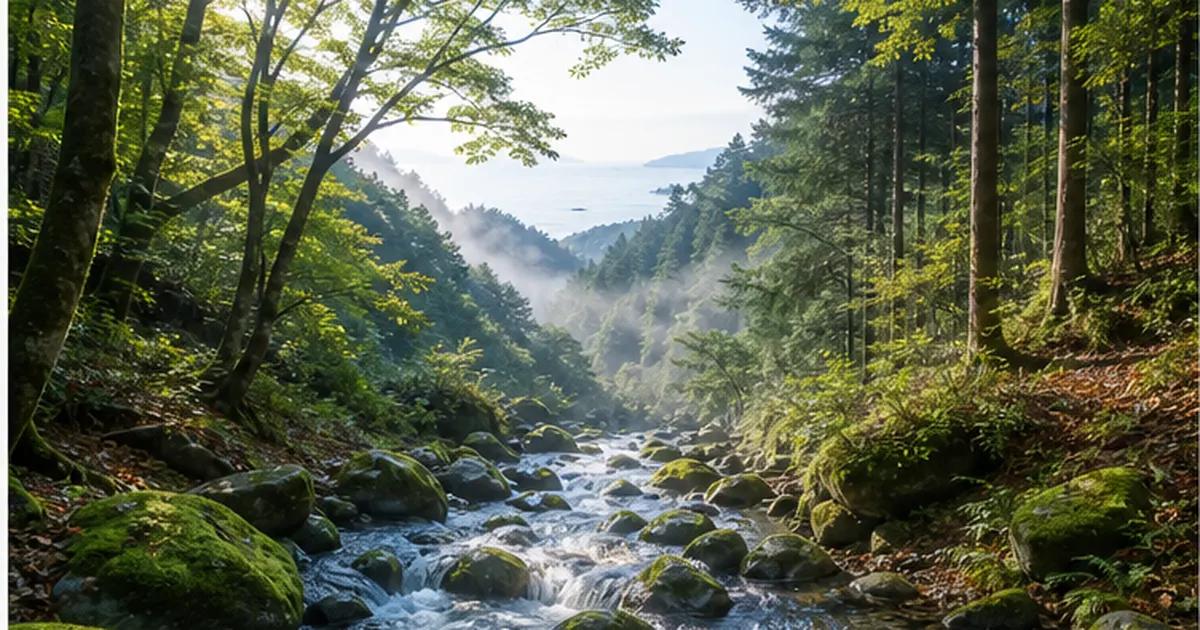
Many of the neat, orderly conifer forests seen across Japan's mountains were planted by hand after the war — they are Japanese cedar (sugi) plantations. Today, these forests are at a major turning point.
While the trees have grown to harvest age, in neglected stands the forest floor is dark, the grass has disappeared, and soil is reported to shift with every rain.
Based on public materials from the Forestry Agency and others, this article reviews the history of cedar plantations, the role of thinning, links to rivers and the sea, and the cycle of protecting forests by using wood.
What you will learn
- How cedar plantations spread through postwar expansion afforestation
- How understory vegetation disappears in neglected stands and soil becomes prone to movement
- Thinning methods, and their effects on water resources and soil, with caveats
- Why the state of the mountains is connected to rivers and the sea
- The link between a domestic cedar-use cycle and pollen allergy countermeasures
Why Cedar Plantations Spread Across Japan
Postwar devastation and "expansion afforestation"
According to the Forestry Agency, logging advanced during and after the war while reforestation was postponed, and in 1949 (Showa 24) land awaiting reforestation reached about 1.5 million ha. The mountains were ravaged, and worries about floods and landslides grew.
Rising timber demand during the period of rapid economic growth then added to the pressure. Expansion afforestation — cutting natural broadleaf forests in satoyama and remote mountains and converting the cleared land to plantations — proceeded nationwide. Cedar, fast-growing and valuable as construction timber, was widely planted as the leading species.
The state of plantations today
In the Forestry Agency's "State of Forest Resources (as of March 31, 2022)," plantations total about 10.09 million ha. By species, cedar is the largest at about 4.41 million ha, followed by cypress (hinoki) at about 2.57 million ha and larch at about 960,000 ha. This means cedar accounts for a little over 40% of plantations.
| Species | Area (approx.) | Characteristics |
|---|---|---|
| Cedar (sugi) | about 4.41 million ha | Fast-growing and suited to construction; found nationwide |
| Cypress (hinoki) | about 2.57 million ha | Highly durable; more common in western Japan |
| Larch (karamatsu) | about 960,000 ha | Common in cold regions; used for plywood and more |
Why cedar?
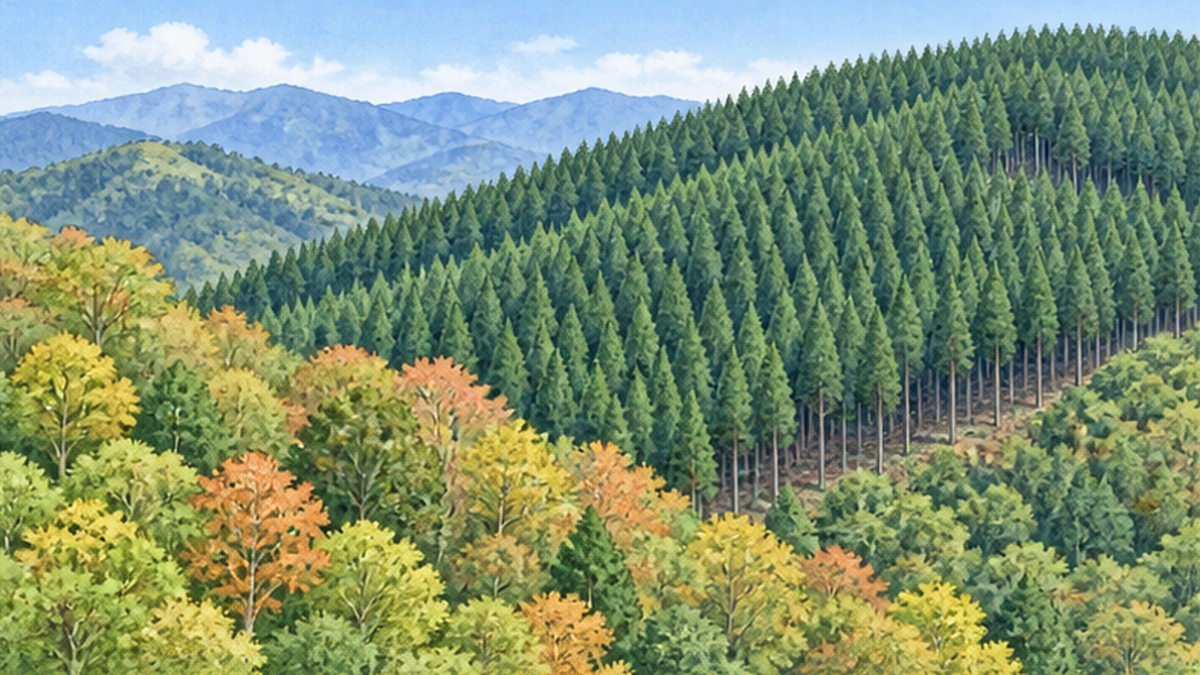
Cedar suits Japan's climate and grows tall and straight, making it easy to use for pillars and beams. Its fast growth and wide range of uses were valued as a tree to plant on cleared land. Planting a single species all at once also makes management and shipment planning easier.
On the other hand, a forest where trees of the same kind and age line up over a wide area tends to have lower diversity than a natural forest. Natural forests mix tall and short trees, broadleaf and conifer, and support many kinds of wildlife. In plantations, how hospitable the forest is to wildlife changes greatly with how it is managed.
Plantations are not the villain
A plantation is originally a forest grown on a plan to produce timber. A well-managed plantation can provide timber, store water, protect soil and absorb CO2. The problem is not plantations themselves, but that care and use have not kept pace after planting.
Key points of this section
- Greening devastated land and timber demand drove expansion afforestation
- Of about 10.09 million ha of plantations, cedar is the largest at about 4.41 million ha
From "Plant and Grow" to "Use It Fully"
Many plantations have reached harvest age
The cedar planted during expansion afforestation has now grown to a size that can be cut and used. The Forestry Agency notes that, by area, about 60% of plantations are over 50 years old and have reached the stage for use. Forests have finished the "making" stage and entered a stage of "using them well while passing them to the next generation."
Wood self-sufficiency is recovering
Japan's wood self-sufficiency rate, once depressed, has recovered to the 40% range in recent years. The FY2024 White Paper on Forests and Forestry also notes that it returned to its highest level in recent years. There is still plenty of room for domestic timber use to grow.
Challenges of neglected plantations
- Some stands have fallen behind in management due to low prices and a shortage of workers
- On steep slopes and in remote areas, haulage costs are high and thinning is slow to progress
- When thinning is delayed, the stand grows dark and the forest's functions decline
The next section looks at what is happening inside plantations where care has fallen behind.
Changes in the environment around forestry
The rise in imported timber, the long-term slump in timber prices, and the decline and aging of forestry workers are known background factors in delayed management. When forestry revenue shrinks, owners find it hard to pay for thinning, and care ends up postponed.
In recent years, efficiency efforts have also advanced, such as high-performance forestry machines, forest road networks, and ICT-based mapping of forest resources. Wider use of domestic timber is expected to return funds to the mountains.
"Using" becomes "protecting"
Trees grown and used keep the forest young. Old trees grow slowly and tend to absorb less CO2. The cycle of cutting at the right time, using the wood and replanting supports both forest health and regional economies.

What Happens Inside Unmanaged Cedar Stands
Dark forest floors and the loss of understory vegetation
When cedar is planted densely, branches overlap and little light reaches the interior. On a dim forest floor, understory vegetation such as grasses and shrubs cannot grow. Raindrops strike the bare ground directly, so surface soil moves easily.
How soil runoff and muddy water arise
Understory plants and fallen leaves act like a "sponge," catching rain and letting it soak into the ground. When they are lost, rainwater flows over the surface more easily, carrying soil and causing muddy water. Muddy water flows from rivers to the sea and can affect the coastal environment.
Root strength and slope failure
When trees are grown healthily, roots spread deep and hold slope soil more firmly. Conversely, overcrowded, thin trees tend to have weaker roots. In heavy rain or earthquakes, slope stability can differ as a result.
What happens when the light environment changes
The light reaching the forest floor changes greatly with how crowded the trees are. In a dense plantation with overlapping branches, very little light arrives, and even if seeds of grasses and shrubs sprout, they cannot keep growing. Over many years, the ground can become almost bare.
Without understory vegetation, fallen leaves are easily washed away and the soil surface tends to harden. Hardened ground absorbs water poorly, causing rainwater to run off all at once.
The forest as a water source
Forests are sometimes likened to "green dams" that store rainwater and release it slowly to rivers. This function works best when the soil is soft and absorbs water well. In stands that are neglected and have poor soil, the function may not work fully.
Of course, forests cannot completely prevent floods. In heavy rain, any forest has limits. Even so, it matters to raise the ability to soften damage through routine care.
Points to note
- "Trees are growing, so it's safe" is not always true
- Even in the same plantation, the forest environment changes greatly depending on whether it is managed
What Is Thinning? Purpose, Methods and Effects
Thinning basics
Thinning is the work of removing some of the trees in a stand being grown to encourage the growth of those left. By thinning crowded trees, space is created for each tree to grow thicker and straighter. The removed trees can be used as construction material, plywood and biomass fuel.
Main thinning methods
| Method | Description | Characteristics |
|---|---|---|
| Selective thinning | Cut poorly formed or crowded trees chosen individually | Easy to improve stand quality, but requires skilled work |
| Row thinning | Cut trees in whole rows | Easy to mechanize and highly efficient |
| Heavy thinning | Greatly reduce the number of trees to let light into the forest | Easy to bring back understory vegetation |
Expected effects of thinning
- The remaining trees grow thicker and the stand becomes more resistant to wind and snow
- Light enters the forest and understory vegetation recovers
- Roots develop, maintaining slope and water-source functions
- The harvested timber becomes income and a regional resource
Thinning is not an act of "cutting down and reducing" a forest, but care to shape the forest's future.
Timing and repetition of thinning
Thinning is generally not a one-time job but repeated several times as the trees grow. In young stands, the first thinning is done when crowding begins, and it continues every several to a dozen or so years while watching the condition of the stand. If the timing is missed, thin and weak trees increase, and care started later is slow to take effect.
Management after thinning
"Cut-and-leave thinning," which leaves felled trees in the forest, is done where haulage costs cannot be borne. "Utilization thinning," which removes and uses the wood, brings income and leads to sustainable forestry. The choice depends on terrain, road networks, timber demand and more.
Trees left on the ground decompose over time and return to the soil. However, if washed away by heavy rain they can cause damage downstream, so care is needed in how they are placed.
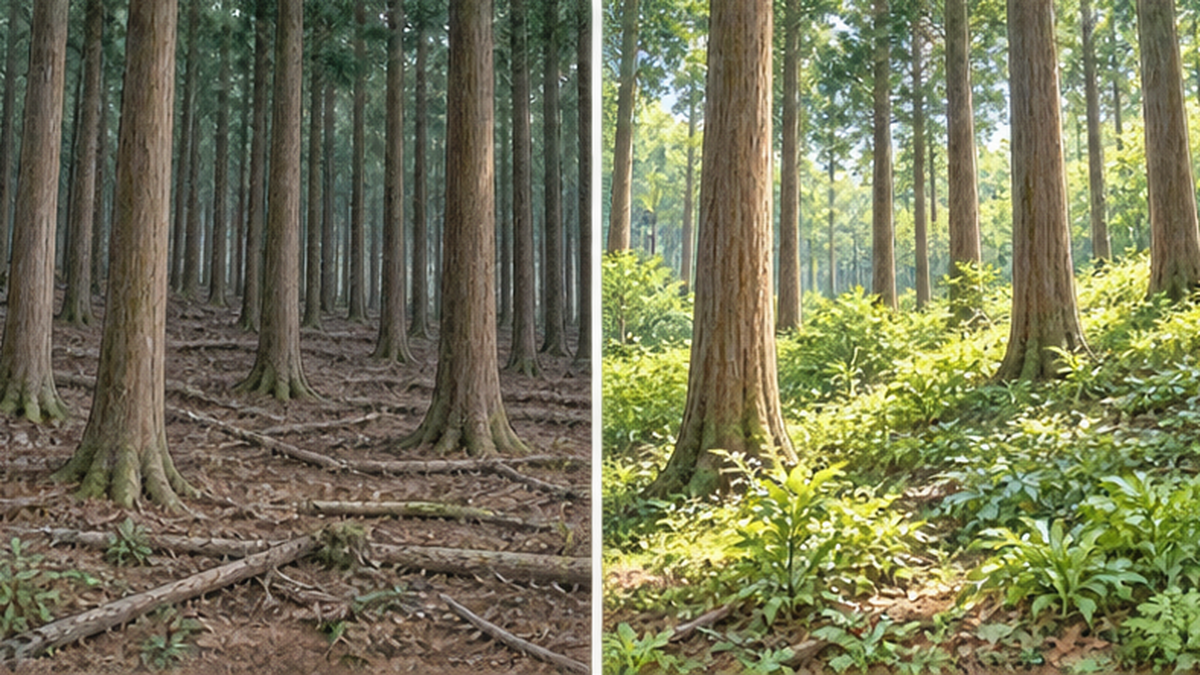
What Research Shows: Effects and Cautions of Thinning
Effects on water resources
Forestry Agency materials introduce findings from the Shikoku Research Center of the Forestry and Forest Products Research Institute on row thinning of about 50% of trees by number in a cypress plantation. The share of evapotranspiration taken by canopy interception and tree transpiration fell from the 40% range to the 30% range, while the share of evaporation from the forest floor rose from 12.7% to 31.4%. This thinning is reported to have improved the water-resource storage rate by about 15% on a five-year average.
Understory vegetation and infiltration capacity
A conference abstract shows that when heavy thinning at a 50–60% thinning rate by number is carried out in degraded cypress plantations, the forest floor becomes covered with understory vegetation, infiltration capacity rises, and the risk of surface flow and muddy water falls. A report from Aichi Prefecture likewise summarizes that heavy thinning is effective for protecting surface soil and shifting toward mixed conifer–broadleaf forest, and that fine-soil runoff has decreased and stabilized after thinning.
What topsoil movement surveys show
In a steep cypress plantation in Tanabe, Wakayama Prefecture, a study measured over four years how topsoil movement changes under clear-cutting (100%), heavy thinning (50%) and ordinary thinning (20%). While soil movement in thinned plots is reported to be smaller than in clear-cut plots, the study also points to the importance of limiting ground disturbance during work while securing rapid vegetation recovery.
Why thinning is not a cure-all
- Depending on how work roads are built and heavy machinery is used, soil can actually move more
- In areas with heavy deer browsing, understory vegetation recovers poorly even when light enters
- Effects vary with terrain, soil and weather, so region-specific design is essential
Guiding stands toward mixed conifer–broadleaf forest
In some plantations, thinning to let in light and keeping naturally growing broadleaf trees can lead to a mixed conifer–broadleaf forest. A forest with many kinds of trees offers more habitat and is thought to be more resilient to pests and changing weather.
However, results differ depending on conditions, such as whether a broadleaf forest that can supply seeds is nearby and whether deer browsing is severe. Not every plantation can become a mixed forest; it is realistic to distinguish stands kept for timber production from stands moved closer to nature, according to purpose.
Cautions when reading research results
The figures introduced here come from specific regions, species and thinning rates. They do not necessarily apply as they are to other areas. Statements such as "thinning raised the storage rate" should be taken as findings under specific conditions.
The loss of understory vegetation caused by deer is explained in detail in Deer Overpopulation and Soil Runoff. Kanagawa Prefecture's materials also name as a challenge that, even as plantation management advances, understory recovery stalls because of deer browsing.
Forest–River–Sea Connections and Impacts on the Coast
How muddy water reaches the sea
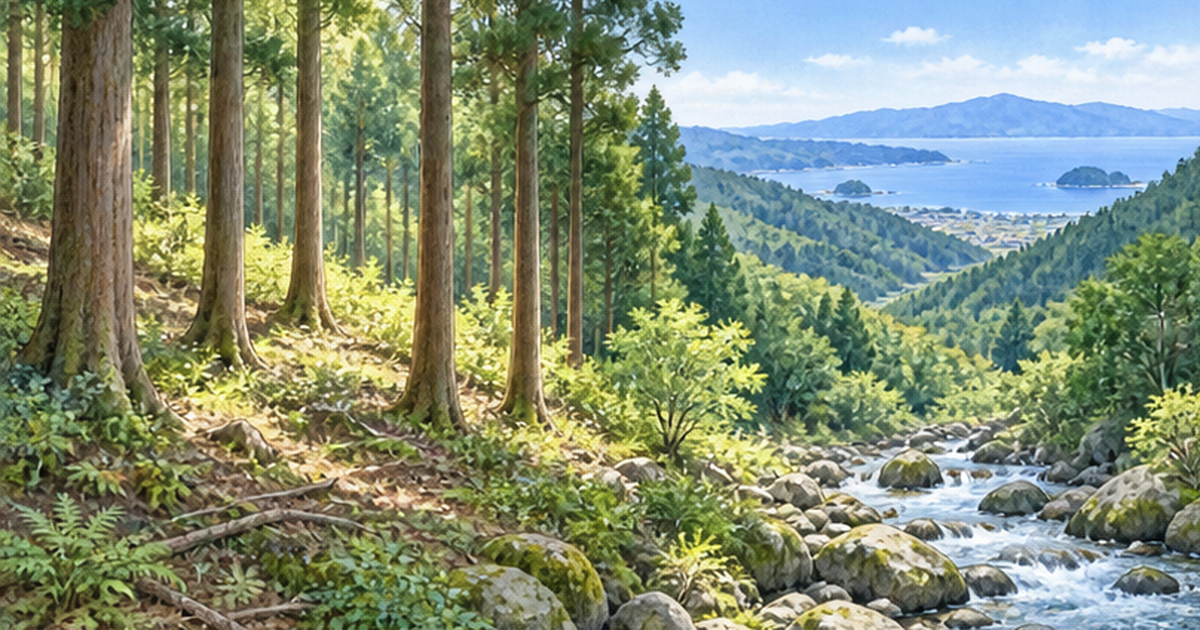
Mountain soil enters rivers with rain and is carried through estuaries to the sea. When plantation floors deteriorate and soil flows easily, river turbidity rises and may affect coastal water clarity and sediments. The state of forests is continuous with the state of rivers and the sea.
The sea nurtured by forests
Nutrients delivered from forests through rivers have long supported coastal life. The spread of tree-planting by fishers in the mountains across Japan is rooted in this idea that "the forest is the sea's sweetheart." The view of the whole watershed as one unit is also introduced in Forest, River and Sea Connectivity.
Supporting the ecosystem in the soil
In well-managed forests, fallen leaves decompose and soil organisms work actively. For the underground world, please also read Life Underground: Soil Biodiversity.
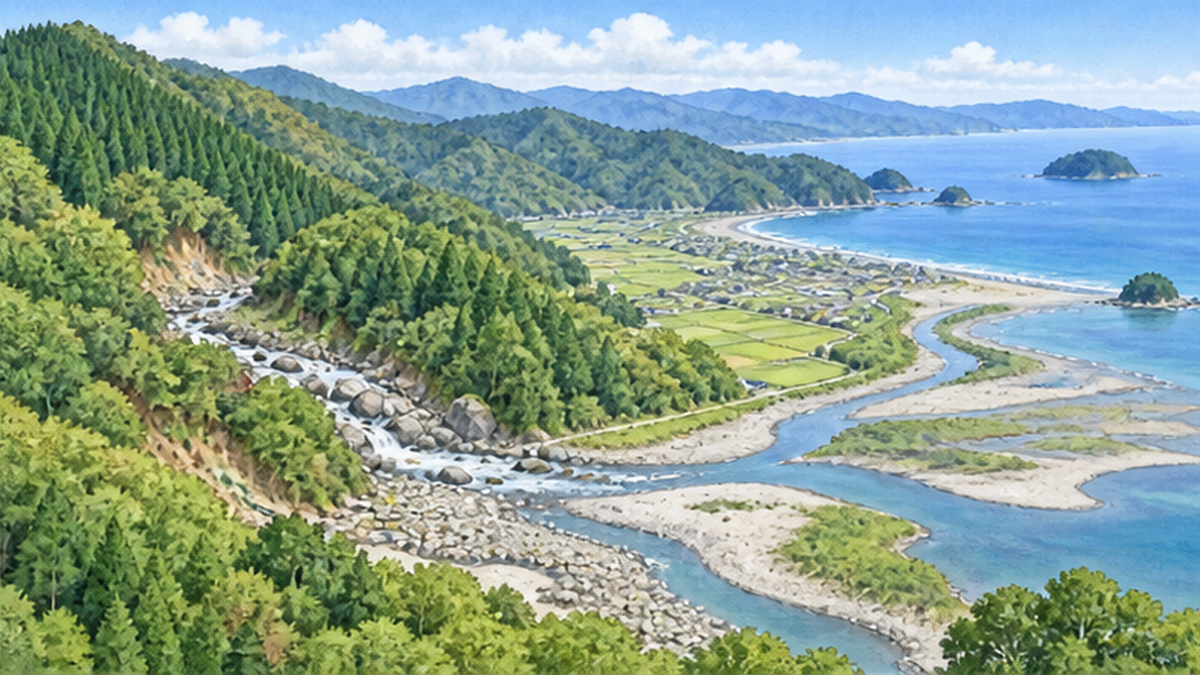
Possible changes on the coast
Fine soil carried by rivers settles at river mouths and along the coast. If the amount grows too large, it may affect the habitat of organisms that prefer clear water, such as seagrass, corals and shellfish. On the other hand, moderate nutrients from forests also feed phytoplankton and support the coastal food web.
The influence of the mountains is not only soil. When driftwood such as logs and branches is washed out in heavy rain, it ends up in rivers and on beaches and is also connected to marine debris problems. Well-managed stands are expected to help limit such outflows.
Thinking at the watershed scale
Rather than treating forest care as an issue only for mountain owners, a movement is spreading to see it as an issue for the whole watershed, including people living in downstream towns and by the sea. Mechanisms for upstream and downstream cooperation are important for securing funds and labor to protect mountains.
Protecting Forests by Using Wood: Domestic Cedar Timber
Thinned timber is a resource, not waste
Timber from thinning is used for construction lumber such as pillars and boards, as well as plywood, glulam, paper and woody biomass fuel. Using wood helps return funds to the mountains for the next round of care.
Plant, grow, use, and plant again
The value of plantations circulates when they are used. Replanting after harvest with fast-growing seedlings makes the forest young again. Trees absorb CO2 as they grow, and carbon stays fixed while the timber is in use.
- Use domestic cedar in wooden buildings and interiors
- Adopt local timber in public facilities and schools
- Use woody biomass to make use of low-grade timber with few other uses
Wood use and carbon storage
Trees absorb CO2 as they grow and store carbon in trunks and branches. If they are cut and used in buildings or furniture, the carbon stays fixed while they are in use. Using wood in forms that last long also contributes to climate action.
As young trees grow after replanting, they absorb CO2 again. However, if the land is not replanted after felling, the forest's functions are lost. It is important to treat cutting, using and planting as a set.
Regional economies and livelihoods
Forest care is also tied to local jobs and industries. As more buildings and products use local timber, work is created for people in the mountains, supporting life in mountain communities.
The shape of the cycle
- Thinning → Use → Return of revenue → Replanting → Next round of care
Pollen Allergy Countermeasures and Renewing Plantations
The national three pillars and numerical targets
At the Cabinet ministers' meeting on pollen allergy held on May 30, 2023, three pillars of pollen allergy countermeasures (source countermeasures, dispersal countermeasures, and onset and exposure countermeasures) were decided. The core of source countermeasures is to accelerate felling and replanting of cedar plantations. The Forestry Agency aims to reduce cedar plantations that serve as pollen sources by about 20% by FY2033 and, in the future (in about 30 years), to halve pollen production.
Expanding demand and switching seedlings
To advance felling, an outlet for the cut timber is also needed. A target has been set to expand cedar timber demand from about 12.4 million m³ at present to about 17.1 million m³ within ten years. Replanting is to use low-pollen seedlings.
Priority felling zones
Prefectures designate "cedar plantation priority felling zones," and about 20% of the nation's cedar plantations are said to fall within these zones. It is a mechanism to advance pollen countermeasures and forest rejuvenation together.
Challenges of replanting and seedlings
Reliably replanting after felling requires labor and money for securing seedlings, planting and early management such as weeding. In some areas, fences and protective materials are also needed to shield seedlings from deer browsing. How to pass on the forest after felling to the next generation is also an important theme in pollen countermeasures.
It takes time for low-pollen seedlings to spread widely, and this effort spans decades. A perspective of nurturing forests over the long term, not just short-term effects, is required.
Using thinning and clear-cutting appropriately
- Thinning is care that improves quality while keeping the stand
- Clear-cutting and replanting is renewal that replaces the stand with a new generation
- The suitable method and scale vary with terrain and soil
What We Can Do
Supporting forests in daily life
- Choose furniture, building materials and paper products made with domestic and local timber
- Support products and shops that promote "kizukai" (using wood)
- Take an interest in local government efforts such as forest environment taxes that support forest care
- Take part in forest volunteering, tree planting and tree-care activities
Staying aware of the connection to the sea
The state of the mountains can lie behind marine litter, turbidity and changes in fishing grounds. Looking at the mountains is also looking at the sea. Visit nearby rivers and forests and feel the connection of the whole watershed.
Summary
Cedar plantations are forests planted by people after the war in an effort to restore ravaged mountains. What is asked of us now is not to leave them untended, but to restore the cycle of thinning, using and replanting. Caring for forests is also an act that protects water and soil and the future of rivers and the sea.
Starting with familiar steps
Protecting forests does not require special activities alone. Simply paying attention to origin and materials when choosing furniture or paper products builds interest in the mountains. Finding a building made of local timber while traveling or joining a forest experience is also a meaningful way to learn.
People who care about the sea especially should know the connection to the mountains. Visiting the forest at a river's source even once may change how you see the sea.
Summary of this article
- About 10.09 million ha of plantations, of which cedar is about 4.41 million ha
- In neglected stands, lack of light removes understory vegetation and soil moves more easily
- Thinning may help restore the forest floor and conserve water resources, but deer and work methods need attention
- Using wood and replanting keeps the cycle connecting forests and the sea going
References and Sources
- Forestry Agency | State of Forest Resources (as of March 31, 2022) – Plantation area by species
- Forestry Agency | Pollen Source Countermeasures – Felling and replanting of cedar plantations
- Forestry Agency | Promoting Pollen Allergy Countermeasures – Three pillars and numerical targets
- Forestry Agency | FY2024 White Paper on Forests and Forestry – Wood self-sufficiency and state of plantations
- Forestry Agency | FY2023 White Paper on Forests and Forestry, Feature – Background of expansion afforestation
- Forestry Agency | Study materials on forest water resources – Thinning and water storage
- Forestry Agency | Materials on mountain disasters and sediment runoff – Forests and sediment runoff
- Aichi Prefecture | Materials on thinning and topsoil conservation – Effects of heavy thinning
- Kanagawa Prefecture | Materials on plantation management and understory vegetation – The deer browsing issue
* Arranged in order of reliability: government agencies > academic institutions > peer-reviewed papers > specialist organizations > reliable media