⚡ The answer in 30 seconds
- When deer eat up the understory (plants and low shrubs near the ground), they even eat fallen leaves and leave the soil bare, so rain easily washes soil away.
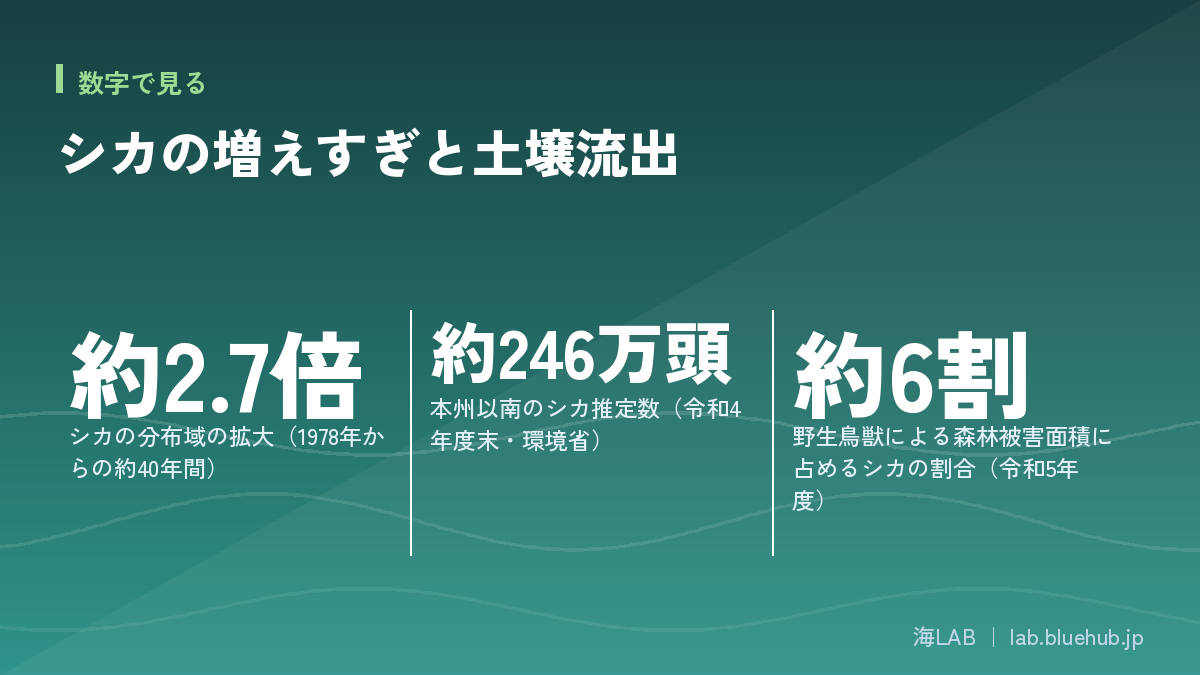
- The Ministry of the Environment estimates about 2.46 million deer south of Hokkaido at the end of FY2022. Numbers fell from the FY2013 peak of about 2.89 million, but have not reached the halving target of about 1.2 million.
- Soil loss does not stop at the forest: it spreads to the water world through muddier stream beds, changes in insect and fish communities, and more nitrate.
- Countermeasures combine local protection such as deer fences with culling to reduce numbers; the aging of hunters is the biggest challenge.
The forest floor has no grass. This scene is spreading across mountains throughout Japan. One cause is the overpopulation of sika deer. Deer eat plants, but when they become too numerous they strip the "ground-covering plants" (the understory) and leave the soil exposed.
On bare slopes, soil and fallen leaves wash away with every rain. The sediment fills stream beds, changes the habitat of insects and fish, and sometimes damages water intake facilities. The deer problem is not just "a mountain problem"; it is also a problem of the water cycle that continues through rivers to the sea.
Based on public materials from the Ministry of the Environment and the Forestry Agency and on surveys at Odaigahara, Tanzawa and Ashiu, this article sorts out why deer increased, what happens in forests that lost their understory, the links to waterways and the sea, and where countermeasures stand. It is not a story of blaming deer, but of an ecological imbalance created by changes in human life.
What you'll learn in this article
- Why deer increased (loss of predators, fewer hunters, warmer winters, land-use change)
- What happens when the understory disappears (soil loss, loss of saplings, simplified vegetation)
- Concrete figures from surveys at Odaigahara, Tanzawa, Ashiu and elsewhere
- How soil loss chains into stream insects, fish and water quality, and the link to the sea
- Where countermeasures stand: deer fences, culling and training hunters
- How this connects to daily life, and what we can do
Why did deer increase so much?
Loss of predators and changes in human life
The sika deer is a native animal that has lived in Japan's forests for a long time. It was not "brought in" like an alien species; the starting point of today's problem is that human activity upset the balance of numbers. Ministry of the Environment and Forestry Agency materials also describe the increase as the result of several overlapping factors rather than a single cause.
The first big factor is the absence of predators. The Japanese wolf, which once preyed on deer, disappeared in the Meiji era, and Japan's forests now have almost no large carnivores that regularly prey on adult deer. The second is a change on the human side: hunters, who used to keep deer in check, have declined over the long term and have aged.
- Loss of predators: with the Japanese wolf extinct, natural population control works poorly
- Fewer and older hunters: hunting pressure has weakened over the long term
- Warmer winters and less snow: fewer deer die from food shortage or snow, so fawns survive more easily
- More feeding grounds: understory in plantations, abandoned farmland and grassland, and riverbanks became new food sources
- History of protection: after past overhunting, there was a period when hunting of female deer was restricted
Range up about 2.7 times in about 40 years
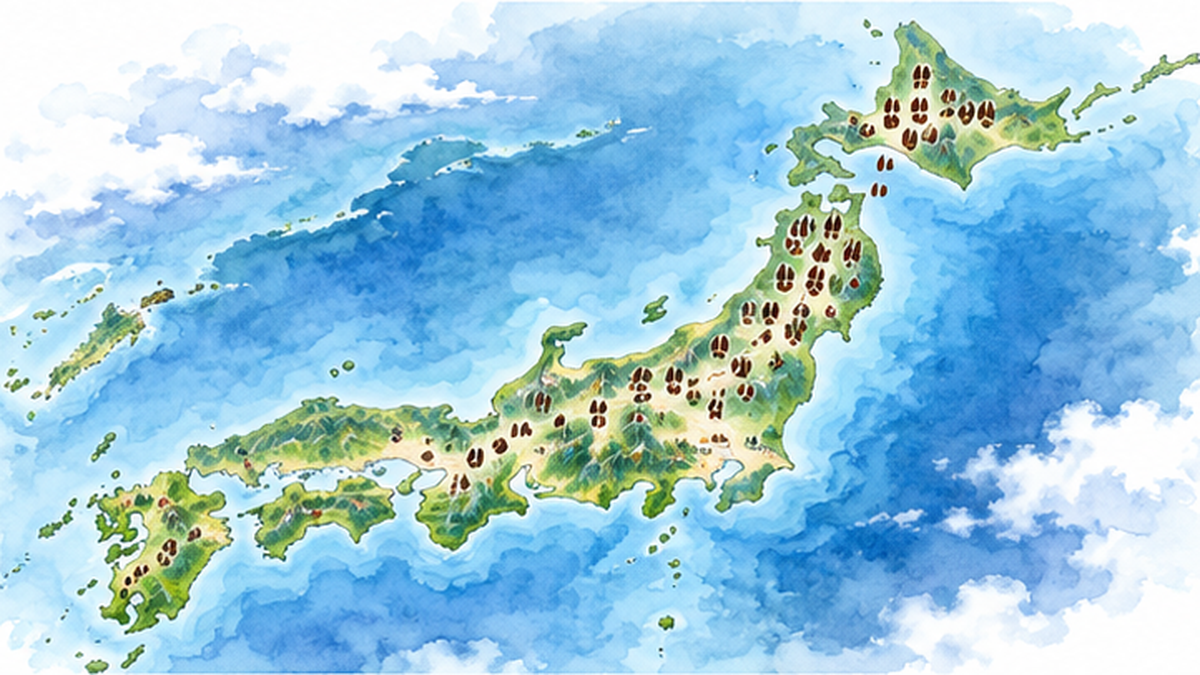
According to the Forestry Agency, the distribution of deer has expanded greatly since 1978, with the range growing about 2.7 times in roughly 40 years. It is spreading especially fast in regions where deer were once scarce, such as Hokkaido, Tohoku and Hokuriku. The Tohoku Regional Forest Office shows that in just eight years from FY2014 to FY2022, high-density areas spread north and west across the Ou Mountains.
Key points
- Deer are native. The problem is not that they exist, but that they have increased beyond the forest's carrying capacity
- The cause is not a natural phenomenon but is closely tied to human-side changes such as the loss of predators, fewer hunters and land-use change
What changes when snow decreases?
In snowy regions, deep snow has acted as a "natural regulator" that limits winter movement, makes food harder to reach and raises deer mortality. When snowfall declines with recent warm winters, more animals survive the winter, and their range spreads into the mountains of northern Japan and the Sea of Japan side. It is one example of climate change quietly affecting the relationship between forests and animals.
Changes in snowfall also matter for water resources through snowmelt. For the link between snow and water, see also the article Snowmelt as a Resource.
The Deer Situation in Numbers
About 2.46 million south of Hokkaido: down from the peak, but
The Ministry of the Environment estimates deer numbers south of Hokkaido by statistical methods. According to its public materials, the estimate (median) rose from about 2.43 million in FY2011 (the base year), peaked at about 2.89 million in FY2013, then began to decline as culling increased, to about 2.44 million in FY2017; Forestry Agency material puts it at about 2.46 million at the end of FY2022.
| Fiscal year | Estimated number south of Hokkaido (median) | Notes |
|---|---|---|
| FY2011 | About 2.43 million | Base year for the halving target |
| FY2013 | About 2.89 million | Estimated peak |
| FY2017 | About 2.44 million | Decline after the 2014 amendment of the Wildlife Protection and Hunting Management Act |
| End of FY2022 | About 2.46 million | According to Forestry Agency material |
| FY2023 (target) | About 1.2 million | Half the base year (Ministry of the Environment target) |
One thing to note is the "wobble" in population estimates. The Ministry's materials state that because estimates are made by adding new catch records and other data, they are revised retroactively, and that annual estimates may change by hundreds of thousands of animals. The numbers are best treated not as an exact head count but as a guide to trends.
Three cautions when reading population numbers
First, a population figure is an estimate, not a count of "how many there are." It is calculated with a statistical model from catch numbers, sighting data and droppings density, and comes with a credible interval. The estimated natural growth rate for FY2022 was a median of 1.19 (90% credible interval 1.16-1.22), meaning that left alone, numbers would grow by almost 20% a year.
Second, the national total does not match local experience. Even when the national trend is downward, density can keep rising at the front where the range is spreading. Third, head count and damage are not proportional. The carrying capacity of a forest varies greatly with vegetation, terrain, snowfall and surrounding food sources, so the same number of deer causes different damage in different places. Use the numbers as a map of the whole picture, and combine them with field observation.
Hokkaido is estimated by a different method
The Ministry of the Environment explains that Hokkaido's Ezo sika deer are estimated with an original method and cannot be added to results for the rest of the country in a scientifically valid way. The estimated population in Hokkaido in FY2017 was 670,000, and the catch in FY2018 was about 110,000. In FY2022 Hokkaido was estimated by region: east, north, central and south.
About 60% of forest damage is from deer
According to the Forestry Agency, deer accounted for about 60% of the area of forest damage by wild animals in FY2023. The Forest Ecosystem Diversity Survey indicates that deer effects are seen in about 30% of forests nationwide, showing that damage has spread across the country.
The damage is not only a forestry problem. In agricultural damage statistics too, sika deer, wild boar and Japanese macaques account for about 70% of damage by wild animals, so deer affect agriculture, forestry and the natural environment alike. The background of macaque crop damage is covered in the article Japanese Macaque.
What Happens in a Forest Without an Understory
What is the understory?
A forest is made of several layers: tall trees (canopy), medium trees (sub-canopy and shrub layer), and the grasses, bamboo grass and saplings near the ground (the understory). The understory is inconspicuous, but it catches raindrops to protect soil, holds down fallen leaves, shelters insects and small animals, and is the cradle of the next generation of trees.
Deer like to eat this understory. While density is low, plants regrow and a balance is kept, but as density rises the plants deer prefer decline first, and finally only plants deer find hard to eat (poisonous or thorny plants) remain.
What is left uneaten: a simplified forest
Forestry Agency case studies show the understory around Mt. Gomadan in Wakayama Prefecture reduced to a single species, Japanese andromeda (a poisonous shrub deer do not eat), and, around Mt. Sanrei in Kochi Prefecture, bamboo grass dying back into bare ground with vegetation remaining only inside protective fences. In the upper Kumozu River basin in Mie Prefecture, loss of the understory in natural forest led to some surface landslides.
- Stage 1: plants and shrubs deer prefer (lily and daisy family flowers, saplings and so on) decrease
- Stage 2: bamboo grass is grazed, becomes shorter, and its standing biomass declines
- Stage 3: plants deer do not eat (Japanese andromeda, bracken-like ferns, Patrinia-like herbs and so on) dominate
- Stage 4: the ground becomes bare, and loss of soil and leaf litter begins
Observation tip
- If you see a line where leaves below waist height are unnaturally uniformly eaten (a browse line), it is a sign of high deer pressure
- A slope with no fallen leaves underfoot and bare soil is easily washed away by rain
Damage in alpine zones and wetlands too
The effect of deer is not limited to lowland forests. It also reaches flower meadows and wetlands in the subalpine and alpine zones. Ministry of the Environment material shows survey cases where flower stems of tall herbs in wetlands were eaten at high rates (99% for Hemerocallis esculenta and 57-91% for other species). The crisis facing alpine plants is also covered in the article Alpine Plants of Japan.
How Soil Loss Happens: What Rain Does on a Bare Slope
A "roof" and a "carpet" that catch raindrops
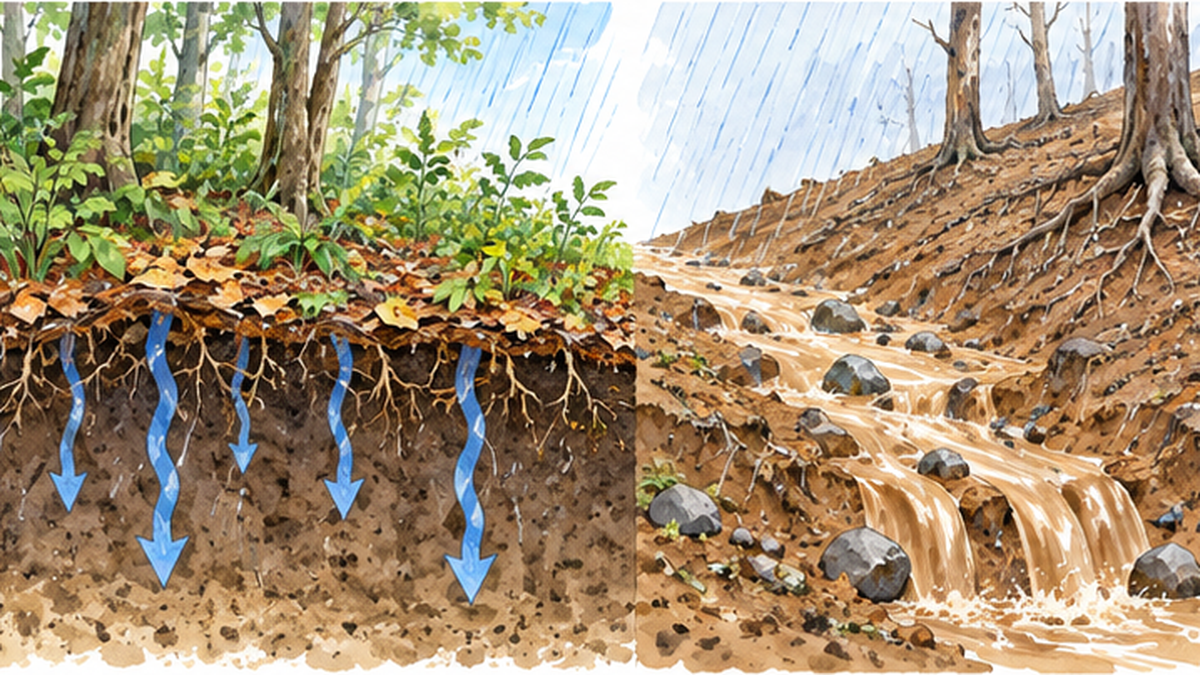
In a healthy forest, the canopy weakens the force of raindrops, and the understory and fallen leaves cover the ground and let water soak slowly into the soil. When the understory and leaves are gone, raindrops hit the soil directly, the surface hardens and water soaks in less, so water flows over the surface. This surface flow carrying away soil and leaves is the basic mechanism of soil loss caused by deer.
Odaigahara: the less bamboo grass, the more the soil moves
At Odaigahara in Nara Prefecture, deer heavily graze the Miyako-zasa bamboo grass of the forest floor in the mixed conifer-broadleaf forest near the summit. In a study that set up plots with deer excluded and plots with bamboo grass cut and measured movement of litter and soil (Furusawa et al. 2003), an exponential negative correlation was found between the aboveground biomass of the bamboo grass and the movement of litter and soil. The less bamboo grass, the more sharply the amount of moving soil rises.
Tanzawa and Hyogo: predictable from slope and degree of decline
In a beech forest at Dodaira in East Tanzawa, Kanagawa Prefecture, soil erosion was measured at three places with large, medium and small forest-floor cover (Ishikawa 2008). Where cover was small, soil erosion became extremely large in July to September when rain is heavy and litter accumulation decreases, and less rainwater soaked into the soil than where cover was large. A survey of 17 places in the same Dodaira area (Hatsu et al. 2010) showed that where the combined cover of vegetation and litter is small, even a slight change in cover has a large effect on erosion.
A survey of deciduous broadleaf forest in Hyogo Prefecture (Uchida et al. 2012) showed that soil erosion by deer occurs mainly on steep slopes with a declined understory, and that its intensity can be predicted from the degree of understory decline and the slope angle. A quick-reference table has also been made to judge erosion risk simply using tree density (Fujiki 2017). A survey in a deer-dense satoyama in Kawanishi City, Hyogo (Takagi 2024) likewise confirmed that erosion tends to be greater where tree density is lower and slopes are steeper.
| Area | What the survey found | Source (as listed in Ministry of the Environment material) |
|---|---|---|
| Odaigahara, Nara | The less Miyako-zasa biomass, the more litter and soil moves | Furusawa et al. 2003 |
| Dodaira, Kanagawa | Where cover is small, soil erosion becomes extremely large in rainy July to September | Ishikawa 2008 |
| Hyogo Prefecture | Erosion concentrated on steep slopes with declined understory; predictable from degree of decline and slope | Uchida et al. 2012 |
| Kawanishi City, Hyogo | Erosion is greater with lower tree density and steeper slopes | Takagi 2024 |
Lost soil is hard to bring back
- It takes a long time for a few centimeters of forest topsoil to form
- Surveys in the Kyushu Mountains also show that where erosion has occurred, the soil microbial community has become one in which plants have difficulty establishing
- Because plants do not return, erosion does not stop, and a vicious circle easily forms
From Forest to River to Sea: A Chain into the Water World
When the stream bed changes, insects change
The effects of soil loss reach stream life. Ministry of the Environment summary material introduces a study (Sakai et al. 2012) in which streams in stands bared by deer had finer bed material (sand and gravel) than deer-excluded plots, with more insects that burrow into fine sediment and fewer insects that cling to gravel.
At Odaigahara, comparing 1983 and 2006, the number of individuals and genera of benthic invertebrates decreased and species composition changed, with mayflies declining and stoneflies increasing (Yoshimura 2023). It is thought to be due to reduced understory and humidity from deer feeding, and higher water and air temperatures from the death of canopy trees. Stream insects are also food for fish such as char.
Downstream fish communities change too
It has been shown that when soil erosion changes bed material, downstream fish communities also change. Ministry of the Environment material includes a report that Tribolodon (dace) decreased and Pseudogobio (sand gudgeon) increased (Nakagawa 2019), and a 2021 survey of river beds in Hyogo catchments of the same size but differing time since forest degradation. When a river bottom is filled with fine sand and mud, fish that spawn in gravel and animals that live between stones struggle to survive.
Effects on water quality: the Ashiu studies
At Kyoto University's Ashiu Research Forest, the understory of natural beech and oak forest declined rapidly in the 2000s because of excessive deer browsing. Stream water was examined in a catchment fenced against deer in 2006, one fenced in 2017, and an unfenced control. Nitrate (NO3-) concentration in the 2006-fenced catchment stayed about 30-40% lower than in the other two. As the understory recovered inside the fence, concentration fell gradually over four to five years, while outside the fence it stayed roughly constant (Fukushima et al. 2020).
This suggests that the understory absorbs nitrogen and holds it in the soil, and that when vegetation is lost nitrogen flows more easily into streams. In test studies in Tanzawa too, small watersheds where vegetation recovered reportedly had less turbid water and less silt (fine mud) runoff.
Water for daily life, dams, and the sea
The effects reach people's lives. In Okutama Town, Tokyo, a heavy rain in July 2004 washed a large amount of sediment from a deer-damaged area, damaging a downstream small water-supply facility and making water intake impossible.
That sediment and nutrients from forests ultimately head for the sea is basic to the material cycle of a whole watershed. However, there are few studies that directly measured how much sediment from deer damage affects coastal seas. This is a future research issue, and for now the honest summary is that changes in forests and rivers have been confirmed and a watershed-wide view including the sea is needed. On rivers, see the article Nature-Oriented River Works; on streamside vegetation, see Riparian Forests.
Forest, river and sea are one continuum
- A forest's understory affects a river's water temperature, turbidity, nutrients and life
- The work of headwater forests is explained in detail in the article Headwater Conservation Forests
Loss of Forest Resilience: Saplings, Bark Stripping and Seeds
The next generation of trees cannot grow
Deer eat not only ground plants but also tree buds and saplings. In forests with high deer density, saplings are eaten before they grow, so after old trees fall there is a "break in generational turnover" with no next generation to replace them. A Forestry Agency case also shows larch plantings in the Iburi region of Hokkaido bonsai-shaped by continuous browsing of twigs and leaves.
Bark stripping and standing dead trees
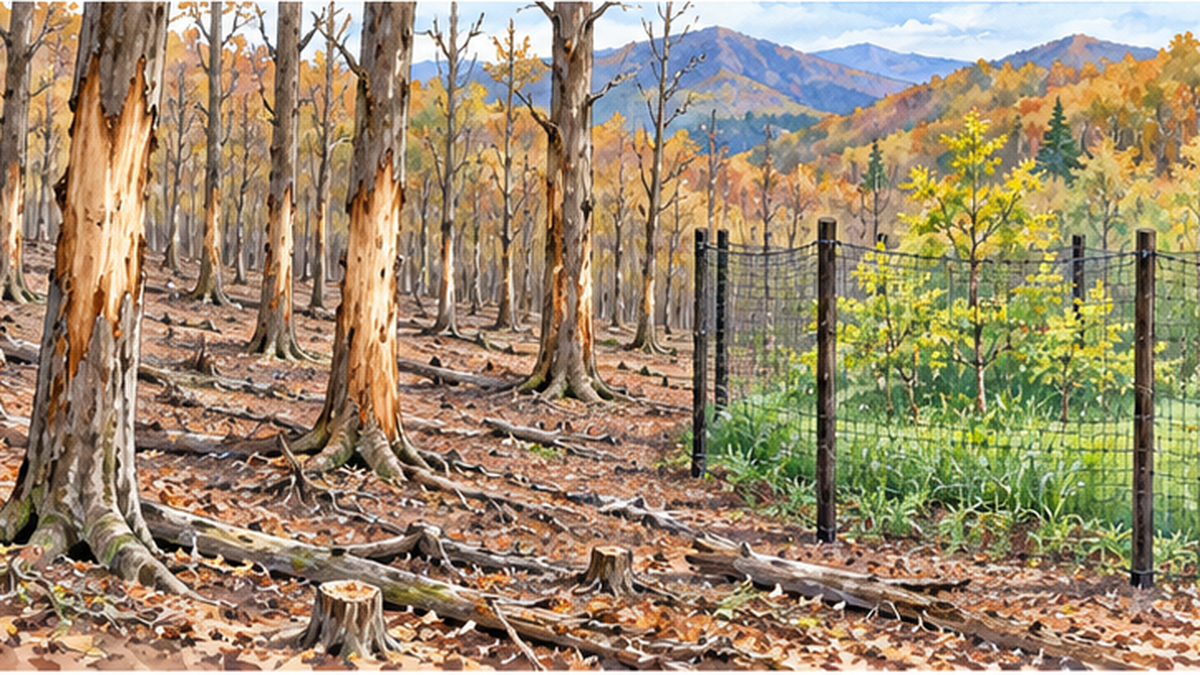
When food is scarce in winter, deer strip bark with their teeth and eat it. This is bark stripping, and when it goes all the way around the trunk, the passage of water and nutrients is cut and the tree dies. Reported cases include death of planted young trees around Mt. Fuji in Yamanashi Prefecture, and conifers such as spruce and Veitch's silver fir killed by bark stripping at Odaigahara and the Omine range in Nara. A vicious circle has also been pointed out: when conifers die, gaps open in the canopy, light enters, bamboo grass increases and feeds more deer, and conifer forest declines further.
Animals that carry seeds, and renewal of the forest
Forest renewal requires a long chain of seed dispersal, germination and sapling growth. Excessive browsing of the understory by deer cuts that chain partway. The link between seed-carrying animals and forests is covered in Animals That Carry Seeds.
Life in the soil changes too
Ministry of the Environment summary material lists cases where deer effects reach underground. In natural beech forest in West Tanzawa, large effects were seen on large soil animals such as earthworms and on oribatid mite communities, and at Kyoto University's Ashiu Forest, changes in large soil animals (earthworms, isopods, amphipods, millipedes and others) were reported after deer increased. The world of life in the soil is introduced in Life in the Soil.
Summary of the chain
- Deer increase → loss of understory → loss of soil and leaf litter
- → muddier stream beds, changes in insects and fish, changes in water quality
- → saplings fail to grow and generational turnover of the forest stops
Regional Faces: Tohoku, Kinki, Shikoku and Kanto
Tohoku: deer spreading north, and forests on coastal peninsulas
According to the Forestry Agency's Tohoku Regional Forest Office, forest damage by deer in Tohoku occurs around Mt. Hayachine and Mt. Goyo in Iwate Prefecture and around the Oshika Peninsula in Miyagi Prefecture. Photos show loss of understory on the Oshika Peninsula, bark stripping in Rikuzentakata, browsing of natural trees in Hanamaki, and browsing of planted trees in Kamaishi. Even coastal forests are under the same rising pressure as inland mountains.
Tohoku used to be a region of low deer density, where heavy snow was a natural brake. Forests there are not "used to" deer, and impacts can be large once damage appears. The illustration that high-density areas spread north and west in the eight years from FY2014 to FY2022 is also the basis for the Tohoku Regional Forest Office's message that early action is needed.
Kinki: long experience at Odaigahara and the Kii Peninsula
Odaigahara in Nara is one of the places where research on deer browsing has accumulated the most. Long-term surveys have covered the relationship between decline of Miyako-zasa and movement of soil and litter, and the comparison of stream benthic animals in 1983 and 2006. The vicious circle in which conifers die from bark stripping, light enters, bamboo grass increases and feeds more deer has also been shown from observations in this area.
In Kinki, Kyoto University's Ashiu Research Forest is also an important observation site. In natural beech-oak forest whose understory declined rapidly in the 2000s, comparison of catchments using deer fences has continued since 2006, revealing changes in stream nitrate and soil animals. Following the same place for a long time shows both the impact of deer browsing and the speed of recovery with fences.
Shikoku and the Kii Mountains: bare ground and monoculture
Around Mt. Sanrei in Kochi, Forestry Agency material shows bamboo grass dying from deer browsing and turning into bare ground, with vegetation remaining only inside protective fences. Around Mt. Gomadan in Wakayama, the understory became a monoculture of Japanese andromeda, which deer do not eat. When the number of species falls and vegetation becomes uniform, it is called "simplification" of biodiversity.
Kanto: Tanzawa, Okutama and the water of the capital region
In the Tanzawa Mountains, deer have increased since the 1970s, and strong browsing pressure that degrades vegetation and strips topsoil has long been pointed out. As part of its water-source conservation and restoration measures, Kanagawa Prefecture has set up test watersheds and examined water and sediment runoff and the habitat of aquatic life. In Okutama, Tokyo, a July 2004 downpour made water intake impossible, an example showing that mountain problems can lead directly to urban water supply.
Three viewpoints for comparing regions
- Deer density: since when, and at what density, have deer been feeding
- Terrain: steep or gentle slopes. Soil loss occurs more easily on steep slopes
- Countermeasures: how far fences, culling and vegetation recovery have progressed
Even for the same "deer browsing," the speed of spread stands out in Tohoku, long-term accumulation in Kinki, bare ground in Shikoku, and closeness to water sources in Kanto. Reading local conditions and choosing measures that fit the place is the practical approach to the deer problem.
Where Countermeasures Stand: Protect, Reduce, Use
Protect with fences: deer fences and understory recovery
Deer fences are one of the most reliable ways to protect vegetation. As in Ashiu and Tanzawa, effects have been confirmed inside fences: the understory recovers and soil and nitrogen loss are reduced. On the other hand, the area that can be fenced is limited, and installation and upkeep need cost and labor. Fences can be damaged by fallen trees or snow. A fence is a means of protecting important places, not of protecting a whole wide forest.
Reduce by culling: the halving target and where we are
In 2013 the Ministry of the Environment and the Ministry of Agriculture, Forestry and Fisheries launched the "fundamental wildlife capture strengthening measures," setting a goal of halving deer and wild boar by FY2023 compared with FY2011. To support this, the Wildlife Protection and Hunting Management Act was amended in 2014 and a certified wildlife capture operator system was created to undertake culling professionally. The catch of deer south of Hokkaido reached about 460,000 in FY2018, contributing to the decline from the peak estimate. However, the estimate at the end of FY2022 is about 2.46 million, and a large gap with the halving target (about 1.2 million) remains.
| Measure | Strengths | Challenges |
|---|---|---|
| Deer fences and netting | Vegetation reliably recovers where installed | Limited area; upkeep costs money and labor |
| Culling (guns and traps) | Can lower browsing pressure over a wide area | Shortage and aging of hunters; falling capture efficiency |
| Venison (game meat) use | Uses the captured animals as a resource and motivates culling | Developing processing facilities, distribution and hygiene control |
| Vegetation recovery and soil stabilization | Turns bare ground green and stops sediment | Plants are eaten again unless deer are reduced |
The wall of aging hunters
Hunting license holders exceeded 500,000 around FY1975 but have since fallen sharply, and in recent years have stayed in the low 200,000s. According to news reports and Ministry of the Environment material, aging is advanced, with people aged 60 or over making up about 60%, and licensing has shifted from gun hunting to trap hunting. How to secure and train those who do the culling is one of the biggest challenges in deer countermeasures.
Directions for countermeasures
- Combine roles: fences where vegetation must be protected, culling over wide areas
- Train people to carry out culling, and develop systems such as venison use that make use of captured animals
- Continuously monitor how vegetation is recovering
Like the expansion of bamboo forest, changes in satoyama that humans no longer manage go hand in hand with the deer problem. Read together with Abandoned Bamboo Forest, the effects of abandoned satoyama management on ecosystems become clearer.
Where Our Lives Connect: What We Can Do, What We Should Think About
Deer are not the "villains"
The overpopulation of deer is not something deer themselves chose. The balance of numbers broke as humans removed predators, changed how forests and land are used, and changed the climate. That is why what is needed is neither a story of hating deer nor one that only calls for protection, but an approach that scientifically determines "how many deer can coexist with the ecosystem of each place" and manages accordingly.
What people who go to the mountains can do
- When hiking or climbing, do not enter protective fences and keep to the marked trails
- Observe slopes with exposed ground and dead trees, and tell local governments or park managers
- Through experiences in mountain nature, take an interest in the connection between forest, river and sea
What we can do at the table
Use of venison (game meat) is advancing in many places. Using captured animals as food supports those who do the culling and also leads to local industry. When buying, it is important to choose products processed at facilities with proper hygiene control.
To learn more
The deer problem is connected to other issues such as alien species, climate change and abandoned satoyama. For how alien species work, see Invasive Alien Species in Japan; for sediment supply to coastal beaches, see Beach Erosion. Sediment from the mountains is also connected to the sand supply of coasts through rivers.
Summary
- The increase of deer is tied to human-side changes such as loss of predators, fewer hunters and warmer winters
- When the understory disappears, soil loss, muddier streams, water-quality changes and a halt in forest renewal occur in a chain
- Countermeasures combine fences to protect, culling to reduce, and training of those who do the culling
- Forest, river and sea form one water cycle. Effects on the sea are also a future research issue
参考文献・出典
- Ministry of the Environment, "Status of estimated populations and catches of sika deer and wild boar" – Trends in estimated sika deer numbers south of Hokkaido and the halving target
- Ministry of the Environment, "Summary of impacts of the marked increase and range expansion of sika deer (supporting material)" – Summary of impact cases on understory, soil loss and stream ecosystems
- Forestry Agency Tohoku Regional Forest Office, "Forest damage by sika deer and countermeasures" – Breakdown of FY2023 forest damage area and range expansion
- Forestry Agency, "Protecting forests from pests, diseases and animal damage" – Overview page on wildlife damage control in forests
- Forestry Agency, "Guide for wildlife damage control in forests (March 2012 edition)" – Handbook of deer countermeasures for forest managers
- Forestry Agency, "On deer damage countermeasures in forests (December 2015)" – Overview of deer damage and countermeasures
- Ministry of the Environment, "Certified wildlife capture operator system" – A system supporting those who carry out culling
- Ministry of the Environment, Nature Conservation Bureau, "Understanding the Wildlife Protection and Hunting Management Act and its management systems" – Framework of the Act and hunting licenses
- Journal of the Japanese Forest Society 90(3) 2008, "Browsing by deer and forest vegetation" – Review of the effects of deer feeding ecology on forest vegetation
- Kanagawa Prefecture, "About Tanzawa" – The natural environment of the Tanzawa Mountains and issues of deer and vegetation
Ordered by reliability: government/academic institutions > peer-reviewed papers > specialized organizations > reputable media