⚡ In short
Fifteen years after the Great East Japan Earthquake, even completed relocation and seawalls have not brought coastal populations back. This article traces the current state of coastal community regeneration through statistics and case studies—rebuilding fishing livelihoods, the participation of women and young people, and the new approach called umigyo.
Fifteen years after the Great East Japan Earthquake, hard infrastructure recovery in the affected coastal areas—housing reconstruction, relocation to higher ground, and seawall construction—is largely complete. But even as towns and ports regain their physical form, the number of people living there has not returned to pre-disaster levels.
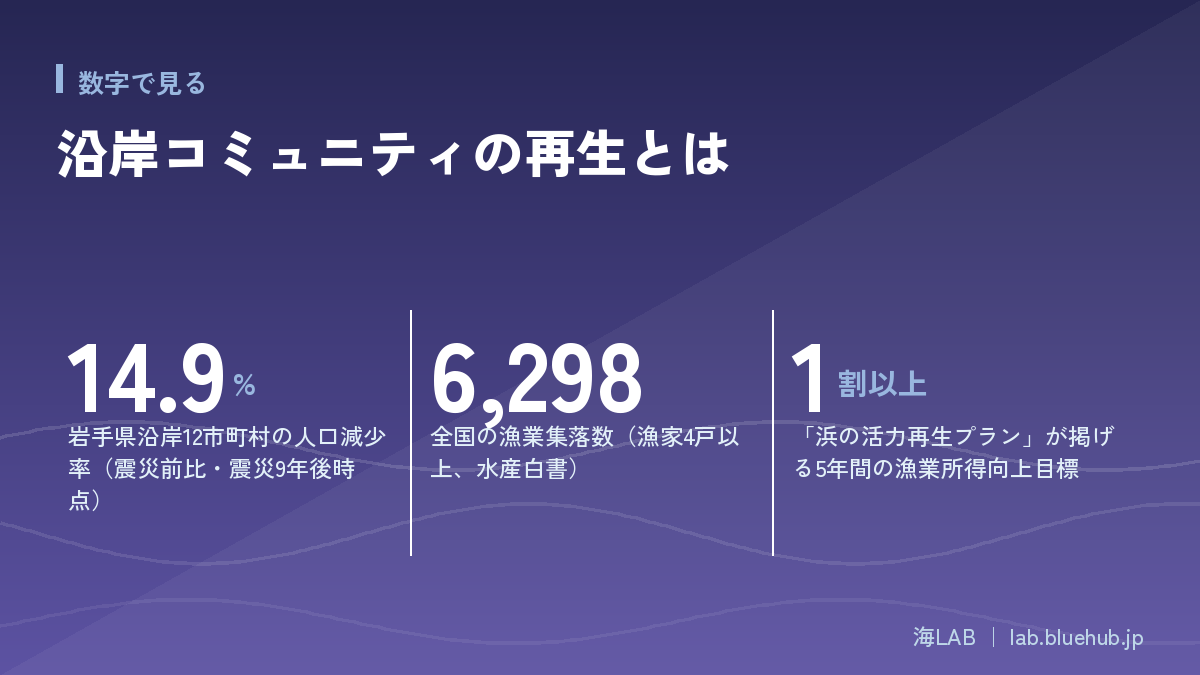
The population of 12 coastal municipalities in Iwate Prefecture fell 14.9% below pre-disaster levels about nine years after the earthquake. The completion of relocation to higher ground and the recovery of population do not necessarily proceed at the same pace. This article traces the current state of coastal community regeneration—from the hard infrastructure of relocation to higher ground, through the rebuilding of fishing as a livelihood, the participation of women and young people, and a new approach to regional development called "umigyo"—through statistics and case studies.
We examine Onagawa, Miyagi Prefecture, which chose not to build a seawall; the "Hama Revitalization Plan" formulated for fishing settlements nationwide; and concrete figures such as the share of women among fishery workers. We consider the challenge of regenerating the community itself, which lies beyond hard infrastructure recovery. None of these treat the completion of disaster-prevention infrastructure as the goal in itself—they all ask the further question of whether people feel they want to keep living there.
What you'll learn in this article
- The progress of relocation to higher ground, and the reality of the "reconstruction dilemma" in which people do not return even as infrastructure does
- How different regions have made different reconstruction choices, such as Onagawa's approach to rebuilding without relying on a seawall
- The national framework for raising fishing income, such as the "Hama Revitalization Plan," and the structural challenges facing fishing settlements nationwide
- How the participation of women and young people is changing the sustainability of fishing communities
- The new regional development movement of "umigyo," which turns fishing ports into hubs for exchange
The "Reconstruction Dilemma" Facing Coastal Communities
Reconstruction after the Great East Japan Earthquake has prioritized hard infrastructure such as housing reconstruction, seawalls, and relocation to higher ground. But even once that infrastructure is complete, it does not necessarily follow that people return. This phenomenon—"infrastructure comes back, but people don't"—has become the greatest dilemma in regenerating coastal communities.
The Cabinet Office's summaries of the state of reconstruction have repeatedly noted that, even as major projects for housing reconstruction and community rebuilding are largely complete, challenges remain in population decline, aging, and mental health care. This shows that the degree of completion of hard infrastructure and the vitality of a community are two separate measures.
Indeed, in the three hardest-hit prefectures of Iwate, Miyagi, and Fukushima, "mental health care centers" were established after the disaster and have provided medium- to long-term mental health support for survivors. Each time residents' living situations changed—from temporary housing to disaster public housing to relocation sites on higher ground—support was needed to help them adjust to a new environment. This psychological care remains a challenge that continues long after the housing reconstruction work itself is finished.
Progress and delays in relocation to higher ground
Relocation to higher ground (the Group Relocation Promotion Project for Disaster Mitigation) moves residential areas in tsunami-hit zones to higher or inland ground, leaving the original sites as non-residential areas. Construction fell far behind initial expectations: even by the end of June 2013, two and a half years after the earthquake, the share of districts where construction had begun was only 22.7% in Iwate, 38.7% in Miyagi, and 45.0% in Fukushima. As a result, many households were left living in temporary housing for a prolonged period.
| Prefecture | Share of districts with construction underway (as of end of June 2013) |
|---|---|
| Iwate | 22.7% |
| Miyagi | 38.7% |
| Fukushima | 45.0% |
Behind this delay lay overlapping factors: difficulty acquiring land, districts waiting their turn for land development, and shortages of materials and workers. During the years it took for relocation-site housing lots to be completed, survivors were forced to live in temporary or deemed-temporary housing, and in many cases they ended up building their lives elsewhere rather than at the relocation site.
The case of Rikuzentakata: falling short of the target population
In Rikuzentakata, Iwate Prefecture, the pre-disaster population of about 24,000 fell to about 18,600 by January 2021. The city's reconstruction plan, formulated in December 2011, set a target population in the mid-25,000s, anticipating the return of evacuees and inflow driven by improved convenience. In reality, however, the population fell more than 3,000 short of even that already-adjusted target. This pattern—in which relocation and land readjustment themselves proceed, but the population outlook falls well short of the plan—is not unique to Rikuzentakata and is seen widely across disaster-affected areas.
The reality of a 14.9% population decline in 12 coastal municipalities of Iwate
Even after relocation to higher ground and the construction of disaster public housing progressed and housing reconstruction itself was largely complete, population recovery remained a separate problem. The estimated population of 12 disaster-affected coastal municipalities in Iwate Prefecture fell 14.9%, from 272,937 before the disaster to 232,404 nine years after the earthquake. The recovery of the fishing industry itself has followed a somewhat different path, which is discussed in detail in Thirteen Years of Fisheries Recovery from the Great East Japan Earthquake.
In all three hard-hit prefectures, the rate of population decline in coastal municipalities far exceeds the national pace of population decline. Even after community reconstruction is "complete," population decline and aging—challenges shared across rural Japan—are appearing in a more acute form in coastal communities.
Why haven't people returned?
- Rebuilding places to work (fisheries, seafood processing, etc.) took time
- As life in temporary housing dragged on, people built new bases of life elsewhere
- Relocation to higher ground separated homes from workplaces, adding inconvenience to commuting and livelihoods
- Population decline and aging were already a nationwide trend before the disaster, and the earthquake accelerated it
What Is Relocation to Higher Ground?—The Risk of Cutting Off Daily Life from the Sea
While relocation to higher ground is an effective means of protecting residents' lives, it has also been noted to carry a side effect: physically widening the distance between daily life and the sea. For fishery workers, having their homes separated from the fishing port affects their livelihood directly.
Two choices: seawalls and relocation to higher ground
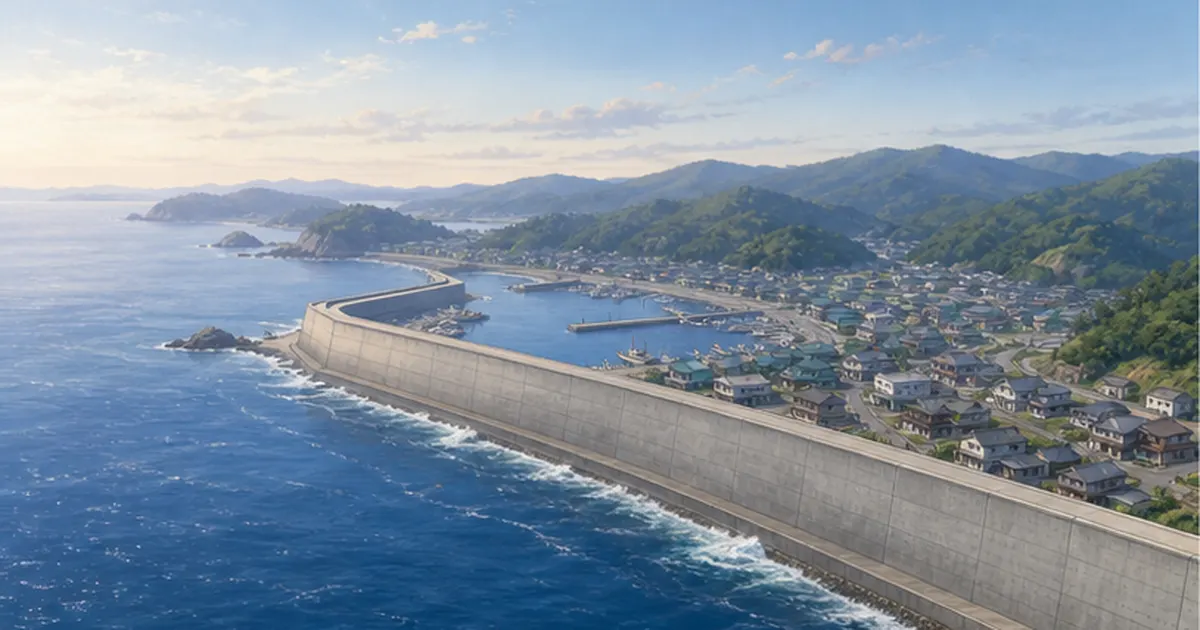
Many affected municipalities pursued reconstruction through a combination of moving residential areas to higher ground and building large-scale seawalls in the former town centers. The debate over the merits of seawalls is discussed in detail in What Do Massive Seawalls Protect, and What Do They Change?
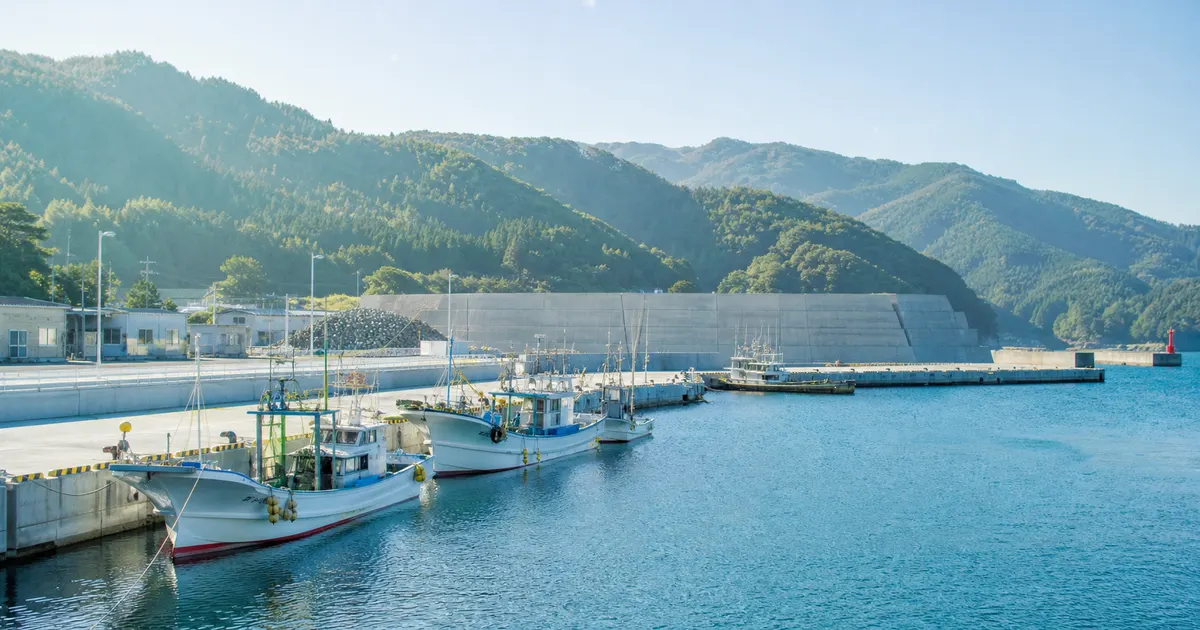
While seawalls reduce the force of a tsunami, they have also raised concerns in various areas: that no longer being able to see the sea in daily life erodes fishery workers' sense of tidal and weather changes, and that it lowers the scenic value of tourist areas. Which consideration takes priority differs by local topography, industrial structure, and the process of building resident consensus, and even along the same Sanriku coast, different municipalities have reached different conclusions.
Why Onagawa chose not to build a seawall
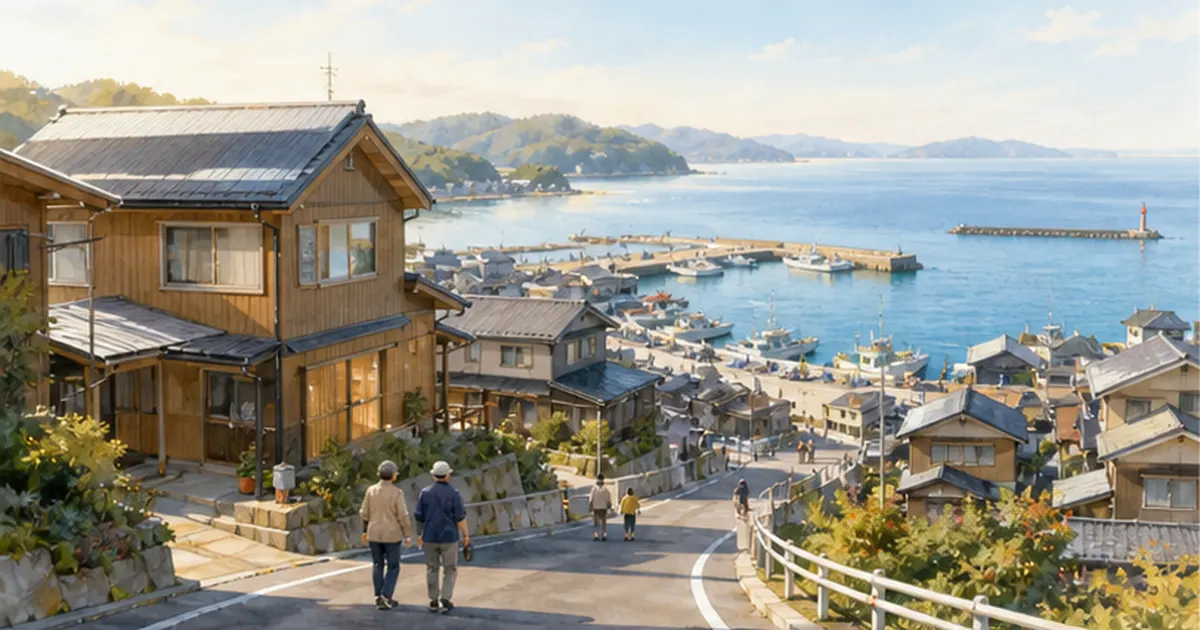
Onagawa, Miyagi Prefecture, is one of the few municipalities that chose not to build a massive seawall blocking the view of the sea from the town. In the town center, maintaining a living space with a view of the sea was made a pillar of reconstruction planning. Immediately after the disaster, the town's chamber of commerce sent the message that "reconstructing the town will take ten or twenty years, and it is the younger generation who will be at the center of that reconstruction," and pursued private-sector-led regeneration.
Onagawa's choice was not to reduce disaster risk to zero, but rather to protect a way of life lived together with the sea by combining evacuation routes and urban-planning ingenuity. This decision also became the foundation for the later efforts to attract newcomers and rebuild the shopping district, discussed below.
Even within the same Kesennuma Bay, there are stretches where large-scale seawall construction was chosen for the urban area, and a decision like Onagawa's—not to build a seawall—did not hold everywhere in the same way. The fact that the choice varies by topography, the scale of past tsunami damage, and the process of building resident consensus itself shows that there is no single correct answer for coastal community regeneration.
What Onagawa's case shows is that maximizing the scale of disaster-prevention infrastructure is not the only correct answer; residents' psychological attachment—whether they feel they want to keep living in that town—is also an important design element of a reconstruction plan. Combined with soft measures such as evacuation routes, evacuation facilities, and regular disaster drills, a form of disaster prevention that does not rely on massive structures can also become a viable option.
See the caseLiving in Onagawa: Voices of People Who Moved In and Started a BusinessVoices of people who moved to and started businesses in Onagawa, a town that chose reconstruction not dependent on a seawall, through its startup support program.🔗 town.onagawa.miyagi.jpRebuilding Livelihoods—The "Hama Revitalization Plan"
Alongside housing reconstruction, the rebuilding of fishing as a livelihood has also proceeded. After the disaster, the Fisheries Agency established a framework for each "hama" (fishing settlement) nationwide to formulate a concrete action plan, and has expanded this beyond disaster recovery into a shared framework for revitalizing fishing communities across the country.
A goal of raising income by 10% in five years
The "Hama Revitalization Plan" is a plan in which each hama organizes income-boosting and cost-cutting measures suited to its circumstances, with the goal of raising local fishery workers' income by 10% or more over five years. Rather than simply increasing the catch, its distinguishing idea is to raise income through a combination of processing, direct sales, tourism, and other approaches; the Fisheries Agency recognizes outstanding efforts with an award each year.
See the programRestoring the Vitality of the Hama (Hama Revitalization Plan)An action plan supported by the Fisheries Agency, formulated by each hama nationwide, aiming to raise fishing income by 10% or more over five years.🔗 jfa.maff.go.jpA distinguishing feature is that these plans are put together not unilaterally by the government but by local fishery workers themselves. In response to the structural challenge of an aging workforce and a shortage of successors, the aim is to increase the number of hama where the next generation feels they "can make a living from this work" by raising profitability.
The structural challenge facing 6,298 fishing settlements nationwide
According to the Fisheries White Paper, there are 6,298 fishing settlements nationwide (settlements of four or more fishing households located at or behind a fishing port or harbor). Of these, about 18% are on remote islands and about 31% are on peninsulas—many are located in geographically disadvantaged areas that are especially exposed to population decline and aging. The population behind fishing ports stood at 1.93 million as of the end of March 2022.
Regardless of whether they were directly affected by the disaster, most of these settlements share a common challenge: a shortage of successors. It is important to view coastal community regeneration not as a problem unique to disaster-affected areas but as an early example of a structural challenge shared by fishing communities nationwide.
The number of people employed in fisheries and aquaculture stood at 123,000 in 2022, down more than 30% over ten years from 180,000 in 2013. On the other hand, the number of new entrants has held steady at around 1,700 per year, and roughly 70% of them are under 39. Even as the absolute number of workers declines, the fact that many people newly choosing fishing are young is one source of hope in rebuilding this livelihood.
The challenge of the Minamisanriku Fisheries Production Cooperative
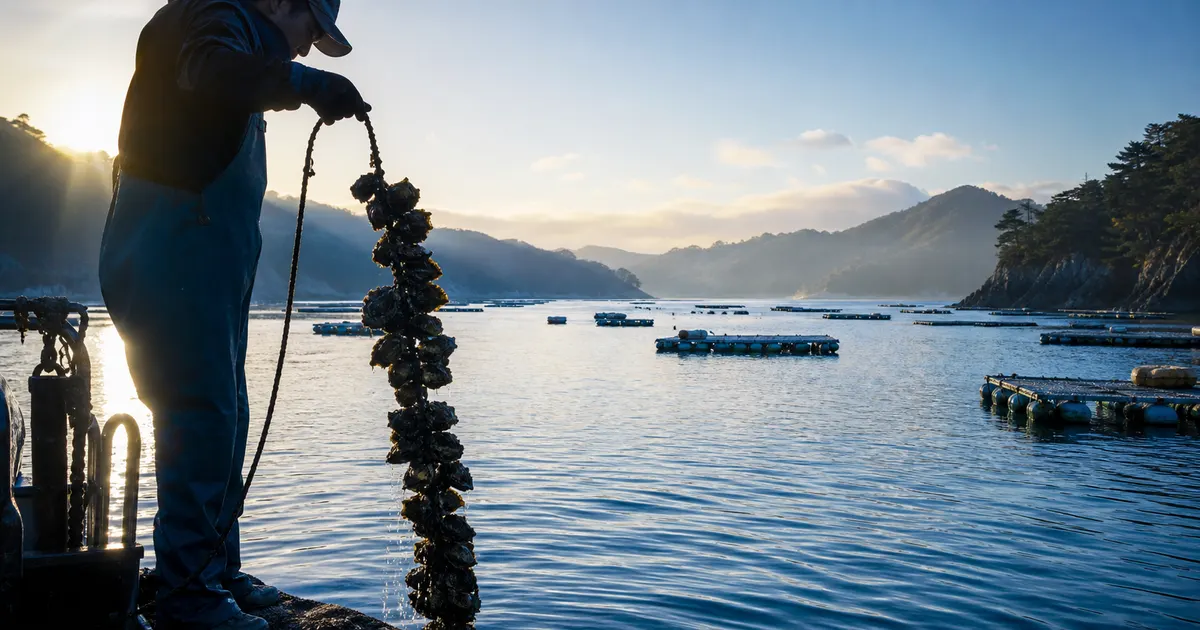
In the Shizugawa district of Minamisanriku, Miyagi Prefecture, fishery workers who had lost most of their boats, gear, and aquaculture facilities in the disaster resolved to "do something bold to survive by the sea," and launched a new jointly capitalized organization, the Minamisanriku Fisheries Production Cooperative. Distinct from the framework of a conventional fisheries cooperative, it adopted a management style closer to that of a company—distributing profits according to work performed and even introducing time cards.
This case, in which a hama previously centered on individually run operations took the step of moving to a jointly managed structure, shows that rebuilding a livelihood is not simply a matter of "restoring what was," but can also mean redesigning the organization itself so the business can be sustained even as the number of workers declines. In Shizugawa Bay, town planning centered on coexistence with nature has continued since the disaster, and in 2018 the diversity of its seagrass and seaweed beds was recognized and the bay was registered as a Ramsar wetland.
Women's Participation Is Changing Fishing Communities
An essential part of the story of fishing community regeneration is the role of women. Looking only at operations at sea, the presence of women in fisheries can be easy to overlook—but broadening the view to the processes after the catch is landed changes the picture considerably.
What the numbers 11%, 36%, and 60% mean
According to the Fisheries White Paper (FY2023 edition), women make up only about 11% of fishery workers overall, but about 36% of those doing onshore work after landing—such as sorting the catch and shucking oysters—and as much as about 60% of workers in seafood processing. It is not only operations at sea; much of the value-adding work that happens after the catch is landed is supported by women's labor.
This structure is also suggestive when thinking about income-boosting measures for fishing communities. Much of the labor behind the income growth that the "Hama Revitalization Plan" seeks through processing and direct sales is, in substance, carried out by women, so creating an environment where women can work comfortably and are fairly recognized directly connects to raising the earning power of the hama as a whole.
The spread of national exchange gatherings for young and women fishers
The Fisheries Agency and fishery cooperatives nationwide support activities in which groups of young and women fishery workers take on product development and local promotion. At the "National Exchange Gathering for Young and Women Fishery Workers," such efforts are recognized with awards and shared as models for expansion to other regions. Cases in which women's divisions of fishery cooperatives lead product development and manage direct-sale outlets have also accumulated as outstanding examples of fishing community revitalization around the country.
As a concrete example, the Women's Division of the Uoshima Fisheries Cooperative in Kamijima Town, Ehime Prefecture, began activities with eight members in 2015 at the cooperative's request, working on product development using seafood and local promotion. Under the motto "let's do our best to the limit," it has continued its activities and has been introduced as an award-winning example by the Fisheries Agency. It is one example of how, even starting from a small group, women have taken on the role of conveying a hama's existence beyond the local area through product development and information sharing.
Such activities go beyond one-off events; they also have the effect of broadening the opportunities for young people and women to be involved in running fishery cooperatives and in local decision-making. Diversifying the range of people recognized as leaders also affects how open a fishing community appears from the outside, lowering the psychological hurdle for people considering moving there or taking up fishing.
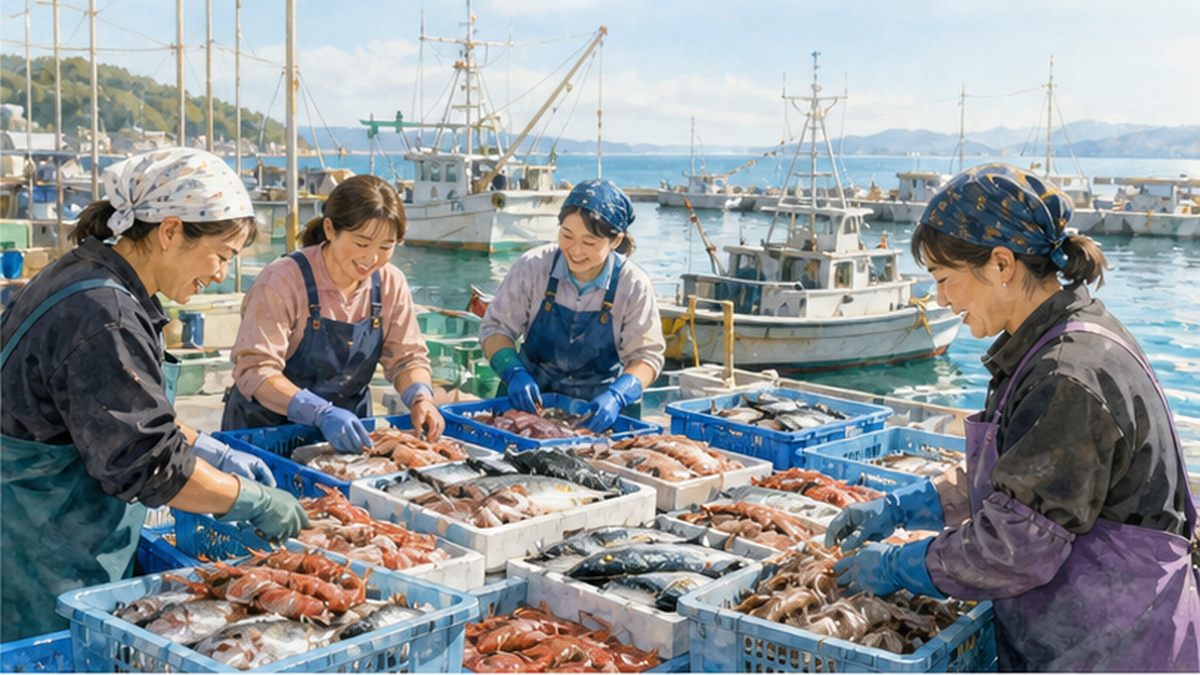
Women's participation matters not only in statistical terms as labor, but also because it brings a diversity of perspectives into decision-making at fishery cooperatives and in local management. Activities that increase points of contact with the outside world through product development and running direct-sale outlets end up strengthening a hama's ability to communicate about itself, which in turn makes it more "approachable" for potential successors and newcomers.
Supporting Young People's Settlement and Startups—Onagawa's "Serious Startup Program"
Stopping population decline also requires mechanisms for bringing in new people from outside as the next generation of leaders. Onagawa has repeatedly been cited as a leading example of this since the disaster.
Why newcomers choose to start businesses there
Onagawa's startup support program, the "Serious Startup Program," provides hands-on support to help prospective newcomers and young local business owners refine their business plans and turn them into actual openings. There are examples of people who developed ties to the Sanriku coast—say, through activities supporting the education of children orphaned by the disaster—and then chose to base their startup in Onagawa, and the program has achieved some success in helping outside talent put down roots.
A distinctive feature of the program is that it goes beyond simply introducing subsidies or vacant storefronts—senior business owners from the local industry sector are involved as mentors. A support system is in place to help people from outside the area launch businesses while understanding local business customs and relationships.
In the 2020 national census, Onagawa's population rose by 98 compared with the previous census five years earlier, drawing attention as one of the few disaster-affected municipalities to record a population increase. This came against the backdrop of the completion of all disaster public housing (March 2018) and the completion of housing-lot supply (February 2019), after which population decline from out-migration settled down to roughly pre-disaster levels. Taking the longer view, however, the population, which stood at about 10,014 before the disaster, is estimated at about 5,831 as of July 2026—a decline of roughly 34% from pre-disaster levels that has continued. Onagawa's real picture is one in which signs of population recovery and a long-term declining trend exist side by side.
The idea of a "sustainable shopping street"
Onagawa's private-sector-led town-planning organization brought together more than 40 leaders from the chamber of commerce, the tourism association, the fish market buyers' cooperative, the innkeepers' association, and other groups immediately after the disaster, and has pursued regeneration under the mottoes "we won't become a street of shuttered storefronts" and "a sustainable shopping street." The fact that it was the local industry sector itself, rather than the administration, that drew up the vision for reconstruction has also helped attract young people and newcomers since.
Key points of Onagawa's approach
- Maintained a townscape with a sea view by not building a massive seawall
- The chamber of commerce, tourism association, fishery cooperative, and other parts of the local industry sector took the lead in drawing up the regeneration plan
- The "Serious Startup Program" provides hands-on support for newcomers and young people opening businesses
- Clearly positioned "the younger generation" as the protagonists of reconstruction
Fisherman Japan, a model for supporting new fishery workers
Fisherman Japan, a general incorporated association based in Ishinomaki, Miyagi Prefecture, launched in July 2014. Centered on the "TRITON PROJECT" started by young fishery workers after the disaster, it continues efforts to connect people interested in fishing with the field. It offers not only pre-employment experience programs, site visits, and matching, but also ongoing support after employment—running shared houses and holding regular check-ins—that covers daily life as well as work. With a goal of increasing the number of people working in the new occupation of "fisherman" in Sanriku by 1,000, it is building a system to welcome outside talent as leaders in the fishing industry itself.
Where Onagawa's startup support targets entrepreneurs and business owners, Fisherman Japan works to widen the base of fishery workers themselves. Providing multiple entry points—relocation, entrepreneurship, and employment—functions effectively to attract outside talent to coastal communities.
Umigyo: A New Approach
Alongside rebuilding the fishing industry itself, an idea that has drawn attention in recent years is "umigyo" (literally, "sea business"). It refers to efforts that make use of the value of local resources held by fishing ports and communities, in combination with industries beyond fishing itself.
Turning fishing ports into hubs for exchange
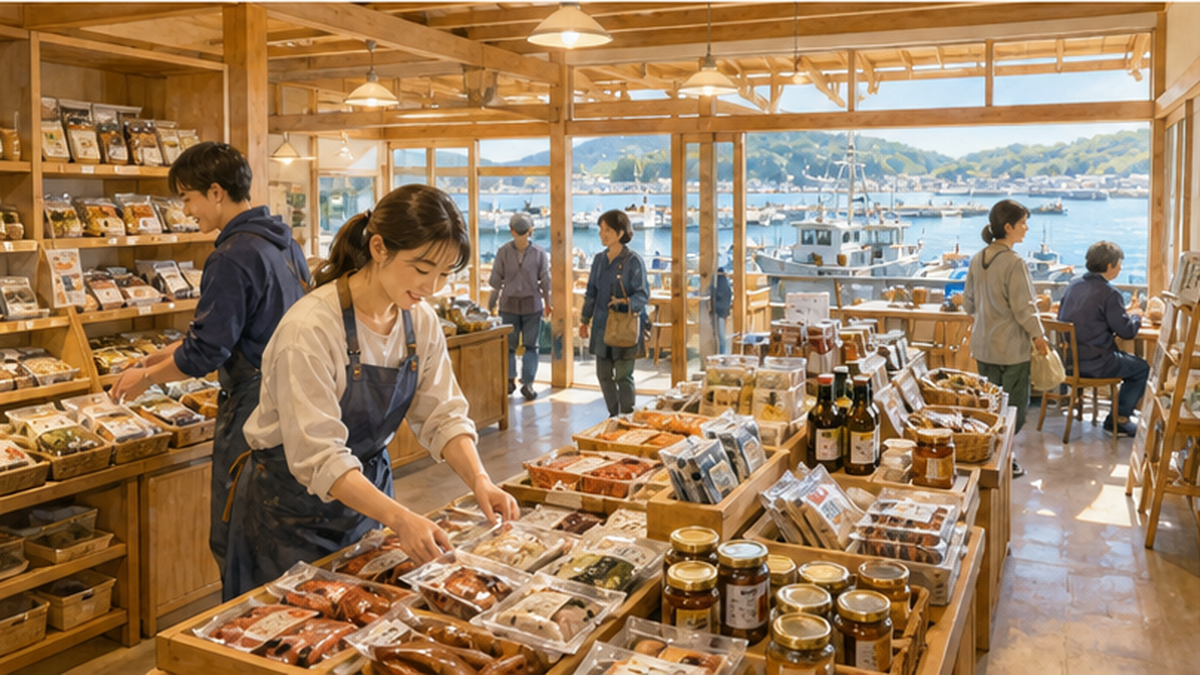
The Fisheries Agency has established an "umigyo support package" and a consultation desk, and is advancing institutional arrangements that allow long-term leasing of fishing port facilities and long-term use of water areas. At Toya Fishing Port in Yomitan Village, Okinawa Prefecture, an aging seafood-handling facility was converted into a complex including a cafeteria and direct-sales shop, which opened in 2017. This kind of move—turning fishing ports into hubs for both livelihood and exchange—is spreading in areas around the country, especially remote islands and peninsulas. For efforts to build exchange populations through fishing experiences and disaster-heritage sites, see also What Is Reconstruction Tourism That Makes Use of the Sea?
A distinguishing feature of the umigyo concept is that it is not meant to be completed by fishery workers alone; it also makes it easier to involve businesses from other sectors—food service, lodging, tourism—and young entrepreneurs from outside the area. Regulatory reforms that allow more flexible use of fishing ports, a limited kind of public space, have helped drive this cross-sector collaboration.
In December 2022, the Fisheries Agency announced the "Umigyo Support Package," clarifying procedures for using fishing port facilities and putting in place a system for cross-referencing subsidy programs from relevant ministries and agencies. The accompanying "Public-Private Umigyo Promotion Portal" introduces real examples of private businesses developing and operating public fishing port facilities, along with the process behind the matching and the procedural flow. As both the institutional framework and real examples are made public, an environment that is easier for other regions to reference is taking shape.
Leading regions honored in the FY2025 award for outstanding cases
Each year, the Fisheries Agency selects and announces model districts nationwide through the "Hama Revitalization Plan Award for Outstanding Cases." In the FY2025 awards, announced in March 2026, hama efforts that achieved both higher fishing income and local revitalization were selected, and there is a growing tendency for comprehensive efforts that include umigyo to be recognized.
A common feature of the award-winning cases is that they are designed not around a single measure, but by combining multiple elements: raising income, securing successors, and exchange with people from outside the area. These leading examples show that regenerating coastal communities cannot be achieved through disaster-prevention infrastructure alone.
Rebuilding Connections—A Social Capital Perspective
Regenerating coastal communities has aspects that cannot be measured by buildings or income figures alone. Research on the disaster has repeatedly pointed to the erosion of social capital—the bonds among people—in affected areas, and to rebuilding it as a long-term challenge.
The erosion and rebuilding of social capital
Moving from temporary housing to disaster public housing and then to a relocation site on higher ground—often more than once—tends to fracture the face-to-face relationships among residents. In fishing communities, connections through the fishery cooperative, festivals, and cooperative work had originally been integrated with livelihood itself, so there is a risk that these very relationships become diluted when people's places of residence move.
For elderly fishery workers in particular, the effect of physically severing, through relocation, the tacit knowledge of fishing grounds built up over many years and the mutual-aid arrangements among neighbors is far from small. Through the experience of the disaster, the importance of building consideration for these relationships into planning from the stage of scheduling hard infrastructure work has come to be widely recognized.
Supporting the rebuilding of these relationships in a visible way were the "Minna no Ie" ("Home for Everyone") gathering places built in disaster-affected areas. The "Minna no Ie" in Rikuzentakata, Iwate Prefecture, designed by the architect Toyo Ito and others, used 19 cedar logs—left standing dead by tsunami salt damage—as pillars, and was built as a place where residents living in temporary housing could gather easily. This effort, in which volunteer architects collaborated on similar buildings in Sendai, Kamaishi, Higashimatsushima, and elsewhere, won the Golden Lion at the 2012 Venice Biennale of Architecture, demonstrating both in Japan and abroad the importance of "places to gather"—something easily lost in the shadow of hard reconstruction.
Passing on the "life of the shore" to the next generation
New efforts such as the participation of women and young people and umigyo function not merely as economic measures, but also as means of passing on to the next generation the human connections that sustain life in fishing communities. Both the hands-on support that welcomes newcomers and the continued activity of women's divisions of fishery cooperatives rest on the same common foundation: the rebuilding of relationships.
Three key perspectives for regeneration
- Rebuild not only livelihoods (income) but also the human connections among people, at the same time
- Support the participation of leaders who have not previously been prominent, such as women and young people
- Combine fishing with other industries (tourism, food service, exchange) to make the fishing port an "open place"
What the "Minna no Ie" effort showed is that rebuilding the physical vessel of housing and rebuilding a place where people gather and talk do not necessarily proceed at the same pace. When thinking about regenerating coastal communities, the question of when and how to prepare places where people connect—separate from the schedule for rebuilding housing and infrastructure—cannot be left out.
Lessons Shared by Coastal Community Regeneration Around the World and in Japan
The challenges of coastal depopulation and relocation to higher ground are not unique to areas affected by the Great East Japan Earthquake. As sea-level rise and storm-surge risk increase with climate change, coastal communities around the world are expected to face similar choices—relocate, or stay—with increasing frequency going forward.
Coastal relocation in the age of climate change
On Isle de Jean Charles, an island in the U.S. state of Louisiana, the federal government committed $48.3 million in grants in 2016 to relocate 37 households that had made their living from fishing and shrimping, in a planned resettlement. This is considered the first case in the United States of a community relocation, on grounds of climate change, fully funded by the federal government. The new site is a town called Gray, about 65 km from the original settlement, and debate continues over the quality of the new foundation for daily life and the extent to which residents' wishes were reflected.
In the Pacific island nation of Fiji, the coastal settlement of Vunidogoloa, which had repeatedly suffered damage from sea-level rise and storm surges, relocated to higher inland ground in 2014. The new village was named "Kenani," after the biblical "promised land," and 30 houses were built about 2 km from the original settlement. The total cost of the move was $980,000, and drawing on this case as a lesson, the Fijian government has listed more than 80 settlements that may need to relocate in the future.
| Case | Timing | Scale | Characteristics |
|---|---|---|---|
| Japan (Group Relocation Promotion Project) | From 2011 | Numerous districts across three affected prefectures | Relocation to higher ground within existing municipalities, combined with seawalls |
| United States, Isle de Jean Charles | From 2016 | 37 households | The first case of an entire community relocation fully funded by the federal government |
| Fiji, Vunidogoloa | 2014 | 30 households | Domestic relocation to higher ground; the Fijian government anticipates 80 more settlements |
What these three cases—differing in scale and institutional framework—share is the difficulty of moving an entire community's foundation for daily life, livelihood, and human relationships to a new place, even where the relocation itself is technically achievable. The challenges that surfaced in Japan's relocation to higher ground—delayed construction, disrupted livelihoods, and a population shortfall—are increasingly being referenced internationally as risks that coastal relocation in the age of climate change commonly faces, regardless of scale.
Japan's experience with relocation to higher ground shows that, alongside its disaster-prevention benefits, it also carries side effects such as disrupted livelihoods and fractured communities. This lesson can also be useful for coastal communities in other countries that may consider relocation because of climate change going forward. It will be necessary to build into the design, from the very start and alongside hard infrastructure work, how to rebuild livelihoods and human connections.
As storm-surge and coastal-flooding risk grows with climate change, more regions around the world will be forced to make this "relocate, or stay" decision going forward. Planning disaster-prevention infrastructure and the process of community regeneration together, rather than separately, will become even more important.
Keeping the option of living by the sea
Efforts such as the "Hama Revitalization Plan" and umigyo can be described as laying the groundwork for fishing communities to keep being chosen as places to live together with the sea, rather than being seen simply as disaster-affected or depopulating areas. The statistical decline in population will not easily reverse, but the accumulation of efforts to widen the circle of people carrying on livelihoods and participation can help preserve, for the next generation, the option of "living by the sea."
Summary
- Even once relocation to higher ground is complete, the recovery of people remains a separate problem, as shown by the 14.9% population decline
- The rebuilding of livelihoods, centered on raising income, is being pursued through efforts such as the "Hama Revitalization Plan"
- Women account for a high share of onshore work and processing, and expanding their participation directly boosts the earning power of a hama as a whole
- As in Onagawa's case, a choice not dependent on seawalls and the proactive participation of young people and newcomers work together as two wheels of the same cart
- Collaboration with industries beyond fishing, such as umigyo, is turning fishing communities into "open places"
References & Sources
- Cabinet Office, Disaster Management – The State of Reconstruction from the Great East Japan Earthquake
- Cabinet Office, Disaster Management – The State of Population (Disaster Management White Paper)
- Fisheries Agency – Restoring the Vitality of the Hama (Hama Revitalization Plan)
- Fisheries Agency – FY2025 Hama Revitalization Plan Award for Outstanding Cases
- Fisheries Agency – Trends Among Fishery Workers (FY2023 Fisheries White Paper)
- Fisheries Agency – The Current State and Role of Fishing Communities
- Fisheries Agency – Feature: Revitalizing Fishing Communities Through Umigyo
- Onagawa Town – Living in Onagawa: Voices of People Who Moved In and Started a Business
- Nikkei – Great East Japan Earthquake: Residents Relocate to Higher Ground, Vacant Lots Remain in Former Town Centers
- Urban Renaissance Agency (UR) – Progress of Minamisanriku's Reconstruction Projects
- State of Louisiana – Isle de Jean Charles Resettlement Project
- The Conversation – Climate change forced these Fijian communities to move
- Nikkei – "Minna no Ie" Gathering Place for Survivors to Be Built in Rikuzentakata
- Ministry of Agriculture, Forestry and Fisheries – Statistics on Fisheries Labor
- Fisherman Japan – TRITON PROJECT
* Listed in order of reliability: government/academic institutions > peer-reviewed papers > specialized organizations > trusted media