⚡ In short
From sashimi to frozen fish, everything on our tables has been kept continuously cold on its journey to us. That cooling consumes enormous amounts of electricity, and the refrigerants involved can carry thousands of times the greenhouse effect of CO2. This article gently explains how to decarbonize the seafood cold chain through the shift to natural refrigerants, energy-efficient freezers, and reductions in food mileage and food loss.
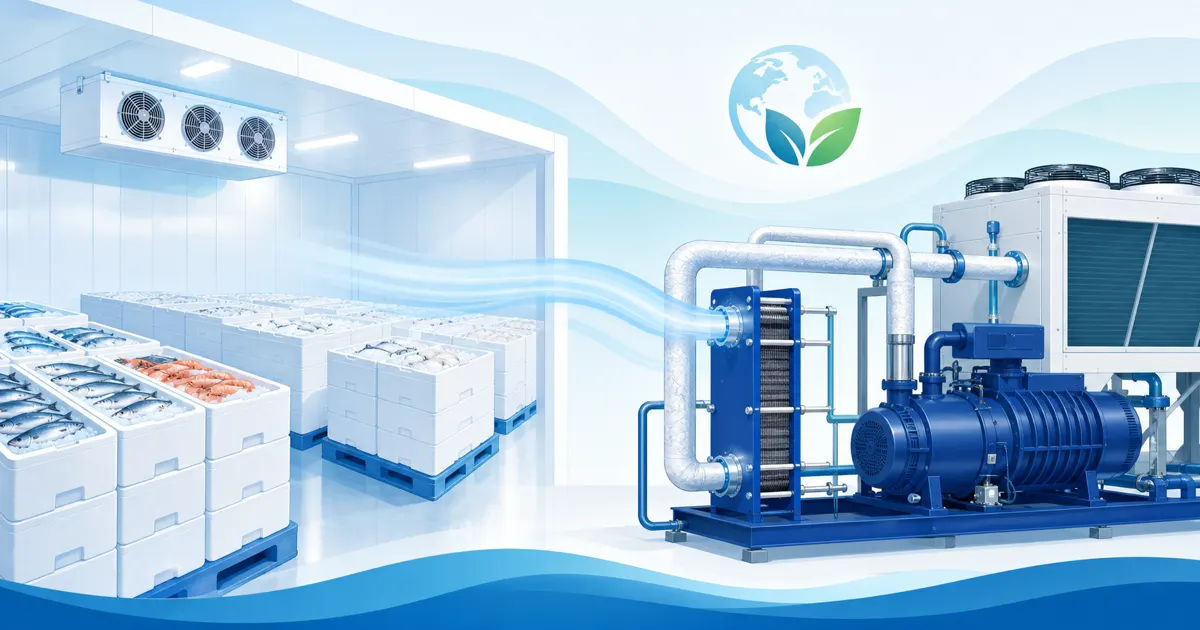
The sashimi lined up at the supermarket's fresh fish counter, the shrimp and squid in the freezer case, the pieces on a conveyor-belt sushi counter — all of it is kept continuously cold from the moment it is landed until it reaches our mouths, without ever being allowed to warm up. This "unbroken chain of low temperature" is called the cold chain. It is the unsung backbone supporting freshness and food safety, but behind the scenes it consumes far more electricity than most of us imagine, quietly leaking invisible greenhouse gases the whole time.
In frozen and refrigerated warehouses, fully 70 to 90 percent of the electricity consumed comes from freezing equipment. What's more, much of the "refrigerant" that carries heat inside those freezers is HFC (hydrofluorocarbon), a fluorocarbon gas with a greenhouse effect thousands of times that of CO2. The more we cool fish, the more electricity we use, and if that electricity comes from fossil fuels, it produces carbon dioxide. And if the fluorocarbon itself leaks from the equipment, it becomes a powerful warming gas in its own right — in this double sense, the cold chain is a major front line in the fight to decarbonize.
This article first untangles why the seafood cold chain consumes so much energy, then lays out, in plain terms, three angles for cutting that cooling electricity and its emissions: the shift to natural refrigerants, energy-efficient freezers, and reductions in food mileage and food loss. Drawing on primary sources from the Ministry of the Environment, the Fisheries Agency, the Ministry of Agriculture, Forestry and Fisheries, and the FAO, we want to take a fresh look at the connection between our dinner tables and the planet.
What you'll learn in this article
- How much electricity is used to "keep seafood cold" across warehouses, factories, and stores
- That HFC fluorocarbons used as refrigerants are powerful greenhouse gases, thousands of times stronger than CO2
- Why the shift to natural refrigerants such as CO2, ammonia, air, and water is gaining momentum
- Practical energy-saving know-how, from adjusting set temperatures to strengthening insulation
- How reducing food mileage and food loss also decarbonizes by cutting the cooling electricity itself
- What familiar retailers such as AEON and Lawson are actually doing to phase out fluorocarbons and decarbonize
Why the Seafood Cold Chain Uses So Much Electricity
A cold chain is a logistics system that keeps fresh food, frozen food, pharmaceuticals, and similar goods at a constant low temperature as they travel from the place of production to the consumer. In Japanese it is also called "low-temperature logistics." Seafood in particular spoils easily — even a slight rise in temperature lets bacteria multiply and freshness and flavor deteriorate rapidly. That is precisely why the work of "keeping things cold" never stops at any stage: landing, processing, storage, transport, and retail.
The problem is that this act of "continuous cooling" is inherently energy-intensive. Cooling means continuously pumping heat out of an enclosed space — heat given off by the fish itself, heat leaking in from the outside air, heat that enters when a door opens, heat brought in by people and machinery. To carry all of that heat away, freezers must keep running day and night without stopping. On hot summer days the temperature difference with the outside air grows larger, so even more heat must be pumped out, and electricity consumption swells further.
What "Keeping Things Cold" Really Means in Energy Terms
We may be conscious of our own refrigerator's electricity bill, but we rarely think about the enormous refrigeration and freezing infrastructure that supports society as a whole. Yet the seafood cold chain is made up of a vast chain of cooling equipment: it begins at the ice-making and ice-storage facilities of fishing ports, continues through frozen-processing factories, commercial cold storage warehouses, refrigerated trucks and containers used for transport, and finally reaches the frozen display cases at the supermarket. If the temperature rises at even one link in that chain, the chain breaks, and food loss follows.
The perspective of this article
- The electricity used to keep seafood cold is large in "volume" (a target for energy efficiency)
- Fluorocarbon refrigerants are powerful greenhouse gases if they leak (a target for phasing out fluorocarbons)
- The farther seafood travels and the longer it is stored, the greater the cooling burden (a target for reducing food mileage and food loss)
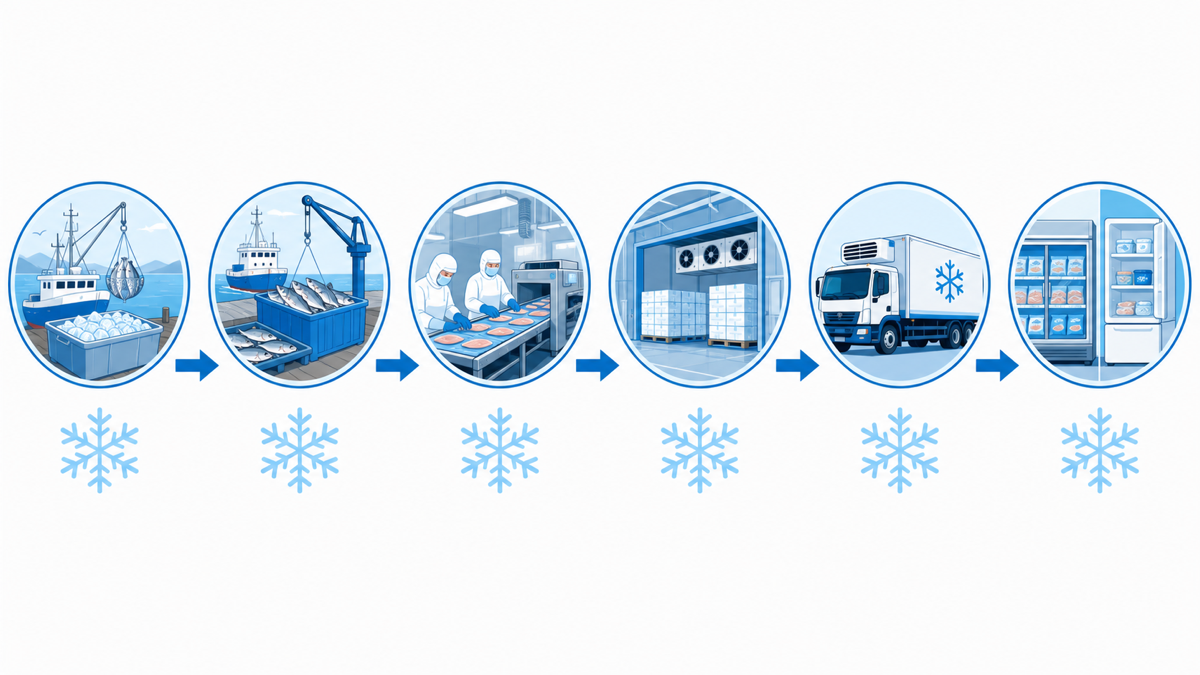
When people think of ocean environmental problems, overfishing, plastic waste, and coral bleaching may come to mind first. But "how fish is cooled and transported" is every bit as directly tied to the sustainability of the ocean and our food supply. We touch on sustainable fisheries and sourcing in our article on sustainable sourcing by a major seafood company, but the energy used in the logistics that deliver the fish we catch is also a major piece of the decarbonization puzzle.
Japan is one of the world's leading seafood-consuming nations, with a food culture deeply rooted in eating fish "raw" or "frozen," as in sashimi and sushi. Unlike ingredients meant to be cooked, enjoying raw fish safely requires strict low-temperature management that never lets the temperature rise from the moment it is landed. In other words, Japan's rich fish-eating culture is supported by a cold chain that is, by global standards, extremely sophisticated and energy-intensive. In exchange for convenience, we are unknowingly using vast amounts of energy for cooling.
What's more, freezing equipment never stops — 24 hours a day, 365 days a year, including the dead of night when stores and factories are closed. Even while people sleep, even during the New Year holidays, freezers quietly keep pumping heat out to protect the fish inside. This inability to ever shut down is the fundamental reason the cold chain's energy consumption is so large. That is exactly why even small efficiency gains add up to substantial reductions over time.
In the sections that follow, we will first confirm with concrete numbers where and how much of this "cooling electricity" is used, then get to the bottom of what refrigerants — an invisible greenhouse gas — really are. After that, we will look, in order, at concrete steps for reducing cooling electricity and emissions: the shift to natural refrigerants, energy efficiency, food mileage, and food loss.
The Energy Structure of Continuous Cooling, in Numbers
Being told that "refrigeration and freezing consume a lot of electricity" doesn't always feel concrete. So let's look, site by site along the cold chain, at how much of the electricity used actually goes toward cooling. The figures cited here reflect levels documented by sources such as the Agency for Natural Resources and Energy, the Ministry of the Environment, and the Institute of Energy Economics, Japan.
Freezing Equipment Uses 70-90% of Electricity in Cold Storage Warehouses
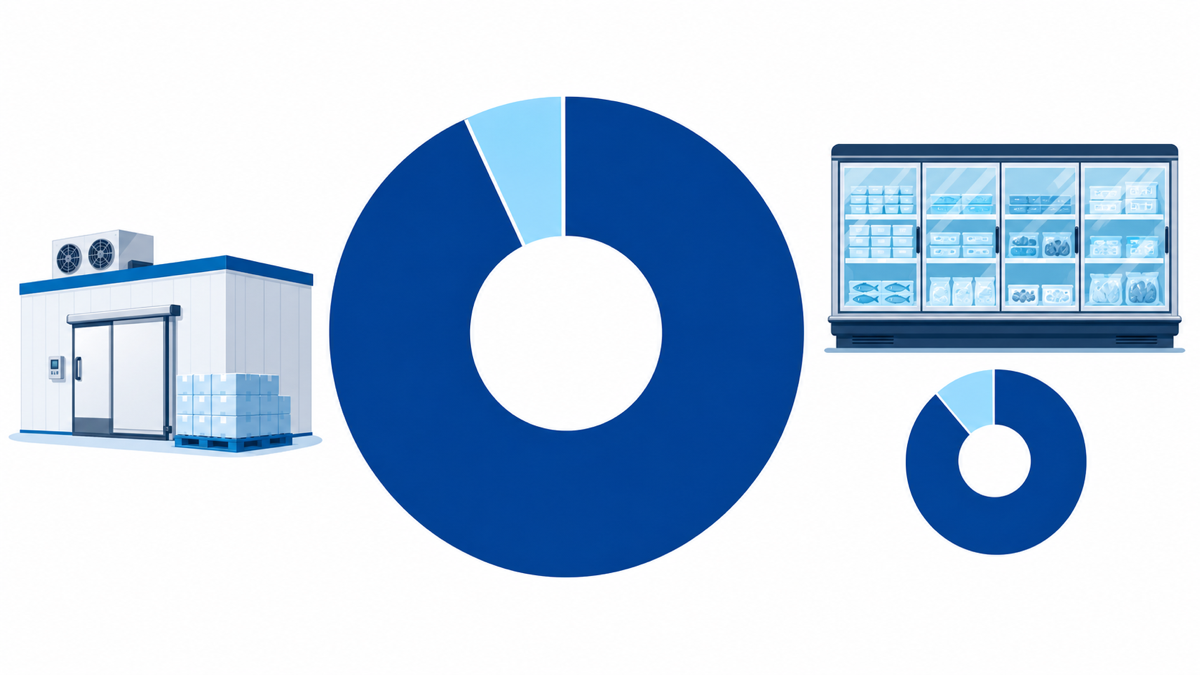
At commercial cold storage warehouses — the storage bases for seafood — roughly 70 to 90 percent of the facility's total electricity consumption comes from freezing equipment. Lighting and office air conditioning make up only a small fraction; the great majority is spent on "continuously keeping the interior cold." Freezer warehouses maintain roughly -20°C, and ultra-low-temperature warehouses may keep tuna and similar products below -50°C — and the larger the temperature difference with the outside air, the more the burden on the freezing equipment spikes.
Cooling Is the Main Act at Food Factories and Supermarkets Too
It is not unusual for food manufacturing plants that process seafood to have freezing and refrigeration equipment account for close to 80 percent of total energy use. The picture is the same at the retail level: at food supermarkets, refrigerated and frozen display cases account for more than 60 percent of electricity consumption, with sales-floor lighting at about 25 percent and air conditioning at about 13 percent. The chilled cases displaying fish and frozen food are, in fact, the equipment that uses the most electricity in the whole store.
| Site | Approximate share of electricity used by cooling equipment | Example temperature ranges maintained |
|---|---|---|
| Cold storage warehouse | About 70-90% | Refrigerated 0-10°C / Frozen around -20°C / Ultra-low below -50°C |
| Food manufacturing (processing) plant | Cases reaching close to 80% | Minus tens of degrees Celsius for processing and rapid freezing |
| Food supermarket (retail) | Over 60% at display cases | Open refrigerated and frozen cases |
A structure worth remembering
The standard approach to decarbonizing the cold chain is to target the cooling equipment that uses the most electricity first. Whether in a warehouse, factory, or store, improving the efficiency of freezing equipment has the largest impact on overall reductions.
Don't Forget Ice-Making and Ice Storage at Fishing Ports
There is also significant cooling demand at fishing ports, where the cold chain begins. The ice-making facilities that pack landed fish in ice, and the ice-storage facilities that hold that ice, are among the equipment that consumes the most electricity in fishing communities. "Pre-cooling" freshly caught fish quickly, and cooling on board the vessel, are also important steps that affect freshness, and they too consume energy. When you add up energy use at every stage between the catch and our mouths, the total is far from small.
Much of this electricity in Japan is still backed by fossil-fuel-based thermal power generation. So reducing the electricity used for cooling not only saves on electricity bills, it directly cuts the CO2 emissions associated with power generation. In recent years, an increasing number of warehouses and stores have installed solar panels on their roofs to cover daytime cooling electricity with self-generated power, and combining energy efficiency with renewable energy has become a practical path to decarbonization.
In other words, if we want to cut emissions from the seafood cold chain, the surest routes are improving the efficiency of freezing equipment and reducing the electricity that equipment uses in the first place. But before we go further into the "volume" of energy, there is another issue we cannot afford to overlook: the "refrigerant" substance itself, which carries heat inside the freezer, is a powerful greenhouse gas.
The True Identity of Refrigerants — Invisible Greenhouse Gases
Inside freezers and air conditioners, a substance called "refrigerant" circulates, changing between liquid and gas, to pump heat out of the enclosed space. It is the heart of the cooling mechanism, and for a long time, fluorocarbons have been the refrigerant of choice. Fluorocarbons cool well and are easy to handle, but they have carried two serious environmental problems.
From Ozone Depletion to Warming: How the Problem Shifted
Early fluorocarbons — CFCs (chlorofluorocarbons) and HCFCs (hydrochlorofluorocarbons) — were found to destroy the ozone layer in the atmosphere, and were regulated worldwide under the 1987 Montreal Protocol. HFCs (hydrofluorocarbons), which do not damage the ozone layer, spread widely to replace them. But HFCs had another side. While they don't destroy the ozone layer, they turned out to be an extremely powerful greenhouse gas.
GWP — A Yardstick for How Many Times Stronger Than CO2
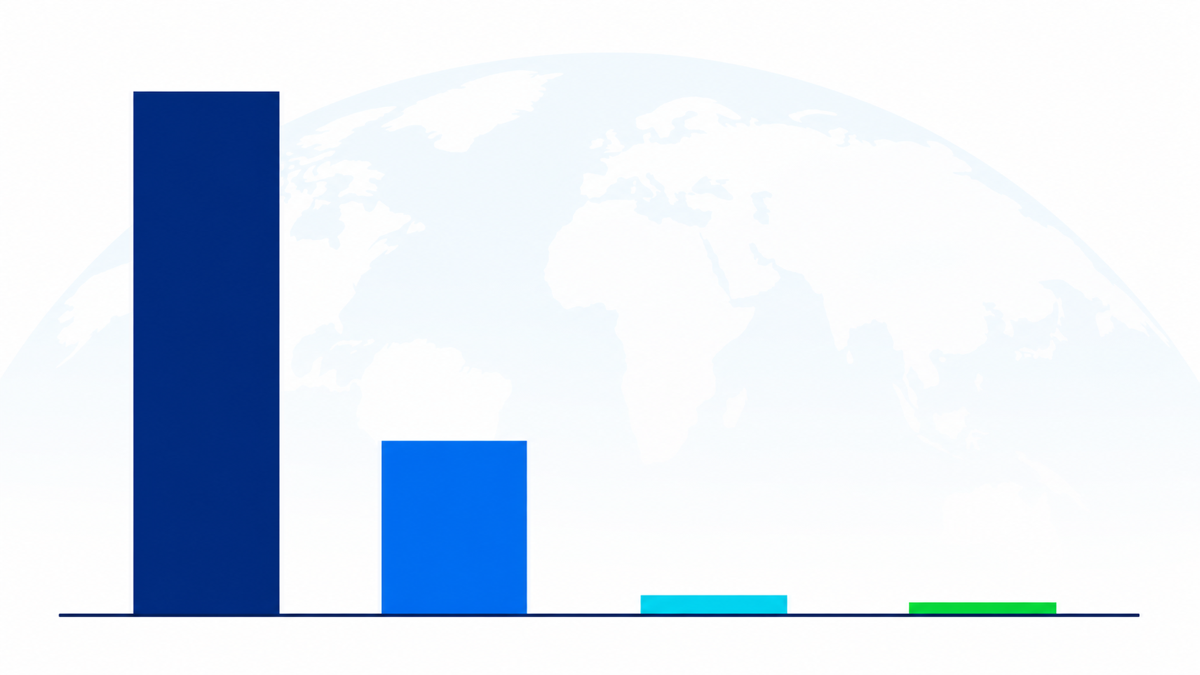
To compare the strength of a greenhouse effect, we use an indicator called GWP (Global Warming Potential). It shows, for an equal mass, how much more strongly a substance warms the atmosphere compared to CO2, which is set to 1. R404A, an HFC widely used in freezers, has a GWP of about 3,920, while R134a, used in household air conditioners and elsewhere, is about 1,430. In other words, if 1 kg of R404A leaks, it has roughly the same warming impact as about 3.9 tons of CO2. Invisible and odorless, refrigerant leaks are quietly shaking the climate.
| Refrigerant | Type | GWP (CO2 = 1) | Characteristics |
|---|---|---|---|
| R404A | HFC | About 3,920 | Widely used in freezing/refrigeration. A powerful warming gas if it leaks |
| R134a | HFC | About 1,430 | Widely used in refrigeration, air conditioning, etc. |
| CO2 (R744) | Natural refrigerant | 1 | Carbon dioxide itself. Non-flammable, low toxicity |
| Ammonia (R717) | Natural refrigerant | 0 (less than 1) | High freezing efficiency. Requires care for toxicity and flammability |
The greenhouse effect of refrigerants accumulates not only from leaks when equipment breaks down or is disposed of, but also from small leaks that build up during ordinary use. In Japan, the Act on Rational Use and Proper Management of Fluorocarbons requires periodic inspection and proper recovery of refrigerants from commercial equipment, but even so, emissions into the atmosphere cannot be reduced to zero. That is exactly why the idea of "switching to refrigerants that have almost no greenhouse effect in the first place" matters so much. That's the natural refrigerants we look at in the next section.
A point that is often overlooked
Cooling electricity (indirect emissions) is not the only warming factor in the cold chain — refrigerant leaks (direct emissions) matter too. Energy efficiency and phasing out fluorocarbons are two wheels that both matter equally.
Japan's Fluorocarbon Regulations and Reduction Targets
Under the Act on Rational Use and Proper Management of Fluorocarbons, which took effect in Japan in 2015, businesses using commercial air conditioners and refrigeration/freezing equipment are required to conduct periodic inspections, manage leak volumes, and properly recover refrigerant when equipment is disposed of. Releasing refrigerant into the atmosphere is prohibited by law, with penalties for violations. Even so, it is difficult to completely eliminate leaks caused by aging equipment or poor maintenance. Globally too, refrigerant leaks continue to have a non-negligible impact on climate change.
Against this backdrop, the Japanese government's Plan for Global Warming Countermeasures, adopted by Cabinet decision in 2021, set a target of significantly reducing HFC emissions by 2030 compared with 2013 levels. What is needed is not only "defensive" measures such as thorough recovery and inspection, but also an "offensive" shift to equipment that doesn't use high-GWP refrigerants in the first place. Natural refrigerants, which we look at in detail in the next section, are expected to fill that role.
The Shift to Natural Refrigerants — CO2, Ammonia, Air, and Water
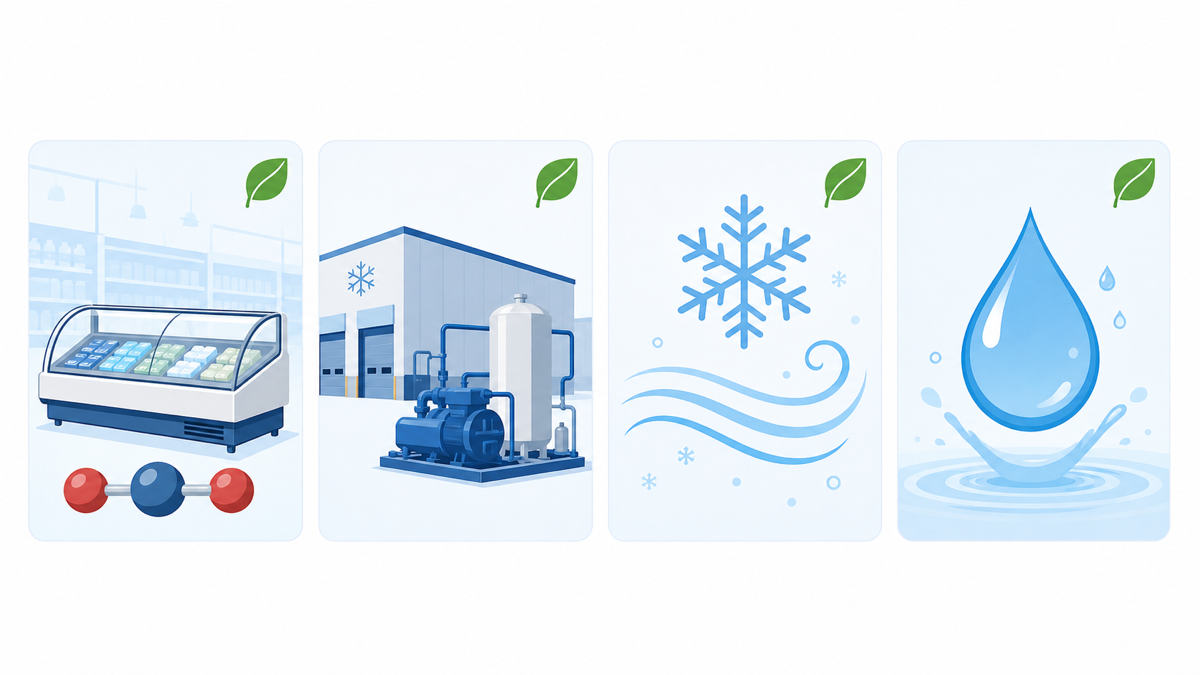
As the name suggests, natural refrigerants use substances that already exist in nature as refrigerants. The representative examples are carbon dioxide (CO2), ammonia, and air and water. All of them have an extremely small greenhouse effect and carry almost none of the ozone-depletion or warming risk that fluorocarbons do. The Ministry of the Environment, too, is promoting the spread of energy-efficient equipment that uses these natural refrigerants as one of its priority national policies.
CO2 Refrigerant (R744) — The Star of Everyday Stores
CO2 refrigerant uses carbon dioxide itself as the refrigerant. Its GWP is 1 — since it is itself the reference substance for global warming, it cannot get any lower than that. It is non-flammable and low in toxicity, and its adoption in the refrigerated and frozen display cases of convenience stores and supermarkets is advancing rapidly. Withstanding high pressure used to be a technical challenge, but the development of dedicated freezers and heat pumps has lowered that hurdle, and CO2 refrigerant has now become the star of fluorocarbon phase-out at familiar neighborhood stores.
Ammonia (R717) — A Powerhouse for Large-Scale Freezing
Ammonia has a GWP of almost zero and is an excellent refrigerant with very high freezing efficiency. It has a long track record of use at sites requiring large freezing capacity, such as cold storage warehouses and food factories. However, it is toxic and flammable, so specialized safety management is essential. In recent years, a secondary-refrigerant approach has become more common, combining ammonia with CO2 — confining the hazardous ammonia to the machine room while cooling the storage space itself with CO2.
Air and Water — Ultimate Natural Refrigerants for Specific Uses
Air-cycle refrigeration, which uses air as the refrigerant, is efficient in the ultra-low-temperature range below -50°C used for tuna and similar products. Water can also be used as a refrigerant, and both are strong choices because they cause almost no environmental harm even if they leak. Each has temperature ranges and applications it is best suited for, and going forward, the approach will be to select the right natural refrigerant for each site.
| Natural refrigerant | GWP | Best suited sites / temperature ranges | Points of caution |
|---|---|---|---|
| CO2 (R744) | 1 | Convenience store and supermarket display cases, small to medium scale | Requires design that can withstand high pressure |
| Ammonia (R717) | About 0 | Large-scale sites such as cold storage warehouses and food factories | Toxic and flammable; safety management is essential |
| Air | 0 | Ultra-low-temperature range (below -50°C) | Systems tend to become large |
| Water | 0 | Air conditioning and relatively higher temperature ranges | Cannot be used below the freezing point |
Key points on natural refrigerants
- Their extremely small greenhouse effect allows fluorocarbon phase-out and decarbonization to advance together
- An increasing number of energy-efficient models also help reduce electricity bills
- They carry their own risks, such as toxicity or high pressure, requiring proper design and safety management
Cost and Subsidies — Mechanisms That Support the Shift
While natural-refrigerant equipment excels in performance and energy efficiency, it tends to come with a higher upfront cost than conventional fluorocarbon equipment. CO2 requires designs that can withstand high pressure, and ammonia requires additional effort for safety measures. To lower this cost barrier, the Ministry of the Environment has continued a program subsidizing part of the cost for cold storage warehouses, food manufacturing plants, food retailers, and others to introduce fluorocarbon-free, low-carbon natural-refrigerant equipment. With this national support, businesses can turn "we'd like to switch eventually" into "we can switch now."
What matters is that the shift to natural refrigerants is not simply an environmental measure. Replacing old equipment with the latest energy-efficient models often lowers daily electricity bills, allowing the investment to pay for itself over the long run. Furthermore, as the Kigali Amendment gradually tightens the supply of HFCs, replenishing refrigerant in existing fluorocarbon equipment will become progressively harder and more expensive. Moving to natural refrigerants early is also a business decision that avoids future risk.
Cutting "Volume" Through Energy-Efficient Freezers and Smarter Operations
Switching refrigerants alone does not complete the job of decarbonization. Reducing the electricity used for cooling itself — the "volume" of energy — is equally important. This is where upgrading to energy-efficient freezers and rethinking day-to-day operations come into play. In particular, many operational improvements can be started without major investment.
Inverter Control and High-Efficiency Freezers
Conventional freezers maintained the interior temperature by repeatedly switching on and off, but high-efficiency units equipped with inverter control can fine-tune the rotation speed to match exactly the cooling power needed at any moment. This reduces wasteful full-power operation and suppresses electricity consumption. Industrial freezers that use CO2 refrigerant while also achieving high energy efficiency have already been put into practical use, expanding the options for achieving fluorocarbon phase-out and energy efficiency in a single unit.
Adjusting Set Temperatures — A Quick Win
An often-overlooked but highly effective measure is optimizing the set temperature. In cold storage warehouses, relaxing the interior temperature by just 1°C can be expected to yield an energy saving of about 4%. Not over-cooling beyond what is needed to preserve quality, and correcting any gap between the actual interior temperature and the set value, are quick, immediately effective measures that require no additional equipment investment. Of course, temperature management that does not compromise the quality of the seafood remains the essential premise.
Steady Gains from Insulation, Doors, and Defrosting
Strengthening insulation to reduce heat intrusion, reviewing doors and curtains to prevent cold air from leaking out when left open, and optimizing defrost cycles to efficiently remove frost that builds up on evaporators — these steady, incremental improvements reliably ease the burden on freezing equipment. The less heat that enters the storage space, the less cooling electricity is required.
- Reduce wasteful operation by upgrading to inverter-controlled, high-efficiency freezers
- Optimize the set temperature within a range that preserves quality (about 4% saving per 1°C)
- Prevent cold air leaks by strengthening insulation and reviewing doors and air curtains
- Optimize defrosting to maintain heat-exchange efficiency
- Catch refrigerant leaks and efficiency loss early with frequent inspections
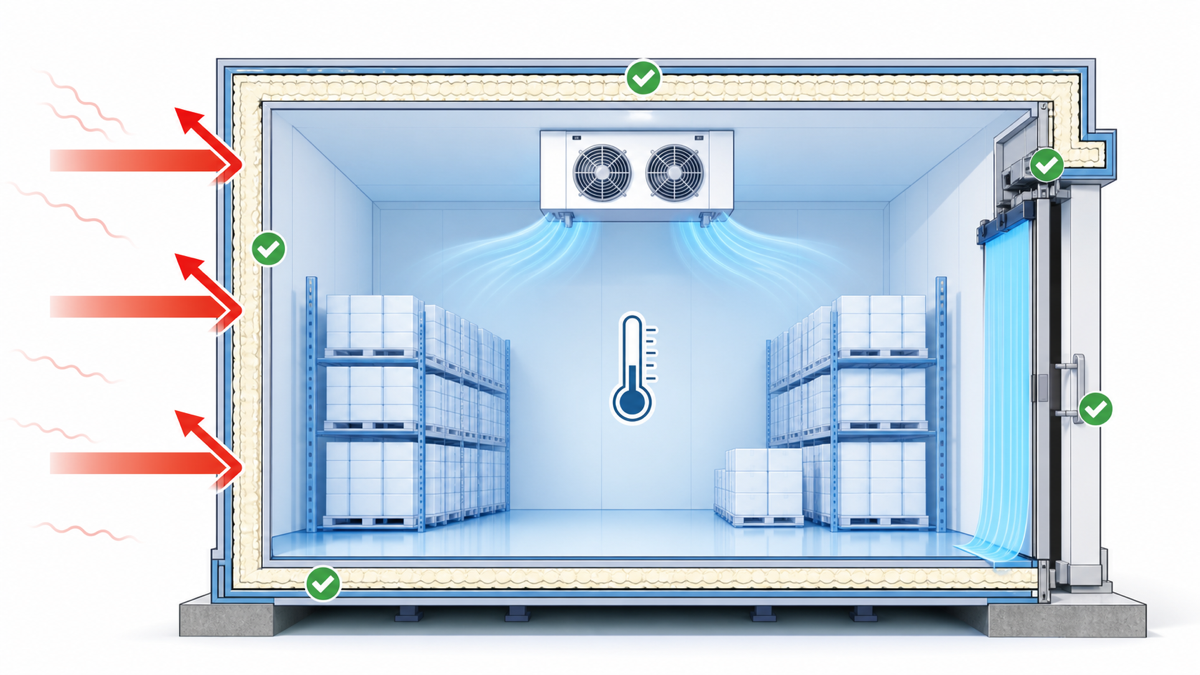
What can be done on-site starting today
- Measure the gap between the set temperature and the actual temperature, and correct any over-cooling
- Shorten door-opening times and keep air curtains or plastic curtains properly maintained
- Check frost buildup and the operating sound of freezers daily to catch anomalies early
The Idea of Reusing Waste Heat Instead of Discarding It
Freezers discharge the heat they pump out of the storage space to the outside. Until now, this waste heat was simply an unwanted byproduct released into the atmosphere. In recent years, however, the idea of heat pumps that reuse this waste heat for hot water supply or heating has been spreading. If the heat generated while cooling fish can be used to heat water, the need to burn additional fuel in a separate boiler is reduced, raising the overall energy efficiency of the facility. The idea of handling both cooling and heating within a single system takes cold chain decarbonization a step further.
In addition, because refrigeration and freezing equipment uses so much electricity, it pairs well with solar power. The hours of peak cooling load in the hot daytime are exactly the hours when solar power generation is also highest. "Self-consumption" solar power — using electricity generated on the roof of a warehouse or store on the spot for cooling — is being adopted increasingly, especially by major retailers, as a strong option that both cuts electricity bills and increases the use of renewable energy.
Food Mileage — The Farther It Travels, the Bigger the Burden
Beyond cooling electricity and refrigerants, another major angle is "transport." The farther seafood is transported, the longer refrigerated trucks and containers must keep cooling it, and the more fuel the transport itself consumes. The indicator that focuses on "how far the food has traveled" is food mileage.
What Is Food Mileage?
Food mileage is an indicator obtained by multiplying the volume (weight) of imported food by the transport distance, expressed in units of ton-kilometers (t·km). It was developed for Japan by Tetsuya Nakata of the Policy Research Institute, Ministry of Agriculture, Forestry and Fisheries, building on the "food miles" concept that originated in the United Kingdom. The larger the number, the more food is being transported over greater distances — meaning a larger environmental burden associated with transport.
Japan Stands Out Far Above the Rest of the World
According to Nakata's 2001 estimate, Japan's food mileage was roughly 900 billion ton-kilometers per year — far larger than any other country in the world. That is about three times the figure for South Korea or the United States, about four times that of the United Kingdom or Germany, and as much as nine times that of France. Even on a per-capita basis, Japan ranks among the highest in the world. This figure directly reflects Japan's structure of low food self-sufficiency and heavy reliance on imports. The CO2 emissions associated with this transport are estimated at roughly 16.9 million tons per year, or about 130 kg per person annually.
| Country | Relative size of food mileage (Japan as reference) |
|---|---|
| Japan | Largest (about 900 billion t·km) |
| South Korea / United States | About one-third of Japan's |
| United Kingdom / Germany | About one-quarter of Japan's |
| France | About one-ninth of Japan's |
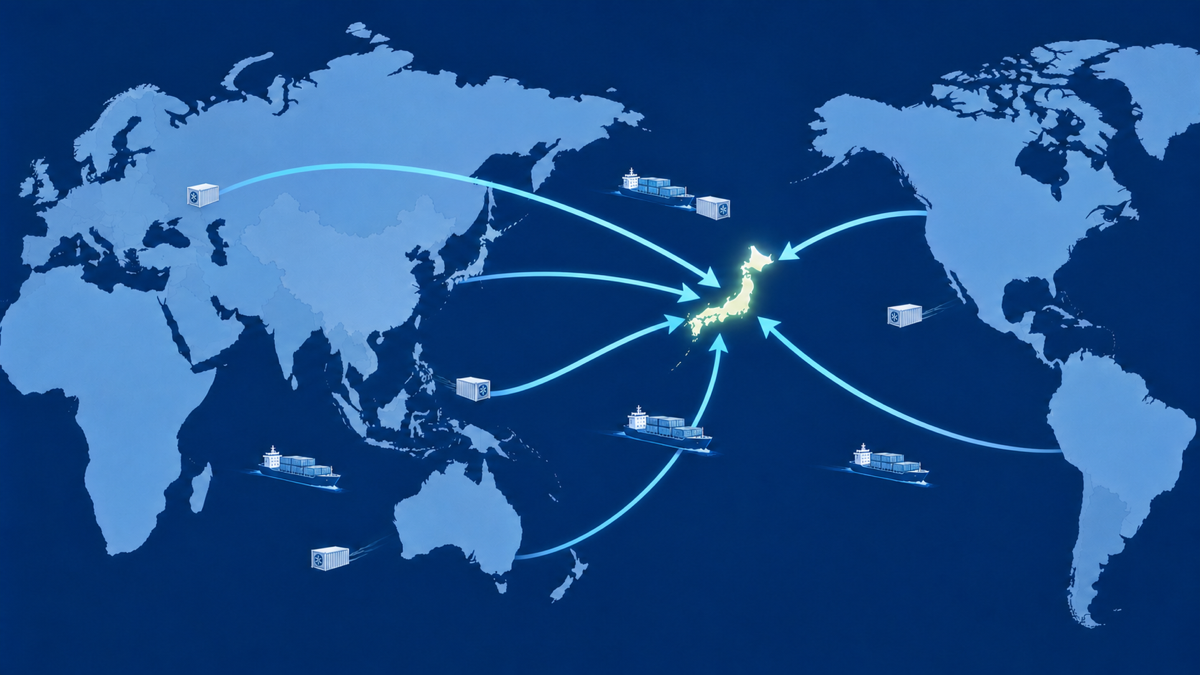
Local Consumption and Modal Shift as Prescriptions
The standard way to lower food mileage is "local production for local consumption" — eating what is caught nearby, close to home. Choosing local fish reduces the burden of both transport and cooling at once. In addition, a modal shift from truck transport to rail or ship, and efforts to raise the loading efficiency of transport, are also effective. When we as consumers turn our attention to locally caught and domestically produced seafood, it quietly contributes to decarbonizing the cold chain as a whole.
Eating fish in season, at the time it is actually in season, also helps reduce food mileage and cooling burden. Trying to keep out-of-season fish available year-round increases the need to transport it from distant places or keep it frozen for long periods. Conversely, choosing fish that is caught abundantly nearby during that season means both transport and storage can be kept short. This traditional way of enjoying the season's bounty makes sense from a climate perspective too. Supporting local fisheries also helps protect both the regional economy and the marine environment.
Reefer Containers Are "Refrigerators on the Move"
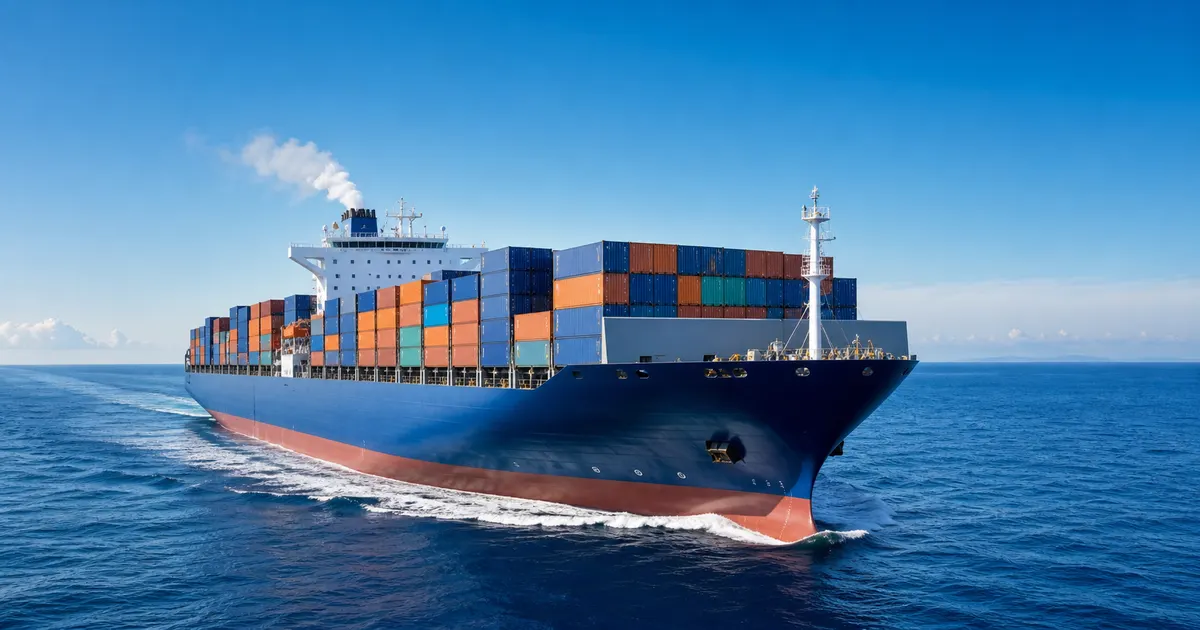
Much of the imported seafood crosses the ocean loaded into "reefer containers" equipped with refrigeration and freezing functions. These are, in effect, refrigerators on the move, kept at low temperature by connecting them to a power source. Because they must keep cooling the fish for the entire duration of a long voyage, the longer the transport distance, the more electricity for cooling the container piles up on top of the ship's fuel. A large food mileage figure also means a longer period of "cooling while transporting," and the burdens of transport and cooling are inseparably linked.
That is exactly why decarbonizing transport is not just about shortening distances — it also requires making cooling during transit as efficient as possible. If natural refrigerants and energy-efficient technology spread to reefer containers as well, the emissions per unit of imported seafood can be lowered. Efforts to shorten distances through local consumption and efforts to make unavoidable long-distance transport more efficient are both needed at the same time.
A caution about food mileage
Food mileage is an easy-to-understand indicator focused on transport distance, but it does not include emissions from the production stage. CO2 per unit also varies greatly depending on the mode of transport (ship or aircraft), so it is best used as one starting point for thinking about the issue, rather than a complete measure.
Reducing Food Loss Is Also Decarbonization That Cuts "Cooling Electricity"
Though often overlooked, reducing food loss is itself a powerful decarbonization measure. A discarded fish wastes everything: the fuel used to catch it, the electricity used to cool, transport, and store it, and the greenhouse effect of the refrigerant involved. Cutting loss means that portion never needs to be cooled in the first place — cutting "cooling electricity" at its very root.
About a Third of Global Production Is Lost
According to the FAO (Food and Agriculture Organization of the United Nations), roughly one-third of the world's food production — about 1.3 billion tons per year — is lost or discarded. Seafood is no exception. In developing countries especially, inadequate cooling equipment and transport means large quantities of fish spoil and are lost soon after landing. Ironically, the regions with the least developed cold chains tend to suffer the greatest loss, because they cannot preserve freshness.
The Challenge of Cold Chains in Developing Countries
In developing countries, building out the cold chain to reduce post-harvest loss benefits both food security and decarbonization. However, adding more freezing equipment creates new challenges around electricity and refrigerants. That is exactly why the ideal is to build low-carbon cold chains from the outset, premised on natural refrigerants and energy-efficient equipment combined with renewable energy. What is needed is a perspective that treats the spread of cooling technology and decarbonization as inseparable.
What We Can Do at Japan's Dinner Table
Even within Japan, "food loss" — food that is still edible but ends up discarded — amounts to several million tons a year, and reducing it has become a nationwide challenge. Whether at home or at a business, seafood is one of the foods most prone to becoming loss, precisely because it spoils easily. Making good use of a household freezer, freezing fish promptly for storage when it can't all be eaten right away, and buying only the amount actually needed, are gentle on the household budget while also contributing to decarbonization. Cooling technology shows its true value when used as an ally against waste, not merely as a convenience.
In a developed country like Japan, most loss occurs at the distribution and consumption stages. Not overbuying, eating what you buy, and making good use of freezing to preserve food before it spoils — these individual actions ultimately reduce wasted cooling electricity. The perspective of valuing marine resources is also connected to efforts that protect nature's own carbon absorption, such as the blue carbon ecosystem. Not wasting fish is an action that protects both the ocean and the climate.
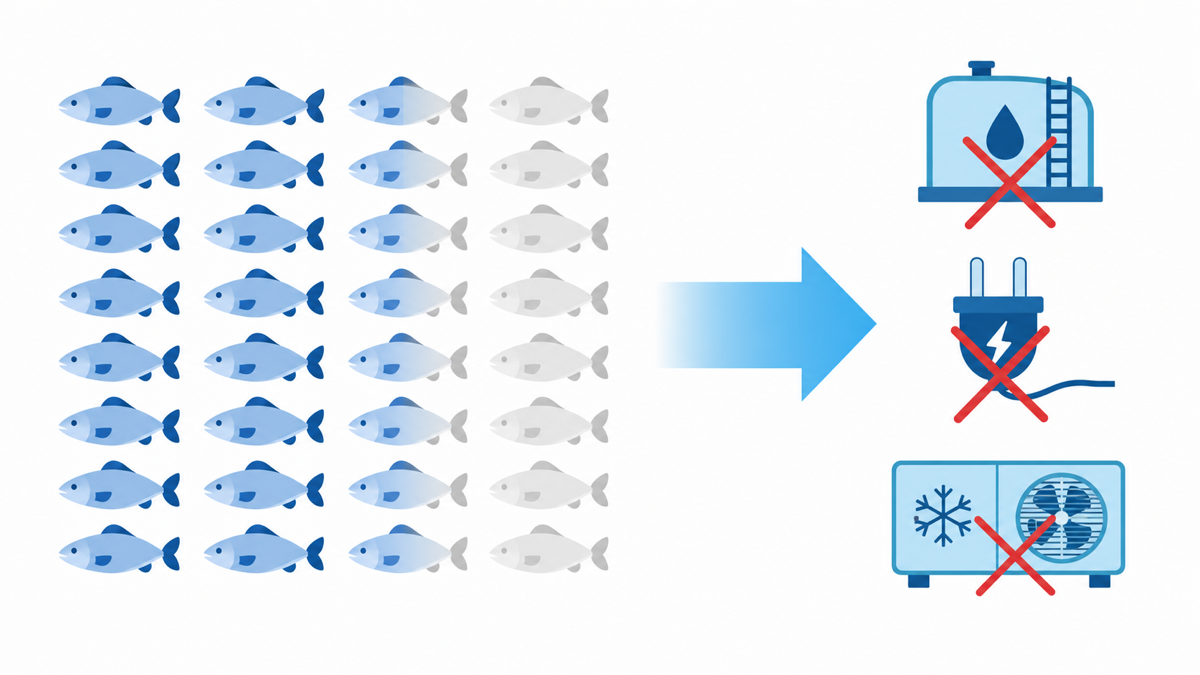
A challenge closely related to food loss is "excessive quality demands." When a fish that is only slightly inferior in appearance, or falls outside the standard grade, is rejected somewhere along the distribution chain, that too represents wasted cooling energy. Building in flexibility to accept fish with no problem in taste or safety, along with outlets such as donations to food banks or conversion into processed products, also supports cold chain decarbonization from the side. Building a system to use every fish caught, right to the end, matters just as much as refining cooling technology itself.
Why reducing food loss counts as decarbonization
- A discarded fish embodies every emission from catching, transport, cooling, and refrigerant
- Reducing loss removes the need to cool that portion in the first place
- Spreading low-carbon cold chains is key to reducing loss in developing countries
Policy and Corporate Action — The Kigali Amendment and Familiar Examples
The shift to natural refrigerants and energy efficiency is being pushed forward not only by individual effort, but also by international rules and corporate investment. Here, let's look at the international framework for refrigerant regulation and the concrete efforts of familiar retailers close to us.
The Kigali Amendment — An International Pledge to Phase Down HFCs
In October 2016, the Meeting of the Parties to the Montreal Protocol adopted the "Kigali Amendment." This is an international pledge to gradually reduce the production and consumption of HFCs — which do not damage the ozone layer, but are powerful greenhouse gases — over time. Developed countries, including Japan, began reductions in 2019 based on the 2011-2013 average, and are committed to cutting about 85% by 2036. Japan's own Plan for Global Warming Countermeasures also sets a target of substantially reducing HFC emissions by 2030 compared with 2013 levels. This trend is powerfully accelerating the shift to natural refrigerants.
Familiar Supermarkets and Convenience Stores Going Fluorocarbon-Free
Stores we use every day are steadily taking action as well. AEON Group declared its shift to natural refrigerants in 2011, and has since adopted CO2 natural refrigerant in the refrigerated and frozen display cases of every new store it opens, while progressively converting existing stores as well. Demonstration tests have confirmed greenhouse gas reductions of more than 50%. Lawson opened a store with all fluorocarbon-free equipment throughout in 2019, and has since been introducing natural-refrigerant display cases at a rate of several hundred stores per year, with the cumulative total now reaching several thousand stores. Retail efforts that include handling certified seafood are also introduced in our article on MSC/ASC certification and distribution companies.
| Actor | What they are doing | Key point |
|---|---|---|
| International community | Phasing down HFCs step by step under the Kigali Amendment | Developed countries to cut about 85% by 2036 |
| Japanese government | Fluorocarbon regulation, warming countermeasures plan, subsidy programs | Mandatory inspection/recovery plus support for natural refrigerant adoption |
| AEON | Adopting CO2 natural refrigerant in new-store display cases | Demonstration confirmed over 50% GHG reduction |
| Lawson | Rolling out fluorocarbon-free stores, several thousand cumulatively | Advancing fluorocarbon phase-out with CO2 and hydrocarbon refrigerants |
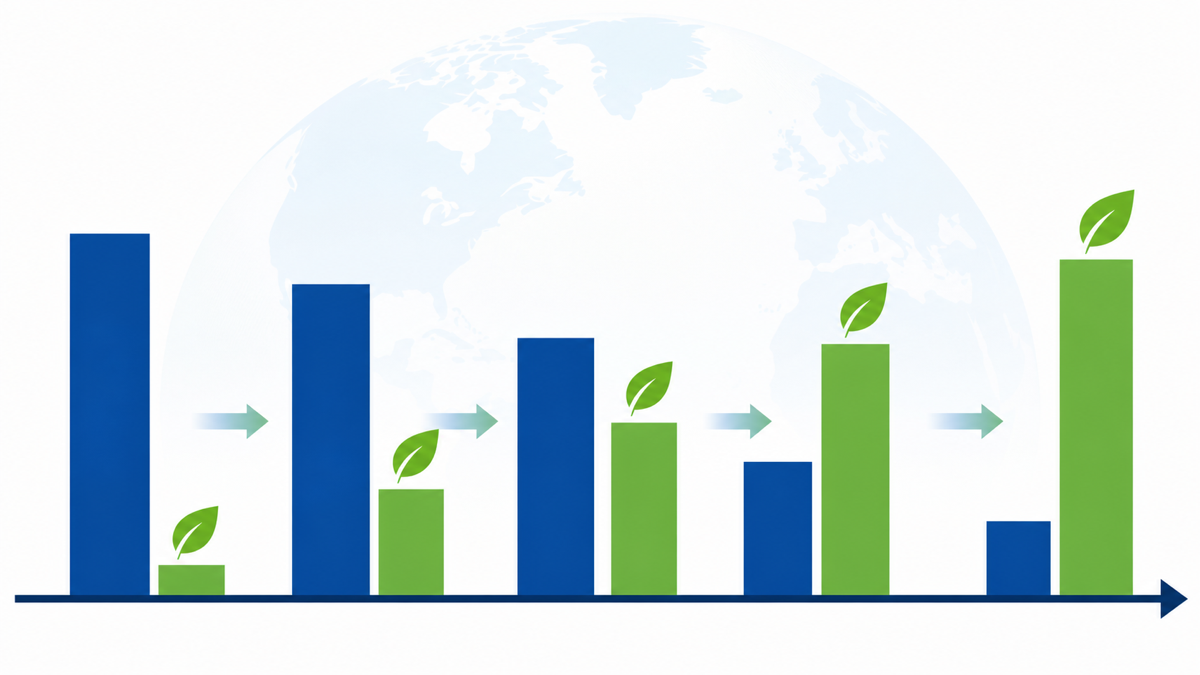
Governments set the direction, companies invest, and equipment manufacturers develop energy-efficient products with a smaller greenhouse effect. When these three forces align, society's cold chain is gradually replaced with a lower-carbon version. Retail and logistics in particular have a huge number of stores and warehouses, so a single company's shift in policy has an outsized ripple effect. When a major retailer adopts natural refrigerants as the standard, mass production of the equipment advances and prices fall, creating a virtuous cycle that makes adoption easier for small and mid-sized businesses too.
The Ministry of Agriculture, Forestry and Fisheries has also laid out a policy to advance decarbonization across the entire food supply chain, from production to distribution and consumption, and is supporting efforts to "visualize" emissions. Once businesses know how much is emitted at which stage, they can direct their efforts where the impact will be greatest. For the seafood cold chain too, pairing this kind of visualization with steady improvements is the surest path to lasting decarbonization.
These policy and corporate moves are hard for consumers to see. But the next time you stand in front of a supermarket's frozen food section, try imagining for a moment what refrigerant is cooling that display case — you'll likely realize that decarbonization is directly connected to your own daily life. If you're curious about the intelligence and wonder of marine creatures, take a look at our article on cephalopod intelligence as well.
How we, as consumers, can get involved
Choosing stores that use natural refrigerants, buying locally caught or domestic fish, and eating what you buy — each of these may be small on its own, but as demand shifts, it becomes a force pushing suppliers toward greater decarbonization investment.
Conclusion — Making the Cooling Chain Gentler and Smarter
The seafood cold chain is essential social infrastructure that protects freshness and food safety, and at the same time it is a major front line of decarbonization, using enormous amounts of electricity and carrying powerful greenhouse gases. In cold storage warehouses, 70 to 90 percent of electricity goes toward cooling, and the HFCs used as refrigerants have a greenhouse effect thousands of times that of CO2. We have several angles from which we can act on these two challenges.
The shift to natural refrigerants such as CO2 and ammonia, whose GWP is negligible; energy efficiency through inverter control and optimized set temperatures; reducing food mileage by not transporting food farther than necessary; and food loss measures that reduce the number of fish thrown away. Rather than any single approach, combining all of these is what lets us make the cooling chain gentler and smarter. International rules like the Kigali Amendment, together with investment from familiar companies such as AEON and Lawson, are helping push that shift forward.
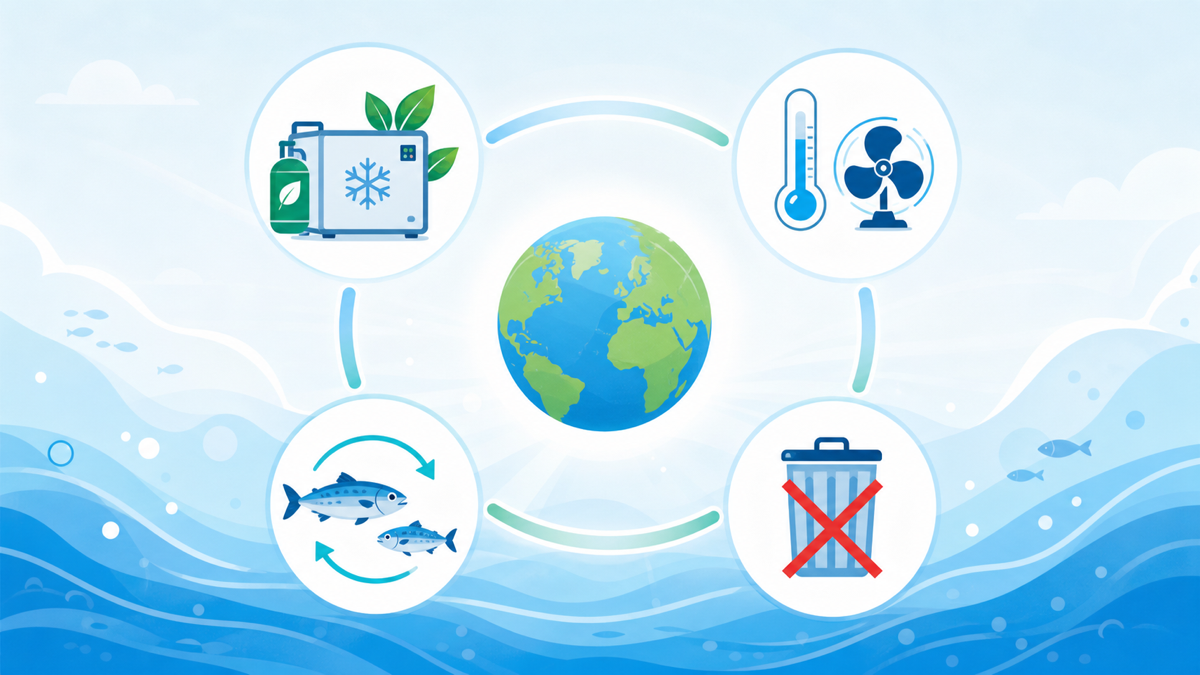
What matters is not letting any one of these measures stand alone. Even if you switch to natural refrigerants, wasting electricity cuts the benefit in half; even if you push energy efficiency, transporting food too far and discarding too much undoes the gains. Refrigerants, electricity, transport, and loss are not independent problems — they are linked together like a single chain. That is exactly why we need to look at the whole picture, from upstream to downstream, and work on all of it, little by little, at the same time.
The next time you choose fish at the supermarket, paying attention to local fish, or buying only what you can finish, is also part of decarbonizing this larger chain. Not rejecting cooling technology, but refining it to use less energy while causing less warming — that is our shared homework for continuing to enjoy the ocean's bounty with peace of mind.
Summary of this article
- The cold chain protects seafood freshness, but it is so energy-intensive that freezing equipment accounts for 70-90% of warehouse electricity
- The HFC refrigerant has a greenhouse effect thousands of times that of CO2; the shift to natural refrigerants such as CO2 and ammonia, with near-zero GWP, is advancing
- Energy-efficient freezers and optimized set temperatures (about 4% per 1°C) can reduce cooling electricity itself through operational improvements
- Reducing food mileage (local consumption) and tackling food loss are forms of decarbonization that cut the need for cooling at the root
- Under the Kigali Amendment, HFCs are to be cut by about 85% by 2036; familiar companies such as AEON and Lawson are also advancing the phase-out of fluorocarbons
References and Sources
- Ministry of the Environment, Japan - Natural Refrigerant Promotion Site / Promoting the Shift to Natural Refrigerants
- Ministry of the Environment, Japan - Program to Promote Fluorocarbon Phase-out and Decarbonization of Refrigeration/Freezing Equipment Supporting the Cold Chain
- Ministry of Economy, Trade and Industry / Ministry of the Environment, Japan - Status of Measures for the Four Alternative Fluorocarbon Gases (2024) / The Kigali Amendment and HFC Regulation
- Fisheries Agency of Japan - Toward Building a Seafood Value Chain
- Ministry of Agriculture, Forestry and Fisheries, Japan - Practicing and Visualizing Decarbonization in the Food Supply Chain
- Agency for Natural Resources and Energy - Energy White Paper 2022, Trends in Energy Consumption by Sector
- Organization for Small & Medium Enterprises and Regional Innovation, Japan (J-Net21) - How Effective Is Relaxing the Set Temperature of Freezers and Refrigerators?
- Ministry of Agriculture, Forestry and Fisheries, Japan - Understanding the State of Food Loss
- AEON Co., Ltd. - Natural Refrigerant Declaration / Decarbonization Vision
- Lawson, Inc. - Decarbonization Efforts: Introducing Store Equipment for Energy Efficiency and Energy Creation
* Listed in order of reliability: government/academic institutions > peer-reviewed papers > expert organizations > trusted media