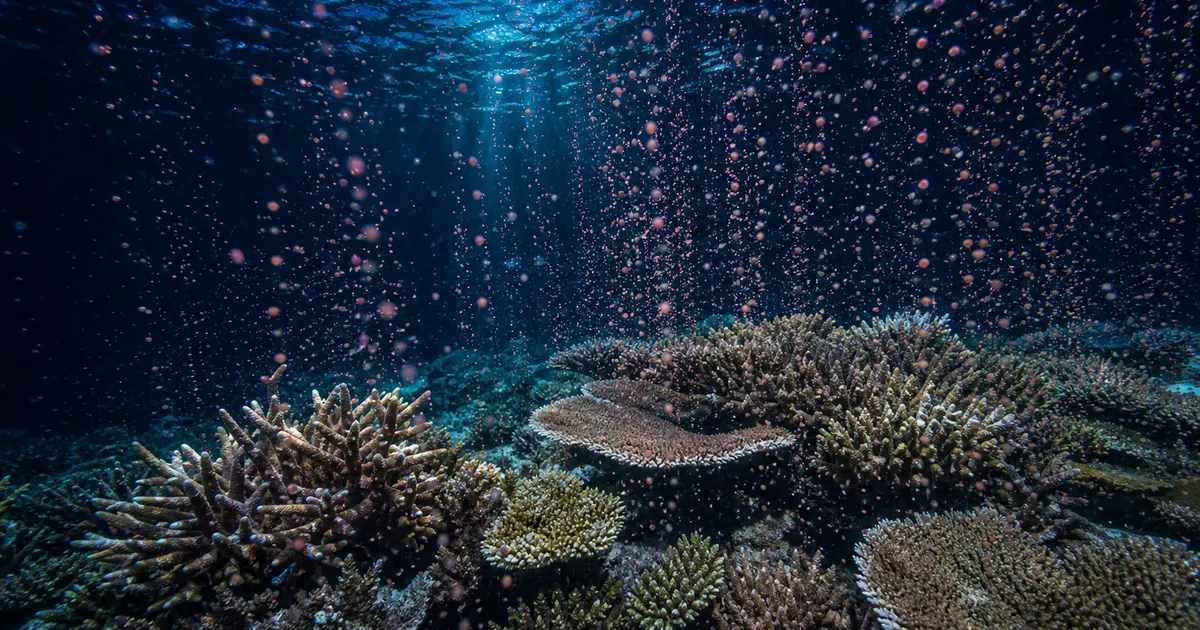
A few days after the full moon in early summer, on a still, windless night. On the seafloor off Okinawa, countless corals begin releasing tiny particles all at once. Pink and orange specks drift upward, as if snow were falling upside-down through the sea—this fantastical sight is the "mass spawning" (synchronized spawning) of reef-building corals. Hundreds of species, countless colonies, release eggs and sperm on the very same night, as though by prior arrangement. How do creatures that cannot move manage to synchronize their timing with such precision?
The tiny particles corals release are, in fact, capsules called "bundles," in which eggs and sperm are packaged together. Bundles float up to the sea surface and burst open, allowing eggs and sperm to meet and fertilize. The fertilized egg eventually becomes a baby coral called a "planula larva," which drifts through the sea before settling on rock and taking the first step toward forming a new colony. The entire future of these organisms rests on this single night of spawning.
This article draws on the latest research from the University of the Ryukyus, Tohoku University, and Ochanomizu University, along with primary sources from Japan's Ministry of the Environment and Okinawa Prefecture, to unravel why corals spawn "all at once," and where the signal lies among the full moon, moonlight, and water temperature. We will then trace the relay of life from fertilization to settlement, and consider what this mass spawning means at a time when bleaching events are becoming more frequent.
What You'll Learn in This Article
- What coral mass spawning is, and why it's called an "underwater snowstorm"
- What the "bundle"—eggs and sperm combined into one—actually is, and how it floats to the surface
- The latest research showing how the full moon, moonlight, and the post-sunset "light gap" serve as the cue for synchronized spawning
- How rising sea temperature fine-tunes the timing, bringing the spawning date forward
- The full sequence from fertilization through the planula larva, settlement, and the birth of a baby coral
- Why mass spawning holds the key to reef restoration in an era of frequent bleaching
What Is Coral Mass Spawning? — The Night of the "Underwater Snowstorm"
Coral mass spawning is a phenomenon in which, on a particular night in early summer, many corals in the same sea area release eggs and sperm together, synchronized down to the hour. The way countless released particles swirl up through the water has earned it the English name "underwater snowstorm." Many reef-building corals bet everything on reproduction for the year on this single night. How corals—which cannot move or make a sound—manage to synchronize their timing has long been one of the ocean's great mysteries.
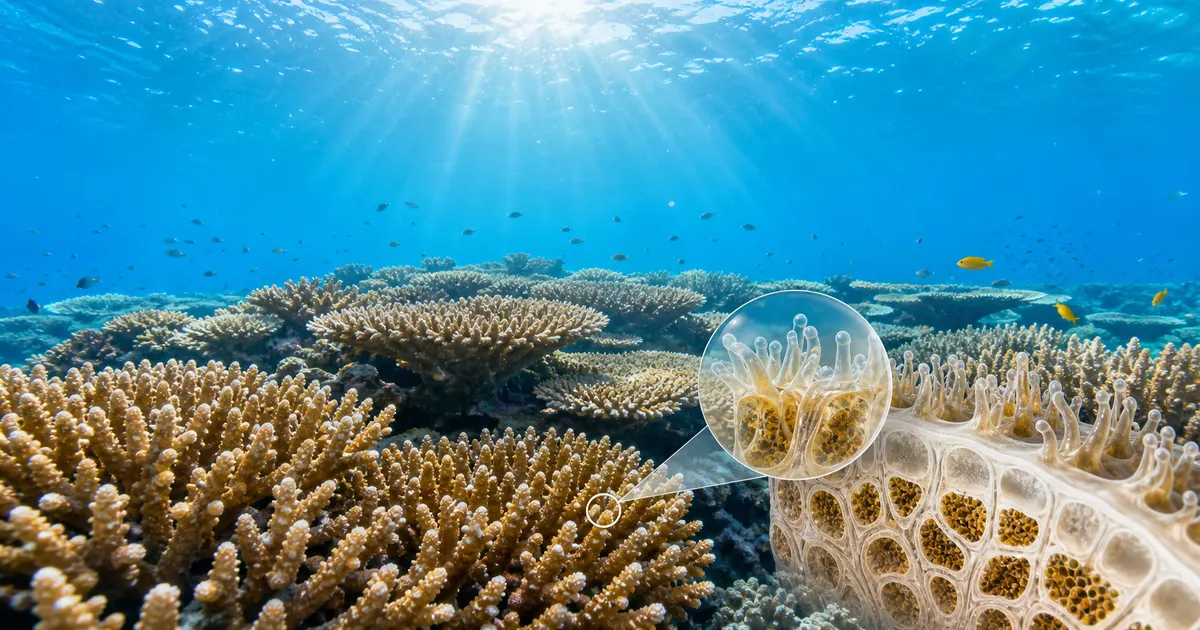
To begin with, corals are cnidarians closely related to sea anemones and jellyfish, made up of countless tiny individuals called "polyps," each just a few millimeters across, gathered into a colony. The fact that corals house microscopic algae called "zooxanthellae" within their tissue and rely on the algae's photosynthesis for most of their nutrition is covered in detail in our article on coral–zooxanthellae symbiosis. How does coral, which builds the enormous ecosystem of a reef through this symbiosis, pass on the next generation? One answer is this grand mass spawning event.
"Broadcast Spawners" and "Brooders" — Two Reproductive Strategies
Coral reproduction broadly falls into two types. One is the broadcast spawning type (mass spawning type), in which eggs and sperm are released into the water and fertilized externally. The Acropora corals, the stars of the reef, are the classic example, spawning just once a year on a fixed night. The other is the brooding type (planula-release type), in which fertilization occurs internally and larvae, already somewhat developed, are released. Pocillopora corals fall into this category, releasing larvae in sync with the monthly lunar cycle.
Two Reproductive Types
- Broadcast spawning: Eggs and sperm are released into the water and fertilized externally. Acropora corals are the classic example. Mass spawning occurs once a year on the same night
- Brooding: Fertilization occurs internally, and developed larvae are released. Pocillopora corals are an example. Larvae are released on a monthly cycle
- Mass spawning famously refers mainly to the broadcast spawning type — a spectacular event in which hundreds of species spawn on the same night
- Both are forms of sexual reproduction, serving to mix genes and spread offspring to new locations

A Major Discovery Unraveled in 1980s Australia
It was only surprisingly recently—the 1980s—that science revealed corals engage in mass spawning on such a large scale. On Australia's Great Barrier Reef, a research team including Harrison and Willis observed multiple sites in 1981–1982 and confirmed that 32 species of coral spawned together over several nights, a few days after the spring full moon. This finding was published in the journal Science in 1984 and stunned the world. A follow-up report (1986) summarizing observations from 1981–1984 found the number of confirmed species had risen to more than 105, spanning 36 genera and 11 families.
What made this discovery so groundbreaking was that it overturned the prevailing belief at the time that "most corals brood their larvae internally." In reality, most reef-building corals are broadcast spawners that release eggs and sperm into the sea for external fertilization—and they do so in synchrony across species on the same night. This fact fundamentally reshaped how we think about coral ecology and conservation. In Japan too, mass spawning began to be observed in many locations, starting with Okinawa, and it now draws many divers into the sea as a hallmark event of early summer.
For Coral, Spawning Is a High-Stakes Event That Happens Only a Few Times in a Lifetime
Just as we take for granted seeing seasonal flowers bloom every year, we tend to think of coral spawning as "something that repeats every year" in the same casual way. But from coral's perspective, a broadcast-spawning colony gets only one chance to spawn per year. And the number of times it can do so over its lifetime, from maturity to death, is limited. A colony that has taken many years to grow stakes an entire year's worth of reproduction on a single night—when you consider it this way, you begin to see just how urgent and how demanding of precision this high-stakes event really is. That is precisely why coral mobilizes every possible cue to choose that one night in which failure is not an option.
Coral reefs are said to cover less than 1% of the seafloor, yet they provide habitat or spawning grounds for roughly a quarter of all marine species. The entirety of that rich ecosystem, traced back to its origin, comes down to a single polyp that settled after a single night of spawning. In other words, mass spawning is both an act performed by a single species and, in a sense, the very root that carries the enormous ecosystem of the coral reef forward into the future.
This article will unravel, step by step, the mechanism behind this grand phenomenon. Let's begin with the biggest mystery of all—the evolutionary reason why coral bothers to spawn all at once.
Why "All at Once"? — The Survival Strategy Behind Synchronized Spawning
Coral spawning on the same night is by no means a coincidence. For coral, which cannot move, releasing eggs and sperm simultaneously with everyone else is decisively advantageous for ensuring they actually meet. Behind synchronized spawning lie several survival strategies honed by evolution.
Maximizing the Chance of Fertilization
Coral cannot move on its own to search for a mate. If eggs and sperm were released at scattered times, the chance of the two meeting in the vast ocean would be vanishingly small. By having many colonies release on the same night, and even within the same window of time, the concentration of eggs and sperm in the seawater spikes at once, maximizing the chance of fertilization. It could be described as a numbers game, a gamble on probability.

Overwhelming Predators with "More Than They Can Eat"
Nutrient-rich eggs released into the water are a prime feast for fish and plankton. If coral spawned little by little, each batch might get eaten up entirely. But by releasing an uncountable number of eggs together in a single night, the sheer volume exceeds what predators can possibly consume, no matter how much they eat. This "predator satiation" allows more eggs to survive and carry on to the next generation—a strategy of safety in numbers.
Spreading the Risk of Total Loss
On the other hand, synchronizing the spawning date too perfectly carries its own dangers. If a typhoon happens to strike that very night and churns up the sea, the released eggs and sperm could all be scattered and lost, wiping out that year's reproduction entirely. Recent research has actually revealed that coral fine-tunes its spawning date slightly according to environmental conditions such as water temperature, introducing a small amount of variation between individuals. This is thought to be a clever way of spreading risk, avoiding total simultaneous loss from a natural disaster. This phenomenon rests on a balance between "synchronizing" and "deliberately varying."
Three Meanings of Synchronized Spawning
- Improved fertilization rate: raising the concentration of eggs and sperm allows even immobile coral to meet
- Predator satiation: releasing a huge volume at once means more survive because predators can't eat it all
- Risk spreading: fine-tuning the spawning date via water temperature avoids total loss from events like typhoons
Furthermore, the fact that many coral species spawn together across species lines is also pointed out to generate genetic diversity through hybridization between species. Higher diversity tends to make a population more resilient to environmental change and disease, and this too is part of a long-term survival strategy. So what exactly do these immobile corals use as a "cue" to synchronize their timing with such precision? The next chapter gets to the heart of that mystery.
Spawning Cue #1: The Full Moon and the "Light Gap" Clock
"Coral spawns on the night of the full moon"—this is a commonly heard explanation, but it isn't quite accurate. Many corals spawn not on the night of the full moon itself, but several days after it. For example, favid corals commonly observed in Okinawa are known to spawn about 6 days after the full moon. So what exactly about the full moon is coral using as its cue?
The Cue Is Not "Moonlight" but a "Window of Darkness"
A research team led by Professor Shunichi Takahashi of the University of the Ryukyus' Tropical Biosphere Research Center provided a surprising answer to this long-standing mystery. The cue turned out not to be the "moonlight" that brightly illuminates the night, but rather the opposite—the "period of darkness" (the light gap) that occurs between sunset and moonrise. This finding was published in the Proceedings of the National Academy of Sciences (PNAS).
Here's how it works. Before the full moon, the moon rises almost simultaneously with sunset, so moonlight is never interrupted throughout the night. But once the full moon has passed, moonrise gradually becomes later, and a "completely dark period without moonlight" appears between sunset and moonrise. This window of darkness grows longer the more days pass after the full moon. Coral reads this pattern of darkness with precision to determine its spawning timing. Moonlight is thought to act as a signal that "suppresses" spawning, and when darkness arrives, that suppression is lifted, accelerating preparation for spawning.

A Light-Blocking Experiment Reveals the "Darkness Switch"
This hypothesis was confirmed by an experiment that artificially manipulated light. In the study, researchers covered coral with aluminum sheets starting three days before the full moon, artificially blocking out moonlight at night. When this artificially recreated, for four days, the pattern of darkness that would normally occur after the full moon, the coral began spawning on the fifth day. In other words, it was confirmed that spawning can be triggered simply by meeting the condition of a "window of darkness," even before the actual full moon. This is evidence that coral is not looking at the sky and counting dates, but rather sensing the rhythm of light and darkness itself with its body.
Coral is thought to be able to sense these changes in light because it possesses proteins that receive light (photoreceptors such as cryptochromes) and an internal "biological clock" (circadian rhythm) that keeps time. Just as we humans adjust our wake-up rhythm using the morning sun, coral reads the rhythm of sunlight and moonlight to decide the day for its once-a-year major task. The fact that coral, which cannot move and has no brain, possesses such an elaborate "calendar" is itself a remarkable product of evolution.
The True Relationship Between the Full Moon and Spawning
- Spawning is more common not on the night of the full moon itself, but several days after it (about 6 days after for favid corals)
- The cue is not moonlight, but the "window of darkness (light gap)" that occurs between sunset and moonrise
- Moonlight is a signal that suppresses spawning; when darkness arrives, that suppression lifts and spawning preparation proceeds
- Coral reads the rhythm of light and darkness precisely using photoreceptors and its internal clock
This mechanism of using the "light gap" as a cue has another advantage. Because the presence or absence of light—while somewhat affected by weather—is rooted in the reliable astronomical rhythm of the moon's phases, it is extremely precise. Even during a string of cloudy nights, the rough timing of when darkness occurs is determined by the lunar cycle, allowing colonies to stay in sync without drifting far apart. That corals, lacking both brain and eyes, can spawn all at once without being thrown off by the noise of clouds and waves—behind this lies a robust mechanism that makes use of the movements of the sky. In recent years, it has also been pointed out that artificial lighting (light pollution) may disrupt this delicate rhythm of darkness and interfere with synchronized spawning, meaning that nighttime brightness along the coast is not irrelevant to coral either.
However, the lunar rhythm alone does not determine "in which month" spawning will occur. The same full moon arrives every month, yet coral spawning is concentrated in early summer. The other cue that determines this "season" is water temperature, which we turn to next.
Spawning Cue #2: Water Temperature as the Seasonal Alarm Clock
If the lunar rhythm determines "on which day of the month" spawning occurs, water temperature is the major cue that determines "in which season of the year" it occurs. For many corals, spawning is concentrated in early summer, once the water has warmed sufficiently. In Okinawa, this is typically seen in May–June, while on the Honshu side—Kyushu, Shikoku, and the Kii Peninsula—it occurs somewhat later, in July–August. This is because egg maturation requires warm water temperatures.
The Higher the Water Temperature, the Earlier the Spawning Date
Recent research has revealed that water temperature governs the timing of spawning in remarkably fine detail. A research team from Tohoku University and Ochanomizu University analyzed Acropora spawning data recorded over 15 years, from 2003 to 2017, by the Okinawa Churaumi Aquarium. The results showed that the higher the water temperature during the roughly two months leading up to the full moon of the spawning month, the earlier that year's first spawning day and peak day tend to occur. This is thought to be because higher water temperatures promote the growth of coral's reproductive organs, allowing eggs to mature more quickly.

Water Temperature, Wind, and Sunlight — Multiple Environmental Factors Combine
The research team further found that, beyond water temperature alone, multiple environmental factors—including wind speed, solar radiation, and precipitation—each influence the spawning date differently at different times. For example, greater solar radiation and precipitation during the month before the full moon tended to bring the spawning peak forward as well. Rather than relying on a single cue, coral layers multiple pieces of information—water temperature, the moon, light, and weather—to work out the optimal spawning date for that particular year.
Why Does "Slightly Shifting" the Date Matter?
The fact that spawning dates vary subtly between individuals depending on factors like water temperature ties back to the "spreading the risk of total loss" discussed in the previous chapter. If every coral spawned on exactly the same night, a typhoon or sudden environmental change could wipe out everything at once. By incorporating water temperature to introduce a slight range in spawning dates, some colonies are more likely to survive—this flexibility is the wisdom that allows coral to keep reproducing in an ever-changing sea.
Concerns That Warming Could Disrupt the Rhythm
The fact that water temperature serves as a spawning cue means that if the sea warms too much, the very rhythm of spawning itself risks being thrown off. In recent years, more years have seen high water temperatures arrive earlier, before the onset of early summer, and it has been pointed out that this could bring spawning dates forward or cause timing to drift between colonies, lowering fertilization rates. Ocean warming and marine heatwaves are beginning to cast a shadow not only over bleaching, but also over the very foundation of coral's reproductive life. If spawning dates shift out of sync, nearby colonies fail to align, and the eggs and sperm that were released may go to waste without ever meeting. Because this is not a visible phenomenon like bleaching, this "quiet disruption" tends to be overlooked, yet it steadily erodes coral's capacity to leave offspring. In the next chapter, we finally approach the moment of spawning itself—the scene on the night the bundles are released.
The Night the Bundles Are Released — The Mechanics of Broadcast Spawning
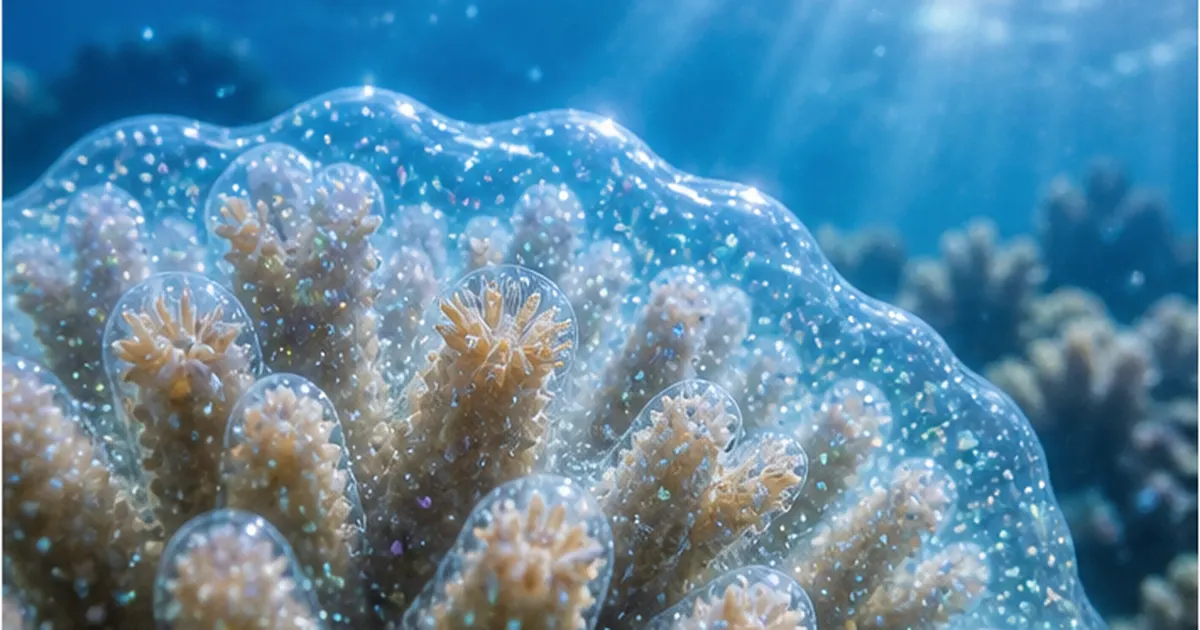
On the night when the two cues—the moon and water temperature—align, coral finally spawns. What broadcast-spawning coral releases is not scattered eggs and sperm, but a small capsule called a "bundle" (egg-sperm bundle), in which the two are combined into one. These are pink, orange, or whitish particles about 1 mm in diameter, and it is the sight of countless numbers of them rising through the water that is the true identity of that "underwater snowstorm."

The Bundle Floats to the Surface and Bursts Open to Fertilize
Because bundles contain a large amount of lipid (fat), they are lighter than water and, once released, slowly float up toward the sea surface. As they approach the surface, the capsule comes apart, scattering the eggs and sperm inside into the seawater. Here, they encounter eggs and sperm released from a different colony, and fertilization occurs. Many corals have a mechanism that makes it difficult for their own sperm to fertilize their own eggs (self-incompatibility), so that genetic diversity is maintained through cross-fertilization with other colonies. The "releasing all at once on the same night" we saw in the previous chapter is precisely what makes this encounter possible.
The "Slick" That Covers the Sea Surface
When countless bundles rise to the surface, pink or orange bands can spread across the water. This film-like band, formed by the gathering of lipid-rich eggs, is called a "slick," and it drifts with the wind and tide. The following morning, seeing the sea surface tinted with the color of eggs can reveal that large-scale spawning occurred the night before. This sight is proof that the reef has just sent new life out into the world.
The Bundle's Journey — 3 Steps
- ① Release: A bundle combining egg and sperm is pushed out from the polyp's mouth
- ② Rising: Being lighter than water due to its lipid content, it slowly floats up to the surface
- ③ Fertilization: It bursts open near the surface and meets eggs and sperm from another colony, fertilizing
The "Spawning Season" Differs by Region
The timing of spawning shifts by region, in line with the season when that area's water temperature rises. Even within Japan, Okinawa, located further south and warming earlier, sees spawning in early summer (May–June), while the Honshu side, where water temperature rises later, sees it in the somewhat later summer months. The lunar timing of spawning also tends to vary by species, often concentrated around the spring tides of the full moon or new moon. The table below gives a rough guide to coral spawning in Japan—note that these are average-year tendencies, and the actual timing can shift earlier or later depending on that year's water temperature.
| Region | Main spawning period | Characteristics |
|---|---|---|
| Okinawa (Yaeyama / Main Island) | Around May–June | Water warms early; famous for mass spawning of Acropora corals |
| Kyushu, Shikoku, Kii Peninsula | Around July–August | Water warms later than Okinawa, so spawning is also later |
| Brooding type (nationwide) | Monthly during summer | Releases larvae monthly, in sync with the full moon/new moon cycle |
Spawning Is Concentrated Within a Few Hours of a Quiet Night
Spawning occurs almost entirely at night, concentrated within a limited window of a few hours after sunset. Many species spawn between roughly 8 p.m. and 11 p.m., though the exact release time varies slightly by species—this too is thought to be a mechanism for avoiding unnecessary hybridization between closely related species. On spawning nights, waves are often calm and tidal movement stable, preventing released eggs and sperm from dispersing needlessly. It is almost as if the entire sea arranges its stillness for this one night.
It takes roughly 3 to 5 years after settlement for coral to grow into an "adult" capable of spawning. A colony that has matured over many years entrusts all of its reproduction to a single night—which is exactly why, if the sea is rough or the water temperature abnormal that night, an entire year's worth of reproduction can come to nothing. This has been the story up through "the eggs being released." From here, we follow the second half of the relay of life—how the fertilized eggs grow into baby coral.
From Fertilization to Larva — The Planula Wanders the Sea
An egg fertilized at the sea surface begins undergoing rapid change from that very moment. In a coral's life, which otherwise appears motionless, this period alone is a special time when coral can "swim and move"—the beginning of a baby coral's journey, wandering the sea in search of a new home.
Cleavage — A Single Egg Divides
The fertilized egg first begins a process of cell division called "cleavage." It splits into two, then four, then eight, and so on, increasing in number. The embryo at this stage is extremely delicate, and can be destroyed if the sea becomes rough. Within a few hours to about a day, the embryo transforms into a tiny larva covered in fine hairs called cilia.

The Planula Larva — A Baby Coral That Swims and Travels
Within a few days of fertilization, the embryo becomes a swimming larva shaped like a pear, called the "planula larva." The planula swims on its own by moving the cilia on its body surface, and moves along with the tidal current. This larval stage is the one and only chance for immobile coral to "move house" far away from where it was born. By riding the current to another island or reef, and spreading coral reefs to new locations—the planula's journey is an essential means by which coral expands its range.
The period the planula drifts at sea varies by species, but is generally about 1 to 2 weeks. Those that can drift longer can disperse farther, but the risk of being eaten by fish or running out of energy before finding a place to settle also increases during that time. Of the countless eggs released into the sea, only a tiny fraction ever make it successfully to settlement. Releasing an enormous number in a single night is, in part, a way of raising even slightly the odds of surviving this harsh gauntlet.
Ocean Currents Decide Where the Offspring End Up
Although the planula larva has the ability to swim on its own, its speed is quite limited, and how far it actually travels is largely determined by ocean currents and tidal flows. Riding a strong current, it might reach a reef on another island tens of kilometers away, or conversely, it might remain near the reef where it was born. This matter of "where it gets carried" determines the connectivity between coral reefs, and affects whether a damaged area can recover through larvae supplied from a healthy reef elsewhere. This is precisely why the idea of protecting scattered coral reefs together, as a connected network, matters so much in conservation.
The Planula Larva Is the Trump Card of "Dispersal"
For coral, which cannot move, the swimming planula stage is the only chance to expand its range. If it rides a current to another reef, it can start a new colony there. When planulae are supplied from elsewhere to a sea area damaged by bleaching or other events, this becomes a lifeline for the natural recovery of the coral reef. This is exactly why having healthy coral reefs remaining nearby determines the resilience of an entire region.
Having wandered the sea, the planula eventually begins searching for a place to decide, "I will live here." But not just anywhere will do. In the next chapter, we look at the moment a baby coral chooses its permanent home and finally puts down roots on the rock—the moment of settlement and establishment.
Settlement and Establishment — A Baby Coral Puts Down Roots
The journey of the planula larva drifting through the sea moves to its next stage once it finds just the right spot and settles on a rock. Here, coral makes a major choice that determines where it will spend the rest of its life. And once it has put down roots, it can never move again. Settlement is one of the most important decisions in a coral's entire life.
Crustose Coralline Algae — The Cue for Settlement
The planula does not attach itself to rock at random. One of the cues it uses to choose where to settle is a seaweed called "crustose coralline algae", which covers rock surfaces in a pink coating. Coralline algae are known to secrete inducing substances that promote settlement and metamorphosis, not only for coral but for the larvae of various marine invertebrates, such as sea urchins and shellfish. The planula senses this chemical signal and judges, "this is a good place to grow," settling accordingly. A rock surface richly covered with coralline algae is a favorable marker for baby coral. The presence of microorganisms such as bacteria hiding on the seafloor is also thought to serve as a cue for settlement.

Metamorphosis — From Swimming Larva to Polyp
Within a few days of settling, the planula transforms dramatically. It loses the cilia it used for swimming, flattens its body into a disc shape and attaches to the rock, and metamorphoses into a "polyp"—a miniature anemone-like form equipped with a mouth and tentacles at its center. This is the momentous first individual, so to speak, the "founder" of a new coral colony. The polyp begins secreting a calcium carbonate skeleton, building the foundation that will protect its body.
Welcoming Zooxanthellae and Growing into a Colony
Many newly settled baby corals do not yet have zooxanthellae inside their bodies. So they take in zooxanthellae from the surrounding seawater and seafloor, newly forming that symbiotic relationship based on photosynthesis. A polyp that has welcomed in zooxanthellae grows faster thanks to the benefits of photosynthesis, and multiplies its own copies (clones) one after another through division. As the number of polyps increases and the skeleton accumulates layer upon layer, it eventually grows into the large coral colony we come to see.
From Settlement to Colony — 4 Steps
- ① Settlement: Relying on cues such as crustose coralline algae, the larva selects and attaches to a favorable rock
- ② Metamorphosis: It loses its cilia and transforms into the first polyp, equipped with a mouth and tentacles
- ③ Symbiosis: It takes in zooxanthellae from its surroundings, establishing a photosynthesis-based symbiotic relationship
- ④ Growth: It multiplies clones through division and builds up its skeleton to become a colony
Growth speed varies by species—even fast-growing branching species grow only about 3 cm per year, while some massive (boulder-shaped) corals grow less than 1 cm per year. And it takes 3 to 5 years from settlement to become a mature adult capable of spawning. Counting from a single night of spawning, it is a journey of several years before the next generation releases its own eggs. The scenery of a coral reef is built upon this dizzying accumulation of time. This is precisely why it is not easy to recover a reef once it has been lost to bleaching or similar events. In the final chapter, we consider what this mass spawning means in today's sea, where bleaching events occur frequently.
Mass Spawning in an Age of Bleaching — A Lifeline to the Future
The mass spawning we have examined so far is not merely a mystery of nature. It is the single restoration mechanism by which coral reefs generate their next generation and heal a damaged sea on their own. And yet, right now, that very mechanism is beginning to waver due to global warming.
Bleaching Robs Coral of Its "Reproductive Power"
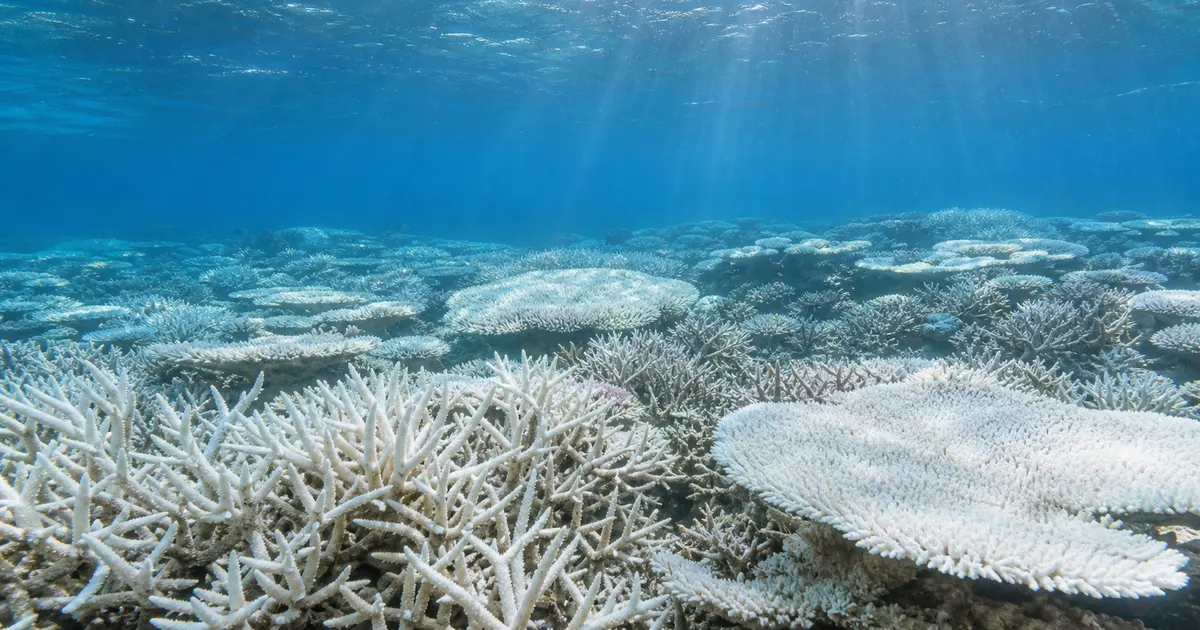
The bleaching phenomenon, in which coral loses its zooxanthellae due to high summer water temperatures, leaves deep scars on subsequent reproduction even if the coral itself manages to avoid death. It is known that even colonies that have recovered from bleaching show slowed growth and release fewer eggs. Coral that has fallen into a state of starvation, having lost its nutrient source of zooxanthellae, has no reserves left to invest in raising eggs. In other words, bleaching not only causes visible mass mortality—it also gradually erodes coral's "reproductive power," thinning out the next generation.

What makes this even more serious is the lack of "recovery time." It takes several years for a colony to recover from bleaching and mature enough to spawn again. But in recent years, bleaching has been repeating every few years, with the next bout of high water temperature striking before the previous wound has healed. Corals are hit by the next blow before they have time to leave offspring through spawning—this vicious cycle is driving the world's coral reefs into a corner. The rise in sea water temperature is also intertwined with its effects on coastal ecosystems and the fishing industry, making the problem all the more complex.
Indeed, after coral in Okinawa's Sekisei Lagoon suffered massive damage from record-breaking bleaching in 2016, it has been reported that the number of healthy colonies capable of participating in spawning in that area declined, along with the volume of eggs released. Fewer spawning parent corals means fewer larvae supplied, which thins out settlement in the next generation. Reduced settlement, in turn, means even fewer colonies capable of spawning a few years later—in this way, bleaching continues to quietly throw off the gears of reproduction and renewal, even after the visible mass mortality has passed. Behind the splendor of a spawning night, the very bearers of that spectacle are quietly dwindling.
Putting Mass Spawning to Work as a "Restoration Technology"
At the same time, this mass spawning is also a source of hope. In recent years, efforts to collect the huge volume of eggs and larvae released on spawning nights, raise them in tanks, let them settle, and then replant them into damaged seas—part of coral reef restoration efforts—have been progressing in various locations. On the Great Barrier Reef, large-scale projects have collected eggs on a scale of millions during the spawning season, raised the resulting larvae, and dispersed them into the sea. Unlike conventional methods that fragment and transplant existing colonies, restoration using this sexual reproduction has the advantage of increasing coral numbers while preserving genetic diversity. Diversity is essential for building populations resilient to heat and disease.
What We Can Do to Protect Mass Spawning
- Reduce greenhouse gas emissions and curb the rise in sea water temperature itself, which disrupts the spawning rhythm
- Reduce the inflow of red soil and wastewater to protect the healthy rock surfaces and coralline algae that serve as settlement sites
- Choose coral-friendly sunscreen so as not to burden the sea during the spawning season
- On spawning observation tours, follow rules to gently watch without touching coral or eggs
- Support marine protected areas and restoration activities to preserve healthy reefs capable of supplying larvae
That said, restoration by human hands has its limits. Replanting all of the world's coral reefs is not realistic, and the fundamental countermeasure is, in the end, nothing other than halting the rise in sea water temperature itself. To make the most of mass spawning's natural power of renewal, it is essential that we curb warming, keep coastal environments clean, and preserve healthy coral reefs. Consider the current state of Japan's coral reefs alongside our articles on Japan's marine biodiversity and marine protected areas.
Conclusion — Coral's Future, Entrusted to a Single Night of Snowfall
On a night after the early-summer full moon, pink particles rise all at once from the seafloor—coral mass spawning is not merely a beautiful sight. Creatures that cannot move or make a sound read the rhythm of the full moon, water temperature, and light with precision, and once a year, across species, they align and release life together. The entire future of the coral reef is entrusted to that single night.

The mechanism of mass spawning we have examined in this article is by no means merely difficult science. "Coral uses the darkness after the full moon and the early-summer water temperature as its cue to spawn all at once." "The bundle of eggs and sperm fertilizes at the sea surface." "The resulting planula larva travels the sea and settles on rock, becoming a baby coral." Once you grasp this flow, it becomes clear why coral spawns all at once, and why warming threatens this act. Spawning is a phenomenon just as crucial to coral's fate as bleaching.
Article Summary
- Mass spawning = a phenomenon in which, on an early-summer night, many corals release bundles of eggs and sperm on the same night (the underwater snowstorm)
- Coral reproduction includes the "broadcast spawning type," which releases eggs and sperm, and the "brooding type," which releases larvae
- The reasons for spawning all at once are survival strategies: maximizing fertilization rate, predator satiation, and spreading the risk of total loss
- Cue #1: Not the full moon itself, but the "window of darkness (light gap)" after sunset that occurs a few days after the full moon
- Cue #2: The higher the water temperature in the two months before spawning, the earlier the spawning date. Water temperature fine-tunes both the season and the exact date
- The bundle rises to the surface and bursts open to fertilize. The fertilized egg becomes a planula larva that drifts at sea for 1-2 weeks
- The larva settles and metamorphoses using cues such as coralline algae, welcomes in zooxanthellae, and grows into a colony (taking 3-5 years to mature)
- Bleaching robs coral of its reproductive power. Restoration that makes use of mass spawning, together with countermeasures against warming, will determine the future of coral reefs
Coral reefs, covering less than 1% of the sea's surface area, are a "cradle of the sea" that supports about a quarter of all marine life. The effort to carry that cradle into the future is packed into this single night of snowfall. Learning about the miracle-like mechanism of mass spawning is not meant to inspire pessimism, but is a first step toward thinking about what we can do to hand this relay of life on to the next generation. Umi LAB will continue to bring you the frontlines of coral science and conservation, backed by reliable data.
References & Sources
- University of the Ryukyus – World's First Discovery of the Cue for Coral's Synchronized Spawning — the "Light Gap" Between Sunset and Moonrise (Published in PNAS)
- Tohoku University Graduate School of Life Sciences – Coral Selects Its Spawning Date According to Environmental Change — Analyzing How Environmental Factors Such as Water Temperature and Wind Speed Affect Synchronized Spawning Behavior
- Ochanomizu University – Coral Selects Its Spawning Date According to Environmental Change (Analysis of 15 Years of Spawning Data from Okinawa Churaumi Aquarium)
- Biodiversity Center of Japan, Ministry of the Environment – Column: Mass Spawning of Stony Corals (Tsuyoshi Hayashibara) / Coral Spawning: Brooding-Type Coral (Saki Harii)
- Okinawa Prefecture – Coral Spawning and the Birth of Baby Coral (An Explanation of Fertilization, the Planula Larva, and Settlement)
- Science (Harrison et al., 1984) – Mass Spawning in Tropical Reef Corals (The Discovery of Multi-Species Synchronized Spawning on the Great Barrier Reef)
- Ocean Policy Research Institute, Sasakawa Peace Foundation – The Frontline of Crustose Coralline Algae Research — Their Role in Inducing Larval Settlement and Metamorphosis
- Fisheries Agency of Japan – A Guide to Coral Propagation and Seedling Production Technology (Larval Settlement and Rearing via Sexual Reproduction)
* Listed in order of reliability: government/academic institutions > peer-reviewed papers > specialized organizations > reliable media