⚡ In short
Heads, bones, skin and viscera, known as 'ara', are estimated at about 750,000 tonnes a year in Japan. This article explains uses from fishmeal and fish oil to broth, collagen, fertilizer and biogas, and the barriers.
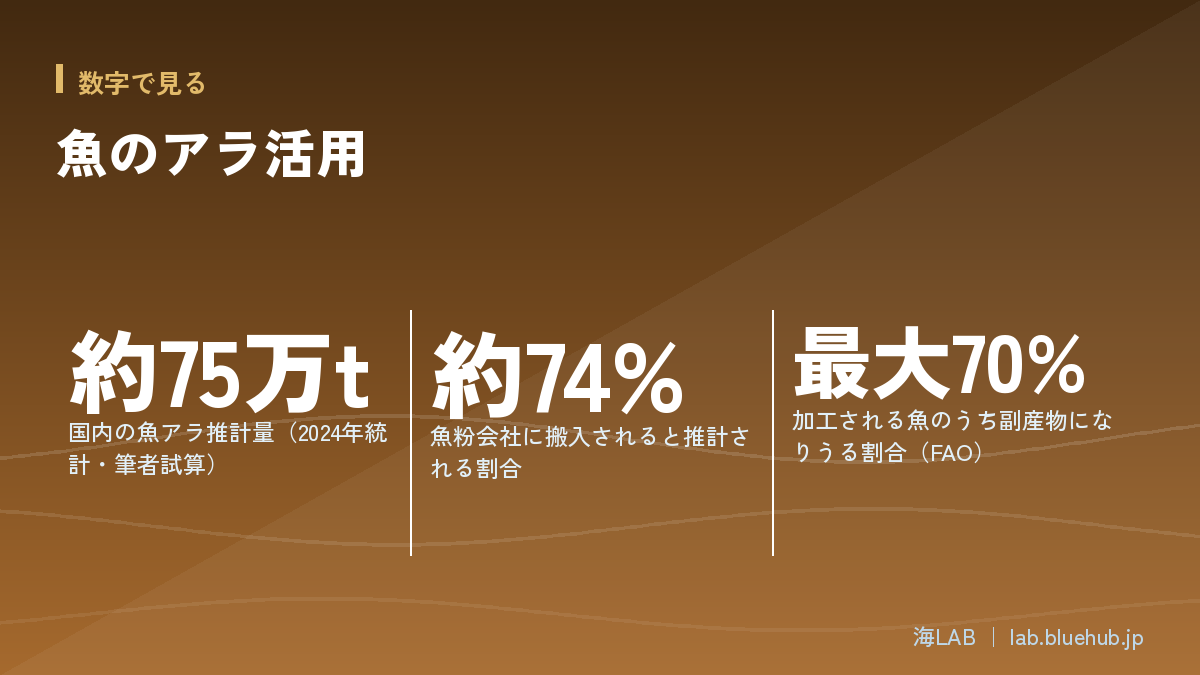
When you eat a fillet of fish, where do the head, bones, skin and guts go? Called "ara" (fish by-products), they are estimated at about 750,000 tonnes a year in Japan alone (an author's estimate based on 2024 data).
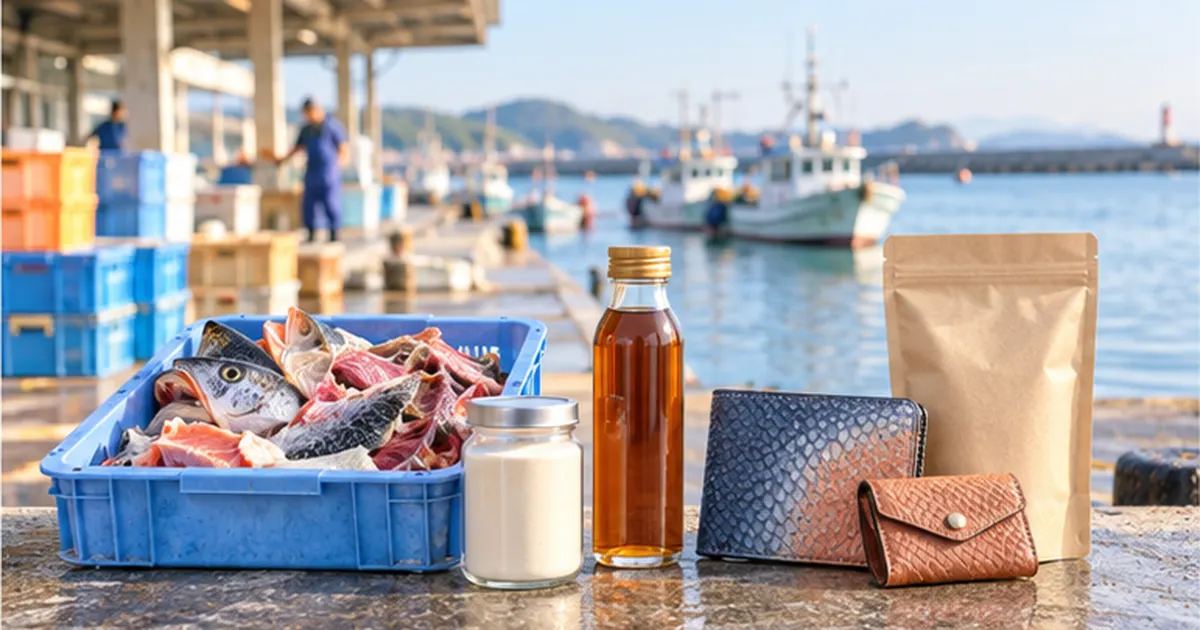
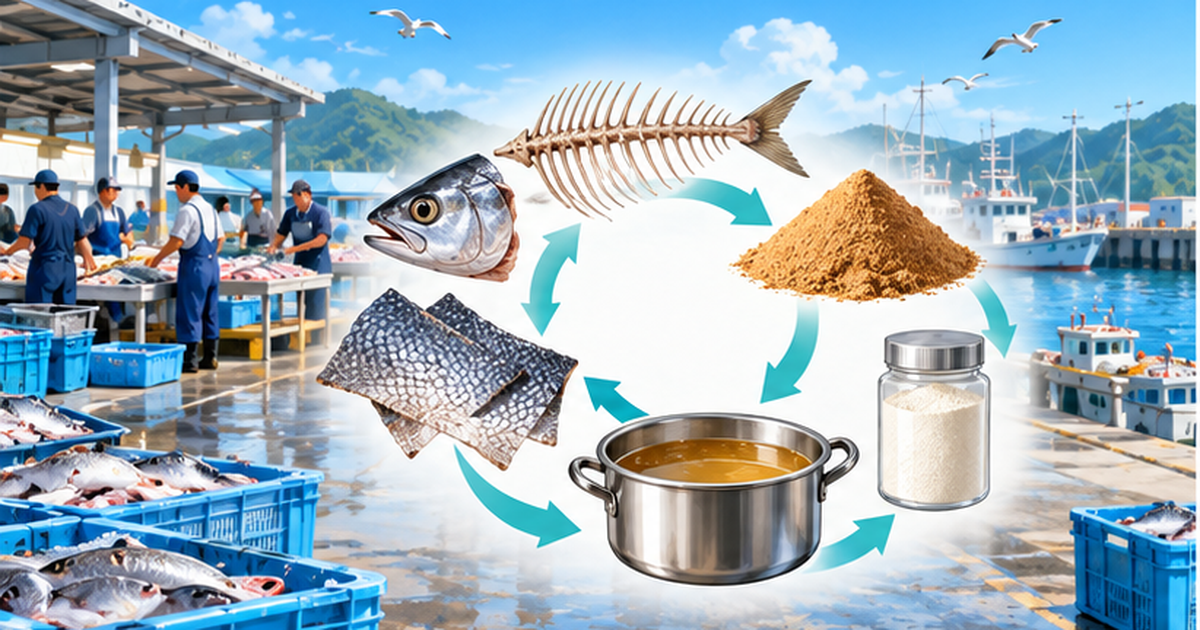
By-products are not simply thrown away. They are used as fishmeal and fish oil for aquaculture feed, as broth and extracts, as collagen and as fertilizer.
This article organizes the sources of by-products, how they are used, the barriers to wider use and what households can do, based on public documents and academic reviews.
What you will learn
- How much by-product each part of a fish produces
- Why fishmeal and fish oil are the largest outlet
- How by-products become broth, collagen, fertilizer and more
- The barriers of freshness, volume and regulation
- How to use up fish by-products at home
What are fish by-products? The discarded portion is bigger than you think
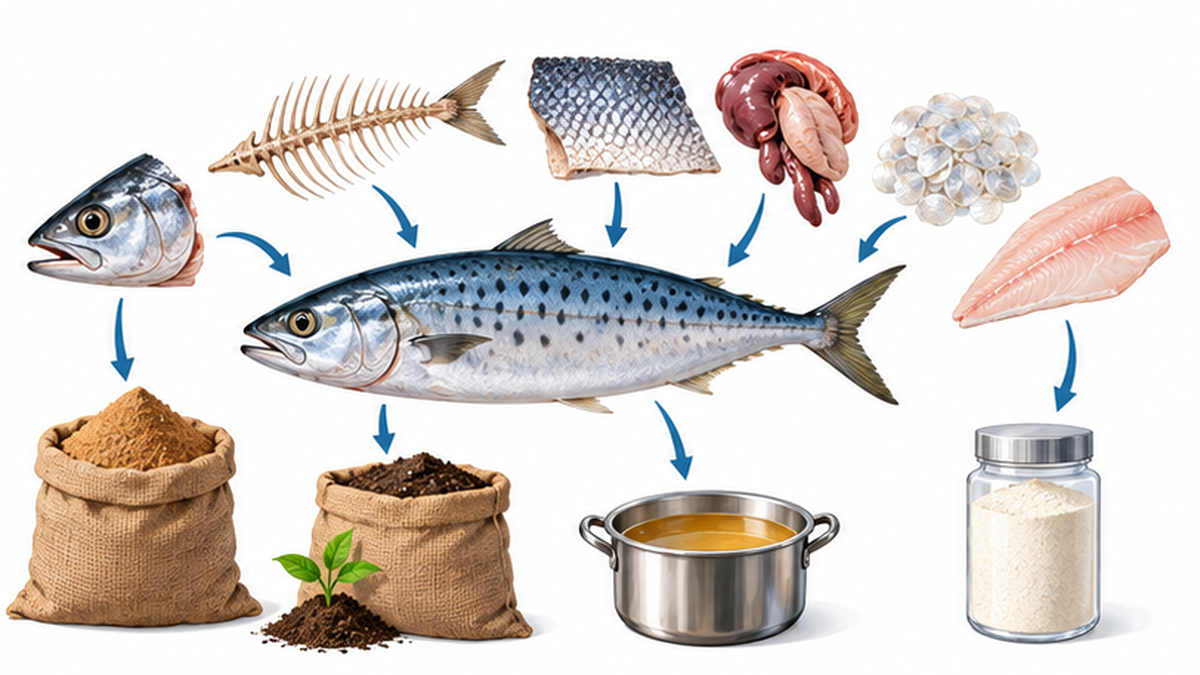
Supermarket fillets, sashimi, canned fish, kamaboko, dried fish. What we eat is really only the "easy to eat" part of a fish. The rest, namely the head, bones, skin, fins, viscera and scales, is called ara or processing residue in the seafood industry. The more a fish is processed, the more by-product is inevitably created.
The volume is far from small. According to an estimate in the trade magazine Ocean Newsletter (Ocean Policy Research Institute, Sasakawa Peace Foundation), seafood supplied domestically excluding shellfish and seaweed is 1.62 million tonnes (2024 data). With an edible yield of 54%, the inedible parts such as heads, bones, skin, fins and viscera come to about 750,000 tonnes. Note that this is the author's estimate and not official statistics from bodies such as the Fisheries Agency.
Rough weight by body part
The share of each part varies greatly with species, size and how the fish is cut. An academic review of collagen peptides breaks down fisheries by-products as follows: heads 9–12% of total weight, viscera 12–18%, skin 1–3%, bones 9–15% and scales about 5%. Taken together, nearly half of a fish's weight is something other than the edible portion.
| Part | Approximate share of total weight | Main characteristics |
|---|---|---|
| Head | 9–12% | Protein, fat, umami components |
| Viscera | 12–18% | Digestive enzymes, fat, protein |
| Skin | 1–3% | Collagen (mainly type I) |
| Bones | 9–15% | Calcium, phosphorus, collagen |
| Scales | about 5% | Collagen, keratin, calcium |
What about the world?
The FAO report The State of World Fisheries and Aquaculture (SOFIA) 2022 states that by-products can account for up to about 70% of processed fish, depending on size, species and processing method (as quoted by IFFO, the marine ingredients organisation). In other words, processing seafood for eating inevitably yields large amounts of by-products.
Highlights of this article
- By-products are not "waste" but a resource containing protein, fat and minerals
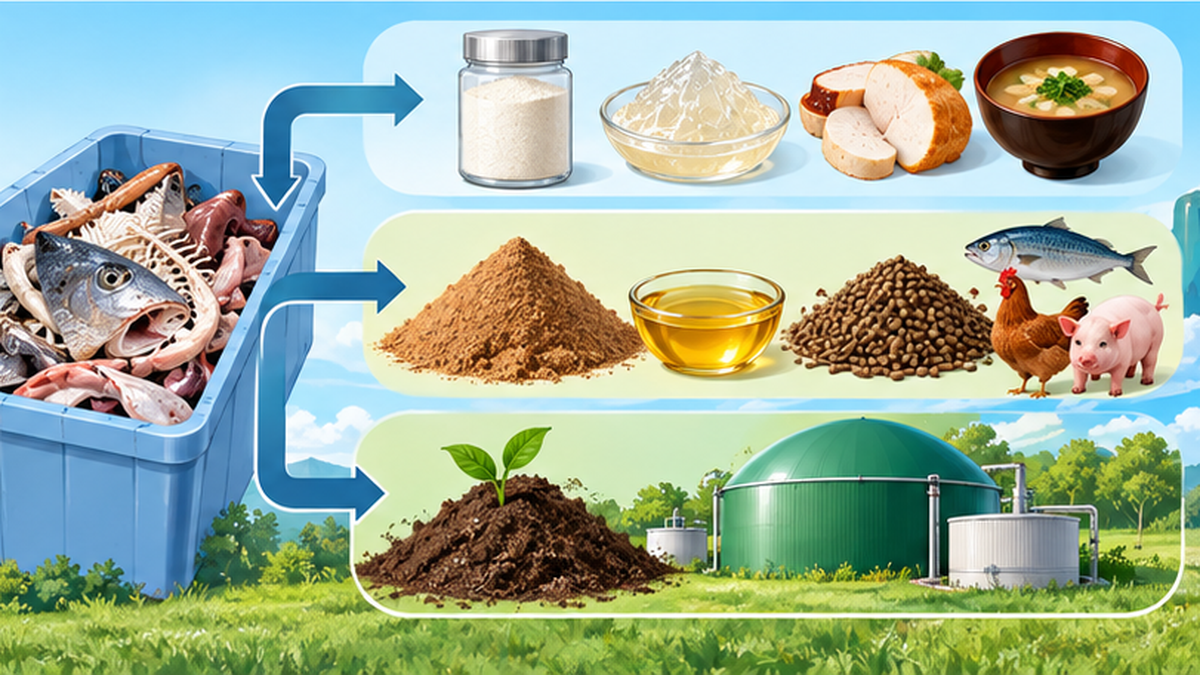
- There are four main destinations: fishmeal and fish oil (aquaculture feed), fertilizer, broth and extracts, and collagen
- Even from the same fish, the destination and value change greatly with freshness and how it is collected
We have also covered by-products from other angles. See What do fish bones, skin and scales become? for collagen, Turning seafood processing residue into a resource for the overall picture in Japan, and Turning bycatch into food.
Where do by-products come from? The source decides the destination
Even among by-products, the nature differs greatly depending on where they come from. Ocean Newsletter divides them into three: from processing plants, from wholesale markets, supermarkets and restaurants, and from households.
By-products from processing plants: large volumes of a single species
Plants making kamaboko, frozen fillets or canned fish handle large amounts of the same species, so the by-product also comes in bulk of a single species. Freshness is easy to maintain, and the standard route is to send it to a nearby fishmeal plant to be made into fishmeal and fish oil. The same article estimates that about 74% of the 750,000 tonnes goes to fishmeal companies.
By-products from markets, retail and restaurants: mixed species
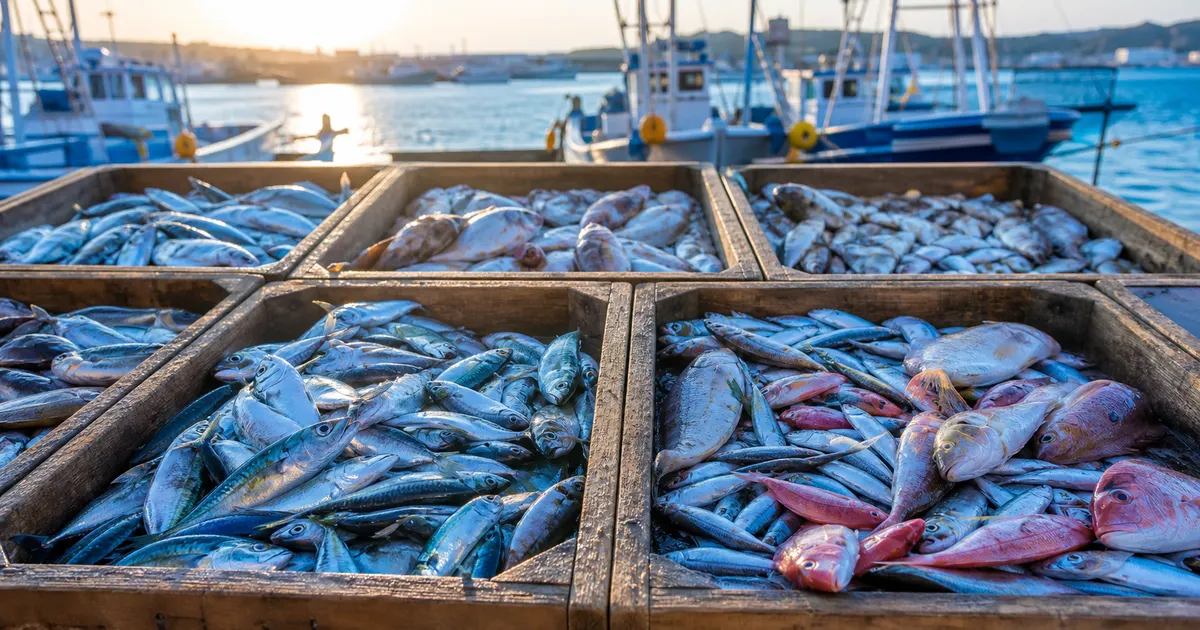
Wholesale markets, supermarket back rooms and restaurants produce small amounts of by-product of mixed species and sizes. Collection takes effort and mixing makes quality hard to stabilize. Still, outlets do exist, such as fishmongers selling by-products to households for fish soup.
Household by-products: mostly burnable waste
Fish bones, skin and heads from home cooking normally enter the municipal incineration route as food waste. The amounts are small each, but multiplied by the number of households they become significant. Some municipalities are working on composting or biogas from food waste.
| Source | Characteristics | Main destinations |
|---|---|---|
| Processing plants | Single species, large volume, good freshness | Fishmeal, fish oil, extracts, collagen raw material |
| Wholesale markets, retailers, restaurants | Mixed species, small amounts | Fishmeal plants, fertilizer, industrial waste treatment |
| Households | Small amounts, scattered | Burnable waste, partly food waste recycling |
The biggest outlet is fishmeal and fish oil: by-products as aquaculture feed
The best-established use of by-products is fishmeal, made by drying and grinding, and fish oil, obtained by pressing. These are used as feed for farmed salmon, yellowtail and sea bream, as well as livestock and pets.
How fishmeal is made
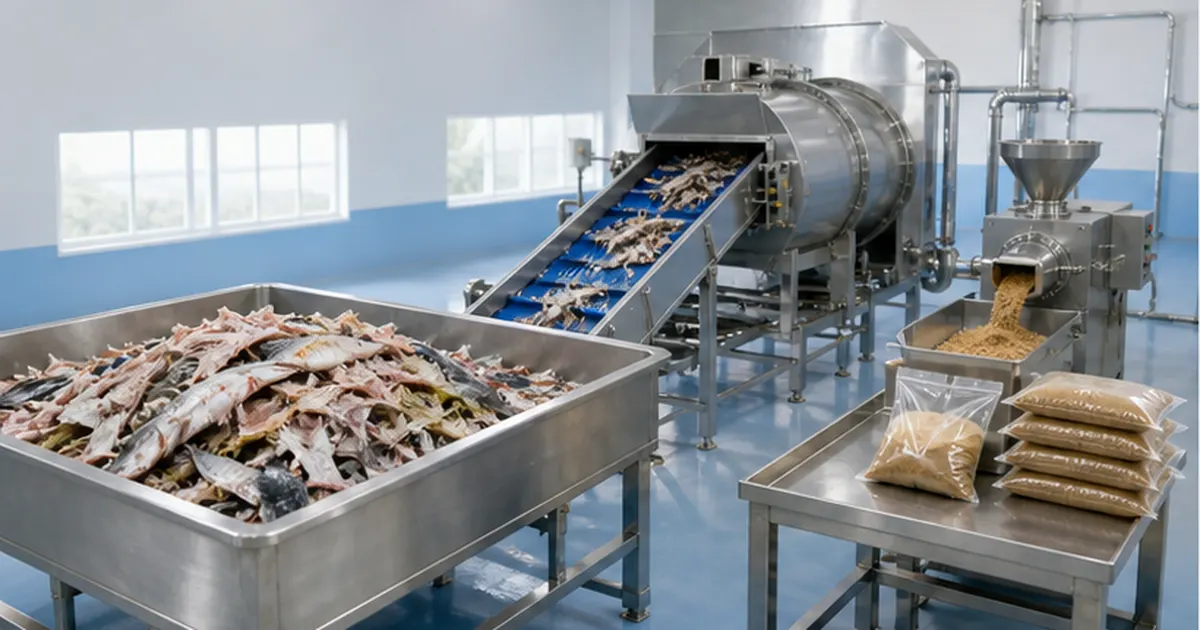
The basic process is crushing, cooking (steaming), pressing to separate water and oil, and drying into powder. A Shizuoka Prefectural Research Institute of Fishery and Ocean Technology document on Yaizu explains that residue from seafood processing plants goes through boiling and solid-liquid separation to be turned into feed, food and organic fertilizer.
Fishmeal, fish oil and the share of by-products worldwide
According to IFFO, the amount of fish used for fishmeal and fish oil peaked at over 30 million tonnes in 1994 and then fell to 16.7 million tonnes in 2022. The share of by-products in the raw material varies by year and source: Seafish (a UK seafood industry body) cites FAO 2020 for 25–35%, while IFFO gives 30% or 42% depending on the source. Years and definitions differ, so they cannot be compared directly, but roughly 30–40% of the world's fishmeal and fish oil raw material comes from by-products of fish processed for human food.
How to read the numbers
- 25–35% (Seafish, citing FAO SOFIA 2020); 30% and 42% (IFFO): sources differ
- Years, regions and definitions differ, so it is safest to think of "around 30–40%" as a range
Challenges of fishmeal and expectations for by-products
Fishmeal made mainly from wild small fish has been criticized for pressure on fish stocks. Directing the by-products of fish already caught and processed for food into fishmeal is a sensible use of resources, and it can reduce the amount of wild small fish newly caught. However, the ratio of protein to ash (bone minerals) changes with species and part, so ways to keep the quality stable as feed are needed.
Broth, extracts and seasonings: drawing out umami
Fish by-products are a treasure trove of umami. The heads, bones and the meat around the backbone contain inosinic acid, amino acids and peptides, and have long been eaten as fish soup and broth. Doing this at factory scale is the processing into extracts and seasonings.
Heat extraction and enzymatic hydrolysis
There are two basic methods. One is hot-water extraction, boiling and concentrating, close to the idea long used in making bonito flakes and the raw material for dashi packs. The other is enzymatic hydrolysis, adding protein-digesting enzymes to break molecules down, which efficiently extracts umami-rich peptides and amino acids. Traditional fish sauce is, in effect, natural enzymatic hydrolysis: fish viscera enzymes and salt ripen the fish over a long time.
Bonito viscera: not food, but "fishing bait"
A Shizuoka Prefectural Research Institute study (fiscal 2024) introduces using extract from bonito viscera (stomach, intestine and pyloric caeca) from seafood processing as an attractant in fishing bait. In tank tests it showed attraction comparable to the conventional bait, Japanese anchovy. Processors want wider uses and higher value, and this is one example of seeking outlets other than food.
Value beyond taste: functional peptides
Research is under way in Japan and abroad on enzyme-digested fish protein, including components expected to help lower blood pressure. However, this is an area where the research stage and the evidence behind each product vary widely. When looking at functional claims, check the ingredient concerned and what the study actually involved.
Using by-products at home
- Blanch fish by-products in hot water to remove odor, then use them for fish soup or broth
- Fry boned flesh into crisp "bone crackers" so you can eat it whole
- If a fishmonger sells by-products cheaply, buy them
Collagen and gelatin: skin and scales add high value
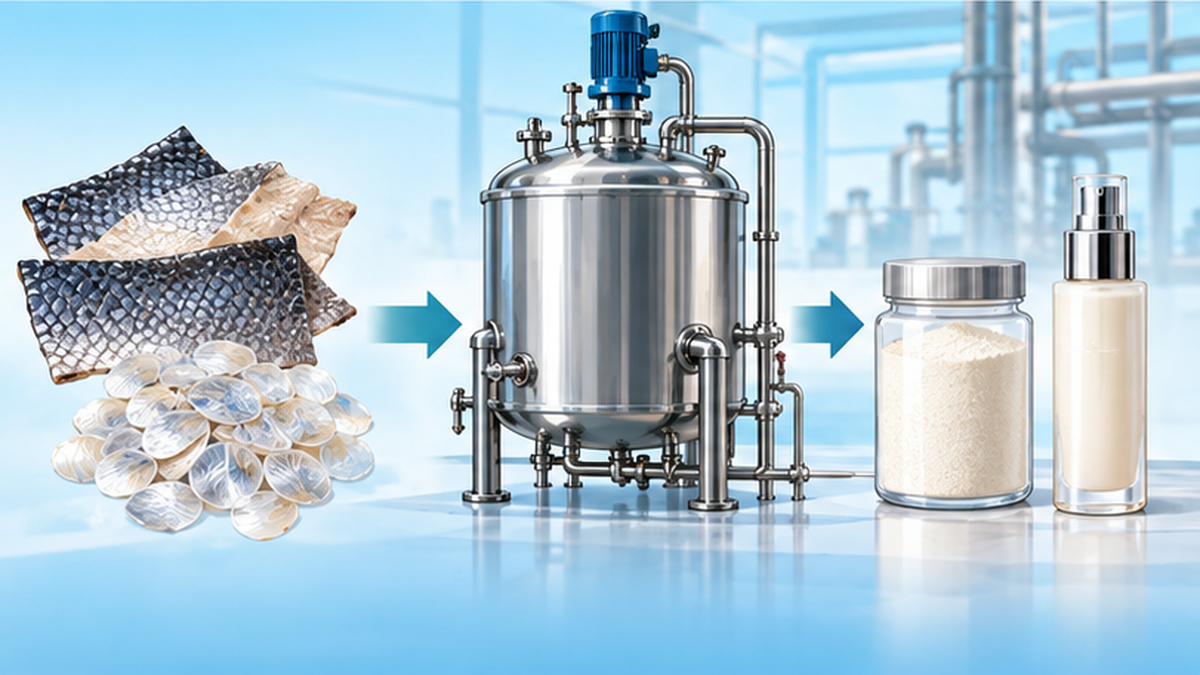
The by-product with the highest potential added value is collagen, found in skin, scales and bones. Academic reviews report that about 70% of fish skin is type I collagen, and that scales are about 70% protein, made up mainly of collagen and keratin.
Three extraction methods
Reviews group the ways of obtaining collagen peptides from fish skin into three: acid or alkali treatment, enzymatic hydrolysis and fermentation. Enzymatic hydrolysis is evaluated as a way to hydrolyze skin without losing nutritional value (this is the view of one review, not an established consensus). Scales contain much calcium, so a decalcification step comes first, and a method using the chemical EDTA has been reported.
Collagen versus gelatin
Gelatin is obtained by partially hydrolyzing collagen, and collagen peptides are the further broken-down form. Fish gelatin is said to cause fewer allergic reactions than gelatin from cattle or pigs and is drawing attention as an alternative in regions with religious dietary restrictions. On the other hand, fish gelatin has a lower melting point, which makes jellies set differently.
| Raw material | Main components | Example products |
|---|---|---|
| Skin | Type I collagen | Gelatin, collagen peptides, cosmetic ingredients |
| Scales | Collagen, keratin, calcium | Collagen, calcium materials |
| Bones | Calcium, phosphorus, collagen | Calcium-fortified foods, fertilizer |
Points to watch
- It cannot simply be said that "fish-derived means safe and highly effective"
- For foods and cosmetics, check ingredient and allergen (fish) labeling
- For products making claims, look into the study behind them
Fertilizer, feed and biogas: closing the loop
Fertilizer, feed and energy use are not high in value but can absorb large volumes.
Fertilizer: a source of nitrogen, phosphorus and calcium
Fish by-products contain nitrogen, phosphorus and bone-derived calcium, and have long been returned to farmland as dried fish meal fertilizer or fermented organic fertilizer. As in the Yaizu example, solids from boiling and solid-liquid separation can go to organic fertilizer. It is a loop returning the nutrients taken from the sea to crops on land.
Fish silage: preserving with acid
Adding organic acids to fish by-products so that they self-digest into a liquid feed is called fish silage. It needs no drying equipment and is easy to adopt even on a small scale. Storage improves, and it can be used as a feed ingredient for livestock and farmed fish.
Biogas: turning it into energy
By-products rich in fat and protein are also good material for methane fermentation. If the gas produced is used for power or heat, it can reduce the fossil fuel burned compared with incineration. However, salt and ammonia in fish affect the fermenting microbes, so adjustments such as mixing with other organic matter are essential.
| Method | Scale of equipment | What is obtained | Suitable material |
|---|---|---|---|
| Fishmeal and fish oil | Large (dedicated plant) | Feed ingredient | Large amounts of single-species by-product |
| Fish silage | Small to medium | Liquid feed ingredient | Fresh by-product |
| Fertilizer | Small to medium | Organic fertilizer | Bones, solids |
| Biogas | Medium to large | Electricity, heat | Mixed with other organic matter |
Barriers to using by-products and ways forward
The technology for using by-products is largely established. They have not spread fully because of barriers other than technology.
Barrier 1: freshness declines quickly
The value of by-products is decided by freshness. Once enzymes in the viscera act, protein and fat degrade in a short time. Small processing plants without enough refrigeration or freezing find them hard to use as raw material unless they are processed immediately.
Barrier 2: small volumes make collection costly
In areas far from ports and for small businesses, the daily volume is small, and transport to a distant plant can cost more than it earns. Mixed species also make it hard to direct them to high-value uses.
Barrier 3: rules and quality standards for each use
To be used as feed or food, safety and quality standards must be met. For feed ingredients, for example, contaminant control and rules on which parts may be used are required. Cosmetics and food also need traceability of raw materials.
Ways forward
- Joint processing in the region:Nearby plants pool their by-products and share refrigeration and primary processing
- Cascading use:Use skin for collagen, bones for calcium and the rest for fishmeal and fertilizer, in order of value
- Opening new outlets:Look for demand beyond food, such as bonito viscera extract as fishing bait
- Understanding among consumers:Choose and buy foods and materials derived from by-products
What we can do: choosing to eat the by-products too
Using by-products is not an issue for businesses and research institutes alone. Consumer choices also widen the outlets.
Three actions at home
- When buying fish, choose whole fish or cuts with the bones as well as fillets, and use them up in fish soup or broth
- Try foods made from by-products, such as bone crackers, fish sauce and dashi packs
- Reduce leftovers. Not wasting the flesh or skin leads to less food loss even before it becomes by-product
Supporting shops and producing regions
Regions and companies selling products made from by-products are gradually increasing. When choosing products, read the explanation of the raw materials and efforts. Choosing seafood with sustainable fishery certification such as MSC is also an action that values the resource as a whole.
Summary
- Fish by-products are estimated at several hundred thousand tonnes a year in Japan alone
- Fishmeal and fish oil are the biggest outlet, with broth, collagen, fertilizer and biogas also growing
- Joint processing and cascading use are overcoming the barriers of freshness, volume and regulation
- Households can start by using by-products up
References and sources
- Ocean Newsletter No. 605 (Ocean Policy Research Institute, Sasakawa Peace Foundation) – Estimated volume of fish by-products and classification by source
- Shizuoka Prefectural Research Institute of Fishery and Ocean Technology, FY2024 results (R6-09) – Use of bonito viscera extract as fishing bait
- Shizuoka Prefectural Research Institute of Fishery and Ocean Technology, FY2023 results (R5-12) – Use of seafood processing residue as feed and fertilizer
- IFFO (The Marine Ingredients Organisation) Marine ingredients – Share of by-products in fishmeal and fish oil raw material
- Seafish: Sourcing fishmeal and fish oil – Share of by-products, citing FAO SOFIA 2020
- Improving the Sustainability of Processing By-Products: Extraction and Recent Biological Activities of Collagen Peptides – Share of fisheries by-products by part and collagen peptides
- A Review on Fish Skin-Derived Gelatin – Review of fish skin gelatin and peptides
- FAO The State of World Fisheries and Aquaculture – FAO report on world fisheries and aquaculture
※ Listed in order of reliability: government and academic institutions > peer-reviewed papers > specialist organizations > reliable media