⚡ The answer in 30 seconds
- Nylon 6 from discarded fishing nets can be returned to caprolactam by depolymerization and regenerated into thread of near-new quality.
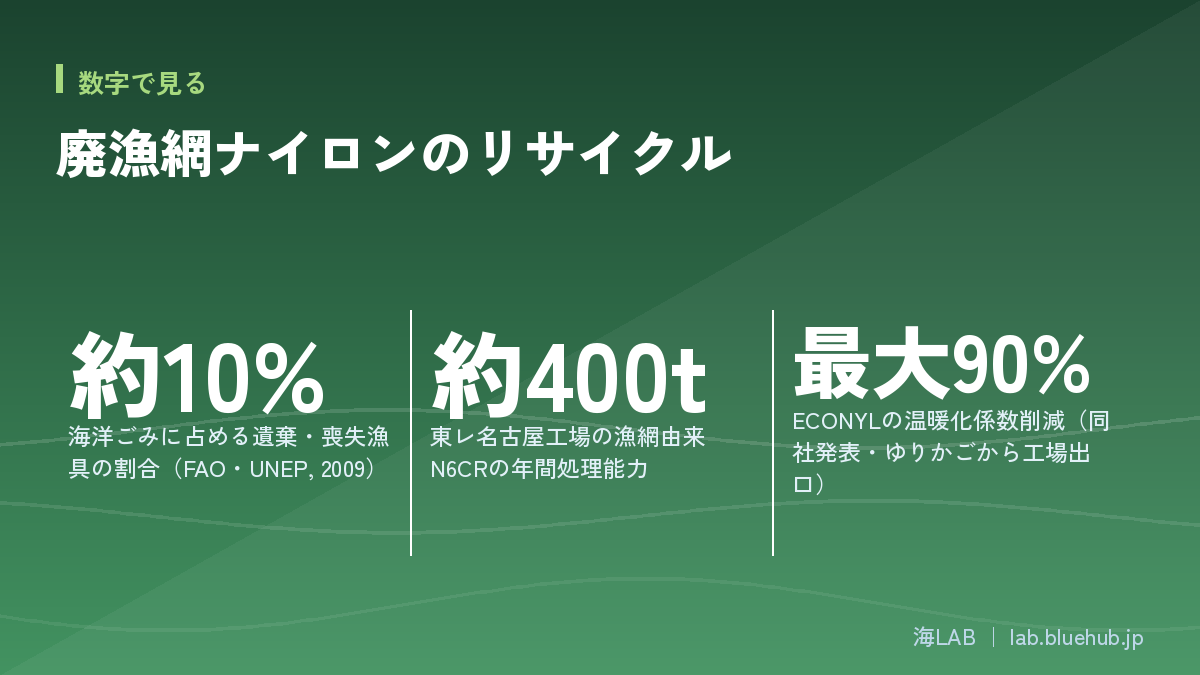
- In 2022 Toray announced N6CR from fishing nets and set up capacity of about 400 tonnes a year at its Nagoya Plant.
- Challenges are cooperation in collection, foreign matter removal, mixed materials, cost, and transparent evaluation of environmental effects.
Most fishing nets are made of durable nylon, and they remain almost undecomposed after use. Turning that property around, efforts to break nets down at the molecular level and regenerate them into new thread are spreading.
This article organizes the chemistry of depolymerization, concrete cases from Toray and Aquafil, and challenges in collection and sorting, based on publicly available primary information.
Note that environmental figures include company announcements. Sources and premises are shown so that readers can distinguish the scope of each evaluation.
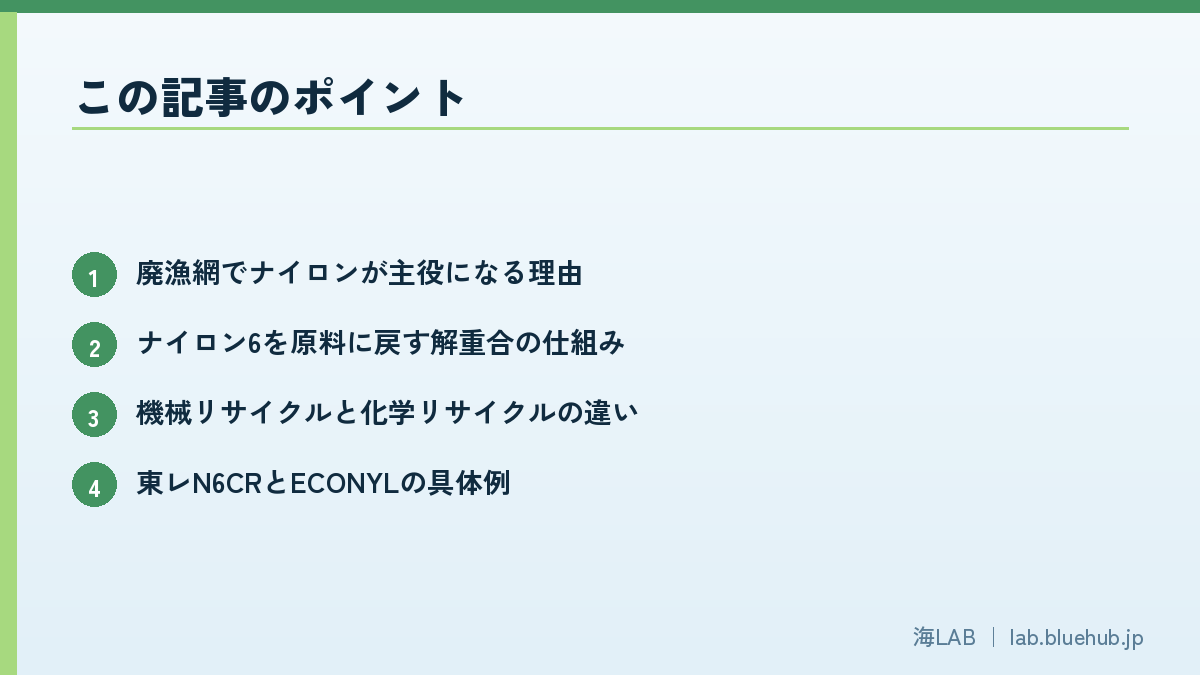
What you will learn in this article
- Why nylon is the star of discarded nets
- How depolymerization returns nylon 6 to raw material
- Mechanical vs. chemical recycling
- Toray N6CR and ECONYL cases
- On-site challenges in collection, sorting, and cost
Why Discarded Fishing Nets Are a Mountain of Nylon Resources
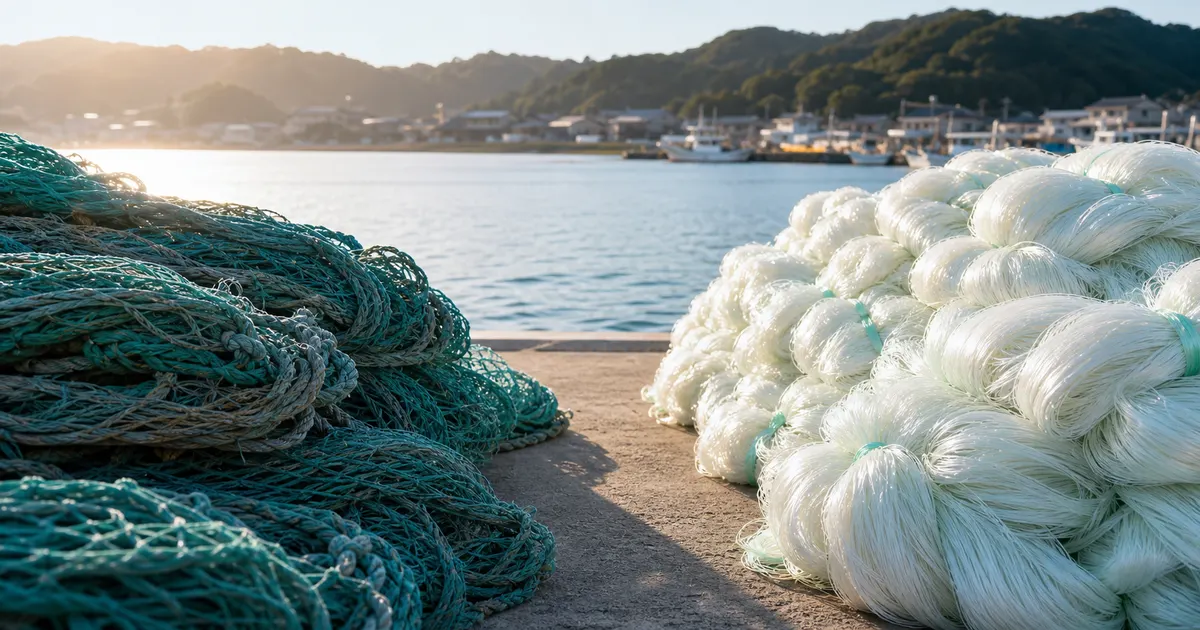
Most fishing nets are made of synthetic fibers that are light, strong, and do not rot when wet. Nylon (polyamide) is widely used in gillnets, set nets, and purse seines, while ropes also use polyethylene and polypropylene. Nylon is a standard net material because of its balance of strength and price. That same durability becomes a nuisance once the gear is discarded.
Seen another way, used nets are a valuable material: large amounts of a uniform polymer. Unlike household plastic waste, nets are made of the same type of fiber, so recycling is more efficient when the composition is consistent. This article explains what nylon from discarded nets can become, covering both the chemistry and the challenges on the ground.
Main Materials Used in Fishing Nets
| Material | Main use | Characteristics |
|---|---|---|
| Nylon 6 / Nylon 66 | Netting for gillnets, set nets, purse seines | High strength and elasticity; absorbs water |
| Polyethylene (PE) | Netting, rope, floats | Light and floats on water; easy to recycle |
| Polypropylene (PP) | Rope, aquaculture materials | Light, with high chemical resistance |
| Polyester | Some nets and ropes | Weather resistant and low stretch |
| Lead / metal | Sinkers, wire-core rope | Must be separated, or it hinders recycling |
The Strengths of Nylon as a Fiber
Nylon was put to practical use in the 1930s as one of the world's first synthetic fibers. It resists tension and abrasion, is light, and dyes easily. It suits fishing nets because it rarely breaks when pulled repeatedly underwater and keeps its strength even in thin threads, making nets harder for fish to see. In clothing it is used for stockings, swimwear, and outdoor wear, where strength and thinness are both needed.
However, nylon stretches when wet and also degrades under ultraviolet light and heat. Fishing nets are consumables replaced every few years, so a fair amount becomes waste every year. Used nets come out mixed with seawater, dirt, attached organisms, and oil, so washing and sorting are essential for recycling.
Is the Material Itself Degraded?
Even nets used at sea often have polymers that are not badly damaged, so they can be recycled with proper pretreatment. By contrast, nets left for long periods in the sea or on beaches are broken into small pieces by ultraviolet light and waves, making collection and recycling difficult. The earlier a net is collected, the more valuable it is as a resource, which is why recycling and loss prevention are linked.
Why Nylon Is the Target
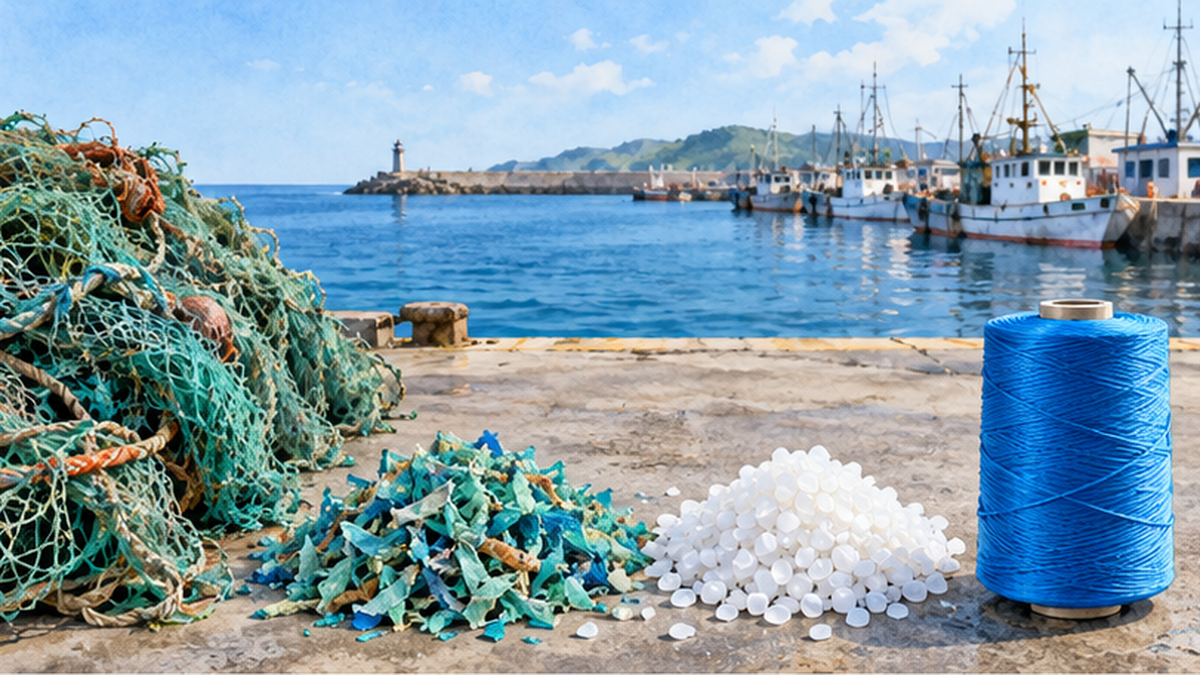
There is a reason recycling focuses mainly on nylon nets. Nylon 6 can be chemically broken down to its monomer and polymerized again. This opens a route to making nylon of new-product quality from old nets.
Key Points of This Section
- The main fishing net materials are synthetic fibers such as nylon, PE and PP
- Nylon 6 can be broken down at the molecular level and regenerated to new-product quality
- Uniform nets are better suited to recycling than other plastic waste
Fishing Gear Flowing into the Sea: The Background in Numbers
Recycling attracts attention because of gear lost in the sea. A 2009 report by the Food and Agriculture Organization (FAO) and the United Nations Environment Programme (UNEP) estimated that abandoned, lost, or discarded fishing gear makes up about 10% of marine litter, roughly 640,000 tonnes. FAO explains that much gear is lost to storms, strong currents, and tangling with other gear, and that long-lasting synthetic materials prolong the problem.
The Damage of Ghost Fishing
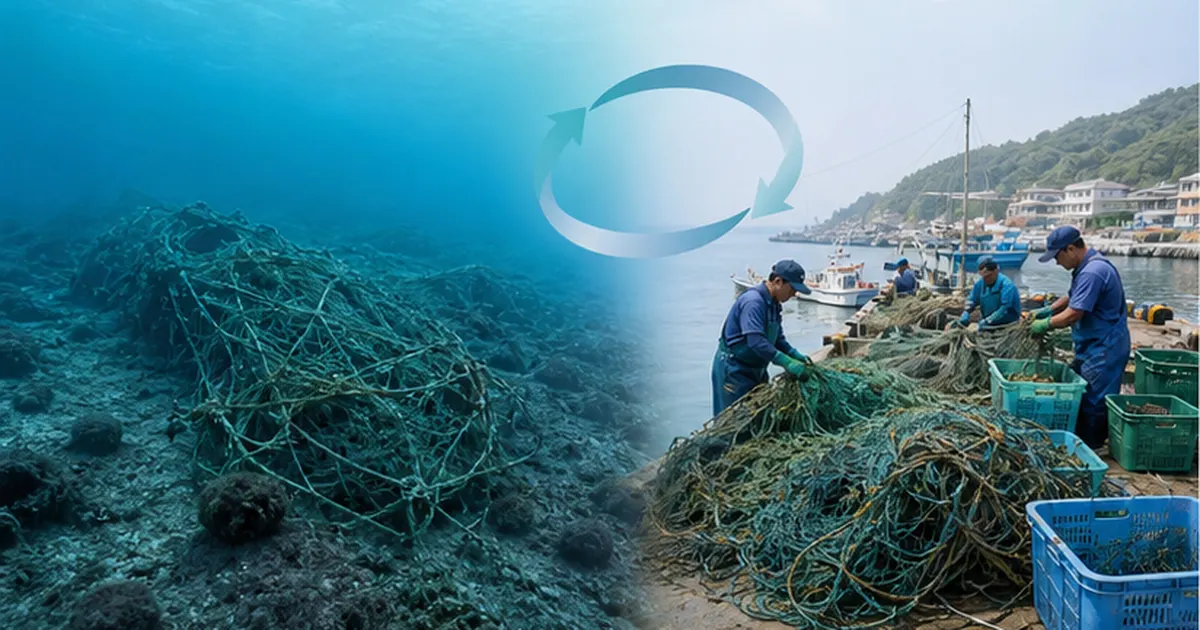
The phenomenon in which nets left at sea keep catching fish, seabirds, and sea turtles is called ghost fishing. According to UNEP, a lost gillnet can keep fishing for months or even years. The mechanism is covered in our article on ghost gear.
Beached Debris and Fishing Nets in Japan
In Japanese Ministry of the Environment surveys of beached debris, discarded fishing nets and ropes reportedly accounted for about 40% of the weight of plastic debris washing ashore in fiscal 2016. There is also a report that fishing gear accounts for about 30% of marine plastic debris in Japan by weight. Figures vary with survey sites and years, but it is common that gear makes up a large part of marine debris.
Degraded Gear Can Also Become a Source of Microplastics
Gear left in the sea gradually breaks into smaller pieces through waves, ultraviolet light, and friction with rock and sand, and is pointed to as one source of microplastics. Fibrous fragments are almost impossible to collect, and the possibility that organisms take them in is under discussion. This is why collecting nets before they fragment is so significant. Some effects are still being researched and cannot be stated definitively, but a precautionary approach to collection is spreading internationally.
Notes on Reading the Numbers
- The 640,000 tonnes from FAO and UNEP is a 2009 estimate and does not directly show later annual outflows
- We could not find a primary statistic for the annual volume of discarded fishing nets in Japan, so this article does not treat estimates as definitive
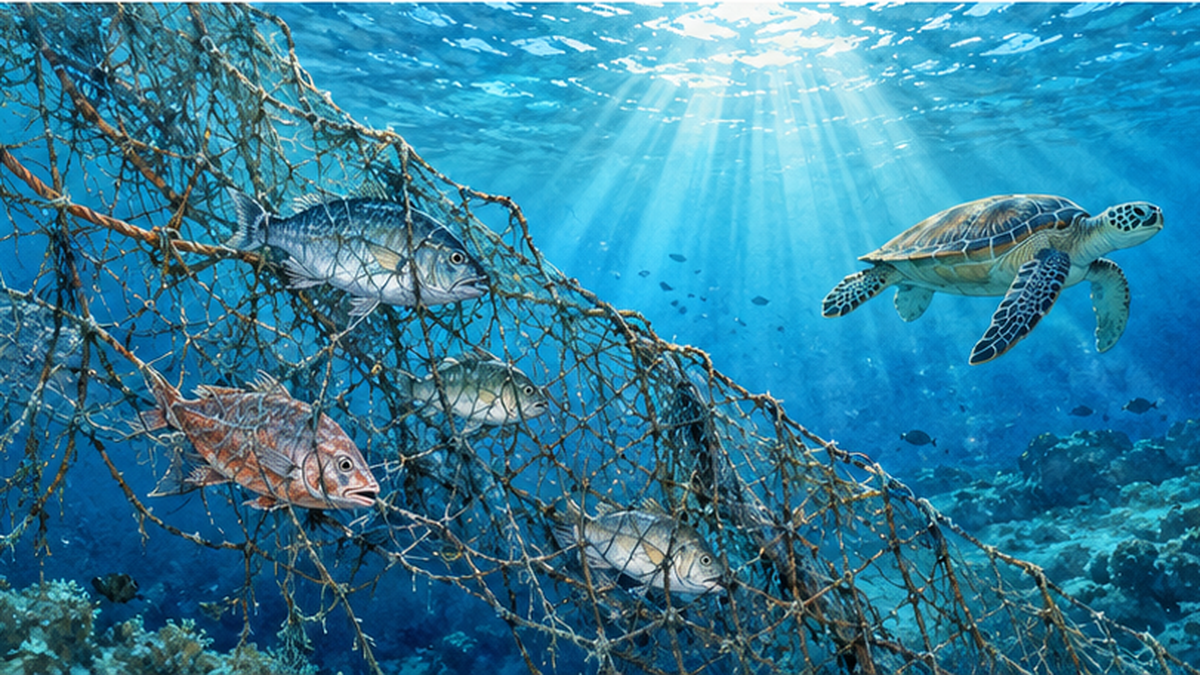
The first step in reducing such damage is not letting gear escape and reliably collecting used nets. If recycling is in place as a destination for collected nets, it also creates an incentive to collect.
The Chemistry of Nylon 6: Why It Can Be Broken Down and Returned
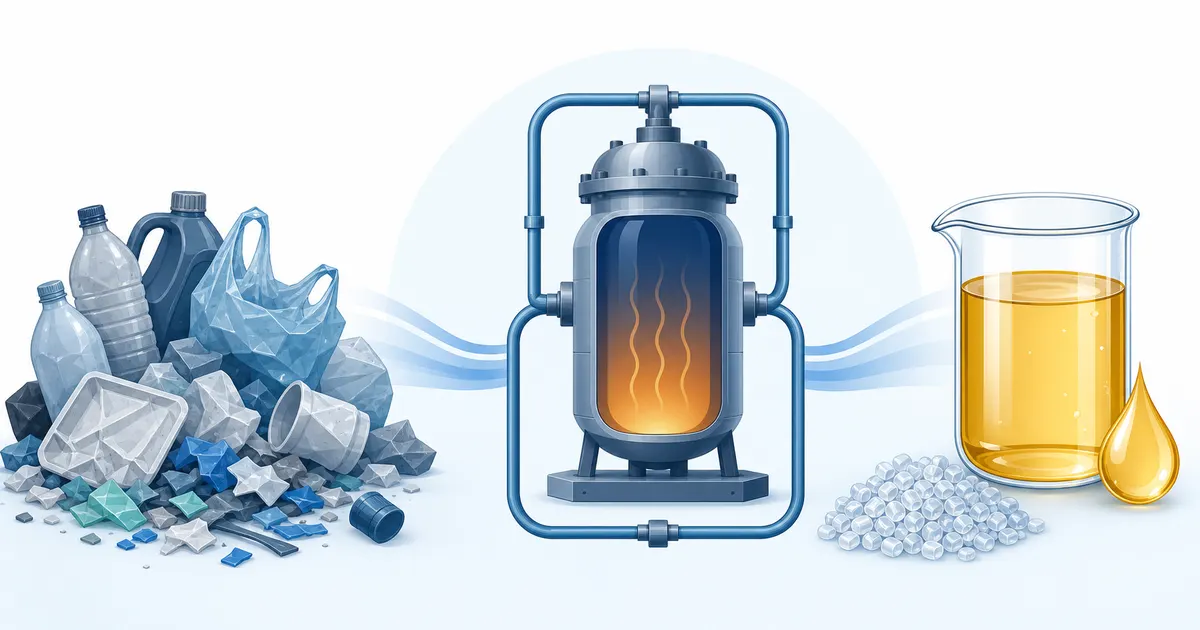
Nylon 6 is a polymer (polycaprolactam) in which a ring-shaped molecule called ε-caprolactam is linked in chains. The linking reaction is called ring-opening polymerization. Conversely, cutting the links with heat, a catalyst, or steam returns caprolactam. This reverse reaction is depolymerization.
Mechanical Recycling vs. Chemical Recycling
| Aspect | Mechanical recycling | Chemical recycling (depolymerization) |
|---|---|---|
| Process | Wash, crush, melt, and pelletize | Break down molecules to raw material and repolymerize |
| Quality | Chains tend to shorten with each melting | Can aim for new-product quality after purification |
| Tolerance of contaminants | Easily affected by impurities | Impurities easier to remove by purification |
| Energy and equipment | Relatively simple | Needs high-temperature treatment and purification equipment |
| Main uses | Molded parts, fishing gear and other resin products | Clothing and industrial fibers requiring high quality |
Mechanical recycling needs simple equipment and is cheap, but its weakness is that quality falls when repeated. Chemical recycling needs larger investment but can serve uses such as fibers that demand high quality. Rather than one being better, using each according to the use and condition of the collected material is realistic.
The Steps of Depolymerization
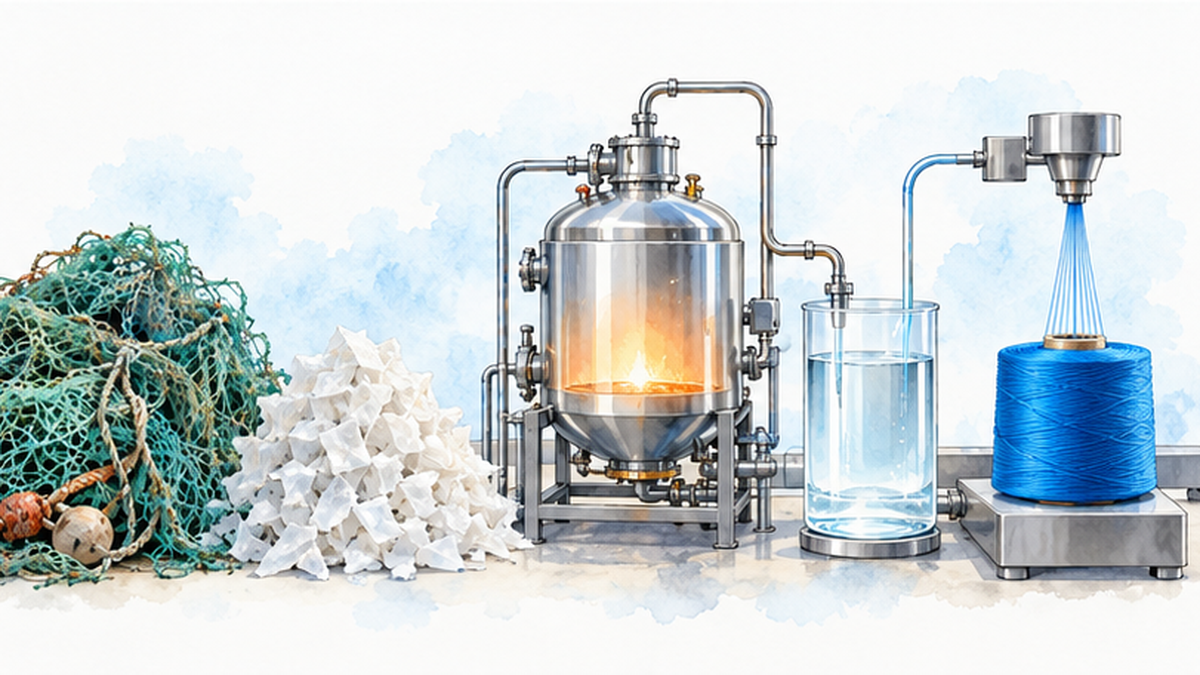
- Put crushed and washed nets or resin into a reactor
- Cut the amide bonds (the links of the chain) with heat and a catalyst, or steam or subcritical water
- Caprolactam is taken out as vapor or solution
- Purify by distillation or similar to remove impurities (dyes, additives, foreign materials)
- Polymerize the purified caprolactam again into nylon 6 resin
- Melt and extrude into fine thread (fiber)
What most affects quality is the purification step. If impurities remain, problems occur such as molecular weight not rising, cloudy color, and weak thread. Conversely, because purification can remove impurities, even dirty or colored waste may be returned to near-new quality. This is the greatest advantage of chemical recycling.
The Reality of Energy and Cost
Depolymerization requires high-temperature treatment and large equipment. If the recycled volume is small it is hard to make a profit, so a stable supply of raw material is a condition for the business. Toray's installing equipment of about 400 tonnes a year and giving sales targets of hundreds of millions of yen can be read as a plan conscious of this break-even line.
Note: The Word Caprolactam
- The small ring-shaped molecule (ε-caprolactam) that is the raw material of nylon 6
- Recycled product is called recycled lactam and can be handled in the same polymerization process as new material
- This property is why nylon 6 is easy to circulate
Nylon 66 Does Not Work the Same Way
Even among nylons, nylon 66 is made from two raw materials, hexamethylenediamine and adipic acid, and does not return to caprolactam. Because identifying the material affects the recycling method, sorting at collection is important.
Section Summary
- Nylon 6 can be returned to caprolactam by depolymerization
- Mechanical recycling is easy but tends to lower quality
- Chemical recycling gives high quality but needs equipment and purification
Cases in Japan: Toray's N6CR and Chemical Regeneration
As a concrete domestic example, on December 5, 2022, Toray announced sales in the Japanese market of "N6CR", a chemically recycled nylon 6 fiber made from discarded fishing nets. It combined resin from Refineverse Group, a company that makes regenerated resin from collected nets, with Toray's depolymerization and repolymerization technology, with a rollout planned from March 2023.
Nagoya Plant Equipment and Sales Plan
- New input equipment for recycled resin and storage tanks for recycled lactam at the Nagoya Plant
- Processing capacity of about 400 tonnes a year
- Sales targets of about 800 million yen in the fiscal year ending March 2023 and about 1.2 billion yen in the year ending March 2025
- Intended uses are thin, high-function materials such as sportswear, outdoor wear, innerwear, and legwear
An important point is that recycled lactam is repolymerized in the same process as new raw material. The final yarn is likely to be more stable in performance than mechanically recycled products.
Recycled Yarn Uses and Required Quality
Recycled nylon yarn for thin garments that touch the skin needs uniform thickness and dyeability. Chemically recycled material can pass through the same process as new raw material, which is an advantage in quality. Toray naming thin materials such as sports, innerwear, and legwear as intended uses is thought to reflect some confidence in the quality of the recycled product. Where recycled yarn costs more than new, development centers on customers who value brand and environmental consideration.
Expansion into Auto Parts: Toray and Honda
Chemical recycling of nylon 6 is not limited to fiber. Toray and Honda are jointly developing a technology to depolymerize glass-fiber-reinforced nylon 6 auto parts with subcritical water and return them to caprolactam. It was selected for a Ministry of the Environment project, and verification at a pilot facility of about 500 tonnes a year was planned. This is an example of the nylon 6 regeneration approach cultivated with fishing nets spreading to other fields.
See also the overview of discarded net recycling and ECONYL product examples.
An Overseas Example: The ECONYL Circular Model
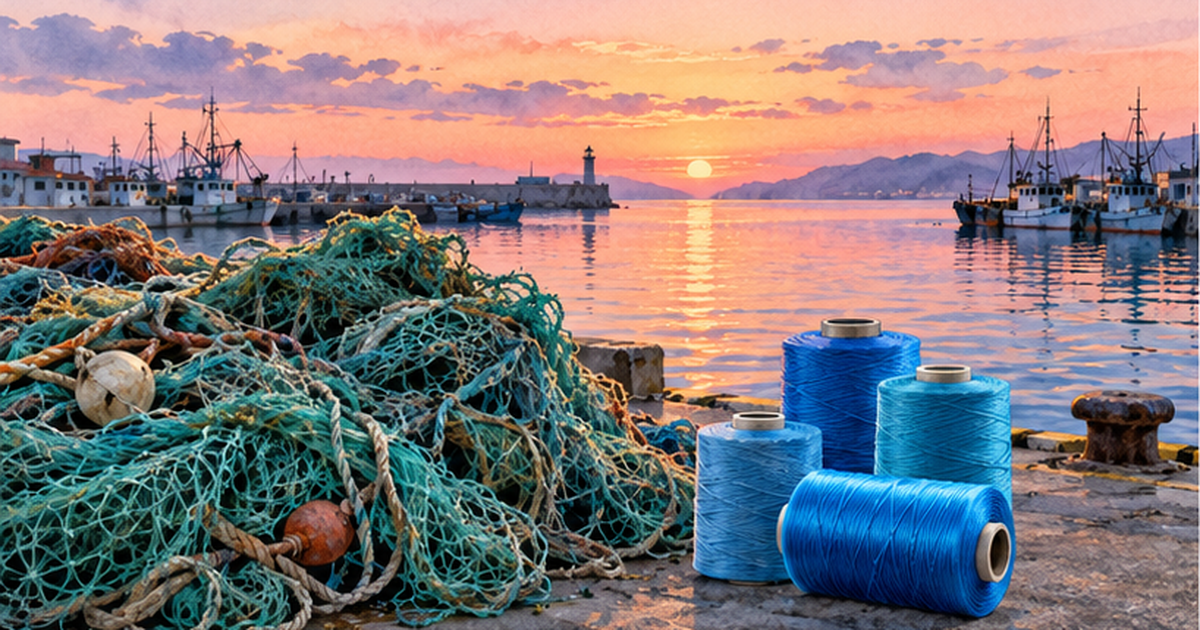
A leading example that spread nylon 6 recycling from discarded nets worldwide is ECONYL from Italy's Aquafil. The company began its regeneration process in 2011 at its Ljubljana plant in Slovenia. It describes a six-step loop: collecting nylon waste such as nets and carpet scrap, depolymerizing it back to caprolactam, and polymerizing it again as nylon 6.
How to Read the Environmental Figures
In its 2019 Sustainability Report, Aquafil states a reduction of global warming potential of up to 90% compared with virgin (petroleum-based) nylon. Meanwhile, an article by the UK seafood body Seafish describes it as "up to 80%", so figures differ by source. The company's LCA covers cradle to gate, and it states that processes after use are outside its scope.
Read Company Figures with Their Conditions
- The reduction rate depends on the evaluation scope (cradle to gate) and the comparison baseline
- A value described as "up to" is not necessarily achieved in all conditions
- Check whether and to what extent there is third-party verification
Brands and Uses
Recycled nylon is used in swimwear, sportswear, carpets, bags, and more. Even recycled products are valued for easily obtaining strength and feel similar to new. On the other hand, recycled yarn tends to cost more than new, so the balance of cost and brand value is the key to adoption. Product examples are also in our Bureo NetPlus article.
Securing a Collection Network Is the Foundation
An important point the ECONYL case shows is not the recycling technology itself but a system to keep collecting the waste used as raw material. Stable supply is possible only with a collection network working with fishers, ports, and aquaculture operators. In Japan too, manufacturers, trading companies, fishing cooperatives, and municipalities are gradually cooperating in their respective roles. Building a network takes time, but once built it is easy to extend to other materials and regions.
The Flow from Collection to Regeneration and On-Site Challenges
Recycling starts with collection and sorting. Used nets gather at fishing cooperatives and ports, are transported, have foreign matter removed, and are then turned into resin and regenerated. In Japan, corporate-led collection is spreading: Toyota Tsusho announced it began trial collection of discarded nets in the Sotobo area of Chiba Prefecture from July 2023.
The Flow as a List
- Collection and storage at fishing ports and cooperatives
- Sorting by material (nylon, PE, PP, etc.)
- Removal of foreign matter such as rope, weights, and hooks
- Washing, cutting, and crushing
- Resin pelletizing or depolymerization
- Processing into recycled thread and resin products
What the Obstacles Are on Site
- Cooperation in collection: Getting fishers nationwide to know about the effort and cooperate is itself said to be a challenge
- Labor of removing foreign matter: Removing debris, hooks, and swivels tangled in nets takes enormous labor
- Mixed materials: Materials other than nylon and lead-weighted ropes need different treatment. For lead-weighted rope, examples such as pyrolysis into oil are shown
- Transport cost: Light, bulky nets are inefficient to transport far
- Unclear material labeling: It is hard to tell which material a net is, so sorting judgments take skill
Sorting: What Goes Where
| Collected item | Suitable treatment | Notes |
|---|---|---|
| Nylon 6 netting | Fiber regeneration by depolymerization / resin | Foreign matter removal is the most important for fiber use |
| Nylon 66 / blends | Mechanical recycling or other methods | Does not return to caprolactam |
| PE / PP rope | Mechanical recycling | Floats on water by density, so easy to sort |
| Lead-weighted or metal-attached | Consider separating metal, then pyrolysis, etc. | Care is needed in handling lead |
| Heavily degraded or contaminated | Energy recovery or proper disposal | May not suit regeneration |
Policy and Business: How to Turn Collection into a System
To keep recycling from remaining the effort of a few advanced companies, cost burden and responsibility must be settled. In recent years, the introduction of extended producer responsibility (EPR), under which gear makers take responsibility for collection and recycling after use, has been discussed internationally. Details are summarized in our article on EPR for fishing gear.
Mechanisms That Support Collection
- Label gear with material names and collection methods to reduce sorting effort
- Make transport efficient with collection points and regular pickups at each cooperative
- Decide how collection costs are shared among municipalities, companies, and fishers
- Secure buyers of recycled material (apparel, automotive, etc.) first
Regional Viewpoints on Promoting Collection
Gear types, fishery scale, and distance to ports differ greatly by region. Rather than a uniform nationwide system, it is realistic to start in regions that handle much recyclable nylon netting and spread by sharing results. Deciding in advance who bears collection costs and how sales of recycled products are returned makes efforts last longer.
What Consumers Can Do
What we can do directly is limited, but choosing products made of recycled material helps support the economics of collection. However, do not assume recycled material is automatically better for the environment; consider durability and collection at disposal. Using things for a long time and returning them for collection when finished saves the most resources in the end.
Checkpoints Readers Can Verify
- The share of recycled material (100% or partly mixed)
- The origin of raw material (discarded nets, carpet, factory scrap, etc.)
- The evaluation scope of environmental effects and whether third-party verification exists
- Whether a system exists to collect the product after use
What You Can Do from Today
- When choosing recycled nylon products, check the explanation of material origin and the collection system
- Use things for a long time, and take unneeded items to stores with a collection route
- If you find fishing gear while fishing or diving, do not forcibly pull it up; contact the municipality or fishing cooperative
Future Challenges and Outlook
Nylon recycling from discarded nets is feasible as a technology. The challenges come down to four: stable raw material supply, efficient sorting, lower cost, and transparent evaluation of environmental effects.
Technical Outlook
Work is under way on improving depolymerization efficiency and on methods that treat material under gentler conditions, such as subcritical water. Designs that sort mixed-material nets and treat each material by its best method will also be important.
Transparency of Evaluation
The environmental effect of recycled material changes with the scope and comparison baseline. Publishing the content of third-party verification and showing evaluation that includes after-use stages is the basis of trust.
From the Viewpoint of Protecting the Sea
Recycling is an end-of-pipe measure. The risk to the sea falls only when preventing gear loss at the entrance, not leaving gear behind, and designs that are easy to collect are combined with it.
Summary
- Discarded nets are a uniform material centered on nylon 6, with high recycling value
- Depolymerization can regenerate thread of near-new quality
- Challenges are collection, sorting, cost, and transparent evaluation
- Both loss prevention at the entrance and recycling at the exit are needed
References
- FAO | Ghost nets hurting marine environment (2009) – Abandoned, lost or discarded fishing gear estimated at about 10% of marine litter, about 640,000 tonnes
- Toray | Domestic sales of chemically recycled nylon 6 fiber from fishing nets (overview) – N6CR, about 400 tonnes a year, Nagoya Plant (announced December 2022)
- Toray to recycle plastic from fishing nets (ecotextile) – News report on Toray's fishing net regeneration project
- Toray, Honda Motor to Jointly Develop Chemical Recycling Technology – Joint development of depolymerization of nylon 6 using subcritical water
- Aquafil | Better recycling through chemistry – Explanation of the ECONYL regeneration process (company information)
- Aquafil | LCA ECONYL polymer – Third-party verified LCA (cradle to gate)
- Seafish | Aquafil's ECONYL yarn – End-of-life fishing gear management and ECONYL introduction
- Toyota Tsusho | Trial collection of discarded fishing nets (2023) – Collection started in the Sotobo area, Chiba Prefecture
- Ministry of the Environment, Japan | Marine litter materials – Share of fishing gear in beached debris, etc.
* Ordered by reliability: government and academic institutions > peer-reviewed papers > specialist bodies > reliable media