⚡ In short
An estimated 640,000 tonnes of fishing nets are lost at sea every year. Aquafil's ECONYL® chemically regenerates them into Prada Re-Nylon bags, Healthy Seas Socks, and Interface carpet tiles. This article explains the circular system behind it, including Japan's own move toward mass production with Itochu and two domestic net makers.
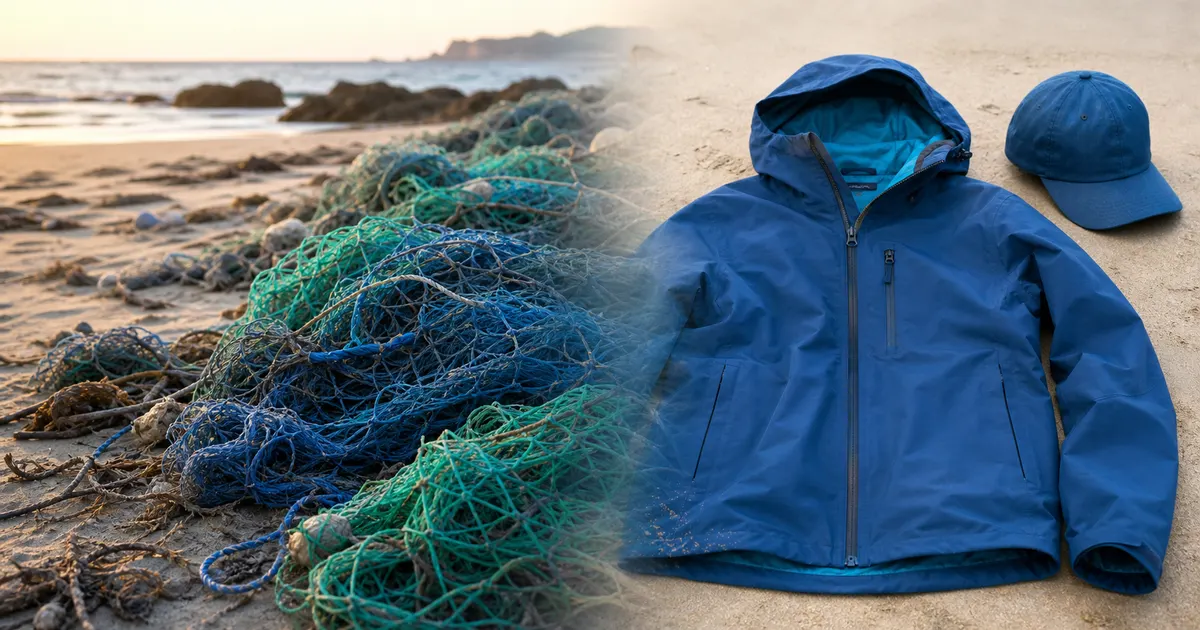
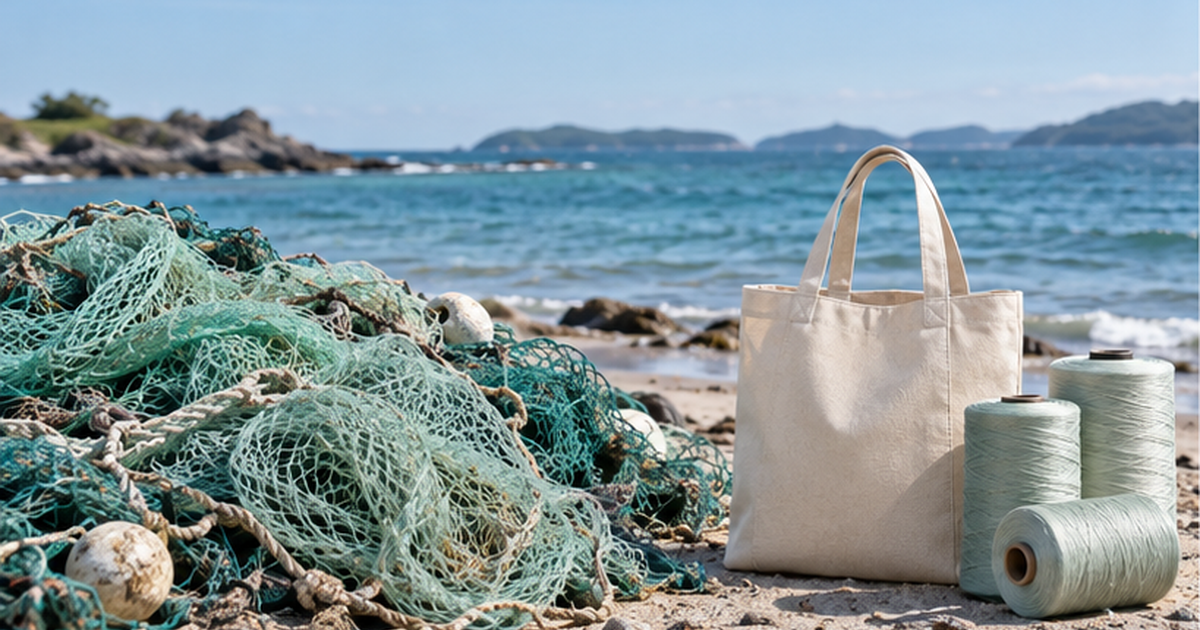
Luxury handbags, sportswear swimsuits, carpet tiles on an office floor. These products seem to have nothing in common, yet some of them are made from fishing nets that were once thrown away at sea. The raw material is ECONYL®, a regenerated nylon developed by the Italian chemical company Aquafil.
An estimated 640,000 tonnes of fishing gear is abandoned or lost in the ocean every year. Known as "ghost gear," it has long entangled and killed fish and sea turtles. ECONYL® turns this troublesome waste into a high-quality resource. More than 2,500 brands worldwide already use it, and in 2024 the Japanese trading house Itochu and two Japanese net makers began mass-producing regenerated fishing nets themselves.
This article explains the chemical process ECONYL® uses to turn fishing nets back into nylon, who collects the nets from the sea, and what real products they become, using examples from actual companies.
What you'll learn in this article
- Why discarded fishing nets keep harming marine life as "ghost gear"
- The chemical process ECONYL® uses to regenerate waste nets into nylon as good as new
- The roles played by organizations from Healthy Seas to Itochu Corporation, from collection to finished products
- Real brand examples such as Prada Re-Nylon and Interface carpet tiles
- The current state of regenerated fishing net mass production by Japan's Momoi Fishnet and Kinoshita Fishnet
- What to check for when choosing regenerated nylon products
Why discarded fishing nets threaten the sea as "ghost gear"
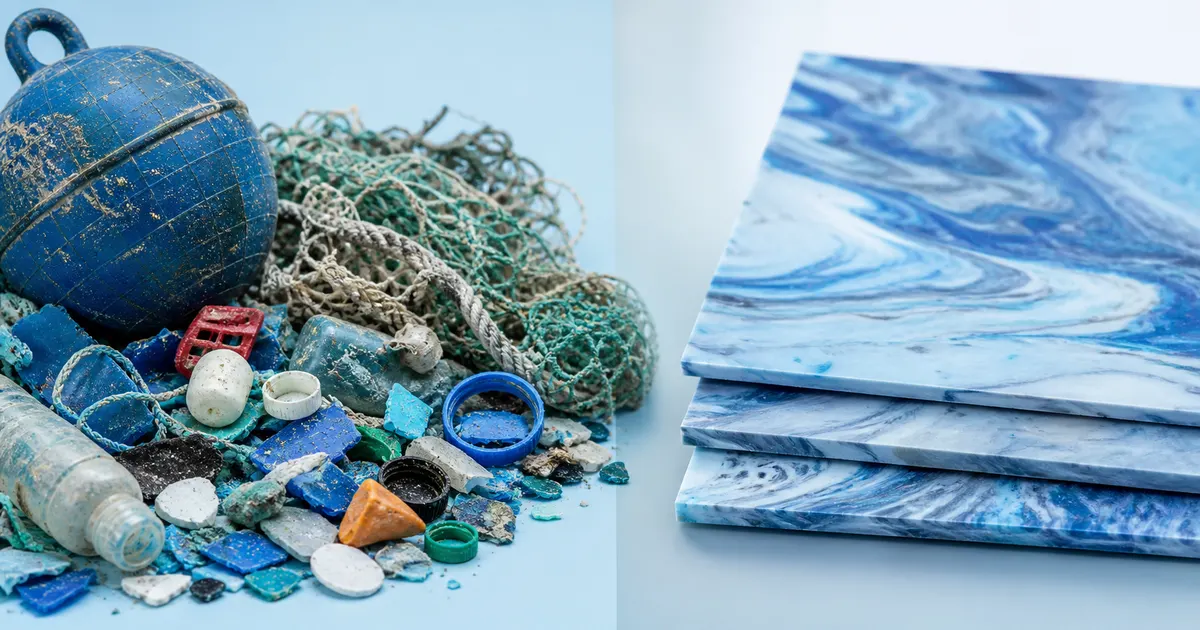
According to estimates from the Food and Agriculture Organization of the United Nations (FAO), roughly 640,000 tonnes of fishing gear is abandoned, lost, or discarded in the world's oceans every year. The routes vary: nets swept away in storms, nets left on the seabed because retrieval costs too much, or worn-out nets that can no longer be reused. According to materials published by Itochu and Aquafil, fishery-related plastic waste as a whole — including ropes and buoys, not just nets — is estimated at around 1.15 million tonnes a year.
Nets that keep "fishing" even after being abandoned
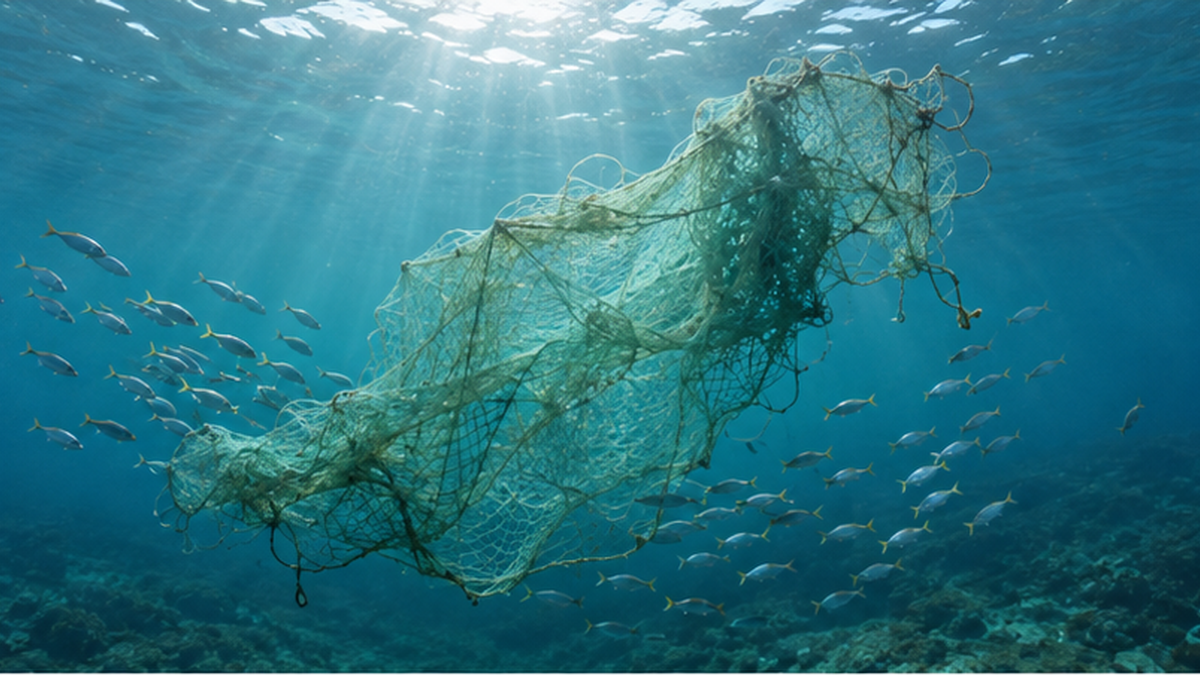
Discarded nets are made of nylon or polyethylene, materials that take an extremely long time to break down naturally. As they drift through the water they continue to entangle fish, sea turtles, and seabirds — which is why they are called "ghost gear" or "ghost nets." For more on how this happens and the international frameworks addressing it, see our article on the ghost gear problem.
A double blow to ecosystems and fisheries
- Fish, crustaceans, seabirds, and sea turtles become trapped and die in a continuous cycle known as "ghost fishing"
- Nets that settle over coral reefs block photosynthesis, leading to bleaching and death
- Deteriorating nets are also a source of microplastics
- Fishers themselves suffer real harm too, from propellers becoming fouled to reduced catches
Once a net is abandoned, entangled animals die and decompose, which can attract other animals that become entangled in turn — a chain reaction. Because nets drift long distances on ocean currents, the sea where they were lost is often not the sea where the damage occurs, making this a cross-border problem that no single country's regulations can solve alone.
How the problem gained international recognition
The "640,000 tonnes" figure traces back to a report jointly published by the UN Environment Programme (UNEP) and the FAO in 2009. It was the first report to quantify abandoned, lost, or discarded fishing gear (ALDFG) and to frame it as a unique category of marine debris — one that keeps capturing marine life rather than simply washing ashore. This led, in 2015, to the launch of the Global Ghost Gear Initiative (GGGI), an international public-private framework that has expanded efforts around recovery, reuse, and prevention. Regenerated-material businesses like ECONYL® exist as an extension of this same context.
Key points from this section
- A 2009 UN report estimated abandoned fishing gear (ALDFG) at around 640,000 tonnes a year
- International public-private frameworks such as the GGGI, launched in 2015, have since expanded
- Being able to sell recovered nets as a resource gives people on the ground a reason to keep collecting them
What is ECONYL®? The technology that turns waste nets into nylon as good as new
ECONYL® is the brand name for regenerated nylon 6 developed by Italy's Aquafil. Its raw material is not limited to fishing nets — it also includes fiber waste from used carpets, offcuts from apparel manufacturing, and industrial nylon plastic waste, in short, any discarded nylon material. All of it is processed through what Aquafil calls the "ECONYL Regeneration System" and turned back into yarn with the same quality as brand-new nylon.
Depolymerization: a chemical regeneration process
Conventional textile recycling is mostly "mechanical recycling," which melts and reshapes waste material — a process that tends to weaken the material with each cycle. ECONYL® instead uses chemical recycling, or depolymerization. Recovered nylon waste is first broken down to the monomer, the molecular level, and then repolymerized into new polymer. This means that even though the material originates as waste, it retains the same quality as virgin, oil-based nylon, and in theory can be regenerated an unlimited number of times without degrading.
Reduced environmental impact
| Metric | ECONYL® impact | Source |
|---|---|---|
| Crude oil saved | 70,000 barrels of crude oil saved per 10,000 tonnes of raw material | Aquafil published data |
| Greenhouse gas emissions | Up to 80% lower than virgin nylon production | Aquafil published data |
| Repeated regeneration | In theory, can be regenerated an unlimited number of times without quality loss | Aquafil published data |
ECONYL®'s raw material isn't only fishing nets
- Fishing nets and aquaculture nets (ocean-sourced)
- Fiber waste from used carpet pile
- Offcuts from apparel factories
- Industrial nylon plastic waste
About Aquafil
Aquafil is a nylon materials manufacturer based in the province of Trento, Italy, that originally focused on making nylon polymer for carpets. After years of R&D, it launched the ECONYL® brand in 2011 and has since shifted its business toward regenerated nylon. It operates dedicated plants in Slovenia and Italy for breaking down and repolymerizing waste material, processing nylon waste gathered from around the world in one integrated system. As of 2025, ECONYL®-branded products account for more than 60% of Aquafil's fiber business revenue — evidence that this is a core business, not merely an environmental PR effort.
"ECONYL® Pure," a newer option
In recent years Aquafil has also introduced "ECONYL® Pure," a variant with an even narrower raw-material composition. While standard ECONYL® blends nylon waste from multiple sources, ECONYL® Pure is made using 100% regenerated nylon only. Brands are increasingly competing on how precisely they can disclose their raw-material composition, and traceability continues to improve year by year.
An aquaculture net that proves "net to net" recycling
Aquafil has developed an aquaculture net made entirely of ECONYL®, which it describes as the world's first "circular aquaculture net." Fishing nets traditionally combine several different materials and parts, which makes them hard to separate into a single material once they reach the end of their life — a major barrier to recycling. This aquaculture net was designed from the outset with regeneration in mind: once it has served its useful life, it can be collected along with other nylon waste and turned back into ECONYL®, potentially becoming the raw material for a new fishing net. It is the example that comes closest to this article's ideal of a true circular loop — "make a new net from a recovered net."
Healthy Seas' recovery network — from the North Sea and Mediterranean to an Italian factory
A fishing net can't become raw material for regeneration unless someone pulls it out of the sea. The organization best known for that work is Healthy Seas, a non-profit project founded in 2013 by the diving group Ghost Diving, Aquafil, and the sock maker Star Sock. Centered on the North Sea, the Adriatic, and the Mediterranean, its divers recover ghost nets from the seabed, and it works with fishers to collect deteriorating nets still in use as well.
From recovery to finished product
- Ghost Diving divers and partner fishers recover ghost nets from the seabed and surface
- The recovered nets are cleaned, sorted, and shipped to Aquafil's factory in Italy
- They are regenerated into ECONYL® nylon yarn through depolymerization
- Partner companies such as Star Sock (the Healthy Seas Socks brand) turn the yarn into finished products
A growing recovery record
Since it began in 2013, Healthy Seas has recovered more than 1,300 tonnes of fishing nets and other marine debris. Since 2021 it has also partnered with the automaker Hyundai, which uses ECONYL® made from recovered nets in the floor mats of models such as the IONIQ series sold in Europe. That partnership alone has recovered more than 320 tonnes of marine debris.
Who dives for the nets
The people on the front line of recovery are volunteer professional divers organized as "Ghost Diving." Because working in the cold, low-visibility waters of the North Sea, or in coastal areas with heavy boat traffic, carries real risk, specially trained teams plan each dive carefully, cutting entangled nets free and bringing them to the surface. What they recover isn't limited to ghost nets sunk on the seabed — it also includes nets still in active use but worn out and due for replacement, as well as aquaculture nets. Recovered nets are sorted by type and then shipped to Aquafil's plant.
Working with fishing communities
Healthy Seas doesn't rely only on divers surveying the seabed. Working fishers are often the people who best know when and where a worn-out net was replaced. The project has built cooperative relationships with fishers in various regions, who hand over decommissioned nets directly on land — reducing reliance on risky underwater recovery. By combining underwater diving recovery with land-based collection from fishers, Healthy Seas has increased both the volume it recovers and the safety of its operations.
Real brand examples — bags, carpets, socks
Among the more than 2,500 brands that use ECONYL®, here are three well-known examples that explicitly highlight their origin in discarded fishing nets.
Prada Re-Nylon (Italy)
The luxury brand Prada has replaced "Pocono," the nylon that had been its signature material since the 1980s, with ECONYL® in its ongoing "Prada Re-Nylon" line. Backpacks, tote bags, and outerwear are all part of the range, and Prada continues to release capsule collections tied to the marine science education program "SEA BEYOND."
When Prada announced the Re-Nylon project in 2019, it set a company-wide goal: "replace all virgin nylon used in its main collections with ECONYL® by the end of 2021." At the time, this drew significant attention as an example of a luxury brand publicly committing to replace its signature material with a regenerated one. Re-Nylon has continued not as a one-off capsule collection but as an ongoing line spanning bags, shoes, and outerwear.
Interface's "Net Effect" carpet tiles
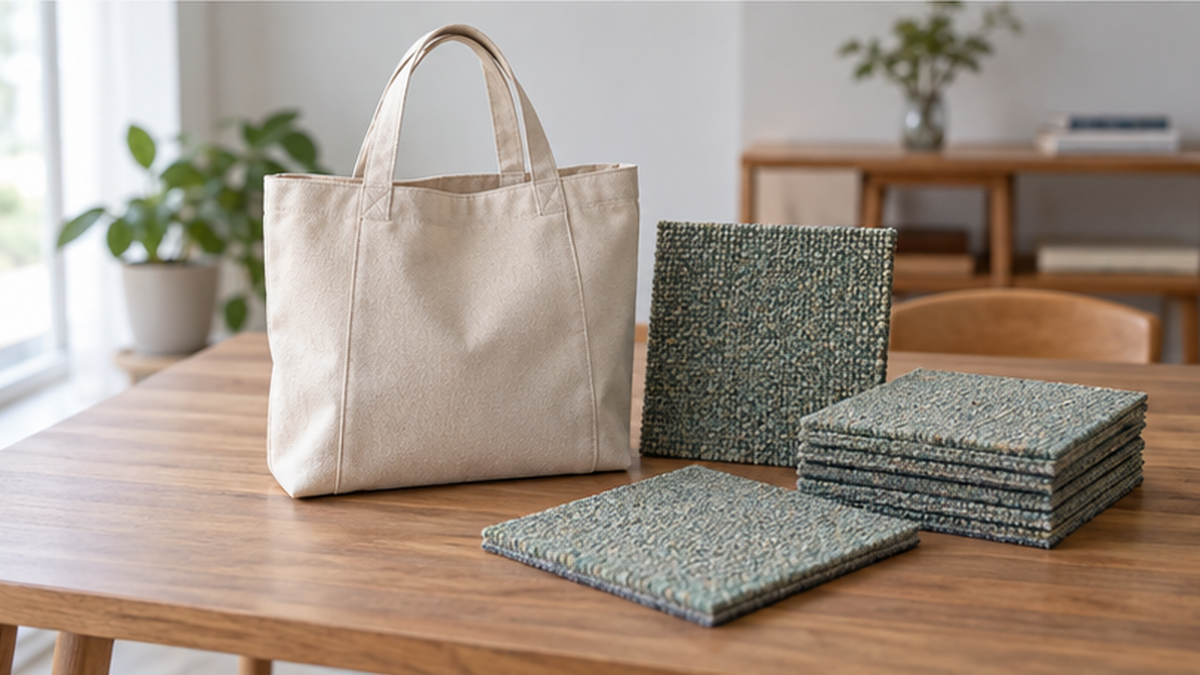
Interface, a major commercial carpet tile maker, launched the "Net-Works" project in the Philippines in 2012 together with the Zoological Society of London (ZSL). It built a system to buy discarded fishing nets from small-scale coastal fishing communities, then regenerated them into carpet fiber through Aquafil's ECONYL Regeneration System. The resulting "Net Effect" collection reaches up to 81% recycled content.
What sets Net-Works apart is that it was designed to support fishing communities' livelihoods at the same time as sourcing raw material. The money paid for recovered nets goes into local "community banks," which fishers can borrow from at low interest. What began in the Philippines has since expanded to Bantayan Island and Northern Iloilo, and now involves a total of 27 fishing communities across the Philippines and Cameroon. It has been cited by bodies such as the UN Environment Programme as a leading example of "inclusive business" that tackles waste and poverty at the same time.
Healthy Seas Socks
The Dutch sock maker Star Sock blends ECONYL® yarn made from Healthy Seas' recovered nets with GOTS-certified organic cotton to create the "Healthy Seas Socks" brand. Since sales began in 2013, more than nine million pairs have been sold, with a portion of proceeds going back to fund Healthy Seas' recovery work.
Hyundai's floor mats
In the automotive industry, South Korea's Hyundai is a notable example. Through its partnership with Healthy Seas, Hyundai uses ECONYL® made from recovered fishing nets in the floor mats of several models sold in Europe, including the IONIQ 5, IONIQ 6, IONIQ 9, INSTER, and SANTA FE. It's an unglamorous part under the seat, but it shows that regenerated nylon can be built into a standard part of a mass-produced vehicle — pointing to the wider potential for adoption across supply chains.
A Japanese initiative — Itochu × Aquafil × two Japanese net makers
Fishery-related plastic waste isn't someone else's problem for Japan either. According to a report compiled by WWF Japan, fishing-related plastic waste such as nets and buoys accounts for 50 to 60% by weight of the plastic debris that washes up on Japan's coastline. As a fishing nation surrounded by the sea, turning discarded fishing nets back into a resource is a pressing issue domestically as well.
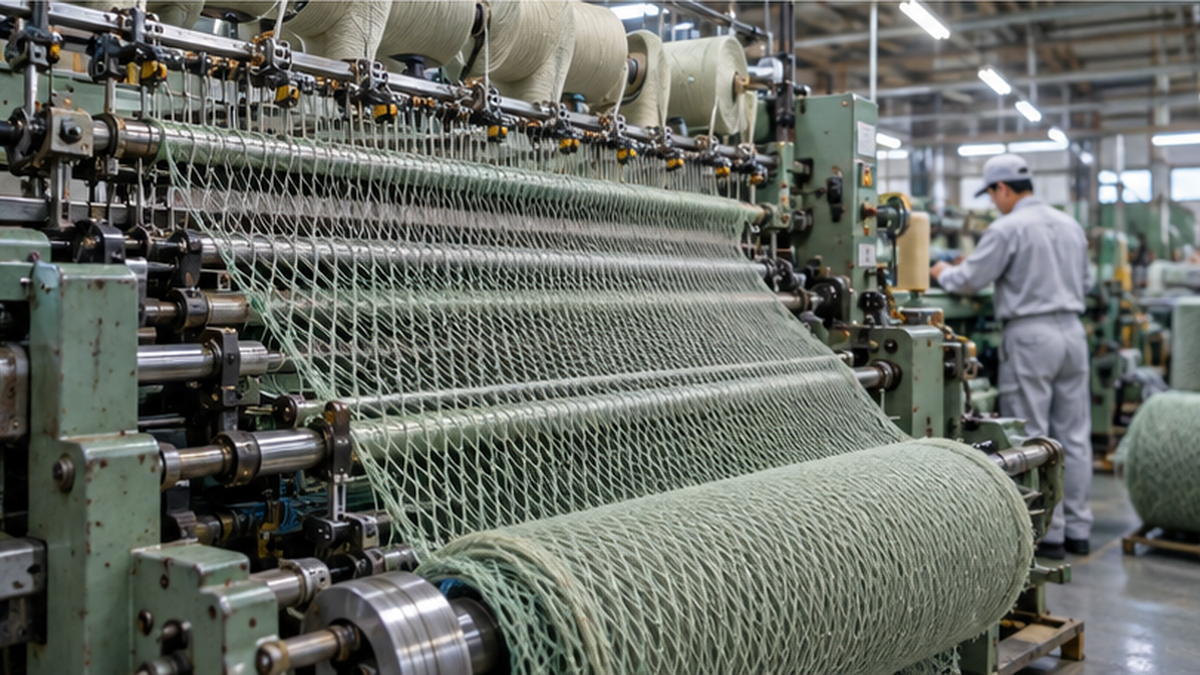
Against this backdrop, ECONYL®-related efforts are also moving forward in Japan. Itochu Corporation entered a business tie-up with Aquafil in 2021 and took a capital stake in 2022. Then in March 2024, Itochu jointly announced, with Aquafil, Momoi Fishnet (based in Ako, Hyogo Prefecture), and Kinoshita Fishnet (based in Nishio, Aichi Prefecture), the co-development and launch of sales of fishing nets made with ECONYL®.
Why regeneration was especially hard for fishing nets
Unlike apparel or carpet, nets actually used at sea require high strength and stable dyeing. Regenerated nylon fiber tends to be less uniform, which had long made it difficult to apply to fishing applications. By combining Momoi Fishnet's and Kinoshita Fishnet's net-making expertise, the partners achieved regenerated nets with quality that matches petroleum-based nets, and a mass-production system is already in place.
What comes next
- A "net to net" circular model that uses recovered nets as raw material for new nets again
- Expansion into uses beyond fishing, such as sports equipment, is also under consideration
- Expanding Japan's domestic collection system for used nets remains a challenge
The role of Japan's net-making industry
Momoi Fishnet (Ako, Hyogo) and Kinoshita Fishnet (Nishio, Aichi) are both long-established net makers specializing in fishing nets and related products. Japan's net-making industry has a history of accumulating expertise at specialized regional makers like these, known for fine-tuning thread thickness and weave to match each fishing method and target species. This partnership combines Aquafil's regenerated-nylon manufacturing technology with the on-the-ground expertise of Japanese net makers in "finishing a net that actually works at sea." If the loop of recovering used nets, turning them back into nylon raw material, and using that material to make nets again can be realized, it would also become a meaningful option for handling Japan's fishery-related waste domestically.
Swimwear, bags, carpet — material properties for each use
Even though it's the same ECONYL® nylon, the performance required differs depending on the product. Here's how the requirements break down by use.
| Use | Required properties | Why ECONYL® suits it |
|---|---|---|
| Swimwear | Stretch recovery, resistance to chlorine and UV | Excellent shape recovery, produces a glossy, premium-feeling fabric |
| Bags and outerwear | Abrasion resistance, light weight, compatibility with waterproof coatings | Reproduces the same feel as the original Pocono nylon |
| Carpet tiles | Abrasion resistance, flame resistance, commercial-grade durability | As nylon 6 polymer, it offers strength equal to virgin material |
| Fishing nets | Tensile strength, weather resistance, uniform dyeing | Combined with domestic net-making technology, it achieves working-grade strength |
| Automotive interiors (floor mats, etc.) | Abrasion resistance, sound and vibration damping, consistent quality at mass-production scale | Easier to achieve the uniform quality required for a standard part in mass-produced vehicles |
Why swimwear brands choose ECONYL®
Swimwear especially needs stretch and resistance to chlorine and UV. Because ECONYL® is chemically regenerated, it shares the same molecular structure as virgin nylon, so its stretch recovery holds up better than that of mechanically recycled fibers. Sustainable swimwear brands overseas have increasingly adopted ECONYL® because it's one of the few regenerated materials that combines environmental credentials with real-world performance.
"Regenerated" doesn't mean "lower performance"
People often assume regenerated materials are weaker or feel cheaper than new ones. But because ECONYL®'s depolymerization process resets the material down to its molecular structure, its quality as a polymer is unchanged even when the source is a fishing net — it's the same as virgin nylon 6. The fact that a luxury brand like Prada has directly swapped in its signature material, and that a commercial carpet maker like Interface uses it where long-term durability is required, backs up its reliability in practice.
Care extends a product's life
Even if the material itself has a lower environmental footprint, that benefit is diminished if the product is thrown away quickly. Rinsing ECONYL® swimwear in fresh water and drying it in the shade, or re-treating a bag with waterproofing spray once its coating wears off, are the same basic care steps used for any nylon product, and they extend the item's life. Carpet tiles, designed for partial replacement, also let you swap out only the worn tiles rather than discarding the whole carpet — another advantage worth noting.
The limits of regenerated nylon and remaining challenges
Collection costs and traceability
Recovering nets from the seabed is mostly manual work done by divers, which takes cost and effort. Much of it is sustained by non-profit activity and brand funding, as with Healthy Seas, which makes it difficult to scale up collection quickly. Establishing traceability — tracking exactly what percentage of a given product actually comes from fishing nets — also remains a challenge for the industry as a whole.
The reality of "infinite recycling"
ECONYL® is said to be regenerable an unlimited number of times in theory without losing quality, but in practice there are real costs: sorting out contaminating materials (such as buttons or zippers that aren't nylon), plus the energy used in transport and chemical processing. Regenerated nylon doesn't mean zero environmental impact — it should be understood as a relative reduction compared to producing virgin nylon.
Microfiber shedding happens with regenerated material too
One point that's easy to overlook is microfiber shedding during washing. This is an unavoidable characteristic of synthetic fiber regardless of whether the nylon is virgin or regenerated, and wastewater treatment plants cannot fully capture these fibers, some of which end up in the ocean. ECONYL® is valuable for reusing "plastic waste that already exists," but tackling microfiber shedding still requires separate measures — such as using a washing bag or a dedicated filter — beyond simply choosing the material.
Don't confuse it with "ocean plastic"
ECONYL®'s main raw materials are fishing nets, carpet, and industrial waste — a different category from "ocean plastic" (polyester-based) materials made from items like PET bottles recovered from beaches, which is what brands such as Adidas × Parley use. When checking a garment's materials, it's worth distinguishing whether it's nylon or polyester-based, and whether the raw material is fishing nets or PET bottles.
The cost reflected in price
Because it passes through several stages — recovery from the seabed, sorting, long-distance transport, and chemical regeneration — ECONYL® tends to cost more as a raw material than ordinary petroleum-based nylon. Even so, more brands like Prada and Interface are adopting it as a core material, because the market that values environmental responsibility — including B2B customers — is growing, and the resulting brand value is seen as offsetting the higher cost. As the collection network expands and production scales up, that cost gap is expected to narrow further.
Comparing three models: NGO-led, corporate buy-back, domestic mass production
The recovery and regeneration systems introduced so far differ in where the funding comes from and how each party is involved. Broadly, they fall into three models.
| Model | Representative example | Who funds and collects | Characteristics |
|---|---|---|---|
| NGO-led | Healthy Seas × Star Sock | Non-profit funding plus sponsoring brands | Divers recover nets for free; a portion of product sales funds activities |
| Buy-back inclusive business | Interface × ZSL "Net-Works" | Corporation buys nets from fishing communities | Designed together with livelihood support for communities; includes community banks |
| Corporate tie-up / mass production | Itochu × Aquafil × two Japanese net makers | Capital and business tie-up between a trading house and manufacturers | Establishes mass production for fishing applications, making it a self-sustaining industry |
The NGO-led model is easy to start even at small scale and has strong educational value, but expanding collection volume depends heavily on donations and sponsorship. The buy-back model creates real economic incentives for fishing communities, giving it strong sustainability, though extending it to new regions takes time. The corporate tie-up / mass-production model can achieve economies of scale, but it depends on securing a collection route that is commercially viable. In practice these models aren't mutually exclusive — they operate in parallel, all feeding into the same regeneration technology provided by Aquafil, which is part of the strength of the ECONYL® ecosystem.
Which model is easiest to make "your own"
- Want to support through donations or sponsorship? → Support a non-profit like Healthy Seas
- Want to contribute through what you buy? → Choose products from brands that clearly state their use of ECONYL®
- Want to follow domestic industry trends? → Keep an eye on Itochu Corporation and Japan's net makers
What consumers can do — how to choose regenerated nylon products
When choosing ECONYL® and other regenerated nylon products, checking the following points makes it easier to judge their real environmental contribution.
- Does the material tag clearly state "ECONYL®" or "regenerated nylon," along with the percentage of regenerated content?
- Does the brand disclose specifics about its collection and regeneration efforts, such as partners and volumes recovered?
- Following care instructions to use the product for longer is, on its own, the most reliable way to offset the environmental impact of production
- Does the brand offer a take-back or recycling program for products that have reached the end of their life?
It's worth resisting the simplification that "it's ECONYL®, so it must be environmentally good," and instead checking what the raw material actually is and how much of the process is disclosed. Some brands don't specify the share coming from fishing nets and simply label items "regenerated nylon." Where possible, checking a brand's sustainability page for its raw-material composition and partners — whether it's Aquafil, or a collection group like Healthy Seas — leads to a more accurate judgment.
Third-party certification as a benchmark
One third-party certification that backs up regenerated-material claims is the Global Recycled Standard (GRS), widely used across the international textile industry. In addition to the traceability of the recycled content, GRS also audits labor conditions and chemical management, and some ECONYL®-based products carry the GRS certification mark. Because self-declared environmental claims and third-party-verified certification are different things, whether a GRS or similar certification logo appears on the packaging or tag is another useful benchmark when choosing a product.
For more on the technology behind discarded fishing net recycling and the international collection system as a whole, see our complete guide to used fishing net recycling; for an outdoor brand example, see our article on Patagonia's NetPlus. Reading both alongside this article will broaden your basis for choosing materials.
A net that would otherwise have kept harming marine life at the bottom of the sea is instead pulled up by a diver's hands, put through a chemical regeneration process, and returned to daily life as a bag, a swimsuit, a carpet, or a car part. This whole chain is a good example of moving marine debris beyond "just collect it" and into "build it back into the economy as a resource." Even a small choice — which product to buy — becomes part of that circle.
References
- FAO – Report on abandoned, lost or discarded fishing gear at sea
- Aquafil Group – ECONYL® official website
- Aquafil Group – Environment and sustainability data
- Itochu Corporation – Joint development and launch of sales of fishing nets using recycled nylon (March 5, 2024)
- Healthy Seas – Overview and recovery record
- Healthy Seas Socks – Brand overview
- Prada Group – About Prada Re-Nylon
- Interface, Inc. – Overview of the Net-Works project
※ Listed in order of reliability: government and academic institutions > peer-reviewed papers > specialist organizations > reputable media