⚡ In short
Asahi Soft Drinks pioneered label-free bottles in 2018, cutting plastic resin use by up to 100%. In July 2026, a METI ordinance revision opened the door to selling label-free PET bottles as single units. Here's how it works and what changed.
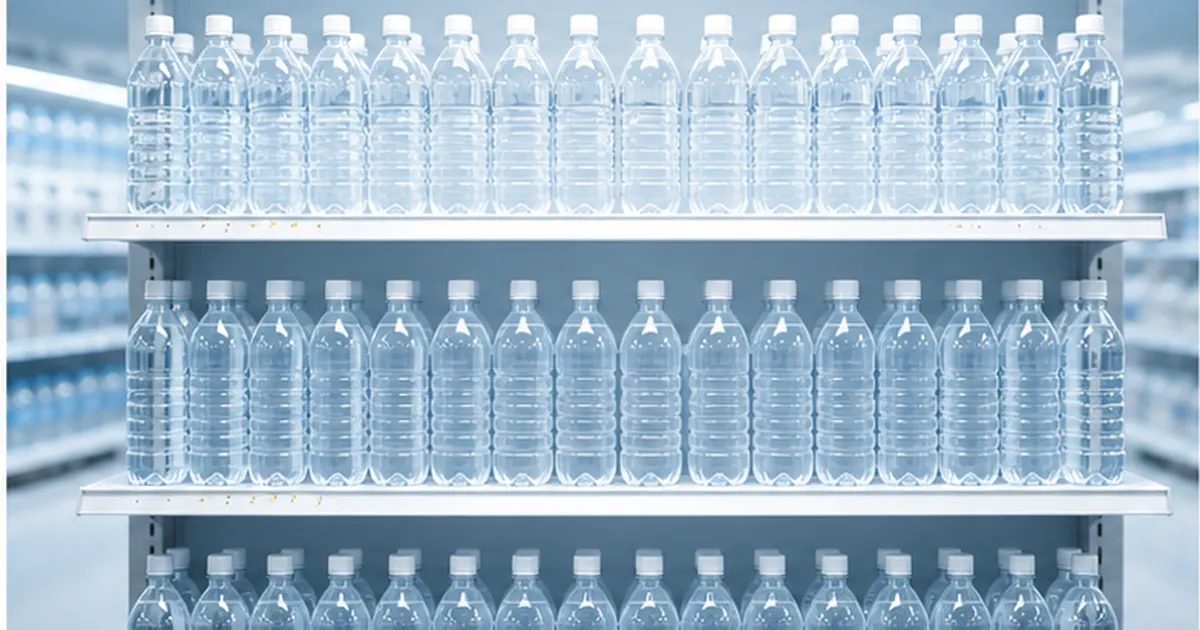
Have you noticed more and more label-free plastic bottles quietly appearing on supermarket and convenience store shelves? The label-free bottle that Asahi Soft Drinks pioneered in the industry back in 2018 is now becoming a standard feature of soft drinks.
How much plastic can simply removing the label actually save — and what changes with the ministerial ordinance that Japan's Ministry of Economy, Trade and Industry (METI) enforced in July 2026? Let's check the numbers against primary sources.
This article centers on Asahi Soft Drinks' efforts, then looks at moves by other companies such as Coca-Cola and Suntory, and finally examines the impact on how consumers sort their waste.
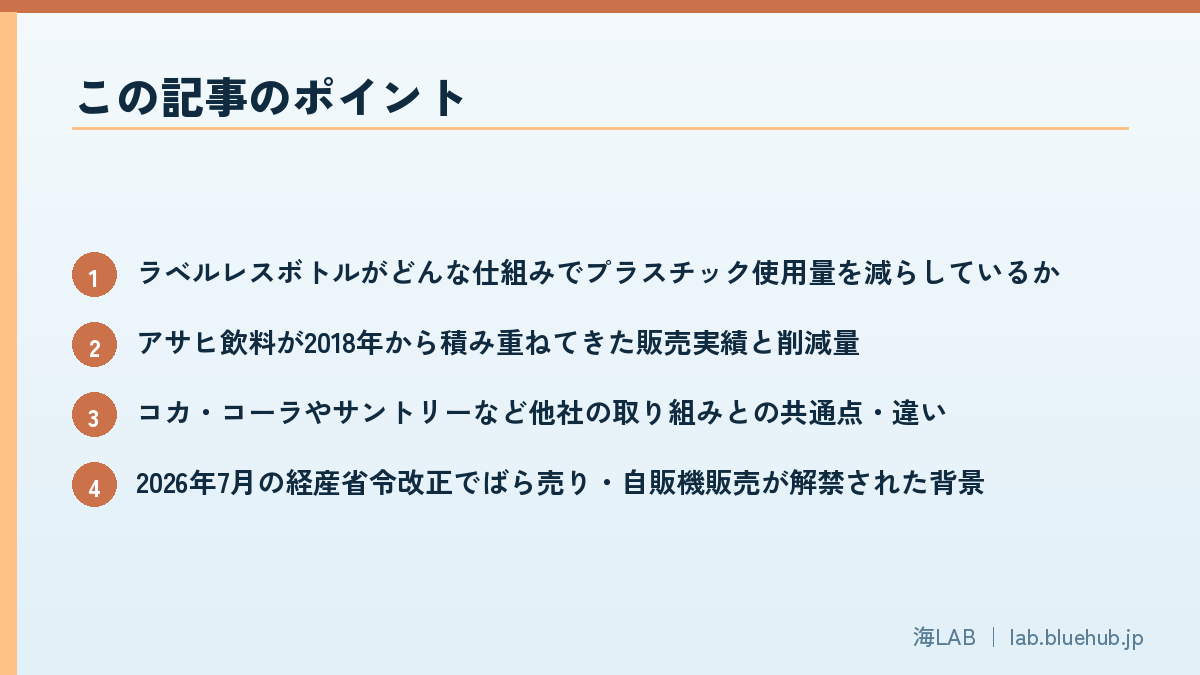
What you'll learn in this article
- How label-free bottles actually cut plastic use
- The sales track record and reduction volumes Asahi Soft Drinks has built up since 2018
- What's common — and different — about the approaches taken by Coca-Cola, Suntory, and others
- Why METI's July 2026 ordinance revision opened the door to single-unit and vending-machine sales
- What consumers should keep in mind when sorting waste or buying these products
What is a label-free bottle?
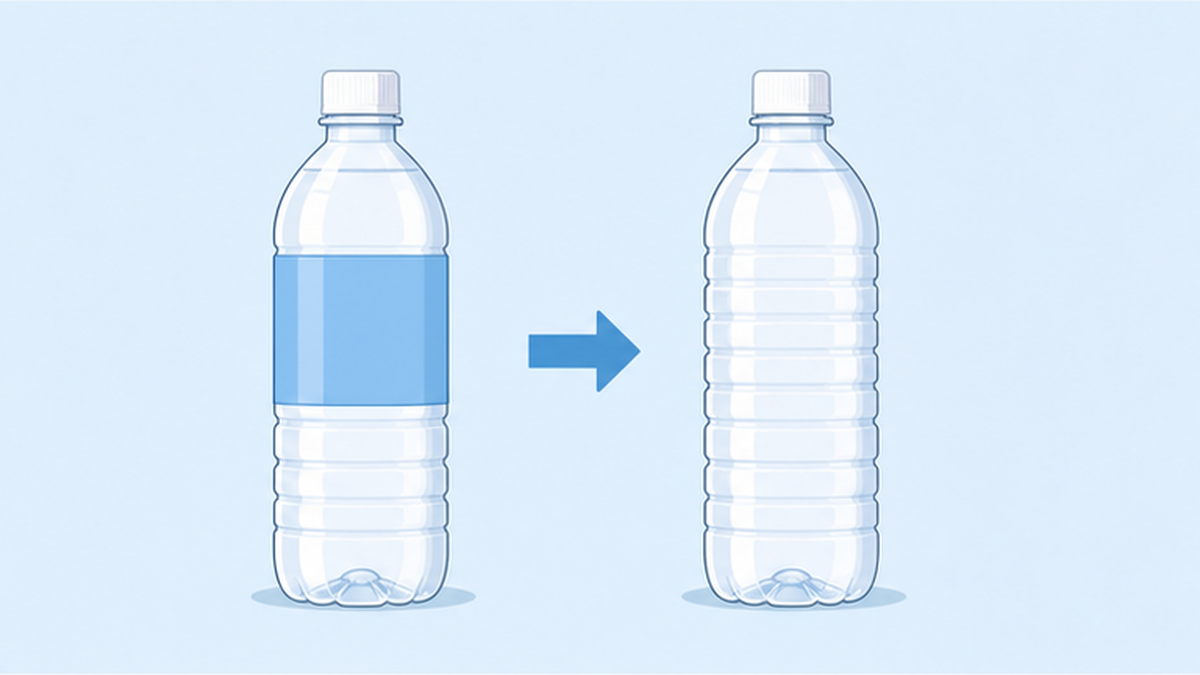
A "label-free bottle" is a PET-bottled beverage sold without the plastic shrink-wrap label that normally carries the product name and ingredient information. Nothing changes about the drink itself or how it's made — the only difference is that the plastic label wrapped around the bottle has either been removed or was never applied in the first place. The look becomes a simple, clear bottle, and the impression it makes on the shelf changes noticeably.
What labels were originally for
Labels have long carried several roles at once: a marketing function that highlights the product name and brand logo, a legal function that conveys information required under food labeling law — ingredients, nutrition facts, best-before dates, manufacturer details — and a material-identification function tied to recycling, such as the identification mark. In retail settings where single units sit on a shelf, a label that lets shoppers identify the brand from a distance has been essential. The reason label-free products stayed "case-sale only" for so long was the unresolved question of how to replace these marketing and identification functions.
What removing the label actually saves
A typical PET bottle label is made from the same PET resin as the bottle itself, or from a polystyrene- or polypropylene-based shrink film. Removing the label directly cuts that amount of plastic use. It also removes the extra step of "peeling off the label before recycling." It may look like a small difference, but multiplied across the huge volume of PET bottles thrown away as household waste every day, it adds up to an amount that's hard to ignore.
- Plastic resin use tied to the label itself goes away
- No more peeling and sorting the label, lowering the barrier to recycling
- Less risk of contamination from label adhesives and other materials, improving the quality of recycled material
- Fewer printing steps also cut down on ink and energy use during manufacturing
How identification marks relate to going label-free
In Japan, the Act on the Promotion of Effective Utilization of Resources requires PET bottles to carry an identification mark showing their material. Since this was traditionally printed on the label, making a bottle fully label-free required moving that mark onto an engraving on the bottle body, the cap, or a small tack seal instead. This technical and regulatory question of "where to display the identification mark" has been the deciding factor in how far label-free bottles could go.
A short history of the labeling-display system
The requirement to display an identification mark on PET bottles began in June 1993. It initially applied only to PET bottles on their own, but a 2001 revision to the Act on the Promotion of Effective Utilization of Resources extended it to plastic and paper containers and packaging more broadly. The purpose of the identification mark is to make it easier for consumers to sort their waste and to support separate collection by municipalities. Going label-free can be seen as taking this original goal of "making sorting easier" one step further, by removing the label altogether.
Background: what is the identification-labeling system?
- A system, based on the Act on the Promotion of Effective Utilization of Resources, that tells consumers what a container is made of
- PET bottles are required to display a "PET" mark
- Printing it on the label was traditionally standard, but displaying it on the cap or bottle body has also long been allowed
- There are minimum size standards: at least 6mm per side when printed or on a label, and at least 8mm when engraved
- The July 2026 ordinance revision expanded the range of cases where an engraving on the bottle body alone satisfies the display requirement
Overseas, some regions are adding labels, not removing them
Looking abroad, some regulations are moving in the opposite direction from Japan's. The EU's new Packaging and Packaging Waste Regulation (PPWR) starts applying from August 2026, and new labeling requirements are being phased in on top of that — a pictogram showing a container's material composition from August 2028, and a reusability label from February 2029. So between 2028 and 2029, the EU will actually be adding new display requirements rather than removing them. Japan's approach of "removing labels to make sorting easier" and the EU's approach of "adding labels to make sorting more precise" are, in that sense, opposites. What they share is the same underlying goal: encouraging consumers to sort correctly and raising recycling rates.
Eight years of label-free innovation at Asahi Soft Drinks
Asahi Soft Drinks is the company that set the label-free trend in motion in Japan. It had been steadily building up this effort since 2018, well before the idea of a circular economy became widespread in the beverage industry.
2018: launched as a case-sale-only product
Starting in 2018, Asahi Soft Drinks became the first in the industry to roll out "label-free" products sold exclusively by the case. By limiting these to bulk-buy and mail-order channels rather than single-unit shelf display, the company sidestepped the labeling requirements tied to in-store product identification. Because online product pages can already carry the product name and ingredient information, there was no need to print everything on the bottle itself — a smart use of that sales channel's particular characteristics.
2020: achieving fully label-free bottles
In 2020, following a review of how the identification-labeling system was operated, two products — "Asahi Oishii Mizu Tennensui Label-Free Bottle" — achieved a fully label-free design. The identification mark was consolidated onto the cap and bottle body, bringing plastic use tied to the label down to zero. Because water has relatively few required items — no long list of ingredients or nutrition facts — it was an easier product to take fully label-free ahead of other processed beverages.
| Period | Sales volume | Year-over-year |
|---|---|---|
| Jan–Aug 2020 | Approx. 1.3 million cases | 217% |
| Full year 2020 | Approx. 2.23 million cases | 2.1x |
The pandemic-driven stay-at-home boom, which pushed up bulk-buying and online shopping, also worked in the lineup's favor, and sales of label-free products expanded rapidly. This early surge appears to have been driven by the coincidence of a broader shift toward buying drinks in bulk while staying home, and the expansion of the label-free lineup at the same time.
See Asahi Soft Drinks' label-free bottlesEasy and Eco-Friendly with No Label | Asahi Soft DrinksAsahi Soft Drinks' feature page on its label-free bottles, introducing eligible products and the "no peeling required" mechanism with photos.🔗 asahiinryo.co.jp2021: "Simple Eco Label" paves the way for single-unit sales
On April 13, 2021, Asahi Soft Drinks began a test sale of "Asahi Oishii Mizu Tennensui Simple Eco Label" (585ml PET) in stores and some vending machines, limited to a portion of eastern Japan. Until then, label-free products had mostly been sold by the case, so consolidating the identification mark into a minimal tack seal — enabling single-unit retail sales — was a breakthrough. By minimizing the area of the tack seal, the CO2 emissions tied to the label material were reportedly cut by about 58%. In a sense, the nationwide single-unit and vending-machine sales that METI opened up in 2026 had already been anticipated by this limited 2021 test.
Two parallel technology bets with Juroku-cha
On December 21, 2021, an even more advanced product went on test sale, exclusively on Amazon.co.jp and limited to 1,200 cases: a "direct marking bottle" version of "Asahi Juroku-cha" using Ricoh's laser-marking technology. The method engraves directly onto the very surface of the PET bottle with a laser, using no tack seal or neck ring display material at all. Because no ink or other foreign material is added, recyclability is easier to maintain, and the product drew attention as the first in the food industry to adopt this technology. That said, it remained a small-scale test and was never rolled out nationwide.
Separately from the laser-marking version, on June 7 the following year, 2022, a tack-seal version — "Asahi Juroku-cha Simple Eco Label" (630ml PET) — launched nationwide. Switching the standard label to a tack seal cut CO2 emissions per bottle by about 53%, with an expected annual CO2 reduction of roughly 16.7 tons. Running a cutting-edge laser-marking pilot alongside a nationwide rollout of the more practical tack-seal approach shows Asahi Soft Drinks' flexibility in choosing technology to fit the moment. On July 18, 2023, a follow-up version with the size increased to 660ml launched exclusively at 7-Eleven, achieving a roughly 33% cut in plastic use and a roughly 46% cut in CO2 emissions.
From mineral water to carbonated drinks
The label-free lineup, initially centered on water products like "Asahi Oishii Mizu Tennensui," later expanded into tea and carbonated drinks as well. A label-free version of "Mitsuya Cider," for example, went on limited-quantity sale on Amazon.co.jp from April 2023, offered in the mail-order-friendly bulk format of a 24-bottle case of 500ml PET bottles. The fact that label-free versions have reached even flagship, long-established brands shows how far consumer acceptance has come.
The plastic-reduction numbers in detail
What a 90–100% resin reduction really means
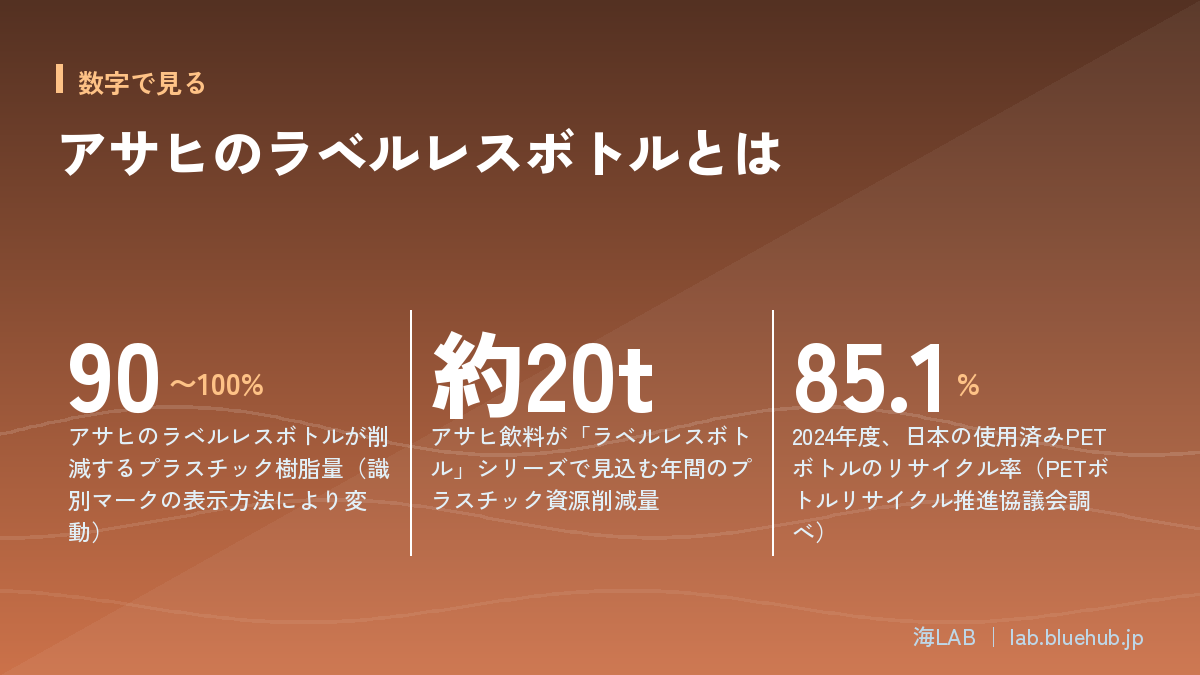
According to Asahi Soft Drinks, ordinary label-free products that move the identification mark onto a tack seal or printed cap achieve a 90% reduction in the plastic resin used per label. The two fully label-free water products go further, cutting label-related plastic use by 100%. The gap between 90% and 100% comes down to whether the identification mark still remains as a small tack seal, or is handled entirely through an engraving on the cap or bottle body. The laser-marking technology described above can be seen as the ultimate version of that 100% reduction, since it adds no extra material at all.
About 20 tons a year, in the context of the whole PET bottle market
Asahi Soft Drinks projects that its "Label-Free Bottle" lineup as a whole will cut plastic resource use by roughly 20 tons per year. It's worth noting that this figure is an estimate limited to part of Asahi's own lineup, not a reduction figure for the beverage industry as a whole. For comparison, the annual sales volume of designated PET bottles distributed in Japan reached about 652,000 tons in FY2024 (Council for PET Bottle Recycling). As a reduction achieved by a single company's product line, 20 tons is small next to the scale of the whole industry — but as more companies adopt similar measures, the combined reduction effect will keep growing.
This 20-ton estimate appears to be calculated by multiplying the annual shipping volume of Asahi's several label-free products, including the Tennensui lineup, by the reduction achieved per bottle. As more brands — such as Mitsuya Cider and Juroku-cha — join the lineup, this reduction figure could well keep climbing.
How consumers see it
According to a consumer survey by a private research firm, among people who had bought a label-free drink, the top reason was "it saves the trouble of peeling off the label" at 40.9%, followed by "novelty" (28.2%) and "environmental awareness" (22.8%). As many as 62.3% said they would prefer the label-free version if given a choice between it and an identical labeled product — suggesting that both practical convenience and environmental concern are driving the choice. Among those who had bought one before, 51.1% said they'd buy again, more than half, suggesting the trend is taking hold rather than being a passing novelty.
On the other hand, among PET bottle buyers overall, only 53.0% said they were aware of label-free products, and only 21.7% had actually purchased one — there's still a gap between awareness and experience. By purchase channel, convenience stores led at 53.0%, followed by supermarkets at 35.9% and online retail at 26.5%, showing that label-free products are gaining a real presence in physical stores as well.
Others follow suit: Coca-Cola and Suntory
Asahi Soft Drinks isn't the only company going label-free. Major beverage makers such as Coca-Cola and Suntory have joined in one after another.
Coca-Cola's label-free bottle made from 100% recycled PET
Coca-Cola (Japan) has sold label-free "Coca-Cola" and "Coca-Cola Zero" bottles made from 100% recycled PET online-only since April 2022 for the 350ml size, and since May 2025 for the 500ml size. Rather than just removing the label, the company also made the bottle itself from recycled PET, pushing resource circulation a step further. "Removing the label" and "making the bottle from recycled material" are separate measures, but combined, their reduction effects multiply.
See Coca-Cola's label-free bottleLabel-free bottle made with 100% recycled PET launched | Coca-Cola JapanThe news release announcing the May 2025 launch of the 500ml label-free "Coca-Cola" and "Coca-Cola Zero" bottles.🔗 coca-cola.comThe Coca-Cola system has set a shared global goal called "World Without Waste," aiming to collect and recycle the equivalent of every bottle and can it sells by 2030. It has set an equivalent target in Japan, and plans to raise its "bottle-to-bottle" ratio to 90% by 2030. Going label-free is positioned as one of the individual measures supporting that larger goal.
Suntory's in-store rollout of the "Hyousetsu Pure Bottle"
In October 2021, Suntory Beverage & Food began selling a label-free version of "Suntory Tennensui" through mail-order channels such as Amazon and Askul. The positive response led the company, on July 5, 2022, to launch a limited-quantity version at convenience stores nationwide using a dedicated label-free bottle called the "Hyousetsu Pure Bottle." Extending beyond mail order into single-unit store sales was notable, making it a rare early example at the time. In terms of bottle circularity, this also connects with Suntory's bottle-to-bottle horizontal recycling efforts for Suntory Tennensui.
| Company | Key initiative | Sales channel |
|---|---|---|
| Asahi Soft Drinks | Case-only from 2018 → fully label-free from 2020 | Mainly mail order and case sales |
| Coca-Cola (Japan) | Label-free bottle made from 100% recycled PET | Online only |
| Suntory Beverage & Food | Dedicated label-free bottle, the "Hyousetsu Pure Bottle" | Mail order plus convenience stores (limited quantity) |
Comparing the three, Asahi Soft Drinks moved earliest, Coca-Cola set itself apart by pairing label removal with recycled-material bottles, and Suntory expanded from mail order into physical single-unit sales. All three ramped up their efforts around 2018–2022, a period that overlaps with the pandemic-era boom in stay-at-home buying and e-commerce use across multiple manufacturers.
2026: METI opens up single-unit and vending-machine sales
What the ordinance revision covers
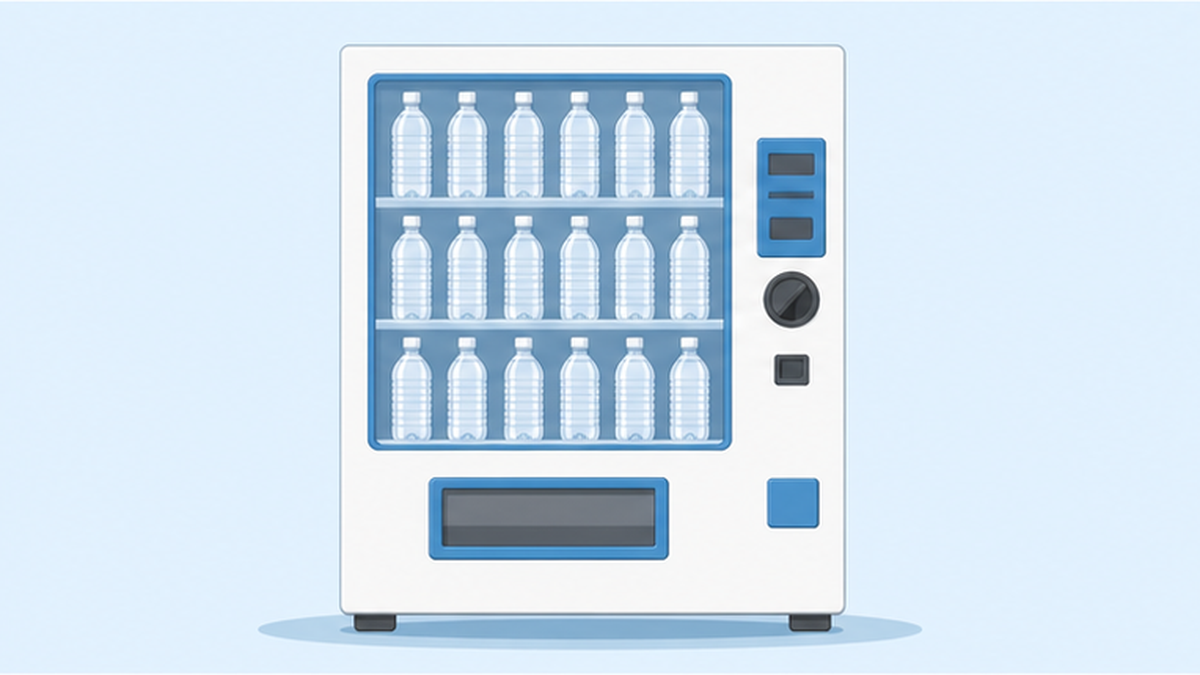
On July 30, 2026, Japan's Ministry of Economy, Trade and Industry issued and enforced an ordinance expanding the scope of label-free PET bottles. Previously, fully omitting the label was limited to case-unit bulk sales, and retail sale of single units or vending-machine sales weren't anticipated. Under the revision, products with fewer required labeling items, such as water, can now be sold label-free even as single units.
Why a PET mark engraving alone is enough
Behind the revision is a judgment that consumers can carry out the same recycling behavior — sorting and disposal — even when the PET mark is simply engraved on the bottom or side of the bottle. As long as no other legally required information, such as food labeling, is placed on the side of the bottle, the side label or printing can now be omitted. Vending machines, which don't require scanning a JAN code, are expected to be the first channel where these products spread.
Why single-unit sales were limited until now
On single-unit retail shelves, printed information on the packaging is often essential for price display and product identification at the point-of-sale register. Vending machines, by contrast, let customers see the product before buying and can display price and product name on the machine itself, making it an easier channel to loosen bottle-labeling requirements for. The fact that the ordinance revision prioritizes vending-machine adoption reflects these differences between sales channels.
Part of a broader plastic resource-circulation policy
This revision isn't an isolated act of deregulation — it's an extension of Japan's broader plastic resource-circulation policy. In April 2022, the Act on Promotion of Resource Circulation for Plastics took effect, setting a national policy of curbing emissions, boosting collection, and promoting recycling for plastic products as a whole, in response to marine plastic pollution and climate change. Going label-free on beverage containers can be seen as one of the initiatives within this larger policy trend that lets consumers experience resource circulation in the most immediate, everyday way.
Impact on consumer sorting behavior and recycling quality
No more peeling off the label
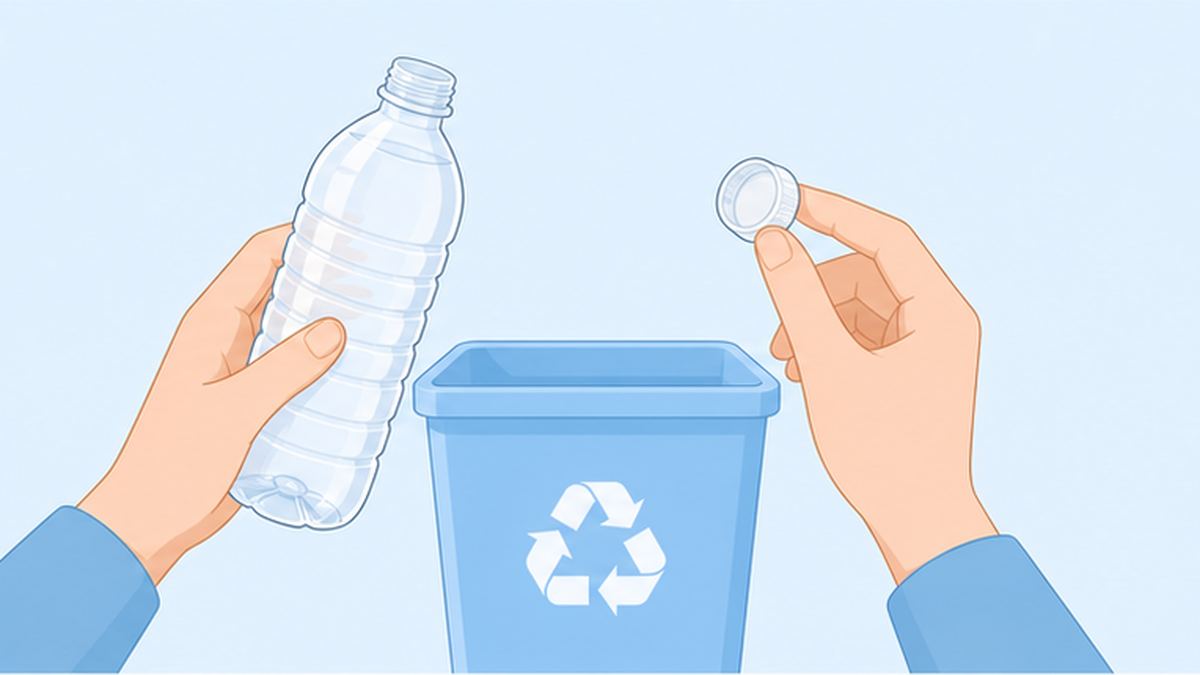
The benefit of a label-free bottle isn't limited to reduced plastic use. In the past, both the cap and the label had to be separated before putting a bottle out as plastic packaging waste — with no label, that whole step disappears. Lowering the barrier to sorting waste in the middle of a busy day also helps push up recycling rates overall. In fact, a separate survey found that "less waste, less to throw away" (76.8%) and "saves the trouble of peeling off the label" (63.9%) were among the top reasons cited in its favor, showing that environmental benefit and everyday convenience are being valued together.
Standard municipal sorting rules for PET bottles typically call for removing the cap and label, rinsing the inside, and crushing the bottle before putting it out. With a label-free bottle, the "remove the label" step in that routine disappears entirely. For elderly residents or busy households in particular, cutting out even this small step makes it easier to keep sorting waste consistently.
The link to bottle-to-bottle horizontal recycling
The adhesives and other materials used in labels have long been one cause of contamination that affects the quality of recycled material in "bottle-to-bottle" horizontal recycling, where used PET bottles are turned back into new bottles. At recycling plants, the process of crushing and washing collected PET bottles requires sorting out and removing the label and cap materials. Fewer labels means less burden on that sorting step, and is expected to make it easier to secure higher-quality recycled PET on a stable basis.
Japan's PET bottle recycling rate is among the world's highest
Japan's recycling rate for used PET bottles reached 85.1% in FY2024, maintaining its 85%-plus target and ranking among the highest in the world. According to a Japan-US-Europe comparison published by the Council for PET Bottle Recycling, as of 2021 the US recycling rate stood at just 19.6%, with a collection rate of only 29% — a wide gap compared to Japan, which maintains a collection rate of around 94%. That said, this 85.1% figure includes material recycled overseas, and how far Japan can raise the ratio of domestic "horizontal recycling" — turning bottles back into bottles — remains the next challenge. From a circular economy perspective, what matters isn't just the quantity of the recycling rate but improving its quality, and going label-free is one answer to that.
Challenges ahead and what comes next
Products with heavier labeling requirements remain difficult
The products covered by this deregulation are mainly ones like water that already have few required labeling items to begin with. For processed beverages with long lists of ingredients, allergen information, and nutrition facts, it remains difficult to fully omit side labeling, so going label-free won't spread to every product overnight. Even where carbonated drinks and dairy beverages have gone label-free, it has largely been limited to mail order, where product information can be posted on the web page — expanding into single-unit retail sales remains a hurdle.
A vending-machine-led adoption scenario
Vending machines, which don't require scanning a JAN code, are drawing attention as a channel with relatively loose labeling constraints despite being a single-unit sales format. Label-free products are expected to spread gradually, starting with water and tea sold through vending machines. Expanding into single-unit shelves at convenience stores and other retailers will require adjustments to point-of-sale systems and price display, and remains a challenge for a later stage.
The gap between awareness and actual purchases
As seen in the previous section, there's still a gap between awareness of label-free products (53.0%) and the share who have actually purchased one (21.7%). Consumers have voiced comments such as "I never get the chance to buy one" or "I've never seen it in a store," suggesting that the still-limited number of stores carrying single units is a bottleneck to wider adoption. Making single-unit and vending-machine sales possible under this ordinance revision is one step toward easing that distribution-side constraint.
Many consumers, meanwhile, still choose to buy labeled products. Surveys have found that 76.3% of people who prefer labeled products cite "it's clear at a glance what drink it is" as their reason — the reassurance of instantly recognizing a brand remains strong. For companies pushing label-free adoption, finding other ways to make a brand instantly recognizable — through bottle shape or cap color, for example — looks set to be the next challenge.
| Challenge | Current state | Direction for addressing it |
|---|---|---|
| Heavy labeling requirements | Processed beverages can't easily omit ingredient lists and similar information | Lead with low-labeling products like water and tea |
| Gap between awareness and purchase opportunity | 53.0% awareness vs. 21.7% purchase experience | Expand single-unit retail and vending-machine availability |
| Brand recognizability | 76.3% of label-preferring consumers value "clarity at a glance" | Differentiate through bottle shape and cap color |
Things you can do starting today
- Choose label-free products when buying by the case or online
- Even without a label, check the cap for the identification mark and sort it correctly
- If you spot a label-free product at a vending machine, take it as a sign of change worth noticing
- Keep separating the cap from the bottle before disposal, as a lasting habit
A small change — removing a single label — turns out to deliver several effects at once: less plastic, easier sorting, and higher-quality recycled material. Next time you spot a label-free product on a single-unit shelf at a convenience store or supermarket, following the 2026 deregulation, it's worth remembering the eight years of incremental work behind it.
References and sources
- Ministry of the Environment, Japan, Plastics Smart: "Asahi Soft Drinks Label-Free Series" case study – 90–100% reduction achieved
- Asahi Group Holdings, "Reducing Environmental Impact Through Going Label-Free" – Projected annual plastic reduction of about 20 tons
- Asahi Soft Drinks, "Switching the Label to a Tack Seal Cuts CO2 Emissions by About 58%" news release – Simple Eco Label test sale (2021)
- Ministry of Economy, Trade and Industry: "Ordinance Expanding the Scope of Label-Free PET Bottles Issued and Enforced" – July 30, 2026
- Coca-Cola Japan, "Label-Free Bottle Made with 100% Recycled PET Launched" news release – April 21, 2025
- Suntory Beverage & Food, "Our First Dedicated Label-Free Bottle, the 'Hyousetsu Pure Bottle'"
- Council for PET Bottle Recycling, 2025 Annual Report – FY2024 recycling rate and sales volume
- MD next, "Label-Free Drinks: Sales Channels Expand, But Purchase Rate Growth Lags" – Consumer survey data
- Council for PET Bottle Recycling, "Comparing Recycling in Japan, the US, and Europe"
- BCN+R, "Asahi Juroku-cha Goes Fully Label-Free with Ricoh's Laser-Marking Technology" – November 22, 2021; limited Amazon test sale of 1,200 cases
- Asahi Soft Drinks, "'Asahi Juroku-cha Simple Eco Label' Launching June 7" news release – Announced May 11, 2022; nationwide launch; about 53% CO2 cut
- Business Insider Japan, "Asahi Juroku-cha Simple Eco Label Version" – July 18, 2023; 660ml, 7-Eleven exclusive; about 33% less plastic / 46% less CO2
- European Commission, "Facts About the New EU Rules on Packaging and Packaging Waste" – PPWR labeling requirements
- Coca-Cola Japan, "Aiming for a World Without Waste"
※ Listed in order of reliability: government and academic institutions > peer-reviewed papers > specialist organizations > trusted media