⚡ In short
An estimated 640,000 tonnes of fishing gear is lost or abandoned in the ocean every year. Why do retired fishing nets become marine debris, and how are recovered nets transformed into clothing and car parts? This article explains the full recycling loop and the pioneers driving it in Japan and around the world.
After years of hard work at sea, a fishing net eventually reaches the end of its life. From there it takes one of two paths: disposal on land as industrial waste, or being left behind in the sea by storms and accidents to become "ghost gear." The FAO (Food and Agriculture Organization of the United Nations) and UNEP (United Nations Environment Programme) estimate that about 640,000 tonnes of fishing gear is lost or abandoned in the ocean every year — roughly 10% of all marine plastic debris.
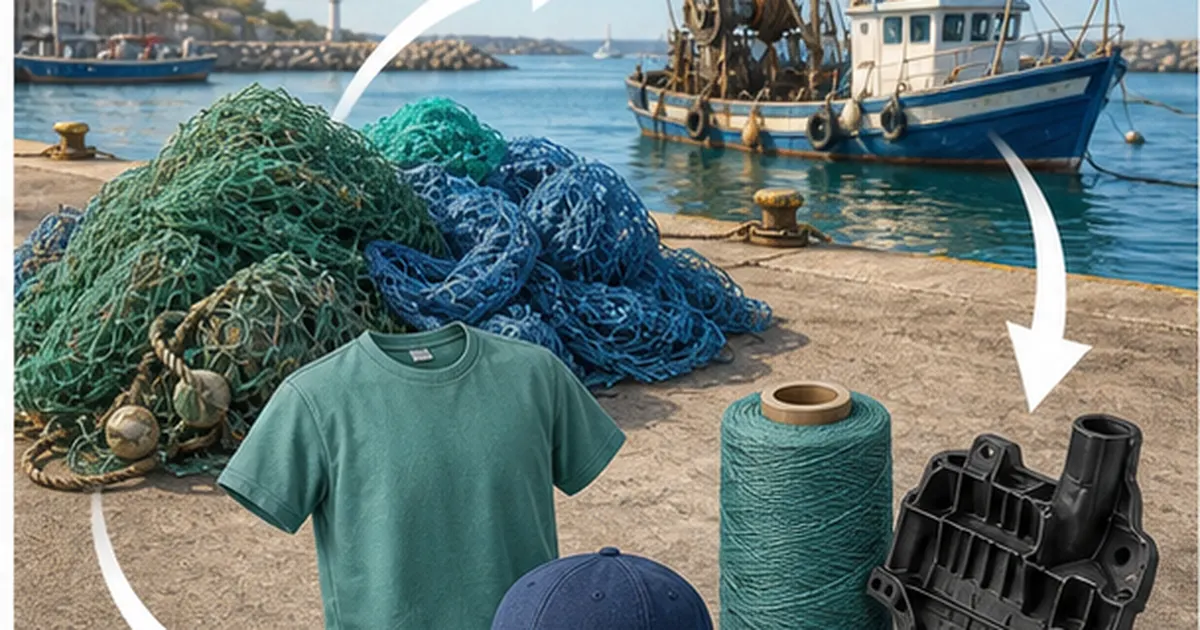
In recent years, however, a movement to see this former "nuisance" as a resource has been accelerating worldwide. Nylon, the main material of fishing nets, is in fact a highly recyclable plastic that can be chemically broken down and returned to virgin-grade raw material. Recovered nets are being reborn as clothing, hats, automotive parts and even stationery.
This article first examines the structural reasons why waste fishing nets become marine debris, using the latest data. It then breaks down the recycling loop from collection to regeneration, and introduces the companies and organizations driving this circulation in Japan and around the world. From "throwing away" to "circulating" — let's follow the life of a fishing net.
What you will learn in this article
- Why retired fishing nets become marine plastic debris and ghost gear, with the latest data on losses
- The materials used in fishing nets — nylon, polyethylene and more — and how recycling routes differ by material
- The five steps of the recycling loop (collection, sorting, washing, regeneration, manufacturing) and the cost-burden challenge
- The frontline players in Japan: Refinverse, amu and Nitto Seimo
- Global initiatives such as ECONYL, NetPlus and the GGGI — and how each of us can help
What Are Waste Fishing Nets? How a Net Becomes "Garbage"
Waste fishing nets are nets no longer in use due to age, damage or a change in target species. Fishing nets are consumables: even with repeated repairs, they need replacing after several years to a decade or so. In a fishing nation like Japan, where diverse gear such as set nets, gillnets, purse seines and trawl nets is in use, every replacement cycle generates a large volume of discarded netting. With roughly 2,800 fishing ports from Hokkaido to Okinawa, waste nets are not a problem of any single region but a shared challenge for every coastal community in Japan.
The Life of a Fishing Net: Repaired, Reused, Then Discarded in Bulk
Constantly exposed to ultraviolet light, salt and friction in the sea, a net gradually loses its strength. Fishers mend torn sections and use their nets with care, but once the whole net degrades, it must be replaced for safety and catch efficiency. A single large set net can weigh several tonnes. Each replacement leaves truckloads of "retired nets" piling up at the port.
The problem is where those nets go. Because waste nets come from business activity, they are not household garbage: they must be processed as industrial waste, and the cost falls, in principle, on the fishers themselves. Until fishers pay to have them hauled away, nets sit stacked in the corner of the harbor — a common sight at fishing ports across Japan.
Know Your Net Materials: Nylon, Polyethylene, Polypropylene
Not all fishing nets are made of the same material. Different synthetic fibers are used for different purposes, and the difference in material translates directly into how easy the net is to recycle. The main materials are summarized below.
| Material | Main uses | Characteristics | Recyclability |
|---|---|---|---|
| Nylon (polyamide 6) | Gillnets, set nets, aquaculture nets | Strong, supple, highly transparent | High (can be chemically returned to raw material) |
| Polyethylene (PE) | Trawl nets, ropes | Light, floats on water, abrasion-resistant | Moderate (reused as pellets) |
| Polypropylene (PP) | Ropes, net edges | Lightweight, inexpensive, buoyant | Moderate (reused as pellets) |
| Polyester (PET) | Some nets and ropes | Low stretch, weather-resistant | Moderate (regenerated into fibers, etc.) |
Nylon 6 in particular, as we will see later, can be chemically processed back into its virgin-grade raw material (caprolactam), making it the star of fishing net recycling. In practice, however, discarded nets combine multiple materials and come with metal weights and floats attached, so the labor of sorting by material is the first gateway to recycling.
Why Waste Fishing Nets Are in the Spotlight Now
Waste nets have always existed, but three trends explain the recent surge of attention. First, SDG 14, "Life Below Water," made marine plastic countermeasures a shared global agenda. Second, at the 2019 G20 Osaka Summit, world leaders shared the Osaka Blue Ocean Vision — reducing additional pollution by marine plastic litter to zero by 2050 — pressing governments for concrete action. Third, as ESG management spread, procuring recycled materials came to be seen as a source of competitiveness rather than a cost.
Another key point: unlike PET bottles or food packaging, fishing nets are waste with a clearly identifiable source. They emerge in bulk from a limited number of locations — fishing ports — so once a collection scheme is in place, they can be turned into resources efficiently. This is why fishing net recycling is seen as a breakthrough for marine plastic policy.

Key points
- Waste fishing nets are processed as industrial waste, with costs borne in principle by fishers
- Materials vary — nylon, PE, PP and more — and each takes a different recycling route
- Nylon 6 is the "honor student" of recycling: it can be restored to virgin quality
The Data: How Much Fishing Gear Disappears into the Sea Each Year?
To understand the waste net problem, we need data on how much fishing gear actually flows into the ocean. Let's look at the numbers for the world and for Japan.
Worldwide: About 640,000 Tonnes a Year — 10% of Marine Plastic
The most widely cited estimate comes from a 2009 joint report by the FAO and UNEP. It concluded that about 640,000 tonnes of fishing gear is abandoned or lost in the ocean every year, equivalent to roughly 10% of all marine plastic debris. Given that an estimated 8 million tonnes of plastic enters the ocean annually, fishing gear accounts for a share that cannot be ignored.
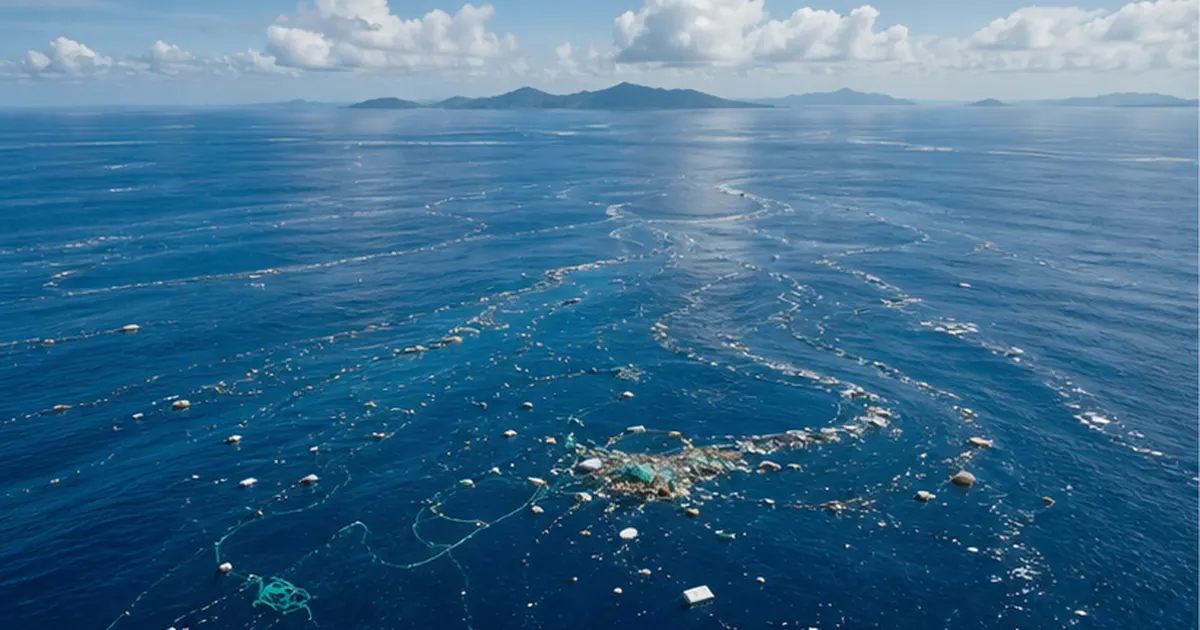
Furthermore, a 2018 study of the Great Pacific Garbage Patch, where debris accumulates offshore in the Pacific, reported that fishing nets made up about 46% of the floating debris by weight. As large plastic debris that persists in the open ocean, fishing gear has an outsized presence.
Latest Research: About 2% of the World's Fishing Gear Is Lost Every Year
In 2022, a research team including Australia's national science agency CSIRO published an estimate in the journal Science Advances, based on interviews with 450 fishers in seven of the world's major fishing nations. It found that about 2% of all fishing gear in use is lost to the sea every year, broken down as follows.
- Gillnets: about 2,963 square kilometers
- Purse seine nets: about 75,049 square kilometers
- Trawl nets: about 218 square kilometers
- Longline mainlines: about 739,583 kilometers (enough to stretch to the moon and back)
- Pots and traps: more than 25 million
"Only 2%" may sound small, but at the scale of global fisheries it accumulates into an enormous quantity each year. The research team warns that if this pace continues, ocean pollution from fishing gear will keep expanding.
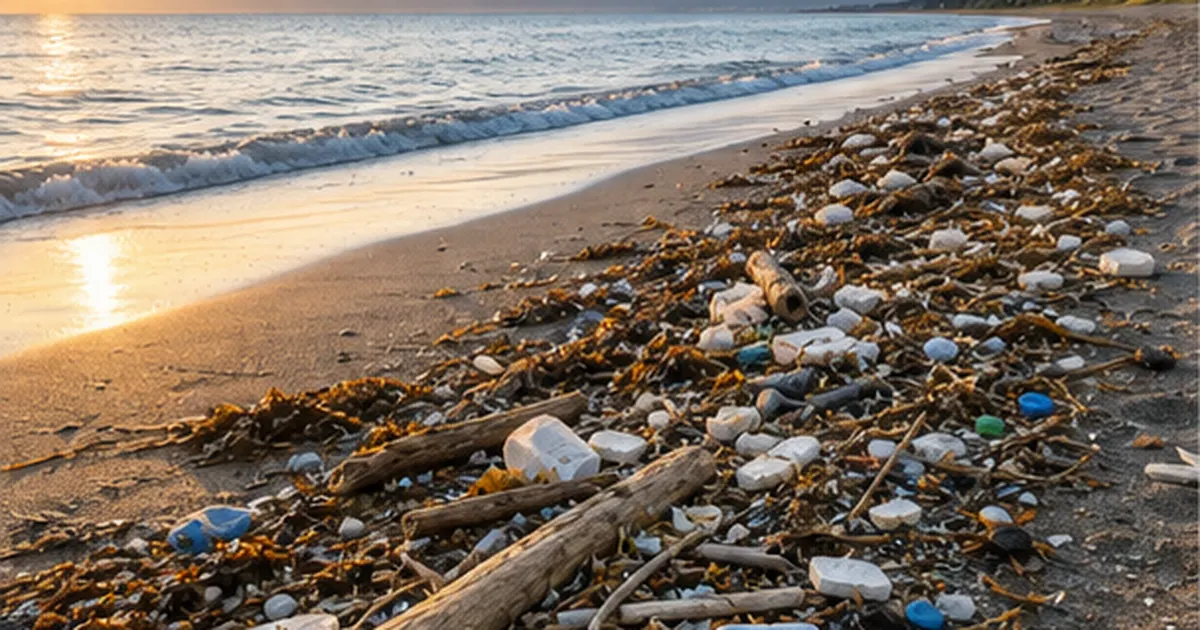
On Japan's Coasts Too: Nets and Ropes Make Up About a Tenth of Beach Litter
Japan is no exception. The Ministry of the Environment's nationwide surveys of marine litter report that, by weight, plastic ropes, cords and fishing nets rank among the top categories of beach litter at many sites. On the border island of Tsushima in Nagasaki Prefecture, collection projects from fiscal 2013 to 2017 found that fishing nets and ropes accounted for just under 10% of the litter washed ashore. Lying in the path of the Tsushima Current, the island receives huge amounts of fishing gear from home and abroad, making it a front line of the marine debris problem.
On remote islands like Tsushima, the cost of collecting and processing stranded fishing gear weighs heavily on local governments. National subsidies exist under Japan's coastal litter law, but hauling nets up from steep shores is grueling manual work, processing facilities on the island are scarce, and shipping the waste to the mainland adds cost. The mismatch between "those who lose the gear" and "those who clean it up" is a difficulty shared across the marine litter problem.
It is also worth knowing that these estimates come with a margin of uncertainty. The 640,000-tonne figure dates from 2009, and later studies using different methods have reported both larger and smaller values. Yet every study agrees on one conclusion: fishing gear is among the most harmful categories of marine plastic. Precisely because it is designed to catch fish, its impact on ecosystems after loss is on another level entirely.

An estimated 640,000 tonnes of fishing gear is abandoned or lost in the ocean every year, accounting for about 10% of marine plastic debris.
― Summary of the FAO/UNEP joint report (2009)
Why Nets Flow into the Sea and Pile Up on Land
Are fishers deliberately dumping nets into the sea? For the most part, no. There are structural reasons behind both losses at sea and stagnation on land.
Losses at Sea: Storms, Snags and Gear Conflicts
The main causes of gear loss are nets swept away by storms and strong currents, nets snagged on rocky reefs or shipwrecks and becoming unrecoverable, and contact between fishing gears during operation — for example, a trawler passing over a fixed gillnet. Losing expensive gear is a serious blow to fishers themselves, and in most cases these losses are accidents.
That said, deliberate dumping is not zero. Discarding old nets at sea to avoid disposal fees, or cutting nets loose to hide evidence of illegal fishing, has been reported around the world. Behind such losses lies the structural problem discussed below: processing nets on land costs money.
Problems on Land: Fishers Pay for Disposal, Landfills Are Filling Up
Processing waste nets brought ashore is not easy either. Because they are industrial waste, the cost of incineration or landfill falls on the fishers. Nets are mixed masses entangled with metal weights, floats and shells, so processing fees are high — in some regions, tens of thousands of yen per tonne. For fishers already squeezed by low fish prices and high fuel costs, this is a heavy burden.
Moreover, incineration emits CO2, and landfilling eats into the remaining capacity of final disposal sites. With landfill space nationwide already limited, bulky, non-degradable fishing nets are a disposal site's nightmare. "Can't afford to throw it away, can't keep it" — this dead end is the soil from which harbor-side net piles, and in the worst cases illegal dumping and ocean loss, grow.
"Sorted Waste Is a Resource" — But Sorting Is the Hard Part
You might think, "If they just sorted the nets properly, they'd be a resource." But real-world waste nets are far tougher than they look. Nets soaked in seawater for years are saturated with salt and encrusted with barnacles, shells and seaweed. Lead weights are woven into the mesh, and ropes of different materials are sewn along the edges. Melt them down without removing all this and the recycled resin's quality drops; feed them into an incinerator and the equipment suffers. The reason ordinary plastic recyclers hesitate to accept fishing nets is precisely this combination of contamination and mixed materials.
That is why recyclers with dedicated washing and sorting lines for fishing nets are so critical. Conversely, if fishers simply adopt primary sorting — storing nylon nets and ropes separately, removing weights beforehand — the economics of recycling improve dramatically. Building a collection scheme is not just about logistics; it is a collaboration that extends to storage and sorting rules at the port.
Three structural reasons waste nets have nowhere to go
- Disposal costs are self-funded by fishers, squeezing their businesses
- Mixed materials and attached debris raise processing fees and limit willing processors
- Incineration emits CO2, while landfill strains disposal capacity — both carry environmental costs

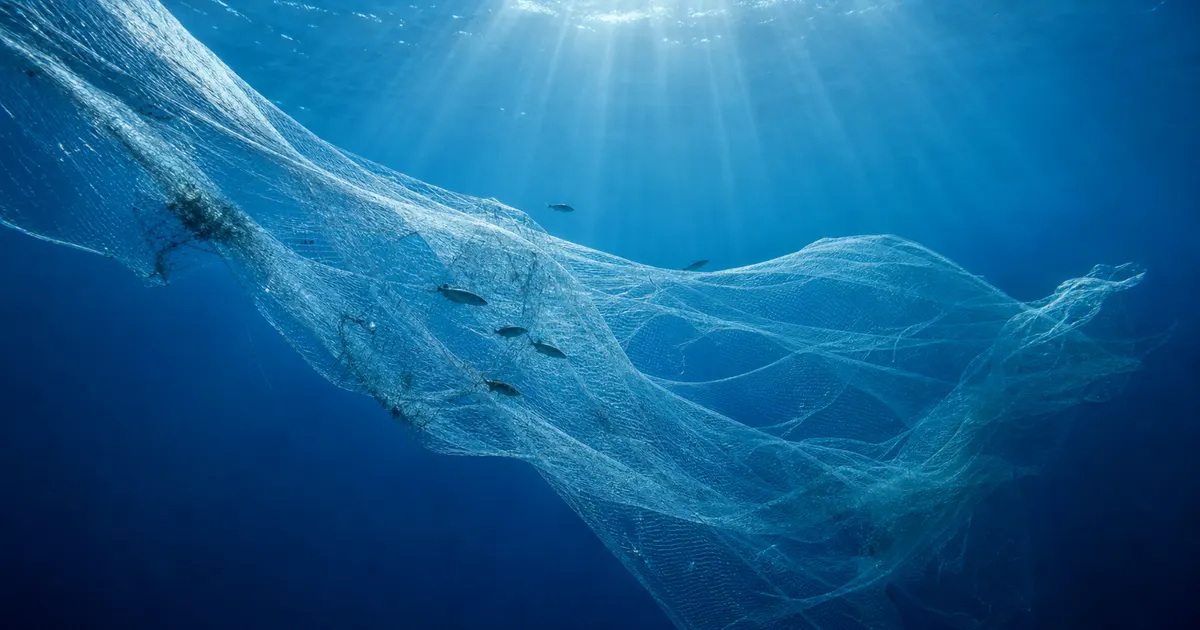
Ghost Gear: Nets Left in the Sea Keep On Fishing
The problems caused by nets lost at sea go beyond "more garbage." A fishing net is a tool built to catch fish. Even after losing its owner, that function keeps working underwater. This phenomenon is called "ghost fishing."
Nobody Harvests, Yet the Catch Continues
When fish get caught in a lost net, other fish and crustaceans approach to feed on them, followed by the sea turtles, seabirds and seals that hunt those — each becoming entangled in turn. Trapped animals die, the net sinks, and once they decompose the net floats up and "resumes fishing" — a vicious cycle that benefits no one and continues for years, or with some materials, decades. Because synthetic fibers like nylon take an extremely long time to break down naturally, a ghost net's "operating life" is long.
Secondary Damage to Coral Reefs, Vessels and Coastlines
The damage is not limited to wildlife. Drifting nets can smother coral reefs, snapping coral branches and blocking the light they need, leading to bleaching and death. Ropes and nets wound around a ship's propeller can disable the vessel and cause maritime accidents. Mass strandings of nets degrade coastal scenery, hurt tourism and inflate municipal cleanup costs. For a full picture of ghost gear's ecological impact and countermeasures, see our related article "What Is Ghost Gear?".
A Blow to Fisheries Themselves: Losing Both Gear and Future Catch
Ghost fishing is an economic problem for fisheries as much as an environmental one. The fish and crustaceans that die in ghost gear could have been fishers' landings. If an abandoned trap keeps catching lobsters and crabs for years, the resource base of that fishing ground itself erodes. Losing gear thus deals fishers a double blow: the loss of their tools and the loss of future catch. From the standpoint of sustainable fisheries, recovering ghost gear and preventing its creation are directly in the industry's own interest.
The crucial point is that building a fishing net recycling system is a countermeasure at the source of ghost gear. If nets have value on land and reliable channels to be collected, the number of nets lost or abandoned at sea will surely fall. Collection and regeneration are also a front line in protecting marine life.

How Fishing Net Recycling Works: Five Steps from Collection to Regeneration
So how does a waste net become a new product? Details vary by operator, but the basic loop is the same everywhere. Let's break it into five steps.
The Recycling Loop, Step by Step
- Collection — Gather waste nets through fishing ports, cooperatives, and collection events at aquariums and NPOs. Some operators run buy-back schemes
- Sorting — Separate by material (nylon, PE, PP) by hand or machine, and remove metal weights, floats, shells and other attachments
- Washing and shredding — Wash off salt and grime, then cut and shred nets into forms suitable for reprocessing
- Regeneration — Produce recycled material either by melting into pellets (material recycling) or by chemically breaking nets down into raw material (chemical recycling)
- Manufacturing — Turn regenerated nylon yarn into clothes and hats, and recycled pellets into auto parts and daily goods, delivering them to consumers
Surprisingly, the bottleneck in this flow is not advanced regeneration technology but the first steps: collection and sorting. The logistics cost of gathering nets from ports scattered nationwide, and the labor of untangling them by material, are the walls to profitability. That is why regional collection networks linking fishers, municipalities and companies are being developed across the country.
The key to clearing the profitability wall is "value creation." If regenerated nylon matches virgin material in quality and carries added environmental value, companies have a reason to buy it even at a premium. Indeed, recycled materials whose CO2 savings can be quantified are increasingly chosen by companies with decarbonization targets. The shift from "use it because it's cheap" to "use it because it has value" is what absorbs collection and sorting costs and makes the loop economically self-sustaining.
Three Regeneration Routes: Material, Chemical and Thermal
| Method | How it works | Strengths | Weaknesses |
|---|---|---|---|
| Material recycling | Washed, shredded nets are melted into pellets and reused as resin | Simple process with low CO2 emissions | Quality easily degraded by impurities and aging |
| Chemical recycling | Nets are chemically broken down into monomers and re-synthesized into virgin-grade resin | Virgin-equivalent quality with broad applications | Requires capital investment and energy |
| Thermal recycling | Nets are incinerated as fuel and the heat energy recovered | Can handle nets too mixed to sort | The material is lost and CO2 is emitted |
For recycled materials to earn market trust, traceability is also essential. Which port did the net come from, which factory regenerated it, which product used it? Only when this chain can be proven can a brand confidently label a product "made from fishing nets." Internationally, third-party certifications for recycled materials such as the GRS (Global Recycled Standard) are widespread, and certification of fishing-net-derived materials is expanding.
Nylon 6's Trump Card: Depolymerization Restores Virgin Quality
The material drawing the most attention in net recycling is nylon 6 (polyamide 6), common in gillnets and set nets. Nylon 6 can be broken down through a chemical reaction called depolymerization into its raw material, caprolactam. Purify and re-polymerize it, and in theory it can be returned to virgin-grade nylon again and again. It has also been confirmed that this cuts CO2 emissions substantially compared with making virgin nylon from petroleum.
For more technical detail on regenerated nylon's quality, applications and ghost gear countermeasures, see our related article "The Complete Guide to Fishing Net Recycling". From the next chapter, we look at the players actually turning this loop in Japan and worldwide.


Japan's Front Line: Companies Turning Waste Nets into Resources
In Japan too, ventures making a business of the waste net loop are spreading. Here are three companies with distinct approaches.
Refinverse "REAMIDE": Regenerated Nylon That Cuts CO2 by About 85%
Refinverse Group produces REAMIDE, a regenerated nylon resin made primarily from used fishing nets. Collected nets are thoroughly washed and cleared of foreign matter, then supplied as high-quality regenerated nylon for automotive interior parts, home appliance components and stationery. It is reported to cut CO2 emissions by about 85% compared with virgin nylon 6, and has been adopted for the body of tape glue dispensers by major stationery maker Tombow Pencil, steadily reaching everyday products. The group is also commercializing material recycling of waste nets in Hokkaido, building processing capacity close to where the nets are generated.
Kesennuma-Born amu "amuca": Buying Nets to Make Fishers Allies
Founded in Kesennuma, Miyagi Prefecture — one of the world's great fishing ports — amu Inc. travels to ports across Japan to buy waste fishing nets directly from fishers, regenerating them as the material brand "amuca" for apparel fabrics, yarns and plastic pellets. Nets that once could only be discarded for a fee become something that sells, reducing fishers' financial burden while boosting collection volumes — the great strength of this model. By 2025 the company had raised more than 130 million yen in cumulative funding and is expanding its collection network nationwide and overseas.
Nitto Seimo: Toward "Net-to-Net" Horizontal Recycling
Major net manufacturer Nitto Seimo, working with material makers, is pursuing the industry's first "net-to-net" recycling — making new fishing nets from discarded ones. The company announced it has achieved physical properties comparable to nets made from 100% virgin material while using regenerated raw material. Unlike "upcycling" into clothes or goods, this is horizontal recycling that returns the product to itself, drawing wide attention. If a net-to-net loop is established, dependence on new petroleum resources can be reduced at the root.
The Circle Widens: Aquariums, Furniture Makers and Local Events
The circle now extends beyond recyclers. Net maker Nichimo converts hard-to-recycle mixed-material nets into solid fuel (RPF) through thermal recycling, cutting the volume sent to landfill. Office furniture giant Okamura developed the "ReNet" chair, whose seat uses fishing-net-derived regenerated nylon — bringing ocean materials to the unexpected setting of an office chair. And in 2024, Shimoda Aquarium in Shizuoka Prefecture held a waste net collection event where 67 visitors took part and recovered an estimated 44 kilograms of netting, creating venues where citizens can join collection directly.
Three companies, three approaches
- Refinverse: pioneering industrial uses — auto parts, stationery — with high-quality recycled resin
- amu: a buy-back scheme that removes fishers' burden and expands the collection network
- Nitto Seimo: building an in-industry loop with net-to-net horizontal recycling

Global Initiatives: Into Clothes, Sunglasses and Skateboards
Fishing net recycling is also a global movement. With famous fashion and outdoor brands adopting regenerated materials, products born from ocean waste are no longer a novelty.
ECONYL: Diver-Recovered Nets Become Luxury-Brand Yarn
Italian fiber maker Aquafil's ECONYL is a yarn brand made by chemically regenerating nylon waste such as discarded fishing nets and used carpets. Ghost nets pulled from the sea by volunteer divers of the marine conservation organization Healthy Seas form part of the raw material, and the recovered nets are processed at a plant in Slovenia. ECONYL is used in swimwear, bags and carpets, and has been adopted in luxury fashion collections — overturning the image of recycled nylon as a compromise material.
Emblematic of this is "Re-Nylon," the project Italian luxury brand Prada launched in 2019. Prada rolled out a bag collection using ECONYL and pledged to eventually switch entirely from virgin to regenerated nylon. A luxury house putting fishing-net-derived material center stage shifted the value of recycled materials from "cheapness" to "story and quality," profoundly influencing the industry.
Bureo "NetPlus": Over 2,000 Tonnes Recovered with Patagonia
Chile-born startup Bureo buys used fishing nets from South American fishing communities and regenerates them as NetPlus material for skateboards, sunglasses and apparel fabrics. Outdoor brand Patagonia invested in the venture and uses NetPlus in hat brims and jacket fabrics, announcing that it has supported the collection and recycling of more than 2,000 tonnes of waste fishing nets to date. The scheme pays participating fishing communities for their nets, earning high praise for combining environmental protection with local economies.
GGGI: Governments, Companies and NGOs Join Hands
Beyond individual corporate efforts, international cooperation is advancing. The Global Ghost Gear Initiative (GGGI), launched in 2015, is an international framework bringing together governments, fishing industry groups, companies and NGOs to solve the ghost gear problem. It develops guidelines for marking gear so owners can be identified, shares recovery data, and supports collection projects worldwide, with participation from Japanese organizations and companies growing. It is a global effort to build "recover and regenerate" into a gear life cycle that used to end at "make, use, lose."

Keeping the Loop Turning: Policy Moves and What We Can Do
The waste net loop cannot be completed by corporate effort alone. Only when policies that support collection and consumers who choose recycled products come together does the circle truly begin to turn.
Policy Moves: Japan's Coastal Litter Act and Regional Collection Support
In Japan, under the Act on Promoting the Treatment of Marine Debris enacted in 2009 (amended in 2018), the national government financially supports municipal beach cleanups and prevention measures. Collecting and processing stranded fishing gear is a key theme of this framework, and regions with heavy strandings, such as Tsushima, run ongoing recovery programs. The Ministry of the Environment and the Fisheries Agency also support proper disposal of fishery waste and recycling pilot projects, gradually building systems that make waste nets easier to collect and regenerate.
Internationally, the debate goes further still: schemes requiring gear to be marked so owners can be identified and held responsible for losses, and applying extended producer responsibility (EPR) — where gear makers and sellers take responsibility through to collection and recycling. In the ongoing negotiations for the United Nations plastics treaty, fishing gear is one of the major agenda items. Whether the roles of "those who make, use and recover" can be designed into policy will be the focus of the next decade.
Support by Buying: How to Choose Recycled-Material Products
The most direct support a consumer can give is choosing products made with fishing-net-derived recycled materials. Clothes, swimwear, hats, bags and stationery made of regenerated nylon are already available in familiar stores and online. Check product tags and descriptions for labels such as "regenerated nylon" or "made from recycled fishing nets." When recycled products sell, companies can collect more nets and pay fishers more. Shopping is a vote that thickens the circle of circulation.
Support the Field: Join Events, Donate, Learn and Share
Aquariums and NPOs across Japan hold net collection events and beach cleanups. Take part, and feeling the weight and tangle of a real net with your own hands transforms your sense of the problem. Donating to collection groups and posting about their work on social media are real contributions too. For the broader concept of the circular economy, see our related article "What Is the Circular Economy?".
Actions you can take today
- When buying clothes and accessories, look for labels like "regenerated nylon" or "made from fishing nets"
- Join net collection events and beach cleanups run by aquariums and NPOs
- Share the work of collection and recycling groups and companies on social media
- When buying fish, keep an eye out for fisheries that care for resources and the marine environment

Summary of this article
- An estimated 640,000 tonnes of fishing gear is lost or abandoned at sea yearly, about 10% of marine plastic debris
- A 2022 study estimates about 2% of the world's fishing gear is lost to the ocean every year
- The structure in which fishers bear industrial waste disposal costs contributes to stagnation and ocean loss
- Nylon 6 can be regenerated to virgin quality via depolymerization, with major CO2 savings
- Japanese companies — Refinverse, amu, Nitto Seimo — are building three distinct loops
- Global initiatives like ECONYL, NetPlus and the GGGI are expanding; choosing recycled products is the closest way to help
References and Sources
- FAO (Food and Agriculture Organization of the United Nations) – Ghost nets hurting marine environment
- Richardson, K. et al. (2022) Science Advances – Global estimates of fishing gear lost to the ocean each year
- CSIRO (Commonwealth Scientific and Industrial Research Organisation) – Fishing gear lost at sea globally revealed
- Lebreton, L. et al. (2018) Scientific Reports – Study reporting that fishing nets account for about 46% of Great Pacific Garbage Patch debris by weight
- Ministry of the Environment, Japan – Marine litter surveys (composition data for beach litter)
- Tsushima Marine Litter Information Center – Beach litter on Tsushima (share of fishing nets and ropes)
- Refinverse Group – Official page for regenerated nylon resin "REAMIDE"
- MONOist (ITmedia) – Regenerated nylon from waste fishing nets cuts CO2 emissions by 85% vs. virgin material
- amu Inc. – Official site for waste net buy-back and the "amuca" recycled material
- Patagonia – NetPlus® Recycled Fishing Nets (partnership with Bureo)
※ Ordered by reliability: government and academic institutions > peer-reviewed papers > specialist organizations > trusted media