⚡ The answer in 30 seconds
- Lanternfish are small glowing deep-sea fish with about 250 species in 33 genera. They are widespread in the mesopelagic zone (200 to 1,000 m depth) and are considered a leading candidate for the most abundant fish on Earth.
- They are a major component of the deep scattering layer, the "false bottom" picked up by sonar in 1942, and carry out diel vertical migration every day, staying deep by day and rising to the surface at night.
- Global mesopelagic fish biomass is estimated at 1.8 to 16 Gt, a wide range. They matter as a link in the food web and a carrier of carbon, and any fishery use calls for careful science.
Lanternfish are small fish with rows of glowing spots on their bodies that hide in the dark deep sea by day and rise several hundred meters at night. They are extremely abundant in the world's oceans and are sometimes called a leading candidate for the most abundant fish on Earth.
They first came to be known in 1942, when a "false bottom" appeared on submarine-detection sonar. What lay behind it was the deep scattering layer, made up of lanternfish and other animals.
This article draws on research papers and public-agency materials to cover the story of the discovery, diel vertical migration, how photophores work, biomass estimates, their role in food webs and carbon transport, and the issues surrounding mesopelagic fisheries.
What you'll learn in this article
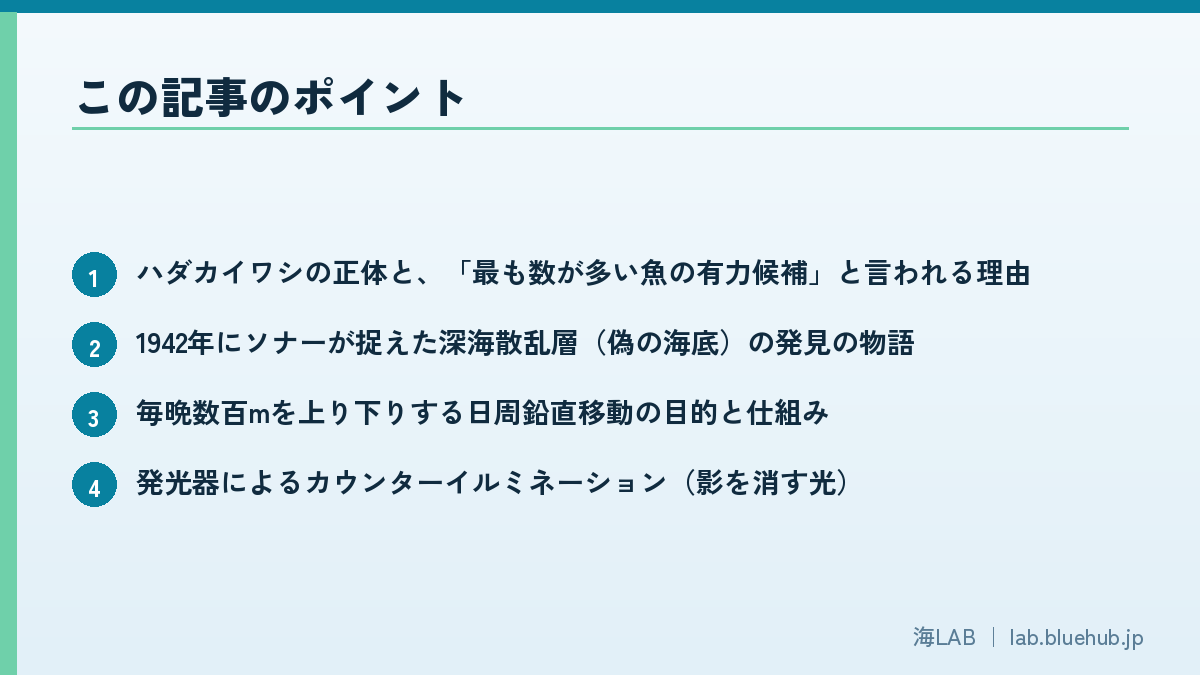
- What lanternfish are, and why they are considered a leading candidate for the most abundant fish
- The story of the 1942 discovery of the deep scattering layer (the "false bottom") by sonar
- The purpose and mechanism of diel vertical migration, in which they move up and down several hundred meters every night
- Counterillumination with photophores (light that erases a shadow)
- Their importance as a link in the food web and a carrier of carbon, and the issues surrounding mesopelagic fisheries
What Are Lanternfish? One of the Ocean's Largest Biomasses in a Tiny Body
Basic profile of the lanternfish family (Myctophidae)
"Lanternfish" is a collective name for small deep-sea fish belonging to the family Myctophidae in the order Myctophiformes. As the name suggests, the small photophores lined along their sides and bellies glow like lanterns in the dark sea. Although the Japanese name contains "iwashi" (sardine), they belong to a different group from the Japanese sardine on our tables (order Clupeiformes) and are only distantly related.
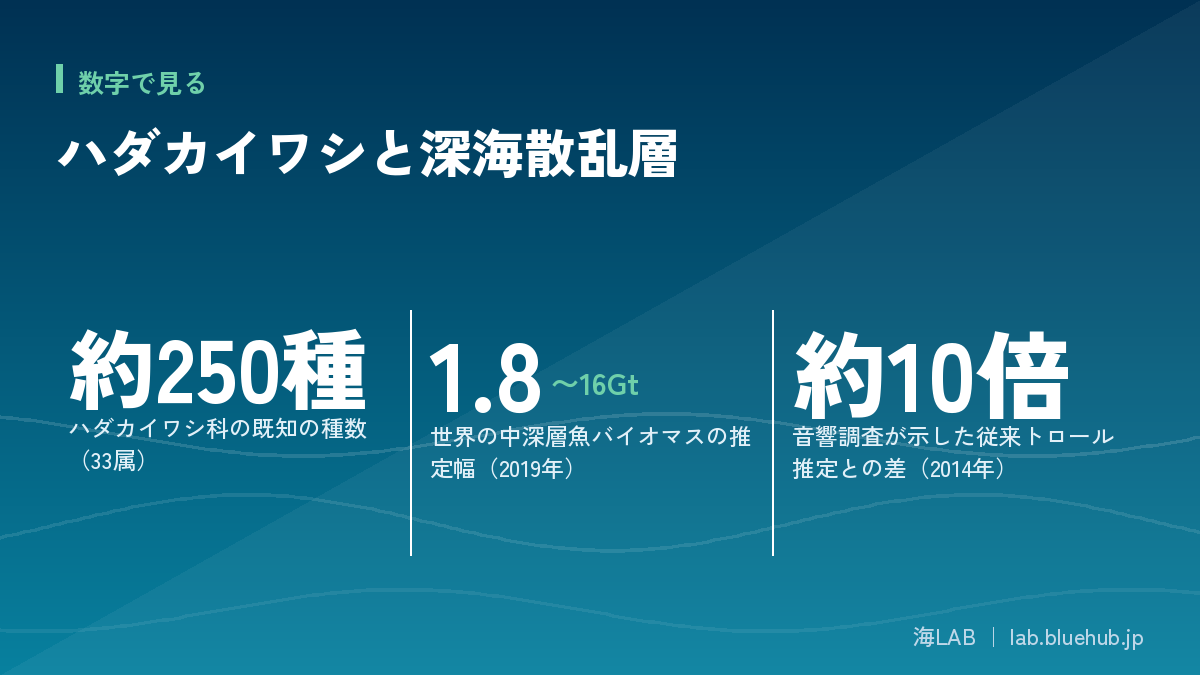
The lanternfish family has about 250 species in 33 genera and is said to occur in nearly every ocean except the Arctic Ocean (according to the review by Catul et al., 2011). Most species measure from a few centimeters to about ten-odd centimeters. We rarely see them in daily life, but they are extremely abundant in the sea and are among the main inhabitants of the dim world called the "mesopelagic zone" (200 to 1,000 m depth).
Why they are called "the most abundant fish on Earth"
Lanternfish are often introduced as "one of the most abundant fish (vertebrates) on Earth." The basis is research showing that the total amount of fish living in the mesopelagic zone is far larger than previously thought. As we will see in detail later, surveys using sound waves (acoustics) have suggested that the total biomass of mesopelagic fish may be orders of magnitude larger.
However, caution is needed in calling them simply "the most abundant." Deep-sea animals are hard to catch in nets, and estimates vary widely depending on how they are counted. Other mesopelagic fish, such as bristlemouths, are also thought to be extremely abundant, and which species or family ranks first has not been firmly settled. This article therefore uses the careful phrasing "lanternfish are one of the leading candidates for the most abundant fish on Earth."
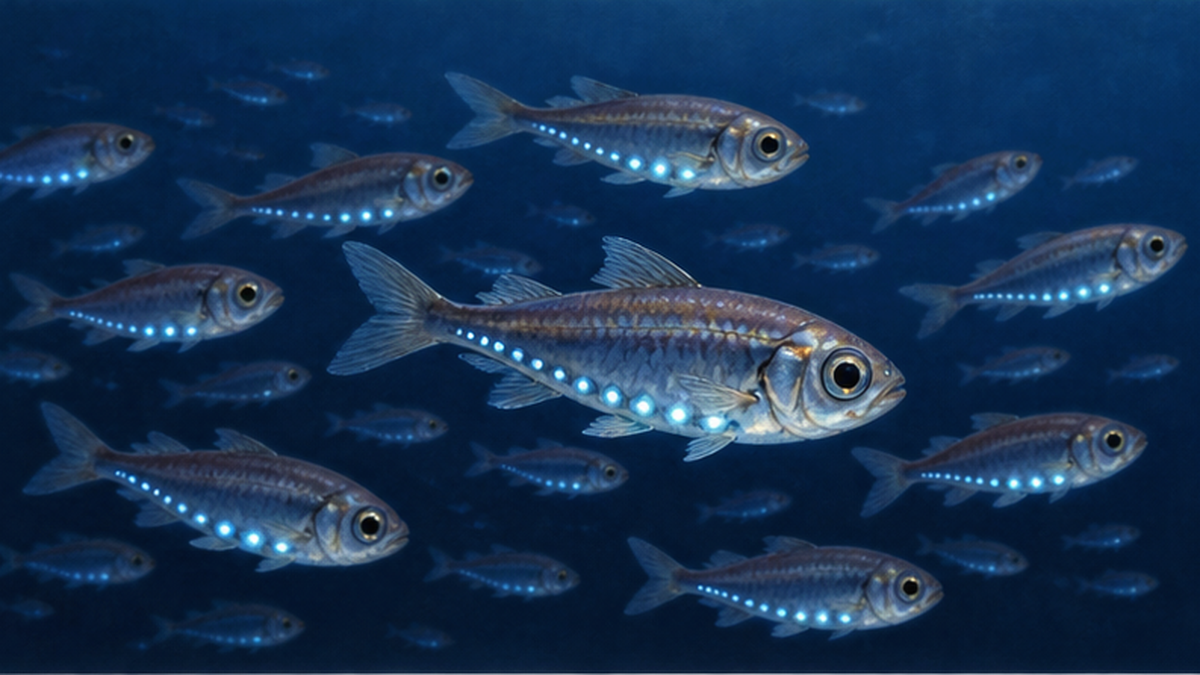
The "stars of the sea" that rarely meet human eyes
Lanternfish are prey for large predators and have never been a main target of fisheries. As a result they are little known to the public, but in marine biology they have long been studied as "key organisms for understanding mesopelagic ecosystems." They link ocean food webs, carry carbon into the deep, and were also the source of the "mysterious echo" in acoustic surveys. These three faces are the theme of this article.
Key points of this section
- The lanternfish family has about 250 species in 33 genera and occurs in the world's oceans except the Arctic Ocean
- Despite the "sardine" in the Japanese name, they belong to a different order from the Japanese sardine
- They are a leading candidate for the most abundant fish, but the uncertainty in counting is large
Discovery of the Deep Scattering Layer: The "False Bottom" on Sonar
A strange event off San Diego in 1942
The deep scattering layer (DSL) is a "layer" in the sea that strongly reflects sound waves. It was discovered in 1942, during World War II. Eyring, Christensen, and Raitt, three researchers in a wartime research unit of the University of California, were testing long-range submarine-detection sonar off San Diego when a strong echo appeared at a depth where there should have been no seafloor (according to NOAA Ocean Exploration and WHOI materials).
This echo appeared at roughly 300 to 500 m depth by day and rose to shallower water at night. Because it was mistaken for the seafloor, it was called the "false bottom" or "phantom bottom" and puzzled naval engineers and oceanographers of the time. For a while it was also called the "ECR layer," after the initials of the three discoverers.
The culprit was a "layer of living things"
Later surveys showed that this reflecting layer was not rock or a temperature boundary but a layer in which countless marine organisms gather. It contains a diverse range of animals, including fish, squid, shrimp, krill, and jellyfish relatives, but the main constituents, with the strongest reflection, are small mesopelagic fish such as lanternfish.
Many species of lanternfish and similar fish have a gas-filled swim bladder. Gas transmits sound very differently from water, so it reflects sound waves well. As a result, even though each fish is only a few centimeters long, the school as a whole shows up strongly on sonar. Conversely, while sonar images allow us to estimate the amount of mesopelagic fish, there is a risk of mistaking echoes from animals without swim bladders, such as siphonophores (jellyfish relatives), for fish, so uncertainty remains in the estimates.
| Year | Event | Significance |
|---|---|---|
| 1942 | A "false bottom" appeared on sonar during tests by the USS Jasper (Eyring, Christensen, Raitt) | Discovery of the deep scattering layer |
| Late 1940s | The reflecting layer was interpreted as a gathering of organisms, and research advanced | The "layer" came to be understood as a biological community |
| 2014 | An acoustic survey reported the total amount of mesopelagic fish to be about 10 times earlier estimates (Irigoien et al.) | The immensity of mesopelagic fish was recognized anew |
| 2019 | The range of global mesopelagic fish biomass estimates was put at 1.8 to 16 Gt (Proud et al.) | The uncertainty of the estimates was made clear |
The deep scattering layer exists worldwide
The deep scattering layer is not a phenomenon of particular sea areas only; it has been observed in oceans around the world from the polar regions to the tropics. Its depth, thickness, and abundance vary with the brightness of the sea, the amount of plankton, and the distribution of water temperature and oxygen. In recent years, research has also advanced on mapping its global distribution using not only shipboard acoustic instruments but also autonomous observation devices and fishing-vessel data.
Trivia: when sonar shows a bottom-like echo shallower than the seafloor
- A strong echo appearing at 300 to 500 m by day and becoming shallower at night is the hallmark of the deep scattering layer
- Fish swim bladders and similar structures strongly reflect sound
- Organisms other than fish, such as jellyfish, also reflect sound, so corrections are needed in the estimates
Diel Vertical Migration: One of the Largest "Daily Migrations" on Earth
Deep by day, shallow by night
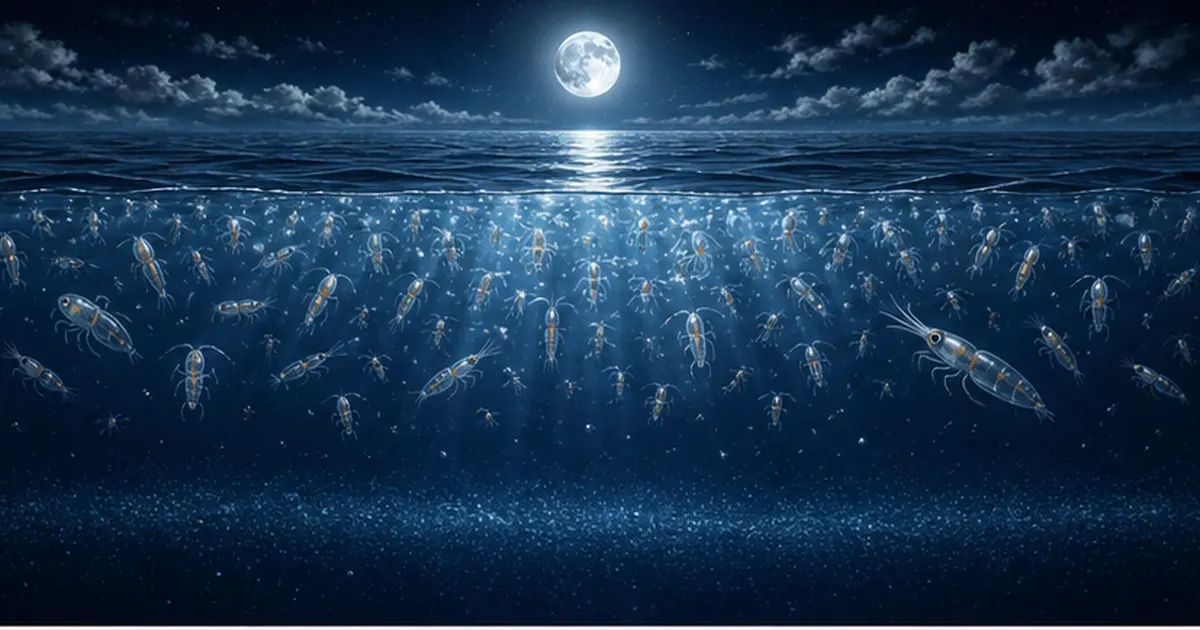
Most lanternfish species stay in the dim mesopelagic zone at roughly 300 to 1,500 m depth during the day, and as sunset approaches they rise to the surface layer near the sea surface (roughly 10 to 100 m depth). This daily up-and-down movement is called diel vertical migration. The distance varies by species and sea area, from several hundred meters to, in some species, more than 1,000 m.
For a fish only a few to about ten-odd centimeters long, a vertical movement of several hundred meters equals tens to hundreds of times its body length. Because this happens simultaneously among trillions of animals, diel vertical migration is described as "the largest daily animal migration on Earth" (according to explanations by NOAA and others).
Why do they go up and down every day?
The reason is thought to be a balance between "eating" and "not being eaten." The surface layer is rich in plankton and thus in food, but in the bright daytime it is a dangerous place where they are easily spotted by large fish, seabirds, and marine mammals that hunt by sight. So they adopt a strategy of rising to the surface to feed only in the dark of night and returning to the dark depths at dawn to hide.
Lanternfish mainly eat zooplankton such as copepods, krill, and amphipods. The zooplankton they feed on also rise at night in the same way, so in part lanternfish are "following the movement of their food."
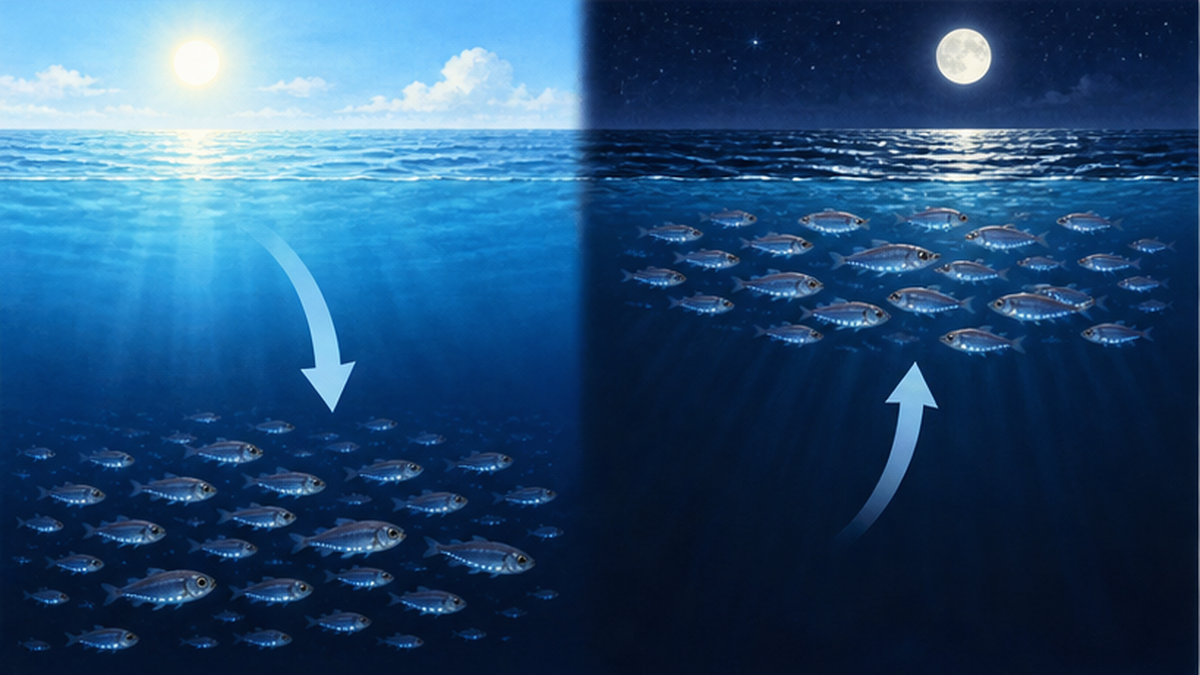
Light intensity acts as the "clock"
The trigger for the migration is mainly the change in light intensity. Many species are said to begin rising in the evening when the surrounding brightness falls below a certain level, and to descend as brightness increases in the morning. It has also been reported that the depth of migration changes on moonlit nights and cloudy days.
Furthermore, there are examples in which the same species changes its behavior with the seasons. For instance, seasonal differences in vertical migration have been reported for Benthosema glaciale (glacier lanternfish), which lives in the northern Atlantic. Because the length of day and night in northern seas changes greatly between summer and winter, the fish adjust their behavior to the light environment.
| Time of day | Position of lanternfish | Main behavior |
|---|---|---|
| Day | Mesopelagic zone (roughly 300 to 1,500 m) | Rest in the dark and hide from predators |
| Evening | Begin rising | Move to shallower layers as light weakens |
| Night | Near the surface (roughly 10 to 100 m) | Feed on zooplankton |
| Dawn | Begin descending | Return to the depths again |
Key points of this section
- Deep by day, shallow by night: this daily up-and-down movement is diel vertical migration
- The purpose is to balance feeding at night with hiding in the dark by day
- Changes in light trigger it, and behavior also varies with the seasons and moonlight
Diel vertical migration is also widely seen in plankton in general. For details, see our sister article Diel Vertical Migration of Plankton: The Largest Migration on Earth.
Photophores Along the Body: Counterillumination, "Glowing to Hide"
What are photophores?
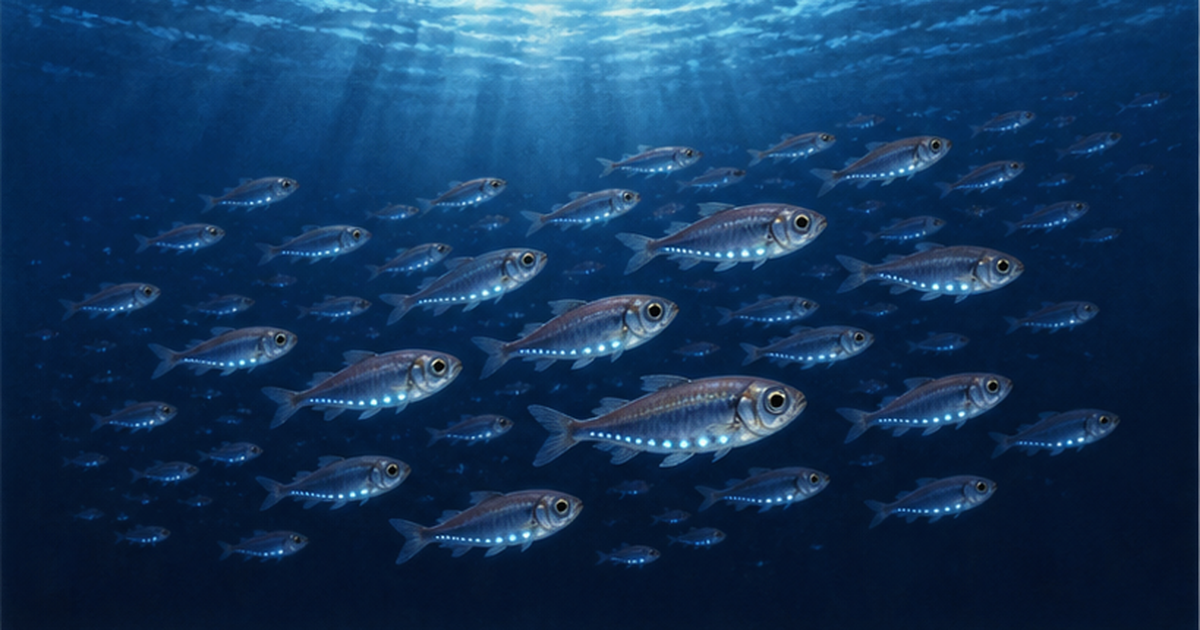
The greatest feature of lanternfish is the photophores dotted along the sides and belly of the body. Nearly all species have these organs; according to research, only one species, Taaningichthys paurolychnus, lacks them. Photophores are arranged in rows along the sides of the body (toward the belly) and are also found on the head.
Japanese-language explanations describe the inside of a photophore as having mirror-like reflective tissue, with light from light-producing cells, which glow through an enzymatic reaction of proteins, reflected inside and emitted outward. In other words, you can picture a small flashlight-like mechanism inside the body.
Glowing to "erase the shadow"
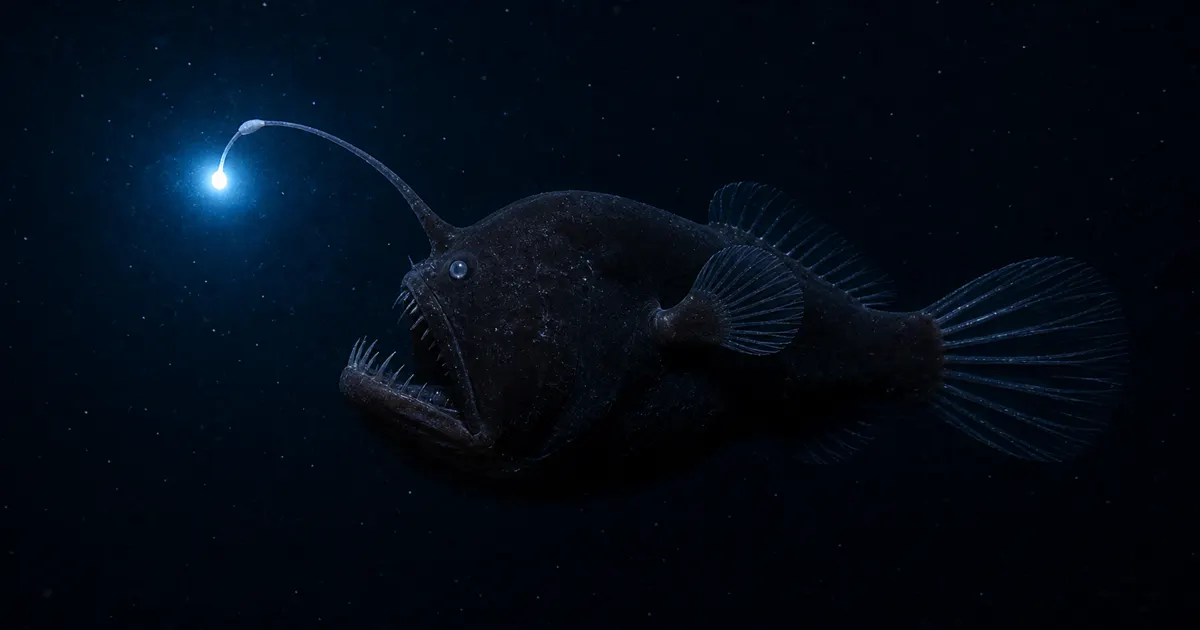
Why do deep-sea fish glow? One of the main explanations is counterillumination. Even in the mesopelagic zone, faint sunlight comes down from above. To a predator looking up from below, a fish's belly stands out as a dark shadow. If the fish emits light from its belly with the same brightness and color as the surroundings, the shadow disappears and it blends into the background. The ventral photophores of lanternfish are thought to be used for this purpose.
This mechanism requires adjusting the light intensity to the environment. A 2020 study (Davis et al.) suggested that the "eye-facing photophores" near the lanternfish's eyes may serve as a reference (reference light) for adjusting the intensity of their own light. However, whether this applies to all species is still under study.
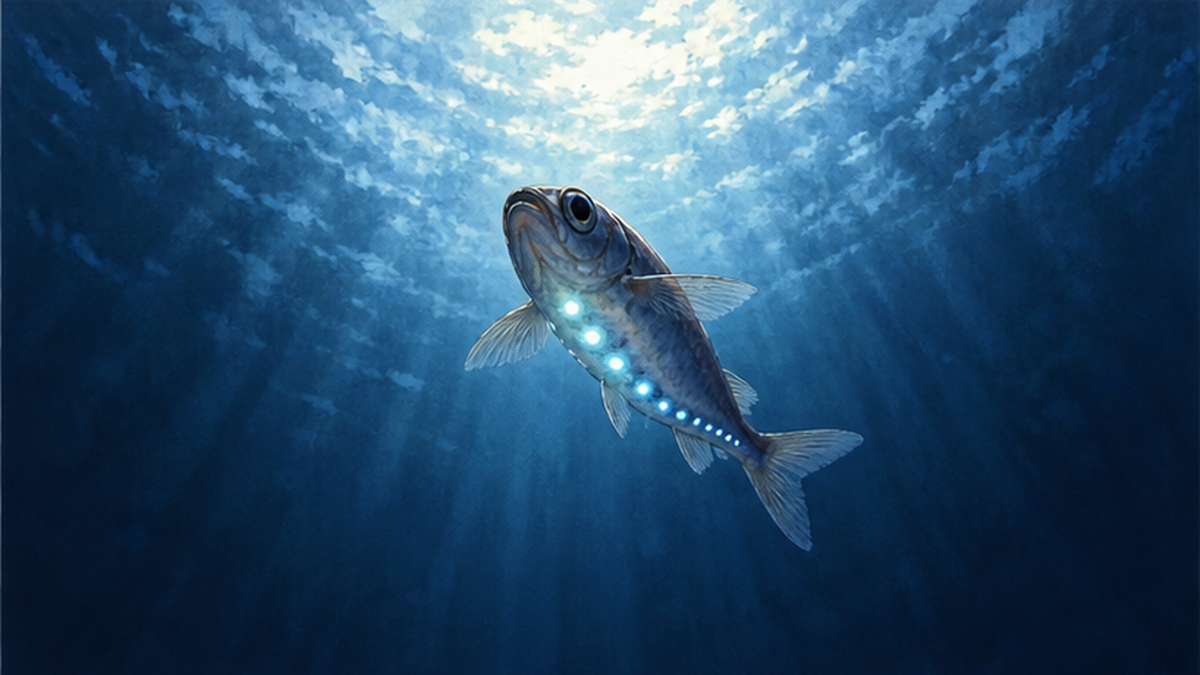
Light also acts as a "name tag"
The arrangement of photophores differs among species and is also used to identify them. From this feature, photophores are thought to serve as "signals" that help companions recognize one another, form schools, and find mates. In some species the size and shape of photophores on the head and at the base of the tail differ between males and females, and a link to courtship is under discussion.
A comparative study published in PLOS ONE (2024) sorts out how diverse the photophore structures of the lanternfish family are from species to species. Even among animals that all "glow," structure, position, and number are made differently by species, suggesting the richness of visual communication that evolved in the darkness of the deep sea.
Trivia: it is not only fish that glow
- In the mesopelagic zone, many animals, including squid, shrimp, jellyfish, and plankton, produce light
- Their purposes differ: erasing their own shadow, luring prey, startling enemies, and so on
- Lanternfish are thought to glow mainly to "erase their shadow and send signals"
Key points of this section
- Nearly all species have photophores on the sides and belly (with one exception)
- Counterillumination, in which light from the belly erases the shadow seen from below, is the leading explanation
- The arrangement of photophores differs by species and is thought to be also used as a signal to companions
How Many Are There? An Estimate That Jumped Tenfold, and the Uncertainty That Remains
From trawl surveys to acoustic surveys
The traditional way to learn the amount of mesopelagic fish was to catch and count them with midwater trawl nets. Estimates by this method put the global biomass of mesopelagic fish at about 1 billion tonnes (1,000 million tonnes). However, mesopelagic fish are good at avoiding nets, and fast-swimming individuals escape. It had long been pointed out that net surveys may "underestimate the real amount."
In 2014, Irigoien and colleagues, in a paper published in Nature Communications, used acoustic data from the Spanish circumnavigation expedition Malaspina 2010 to estimate the biomass of mesopelagic fish at about 10 billion tonnes, roughly 10 times the earlier figure. The paper also showed that the amount of mesopelagic fish in the open ocean is closely related to primary production (photosynthesis by phytoplankton) and that the efficiency of energy transfer from phytoplankton to mesopelagic fish is higher than previously assumed.
The 2019 revision: a range of 1.8 to 16 gigatonnes
A more cautious reassessment followed. In 2019, Proud and colleagues, in the ICES Journal of Marine Science, estimated global mesopelagic fish biomass from daytime 38 kHz acoustic backscatter data and showed that the results span a wide range. The estimate was a range of 1.8 to 16 gigatonnes (Gt), with medians of 3.8, 4.6, and 8.3 Gt depending on the method (Proud et al., 2019).
This range changes with assumptions such as "how much of the acoustic reflection comes from fish" and "how much sound one lanternfish reflects." Another study estimated from acoustic properties that the amount of mesopelagic fish in the Southern Ocean is large (Proc. R. Soc. B, 2022). In conclusion, the exact total is still unknown, but there is a common direction: mesopelagic fish probably make up the greater part of the ocean's fish biomass. Some estimates hold that lanternfish, as the central group, account for a large share of the total (up to 65% in one review).
| Estimate | Method | Global mesopelagic fish biomass |
|---|---|---|
| Earlier estimate | Midwater trawl surveys | About 1 billion tonnes (1 Gt) |
| Irigoien et al., 2014 | Acoustic observations from the Malaspina expedition | About 10 billion tonnes (about 10 Gt) |
| Proud et al., 2019 | Modeling of acoustic backscatter data | 1.8 to 16 Gt (median 3.8 to 8.3 Gt) |
Why are they "hard to count accurately"?
- The deep sea is vast, and direct observation and sampling are difficult
- Many individuals avoid nets or escape from them in the lower layers of the sea
- Acoustic reflections also come from organisms other than fish (such as jellyfish relatives)
- Their depth changes with day and night and with the seasons, making it hard to grasp the whole picture in a single survey
Numbers that change greatly are not a failure of science but evidence that new observation technology is updating how things look. Combining acoustic surveys with environmental DNA, autonomous observation devices, deep-sea cameras, and the like is expected to improve the accuracy of the estimates.
Key points of this section
- The earlier trawl-based estimate was about 1 billion tonnes; a 2014 acoustic survey reported about 10 billion tonnes
- The 2019 reassessment gave a wide range of 1.8 to 16 Gt and is not settled
- They are likely "among the largest fish biomasses," but the figures are provisional
The "Middle Layer" Supporting the Ocean Food Web: Who Eats Them, and What Do They Eat?
A bridge connecting plankton and large predators
Ocean food webs link phytoplankton to zooplankton to small fish to large fish, seabirds, and marine mammals. Within this chain, lanternfish are a "bridge" connecting zooplankton and large predators. In the Southern Ocean and elsewhere, fish of the lanternfish family are regarded as an important trophic level linking zooplankton and higher predators.
The animals that eat lanternfish are diverse. They include tunas and skipjack, squid, large deep-sea fish, sharks, and even seals, whales, penguins, and seabirds.
A Southern Ocean example: a food web that cannot be told with krill alone
Antarctic krill are famous in the Antarctic food web, but lanternfish are in fact indispensable too. Electrona antarctica, a representative Southern Ocean species, eats krill and other prey and is itself food for many seabirds. According to explanations by the Australian Antarctic Division and others, about 80% of the king penguin's diet is said to be lanternfish, and they are also eaten by marine mammals such as Antarctic fur seals and by large fish such as the Patagonian toothfish.
In other words, if the amount of lanternfish dropped sharply, these predators could run short of food. Conversely, a sea rich in lanternfish is also a rich sea for the predators above them.
The more of these "link" fish a sea has, the thicker and more stable its food web. For the lives of schooling fish, see also Why Do Fish School?.
A staple for deep-sea predators
Lanternfish are also an important food for large predators living in the deep sea. Because they stay in the mesopelagic zone during the day, they are ideal prey for mesopelagic predators. The latest status of deep-sea biodiversity and its conservation is covered in our sister article The Full Picture of Deep-Sea Biodiversity.
Key points of this section
- Lanternfish are an important trophic level linking zooplankton and higher predators
- In the Southern Ocean, about 80% of the king penguin's diet is said to be lanternfish
- A decline could ripple out to many animals, including tunas, seabirds, and marine mammals
Lanternfish as Carriers in the "Biological Pump" That Moves Carbon into the Deep
How the ocean stores carbon dioxide
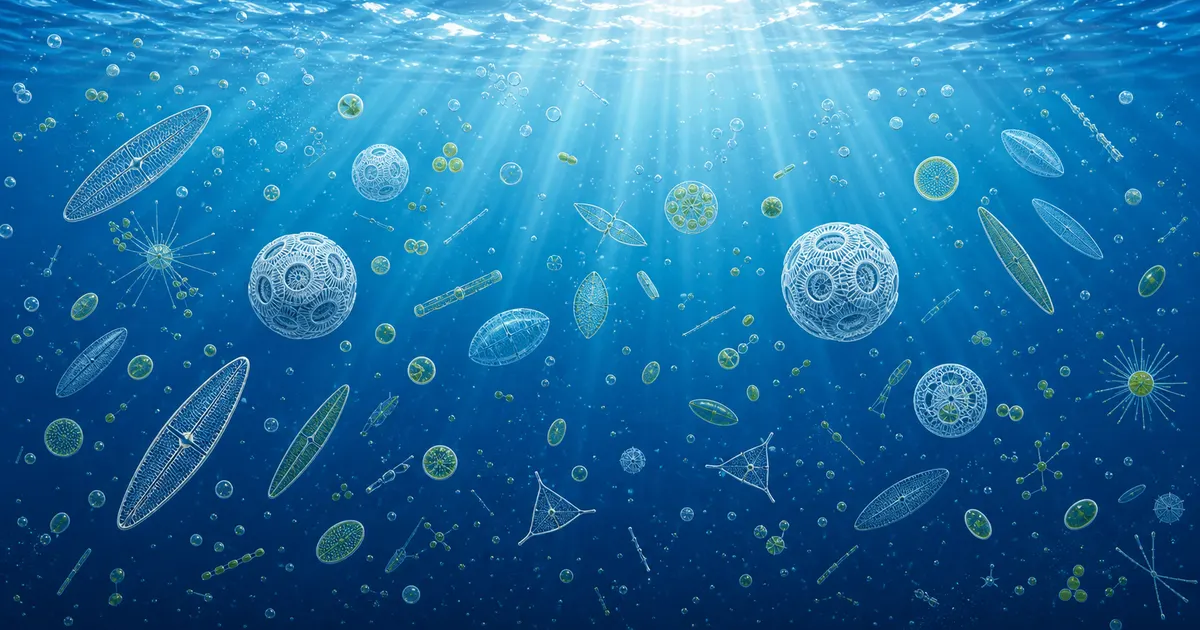
The ocean absorbs atmospheric carbon dioxide (CO2) and carries part of it into deep layers. One of the mechanisms is the biological pump. In the surface layer, phytoplankton take up CO2 by photosynthesis, are eaten, and sink into the deep sea as waste and carcasses. The overall role of the ocean in absorbing carbon is explained in our sister article What Percentage of Human CO2 Does the Ocean Absorb?.
It has been pointed out that mesopelagic fish such as lanternfish may work as "active carriers" in this biological pump. They feed at the surface at night, then move to depth by day, where they respire, defecate, and die.
What is "active transport"?
The ordinary biological pump is "passive," with particles sinking by gravity. In contrast, lanternfish swim by themselves and carry surface carbon into the depths. The carbon they take in by eating plankton at the surface at night is released as CO2 through respiration in the deep sea by day, and also dropped as feces. Carbon released at depth does not return to the atmosphere as easily as at the surface, so it tends to stay in the ocean for a long time.
A 2013 study in the northeast Pacific by Davison and colleagues (Carbon export mediated by mesopelagic fishes in the northeast Pacific Ocean) is cited in many papers as a representative study quantifying this carbon transport by mesopelagic fish. Feces readily become fast-sinking particles and are said to contribute to carbon transport into the deep sea.
Recent modeling studies estimate that, in carbon sequestration by mesopelagic fish, the pathway of CO2 release (respiration) at their deep daytime depths accounts for a large share (over 70% in some estimates, within a range of 30 to 80%) (Biogeosciences, 2023). However, another study notes that large uncertainties in fish metabolism and feeding rates leave high uncertainty in estimates of the transport amount.
| Pathway | Mechanism | Characteristics |
|---|---|---|
| Passive sinking | Particles of carcasses, feces, and plankton sink by gravity | Depends on particle size and speed |
| Active transport (respiration) | Feed at the surface at night, respire at depth by day, and release CO2 | Released in deep layers, so it is readily sequestered |
| Active transport (excretion) | Release feces and mucus at depth | Fast-sinking fecal particles carry carbon deep |
| Active transport (death) | Die at depth and sink | Many die from predation, so the contribution is seen as limited |
If they were caught on a large scale
The contribution of mesopelagic fish to carbon transport is also tied to fisheries issues. If mesopelagic fish were caught in large quantities, then in addition to effects on the food web, their function as carbon carriers might be impaired. Whether to prioritize the ecosystem service of "carbon sequestration" or the use of fisheries has to be considered amid large scientific uncertainty (for example, the modeling study in Ambio, 2024).
Key points of this section
- Lanternfish are "carbon carriers" that feed at the surface at night and respire and excrete at depth by day
- Active transport releases carbon at depth, so it tends to stay in the ocean for a long time
- Estimates of the transport amount are highly uncertain, and research is ongoing
Future Challenges: Mesopelagic Fisheries, Climate Change, and What We Can Do
Expectations of a "huge untapped resource" and concerns
As the world's population grows, demand for fishery resources is rising. Mesopelagic fish such as lanternfish have large biomass and contain protein and omega-3 fatty acids (EPA and DHA), so they have drawn attention as a raw material for fishmeal and fish oil. This is the view of them as a "huge untapped resource."
On the other hand, researchers have voiced strong caution. Much is still unknown about the food webs, life histories, behavior, biomass, and genetic population structure of mesopelagic organisms. No economically successful case has been confirmed in past attempts at mesopelagic fisheries. And since, as seen in the previous sections, they play important roles in both food webs and carbon transport, careless expansion carries risk.
Furthermore, because mesopelagic fish are also food for tunas and other species, catching them could affect large fishery resources as well. In fact, a paper in Fisheries Management and Ecology has examined how a fishery targeting mesopelagic fish could affect the management of bigeye tuna stocks.
Effects of climate change and ocean acidification
The mesopelagic zone is coming under the influence of rising water temperature, declining oxygen (deoxygenation), and acidification. If the amount of surface phytoplankton changes, so does the food of zooplankton and lanternfish. If the layered structure of the sea changes, the depth of diel vertical migration and the position of the deep scattering layer may also shift. However, research is still insufficient on how strongly lanternfish are affected.
Genetic research has also begun. The Institute of Marine Research in Norway and others have examined the population structure of the glacier lanternfish across its entire range, advancing understanding of the organisms of the ocean's twilight zone (2025 report). Knowing how well a widely distributed species mixes as a single population would help in resource management and in assessing its resilience to climate change.
To address these unresolved questions, research institutions in many countries, including Japan, are conducting joint international surveys. In the United States, large projects such as the Ocean Twilight Zone project centered on WHOI have investigated mesopelagic ecosystems by combining acoustics, cameras, and sampling.
What we can do
- Know that there is life and a carbon cycle in the sea's "invisible layers" (learning at school and at home)
- Take an interest in how fishmeal and fish oil are used and in how to choose sustainable seafood (such as certification labels)
- Support greenhouse gas reduction and ocean conservation, and share news of changes in the sea
- Share scientific uncertainty as the message "we don't know yet, so let's be careful"
Small steps you can take starting today
- Look for exhibits and explanations about lanternfish and the deep scattering layer at aquariums and museums
- Look at photos and videos of the night sea while imagining the "fish that rise at night"
- Tell a family member or friend one thing about the link between marine life and the carbon cycle
Summary
- Lanternfish live in the mesopelagic zone worldwide, with about 250 species in 33 genera, and erase their shadow with photophores on their sides and bellies
- They are one of the main constituents of the deep scattering layer, discovered in 1942 as a "false bottom"
- Through daily diel vertical migration, they link the food web and carry carbon into the deep sea
- Total biomass is estimated at a wide 1.8 to 16 Gt, with much still unknown; use of them calls for more careful science
References and Sources
- Irigoien et al. (2014) Large mesopelagic fishes biomass and trophic efficiency in the open ocean. Nature Communications 5:3271 – Biomass estimate of mesopelagic fishes from acoustic observations
- Proud et al. (2019) From siphonophores to deep scattering layers: uncertainty ranges for the estimation of global mesopelagic fish biomass. ICES J. Mar. Sci. – Range of global mesopelagic fish biomass estimates (1.8–16 Gt)
- Catul et al. (2011) A review on mesopelagic fishes belonging to family Myctophidae. Reviews in Fish Biology and Fisheries – Review of the lanternfish family
- NOAA Ocean Exploration: What is the deep scattering layer? – Explainer on the deep scattering layer
- Eyring, Christensen & Raitt (1948) Reverberation in the Sea(WHOI Twilight Zone) – Original paper on the discovery of the deep scattering layer
- Variation in lanternfish (Myctophidae) photophore structure: A comprehensive comparative analysis. PLOS ONE (2024) – Comparative study of photophore structure
- Davis et al. (2020) Evidence that eye-facing photophores serve as a reference for counterillumination – Role of eye-facing photophores
- Model estimates of metazoans' contributions to the biological carbon pump. Biogeosciences (2023) – Model estimates of animals' contribution to the biological pump
- Large mesopelagic fish biomass in the Southern Ocean resolved by acoustic properties. Proc. R. Soc. B (2022) – Mesopelagic fish biomass in the Southern Ocean
- Australian Antarctic Program: Antarctic food web – The Antarctic food web
Ordered by reliability: government/academic institutions > peer-reviewed papers > specialized organizations > reputable media