The "heatwaves" that scorch the land each summer have become an annual news story. Yet few people realize the same thing is happening beneath the waves. Scientists call the phenomenon in which sea temperatures stay abnormally high for days, or sometimes months, a "marine heatwave." Progressing out of sight, this heat turns coral reefs bone white, kills fish and shellfish en masse, and quietly shakes the fishing industry and our dinner tables alike.
Marine heatwaves are far from a problem confined to distant southern seas. Sea surface temperatures around Japan are rising at a rate of 1.33°C per 100 years — more than double the global average — and 2024 saw the highest annual average on record. Off Sanriku and along the coast of Hokkaido, ecosystem disruptions linked to abnormally high water temperatures are already a reality.
This article walks through what a marine heatwave is, the mechanisms behind coral bleaching and mass die-offs, representative events in Japan and around the world, and what we can do about it — all grounded in primary sources from the Japan Meteorological Agency (JMA), NOAA, and the IPCC.
What you'll learn in this article
- The scientific definition of a marine heatwave (water temperature exceeding the 90th percentile of the past 30 years for five days or more) and its four intensity categories
- Why marine heatwaves are becoming more likely as the ocean absorbs roughly 90% of the Earth's excess heat
- The physiological mechanism by which rising temperatures expel symbiotic algae from corals, leading from bleaching to death
- Landmark events at home and abroad, from "The Blob" and the 2016 Sekisei Lagoon bleaching to the global record set in 2023
- How the seas around Japan are warming faster than the global average, fueling harmful algal blooms, "isoyake" barren grounds, and fishery damage
- What we can do, from three angles — monitoring, mitigation, and adaptation
What is a marine heatwave?
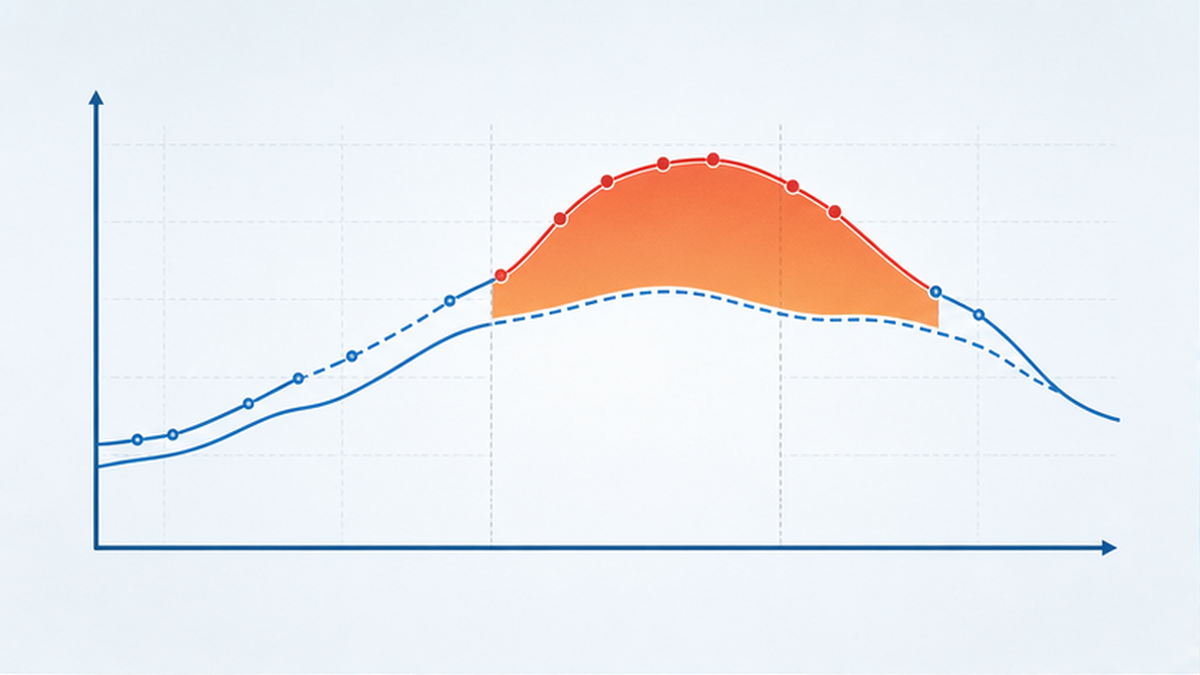
A marine heatwave is a phenomenon in which sea temperatures in a given region become extremely high compared to the seasonal norm and stay that way for five days or more. In English it is called a "marine heatwave," often abbreviated MHW. Just as a heatwave on land refers to abnormally high air temperatures lasting several days, the sea can also experience a sustained period of being "noticeably hotter than usual" — and that period becomes a major source of stress for marine life.
What matters is not simply that the water is hot, but that it is abnormally hot for that particular place and season. A tropical sea at 30°C and a northern sea at 20°C differ in absolute terms, but for the creatures that live in each, either can become a heatwave once it exceeds what they can tolerate. The benchmark is always "how far the temperature deviates from that region's normal value." That is precisely why the same term, "marine heatwave," can be applied worldwide — whether to a coral reef on a southern island or a kelp bed off the coast of Hokkaido.
The term "marine heatwave" only began to be used seriously in scientific circles surprisingly recently, in the 2010s. A record-breaking spell of high water temperatures off Western Australia in 2011 wiped out kelp forests over a wide area and dealt a blow to the local fishing industry — and that event drove home to researchers the need to quantify "ocean heatwaves" the same way land heatwaves are measured. Since then, as satellite sea-surface-temperature data has accumulated, research into marine heatwaves has advanced rapidly.
The scientific definition: above the 90th percentile for five days or more
The definition most widely used around the world is the criterion proposed in 2016 by Australian oceanographer Alistair Hobday and colleagues. Specifically, when sea surface temperature for that day and that region exceeds the top 10% (the 90th percentile) based on roughly the past 30 years of observations, and this continues for five consecutive days or more, it is counted as one marine heatwave event. Statistically speaking, this is a level of heat that occurs no more than 10% of the time.
Brief spikes of high temperature lasting fewer than five days are not counted, and if a high-temperature period is interrupted for less than three days, the periods before and after are treated as a single continuous heatwave. By fixing these rules, researchers around the world can compare and tally marine heatwaves using the same yardstick. Because a given sea region's heatwave duration, frequency, and intensity for a given year can be expressed in numbers, it becomes possible to discuss year-to-year trends, regional differences, and long-term increases objectively.
Note that the 90th-percentile threshold does not represent "the normal sea temperature" itself, but rather "a rare high that falls within the top 10% relative to normal." In other words, the threshold itself shifts with the seasons — there is a summer threshold and a winter threshold — and if that threshold is exceeded, a marine heatwave can occur even in the dead of winter. Indeed, in northern seas, winter-to-spring marine heatwaves have been known to affect the breeding and migration of marine life.
Intensity is expressed in four categories
Marine heatwaves are classified by how far they deviate from the normal value. In the Hobday framework, they are divided, from weakest to strongest, into four categories: "moderate," "strong," "severe," and "extreme." The higher the category, the more severe the damage to marine life, and the more likely it is to lead to visible harm such as coral bleaching or mass mortality.
| Category | Rough intensity | Typical ecosystem impact |
|---|---|---|
| Moderate | Slightly above the normal top 10% | Most organisms can tolerate it, but stress begins |
| Strong | Roughly twice the moderate anomaly | Shifts in distribution and stunted growth begin to appear |
| Severe | Roughly three times the moderate anomaly | Bleaching and localized die-offs become likely |
| Extreme | Four times or more the moderate anomaly | High risk of large-scale bleaching and mass mortality |
How it differs from a heatwave on land
A heatwave on land often subsides within a few days, but because water holds far more heat than air (it has a much higher heat capacity), a sea that has once warmed up does not cool down easily. As a result, marine heatwaves can last for weeks, and in extended cases, more than a year. For marine creatures with nowhere to escape, this "duration" is precisely what makes it lethal.
Another difference is that it is "hard to see." A land heatwave can be felt directly and is widely reported in weather forecasts. A marine heatwave, however, progresses beneath the surface, so it often goes unnoticed without dedicated observation. It is not unusual for fishers to realize "something is off with the fish this year" only after high water temperatures have already persisted for weeks or months. Because of this inconspicuousness, marine heatwaves are sometimes called a "silent disaster."
Key points from this section
- A marine heatwave is a phenomenon in which sea temperature abnormal for that sea and season persists for five days or more
- The benchmark is the 90th percentile of the past 30 years; intensity is expressed in four categories
- Because water does not cool easily, marine heatwaves tend to last longer than heatwaves on land
Why do marine heatwaves occur?
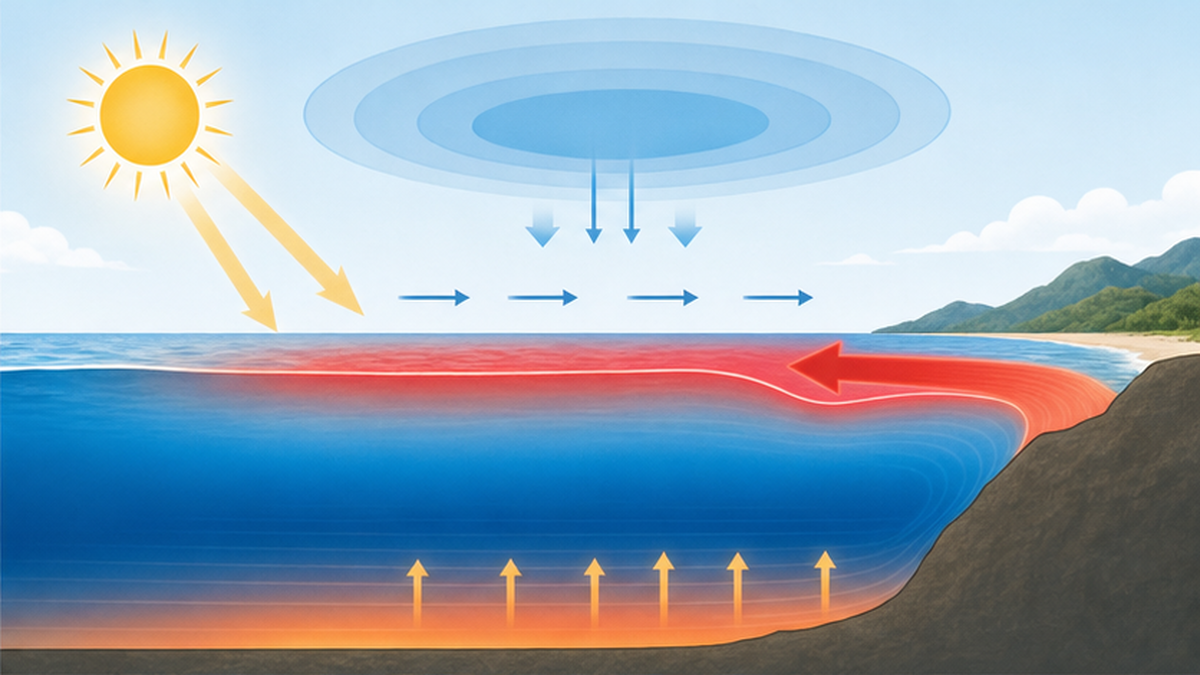
Behind every marine heatwave lies a combination of two things: the long-term "baseline rise" from global warming, and the year-to-year "fluctuations" in weather and ocean conditions. When conditions that happen to bring high temperatures are layered on top of a sea temperature base that is steadily rising, the result is an extreme heatwave that far exceeds the threshold.
The ocean absorbs about 90% of the Earth's excess heat
Of the excess heat that has built up on Earth due to rising greenhouse gases, roughly 90% has been absorbed not by the atmosphere but by the ocean (IPCC Sixth Assessment Report). The ocean is Earth's giant "heat piggy bank," and the temperature rise we feel in the air is only a small fraction of the heat the planet has actually stored. Behind the scenes, sea temperature keeps climbing steadily, laying the groundwork for marine heatwaves to occur more easily. This absorption of heat and carbon is also deeply connected to changes in sea temperature and ocean currents and to ocean acidification.
This "baseline rise" shows up in the numbers as well. The frequency with which marine heatwaves cover the world's sea surface is reported to have roughly doubled compared with the 1980s. And if greenhouse gas emissions continue at a high level going forward, the frequency of marine heatwaves is projected to increase by several dozen times more. Because the heat the ocean has absorbed stays there for centuries, even if emissions were reduced to zero right now, conditions favorable to marine heatwaves would persist for some time.
Climate fluctuations such as El Niño
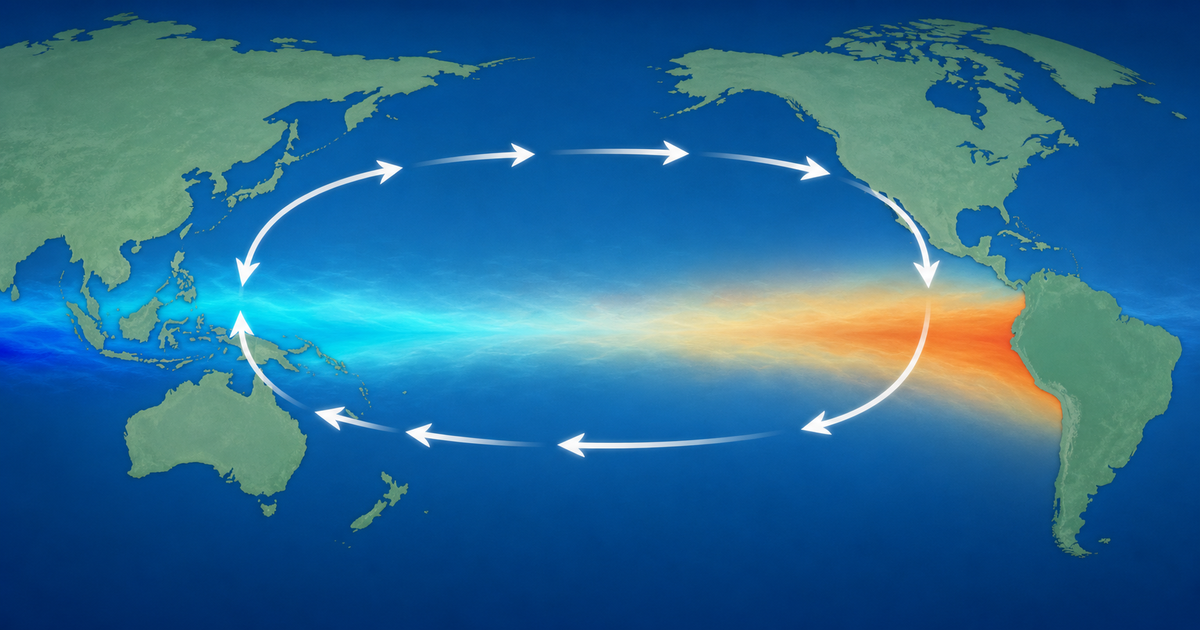
The El Niño phenomenon, in which sea surface temperatures fluctuate across the equatorial Pacific, is a classic driver that pushes up sea temperatures on a global scale. In fact, the record-breaking high temperatures of 2023–2024 are thought to be partly the result of the long-term warming trend coinciding with a shift from La Niña to El Niño. In El Niño years, large-scale coral bleaching tends to occur simultaneously in many parts of the world. It is no coincidence that many of the past global coral bleaching events have overlapped with strong El Niño years.
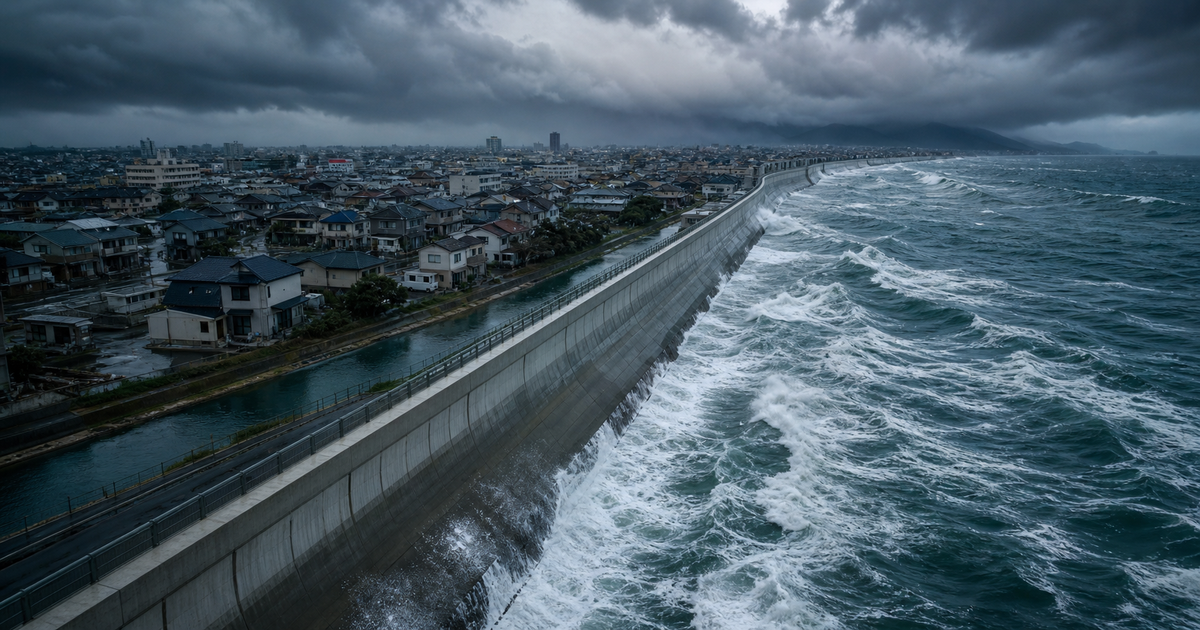
Such climate fluctuations are a natural rhythm and are not inherently "bad" in themselves. The problem is that, because warming has raised the baseline temperature of the ocean as a whole, when a natural fluctuation such as El Niño is added on top, sea temperatures can spike to levels never experienced before. It is the same logic as a wave more easily overtopping a seawall when the sea level was already elevated to begin with.
Ocean currents, high-pressure systems, and weak winds
- Meandering or strengthening of warm currents: when a warm current such as the Kuroshio flows in more strongly than normal, sea temperature in that region can spike
- Blocking highs (stalled high-pressure systems): sustained clear skies and weak winds allow the sea surface to keep absorbing solar heat, which builds up in the surface layer without being mixed away
- Weak winds: when winds are weak, mixing between cold deep water and surface water is reduced, so only the surface warms abnormally
The massive marine heatwave in the northeast Pacific known as "The Blob" (2013–2016) was a textbook case of a stalled high-pressure system combined with weak winds, which pushed sea temperatures over an area comparable to the size of Canada up to 4°C above normal at their peak. Even when such weather conditions are temporary, the damage lingers because a warmed sea does not cool easily.
Marine heatwaves are also not confined to the sea surface. Even when the surface itself is not especially hot, a "hidden marine heatwave" — abnormally high temperatures persisting at a depth of several tens of meters — can strike corals and fish living in deeper water. Because satellites can only observe the sea surface, these underwater heatwaves are easily overlooked. Ocean heat is more complex and three-dimensional in its spread than we tend to assume.
The "baseline" and the "trigger"
Global warming is the foundation that raises sea temperature a little each year, while phenomena such as El Niño or a stalled high-pressure system act as the trigger that sets off a heatwave in a given year. The higher the baseline has risen, the more likely the same trigger is to produce an extreme heatwave.
How coral bleaching happens
The most widely known consequence of marine heatwaves is coral bleaching. In this phenomenon, corals that were once vividly colored turn stark white, as if bleached — and behind it lies the collapse of the "symbiotic relationship" between coral and microscopic algae.
The symbiosis between coral and zooxanthellae
Coral is an animal (a cnidarian), yet it houses tiny algae called zooxanthellae within its tissue. Zooxanthellae generate energy through photosynthesis and supply most of it to the coral. Much of the energy a coral obtains depends on these zooxanthellae, making the two inseparable partners. Even coral's vivid coloration actually comes from the pigments of the zooxanthellae. This symbiotic mechanism is explored in more depth in our article on coral symbiosis and bleaching.
It is precisely because of this symbiosis that corals can build such enormous, intricate reefs even in nutrient-poor tropical seas. Using the energy the zooxanthellae produce, coral builds up its calcium-carbonate skeleton, and that skeleton in turn becomes home to countless fish, shellfish, and crustaceans. The richness of a coral reef is, in fact, built on a cooperative relationship with algae too small to see — which is why the collapse of that relationship is not merely a problem for a single coral, but leads to the collapse of the entire reef ecosystem.
High water temperatures drive out the zooxanthellae
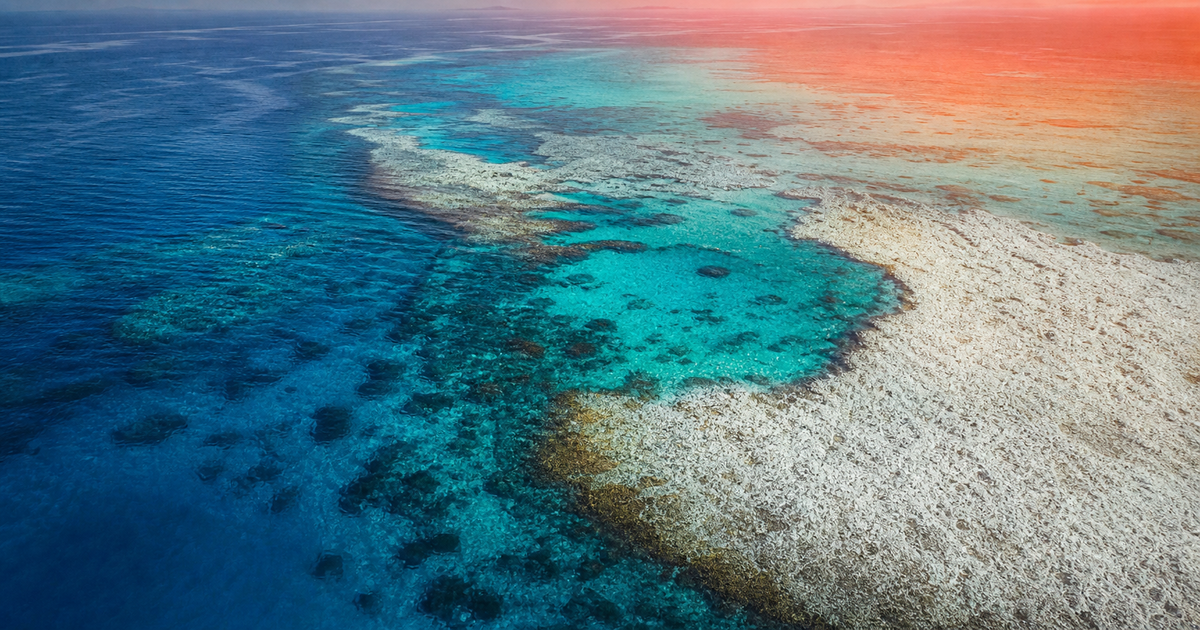
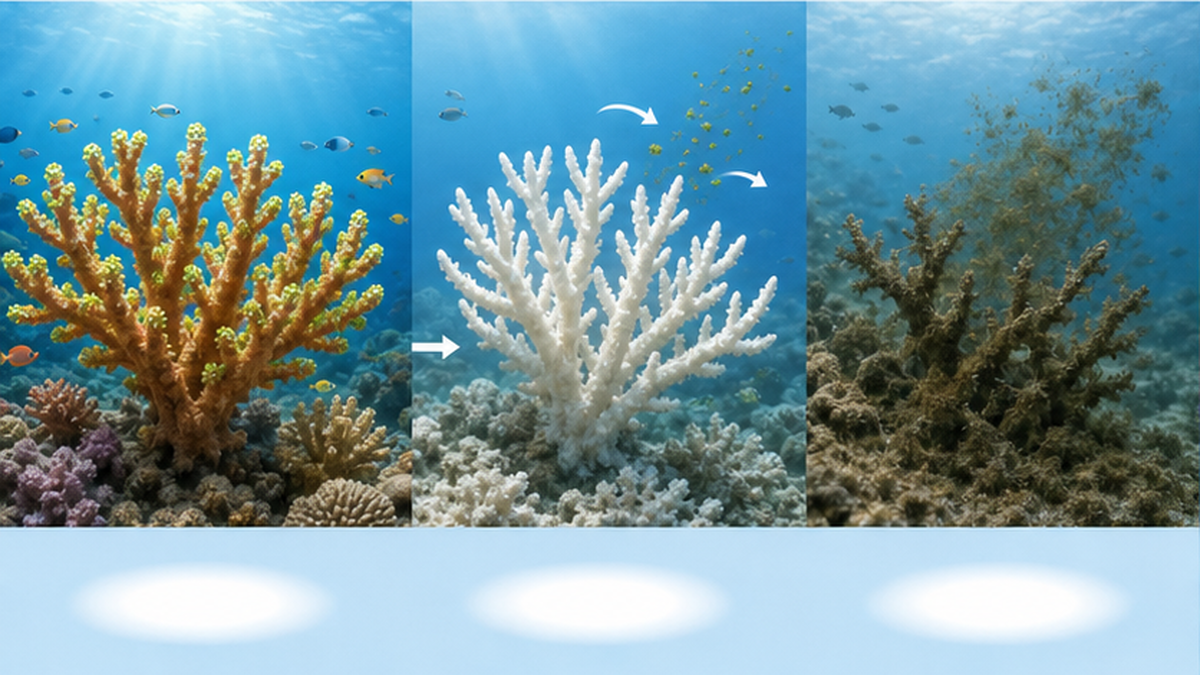
However, when sea temperature rises too high, the zooxanthellae's photosynthetic machinery breaks down, and they begin producing reactive oxygen species harmful to the coral. In response, the coral expels the zooxanthellae from its body to protect itself. Once the zooxanthellae are gone, the pigment goes with them, and the coral's white skeleton becomes visible through its now-transparent tissue. This is bleaching. As a rough guide, bleaching tends to occur when water temperature stays above 30°C for several weeks.
Bleaching does not mean the coral is dead — it is, in a sense, "weakened after losing its source of nutrition." If the temperature drops and the zooxanthellae return, recovery is possible. But if high temperatures persist, a coral unable to obtain energy starves, weakens, loses the ability to grow or reproduce, and eventually dies. This is exactly where the "duration" of a marine heatwave becomes the difference between life and death. If the temperature drops within a few days, there is a chance of recovery, but if high temperatures continue for weeks to months, most corals cannot hold on.
Furthermore, bleached and weakened corals become more susceptible to disease and face a higher risk of being smothered by surrounding algae. Even if they survive, growth and spawning can be disrupted for years, and it is not unusual for a reef to take more than a decade to regain its former state. If marine heatwaves recur year after year, corals suffer the next round of damage before they have any chance to recover, and gradually decline. It is precisely this situation — "recovery unable to keep pace" — that has become a serious concern in recent years.
"Degree Heating Weeks" (DHW): measuring heat stress
Researchers assess bleaching risk not simply by water temperature but by the "cumulative amount" of heat stress. NOAA's Coral Reef Watch monitors how far, and for how many weeks, temperature has exceeded the threshold at which bleaching begins to occur, using an index called "Degree Heating Weeks" (DHW). Once DHW exceeds 4, corals are prone to severe bleaching; once it exceeds 8, the risk of widespread mortality rises sharply.
What this concept shows is that both "mild heat sustained for a long time" and "intense heat sustained briefly" are dangerous for coral. For example, if the temperature stays 1°C above the bleaching threshold for four weeks, DHW reaches 4. In human terms, it is like running a low-grade fever that never quite breaks — your stamina is worn down little by little. The true danger of a marine heatwave for coral lies in this "gradually accumulating heat stress." That is precisely why how long high temperatures persist matters far more than any single temperature reading.
Bleaching is "one step before death"
At the point of bleaching, the coral is still alive. But if a marine heatwave drags on and the zooxanthellae fail to return for weeks, the coral will die of malnutrition. News of bleaching needs to be understood as a "warning sign of crisis."
Marine heatwave records that struck the world
Over the past decade or so, marine heatwaves have left serious scars around the world. Here we look back at some of the most extensively studied examples. Each took place in a different region and time, yet lining them up reveals a common thread: their scale and frequency are increasing year after year.
"The Blob": a million seabirds lost
"The Blob," which occurred in the northeast Pacific from the autumn of 2013 through 2016, was a record-breaking marine heatwave in which water up to 4°C above normal lingered for roughly three and a half years. An area of ocean comparable in size to Canada was blanketed in abnormal heat, and the impact ran from the bottom of the food chain to the top. High temperatures first reduced phytoplankton, which lowered the quality of zooplankton, which in turn reduced the nutritional value of the small fish that fed on them. As this foundation collapsed, an estimated one million common murres (a seabird), with some estimates as high as four million, starved to death, and sea lions and whales suffered repeated bouts of emaciation and stranding. It was a case where the ocean's food web was shaken to its roots, out of sight. The outsized role plankton play is discussed in more detail in our article on phytoplankton.
What "The Blob" made clear is that the damage from a marine heatwave cannot be measured by heat alone. Many of the seabirds that starved showed no notable abnormality other than being emaciated. In other words, they did not die directly "from the heat" — they died because food ran short. A marine heatwave first starves the plankton and small fish that form the base of the food web, and that hunger cascades up to the creatures above. This "impact transmitted through food" is arguably the true horror of a marine heatwave.
2016: a global-scale coral bleaching event
2016, which coincided with a strong El Niño, was a year in which large-scale coral bleaching occurred simultaneously around the world, including on Australia's Great Barrier Reef. At the time, the global average number of marine heatwave days reached 86 — a figure that stood for a long time as the record high.
In Japan too, catastrophic bleaching struck the Sekisei Lagoon in Okinawa's Yaeyama Islands in 2016. Sekisei Lagoon, spread between Ishigaki Island and Iriomote Island, is one of Japan's largest coral reefs. According to surveys by the Ministry of the Environment and others, following the abnormally high water temperatures of summer 2016, 98% or more of the coral surveyed at many sites was found to be bleached or dead, and across the reef as a whole, about 97% was bleached, of which roughly 70% had died. One of Japan's most treasured coral reefs was transformed dramatically by a single summer's marine heatwave.
2023: the highest number of marine heatwave days on record
Then, in 2023, global sea surface temperature hit a record high. The global average number of marine heatwave days reached 116 — far surpassing the previous record of 86 days set in 2016, making it the highest figure ever recorded. The heat was so intense that it came to be called a "super-marine heatwave," a term that stunned researchers.
2023–2025: the fourth global bleaching event in history
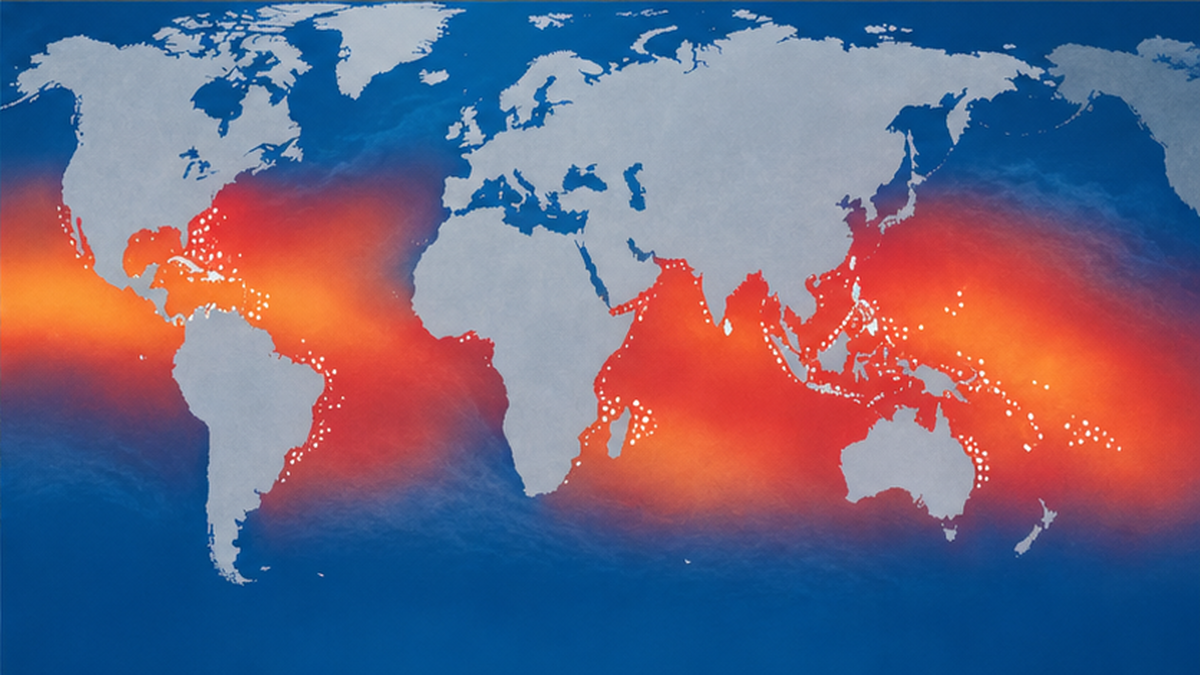
In response to this record-breaking heat, NOAA officially confirmed in April 2024 the fourth global coral bleaching event on record. From early 2023 through mid-2025, bleaching-level heat stress affected 84% of the world's coral reef area, with bleaching confirmed in at least 83 countries and territories. It struck the Pacific, Atlantic, and Indian Oceans all at once — a crisis of unprecedented scale. This fourth event is believed to have finally subsided in mid-2025, but by then the damage inflicted on coral worldwide had surpassed that of the previous three events combined.
This marks the fourth global coral bleaching event, following those in 1998, 2010, and 2014–2017. Whereas 12 years separated the first event from the second, the interval between the third and fourth events has shrunk to just a few years. The very fact that the intervals between bleaching events are shrinking speaks to how frequently marine heatwaves are now occurring — and it is also a warning that corals are being robbed of the time they need to recover.
| Event | Period | Main damage |
|---|---|---|
| The Blob (northeast Pacific) | 2013–2016 | An estimated 1 million seabirds starved; marine mammals weakened and stranded |
| Global bleaching event (3rd) | 2014–2017 | Global-scale bleaching including the Great Barrier Reef |
| Global average MHW-days record | 2023 | An all-time high of 116 days |
| Global bleaching event (4th) | 2023–2025 | 84% of coral reef area under heat stress; bleaching in 83+ countries and territories |
Records keep being broken year after year
Phrases like "highest ever" and "record-breaking" have been updated repeatedly over just the past few years. This is not statistical noise — it is a reflection of the steady, ongoing rise in the baseline sea temperature driven by global warming.
Marine heatwaves recurring in the seas around Japan
Marine heatwaves are not just a problem for southern seas. In fact, the seas around Japan are warming at one of the fastest rates in the world, making them one of the "hotspots" for marine heatwaves.
A warming rate more than double the global average
According to the Japan Meteorological Agency (JMA), the annual average sea surface temperature around Japan is rising at a rate of +1.33°C per 100 years (as of 2024). That is more than double the global average rate of increase (+0.62°C per 100 years). The seas around Japan are thought to warm faster because they are surrounded by land, which heats up easily, and are strongly influenced by the warm Kuroshio Current. Notably, this figure of +1.33°C is nearly identical to the rate at which air temperature over land in Japan is rising (+1.40°C per 100 years) — showing that one cannot assume "the sea changes more slowly" simply because it is the sea.
Looking region by region, the pace of warming varies. In particular, parts of the East China Sea and the Sea of Japan are warming even faster than the average for the seas around Japan. Regions along the paths of warm currents such as the Kuroshio and the Tsushima Warm Current tend to accumulate heat more readily and are correspondingly more susceptible to marine heatwaves. Because the Japanese archipelago stretches north to south and is surrounded by seas ranging from subtropical to subarctic, marine heatwaves can take on an entirely different character from one region to the next.
2024: a new record high
The JMA announced that the annual average sea surface temperature around Japan in 2024 set a new record high since statistics began. A rising baseline in sea temperature directly pushes up both the frequency and intensity of marine heatwaves, because a higher baseline makes it easier for even ordinary weather conditions to exceed the threshold. For more on how rising sea temperature affects the broader marine environment, see our article on sea temperature and ocean currents. High water temperatures that were once a once-in-several-years "anomaly" are now edging closer to becoming the new normal. This "normalization of the abnormal" is precisely the reality the seas around Japan now face.
Repeated summer heatwaves off Sanriku
Marine heatwaves around Japan have been observed for some time. Off Sanriku, for example, marine heatwaves occurred almost every summer from 2010 through 2016, and reports indicate that the distribution of yellowtail, a fish that favors warm water, expanded northward, affecting catches. The waters off Sanriku, where a warm current meets a cold current, are especially prone to visible changes in the marine environment.
As in the case of Sanriku, the "tide boundary" where a warm current (the Kuroshio) meets a cold current (the Oyashio) has long been known as one of the world's richest fishing grounds precisely because of its abundant nutrients. But this boundary is highly sensitive to temperature change, and when a marine heatwave strikes, fish that had long been at home in that sea can disappear, while fish from warmer, southern waters move in instead. Those who have fished the same waters for the longest tend to feel most strongly that "what we catch has changed from the old days." A marine heatwave is not only a statistic — it is a change genuinely etched into the experience of fishing communities.
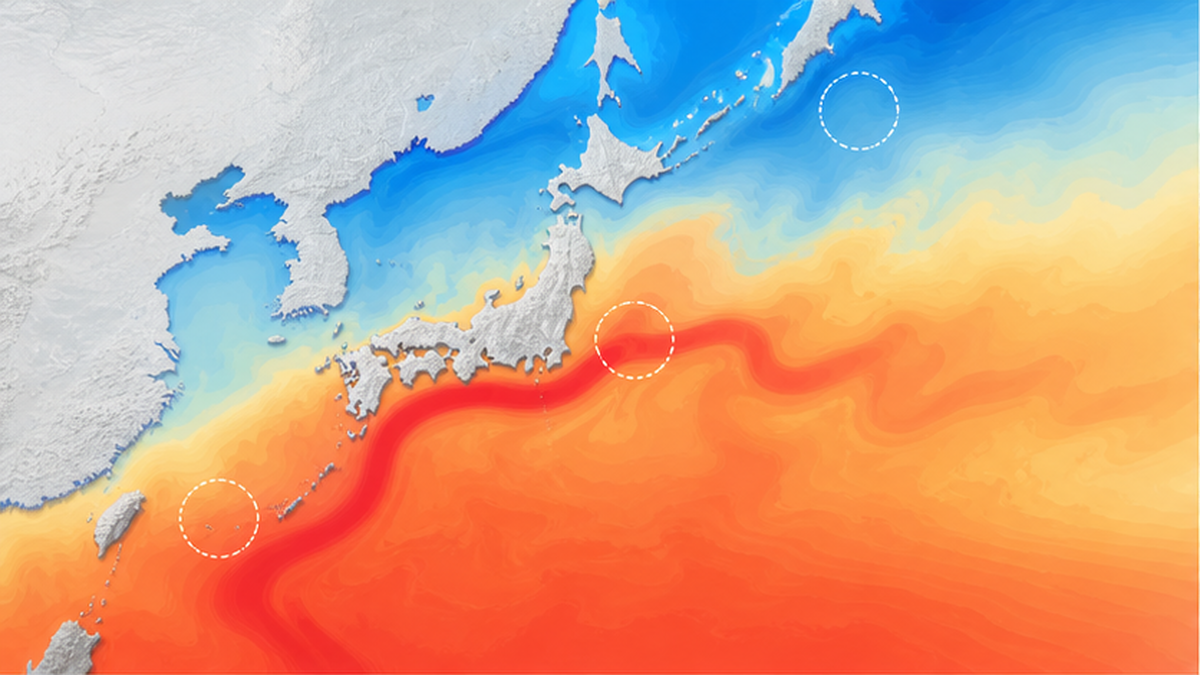
The rate of increase in sea surface temperature around Japan (+1.33°C per 100 years) is greater than the global average rate of increase in sea surface temperature (+0.62°C), and is comparable to the rate of increase in air temperature in Japan (+1.40°C).
— Japan Meteorological Agency, "Ocean Health Check Chart": Long-term trend in sea surface temperature (seas around Japan)
Key points from this section
- Sea surface temperature around Japan has risen +1.33°C over 100 years, more than double the global average
- 2024 set a new record high for annual average sea surface temperature
- Off Sanriku, marine heatwaves were observed almost every summer from 2010 to 2016
The toll on ecosystems and fisheries
The impact of marine heatwaves is not limited to coral. Seaweed forests vanish, shellfish and fish die en masse, and the species we catch change. Heatwaves strike directly at the lives of people who depend on the sea's bounty.
Hokkaido, 2021: a red tide causes ¥7.6 billion in fishery damage
In the autumn of 2021, a large-scale red tide occurred along the Pacific coast of eastern Hokkaido, causing mass die-offs of salmon and sea urchin. The cause was identified as a red tide dominated by a rare species of plankton (Karenia selliformis) that can proliferate even in cold water. Abnormal sea temperature is believed to have been behind its emergence and spread, and a Hokkaido official stated that "a red tide of this scale has no precedent on record." Damages across the four regions of Nemuro, Kushiro, Tokachi, and Hidaka totaled roughly ¥7.6 billion, with sea urchin alone accounting for about ¥6.8 billion; roughly 1,500 tons of sea urchin and about 17,800 salmon died. The mechanism behind red tides is explained in more detail in our article on red tides.
What made this red tide so shocking was that a type of plankton rarely a problem in cold waters like Hokkaido's ran rampant across a wide area. It shows that changing sea temperatures are beginning to bring about phenomena that defy past "common sense." In the affected areas, sea urchin fishing was forced into a prolonged suspension, and the economic fallout spread further, including the suspension of local "furusato nozei" (hometown tax) gift programs that had featured local specialties. It was an event in which upheaval in the sea shook the very fabric of local life.
Isoyake: when the seaweed forest disappears
High water temperatures also take a toll on seaweed forests (moba) such as kelp and wakame. "Isoyake" — a phenomenon in which seaweed dies off and rocky areas become bare — is spreading in various regions. Furthermore, when water temperature is high, sea urchins and herbivorous fish that eat seaweed remain active even through winter, hindering the recovery of these seaweed beds. Seaweed beds serve as spawning and nursery grounds for a wide variety of fish and shellfish, so their loss undermines the very foundation of fishery resources. For more on the carbon-storage role seaweed beds play, see our article on blue carbon.
What makes isoyake so troublesome is that once a rocky area becomes bare, it rarely returns to its former state. As seaweed declines, the sea urchins that once fed on it grow thin, but their numbers do not decrease — and they end up devouring even the faintest new seaweed shoots that try to sprout. In this way, a "sea with little seaweed" becomes locked in. High water temperature is what pulls the trigger on this vicious cycle. Isoyake, once conspicuous mainly in the warmer seas of western Japan, has in recent years been spreading northward along with rising water temperatures.
The fish we catch are changing
- Northward shift in distribution: fish that prefer warmer water move north, increasing the presence of southern species not previously caught, while cold-water species decline
- Shifts in migration: the timing and routes of fish that migrate based on temperature cues change, making it harder to plan fishing operations
- Damage to aquaculture: farmed fish and shellfish, unable to flee, face a particularly high risk of death from high water temperatures
As discussed in our article on warming and fisheries, these changes feed directly back into fishers' incomes, local economies, and our own dinner tables. A marine heatwave is an environmental issue, but it is also a matter of livelihoods and economics.
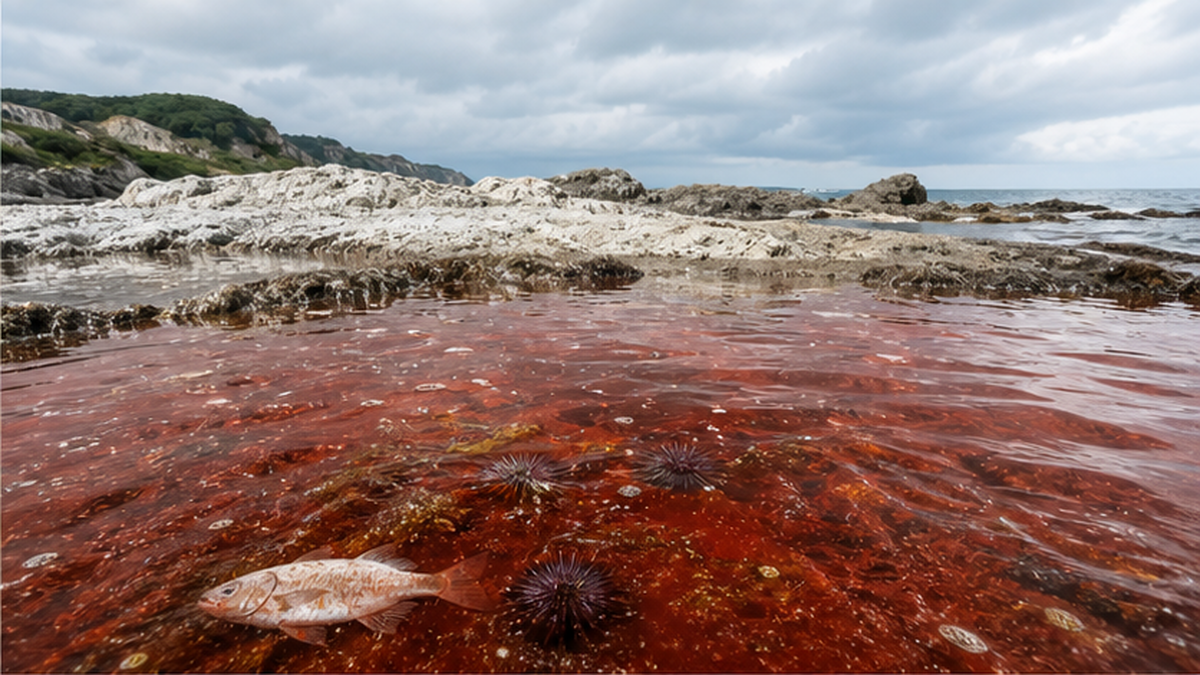
A heatwave's damage works through "chains"
The damage from a marine heatwave spreads not just through high temperature itself, but through chains of consequences: the outbreak of red tides, the decline of plankton and small fish used as food, and the loss of seaweed beds. What makes this so serious is that a single disruption can shake the entire food web.
How marine heatwaves affect people and society
High water temperature in the ocean may look like a distant natural phenomenon, but it actually reaches into our daily lives and into the climate of the entire planet. Let's take a fresh look at marine heatwaves as a "social issue."
Ripple effects on our tables and the economy
In the wake of Hokkaido's red tide damage, prices of sea urchin and salmon soared, and some municipalities even suspended their "furusato nozei" gift programs. Declining catches and shifting fish species translate directly into higher prices and lost local specialties on consumers' tables. The blow is heaviest in regions whose income depends most on the sea's bounty — coastal tourism built around coral reefs, or coastal fisheries supported by seaweed beds. Around the world, an estimated several hundred million people make their living from coral reef tourism and fisheries, and bleaching directly threatens their livelihoods.
Because the effects of a marine heatwave creep in gradually, they are easy to miss, and responses tend to lag behind. A poor catch in a given year gets written off as "just bad luck," and only after it repeats for several years does it become clear that something structural has changed. That is precisely why it matters to monitor ocean changes numerically and translate them into early preparedness. A marine heatwave is a cross-cutting issue that links the environment, the economy, and disaster preparedness.
Feedback into the climate itself
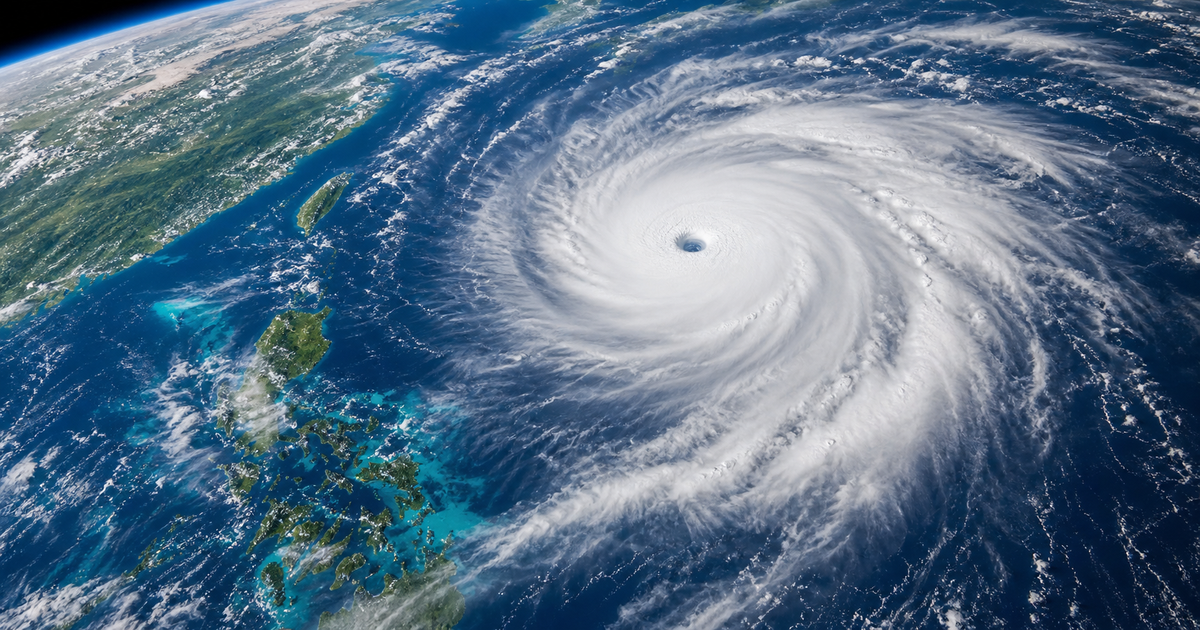
A warmed sea also affects the atmosphere. The higher the sea surface temperature, the more water vapor is released from the ocean into the air, which can become an energy source that intensifies typhoons and heavy rainfall. In recent years, it has increasingly been pointed out that high sea temperatures around Japan are one factor allowing typhoons to approach while maintaining their strength. Ocean heat feeds back not just into the sea itself, but into the weather we experience on land.
Furthermore, coastal ecosystems such as coral reefs, seaweed beds, and mangroves play a role in absorbing and storing carbon (blue carbon), but if heatwaves destroy them, that absorptive capacity declines as well. This makes it harder to reduce atmospheric carbon dioxide, which drives further warming, which in turn makes marine heatwaves more likely — a vicious cycle. A marine heatwave is both a "consequence" of climate change and, potentially, a "cause" that further accelerates it.
Loss of biodiversity
Coral reefs are often called the "rainforests of the sea," and roughly a quarter of all marine species are thought to depend on them at some point in their life cycle — making them a treasure trove of biodiversity. Coral deaths caused by marine heatwaves rob countless dependent creatures of their habitat. The effects extend even to individual species such as sea turtles, through changes to their feeding grounds and nesting environments, as discussed in our article on sea turtle conservation. Once an ecosystem is lost, restoring it is extremely difficult.
The loss of biodiversity is not simply a matter of "fewer species." An ecosystem with a greater variety of organisms is more resilient to environmental change and better able to recover. Conversely, a sea that has lost diversity to a marine heatwave becomes even more vulnerable to the next heatwave or disease outbreak. A sea that has lost its richness finds it ever harder to bounce back. That is precisely why protecting still-healthy seas and preserving their diversity is also the best insurance against future marine heatwaves.
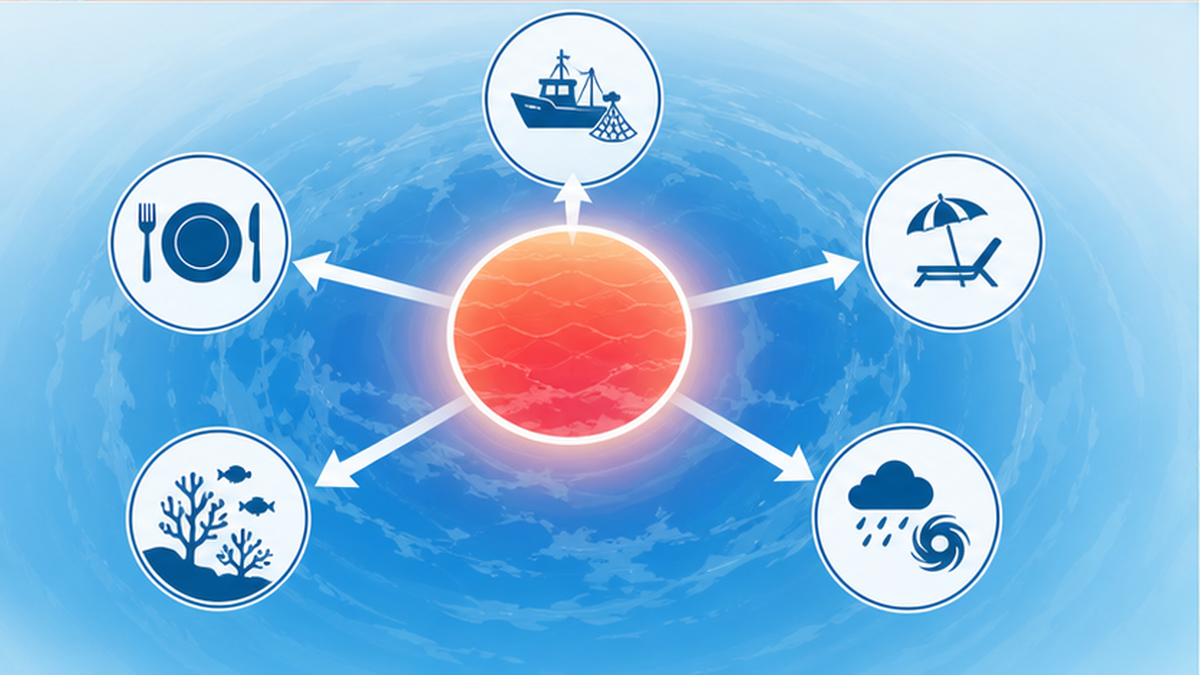
A "problem of the sea" is a "problem of the land"
Marine heatwaves do not stay confined to the ocean. Through food, the economy, disaster preparedness, and biodiversity, they are directly connected to our own lives — which is precisely why they matter even to people who live far inland.
What we can do — and what comes next
The root cause of marine heatwaves is global warming, and there is no silver bullet. Even so, there is real, meaningful action to take across three fronts: monitoring, reducing the cause, and preparing for the damage.
Monitor: making the invisible heatwave visible
Precisely because a marine heatwave is invisible, "measuring" it comes first. The JMA monitors and publishes sea surface temperatures around Japan on a daily basis, and NOAA's Coral Reef Watch uses satellites to track heat stress on coral reefs worldwide. If bleaching risk can be forecast in advance, fishers and conservation groups can act early. Forecasting technology for marine heatwaves has also been advancing rapidly in recent years thanks to artificial intelligence. If sea temperature can be predicted weeks to months ahead, concrete responses become possible — such as bringing forward aquaculture harvest schedules, or temporarily protecting valuable coral.
Cut the cause: reducing greenhouse gas emissions
The single biggest factor determining the frequency and intensity of marine heatwaves is the volume of greenhouse gas emissions. The IPCC has shown that the more warming is curbed, the more the future increase in marine heatwaves can be suppressed. Large differences in the future frequency of marine heatwaves are projected between the "1.5°C" and "2°C" targets set out in the Paris Agreement, meaning that even modest efforts to cut emissions can directly shape the ocean's future. Climate measures such as energy conservation, the shift to renewable energy, and rethinking our consumption habits may seem like roundabout approaches, but they are in fact the most fundamental countermeasure against marine heatwaves.
Prepare: protection and restoration efforts
- Establishing marine protected areas: reducing pressure from fishing and development to keep the sea healthy and better able to recover from heatwaves (see marine protected areas)
- Restoring coral reefs and seaweed beds: efforts to restore damaged ecosystems, such as transplanting heat-tolerant coral strains or cultivating new seaweed beds
- Adapting fisheries: changing fishing practices in step with these shifts, such as revising target species and seasons, or improving aquaculture conditions
Learn, and share
And "learning about and sharing" what's happening beneath the waves is also a meaningful form of action. Marine heatwaves don't make headlines the way land heatwaves do, but their damage reaches all the way to our tables and our climate. As more people take an interest, it becomes a force that can shift policy and consumer behavior. We hope this article can serve as one small starting point. If you get the chance to visit the sea, take a moment to notice the water temperature and the state of the marine life around you. The simple act of more people noticing changes in the sea is itself a force that helps protect it.
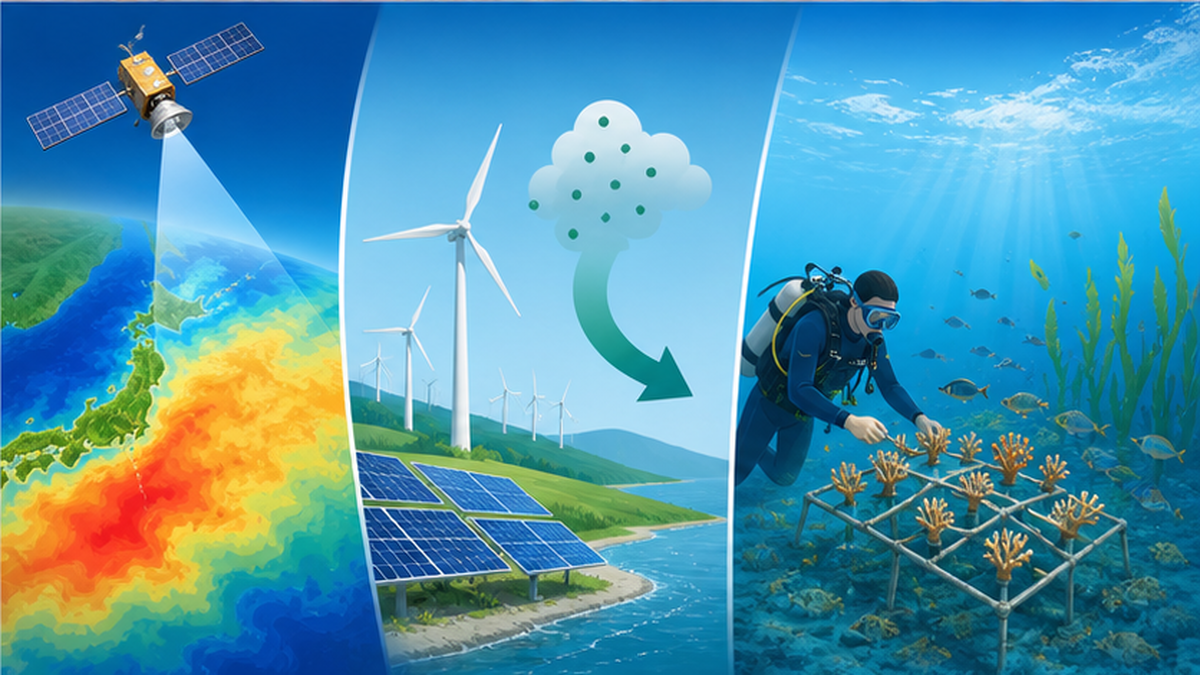
Small steps you can take starting today
- Check out sea surface temperature and bleaching alert information from the JMA or NOAA
- Choose a lifestyle that cuts greenhouse gas emissions, through energy conservation and renewable energy
- Choose seafood caught through sustainable fisheries (look for certification labels)
- Share what you learn about marine heatwaves and coral bleaching with people around you
Conclusion: paying attention to a heatwave we cannot see
The marine heatwave is a front line of climate change advancing quietly, yet unmistakably, beneath the ocean's surface. Defined by a clear standard — sea temperature exceeding the past 30 years' 90th percentile for five days or more — its frequency and intensity are increasing year after year as the ocean, which absorbs roughly 90% of the Earth's excess heat, has its baseline pushed steadily higher.
High water temperature strips zooxanthellae from coral, driving bleaching and death, and strikes fisheries and dinner tables through red tides and isoyake. The million seabirds lost to "The Blob," the global bleaching events of 2016 and 2023–2025, and the seas around Japan warming more than twice as fast as the global average — these are not separate incidents, but a single, continuous warning.
The situation surrounding marine heatwaves is severe. Even so, pessimism alone changes nothing. Researchers around the world continue to expand observation networks, cultivate heat-resistant coral, and restore damaged seaweed beds. What each of us can do individually may look small, but choosing to cut greenhouse gas emissions, and treating the sea's bounty with care, are both genuinely connected to the ocean's future.
Since the root cause is global warming, there is no easy fix. Even so, we can monitor, reduce the cause, and prepare. The first step is simply recognizing the fact that "the sea has heatwaves too." That is the first step toward a long, sustainable relationship with the ocean.
Summary of this article
- A marine heatwave is a phenomenon in which sea temperature abnormal for that sea and season (above the past 30 years' 90th percentile) persists for five days or more
- Because the ocean absorbs roughly 90% of the Earth's excess heat, warming is raising the baseline for the frequency and intensity of marine heatwaves
- High water temperature expels zooxanthellae from coral, causing bleaching, and death if prolonged (roughly, above 30°C for several weeks)
- In 2023, the global average marine heatwave days reached an all-time high of 116; the fourth global bleaching event affected 84% of coral reefs
- The seas around Japan have warmed +1.33°C over 100 years, more than double the global average, setting a new record in 2024; effects are already materializing, including ¥7.6 billion in red tide damage
- Monitoring, mitigation, and adaptation, together with "learning and sharing," are the preparations we can make
References and sources
- Japan Meteorological Agency – Ocean Health Check Chart: Long-term trend in sea surface temperature (seas around Japan)
- Japan Meteorological Agency – Ocean Health Check Chart, special report: 2024 annual average sea surface temperature around Japan sets a new record high
- Japan Meteorological Agency – Climate Change in Japan 2025: Observation and Projection Assessment Report on the Atmosphere, Land, and Ocean (Chapter 8: Sea Temperature)
- NOAA – NOAA confirms 4th global coral bleaching event
- NOAA NESDIS – World's Fourth Mass Coral Bleaching Event Likely Ended in 2025
- NOAA NCEI – Super-Marine Heatwaves: A New Term for a Growing Concern (the 116-day record of 2023)
- PLOS ONE / NCBI – Extreme mortality and reproductive failure of common murres resulting from the northeast Pacific marine heatwave of 2014–2016 (The Blob; estimates of mass seabird mortality)
- Journal of the Japanese Coral Reef Society (J-STAGE) – Large-scale bleaching at Sekisei Lagoon in summer 2016
- Nikkei – Mass die-off of sea urchin and salmon, ¥7.6 billion in fishery damage: Hokkaido holds countermeasures meeting (2021 Hokkaido red tide)
- JAMSTEC (Climate System Hotspot) – Glossary: Marine Heatwave
* Listed in order of reliability: government and academic institutions > peer-reviewed papers > specialist organizations > reputable media