⚡ In short
How does MUJI turn used PET bottles into the recycled polyester used in its clothing and household goods? This article explains the single-material design of the "Fleece That Returns to Material," the history of MUJI's clothing collection, and the link to the ocean plastic problem, based on official announcements and statistics.
Many people have probably seen the labels "recycled polyester" or "100% PET" at a MUJI store. Much of that raw material comes from something we throw away every day: used PET bottles. Bottles crushed into flakes are turned into pellets, then spun into yarn, and reborn as the fabric of fleeces and T-shirts — this chain of steps is one of the most familiar, hands-on ways to experience the idea of a circular economy.
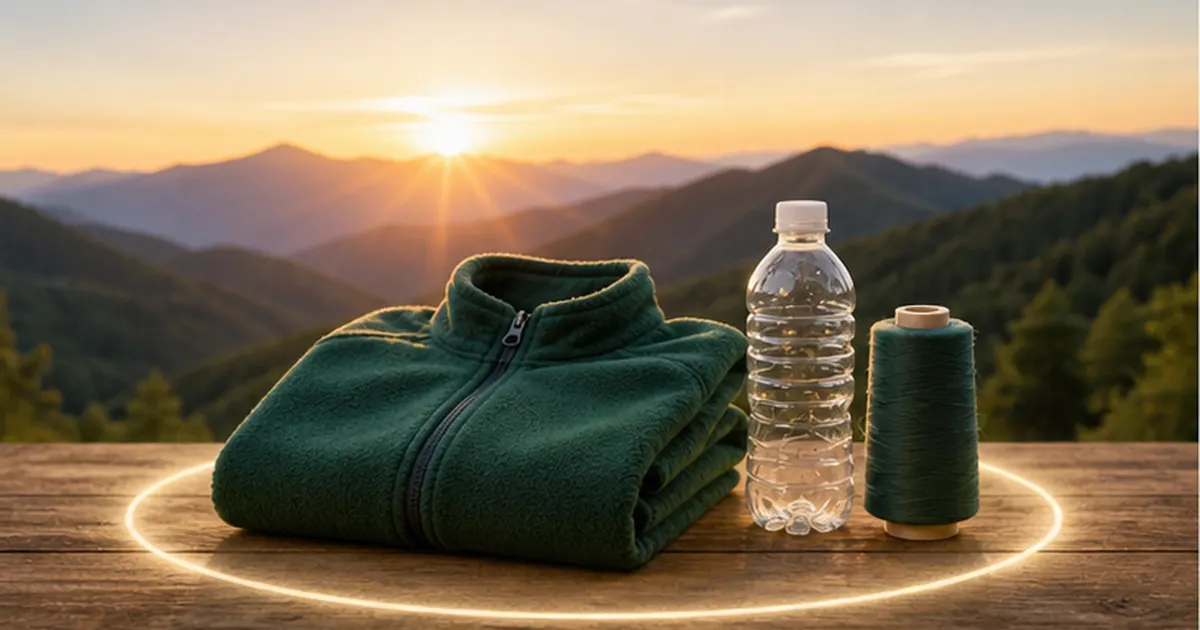
Ryohin Keikaku Co., Ltd. launched its "Fleece That Returns to Material" series in 2024 and expanded the lineup to 10 items in 2025. The product uses 100% PET single material not just for the fabric but for every part down to the buttons and sewing thread, aiming for an "easy-to-recycle design" that skips the disassembly and separation steps once the garment is worn out. MUJI has also continued collecting used clothing since 2015, and since March 2025 "ReMUJI" has become the name for its entire resource-circulation effort.
This article organizes, based on official announcements and statistical data, how recycled polyester is made from PET bottles, why MUJI is committed to single-material design, and how this connects to Japan's PET bottle recycling rate and the ocean plastic problem.
What you'll learn in this article
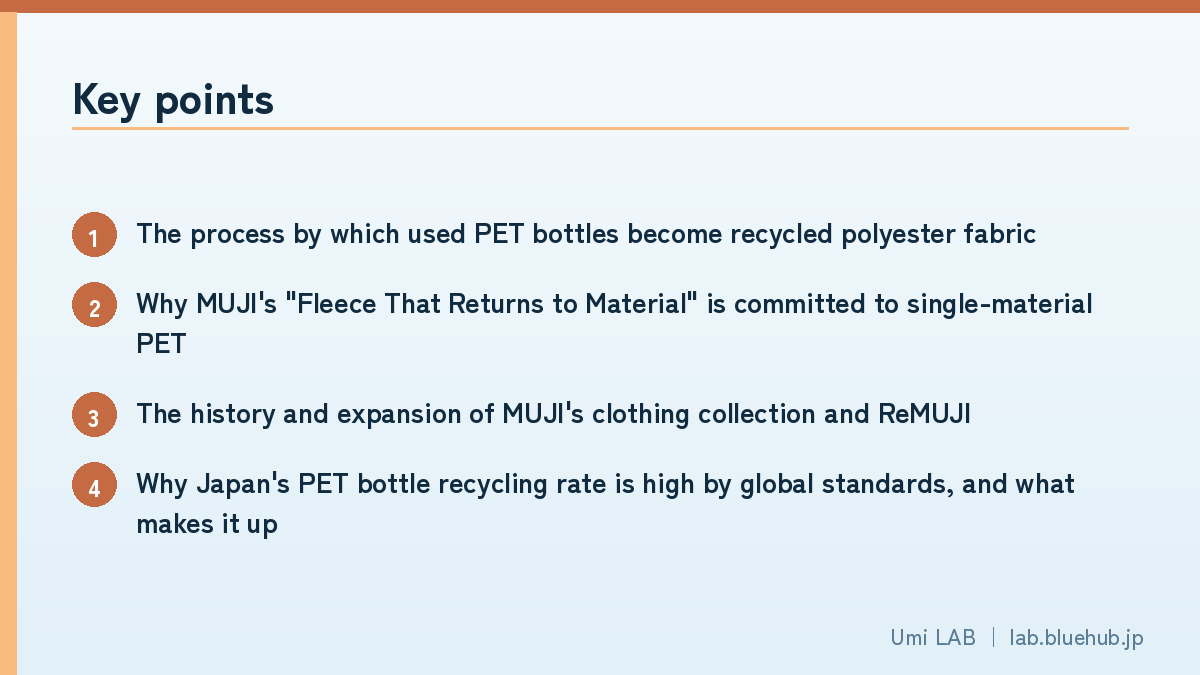
- The process by which used PET bottles become recycled polyester fabric
- Why MUJI's "Fleece That Returns to Material" is committed to single-material PET
- The history and expansion of MUJI's clothing collection and ReMUJI
- Why Japan's PET bottle recycling rate is high by global standards, and what makes it up
- The relationship between ocean plastic waste and PET bottle recycling
- What consumers can do when choosing recycled-material products
Why MUJI Is Committed to "Recycled Materials"
Ryohin Keikaku Co., Ltd., which operates MUJI, has made "resource circulation" one of the pillars of its sustainability policy. It is building systems across clothing, household goods, and packaging to put things back to use as resources once they've served their purpose, and its use of recycled polyester is a representative example. MUJI has always followed a philosophy of "this is enough" — using materials without waste and avoiding excessive processing or decoration — so its adoption of recycled materials is less a new policy shift than an extension of the stance it has held since its founding. Designing everything as one continuous flow, from raw-material selection through manufacturing to post-sale collection, is less about releasing a single "eco-friendly" product and more an effort to bring the business itself closer to a circular model.
Product Development Born From "Mottainai" (Not Wasting Things)
Since the spring/summer 2020 season, MUJI has switched the packaging of items such as innerwear to paper-centered materials, cutting down on zippers and backing cards. This effort alone has cut about 26 tons of plastic per half-year. Simplifying packaging and replacing the fabric itself with recycled material have both moved forward in parallel under the same "resource circulation" policy. Starting with a visible area like packaging and then reaching into the less visible area of a fabric's raw-material makeup is characteristic of how MUJI approaches resource circulation.
Three Directions: Clothing, Household Goods, and Packaging
Recycled polyester is used not only in clothing but has also been rolled out into plastic products such as storage items, dust boxes, and stools. In July 2020, MUJI began collecting used lotion and milky-lotion bottles as well as refillable water bottles, and in February 2023 it expanded the target items to plastic storage products and furniture. The collected PET bottle material is recycled into polyester raw material. In other words, it's not just "turning clothes back into clothing material" — multiple routes run at once, such as "turning everyday bottles into clothing material" and "turning clothing back into clothing," and this is why MUJI's resource circulation functions as a system rather than a one-off campaign.
Three Entry Points Into MUJI's Resource Circulation
- Clothing collection (since 2015): collecting clothes no longer worn in stores and reviving and reselling them as ReMUJI
- PET bottle collection (since July 2020): collecting lotion, milky-lotion, and refillable water bottles and turning them into polyester raw material
- Simplified packaging (since spring/summer 2020): reducing plastic use by switching innerwear packaging to paper
How PET Bottles Are Reborn as Fabric
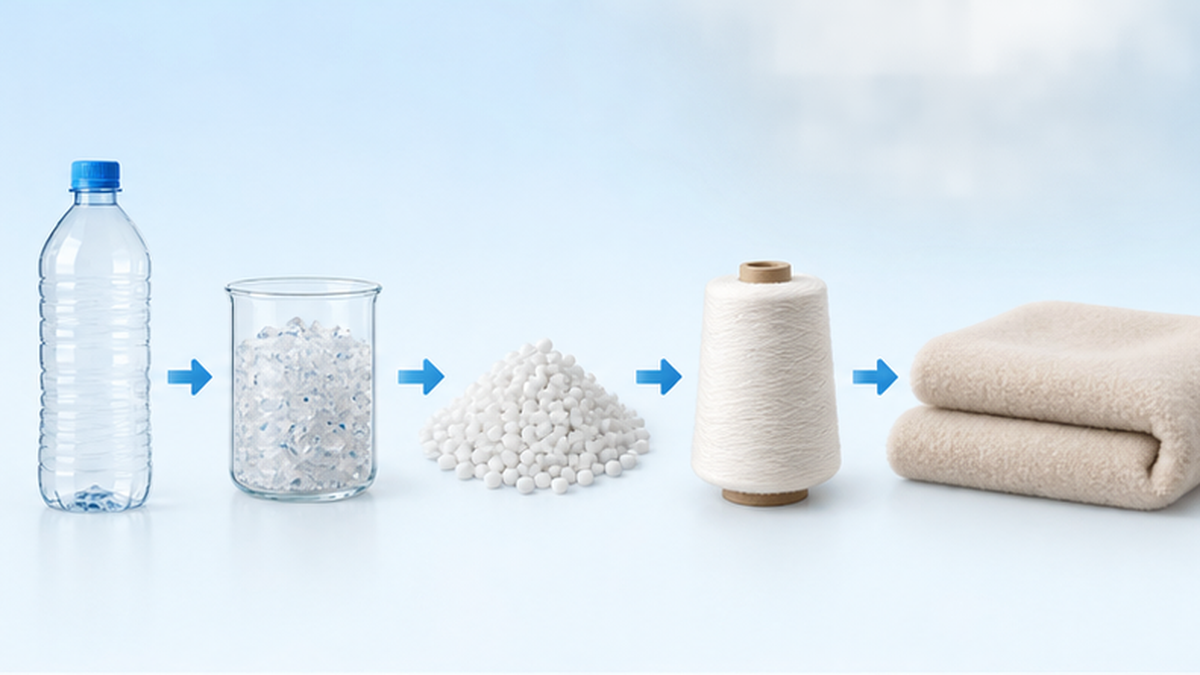
The raw material for recycled polyester is the PET bottles we put out as recyclable waste after drinking a beverage. Collected PET bottles have their labels and caps removed, are crushed and washed, and then go through the following process to become fabric.
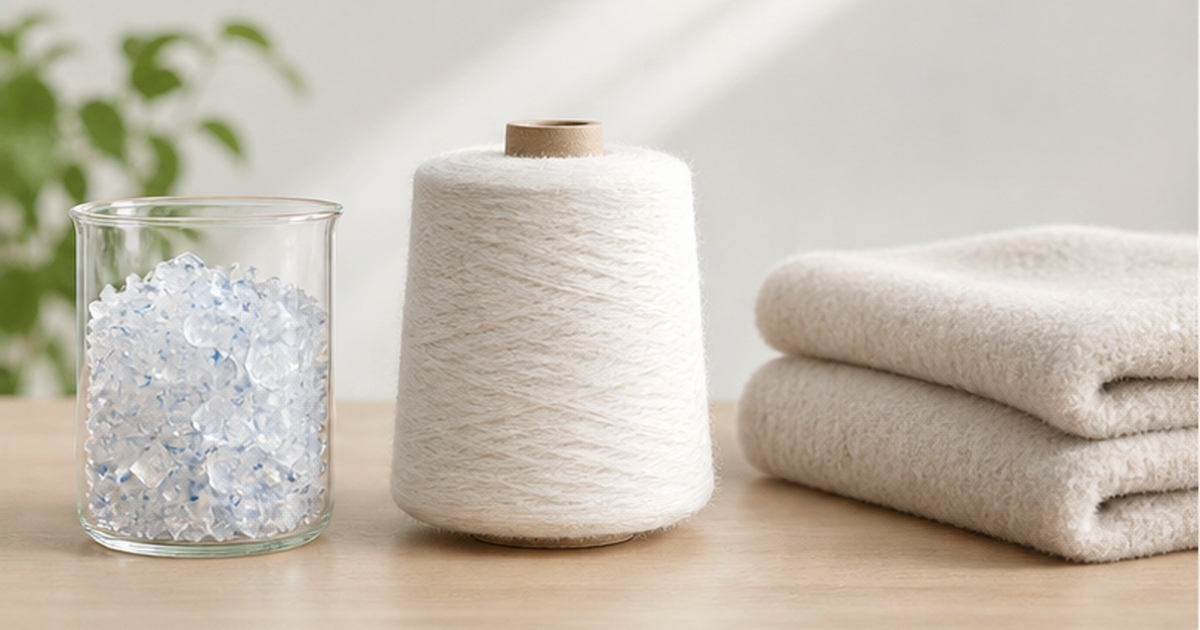
From Flakes to Pellets, and Then Yarn
- Collection and sorting: PET bottles collected by municipalities or at stores are sorted by color and material
- Crushing and washing: labels and caps are removed, and the bottles are crushed into small pieces called "flakes"
- Pelletizing: the flakes are melted and turned back into a granular raw material called "pellets"
- Melt spinning: the pellets are melted again and extruded into thin strands to become fiber (recycled polyester yarn)
- Weaving and knitting: the yarn is woven or knitted into fabric, finished into products such as fleeces and T-shirts
This process falls under what is called "material recycling" (mechanical recycling). PET resin, the main component of PET bottles, has the property of melting when heated and being respun into yarn, and this property makes it possible to remake resin that has already become a product into a different form again and again. However, each time it is melted and spun, the resin's molecular weight drops slightly and its strength and clarity decline, so it cannot be recycled at the same quality indefinitely.
How It Differs From Petroleum-Based Polyester
Ordinary polyester is synthesized from scratch using petroleum-derived naphtha as a raw material, whereas recycled polyester reuses PET resin that has already been used once as a product. Being able to hold down the use of new fossil-derived raw material at the sourcing stage is considered an advantage from the standpoint of reducing environmental impact. The texture and durability of the fabric vary depending on the production method, and product development continues — as with MUJI's "Fleece That Returns to Material" — to achieve 100% recycled material while keeping the fabric light and soft to wear.
Its Place as "Cascade Recycling"
Recycling that turns PET bottles into fiber is often called "cascade recycling" in the industry. It means remaking a product into a different use (fiber) with more lenient quality requirements than the original product (a bottle), which distinguishes it from "bottle to bottle" (horizontal recycling into the same use), discussed later. Once turned into fiber, recycled polyester often becomes difficult to remake into yet another product, so it is treated as one of the "endpoints" of recycling. For an apparel brand like MUJI to serve as a destination for recycled polyester gives PET bottles, as a resource, a new place to go.
Reducing Dependence on Fossil Resources in Sourcing
Ordinary polyester production starts by extracting naphtha from crude oil and then chemically synthesizing PET resin from it. Recycled polyester, by contrast, only needs to melt and respin PET resin (used PET bottles) that has already been synthesized, skipping the step of synthesizing raw material from scratch. Because of this difference, using recycled polyester is positioned as one way to hold down the use of new fossil-derived raw material. That said, energy is still needed at each step — collection, washing, melting, and spinning — so it isn't the case that "environmental impact becomes zero just because it's a recycled material." It is closer to reality to understand this as a relative reduction in impact compared with polyester newly made from crude oil.
| Petroleum-based polyester | Recycled polyester | |
|---|---|---|
| Main raw material | Petroleum-derived naphtha | Used PET bottles (PET resin) |
| Starting point of sourcing | Synthesizing resin from scratch through chemistry | Melting and respinning resin that already exists |
| Use of fossil-derived raw material | Newly required | Relatively reduced |
| Number of times it can be recycled | ― | Limited, since quality drops slightly each time it is melted and spun |
Adoption Spreading Beyond MUJI
Recycled polyester made from used PET bottles is a material being adopted not just by MUJI but across a wide range of apparel companies, including outdoor and sports brands. Adoption has spread starting with products that have relatively simple structures, such as fleeces, T-shirts, and bags — a product characteristic that makes them easy to build from a single resin and easy to switch to recycled polyester yarn. MUJI's effort can be seen as one example within this broader industry trend.
The Idea Behind "Fleece That Returns to Material"
In September 2024, MUJI launched its "Fleece That Returns to Material" series. By September 2025, the lineup had expanded to 10 items across men's, women's, and kids'. The series' defining feature is that not just the fabric but every part making up the product is unified as 100% PET single material.
100% PET From the Fabric to the Buttons and Sewing Thread
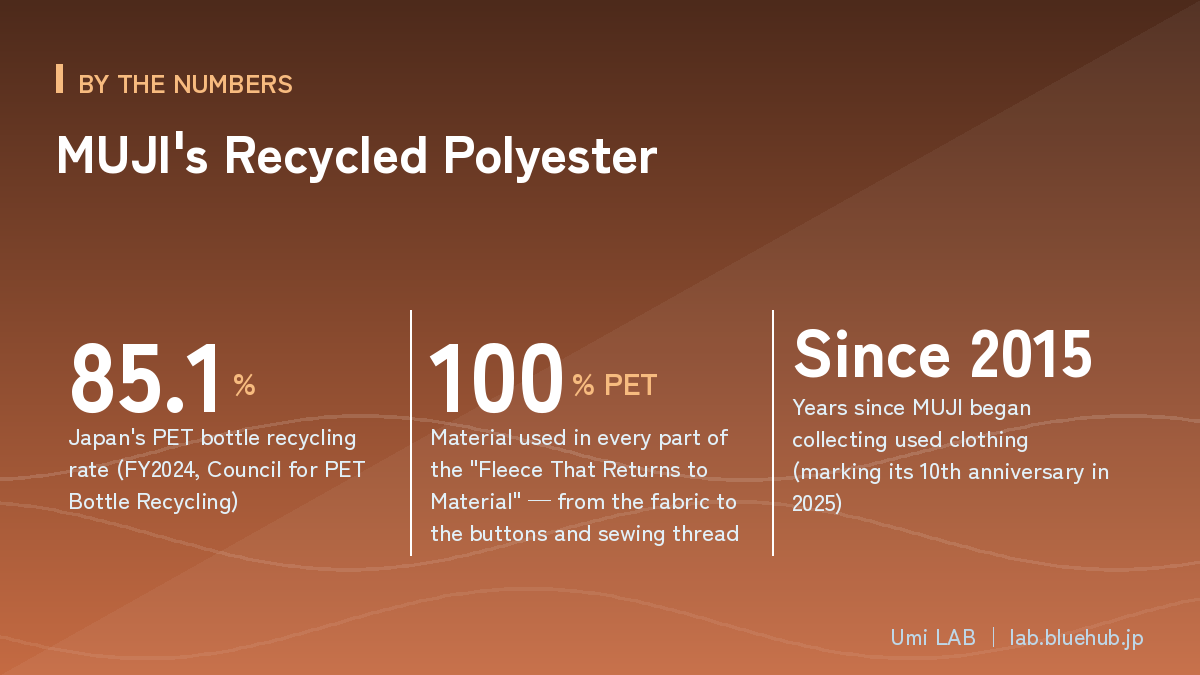
According to Ryohin Keikaku's announcement, the fabric uses 100% recycled PET material sourced mainly from PET bottles, and 100% PET (polyethylene terephthalate) raw material is used for every part of the product, down to accessories like buttons and the sewing thread. The women's and men's cardigans and pullovers are each priced at 2,990 yen (tax included), and the kids' cardigan is priced at 2,490 yen (tax included). Texture was also a priority, and the fleece fabric is finished to be lightweight with a moderate loft and soft feel.
Why Commit to a Single Material
Clothing typically combines several different materials — fabric, lining, buttons, zippers, sewing thread, and so on. When materials are mixed together, manual disassembly and separation become necessary for recycling, which tends to make cost and effort a barrier to recycling. "Fleece That Returns to Material" achieves a design that is easy to turn back into resources after use by unifying every part as a single PET material, eliminating this disassembly and separation step. A dedicated laundry net that keeps fiber lint from escaping during washing has also been developed and sold alongside it.
Designed Together With Microplastic Countermeasures
With recycled polyester clothing, there are concerns that every wash releases tiny fiber fragments (microfibers) through wastewater, potentially contributing to microplastic pollution in rivers and the ocean. The fact that a laundry net designed to keep fiber lint from passing through was developed and sold alongside "Fleece That Returns to Material" can be seen as a response that takes this issue into account. A design philosophy that pays attention to both the entry point of raw material (collecting PET bottles) and the exit point (washing and disposal after wear) is a defining feature of this series.
In its announcement, Ryohin Keikaku explained the aim of unifying the material as being "so that it can be easily turned back into resources after use." Not having to go through manual disassembly and separation steps also helps lower the cost barrier for recycling operators.
The Expanding Scope of MUJI's Resource Circulation: From Clothing Collection to ReMUJI
Alongside developing new products made from recycled materials, MUJI has for many years continued collecting clothing that is no longer worn. That history goes back more than a decade before the launch of "Fleece That Returns to Material."
Starting With the FUKU-FUKU Project in 2010
The starting point of MUJI's clothing collection goes back to 2010. It began as the "FUKU-FUKU Project," an effort to regenerate collected cotton products into bioethanol. Collection was carried out at roughly 350 stores nationwide by October 2015, and about 60 tons of textile products are reported to have been regenerated as energy. Through this collection, it became clear that many of the collected clothes were actually still wearable, and this discovery became the trigger for the next step: the birth of "ReMUJI."
"ReMUJI," Launched in 2015, and Its 10th Anniversary in 2025
Against this background, the "ReMUJI" project began in 2015, reselling used clothing after re-dyeing it or reinforcing torn sections using techniques inspired by Japan's traditional sashiko mending culture. Both the volume collected and the volume sold have grown year by year, and as of the end of August 2025 the number of participating stores had expanded to 43. 2025 marked exactly 10 years since MUJI began selling reused clothing, and commemorative initiatives were carried out. And since March 2025, the name "ReMUJI" itself has come to refer to the whole of MUJI's resource-circulation efforts, including not just clothing collection but also the resale of household goods and furniture.
Resale Expanding to Household Goods and Furniture
ReMUJI initially centered on re-dyeing and mending clothing, but its scope has now expanded to reselling household goods and furniture as well. A system has been added in which collected fixtures and plastic storage items are inspected and cleaned before being put back on store shelves, so both a route of "collecting and turning back into raw material" and a route of "collecting and reusing as-is" are now available as options within resource circulation. Which route an item follows depends on its condition when collected.
Collected PET Material Becomes Polyester Raw Material
Beyond clothing, the collection and reuse of plastic products as recycled material is also progressing. From July 2020, MUJI began collecting used lotion and milky-lotion bottles as well as refillable water bottles sold in stores, building a system to recycle the collected PET bottle material into polyester raw material. In February 2023 it expanded the target items to plastic storage products, dust boxes, and stools. This growing collection network underpins the supply of raw material for new products made with recycled polyester.
Another clothing brand built around recycled materials worth noting is Montbell's recycled-material apparel. Its approach of combining a long-lasting design with recycled polyester has much in common with MUJI's.
See the productMUJI Launches "Fleece That Returns to Material" Series in 10 ItemsAn easy-to-recycle fleece with 100% PET used in every part, from the fabric to the buttons and sewing thread🔗 ryohin-keikaku.jpWhy This Connects to the Ocean: PET Bottles and Plastic Waste
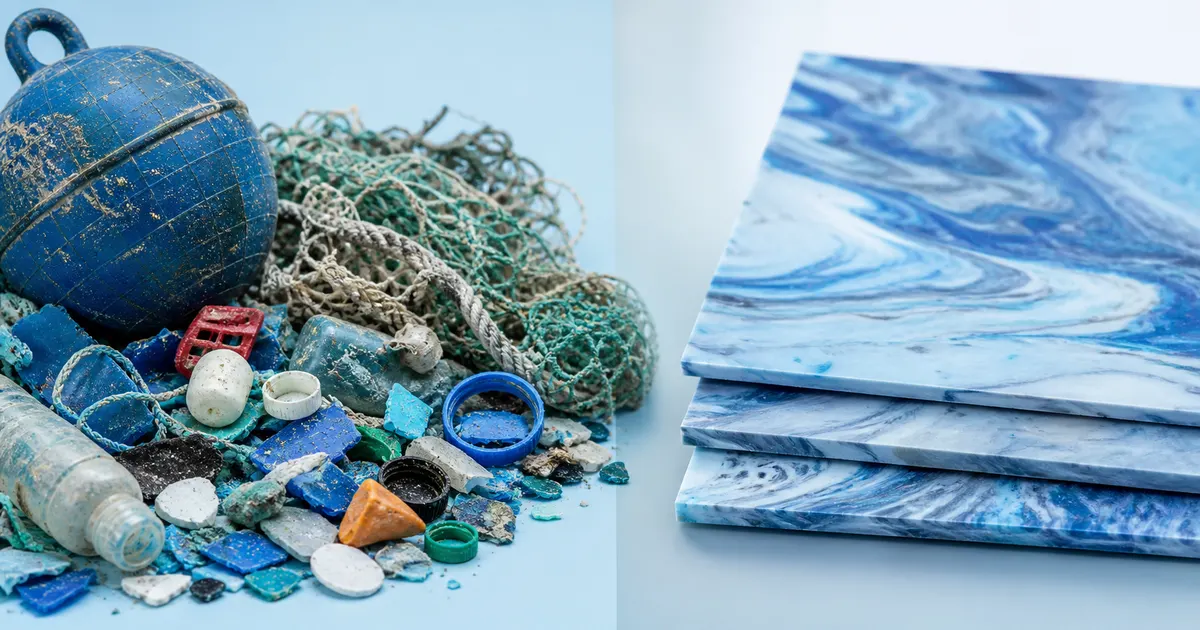
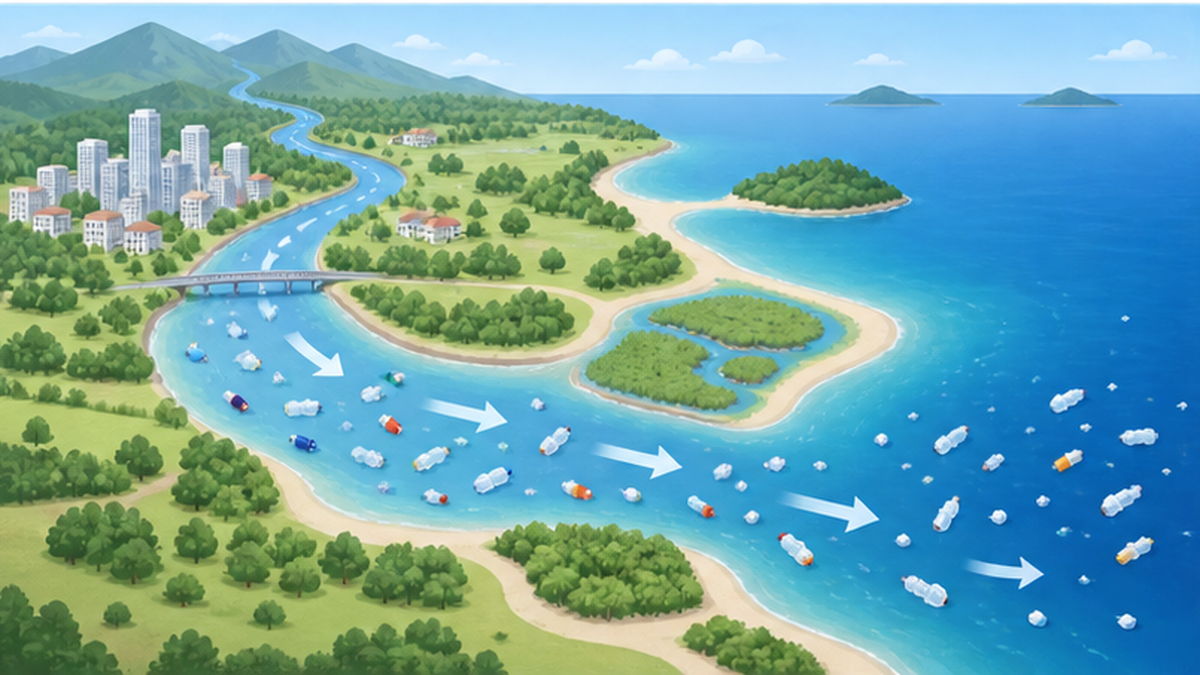
Recycling clothing might seem, at first glance, to have little to do with the ocean. But the raw material — PET bottles — is also a leading example of plastic waste that can flow into the sea via rivers if it isn't properly collected and recycled.
Plastic Makes Up Much of Ocean Debris
Surveys of ocean debris conducted by Japan's Ministry of the Environment report that plastic accounts for the largest share by both volume and item count. Looking at the country of manufacture of PET bottles collected along the coast also shows regional differences in where the waste originates: in Amami, foreign-made bottles account for over 80%, and in Tsushima, Tanegashima, Kushimoto, and Goto foreign-made bottles account for 40–60% at some sites, while in Nemuro, Hakodate, and Kunisaki, Japanese-made bottles account for 50–70%. In other words, the PET bottle waste that washes up on Japan's shores includes not only what wasn't properly handled domestically but also a good deal that has drifted in on ocean currents from neighboring countries.
The Route by Which Bottles Discarded on Land Reach the Sea
Much of the plastic waste found in the ocean is thought to occur not because it's thrown directly into the sea, but because waste that wasn't properly handled on land flows out to sea via rivers and other routes. Making recycling systems that reliably collect and reuse plastic products, including PET bottles, as resources function properly is the foundation for reducing the absolute amount of plastic that flows into the ocean. When an apparel company like MUJI actively takes on used PET bottles as raw material for fabric, it creates a new outlet within this collection-and-reuse cycle.
Plastic's Resistance to Breaking Down
Plastics containing PET resin are known not to break down quickly through microbial action in the natural environment; instead, they merely fragment gradually under UV light and wave action, remaining in the environment for a long time. Because of this, once a PET bottle has flowed into the ocean, collecting and removing it is not easy, which is why land-based collection and recycling systems — an "entry-point" countermeasure aimed at preventing plastic from flowing into the sea in the first place — are considered so important. The use of recycled materials by companies including MUJI is positioned as part of that entry-point countermeasure.
Why an Apparel Maker's Use of Recycled Material Is an Ocean Topic
"Clothing materials" and "the ocean plastic problem" might look like separate topics, but what connects them is the raw material itself: PET bottles. The more routes there are for PET bottles to be properly collected and used as recycled material, the relatively smaller the amount that gets discarded and flows into the natural environment. Put another way, efforts that expand where collected PET bottles can go — such as the expanded "outlet" represented by MUJI's clothing discussed here — function as a behind-the-scenes part of ocean plastic countermeasures. Seen through the lens of ocean education, even a single fleece on a store shelf can be understood as part of a larger resource-circulation system.
Japan's PET Bottle Recycling Is Among the World's Best
Behind MUJI's ability to reliably secure raw material for recycled polyester lies the strength of Japan's PET bottle collection and recycling system.
Breaking Down the 85.1% Recycling Rate
According to the annual report published by the Council for PET Bottle Recycling, the recycling rate for used PET bottles in FY2024 was 85.1%. Against sales of 652,000 tons of designated PET bottles, the combined municipal and business-sector collection volume was 600,000 tons (a collection rate of 91.9%). Of the total collection volume of 723,000 tons, 570,000 tons were recycled domestically, with the rest exported overseas. The previous year, FY2023, also saw a recycling rate of 85.0% and a lightweighting rate of 28.4%, both exceeding the council's target levels.
| Indicator | FY2024 result |
|---|---|
| Sales volume of designated PET bottles | 652,000 tons |
| Collection volume (municipal + business sector) | 600,000 tons (91.9% collection rate) |
| Recycling rate | 85.1% |
| Total collection volume | 723,000 tons |
| Domestic use volume | 570,000 tons |
"Bottle to Bottle": Horizontal Recycling
The share of used PET bottles recycled back into PET bottles — known as "bottle to bottle," or horizontal recycling — reached 33.7% as of FY2023. This mechanism is explained in detail in What Is Bottle-to-Bottle Horizontal Recycling?. By contrast, the route by which PET bottles are recycled into fiber and other different products, as with MUJI's recycled polyester, falls under the "cascade recycling" described earlier, serving as another important destination distinct from bottle to bottle.
The System Behind the High Recycling Rate, and the Challenges That Remain
The high recycling rate for PET bottles in Japan is supported by a nationwide collection infrastructure — sorted household waste collection, in-store collection, and collection boxes next to vending machines — that assumes consumers will sort their waste. The fact that two routes work in parallel — sorted collection by municipalities and business-sector in-store collection by beverage makers and retailers — is also one of the factors behind the high 91.9% collection rate. At the same time, colored bottles, contamination from labels and caps left on, and containers combining multiple materials push up the cost of sorting and recycling, so not every PET bottle becomes a high-quality recycled raw material. Demand from apparel uses, such as MUJI's, also plays a role in widening this "outlet" for recycled raw material.
How This Differs From the Efforts of Companies That Collect Bottles
MUJI is a company on the "using" side of recycled polyester, but there are also companies on the side that "collects [PET bottles] and turns them back into bottles." Understanding the difference between these two roles makes the journey of a single PET bottle easier to picture in full.
Beverage Makers' "Bottle to Bottle" Efforts
Coca-Cola, for example, has adopted 100% recycled PET bottles for some of its products and is advancing a "bottle to bottle" mechanism that recycles used bottles back into bottles. This effort is explained in detail in What Is Coca-Cola's 100% Recycled PET Bottle?. While beverage makers aim to keep circulating the material as bottles, MUJI instead deliberately directs the same raw material toward a different use — clothing — so the two differ in how they put the resource to use.
"Bottle to Bottle" and "Bottle to Clothing" Are Complementary
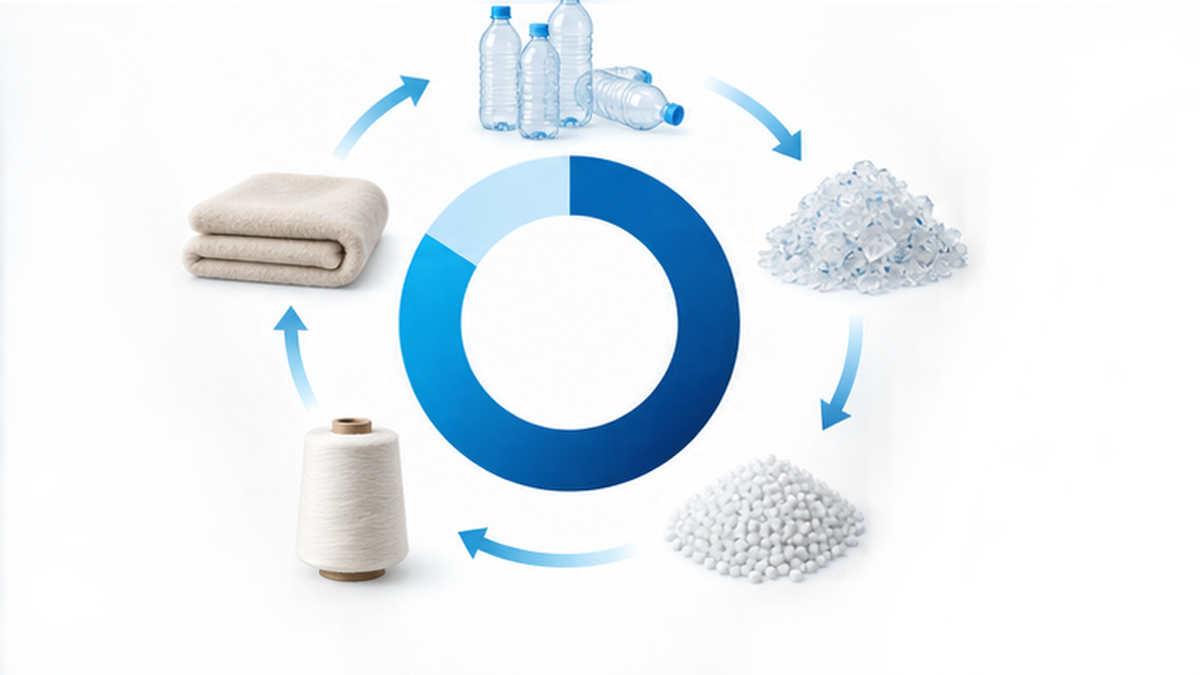
Collected used PET bottles are routed to "bottle to bottle" recycling back into bottles when quality and cost conditions allow, and to "cascade recycling" by apparel makers like MUJI when conditions don't match or there is demand for fiber use. Neither route alone can absorb all the PET bottles that are collected. It is only by running beverage makers' horizontal recycling and apparel makers' fiber recycling side by side that a system is established for using most of the collected PET bottles as resources domestically.
What Consumers Can Do When Choosing Products
Recycled polyester fabric only becomes possible once the PET bottles that serve as its raw material are properly collected. Tracing back through collection, processing into fabric, and product creation, every step ultimately rests on the accumulation of small, everyday choices about how each of us throws away a PET bottle.
Look for "100% PET" and "Recycled Material" Labels
Making a habit of checking for labels such as "recycled polyester" or "recycled PET" on tags and product descriptions when choosing clothing helps encourage companies that use recycled materials. Brands adopting such labels are increasing, not just MUJI, and consumer awareness plays a part in creating demand. Some products, such as "Fleece That Returns to Material," are offered at a relatively accessible price point in the low thousands of yen, showing that using recycled material doesn't necessarily mean a much higher price — which also lowers the barrier to choosing them.
Taking Part in the Cycle: Use Things Longer, Let Them Go Properly
Even a product made from recycled material has limited effect as resource circulation if it's treated as disposable and discarded quickly. What matters first is using the clothing you already own for a long time with care, and then, once it can no longer be worn, taking it to resource collection or in-store collection rather than putting it out with household trash — this is important for closing the loop of circulation. Both "buying new clothing made from recycled material" and "wearing existing clothing for a long time and letting it go properly" need to happen together for the phrase "resource circulation" to carry real meaning.
Finding a Collection Box
At MUJI stores, the items eligible for clothing collection or plastic product collection and the collection points are announced on a store-by-store basis. Because the timing of collection campaigns and eligible items can change, it's worth checking the official website or in-store signage for the latest eligible items before bringing something in. When using municipal recyclable-waste collection as well, removing the label and cap from a PET bottle, rinsing it out, and crushing it before putting it out helps the sorting and recycling process go smoothly.
Three Actions to Take Part in the Cycle
- Remove the label and cap from a PET bottle, crush it, and sort it correctly as recyclable waste
- Take clothing you no longer wear to municipal resource collection or an in-store clothing collection box
- Make products labeled "recycled material" or "100% PET" one of your options
Even if these actions are individually small, Japan's 85.1% recycling rate is a figure built up from the accumulation of everyone's sorting efforts together with companies' collection and manufacturing efforts.
Conclusion: Small Clothing Choices Build the Cycle
MUJI's recycled polyester is an effort to turn a familiar resource — used PET bottles — into clothing fabric through the process of flakes, pellets, and yarn. The commitment to a single material shown by "Fleece That Returns to Material" is a design philosophy that looks ahead to how easily the item can be turned back into resources once it's worn out, and together with the history running from the 2010 FUKU-FUKU Project through the start of clothing collection in 2015 to ReMUJI in 2025, it embodies MUJI's resource-circulation policy. Behind a single fleece lie three layered systems: a collection network for raw material, a processing stage, and re-collection after sale.
And the raw material itself — PET bottles — can also become ocean plastic waste if not properly collected. Japan's PET bottle recycling rate of 85.1% is a high standard by global comparison, but maintaining this figure and further expanding uses for recycled material requires the ongoing accumulation of small actions on the consumer side, namely sorting. Beverage makers' "bottle to bottle" recycling and apparel makers' recycling into clothing are complementary — if either one is missing, the destinations available for collected PET bottles narrow. The next time you choose a piece of clothing, take a moment to notice the words "100% PET" on the tag.
Summary of This Article
- MUJI's recycled polyester is made mainly from used PET bottles, reborn through the process of flakes → pellets → yarn → fabric
- "Fleece That Returns to Material" is an easy-to-recycle design that unifies every part, from the fabric to the buttons and sewing thread, as 100% PET
- MUJI moved from the 2010 FUKU-FUKU Project through clothing collection starting in 2015 to ReMUJI becoming the overarching name for resource circulation from 2025
- Japan's PET bottle recycling rate was 85.1% in FY2024, a high standard globally
- Properly sorting PET bottles also helps curb ocean plastic waste
References and Sources
- Ministry of the Environment, Japan, "Estimated Outflow of Marine Plastic Waste" – Conservation of Water, Soil, and Marine Environments
- Ministry of the Environment, Japan, "Results of the FY2019 Marine Debris Survey" – Press release
- Council for PET Bottle Recycling, "PET Bottle Recycling Annual Report 2025" – FY2024 results data
- Ryohin Keikaku Co., Ltd., "MUJI Launches 'Fleece That Returns to Material' Series in 10 Items" – News release, September 17, 2025
- Ryohin Keikaku Co., Ltd., "Notice of Sale of the MUJI 'Fleece That Returns to Material' Series" – Press release, September 2024
- Ryohin Keikaku Co., Ltd., "Marking the 10th Anniversary of the Sale of Reused Clothing With 'ReMUJI'" – News release, September 19, 2025
- Ryohin Keikaku Co., Ltd., "Resource Circulation" – Sustainability
- MUJI, "Our Commitment to Recycled Materials" – Feature page
※ Listed in order of reliability: government and academic institutions > peer-reviewed papers > specialized organizations > trusted media