⚡ The answer in 30 seconds
- Light pollution is the harm caused by excessive or unnecessary artificial light; it brightens the night sky and also affects ecosystems and people's lives.
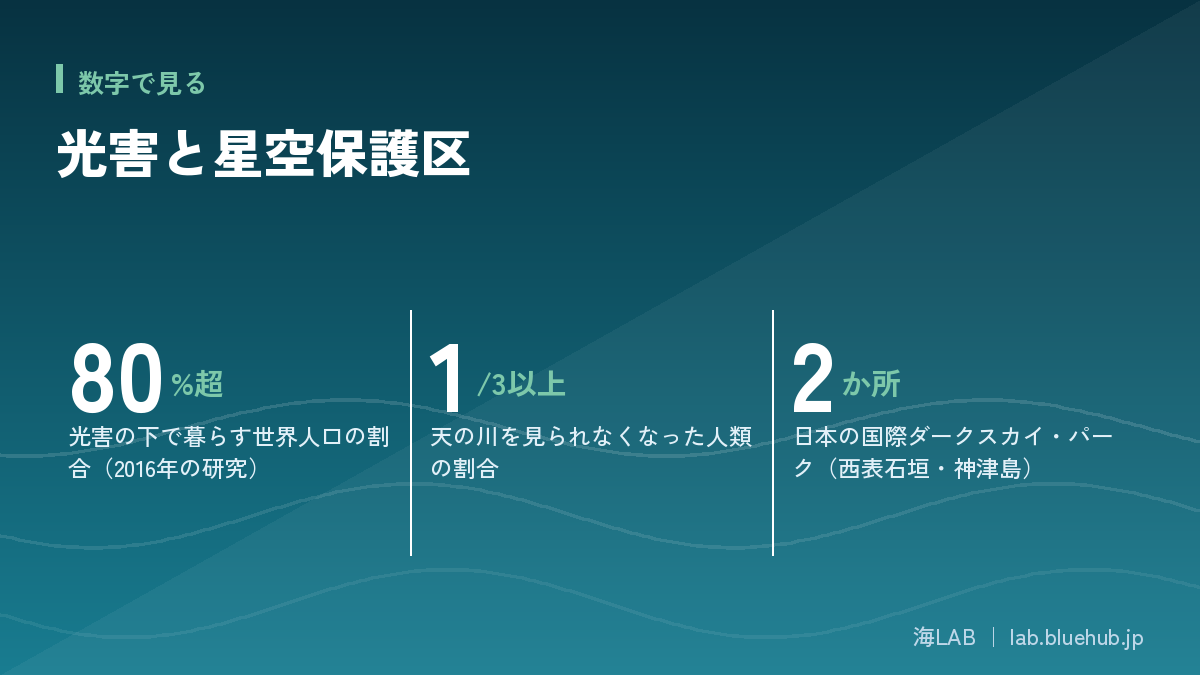
- More than 80% of the world's population lives under light-polluted skies, and over one-third of humanity can no longer see the Milky Way.
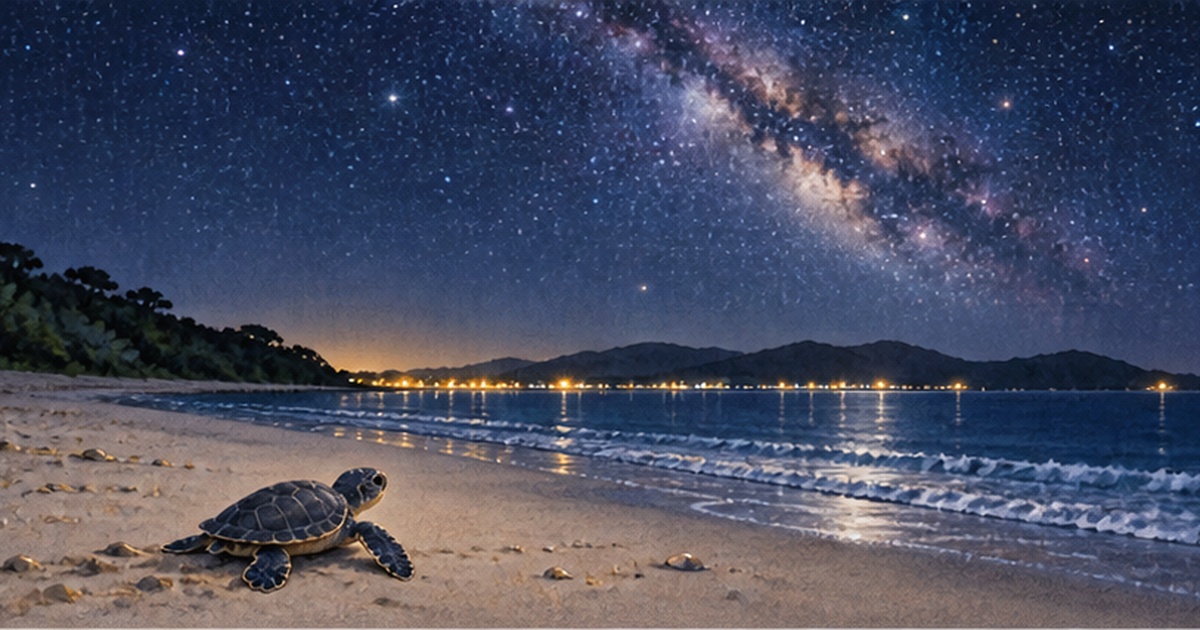
- Artificial light at night can affect the direction hatchling sea turtles travel and the synchronized spawning of corals.
- In Japan, Iriomote-Ishigaki National Park and Kozushima are certified International Dark Sky Parks, protecting darkness through lighting improvements.
Stand on a seashore at night and you will see the lights of distant ports and roads trembling on the water. Those lights actually reach the lives of marine organisms too.
Nighttime darkness is part of the natural environment that supports sea turtle nesting, mass coral spawning and plankton migration. This article walks through the basics of light pollution, Japan's dark sky places, and what you can do starting today.
As primary sources, we draw on the Ministry of the Environment's Light Pollution Guidelines, materials from the International Dark-Sky Association (IDA), and peer-reviewed papers.
What you'll learn in this article
- The four types of light pollution (skyglow, glare, light trespass, waste)
- The state of night skies in the world and Japan
- Impacts on marine life such as sea turtles and corals
- How dark sky places work, and examples in Japan
- Five principles for using lighting wisely
- What households, schools and communities can do
What Is Light Pollution? Brightness at Night Can Be "Pollution" Too
The definition of light pollution and its four faces
Light pollution (hikarigai) is a general term for the adverse effects caused by excessive or unnecessary artificial light: the night sky brightens and stars disappear, glaring light pours into homes, energy is wasted, and the lives of wild creatures are disrupted. The Ministry of the Environment's "Light Pollution Guidelines" (revised March 2021) cover all of these together and take as their basic principle using lighting "where it is needed, in the amount needed, and for the time needed."
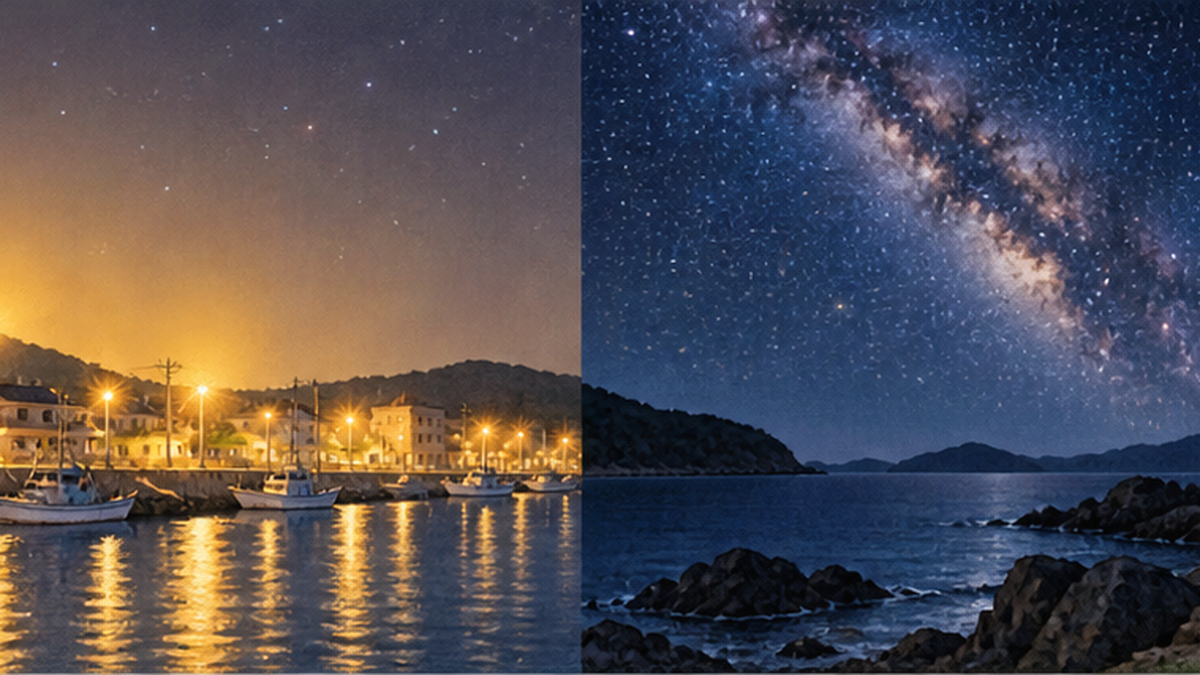
Broadly, light pollution comes in four forms: "skyglow," where light leaking upward brightens the night sky; "glare," where light enters the eyes directly and dazzles; "light trespass," where light intrudes into homes and natural environments; and "energy waste" from overuse. Seaside towns tend to experience all of them at once, because there is little to block light over the sea, and lighting from ports, fishing harbors, coastal roads and resorts spreads widely over the water and the beach.
- Skyglow: light leaking upward is scattered by water vapor and dust in the atmosphere, leaving the whole night sky faintly bright
- Glare: light sources entering the eyes directly and feeling dazzling; it can also affect driving and walking safety at night
- Light trespass: light reaching places where it isn't needed (bedrooms, forests, beaches, the sea surface)
- Energy waste: lighting directed where, or when, it isn't needed increases electricity use and CO2 emissions
Darkness is part of the natural environment
For hundreds of thousands of years, humans evolved in a world where night fell with the sunset. Many plants and animals likewise use the "rhythms of light" — day length, the phases of the moon, starlight — as cues for when to breed, migrate and feed. Nighttime darkness is a component of the natural environment, like water and air, and when it is lost, the clock of the ecosystem goes out of order.
This idea of "protecting darkness" is also an excellent doorway into ocean learning. Sea turtles that nest on night beaches, corals that spawn together a few days after the full moon, and zooplankton that rise toward the surface after sunset all live lives closely tied to the night light environment.
How "light pollution" is used in this article
- We cover not only how hard the night sky is to see, but also effects on living things and people
- We frame the issue not as "get rid of lighting" but as "use it wisely"
How Much Starlight Have We Lost? The World and Japan Today
More than 80% of the world lives under light-polluted skies
A 2016 study by Falchi and colleagues in the journal Science Advances, "The new world atlas of artificial night sky brightness," combined satellite and ground observations to map the brightness of the world's night skies. The result was striking: it reported that more than 80% of the world's population, and more than 99% of the populations of the United States and Europe, live under skies affected by light pollution. It also found that the Milky Way is no longer visible to more than one-third of humanity.
Japan's night sky: a bright country, and places where darkness remains
Japan is one of the countries with the most outdoor lighting at night, and in large metropolitan areas the number of stars visible to the naked eye falls to a few dozen. Meanwhile, remote islands and mountain areas still keep skies so dark that the Milky Way appears like a shadow. The Ministry of the Environment runs awareness activities, including star-observation programs open to citizens nationwide, that record night sky brightness over time and encourage awareness of light pollution and air pollution.
How well stars can be seen can be gauged by limiting magnitude (the faintest star visible to the naked eye). In cities you can see only stars down to about magnitude 3–4, while in dark places stars down to around magnitude 6 are visible, so the number of visible stars increases by orders of magnitude. Stargazing needs no special equipment and works as a familiar environmental survey of your own town's light environment.
| Type of place | How the night sky looks (rough guide) | Characteristics |
|---|---|---|
| Central city | Mostly bright stars, the Moon and planets | The Milky Way is almost invisible |
| Suburban residential area | A few hundred stars | The Milky Way is hardly visible |
| Rural coast or mountain area | The number of stars increases greatly | The Milky Way can be made out in good conditions |
| Remote island or dark area in a national park | A sky full of stars | The Milky Way can be seen clearly |
Stargazing is an environmental survey
- Keeping records at the same place and by the same method reveals changes in the night sky
- Taking moonlight and weather into account, observing on clear nights around the new moon makes comparison easier
How Light Affects Marine Life
Coastal lighting also reaches underwater
Light pollution may sound like a matter of looking up at the sky, but for marine life the major problem is "light intruding on the sea surface and the shore." A 2022 review in Global Change Biology, "Impacts of artificial light at night in marine ecosystems — A review" (Marangoni et al.), summarizes how artificial light at night can affect a wide range of marine organisms, including sea turtle behavior, coral spawning, predator–prey relationships, and the diel vertical migration of zooplankton.
Sea turtles: hatchlings that lose the direction of the sea
When hatchling sea turtles emerge from the sand, they instinctively head toward the bright, open horizon and into the sea. But where streetlights and hotel lighting along the shore are strong, hatchlings can go the wrong way and head inland. The review above also points out that artificial light can affect the behavior and nest-site selection of females coming ashore to nest, the hatchlings' route to the sea, and even their dispersal after they reach the water.
In Japan, too, there are many sandy beaches known as nesting sites for loggerhead and green sea turtles. Local governments and community groups carry out measures such as turning off or shielding shoreside lighting during the nesting season and restricting vehicle access to beaches.
Corals: the rhythm of moonlight is disrupted
Many corals take part in "mass spawning," releasing eggs and sperm together on particular nights around the full moon once a year. Corals are thought to synchronize their timing using the phases of the moon and the dark period between sunset and moonrise. A 2023 study in Nature Communications showed, from a global perspective, that artificial light at night may be disrupting the synchronization of coral mass spawning. Blue wavelengths in particular are thought to be especially influential.
For coral reef conservation, see also our article on coral reef restoration efforts in Okinawa. Alongside measures against rising water temperatures and bleaching, protecting the "night light environment" is becoming part of conservation.
Fish and plankton: predator–prey relationships change
Around port and pier lights, small fish gather at night, and larger fish gather to hunt them. On coral reefs too, research has reported that artificial light can increase predatory fish at night and change fish community composition. Zooplankton perform diel vertical migration, staying deep by day and moving shallower at night, but strong light can disrupt this movement. Plankton are the foundation of the marine food web, so even small changes may ripple outward in a chain.
- Sea turtles: affects coming ashore, nesting and hatchlings' route to the sea
- Corals: may affect the timing of mass spawning
- Fish: changes in nighttime aggregation and predator–prey relationships
- Zooplankton: diel vertical migration may be disrupted
Effects on Land Animals and Human Life
Birds, insects and bats: creatures that rely on the night
Light pollution's effects are not limited to the seashore. Migratory birds travel at night using stars and the Earth's magnetic field as cues, but they can be drawn to bright cities and tall buildings and lose their way. Insects gather around streetlights and lose chances to breed and feed. Creatures that find mates by light, like fireflies, find courtship signals harder to see where artificial light is strong.
Waterside areas connected to rivers and the sea are also pathways for these creatures. As our article on firefly ecology also notes, waterfronts where darkness is preserved are an essential environment for light-emitting creatures.
Effects on people: sleep, body clock and safety
For humans too, many studies have pointed out that strong light at night can affect the body clock (circadian rhythm) and sleep. Bluish-white light, especially before bed or at night, is said to suppress melatonin, the hormone that promotes sleep. That does not mean safety lighting is unnecessary. It is important to secure the brightness needed for crime prevention and traffic safety while reducing glare and narrowing the area that is lit.
"Brighter" does not always mean "safer"
- Lighting that is too strong can create glare and make things harder to see
- Designs that light the needed area evenly are better at balancing safety and darkness
It also wastes energy
Light that leaks upward or sideways escapes into the sky without helping anyone. Because lighting is often powered by electricity from fossil fuels, reducing unnecessary light also contributes to decarbonization. Light pollution measures are one of the few fields that advance ecosystem conservation and energy saving at the same time.
What Are Dark Sky Places?
The International Dark-Sky Association (IDA) certification program
International Dark Sky Places is a certification program begun in 2001 by the International Dark-Sky Association (IDA) to encourage areas and organizations working to protect and preserve dark, beautiful night skies with little light pollution. Certification is based not only on how dark the sky is, but on a comprehensive review of lighting management policy, education for residents and visitors, and continuing efforts.
There are several categories, including "Parks" for national and nature parks, "Communities" for towns where people live, and "Islands" for remote islands. In sea-surrounded Japan, remote islands and coastal national parks are the main stages.
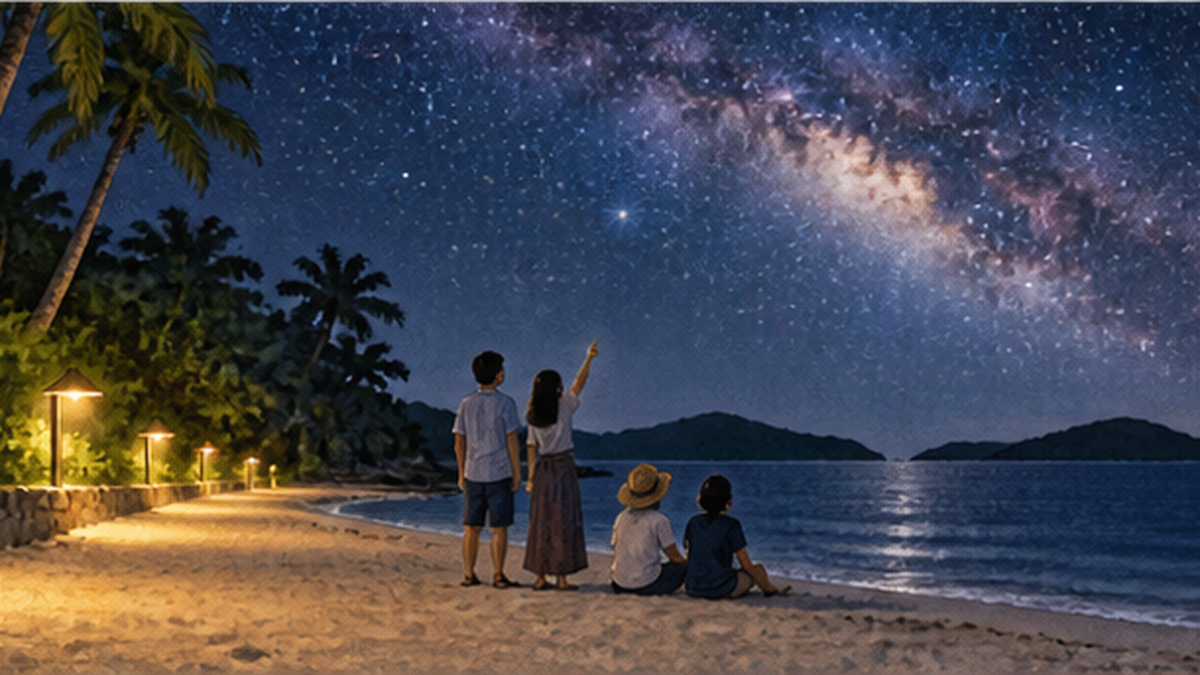
The certification process and key points
- Measure the darkness of the area and understand the current situation
- Establish rules to reduce light pollution, such as a lighting ordinance or lighting improvement plan
- Carry out awareness activities for residents, businesses and visitors
- Apply to the IDA and be certified after review
- Report regularly after certification and keep up the effort
The point is changing the quality, not just making things dark
- Light downward only, with shielded (full cutoff) fixtures
- Choose warm-colored light sources with low color temperature
- Dim or turn off lights during hours when they are not needed
Dark Sky Places in Japan: Iriomote-Ishigaki National Park and Kozushima
Japan's first: Iriomote-Ishigaki National Park
The first place in Japan certified as an International Dark Sky Park was Okinawa Prefecture's Iriomote-Ishigaki National Park. It is Japan's southernmost national park, with a vast subtropical forest said to be unique in the country, mangrove forests and coral reefs. Its night sky has features that come with its low latitude, and it is known as an area where, even though it lies in the northern hemisphere, the Southern Cross can be seen.
Iriomote is also an island of endemic wildlife, including the Iriomote cat. Protecting the lives of nocturnal animals is another reason why guarding the dark of night matters. See also our article on the Iriomote cat.
The second certification: Kozushima, Tokyo
Kozushima in the Izu Islands was certified as Japan's second International Dark Sky Park. It is a remote island about 180 km south of Tokyo, about four hours by jet boat or about 30 minutes by plane. It is reported that in 2020, under the mayor's leadership, more than 400 streetlights were replaced with types that reduce glare, which helped drive certification.
Kozushima's efforts are a good example of showing that change is possible not through large capital investment but through swapping existing streetlights and refining operations. For visitors, a new attraction — the starry sky — has been created; for island life, energy saving and nighttime safety are both achieved.
| Area | Characteristics | Example of efforts |
|---|---|---|
| Iriomote-Ishigaki National Park (Okinawa) | Japan's first International Dark Sky Park. Subtropical forest and coral reefs | Protecting and promoting the starry sky across the whole park |
| Kozushima (Tokyo) | Japan's second certification. A remote island in the Izu Islands | About 400 streetlights replaced with glare-reducing fixtures |
Lighting Technology to Reduce Light Pollution, and the Ministry's Guidelines
Five principles of good lighting
The key to light pollution measures is not eliminating lighting but changing its quality. The Ministry of the Environment's "Light Pollution Guidelines" also lay out the basics of how to use lighting. Here are internationally shared principles summarized into five points.
- Necessity: consider whether lighting is really needed there
- Direction: don't let light leak upward or sideways; light only the places that need it (shielded, pointing down)
- Brightness: don't make it brighter than needed; keep it even and reduce glare
- Time: dim or turn off lights late at night when no one is around, and use motion sensors
- Color: avoid bluish-white light and choose warm colors (low color temperature)
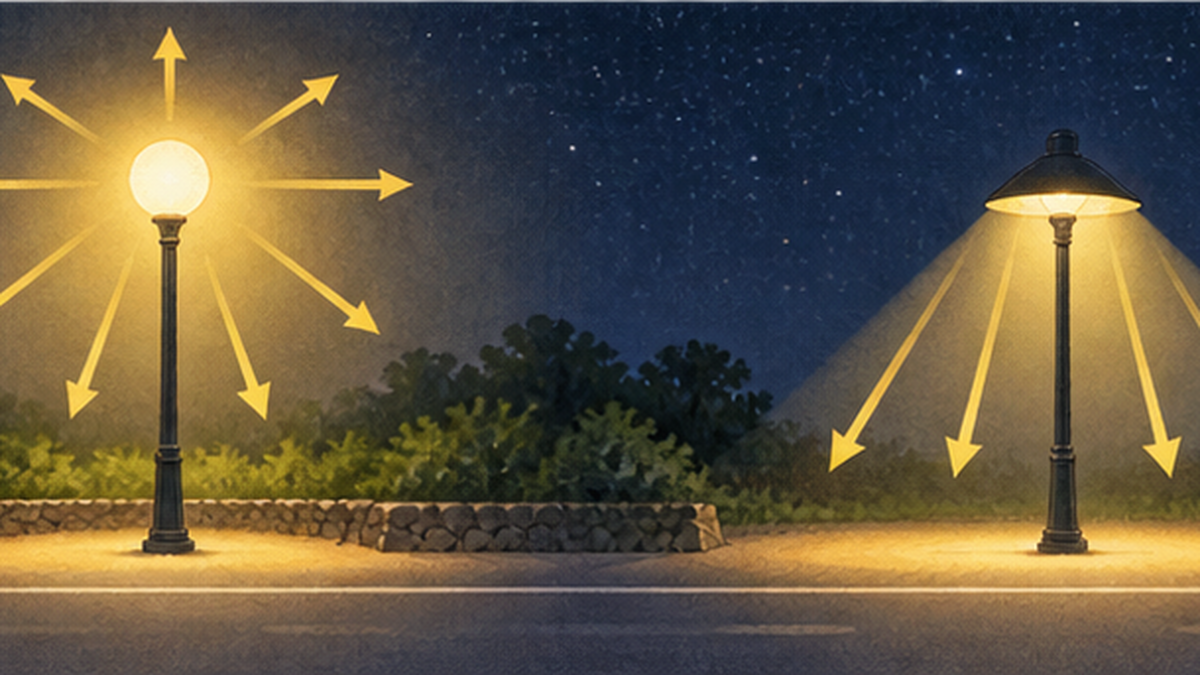
The pitfall of switching to LEDs
Switching to LEDs has advanced in recent years, with great results in energy saving. On the other hand, LEDs are bright and tend to emit bluish-white light (high color temperature), so wrong design or selection can in fact make effects on the night sky and wildlife stronger. The Ministry's guidelines also call for considering the type of light source, light distribution, color temperature and operation together. LEDs are not "done once installed"; how they are used is what matters.
Special care for seaside lighting
Seaside and port lighting checklist
- Is light reaching the beach or sea surface directly?
- Can you turn off or shield shoreside lighting during the sea turtle nesting season?
- Are you choosing warm-colored light sources rather than bluish-white light?
- Can you cut unnecessary signs and illumination at night?
What You Can Do Today: Efforts for Schools, Homes and Communities
What households and individuals can do
Light pollution measures are not only a job for specialists. At home you can angle outdoor lights down, turn them off when no one is there, use motion sensors on security lights, and keep indoor light from leaking outside with curtains. When going to see the night sea or stars, covering a flashlight with red film reduces the effect on wildlife and helps your own eyes adapt to the dark.
- Point outdoor lights downward and keep them on only when needed
- Dim indoor lights before bed to keep your body clock in order
- Avoid strong lights and flash photography on the shore
- On stargazing days, ask nearby shops and neighborhood associations to cooperate
Observing stars and the night sea at school and in the community
Stargazing is a perfect entry point to environmental learning. Counting stars regularly at the same place, observing creatures on a night beach, and making a map of local lighting are activities that build the ability to think from data. For daytime rocky-shore observation, see also our article on tidepool exploration. Noticing that the cast of creatures differs between day and night deepens interest in the night environment.
Thinking about rules in the community
Changing a town's lighting requires agreement among local government, businesses and residents. Efforts like Kozushima's — replacing streetlights, setting rules for how lighting is used, and continuing awareness — are achievable even in small towns. The Light Pollution Guidelines can also be used as a reference when local governments consider ordinances and policies.
Conclusion: protecting darkness means protecting the sea
The darkness of night is an invisible environmental resource that supports hatchling sea turtles, coral spawning and plankton movement. Using lighting wisely not only protects the starry sky but also protects marine life and saves energy. On the next clear night, look up at the sky from a nearby shore or park. The brightness of that sky reflects your town's environment.
Summary of this article
- Light pollution affects not only the night sky but also living things and people's lives
- More than 80% of the world's people live under light-polluted skies
- In Japan, Iriomote-Ishigaki National Park and Kozushima are certified Dark Sky Parks
- The basis of countermeasures is changing the "quality" of lighting: shielding, warm color and dimming
References and Sources
- Ministry of the Environment, Japan: Light Pollution Guidelines (revised March 2021) – Basics of lighting use and the concept of light pollution
- Ministry of the Environment, Japan: Light Pollution Guidelines (revised December 2006) – Effects of light pollution and basic countermeasures
- Falchi et al. (2016) The new world atlas of artificial night sky brightness, Science Advances – A map of the brightness of the world's night skies
- Marangoni et al. (2022) Impacts of artificial light at night in marine ecosystems—A review, Global Change Biology – A review of the effects of artificial light at night on marine ecosystems
- Global disruption of coral broadcast spawning associated with artificial light at night, Nature Communications (2023) – Coral mass spawning and artificial light
- International Dark-Sky Association: Iriomote-Ishigaki National Park – Japan's first International Dark Sky Park
- International Dark-Sky Association: Kozushima recognized as Dark Sky Park – Certification of Kozushima
- National Astronomical Observatory of Japan, Frequency Resource Protection Office: What is light pollution – An overview of light pollution
Ordered by reliability: government/academic institutions > peer-reviewed papers > specialized organizations > reputable media